EP1135010A2 - Zündungsanordnung für eine Entladungslampe - Google Patents
Zündungsanordnung für eine Entladungslampe Download PDFInfo
- Publication number
- EP1135010A2 EP1135010A2 EP01103887A EP01103887A EP1135010A2 EP 1135010 A2 EP1135010 A2 EP 1135010A2 EP 01103887 A EP01103887 A EP 01103887A EP 01103887 A EP01103887 A EP 01103887A EP 1135010 A2 EP1135010 A2 EP 1135010A2
- Authority
- EP
- European Patent Office
- Prior art keywords
- starting
- core
- high voltage
- discharge lamp
- socket
- Prior art date
- Legal status (The legal status is an assumption and is not a legal conclusion. Google has not performed a legal analysis and makes no representation as to the accuracy of the status listed.)
- Withdrawn
Links
Images




Classifications
-
- H—ELECTRICITY
- H05—ELECTRIC TECHNIQUES NOT OTHERWISE PROVIDED FOR
- H05B—ELECTRIC HEATING; ELECTRIC LIGHT SOURCES NOT OTHERWISE PROVIDED FOR; CIRCUIT ARRANGEMENTS FOR ELECTRIC LIGHT SOURCES, IN GENERAL
- H05B41/00—Circuit arrangements or apparatus for igniting or operating discharge lamps
- H05B41/02—Details
- H05B41/04—Starting switches
- H05B41/042—Starting switches using semiconductor devices
Definitions
- the present invention relates to a starting device for discharge lamp, particularly suitable to a lamp lighting device for vehicle headlights.
- the lamp lighting device for vehicle headlights usually consists of the following components: a discharge lamp, a socket for mounting the discharge lamp equipped with a high voltage electrode and a starting transformer equipped with a bobbin for winding a primary and a secondary coils.
- the starting transformer equipped with a core has been widely used in the conventional lamp lighting device.
- FIG.7A and FIG.7B show examples of structures (with cores 91 without through holes) in conventional starting transformers.
- FIG.7A illustrates manners how all leading wires (i.e. a leading wire 36 at a high voltage side of a secondary coil 32, a leading wire 37 at a low voltage side of the secondary coil 32 and two leading wires 38 from a primary coil 33), are led out from a surface of a cast molding material 40.
- the molding material 40 should be formed so as to have at least 2 to 3 mm thickness for having an enough insulation distance. Which requires not only an enclosing case 92 with larger diameter but also insulation of wiring between the leading wire 36 to the high voltage electrode 22 (See FIG.1A, FIG.2A FIG.3 and FIGs.6A, 6C) arranged in the center of the socket. In order to ensure these insulation, more molding material are required, consequently, a larger and heavier transformer is required.
- FIG.7B shows another example where the leading wire 37 at a low voltage side and two leading wires 38 are led out from the bottom of the enclosing case 92.
- holes for leading these leading wires should be sealed by adhesives etc. to prevent the molding material from leaking out, which results in more man-hours.
- the same drawbacks larger and heavier transformer
- the present invention is carried out in view of the above-mentioned problems so as to provide a small sized and light weighed device free from breakage due to vibrations and impacts. Also it provides a starting device for discharge lamp with good weight balanced main body having more efficiency with less conductor loss.
- the starting device for discharge lamp is constituted as follows:
- FIGs.1A and 1B show a constitution of a first embodiment according to the present invention.
- FIG.1A is a front view.
- FIG.1B is a side view
- FIGs.2A is a cross sectional view along A-A line in FIG.1A.
- FIG.2B is a rear view of the embodiment with a rear socket cover removed.
- FIG.3 is an enlarged view of the main portion of FIG.2A.
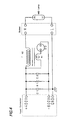
- FIG.4 shows a starting circuit diagram of the present invention.
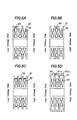
- FIGs.5A to 5D show winding manners in primary and secondary coils.
- FIGs.5A to 5D show a first, a second, a third and a fourth methods respectively.
- FIGs.6A to 6D show a constitution of a second embodiment according to the present invention.
- FIG.6A is a front view.
- FIG.6B is a side view.
- FIG.6C is a cross sectional view along B-B line in FIG.6A.
- FIG.6D is a rear view with a rear socket case removed, where a direct coupler is equipped.
- FIGs.7A and 7B show constitutions of conventional starting transformers.
- FIG.1 to FIGs.6A.to 6D Hereinafter detailed description of embodiments according to the present invention is explained by referring FIG.1 to FIGs.6A.to 6D.
- the first embodiment according to the present invention shown in FIGs.1A, 1B and FIGs.2A, 2B is explained.
- This embodiment relates to a starting device for lamp lighting equipped in a lamp lighting device for an HID lamp.
- the lamp lighting device includes power sources for the HID lamp and for a trigger element to generate a starting pulse etc. equipped in a main body (not shown) of the lamp lighting device.
- the starting device for lamp lighting consists structural members such as parts for starting and an HID lamp socket etc..
- the main body of the lamp lighting device and the starting device for lamp lighting is electrically connected between a connector 7 equipped to the starting device for lamp lighting via a harness 6 and a direct coupler equipped to the main body of the lightning device.
- FIG.1A is a front view of a starting device 1 for lamp lighting for car use where a front socket case 2, a left side portion of a parting line 9 (see FIG.1B), has a high voltage electrode 22 and a GND (grounding) electrode 23 formed by an insert molding or a direct insertion.
- FIG.1B is a side view illustrating how 7 protruded portions 2a (quantity varies case by case) formed on the socket case 2 are fitted in cutout openings 3a formed on a rear socket case 3.
- FIG.2A a cross sectional view of along A-A line in FIG.1A, FIG.2B, a rear view with a socket case 3 removed and FIG.3, an enlarged view of FIG.2A.
- An insulating wall 28 is formed in the socket for insulating between the high voltage electrode 22 and the GND electrode 23, since a voltage between them reaches up to 20-odd kV.
- a high voltage leading electrode 22c led out from a high voltage lamp mounting electrodes 22a of the high voltage electrode 22 surrounded by the insulating wall 28, comprises a rear portion of the high voltage electrode 22.
- the high voltage leading electrode 22c has a circular cross sectional area with diameter of 0.1 to 10mm or a corresponding square cross sectional area with diameter of 0.1 to 8mm square, so as to withstand the maximum current 2.6A for the HID lamp.
- the high voltage leading electrode 22c extends thorough a separating wall 21 of the socket to a starting transformer accommodating space 4.
- the starting transformer 30 has a hollow space 34 where a core 39 (out of Ni-ferrite or dust core material) having a through hole (0.1 to 10mm in diameter and 2 to 20mm long) is inserted.
- the one end of the high voltage leading electrode 22c extending through the through hole of the core 39 is pressed into flat so as to form a high voltage electrode 22b at a starting transformer side.
- the core 39 with the through hole is fixed to the hollow space 34 by adhesives etc..
- a leading wire 36 at a high voltage side of a secondary coil 32 (which is explained below) is connected to the high voltage electrode 22b at the starting transformer side.
- the starting transformer 30 consists of the bobbin 31 (having a circular cross section; winding portions are divided into 3 to 6 sections.), the secondary coil 32 evenly wound around each winding section or more turns at a low voltage side than a high voltage side (not shown. Insulating property is improved by gradated turns.) and a primary coil wound around the secondary coil.
- a wire with a circular cross section is wound rather than a wire with a rectangular cross section considering a winding efficiency.
- the wire with the circular section has the lowest copper loss when a cross sectional area and the number of the turn are kept constant due to the fact that the outer diameter of the wire, namely, a length of the wound wire amounts to the shortest.
- a width of each divided section of the bobbin 31 is set several (an integer) times of the outer diameter (0.5. ⁇ 5.0mm) of the wire so as to attain the most efficient winding.
- a wall thickness between the sections is set 0.5 to 2.0mm.
- the primary coil 33 is arranged at the low voltage section of the secondary coil 32 (See FIG.5A) considering a voltage difference between the primary and secondary coils.
- a wire with high insulating property withstand voltage: 10 to 20 kV
- the wire should be wound in a central area of the bobbin 31 where a connection between the primary and the secondary coils is most preferable.
- sections in the bobbin 31 with evenly wound coil See FIG.5C) can be employed when good connection is attained.
- FIG.5D The another alternative shown in FIG.5D is constituted as follows:
- a bobbin case 31b is used as an insulating wall for preventing a leakage between the primary and secondary coils.
- On the primary coil a wire with a circular or rectangular cross-section is uniformly and sparsely wound around the outer diameter of the bobbin case 31b.
- the wire is wound densely on the center section of the bobbin case 31b.
- On the bobbin case a groove 31c is formed spirally on the outer surface of the bobbin case 31b so as to ensure firm winding of the coil.
- a leading wire 37 at a lower voltage side (see FIG.2B) of the secondary coil 32 and two leading wires 38 of the primary coil 33 are connected to three leading wire connecting points 50 (number is adjustable) formed on the bobbin 31. And these leading wires are led to parts accommodating compartment 5 for the starting device via three slits 2b so as to trail on the side wall of a starting transformer accommodating compartment 4.
- Parts for a starting circuit accommodated in the parts accommodating compartment 5 for the starting device are connected to a connecting board 29 (see FIG.2B) connected to the starting transformer and a harness assembly 8, by welding or high temperature soldering. Since this portion is located near the HID lamp so that the ambient temperature reaches ca. 150 °C, a low temperature solder usually employed in organic circuit boards is not suitable.
- leading wires 37 and 38 are closely contacted with the starting transformer accommodating compartment 4 via a clip 51 in order to avoid these leading wires from contacting the coil 35 (particularly the secondary coil 32, to ensure insulation).
- the starting transformer 30 After accommodating the starting transformer 30 in the accommodating compartment 4, only the starting transformer 30 is molded with a molding material. (an epoxy resin, a urethane resin, a silicon resin and the like) The insulation is easily attained by the molding material 40 which is flown into the core 39 and its through hole.
- the parts accommodating compartment 5 for starting device is molded after arranging parts for the starting circuit in it for ensuring insulation, protection against humidity and vibration and a stable fixture of parts
- the GND electrode 23 is connected to the parts accommodating compartment 5 for the starting device via inner portion of a separating wall 21 of the socket (see FIG.2A), and finally it is connected to the harness assembly 8, which leads to the main body of the starting apparatus via the inputting connector 7.
- An electrical connection between the main body of the starting device and starting device for lamp lighting is attained by connecting a direct coupler equipped on the main body of the starting device to a direct coupler 81 equipped on the starting device for lamp lighting, via a harness having a connector (not shown).
- Input terminals 82 (3 terminals +400V, -600V and GND in FIG.4) equipped in the direct coupler 81 are metal electrodes formed in one-pieced member (formed in the socket case 2 or 3 by an insert molding) combined with a HID-GND electrode and an electrode 23 at a low voltage side of the secondary coil 32 or formed in separated members. Since only this forming method of the metal electrodes is different from that of the preceding embodiment 1, further detailed explanation is omitted.
- Input powers supplied from the main body of the starting device are +400V, GND as main powers and -600V as a power for SG (spark gap), a trigger element for high voltage pulse.
- the SG having a break down point of 800kV is selected among SGs for car use having the break down points between 400V and 3kV.
- the power -600V is supplied to the starting device circuit via resistance (not shown) connected in series to the output terminal.
- a constant determining a pulse cycle (usually between 30 to 150Hz) is determined by applying 1kV (voltage between the two terminals -600V and 400V) to a circuit where the above-mentioned resistance (not shown) and a charging/discharging capacitor C2 are connected in series.
- the device arranged the core structure having the through hole and the electrical connection between the leading wire at high voltage side of the secondary coil and the high voltage electrode led through the through hole of the core having the through hole.
- a higher insulating property between the transformer and its periphery is attained.
- a smaller and lighter device is obtained.
- Breakage of the device caused by vibrations and impacts etc. is prevented by arranging the starting transformer on the same central axis of the socket.
- the device having the less conductor loss with high efficiency and a good weight balance is obtained by forming the bobbin of the transformer having the round cross section.
- the device can be fitted to every type of cars by attaining various connecting methods between the main body of the lamp lighting device and the starting device for lamp lighting.
Landscapes
- Non-Portable Lighting Devices Or Systems Thereof (AREA)
- Circuit Arrangements For Discharge Lamps (AREA)
Applications Claiming Priority (2)
| Application Number | Priority Date | Filing Date | Title |
|---|---|---|---|
| JP2000066436A JP2001257087A (ja) | 2000-03-10 | 2000-03-10 | 放電灯起動装置 |
| JP2000066436 | 2000-03-10 |
Publications (2)
| Publication Number | Publication Date |
|---|---|
| EP1135010A2 true EP1135010A2 (de) | 2001-09-19 |
| EP1135010A3 EP1135010A3 (de) | 2004-10-27 |
Family
ID=18585796
Family Applications (1)
| Application Number | Title | Priority Date | Filing Date |
|---|---|---|---|
| EP01103887A Withdrawn EP1135010A3 (de) | 2000-03-10 | 2001-02-16 | Zündungsanordnung für eine Entladungslampe |
Country Status (3)
| Country | Link |
|---|---|
| US (1) | US20010020825A1 (de) |
| EP (1) | EP1135010A3 (de) |
| JP (1) | JP2001257087A (de) |
Families Citing this family (6)
| Publication number | Priority date | Publication date | Assignee | Title |
|---|---|---|---|---|
| JP2003017283A (ja) * | 2001-06-29 | 2003-01-17 | Ushio Inc | 光源装置 |
| JP4797337B2 (ja) * | 2004-05-26 | 2011-10-19 | パナソニック電工株式会社 | ボビン、インダクタンス、トランス、およびパルス発生装置 |
| US20060291216A1 (en) * | 2005-06-14 | 2006-12-28 | Blumel Daniel M | Apparatus for reducing in size an igniter circuit and assembly |
| US7615941B2 (en) * | 2005-08-17 | 2009-11-10 | Blumel Daniel M | Apparatus and method for maximizing the longevity of arc tube bulbs during pulsing operation |
| JP4795427B2 (ja) | 2006-03-13 | 2011-10-19 | 三菱電機株式会社 | 放電灯点灯装置用高電圧発生トランス |
| US20120274328A1 (en) * | 2011-04-28 | 2012-11-01 | Hanington Gary J | Axial high voltage transformer with signal pass-through ability |
Family Cites Families (2)
| Publication number | Priority date | Publication date | Assignee | Title |
|---|---|---|---|---|
| DE69712859T2 (de) * | 1996-12-07 | 2002-09-05 | Ngk Spark Plug Co., Ltd. | Steuerungsgerät für eine Fahrzeugbeleuchtung |
| JPH11260573A (ja) * | 1998-03-09 | 1999-09-24 | Toyo Denso Co Ltd | 車両用hid前照灯装置 |
-
2000
- 2000-03-10 JP JP2000066436A patent/JP2001257087A/ja not_active Withdrawn
-
2001
- 2001-02-07 US US09/778,512 patent/US20010020825A1/en not_active Abandoned
- 2001-02-16 EP EP01103887A patent/EP1135010A3/de not_active Withdrawn
Non-Patent Citations (1)
| Title |
|---|
| None |
Also Published As
| Publication number | Publication date |
|---|---|
| JP2001257087A (ja) | 2001-09-21 |
| EP1135010A3 (de) | 2004-10-27 |
| US20010020825A1 (en) | 2001-09-13 |
Similar Documents
| Publication | Publication Date | Title |
|---|---|---|
| EP0886286B1 (de) | Hochspannungstransformator und Beleuchtungsvorrichtung mit Fahrzeuglampe dafür | |
| JPH08130127A (ja) | 高圧トランス及び放電灯回路 | |
| US8193891B2 (en) | High voltage transformer with space-saving primary windings | |
| JP4541387B2 (ja) | 放電ランプ用ソケット | |
| EP1135010A2 (de) | Zündungsanordnung für eine Entladungslampe | |
| US6404142B2 (en) | Starting device for discharge lamp | |
| JP4915892B2 (ja) | 高圧放電ランプ用のランプ口金および高圧放電ランプ | |
| US6479948B2 (en) | Starting device for discharge lamp | |
| JP3445830B2 (ja) | 二口用高電圧発生装置 | |
| JP4506078B2 (ja) | 電磁装置および高電圧発生装置 | |
| JP4535579B2 (ja) | 放電灯起動装置 | |
| EP1146779A2 (de) | Zündungsanordnung für eine Entladungslampe | |
| JP2004014832A (ja) | 電磁装置及び高電圧発生装置 | |
| JP3962889B2 (ja) | Hidランプ点灯装置 | |
| KR100715387B1 (ko) | 방전등 점등 장치 | |
| CN100453899C (zh) | 放电灯点亮装置 | |
| JPH11307373A (ja) | 高電圧発生コイル | |
| KR200426420Y1 (ko) | 권취 보빈 | |
| JP2003197446A (ja) | 内燃機関用点火コイル | |
| JPH0855742A (ja) | 内燃機関用点火コイル | |
| JP2004207404A (ja) | 電磁装置及び高電圧発生装置 |
Legal Events
| Date | Code | Title | Description |
|---|---|---|---|
| PUAI | Public reference made under article 153(3) epc to a published international application that has entered the european phase |
Free format text: ORIGINAL CODE: 0009012 |
|
| AK | Designated contracting states |
Kind code of ref document: A2 Designated state(s): AT BE CH CY DE DK ES FI FR GB GR IE IT LI LU MC NL PT SE TR |
|
| AX | Request for extension of the european patent |
Free format text: AL;LT;LV;MK;RO;SI |
|
| PUAL | Search report despatched |
Free format text: ORIGINAL CODE: 0009013 |
|
| AK | Designated contracting states |
Kind code of ref document: A3 Designated state(s): AT BE CH CY DE DK ES FI FR GB GR IE IT LI LU MC NL PT SE TR |
|
| AX | Request for extension of the european patent |
Extension state: AL LT LV MK RO SI |
|
| 17P | Request for examination filed |
Effective date: 20041211 |
|
| AKX | Designation fees paid |
Designated state(s): DE FR GB |
|
| STAA | Information on the status of an ep patent application or granted ep patent |
Free format text: STATUS: THE APPLICATION IS DEEMED TO BE WITHDRAWN |
|
| 18D | Application deemed to be withdrawn |
Effective date: 20060527 |