EP1138295A1 - Serviette hygiénique flexible - Google Patents
Serviette hygiénique flexible Download PDFInfo
- Publication number
- EP1138295A1 EP1138295A1 EP01100421A EP01100421A EP1138295A1 EP 1138295 A1 EP1138295 A1 EP 1138295A1 EP 01100421 A EP01100421 A EP 01100421A EP 01100421 A EP01100421 A EP 01100421A EP 1138295 A1 EP1138295 A1 EP 1138295A1
- Authority
- EP
- European Patent Office
- Prior art keywords
- absorbent
- thong
- sanitary napkin
- napkin
- undergarment
- Prior art date
- Legal status (The legal status is an assumption and is not a legal conclusion. Google has not performed a legal analysis and makes no representation as to the accuracy of the status listed.)
- Withdrawn
Links
Images
Classifications
-
- A—HUMAN NECESSITIES
- A61—MEDICAL OR VETERINARY SCIENCE; HYGIENE
- A61F—FILTERS IMPLANTABLE INTO BLOOD VESSELS; PROSTHESES; DEVICES PROVIDING PATENCY TO, OR PREVENTING COLLAPSING OF, TUBULAR STRUCTURES OF THE BODY, e.g. STENTS; ORTHOPAEDIC, NURSING OR CONTRACEPTIVE DEVICES; FOMENTATION; TREATMENT OR PROTECTION OF EYES OR EARS; BANDAGES, DRESSINGS OR ABSORBENT PADS; FIRST-AID KITS
- A61F13/00—Bandages or dressings; Absorbent pads
- A61F13/15—Absorbent pads, e.g. sanitary towels, swabs or tampons for external or internal application to the body; Supporting or fastening means therefor; Tampon applicators
- A61F13/45—Absorbent pads, e.g. sanitary towels, swabs or tampons for external or internal application to the body; Supporting or fastening means therefor; Tampon applicators characterised by the shape
- A61F13/47—Sanitary towels, incontinence pads or napkins
- A61F13/472—Sanitary towels, incontinence pads or napkins specially adapted for female use
- A61F13/47236—Sanitary towels, incontinence pads or napkins specially adapted for female use characterised by an unusual contour
- A61F13/47245—Sanitary towels, incontinence pads or napkins specially adapted for female use characterised by an unusual contour with asymmetry around the x or y axis
- A61F13/47254—Sanitary towels, incontinence pads or napkins specially adapted for female use characterised by an unusual contour with asymmetry around the x or y axis with a tanga shape
-
- A—HUMAN NECESSITIES
- A61—MEDICAL OR VETERINARY SCIENCE; HYGIENE
- A61F—FILTERS IMPLANTABLE INTO BLOOD VESSELS; PROSTHESES; DEVICES PROVIDING PATENCY TO, OR PREVENTING COLLAPSING OF, TUBULAR STRUCTURES OF THE BODY, e.g. STENTS; ORTHOPAEDIC, NURSING OR CONTRACEPTIVE DEVICES; FOMENTATION; TREATMENT OR PROTECTION OF EYES OR EARS; BANDAGES, DRESSINGS OR ABSORBENT PADS; FIRST-AID KITS
- A61F13/00—Bandages or dressings; Absorbent pads
- A61F13/15—Absorbent pads, e.g. sanitary towels, swabs or tampons for external or internal application to the body; Supporting or fastening means therefor; Tampon applicators
- A61F13/15203—Properties of the article, e.g. stiffness or absorbency
Definitions
- the present invention relates to menstrual absorbent articles, such as female sanitary napkins which are designed to be worn in and attached to a thong slips or G-string undergarment.
- menstrual absorbent articles such as female sanitary napkins which are designed to be worn in and attached to a thong slips or G-string undergarment.
- absorbent articles for wearing with and attached to an undergarment should be designed to follow the shape of the undergarment where they are attached.
- a thong slip this results in a sanitary napkin or panty liner having a wider front end and a narrower rear end.
- This design can also be described as triangular shape or trapezoidal shape.
- such thong shaped menstrual absorbent articles are provided in a construction in which the kind and amount of material, in particular for the absorbent core, and constuction of the article, is selected such that the flexure resistance of the article remains below a critical value.
- Articles constructed according to the present invention will display an absorbent and leakage performance in use, which surpasses even articles with a substantially higher amount of absorbent material.
- sanitary napkins for wearing with and attached to an undergarment should be designed to follow the shape of the undergarment where they are attached. This causes considerable manufacturing complexity since a strait sided napkin is much easier to make and hence less costly.
- shaped sanitary napkins or panty liners have prevailed commercially due to their technical benefit of better fit to the undergarment and wearer.
- thong slips or G-string undergarments have achieved increased in popularity and have raised the demand for respectively designed thong sanitary napkins and panty liners.
- sanitary napkins or panty liners are flexible and pliable for comfort by following the undergarment when the wearer moves. Improved flexibility was also considered to enhance the performance of absorbent articles since this would allow them to come closer to the vaginal orifice, i.e. the liquid source. This is e.g. described in EP-A-0.336.578 (to Osborn), EP-A-0.705.585 (to Querqui), EP-A-0.705.586 (to Querqui), or EP-A-0.705.584 (to Hirsch). On the other hand a limitation to flexibility was also realized already by Querqui and Hirsch and discussed already in US-A-4.217.901 (to Bradstreet).
- Napkins with the conventional dog-bone or hour glass shape have a center region where highest absorbency is needed. This center region has e.g. been provided with additional absorbent material relative to the front and rear regions.
- menstrual absorbent articles are provided with an absorbent structure, sandwiched between a liquid permeable topsheet and a liquid impermeable backsheet having a flexure resistance and pliability, which allows the articles to follow the natural shape and fit a thong undergarment will provide if worn without any absorbent article, namely intimately molded to the body of the wearer, in particular in the region of the vaginal orifice and the crease of the buttocks.
- menstrual absorbent articles are provided with an absorbent core or structure, conventionally sandwiched between a liquid permeable topsheet and a liquid impermeable backsheet having a flexure resistance and pliability, as measured in accordance with a modified circular bend procedure defined below, in the range of 600 grams or less, preferably 550 grams to 200 grams, more preferably 500 grams to 300 grams, most preferably between 500 grams and 450 grams.
- the absorbent core is the structure within the napkins according to the present invention providing the main part of the flexure resistance.
- the ratio between the value of flexure resistance of the absorbent core to the value of the flexure resistance of the whole absorbent napkin is above 0.5, preferably above 0.55, more preferably above 0.6, and most preferably above 0.65.
- wings or side flaps for wrapping the side edges of the crotch portion of the undergarment, especially the narrow thong portion of the undergarment, are provided by portions of the topsheet and the backsheet extending beyond the periphery of the absorbent core.
- flaps are preferably provided with attachment means and in particular preferred embodiments they extend all the way to the rearward end of the menstrual article.
- masking of the article as such, but at least of the side flaps, but also for masking of components of the absorbent core for masking of the liquid absorbed into the article, or for masking of residue liquid remaining on the topsheet side of the article is particularly preferred.
- dark coloration such as black, dark red, dark green, or dark blue is also in line with fashion aspects of currently frequently used thong undergarments.
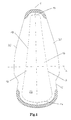
- Fig 1. Is a plan view of a preferred absorbent article of the present invention with side flaps.
- the term “longitudinal” refers to the direction of the central longitudinal axis referred to by reference numeral 1 in Fig 1.
- the term “transverse” refers to the direction of the transverse axis referred to by reference numeral 2 in Fig 1 and which is generally perpendicular to the central longitudinal axis.
- non folded configuration or “unfolded configuration” refers to the configuration in which the side flaps of the absorbent article are spread out in the same plane as the absorbent article as illustrated in Fig 1.
- the preferred embodiment of the absorbent article of the present invention is shown in Fig 1.
- the absorbent article in Fig 1 is generally referred to by reference numeral 10.
- Absorbent article 10 comprises a central absorbent pad, which is generally referred to by reference numeral 12.
- the central absorbent pad 12 has longitudinal edges 13 generally oriented parallel to the central longitudinal axis 1, transverse ends 14 generally oriented parallel to the transverse axis 2, a body facing side 22 and an undergarment facing side. Extending from each longitudinal edge 13 of the central absorbent pad 12 are flaps 30.
- the central absorbent pad 12 usually will comprise a liquid pervious topsheet, an absorbent core 16, and a liquid impervious backsheet.
- the central absorbent pad 12 and the absorbent core have a generally thong, trapezoidal or triangular shape having a wider front than rear portion which is especially shaped for use in modern undergarments of the G-string or string tanga type. This shape is referred to as thong shape both for describing undergarments or napkins in accordance with the present invention.
- the liquid pervious topsheet should be compliant, soft feeling and non-irritating to the user's skin. It can be made from any of the conventional materials for this type of use. Examples of suitable materials are woven and non-woven polyester, polypropylene, nylon and apertured films, preferably 3 dimensionally apertured films.
- the outer surface of the topsheet, preferably around the locations of intended liquid penetration may be treated with a compound, which renders the surface more hydrophilic allowing the liquid to penetrate the topsheet easily.
- the outer surface of the topsheet, preferably between the locations of liquid penetration may be treated with a compound which renders the surface more hydrophobic allowing liquid deposited there to migrate fast to locations where it can penetrate the topsheet easily, thus reducing liquid build up on the topsheet.
- the inner surface of the top sheet may be secured to the surface of the absorbent core 16 for example by the use of an adhesive or by other bonding means such as compression and/or thermo-bonding. This contacting relationship also results in liquid penetrating the topsheet easier.
- the absorbent core 16 shown in its outline by a dashed line, is positioned between the topsheet and the backsheet and comprises a fluid absorbing material.
- Fluid absorbing materials may be natural or synthetic or combinations thereof. Examples of absorbent materials include cellulose fibers and super-absorbent gelling materials. Absorbent materials may be used either alone or in combination with other materials, both absorbent or not.
- the absorbent core can be provided as a single entity or comprise several layers.
- the backsheet if present is impervious to liquids or retarding liquid penetration sufficient for the intended purpose of preventing fluid from the absorbent core migrating easily towards an underlying garment and soiling the garment or body of the user.
- the backsheet can be made from any of the conventional materials for this type of use. Suitable materials include embossed or nonembossed polyethylene, polypropylene, or other thermoplastic films or non-wovens . Especially breathable materials or multiple layer composites are preferred for use in the sanitary napkins according to the present invention.
- the topsheet and the backsheet extend beyond the periphery of the absorbent core and are attached to each other in the peripheral region around the absorbent core.
- Particularly beneficial is the crimping, indicated by hatched lines in figure 1, in the front and rear peripheral region, while in the peripheral region around the absorbent core adjacent the side flaps the attachment is achieved by adhesive combination.
- the peripheral region around the absorbent core, if present for joining the topsheet to the backsheet, in accordance with the present invention is part of the central absorbent pad (12).
- side flaps for folding around the edge of the undergarment are optionally present. Depending on the detailed construction of the optional side flaps this folding can include the peripheral region formed by the topsheet and the backsheet.
- a portion of the undergarment facing side of the backsheet is coated with a panty-fastening adhesive.
- the adhesive is intended to fix the central absorbent pad to the crotch of the undergarment during use of the article. Any adhesive used in the art for such purpose can be used herein, with pressure sensitive adhesives being preferred.
- the adhesive should be covered by a removable release liner to prevent the adhesive from drying out, being contaminated, or sticking to a surface other than those intended for that purpose. Silicone coated paper strips or polymeric filmstrips can provide such removable release liners.
- the release liner material also provides an individual wrapping of the thong sanitary napkin.
- Preferred sanitary napkins according to the present invention further comprise flaps (30) which are folded about the edge of the undergarment's leg openings in order to provide additional protection from soiling the undergarment and, provided the flaps are equipped with an attachment means such as the panty fastening adhesive mentioned above or a mechanical attachment means on their garment facing surface, to support fixation of the article to the undergarment during use.
- the flaps (30) can be made of any suitable material. They can be integral extensions of one, some or all of the materials used to provide the central absorbent pad (12). Alternatively the flaps (30) can be constructed separately from the absorbent central pad (12). In this case they can be made from the same materials used already for the absorbent pad or form different materials such as those mentioned herein already.
- the flaps are attached to the central absorbent pad (12) by any means conventionally used in combining absorbent articles, such as adhesives, thermo, or mechanical bonding.
- a key benefit of the integral construction is the ease of manufacture while the attached flaps provide benefits in material consumption and flexibility in material selection for the article manufacturer.
- the flaps (30) comprise a flap topsheet and a flap backsheet.
- the flap topsheet is integral with the topsheet.
- the flap backsheet is also integral with the backsheet.
- no absorbent material or only a very thin absorbent layer such as a tissue is provided as absorbent material in the flaps.
- Flaps (30) can be essentially of any shape. As illustrated in Fig 1 the flaps (30) may have the same shape but they can also be provided asymmetrically with respect to the longitudinal axis(1) such that they do not overlap when folded in use. The flaps may have a different shape to achieve this purpose. Any differing shapes between the flaps may be used to ensure they do not overlap when folded around the thong undergarment. Of course flaps (30) can be identical in shape as shown in Fig. 1. The flaps (30) can extend along a small or a long portion of the central absorbent pad (12). It is preferred that the flaps be as long as practical so as to maximize the extent of undergarment side edge which is covered. In this respect it is possible and preferred that both flaps (30) extend all the way to the rear end of the absorbent article.
- the masking of the absorbent core - when it is unsoiled or soiled - but also of any residue liquid remaining on the topsheet by use of dark coloration of the topsheet and backsheet provides a visual benefit to the articles according to the present invention.
- the flaps can be provided in a transparent or translucent design such replicating the color of the underlying material.
- Flexure resistance is a measurement which allows to quantify considerations of pliability, flexibility or stiffness, 'Schmiegsamkeit', and capability to follow and resemble the surface contour or topography of another structure.
- the absorbent core provides the main component of the value of flexure resistance of the sanitary napkin. It is therefore essential that the absorbent core does not create a barrier to comfort and functionality of the thong sanitary napkin by having too high a flexure resistance.
- the other materials and the construction of an absorbent article in general will increase flexure resistance as well.
- the conventional layered construction of topsheet, core and backsheet, potentially with multiple layers in each of these components, where the layers are attached across their surface will increase flexure resistance.
- flexure resistance of the article needs to be limited to 600 or less gram but also above 200g, preferably above 300g, more preferably above 450g.
- the ration of the value of flexure resistance of the core to flexure resistance of the whole napkin preferably has to be more than 0.5.
- the absorbent core is provided with a pre-scoring in order to reduce its flexure resistance.
- a pre-scoring is preferably parallel to and along its longitudinal centerline such that the garment facing surface of the absorbent core on the right and left side of the longitudinal centerline more readily fold towards each other. Scoring can be on the garment facing side or on the wearer facing side of the absorbent core.
- Preferred are longitudinally symmetrical scoring lines offset from the longitudinal centerline, especially in the center and front half of the thong sanitary napkin. In addition transverse scoring can also be provided to further increase flexure resistance.
- the sanitary napkin of the present invention has a low flexure-resistance.
- the sanitary napkin of the present invention is highly flexible and conforms very well to the various shapes of the female uro-genital region.
- the sanitary napkin of the present invention has a flexure-resistance of less than 6.0 grams.
- the flexure-resistance of a sanitary napkin is measured by peak bending stiffness. Peak bending stiffness is determined by a test which is modeled after the ASTM D 4032-82 CIRCULAR BEND PROCEDURE, the procedure being considerably modified and performed as follows.
- the CIRCULAR BEND PROCEDURE is a simultaneous multi-directional deformation of a material in which one face of a specimen becomes concave and the other face becomes convex.
- the CIRCULAR BEND PROCEDURE gives a force value related to flexure-resistance, simultaneously averaging stiffness in all directions.
- the apparatus necessary for the CIRCULAR BEND PROCEDURE is a modified Circular Bend Stiffness Tester, having the following parts:
- a smooth-polished steel plate platform which is 102.0 x 102.0 x 6.35 millimeters having an 18.75 millimeter diameter orifice.
- the lap edge of the orifice should be at a 45 degree angle to a depth of 4.75 millimeters.
- a plunger having an overall length of 72.2 millimeters, a diameter of 6.25 millimeters, a ball nose having a radius of 2.97 millimeters and a needle-point extending 0.88 millimeter therefrom having a 0.33 millimeter base diameter and a point having a radius of less than 0.5 millimeter, the plunger being mounted concentric with the orifice and having equal clearance on all sides. Note that the needle-point is merely to prevent lateral movement of the test specimen during testing.
- a force-measurement gauge and more specifically an Instron inverted compression load cell The load cell has a load range of from 0.0 to 1000 grams. Of course force measurements are not identical to mass measurements. However, the gauge is set such that it displays a value of mass excerting the equivalent force under gravity.
- sanitary napkins In order to perform the procedure for this test, as explained below, five representative sanitary napkins are necessary. From one of the five napkins to be tested, some number "Y" of 37.5 x 37.5 millimeter test specimens are cut. Specimens should be representative of the center of the napkin, or the region of highest apparent stiffness and not include portions in which e.g. a topsheet is joined directly to a backsheet. The reason that these specimens are not tested is due to the realization that prior art napkins exist in which a topsheet is joined to a barrier sheet beyond the edges of an absorbent core in the periphery of the napkin, such portions of which are highly flexible.
- the present invention is concerned with the overall flexibility of the sanitary napkin and not merely the peripheral portions thereof and, therefore, the flexibility of the present invention is more concerned with the flexibility of the significant absorbent portions of the sanitary napkin. If any of these significant absorbent portions of the sanitary napkin meet the parameters of this test, then the sanitary napkin satisfies the test. Therefore, a number of different specimens should be tested from each sanitary napkin. For the purpose of the present invention, the structurally least flexible portion of the sanitary napkin should be tested. The test specimens should not be folded or bent by the test person, and the handling of specimens must be kept to a minimum and to the edges to avoid affecting flexural-resistance properties. From the four remaining sanitary napkins, an equal number "Y" of 37.5 x 37.5 millimeter specimens, identical to the specimens cut from the first napkin, are cut. Thus, the test person should have "Y" number of sets of five identical specimens.
- the same sample preparation is done for the absorbent core, prior to installation of such core material into the sanitary napkin.
- the absorbent core should be carefully removed between the topsheet and the backsheet.
- the procedure for the CIRCULAR BEND PROCEDURE is as follows.
- the specimens are conditioned by leaving them in a room that is 21 +/- 1 DEG C and 50 +/- 2% relative humidity for a period of two hours.
- the test plate is leveled.
- the plunger speed is set at 50.0 centimeters per minute per full stroke length.
- a specimen is centered on the orifice platform below the plunger such that the body surface of the specimen is facing the plunger and the garment surface of the specimen is facing the platform.
- the indicator zero is checked and adjusted, if necessary.
- the plunger is actuated. Touching the specimen during the testing should be avoided. The maximum force reading to the nearest gram is recorded. The above steps are repeated until all five of the identical specimens have been tested.
- the peak bending stiffness for each specimen is the maximum force reading for that specimen.
- "Y" number of sets of five identical specimens were cut. Each set of five identical specimens is tested and the five values received for that set are averaged. Thus, the test person now has an average value for each of the "Y" sets tested.
- the flexure-resistance for a particularly designed sanitary napkin is the greatest of these average peak-bending stiffness.
Landscapes
- Health & Medical Sciences (AREA)
- Epidemiology (AREA)
- Life Sciences & Earth Sciences (AREA)
- Biomedical Technology (AREA)
- Heart & Thoracic Surgery (AREA)
- Vascular Medicine (AREA)
- Engineering & Computer Science (AREA)
- Animal Behavior & Ethology (AREA)
- General Health & Medical Sciences (AREA)
- Public Health (AREA)
- Veterinary Medicine (AREA)
- Absorbent Articles And Supports Therefor (AREA)
- Orthopedics, Nursing, And Contraception (AREA)
- Undergarments, Swaddling Clothes, Handkerchiefs Or Underwear Materials (AREA)
Priority Applications (14)
| Application Number | Priority Date | Filing Date | Title |
|---|---|---|---|
| EP01100421A EP1138295A1 (fr) | 2000-03-15 | 2001-01-08 | Serviette hygiénique flexible |
| JP2001566491A JP2003526466A (ja) | 2000-03-15 | 2001-03-09 | 改良された吸収性強化構造を持つソング衛生ナプキン |
| AU2001245616A AU2001245616A1 (en) | 2000-03-15 | 2001-03-09 | Thong sanitary napkin with an improved, absorbency enhancing construction |
| BR0109099-2A BR0109099A (pt) | 2000-03-15 | 2001-03-09 | Absorvente feminino menstrual descartável |
| MXPA02008305A MXPA02008305A (es) | 2000-03-15 | 2001-03-09 | Toalla sanitaria tipo "thong" o tira angosta con una construccion mejorada que incrementa la absorbencia. |
| SG200407338A SG123616A1 (en) | 2000-03-15 | 2001-03-09 | Flexible sanitary napkin |
| US10/221,452 US20030208177A1 (en) | 2000-03-15 | 2001-03-09 | Flexible sanitary napkin |
| EP01918553A EP1263371A2 (fr) | 2000-03-15 | 2001-03-09 | Serviette hygienique sous forme de laniere a construction d'absorption amelioree |
| CA002399861A CA2399861A1 (fr) | 2000-03-15 | 2001-03-09 | Serviette hygienique sous forme de laniere a construction d'absorption amelioree |
| PCT/US2001/007779 WO2001068024A2 (fr) | 2000-03-15 | 2001-03-09 | Serviette hygienique sous forme de laniere a construction d'absorption amelioree |
| KR1020027012112A KR20020075936A (ko) | 2000-03-15 | 2001-03-09 | 개선된 흡수성 향상 구조를 갖는 끈 생리대 |
| IL15112301A IL151123A0 (en) | 2000-03-15 | 2001-03-09 | Thong sanitary napkin with an improved, absorbency enhancing construction |
| PE2001000247A PE20011204A1 (es) | 2000-03-15 | 2001-03-15 | Toalla higienica con una configuracion convergente hacia el extremo posterior, una construccion mejorada y absorbencia aumentada |
| ARP010101205 AR042376A1 (es) | 2001-01-08 | 2001-03-15 | Toalla higienica desechable para flujo menstrual |
Applications Claiming Priority (3)
| Application Number | Priority Date | Filing Date | Title |
|---|---|---|---|
| EP00200935A EP1133961A1 (fr) | 2000-03-15 | 2000-03-15 | Serviette hygiénique ou protège-slip pour slip tanga |
| EP00200935 | 2000-03-15 | ||
| EP01100421A EP1138295A1 (fr) | 2000-03-15 | 2001-01-08 | Serviette hygiénique flexible |
Publications (1)
| Publication Number | Publication Date |
|---|---|
| EP1138295A1 true EP1138295A1 (fr) | 2001-10-04 |
Family
ID=26072000
Family Applications (2)
| Application Number | Title | Priority Date | Filing Date |
|---|---|---|---|
| EP01100421A Withdrawn EP1138295A1 (fr) | 2000-03-15 | 2001-01-08 | Serviette hygiénique flexible |
| EP01918553A Withdrawn EP1263371A2 (fr) | 2000-03-15 | 2001-03-09 | Serviette hygienique sous forme de laniere a construction d'absorption amelioree |
Family Applications After (1)
| Application Number | Title | Priority Date | Filing Date |
|---|---|---|---|
| EP01918553A Withdrawn EP1263371A2 (fr) | 2000-03-15 | 2001-03-09 | Serviette hygienique sous forme de laniere a construction d'absorption amelioree |
Country Status (11)
| Country | Link |
|---|---|
| EP (2) | EP1138295A1 (fr) |
| JP (1) | JP2003526466A (fr) |
| KR (1) | KR20020075936A (fr) |
| AU (1) | AU2001245616A1 (fr) |
| BR (1) | BR0109099A (fr) |
| CA (1) | CA2399861A1 (fr) |
| IL (1) | IL151123A0 (fr) |
| MX (1) | MXPA02008305A (fr) |
| PE (1) | PE20011204A1 (fr) |
| SG (1) | SG123616A1 (fr) |
| WO (1) | WO2001068024A2 (fr) |
Cited By (4)
| Publication number | Priority date | Publication date | Assignee | Title |
|---|---|---|---|---|
| FR2821740A1 (fr) * | 2001-03-12 | 2002-09-13 | Johnson & Johnson Ind Com | Article absorbant sanitaire |
| EP1327428A1 (fr) * | 2001-12-19 | 2003-07-16 | grupo P.I. Mabe, S.A. de C.V. | Serviette hygiénique ou protège-slip pour slip tanga |
| USD498841S1 (en) | 2002-11-27 | 2004-11-23 | Kimberly-Clark Worldwide, Inc. | Garment liner |
| US6964655B2 (en) | 2001-11-01 | 2005-11-15 | Mcneil-Ppc, Inc. | Thong sanitary napkin with self folding flaps |
Families Citing this family (4)
| Publication number | Priority date | Publication date | Assignee | Title |
|---|---|---|---|---|
| US7278988B2 (en) | 2000-12-15 | 2007-10-09 | Kimberly-Clark Worldwide, Inc. | Dual-use pantiliner |
| US6443934B1 (en) * | 2001-09-27 | 2002-09-03 | Tyco Healthcare Retail Services Ag | Efficient thong pantiliner with fold-over attachment means |
| US6821270B2 (en) * | 2002-02-13 | 2004-11-23 | Mcneil-Ppc, Inc. | Sanitary absorbent article |
| WO2014208363A1 (fr) * | 2013-06-25 | 2014-12-31 | 株式会社瑞光 | Article absorbant et son procédé de fabrication |
Citations (2)
| Publication number | Priority date | Publication date | Assignee | Title |
|---|---|---|---|---|
| US5009653A (en) * | 1988-03-31 | 1991-04-23 | The Procter & Gamble Company | Thin, flexible sanitary napkin |
| WO1995020931A1 (fr) * | 1994-02-04 | 1995-08-10 | The Procter & Gamble Company | Articles absorbants |
Family Cites Families (1)
| Publication number | Priority date | Publication date | Assignee | Title |
|---|---|---|---|---|
| DE29917153U1 (de) * | 1999-09-29 | 1999-12-30 | Beilker, Dirk, Dipl.-Ing. (FH), 60598 Frankfurt | Slipeinlage zum Gebrauch in String-Tanga-Slips |
-
2001
- 2001-01-08 EP EP01100421A patent/EP1138295A1/fr not_active Withdrawn
- 2001-03-09 WO PCT/US2001/007779 patent/WO2001068024A2/fr not_active Ceased
- 2001-03-09 MX MXPA02008305A patent/MXPA02008305A/es not_active Application Discontinuation
- 2001-03-09 IL IL15112301A patent/IL151123A0/xx unknown
- 2001-03-09 BR BR0109099-2A patent/BR0109099A/pt not_active IP Right Cessation
- 2001-03-09 AU AU2001245616A patent/AU2001245616A1/en not_active Abandoned
- 2001-03-09 CA CA002399861A patent/CA2399861A1/fr not_active Abandoned
- 2001-03-09 EP EP01918553A patent/EP1263371A2/fr not_active Withdrawn
- 2001-03-09 SG SG200407338A patent/SG123616A1/en unknown
- 2001-03-09 KR KR1020027012112A patent/KR20020075936A/ko not_active Ceased
- 2001-03-09 JP JP2001566491A patent/JP2003526466A/ja not_active Withdrawn
- 2001-03-15 PE PE2001000247A patent/PE20011204A1/es not_active Application Discontinuation
Patent Citations (2)
| Publication number | Priority date | Publication date | Assignee | Title |
|---|---|---|---|---|
| US5009653A (en) * | 1988-03-31 | 1991-04-23 | The Procter & Gamble Company | Thin, flexible sanitary napkin |
| WO1995020931A1 (fr) * | 1994-02-04 | 1995-08-10 | The Procter & Gamble Company | Articles absorbants |
Cited By (8)
| Publication number | Priority date | Publication date | Assignee | Title |
|---|---|---|---|---|
| FR2821740A1 (fr) * | 2001-03-12 | 2002-09-13 | Johnson & Johnson Ind Com | Article absorbant sanitaire |
| GB2379391A (en) * | 2001-03-12 | 2003-03-12 | Johnson & Johnson Ind Com | Sanitary napkin |
| GB2379391B (en) * | 2001-03-12 | 2004-12-01 | Johnson & Johnson Ind Com | Sanitary absorbent article |
| US8277428B2 (en) | 2001-03-12 | 2012-10-02 | Johnson & Johnson Ind. E Com. Ltda | Sanitary absorbent article |
| US6964655B2 (en) | 2001-11-01 | 2005-11-15 | Mcneil-Ppc, Inc. | Thong sanitary napkin with self folding flaps |
| EP1327428A1 (fr) * | 2001-12-19 | 2003-07-16 | grupo P.I. Mabe, S.A. de C.V. | Serviette hygiénique ou protège-slip pour slip tanga |
| USD498841S1 (en) | 2002-11-27 | 2004-11-23 | Kimberly-Clark Worldwide, Inc. | Garment liner |
| USD507051S1 (en) | 2002-11-27 | 2005-07-05 | Kimberly-Clark Worldwide, Inc. | Garment liner |
Also Published As
| Publication number | Publication date |
|---|---|
| KR20020075936A (ko) | 2002-10-07 |
| SG123616A1 (en) | 2006-07-26 |
| MXPA02008305A (es) | 2002-12-09 |
| JP2003526466A (ja) | 2003-09-09 |
| PE20011204A1 (es) | 2001-12-08 |
| BR0109099A (pt) | 2003-06-03 |
| EP1263371A2 (fr) | 2002-12-11 |
| IL151123A0 (en) | 2003-04-10 |
| WO2001068024A3 (fr) | 2002-03-14 |
| WO2001068024A2 (fr) | 2001-09-20 |
| CA2399861A1 (fr) | 2001-09-20 |
| AU2001245616A1 (en) | 2001-09-24 |
Similar Documents
| Publication | Publication Date | Title |
|---|---|---|
| US20030208177A1 (en) | Flexible sanitary napkin | |
| CA2093350C (fr) | Serviette hygienique munie d'elements pouvant etre retires pendant l'usage | |
| AU656043B2 (en) | An absorbent article | |
| CA2276367C (fr) | Serviettes hygieniques possedant des elements stabilisants dans les regions d'extremite | |
| AU713142B2 (en) | Thin, curved absorbent article having elasticized edges | |
| AU769730B2 (en) | Sanitary napkin with rear extension providing a liquid blocking function | |
| JP6363727B2 (ja) | 成人用吸収性物品及びその群 | |
| JP3933685B2 (ja) | 補剛用側部スタビライザーを有する衛生ナプキン | |
| FI102245B (fi) | Terveysside varustettuna sivusuuntaisilla laajentuvilla välineillä kii nnitystä varten käyttäjän alusvaatteeseen | |
| PL172233B1 (pl) | Podpaska higieniczna PL PL PL PL | |
| AU778451B2 (en) | Compound napkin | |
| CZ288444B6 (en) | Sanitary napkin | |
| AU7142700A (en) | Compound sanitary napkin | |
| JPH10502843A (ja) | 良好な適合性を有する予め折られた吸収物品 | |
| WO2001068024A2 (fr) | Serviette hygienique sous forme de laniere a construction d'absorption amelioree | |
| RU2229868C2 (ru) | Абсорбирующее изделие, гигиеническая прокладка (варианты) | |
| MXPA97002538A (en) | Flexible and estirable absorbent articles, and its fixation to interior garments | |
| PL204969B1 (pl) | Zwężający się wyrób chłonny z elementami bocznymi | |
| MXPA97002540A (en) | Flexible absorbent articles and its fixation to interior garments | |
| RU2387426C2 (ru) | Абсорбирующее изделие | |
| AU4005895A (en) | Flexible and water vapour permeable absorbent articles and their fixation to undergarments | |
| MXPA95001002A (en) | Absorbent article that conforms to the cue | |
| HK1014488B (en) | Hygienic absorbent article | |
| MXPA98000474A (en) | Absorbent articles that have covering components of the inside garment with mechanical fasteners that have properties to the improved touch | |
| MXPA99006222A (en) | Sanitary napkin having stabilizing members in the end regions |
Legal Events
| Date | Code | Title | Description |
|---|---|---|---|
| PUAI | Public reference made under article 153(3) epc to a published international application that has entered the european phase |
Free format text: ORIGINAL CODE: 0009012 |
|
| AK | Designated contracting states |
Kind code of ref document: A1 Designated state(s): AT BE CH CY DE DK ES FI FR GB GR IE IT LI LU MC NL PT SE TR |
|
| AX | Request for extension of the european patent |
Free format text: AL;LT;LV;MK;RO;SI |
|
| AKX | Designation fees paid | ||
| REG | Reference to a national code |
Ref country code: DE Ref legal event code: 8566 |
|
| STAA | Information on the status of an ep patent application or granted ep patent |
Free format text: STATUS: THE APPLICATION IS DEEMED TO BE WITHDRAWN |
|
| 18D | Application deemed to be withdrawn |
Effective date: 20020405 |