EP1138380A1 - Méthode de production du fomaldéhyde directement à partir du méthane - Google Patents
Méthode de production du fomaldéhyde directement à partir du méthane Download PDFInfo
- Publication number
- EP1138380A1 EP1138380A1 EP00110907A EP00110907A EP1138380A1 EP 1138380 A1 EP1138380 A1 EP 1138380A1 EP 00110907 A EP00110907 A EP 00110907A EP 00110907 A EP00110907 A EP 00110907A EP 1138380 A1 EP1138380 A1 EP 1138380A1
- Authority
- EP
- European Patent Office
- Prior art keywords
- sma
- catalyst
- silica
- supported
- methane
- Prior art date
- Legal status (The legal status is an assumption and is not a legal conclusion. Google has not performed a legal analysis and makes no representation as to the accuracy of the status listed.)
- Granted
Links
- 238000000034 method Methods 0.000 title claims abstract description 52
- WSFSSNUMVMOOMR-UHFFFAOYSA-N Formaldehyde Chemical compound O=C WSFSSNUMVMOOMR-UHFFFAOYSA-N 0.000 title claims description 267
- VNWKTOKETHGBQD-UHFFFAOYSA-N methane Chemical compound C VNWKTOKETHGBQD-UHFFFAOYSA-N 0.000 title claims description 208
- VYPSYNLAJGMNEJ-UHFFFAOYSA-N Silicium dioxide Chemical compound O=[Si]=O VYPSYNLAJGMNEJ-UHFFFAOYSA-N 0.000 claims abstract description 202
- 238000006243 chemical reaction Methods 0.000 claims abstract description 147
- 239000003054 catalyst Substances 0.000 claims abstract description 132
- 239000000377 silicon dioxide Substances 0.000 claims abstract description 99
- 239000002253 acid Substances 0.000 claims abstract description 19
- 239000003377 acid catalyst Substances 0.000 claims abstract description 16
- XLYOFNOQVPJJNP-UHFFFAOYSA-N water Chemical compound O XLYOFNOQVPJJNP-UHFFFAOYSA-N 0.000 claims description 86
- QVGXLLKOCUKJST-UHFFFAOYSA-N atomic oxygen Chemical compound [O] QVGXLLKOCUKJST-UHFFFAOYSA-N 0.000 claims description 52
- 239000001301 oxygen Substances 0.000 claims description 52
- 229910052760 oxygen Inorganic materials 0.000 claims description 52
- 239000007789 gas Substances 0.000 claims description 42
- 239000012495 reaction gas Substances 0.000 claims description 3
- OKKJLVBELUTLKV-UHFFFAOYSA-N Methanol Chemical compound OC OKKJLVBELUTLKV-UHFFFAOYSA-N 0.000 description 157
- 229960004279 formaldehyde Drugs 0.000 description 84
- 235000019256 formaldehyde Nutrition 0.000 description 84
- 238000010438 heat treatment Methods 0.000 description 40
- 230000003197 catalytic effect Effects 0.000 description 33
- CURLTUGMZLYLDI-UHFFFAOYSA-N Carbon dioxide Chemical compound O=C=O CURLTUGMZLYLDI-UHFFFAOYSA-N 0.000 description 30
- 229910000476 molybdenum oxide Inorganic materials 0.000 description 27
- 239000000843 powder Substances 0.000 description 27
- PQQKPALAQIIWST-UHFFFAOYSA-N oxomolybdenum Chemical compound [Mo]=O PQQKPALAQIIWST-UHFFFAOYSA-N 0.000 description 24
- 229910052681 coesite Inorganic materials 0.000 description 23
- 229910052906 cristobalite Inorganic materials 0.000 description 23
- 229910052682 stishovite Inorganic materials 0.000 description 23
- 229910052905 tridymite Inorganic materials 0.000 description 23
- 230000008569 process Effects 0.000 description 20
- 229910002092 carbon dioxide Inorganic materials 0.000 description 19
- 230000000694 effects Effects 0.000 description 16
- 238000000354 decomposition reaction Methods 0.000 description 12
- WSFSSNUMVMOOMR-NJFSPNSNSA-N methanone Chemical compound O=[14CH2] WSFSSNUMVMOOMR-NJFSPNSNSA-N 0.000 description 12
- 239000001569 carbon dioxide Substances 0.000 description 11
- 230000015572 biosynthetic process Effects 0.000 description 9
- 230000008859 change Effects 0.000 description 9
- 239000010410 layer Substances 0.000 description 9
- 239000002245 particle Substances 0.000 description 9
- 238000002360 preparation method Methods 0.000 description 9
- UGFAIRIUMAVXCW-UHFFFAOYSA-N Carbon monoxide Chemical compound [O+]#[C-] UGFAIRIUMAVXCW-UHFFFAOYSA-N 0.000 description 8
- 229910002091 carbon monoxide Inorganic materials 0.000 description 8
- 238000010521 absorption reaction Methods 0.000 description 7
- 238000007254 oxidation reaction Methods 0.000 description 7
- 238000011069 regeneration method Methods 0.000 description 7
- 238000005979 thermal decomposition reaction Methods 0.000 description 7
- 230000003301 hydrolyzing effect Effects 0.000 description 6
- GRVDJDISBSALJP-UHFFFAOYSA-N methyloxidanyl Chemical compound [O]C GRVDJDISBSALJP-UHFFFAOYSA-N 0.000 description 6
- 238000011160 research Methods 0.000 description 6
- 239000000243 solution Substances 0.000 description 6
- 230000002194 synthesizing effect Effects 0.000 description 6
- XLYOFNOQVPJJNP-ZSJDYOACSA-N heavy water Substances [2H]O[2H] XLYOFNOQVPJJNP-ZSJDYOACSA-N 0.000 description 5
- 230000003647 oxidation Effects 0.000 description 5
- 230000008929 regeneration Effects 0.000 description 5
- 238000001816 cooling Methods 0.000 description 4
- 239000013078 crystal Substances 0.000 description 4
- 238000004519 manufacturing process Methods 0.000 description 4
- 239000008188 pellet Substances 0.000 description 4
- 239000002994 raw material Substances 0.000 description 4
- 238000003786 synthesis reaction Methods 0.000 description 4
- 238000012360 testing method Methods 0.000 description 4
- OKTJSMMVPCPJKN-UHFFFAOYSA-N Carbon Chemical compound [C] OKTJSMMVPCPJKN-UHFFFAOYSA-N 0.000 description 3
- BOTDANWDWHJENH-UHFFFAOYSA-N Tetraethyl orthosilicate Chemical compound CCO[Si](OCC)(OCC)OCC BOTDANWDWHJENH-UHFFFAOYSA-N 0.000 description 3
- 238000002441 X-ray diffraction Methods 0.000 description 3
- 238000000862 absorption spectrum Methods 0.000 description 3
- -1 carbonium cation Chemical class 0.000 description 3
- 150000001875 compounds Chemical class 0.000 description 3
- 238000001704 evaporation Methods 0.000 description 3
- 239000000463 material Substances 0.000 description 3
- 239000000203 mixture Substances 0.000 description 3
- 230000001590 oxidative effect Effects 0.000 description 3
- 239000011148 porous material Substances 0.000 description 3
- 239000011541 reaction mixture Substances 0.000 description 3
- 239000000741 silica gel Substances 0.000 description 3
- 229910002027 silica gel Inorganic materials 0.000 description 3
- 230000009471 action Effects 0.000 description 2
- 238000004458 analytical method Methods 0.000 description 2
- 229910052799 carbon Inorganic materials 0.000 description 2
- 230000003028 elevating effect Effects 0.000 description 2
- 238000002474 experimental method Methods 0.000 description 2
- 238000005470 impregnation Methods 0.000 description 2
- 125000000956 methoxy group Chemical group [H]C([H])([H])O* 0.000 description 2
- 239000002356 single layer Substances 0.000 description 2
- 238000003756 stirring Methods 0.000 description 2
- 239000011882 ultra-fine particle Substances 0.000 description 2
- UFHFLCQGNIYNRP-UHFFFAOYSA-N Hydrogen Chemical compound [H][H] UFHFLCQGNIYNRP-UHFFFAOYSA-N 0.000 description 1
- 230000010718 Oxidation Activity Effects 0.000 description 1
- 239000004698 Polyethylene Substances 0.000 description 1
- WGLPBDUCMAPZCE-UHFFFAOYSA-N Trioxochromium Chemical compound O=[Cr](=O)=O WGLPBDUCMAPZCE-UHFFFAOYSA-N 0.000 description 1
- 229920001807 Urea-formaldehyde Polymers 0.000 description 1
- XHCLAFWTIXFWPH-UHFFFAOYSA-N [O-2].[O-2].[O-2].[O-2].[O-2].[V+5].[V+5] Chemical compound [O-2].[O-2].[O-2].[O-2].[O-2].[V+5].[V+5] XHCLAFWTIXFWPH-UHFFFAOYSA-N 0.000 description 1
- 230000004913 activation Effects 0.000 description 1
- 238000005054 agglomeration Methods 0.000 description 1
- 230000002776 aggregation Effects 0.000 description 1
- 238000003915 air pollution Methods 0.000 description 1
- 239000007864 aqueous solution Substances 0.000 description 1
- 230000002238 attenuated effect Effects 0.000 description 1
- 239000011324 bead Substances 0.000 description 1
- 238000001354 calcination Methods 0.000 description 1
- 125000005626 carbonium group Chemical group 0.000 description 1
- 239000000969 carrier Substances 0.000 description 1
- 150000001768 cations Chemical class 0.000 description 1
- 239000000919 ceramic Substances 0.000 description 1
- 229910000423 chromium oxide Inorganic materials 0.000 description 1
- 238000011109 contamination Methods 0.000 description 1
- 230000003247 decreasing effect Effects 0.000 description 1
- 230000001419 dependent effect Effects 0.000 description 1
- 238000011161 development Methods 0.000 description 1
- 230000018109 developmental process Effects 0.000 description 1
- 238000007598 dipping method Methods 0.000 description 1
- 239000003814 drug Substances 0.000 description 1
- 229940079593 drug Drugs 0.000 description 1
- 238000001035 drying Methods 0.000 description 1
- 238000010828 elution Methods 0.000 description 1
- 238000011156 evaluation Methods 0.000 description 1
- 230000008020 evaporation Effects 0.000 description 1
- 238000004817 gas chromatography Methods 0.000 description 1
- 239000011521 glass Substances 0.000 description 1
- 239000001257 hydrogen Substances 0.000 description 1
- 229910052739 hydrogen Inorganic materials 0.000 description 1
- 238000012844 infrared spectroscopy analysis Methods 0.000 description 1
- 238000002329 infrared spectrum Methods 0.000 description 1
- 238000004811 liquid chromatography Methods 0.000 description 1
- 238000011068 loading method Methods 0.000 description 1
- 238000005259 measurement Methods 0.000 description 1
- 230000007246 mechanism Effects 0.000 description 1
- JKQOBWVOAYFWKG-UHFFFAOYSA-N molybdenum trioxide Chemical compound O=[Mo](=O)=O JKQOBWVOAYFWKG-UHFFFAOYSA-N 0.000 description 1
- 229920001568 phenolic resin Polymers 0.000 description 1
- 239000005011 phenolic resin Substances 0.000 description 1
- 229920000573 polyethylene Polymers 0.000 description 1
- 238000004445 quantitative analysis Methods 0.000 description 1
- 239000010453 quartz Substances 0.000 description 1
- 230000035484 reaction time Effects 0.000 description 1
- 238000002407 reforming Methods 0.000 description 1
- 238000006057 reforming reaction Methods 0.000 description 1
- 238000007086 side reaction Methods 0.000 description 1
- 238000001179 sorption measurement Methods 0.000 description 1
- 238000004611 spectroscopical analysis Methods 0.000 description 1
- 229910001220 stainless steel Inorganic materials 0.000 description 1
- 239000010935 stainless steel Substances 0.000 description 1
- 239000000126 substance Substances 0.000 description 1
- 239000008400 supply water Substances 0.000 description 1
- 229920003002 synthetic resin Polymers 0.000 description 1
- 239000000057 synthetic resin Substances 0.000 description 1
- 238000011144 upstream manufacturing Methods 0.000 description 1
- 229910001935 vanadium oxide Inorganic materials 0.000 description 1
- 229910003149 α-MoO3 Inorganic materials 0.000 description 1
Images



Classifications
-
- B—PERFORMING OPERATIONS; TRANSPORTING
- B01—PHYSICAL OR CHEMICAL PROCESSES OR APPARATUS IN GENERAL
- B01J—CHEMICAL OR PHYSICAL PROCESSES, e.g. CATALYSIS OR COLLOID CHEMISTRY; THEIR RELEVANT APPARATUS
- B01J27/00—Catalysts comprising the elements or compounds of halogens, sulfur, selenium, tellurium, phosphorus or nitrogen; Catalysts comprising carbon compounds
- B01J27/14—Phosphorus; Compounds thereof
- B01J27/186—Phosphorus; Compounds thereof with arsenic, antimony, bismuth, vanadium, niobium, tantalum, polonium, chromium, molybdenum, tungsten, manganese, technetium or rhenium
- B01J27/188—Phosphorus; Compounds thereof with arsenic, antimony, bismuth, vanadium, niobium, tantalum, polonium, chromium, molybdenum, tungsten, manganese, technetium or rhenium with chromium, molybdenum, tungsten or polonium
-
- B—PERFORMING OPERATIONS; TRANSPORTING
- B01—PHYSICAL OR CHEMICAL PROCESSES OR APPARATUS IN GENERAL
- B01J—CHEMICAL OR PHYSICAL PROCESSES, e.g. CATALYSIS OR COLLOID CHEMISTRY; THEIR RELEVANT APPARATUS
- B01J23/00—Catalysts comprising metals or metal oxides or hydroxides, not provided for in group B01J21/00
- B01J23/16—Catalysts comprising metals or metal oxides or hydroxides, not provided for in group B01J21/00 of arsenic, antimony, bismuth, vanadium, niobium, tantalum, polonium, chromium, molybdenum, tungsten, manganese, technetium or rhenium
- B01J23/24—Chromium, molybdenum or tungsten
- B01J23/28—Molybdenum
-
- C—CHEMISTRY; METALLURGY
- C07—ORGANIC CHEMISTRY
- C07C—ACYCLIC OR CARBOCYCLIC COMPOUNDS
- C07C45/00—Preparation of compounds having >C = O groups bound only to carbon or hydrogen atoms; Preparation of chelates of such compounds
- C07C45/27—Preparation of compounds having >C = O groups bound only to carbon or hydrogen atoms; Preparation of chelates of such compounds by oxidation
- C07C45/32—Preparation of compounds having >C = O groups bound only to carbon or hydrogen atoms; Preparation of chelates of such compounds by oxidation with molecular oxygen
- C07C45/33—Preparation of compounds having >C = O groups bound only to carbon or hydrogen atoms; Preparation of chelates of such compounds by oxidation with molecular oxygen of CHx-moieties
Definitions
- the present invention relates to a method of producing formaldehyde, particularly to a novel catalyst that permits producing formaldehyde directly from methane at a high yield and a method of producing formaldehyde by using the novel catalyst.
- Formaldehyde is produced by partial oxidation reaction of methanol. Half the methanol produced in an amount of one million tons in a year in Japan is used as a raw material for the production of formaldehyde.
- the produced formaldehyde is used as a raw material of synthetic resins such as phenolic resins and urea resins or as a raw material of various medicines.
- Methanol is synthesized from hydrogen and carbon monoxide obtained by water vapor reforming reaction of methane.
- the conventional process of producing formaldehyde is as given below: Methane ⁇ H 2 /CO ⁇ Methanol ⁇ Formaldehyde
- the reaction for preparing H 2 /CO from methane is an endothermic reaction using a large amount of high temperature water vapor, which is one of typical processes consuming a large amount of energy.
- the reaction for synthesizing methanol from H 2 /CO is an exothermic reaction.
- the CO conversion rate must be suppressed to about 10% in operating the process unit.
- the conversion rate of methanol must be suppressed in operating the process unit in the production of formaldehyde by partial oxidation of methanol in order to suppress formation of carbon dioxide and carbon monoxide.
- the conventional process of producing formaldehyde is a process consuming a large amount of energy and requiring a very complex operation of the process unit.
- the yield of methanol or formaldehyde is very low, i.e., less than 1% in general, even in the presence of these catalysts. It is said among the researchers in this field that it is difficult for the yield of methanol or formaldehyde to exceed 4%. In other words, the yield of 4% is said to be a wall that cannot be broken in the direct synthesis of methanol or formaldehyde from methane. Further, the methane conversion rate of at least 10% is required for putting the process to practical use. In conclusion, a process for direct conversion from methane into formaldehyde with a practical yield of formaldehyde has not yet been developed.
- An object of the present invention is to produce formaldehyde with a high yield directly from methane by a process that does not involve a water vapor reforming step of methane, which is a step consuming a large amount of energy, and that does not bring about an air pollution or water contamination problem.
- the present invention provides a novel catalyst and a method of producing formaldehyde by using the novel catalyst.
- the present inventors have conducted an extensive research on a catalyst excellent in its activity of partially oxidizing methane and on the conditions of the reaction carried out in the presence of the particular catalyst, and found that a silica-supported 12-molybdosilicic acid catalyst, in which 12-molybdosilicic acid is supported on silica, is excellent in its activity of partially oxidizing methane and, thus, is very effective when used as a catalyst in the synthesis of formaldehyde directly from methane.
- 12-molybdosilicic acid (which may be hereinafter referred to as SMA in some cases) is poor in thermal stability. Therefore, in using the novel catalyst, it was required to carry out the synthetic reaction of formaldehyde while suppressing the thermal decomposition of the SMA catalyst.
- the present inventors have continued an extensive research bearing this in mind to arrive at a very important finding. Specifically, it has been found that, for suppressing the thermal decomposition of the SMA catalyst, it is effective to carry out the synthetic reaction of formaldehyde in the presence of the particular catalyst under a water vapor atmosphere. It has also been found that it is very important to control appropriately the temperature elevation rate in heating the reaction system to the reaction temperature.
- formaldehyde can be synthesized directly from methane with a high yield exceeding 15%, which suggests a breakaway from the conventional process consuming a large amount of energy. It follows that the present invention is expected to make a great contribution to the energy saving in the chemical industries.
- reaction between methane and oxygen is carried out in the presence of a catalyst for producing formaldehyde directly from methane.
- the catalyst used in the present invention is prepared by having 12-molybdosilicic acid supported on a silica carrier.
- the silica-supported 12-molybdosilicic acid catalyst of the present invention can be prepared by an impregnation method as follows. Specifically, 12-molybdosilicic acid (SMA) is sufficiently dissolved in pure water at room temperature. Then, a silica powder is dipped in the solution, followed by evaporating the water such that the catalyst is not dried completely. If the catalyst is completely dried and heated at 350°C or more, SMA within the catalyst is thermally decomposed into silica and molybdenum oxide, as shown below: H 4 SiMo 12 O 40 ⁇ SiO 2 + 12MoO 3 + 2H 2 O
- the water should be evaporated on, preferably, a water bath while heating and stirring the solution such that the catalyst is not dried completely.
- the catalyst is further dried for obtaining the catalyst of the present invention.
- SMA used as a raw material is a compound having a molecular formula of H 4 SiMo 12 O 40 .
- the silica powder used as a carrier should desirably have a high purity and a specific surface area of at least 500 m 2 /g. If the specific surface area is smaller than 500 m 2 /g, SMA is agglomerated on the surface of the silica carrier so as to inhibit the partial oxidation reaction of methane.
- the silica powder can be prepared by a known method. For example, a silica gel obtained by hydrolyzing ethyl silicate is dried and calcined to obtain a desired silica powder.
- a silica carrier having a desired specific surface area can be obtained by controlling the pH value in the hydrolyzing step. It should be noted that the pores present in the silica obtained by hydrolyzing ethyl silicate have an average diameter of about 40 X 10 -10 m. On the other hand, SMA molecules have an average diameter of, about 28 X 10 -10 m. It follows that the SMA molecules can be held within the pores of the silica carrier even under a water vapor atmosphere described herein later, making it possible to suppress elution of the water-soluble SMA molecules so as to improve the durability of the catalyst. However, a silica powder available on the market can also be used satisfactorily in the present invention as the silica carrier.
- SMA SMA
- the SMA formation amount by the regeneration reaction given above is limited to a certain value.
- formaldehyde cannot be obtained at a high yield conforming with the SMA amount where the amount of SMA supported on the carrier exceeds 50 mass %, as pointed out above.
- the amount of SMA supported on the carrier can be controlled as desired by controlling the SMA concentration in the aqueous solution of SMA in the catalyst preparation method described above.
- a mixed gas of methane and oxygen is brought into contact with the catalyst of the present invention.
- a mixed gas of methane and oxygen is passed through a bed of the catalyst of the present invention, which is heated to a predetermined temperature, so as to carry out reaction between methane and oxygen.
- the novel catalyst of the present invention is a silica-supported SMA catalyst consisting of SMA supported on silica.
- the catalyst of the present invention is poor in thermal stability. If heated to the reaction temperature, e.g., 600°C, the catalyst tends to be thermally decomposed. Therefore, in the method of the present invention for producing formaldehyde, it is desirable to develop a technique that permits elevating the temperature of the silica-supported SMA catalyst to the reaction temperature while suppressing the thermal decomposition of the silica-supported SMA catalyst in order to enable the catalyst to exhibit sufficiently the catalytic function inherent in SMA. Under the circumstances, a very interesting technique has been developed by the present inventors as follows.
- SMA is poor in heat resistance. If heated to temperatures not lower than 350°C, SMA is readily decomposed thermally to form silica and molybdenum oxide. If SMA is supported on silica, the heat resistance is improved. However, if heated to the synthesizing temperature of formaldehyde employed in the method of the present invention, preferably 550 to 650°C as described herein later, SMA is thermally decomposed substantially completely into silica and molybdenum oxide.
- reaction formula (I) given below, with the result that the thermal decomposition and regeneration of SMA proceed in equilibrium to cause SMA to be kept present in the reaction system: SiO 2 + 12MoO 3 + 2H 2 O ⁇ H 4 SiMo 12 O 40
- the presence of the water vapor in the reaction system serves to suppress the thermal decomposition of SMA so as to enable SMA to exhibit the catalytic function inherent in SMA.
- the present inventors have also conducted an extensive research with attentions paid to the temperature elevation rate of the SMA catalyst, finding a very interesting relationship between the decomposition-regeneration of SMA and the temperature elevation rate under a water vapor atmosphere.
- the silica-supported SMA catalyst it is desirable in the present invention to heat the silica-supported SMA catalyst to the reaction temperature at a temperature elevation rate not lower than 100°C/min.
- the reason for heating the catalyst at the particular temperature elevation rate is as follows.
- reaction formula (II) is thermally decomposed as denoted by reaction formula (II) given below, as described in, for example, "H. Hu et al., J. Phys. Chem., 99, 10897 (1995)” and “C.R. Deltcheff et al., J. Catal., 125, 292 (1990)"
- reaction formula (II) As denoted by reaction formula (II) given above, SMA is completely decomposed to molybdenum oxide ( ⁇ -MoO 3 ) under the synthetic reaction temperature of formaldehyde, e.g., 600°C. However, since SMA is regenerated under a water vapor atmosphere as denoted by reaction formula (I) given previously, the decomposition-regeneration of SMA is repeated so as to seemingly suppress decomposition of SMA. However, the reaction rate of the reaction denoted by formula (I) is greatly dependent on the size of the molybdenum oxide particles.
- the reaction of formula (I) proceeds at a high reaction rate. If the molybdenum oxide particles are large, however, the reaction of formula (I) proceeds very slowly so as to impair regeneration of SMA.
- reaction formula (II) the temperature elevation rate of the silica-supported SMA catalyst. If the temperature of the SMA catalyst is slowly elevated to reach the reaction temperature, the processes of the SMA decomposition shown in reaction formula (II) proceed substantially in equilibrium. As a result, growth of the decomposition intermediate formed in each process is promoted, leading to formation of the final decomposition product of molybdenum oxide in the form of crystals having a large particle diameter. However, if the temperature elevation rate is increased, the decomposition processes proceed in non-equilibrium and, thus, the particle growth is not promoted. As a result, the final decomposition product of molybdenum oxide is in the form of crystals having a small particle diameter. In this case, SMA can be regenerated easily under a water vapor atmosphere as denoted by reaction formula (I).
- This finding is very important and is effectively utilized in the process of heating the SMA catalyst to the reaction temperature. Specifically, depending on the mode of elevating the temperature of the SMA catalyst, SMA is already converted into molybdenum oxide crystals having a large particle diameter at the stage of reaching the reaction temperature. In this case, it is difficult to regenerate SMA. Under the circumstances, in order to enable SMA to exhibit sufficiently the catalytic function inherent in SMA, it is desirable to heat the catalyst to the operating temperature at a temperature elevation rate not lower than a predetermined level.
- molybdenum oxide is present in the form of ultra fine particles, preferably ultra fine particles having an average particle diameter not larger than 20 X 10 -10 m, at the stage of reaching a predetermined reaction temperature, making it possible to regenerate SMA easily in accordance with reaction formula (I).
- the temperature elevation rate in the presence of the silica-supported SMA catalyst should desirably be not lower than 100°C/min.
- the reaction in the present invention proceeds satisfactorily if the volume ratio of methane/oxygen in the mixed gas falls within a range of between 9/1 and 4/6.
- the volume ratio of methane/oxygen in the mixed gas falls within a range of between 7/3 and 6/4.
- the reaction for synthesizing formaldehyde should desirably be carried out at 550 to 650°C. If the reaction temperature is lower than 550°C, the methane conversion rate is lowered, leading to a low formaldehyde yield. Also, if the reaction temperature is higher than 650°C, the selectivity of carbon dioxide or carbon monoxide is increased so as to lower the formaldehyde yield. More preferably, the reaction temperature should be 580 to 620°C.
- the mark "(ad)” represents an adsorbed state, and "s” denotes the active site on the SMA catalyst.
- Formaldehyde is formed by reactions (1) to (5). However, reactions (6) and (7) also take place to form carbon dioxide and carbon monoxide.
- the mark "H + (ad)” represents a proton present on SMA. A single SMA molecule has four protons. For synthesizing formaldehyde by partial oxidation of methane, it is absolutely necessary to form an adsorbed methoxy group "CH 3 O(ad)".
- water vapor should be supplied in an amount of 40 to 80% by volume of the total volume of the mixed gas of methane and oxygen and the water vapor.
- water vapor should be supplied in an amount of 60 to 70% by volume of the total volume in order to obtain formaldehyde efficiently in view of the methane conversion rate and the formaldehyde selectivity.
- a novel catalyst excellent in partial oxidation activity of methane which is prepared by having SMA supported on silica, and a method of producing formaldehyde in the presence of the particular catalyst will now be described with reference to Examples.
- a silica gel obtained by hydrolyzing ethyl silicate was dried at 110°C for 10 hours, followed by calcining the dried silica gel at 600°C for 3 hours so as to prepare a high purity silica used as a carrier for preparing a silica-supported SMA catalyst of the present invention.
- Three kinds of silica carriers differing from each other in the specific surface area as shown in Table 1 below were prepared by changing the pH value in the hydrolyzing step.
- a silica-supported SMA catalyst was prepared by an impregnation method as follows.
- an SMA powder available on the market was dissolved sufficiently in 50 milliliters (mL) of pure water at room temperature, followed by transferring the resultant SMA solution into an evaporating dish and subsequently dipping 20g of the silica powder prepared in Preparation Example 1 in the SMA solution. Then, the silica-containing solution was heated at about 50°C above a water bath while stirring the solution to evaporate water such that the catalyst was not dried completely. The catalyst having water evaporated therefrom was put in a dryer kept at about 110°C for further drying for 10 hours. The resultant catalyst, which was found to contain 20 mass % of SMA supported on the silica carrier, was put in a hermetically sealed polyethylene bag and stored in a desiccator.
- Example 2 A method of evaluating the activity of the silica-supported SMA catalyst prepared in Example 1 and a reaction apparatus for evaluating the activity by the particular method will now be described as Example 2.
- Example 2 Method of Evaluating Activity of Silica-Supported SMA Catalyst and Reaction Apparatus for Activity Evaluation:
- FIG. 1 schematically shows a reaction apparatus for evaluating the activity of the silica-supported SMA catalyst of the present invention.
- a methane bomb 1, an oxygen bomb 2 and a water supply device 4 are connected to a gas mixer 3 through pipes.
- the gas mixer 3 is connected to a reaction tube 11 through a pipe 20.
- the pipe 20 is branched upstream of the reaction tube 11, and a branched pipe 21 connected at one end to the branched portion of the pipe 20 communicates at the other end with a valve 8.
- a pipe 22 communicates at one end with the outlet port of the reaction tube 11 and is connected at the other end to gas chromatographs 9 and 10 through branched pipes 22a, 22b, respectively.
- the branched pipe 21 communicates with the pipe 22 via the valve 8.
- a catalyst 6 is loaded in the reaction tube 11, and a heater 7 is arranged to surround the reaction tube 11. Further, a thermocouple 5 is inserted into the reaction tube 11.
- Methane and oxygen are supplied from the bombs 1 and 2 into the gas mixer 3 at supply rates of, generally, 1.8L (liters)/h and 0.2 L/h, respectively.
- the water supplied from the water supply device 4 is converted into water vapor within the gas mixer 3 heated to 250°C.
- the water vapor is mixed completely before entering the catalyst layer with the methane and oxygen by the action of ceramic pieces (not shown) such as glass beads (5 mm ⁇ ) loaded in the mixer 3.
- a press fitting device for a liquid chromatography is used as the water supply device 4.
- the water vapor supply rate can be controlled freely within a range of between 0.2 L/h and 4 L/h.
- the mixed gas is supplied into the gas chromatographs 9 and 10 through the branched pipes 22a and 22b, respectively.
- Carbosieve S-II is loaded in the column of the gas chromatograph 9 for measuring mainly methane, carbon monoxide and carbon dioxide.
- APS-201 is loaded in the column of the gas chromatograph 10 for measuring mainly methanol, formaldehyde and water. If the valve 8 mounted to the branched pipe 21 is closed, the mixed gas is introduced into the reaction tube 11 having a diameter of 10 mm and loaded with 1.5g of the catalyst 6.
- the catalyst layer 6 is heated at a heating rate of between 100 and 150°C/min by the heater 7 set at 550 to 650°C, and the temperature within the reaction tube 11 is measured by the thermocouple 5.
- the formed gas passing through the catalyst layer 6 is also introduced into the gas chromatographs 9 and 10 for the composition analysis like the mixed gas flowing through the branched pipe 21.
- the main component of the formed gas is formaldehyde.
- about 5% by mass of methanol based on the amount of formaldehyde is also contained in the formed gas. Therefore, formaldehyde and methanol are denoted together by the expression "methanol/formaldehyde" in the following description.
- Methane Conversion Rate P/the number of moles of introduced methane
- Selectivity of Formed Compound X the number of moles of formed compound X/P where P denotes the total number of moles of (methanol/formaldehyde + CO + CO 2 ), and X denotes the number of moles of methanol/formaldehyde, CO or CO 2 .
- Example 3 The influences given by the water vapor addition amount to the activity of the silica-supported SMA catalyst will now be described as Example 3.
- a catalyst having 27 mass % of SMA supported on the silica powder 2 prepared in Preparation Example 1 was prepared as in Example 1.
- the catalyst thus prepared is abbreviated herein as "27mass%SMA/SiO 2 ".
- the catalytic activity was evaluated by the method of Example 2. Specifically, the methane conversion rate and the selectivity of each of methanol/formaldehyde, CO and CO 2 were calculated under the conditions given below:
- the yield of methanol/formaldehyde was also calculated based on the calculated values of the methane conversion rate and the selectivity. The results are shown in Table 2 and in FIG. 2.
- the methane conversion rate, the methanol/formaldehyde selectivity and the methanol/formaldehyde yield are increased with increase in the water vapor amount within the total gas.
- the water vapor partial pressure is increased to 60% or more, the methane conversion rate is rapidly increased and the methanol/formaldehyde selectivity is increased to exceed 80%, supporting that methane is efficiently converted into methanol/formaldehyde.
- the methanol/formaldehyde yield exceeds 8%, which is markedly higher than 4% that was regarded as an unbreakable wall in this technical field.
- the amount of methanol in the methanol/formaldehyde was found to be not larger than 5 mass % of the amount of formaldehyde under each of the water vapor partial pressures tested. This was also the case with any of the following Examples.
- Example 3 The catalyst used in Example 3, i.e., 27 mass%SMA/SiO 2 , was diluted with a KBr powder to form a pellet sample for the IR spectroscopic analysis.
- the pellet sample thus formed was put in a heating type infrared spectroscopic cell for measuring the infrared absorption spectrum.
- the reaction was carried out under the heating rate to the reaction temperature of 100°C/min.
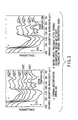
- FIG. 3a shows the changes in the infrared absorption spectra when the pellet sample was heated under the air atmosphere. The measurements were carried out at room temperature after cooling the samples down to room temperature. Two absorption peaks observed at 907 cm -1 and 954 cm -1 are inherent in SMA.
- pellet sample is heated to 400°C or more, these two peak intensities are attenuated and a single absorption peak is newly observed at 1000 cm -1 .
- the new absorption peak is characteristic of molybdenum oxide (MoO 3 ). If the sample is heated to 600°C, the absorption peaks ascribed to SMA disappear substantially completely, and only the absorption peak ascribed to MoO 3 can be observed.
- SMA is poor in heat resistance. If heated to 350°C or higher, SMA is easily decomposed to form silica and molybdenum oxide as given below: H 4 SiMo 12 O 40 ⁇ SiO 2 + 12MoO 3 + 2H 2 O
- FIG. 3b shows the results.
- SMA was gradually regenerated by the treatment with water vapor.
- a small amount of SMA is formed if a silica powder and a molybdenum oxide powder are mixed and stirred within water, as described in, for example, "J.M. Tatibouet, et al., J. Chem. Soc., Chem.
- the regenerated SMA begins to be thermally decomposed at 400°C and is thermally decomposed completely at 600°C to form silica and molybdenum oxide, as in FIG. 3a.
- Example 3 It has been confirmed in Example 3 that the yield of methanol/formaldehyde is markedly increased where the water vapor supply rate is set at 3.0 to 3.5 L/h (water vapor partial pressure of 60 to 64%).
- Example 5 an experiment was conducted under a water vapor supply rate of 3.5 L/h by changing the amount of SMA supported on silica powder 2 in order to observe the change in the catalytic activity caused by the change in the amount of the supported SMA.
- the other reacting conditions were equal to those in Example 3, as given below:
- the amount of the supported SMA was changed within a range of 6 to 36 mass %.
- the experimental data are shown in Table 3 and FIG. 4. Change in catalytic activity caused by change in amount of supported SMA Amount of supported SMA (% by mass) 6 12 18 27 36 Methane conversion rate (%) 4.3 6.5 7.9 11.3 11.0 Methanol/formaldehyde selectivity (%) 84.8 71.4 83.2 83.9 86.6 CO selectivity (%) 2.6 12.9 3.6 7.8 4.8 CO 2 selectivity (%) 12.6 15.7 13.2 9.0 8.5 Methanol/formaldehyde yield (%) 3.67 4.66 6.60 9.44 9.56
- the experimental data indicate that the methane conversion rate is increased with increase in the supported amount of SMA, leading to an increased yield of methanol/formaldehyde, though the selectivity of methanol/formaldehyde is not appreciably changed by the change in the supported amount of SMA.
- a prominently high yield of methanol/formaldehyde i.e., about 10%, was obtained where the supported amount of SMA exceeded 18 mass %.
- the methane/oxygen ratio of the methane/oxygen mixed gas used in the reaction is 1/1.
- the methane/oxygen ratio was set at 9/1.
- Example 6 1.5g of 27mass%SMA/SiO 2 catalyst was used, and the reaction was carried out under a water vapor flow rate of 3.5 L/hr, the reaction temperature of 600°C and the heating rate to the reaction temperature of 100°C/min, while changing the methane/oxygen ratio within a range of 9/1 to 4/6 for evaluating the catalytic activity.
- the flow rate of the methane/oxygen mixed gas was set constant at 2.0 L/h.
- the methane/oxygen volume ratio was changed stepwise from 9/1 to 4/6.
- the oxygen content of the methane/oxygen mixture was increased stepwise.
- the methanol/formaldehyde yield was found to increase with increase in the oxygen content of the methane/oxygen mixture to reach 17.25% when the methane/oxygen volume ratio was set at 6/4.
- the methane/oxygen volume ratio was held within a range of between 9/1 and 6/4
- the methanol/formaldehyde selectivity of the reaction mixture was held substantially constant at 85% or more. Also, the selectivity of any of carbon monoxide and carbon dioxide was lower than 10%.
- Example 7 Dependence of Catalytic Activity on Specific Surface Area of Silica Carrier:
- a single SMA molecule has a diameter of about 28 X 10 -10 m and, thus, has a cross sectional area of about 600 X 10 -20 m 2 . Also, SMA has a molecular weight of about 1824. Therefore, in the 27mass%SMA/SiO 2 catalyst, 0.27g of SMA, i.e., 0.9 X 10 20 SMA molecules, are supported by 1g of silica. It should be noted that the sum of the cross sectional areas of 0.9 X 10 20 SMA molecules is 540m 2 .
- silica powder 2 shown in Table 1 was used as a silica carrier. As shown in Table 1, silica powder 2 has a specific surface area of 570 m 2 /g.
- the entire surface of the silica carrier is covered substantially completely with a monolayer of the SMA molecules.
- the SMA molecules are caused to form a plurality of layers on the silica surface.
- the methanol/formaldehyde yield remains substantially constant if the amount of SMA supported on the carrier is 27 mass % or more.
- the catalytic activity substantially reaches saturation if SMA is supported in an amount sufficient to form a monolayer covering the entire surface of the silica carrier.
- Example 7 a 27mass%SMA/SiO 2 catalyst was prepared as in Example 1 by using each of silica powders 1, 2 and 3 prepared in Preparation Example 1, the silica powders differing from each other in specific surface area, for evaluating the catalytic activity.
- the reaction was carried out under the methane/oxygen ratio of the mixed gas of 9/1, the water vapor flow rate of 3.5 L/h, the reaction temperature of 600°C, and the heating rate to the reaction temperature of 100°C/min. Table 5 and FIG. 6 show the results.
- silica powder 1 having the smallest specific surface area led to a low methane conversion rate and to a low selectivity of methanol/formaldehyde.
- the yield of methanol/formaldehyde for silica powder 1 was lower than those for the other silica powders.
- SMA molecules are agglomerated on the surface of the silica carrier. This clearly suggests that the SMA agglomeration is not desirable for the partial oxidation of methane.
- Example 8 The reaction was carried out under the conditions similar to those for Example 7.
- used was 1.5g of a 27mass%SMA/SiO 2 catalyst prepared by using silica powder 2, and the reaction temperature was changed within a range of between 550°C and 650°C (heating rate of 100°C/min) so as to evaluate the effect given by the reaction temperature to the catalytic activity.
- Table 6 and FIG. 7 show the results.
- Durability tests were conducted under different conditions by using 1.5g of a 27mass%SMA/SiO 2 catalyst. Specifically, one of the tests was conducted for 85 hours under the methane flow rate of 1.8 L/h, the oxygen flow rate of 0.2 L/h, the water vapor flow rate of 3.5 L/h, the reaction temperature of 600°C and the heating rate to the reaction temperature of 100°C/min. Table 7 and FIG. 8 show the results.
- Material Balance of Carbon A/B X 100 where A represents the sum of the unreacted methane, methanol, formaldehyde, CO and CO 2 , and B denotes the amount of methane supplied to the reaction system.
- the heating rate to the reaction temperature was set at 100°C/min.
- the influences given by the heating rate to the catalytic activity will now be described as Examples 10 and 11.
- FIG. 10 shows the X-ray diffraction pattern of the SMA/SiO 2 catalyst after the catalyst was heated to 600°C at each of various heating rates.
- the arrows put in the diffraction pattern denote diffraction peaks characteristic of molybdenum oxide. These peaks clearly support that SMA was decomposed in the catalysts that were heated at relatively low heating rates of 40°C/min and 60°C/min so as to form large crystal grains of molybdenum oxide.
- the molybdenum oxide was formed in a small amount in the SMA catalyst that was heated rapidly at a heating rate of 100°C/min, suggesting that almost all portion of the SMA catalyst remained as it was.
- the diffraction peaks denoted by asterisks * in the diffraction pattern represent peaks belonging to ⁇ -molybdenum oxide (MoO 3 ⁇ H 2 O) formed by decomposition of SMA in the cooling process from 600°C to room temperature.
- ⁇ -molybdenum oxide MoO 3 ⁇ H 2 O
- the heating rate in the process of heating the silica-supported SMA catalyst to the reaction temperature in order to suppress decomposition of the catalyst during the heating process.
- the reaction mixture which consisted of formaldehyde, carbon dioxide and carbon monoxide, was subjected to a quantitative analysis by means of a gas chromatography so as to evaluate the catalytic activity by the method equal to that employed in Example 2.
- Table 9 and FIG. 11 show the results.
- the methane conversion rate was markedly low in the SMA/SiO 2 catalysts heated at the heating rates of 40°C/min and 60°C/min, compared with the catalyst heated at a heating rate of 100°C/min.
- SMA active species of the reaction
- SMA was decomposed in the catalysts heated at heating rates of 40°C/min and 60°C/min.
- carbon dioxide gas was contained in the reaction mixture in the catalysts heated at heating rates of 40°C/min and 60°C/min.
- the silica-supported SMA catalyst plays the role of the active species in the reaction of forming formaldehyde.
- Example 9 the experimental data obtained in Example 9 clearly support that, if the silica-supported SMA catalyst is heated at such a high heating rate as 100°C/min or more, it is possible to suppress decomposition of the SMA catalyst in the heating step.
Landscapes
- Chemical & Material Sciences (AREA)
- Organic Chemistry (AREA)
- Engineering & Computer Science (AREA)
- Materials Engineering (AREA)
- Chemical Kinetics & Catalysis (AREA)
- Catalysts (AREA)
- Organic Low-Molecular-Weight Compounds And Preparation Thereof (AREA)
Applications Claiming Priority (2)
| Application Number | Priority Date | Filing Date | Title |
|---|---|---|---|
| JP2000087641 | 2000-03-27 | ||
| JP2000087641A JP3383841B2 (ja) | 1999-03-26 | 2000-03-27 | メタンから直接ホルムアルデヒドを製造する方法 |
Publications (2)
| Publication Number | Publication Date |
|---|---|
| EP1138380A1 true EP1138380A1 (fr) | 2001-10-04 |
| EP1138380B1 EP1138380B1 (fr) | 2004-07-28 |
Family
ID=18603616
Family Applications (1)
| Application Number | Title | Priority Date | Filing Date |
|---|---|---|---|
| EP00110907A Expired - Lifetime EP1138380B1 (fr) | 2000-03-27 | 2000-05-24 | Méthode de production du fomaldéhyde directement à partir du méthane |
Country Status (6)
| Country | Link |
|---|---|
| US (1) | US6414195B1 (fr) |
| EP (1) | EP1138380B1 (fr) |
| AU (1) | AU747541B2 (fr) |
| DE (1) | DE60012478T2 (fr) |
| ES (1) | ES2223346T3 (fr) |
| HU (1) | HUP0002005A3 (fr) |
Cited By (1)
| Publication number | Priority date | Publication date | Assignee | Title |
|---|---|---|---|---|
| WO2023073592A1 (fr) * | 2021-10-27 | 2023-05-04 | University Of Cape Town | Oxydation sélective de méthane en milieu aérobie |
Families Citing this family (2)
| Publication number | Priority date | Publication date | Assignee | Title |
|---|---|---|---|---|
| AU2001275941A1 (en) * | 2000-08-07 | 2002-02-18 | Honda Of America Mfg., Inc. | Supplier synchronization system and method |
| US10786044B2 (en) | 2017-08-16 | 2020-09-29 | Wolverine Outdoors, Inc. | Footwear with protective toe guard and related method |
Citations (5)
| Publication number | Priority date | Publication date | Assignee | Title |
|---|---|---|---|---|
| WO1986006063A1 (fr) * | 1985-04-16 | 1986-10-23 | W. R. Grace & Co. | Procede et catalyseur a faible teneur en sodium pour la production de formaldehyde a partir de methane |
| US4705771A (en) * | 1985-04-16 | 1987-11-10 | W. R. Grace & Co. | Process and catalyst for the production of formaldehyde from methane |
| EP0419077A2 (fr) * | 1989-09-20 | 1991-03-27 | Texaco Chemical Company | Synthèse d'éthers de bas poids moléculaire d'éthylène glycol ou de propylène glycol par addition d'oléfine au glycol correspondant |
| US5300703A (en) * | 1993-04-05 | 1994-04-05 | Texaco Chemical Company | Alkylphenol synthesis using heteropoly acid catalysts |
| WO1995013869A1 (fr) * | 1993-11-19 | 1995-05-26 | Exxon Research & Engineering Company | Composes heteropoly et leur utilisation dans l'alkylation aromatique |
Family Cites Families (1)
| Publication number | Priority date | Publication date | Assignee | Title |
|---|---|---|---|---|
| EP1038578A3 (fr) | 1999-03-26 | 2002-01-30 | President of Shizuoka University, a government agency of Japan | Procédé de production de formaldehyde directement à partir de méthane |
-
2000
- 2000-05-23 AU AU36413/00A patent/AU747541B2/en not_active Ceased
- 2000-05-23 US US09/576,293 patent/US6414195B1/en not_active Expired - Fee Related
- 2000-05-24 ES ES00110907T patent/ES2223346T3/es not_active Expired - Lifetime
- 2000-05-24 DE DE60012478T patent/DE60012478T2/de not_active Expired - Fee Related
- 2000-05-24 HU HU0002005A patent/HUP0002005A3/hu unknown
- 2000-05-24 EP EP00110907A patent/EP1138380B1/fr not_active Expired - Lifetime
Patent Citations (5)
| Publication number | Priority date | Publication date | Assignee | Title |
|---|---|---|---|---|
| WO1986006063A1 (fr) * | 1985-04-16 | 1986-10-23 | W. R. Grace & Co. | Procede et catalyseur a faible teneur en sodium pour la production de formaldehyde a partir de methane |
| US4705771A (en) * | 1985-04-16 | 1987-11-10 | W. R. Grace & Co. | Process and catalyst for the production of formaldehyde from methane |
| EP0419077A2 (fr) * | 1989-09-20 | 1991-03-27 | Texaco Chemical Company | Synthèse d'éthers de bas poids moléculaire d'éthylène glycol ou de propylène glycol par addition d'oléfine au glycol correspondant |
| US5300703A (en) * | 1993-04-05 | 1994-04-05 | Texaco Chemical Company | Alkylphenol synthesis using heteropoly acid catalysts |
| WO1995013869A1 (fr) * | 1993-11-19 | 1995-05-26 | Exxon Research & Engineering Company | Composes heteropoly et leur utilisation dans l'alkylation aromatique |
Cited By (1)
| Publication number | Priority date | Publication date | Assignee | Title |
|---|---|---|---|---|
| WO2023073592A1 (fr) * | 2021-10-27 | 2023-05-04 | University Of Cape Town | Oxydation sélective de méthane en milieu aérobie |
Also Published As
| Publication number | Publication date |
|---|---|
| EP1138380B1 (fr) | 2004-07-28 |
| DE60012478T2 (de) | 2005-08-04 |
| AU3641300A (en) | 2001-10-04 |
| HUP0002005A2 (hu) | 2002-01-28 |
| HUP0002005A3 (en) | 2004-03-01 |
| US6414195B1 (en) | 2002-07-02 |
| ES2223346T3 (es) | 2005-03-01 |
| AU747541B2 (en) | 2002-05-16 |
| DE60012478D1 (de) | 2004-09-02 |
Similar Documents
| Publication | Publication Date | Title |
|---|---|---|
| Krenzke et al. | The catalytic oxidation of propylene: VI. Mechanistic studies utilizing isotopic tracers | |
| Liu et al. | Low-temperature CO oxidation on CuO-CeO2 catalyst prepared by facile one-step solvothermal synthesis: Improved activity and moisture resistance via optimizing the activation temperature | |
| Mendelovici et al. | Partial oxidation of ethane to ethylene and acetaldehyde over a supported molybdenum catalyst | |
| Toth et al. | Partial oxidation of ethanol on supported Rh catalysts: Effect of the oxide support | |
| Sivaraj et al. | Characterization of copper/alumina catalysts prepared by deposition—precipitation using urea hydrolysis: I. Nitrous Oxide Decomposition and Reaction of Ethanol | |
| CN105859555A (zh) | 一种甲醇常压下脱氢制备甲酸甲酯的方法 | |
| Liu et al. | Methanol steam reforming using Ce and La modified low-Cu catalysts for on-board hydrogen production | |
| Shter et al. | Organically doped metals—A new approach to metal catalysis: Enhanced Ag‐catalyzed oxidation of methanol | |
| EP1138380B1 (fr) | Méthode de production du fomaldéhyde directement à partir du méthane | |
| Kido et al. | Effects of catalyst heating rates upon the activity of silica-supported silicomolybdic acid catalysts for methane partial oxidation | |
| AU733990B2 (en) | Method of producing formaldehyde directly from methane | |
| Álvarez-Rodríguez et al. | Effect of nickel precursor and the copper addition on the surface properties of Ni/KL-supported catalysts for selective hydrogenation of citral | |
| Qiu et al. | Selective oxidation of methyl glycolate to methyl glyoxylate with molecular oxygen catalyzed by VOx/γ-Al2O3 | |
| Huang et al. | Influence of Zirconia Promoter on Catalytic Properties of Cu–Cr–Si Catalysts for Methanol Synthesis at High CO Conversion in Slurry Phase. | |
| JP2022549727A (ja) | イソプロピルベンゼンを製造するための触媒ならびにその製造方法および使用 | |
| JP3383841B2 (ja) | メタンから直接ホルムアルデヒドを製造する方法 | |
| US10987656B2 (en) | Core-shell nanoparticle, method for manufacturing same and method for producing hydrogen peroxide using same | |
| Semushina et al. | Relationship between the catalytic properties of the products of the oxidative thermolysis of certain complexes and the porous structures of samples in the oxidation reactions of volatile organic compounds | |
| Genta et al. | Roles of alkali-metal added to Cu-NaZSM-5 catalysts in the oxidation of benzyl alcohol | |
| Xu et al. | Effect of alkali metals added to Cu ion-exchanged Y-type zeolite catalysts in the gas-phase catalytic oxidation of benzyl alcohol | |
| Tarasov et al. | The influence of the dispersion of metals on the activity of Pt/C and Pd/C catalysts in the dehydrogenation of perhydroterphenyl | |
| Matsumura et al. | Mechanism for the formation of carbon dioxide in the catalytic oxidation of carbon monoxide and methane on silica | |
| CN115475645B (zh) | 一种氧化催化剂及其制备方法和应用 | |
| Matsumoto et al. | Reaction mechanism of methane oxidation to synthesis gas over an activated PdY zeolite | |
| Volkov et al. | Catalytic perfomance of rhodium chalcogen halides and rhodium chalcogenides over silica supports in methane oxidative carbonylation |
Legal Events
| Date | Code | Title | Description |
|---|---|---|---|
| PUAI | Public reference made under article 153(3) epc to a published international application that has entered the european phase |
Free format text: ORIGINAL CODE: 0009012 |
|
| 17P | Request for examination filed |
Effective date: 20000809 |
|
| AK | Designated contracting states |
Kind code of ref document: A1 Designated state(s): AT BE CH CY DE DK ES FI FR GB GR IE IT LI LU MC NL PT SE Kind code of ref document: A1 Designated state(s): DE ES FR GB IT NL |
|
| AX | Request for extension of the european patent |
Free format text: AL;LT;LV;MK;RO;SI |
|
| 17Q | First examination report despatched |
Effective date: 20011214 |
|
| AKX | Designation fees paid |
Free format text: DE ES FR GB IT NL |
|
| GRAP | Despatch of communication of intention to grant a patent |
Free format text: ORIGINAL CODE: EPIDOSNIGR1 |
|
| GRAS | Grant fee paid |
Free format text: ORIGINAL CODE: EPIDOSNIGR3 |
|
| GRAA | (expected) grant |
Free format text: ORIGINAL CODE: 0009210 |
|
| AK | Designated contracting states |
Kind code of ref document: B1 Designated state(s): DE ES FR GB IT NL |
|
| REG | Reference to a national code |
Ref country code: GB Ref legal event code: FG4D |
|
| REF | Corresponds to: |
Ref document number: 60012478 Country of ref document: DE Date of ref document: 20040902 Kind code of ref document: P |
|
| ET | Fr: translation filed | ||
| REG | Reference to a national code |
Ref country code: ES Ref legal event code: FG2A Ref document number: 2223346 Country of ref document: ES Kind code of ref document: T3 |
|
| PG25 | Lapsed in a contracting state [announced via postgrant information from national office to epo] |
Ref country code: IT Free format text: LAPSE BECAUSE OF NON-PAYMENT OF DUE FEES Effective date: 20050524 Ref country code: GB Free format text: LAPSE BECAUSE OF NON-PAYMENT OF DUE FEES Effective date: 20050524 |
|
| PG25 | Lapsed in a contracting state [announced via postgrant information from national office to epo] |
Ref country code: ES Free format text: LAPSE BECAUSE OF NON-PAYMENT OF DUE FEES Effective date: 20050525 |
|
| PLBE | No opposition filed within time limit |
Free format text: ORIGINAL CODE: 0009261 |
|
| STAA | Information on the status of an ep patent application or granted ep patent |
Free format text: STATUS: NO OPPOSITION FILED WITHIN TIME LIMIT |
|
| 26N | No opposition filed |
Effective date: 20050429 |
|
| PG25 | Lapsed in a contracting state [announced via postgrant information from national office to epo] |
Ref country code: NL Free format text: LAPSE BECAUSE OF NON-PAYMENT OF DUE FEES Effective date: 20051201 Ref country code: DE Free format text: LAPSE BECAUSE OF NON-PAYMENT OF DUE FEES Effective date: 20051201 |
|
| GBPC | Gb: european patent ceased through non-payment of renewal fee |
Effective date: 20050524 |
|
| PG25 | Lapsed in a contracting state [announced via postgrant information from national office to epo] |
Ref country code: FR Free format text: LAPSE BECAUSE OF NON-PAYMENT OF DUE FEES Effective date: 20060131 |
|
| NLV4 | Nl: lapsed or anulled due to non-payment of the annual fee |
Effective date: 20051201 |
|
| REG | Reference to a national code |
Ref country code: FR Ref legal event code: ST Effective date: 20060131 |
|
| REG | Reference to a national code |
Ref country code: ES Ref legal event code: FD2A Effective date: 20050525 |