EP1140918B1 - Thrombin-inhibitoren - Google Patents
Thrombin-inhibitoren Download PDFInfo
- Publication number
- EP1140918B1 EP1140918B1 EP99962534A EP99962534A EP1140918B1 EP 1140918 B1 EP1140918 B1 EP 1140918B1 EP 99962534 A EP99962534 A EP 99962534A EP 99962534 A EP99962534 A EP 99962534A EP 1140918 B1 EP1140918 B1 EP 1140918B1
- Authority
- EP
- European Patent Office
- Prior art keywords
- methyl
- amide
- prolyl
- amidino
- diphenylalanyl
- Prior art date
- Legal status (The legal status is an assumption and is not a legal conclusion. Google has not performed a legal analysis and makes no representation as to the accuracy of the status listed.)
- Expired - Lifetime
Links
- CZZYITDELCSZES-UHFFFAOYSA-N C(c1ccccc1)c1ccccc1 Chemical compound C(c1ccccc1)c1ccccc1 CZZYITDELCSZES-UHFFFAOYSA-N 0.000 description 1
- XKTPXDUNTNQDPG-UHFFFAOYSA-N NC(c1ccc(CNC(C(CC(C2)c3c(Cc4ccccc4)cccc3)N2C(CN(CC(O)=O)N)=O)=O)[s]1)=N Chemical compound NC(c1ccc(CNC(C(CC(C2)c3c(Cc4ccccc4)cccc3)N2C(CN(CC(O)=O)N)=O)=O)[s]1)=N XKTPXDUNTNQDPG-UHFFFAOYSA-N 0.000 description 1
- PWYITWXIYGQINI-UHFFFAOYSA-N NC(c1ccc(CNC(C(CC(C2)c3ccccc3Cc3ccccc3)N2C(CN(N)[SH+2](NC2CCCCC2)O)=O)=O)[s]1)=N Chemical compound NC(c1ccc(CNC(C(CC(C2)c3ccccc3Cc3ccccc3)N2C(CN(N)[SH+2](NC2CCCCC2)O)=O)=O)[s]1)=N PWYITWXIYGQINI-UHFFFAOYSA-N 0.000 description 1
- ASMLRPJZTDMOPR-UHFFFAOYSA-O NCc1cc(CNC(C(CCC2)N2C(CN[SH+]O)=O)=O)c[s]1 Chemical compound NCc1cc(CNC(C(CCC2)N2C(CN[SH+]O)=O)=O)c[s]1 ASMLRPJZTDMOPR-UHFFFAOYSA-O 0.000 description 1
Classifications
-
- C—CHEMISTRY; METALLURGY
- C07—ORGANIC CHEMISTRY
- C07D—HETEROCYCLIC COMPOUNDS
- C07D205/00—Heterocyclic compounds containing four-membered rings with one nitrogen atom as the only ring hetero atom
- C07D205/02—Heterocyclic compounds containing four-membered rings with one nitrogen atom as the only ring hetero atom not condensed with other rings
- C07D205/06—Heterocyclic compounds containing four-membered rings with one nitrogen atom as the only ring hetero atom not condensed with other rings having one double bond between ring members or between a ring member and a non-ring member
- C07D205/08—Heterocyclic compounds containing four-membered rings with one nitrogen atom as the only ring hetero atom not condensed with other rings having one double bond between ring members or between a ring member and a non-ring member with one oxygen atom directly attached in position 2, e.g. beta-lactams
- C07D205/085—Heterocyclic compounds containing four-membered rings with one nitrogen atom as the only ring hetero atom not condensed with other rings having one double bond between ring members or between a ring member and a non-ring member with one oxygen atom directly attached in position 2, e.g. beta-lactams with a nitrogen atom directly attached in position 3
-
- C—CHEMISTRY; METALLURGY
- C07—ORGANIC CHEMISTRY
- C07K—PEPTIDES
- C07K5/00—Peptides containing up to four amino acids in a fully defined sequence; Derivatives thereof
- C07K5/02—Peptides containing up to four amino acids in a fully defined sequence; Derivatives thereof containing at least one abnormal peptide link
- C07K5/022—Peptides containing up to four amino acids in a fully defined sequence; Derivatives thereof containing at least one abnormal peptide link containing the structure -X-C(=O)-(C)n-N-C-C(=O)-Y-; X and Y being heteroatoms; n being 1 or 2
- C07K5/0222—Peptides containing up to four amino acids in a fully defined sequence; Derivatives thereof containing at least one abnormal peptide link containing the structure -X-C(=O)-(C)n-N-C-C(=O)-Y-; X and Y being heteroatoms; n being 1 or 2 with the first amino acid being heterocyclic, e.g. Pro, Trp
-
- A—HUMAN NECESSITIES
- A61—MEDICAL OR VETERINARY SCIENCE; HYGIENE
- A61P—SPECIFIC THERAPEUTIC ACTIVITY OF CHEMICAL COMPOUNDS OR MEDICINAL PREPARATIONS
- A61P43/00—Drugs for specific purposes, not provided for in groups A61P1/00-A61P41/00
-
- A—HUMAN NECESSITIES
- A61—MEDICAL OR VETERINARY SCIENCE; HYGIENE
- A61P—SPECIFIC THERAPEUTIC ACTIVITY OF CHEMICAL COMPOUNDS OR MEDICINAL PREPARATIONS
- A61P7/00—Drugs for disorders of the blood or the extracellular fluid
-
- A—HUMAN NECESSITIES
- A61—MEDICAL OR VETERINARY SCIENCE; HYGIENE
- A61P—SPECIFIC THERAPEUTIC ACTIVITY OF CHEMICAL COMPOUNDS OR MEDICINAL PREPARATIONS
- A61P7/00—Drugs for disorders of the blood or the extracellular fluid
- A61P7/02—Antithrombotic agents; Anticoagulants; Platelet aggregation inhibitors
-
- A—HUMAN NECESSITIES
- A61—MEDICAL OR VETERINARY SCIENCE; HYGIENE
- A61P—SPECIFIC THERAPEUTIC ACTIVITY OF CHEMICAL COMPOUNDS OR MEDICINAL PREPARATIONS
- A61P9/00—Drugs for disorders of the cardiovascular system
- A61P9/10—Drugs for disorders of the cardiovascular system for treating ischaemic or atherosclerotic diseases, e.g. antianginal drugs, coronary vasodilators, drugs for myocardial infarction, retinopathy, cerebrovascula insufficiency, renal arteriosclerosis
-
- C—CHEMISTRY; METALLURGY
- C07—ORGANIC CHEMISTRY
- C07K—PEPTIDES
- C07K5/00—Peptides containing up to four amino acids in a fully defined sequence; Derivatives thereof
- C07K5/04—Peptides containing up to four amino acids in a fully defined sequence; Derivatives thereof containing only normal peptide links
- C07K5/06—Dipeptides
- C07K5/06008—Dipeptides with the first amino acid being neutral
- C07K5/06078—Dipeptides with the first amino acid being neutral and aromatic or cycloaliphatic
-
- A—HUMAN NECESSITIES
- A61—MEDICAL OR VETERINARY SCIENCE; HYGIENE
- A61K—PREPARATIONS FOR MEDICAL, DENTAL OR TOILETRY PURPOSES
- A61K38/00—Medicinal preparations containing peptides
Definitions
- the present invention relates to thrombin inhibitors that are useful as anticoagulants.
- this invention relates to peptide derivatives having high antithrombotic activity and high oral bioavailability.
- Thrombosis is characterized by excessive blood clotting.
- the condition plays a significant role in cardiovascular and related diseases, and thrombotic events underlie a significant proportion of the mortality and morbidity associated with cardiovascular disease.
- Thrombosis can cause a range of disease states which are characterized by the location of the blood vessel in which the clot is formed.
- Thrombin is a trypsin-like serine protease that plays a key role in the blood coagulation cascade by catalyzing the conversion of fibrinogen to insoluble fibrin. This enzyme also activates Factor V and Factor VIII for its own production and potently activates platelets as well. Therefore, thrombin has long been recognized as a central regulator in thrombosis and hemostasis, and its inhibition has become a major therapeutic target in the treatment of cardiovascular diseases such as myocardial infarction, unstable angina, deep vein thrombosis and pulmonary embolism
- Indirect thrombin inhibitors such as heparin and warfarin (coumarin) have been used as antithrombotic therapies with, however, several limitations Heparin demonstrates low bioavailability and is associated with side effects such as bleeding problems, moreover, it is not able to inhibit clot-bound thrombin.
- Warfarin is an effective oral anticoagulant but it has a narrow therapeutic window and also requires patient monitoring.
- a natural protein inhibitor, hirudin has been associated with bleeding complications.
- thrombin inhibitors are broadly based upon peptides or peptidomimetic templates which operate by a direct mechanism of action against the target enzyme.
- tripeptidic aldehydes such as D-Phe-Pro-Arg-H and Me-D-Phe-Pro-Arg-H that have been reported to be effective thrombin inhibitors (Bajusz et al. J. Med. Chem. 1990, 33, 1729).
- thrombin inhibitors bearing the unique amino acid D-diphenylalanine at P3 position have been disclosed (WO 93/11152, US 5510369. WO 97/15190). These compounds have been reported to have higher potency against thrombin compared to the corresponding D-phenylalanine alalogs (J. Med. Chem. 1992, 35, 3365; J. Med. Chem. 1997, 40, 830). In addition, some of this class of compounds exhibited good oral bioavailability (J. Med. Chem. 1997, 40, 3687; J. Med. Chem. 1997, 40, 3726).
- amidinothiophene groups have been shown to be better para-benzamidine surrogates (WO 95/23609, WO98/24784, Bioorg Med. Chem. Lett. 1998, 8. 1683).
- 2,5-thiophene and other 5-membered heterocyclic moieties have effectively served as a para-phenylene isostere in the inhibitors of other drug-targeting enzymes such as thymidylate synthase and glycinamide riobonuceotide formyltransferase (J. Med Chem. 1991, 34, 1594, Cancer Research 1994, 54, 1021, WO 97/41115).
- thrombin inhibitors which have improved oral bioavailability and stablility as compared to those described supra.
- the compounds of the present invention are potent inhibitors of thrombin in vitro and in vivo
- certain compounds of this invention exhibit high bioavailability after oral administration.
- the present invention relates to compounds falling within formula I below which modulate and/or inhibit the serine protease thrombin, as well as to acceptable prodrugs, pharmaceutically active metabolites, and pharmaceutically acceptable salts thereof (such compounds, prodrugs, metabolites and salts are collectively referred to as "agents").
- agents such compounds, prodrugs, metabolites and salts are collectively referred to as "agents").
- the invention is also directed to pharmaceutical compositions containing such agents and their therapeutic use in treating diseases mediated by thrombin, such as myocardial infarction, unstable angina, deep vein thrombosis and pulmonary embolism, as well as other disease states associated with blood clotting and associated clotting factors.
- the invention relates to a compound having formula I: and pharmaceutically acceptable salts thereof wherein n is 2 A is hydrogen, alkyl, C 3-7 cycloalkyl, aryl, -SO 2 R 1 , -SO 3 R 1 , -COR', -CO 2 R 2 , -PO(OR 1 ) 2 , (CH 2 ) m CO 2 R 1 , -(CH 2 ) m SO 2 R 1 , -(CH 2 ) m SO 3 R 1 , or -(CH 2 ) m PO(OR 1 ) 2 , -PO(R 1 ) 2 ; wherein R 1 is hydrogen, C 1-6 alkyl, C 3-7 cycloalkyl, aryl, -(CH 2 ) m aryl, or NR 3 R 4 , hydroxy; R 2 is C 1-6 alkyl, C 3-7 cycloalkyl, aryl, -(CH 2 ) m aryl, or NR 3
- the invention also discloses pharmaceutical compositions each comprising: an effective amount of an agent selected from compounds of Formula I and pharmaceutically acceptable salts, pharmaceutically active metabolites, and pharmaceutically acceptable prodrugs thereof; and a pharmaceutically acceptable carrier or vehicle for such agent.
- the invention further discloses methods of treating cardiovascular diseases such as myocardial infarction, unstable angina, deep vein thrombosis and pulmonary embolism, as well as other disease states associated with excess thrombin.
- inventive compounds of Formula I are useful for mediating the activity of trypsin-like serine proteases. More particularly, the compounds are useful as anticoagulant agents and as agents for modulating and/or inhibiting the activity of trypsin-like serine proteases, thus providing treatments for thrombosis and other cardiovascular diseases such as myocardial infarction, unstable angina, deep vein thrombosis and pulmonary embolism.
- alkyl group is intended to mean a straight or branched chain monovalent radical of saturated and/or unsaturated carbon atoms and hydrogen atoms, such as methyl (Me), ethyl (Et), propyl, isopropyl, butyl (Bu), isobutyl, t-butyl (t-Bu), ethenyl, pentenyl, butenyl, propenyl, ethynyl, butynyl, propynyl, pentynyl, hexynyl, and the like, which may be unsubstituted (i e , containing only carbon and hydrogen) or substituted by one or more suitable sustituents as defined below (e.g , one or more halogens, such as F, Cl, Br, or l, with F and Cl being preferred).
- suitable sustituents e.g , one or more halogens, such as F, Cl, Br, or l
- a "lower alkyl group” is intended to mean an alkyl group having from 1 to 8 carbon atoms in its chain.
- a "cycloalkyl group” is intended to mean a non-aromatic monovalent monocyclic, bicyclic, or tricyclic radical containing 3, 4, 5, 6, 7, 8, 9, 10, 11, 12, 13, or 14 carbon ring atoms, each of which may be saturated or unsaturated, and which may be unsubstituted or substituted by one or more suitable substituents as defined below, and to which may be fused one or more heterocycloalkyl groups, aryl groups, or heteroaryl groups, which themselves may be unsubstituted or substituted by one or more substituents.
- heterocycloalkyl group is intended to mean a non-aromatic monovalent monocyclic, bicyclic, or tricyclic radical, which is saturated or unsaturated, containing 3, 4, 5, 6, 7, 8, 9, 10, 11, 12, 13, 14, 15, 16, 17, or 18 ring atoms, which includes 1, 2, 3, 4, or 5 heteroatoms selected nitrogen, oxygen, and sulfur, where the radical is unsubstituted or substituted by one or more suitable substituents as defined below, and to which may be fused one or more cycloalkyl groups, aryl groups, or heteroaryl groups, which themselves may be unsubstituted or substituted by one or more suitable substituents.
- aryl group is intended to mean an aromatic monovalent monocyclic, bicyclic, or tricyclic radical containing 6, 10, 14, or 18 carbon ring atoms, which may be unsubstituted or substituted by one or more suitable substituents as defined below, and to which may be fused one or more cycloalkyl groups, heterocycloalkyl groups, or heteroaryl groups, which themselves may be unsubstituted or substituted by one or more suitable substituents.
- the term "aryl group” includes a benzyl group (Bzl)., or tricyclic radical containing 4, 5, 6, 7, 8, 9, 10, 11, 12, 13, 14, 15, 16, 17, or 18 ring atoms, including 1.
- heteroatoms selected from nitrogen, oxygen, and sulfur which may be unsubstituted or substituted by one or more suitable substituents as defined below, and to which may be fused one or more cycloalkyl groups, heterocycloalkyl groups, or aryl groups, which themselves may be unsubstituted or substituted by one or more suitable substituents.
- heterocycle is intended to mean a heteroaryl or heterocycloalkyl group (each of which, as defined above, are optionally substituted).
- acyl group is intended to mean a -C(O)-R radical, where R is a substituent as defined below.
- a “thioacyl group” is intended to mean a -C(S)-R radical, where R is a substituent as defined below.
- a “sulfonyl group” is intended to mean a -SO 2 R radical, where R is a substituent as defined below.
- a "hydroxy group” is intended to mean the radical -OH.
- amino group is intended to mean the radical -NH 2 .
- alkylamino group is intended to mean the radical -NHR a , where R a is an alkyl group.
- dialkylamino group is intended to mean the radical -NR a R b , where R a and R b are each independently an alkyl group.
- alkoxy group is intended to mean the radical -OR a , where R a is an alkyl group.
- alkoxy groups include methoxy, ethoxy, propoxy, and the like.
- alkoxycarbonyl group is intended to mean the radical -C(O)OR a , where R a is an alkyl group.
- alkylsulfonyl group is intended to mean the radical -SO 2 R a , where R a is an alkyl group.
- alkylaminocarbonyl group is intended to mean the radical -C(O)NHR a , where R a is an alkyl group.
- dialkylaminocarbonyl group is intended to mean the radical -C(O)NR a R b , where R a and R b are each independently an alkyl group.
- a “mercapto group” is intended to mean the radical -SH.
- alkylthio group is intended to mean the radical -SR a , where R a is an alkyl group.
- a “carboxy group” is intended to mean the radical -C(O)OH.
- a “carbamoyl group” is intended to mean the radical -C(O)NH 2 .
- aryloxy group is intended to mean the radical -OR c , where R c is an aryl group.
- heteroaryloxy group is intended to mean the radical -OR d , where R d is a heteroaryl group.
- arylthio group is intended to mean the radical -SR c , where R c is an aryl group.
- heteroarylthio group is intended to mean the radical -SR d , where R d is a heteroaryl group.
- a “leaving group” is intended to mean any suitable group that will be displaced by a substitution reaction.
- any conjugate base of a strong acid can act as a leaving group.
- suitable leaving groups include, but are not limited to, -F, -Cl, -Br, alkyl chlorides, alkyl bromides, alkyl iodides, alkyl sulfonates, alkyl benzenesulfonates, alkyl p-toluenesulfonates, alkyl methanesulfonates, triflate, and any groups having a bisulfate, methyl sulfate, or sulfonate ion.
- suitable organic moiety is intended to mean any organic moiety recognizable, such as by routine testing, to those skilled in the art as not adversely affecting the inhibitory activity of the inventive compounds.
- suitable organic moieties include, but are not limited to, hydroxyl groups, alkyl groups, oxo groups, cycloalkyl groups, heterocycloalkyl groups, aryl groups, heteroaryl groups, acyl groups, sulfonyl groups, mercapto groups, alkylthio groups, alkoxy groups, carboxy groups, amino groups, alkylamino groups, dialkylamino groups, carbamoyl groups, arylthio groups, heteroarylthio groups, and the like.
- substituted substituent or suitable substituent is intended to mean any suitable substituent that may be recognized or selected, such as through routine testing, by those skilled in the art.
- suitable substituents include hydroxy groups, halogens, oxo groups, alkyl groups, acyl groups, sulfonyl groups, mercapto groups, alkylthio groups, alkyloxy groups, cycloalkyl groups, heterocycloalkyl groups, aryl groups, heteroaryl groups, carboxy groups, amino groups, alkylamino groups, dialkylamino groups, carbamoyl groups, aryloxy groups, heteroaryloxy groups, arylthio groups, heteroarylthio groups, and the like.
- optionally substituted is intended to expressly indicate that the specified group is unsubstituted or substituted by one or more suitable substituents, unless the optional substituents are expressly specified, in which case the term indicates that the group is unsubstituted or substituted with the specified substituents.
- various groups may be unsubstituted or substituted (i.e., they are optionally substituted) unless indicated otherwise herein (e.g , by indicating that the specified group is unsubstituted).
- a "pharmaceutically acceptable prodrug” is a compound that may be converted under physiological conditions or by solvolysis to the specified compound or to a pharmaceutically acceptable salt of such compound.
- a "pharmaceutically active metabolite” is intended to mean a pharmacologically active product produced through metabolism in the body of a specified compound or salt thereof. Metabolites of a compound may be identified using routine techniques known in the art and their activities determined using tests such as those descibed herein.
- a “pharmaceutically acceptable salt” is intended to mean a salt that retains the biological effectiveness of the free acids and bases of the specified compound and htat is not biologically or otherwise undesirable
- a compound of the invention may possess a sufficiently acidic, a sufficiently basic, or both functional groups, and accordingly react with any of a number of inorganic or organic bases, and inorganic and organic acids, to form pharmaceutically acceptable salt.
- Exemplary pharmaceutically acceptable salts include those salts prepared by reaction of the compounds of the present invention with a nimeral or organic acid or an inorganic base, such as salts including sulfates, pyrosulfates, bisulfates, sulfites, bisulfites, phosphates, monohydrogenphosphates, dihydrogenphosphates, metaphosphates, pyrophosphates, chlorides, bromides, iodides, acetates, propionates, decanoates, caprylates, acrylates, formates, isobutyrates, caproates, heptanoates, propiolates, oxalates, malonates, succinates, suberates, sebacates, fumarates, maleates, butyne-1,4-dioates, hexyne-1,6-dioates, benzoates, chlorobenzoates, methylbenzoates, dinitrobenzoates, hydroxybenzoates, methoxy
- an inorganic acid such as hydrochloric acid
- the desired pharmaceutically acceptable salt may be prepared by any suitable method, for example, treatment of the free acid with an inorganic or organic base, such as an amine (primary, secondary or tertiary), an alkali metal hydroxide or alkaline earth metal hydroxide, or the like.
- suitable salts include organic salts derived from amino acids, such as glycine and arginine, ammonia, primary, secondary, and tertiary amines, and cyclic amines, such as piperidine, morpholine and piperazine, and inorganic salts derived from sodium, calcium, potassium, magnesium, manganese, iron, copper, zinc, aluminum and lithium.
- Preferred compounds of the invention include, but are not limited to the following:
- a protected amino acid such as N-Boc-D-diphenylalnine is coupled to proline methyl ester using a couping agent such as EDC and HOBT.
- the resultant dipeptide is treated with a strong acid such as hydrochloric acid gas or trifluoroacetic acid to remove the t-butoxycarbonyl (Boc) protecting group.
- the resultant free amine is reacted with a sulfonylating reagent such as sulfamoyl chloride and a base such as triethylamine.
- Carbamate-containing compounds are prepared using chloroformates.
- the product is then hydrolyzed with base such as lithium hydroxide, and the resultant acid is coupled to the desired amine such as 5-(aminomethyl)thiophene-2-carbonitrile.
- the coupled product is converted to the amidine by a three-step sequence involving sequential treatment with hydrogen sulfide, methyl iodide, and ammonium acetate.
- the amidrazone compound is obtained by treatment with hydrazine in place of ammonium acetate in the final step.
- the nitrile intermediate is also converted to the methylamine by catalytic hydrogenation in the presence of a strong acid such as hydrochloric acid.
- N-Boc-D-diphenylalnine can be coupled directly to the amine-coupled proline as exemplified by Example 32 (Scheme 3) The product is then deprotected and subsequently sulfonylated.
- Example 28 and Example 29 Another method for synthesizing compounds of the invention, particularly N-carboxyalkyl substituted compounds, is as exemplified by Example 28 and Example 29 (Scheme 4).
- the free amino containing compound reacts with an alkylating agent such as t-butylbromoacetate and a base such as diisopropylethylamine (DIPEA).
- DIPEA diisopropylethylamine
- the resulting compound is treated with hydroxylamine hydrochloride in the presence of base such as sodium carbonate, and the resultant amidoxime is catalytically hydrogenated in the presence of acetic anhydride to produce the amidine.
- the t-butyl group is removed with acid such as trifluoroacetic acid and hydrochloric acid to give the product.
- Amide coupling used to form the compounds of this invention are typically performed by the carbodiimide method with reagents such as dicyclohexylcarbodiimide (DCC) or 1-ethyl-3-(3-dimethylaminopropyl) carbodiimide (EDC).
- DCC dicyclohexylcarbodiimide
- EDC 1-ethyl-3-(3-dimethylaminopropyl) carbodiimide
- Other method for forming the amide or peptide bond include, but not limited to the synthetic routes via an acid chloride, azide, mixed anhydnde or activated ester. The addition and removal of one or more protecting groups are typical practice. Methods for suitable protection and deprotection are provided in "Protective Groups in Organic Synthesis", 3rd Edition, by T. W. Green and Peter G. M Wuts (1999), John Wiley & Sons, Inc., publishers.
- the amide coupling reactions are carried out in an inert organic solvent such as dimethylformamide, dimethylacetamide, tetrahydrofuran, dichloromethane, chloroform, and like common solvents or a mixture of such solvents.
- an inert organic solvent such as dimethylformamide, dimethylacetamide, tetrahydrofuran, dichloromethane, chloroform, and like common solvents or a mixture of such solvents.
- the present invention is further directed to methods of modulating trypsin-like serine protease activity, for example in mammalian tissue, by administering an inventive agent.
- the activity of the inventive compounds as modulators of trypsin-like serine protease activity, such as the activity of thrombin may be measured by any of the methods available to those skilled in the art, including in vivo and/or in vitro assays. These properties may be assessed, for example, by using one or more of the biological testing procedures set out in the examples below.
- compositions of this invention comprise an effective modulating, regulating, or inhibiting amount of a compound of Formula I and an inert, pharmaceutically acceptable carrier or diluent.
- efficacious levels of the inventive agents are provided so as to provide therapeutic benefits involving modulation of tyrpsin-like serine proteases.
- efficacious levels is meant levels in which the effects of tyrpsin-like serine proteases like thrombin are, at a minimum, regulated.
- compositions of the invention may be manufactured in manners generally known for preparing pharmaceutical compositions, e.g., using conventional techniques such as mixing, dissolving, granulating, dragee-making, levigating, emulsifying, encapsulating, entrapping or lyophilizing.
- Pharmaceutical compositions may be formulated in a conventional manner using one or more physiologically acceptable carriers, which may be selected from excipients and auxiliaries that facilitate processing of the active compounds into preparations which can be used pharmaceutically.
- the pharmaceutical compositions also may comprise suitable solid- or gel-phase carriers or excipients.
- suitable solid- or gel-phase carriers or excipients include calcium carbonate, calcium phosphate, sugars, starches, cellulose derivatives, gelatin, and polymers such as polyethylene glycols.
- a solid carrier if a solid carrier is used, the preparation can be tableted, placed in a hard gelatin capsule in powder or pellet form or in the form of a troche or lozenge.
- the amount of solid carrier may vary, but generally will be from about 25 mg to about 1 g. If a liquid carrier is used, the preparation will be in the form of syrup, emulsion, soft gelatin capsule, sterile injectable solution or suspension in an ampule or vial or non-aqueous liquid suspension.
- a pharmaceutically acceptable salt of an inventive agent is dissolved in an aqueous solution of an organic or inorganic acid, such as 0.3M solution of succinic acid or citric acid.
- the agent may be dissolved in a suitable cosolvent or combinations of cosolvents.
- suitable cosolvents include, but are not limited to, alcohol, propylene glycol, polyethylene glycol 300, polysorbate 80, gylcerin and the like in concentrations ranging from 0-60% of the total volume.
- a compound of Formula I is dissolved in DMSO and diluted with water.
- the composition may also be in the form of a solution of a salt form of the active ingredient in an appropriate aqueous vehicle such as water or isotonic saline or dextrose solution.
- a pharmaceutical carrier for hydrophobic compounds is a cosolvent system comprising benzyl alcohol, a nonpolar surfactant, a water-miscible organic polymer, and an aqueous phase.
- the cosolvent system may be a VPD co-solvent system
- VPD is a solution of 3% w/v benzyl alcohol, 8% w/v of the nonpolar surfactant polysorbate 80, and 65% w/v polyethylene glycol 300 made up to volume in absolute ethanol.
- the VPD co-solvent system (VPD:5W) contains VPD diluted 1:1 with a 5% dextrose in water solution. This co-solvent system dissolves hydrophobic compounds well, and itself produces low toxicity upon systemic administration.
- co-solvent system may be varied considerably without destroying its solubility and toxicity characteristics.
- identity of the co-solvent components may be varied: for example, other low-toxicity nonpolar surfactants may be used instead of polysorbate 80; the fraction size of polyethylene glycol may be varied, other biocompatible polymers may replace polyethylene glycol, e.g polyvinyl pyrrolidone; and other sugars or polysaccharides may be substituted for dextrose.
- hydrophobic pharmaceutical compounds may be employed.
- Liposomes and emulsions are known examples of delivery vehicles or carriers for hydrophobic drugs.
- Certain organic solvents such as dimethylsulfoxide also may be employed, although usually at the cost of greater toxicity.
- the compounds may be delivered using a sustained-release system, such as semipermeable matrices of solid hydrophobic polymers containing the therapeutic agent.
- sustained-release materials have been established and are known by those skilled in the art. Sustained-release capsules may, depending on their chemical nature, release the compounds for a few weeks up to over 100 days. Depending on the chemical nature and the biological stability of the therapeutic reagent, additional strategies for protein stabilization may be employed.
- an exemplary daily dose generally employed is from about 0.001 to about 1000 mg/kg of body weight, more preferably from about 0 001 to about 50 mg/kg body weight, and most preferably 1-20 mg/kg, with courses of treatment repeated at appropriate intervals.
- Administration of prodrugs are typically dosed at weight levels which are chemically equivalent to the weight levels of the fully active form.
- the most preferred doses will range from about 0 01 to about 10 mg/kg/minute during a constant rate infusion.
- the thrombin inhibitors may be administered in divided doses of two, three, or four times daily.
- they can be administered in intranasal form vial topical use of suitable intranasal vehicles, or via transdermal routes, using those forms of transdermal skin patches well known to those of ordinary skill in that art.
- the dosage administration will, or course, be continuous rather than intermittent throughout the dosage regime.
- Therapeutically effective amounts of the agents of the invention may be used to treat diseases mediated by modulation or regulation of trypsin-like serine proteases.
- An "effective amount" is intended to mean that amount of an agent that, when administered to a mammal in need of such treatment, is sufficient to effect treatment for a disease mediated by the activity of one or more trypsin-like serine proteases, such as thrombin.
- a therapeutically effective amount of a compound of the Formula I, salt, active metabolite or prodrug thereof is a quantity sufficient to modulate, regulate, or inhibit the activity of one or more protein kinases such that a disease condition which is mediated by that activity is reduced or alleviated.
- the amount of a given agent that will correspond to such an amount will vary depending upon factors such as the particular compound, disease condition and its severity, the identity (e g., weight) of the mammal in need of treatment, but can nevertheless be routinely determined by one skilled in the art.
- Treating is intended to mean at least the mitigation of a disease condition in a mammal, such as a human, that is affected, at least in part, by the activity of one or more trypsin-like serine proteases, such as thrombin, and includes: preventing the disease condition from occurring in a mammal, particularly when the mammal is found to be predisposed to having the disease condition but has not yet been diagnosed as having it; modulating and/or inhibiting the disease condition; and/or alleviating the disease condition.
- inventive compounds may be administered in intravenous (bolus or infusion), intraperitoneal, subcutaneous, or intramuscular form, all using forms well known to those of ordinary skill in the pharmaceutical arts.
- An effective but non-toxic amount of the compound desired can be employed as an anti-aggregation agent.
- the compounds may be administered intraocularly or topically as well as orally or parenterally.
- the agents of the invention may be formulated into aqueous solutions, preferably in physiologically compatible buffers such as Hanks's solution, Ringer's solution or physiological saline buffer.
- physiologically compatible buffers such as Hanks's solution, Ringer's solution or physiological saline buffer.
- penetrants appropriate to the barrier to be permeated are used in the formulation. Such penetrants are generally known in the art.
- the compounds can be formulated readily by combining the active compounds with pharmaceutically acceptable carriers known in the art.
- Such carriers enable the compounds of the invention to be formulated as tablets, pills, dragees, capsules, liquids, gels, syrups, slurries, suspensions and the like, for oral ingestion by a patient to be treated.
- compositions for oral use can be obtained using a solid excipient in admixture with the active ingredient (agent), optionally grinding the resulting mixture, and processing the mixture of granules after adding suitable auxiliaries, if desired, to obtain tablets or dragee cores
- suitable excipients include fillers such as sugars, including lactose, sucrose, mannitol, or sorbitol; and cellulose preparations, for example, maize starch, wheat starch, rice starch, potato starch, gelatin, gum, methyl cellulose, hydroxypropylmethyl-cellulose, sodium carboxymethylcellulose, or polyvinylpyrrolidone (PVP).
- disintegrating agents may be added, such as crosslinked polyvinyl pyrrolidone, agar, or alginic acid or a salt thereof such as sodium alginate.
- Dragee cores are provided with suitable coatings.
- suitable coatings For this purpose, concentrated sugar solutions may be used, which may optionally contain gum arabic, polyvinyl pyrrolidone, Carbopol gel, polyethylene glycol, and/or titanium dioxide, lacquer solutions, and suitable organic solvents or solvent mixtures.
- Dyestuffs or pigments may be added to the tablets or dragee coatings for identification or to characterize different combinations of active agents.
- compositions which can be used orally include push-fit capsules made of gelatin, as well as soft, sealed capsules made of gelatin and a plasticizer, such as glycerol or sorbitol.
- the push-fit capsules can contain the active ingredients in admixture with fillers such as lactose, binders such as starches, and/or lubricants such as talc or magnesium stearate, and, optionally, stabilizers.
- the active agents may be dissolved or suspended in suitable liquids, such as fatty oils, liquid paraffin, or liquid polyethylene glycols.
- stabilizers may be added. All formulations for oral administration should be in dosages suitable for such administration.
- the compositions may take the form of tablets or lozenges formulated in conventional manner.
- the compounds for use according to the present invention are conveniently delivered in the form of an aerosol spray presentation from pressurized packs or a nebuliser, with the use of a suitable propellant, e g., dichlorodifluoromethane, trichlorofluoromethane, dichlorotetrafluoroethane, carbon dioxide or other suitable gas.
- a suitable propellant e g., dichlorodifluoromethane, trichlorofluoromethane, dichlorotetrafluoroethane, carbon dioxide or other suitable gas.
- the dosage unit may be determined by providing a valve to deliver a metered amount.
- Capsules and cartridges of gelatin for use in an inhaler or insufflator and the like may be formulated containing a powder mix of the compound and a suitable powder base such as lactose or starch.
- the compounds may be formulated for parenteral administration by injection, e.g., by bolus injection or continuous infusion.
- Formulations for injection may be presented in unit-dosage form, e g , in ampoules or in multi-dose containers, with an added preservative.
- the compositions may take such forms as suspensions, solutions or emulsions in oily or aqueous vehicles, and may contain formulatory agents such as suspending, stabilizing and/or dispersing agents.
- compositions for parenteral administration include aqueous solutions of the active compounds in water-soluble form. Additionally, suspensions of the active agents may be prepared as appropriate oily injection suspensions. Suitable lipophilic solvents or vehicles include fatty oils such as sesame oil, or synthetic fatty acid esters; such as ethyl oleate or triglycerides, or liposomes. Aqueous injection suspensions may contain substances which increase the viscosity of the suspension, such as sodium carboxymethyl cellulose, sorbitol, or dextran. Optionally, the suspension may also contain suitable stabilizers or agents which increase the solubility of the compounds to allow for the preparation of highly concentrated solutions.
- the active ingredient may be in powder form for constitution with a suitable vehicle, e.g., sterile pyrogen-free water, before use.
- a suitable vehicle e.g., sterile pyrogen-free water
- the compounds may also be formulated in rectal compositions such as suppositories or retention enemas, e. g, containing conventional suppository bases such as cocoa butter or other glycerides.
- the compounds may also be formulated as a depot preparation.
- Such long-acting formulations may be administered by implantation (for example, subcutaneously or intramuscularly) or by intramuscular injection.
- the compounds may be formulated with suitable polymeric or hydrophobic materials (for example, as an emulsion in an acceptable oil) or ion-exchange resins, or as sparingly soluble derivatives, for example, as a sparingly soluble salt.
- the thrombin inhibitors can also be co-administered with suitable anticoagulation agents or thrombolytic agents such as plasminogen activators or streptokinase to achieve synergistic effects in the treatment of various ascular pathologies.
- suitable anticoagulation agents or thrombolytic agents such as plasminogen activators or streptokinase to achieve synergistic effects in the treatment of various ascular pathologies.
- thrombin inhibitors enhance the efficiency of tissue plasminogen activator-mediated thrombolytic reperfusion.
- Thrombin inhibitors may be administered first following thrombus formation, and tissue plasminogen activator or other plasminogen activator is administered thereafter. They may also be combined with heparin, aspirin, or warfarin.
- Anticoagulant therapy is indicated for the treatment and prevention of a variety of thrombotic conditions, particularly coronary artery and cerebrovascular disease. Those experienced in this field are readily aware of the circumstances requiring anticoagulant therapy.
- patient used herein is taken to mean mammals such as primates, including humans, sheep, horses, cattle, pigs, dogs, cats, rats, and mice.
- the dosage regimen utilizing the thrombin inhibitors is selected in accordance with a variety of factors including type, species, age, weight, sex and medical condition of the patient; the seventy of the condition to be treated; the route of administration; the renal and hepatic function of the patient; and the particular compound or salt thereof employed.
- An ordinarily skilled physician or veterinarian can readily determine and prescribe the effective amount of the drug required to prevent counter or arrest the progress of the condition.
- Thrombin inhibition is useful not only in the anticoagulant therapy of individuals having thrombotic conditions, but is useful whenever inhibition of blood coagulation is required such as to prevent coagulation of stored whole blood and to prevent coagulation in other biological samples for testing or storage.
- the thrombin inhibitors can be added to or contacted with any medium containing or suspected of containing thrombin and in which it is desired that blood coagulation be inhibited, e. g, when contacting the mammal's blood with material selected from the group consisting of vascular grafts, stents, orthopedic prothesis, cardiac prosthesis, and extracorporeal circulation systems.
- inventive agents may be prepared using the reaction routes and synthesis schemes as described below employing the techniques available in the art using starting materials that are readily available.
- N-aminosulfonyl-D-diphenylalanyl-L-proline methyl ester (1.88 g, 4.36 mmol) in a mixture of water (100 mL) and methanol (150 mL) was added 0.5 N lithium hydroxide (40 mL) and the mixture stirred overnight at rt.
- the resulting solution was acidified to pH 2 by addition of 1N HCl and the solvent partially removed by evaporation in vacuo.
- N-Aminosulfonyl-D-diphenylalanyl-L-prolyl-[(5-cyano-2-thienyl)methyl]amide prepared in Example 1, Step E (0.1 g 0.19 mmol) was dissolved in methanol (2 mL). To this solution was added 10% palladium-on-carbon (100 mg) and 3 drops of conc HCl and the mixture stirred for 2 days under H 2 (60 psi). The reaction mixture was filtered through Celite and the filtrate concentrated in vacuo. The residue was purified by preparative HPLC (TFA(0.1%)-H 2 O-MeOH gradient) to give the title compound (40 mg, 36%) as a white solid.
- This compound was prepared from methylsufamic acid (5 g, 45.9 mmol) using the procedure described in Example 20, Step A; yield 70%.
- Step A To a solution of the compound obtained in Step A (2.31 g, 4.03 mmol) in a 4:1 mixture of ethanol and water (60 mL) was added hydroxylamine hydrochloride (1.04 g, 14.91 mmol) and sodium carbonate (726 mg, 6.85 mmol), and the mixture heated at reflux for 1 h.
- Step B The compound prepared in Step B (2.36 g, 3.89 mmol) was dissolved in methanol (45 mL). To this solution was added 10% palladium-on-carbon (240 mg), acetic anhydride (0.74 mL, 7.78 mmol) and the mixture was stirred for 8 h under H 2 (1 atm). The reaction mixture was filtered through Celite and the filtrate was concentrated in vacuo. The residue was purified by preparative HPLC (H 2 O-MeOH gradient) to give the title compound (1.6 g, 70%).
- This compound was prepared from N-methylsulfonyl-D-diphenylalanyl-L-proline (see Example 3, Step A) and 5-(aminomethyl)-1-methylpyrrole-2-carbonitrile using the procedure described in Example 1, Step E and F; yield 17%.
- 5-(Aminomethyl)-1-methyl-pyrrole-2-carbonitrile was prepared from 1,5-dimethyl-pyrrole-2-carbonitrile using the procedure described in Example 1, Step A and B.
- This compound was prepared from D-diphenylalanyl-L-prolyl-[(5-cyano-3-thienyl)methyl]amide.HCl (obtained dunng the preparation of Example 19) using the procedures described in Examples 28 and 29; yield 41 %.
- Step A To a solution of the compound obtained in Step A (0.05 g, 0.071 mmol) in methanol was added 0.4N HCl solution in methanol (0.9 mL) and the mixture stirred for 2 h. The solvent was removed in vacuo and the residue was purified by preparative HPLC (TFA (0.1 %)-H 2 O-MeOH gradient) to give the title compound (45 mg, 88%).
- EXAMPLE 45 In vitro enzyme assays for determining inhibition constants
- thrombin The activity of thrombin was measured spectrophotometrically using tosyl-Gly-Pro-Arg-p-nitroanilide acetate (Chromozym TH, Boehringer Mannheim) as a substrate.
- Thrombin used in this test was prepared from human plasma according to the protocol of Ngai and Chang (see, Biochem. J. 1991, 280, 805). Each compound was dissolved in DMSO to make a 1 mM stock solution and dilutions were made thereof with assay buffer (0.1 M TrisHCl, 0.15 M NaCl, 0.1% polyethylene glycol 8000, pH 7.8). Different concentrations of inhibitor were mixed with 0.3 NIH units of thrombin in 0.8 mL of the buffer.
- the mixture was incubated for 10 min at room temperature before adding 0.2 mL of the substrate to a final concentration of 20 ⁇ M.
- the release of p-nitroaniline by hydrolysis of the substrate was monitored for 5 min by measuring the increase in optical density at 381 nm with a UV2100S spectrometer (Shimadzu).
- a graph for the reciprocal value of initial velocity to the inhibitor concentration was derived from progress curves by fitting the data using a linear regression program.
- the inhibition constants (Ki values) were then obtained from the Dixon plot equation (see, Biochem. J. 1953, 55, 170). Under these conditions, the Km value for the substrate hydrolysis was 5.2 ⁇ M as determined from a non-linear regression analysis of initial rate assuming Michaelis-Menten kinetics.
- Table 1 shows the thrombin inhibitory activity (Ki values) obtained with the exemplary compounds of the present invention. It can be identified that the compounds of the present invention show excellent inhibitory activity against thrombin.
- EXAMPLE 46 Pharmacokinetic studies for determining oral bioavailability
- mice Male Sprague-Dawley rats (250-300 g) were restrained individually in a surgical plate (Dae Jong Instrument Company, Seoul, Korea) as supine position.
- the femoral artery and the femoral vein (iv only) of rats were cannulated with polyethylene tubing (PE-50, Clay Adams, Parsippany, NJ, USA) under light ether anesthesia.
- rats were given 30mg/kg of test compound dissolved in distilled water via oral gavage or given 10mg/kg via the femoral vein for intravenous (iv) study.
- Blood samples (0.25 mL) were collected from the femoral artery at 0 (for control), 1 (iv only), 5.15. 30. 60. 90 (iv only) 120, 180, and 240 mm after dosing.
- Male beagle dogs (7-10 kg, Hazleton Research Product Inc., Kalamazoo, MI, USA) were housed individually in a metabolic cage for plasma disposition study. Dogs were orally administered with 10 mg/kg of test compound dissolved in distilled water via gavage or injected with 2mg/0.2 mL/kg via the cephalic vein using INTROCAN®. Blood samples were withdrawn via the cephalic vein at 0 (for control), 1, 5 (iv only), 15, 30, 60, 90, 120, 180, 240, 360 (po only) and 480 (po only) min after dosing.
- Plasma concentration of test compound was recorded and used to calculate the pharmacokinetic parameters: maximum plasma concentration of test compound (C max ), time of maximum plasma concentration (T max ), area under the curve (AUC), and fraction of test compound absorbed (F).
- the compounds of the present invention demonstrate generally good oral absorption in rats and dogs.
- the compounds bearing D-diphenylalaine moiety exhibit higher absorption compared to the corresponding compounds that contain D-cyclohexylalanine moiety.
- Table 2 illustrates the pharmacokinetic results for some exemplary compounds of invention obtained upon oral dosing in rats.
- Simplastin® (Organon Teknika, USA) was reconstituted with 4 mL of distilled water and then given diluted at 1:2.5 in distilled water.
- the vena cava was ligatured below the left renal vein.
- vena cava was also ligatured above the iliac veins 16 mm apart from upper ligature.
- the thrombus formed inside the vessel was carefully removed and weighed. Before wighing, the excess blood was removed by blotting the wet clot on the wet Whatman filter paper (see, Millet, J.; Theveniaux, J.; Brown, N. L. Thromb. Haemost. 1992, 67, 176).
- the compounds of the present invention are effective in preventing thrombotic occlusions.
- the compounds containing both D-diphenylalaine and amidine moieties exhibit excellent antithrombotic activity.
- the compounds of Example 1, 3, 11, 15, 19, 29, and 41 are 100% effective in inhibiting thrombus formation in the rat venous thrombosis model.
Landscapes
- Chemical & Material Sciences (AREA)
- Health & Medical Sciences (AREA)
- Organic Chemistry (AREA)
- Medicinal Chemistry (AREA)
- General Health & Medical Sciences (AREA)
- Life Sciences & Earth Sciences (AREA)
- Engineering & Computer Science (AREA)
- Bioinformatics & Cheminformatics (AREA)
- General Chemical & Material Sciences (AREA)
- Molecular Biology (AREA)
- Chemical Kinetics & Catalysis (AREA)
- Pharmacology & Pharmacy (AREA)
- Proteomics, Peptides & Aminoacids (AREA)
- Animal Behavior & Ethology (AREA)
- Nuclear Medicine, Radiotherapy & Molecular Imaging (AREA)
- Public Health (AREA)
- Veterinary Medicine (AREA)
- Biochemistry (AREA)
- Biophysics (AREA)
- Genetics & Genomics (AREA)
- Diabetes (AREA)
- Hematology (AREA)
- Urology & Nephrology (AREA)
- Vascular Medicine (AREA)
- Cardiology (AREA)
- Heart & Thoracic Surgery (AREA)
- Medicines That Contain Protein Lipid Enzymes And Other Medicines (AREA)
- Pharmaceuticals Containing Other Organic And Inorganic Compounds (AREA)
- Plural Heterocyclic Compounds (AREA)
- Peptides Or Proteins (AREA)
- Saccharide Compounds (AREA)
Claims (14)
- Verbindung mit Formel I:und pharmazeutisch annehmbare Salze derselben,
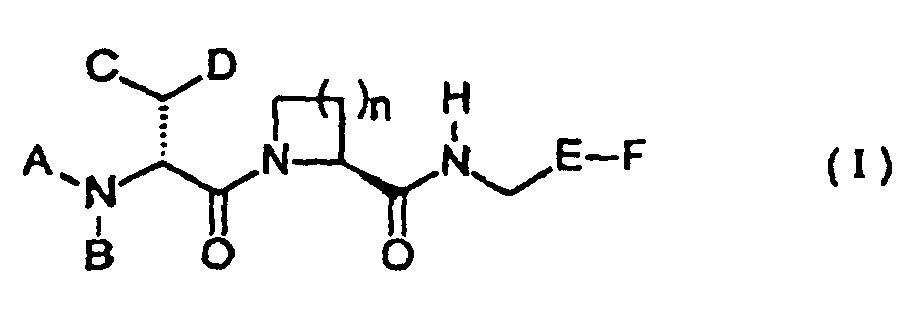
wobei
n 1, 2 oder 3 ist,
A Wasserstoff, Alkyl, C3-7-Cycloalkyl, Aryl, -SO2R1, -SO3R1, -COR1, -CO2R2, -PO(OR1)2, -(CH2)mCO2R1, -(CH2)mSO2R1, -(CH2)mSO3R1 oder -(CH2)mPO(OR1)2, -PO(R1)2 ist;
wobei
R1 Wasserstoff, C1-6-Alkyl, C3-7-Cycloalkyl, Aryl,-(CH2)m-Aryl oder NR3R4, Hydroxy ist;
R2 C1-6-Alkyl, C3-7-Cycloalkyl, Aryl, -(CH2)m-Aryl oder Alkenyl ist und m 1, 2 oder 3 ist,
wobei
Aryl unsubstituiertes oder substituiertes Phenyl oder ein 5- bis 6-gliedriger aromatischer heterozyklischer Ring ist und R3 und R4 unabhängig Wasserstoff, C1-6-Alkyl oder C3-7-Cycloalkyl sind;
B Wasserstoff oder C1-6-Alkyl ist;
C und D identisch sind und ausgewählt sind aus der Gruppe, bestehend aus Phenyl, unsubstituiert oder substituiert mit einem oder zwei Substituenten, die ausgewählt sind aus der Gruppe, bestehend aus C1-4-Alkyl, C1-4-Alkoxy, CF3, Methylendioxy, Halogen, Hydroxy und -NR3R4;
C3-7-Cycloalkyl; oder
einem 5- bis 6-gliedrigen heterozyklischen Ringsystem, das gesättigt oder ungesättigt sein kann und das aus Kohlenstoffatomen und 1-3 Heteroatomen besteht, die ausgewählt sind aus der Gruppe, bestehend aus N, O und S;
Eist,
wobei
X S, O oder NR5 ist und
Y und Z unabhängig N oder CR6 sind,
wobei
R5 Wasserstoff oder C1-4-Alkyl ist und
R6 Wasserstoff, Halogen, CF3 oder C1-4-Alkyl ist und
F -C(NH)N(R7)2, -C(NH2)NN(R7)2, -C(NH2)NOH oder -CH2NH(R7) ist, wobei R7 identisch oder verschieden ist und Wasserstoff, C1-4-Perfluoralkyl oder C1-4-Alkyl ist. - Verbindung nach Anspruch 1 und pharmazeutisch annehmbare Salze derselben, dadurch gekennzeichnet, daß A ausgewählt ist aus der Gruppe, die aus Wasserstoff, Aryl, -SO2R1, -SO3H, -COR1, -CO2R2, -PO(R1)2, -PO(OR1)2 und - (CH2)mCO2R1 besteht, wobei R1 und R2 sind, wie zuvor definiert.
- Verbindung nach Anspruch 2 und pharmazeutisch annehmbare Salze derselben, dadurch gekennzeichnet, daß A ausgewählt ist aus der Gruppe, die aus SO2R3R4, - PO(R1)2, -PO(OR1)2, -(CH2)mCO2R1 oder Aryl besteht.
- Verbindung nach Anspruch 1 und pharmazeutisch annehmbare Salze derselben, dadurch gekennzeichnet, daß A ausgewählt ist aus der Gruppe, die aus Wasserstoff, -SO2R1, -PO(C1-6-Alkyl)2, -PO(OC1-6-Alkyl)2, -CO(C1-6-Alkyl), -CO2R2, -(CH2)mCO2H und -(CH2)mCO2(C1-6-Alkyl) besteht,
wobei
m 1 oder 2 ist und
R1 C1-6-Alkyl, Aryl, -(CH2)m-Aryl, Hydroxy oder -NR3R4 ist, wobei R3 und R4 sind, wie zuvor definiert. - Verbindung nach Anspruch 1 und pharmazeutisch annehmbare Salze derselben, dadurch gekennzeichnet, daß C und D ausgewählt sind aus der Gruppe, bestehend aus Phenyl, Pyridyl oder Cyclohexyl, unsubstituiert oder substituiert mit einem oder zwei Substituenten, die ausgewählt sind aus der Gruppe, bestehend aus C1-4-Alkyl, C1-4-Alkoxy, Methylendioxy, Halogen, Hydroxy und NR3R4, wobei R3 und R4 sind, wie zuvor definiert.
- Verbindung nach Anspruch 1 und pharmazeutisch annehmbare Salze derselben, dadurch gekennzeichnet, daß C und D ausgewählt sind aus der Gruppe, die aus Phenyl oder Cyclohexyl besteht.
- Verbindung nach Anspruch 1 und pharmazeutisch annehmbare Salze derselben, dadurch gekennzeichnet, daß E ausgewählt ist aus der Gruppe, bestehend auswobei

wenn X S, O oder NR5 ist, Y CH ist und Z CR6 ist oder Y CR6 ist und Z CH ist; wenn X S, O oder NH ist, Y N ist und Z CR6 ist oder Y CR6 ist und Z N ist, wobei R5 und R6 sind, wie zuvor definiert. - Verbindung nach Anspruch 7 und pharmazeutisch annehmbare Salze derselben, dadurch gekennzeichnet, daß R5 und R6 unabhängig Wasserstoff oder C1-4-Alkyl sind.
- Verbindung nach Anspruch 1 und pharmazeutisch annehmbare Salze derselben, dadurch gekennzeichnet, daß F ausgewählt ist aus der Gruppe, bestehend aus - C(NH)NH2, -C(NH2)NOH, -C(NH2)NNH2 und -CH2NH2.
- Verbindung nach Anspruch 1, dadurch gekennzeichnet, daß die Verbindung ausgewählt ist aus der Gruppe, bestehend aus:und pharmazeutisch annehmbare Salze davon.N-Aminosulfonyl-D-diphenylalanyl-L-prolyl-[(5-amidino-2-thienyl)methyl)amid,N-Aminosulfonyl-D-diphenylalanyl-L-prolyl-[(5-aminomethyl-2-thienyl)methyl]amid,N-Methylsulfonyl-D-diphenylalanyl-L-prolyl-[(5-amidino-2-thienyl)methyl]amid,N-Methylsulfonyl-D-diphenylalanyl-L-prolyl-[(5-amidrazono-2-thienyl)methyl]amid,N-Methylsulfonyl-D-diphenylalanyl-L-prolyl-[(5-aminomethyl-2-thienyl)methyl]amid,N-Benzylsulfonyl-D-diphenylalanyl-L-prolyl-[(5-amidino-2-thienyl)methyl]amid,N-t-butoxycarbonyl-D-diphenylalanyl-L-prolyl-[(5-amidino-2-thienyl)methyl]amid,N-Methoxycarbonyl-D-diphenylalanyl-L-prolyl-[(5-amidino-2-thienyl)methyl]amid,N-Methoxycarbonyl-D-dicyclohexylalanyl-L-prolyl-[(5-amidino-2-thienyl)methyl]amid,N-Aminosulfonyl-D-diphenylalanyl-L-prolyl-[(4-amidino-2-thienyl)methyl]amid,N-Methylsulfonyl-D-diphenylalanyl-L-prolyl-[(4-amidino-2-thienyl)methyl)amid,N-Methylsulfonyl-D-diphenylalanyl-L-prolyl-[(4-aminomethyl-2-thienyl)methyl]amid,N-Methoxycarbonyl-D-diphenylalanyl-L-prolyl-[(4-amidino-2-thienyl)methyl]amid,N-Aminosulfonyl-D-diphenylalanyl-L-prolyl-[(5-amidino-3-thienyl)methyl]amid,N-Methylsulfonyl-D-diphenylalanyl-L-prolyl-[(5-amidino-3-thienyl)methyl)amid,N-Methylsulfonyl-D-diphenylalanyl-L-prolyl-[(5-amidrazono-3-thienyl)methyl]amid,N- Methylsulfonyl-D-diphenylalanyl-L-prolyl-[(5-aminomethyl-3-thienyl)methyl]amid,N-Methoxycarbonyl-D-diphenylalanyl-L-prolyl-[(5-amidino-3-thienyl)methyl]amid,N-Cyclohexylsulfamoyl-D-diphenylalanyl-L-prolyl-[(5-amidino-2-thienyl)methyl]amid,N-Allyloxycarbonyl-D-diphenylalanyl-L-prolyl-[(5-amidino-2-thienyl)methyl]amid,N-Carboxymethyl-D-diphenylalanyl-L-prolyl-[(5-amidino-2-thienyl)methyl]amid,N-Methyl-N-carboxymethyl-D-diphenylalanyl-L-prolyl-[(5-amidino-2-thienyl)methyl]amid,N-Hydroxysulfonyl-D-diphenylalanyl-L-prolyl-[(5-amidino-2-thienyl)methyl]amid,N-Methylsulfonyl-D-diphenylalanyl-L-azetidin-2-carboxyl-[(5-amidino-2-thienyl)methyl]amid,N-Methylsulfonyl-D-diphenylalanyl-L-prolyl-[(4-amidino-5-methyl-2-thienyl)methyl]amid,N-Methylsulfonyl-D-diphenylalanyl-L-prolyl-[(5-amidino-2-furanyl)methyl]amid,N-Methoxycabonyl-D-diphenylalanyl-L-prolyl-[(5-amidino-2-furanyl)methyl]amid,N-Aminosulfonyl-D-diphenylalanyl-L-prolyl-[(5-amidino-3-furanyl)methyl]amid,N-Aminosulfonyl-D-diphenylalanyl-L-prolyl-[(4-amidino-2-thiazolyl)methyl]amid,N-Methylsulfonyl-D-diphenylalanyl-L-prolyl-[(5-amidino-1-methyl-2-pyrrolyl)methyl]amid,N-Carboxymethyl-D-diphenylalanyl-L-prolyl-[(5-amidino-3-thienyl)methyl]amid,N-Carboxymethyl-D-diphenylalanyl-L-prolyl-[(4-amidino-2-thiazolyl)methyl]amid,N-(2-carboxyethyl)-D-diphenylalanyl-L-prolyl-[(5-amidino-2-thienyl)methyl]amid,N-Boc-D-Diphenylalanyl-L-prolyl-[(5-amidrazono-2-thienyl)methyl]amid,D-Diphenylalanyl-L-prolyl-[(5-amidrazono-2-thienyl)methyl]amid,N-Methoxycarbonyl-D-diphenylalanyl-L-azetidin -2-carboxyl-[(5-amidino-2-thienyl)methyl]amid ,N-(2-Carboxyethyl)-D-diphenylalanyl-L-azetidin -2-carboxyl-[(5-amidino-2-thienyl)methyl]amid ,D-Diphenylalanyl-L-prolyl-[(5-amidino-2-thienyl)methyl]amid,N-(3-Carboxypropyl)-D-diphenylalanyl-L-prolyl-[(5-amidino-2-thienyl)methyl]amid,N-(MeO)2P(O)-D-Diphenylalanyl-L-prolyl-[(5-amidino-2-thienyl)methyl]amid,N-(Me)2P(O)-D-Diphenylalanyl-L-prolyl-[(5-amidino-2-thienyl)methyl]amid,N-(HO)2P(O)-D-Diphenylalanyl-L-prolyl-[(5-amidino-2-thienyl)methyl]amid,N-Methyl-D-diphenylalanyl-L-prolyl-[(5-amidino-2-thienyl)methyl]amid,N-Phenyl-D-diphenylalanyl-L-prolyl-[(5-amidino-2-thienyl)methyl]amid,N-[(N,N-Diethylcarboxamido)methyl]-D-diphenylalanyl-L-prolyl-[(5-amidino-2-thienyl)methyl]amid,N-[(N,N-Diethylcarboxamido)ethyl]-D-diphenylalanyl-L-prolyl-[(5-amidino-2-thienyl)methyl]amid,N-Aminosulfonyl-D-diphenylalanyl-L-prolyl-[(5-amidino-2-thiazolyl)methyl]amid,N-Aminosulfonyl-D-diphenylalanyl-L-prolyl-[(2-amidino-4-thiazolyl)methyl]amid ,N-Aminosulfonyl-D-diphenylalanyl-L-prolyl-[(4-amidino-2-thiazolyl)methyl]amid,N-Aminosulfonyl-D-diphenylalanyl-L-prolyl-[(2-amidino-5-thiazolyl)methyl]amid,N-Methylsulfonyl-D-diphenylalanyl-L-prolyl-[(5-amidino-2-thiazolyl)methyl]amid,N-Methylsulfonyl-D-diphenylalanyl-L-prolyl-[(2-amidino-4-thiazolyl)methyl]amid,N-Methylsulfonyl-D-diphenylalanyl-L-prolyl-[(4-amidino-2-thiazolyl)methyl]amid,N-Methylsulfonyl-D-diphenylalanyl-L-prolyl-[(2-amidino-5-thiazolyl)methyl]amid,N-Methoxycarbonyl-D-diphenylalanyl-L-prolyl-[(5-amidino-2-thiazolyl)methyl]amid,N-Methoxycarbonyl-D-diphenylalanyl-L-prolyl-[(2-amidino-4-thiazolyl)methyl]amid,N-Methoxycarbonyl-D-diphenylalanyl-L-protyl-[(4-amidino-2-thiazolyl)methyl]amid,N-Methoxycarbonyl-D-diphenylalanyl-L-prolyl-[(2-amidino-5-thiazolyl)methyl]amid,N-Carboxymethyl-D-diphenylalanyl-L-prolyl-[(5-amidino-2-thiazolyl)methyl]amide,N-Carboxymethyl-D-diphenylalanyl-L-prolyl-[(2-amidino-4-thiazolyl)methyl]amid,N-Carboxymethyl-D-diphenylalanyl-L-prolyl-[(2-amidino-5-thiazolyl)methyl]amid,N-Aminosulfonyl-D-diphenylalanyl-L-prolyl-[(5-amidino-2-oxazolyl)methyl]amid,N-Aminosulfonyl-D-diphenylalanyl-L-prolyl-[(2-amidino-4-oxazolyl)methyl]amid,N-Aminosulfonyl-D-diphenylalanyl-L-prolyl-[(4-amidino-2-oxazolyl)methyl]amid,N-Aminosulfonyl-D-diphenylalanyl-L-prolyl-[(2-amidino-5-oxazolyl)methyl]amid,N-Methylsulfonyl-D-diphenylalanyl-L-prolyl-[(5-amidino-2-oxazolyl)methyl]amid,N-Methylsulfonyl-D-diphenylalanyl-L-prolyl-[(2-amidino-4-oxazolyl)methyl]amid,N-Methylsulfonyl-D-diphenylalanyl-L-prolyl-[(4-amidino-2-oxazolyl)methyl]amid,N-Methylsulfonyl-D-diphenylalanyl-L-prolyl-[(2-amidino-5-oxazolyl)methyl]amid,N-Methoxycarbonyl-D-diphenylalanyl-L-prolyl-[(5-amidino-2-oxazolyl)methyl]amid,N-Methoxycarbonyl-D-diphenylalanyl-L-prolyl-[(2-amidino-4-oxazolyl)methyl]amid,N-Methoxycarbonyl-D-diphenylalanyl-L-prolyl-[(4-amidino-2-oxazolyl)methyl]amid,N-Methoxycarbonyl-D-diphenylalanyl-L-prolyl-[(2-amidino-5-oxazolyl)methyl]amid,N-Carboxymethyl-D-diphenylalanyl-L-prolyl-[(5-amidino-2-oxazolyl)methyl]amid,N-Carboxymethyl-D-diphenylalanyl-L-prolyl-[(2-amidino-4-oxazolyl)methyl]amid,N-Carboxymethyl-D-diphenylalanyl-L-prolyl-[(4-amidino-2-oxazolyl)methyl]amid,N-Carboxymethyl-D-diphenylalanyl-L-prolyl-[(2-amidino-5-oxazolyl)methyl]amid,N-Aminosulfonyl-D-diphenylalanyl-L-prolyl-[(2-amidino-4-isoxazolyl)methyl)amid,N-Aminosulfonyl-D-diphenylalanyl-L-prolyl-[(4-amidino-2-isoxazolyl)methyl]amid,N-Methylsulfonyl-D-diphenylalanyl-L-prolyl-[(2-amidino-4-isoxazolyl)methyl]amid,N-Methylsulfonyl-D-diphenylalanyl-L-prolyl-[(4-amidino-2-isoxazolyl)methyl]amid,N-Methoxycarbonyl-D-diphenylalanyl-L-prolyl-[(2-amidino-4-isoxazolyl)methyl]amid,N-Methoxycarbonyl-D-diphenylalanyl-L-prolyl-[(4-amidino-2-isoxazolyl)methyl]amid,N-Carboxymethyl-D-diphenylalanyl-L-prolyl-[(4-amidino-2-isoxazolyl)methyl]amid ,N-Carboxymethyl-D-diphenylalanyl-L-prolyl-[(2-amidino-4-isoxazolyl)methyl]amid,N-Aminosulfonyl-D-diphenylalanyl-L-prolyl-[(4-amidino-2-pyrazolyl)methyl]amid,N-Methylsulfonyl-D-diphenylalanyl-L-prolyl-[(4-amidino-2-pyrazolyl)methyl]amid,N-Methoxycarbonyl-D-diphenylalanyl-L-prolyl-[(4-amidino-2-pyrazolyl)methyl]amid,N-Carboxymethyl-D-diphenylalanyl-L-prolyl-[(4-amidino-2-pyrazolyl)methyl]amid,N-Aminosulfonyl-D-diphenylalanyl-L-prolyl-[(5-amidino-2-pyrrolyl)methyl]amid,N-Aminosulfonyl-D-diphenylalanyl-L-prolyl-[(4-amidino-2-pyrrolyl)methyl]amid,N-Aminosulfonyl-D-diphenylalanyl-L-prolyl-[(5-amidino-3-pyrrolyl)methyl]amid,N-Methylsulfonyl-D-diphenylalanyl-L-prolyl-[(5-amidino-2-pyrrolyl)methyl]amid,N-Methylsulfonyl-D-diphenylalanyl-L-prolyl-[(4-amidino-2-pyrrolyl)methyl]amid,N-Methylsulfonyl-D-diphenylalanyl-L-prolyl-[(5-amidino-3-pyrrolyl)methyl]amid,N-Methoxycarbonyl-D-diphenylalanyl-L-prolyl-[(5-amidino-2-Pyrrolyl)methyl]amid,N-Methoxycarbonyl-D-diphenylalanyl-L-prolyl-[(4-amidino-2-pyrrolyl)methyl]amid,N- Methoxycarbonyl-D-diphenylalanyl-L-prolyl-[(5-amidino-3-pyrrolyl)methyl]amid,N-Carboxymethyl-D-diphenylalanyl-L-prolyl-[(5-amidino-2-pyrrolyl)methyl]amid,N-Carboxymethyl-D-diphenylalanyl-L-prolyl-[(4-amidino-2-pyrrolyl)methyl]amid,N-Carboxymethyl-D-diphenylalanyl-L-prolyl-[(5-amidino-3-pyrrolyl)methyl]amid,N-Aminosulfonyl-D-bis-(para-methoxyphenyl)alanyl-L-prolyl-[(5-amidino-2-thienyl)methyl]amid,N-hethylsulfonyl-D-bis-(para-methoxyphenyl)alanyl-L-prolyl-[(5-amidino-2-thienyl)methyl]amid,N-Methoxycarbonyl-D-bis-(para-methoxyphenyl)alanyl-L-prolyl-[(5-amidino-2-thienyl)methyl]amid,N-Carboxymethyl-D-bis-(para-methoxyphenyl)alanyl-L-prolyl-[(5-amidino-2-thienyl)methyl]amid,N-Aminosulfonyl-D-bis-(para-aminophenyl)alanyl-L-prolyl-[(5-amidino-2-thienyl)methyl]amid,N-Methylsulfonyl-D-bis-(para-aminophenyl)alanyl-L-prolyl-[(5-amidino-2-thienyl)methyl]amid,N-Methoxycarbonyl-D-bis-(para-aminophenyl)alanyl-L-prolyl-[(5-amidino-2-thienyl)methyl]amid,N-Carboxymethyl-D-bis-(para-aminophenyl)alanyl-L-prolyl-[(5-amidino-2-thienyl)methyl]amid,N-Aminosulfonyl-D-bis-(para-chlorophenyl)alanyl-L-prolyl-[(5-amidino-2-thienyl)methyl]amid,N-Methylsulfonyl-D-bis-(para-chlorophenyl)alanyl-L-prolyl-[(5-amidino-2-thienyl)methyl]amid,N-Methoxycarbonyl-D-bis-(para-chlorophenyl)alanyl-L-prolyl-[(5-amidino-2-thienyl)methyl]amid, undN-Carboxymethyl-D-bis-(para-chlorophenyl)alanyl-L-prolyl-[(5-amidino-2-thienyl)methyl]amid,N-(t-butoxycarbonyl)methyl-D-diphenylalanyl-L-prolyl-[(5-amidino-2-thienyl)methyl]amid,N-(t-butoxycarbonyl)methyl-D-diphenylalanyl-L-prolyl-[(5-hydroxyamidino-2-thienyl)methyl]amid,N-[2-(methoxycarbonyl)ethyl]-D-diphenylalanyl-L-prolyl-[(5-amidino-2-thienyl)methyl]amid,N-Carboxymethyl-D-diphenylalanyl-L-prolyl-[(5-hydroxyamidino-2-thienyl)methyl]amid,N-(Methoxycarbonyl)methyl-D-diphenylalanyl-L-prolyl-[(5-hydroxyamidino-2-thienyl)methyl]amid,N-Aminosulfonyl-D-dicyclohexylalanyl-L-prolyl-[(5-amidino-2-thienyl)methyl]amid,N-Methylsulfonyl-D-dicyclohexylalanyl-L-prolyl-[(5-amidino-2-thienyl)methyl]amid,N-Carboxymethyl-D-dicyclohexylalanyl-L-prolyl-[(5-amidino-2-thienyl)methyl]amid;
- Verwendung einer Verbindung nach Anspruch 1 oder eines pharmazeutisch annehmbaren Salzes derselben zur Herstellung einer pharmazeutischen Zusammensetzung zur Behandlung eines Säugers mit einem Verfahren der Modulation trypsinähnlicher Serinprotease.
- Verwendung einer Verbindung nach Anspruch 1 oder eines pharmazeutisch annehmbaren Salzes derselben zur Herstellung einer pharmazeutischen Zusammensetzung zur Behandlung eines Säugers mit einem Verfahren der Inhibition trypsinähnlicher Serinprotease.
- Verwendung einer Zusammensetzung nach Anspruch 1 oder eines pharmazeutisch annehmbaren Salzes derselben zur Herstellung einer pharmazeutischen Zusammensetzung zur Behandlung eines Säugers mit einem Verfahren der Modulation von Thrombin.
- Verwendung einer Verbindung nach Anspruch 1 oder eines pharmazeutisch annehmbaren Salzes derselben zur Herstellung einer pharmazeutischen Zusammensetzung zur Behandlung eines Säugers mit einem Verfahren der Inhibition von Thrombin.
Priority Applications (1)
| Application Number | Priority Date | Filing Date | Title |
|---|---|---|---|
| DK99962534T DK1140918T3 (da) | 1998-12-29 | 1999-12-29 | Thrombininhibitorer |
Applications Claiming Priority (5)
| Application Number | Priority Date | Filing Date | Title |
|---|---|---|---|
| KR9860266 | 1998-12-29 | ||
| KR19980060266 | 1998-12-29 | ||
| KR1019990033490A KR20000047461A (ko) | 1998-12-29 | 1999-08-14 | 트롬빈 억제제 |
| KR9933490 | 1999-08-14 | ||
| PCT/KR1999/000830 WO2000039124A1 (en) | 1998-12-29 | 1999-12-29 | Thrombin inhibitors |
Publications (2)
| Publication Number | Publication Date |
|---|---|
| EP1140918A1 EP1140918A1 (de) | 2001-10-10 |
| EP1140918B1 true EP1140918B1 (de) | 2004-08-11 |
Family
ID=26634497
Family Applications (1)
| Application Number | Title | Priority Date | Filing Date |
|---|---|---|---|
| EP99962534A Expired - Lifetime EP1140918B1 (de) | 1998-12-29 | 1999-12-29 | Thrombin-inhibitoren |
Country Status (22)
| Country | Link |
|---|---|
| US (2) | US6492402B1 (de) |
| EP (1) | EP1140918B1 (de) |
| JP (1) | JP3847092B2 (de) |
| KR (2) | KR20000047461A (de) |
| CN (1) | CN1149210C (de) |
| AT (1) | ATE273305T1 (de) |
| AU (1) | AU765417B2 (de) |
| BR (1) | BR9916678A (de) |
| CA (1) | CA2355281A1 (de) |
| CZ (1) | CZ20012429A3 (de) |
| DE (1) | DE69919397T2 (de) |
| DK (1) | DK1140918T3 (de) |
| ES (1) | ES2226482T3 (de) |
| HK (1) | HK1044936A1 (de) |
| HU (1) | HUP0104500A3 (de) |
| IL (1) | IL143545A (de) |
| NO (1) | NO321739B1 (de) |
| NZ (1) | NZ513174A (de) |
| RU (1) | RU2221808C2 (de) |
| TR (1) | TR200101899T2 (de) |
| WO (1) | WO2000039124A1 (de) |
| ZA (1) | ZA200104780B (de) |
Families Citing this family (40)
| Publication number | Priority date | Publication date | Assignee | Title |
|---|---|---|---|---|
| NZ515026A (en) * | 1999-04-09 | 2003-10-31 | Abbott Gmbh & Co | Heterocyclic amidine derivatives useful as prodrugs of thrombin inhibitors |
| DE19934066A1 (de) * | 1999-07-23 | 2001-01-25 | Basf Ag | Verfahren zur Herstellung von 4-Cyano-2-aminomethylthiazol |
| DE19933861A1 (de) | 1999-07-23 | 2001-01-25 | Basf Ag | Verfahren zur Herstellung von 2-Aminomethyl-4-cyano-thiazol |
| DE10049937A1 (de) * | 2000-10-06 | 2002-04-11 | Knoll Ag | Niedermolekulare Inhibitoren von Serinproteasen mit Polyhydroxyalkyl- und Polyhydroxycycloalkylresten |
| KR100447421B1 (ko) * | 2001-04-04 | 2004-09-07 | 주식회사 엘지생명과학 | 5-(아미노메틸)-2-티오펜카보니트릴 염산염의 연속반응에의한 새로운 제조방법 |
| JP2005526800A (ja) * | 2002-03-22 | 2005-09-08 | エルジー・ライフ・サイエンシーズ・リミテッド | (2S)−N−5−[アミノ(イミノ)メチル]−2−チエニルメチル−1−(2R)−2−[(カルボキシルメチル)アミノ]−3,3−ジフェニルプロパノイル−2−ピロリジンカルボキサミド・nH2Oの新しい結晶形 |
| US20050154229A1 (en) * | 2002-03-22 | 2005-07-14 | Aeri Kim | Maleic acid salt of(2s)-n-{5-[amino(imino)methy]-2-thienyl}methyl-1-{(2r)-2-[(carboxymethyl)amino]-3,3-diphenylpropanoyl}-2-pyrrolidine carboxamide and a process for |
| WO2004002985A1 (en) * | 2002-06-27 | 2004-01-08 | Lg Life Sciences Ltd. | Peptidic thrombin inhibitor compound |
| US7097967B2 (en) | 2002-10-24 | 2006-08-29 | Lg Life Sciences Ltd. | Method of predicting drug-food interaction |
| US7399870B2 (en) * | 2004-03-30 | 2008-07-15 | Wyeth | Synthesis of pyrrole-2-carbonitriles |
| GB0507577D0 (en) | 2005-04-14 | 2005-05-18 | Novartis Ag | Organic compounds |
| US7678917B2 (en) * | 2005-09-01 | 2010-03-16 | Hoffman-La Roche Inc. | Factor Xa inhibitors |
| HRP20110498T1 (hr) | 2005-10-07 | 2011-08-31 | Exelixis | Azetidini kao inhibitori mek za liječenje proliferativnih bolesti |
| US7951823B2 (en) | 2006-05-23 | 2011-05-31 | Irm Llc | Compounds and compositions as channel activating protease inhibitors |
| JP2008115178A (ja) | 2006-11-03 | 2008-05-22 | Ajinomoto Co Inc | ジフェニルアラニン−Ni(II)錯体の製造方法 |
| EA016327B1 (ru) | 2007-02-09 | 2012-04-30 | Айрм Ллк | Соединения и композиции в качестве ингибиторов протеазы, активирующей каналы |
| WO2008135525A2 (en) * | 2007-05-02 | 2008-11-13 | Boehringer Ingelheim International Gmbh | Substituted azetidines, manufacturing and use thereof as medicaments |
| JP6155187B2 (ja) | 2010-03-30 | 2017-06-28 | ヴァーセオン コーポレイション | トロンビンの阻害剤としての多置換芳香族化合物 |
| US9273028B2 (en) | 2010-10-29 | 2016-03-01 | Biogen Ma Inc. | Heterocyclic tyrosine kinase inhibitors |
| MA38085B1 (fr) | 2012-10-12 | 2018-11-30 | Exelixis Inc | Nouveau procédé pour la production de composés à utiliser dans le traitement du cancer |
| HK1214252A1 (zh) | 2013-03-15 | 2016-07-22 | Verseon Corporation | 作為凝血酶抑制劑的鹵代吡唑 |
| CN110179795A (zh) | 2013-03-15 | 2019-08-30 | 维颂公司 | 作为丝氨酸蛋白酶抑制剂的多取代芳族化合物的制药用途 |
| US10189810B2 (en) | 2014-09-17 | 2019-01-29 | Verseon Corporation | Pyrazolyl-substituted pyridone compounds as serine protease inhibitors |
| CN107405333A (zh) | 2015-02-27 | 2017-11-28 | 维颂公司 | 作为丝氨酸蛋白酶抑制剂的被取代的吡唑化合物 |
| WO2017035409A1 (en) | 2015-08-26 | 2017-03-02 | Achillion Pharmaceuticals, Inc. | Aryl, heteroaryl, and heterocyclic compounds for treatment of immune and inflammatory disorders |
| WO2017035401A1 (en) | 2015-08-26 | 2017-03-02 | Achillion Pharmaceuticals, Inc. | Amide compounds for treatment of immune and inflammatory disorders |
| WO2017035405A1 (en) | 2015-08-26 | 2017-03-02 | Achillion Pharmaceuticals, Inc. | Amino compounds for treatment of immune and inflammatory disorders |
| AR106018A1 (es) | 2015-08-26 | 2017-12-06 | Achillion Pharmaceuticals Inc | Compuestos de arilo, heteroarilo y heterocíclicos para el tratamiento de trastornos médicos |
| CN110603252A (zh) | 2017-03-01 | 2019-12-20 | 艾其林医药公司 | 用于治疗医学障碍的芳基、杂芳基和杂环药物化合物 |
| WO2018160891A1 (en) | 2017-03-01 | 2018-09-07 | Achillion Pharmaceutical, Inc. | Pharmaceutical compounds for treatment of medical disorders |
| CN112867706B (zh) | 2018-05-29 | 2024-11-15 | 奥默罗斯公司 | Masp-2抑制剂和使用方法 |
| US11814363B2 (en) | 2018-09-06 | 2023-11-14 | Achillion Pharmaceuticals, Inc. | Morphic forms of danicopan |
| BR112021005506A2 (pt) | 2018-09-25 | 2021-06-15 | Achillion Pharmaceuticals, Inc. | formas mórficas de inibidores de fator complementar d |
| KR20210104071A (ko) | 2018-12-17 | 2021-08-24 | 아칠리온 파르마세우티칼스 인코포레이티드 | 보체 매개 장애의 치료를 위한 표적 투약 |
| WO2020198062A1 (en) * | 2019-03-22 | 2020-10-01 | Achillion Pharmaceuticals, Inc. | Pharmaceutical compounds for the treatment of complement mediated disorders |
| JP7699389B2 (ja) | 2019-12-04 | 2025-06-27 | オメロス コーポレーション | Masp-2阻害剤および使用方法 |
| EP4069676A1 (de) | 2019-12-04 | 2022-10-12 | Omeros Corporation | Masp-2-hemmer und verfahren zur verwendung |
| IL293550A (en) | 2019-12-04 | 2022-08-01 | Omeros Corp | 2-masp inhibitor compounds, preparations containing them and their uses |
| JP7764808B2 (ja) * | 2021-08-11 | 2025-11-06 | Jsr株式会社 | 液晶配向剤、液晶配向膜及びその製造方法、液晶素子並びに重合体 |
| US20250346585A1 (en) * | 2022-03-22 | 2025-11-13 | Alexion Pharmaceuticals, Inc. | Pharmaceutical compounds for the treatment of complement mediated disorders |
Family Cites Families (13)
| Publication number | Priority date | Publication date | Assignee | Title |
|---|---|---|---|---|
| CA2008116C (en) * | 1989-02-23 | 2001-11-20 | Thomas Weller | Glycine derivatives |
| SE9301916D0 (sv) * | 1993-06-03 | 1993-06-03 | Ab Astra | New peptides derivatives |
| ZA951617B (en) * | 1994-03-04 | 1997-02-27 | Lilly Co Eli | Antithrombotic agents. |
| US5707966A (en) * | 1994-03-04 | 1998-01-13 | Eli Lilly And Company | Antithrombotic agents |
| US5705487A (en) * | 1994-03-04 | 1998-01-06 | Eli Lilly And Company | Antithrombotic agents |
| US5726159A (en) * | 1994-03-04 | 1998-03-10 | Eli Lilly And Company | Antithrombotic agents |
| MX9705970A (es) | 1995-02-10 | 1997-11-29 | Basf Ag | Inhibidores de trombina. |
| US5710130A (en) * | 1995-02-27 | 1998-01-20 | Eli Lilly And Company | Antithrombotic agents |
| US5914319A (en) * | 1995-02-27 | 1999-06-22 | Eli Lilly And Company | Antithrombotic agents |
| SA96170106A (ar) * | 1995-07-06 | 2005-12-03 | أسترا أكتيبولاج | مشتقات حامض أميني جديدة |
| IL123986A (en) * | 1997-04-24 | 2011-10-31 | Organon Nv | Medicinal compounds |
| EP1051431A1 (de) * | 1998-01-26 | 2000-11-15 | Basf Aktiengesellschaft | Thrombininhibitoren |
| AU2424499A (en) * | 1998-01-26 | 1999-08-09 | Basf Aktiengesellschaft | Heterocyclic amidines as callicrein protease inhibitors |
-
1999
- 1999-08-14 KR KR1019990033490A patent/KR20000047461A/ko active Pending
- 1999-12-29 RU RU2001121138/04A patent/RU2221808C2/ru not_active IP Right Cessation
- 1999-12-29 HU HU0104500A patent/HUP0104500A3/hu unknown
- 1999-12-29 WO PCT/KR1999/000830 patent/WO2000039124A1/en not_active Ceased
- 1999-12-29 TR TR2001/01899T patent/TR200101899T2/xx unknown
- 1999-12-29 KR KR10-2001-7008401A patent/KR100462974B1/ko not_active Expired - Fee Related
- 1999-12-29 US US09/473,681 patent/US6492402B1/en not_active Expired - Fee Related
- 1999-12-29 IL IL14354599A patent/IL143545A/xx not_active IP Right Cessation
- 1999-12-29 CZ CZ20012429A patent/CZ20012429A3/cs unknown
- 1999-12-29 AT AT99962534T patent/ATE273305T1/de not_active IP Right Cessation
- 1999-12-29 ES ES99962534T patent/ES2226482T3/es not_active Expired - Lifetime
- 1999-12-29 CA CA002355281A patent/CA2355281A1/en not_active Abandoned
- 1999-12-29 NZ NZ513174A patent/NZ513174A/en unknown
- 1999-12-29 JP JP2000591035A patent/JP3847092B2/ja not_active Expired - Fee Related
- 1999-12-29 EP EP99962534A patent/EP1140918B1/de not_active Expired - Lifetime
- 1999-12-29 CN CNB998151815A patent/CN1149210C/zh not_active Expired - Fee Related
- 1999-12-29 HK HK02105401.0A patent/HK1044936A1/zh unknown
- 1999-12-29 AU AU18951/00A patent/AU765417B2/en not_active Ceased
- 1999-12-29 DK DK99962534T patent/DK1140918T3/da active
- 1999-12-29 DE DE69919397T patent/DE69919397T2/de not_active Expired - Fee Related
- 1999-12-29 BR BR9916678-0A patent/BR9916678A/pt not_active IP Right Cessation
-
2001
- 2001-06-12 ZA ZA200104780A patent/ZA200104780B/en unknown
- 2001-06-27 NO NO20013220A patent/NO321739B1/no unknown
-
2002
- 2002-11-01 US US10/285,417 patent/US6864249B2/en not_active Expired - Fee Related
Also Published As
Similar Documents
| Publication | Publication Date | Title |
|---|---|---|
| EP1140918B1 (de) | Thrombin-inhibitoren | |
| JP4392061B2 (ja) | ヘテロ環誘導体および抗血栓剤としてのその使用 | |
| ES2483802T3 (es) | Inhibidores de serina proteasa | |
| CA2338524C (en) | Inhibitors of urokinase and blood vessel formation | |
| CZ86396A3 (en) | Derivatives of benzazepine-, benzoxazepine- and benzothiazepine-n-acetic acid, process of their preparation and a medicament in which said compounds are comprised | |
| JPH11503455A (ja) | トロンビン阻害剤 | |
| JP2001512742A (ja) | 選択的Xa因子阻害剤 | |
| EP1115390B1 (de) | Hydroxamat-enthaltende inhibitoren der cystein- und serinproteasen | |
| AU709088B2 (en) | Thrombin inhibitors | |
| US6774110B2 (en) | Orally available peptidic thrombin inhibitors | |
| EP1635816B1 (de) | Enalapril-nitroxy-derivate und verwandte verbindungen als ace-hemmer zur behandlung von kardiovaskulären erkrankungen | |
| AU3865099A (en) | Amino acid amidinohydrazones, alkoxyguanidines and aminoguanidines as protease inhibitors | |
| MXPA01006708A (en) | Thrombin inhibitors |
Legal Events
| Date | Code | Title | Description |
|---|---|---|---|
| PUAI | Public reference made under article 153(3) epc to a published international application that has entered the european phase |
Free format text: ORIGINAL CODE: 0009012 |
|
| 17P | Request for examination filed |
Effective date: 20010608 |
|
| AK | Designated contracting states |
Kind code of ref document: A1 Designated state(s): AT BE CH CY DE DK ES FI FR GB GR IE IT LI LU MC NL PT SE |
|
| AX | Request for extension of the european patent |
Free format text: AL;LT;LV;MK;RO;SI |
|
| RIN1 | Information on inventor provided before grant (corrected) |
Inventor name: PARK, HEE, DONG Inventor name: LEE, SUN, HWA Inventor name: LEE, SANG, KOO Inventor name: PARK, CHEOL, WON Inventor name: JUNG, WON, HYUK Inventor name: LEE, KOO |
|
| 17Q | First examination report despatched |
Effective date: 20020705 |
|
| RAP1 | Party data changed (applicant data changed or rights of an application transferred) |
Owner name: LG LIFE SCIENCES LTD. |
|
| GRAP | Despatch of communication of intention to grant a patent |
Free format text: ORIGINAL CODE: EPIDOSNIGR1 |
|
| GRAS | Grant fee paid |
Free format text: ORIGINAL CODE: EPIDOSNIGR3 |
|
| GRAA | (expected) grant |
Free format text: ORIGINAL CODE: 0009210 |
|
| AK | Designated contracting states |
Kind code of ref document: B1 Designated state(s): AT BE CH CY DE DK ES FI FR GB GR IE IT LI LU MC NL PT SE |
|
| PG25 | Lapsed in a contracting state [announced via postgrant information from national office to epo] |
Ref country code: FI Free format text: LAPSE BECAUSE OF FAILURE TO SUBMIT A TRANSLATION OF THE DESCRIPTION OR TO PAY THE FEE WITHIN THE PRESCRIBED TIME-LIMIT Effective date: 20040811 Ref country code: CY Free format text: LAPSE BECAUSE OF FAILURE TO SUBMIT A TRANSLATION OF THE DESCRIPTION OR TO PAY THE FEE WITHIN THE PRESCRIBED TIME-LIMIT Effective date: 20040811 Ref country code: BE Free format text: LAPSE BECAUSE OF FAILURE TO SUBMIT A TRANSLATION OF THE DESCRIPTION OR TO PAY THE FEE WITHIN THE PRESCRIBED TIME-LIMIT Effective date: 20040811 |
|
| REG | Reference to a national code |
Ref country code: GB Ref legal event code: FG4D |
|
| REG | Reference to a national code |
Ref country code: CH Ref legal event code: EP |
|
| REG | Reference to a national code |
Ref country code: IE Ref legal event code: FG4D |
|
| REF | Corresponds to: |
Ref document number: 69919397 Country of ref document: DE Date of ref document: 20040916 Kind code of ref document: P |
|
| REG | Reference to a national code |
Ref country code: SE Ref legal event code: TRGR |
|
| PG25 | Lapsed in a contracting state [announced via postgrant information from national office to epo] |
Ref country code: GR Free format text: LAPSE BECAUSE OF FAILURE TO SUBMIT A TRANSLATION OF THE DESCRIPTION OR TO PAY THE FEE WITHIN THE PRESCRIBED TIME-LIMIT Effective date: 20041111 |
|
| REG | Reference to a national code |
Ref country code: CH Ref legal event code: NV Representative=s name: BUECHEL, KAMINSKI & PARTNER PATENTANWAELTE ESTABLI |
|
| REG | Reference to a national code |
Ref country code: DK Ref legal event code: T3 |
|
| PG25 | Lapsed in a contracting state [announced via postgrant information from national office to epo] |
Ref country code: LU Free format text: LAPSE BECAUSE OF NON-PAYMENT OF DUE FEES Effective date: 20041229 |
|
| PG25 | Lapsed in a contracting state [announced via postgrant information from national office to epo] |
Ref country code: IE Free format text: LAPSE BECAUSE OF NON-PAYMENT OF DUE FEES Effective date: 20041230 |
|
| PG25 | Lapsed in a contracting state [announced via postgrant information from national office to epo] |
Ref country code: MC Free format text: LAPSE BECAUSE OF NON-PAYMENT OF DUE FEES Effective date: 20041231 |
|
| ET | Fr: translation filed | ||
| LTIE | Lt: invalidation of european patent or patent extension |
Effective date: 20040811 |
|
| REG | Reference to a national code |
Ref country code: ES Ref legal event code: FG2A Ref document number: 2226482 Country of ref document: ES Kind code of ref document: T3 |
|
| PLBE | No opposition filed within time limit |
Free format text: ORIGINAL CODE: 0009261 |
|
| STAA | Information on the status of an ep patent application or granted ep patent |
Free format text: STATUS: NO OPPOSITION FILED WITHIN TIME LIMIT |
|
| 26N | No opposition filed |
Effective date: 20050512 |
|
| REG | Reference to a national code |
Ref country code: IE Ref legal event code: MM4A |
|
| PGFP | Annual fee paid to national office [announced via postgrant information from national office to epo] |
Ref country code: NL Payment date: 20061203 Year of fee payment: 8 |
|
| PGFP | Annual fee paid to national office [announced via postgrant information from national office to epo] |
Ref country code: SE Payment date: 20061206 Year of fee payment: 8 |
|
| PGFP | Annual fee paid to national office [announced via postgrant information from national office to epo] |
Ref country code: FR Payment date: 20061208 Year of fee payment: 8 |
|
| PGFP | Annual fee paid to national office [announced via postgrant information from national office to epo] |
Ref country code: AT Payment date: 20061213 Year of fee payment: 8 |
|
| PGFP | Annual fee paid to national office [announced via postgrant information from national office to epo] |
Ref country code: DE Payment date: 20061221 Year of fee payment: 8 |
|
| PGFP | Annual fee paid to national office [announced via postgrant information from national office to epo] |
Ref country code: GB Payment date: 20061227 Year of fee payment: 8 Ref country code: DK Payment date: 20061227 Year of fee payment: 8 Ref country code: CH Payment date: 20061227 Year of fee payment: 8 |
|
| PGFP | Annual fee paid to national office [announced via postgrant information from national office to epo] |
Ref country code: IT Payment date: 20061231 Year of fee payment: 8 |
|
| PGFP | Annual fee paid to national office [announced via postgrant information from national office to epo] |
Ref country code: ES Payment date: 20070122 Year of fee payment: 8 |
|
| PG25 | Lapsed in a contracting state [announced via postgrant information from national office to epo] |
Ref country code: PT Free format text: LAPSE BECAUSE OF NON-PAYMENT OF DUE FEES Effective date: 20050111 |
|
| REG | Reference to a national code |
Ref country code: CH Ref legal event code: PL |
|
| REG | Reference to a national code |
Ref country code: DK Ref legal event code: EBP |
|
| EUG | Se: european patent has lapsed | ||
| GBPC | Gb: european patent ceased through non-payment of renewal fee |
Effective date: 20071229 |
|
| PG25 | Lapsed in a contracting state [announced via postgrant information from national office to epo] |
Ref country code: AT Free format text: LAPSE BECAUSE OF NON-PAYMENT OF DUE FEES Effective date: 20071229 |
|
| NLV4 | Nl: lapsed or anulled due to non-payment of the annual fee |
Effective date: 20080701 |
|
| PG25 | Lapsed in a contracting state [announced via postgrant information from national office to epo] |
Ref country code: SE Free format text: LAPSE BECAUSE OF NON-PAYMENT OF DUE FEES Effective date: 20071230 Ref country code: LI Free format text: LAPSE BECAUSE OF NON-PAYMENT OF DUE FEES Effective date: 20071231 Ref country code: DE Free format text: LAPSE BECAUSE OF NON-PAYMENT OF DUE FEES Effective date: 20080701 Ref country code: CH Free format text: LAPSE BECAUSE OF NON-PAYMENT OF DUE FEES Effective date: 20071231 |
|
| REG | Reference to a national code |
Ref country code: FR Ref legal event code: ST Effective date: 20081020 |
|
| PG25 | Lapsed in a contracting state [announced via postgrant information from national office to epo] |
Ref country code: NL Free format text: LAPSE BECAUSE OF NON-PAYMENT OF DUE FEES Effective date: 20080701 |
|
| PG25 | Lapsed in a contracting state [announced via postgrant information from national office to epo] |
Ref country code: GB Free format text: LAPSE BECAUSE OF NON-PAYMENT OF DUE FEES Effective date: 20071229 |
|
| PG25 | Lapsed in a contracting state [announced via postgrant information from national office to epo] |
Ref country code: DK Free format text: LAPSE BECAUSE OF NON-PAYMENT OF DUE FEES Effective date: 20080102 |
|
| REG | Reference to a national code |
Ref country code: ES Ref legal event code: FD2A Effective date: 20071231 |
|
| PG25 | Lapsed in a contracting state [announced via postgrant information from national office to epo] |
Ref country code: FR Free format text: LAPSE BECAUSE OF NON-PAYMENT OF DUE FEES Effective date: 20071231 Ref country code: ES Free format text: LAPSE BECAUSE OF NON-PAYMENT OF DUE FEES Effective date: 20071231 |
|
| PG25 | Lapsed in a contracting state [announced via postgrant information from national office to epo] |
Ref country code: IT Free format text: LAPSE BECAUSE OF NON-PAYMENT OF DUE FEES Effective date: 20071229 |