EP1141122B1 - Thermoplastische formmassen - Google Patents
Thermoplastische formmassen Download PDFInfo
- Publication number
- EP1141122B1 EP1141122B1 EP99963561A EP99963561A EP1141122B1 EP 1141122 B1 EP1141122 B1 EP 1141122B1 EP 99963561 A EP99963561 A EP 99963561A EP 99963561 A EP99963561 A EP 99963561A EP 1141122 B1 EP1141122 B1 EP 1141122B1
- Authority
- EP
- European Patent Office
- Prior art keywords
- weight
- block
- diene
- molding composition
- styrene
- Prior art date
- Legal status (The legal status is an assumption and is not a legal conclusion. Google has not performed a legal analysis and makes no representation as to the accuracy of the status listed.)
- Expired - Lifetime
Links
- 238000009757 thermoplastic moulding Methods 0.000 title claims abstract description 27
- 239000000463 material Substances 0.000 title description 2
- 239000000203 mixture Substances 0.000 claims abstract description 93
- 239000000178 monomer Substances 0.000 claims abstract description 83
- 150000001993 dienes Chemical class 0.000 claims abstract description 49
- 238000000465 moulding Methods 0.000 claims abstract description 48
- 229920001400 block copolymer Polymers 0.000 claims abstract description 28
- 229920001577 copolymer Polymers 0.000 claims abstract description 26
- 229920000578 graft copolymer Polymers 0.000 claims abstract description 22
- 239000004417 polycarbonate Substances 0.000 claims abstract description 14
- 229920000515 polycarbonate Polymers 0.000 claims abstract description 14
- 239000000654 additive Substances 0.000 claims abstract description 11
- 239000006057 Non-nutritive feed additive Substances 0.000 claims abstract description 7
- 239000000835 fiber Substances 0.000 claims abstract description 6
- PPBRXRYQALVLMV-UHFFFAOYSA-N Styrene Chemical compound C=CC1=CC=CC=C1 PPBRXRYQALVLMV-UHFFFAOYSA-N 0.000 claims description 77
- KAKZBPTYRLMSJV-UHFFFAOYSA-N Butadiene Chemical compound C=CC=C KAKZBPTYRLMSJV-UHFFFAOYSA-N 0.000 claims description 58
- 229920000642 polymer Polymers 0.000 claims description 44
- NLHHRLWOUZZQLW-UHFFFAOYSA-N Acrylonitrile Chemical compound C=CC#N NLHHRLWOUZZQLW-UHFFFAOYSA-N 0.000 claims description 42
- RRHGJUQNOFWUDK-UHFFFAOYSA-N Isoprene Chemical compound CC(=C)C=C RRHGJUQNOFWUDK-UHFFFAOYSA-N 0.000 claims description 35
- 229920002554 vinyl polymer Polymers 0.000 claims description 28
- GYCMBHHDWRMZGG-UHFFFAOYSA-N Methylacrylonitrile Chemical compound CC(=C)C#N GYCMBHHDWRMZGG-UHFFFAOYSA-N 0.000 claims description 26
- 238000000034 method Methods 0.000 claims description 21
- 230000009477 glass transition Effects 0.000 claims description 20
- 238000004519 manufacturing process Methods 0.000 claims description 20
- VVQNEPGJFQJSBK-UHFFFAOYSA-N Methyl methacrylate Chemical compound COC(=O)C(C)=C VVQNEPGJFQJSBK-UHFFFAOYSA-N 0.000 claims description 18
- 150000001875 compounds Chemical class 0.000 claims description 15
- 239000003999 initiator Substances 0.000 claims description 11
- 238000004132 cross linking Methods 0.000 claims description 9
- XYLMUPLGERFSHI-UHFFFAOYSA-N alpha-Methylstyrene Chemical compound CC(=C)C1=CC=CC=C1 XYLMUPLGERFSHI-UHFFFAOYSA-N 0.000 claims description 8
- 230000008569 process Effects 0.000 claims description 8
- 238000002156 mixing Methods 0.000 claims description 6
- HRPVXLWXLXDGHG-UHFFFAOYSA-N Acrylamide Chemical compound NC(=O)C=C HRPVXLWXLXDGHG-UHFFFAOYSA-N 0.000 claims description 5
- FPYJFEHAWHCUMM-UHFFFAOYSA-N maleic anhydride Chemical compound O=C1OC(=O)C=C1 FPYJFEHAWHCUMM-UHFFFAOYSA-N 0.000 claims description 5
- 229920000058 polyacrylate Polymers 0.000 claims description 4
- ZMYIIHDQURVDRB-UHFFFAOYSA-N 1-phenylethenylbenzene Chemical group C=1C=CC=CC=1C(=C)C1=CC=CC=C1 ZMYIIHDQURVDRB-UHFFFAOYSA-N 0.000 claims description 3
- 150000001252 acrylic acid derivatives Chemical class 0.000 claims description 3
- 239000007822 coupling agent Substances 0.000 claims description 3
- PMJHHCWVYXUKFD-SNAWJCMRSA-N (E)-1,3-pentadiene Chemical group C\C=C\C=C PMJHHCWVYXUKFD-SNAWJCMRSA-N 0.000 claims description 2
- XZKRXPZXQLARHH-XVNBXDOJSA-N [(1e)-buta-1,3-dienyl]benzene Chemical compound C=C\C=C\C1=CC=CC=C1 XZKRXPZXQLARHH-XVNBXDOJSA-N 0.000 claims description 2
- PMJHHCWVYXUKFD-UHFFFAOYSA-N piperylene Natural products CC=CC=C PMJHHCWVYXUKFD-UHFFFAOYSA-N 0.000 claims description 2
- HJWLCRVIBGQPNF-UHFFFAOYSA-N prop-2-enylbenzene Chemical compound C=CCC1=CC=CC=C1 HJWLCRVIBGQPNF-UHFFFAOYSA-N 0.000 claims description 2
- 125000000008 (C1-C10) alkyl group Chemical group 0.000 claims 4
- 125000004178 (C1-C4) alkyl group Chemical group 0.000 claims 2
- 150000003923 2,5-pyrrolediones Chemical class 0.000 claims 2
- 229920000193 polymethacrylate Polymers 0.000 claims 1
- 239000002585 base Substances 0.000 description 32
- 125000004432 carbon atom Chemical group C* 0.000 description 27
- 239000002245 particle Substances 0.000 description 26
- 238000006116 polymerization reaction Methods 0.000 description 21
- -1 alkyl radical Chemical class 0.000 description 17
- ZMXDDKWLCZADIW-UHFFFAOYSA-N N,N-Dimethylformamide Chemical compound CN(C)C=O ZMXDDKWLCZADIW-UHFFFAOYSA-N 0.000 description 15
- 125000005250 alkyl acrylate group Chemical group 0.000 description 14
- 238000002360 preparation method Methods 0.000 description 14
- XLYOFNOQVPJJNP-UHFFFAOYSA-N water Substances O XLYOFNOQVPJJNP-UHFFFAOYSA-N 0.000 description 13
- ZLMJMSJWJFRBEC-UHFFFAOYSA-N Potassium Chemical compound [K] ZLMJMSJWJFRBEC-UHFFFAOYSA-N 0.000 description 12
- 229920001971 elastomer Polymers 0.000 description 12
- 229910052700 potassium Inorganic materials 0.000 description 12
- 239000011591 potassium Substances 0.000 description 12
- 238000012545 processing Methods 0.000 description 11
- 239000000243 solution Substances 0.000 description 11
- 125000005670 ethenylalkyl group Chemical group 0.000 description 10
- 239000004816 latex Substances 0.000 description 10
- 229920000126 latex Polymers 0.000 description 10
- 239000003995 emulsifying agent Substances 0.000 description 9
- 239000000839 emulsion Substances 0.000 description 9
- XAEFZNCEHLXOMS-UHFFFAOYSA-M potassium benzoate Chemical compound [K+].[O-]C(=O)C1=CC=CC=C1 XAEFZNCEHLXOMS-UHFFFAOYSA-M 0.000 description 9
- 239000005060 rubber Substances 0.000 description 9
- UIIMBOGNXHQVGW-UHFFFAOYSA-M Sodium bicarbonate Chemical compound [Na+].OC([O-])=O UIIMBOGNXHQVGW-UHFFFAOYSA-M 0.000 description 8
- 229920006222 acrylic ester polymer Polymers 0.000 description 8
- 238000006243 chemical reaction Methods 0.000 description 8
- USHAGKDGDHPEEY-UHFFFAOYSA-L potassium persulfate Chemical compound [K+].[K+].[O-]S(=O)(=O)OOS([O-])(=O)=O USHAGKDGDHPEEY-UHFFFAOYSA-L 0.000 description 8
- 238000012360 testing method Methods 0.000 description 8
- LFQSCWFLJHTTHZ-UHFFFAOYSA-N Ethanol Chemical compound CCO LFQSCWFLJHTTHZ-UHFFFAOYSA-N 0.000 description 7
- IISBACLAFKSPIT-UHFFFAOYSA-N bisphenol A Chemical compound C=1C=C(O)C=CC=1C(C)(C)C1=CC=C(O)C=C1 IISBACLAFKSPIT-UHFFFAOYSA-N 0.000 description 7
- 239000006185 dispersion Substances 0.000 description 7
- 150000002148 esters Chemical class 0.000 description 7
- 238000001125 extrusion Methods 0.000 description 7
- XDTMQSROBMDMFD-UHFFFAOYSA-N Cyclohexane Chemical compound C1CCCCC1 XDTMQSROBMDMFD-UHFFFAOYSA-N 0.000 description 6
- MZRVEZGGRBJDDB-UHFFFAOYSA-N N-Butyllithium Chemical compound [Li]CCCC MZRVEZGGRBJDDB-UHFFFAOYSA-N 0.000 description 6
- 239000005062 Polybutadiene Substances 0.000 description 6
- CQEYYJKEWSMYFG-UHFFFAOYSA-N butyl acrylate Chemical compound CCCCOC(=O)C=C CQEYYJKEWSMYFG-UHFFFAOYSA-N 0.000 description 6
- 238000009826 distribution Methods 0.000 description 6
- 229920002857 polybutadiene Polymers 0.000 description 6
- 238000003756 stirring Methods 0.000 description 6
- MYRTYDVEIRVNKP-UHFFFAOYSA-N 1,2-Divinylbenzene Chemical compound C=CC1=CC=CC=C1C=C MYRTYDVEIRVNKP-UHFFFAOYSA-N 0.000 description 5
- NIXOWILDQLNWCW-UHFFFAOYSA-M Acrylate Chemical compound [O-]C(=O)C=C NIXOWILDQLNWCW-UHFFFAOYSA-M 0.000 description 5
- 238000007334 copolymerization reaction Methods 0.000 description 5
- 239000011888 foil Substances 0.000 description 5
- 229910052744 lithium Inorganic materials 0.000 description 5
- NIXOWILDQLNWCW-UHFFFAOYSA-N Acrylic acid Chemical compound OC(=O)C=C NIXOWILDQLNWCW-UHFFFAOYSA-N 0.000 description 4
- JIGUQPWFLRLWPJ-UHFFFAOYSA-N Ethyl acrylate Chemical compound CCOC(=O)C=C JIGUQPWFLRLWPJ-UHFFFAOYSA-N 0.000 description 4
- WHXSMMKQMYFTQS-UHFFFAOYSA-N Lithium Chemical compound [Li] WHXSMMKQMYFTQS-UHFFFAOYSA-N 0.000 description 4
- 125000000217 alkyl group Chemical group 0.000 description 4
- 235000014113 dietary fatty acids Nutrition 0.000 description 4
- FJKIXWOMBXYWOQ-UHFFFAOYSA-N ethenoxyethane Chemical compound CCOC=C FJKIXWOMBXYWOQ-UHFFFAOYSA-N 0.000 description 4
- 239000000194 fatty acid Substances 0.000 description 4
- 229930195729 fatty acid Natural products 0.000 description 4
- 150000004665 fatty acids Chemical class 0.000 description 4
- 239000008187 granular material Substances 0.000 description 4
- 150000003949 imides Chemical class 0.000 description 4
- 230000000977 initiatory effect Effects 0.000 description 4
- 229920002587 poly(1,3-butadiene) polymer Polymers 0.000 description 4
- 235000017557 sodium bicarbonate Nutrition 0.000 description 4
- 229910000030 sodium bicarbonate Inorganic materials 0.000 description 4
- FQENQNTWSFEDLI-UHFFFAOYSA-J sodium diphosphate Chemical compound [Na+].[Na+].[Na+].[Na+].[O-]P([O-])(=O)OP([O-])([O-])=O FQENQNTWSFEDLI-UHFFFAOYSA-J 0.000 description 4
- 229940048086 sodium pyrophosphate Drugs 0.000 description 4
- 235000019818 tetrasodium diphosphate Nutrition 0.000 description 4
- 239000001577 tetrasodium phosphonato phosphate Substances 0.000 description 4
- 238000003856 thermoforming Methods 0.000 description 4
- OKKJLVBELUTLKV-UHFFFAOYSA-N Methanol Chemical compound OC OKKJLVBELUTLKV-UHFFFAOYSA-N 0.000 description 3
- 150000008052 alkyl sulfonates Chemical class 0.000 description 3
- MTAZNLWOLGHBHU-UHFFFAOYSA-N butadiene-styrene rubber Chemical compound C=CC=C.C=CC1=CC=CC=C1 MTAZNLWOLGHBHU-UHFFFAOYSA-N 0.000 description 3
- 230000015556 catabolic process Effects 0.000 description 3
- 239000000806 elastomer Substances 0.000 description 3
- RTZKZFJDLAIYFH-UHFFFAOYSA-N ether Substances CCOCC RTZKZFJDLAIYFH-UHFFFAOYSA-N 0.000 description 3
- 125000005843 halogen group Chemical group 0.000 description 3
- 230000006872 improvement Effects 0.000 description 3
- 238000002347 injection Methods 0.000 description 3
- 239000007924 injection Substances 0.000 description 3
- 238000001746 injection moulding Methods 0.000 description 3
- 239000000155 melt Substances 0.000 description 3
- 229910052751 metal Inorganic materials 0.000 description 3
- 239000002184 metal Substances 0.000 description 3
- XJRBAMWJDBPFIM-UHFFFAOYSA-N methyl vinyl ether Chemical compound COC=C XJRBAMWJDBPFIM-UHFFFAOYSA-N 0.000 description 3
- PNJWIWWMYCMZRO-UHFFFAOYSA-N pent‐4‐en‐2‐one Natural products CC(=O)CC=C PNJWIWWMYCMZRO-UHFFFAOYSA-N 0.000 description 3
- ISWSIDIOOBJBQZ-UHFFFAOYSA-N phenol group Chemical group C1(=CC=CC=C1)O ISWSIDIOOBJBQZ-UHFFFAOYSA-N 0.000 description 3
- 159000000001 potassium salts Chemical class 0.000 description 3
- 239000011541 reaction mixture Substances 0.000 description 3
- 239000002904 solvent Substances 0.000 description 3
- 229920001169 thermoplastic Polymers 0.000 description 3
- GVJHHUAWPYXKBD-UHFFFAOYSA-N (±)-α-Tocopherol Chemical compound OC1=C(C)C(C)=C2OC(CCCC(C)CCCC(C)CCCC(C)C)(C)CCC2=C1C GVJHHUAWPYXKBD-UHFFFAOYSA-N 0.000 description 2
- OVGRCEFMXPHEBL-UHFFFAOYSA-N 1-ethenoxypropane Chemical compound CCCOC=C OVGRCEFMXPHEBL-UHFFFAOYSA-N 0.000 description 2
- YAJYJWXEWKRTPO-UHFFFAOYSA-N 2,3,3,4,4,5-hexamethylhexane-2-thiol Chemical compound CC(C)C(C)(C)C(C)(C)C(C)(C)S YAJYJWXEWKRTPO-UHFFFAOYSA-N 0.000 description 2
- GOXQRTZXKQZDDN-UHFFFAOYSA-N 2-Ethylhexyl acrylate Chemical compound CCCCC(CC)COC(=O)C=C GOXQRTZXKQZDDN-UHFFFAOYSA-N 0.000 description 2
- KUDUQBURMYMBIJ-UHFFFAOYSA-N 2-prop-2-enoyloxyethyl prop-2-enoate Chemical compound C=CC(=O)OCCOC(=O)C=C KUDUQBURMYMBIJ-UHFFFAOYSA-N 0.000 description 2
- DLHQZZUEERVIGQ-UHFFFAOYSA-N 3,7-dimethyl-3-octanol Chemical compound CCC(C)(O)CCCC(C)C DLHQZZUEERVIGQ-UHFFFAOYSA-N 0.000 description 2
- JLBJTVDPSNHSKJ-UHFFFAOYSA-N 4-Methylstyrene Chemical compound CC1=CC=C(C=C)C=C1 JLBJTVDPSNHSKJ-UHFFFAOYSA-N 0.000 description 2
- IJGRMHOSHXDMSA-UHFFFAOYSA-N Atomic nitrogen Chemical compound N#N IJGRMHOSHXDMSA-UHFFFAOYSA-N 0.000 description 2
- SDDLEVPIDBLVHC-UHFFFAOYSA-N Bisphenol Z Chemical compound C1=CC(O)=CC=C1C1(C=2C=CC(O)=CC=2)CCCCC1 SDDLEVPIDBLVHC-UHFFFAOYSA-N 0.000 description 2
- RPNUMPOLZDHAAY-UHFFFAOYSA-N Diethylenetriamine Chemical compound NCCNCCN RPNUMPOLZDHAAY-UHFFFAOYSA-N 0.000 description 2
- YNQLUTRBYVCPMQ-UHFFFAOYSA-N Ethylbenzene Chemical compound CCC1=CC=CC=C1 YNQLUTRBYVCPMQ-UHFFFAOYSA-N 0.000 description 2
- QIGBRXMKCJKVMJ-UHFFFAOYSA-N Hydroquinone Chemical compound OC1=CC=C(O)C=C1 QIGBRXMKCJKVMJ-UHFFFAOYSA-N 0.000 description 2
- KFZMGEQAYNKOFK-UHFFFAOYSA-N Isopropanol Chemical compound CC(C)O KFZMGEQAYNKOFK-UHFFFAOYSA-N 0.000 description 2
- CSNNHWWHGAXBCP-UHFFFAOYSA-L Magnesium sulfate Chemical compound [Mg+2].[O-][S+2]([O-])([O-])[O-] CSNNHWWHGAXBCP-UHFFFAOYSA-L 0.000 description 2
- CERQOIWHTDAKMF-UHFFFAOYSA-N Methacrylic acid Chemical compound CC(=C)C(O)=O CERQOIWHTDAKMF-UHFFFAOYSA-N 0.000 description 2
- YGYAWVDWMABLBF-UHFFFAOYSA-N Phosgene Chemical compound ClC(Cl)=O YGYAWVDWMABLBF-UHFFFAOYSA-N 0.000 description 2
- 239000004793 Polystyrene Substances 0.000 description 2
- XBDQKXXYIPTUBI-UHFFFAOYSA-M Propionate Chemical compound CCC([O-])=O XBDQKXXYIPTUBI-UHFFFAOYSA-M 0.000 description 2
- JUJWROOIHBZHMG-UHFFFAOYSA-N Pyridine Chemical compound C1=CC=NC=C1 JUJWROOIHBZHMG-UHFFFAOYSA-N 0.000 description 2
- WYURNTSHIVDZCO-UHFFFAOYSA-N Tetrahydrofuran Chemical compound C1CCOC1 WYURNTSHIVDZCO-UHFFFAOYSA-N 0.000 description 2
- 239000002253 acid Substances 0.000 description 2
- 238000005054 agglomeration Methods 0.000 description 2
- 230000002776 aggregation Effects 0.000 description 2
- 150000001408 amides Chemical class 0.000 description 2
- 238000010539 anionic addition polymerization reaction Methods 0.000 description 2
- 230000001588 bifunctional effect Effects 0.000 description 2
- 238000009835 boiling Methods 0.000 description 2
- 239000000872 buffer Substances 0.000 description 2
- NNBZCPXTIHJBJL-UHFFFAOYSA-N decalin Chemical compound C1CCCC2CCCCC21 NNBZCPXTIHJBJL-UHFFFAOYSA-N 0.000 description 2
- 238000007872 degassing Methods 0.000 description 2
- 230000001419 dependent effect Effects 0.000 description 2
- ISRJTGUYHVPAOR-UHFFFAOYSA-N dihydrodicyclopentadienyl acrylate Chemical compound C1CC2C3C(OC(=O)C=C)C=CC3C1C2 ISRJTGUYHVPAOR-UHFFFAOYSA-N 0.000 description 2
- MTZQAGJQAFMTAQ-UHFFFAOYSA-N ethyl benzoate Chemical compound CCOC(=O)C1=CC=CC=C1 MTZQAGJQAFMTAQ-UHFFFAOYSA-N 0.000 description 2
- 238000001704 evaporation Methods 0.000 description 2
- WBJINCZRORDGAQ-UHFFFAOYSA-N formic acid ethyl ester Natural products CCOC=O WBJINCZRORDGAQ-UHFFFAOYSA-N 0.000 description 2
- 229910052736 halogen Inorganic materials 0.000 description 2
- 150000002367 halogens Chemical class 0.000 description 2
- 238000010438 heat treatment Methods 0.000 description 2
- 238000010348 incorporation Methods 0.000 description 2
- 239000000314 lubricant Substances 0.000 description 2
- 238000005259 measurement Methods 0.000 description 2
- 238000002844 melting Methods 0.000 description 2
- 230000008018 melting Effects 0.000 description 2
- FQPSGWSUVKBHSU-UHFFFAOYSA-N methacrylamide Chemical compound CC(=C)C(N)=O FQPSGWSUVKBHSU-UHFFFAOYSA-N 0.000 description 2
- MYWUZJCMWCOHBA-VIFPVBQESA-N methamphetamine Chemical compound CN[C@@H](C)CC1=CC=CC=C1 MYWUZJCMWCOHBA-VIFPVBQESA-N 0.000 description 2
- BDAGIHXWWSANSR-UHFFFAOYSA-N methanoic acid Natural products OC=O BDAGIHXWWSANSR-UHFFFAOYSA-N 0.000 description 2
- UAEPNZWRGJTJPN-UHFFFAOYSA-N methylcyclohexane Chemical compound CC1CCCCC1 UAEPNZWRGJTJPN-UHFFFAOYSA-N 0.000 description 2
- 150000002902 organometallic compounds Chemical class 0.000 description 2
- JRKICGRDRMAZLK-UHFFFAOYSA-L persulfate group Chemical group S(=O)(=O)([O-])OOS(=O)(=O)[O-] JRKICGRDRMAZLK-UHFFFAOYSA-L 0.000 description 2
- OJMIONKXNSYLSR-UHFFFAOYSA-N phosphorous acid Chemical compound OP(O)O OJMIONKXNSYLSR-UHFFFAOYSA-N 0.000 description 2
- 239000003505 polymerization initiator Substances 0.000 description 2
- 229920002223 polystyrene Polymers 0.000 description 2
- GHMLBKRAJCXXBS-UHFFFAOYSA-N resorcinol Chemical compound OC1=CC=CC(O)=C1 GHMLBKRAJCXXBS-UHFFFAOYSA-N 0.000 description 2
- 150000003839 salts Chemical class 0.000 description 2
- 239000011734 sodium Substances 0.000 description 2
- 159000000000 sodium salts Chemical class 0.000 description 2
- 239000007787 solid Substances 0.000 description 2
- 239000003381 stabilizer Substances 0.000 description 2
- 150000003440 styrenes Chemical class 0.000 description 2
- 239000000126 substance Substances 0.000 description 2
- 239000004416 thermosoftening plastic Substances 0.000 description 2
- GVJHHUAWPYXKBD-IEOSBIPESA-N α-tocopherol Chemical compound OC1=C(C)C(C)=C2O[C@@](CCC[C@H](C)CCC[C@H](C)CCCC(C)C)(C)CCC2=C1C GVJHHUAWPYXKBD-IEOSBIPESA-N 0.000 description 2
- KOMNUTZXSVSERR-UHFFFAOYSA-N 1,3,5-tris(prop-2-enyl)-1,3,5-triazinane-2,4,6-trione Chemical compound C=CCN1C(=O)N(CC=C)C(=O)N(CC=C)C1=O KOMNUTZXSVSERR-UHFFFAOYSA-N 0.000 description 1
- HSOOIVBINKDISP-UHFFFAOYSA-N 1-(2-methylprop-2-enoyloxy)butyl 2-methylprop-2-enoate Chemical compound CC(=C)C(=O)OC(CCC)OC(=O)C(C)=C HSOOIVBINKDISP-UHFFFAOYSA-N 0.000 description 1
- OGBWMWKMTUSNKE-UHFFFAOYSA-N 1-(2-methylprop-2-enoyloxy)hexyl 2-methylprop-2-enoate Chemical compound CCCCCC(OC(=O)C(C)=C)OC(=O)C(C)=C OGBWMWKMTUSNKE-UHFFFAOYSA-N 0.000 description 1
- VOBUAPTXJKMNCT-UHFFFAOYSA-N 1-prop-2-enoyloxyhexyl prop-2-enoate Chemical compound CCCCCC(OC(=O)C=C)OC(=O)C=C VOBUAPTXJKMNCT-UHFFFAOYSA-N 0.000 description 1
- RFZHJHSNHYIRNE-UHFFFAOYSA-N 2,3-dimethylpentan-3-ol Chemical compound CCC(C)(O)C(C)C RFZHJHSNHYIRNE-UHFFFAOYSA-N 0.000 description 1
- BJELTSYBAHKXRW-UHFFFAOYSA-N 2,4,6-triallyloxy-1,3,5-triazine Chemical compound C=CCOC1=NC(OCC=C)=NC(OCC=C)=N1 BJELTSYBAHKXRW-UHFFFAOYSA-N 0.000 description 1
- SMZOUWXMTYCWNB-UHFFFAOYSA-N 2-(2-methoxy-5-methylphenyl)ethanamine Chemical compound COC1=CC=C(C)C=C1CCN SMZOUWXMTYCWNB-UHFFFAOYSA-N 0.000 description 1
- KAIRTVANLJFYQS-UHFFFAOYSA-N 2-(3,5-dimethylheptyl)phenol Chemical compound CCC(C)CC(C)CCC1=CC=CC=C1O KAIRTVANLJFYQS-UHFFFAOYSA-N 0.000 description 1
- CFVWNXQPGQOHRJ-UHFFFAOYSA-N 2-methylpropyl prop-2-enoate Chemical compound CC(C)COC(=O)C=C CFVWNXQPGQOHRJ-UHFFFAOYSA-N 0.000 description 1
- DXIJHCSGLOHNES-UHFFFAOYSA-N 3,3-dimethylbut-1-enylbenzene Chemical compound CC(C)(C)C=CC1=CC=CC=C1 DXIJHCSGLOHNES-UHFFFAOYSA-N 0.000 description 1
- ZDWSNKPLZUXBPE-UHFFFAOYSA-N 3,5-ditert-butylphenol Chemical compound CC(C)(C)C1=CC(O)=CC(C(C)(C)C)=C1 ZDWSNKPLZUXBPE-UHFFFAOYSA-N 0.000 description 1
- PYSRRFNXTXNWCD-UHFFFAOYSA-N 3-(2-phenylethenyl)furan-2,5-dione Chemical compound O=C1OC(=O)C(C=CC=2C=CC=CC=2)=C1 PYSRRFNXTXNWCD-UHFFFAOYSA-N 0.000 description 1
- XKIRHOWVQWCYBT-UHFFFAOYSA-N 3-ethylpentan-3-ol Chemical compound CCC(O)(CC)CC XKIRHOWVQWCYBT-UHFFFAOYSA-N 0.000 description 1
- CUAUDSWILJWDOD-UHFFFAOYSA-N 4-(3,5-dimethylheptyl)phenol Chemical compound CCC(C)CC(C)CCC1=CC=C(O)C=C1 CUAUDSWILJWDOD-UHFFFAOYSA-N 0.000 description 1
- OSWFIVFLDKOXQC-UHFFFAOYSA-N 4-(3-methoxyphenyl)aniline Chemical compound COC1=CC=CC(C=2C=CC(N)=CC=2)=C1 OSWFIVFLDKOXQC-UHFFFAOYSA-N 0.000 description 1
- KJWMCPYEODZESQ-UHFFFAOYSA-N 4-Dodecylphenol Chemical compound CCCCCCCCCCCCC1=CC=C(O)C=C1 KJWMCPYEODZESQ-UHFFFAOYSA-N 0.000 description 1
- NIRYBKWMEWFDPM-UHFFFAOYSA-N 4-[3-(4-hydroxyphenyl)-3-methylbutyl]phenol Chemical compound C=1C=C(O)C=CC=1C(C)(C)CCC1=CC=C(O)C=C1 NIRYBKWMEWFDPM-UHFFFAOYSA-N 0.000 description 1
- DBCAQXHNJOFNGC-UHFFFAOYSA-N 4-bromo-1,1,1-trifluorobutane Chemical compound FC(F)(F)CCCBr DBCAQXHNJOFNGC-UHFFFAOYSA-N 0.000 description 1
- JHWGFJBTMHEZME-UHFFFAOYSA-N 4-prop-2-enoyloxybutyl prop-2-enoate Chemical compound C=CC(=O)OCCCCOC(=O)C=C JHWGFJBTMHEZME-UHFFFAOYSA-N 0.000 description 1
- ISAVYTVYFVQUDY-UHFFFAOYSA-N 4-tert-Octylphenol Chemical compound CC(C)(C)CC(C)(C)C1=CC=C(O)C=C1 ISAVYTVYFVQUDY-UHFFFAOYSA-N 0.000 description 1
- QHPQWRBYOIRBIT-UHFFFAOYSA-N 4-tert-butylphenol Chemical compound CC(C)(C)C1=CC=C(O)C=C1 QHPQWRBYOIRBIT-UHFFFAOYSA-N 0.000 description 1
- IZSHZLKNFQAAKX-UHFFFAOYSA-N 5-cyclopenta-2,4-dien-1-ylcyclopenta-1,3-diene Chemical group C1=CC=CC1C1C=CC=C1 IZSHZLKNFQAAKX-UHFFFAOYSA-N 0.000 description 1
- LSNNMFCWUKXFEE-UHFFFAOYSA-M Bisulfite Chemical compound OS([O-])=O LSNNMFCWUKXFEE-UHFFFAOYSA-M 0.000 description 1
- WKBOTKDWSSQWDR-UHFFFAOYSA-N Bromine atom Chemical compound [Br] WKBOTKDWSSQWDR-UHFFFAOYSA-N 0.000 description 1
- BMTAFVWTTFSTOG-UHFFFAOYSA-N Butylate Chemical group CCSC(=O)N(CC(C)C)CC(C)C BMTAFVWTTFSTOG-UHFFFAOYSA-N 0.000 description 1
- UXVMQQNJUSDDNG-UHFFFAOYSA-L Calcium chloride Chemical compound [Cl-].[Cl-].[Ca+2] UXVMQQNJUSDDNG-UHFFFAOYSA-L 0.000 description 1
- 239000004215 Carbon black (E152) Substances 0.000 description 1
- ZAMOUSCENKQFHK-UHFFFAOYSA-N Chlorine atom Chemical compound [Cl] ZAMOUSCENKQFHK-UHFFFAOYSA-N 0.000 description 1
- 239000004641 Diallyl-phthalate Substances 0.000 description 1
- 239000004908 Emulsion polymer Substances 0.000 description 1
- UFHFLCQGNIYNRP-UHFFFAOYSA-N Hydrogen Chemical compound [H][H] UFHFLCQGNIYNRP-UHFFFAOYSA-N 0.000 description 1
- DGAQECJNVWCQMB-PUAWFVPOSA-M Ilexoside XXIX Chemical compound C[C@@H]1CC[C@@]2(CC[C@@]3(C(=CC[C@H]4[C@]3(CC[C@@H]5[C@@]4(CC[C@@H](C5(C)C)OS(=O)(=O)[O-])C)C)[C@@H]2[C@]1(C)O)C)C(=O)O[C@H]6[C@@H]([C@H]([C@@H]([C@H](O6)CO)O)O)O.[Na+] DGAQECJNVWCQMB-PUAWFVPOSA-M 0.000 description 1
- YIVJZNGAASQVEM-UHFFFAOYSA-N Lauroyl peroxide Chemical compound CCCCCCCCCCCC(=O)OOC(=O)CCCCCCCCCCC YIVJZNGAASQVEM-UHFFFAOYSA-N 0.000 description 1
- 239000002879 Lewis base Substances 0.000 description 1
- LSDPWZHWYPCBBB-UHFFFAOYSA-N Methanethiol Chemical compound SC LSDPWZHWYPCBBB-UHFFFAOYSA-N 0.000 description 1
- 229910000574 NaK Inorganic materials 0.000 description 1
- 229920000147 Styrene maleic anhydride Polymers 0.000 description 1
- DKGAVHZHDRPRBM-UHFFFAOYSA-N Tert-Butanol Chemical compound CC(C)(C)O DKGAVHZHDRPRBM-UHFFFAOYSA-N 0.000 description 1
- 229930003427 Vitamin E Natural products 0.000 description 1
- GHVZOJONCUEWAV-UHFFFAOYSA-N [K].CCO Chemical compound [K].CCO GHVZOJONCUEWAV-UHFFFAOYSA-N 0.000 description 1
- 230000002378 acidificating effect Effects 0.000 description 1
- 150000007513 acids Chemical class 0.000 description 1
- 125000005396 acrylic acid ester group Chemical group 0.000 description 1
- 150000001298 alcohols Chemical class 0.000 description 1
- 150000001338 aliphatic hydrocarbons Chemical class 0.000 description 1
- 229910052783 alkali metal Inorganic materials 0.000 description 1
- 150000001340 alkali metals Chemical class 0.000 description 1
- 150000001447 alkali salts Chemical class 0.000 description 1
- 150000008051 alkyl sulfates Chemical class 0.000 description 1
- 229940045714 alkyl sulfonate alkylating agent Drugs 0.000 description 1
- 125000005399 allylmethacrylate group Chemical group 0.000 description 1
- 229940087168 alpha tocopherol Drugs 0.000 description 1
- 125000000129 anionic group Chemical group 0.000 description 1
- 239000003963 antioxidant agent Substances 0.000 description 1
- 235000006708 antioxidants Nutrition 0.000 description 1
- 239000002216 antistatic agent Substances 0.000 description 1
- 238000000149 argon plasma sintering Methods 0.000 description 1
- 125000003118 aryl group Chemical group 0.000 description 1
- 238000005452 bending Methods 0.000 description 1
- 230000008901 benefit Effects 0.000 description 1
- VCCBEIPGXKNHFW-UHFFFAOYSA-N biphenyl-4,4'-diol Chemical group C1=CC(O)=CC=C1C1=CC=C(O)C=C1 VCCBEIPGXKNHFW-UHFFFAOYSA-N 0.000 description 1
- ZPOLOEWJWXZUSP-AATRIKPKSA-N bis(prop-2-enyl) (e)-but-2-enedioate Chemical compound C=CCOC(=O)\C=C\C(=O)OCC=C ZPOLOEWJWXZUSP-AATRIKPKSA-N 0.000 description 1
- ZPOLOEWJWXZUSP-WAYWQWQTSA-N bis(prop-2-enyl) (z)-but-2-enedioate Chemical compound C=CCOC(=O)\C=C/C(=O)OCC=C ZPOLOEWJWXZUSP-WAYWQWQTSA-N 0.000 description 1
- QUDWYFHPNIMBFC-UHFFFAOYSA-N bis(prop-2-enyl) benzene-1,2-dicarboxylate Chemical compound C=CCOC(=O)C1=CC=CC=C1C(=O)OCC=C QUDWYFHPNIMBFC-UHFFFAOYSA-N 0.000 description 1
- GDTBXPJZTBHREO-UHFFFAOYSA-N bromine Substances BrBr GDTBXPJZTBHREO-UHFFFAOYSA-N 0.000 description 1
- 229910052794 bromium Inorganic materials 0.000 description 1
- QNRMTGGDHLBXQZ-UHFFFAOYSA-N buta-1,2-diene Chemical compound CC=C=C QNRMTGGDHLBXQZ-UHFFFAOYSA-N 0.000 description 1
- 238000003490 calendering Methods 0.000 description 1
- 239000003795 chemical substances by application Substances 0.000 description 1
- 239000000460 chlorine Substances 0.000 description 1
- 229910052801 chlorine Inorganic materials 0.000 description 1
- 239000000356 contaminant Substances 0.000 description 1
- 238000010924 continuous production Methods 0.000 description 1
- 238000001816 cooling Methods 0.000 description 1
- 230000008878 coupling Effects 0.000 description 1
- 238000005859 coupling reaction Methods 0.000 description 1
- 230000006866 deterioration Effects 0.000 description 1
- 238000006471 dimerization reaction Methods 0.000 description 1
- 239000012153 distilled water Substances 0.000 description 1
- 238000001035 drying Methods 0.000 description 1
- 239000000975 dye Substances 0.000 description 1
- 238000001493 electron microscopy Methods 0.000 description 1
- 238000007720 emulsion polymerization reaction Methods 0.000 description 1
- STVZJERGLQHEKB-UHFFFAOYSA-N ethylene glycol dimethacrylate Substances CC(=C)C(=O)OCCOC(=O)C(C)=C STVZJERGLQHEKB-UHFFFAOYSA-N 0.000 description 1
- BLHLJVCOVBYQQS-UHFFFAOYSA-N ethyllithium Chemical compound [Li]CC BLHLJVCOVBYQQS-UHFFFAOYSA-N 0.000 description 1
- 230000002349 favourable effect Effects 0.000 description 1
- 239000000945 filler Substances 0.000 description 1
- 239000003063 flame retardant Substances 0.000 description 1
- 230000009969 flowable effect Effects 0.000 description 1
- 235000013305 food Nutrition 0.000 description 1
- 235000019253 formic acid Nutrition 0.000 description 1
- 238000010528 free radical solution polymerization reaction Methods 0.000 description 1
- WIGCFUFOHFEKBI-UHFFFAOYSA-N gamma-tocopherol Natural products CC(C)CCCC(C)CCCC(C)CCCC1CCC2C(C)C(O)C(C)C(C)C2O1 WIGCFUFOHFEKBI-UHFFFAOYSA-N 0.000 description 1
- 238000005227 gel permeation chromatography Methods 0.000 description 1
- 125000005456 glyceride group Chemical group 0.000 description 1
- 229920001519 homopolymer Polymers 0.000 description 1
- 229930195733 hydrocarbon Natural products 0.000 description 1
- 150000002430 hydrocarbons Chemical class 0.000 description 1
- 239000001257 hydrogen Substances 0.000 description 1
- 229910052739 hydrogen Inorganic materials 0.000 description 1
- 125000004435 hydrogen atom Chemical group [H]* 0.000 description 1
- 125000002887 hydroxy group Chemical group [H]O* 0.000 description 1
- 239000012442 inert solvent Substances 0.000 description 1
- 239000003112 inhibitor Substances 0.000 description 1
- 150000002500 ions Chemical class 0.000 description 1
- 150000007527 lewis bases Chemical class 0.000 description 1
- 239000000944 linseed oil Substances 0.000 description 1
- 235000021388 linseed oil Nutrition 0.000 description 1
- WGOPGODQLGJZGL-UHFFFAOYSA-N lithium;butane Chemical compound [Li+].CC[CH-]C WGOPGODQLGJZGL-UHFFFAOYSA-N 0.000 description 1
- XBEREOHJDYAKDA-UHFFFAOYSA-N lithium;propane Chemical compound [Li+].CC[CH2-] XBEREOHJDYAKDA-UHFFFAOYSA-N 0.000 description 1
- 229910052943 magnesium sulfate Inorganic materials 0.000 description 1
- 235000019341 magnesium sulphate Nutrition 0.000 description 1
- 238000000691 measurement method Methods 0.000 description 1
- GYNNXHKOJHMOHS-UHFFFAOYSA-N methyl-cycloheptane Natural products CC1CCCCCC1 GYNNXHKOJHMOHS-UHFFFAOYSA-N 0.000 description 1
- DVSDBMFJEQPWNO-UHFFFAOYSA-N methyllithium Chemical compound C[Li] DVSDBMFJEQPWNO-UHFFFAOYSA-N 0.000 description 1
- 239000006082 mold release agent Substances 0.000 description 1
- 230000006855 networking Effects 0.000 description 1
- 229910052757 nitrogen Inorganic materials 0.000 description 1
- 239000012454 non-polar solvent Substances 0.000 description 1
- SSDSCDGVMJFTEQ-UHFFFAOYSA-N octadecyl 3-(3,5-ditert-butyl-4-hydroxyphenyl)propanoate Chemical compound CCCCCCCCCCCCCCCCCCOC(=O)CCC1=CC(C(C)(C)C)=C(O)C(C(C)(C)C)=C1 SSDSCDGVMJFTEQ-UHFFFAOYSA-N 0.000 description 1
- 229910052762 osmium Inorganic materials 0.000 description 1
- SYQBFIAQOQZEGI-UHFFFAOYSA-N osmium atom Chemical compound [Os] SYQBFIAQOQZEGI-UHFFFAOYSA-N 0.000 description 1
- 230000003647 oxidation Effects 0.000 description 1
- 238000007254 oxidation reaction Methods 0.000 description 1
- 239000012188 paraffin wax Substances 0.000 description 1
- 230000005501 phase interface Effects 0.000 description 1
- 239000000049 pigment Substances 0.000 description 1
- 229920003023 plastic Polymers 0.000 description 1
- 239000004033 plastic Substances 0.000 description 1
- 239000004014 plasticizer Substances 0.000 description 1
- 229920003229 poly(methyl methacrylate) Polymers 0.000 description 1
- 229920002589 poly(vinylethylene) polymer Polymers 0.000 description 1
- 230000000379 polymerizing effect Effects 0.000 description 1
- 239000004926 polymethyl methacrylate Substances 0.000 description 1
- FEMRXDWBWXQOGV-UHFFFAOYSA-N potassium amide Chemical class [NH2-].[K+] FEMRXDWBWXQOGV-UHFFFAOYSA-N 0.000 description 1
- 150000003112 potassium compounds Chemical class 0.000 description 1
- 229910001414 potassium ion Inorganic materials 0.000 description 1
- BDAWXSQJJCIFIK-UHFFFAOYSA-N potassium methoxide Chemical compound [K+].[O-]C BDAWXSQJJCIFIK-UHFFFAOYSA-N 0.000 description 1
- 238000001556 precipitation Methods 0.000 description 1
- SCUZVMOVTVSBLE-UHFFFAOYSA-N prop-2-enenitrile;styrene Chemical compound C=CC#N.C=CC1=CC=CC=C1 SCUZVMOVTVSBLE-UHFFFAOYSA-N 0.000 description 1
- FBCQUCJYYPMKRO-UHFFFAOYSA-N prop-2-enyl 2-methylprop-2-enoate Chemical compound CC(=C)C(=O)OCC=C FBCQUCJYYPMKRO-UHFFFAOYSA-N 0.000 description 1
- QTECDUFMBMSHKR-UHFFFAOYSA-N prop-2-enyl prop-2-enoate Chemical compound C=CCOC(=O)C=C QTECDUFMBMSHKR-UHFFFAOYSA-N 0.000 description 1
- UMJSCPRVCHMLSP-UHFFFAOYSA-N pyridine Natural products COC1=CC=CN=C1 UMJSCPRVCHMLSP-UHFFFAOYSA-N 0.000 description 1
- 239000002516 radical scavenger Substances 0.000 description 1
- 239000012429 reaction media Substances 0.000 description 1
- 239000012966 redox initiator Substances 0.000 description 1
- 230000009467 reduction Effects 0.000 description 1
- 238000010992 reflux Methods 0.000 description 1
- 239000012744 reinforcing agent Substances 0.000 description 1
- 239000011347 resin Substances 0.000 description 1
- 229920005989 resin Polymers 0.000 description 1
- 238000005096 rolling process Methods 0.000 description 1
- 238000007493 shaping process Methods 0.000 description 1
- 239000000344 soap Substances 0.000 description 1
- 229910052708 sodium Inorganic materials 0.000 description 1
- 238000010996 solid-state NMR spectroscopy Methods 0.000 description 1
- 239000003549 soybean oil Substances 0.000 description 1
- 235000012424 soybean oil Nutrition 0.000 description 1
- 238000001228 spectrum Methods 0.000 description 1
- 239000010935 stainless steel Substances 0.000 description 1
- 229910001220 stainless steel Inorganic materials 0.000 description 1
- 230000003068 static effect Effects 0.000 description 1
- 229920006301 statistical copolymer Polymers 0.000 description 1
- 229920000638 styrene acrylonitrile Polymers 0.000 description 1
- 229920006132 styrene block copolymer Polymers 0.000 description 1
- KUCOHFSKRZZVRO-UHFFFAOYSA-N terephthalaldehyde Chemical compound O=CC1=CC=C(C=O)C=C1 KUCOHFSKRZZVRO-UHFFFAOYSA-N 0.000 description 1
- ISXSCDLOGDJUNJ-UHFFFAOYSA-N tert-butyl prop-2-enoate Chemical compound CC(C)(C)OC(=O)C=C ISXSCDLOGDJUNJ-UHFFFAOYSA-N 0.000 description 1
- YLQBMQCUIZJEEH-UHFFFAOYSA-N tetrahydrofuran Natural products C=1C=COC=1 YLQBMQCUIZJEEH-UHFFFAOYSA-N 0.000 description 1
- 229960000984 tocofersolan Drugs 0.000 description 1
- RBNWAMSGVWEHFP-UHFFFAOYSA-N trans-p-Menthane-1,8-diol Chemical compound CC(C)(O)C1CCC(C)(O)CC1 RBNWAMSGVWEHFP-UHFFFAOYSA-N 0.000 description 1
- XHGIFBQQEGRTPB-UHFFFAOYSA-N tris(prop-2-enyl) phosphate Chemical compound C=CCOP(=O)(OCC=C)OCC=C XHGIFBQQEGRTPB-UHFFFAOYSA-N 0.000 description 1
- 230000007306 turnover Effects 0.000 description 1
- PXXNTAGJWPJAGM-UHFFFAOYSA-N vertaline Natural products C1C2C=3C=C(OC)C(OC)=CC=3OC(C=C3)=CC=C3CCC(=O)OC1CC1N2CCCC1 PXXNTAGJWPJAGM-UHFFFAOYSA-N 0.000 description 1
- 235000019165 vitamin E Nutrition 0.000 description 1
- 229940046009 vitamin E Drugs 0.000 description 1
- 239000011709 vitamin E Substances 0.000 description 1
- 238000005406 washing Methods 0.000 description 1
- 238000005303 weighing Methods 0.000 description 1
- 238000004383 yellowing Methods 0.000 description 1
- 239000002076 α-tocopherol Substances 0.000 description 1
- 235000004835 α-tocopherol Nutrition 0.000 description 1
Classifications
-
- C—CHEMISTRY; METALLURGY
- C08—ORGANIC MACROMOLECULAR COMPOUNDS; THEIR PREPARATION OR CHEMICAL WORKING-UP; COMPOSITIONS BASED THEREON
- C08L—COMPOSITIONS OF MACROMOLECULAR COMPOUNDS
- C08L51/00—Compositions of graft polymers in which the grafted component is obtained by reactions only involving carbon-to-carbon unsaturated bonds; Compositions of derivatives of such polymers
- C08L51/04—Compositions of graft polymers in which the grafted component is obtained by reactions only involving carbon-to-carbon unsaturated bonds; Compositions of derivatives of such polymers grafted on to rubbers
-
- C—CHEMISTRY; METALLURGY
- C08—ORGANIC MACROMOLECULAR COMPOUNDS; THEIR PREPARATION OR CHEMICAL WORKING-UP; COMPOSITIONS BASED THEREON
- C08F—MACROMOLECULAR COMPOUNDS OBTAINED BY REACTIONS ONLY INVOLVING CARBON-TO-CARBON UNSATURATED BONDS
- C08F265/00—Macromolecular compounds obtained by polymerising monomers on to polymers of unsaturated monocarboxylic acids or derivatives thereof as defined in group C08F20/00
- C08F265/04—Macromolecular compounds obtained by polymerising monomers on to polymers of unsaturated monocarboxylic acids or derivatives thereof as defined in group C08F20/00 on to polymers of esters
-
- C—CHEMISTRY; METALLURGY
- C08—ORGANIC MACROMOLECULAR COMPOUNDS; THEIR PREPARATION OR CHEMICAL WORKING-UP; COMPOSITIONS BASED THEREON
- C08F—MACROMOLECULAR COMPOUNDS OBTAINED BY REACTIONS ONLY INVOLVING CARBON-TO-CARBON UNSATURATED BONDS
- C08F265/00—Macromolecular compounds obtained by polymerising monomers on to polymers of unsaturated monocarboxylic acids or derivatives thereof as defined in group C08F20/00
- C08F265/04—Macromolecular compounds obtained by polymerising monomers on to polymers of unsaturated monocarboxylic acids or derivatives thereof as defined in group C08F20/00 on to polymers of esters
- C08F265/06—Polymerisation of acrylate or methacrylate esters on to polymers thereof
-
- C—CHEMISTRY; METALLURGY
- C08—ORGANIC MACROMOLECULAR COMPOUNDS; THEIR PREPARATION OR CHEMICAL WORKING-UP; COMPOSITIONS BASED THEREON
- C08L—COMPOSITIONS OF MACROMOLECULAR COMPOUNDS
- C08L53/00—Compositions of block copolymers containing at least one sequence of a polymer obtained by reactions only involving carbon-to-carbon unsaturated bonds; Compositions of derivatives of such polymers
- C08L53/02—Compositions of block copolymers containing at least one sequence of a polymer obtained by reactions only involving carbon-to-carbon unsaturated bonds; Compositions of derivatives of such polymers of vinyl-aromatic monomers and conjugated dienes
-
- C—CHEMISTRY; METALLURGY
- C08—ORGANIC MACROMOLECULAR COMPOUNDS; THEIR PREPARATION OR CHEMICAL WORKING-UP; COMPOSITIONS BASED THEREON
- C08J—WORKING-UP; GENERAL PROCESSES OF COMPOUNDING; AFTER-TREATMENT NOT COVERED BY SUBCLASSES C08B, C08C, C08F, C08G or C08H
- C08J2300/00—Characterised by the use of unspecified polymers
- C08J2300/22—Thermoplastic resins
-
- C—CHEMISTRY; METALLURGY
- C08—ORGANIC MACROMOLECULAR COMPOUNDS; THEIR PREPARATION OR CHEMICAL WORKING-UP; COMPOSITIONS BASED THEREON
- C08L—COMPOSITIONS OF MACROMOLECULAR COMPOUNDS
- C08L2666/00—Composition of polymers characterized by a further compound in the blend, being organic macromolecular compounds, natural resins, waxes or and bituminous materials, non-macromolecular organic substances, inorganic substances or characterized by their function in the composition
- C08L2666/02—Organic macromolecular compounds, natural resins, waxes or and bituminous materials
Definitions
- the present invention relates to thermoplastic molding compositions with improved Processing properties based on graft copolymers and block copolymers.
- ABS or ASA polymers Rubber-styrene-styrene-styrene-styrene-styrene-styrene-styrene-styrene-styrene-styrene-styrene-styrene-styrene-styrene-styrene-styrene-styrene-styrene-styrene-styrene-styrene-styrene-styrene-styrene-styrene-styrene-styrene-styrene-styrene-styrene-styrene-styrene-styrene-styrene-styrene-styrene-styrene-styrene-styrene-styrene-styrene-
- the object of the present invention is therefore to provide thermoplastic molding compositions on the To provide the basis of ABS or ASA polymers, the one balanced range of properties.
- thermoplastic molding compositions according to the invention have a comparable Molding compounds better flowability at the same time improved Demoldability, deep drawing strength and not deteriorated color adhesion on and are largely free of evaporating and exuding components.
- thermoforming and deep drawing are suitable for the production of foils, moldings (especially plates) and Fibers that are excellently processed by thermoforming and deep drawing can be, as well as for the production of injection molded parts, in particular for fast processing with short cycle times.
- (A) is a butadiene rubber
- they are excellent Puncture resistance and a significantly improved impact strength.
- (A) is an acrylate rubber is in particular the very good impact strength emphasized.
- good workability is one high flowability, good mold release and good for the finished part
- Impact strength with and without pre-damage and good multiaxial toughness i.e., the toughness in the molded body is good in all directions and has none Preferred direction
- the other properties such as heat resistance, Stiffness and bending strength are significantly deteriorated.
- Lubricants are usually added to improve flowability, often with a reduction in the rubber content. Products with a lower Rubber content is more flowable than similar products with a high Rubber content that has good toughness but poor flowability. A simultaneous improvement in toughness and fluidity is not possible only by changing the rubber content.
- Another object of the present invention is therefore thermoplastic Molding compositions based on ABS or ASA polymers, in particular on the basis of ABS polymers, which are available compared to the conventional materials have better fluidity and toughness and furthermore are easier to demold and have a lighter color.
- a diene polymer (a 12 ) is preferably used as the graft base (a 1 ).
- a butadiene polymer is particularly preferably used, a butadiene polymer being very particularly preferably used and the proportion of component C being 0.1 to 15% by weight, based on (A), (B), (C) and optionally (D) and ( E).
- the flowability and the toughness of the molding compositions according to the invention in particular those based on ABS, ie in which a diene polymer (a 12 ) is used as the graft base (a 1 ), can be significantly improved even with small amounts of component C. This is particularly the case when the content of component (b 2 ) in the copolymer (B) used is in the range from 19 to 31% by weight, based on component (B).
- the Molding compositions according to the invention according to this embodiment by adding the Component (C) significantly improves the impact strength perpendicular to the direction of extrusion.
- the molding compositions according to the invention are therefore suitable in accordance with this embodiment in particular for the production of moldings, plates, profiles, tubes and fibers, which can be further processed excellently by thermoforming and deep drawing, as well as for the production of injection molded parts, especially in a fast Processing with short cycle times and high demands on the mechanics of the finished part.
- the inventive molding compositions according to the first contain as component (A) Embodiment 5 to 98, preferably 10 to 90 and in particular 15 to 80% by weight, based on the total weight of the molding compositions, a rubber-like Graft copolymer.
- the molding compositions according to the invention contain as Component (A) 5 to 98.9, preferably 5 to 98, in particular 10 to 90 and completely particularly preferably 15 to 80% by weight, based on the total weight of the molding compositions, at least one rubber-like graft copolymer.
- This graft copolymer (A) is composed of a graft base (a 1 ) with a glass transition temperature T g of below -10 ° C and a graft (a 2 ) with a glass transition temperature T g of more than 50 ° C, the amount of the graft base ( a 11 ) + (a 12 ) 30 to 90, preferably 35 to 85 and in particular 40 to 80% by weight and the graft (a 2 ) correspondingly 10 to 70, preferably 15 to 65 and in particular 20 to 60% by weight accounts.
- molding compositions which contain either only an acrylic ester polymer (a 11 ) or only one butadiene polymer (a 12 ) or a mixture of two polymers (a 11 ) and (a 12 ) as a graft base can be used according to the invention.
- the mixing ratio is not critical, but is generally in the range from 4: 1 to 1: 4, in particular from 1: 2 to 2: 1.
- thermoplastic molding compositions are those in which a graft copolymer with a graft base (a 12 ) (diene polymer, in particular butadiene polymer) is used as component (A).
- the property profile of the polymers (a 11 ) can be controlled, for example with regard to the degree of crosslinking, which can be desirable in some cases.
- the graft base (a 1 ) is first prepared. If the graft base is to be an acrylate rubber, (a 11 ), one or more acrylic acid esters (a 111 ), a polyfunctional monomer (a 112 ) and optionally another copolymerizable monomer (a 113 ) in aqueous emulsion at 20 to 100 ° C, preferably polymerized between 50 and 80 ° C.
- the usual emulsifiers such as the alkali salts of alkyl or arylsulfonic acids, alkyl sulfates, fatty alcohol sulfonates, salts of higher fatty acids with 10 to 30 carbon atoms or resin soaps can be used.
- the sodium or potassium salts of alkyl sulfonates or of fatty acids having 10 to 18 carbon atoms are preferably used. It is favorable to use the emulsifiers in an amount of 0.5 to 5% by weight, in particular 0.5 to 2% by weight, based on the total weight of the monomers used for the preparation of the graft base (a 1 ) , In general, a water / monomer ratio of 2: 1 to 0.7: 1 is used.
- the amount of initiators e.g. 0.1 to 1% by weight based on the total weight of the monomers) in a known manner according to the desired molecular weight.
- buffer substances by means of which pH values, can be used as polymerization auxiliaries from preferably 6 to 9, e.g. Sodium bicarbonate and sodium pyrophosphate, and 0.1 to 3% by weight of a molecular weight regulator, such as mercaptan, Terpinol or dimeric ⁇ -methylstyrene can be used.
- a molecular weight regulator such as mercaptan, Terpinol or dimeric ⁇ -methylstyrene
- the exact polymerization conditions, in particular the type, dosage and amount of the emulsifier are chosen within the ranges given above so that the latex of the crosslinked acrylic ester polymer (a 11 ) obtained ad 50 value in the range from about 30 to 1000 nm, preferably in Has a range of 50 to 900 nm.
- the d 50 value of the particle size is, as usual, defined as the weight average of the particle size, as determined using an analytical ultracentrifuge according to the method of W. Scholtan and H. Lange, Kolloid-Z. and Z.-Polymer 250 (1972), pages 782 to 796.
- the ultracentrifuge measurement provides the integral mass distribution of the particle diameter of a sample. From this it can be seen what percentage by weight of the particles have a diameter equal to or less than a certain size.
- the mean particle diameter which is also referred to as the d 50 value of the integral mass distribution, is defined as the value at which 50% by weight of the particles have a smaller diameter and 50% by weight of the particles have a larger diameter than the d 50 value.
- the graft copolymers (A) can also contain diene polymers (a 12 ) as the graft base.
- the polymers (a 12 ) are diene copolymers which, in addition to 60 to 100, preferably 70 to 99% by weight, of one or more dienes, preferably butadiene or isoprene, up to 40, preferably 2 to 30% by weight may contain further copolymerizable monomers.
- dienes preferably butadiene or isoprene
- Both the alkyl acrylates described under (a 111 ) and the monomers (a 113 ) copolymerizable with (a 111 ) are suitable as such; for detailed explanations, reference is made to the description there.
- the procedure is expediently as follows: the elastomer, the graft base (a 12 ), is produced by the components (a 121 ) and (a 122 ) in aqueous emulsion in a manner known per se Be polymerized at temperatures of 20 to 100 ° C, preferably from 50 to 90 ° C.
- the customary emulsifiers, polymerization initiators and other polymerization auxiliaries, such as buffer substances and molecular weight regulators described above in the preparation of the acrylate polymer (a 11 ), can be used in the amounts specified therein.
- the exact polymerization conditions for the preparation of the diene polymer (a 12 ), in particular the type, dosage and amount of the emulsifier, are chosen within the ranges specified above in such a way that the latex of the diene polymer (a 12 ) obtained ad 50 value (cf. above) in the range from about 50 to 750 nm, preferably in the range from 70 to 600 nm.
- ad 50 value cf. above
- an emulsion polymer with average particle sizes in the range from 60-150 nm can also be agglomerated, as described, for example, in DE-A 24 279 60.
- the graft shell (a 2 ) can be produced in one or more, for example two or three, process steps, the gross composition remains unaffected.
- the graft shell is made in emulsion as e.g. in DE-C 1 260 135, DE-A 32 27 555, DE-A 31 49 357, DE-A 31 49 358 and DE-A 34 14 118 is described.
- graft copolymerization again on the polymer used as the graft base (a 1 ) in an aqueous emulsion. It can be carried out in the same system as the polymerization of the graft base, it being possible for further emulsifier and initiator to be added. These need not be identical to the emulsifiers or initiators used to prepare the graft base (a 1 ). For example, it may be expedient to use a persulfate as the initiator for the preparation of the graft base (a 1 ), but to use a redox initiator system to polymerize the graft shell (a 2 ). For the rest, what has been said for the preparation of the graft base (a 1 ) applies to the choice of emulsifier, initiator and polymerization auxiliaries.
- the monomer mixture to be grafted on can be added to the reaction mixture in one batch in several stages or preferably continuously during the polymerization be added.
- the graft copolymerization is advantageously controlled in such a way that that a degree of grafting of 10 to 60% by weight, preferably 15 to 55% by weight, results.
- the graft copolymer (A) ((a 1 ) + (a 2 )) generally has an average particle size of preferably 30 to 1000 nm, in particular 100 to 900 nm (d 50 weight average).
- the conditions in the production of the elastomer a 1 ) and in the grafting are therefore preferably chosen so that particle sizes result in this range. Measures for this are known and are described, for example, in DE-C 1 260 135 and DE-A 28 26 925 and in Journal of Applied Polymer Science, Vol. 9 (1965), pp. 2929 to 2938.
- the particle enlargement of the latex of the elastomer can be accomplished, for example, by means of agglomeration.
- preferred mixtures of acrylic ester polymers used are those in which a first polymer has a particle size d 50 in the range from 50 to 150 nm and a second polymer has a particle size from 200 to 700 nm, as described in the already mentioned US Pat. No. 5,196,480.
- (11 a) (as described in DE-A 11 64 080, DE-C 19 11 882 and DE-A 31 49 358) as the graft base (a 1) mixtures of polymers and polymers (A 12 ), the polymers (a 12 ) generally having an average particle size in the range from 30 to 1000, preferably from 100 to 900 nm.
- Such products can e.g. according to that in DE-A 10 01 001 and DE-A 10 03 436 described methods are produced.
- Such copolymers are also commercially available available.
- the weight average determined by light scattering is preferably the molecular weight in the range of 40,000 to 500,000, in particular 100,000 to 250,000, which have viscosity numbers in the range from 40 to 200, preferably from 40 to 160 ml / g, corresponds to (measured in 0.5% by weight solution in dimethylformamide 25 ° C).
- the polymer (B) can also be a mixture of different copolymers of styrene or ⁇ -Methylstyrene and acrylonitrile, which can be found, for example, in the acrylonitrile content or differentiate in the average molecular weight.
- the proportion of component (C) in the molding compositions is based on the total of components (A), (B), (C) and optionally (D) and (E), 1 to 70, preferably 1 up to 50 and particularly preferably 1 to 40% by weight.
- the proportion of component (C) in the molding compositions according to the second invention Embodiment is based on the sum of components (A), (B), (C) and optionally (D and (E)), 0.1 to 70, preferably 0.1 to 50 and particularly preferred 0.1 to 40% by weight.
- the proportion of the component is very particularly preferably (C) 0.1 to 15, in particular 0.5 to 15 and very particularly 1 to 15% by weight.
- Component (C) is a rubber-elastic block copolymer at least one polymerized units of vinyl aromatic monomers having a hard phase forming block C A and at least one polymerized units of vinyl aromatic monomers and a diene-containing elastomeric block C B / A forming a soft phase , where the glass transition temperature T g of block C A is above 25 ° C., preferably above 50 ° C., and that of block C B / A is below 25 ° C., preferably below 5 ° C., and the phase volume ratio of block C A to block C B / A is selected such that the proportion of the hard phase in the total block copolymer is 1 to 40% by volume and the proportion by weight of the diene is less than 50% by weight, where the relative proportion of 1,2-linkages of the polydiene, based on the sum of 1,2- and 1,4-cis / trans linkages, is below approximately 15%, preferably below 12%.
- component C Detailed information on the structure and manufacture of component C can be found in DE-A 19 615 533, to which reference is made here.
- Preferred vinylaromatic compounds are styrene and also ⁇ -methylstyrene, 1,1-diphenylethylene and vinyl toluene and mixtures of these compounds.
- preferred Dienes are butadiene and isoprene, also piperylene, 1-phenylbutadiene and mixtures of these connections.
- a particularly preferred monomer combination is butadiene and styrene.
- the C B / A block is built up, for example, from 75-30% by weight of styrene and 25-70% by weight of butadiene.
- a soft block particularly preferably has a butadiene content between 35 and 70% and a styrene content between 65 and 30%.
- the weight fraction of the diene in the entire block copolymer is in the case of the monomer combination Styrene / butadiene at 15-65 wt .-%, that of the vinyl aromatic Component accordingly at 85-35 wt .-%.
- Butadiene-styrene block copolymers are particularly preferred with a monomer composition of 25-60 wt .-% diene and 75-40% by weight of vinyl aromatic compound.
- a block copolymer C can be represented, for example, by one of the general formulas 1 to 11: (1) (C A -C (B / A) ) n ; (2) (C A -C (B / A) ) n -C A ; (3) C (B / A) - (C A .C (B / A) ) n ; (4) X - [(C A -C (B / A) ) n ] m + 1 ; (5) X - [(C ( B / A ) -C A ) n ] m + 1 ; (6) X - [(C A -C (B / A) ) n -C A ] m + 1 ; (7) X - [(C (B / A) -C A ) n -C (B / A) ] m + 1 ; (8) Y - [(C A -C (B / A) )
- Block copolymers of one of the general formulas C A -C (B / A) -C A , X - [- C (B / A) -C A ] 2 and Y - [- C (B / A) -C A ] are preferred 2 (meaning the abbreviations as above) and particularly preferred is a block copolymer whose soft phase is divided into blocks (12) C (B / A) 1 -C (B / A) 2 ; (13) C (B / A) 1 -C (B / A) 2 -C (B / A) 1 ; (14) C (B / A) 1 -C (B / A) 2 -C (B / A) 3 ; the blocks being constructed differently or their vinylaromatic / diene ratio in the individual blocks C (B / A) changing such that in each section (sub-block) a composition gradient C (B / A) p1 ⁇ C (B / A) p2 ⁇
- Block copolymers of this type which have, for example, p repeating sections (partial blocks) with a changing monomer structure within a block C (B / A) , can be formed by adding the monomers in portions, p being an integer between 2 and 10. The portionwise addition can serve, for example, to control the heat balance in the reaction mixture.
- a block copolymer which has several blocks C ( B / A ) and / or C A , each with a different molecular weight per molecule, is also preferred.
- a block C B can take the place of a block C A composed exclusively of vinyl aromatic units, since the only thing that matters is that a rubber-elastic block copolymer is formed.
- Such copolymers can have, for example, the structure (15) to (18) (15) C B -C (B / A) (16) C (B / A) -C B -C (B / A) (17) C (B / A) 1 -C B -C (B / A) 2 (18) C B [C (B / A) 1 -C (B / A) 2 ]
- the block polymers are made by anionic polymerization in a non-polar solvent prepared, the initiation by means of organometallic compounds he follows.
- Compounds of alkali metals, especially lithium are preferred.
- initiators are methyl lithium, ethyl lithium, propyllithium, n-butyllithium, sec. Butyllithium and tert. Butyl lithium.
- the organometallic compound is called a solution added in a chemically indifferent (inert) hydrocarbon.
- the dosage depends on the desired molecular weight of the polymer, but lies in usually in the range of 0.002 to 5 mole% when referring to the monomers.
- Aliphatic hydrocarbons such as cyclohexane are preferred as solvents or methylcyclohexane used.
- the statistical blocks of the block copolymers containing vinyl aromatic and diene at the same time are added with the addition of a soluble potassium salt, in particular a potassium alcoholate, manufactured.
- potassium carbanions form, which preferably add styrene, while lithium cabanions preferably add butadiene.
- potassium carbanions are much more reactive, a small fraction is enough namely 1/10 to 1/40 in order to together with the predominant lithium carbanions Means to make the incorporation of styrene and butadiene equally likely.
- it often becomes one during the polymerization process Metal exchange between the living chains and between a living chain and the dissolved salt, so that the same chain prefers styrene once and then butadiene added again. As a result, the copolymerization parameters are then for Styrene and butadiene are approximately the same.
- Particularly suitable potassium salts are potassium alcoholates, especially tertiary ones Alcoholates with at least 7 carbon atoms.
- Typical corresponding alcohols are e.g. 3-ethyl-3-pentanol and 2,3-dimethyl-3-pentanol.
- tetrahydrolinalool 3,7-dimethyl-3-octanol.
- Other potassium salts that are opposed to metal alkyls behave inertly. These include dialkyl potassium amides, alkylated diaryl potassium amides, Alkyl thiolates and alkylated aryl thiolates.
- the potassium salt is added to the reaction medium becomes.
- the solvent and the monomer are used for submitted the first block in the reaction vessel. It is not recommended at this time
- Add the potassium salt as there are traces of protic contaminants is at least partially hydrolyzed to KOH and alcohol.
- the potassium ions are then irreversibly deactivated for the polymerization. Therefore, the lithium organyl added and mixed in, only then the potassium salt.
- the first block is one Homopolymerizat, it is recommended that the potassium salt only shortly before the polymerization of the statistical block.
- the potassium alcoholate can be easily extracted from the corresponding alcohol by stirring one Cyclohexane solution prepared in the presence of excess potassium-sodium alloy become. After 24 hours at 25 ° C, the hydrogen evolution and thus the Implementation finished. The reaction can also be done by refluxing at 80 ° C to a few Hours can be shortened.
- An alternative implementation is alcohol with a slight excess of potassium methylate, potassium ethylate or potassium tertiary butylate in the presence of a high-boiling inert solvent such as decalin or To add ethylbenzene, the low-boiling alcohol, here methanol, or ethanol Distill off tertiary butanol, dilute the residue with cyclohexane and from filter off excess poorly soluble alcoholate.
- a high-boiling inert solvent such as decalin or To add ethylbenzene
- the share of 1,2 or 1,4 links between the service units when using a Lewis base according to DE-A 44 20 952 e.g. a value of 15-40 % for the 1,2 and 85-60% for the 1,4 links, each based on the total on polymerized diene units.
- the polymerization temperature can be between 0 and 130 ° C. Is preferred the temperature range between 30 and 100 ° C.
- the volume fraction of the soft phase composed of diene and vinyl aromatic sequences is 60 to 95, preferably 70 to 90 and particularly preferably 80 to 90% by volume.
- the blocks C A formed from the vinyl aromatic monomers form the hard phase, the volume fraction of which corresponds to 5 to 40, preferably 10 to 30 and particularly preferably 10 to 20% by volume.
- the volume fraction of the two phases can be measured by means of contrasted electron microscopy or solid-state NMR spectroscopy.
- the percentage of vinyl aromatic blocks can be determined after osmium breakdown of the polydiene content by precipitation and weighing.
- the future phase ratio of a polymer can also be determined from the one used Calculate monomer amounts if you allow to polymerize completely each time.
- the block copolymer is clearly defined by the quotient of the volume fraction in percent of the soft phase formed from the C (B / A) blocks and the fraction of diene units in the soft phase, which is between 25 and 70% by weight for the styrene / butadiene combination ,
- the glass transition temperature (T g ) is influenced by the static incorporation of the vinylaromatic compounds into the soft block of the block copolymer and the use of potassium alcoholates during the polymerization.
- a glass transition temperature between -50 and + 25 ° C, preferably -50 to + 5 ° C is typical.
- the glass transition temperature is on average 2 to 5 ° C. lower than with the corresponding Lewis base-catalyzed products, because the latter have an increased proportion of 1,2-butadiene linkages.
- 1,2-polybutadiene has a glass transition temperature 70-90 ° C higher than 1,4-polybutadiene.
- the molecular weight of the block C A is generally between 1000 and 200,000, preferably between 3,000 and 80,000 [g / mol].
- C A blocks can have different molecular weights within one molecule.
- the molecular weight of block C ( B / A ) is usually between 2,000 and 250,000 [g / mol], values between 5,000 and 150,000 [g / mol] are preferred.
- a block C ( B / A ), like a block C A, can also have different molecular weight values within one molecule.
- the coupling center X is created by the reaction of the living anionic chain ends formed with an at least bifunctional coupling agent.
- examples for such compounds are described in US 3,985,830, US 3,280,084, US 3,637,554 and US 4,091,053 to find.
- epoxidized glycerides such as epoxidized Linseed oil or soybean oil used; divinylbenzene is also suitable.
- Dimerization are dichlorodialkylsilanes, dialdehydes such as terephthalaldehyde and esters such as ethyl formate or ethyl benzoate.
- Preferred polymer structures are C A -C (B / A) -C A ; X - [- C (B / A) -C A] 2 and Y - [- C (B / A) -C A] 2 , whereby the statistical block C (B / A) itself again in blocks C (B1 / A1) -C (B2 / A2) -C (B3 / A3) -... can be divided.
- the statistical block preferably consists of 2 to 15 statistical sub-blocks, particularly preferably 3 to 10 sub-blocks.
- the division of the statistical block C (B / A) into as many sub-blocks C Bn / An as possible offers the decisive advantage that even with a continuously changing composition (a gradient) within a sub-block C Bn / An , as it is in the anionic polymerization is difficult to avoid under practical conditions (see below), the C (B / A) block as a whole behaves like an almost perfect statistical polymer. It is therefore advisable to add less than the theoretical amount of potassium alcoholate. A larger or a smaller proportion of the sub-blocks can be equipped with a high proportion of diene. This means that the polymer retains its residual toughness even below the glass transition temperature of the predominant C (B / A) blocks and does not become completely brittle.
- the block copolymers according to the invention have a very similar one to the soft PVC Property spectrum, however, can be completely free of migratable, low molecular weight Plasticizers are made. They are under the usual processing conditions (180 to 220 ° C) stable against cross-linking. The excellent stability The crosslinking polymers according to the invention can be rheographed be clearly proven.
- the experimental setup corresponds to that of the MVR measurement. At a constant melt flow rate, the pressure increase is dependent on the Time recorded.
- the polymers of the invention show even after 20 minutes 250 ° C no pressure increase and result in a smooth melt strand, while at a comparison sample prepared according to DE-A 44 20 952 with tetrahydrofuran the same conditions tripled the pressure and stranded one for networking typical barbed wire appearance.
- the polymerization is carried out in several stages and, for monofunctional initiation, for example, the production of the hard block C A is started. Some of the monomers are placed in the reactor and the polymerization is started by adding the initiator. In order to achieve a defined chain structure that can be calculated from the monomer and initiator metering, it is advisable to carry out the process up to a high conversion (over 99%) before the second monomer is added. However, this is not absolutely necessary.
- the sequence of the monomer addition depends on the selected block structure.
- the vinyl aromatic compound is either initially introduced or metered in directly.
- a cyclohexane solution of the potassium alcoholate is then added.
- diene and vinyl aromatic should be added at the same time if possible.
- the addition can be done in several portions.
- the statistical structure and the composition of block C (B / A) are determined by the quantitative ratio of diene to vinylaromatic compound, the concentration of the potassium salt and the temperature.
- the diene takes up a proportion by weight of 25% to 70% relative to the total mass, including vinyl aromatic compound.
- Block C A can then be polymerized by adding the vinylaromatic. Instead, the required polymer blocks can also be connected to one another by a coupling reaction.
- the C (B / A) block is built up first, followed by the C A block.
- thermoplastic molding compositions according to the invention can be used as component (D) to 300% by weight, based on the sum of (A), (B) and (C), preferably 0 to 200 Wt .-%, contain at least one polycarbonate.
- Suitable polycarbonates are, for example, those based on diphenols of the general formula II wherein Z is a single bond, a C 1 - to C 3 -alkylene-, a C 2 - to C 3 -alkylidene, a C 3 - to C 6 -cycloalkylidene group, as well as -S- or -SO 2 -.
- Preferred diphenols of the formula II are, for example, 4,4'-dihydroxydiphenyl, 2,2-bis (4-hydroxyphenyl) propane, 2,4-bis (4-hydroxyphenyl) -2-methylbutane, 1,1-bis (4-hydroxyphenyl) cyclohexane.
- 2,2-bis (4-hydroxyphenyl) propane are particularly preferred and 1,1-bis (4-hydroxyphenyl) cyclohexane.
- component (D) Both homopolycarbonates and copolycarbonates are suitable as component (D) In addition to the bisphenol A homopolymer, the copolycarbonates of Bisphenol A.
- the suitable polycarbonates can be branched in a known manner, preferably by incorporating 0.05 to 2.0 mol%, based on the sum of the used Diphenols, on at least trifunctional compounds, for example those with three or more than three phenolic OH groups.
- polycarbonates suitable as component (D) can be added to the aromatic Units one to three times with halogen atoms, preferably with chlorine and / or Bromine.
- halogen-free compounds are particularly preferred.
- the diphenols of the general formula II are known per se or according to known ones Process can be produced.
- the polycarbonates can be prepared, for example, by reacting the diphenols with phosgene using the phase interface method or with phosgene using a method in a homogeneous phase (the so-called pyridine process), which in each case molecular weight to be set in a known manner by a corresponding Amount of known chain terminators is achieved. (Regarding polydiorganosiloxane containing For polycarbonates, see for example DE-A 33 34 782).
- Suitable chain terminators are, for example, phenol, but also p-tert-butylphenol long-chain alkylphenols such as 4- (1,3-tetramethylbutyl) phenol, according to DE-A 28 42 005 or monoalkylphenols or dialkylphenols with a total of 8 to 20 carbon atoms in the Alkyl substituents according to DE-A 35 06 472, such as p-nonylphenyl, 3,5-di-tert-butylphenol, p-tert-octylphenol, p-dodecylphenol, 2- (3,5-dimethyl-heptyl) phenol and 4- (3,5-dimethylheptyl) phenol.
- p-tert-butylphenol long-chain alkylphenols such as 4- (1,3-tetramethylbutyl) phenol, according to DE-A 28 42 005 or monoalkylphenols or dialkylphenols with a total of 8 to
- polycarbonates are those based on hydroquinone or resorcinol.
- thermoplastic molding compositions still conventional additives and processing aids as component E) in one Amount of 0 to 30 wt .-%, based on the total weight of the molding compositions.
- additives and processing aids are lubricants and mold release agents, Pigments, dyes, flame retardants, antioxidants, stabilizers against Exposure to light, fibrous and powdery fillers and reinforcing agents and antistatic agents in the amounts customary for these agents.
- the molding compositions according to the invention can be prepared according to known methods Mixing processes take place, for example with melting in an extruder, Banbury mixer, Kneader, roller mill or calender. However, the components can also be mixed "cold" without melting and the powdery or consisting of granules The mixture is only melted and homogenized during processing.
- Another object of the present invention is therefore a method for manufacturing the thermoplastic molding compositions according to the invention by mixing the Components according to mixing processes known per se.
- Moldings of all kinds can be made from the molding compositions. produce.
- the films can be produced by extrusion, rolling, Calendering and other processes known to the person skilled in the art take place.
- the invention Molding compounds are made by heating and / or friction alone or under Use of softening or other additives to a processable Foil or a sheet (plate) shaped. Processing too Three-dimensional moldings of all kinds are made, for example, by injection molding.
- Another object of the present invention is thus the use of the invention thermoplastic molding compositions for the production of moldings, Foils and fibers. Furthermore, the use of the thermoplastic Molding bodies obtainable molding the subject of the present invention.
- thermoplastic molding compositions according to the invention have a comparable Molding compounds better flowability with improved demoldability, Thermoforming strength and not deteriorated color adhesion and are largely free from evaporating and exuding components.
- (A) is a butadiene rubber, they have excellent puncture resistance and impact strength. In the event that (A) is an acrylate rubber the very good impact strength is particularly noteworthy.
- They are suitable for the production of foils, moldings (especially sheets) and fibers, which are excellently processed by thermoforming and deep drawing can, as well as for the production of injection molded parts, especially for fast processing with short cycle times.
- the molding compositions according to the invention are suitable for use in electrical appliances such as Food processors, shavers, telephones, vacuum cleaners, monitor housings, keyboards, Electric lawn mowers, toy trains, washing machines, dishwashers and refrigerators.
- electrical appliances such as Food processors, shavers, telephones, vacuum cleaners, monitor housings, keyboards, Electric lawn mowers, toy trains, washing machines, dishwashers and refrigerators.
- the molding compositions according to the invention for the production of automotive parts suitable.
- they can be used in automotive interiors in center consoles, door side panels, speedometer housings, fan nozzles, buttons and switches.
- They are also suitable for outdoor use in automobiles, for example for hubcaps, exterior mirrors (colored, painted or galvanized), galvanized Emblems, grille and spoiler.
- molding compositions according to the invention for toys, profile extrusion, Pipe extrusion, sheet extrusion, 2-layer and multi-layer extrusion and housing parts suitable.
- the average particle size mentioned in the description of component (A) is that Weight average particle sizes.
- the mean diameter corresponds to the d 50 value, according to which 50% by weight of all particles have a smaller diameter and 50% by weight a larger diameter than the diameter which corresponds to the d 50 value.
- the d 10 and d 90 values are often given in addition to the d 50 value. 10% by weight of all particles are smaller and 90% by weight larger than the d 10 diameter. Analogously, 90% by weight of all particles have a smaller and 10% by weight a larger diameter than that which corresponds to the d 90 value.
- the quotient Q (d 90 -d 10 ) / d 50 is a measure of the width of the particle size distribution. The smaller Q, the narrower the distribution.
- the respective acrylic ester-based graft base ((a 111 ) + (a 112 )) was prepared according to the following general procedure:
- the respective butadiene-based graft base (a 121 + a 122 ) was produced according to the following regulation:
- a polybutadiene latex is prepared at 65 ° C. by polymerizing 600 g of butadiene in the presence of 6 g of tert-dodecyl mercaptan, 7 g of C 14 Na alkyl sulfonate as emulsifier, 2 g of potassium peroxodisulfate and 2 g of sodium pyrophosphate in 800 ml of water. The turnover is 98%.
- a latex is obtained, the average particle size of which is 100 nm.
- the latex obtained is agglomerated by adding 25 g of an emulsion of a copolymer of 96 parts of ethyl acrylate and 4 parts of methacrylic acid amide with a solids content of 10% by weight, a polybutadiene latex having an average particle size of 350 nm being formed.
- potassium persulfate and 0.3% lauroyl peroxide are used as the polymerization initiator. each based on the monomers - added and dissolved in the mixture of monomers.
- Component B was produced by the continuous process Solution polymerization, as described in the plastics manual, ed. R. Vieweg and G. Daumiller, Vol V "Polystyrene", Carl Hanser Verlag, Kunststoff 1969, pages 122 to 124, is described.
- component C a 50 liter stainless steel autoclave that could be heated and cooled simultaneously, which was equipped with a cross bar stirrer, by rinsing with Nitrogen, boil with a solution of sec-butyllithium and 1,1-diphenylethylene prepared in a molar ratio of 1: 1 in cyclohexane and drying.
- the temperature of the reaction mixture was controlled by heating or cooling the reactor jacket controlled. After the end of the reaction (consumption of the monomers), Titrated ethyl formate to colorlessness and the mixture with a 1.5-fold excess acidified with formic acid. Finally, 34 g of a commercially available stabilizer (® Irganox 3052; Ciba-Geigy / Basel) and 82 g of trisnonylphenyl phosphite were added.
- a commercially available stabilizer (® Irganox 3052; Ciba-Geigy / Basel) and 82 g of trisnonylphenyl phosphite were added.
- the solution was worked up on a degassing extruder (three domes, forward and backward degassing) at 200 ° C.
- the granules obtained in this way were used to produce the molding composition.
- the average molar masses (in g / mol) of the polymer were determined by gel permeation chromatography (calibration against polystyrene).
- M n means number average, M v viscosity average and M w weight average.
- the glass transition temperatures T g were determined by DSC and were -55 ° C to -25 ° C for the soft phase and + 60 ° C to + 100 ° C for the hard phase.
- the melt volume index MVI was measured at 200 ° C and a load of 5 kg DIN 53 735 determined and was 8.5 ml / 10 min.
- the molding compositions according to the invention and the comparison compositions were produced on a ZSK-30 extruder from Wemer and Pfleiderer at 250 ° C with 200 RPM and 10 kg / h throughput.
- the product was cooled in a water bath, granulated and opened an injection molding machine (Arburg Allrounder) to test specimens.
- the exam the elongation at break was in accordance with DIN 53504.
- the flowability of the molding compositions was determined on the granules by the melt flow volume index MVR (melt volume rate) at 220 ° C and a load of 10 kp was determined. It is given in 10 min. discharged through a standardized nozzle Amount in ml.
- the Charpy impact strength was measured according to ISO 179/1 eu, measured on 4 mm tension rods.
- the Charpy impact strength was measured at a melt temperature of 240 ° C. / 60 ° C mold temperature sprayed test bars measuring 80 x 10 x 4 mm with milled notch, tested according to the ISO 179 / leA standard.
- the puncture resistance was measured in accordance with ISO 6603.
Landscapes
- Chemical & Material Sciences (AREA)
- Health & Medical Sciences (AREA)
- Chemical Kinetics & Catalysis (AREA)
- Medicinal Chemistry (AREA)
- Polymers & Plastics (AREA)
- Organic Chemistry (AREA)
- Compositions Of Macromolecular Compounds (AREA)
- Manufacture Of Macromolecular Shaped Articles (AREA)
- Graft Or Block Polymers (AREA)
- Moulds For Moulding Plastics Or The Like (AREA)
- Organic Insulating Materials (AREA)
- Polymers With Sulfur, Phosphorus Or Metals In The Main Chain (AREA)
- Polyoxymethylene Polymers And Polymers With Carbon-To-Carbon Bonds (AREA)
Description
und
mindestens einem einpolymerisierte Einheiten aus vinylaromatischen Monomeren aufweisenden, eine Hartphase bildenden Block CA und
mindestens einem einpolymerisierte Einheiten aus vinylaromatischen Monomeren sowie einem Dien aufweisenden elastomeren, eine Weichphase bildenden Block CB/A,
wobei die Glasübergangstemperatur Tg des Blocks CA über 25°C und die des Blocks CB/A unter 25°C liegt und
das Phasenvolumen-Verhältnis von Block CA zu Block CB/A so gewählt ist, daß der Anteil der Hartphase am gesamten Blockcopolymerisat 1 bis 40 Vol.-% und der Gewichtsanteil des Diens im gesamten Blockcopolymerisat weniger als 50 Gew.-% beträgt,
wobei der relative Anteil an 1,2-Verknüpfungen des Polydiens, bezogen auf die Summe an 1,2- und 1,4-cis/trans-Verknüpfungen, unterhalb von 15% liegt,
und
und
mindestens einem einpolymersierte Einheiten aus vinylaromatischen Monomere aufweisenden, eine Hartphase bildenden Block CA und
mindestens einem einpolymerisierte Einheiten aus vinylaromatischen Monomeren sowie einem Dien aufweisenden elastomeren, eine Weichphase bildenden Block CB/A
wobei die Glasübergangstemperatur Tg des Blocks CA über 25°C und die des Blocks CB/A und 25°C liegt und
das Phasenvolumen-Verhältnis von Block CA zu Block CB/A so gewählt ist, daß der Anteil der Hartphase am gesamten Blockcopolymerisat 1 bis 40 Vol.-% und der Gewichtsanteil des Diens im gesamt Blockcopolymerisat weniger als 50 Gew.-% beträgt,
wobei der relative Anteil an 1,2-Verknüpfungen des Polydiens, bezogen auf die Summe an 1,2- und 1,4-cis/trans-Verknüpfungen unterhalb von 15% liegt,
und

und
mindestens einem einpolymerisierte Einheiten aus vinylaromatischen Monomeren aufweisenden, eine Hartphase bildenden Block CA und
mindestens einem einpolymerisierte Einheiten aus vinylaromatischen Monomeren sowie einem Dien aufweisenden elastomeren, eine Weichphase bildenden Block CB/A, wobei
die Glasübergangstemperatur Tg des Blocks CA über 25°C, bevorzugt über 50°C, und die des Blocks CB/A unter 25°C, bevorzugt unter 5°C, liegt und
das Phasenvolumen-Verhältnis von Block CA zu Block CB/A so gewählt ist, daß der Anteil der Hartphase am gesamten Blockcopolymerisat 1 bis 40 Vol.-% und der Gewichtsanteil des Diens weniger als 50 Gew.-% beträgt, wobei
der relative Anteil an 1,2-Verknüpfungen des Polydiens, bezogen auf die Summe an 1,2-und 1,4-cis/trans-Verknüpfungen unterhalb von etwa 15%, bevorzugt unterhalb von 12%, liegt.
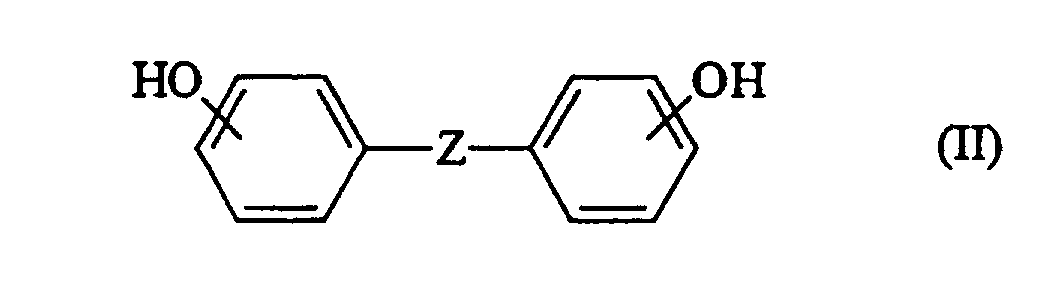
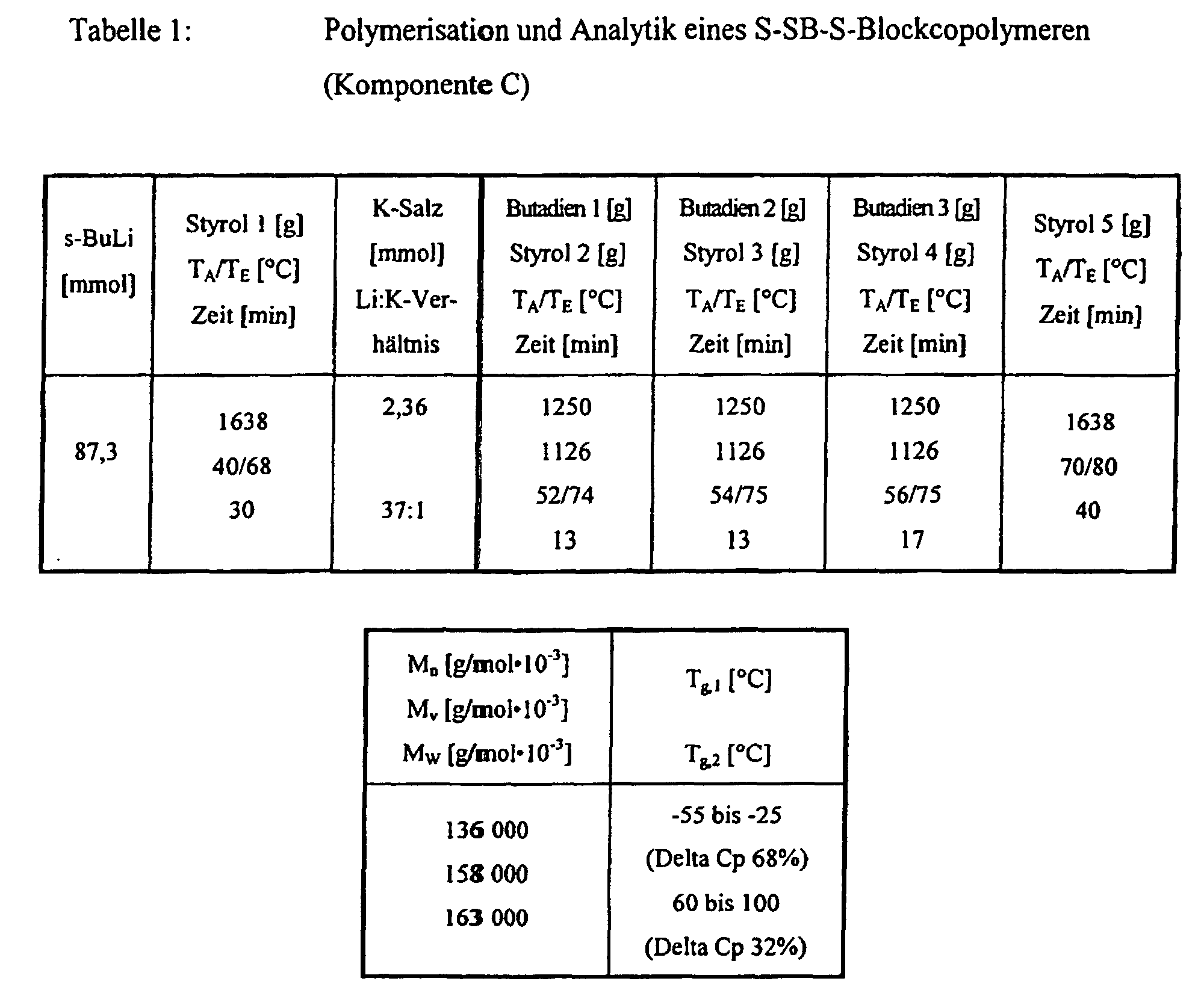
| Mischung/Komponente | Einheit | 1 | 2 | 3 | 4 | 5 |
| A3 | % | 40 | 38 | 36 | 34 | 32 |
| B3 | % | 60 | 57 | 54 | 51 | 48 |
| C | % | 0 | 5 | 10 | 15 | 20 |
| MVR 220/10 | cm3/10min | 3,6 | 4,7 | 6,1 | 8,9 | 13 |
| Bruchspannung | Mpa | 33 | 29 | 27 | 26 | 24 |
| Streckdehnung | % | 3,1 | 3,3 | 3,2 | 3,3 | 3,4 |
| Schlagzähigkeit Charpy 23°C | kJ/m2 | kein Bruch | kein Bruch | kein Bruch | kein Bruch | kein Bruch |
| Kerbschlagzähigkeit Charpy, 23°C | kJ/m2 | 32,8 | 34,9 | 40,4 | 43,9 | 47,1 |
| Kerbschlagzähigkeit Charpy, -30°C | kJ/m2 | 17 | 9 | 10 | 8 | 5 |
| Durchstoßtest | 25 | 26 | 26 | 26 | 24 | |
| Vergilbung nach 16 h Belichtung | +32 | +25 | +27 | +27 | +27 | |
| Vicat | °C | 96,5 | 94 | 91 | 85 | 80 |
| Mischung/Komponente | Einheit | 11 | 12 | 13 | 14 | 15 |
| A1 | % | 42 | 39,9 | 37,8 | 35,7 | 33,6 |
| B4 | % | 58 | 55,1 | 52,2 | 49,3 | 46,4 |
| C | % | 0 | 5 | 10 | 15 | 20 |
| MVR 220/10 | cm3/10min | 4,7 | 4,9 | 7,9 | 8,9 | 13,3 |
| Bruchspannung | Mpa | 35 | 34 | 31 | 28 | 28 |
| Streckdehnung % | % | 3,5 | 3,4 | 3,5 | 3,5 | 3,6 |
| Kerbschlagzähigkeit Charpy, 23°C | kJ/m2 | 46,8 | 48,4 | 49,7 | 28,3 | 22,3 |
| Kerbschlagzähigkeit Charpy, -30°C | kJ/m2 | 2,3 | 2,3 | 2 | 1,8 | 1,8 |
| Durchstoßtest MT 220° | 25 | 25 | 11 | 9 | 9 | |
| Vicat°C | °C | 91,5 | 90,5 | 86,2 | 79,3 | 73,4 |
| Komponente | Prüfvorschrift, ISO | Einheit | 1 | 2 | 3 | 4 | 5 | 6 | 7 |
| A2 | % | 30 | 29,4 | 28,5 | 27 | 24 | 15 | 6 | |
| B1 | % | 70 | 68,6 | 66,5 | 63 | 56 | 35 | 17 | |
| C | % | 0 | 2 | 5 | 10 | 20 | 50 | 80 | |
| Melt-Volume Rate (220°C/10kg) | 1133 | cm3/10min | 16,3 | 16,9 | 18,7 | 23,1 | 34,2 | 73,9 | 74 |
| Vicat-Erweichungstemperatur VST/B/50 | 306 | °C | 101,3 | 100,6 | 99,2 | 97,0 | 99,1 | 59,9 | nmb |
| Charpy Schlagzähigkeit bei 23°C | 179/leU | kJ/m2 | 226 | 237 | 276 | 296 | k.b.2) | k.b. | nmb 1) |
| Charpy Schlagzähigkeit bei -30°C | 179/leU | kJ/m2 | 82,8 | 93,5 | 105 | 99,4 | 146 | k.b.2) | nmb 1) |
| Charpy Kerbschlagzähigkeit bei 23°C | 179/leA | kJ/m2 | 14,3 | 12,4 | 13,7 | 12,5 | 34 | 31 | nmb 1) |
| Charpy Kerbschlagzähigkeit bei -30°C | 179/l eA | kJ/m2 | 5,4 | 4,6 | 4,5 | 4,1 | 3,8 | 2,7 | -- |
| IZOD Kerbschlagzähigkeit bei 23°C | 180/1A | kJ/m2 | 18,4 | 13,8 | 14,8 | ||||
| IZOD Kerbschlagzähigkeit bei -30°C | 180/1A | kJ/m2 | 5,4 | 4,5 | 4,3 | ||||
| Dehnung bei Streckspannung | 527-2 | % | 2,9 | 2,9 | 2,9 | 2,9 | 2,9 | 2,5 | 8,4 |
| Nominelle Reißdehnung | 527-2 | % | 7,9 | 9,2 | 10,8 | 14,2 | 21,4 | 117 | 351 |
| Zug-E-Modul | 527-2 | MPa | 2390 | 2330 | 2245 | 2148 | 1745 | 1108 | 298 |
| Biegefestigkeit (max) | 178 | MPa | 74,9 | 72,9 | 69,4 | 63,6 | 47,3 | 26,7 | -- |
| Yellowness | 48,8 | 48,1 | 47,1 | 44,1 | 41,7 | 34 | 22,4 |
| Komponente | Prüfvorschrift, ISO | Einheit | 1 | 2 | 3 | 4 | 5 | 6 | 7 |
| A3 | % | 30 | 29,4 | 28,5 | 27 | 24 | 15 | 6 | |
| B2 | % | 70 | 68,6 | 66,5 | 63 | 56 | 35 | 17 | |
| C | % | 0 | 2 | 5 | 10 | 20 | 50 | 80 | |
| Melt-Volume Rate (220°C/10kg) | 1133 | cm3/10min | 17,2 | 19,8 | 21,5 | 26,1 | 36,5 | 72,8 | nmb |
| Vicat-Erweichungstemperatur VST/B/50 | 306 | °C | 96,3 | 95,5 | 94,3 | 90,6 | 83,2 | nmb | nmb |
| Charpy Schlagzähigkeit bei 23°C | 179/1eU | kJ/m2 | 157 | 208 | 221 | 269 | k.b. | k.b. | nmb |
| Charpy Schlagzähigkeit bei -30°C | 179/1eU | kJ/m2 | 101 | 119 | 121 | 124 | 138 | k.b. | nmb |
| Charpy Kerbschlagzähigkeit bei 23°C | 179/1eA | kJ/m2 | 22,9 | 27,1 | 31,3 | 37,1 | 34,4 | 55,3 | nmb |
| Charpy Kerbschlagzähigkeit bei -30°C | 179/1eA | kJ/m2 | 7,5 | 6,8 | 6,2 | 5,2 | 3,6 | 3,3 | nmb |
| IZOD Kerbschlagzähigkeit bei 23°C | 180/1A | kJ/m2 | 17,6 | 23,3 | 28,7 | - | - | - | - |
| IZOD Kerbschlagzähigkeit bei -30°C | 1801/1A | kJ/m2 | 7,6 | 7,3 | 6,7 | - | - | - | - |
| Dehn-Streckspannung | 527-2 | % | 2,7 | 2,8 | 2,9 | 2,9 | 2,9 | 3,2 | 10,9 |
| Nominelle Reißdehnung | 527-2 | % | 5,2 | 5,7 | 8,7 | 11,6 | 21,4 | 122 | 389 |
| Zug-E-Modul | 527-2 | MPa | 2205 | 2143 | 2063 | 1946 | 1746 | 986 | 251 |
| Biegefestigkeit (max) | 178 | MPa | 65,9 | 63,8 | 60,9 | 55,6 | 47,6 | 22,5 | - |
| Yellowness | 27,3 | 26,0 | 24,4 | 23,3 | 21,5 | 15,5 | nmb |
| Komponente | Prüfvorschrift, ISO | Einheit | 1 | 2 | 3 | 4 | 5 |
| A3 | % | 30 | 29,4 | 28,5 | 27 | 24 | |
| B3 | % | 70 | 68,6 | 66,5 | 63 | 56 | |
| C | % | 0 | 2 | 5 | 10 | 20 | |
| Melt-Volume Rate (220°C/10kg) | 1133 | cm3/10min | 6,4 | 7,2 | 8,4 | 11,4 | 18,8 |
| Vicat-Erweichungstemperatur VST/B/50 | 306 | °C | 99,9 | 99,3 | 98,1 | 94,4 | 80 |
| Charpy Schlagzähigkeit bei 23°C | 179/1eU | kJ/m2 | 183 | 232 | 221 | 269 | k.b. |
| Charpy Schlagzähigkeit bei -30°C | 179/1eU | kJ/m2 | 110 | 107 | 92,4 | 137 | 154 |
| Charpy Kerbschlagzähigkeit bei 23°C | 179/1eA | kJ/m2 | 16,9 | 21,9 | 27,6 | 35,6 | 30,2 |
| Charpy Kerbschlagzähigkeit bei -30°C | 179/1eA | kJ/m2 | 6,9 | 6,7 | 5,9 | 4,9 | 2,6 |
| IZOD Kerbschlagzähigkeit bei 23°C | 180/1A | kJ/m2 | 14,1 | 17,2 | 22,5 | - | - |
| IZOD Kerbschlagzähigkeit bei - 30°C | 180/1A | kJ/m2 | 6,9 | 6,4 | 5,5 | - | - |
| Dehn-Streckspannung | 527-2 | % | 3,1 | 3,1 | 3,1 | 3,0 | 3,0 |
| Nominelle Reißdehnung | 527-2 | % | 4,9 | 5,7 | 8,2 | 12,8 | 24,9 |
| Zug-E-Modul | 527-2 | MPa | 2290 | 2240 | 2180 | 2050 | 1760 |
| Biegefestigkeit (max) | 178 | MPa | 73,0 | 70,9 | 67,1 | 60,0 | 50,5 |
| Yellowness | 27,5 | 26,5 | 25,0 | 23,8 | 21,6 |
| Komponente | Prüfvorschrift, ISO | Einheit | 1 | 2 | 3 | 4 | 5 |
| A4 | % | 30 | 29,4 | 28,5 | 27 | 24 | |
| B4 | % | 70 | 68,6 | 66,5 | 63 | 56 | |
| C | % | 0 | 2 | 5 | 10 | 20 | |
| Melt-Volume Rate (220°C/10kg) | 1133 | cm3/10min | 2,7 | 2,7 | 3,4 | 4,8 | 11,6 |
| Vicat-Erweichungstemperatur VST/B/50 | 306 | °C | 100,3 | 99,6 | 97,8 | 91,2 | 75 |
| Charpy Schlagzähigkeit bei 23°C | 179/1eU | kJ/m2 | 198 | 236 | nb 1) | nb1) | nb |
| Charpy Schlagzähigkeit bei -30°C | 179/1eU | kJ/m2 | 85,5 | 118 | 107 | 135 | 61 |
| Charpy Kerbschlagzähigkeit bei 23°C | 179/1eA | kJ/m2 | 9,3 | 10,7 | 12,2 | 17,5 | 29,6 |
| Charpy Kerbschlagzähigkeit bei -30°C | 179/1eA | kJ/m2 | 2,8 | 3,1 | 2,6 | 2,5 | 1,8 |
| IZOD Kerbschlagzähigkeit bei 23°C | 180/1A | kJ/m2 | 8,8 | 9,6 | 8,5 | - | - |
| IZOD Kerbschlagzähigkeit bei -30°C | 180/1A | kJ/m2 | 3,5 | 3,8 | 3,2 | - | - |
| Dehn-Streckspannung | 527-2 | % | 3,7 | 3,7 | 3,7 | 3,6 | 3,7 |
| Nominelle Reißdehnung | 527-2 | % | 12,7 | 14 | 15 | 20,6 | 42 |
| Zug-E-Modul | 527-2 | MPa | 2180 | 2120 | 2042 | 1920 | 1640 |
| Biegefestigkeit (max) | 178 | MPa | 70,4 | 66,7 | 63,3 | 59,2 | 46,8 |
| Yellowness | 42,8 | 43,7 | 42,7 | 43,1 | 39,4 |
| Komponente | 1 | 2 |
| A3 [%] | 40 | 39,2 |
| B3 [%] | 60 | 58,8 |
| C [%] | - | 2 |
| IZOD Kerbschlagzähigkeit bei 23°C | 170 | 350 |
| ⊥ [kJ/m2] | ||
| IZOD Kerbschlagzähigkeit bei 23°C | 350 | 350 |
| ∥ [kJ/m2] |
Claims (10)
- Thermoplastische Formmassen, enthaltend(A) 5 bis 98 Gew.-%, bezogen auf das Gesamtgewicht der Formmassen, eines kautschukartigen Pfropfcopolymerisats, aufgebaut aus(a1) 30 bis 90 Gew.-%, bezogen auf (A), einer Pfropfgrundlage mit einer Glasübergangstemperatur (Tg) von unter -10 °C aus(a11) einem zumindest teilweise vernetzten Acrylester-Polymerisat gebildet ausund/oder(a111) 50 bis 99,9 Gew.-%, bezogen auf (a11), mindestens eines Alkylacrylates mit 1 bis 10 C-Atomen im Alkylrest,(a112) 0,1 bis 5 Gew.-%, bezogen auf (a11), mindestens eines polyfunktionellen, vernetzend wirkenden Monomeren und(a113) 0 bis 49,9 Gew.-%, bezogen auf (a11), mindestens eines weiteren mit (a111) copolymerisierbaren Monomeren aus der Gruppe der Vinylalkylether mit 1 bis 8 C-Atomen im Alkylrest, Butadien, Isopren, Styrol, Acrylnitril, Methacrylnitril und/oder Methylmethacrylat(a12) einem Dienpolymerisat, aufgebaut aus(a121) 60 bis 100 Gew.-%, bezogen auf (a12), mindestens eines Diens und(a122) 0 bis 40 Gew.-%, bezogen auf (a12), weiterer copolymerisierbarer Monomere aus der Gruppe der Alkylacrylate mit 1 bis 10 C-Atomen im Alkylrest, Vinylalkylether mit 1 bis 8 C-Atomen im Alkylrest, Butadien, Isopren, Styrol, Acrylnitril, Methacrylnitril und/oder Methylmethacrylat,(a2) 10 bis 70 Gew.-%, bezogen auf (A), einer auf die Pfropfgrundlage aufgepfropften Pfropfauflage mit einer Tg von mehr als 50 °C, aufgebaut aus(a21) 50 bis 95 Gew.-%, bezogen auf (a2), mindestens eines vinylaromatischen Monomeren,(a22) 5-50 Gew.-%, bezogen auf (a2), mindestens eines polaren, copolymerisierbaren Comonomeren aus der Gruppe Acrylnitril, Methacrylnitril, Ester der(Meth)acrylsäure mit 1 bis 4 C-Atomen im Alkylrest, Maleinsäureanhydrid und dessen Imide, (Meth)acrylamid und/oder Vinylalkylether mit 1 bis 8 C-Atomen im Alkylrest oder deren Mischung,(B) 1 bis 90 Gew.-%, bezogen auf das Gesamtgewicht der Formmasse, eines Copolymerisats aus(b1) 50 bis 99 Gew.-%, bezogen auf (B), mindestens eines vinylaromatischen Monomeren
und(b2) 1 bis 50 Gew.-%, bezogen auf (B), Monomeren wie für (a22) beschrieben,(C) 1 bis 70 Gew.-%, bezogen auf (A), (B), (C) und gegebenenfalls (D), eines kautschukelastischen Blockcopolymerisates aus
mindestens einem einpolymerisierte Einheiten aus vinylaromatischen Monomeren aufweisenden, eine Hartphase bildenden Block CA und
mindestens einem einpolymerisierte Einheiten aus vinylaromatischen Monomere sowie einem Dien aufweisenden elastomeren, eine Weichphase bildenden Block CB/A,
wobei die Glasübergangstemperatur Tg des Blocks CA über 25°C und die des Blocks CB/A unter 25°C liegt und
das Phasenvolumen-Verhältnis von Block CA zu Block CB/A so gewählt ist, daß der Anteil der Hartphase am gesamten Blockcopolymerisat 1 bis 40 Vol.-% und der Gewichtsanteil des Diens im gesamten Blockcopolymerisat weniger als 50 Gew.-% beträgt,
wobei der relative Anteil an 1,2-Verknüpfungen des Polydiens, bezogen auf die Summe an 1,2- und 1,4-cis/trans-Verknüpfungen, unterhalb von 15% liegt,
und(D) 0-300 Gew.-%, bezogen auf das Gewicht der Komponenten (A) bis (C), eines Polycarbonats,(E) 0 bis 30 Gew.-%, bezogen auf das Gesamtgewicht der Formmassen, üblicher Zusatzstoffe und Verarbeitungshilfsmittel. - Thermoplastische Formmassen, enthaltend(A) 5 bis 98,9 Gew.-%, bezogen auf das Gesamtgewicht der Formmassen, mindestens eines kautschukartigen Pfropfcopolymerisats, aufgebaut aus(a1) 30 bis 90 Gew.-%, bezogen auf (A), einer Pfropfgrundlage mit einer Glasübergangstemperatur (Tg) von unter -10 °C aus(a11) einem zumindest teilweise vernetzten Acrylester-Polymerisat gebildet ausund/oder(a111) 50 bis 99,9 Gew.-%, bezogen auf (a11), mindestens eines Alkylacrylates mit 1 bis 10 C-Atomen im Alkylrest,(a112) 0,1 bis 5 Gew.-%, bezogen auf (a11), mindestens eines polyfunktionellen, vernetzend wirkenden Monomeren und(a113) 0 bis 49,9 Gew.-%, bezogen auf (a11), mindestens eines weiteren mit (a111)copolymerisierbaren Monomeren aus der Gruppe der Vinylalkylether mit 1 bis 8 C-Atomen im Alkylrest, Butadien, Isopren, Styrol, Acrylnitril, Methacrylnitril und/oder Methylmethacrylat(a12) einem Dienpolymerisat, aufgebaut aus(a121) 60 bis 100 Gew.-%, bezogen auf (a12), mindestens eines Diens und(a122) 0 bis 40 Gew.-%, bezogen auf (a12), weiterer copolymerisierbarer Monomere aus der Gruppe der Alkylacrylate mit 1 bis 10 C-Atomen im Alkylrest, Vinylalkylether mit 1 bis 8 C-Atomen im Alkylrest, Butadien, Isopren, Styrol, Acrylnitril, Methacrylnitril und/oder Methylmethacrylat,(a2) 10 bis 70 Gew.-%, bezogen auf (A), einer auf die Pfropfgrundlage aufgepfropften Pfropfauflage mit einer Glasübergangstemperatur (Tg) von mehr als 50 °C, aufgebaut aus(a21) 65 bis 95 Gew.-%, bezogen auf (a2), mindestens eines vinylaromatischen Monomeren,(a22) 5 bis 35 Gew.-%, bezogen auf (a2), mindestens eines polaren, copolymerisierbaren Comonomeren aus der Gruppe Acrylnitril, Methacrylnitril, Ester der(Meth)acrylsäure mit 1 bis 4 C-Atomen im Alkylrest, Maleinsäureanhydrid und dessen Imide, (Meth)acrylamid und/oder Vinylalkylether mit 1 bis 8 C-Atomen im Alkylrest oder deren Mischung,(B) 1 bis 90 Gew.-%, bezogen auf das Gesamtgewicht der Formmasse, eines Copolymerisats aus(b1) 69 bis 81 Gew.-%, bezogen auf (B), mindestens eines vinylaromatischen Monomeren
und(b2) 19 bis 31 Gew.-%, bezogen auf (B), Monomeren wie für (a22) beschrieben,(C) 0,1 bis 70 Gew.-%, bezogen auf (A), (B), (C) und gegebenenfalls (D) und (E), eines kautschukelastischen Blockcopolymerisates aus
mindestens einem einpolymerisierte Einheiten aus vinylaromatische Monomeren aufweisenden, eine Hartphase bildenden Block CA und
mindestens einem einpolymerisierte Einheiten aus vinylaromatische Monomeren sowie ein Dien aufweisenden elastomeren, eine Weichphase bildenden Block CB/A,
wobei die Glasübergangstemperatur Tg des Blocks CA über 25°C und die des Blocks CB/A unter 25°C liegt und
das Phasenvolumen-Verhältnis von Block CA zu Block CB/A so gewählt ist, daß der Anteil der Hartphase am gesamten Blockcopolymerisat 1 bis 40 Vol.-% und der Gewichtsanteil des Diens im gesamten Blockcopolymerisat weniger als 50 Gew.-% beträgt,
wobei der relative Anteil an 1,2-Verknüpfungen des Polydiens, bezogen auf die Summe an 1,2- und 1,4-cis/trans-Verknüpfungen, unterhalb von 15% liegt,
und(D) 0-300 Gew.-%, bezogen auf das Gewicht der Komponenten (A) bis (C), eines Polycarbonats, S-MSA-Copolymeren (Styrol-Maleinsäure-Copolyeren), S-Imid-MSA-Copolymeren (Styrol-Imid-Maleinsäureanhydrid-Copolymeren), S-Imid-AN-MSA-Copolymeren (Styrol-Imid-Acrylnitril-Maleinsäureanhydrid-Copolymeren), eines Polymethacrylimids oder eines Polymethacrylats,(E) 0 bis 30 Gew.-%, bezogen auf das Gesamtgewicht der Formmassen, üblicher Zusatzstoffe und Verarbeitungshilfsmittel. - Thermoplastische Formmassen nach Anspruch 2, dadurch gekennzeichnet, daß der Anteil der Komponente (C) 0,1 bis 15 Gew.-%, bezogen auf (A), (B), (C) und gegebenenfalls (D) und (E) beträgt.
- Thermoplastische Formmassen nach einem der Ansprüche 1 bis 3, wobei als Komponente (A) ein Pfropfcopolymerisat mit einer Pfropfgrundlage (a12) eingesetzt wird.
- Thermoplastische Formmassen nach einem der Ansprüche 1 bis 4, dadurch gekennzeichnet, daß in der Komponente (C) das vinylaromatische Monomere ausgewählt ist aus Styrol, α-Methylstyrol, Vinyltoluol, 1,1-Diphenylethylen sowie Mischungen dieser Verbindungen und das Dien aus Butadien, Isopren, Piperylen, 1-Phenylbutadien sowie Mischungen dieser Verbindungen.
- Thermoplastische Formmassen nach einem der Ansprüche 1 bis 5, in denen die Komponente (C) durch eine der allgemeinen Formeln 1 bis 11 dargestellt wird:
- Thermoplastische Formmassen nach einem der Ansprüche 1 bis 6, dadurch gekennzeichnet, daß in der Komponente (C) das Molekulargewicht des Blocks CA zwischen 1000 und 200 000 liegt und das des Blocks C(B/A) zwischen 2 000 und 250 000 [g/mol].
- Verfahren zur Herstellung thermoplastischer Formmassen nach einem der Ansprüche 1 bis 7, dadurch gekennzeichnet, daß die Komponenten nach an sich bekannten Mischverfahren gemischt werden.
- Verwendung der thermoplastischen Formmassen nach einem der Ansprüche 1 bis 7 zur Herstellung von Folien, Formkörpem und Fasern.
- Formkörper erhältlich unter Verwendung der thermoplastischen Formmassen nach einem der Ansprüche 1 bis 7.
Applications Claiming Priority (3)
| Application Number | Priority Date | Filing Date | Title |
|---|---|---|---|
| DE19858141A DE19858141A1 (de) | 1998-12-16 | 1998-12-16 | Thermoplasische Formmassen |
| DE19858141 | 1998-12-16 | ||
| PCT/EP1999/010016 WO2000036010A1 (de) | 1998-12-16 | 1999-12-16 | Thermoplastische formmassen |
Publications (2)
| Publication Number | Publication Date |
|---|---|
| EP1141122A1 EP1141122A1 (de) | 2001-10-10 |
| EP1141122B1 true EP1141122B1 (de) | 2004-09-15 |
Family
ID=7891343
Family Applications (1)
| Application Number | Title | Priority Date | Filing Date |
|---|---|---|---|
| EP99963561A Expired - Lifetime EP1141122B1 (de) | 1998-12-16 | 1999-12-16 | Thermoplastische formmassen |
Country Status (9)
| Country | Link |
|---|---|
| US (1) | US6579937B1 (de) |
| EP (1) | EP1141122B1 (de) |
| KR (1) | KR100652084B1 (de) |
| CN (1) | CN1137206C (de) |
| AT (1) | ATE276316T1 (de) |
| AU (1) | AU1981200A (de) |
| DE (2) | DE19858141A1 (de) |
| ES (1) | ES2229799T3 (de) |
| WO (1) | WO2000036010A1 (de) |
Families Citing this family (33)
| Publication number | Priority date | Publication date | Assignee | Title |
|---|---|---|---|---|
| DE19953955A1 (de) * | 1999-11-09 | 2001-05-10 | Basf Ag | Thermoplastische Formmassen mit geringer Eigenfarbe und guter Verarbeitbarkeit |
| DE60333911D1 (de) * | 2002-04-25 | 2010-10-07 | Asahi Kasei Chemicals Corp | Blockcopolymer und zusammensetzung davon |
| US6730748B2 (en) * | 2002-07-09 | 2004-05-04 | Bayer Polymers Llc | Thermoplastic polycarbonate compositions having high toughness |
| DE10330397A1 (de) * | 2003-07-04 | 2005-01-20 | Basf Ag | Mischung aus Propfcopolymeren und Styrol-Butadien-Blockcopolymeren |
| US7247675B2 (en) * | 2003-12-30 | 2007-07-24 | Kimberly-Clark Worldwide, Inc. | Elastomer compositions and method of making them |
| WO2005075561A1 (de) | 2004-02-09 | 2005-08-18 | Basf Aktiengesellschaft | Formmassen aus styrolpolymeren mit matter oberfläche |
| KR100626954B1 (ko) * | 2004-08-19 | 2006-09-20 | 주식회사 엘지화학 | 열가소성 투명수지 조성물 및 그 제조방법 |
| WO2006053711A1 (de) * | 2004-11-17 | 2006-05-26 | Basf Aktiengesellschaft | Zähe, füllstoff-haltige formmassen auf basis von styrolpolymeren |
| DE102004055539A1 (de) * | 2004-11-17 | 2006-05-18 | Basf Ag | Masterbatch auf Basis von Styrol-Butadien-Blockcopolymeren |
| JP2006199743A (ja) * | 2005-01-18 | 2006-08-03 | Idemitsu Kosan Co Ltd | 熱可塑性樹脂組成物および成形体 |
| DE502008001538D1 (de) * | 2007-05-23 | 2010-11-25 | Basf Se | Isotaktisches polystyrol mit reaktiven gruppen |
| EP2178970B1 (de) * | 2007-07-10 | 2011-02-23 | Basf Se | Flammwidrige thermoplastische formmassen |
| EP2190922B1 (de) | 2007-09-14 | 2011-06-22 | Basf Se | Transparente und zähsteife formmassen auf basis von styrol-butadien-blockcopolymermischungen |
| WO2009074645A1 (de) * | 2007-12-13 | 2009-06-18 | Basf Se | Thermoplastisches linoleum |
| AU2009234514B2 (en) * | 2008-04-08 | 2014-05-01 | Formway Furniture Limited | Injection moulding method |
| US8536279B2 (en) | 2008-12-23 | 2013-09-17 | Styrolution GmbH | Phase-separating block or graft copolymers comprising incompatible hard blocks and moulding compositions having a high stiffness |
| CN101838862B (zh) * | 2010-05-07 | 2012-01-04 | 天津工业大学 | 一种有机液体吸附纤维的制造方法 |
| CN101845756B (zh) * | 2010-05-07 | 2011-08-31 | 天津工业大学 | 一种夹层型复合吸油材料的制造方法 |
| CN101929034B (zh) * | 2010-08-18 | 2011-11-09 | 天津工业大学 | 一种吸附有机液体非织造布的制造方法 |
| CN102002203B (zh) * | 2010-12-10 | 2013-11-20 | 上海金发科技发展有限公司 | 一种阻燃asa改性树脂及其制备方法 |
| US9238770B2 (en) * | 2012-03-29 | 2016-01-19 | Kraton Polymers U.S. Llc | Low viscosity synthetic cement |
| WO2017060344A1 (en) | 2015-10-09 | 2017-04-13 | Ineos Styrolution Group Gmbh | Thermally conductive polymer resin composition based on styrenics with low density |
| WO2017060347A1 (en) | 2015-10-09 | 2017-04-13 | Ineos Styrolution Group Gmbh | Electrically insulating thermally conductive polymer resin composition based on styrenics with balanced properties |
| WO2017060343A1 (en) | 2015-10-09 | 2017-04-13 | Ineos Styrolution Group Gmbh | Electrically conducting thermally conductive polymer resin composition based on styrenics with balanced properties |
| US11027466B2 (en) | 2015-12-17 | 2021-06-08 | Ineos Styrolution Group Gmbh | Process for producing foam molded parts with aesthetic surfaces by foam injection molding |
| WO2017182452A1 (en) * | 2016-04-21 | 2017-10-26 | Ineos Styrolution Group Gmbh | Abs molding composition having improved crack and chemical resistance and its use |
| EP3445815B1 (de) | 2016-04-21 | 2021-06-09 | INEOS Styrolution Group GmbH | Abs-formmasse mit erhöhter riss- und chemischer beständigkeit und deren verwendung |
| ES2950797T3 (es) * | 2018-02-16 | 2023-10-13 | Ineos Styrolution Group Gmbh | Composición de moldeo de ABS resistente a altas temperaturas |
| CN109627735A (zh) * | 2018-12-26 | 2019-04-16 | 天津金发新材料有限公司 | 一种抗静电、抗菌pc/asa材料、制备方法及其应用 |
| CN110092960B (zh) * | 2019-03-29 | 2021-11-12 | 金发科技股份有限公司 | 一种热塑性聚合物组合物及其制备方法 |
| WO2021032827A1 (en) | 2019-08-21 | 2021-02-25 | Ineos Styrolution Group Gmbh | Abs molding composition for sheet extrusion and thermoforming with high escr, high color and thermal stability and low tendency to delamination |
| CN114846067A (zh) | 2019-12-20 | 2022-08-02 | 丘奇和德怀特有限公司 | 聚合物组合物及由其形成的产品 |
| MX2022007772A (es) | 2019-12-20 | 2022-09-09 | Church & Dwight Co Inc | Composiciones polimericas y productos formados con las mismas. |
Family Cites Families (4)
| Publication number | Priority date | Publication date | Assignee | Title |
|---|---|---|---|---|
| NL9002379A (nl) | 1990-11-01 | 1992-06-01 | Stamicarbon | Polymeermengsel bevattende een aromatisch polycarbonaat hars en een slagvastheid verhogend middel. |
| US5760134A (en) | 1995-10-02 | 1998-06-02 | Basf Aktiengesellschaft | Thermoplastic molding materials |
| US5814702A (en) | 1996-02-20 | 1998-09-29 | General Electric Company | Elastomer composition and thermoplastic resin composition modified therewith |
| DE19638256A1 (de) * | 1996-09-19 | 1998-03-26 | Basf Ag | Thermoplastische Formmassen |
-
1998
- 1998-12-16 DE DE19858141A patent/DE19858141A1/de not_active Withdrawn
-
1999
- 1999-12-16 WO PCT/EP1999/010016 patent/WO2000036010A1/de not_active Ceased
- 1999-12-16 KR KR1020017007625A patent/KR100652084B1/ko not_active Expired - Fee Related
- 1999-12-16 AT AT99963561T patent/ATE276316T1/de not_active IP Right Cessation
- 1999-12-16 CN CNB998161381A patent/CN1137206C/zh not_active Expired - Lifetime
- 1999-12-16 EP EP99963561A patent/EP1141122B1/de not_active Expired - Lifetime
- 1999-12-16 ES ES99963561T patent/ES2229799T3/es not_active Expired - Lifetime
- 1999-12-16 AU AU19812/00A patent/AU1981200A/en not_active Abandoned
- 1999-12-16 DE DE59910537T patent/DE59910537D1/de not_active Expired - Lifetime
- 1999-12-16 US US09/868,516 patent/US6579937B1/en not_active Expired - Lifetime
Also Published As
| Publication number | Publication date |
|---|---|
| KR100652084B1 (ko) | 2006-11-30 |
| DE19858141A1 (de) | 2000-06-21 |
| EP1141122A1 (de) | 2001-10-10 |
| ATE276316T1 (de) | 2004-10-15 |
| CN1137206C (zh) | 2004-02-04 |
| WO2000036010A1 (de) | 2000-06-22 |
| KR20010093191A (ko) | 2001-10-27 |
| DE59910537D1 (de) | 2004-10-21 |
| AU1981200A (en) | 2000-07-03 |
| CN1334846A (zh) | 2002-02-06 |
| US6579937B1 (en) | 2003-06-17 |
| ES2229799T3 (es) | 2005-04-16 |
Similar Documents
| Publication | Publication Date | Title |
|---|---|---|
| EP0800555B1 (de) | Thermoplastische formmassen auf der basis von pfropfcopolymeren und blockpolymeren | |
| WO2000036010A1 (de) | Thermoplastische formmassen | |
| EP0576960B1 (de) | Formmasse mit matter Oberfläche | |
| EP0769524B1 (de) | Verwendung von Formteilen aus thermoplastischen Formmassen | |
| DE10008420A1 (de) | Polymerzusammensetzungen mit verbesserter Eigenschaftskonstanz | |
| DE102005022632B4 (de) | Teilchenförmiger Kautschuk, Verfahren zu dessen Herstellung und Verwendung, sowie Pfropfcopolymerisat, thermoplastische Formmasse und Verfahren zu deren Herstellung | |
| DE60007596T2 (de) | Mehrphasig strukturierte Polymerteilchen, Verfahren zu deren Herstellung und ihre Anwendungen | |
| EP0312929A2 (de) | Thermoplastische Formmasse, Verfahren zu ihrer Herstellung und deren Verwendung | |
| DE19926622A1 (de) | Thermoplastische Formmassen | |
| DE102010032624B4 (de) | Kautschukverstärkte thermoplastische Harzzusammensetzung mit hoher Schlagfestigkeit und Einfärbbarkeit | |
| EP0253236B1 (de) | Verfahren zur Herstellung thermoplastischer Formmassen | |
| DE68924511T2 (de) | Verfahren zur Herstellung eines mit Kautschuk modifizierten thermoplastischen Harzes und thermoplastische Harzmasse, die das modifizierte thermoplastische Harz enthält. | |
| DE4142910A1 (de) | Schlagzaehmodifier und diesen enthaltende formmasse | |
| DE10216071A1 (de) | Polycarbonat-Styrolcopolymer-Blends mit verbesserten Eigenschaften | |
| WO2001030901A1 (de) | Verfahren zur verminderung des cold stress whitening | |
| EP0743342B1 (de) | Thermoplastische ABS-Formmassen | |
| EP0731138B1 (de) | Thermoplastische Formmassen vom ABS-Typ | |
| EP0135802B1 (de) | Thermoplastische Formmasse | |
| DE19639592A1 (de) | Thermoplastische Formmassen | |
| WO1998012257A1 (de) | Thermoplastische formmassen | |
| EP0711807B1 (de) | Matte thermoplastische Formmassen | |
| EP0927227B1 (de) | Thermoplastische formmassen | |
| EP0902810B1 (de) | Thermoplastische formmassen auf basis von polycarbonaten und styrol/acrylnitrilpolymerisaten, die zur verbesserung ihrer eigenschaften copolymerisate auf alkyl(meth)acrylat-basis enthalten | |
| DE10046774A1 (de) | Thermoplastische Formmassen mit speziellen Additivmischungen | |
| WO2001034699A1 (de) | Thermoplastische formmassen mit geringer eigenfarbe und guter verarbeitbarkeit |
Legal Events
| Date | Code | Title | Description |
|---|---|---|---|
| PUAI | Public reference made under article 153(3) epc to a published international application that has entered the european phase |
Free format text: ORIGINAL CODE: 0009012 |
|
| 17P | Request for examination filed |
Effective date: 20010627 |
|
| AK | Designated contracting states |
Kind code of ref document: A1 Designated state(s): AT BE CH CY DE DK ES FI FR GB GR IE IT LI LU MC NL PT SE |
|
| AX | Request for extension of the european patent |
Free format text: AL;LT;LV;MK;RO;SI |
|
| GRAP | Despatch of communication of intention to grant a patent |
Free format text: ORIGINAL CODE: EPIDOSNIGR1 |
|
| GRAS | Grant fee paid |
Free format text: ORIGINAL CODE: EPIDOSNIGR3 |
|
| GRAA | (expected) grant |
Free format text: ORIGINAL CODE: 0009210 |
|
| AK | Designated contracting states |
Kind code of ref document: B1 Designated state(s): AT BE CH CY DE DK ES FI FR GB GR IE IT LI LU MC NL PT SE |
|
| PG25 | Lapsed in a contracting state [announced via postgrant information from national office to epo] |
Ref country code: IE Free format text: LAPSE BECAUSE OF FAILURE TO SUBMIT A TRANSLATION OF THE DESCRIPTION OR TO PAY THE FEE WITHIN THE PRESCRIBED TIME-LIMIT Effective date: 20040915 Ref country code: FI Free format text: LAPSE BECAUSE OF FAILURE TO SUBMIT A TRANSLATION OF THE DESCRIPTION OR TO PAY THE FEE WITHIN THE PRESCRIBED TIME-LIMIT Effective date: 20040915 Ref country code: CY Free format text: LAPSE BECAUSE OF FAILURE TO SUBMIT A TRANSLATION OF THE DESCRIPTION OR TO PAY THE FEE WITHIN THE PRESCRIBED TIME-LIMIT Effective date: 20040915 |
|
| REG | Reference to a national code |
Ref country code: GB Ref legal event code: FG4D Free format text: NOT ENGLISH Ref country code: CH Ref legal event code: EP |
|
| REG | Reference to a national code |
Ref country code: IE Ref legal event code: FG4D Free format text: GERMAN |
|
| REF | Corresponds to: |
Ref document number: 59910537 Country of ref document: DE Date of ref document: 20041021 Kind code of ref document: P |
|
| GBT | Gb: translation of ep patent filed (gb section 77(6)(a)/1977) | ||
| PG25 | Lapsed in a contracting state [announced via postgrant information from national office to epo] |
Ref country code: SE Free format text: LAPSE BECAUSE OF FAILURE TO SUBMIT A TRANSLATION OF THE DESCRIPTION OR TO PAY THE FEE WITHIN THE PRESCRIBED TIME-LIMIT Effective date: 20041215 Ref country code: GR Free format text: LAPSE BECAUSE OF FAILURE TO SUBMIT A TRANSLATION OF THE DESCRIPTION OR TO PAY THE FEE WITHIN THE PRESCRIBED TIME-LIMIT Effective date: 20041215 Ref country code: DK Free format text: LAPSE BECAUSE OF FAILURE TO SUBMIT A TRANSLATION OF THE DESCRIPTION OR TO PAY THE FEE WITHIN THE PRESCRIBED TIME-LIMIT Effective date: 20041215 |
|
| PG25 | Lapsed in a contracting state [announced via postgrant information from national office to epo] |
Ref country code: LU Free format text: LAPSE BECAUSE OF NON-PAYMENT OF DUE FEES Effective date: 20041216 Ref country code: AT Free format text: LAPSE BECAUSE OF NON-PAYMENT OF DUE FEES Effective date: 20041216 |
|
| PG25 | Lapsed in a contracting state [announced via postgrant information from national office to epo] |
Ref country code: MC Free format text: LAPSE BECAUSE OF NON-PAYMENT OF DUE FEES Effective date: 20041231 Ref country code: LI Free format text: LAPSE BECAUSE OF NON-PAYMENT OF DUE FEES Effective date: 20041231 Ref country code: CH Free format text: LAPSE BECAUSE OF NON-PAYMENT OF DUE FEES Effective date: 20041231 |
|
| LTIE | Lt: invalidation of european patent or patent extension |
Effective date: 20040915 |
|
| REG | Reference to a national code |
Ref country code: ES Ref legal event code: FG2A Ref document number: 2229799 Country of ref document: ES Kind code of ref document: T3 |
|
| REG | Reference to a national code |
Ref country code: IE Ref legal event code: FD4D |
|
| PLBE | No opposition filed within time limit |
Free format text: ORIGINAL CODE: 0009261 |
|
| STAA | Information on the status of an ep patent application or granted ep patent |
Free format text: STATUS: NO OPPOSITION FILED WITHIN TIME LIMIT |
|
| REG | Reference to a national code |
Ref country code: CH Ref legal event code: PL |
|
| ET | Fr: translation filed | ||
| 26N | No opposition filed |
Effective date: 20050616 |
|
| PG25 | Lapsed in a contracting state [announced via postgrant information from national office to epo] |
Ref country code: PT Free format text: LAPSE BECAUSE OF NON-PAYMENT OF DUE FEES Effective date: 20050215 |
|
| REG | Reference to a national code |
Ref country code: DE Ref legal event code: R082 Ref document number: 59910537 Country of ref document: DE Representative=s name: PATENTANWAELTE ISENBRUCK BOESL HOERSCHLER LLP, DE |
|
| PGFP | Annual fee paid to national office [announced via postgrant information from national office to epo] |
Ref country code: ES Payment date: 20141215 Year of fee payment: 16 Ref country code: GB Payment date: 20141216 Year of fee payment: 16 |
|
| REG | Reference to a national code |
Ref country code: DE Ref legal event code: R082 Ref document number: 59910537 Country of ref document: DE Representative=s name: PATENTANWAELTE ISENBRUCK BOESL HOERSCHLER LLP, DE Effective date: 20141223 Ref country code: DE Ref legal event code: R081 Ref document number: 59910537 Country of ref document: DE Owner name: STYROLUTION EUROPE GMBH, DE Free format text: FORMER OWNER: BASF SE, 67063 LUDWIGSHAFEN, DE Effective date: 20141223 |
|
| PGFP | Annual fee paid to national office [announced via postgrant information from national office to epo] |
Ref country code: FR Payment date: 20141212 Year of fee payment: 16 Ref country code: NL Payment date: 20141215 Year of fee payment: 16 |
|
| REG | Reference to a national code |
Ref country code: GB Ref legal event code: 732E Free format text: REGISTERED BETWEEN 20150205 AND 20150211 |
|
| REG | Reference to a national code |
Ref country code: ES Ref legal event code: PC2A Owner name: STYROLUTION EUROPE GMBH Effective date: 20150317 |
|
| PGFP | Annual fee paid to national office [announced via postgrant information from national office to epo] |
Ref country code: IT Payment date: 20141216 Year of fee payment: 16 |
|
| REG | Reference to a national code |
Ref country code: FR Ref legal event code: TP Owner name: STYROLUTION EUROPE GMBH, DE Effective date: 20150421 Ref country code: FR Ref legal event code: CJ Effective date: 20150421 Ref country code: FR Ref legal event code: CD Owner name: STYROLUTION EUROPE GMBH, DE Effective date: 20150421 |
|
| PGFP | Annual fee paid to national office [announced via postgrant information from national office to epo] |
Ref country code: BE Payment date: 20151221 Year of fee payment: 17 |
|
| REG | Reference to a national code |
Ref country code: NL Ref legal event code: PD Owner name: STYROLUTION EUROPE GMBH; DE Free format text: DETAILS ASSIGNMENT: VERANDERING VAN EIGENAAR(S), VERANDERING VAN DE JURIDISCHE ENTITEIT; FORMER OWNER NAME: STYROLUTION GMBH Effective date: 20151029 |
|
| PGFP | Annual fee paid to national office [announced via postgrant information from national office to epo] |
Ref country code: DE Payment date: 20160229 Year of fee payment: 17 |
|
| GBPC | Gb: european patent ceased through non-payment of renewal fee |
Effective date: 20151216 |
|
| REG | Reference to a national code |
Ref country code: NL Ref legal event code: MM Effective date: 20160101 |
|
| REG | Reference to a national code |
Ref country code: FR Ref legal event code: ST Effective date: 20160831 |
|
| PG25 | Lapsed in a contracting state [announced via postgrant information from national office to epo] |
Ref country code: NL Free format text: LAPSE BECAUSE OF NON-PAYMENT OF DUE FEES Effective date: 20160101 Ref country code: GB Free format text: LAPSE BECAUSE OF NON-PAYMENT OF DUE FEES Effective date: 20151216 |
|
| PG25 | Lapsed in a contracting state [announced via postgrant information from national office to epo] |
Ref country code: FR Free format text: LAPSE BECAUSE OF NON-PAYMENT OF DUE FEES Effective date: 20151231 |
|
| PG25 | Lapsed in a contracting state [announced via postgrant information from national office to epo] |
Ref country code: IT Free format text: LAPSE BECAUSE OF NON-PAYMENT OF DUE FEES Effective date: 20151216 |
|
| REG | Reference to a national code |
Ref country code: ES Ref legal event code: FD2A Effective date: 20170126 |
|
| PG25 | Lapsed in a contracting state [announced via postgrant information from national office to epo] |
Ref country code: ES Free format text: LAPSE BECAUSE OF NON-PAYMENT OF DUE FEES Effective date: 20151217 |
|
| PG25 | Lapsed in a contracting state [announced via postgrant information from national office to epo] |
Ref country code: BE Free format text: LAPSE BECAUSE OF NON-PAYMENT OF DUE FEES Effective date: 20161231 |
|
| REG | Reference to a national code |
Ref country code: DE Ref legal event code: R119 Ref document number: 59910537 Country of ref document: DE |
|
| PG25 | Lapsed in a contracting state [announced via postgrant information from national office to epo] |
Ref country code: DE Free format text: LAPSE BECAUSE OF NON-PAYMENT OF DUE FEES Effective date: 20170701 |
|
| REG | Reference to a national code |
Ref country code: BE Ref legal event code: PD Owner name: STYROLUTION EUROPE GMBH; DE Free format text: DETAILS ASSIGNMENT: CHANGE OF OWNER(S), AFFECTATION / CESSION; FORMER OWNER NAME: BASF SE Effective date: 20150331 Ref country code: BE Ref legal event code: MM Effective date: 20161231 Ref country code: BE Ref legal event code: HC Owner name: BASF SE; DE Free format text: DETAILS ASSIGNMENT: CHANGE OF OWNER(S), CHANGEMENT NOM PROPRIETAIRE; FORMER OWNER NAME: BASF AKTIENGESELLSCHAFT Effective date: 20150331 |