EP1145149B1 - Procedes et systeme de collection et de stockage efficaces de donnees experimentales - Google Patents
Procedes et systeme de collection et de stockage efficaces de donnees experimentales Download PDFInfo
- Publication number
- EP1145149B1 EP1145149B1 EP99958879A EP99958879A EP1145149B1 EP 1145149 B1 EP1145149 B1 EP 1145149B1 EP 99958879 A EP99958879 A EP 99958879A EP 99958879 A EP99958879 A EP 99958879A EP 1145149 B1 EP1145149 B1 EP 1145149B1
- Authority
- EP
- European Patent Office
- Prior art keywords
- database
- data
- container
- sub
- feature
- Prior art date
- Legal status (The legal status is an assumption and is not a legal conclusion. Google has not performed a legal analysis and makes no representation as to the accuracy of the status listed.)
- Expired - Lifetime
Links
Images




Classifications
-
- G—PHYSICS
- G06—COMPUTING OR CALCULATING; COUNTING
- G06V—IMAGE OR VIDEO RECOGNITION OR UNDERSTANDING
- G06V20/00—Scenes; Scene-specific elements
- G06V20/60—Type of objects
- G06V20/69—Microscopic objects, e.g. biological cells or cellular parts
-
- G—PHYSICS
- G01—MEASURING; TESTING
- G01N—INVESTIGATING OR ANALYSING MATERIALS BY DETERMINING THEIR CHEMICAL OR PHYSICAL PROPERTIES
- G01N15/00—Investigating characteristics of particles; Investigating permeability, pore-volume or surface-area of porous materials
- G01N15/10—Investigating individual particles
- G01N15/14—Optical investigation techniques, e.g. flow cytometry
- G01N15/1429—Signal processing
- G01N15/1433—Signal processing using image recognition
-
- G—PHYSICS
- G01—MEASURING; TESTING
- G01N—INVESTIGATING OR ANALYSING MATERIALS BY DETERMINING THEIR CHEMICAL OR PHYSICAL PROPERTIES
- G01N15/00—Investigating characteristics of particles; Investigating permeability, pore-volume or surface-area of porous materials
- G01N15/10—Investigating individual particles
- G01N15/14—Optical investigation techniques, e.g. flow cytometry
- G01N2015/1477—Multiparameters
-
- G—PHYSICS
- G01—MEASURING; TESTING
- G01N—INVESTIGATING OR ANALYSING MATERIALS BY DETERMINING THEIR CHEMICAL OR PHYSICAL PROPERTIES
- G01N15/00—Investigating characteristics of particles; Investigating permeability, pore-volume or surface-area of porous materials
- G01N15/10—Investigating individual particles
- G01N15/14—Optical investigation techniques, e.g. flow cytometry
- G01N2015/1497—Particle shape
-
- G—PHYSICS
- G01—MEASURING; TESTING
- G01N—INVESTIGATING OR ANALYSING MATERIALS BY DETERMINING THEIR CHEMICAL OR PHYSICAL PROPERTIES
- G01N35/00—Automatic analysis not limited to methods or materials provided for in any single one of groups G01N1/00 - G01N33/00; Handling materials therefor
- G01N35/00029—Automatic analysis not limited to methods or materials provided for in any single one of groups G01N1/00 - G01N33/00; Handling materials therefor provided with flat sample substrates, e.g. slides
- G01N2035/00099—Characterised by type of test elements
- G01N2035/00158—Elements containing microarrays, i.e. "biochip"
Definitions
- This invention relates to collecting and storing experimental data. More specifically, it relates to methods and system for efficient collection and storage of experimental data from automated feature-rich, high-throughput experimental data collection systems.
- feature-rich data includes data wherein one or more individual features of an object of interest (e.g., a cell) can be collected.
- object of interest e.g., a cell
- Identification, selection, validation and screening of new drug compounds is often completed at a nucleotide level using sequences of Deoxyribonucleic Acid ("DNA”), Ribonucleic Acid (“RNA”) or other nucleotides.
- DNA Deoxyribonucleic Acid
- RNA Ribonucleic Acid
- Genes are regions of DNA
- proteins are the products of genes. The existence and concentration of protein molecules typically help determine if a gene is “expressed” or “repressed” in a given situation.
- Responses of genes to natural and artificial compounds are typically used to improve existing drugs, and develop new drugs. However, it is often more appropriate to determine the effect of a new compound on a cellular level instead of a nucleotide level.
- Cells are the basic units of life and integrate information from DNA, RNA, proteins, metabolites, ions and other cellular components. New compounds that may look promising at a nucleotide level may be toxic at a cellular level. Florescence-based reagents can be applied to cells to determine ion concentrations, membrane potentials, enzyme activities, gene expression, as well as the presence of metabolites, proteins, lipids, carbohydrates, and other cellular components.
- live cell screening There are two types of cell screening methods that are typically used: (1) fixed cell screening; and (2) live cell screening.
- fixed cell screening initially living cells are treated with experimental compounds being tested. No environmental control of the cells is provided after application of a desired compound and the cells may die during screening.
- Live cell screening requires environmental control of the cells (e.g., temperature, humidity, gases, etc.) after application of a desired compound, and the cells are kept alive during screening.
- Fixed cell assays allow spatial measurements to be obtained, but only at one point in time. Live cell assays allow both spatial and temporal measurements to be obtained.
- the spatial and temporal frequency of chemical and molecular information present within cells makes it possible to extract feature-rich cell information from populations of cells. For example, multiple molecular and biochemical interactions, cell kinetics, changes in sub-cellular distributions, changes in cellular morphology, changes in individual cell subtypes in mixed populations, changes and sub-cellular molecular activity, changes in cell communication, and other types of cell information can be obtained.
- the disclosed cell screening system in particular comprises a computer means for receiving and processing digital data from a digital camera wherein the computer means includes a digital frame grabber for receiving the images from the camera, a display for user interaction and display of assay results, digital storage media for data storage and archiving and a means for control, acquisition, processing and display of results.
- Photographic images are typically collected using a digital camera.
- a single photographic image may take up as much as 512 Kilobytes ("KB") or more of storage space as is explained below. Collecting and storing a large number of photographic.images adds to the data problems encountered when using high throughput systems.
- KB Kilobytes
- Such automated feature-rich cell screening systems and other systems known in the art typically include microplate scanning hardware, fluorescence excitation of cells, fluorescence captive emission optics, a photographic microscopic with a camera, data collection, data Storage and data display capabilities.
- feature-rich cell screening see "High content fluorescence-based screening,” by Kenneth A. Guiliano, et al., Journal of Biomolecular Screening, Vol. 2, No. 4, pp. 249-259, Winter 1997, ISSN 1087-0571, "PTH receptor internalization,” Bruce R. Conway, et al., Journal of Biomolecular Screening, Vol. 4, No. 2, pp.
- ISSN 1087-0571 "Fluorescent-protein biosensors: new tools for drug discovery," Kenneth A. Giuliano and D. Lansing Taylor, Trends in Biotechnology, (“TIBTECH”), Vol. 16, No. 3, pp. 99-146. March 1998, ISSN 0167-7799.
- An automated feature-rich cell screening system typically automatically scans a microplate plate with multiple wells and acquires multi-color fluorescence data of cells at one or more instances of time at a pre-determined spatial resolution.
- Automated feature-rich cell screen systems typically support multiple channels of fluorescence to collect multi-color fluorescence data at different wavelengths and may also provide the ability to collect cell feature information on a cell-by-cell basis including such features as the size and shape of cells and sub-cellar measurements of organelles within a cell.
- bioinformatic techniques are used to address problems related to the collection, processing, storage, retrieval and analysis of biological information including cellular information.
- Bioinformatics is defined as the systematic development and application of information technologies and data processing techniques for collecting; analyzing and displaying data obtained by experiments, modeling, database searching, and instrumentation to make observations about biological processes.
- the need for efficient data management is not limited to feature-rich cell screening systems or to cell based arrays. Virtually any instrument that runs High Throughput Screening ("HTS”) assays also generate large amounts of data.
- HTS High Throughput Screening
- bio-chip is a stratum with hundreds or thousands of absorbent micro-gels fixed to its surface.
- a single bio-chip may contain 10,000 or more micro-gels.
- each micro-gel on a bio-chip is like a micro-test tube or a well in a microplate.
- a bio-chip provides a medium for analyzing known and unknown biological (e.g., nucleotides, cells, etc.) samples in an automated, high-throughput screening system.
- a microplate plate used for feature-rich screening typically includes 96 to 1536 individual wells.
- a "microplate” is a flat, shallow dish that stores multiple samples for analysis.
- a "well” is a small area in a microplate used to contain an individual sample for analysis.
- Each well may be divided into multiple fields.
- a "field” is a sub-region of a well that represents a field of vision (i.e., a zoom level) for a photographic microscope.
- Each well is typically divided into one to sixteen fields.
- Each field typically will have between one and six photographic images taken of it, each using a different light filter to capture a different wavelength of light for a different fluorescence response for desired cell components.
- a pre-determined number of cells are selected to analyze. The number of cells will vary (e.g., between ten and one hundred).
- For each cell multiple cell features are collected.
- the cell features may include features such as size, shape, etc. of a cell. Thus, a very large amount of data is typically collected for just one well on a single microplate.
- the data to be saved for a well can be estimated by number of cell feature records collected and the number of images collected.
- the number of images collected can be typically estimated by: (number of wells x number of fields x images per field).
- the current size of an image file is approximately 512 Kilobytes ("KB") of uncompressed data.
- KB Kilobytes
- the number of cell feature records can typically be estimated by: (number of wells x number of fields x cells per field x features per cell).
- Data collected from multiple wells on a microplate is typically formatted and stored on a computer system. The collected data is stored in format that can be used for visual presentation software, and allow for data mining and archiving using bioinformatic techniques.
- a megabyte is 2 20 or 1,048,576 bytes and is commonly interpreted as "one million bytes.”
- disk storage on a typical computer network may be in the range from about ten gigabytes ("GB") to about one-hundred GB of data storage.
- GB gigabyte
- 1024 MB 1024 MB
- microplate scan results information for one microplate can easily exceed about 1,000 database records per plate, and cell feature data and image data can easily exceed about 6,000,000 database records per plate.
- Most conventional databases used on personal computers can not easily store and manipulate such a large number of data records.
- waiting relatively long periods of time to open such a large database on a conventional computer personal computer to query and/or display data may severely affect the performance of a network and may quickly lead to user frustration or user dissatisfaction.
- the data storage system should provide a flexible and scalable repository of cell data that can be easily managed and allows data to be analyzed, manipulated and archived.
- One aspect of the present invention includes a method for collecting experimental data.
- the method includes collecting image and feature data from desired sub-containers within a container.
- the image and feature data is stored in multiple image and feature databases.
- Summary data calculated for the desired sub-containers and the container are stored in sub-container and container databases.
- Another aspect of the present invention includes a method for storing experimental data on a computer system.
- the method includes collecting image data and feature data from desired sub-containers in a container.
- the image and feature data is stored in multiple third databases comprising multiple database tables.
- Summary data calculated for desired sub-containers and the container is stored in a second database comprising multiple database tables.
- a first database is created that is a "pass-through" database.
- the first database includes a pass-through database table with links to the second database and links to the multiple third databases, but does not include any data collected from the container.
- Another aspect of the present invention includes a method for spooling experimental data off devices that collect the data to a number of different remote storage locations. Links in a pass-through database table in a first database are updated to reflect the new locations of second database and multiple third databases.
- Another aspect of the invention includes presenting the experimental data from a display application on a computer.
- the data presented by the display application is obtained from multiple databases obtained from multiple locations remote to the computer.
- the data displayed appears to be obtained from databases on local storage on the computer instead of from the remote locations.
- Another aspect of the invention includes a data storage system that provides virtually unlimited amounts of "virtual" disk space for data storage at multiple local and remote storage locations for storing experimental data that is collected.
- these methods and system may allow experimental data from high-throughput data collection systems to be efficiently collected, stored, managed and displayed.
- the methods and system can be used for, but is not limited to, storing managing and displaying cell image data and cell feature data collected from microplates including multiple wells or bio-chips including multiple micro-gels in which an experimental compound has been applied to a population of cells.
- the methods and system may provide a flexible and scalable repository of experimental data that can be easily managed and allows the data to be analyzed, manipulated and archived.
- the methods and system may improve the identification, selection, validation and screening of new experimental compounds (e.g., drug compounds).
- the methods and system may also be used to provide new bioinformatic techniques used to make observations about experimental data.
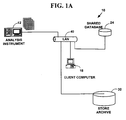
- FIG. 1A illustrates an exemplary data storage system 10 for preferred embodiments of the present invention.
- the exemplary data storage system 10 includes an analysis instrument 12, connected to a client computer 18, a shared database 24 and a data store archive 30 with a computer network 40.
- the analysis instrument 12 includes any scanning instrument capable of collecting feature-rich experimental data, such as nucleotide, cell or other experimental data, or any analysis instrument capable of analyzing feature-rich experimental data.
- feature-rich data includes data wherein one or more individual features of an object of interest (e.g., a cell) can be collected.
- the client computer 18 is any conventional computer including a display application that is used to lead a scientist or lab technician through data analysis.
- the shared database 24 is a multi-user, multi-view relational database that stores data from the analysis instrument 12.
- the data archive 30 is used to provide virtually unlimited amounts of "virtual" disk space with a multi-layer hierarchical storage management system.
- the computer network 40 is any fast Local Area Network ("LAN") (e.g., capable of data rates of 100 Mega-bit per second or faster).
- LAN Local Area Network
- Data storage system 10 can be used for virtually any system capable of collecting and/or analyzing feature-rich experimental data from biological and non-biological experiments.
- FIG. 1B illustrates an exemplary data storage system 10' for one preferred embodiment of the present invention with specific components.
- the data storage system 10' includes one or more analysis instruments 12, 14, 16, for collecting and/or analyzing feature-rich experimental data, one or more data store client computers, 18, 20, 22, a shared database 24, a data store server 26, and a shared database file server 28.
- a data store archive 30 includes any of a disk archive 32, an optical jukebox 34 or a tape drive 36.
- the data store archive 30 can be used to provide virtually unlimited amounts of "virtual" disk space with a multi-layer hierarchical storage management system without changing the design of any databases used to stored collected experimental data as is explained below.
- the data store archive 30 can be managed by an optional data archive server 38.
- Data storage system 10' components are connected by a computer network 40. However, more or fewer data store components can also be used and the present invention is not limited to the data storage system 10' components illustrated in FIG. 1B.
- data storage system 10' includes the following specific components. However, the present invention is not limited to these specific components and other similar or equivalent components may also be used.
- Analysis instruments 12, 14, 16, comprise a feature-rich array scanning system capable of collecting and/or analyzing experimental data such as cell experimental data from microplates, DNA arrays or other chip-based or bio-chip based arrays.
- Bio-chips include any of those provided by Motorola Corporation of Schaumburg, Illinois, Packard Instrument, a subsidiary of Packard BioScience Co. of Meriden, Connecticut, Genometrix, Inc. of Woodlands, Texas, and others.
- the one or more data store client computers, 18, 20, 22, are conventional personal computers that include a display application that provides a Graphical User Interface ("GUI") to a local hard disk, the shared database 24, the data store server 26 and/or the data store archive 30.
- GUI Graphical User Interface
- the GUI display application is used to lead a scientist or lab technician through standard analyses, and supports custom and query viewing capabilities.
- the display application GUI also supports data exported into standard desktop tools such as spreadsheets, graphics packages, and word processors.
- the data store client computers 18, 20, 22 connect to the store server 26 through an Open Data Base Connectivity ("ODBC") connection over network 40.
- ODBC Open Data Base Connectivity
- computer network 40 is a 100 Mega-bit (“Mbit”) per second or faster Ethernet, Local Area Network (“LAN”).
- Mbit Mega-bit
- LAN Local Area Network
- other types of LANs could also be used (e.g., optical or coaxial cable networks).
- the present invention is not limited to these specific components and other similar components may also be used.
- OBDC is an interface providing a common language for applications to gain access to databases on a computer network.
- the store server 26 controls the storage based functions plus an underlying Database Management System ("DBMS").
- DBMS Database Management System
- the shared database 24 is a multi-user, multi-view relational database that stores summary data from the one or more analysis instruments 12, 14, 16.
- the shared database 24 uses standard relational database tools and structures.
- the data store archive 30 is a library of image and feature database files.
- the data store archive 30 uses Hierarchical Storage Management ("HSM”) techniques to automatically manage disk space of analysis instruments 12, 14, 16 and the provide a multi-layer hierarchical storage management system.
- HSM Hierarchical Storage Management
- An operating environment for components of the data storage system 10 and 10' for preferred embodiments of the present invention include a processing system with one or more high-speed Central Processing Unit(s) (“CPU”) and a memory.
- CPU Central Processing Unit
- a memory for storing program code.
- acts and symbolically represented operations or instructions include the manipulation of electrical signals by the CPU.
- An electrical system represents data bits which cause a resulting transformation or reduction of the electrical signals, and the maintenance of data bits at memory locations in a memory system to thereby reconfigure or otherwise alter the CPU's operation, as well as other processing of signals.
- the memory locations where data bits are maintained are physical locations that have particular electrical, magnetic, optical, or organic properties corresponding to the data bits.
- the data bits may also be maintained on a computer readable medium including magnetic disks, optical disks, organic memory, and any other volatile (e.g., Random Access Memory (“RAM”)) or non-volatile (e.g., Read-Only Memory (“ROM”)) mass storage system readable by the CPU.
- RAM Random Access Memory
- ROM Read-Only Memory
- the computer readable medium includes cooperating or interconnected computer readable medium, which exist exclusively on the processing system or be distributed among multiple interconnected processing systems that may be local or remote to the processing system.
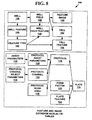
- FIG. 2 is a block diagram illustrating an exemplary array scan module 42 architecture.
- the array scan module 42 such as one associated with analysis instrument 12, 14, 16 (FIG. 1B) includes software/hardware that is divided into four functional groups or modules. However, more of fewer functional modules can also be used and the present invention is not limited to four functional modules.
- the Acquisition Module 44 controls a robotic microscope and digital camera, acquires images and sends the images to the Assay Module 46.
- the Assay Module 46 "reads" the images, creates graphic overlays, interprets the images collects feature data and returns the new images and feature data extracted from the images back to the Acquisition Module 44.
- the Acquisition Module 44 passes the image and interpreted feature data to the Data Base Storage Module 48.
- the Data Base Storage Module 48 saves the image and feature information in a combination of image files and relational database records.
- the store clients 18, 20, 22 use the Data Base Storage Module 48 to access feature data and images for presentation and data analysis by the Presentation Module 50.
- the Presentation Module 50 includes a display application with a GUI as was discussed above.
- a user can select a desired sub-set of the sub-containers in a container for analysis.
- image data is collected from the sub-container.
- the image data is stored in an image database.
- feature data is collected from the image data.
- the feature data is stored in a feature database.
- the image database and feature databases are combined into a single database comprising multiple tables including the image and feature data.
- the image database and feature databases are maintained as separate databases.
- sub-container summary data is calculated.
- the sub-container summary data is stored in a sub-container database.
- the sub-container database and the container database are combined into a single database comprising multiple tables including the sub-container and container summary data.
- the sub-container and container databases are maintained as separate databases.
- the loop continues at Step 58 (FIG. 3A) until the desired sub-containers within a container have been analyzed. After the desired sub-containers have been processed in the container, the loop at Step 58 ends.
- container summary data is calculated using sub-container summary data from the sub-container database.
- the container summary data is stored in the container database.
- Step 66 features from any imaging-based analysis system can be used.
- a digitized image including one or more objects (e.g., cells)
- object isolation in which a desired object is isolated from the rest of the image.
- feature extraction typically a function of one or more measurements, calculated so that it quantifies a significant characteristic of an object. Typical object measurements include size, shape, intensity, texture, location, and others.
- the "size” of an object can be represented by its area, perimeter, boundary definition, length, width, etc.
- the "shape” of an object can be represented by its rectangularity (e.g., length and width aspect ratio), circularity (e.g., perimeter squared divided by area, bounding box, etc.), moment of inertia, differential chain code, Fourier descriptors, etc.
- the "intensity” of an object can be represented by a summed average, maximum or minimum grey levels of pixels in an object, etc.
- the "texture” of an object quantifies a characteristic of grey-level variation within an object and can be represented by statistical features including standard deviation, variance, skewness, kurtosis and by spectral and structural features, etc.
- the "location" of an object can be represented by an object's center of mass, horizontal and vertical extents, etc. with respect to a pre-determined grid system.
- Each field typically will have between one and six photographic images taken of it, each using a different light filter to capture a different wavelength of light for a different fluorescence response for desired cell components.
- the present invention is not limited to such an embodiment, and other containers (e.g., varieties of biological chips, such as DNA chips, micro-arrays, and other containers with multiple sub-containers), sub-containers can also be used to collect image data and feature data from other than cells.
- a microplate with multiple wells is initialized using configuration information.
- the configuration information used for the microplate is stored in a microplate database.
- a loop is entered to repeat Steps 60, 62, 64, 66, 68, 70 and 72 for desired wells in the microplate.
- a well in the microplate is selected.
- cell image data is collected from the well.
- the cell image data includes digital photographic images collected with a digital camera attached to a robotic microscope. However, other types of cameras can also be used and other types of image data can also be collected.
- the cell image data is stored in an image database.
- the image database is a collection of individual image files. stored in a binary format (e.g., Tagged Image File Format ("TIFF"), Device-Independent Bit map (“DIB”) and others).
- TIFF Tagged Image File Format
- DIB Device-Independent Bit map
- the collection of individual image files may or may not be included in a formal database framework.
- the individual image files may exist as a collection of individual image files in specified directories that can be accessed from another database (e.g., a pass-through database).
- Step 66 cell feature data is collected from the cell image data.
- Step 66 includes collecting any of the cell feature data illustrated in Table 1.
- other feature data and other cell feature can also be collected and the present invention is not limited to the cell feature data illustrated in Table 1.
- Virtually any feature data can be collected from the image data.
- the cell feature data is stored in a cell feature database.
- the image database and cell feature databases are combined into a single database comprising multiple tables including the cell image and cell feature data.
- the image database (or image files) and feature databases are maintained as separate databases.
- well summary data is calculated using the image data and the feature data collected from the well.
- the well summary data calculated at Step 72 includes calculating any of the well summary data illustrated in Table 2.
- the present invention is not limited to the well summary data illustrated in Table 2, and the other sub-containers and other sub-container summary data can also be calculated. Virtually any sub-container summary data can be calculated for desired sub-containers.
- a "SPOT" indicates a block of fluorescent response intensity as a measure of biological activity.
- the well summary data is stored in a well database.
- the well database and the microplate database are combined into a single database comprising multiple tables including the well and microplate data.
- the well and microplate databases are maintained as separate databases.
- Step 58 After the desired wells have been processed in the microplate, the loop at Step 58 ends.
- summary data is calculated using well summary data from the microplate database.
- the microplate summary data is stored in the well database.
- the microplate summary data calculated at Step 74 includes calculating any of the microplate summary data illustrated in Table 3.
- the present invention is not limited to the microplate summary data illustrated in Table 3, and other container and other container summary data can also be calculated. Virtually any container summary data can be calculated for a container.
- "MEAN” indicates a statistical mean
- “STDEV” indicates a statistical standard deviation, known in the art
- a "SPOT” indicates a block of fluorescent response intensity as a measure of biological activity.
- cell assays are created using selected entries from Tables 1-3.
- a "cell assay” is a specific implementation of an image processing method used to analyze images and return results related to biological processes being examined. For more information on the image processing methods used in cell assays targeted to specific biological processes, see co-pending applications 09/031,217 and 09/352,171, assigned to the same Assignee as the present application.
- the microplate and well databases are stored in a single database comprising multiple tables called “SYSTEM.MDB.”
- the image and feature data for each well is stored in separate databases in the format "ID.MDB,” where ID is a unique identifier for a particular scan.
- ID.MDB the format "ID.MDB”
- the present invention is not limited to this implementation, and other types, and more or fewer databases can also be used.
- FIG. 4 is a flow diagram illustrating a Method 78 for storing collected experimental data.
- image data and feature data is collected from desired sub-containers in a container (e.g., with Method 52 of FIG. 3).
- a first database is created.
- the first database includes links to other databases but does not include any data collected from the container.
- the first database is used as a "pass-through" database by a display application to view data collected from a container.
- a first entry is created in the first database linking the first database to a second database.
- the second database includes configuration data used to collect data from the container, summary data for the container calculated from the desired sub-containers and summary data for the desired sub-containers in the container calculated from the image data and feature data.
- the information is organized in multiple database tables in the second database.
- multiple second entries are created in the first database linking the first database to multiple third databases.
- the multiple third databases include image data and feature data collected from the desired sub-containers in the container.
- the data is organized in multiple database tables in the third database.
- image data and feature data is collected from desired wells in a microplate using Method 52 of FIG. 3.
- Method 52 to collect experimental data and other methods can also be used.
- the present invention is not limited to collecting image data and feature data from wells in a microplate and other sub-containers and containers can also be used (e.g., bio-chips with multiple micro-gels).
- an application database is created.
- the application database includes links to other databases but does not include any data collected from the microplate.
- the application database is used by a display application to view data collected from a microplate.
- the application database may include actual data.
- FIG. 5 is a block diagram illustrating an exemplary database system 88 for Method 78 of FIG. 4.
- the database system 88 includes an application database 90, a system database 92 and multiple image and feature databases 94, 96, 98, 100.
- FIG. 5 illustrates only four image and feature databases numbered 1-N. However, the present invention is not limited to four image and features databases and typically hundreds or thousands of individual image and feature databases may actually be used. In addition the present invention is not limited to the databases or database names illustrated in FIG. 5 and more or fewer databases and other database names may also be used.
- a display application used to display and analyze collected experimental does not access over a few thousand records at one time. This is because there is no need for evaluation of microplate detail data information (e.g., image or cell feature database data) across microplates. Summary microplate information is stored in microplate, well, microplate feature and well feature summary tables to be compared across microplates. Detailed information about individual cells is accessed within the context of evaluating one microplate test. This allows a display application to make use of pass-through tables in the application database 90.
- microplate detail data information e.g., image or cell feature database data
- the application database 90 does not contain any actual data, but is used as a "pass-through" database to other databases that do contain actual data.
- a pass-through database includes links to other databases, but a pass-through database typically does not contain any actual database data.
- the application database 90 uses links to the system database 92 and the multiple image and feature databases 94, 96, 98, 100 to pass-through data requests to the application database 90 to these databases.
- the application database 90 may include some of the actual data collected, or summaries of actual data collected.
- the application database 90 is a Microsoft Access database, a Microsoft Structured Query Language ("SQL") database or Microsoft SQL Server by Microsoft of Redmond, Washington.
- SQL Microsoft Structured Query Language
- other databases such as Oracle databases by Oracle Corporation of Mountain View, California, could also be used for application database 90, and the present invention is not limited to Microsoft databases.
- a first pass-through database is not used at all.
- the first pass-through database is replaced by computer software that dynamically "directs" queries to/from the second and third databases without actually creating or using a first pass-through database.
- FIG. 6 is a block diagram illustrating an exemplary database table layout 102 for the application database 90 of FIG. 5.
- the database table layout 102 of FIG. 6 includes a first pass-through database entry 104 linking the application database 90 to the system database 92.
- the database table layout also includes multiple second pass through database entries 106, 108, 110, 112 linking the application database to multiple image and feature databases 94, 96, 98, 100.
- more or fewer types of database entries can also be used in the application database, and the present invention is not limited to two types of pass-through databases entries.
- the application database 92 may also include experimental data (not illustrated in FIG. 6).
- system database 92 is called "SYSTEM.MDB.”
- system database 92 may also be linked to other databases including microplate configuration and microplate summary data and is used in a pass-through manner as was described above for the application database.
- system database 92 is not linked to other databases, but instead includes actual microplate configuration and microplate summary data in multiple internal tables.
- the name of the system database 92 is not changed from microplate-to-microplate. In another preferred embodiment of the present invention, the name of the system database 92 is changed from microplate-to-microplate.
- a display application will refer to the system database 92 using its assigned name (e.g., SYSTEM.MDB) for microplate configuration and microplate summary data. Data stored in the system database 92 may be stored in linked databases so that the actual microplate container configuration and microplate summary data can be relocated without changing the display application accessing the system database 92.
- the actual database engine could be changed to another database type, such as a Microsoft SQL Server or Oracle databases by Oracle, or others without modifying the display application accessing the system database 92.
- FIG. 7 is a block diagram illustrating exemplary database tables 114 for the system database 92 of FIG. 5.
- the database table, 114 of FIG. 7 includes a plate table 116 that includes a list of plates being used.
- the plate table 116 is linked to a protocol table 118, a form factor table 122, a plate feature table 124 and a well table 126.
- the protocol table 118 includes protocol information.
- a protocol specifies a series of system settings including a type of analysis instrument, an assay, dyes used to measure biological markers cell identification parameters and other parameters used to collect experimental data. An assay is described below.
- the form factor table 122 includes microplate layout geometry.
- a standard 96-well microplate includes 12 columns of wells labeled 1 through 12 and 8 rows of wells labeled A through H for a total of 96.
- the plate feature table 124 includes a mapping of features to microplates.
- the form factor table 122 is liked to the manufacturer table 120.
- the manufacturer table 120 includes a list microplate manufactures and related mircoplate information.
- the well table 126 includes details in a well.
- a well is a small area (e.g., a circular area) in a microplate used to contain cell samples for analysis.
- the protocol table 118 is linked to a protocol assay parameters table 128.
- an "assay” is a specific implementation of an image processing method used to analyze images and return results related to biological processes being examined.
- the protocol assay parameters table 128 is linked to an assay parameters table 130.
- the assay parameters table 130 include parameters for an assay in use.
- the protocol table 118 is also linked to a protocol channel table 132.
- a protocol channel table 132 typically an assay will have two or more channels.
- a "channel" is a specific configuration of optical filters and channel specific parameters and is used to acquire an image.
- different fluorescent dyes are used to label different cell structures. The fluorescent dyes emit light at different wavelengths. Channels are used to acquire photographic images for different dye emission wavelengths.
- the protocol channel table 132 is linked to a protocol channel reject parameters table 134.
- the protocol channel reject parameters table 134 includes channel parameters used to reject images that do not meet the desired channel parameters.
- the protocol table 118 is also linked to a protocol scan area table 136.
- the protocol scan area table 136 includes methods used to scan a well.
- the protocol scan area table 136 is linked to a system table 138.
- the system table 138 includes information configuration information and other information used to collect experimental data.
- the well table 126 is linked to a well feature table 140.
- the well feature table 140 includes mapping of cell features to wells.
- the well feature table 140 is linked to a feature type table 142.
- the feature type table 142 includes a list of features (e.g., cell features) that will be collected.
- features e.g., cell features
- more or fewer tables can also be used, more or fewer links can be used to link the tables, and the present invention is not limited to the tables described for the system database 92.
- multiple second entries are created in the application database 92 linking the application database 92 to multiple image and feature databases 94, 96, 98, 100.
- the multiple image and feature databases include image data and feature data collected from the desired wells in the microplate. The data is organized in multiple database tables in the image and feature databases.
- names of image and feature databases 94, 96, 98, 100 that contain the actual image and feature data are changed dynamically from microplate-to-microplate. Since the image and feature data will include many individual databases, an individual image and feature database is created when a microplate record is created (e.g., in the plate table 116 (FIG. 7) in the system database 92 (FIG. 5)) and has a name that is created by taking a plate field value and adding ".MDB" to the end.
- a record in a plate table 116 with a field identifier of "1234569803220001" will have it's data stored in a image and feature database with the name "1234569803220001.MDB").
- other names can also be used for the image and feature databases and the present invention is not limited to the naming scheme using a field identifier from the plate table 116.
- FIG. 8 is a block diagram illustrating exemplary database tables 144 for image and feature databases 94, 96, 98, 100 of FIG. 5.
- the image and feature databases for a microplate include tables to hold image and feature data and a copy of the tables It 6-142 (FIG. 7) excluding the manufacturer table 120 and the system table 138 used for the system database 92.
- the image and feature databases 94, 96, 98, 100 include a copy or all of the tables 116-142 (FIG. 7).
- the image and feature databases 94, 96, 98, 100 do not include a copy of the tables 116-142 (FIG. 7) used for the system database 92.
- having a copy of the system database 92 tables in the image and feature databases allows individual image and feature databases to be archived and copied to another data storage system for later review and thus aids analysis.
- the image and feature databases 94, 96, 98, 100, tables 144 include a well field table 146 for storing information about fields in a well.
- the well field table 146 is linked to a well feature table 148 that includes information a list of features that will be collected from a well.
- the well field table 146 is also linked to a feature image table 150 that includes a list of images collected from a well and a cell table 152 that includes information to be collected about a cell.
- the cell table 152 is linked to a cell feature table 154 that includes a list of features that will be collected from a cell.
- more or fewer tables can also be used, more or fewer links can be used to link the tables, and the present invention is not limited to the tables described for the image and feature databases.
- the analysis instruments modules 12, 14, 16 generate a large amount of data including image data, feature data, and summary data for sub-containers and containers.
- the raw feature data values are stored as database files with multiple tables described above (e.g., FIG. 8).
- database files are managed using a hierarchical data management system.
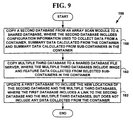
- FIG. 9 is a flow diagram illustrating a Method 156 for spooling experimental data.
- a second database is copied from an analysis instrument to a shared database.
- the second database includes configuration data used to collect data from a container, summary data for the container calculated from one or more sub-containers in the container and summary data for sub-containers in the container calculated from image data and feature data collected from desired sub-containers.
- the data in the second database is organized into one or more database tables.
- multiple third databases are copied to a shared database file server.
- the multiple third databases include image data and a feature data collected from the desired sub-containers in the container.
- the data in the third database is organized into one or more database tables.
- a location of the second database and the one or more third databases is updated in a first database on the analysis instrument to reflect new storage locations for the second database on the shared database and one or more third databases on the shared database file server.
- the first database includes links to the second database and the one or more third databases but does not include any data collected from the container.
- the first database is used by a display application to view data collected from a container.
- Method 156 further comprises copying the first database from the analysis instruments 12, 14, 16 to a store client computers 18, 20, 22.
- Such an embodiment allows a display application on the store client computers 18, 20, 22 to view the data collected from the container using the first database copied to local storage on the client computers 18, 20, 22.
- Method 156 further comprises locating the first database on the analysis instruments 12, 14, 16 from store client computers 18, 20, 22.
- Such an embodiment allows a display application on the store client computers 18, 20, 22 to view the data collected from the container at a remote location on the exemplary data storage system 10' from the store client computers 18, 20, 22.
- the data collected is viewed from the display application on the store client computers 18, 20, 22 by retrieving container and sub-container data from the second database on the shared database 24 and image and feature data from the multiple third databases on the shared database file server 28.
- a location of the system database 92 and the one or more image and feature databases 94, 96, 98, 100 is updated in an application database 90 (FIG. 6) on the analysis instrument 12, 14, 16 to reflect new storage locations for the system database 92 on the store database 24 and one or more image and feature databases 94, 96, 98, 100 on the store archive 28.
- the application database 90 is a pass-through database that includes links (e.g., FIG. 6) to the system database 92 and the one or more image and feature databases 94, 96, 98, 100 but does not include any data collected from the microplate.
- the application database 90 includes data from the microplate.
- the application database 92 is used by a display application to view data collected from a microplate.
- the present invention is not limited to this embodiment and other containers, sub-containers, (e.g., bio-chips with multiple micro-gels) and databases can also be used.
- an analysis instrument 12, 14, 16 can generate a huge amount of experimental data. To be useful, the experimental data has to be visually presented to a scientist or technician for analysis.
- FIG. 11 is a flow diagram illustrating a Method 178 for presenting experimental data.
- a list including one or more containers is displayed using a first database from a display application on a computer.
- the containers include multiple sub-containers. Image data and feature data was collected from the one or more containers.
- the first database is a pass-through database including links to other databases with experimental data.
- a first selection input is received on the display application for a first container from the list.
- a second database is obtained for the first container from a first remote storage location. The first remote location is remote to the computer running the display application.
- the second database includes configuration data used to collect data from the first container, summary data for the first container calculated from the sub-containers in the first container and summary data for desired sub-containers in the first container calculated from image data and feature data collected from desired sub-containers.
- a second selection input is received on the display application for one or more sub-containers in the first container.
- multiple third databases are obtained from a second remote storage location. The multiple third databases include image data and feature data collected from the one or more sub-containers in the first container.
- a graphical display is created from the display application including container and sub-container data from the second database, image data and feature data from the multiple third databases collected from the one or more sub-containers. Data displayed on the graphical display will appear to be obtained from local storage on the computer instead of the first remote storage location and the second remote storage location.
- Method 178 is used for displaying experimental data collected from microplates with multiple wells.
- the present invention is not limited to this embodiment and can be used for other containers and sub-containers besides microplates with multiple wells (e.g., bio-chips with multiple micro-gels).
- a list including multiple microplates is displayed from a display application on a computer.
- the microplates include multiple wells. Cell image data and cell feature data were collected from the multiple microplates.
- the display application uses an application database 90 to locate other databases, including experimental data.
- the application database 90 is located on the exemplary data storage system 10' at a location remote from the computer including the display application.
- the application database 90 is used from the computer including the display application without copying the application database 90 from a remote location on the exemplary data storage system 10'.
- the application database 90 is copied from a location on the exemplary data storage system 10' to local storage on the computer including the display application.
- the application database 90 is copied to, and exists on the computer including the display application.
- a first selection input is received on the display application for a first microplate from the list.
- a system database 92 is obtained for the first microplate from a first remote storage location.
- the first remote storage location is remote to the computer running the display application.
- the system database 92 includes configuration data used to collect data from the first microplate summary data for the first microplate calculated from the wells in the first microplate and summary data for desired wells in the first microplate calculated from image data and feature data collected from desired wells.
- a second selection input is received on the display application for one or more wells in the first microplate.
- multiple image and feature databases 94, 96, 98, 100 are obtained from a second remote storage location.
- the multiple image and feature databases 94, 96, 98, 100 include image data and feature data collected from the one or more wells in the first microplate.
- a graphical display is created from the display application including microplate and well summary data from the system database 92, image data and feature data from the multiple image and feature databases 94, 96, 98, 100 collected from the one or more wells. Data displayed on the graphical display appears to be obtained from local storage on the computer instead of the first remote storage location and the second remote storage location.
- FIG. 12 is a block diagram illustrating an exemplary screen display 192 for visually displaying experimental data from a display application.
- the screen display 192 includes a display of multiple sub-containers 194 in a container 196.
- the screen display 192 also includes container summary data 198, sub-container summary data 200, image data 202, and feature data 204.
- the screen display 192 is capable of displaying the data in both graphical formats and textual formats depending on user preferences. A user can select his/her display preferences from menus created by the display application (Not illustrated in FIG. 12).
- Screen display 192 illustrates exemplary data for sub-container A-3 illustrated by the blacked sub-container 206 in the container 196.
- Experimental data collected from a container is visually presented to a scientist or lab technician for analysis using Method 178 and screen display 192 with a pass-through database with multiple links to multiple databases from multiple remote locations.
- a Store Application Programming Interface (“API") is provided to access and use the methods and system described herein.
- API is set of interface routines used by an application program to access a set of functions that perform a desired task.
- the store API is stored in a Dynamic Link Library ("DLL") used with the Windows 95/98/NT/2000 operating system by Microsoft.
- the DLL is called "mvPlateData.DLL”
- the present invention is not limited to storing an API in a Window's DLL or using the described name of the DLL and other methods and names can also be used to store and use the API.
- a DLL is library that allows executable routines to be stored and to be loaded only when needed by an application.
- the Store API in a DLL is registered with the Window's "REGSVR32.EXE” application to make it available to other applications.
- the Store API provides an interface access to plate, well image and cell feature information and provides a facility to enter desired well feature information that will be collected.
- the methods and system described herein may allow experimental data from high-throughput data collection/analysis systems to be efficiently collected, stored, managed and displayed.
- the methods and system can be used for, but is not limited to storing managing and displaying cell image data and cell feature data collected from microplates including multiple wells or bio-chips including multiple micro-gels in which an experimental compound has been applied to a population of cells. If bio-chips are used, any references to microplates herein, can be replaced with bio-chips, and references to wells in a microplate can be replaced with micro-gels on a bio-chip and used with the methods and system described.
- the methods and system may provide a flexible and scalable repository of cell data that can be easily managed and allows cell data to be analyzed, manipulated and archived.
- the methods and system may improve the identification, selection, validation
Landscapes
- Engineering & Computer Science (AREA)
- Multimedia (AREA)
- Theoretical Computer Science (AREA)
- Biomedical Technology (AREA)
- General Health & Medical Sciences (AREA)
- Molecular Biology (AREA)
- Physics & Mathematics (AREA)
- General Physics & Mathematics (AREA)
- Health & Medical Sciences (AREA)
- Life Sciences & Earth Sciences (AREA)
- Information Retrieval, Db Structures And Fs Structures Therefor (AREA)
- Apparatus Associated With Microorganisms And Enzymes (AREA)
- Automatic Analysis And Handling Materials Therefor (AREA)
- Management, Administration, Business Operations System, And Electronic Commerce (AREA)
- Medical Treatment And Welfare Office Work (AREA)
- Measuring Or Testing Involving Enzymes Or Micro-Organisms (AREA)
- Investigating Or Analysing Biological Materials (AREA)
- Recording Measured Values (AREA)
- Monitoring And Testing Of Transmission In General (AREA)
Claims (43)
- Procédé pour collecter des données expérimentales sur un système informatique, le procédé comprenant les étapes consistant à :initialiser un conteneur, en utilisant des données de configuration, le conteneur comprenant une pluralité de conteneurs secondaires ;enregistrer les données de configuration utilisées pour le conteneur dans une base de données de conteneur ;répéter les étapes (a) à (g) pour des conteneurs secondaires désirés dans le conteneur :(a) sélectionner un conteneur secondaire individuel dans le conteneur,(b) collecter une pluralité de données d'images à partir du conteneur secondaire,(c) enregistrer la pluralité de données d'images dans une base de données d'images,(d) collecter une pluralité de données de caractéristiques à partir des données d'images,(e) enregistrer la pluralité de données de caractéristiques dans une base de données de caractéristiques,(f) calculer une pluralité de données de résumé de conteneur secondaire en utilisant la pluralité de données d'images et la pluralité de données de caractéristiques collectées à partir du conteneur secondaire,
et(g) enregistrer la pluralité de données de résumé de conteneur secondaire dans une base de données de conteneur secondaire ;(h) calculer une pluralité de données de résumé de conteneur en utilisant la pluralité de données de résumé de conteneur secondaire à partir de la base de données de conteneur secondaire ;(i) enregistrer la pluralité de données de résumé de conteneur dans la base de données de conteneur ;(j) enregistrer les données de la base de données de conteneur et les données de la base de données de conteneur secondaire dans une deuxième base de données sur une base de données partagée ;(k) enregistrer les données de la base de données d'images et les données de la base de données de caractéristiques dans une pluralité de troisièmes bases de données sur un serveur de fichiers de base de données partagée ; et(l) créer des liens dans une première base de données vers la deuxième base de données et la pluralité de troisièmes bases de données, la première base de données comprenant des liens vers la deuxième base de données et la pluralité de troisièmes bases de données mais ne comprenant aucune des données collectées à partir du conteneur, et la première base de données étant utilisée par une application de visualisation afin de visualiser les données collectées à partir d'un conteneur. - Support apte à être lu par un ordinateur, comprenant des instructions enregistrées sur lui pour amener une unité centrale de traitement à exécuter le procédé selon la revendication 1.
- Procédé selon la revendication 1, dans lequel la pluralité de conteneurs secondaires comprend une pluralité de cellules qui sont traitées à l'aide d'un composé expérimental.
- Procédé selon la revendication 1, dans lequel le conteneur comprend une microplaque, et la pluralité de conteneurs secondaires comprend des puits dans une microplaque.
- Procédé selon la revendication 1, dans lequel la base de données de conteneur comprend des données de microplaque, la base de données de conteneur secondaire comprend des données de puits, la base de données d'images comprend des données d'images photographiques et la base de données de caractéristiques comprend des données de caractéristiques de cellules.
- Procédé selon la revendication 1, dans lequel l'étape consistant à collecter une pluralité de données de caractéristiques à partir des données d'images comprend l'étape consistant à collecter l'un quelconque des éléments suivants : dimension, forme, intensité, texture, emplacement, surface, périmètre, facteur de forme, diamètre équivalent, longueur, largeur, intensité de fluorescence intégrée, intensité de fluorescence moyenne, variance, asymétrie, aplatissement, intensité de fluorescence minimum, intensité de fluorescence maximum, centre géométrique, une coordonnée en X d'un centre géométrique ou une coordonnée en Y d'un centre géométrique pour les cellules.
- Procédé selon la revendication 1, dans lequel l'étape consistant à calculer une pluralité de données de résumé de conteneur secondaire comprend l'étape consistant à calculer l'un quelconque des éléments suivants : dimensions, formes, intensités, textures, emplacements, surface de noyau, compte de points, surface de point agrégée, surface de point moyenne, surface de point minimum, surface de point maximum, intensité de point agrégée, intensité de point moyenne, intensité de point minimum, intensité de point maximum, intensité de point moyenne normalisée, compte de points normalisé, nombre de noyaux, intensité agrégée de surface de coloration de noyau, intensité de coloration agrégée, intensité de noyau, intensité de cytoplasme, différence entre l'intensité de noyau et l'intensité de cytoplasme, surface de noyau, compte de cellules, rapport de remplissage de boítier de noyau, surface au carré de périmètre de noyau ou rapport hauteur/largeur de noyau.
- Procédé selon la revendication 1, dans lequel l'étape consistant à calculer une pluralité de données de résumé de conteneur comprend l'étape consistant à calculer l'un quelconque des éléments suivants : dimension, forme moyenne, intensité moyenne, texture moyenne, emplacements des cellules, nombre de cellules, nombre de champs valides, déviation standard de la surface de noyau, compte de points moyen, déviation standard de compte de points, surface de point agrégée moyenne, déviation standard de surface de point agrégée, surface de point moyenne pondérée, déviation standard de surface de point moyenne, surface de noyau moyenne, intensité agrégée de noyau moyenne, déviation standard d'intensité de noyau, surface de coloration moyenne, déviation standard de surface de coloration, intensité agrégée de coloration moyenne, déviation standard d'intensité de coloration agrégée, moyenne de surface de point minimum, déviation standard de surface de point minimum, moyenne de surface de point maximum, déviation standard de surface de point maximum, intensité de point agrégée moyenne, déviation standard d'intensité de point agrégée moyenne, intensité de point agrégée moyenne, intensités de noyau, intensités de cytoplasme, différence entre les intensités de noyau et les intensités de cytoplasme, surfaces de noyau, rapports de remplissage de boítier de noyau, surfaces au carré de périmètre de noyau, rapports hauteur/largeur de noyau, compte de cellules de puits.
- Procédé selon la revendication 1, dans lequel le conteneur comprend une biopuce et la pluralité de conteneurs secondaires comprend des micro-gels sélectionnés sur la biopuce.
- Procédé selon la revendication 1, dans lequel la base de données partagée comprend une mémoire locale d'accès plus rapide.
- Procédé selon la revendication 1, dans lequel le serveur de fichiers de la base de données partagée comprend une mémoire à distance d'accès moins rapide.
- Procédé selon la revendication 1, comprenant en outre les étapes consistant à :créer une première entrée dans la première base de données pour lier la première base de données à une deuxième base de données, la première base de données étant utilisée comme une base de données d'intercommunication par une application de visualisation afin de visualiser les données collectées à partir d'un conteneur, la deuxième base de données comprenant des données de configuration utilisées pour collecter des données à partir du conteneur, des données de résumé pour le conteneur qui sont calculées à partir de la pluralité de données de conteneurs secondaires et de données de résumé pour les conteneurs secondaires dans le conteneur qui sont calculées à partir de la pluralité de données d'images et de la pluralité de données de caractéristiques, et les données dans la deuxième base de données étant organisées en une pluralité de tables ; etcréer une pluralité de deuxièmes entrées dans la première base de données pour lier la première base de données à une pluralité de troisièmes bases de données, la pluralité de troisièmes bases de données comprenant une pluralité de données d'images et une pluralité de données de caractéristiques qui sont collectées à partir de la pluralité de conteneurs secondaires dans le conteneur, et les données dans la pluralité de troisièmes bases de données étant organisées en une pluralité de tables.
- Support apte à être lu par un ordinateur, comprenant des instructions enregistrées sur lui pour amener une unité centrale de traitement à exécuter le procédé selon la revendication 12.
- Procédé selon la revendication 12, dans lequel la pluralité de conteneurs secondaires comprend une pluralité de cellules qui sont traitées à l'aide d'un composé expérimental.
- Procédé selon la revendication 12, dans lequel le conteneur comprend une microplaque, et la pluralité de conteneurs secondaires comprend des puits dans la microplaque.
- Procédé selon la revendication 12, dans lequel le conteneur comprend une biopuce et la pluralité de conteneurs secondaires comprend des micro-gels sélectionnés sur la biopuce.
- Procédé selon la revendication 12, dans lequel la pluralité de données de caractéristiques comprend une pluralité de données de caractéristiques de cellules pour une pluralité de cellules dans le conteneur secondaire et la pluralité de données d'images comprend une pluralité de données d'images photographiques qui sont collectées à partir de la pluralité de cellules dans un conteneur secondaire.
- Procédé selon la revendication 12, dans lequel la première base de données est une base de données d'intercommunication et elle ne comprend aucune des données collectées à partir du conteneur.
- Procédé selon la revendication 12, dans lequel la première base de données comprend une base de données d'applications comprenant une pluralité de tables d'intercommunication comprenant une pluralité d'entrées qui relient la base de données d'applications à d'autres bases de données.
- Procédé selon la revendication 12, dans lequel la deuxième base de données comprend une base de données de système qui comprend une pluralité de tables de base de données comprenant l'un quelconque des éléments suivants : plaque, protocole, paramètre d'essai de protocole, surface de balayage de protocole, paramètres d'essai, voie de protocole, paramètres de refus de voie de protocole, fabricant, facteur de forme, caractéristique de plaque, puits, caractéristique de puits, tables de base de données de système ou de caractéristiques.
- Procédé selon la revendication 12, dans lequel une troisième base de données parmi la pluralité de troisièmes bases de données est une base de données de plaque comprenant une pluralité de tables de base de données comprenant l'un quelconque des éléments suivants : puits, caractéristique de puits, champ de puits de type caractéristique, caractéristique de champ de puits, image caractéristique de champ de puits, tables de cellule ou de caractéristiques de cellule.
- Procédé selon la revendication 21, dans lequel la troisième base de données parmi la pluralité de troisièmes bases de données comprend en outre l'un quelconque des éléments suivants : plaque, protocole, paramètre d'essai de protocole, surface de balayage de protocole, paramètres d'essai, voie de protocole, paramètres de refus de voie de protocole, fabricant, facteur de forme, caractéristique de plaque, tables de base de données de système ou de caractéristique de puits, de sorte que la troisième base de données puisse être archivée et copiée sur un autre système informatique pour l'étudier sans copier la deuxième base de données sur un autre système informatique.
- Procédé selon la revendication 12, dans lequel l'étape consistant à collecter une pluralité de données d'images et une pluralité de données de caractéristiques à partir d'une pluralité de conteneurs secondaires dans un conteneur comprend les étapes consistant à :initialiser un conteneur en utilisant des données de configuration ;enregistrer les données de configuration utilisées pour le conteneur dans la deuxième base de données ;répéter les étapes (a) à (g) pour les conteneurs secondaires désirés dans le conteneur :(a) sélectionner un conteneur secondaire individuel dans le conteneur,(b) collecter une pluralité de données d'images à partir des données d'image,(c) enregistrer la pluralité de données d'images dans l'une d'une pluralité de troisièmes bases de données,(d) collecter une pluralité de données de caractéristiques à partir des données d'images,(e) enregistrer la pluralité de données de caractéristiques dans l'une de la pluralité de troisièmes bases de données,(f) calculer une pluralité de données de résumé de conteneur secondaire en utilisant la pluralité de données d'images et la pluralité de données de caractéristiques collectées à partir du conteneur secondaire,(g) enregistrer la pluralité de données de résumé de conteneur secondaire dans la deuxième base de données,(h) calculer une pluralité de données de résumé de conteneur pour le conteneur en utilisant la pluralité de données de conteneurs secondaires à partir de la deuxième base de données ; et(i) enregistrer la pluralité de données de résumé de conteneur dans la deuxième base de données.
- Procédé selon la revendication 12, dans lequel la première base de données est enregistrée sur un ordinateur de bureau, la deuxième base de données est enregistrée sur un serveur de base de données et la pluralité de troisièmes bases de données est enregistrée sur un serveur de fichiers de base de données partagée.
- Procédé selon la revendication 12, dans lequel l'étape consistant à collecter une pluralité de données d'images et une pluralité de données de caractéristiques à partir d'une pluralité de conteneurs secondaires dans un conteneur comprend l'étape consistant à collecter une pluralité de données d'images photographiques et une pluralité de données de caractéristiques de cellules pour une pluralité de cellules à partir d'une pluralité de puits dans une microplaque pour un essai prédéterminé pour un composé expérimental.
- Procédé pour enregistrer sur un support intermédiaire des données expérimentales sur un système informatique, le procédé comprenant les étapes consistant à :copier une deuxième base de données depuis un instrument d'analyse vers une base de données partagée, la deuxième base de données comprenant des données de configuration qui sont utilisées pour collecter les données à partir d'un conteneur, des données de résumé pour le conteneur qui sont calculées à partir d'une pluralité de conteneurs secondaires dans le conteneur et des données de résumé pour les conteneurs secondaires dans le conteneur qui sont calculées à partir d'une pluralité de données d'images et d'une pluralité de données de caractéristiques qui sont collectées à partir de conteneurs secondaires désirés, et les données dans la deuxième base de données étant organisées en une pluralité de tables de base de données ;copier une pluralité de troisièmes bases de données depuis un instrument, d'analyse vers un serveur de fichiers de base de données partagée, la pluralité de troisièmes bases de données comprenant une pluralité de données d'images et une pluralité de données de caractéristiques qui sont collectées à partir de la pluralité de conteneurs secondaires dans le conteneur, et les données étant organisées en une pluralité de tables de base de données ; etmettre à jour l'emplacement de la deuxième base de données et de la pluralité de troisièmes bases de données dans une première base de données sur l'instrument d'analyse de manière à réfléchir de nouveaux emplacements d'enregistrement pour la deuxième base de données sur la base de données partagée et la pluralité de troisièmes bases de données sur le serveur de fichiers de la base de données partagée, la première base de données est une base de données d'intercommunication qui comprend des liens vers la deuxième base de données et la pluralité de troisièmes bases de données mais ne comprend aucune des données collectées à partir du conteneur, et la première base de données étant utilisée par une application de visualisation afin de visualiser les données collectées à partir d'un conteneur.
- Support apte à être lu par un ordinateur, comprenant des instructions enregistrées sur lui pour amener une unité centrale de traitement à exécuter des instructions pour le procédé selon la revendication 26.
- Procédé selon la revendication 26, comprenant en outre les étapes consistant à :copier la première base de données depuis l'instrument d'analyse vers un emplacement de mémoire locale sur un ordinateur d'enregistrement de client pour permettre à une application de visualisation sur l'ordinateur d'enregistrement de client de visualiser les données collectées à partir du conteneur ; etvisualiser les données collectées à partir de l'application de visualisation sur l'ordinateur d'enregistrement de client en utilisant la première base de données pour retrouver les données relatives au conteneur et au conteneur secondaire à partir de la deuxième base de données sur la base de données partagée et les données d'images et de caractéristiques à partir de la pluralité de troisièmes bases de données sur le serveur de fichiers de la base de données partagée.
- Procédé selon la revendication 26, comprenant en outre les étapes consistant à :localiser la première base de données à partir d'un ordinateur d'enregistrement de client à un emplacement à distance afin de permettre à une application de visualisation sur l'ordinateur d'enregistrement de client de visualiser les données collectées à partir du conteneur ; etvisualiser les données collectées à partir de l'application de visualisation sur l'ordinateur d'enregistrement de client en utilisant la première base de données à l'emplacement à distance pour récupérer les données relatives au conteneur et au conteneur secondaire à partir de la deuxième base de données sur la base de données partagée et les données d'images et de caractéristiques à partir de la pluralité de troisièmes bases de données sur le serveur de fichiers de la base de données partagée.
- Procédé selon la revendication 26, dans lequel le conteneur comprend une microplaque, et la pluralité de conteneurs secondaires comprend des puits dans la microplaque.
- Procédé selon la revendication 26, dans lequel le conteneur comprend, une biopuce et la pluralité de conteneurs secondaires comprend des micro-gels sélectionnés sur la biopuce.
- Procédé selon la revendication 26, dans lequel la pluralité de conteneurs secondaires comprend une pluralité de cellules qui sont traitées à l'aide d'un composé expérimental.
- Procédé selon la revendication 26, dans lequel la base de données partagée comprend une mémoire locale d'accès plus rapide.
- Procédé selon la revendication 26, dans lequel le serveur de fichiers de la base de données partagée comprend une mémoire à distance d'accès moins rapide.
- Procédé pour présenter des données expérimentales à partir d'une pluralité de bases de données, le procédé comprenant les étapes consistant à :afficher une liste comprenant une pluralité de conteneurs en utilisant une première base de données à partir d'une application de visualisation sur un ordinateur, la première base de données étant une base de données d'intercommunication qui comprend des liens vers une deuxième base de données et une pluralité de troisièmes bases de données mais qui ne comprend aucune des données collectées à partir du conteneur, les conteneurs comprenant une pluralité de conteneurs secondaires, et une pluralité de données d'images et une pluralité de données de caractéristiques ayant été collectées à partir de la pluralité de conteneurs ;recevoir une première entrée sélective sur l'application de visualisation pour un premier conteneur à partir de la liste comprenant une pluralité de conteneurs ;obtenir une deuxième base de données pour le premier conteneur à partir d'une base de données partagée à distance, l'application de visualisation utilisant des liens depuis la première base de données vers la deuxième base de données, la deuxième base de données comprenant des données de configuration qui sont utilisées pour collecter des données à partir du premier conteneur, des données de résumé pour le premier conteneur qui sont calculées à partir d'une pluralité de conteneurs secondaires dans le premier conteneur et des données de résumé pour les conteneurs secondaires désirés dans le premier conteneur qui sont calculées à partir d'une pluralité de données d'images et d'une pluralité de données de caractéristiques collectées à partir de conteneurs secondaires désirés ;recevoir une seconde entrée sélective sur l'application de visualisation pour un ou plusieurs conteneurs secondaires dans le premier conteneur ;obtenir une pluralité de troisièmes bases de données à partir d'un serveur de fichiers de base de données partagée à distance, l'application de visualisation utilisant des liens depuis la première base de données vers la pluralité de troisièmes bases de données, dans laquelle la pluralité de troisièmes bases de données comprend une pluralité de données d'images et une pluralité de données de caractéristiques qui sont collectées à partir d'un ou de plusieurs conteneurs secondaires dans le premier conteneur ;créer un affichage graphique à partir de l'application de visualisation comprenant des données relatives au conteneur et au conteneur secondaire à partir de la deuxième base de données, des données d'images et des données de caractéristiques à partir de la pluralité de troisièmes bases de données collectées à partir d'un ou de plusieurs conteneurs secondaires, les données affichées sur l'affichage graphique ayant l'air d'être obtenues à partir d'une mémoire locale sur l'ordinateur plutôt qu'à partir de la base de données partagée à distance ou à partir du serveur de fichiers de base de données partagée à distance.
- Support apte à être lu par un ordinateur, comprenant des instructions enregistrées sur lui pour amener une unité centrale de traitement à exécuter le procédé selon la revendication 35.
- Procédé selon la revendication 35, dans lequel le conteneur comprend une microplaque, et la pluralité de conteneurs secondaires comprend des puits dans la microplaque.
- Procédé selon la revendication 35, dans lequel le conteneur comprend une biopuce et la pluralité de conteneurs secondaires comprend des micro-gels sélectionnés sur la biopuce.
- Procédé selon la revendication 35, dans lequel la pluralité de conteneurs secondaires comprend une pluralité de cellules qui sont traitées à l'aide d'un composé expérimental.
- Procédé selon la revendication 35, dans lequel le premier emplacement de mémoire à distance et le second emplacement de mémoire à distance comprennent l'un quelconque parmi : une base de données partagée, un serveur de fichiers de base de données partagée, une archive sur disque, un juke-box optique ou une bande magnétique numérique linéaire dans un emplacement à distance par rapport à l'ordinateur comprenant l'application de visualisation.
- Procédé selon la revendication 35, dans lequel la deuxième base de données comprend une base de données de système et dans laquelle la pluralité de troisièmes bases de données comprend une pluralité de bases de données d'images et une pluralité de bases de données de caractéristiques.
- Procédé selon la revendication 35, dans lequel l'étape consistant à afficher une liste comprenant une pluralité de conteneurs en utilisant une première base de données à partir d'une application de visualisation sur un ordinateur comprend les étapes consistant à localiser la première base de données au niveau d'un emplacement à distance par rapport à l'ordinateur et à afficher une liste à partir de l'application de visualisation sur l'ordinateur en utilisant la première base de données à l'emplacement à distance.
- Système d'enregistrement de données, comprenant en combinaison :une base de données partagée sur un réseau local d'entreprise pour enregistrer des données de configuration utilisées pour une microplaque, des données de résumé collectées à partir d'une pluralité de puits dans une microplaque et des données de résumé pour une microplaque ;un serveur de fichiers de base de données partagée sur un réseau local d'entreprise pour enregistrer des données d'images et des données de caractéristiques qui sont collectées à partir d'une pluralité de puits dans une microplaque ;une base de données d'intercommunication comportant de multiples liens qui procurent l'accès à des fichiers de base de données qui sont enregistrés dans la base de données partagée, et le serveur de fichiers de la base de données partagée, la base de données d'intercommunication ne comprenant aucune des données collectées à partir de la microplaque et elle est utilisée par une application de visualisation sur un ordinateur pour afficher des données expérimentales à partir des fichiers de la base de données ;une deuxième base de données qui comprend des données de configuration qui sont utilisées pour collecter les données à partir d'un conteneur, des données de résumé pour le conteneur qui sont calculées à partir d'une pluralité de conteneurs secondaires dans le conteneur et des données de résumé pour les conteneurs secondaires dans le conteneur qui sont calculées à partir d'une pluralité de données d'images et d'une pluralité de données de caractéristiques collectées à partir de conteneurs secondaires désirés, les données dans la deuxième base de données étant organisées en une pluralité de tables de base de données ;une pluralité de troisièmes bases de données, qui comprend une pluralité de données d'images et une pluralité de données de caractéristiques qui sont collectées à partir de la pluralité de conteneurs secondaires dans le conteneur, les données étant organisées en une pluralité de tables de base de données ; etune interface de programmation d'application pour fournir une interface de programmation à la base de données partagée, et au serveur de fichiers de la base de données partagée.
Priority Applications (1)
| Application Number | Priority Date | Filing Date | Title |
|---|---|---|---|
| EP05002417.3A EP1533720A3 (fr) | 1998-11-13 | 1999-11-10 | Méthodes et système d'acquisition efficace et de stockage de données expérimentales |
Applications Claiming Priority (11)
| Application Number | Priority Date | Filing Date | Title |
|---|---|---|---|
| US10829198P | 1998-11-13 | 1998-11-13 | |
| US108291P | 1998-11-13 | ||
| US11064398P | 1998-12-01 | 1998-12-01 | |
| US110643P | 1998-12-01 | ||
| US14024099P | 1999-06-21 | 1999-06-21 | |
| US140240P | 1999-06-21 | ||
| US14264699P | 1999-07-06 | 1999-07-06 | |
| US14237599P | 1999-07-06 | 1999-07-06 | |
| US142375P | 1999-07-06 | ||
| US142646P | 1999-07-06 | ||
| PCT/US1999/026562 WO2000029984A2 (fr) | 1998-11-13 | 1999-11-10 | Procedes et systeme de collection et de stockage efficaces de donnees experimentales |
Related Child Applications (1)
| Application Number | Title | Priority Date | Filing Date |
|---|---|---|---|
| EP05002417.3A Division EP1533720A3 (fr) | 1998-11-13 | 1999-11-10 | Méthodes et système d'acquisition efficace et de stockage de données expérimentales |
Publications (2)
| Publication Number | Publication Date |
|---|---|
| EP1145149A2 EP1145149A2 (fr) | 2001-10-17 |
| EP1145149B1 true EP1145149B1 (fr) | 2005-04-06 |
Family
ID=27537209
Family Applications (1)
| Application Number | Title | Priority Date | Filing Date |
|---|---|---|---|
| EP99958879A Expired - Lifetime EP1145149B1 (fr) | 1998-11-13 | 1999-11-10 | Procedes et systeme de collection et de stockage efficaces de donnees experimentales |
Country Status (9)
| Country | Link |
|---|---|
| US (3) | US7467153B2 (fr) |
| EP (1) | EP1145149B1 (fr) |
| JP (3) | JP2002530748A (fr) |
| AT (1) | ATE292822T1 (fr) |
| AU (1) | AU1615600A (fr) |
| CA (1) | CA2350587C (fr) |
| DE (1) | DE69924645T2 (fr) |
| IL (1) | IL142765A0 (fr) |
| WO (1) | WO2000029984A2 (fr) |
Cited By (2)
| Publication number | Priority date | Publication date | Assignee | Title |
|---|---|---|---|---|
| CN111372075A (zh) * | 2020-02-28 | 2020-07-03 | 钱秀华 | 网络图像诊断方法、装置及图像处理设备 |
| US11536673B2 (en) | 2018-11-30 | 2022-12-27 | Shimadzu Corporation | Analysis system, analysis apparatus, server, and information processing method |
Families Citing this family (40)
| Publication number | Priority date | Publication date | Assignee | Title |
|---|---|---|---|---|
| GB9722550D0 (en) * | 1997-10-24 | 1997-12-24 | Univ Southampton | Fabrication of optical waveguide gratings |
| US6651008B1 (en) | 1999-05-14 | 2003-11-18 | Cytokinetics, Inc. | Database system including computer code for predictive cellular bioinformatics |
| US7151847B2 (en) | 2001-02-20 | 2006-12-19 | Cytokinetics, Inc. | Image analysis of the golgi complex |
| US6743576B1 (en) | 1999-05-14 | 2004-06-01 | Cytokinetics, Inc. | Database system for predictive cellular bioinformatics |
| GB2365556B (en) * | 2000-08-04 | 2005-04-27 | Hewlett Packard Co | Gateway device for remote file server services |
| US7218764B2 (en) | 2000-12-04 | 2007-05-15 | Cytokinetics, Inc. | Ploidy classification method |
| JP2004534207A (ja) * | 2001-02-14 | 2004-11-11 | テイボテク・ビーブイビーエイ | 高スループット選別用の自動情報管理を提供する方法と装置 |
| US6999607B2 (en) | 2001-02-20 | 2006-02-14 | Cytokinetics, Inc. | Method and apparatus for automated cellular bioinformatics |
| US6956961B2 (en) | 2001-02-20 | 2005-10-18 | Cytokinetics, Inc. | Extracting shape information contained in cell images |
| US7016787B2 (en) | 2001-02-20 | 2006-03-21 | Cytokinetics, Inc. | Characterizing biological stimuli by response curves |
| US7751628B1 (en) * | 2001-12-26 | 2010-07-06 | Reisman Richard R | Method and apparatus for progressively deleting media objects from storage |
| AU2003237283A1 (en) * | 2002-05-28 | 2003-12-12 | Autogenomics, Inc. | Integrated sample processing platform |
| US20050014217A1 (en) | 2003-07-18 | 2005-01-20 | Cytokinetics, Inc. | Predicting hepatotoxicity using cell based assays |
| EP1646926A2 (fr) | 2003-07-18 | 2006-04-19 | Cytokinetics, Inc. | Caracterisation de stimuli biologiques par courbes de reponse |
| US7235353B2 (en) | 2003-07-18 | 2007-06-26 | Cytokinetics, Inc. | Predicting hepatotoxicity using cell based assays |
| WO2005078606A2 (fr) * | 2004-02-11 | 2005-08-25 | Storage Technology Corporation | Services de fichiers hierarchiques groupes |
| EP1574988B1 (fr) * | 2004-03-08 | 2014-06-18 | Siemens Product Lifecycle Management Software Inc. | Détermination et utilisation de données de caractéristiques géométriques |
| EP1764717A4 (fr) * | 2004-06-25 | 2009-08-05 | Nat Inst Of Advanced Ind Scien | Système d'analyse de réseau de cellules |
| US7323318B2 (en) | 2004-07-15 | 2008-01-29 | Cytokinetics, Inc. | Assay for distinguishing live and dead cells |
| US7697755B2 (en) * | 2004-09-29 | 2010-04-13 | Drvision Technologies Llc | Method for robust analysis of biological activity in microscopy images |
| US20060235741A1 (en) * | 2005-04-18 | 2006-10-19 | Dataforensics, Llc | Systems and methods for monitoring and reporting |
| US9274765B2 (en) * | 2005-05-12 | 2016-03-01 | Drawing Management, Inc. | Spatial graphical user interface and method for using the same |
| CA2984772C (fr) | 2005-09-21 | 2018-04-03 | Luminex Corporation | Procedes et systemes de traitement de donnees image |
| US20080155539A1 (en) * | 2006-12-20 | 2008-06-26 | Darland Edward J | Automated Data Processing Reconstruction System And Method |
| US8537165B2 (en) * | 2008-06-18 | 2013-09-17 | Roblox Corporation | Method and apparatus for automatic coalescence of connected rigid bodies |
| JP5346506B2 (ja) * | 2008-06-30 | 2013-11-20 | 株式会社日立ソリューションズ | ファイル管理装置 |
| KR101268574B1 (ko) * | 2009-11-03 | 2013-05-28 | 한국전자통신연구원 | 태그 위치 추정 방법 |
| US9183255B1 (en) * | 2009-12-30 | 2015-11-10 | Teradata Us, Inc. | Spool management and checkpointing in a multi-database system |
| US8959300B2 (en) | 2010-05-18 | 2015-02-17 | International Business Machines Corporation | Cascade ordering |
| US9665956B2 (en) | 2011-05-27 | 2017-05-30 | Abbott Informatics Corporation | Graphically based method for displaying information generated by an instrument |
| US9432402B1 (en) * | 2011-09-06 | 2016-08-30 | Utility Associates, Inc. | System and method for uploading files to servers utilizing GPS routing |
| CA2852915C (fr) * | 2011-10-18 | 2018-05-15 | Luminex Corporation | Procedes et systemes de traitement de donnees d'image |
| US9268619B2 (en) | 2011-12-02 | 2016-02-23 | Abbott Informatics Corporation | System for communicating between a plurality of remote analytical instruments |
| US10776606B2 (en) * | 2013-09-22 | 2020-09-15 | The Regents Of The University Of California | Methods for delineating cellular regions and classifying regions of histopathology and microanatomy |
| US20150227463A1 (en) * | 2014-02-07 | 2015-08-13 | Cisco Technology, Inc. | Precaching of responsive information |
| US11955207B2 (en) * | 2015-06-30 | 2024-04-09 | Emerald Cloud Lab, Inc. | Laboratory experiment data exploration and visualization |
| US11507313B2 (en) * | 2017-12-20 | 2022-11-22 | Telefonaktiebolaget Lm Ericsson (Publ) | Datafall: a policy-driven algorithm for decentralized placement and reorganization of replicated data |
| CN109344722B (zh) * | 2018-09-04 | 2020-03-24 | 阿里巴巴集团控股有限公司 | 一种用户身份确定方法、装置及电子设备 |
| US11294928B1 (en) * | 2018-10-12 | 2022-04-05 | Palantir Technologies Inc. | System architecture for relating and linking data objects |
| KR102830857B1 (ko) | 2024-11-28 | 2025-07-07 | 주식회사 더블오 | 낸드 플래시 메모리의 데이터 추출을 위한 최적 인가 전압 추천 방법 |
Family Cites Families (99)
| Publication number | Priority date | Publication date | Assignee | Title |
|---|---|---|---|---|
| FR2050251A1 (en) | 1969-07-08 | 1971-04-02 | Inst Francais Du Petrole | Sulphonated polyimides (i) used as ion ex- - changes and in electrodialysis |
| US4857549A (en) * | 1984-02-01 | 1989-08-15 | Smithkline Beckman Corporation | Antitumor compounds |
| US4942231A (en) | 1984-05-24 | 1990-07-17 | Mallinckrodt, Inc. | Method of preparing a chlorinated, brominated, radio-brominated, iodinated and/or radioiodinated aromatic or heteroaromatic compound |
| JPH083815B2 (ja) | 1985-10-25 | 1996-01-17 | 株式会社日立製作所 | 自然言語の共起関係辞書保守方法 |
| JP2679972B2 (ja) * | 1986-02-10 | 1997-11-19 | 株式会社日立製作所 | 情報サービス処理方法 |
| US5185809A (en) * | 1987-08-14 | 1993-02-09 | The General Hospital Corporation | Morphometric analysis of anatomical tomographic data |
| JPH0242572A (ja) | 1988-08-03 | 1990-02-13 | Hitachi Ltd | 共起関係辞書生成保守方法 |
| US5025388A (en) | 1988-08-26 | 1991-06-18 | Cramer Richard D Iii | Comparative molecular field analysis (CoMFA) |
| EP0367544A3 (fr) | 1988-10-31 | 1990-12-19 | International Development Research Centre | Commande de processus utilisant des systèmes basés sur l'intelligence artificielle |
| JPH0650460B2 (ja) | 1989-10-17 | 1994-06-29 | アプライド バイオシステムズ インコーポレイテッド | ロボットインターフェース |
| US5048109A (en) * | 1989-12-08 | 1991-09-10 | Xerox Corporation | Detection of highlighted regions |
| US5276860A (en) | 1989-12-19 | 1994-01-04 | Epoch Systems, Inc. | Digital data processor with improved backup storage |
| US5276867A (en) | 1989-12-19 | 1994-01-04 | Epoch Systems, Inc. | Digital data storage system with improved data migration |
| US5218695A (en) | 1990-02-05 | 1993-06-08 | Epoch Systems, Inc. | File server system having high-speed write execution |
| US5375606A (en) | 1990-02-28 | 1994-12-27 | Zynaxis, Inc. | Bio-analytical separation method |
| WO1991016675A1 (fr) | 1990-04-06 | 1991-10-31 | Applied Biosystems, Inc. | Laboratoire de biologie moleculaire automatise |
| DE59105367D1 (de) | 1990-08-17 | 1995-06-08 | Ciba Geigy Ag | Copolyimide, Verfahren zu deren Herstellung und deren Verwendung. |
| US5235522A (en) | 1990-10-10 | 1993-08-10 | Cell Analysis Systems, Inc. | Method and apparatus for automated analysis of biological specimens |
| US5340719A (en) | 1990-11-23 | 1994-08-23 | Corporation Coulter | Method and apparatus for optically screening microscopic cells |
| IL100124A (en) | 1990-11-23 | 1995-12-31 | Coulter Corp | Method and apparatus for optically screening microscopic cells |
| US5218965A (en) | 1990-12-03 | 1993-06-15 | Becton, Dickinson And Company | Apparatus for carrying a sensor in a connector for a catheter adapter |
| EP0496902A1 (fr) | 1991-01-26 | 1992-08-05 | International Business Machines Corporation | Système et procédé à base de connaissance pour la recherche de molécules |
| JPH04260132A (ja) | 1991-02-15 | 1992-09-16 | Hitachi Ltd | 問題解決システム |
| US5287497A (en) | 1991-03-15 | 1994-02-15 | Unisys Corporation | Image statement printing system with document storage/retrieval using optical media |
| CA2065473C (fr) | 1991-04-25 | 1999-08-10 | Kouichi Shibao | Gestionnaire de base de connaissances pour systeme expert |
| US5239591A (en) * | 1991-07-03 | 1993-08-24 | U.S. Philips Corp. | Contour extraction in multi-phase, multi-slice cardiac mri studies by propagation of seed contours between images |
| US5548661A (en) | 1991-07-12 | 1996-08-20 | Price; Jeffrey H. | Operator independent image cytometer |
| US5418943A (en) | 1991-10-23 | 1995-05-23 | At&T Corp. | Information system with knowledge base and data base |
| US5670113A (en) | 1991-12-20 | 1997-09-23 | Sibia Neurosciences, Inc. | Automated analysis equipment and assay method for detecting cell surface protein and/or cytoplasmic receptor function using same |
| US5332968A (en) * | 1992-04-21 | 1994-07-26 | University Of South Florida | Magnetic resonance imaging color composites |
| US5263126A (en) | 1992-09-10 | 1993-11-16 | Chang Hou Mei H | Automatic expert system |
| US5355215A (en) | 1992-09-30 | 1994-10-11 | Environmental Research Institute Of Michigan | Method and apparatus for quantitative fluorescence measurements |
| US5659724A (en) | 1992-11-06 | 1997-08-19 | Ncr | Interactive data analysis apparatus employing a knowledge base |
| US5511186A (en) | 1992-11-18 | 1996-04-23 | Mdl Information Systems, Inc. | System and methods for performing multi-source searches over heterogeneous databases |
| US5379366A (en) | 1993-01-29 | 1995-01-03 | Noyes; Dallas B. | Method for representation of knowledge in a computer as a network database system |
| US5615112A (en) | 1993-01-29 | 1997-03-25 | Arizona Board Of Regents | Synthesized object-oriented entity-relationship (SOOER) model for coupled knowledge-base/database of image retrieval expert system (IRES) |
| JP3315754B2 (ja) | 1993-04-27 | 2002-08-19 | 株式会社東芝 | 医用データベース装置 |
| US5596744A (en) * | 1993-05-20 | 1997-01-21 | Hughes Aircraft Company | Apparatus and method for providing users with transparent integrated access to heterogeneous database management systems |
| US5435310A (en) * | 1993-06-23 | 1995-07-25 | University Of Washington | Determining cardiac wall thickness and motion by imaging and three-dimensional modeling |
| US5434796A (en) | 1993-06-30 | 1995-07-18 | Daylight Chemical Information Systems, Inc. | Method and apparatus for designing molecules with desired properties by evolving successive populations |
| US6415048B1 (en) * | 1993-10-12 | 2002-07-02 | Schneider Medical Technologies, Inc. | Compositional analysis system |
| JP3212787B2 (ja) * | 1993-12-02 | 2001-09-25 | 日本電気株式会社 | 転送データ管理方式およびホスト・端末間データ転送方式 |
| US5537585A (en) | 1994-02-25 | 1996-07-16 | Avail Systems Corporation | Data storage management for network interconnected processors |
| US5675819A (en) | 1994-06-16 | 1997-10-07 | Xerox Corporation | Document information retrieval using global word co-occurrence patterns |
| US5577239A (en) | 1994-08-10 | 1996-11-19 | Moore; Jeffrey | Chemical structure storage, searching and retrieval system |
| US5463564A (en) | 1994-09-16 | 1995-10-31 | 3-Dimensional Pharmaceuticals, Inc. | System and method of automatically generating chemical compounds with desired properties |
| US5980096A (en) | 1995-01-17 | 1999-11-09 | Intertech Ventures, Ltd. | Computer-based system, methods and graphical interface for information storage, modeling and stimulation of complex systems |
| US5930154A (en) | 1995-01-17 | 1999-07-27 | Intertech Ventures, Ltd. | Computer-based system and methods for information storage, modeling and simulation of complex systems organized in discrete compartments in time and space |
| DE69603020T2 (de) | 1995-01-17 | 2000-02-24 | Intertech Ventures Ltd., Wallesley | Auf simulierten virtuellen modellen basierendes steuerungssystem |
| US5914891A (en) | 1995-01-20 | 1999-06-22 | Board Of Trustees, The Leland Stanford Junior University | System and method for simulating operation of biochemical systems |
| US5740428A (en) | 1995-02-07 | 1998-04-14 | Merge Technologies, Inc. | Computer based multimedia medical database management system and user interface |
| US5819266A (en) | 1995-03-03 | 1998-10-06 | International Business Machines Corporation | System and method for mining sequential patterns in a large database |
| US5657255C1 (en) | 1995-04-14 | 2002-06-11 | Interleukin Genetics Inc | Hierarchic biological modelling system and method |
| US5867118A (en) | 1995-06-07 | 1999-02-02 | Lockheed Martin Corporation | Apparatus for and method of classifying patterns |
| US5725633A (en) | 1995-06-30 | 1998-03-10 | Praxair Technology, Inc. | Sulfonated polyimide gas separation membranes |
| US5732150A (en) | 1995-09-19 | 1998-03-24 | Ihc Health Services, Inc. | Method and system for multiple wavelength microscopy image analysis |
| US5742811A (en) | 1995-10-10 | 1998-04-21 | International Business Machines Corporation | Method and system for mining generalized sequential patterns in a large database |
| US6035298A (en) | 1995-10-19 | 2000-03-07 | British Telecommunications Public Limited Company | Accessing plural independent databases having plural database schemas |
| JP2960340B2 (ja) | 1995-10-20 | 1999-10-06 | 富士ゼロックス株式会社 | データ検索方法及び装置 |
| US5689698A (en) | 1995-10-20 | 1997-11-18 | Ncr Corporation | Method and apparatus for managing shared data using a data surrogate and obtaining cost parameters from a data dictionary by evaluating a parse tree object |
| US5809499A (en) | 1995-10-20 | 1998-09-15 | Pattern Discovery Software Systems, Ltd. | Computational method for discovering patterns in data sets |
| US5970482A (en) | 1996-02-12 | 1999-10-19 | Datamind Corporation | System for data mining using neuroagents |
| US5978804A (en) | 1996-04-11 | 1999-11-02 | Dietzman; Gregg R. | Natural products information system |
| FR2748485B1 (fr) | 1996-05-07 | 1998-08-07 | Commissariat Energie Atomique | Polyimides sulfones, membranes preparees avec ceux-ci, et dispositif de pile a combustible comprenant ces membranes |
| US5884315A (en) * | 1996-05-09 | 1999-03-16 | Philips Electronics North America Corporation | System and method for handling technical hardware related information |
| US5989835A (en) | 1997-02-27 | 1999-11-23 | Cellomics, Inc. | System for cell-based screening |
| US6103479A (en) | 1996-05-30 | 2000-08-15 | Cellomics, Inc. | Miniaturized cell array methods and apparatus for cell-based screening |
| US5901214A (en) * | 1996-06-10 | 1999-05-04 | Murex Securities, Ltd. | One number intelligent call processing system |
| US5892838A (en) | 1996-06-11 | 1999-04-06 | Minnesota Mining And Manufacturing Company | Biometric recognition using a classification neural network |
| US7013298B1 (en) * | 1996-07-30 | 2006-03-14 | Hyperphrase Technologies, Llc | Method and system for automated data storage and retrieval |
| US5751605A (en) | 1996-08-15 | 1998-05-12 | Tripos, Inc. | Molecular hologram QSAR |
| US5873080A (en) | 1996-09-20 | 1999-02-16 | International Business Machines Corporation | Using multiple search engines to search multimedia data |
| EP0931259B1 (fr) | 1996-10-07 | 2006-11-29 | Discovery Partners International, Inc. | Systeme de synthese d'une bibliotheque de composes et son usage |
| US6023659A (en) | 1996-10-10 | 2000-02-08 | Incyte Pharmaceuticals, Inc. | Database system employing protein function hierarchies for viewing biomolecular sequence data |
| US5862514A (en) | 1996-12-06 | 1999-01-19 | Ixsys, Inc. | Method and means for synthesis-based simulation of chemicals having biological functions |
| US5966712A (en) | 1996-12-12 | 1999-10-12 | Incyte Pharmaceuticals, Inc. | Database and system for storing, comparing and displaying genomic information |
| US5970500A (en) | 1996-12-12 | 1999-10-19 | Incyte Pharmaceuticals, Inc. | Database and system for determining, storing and displaying gene locus information |
| US6021220A (en) | 1997-02-11 | 2000-02-01 | Silicon Biology, Inc. | System and method for pattern recognition |
| WO1998038490A1 (fr) * | 1997-02-27 | 1998-09-03 | Cellomics, Inc. | Systeme de criblage de cellules |
| US5977890A (en) | 1997-06-12 | 1999-11-02 | International Business Machines Corporation | Method and apparatus for data compression utilizing efficient pattern discovery |
| WO1999005574A1 (fr) | 1997-07-25 | 1999-02-04 | Affymetrix, Inc. | PROCEDE ET SYSTEME D'OBTENTION D'UNE BASE DE DONNEES DE CONCEPTION DE PUCES A ENSEMBLES DE SONDES$i() |
| US6134558A (en) * | 1997-10-31 | 2000-10-17 | Oracle Corporation | References that indicate where global database objects reside |
| US6681227B1 (en) * | 1997-11-19 | 2004-01-20 | Ns Solutions Corporation | Database system and a method of data retrieval from the system |
| US6192165B1 (en) | 1997-12-30 | 2001-02-20 | Imagetag, Inc. | Apparatus and method for digital filing |
| US6199059B1 (en) * | 1998-04-22 | 2001-03-06 | International Computex, Inc. | System and method for classifying and retrieving information with virtual object hierarchy |
| US5965352A (en) | 1998-05-08 | 1999-10-12 | Rosetta Inpharmatics, Inc. | Methods for identifying pathways of drug action |
| US6094652A (en) | 1998-06-10 | 2000-07-25 | Oracle Corporation | Hierarchical query feedback in an information retrieval system |
| NL1009376C1 (nl) | 1998-06-11 | 1998-07-06 | Boardwalk Ag | Datasysteem voor het verschaffen van relatiepatronen tussen personen. |
| JP2000082064A (ja) * | 1998-09-04 | 2000-03-21 | Casio Comput Co Ltd | データアクセス装置 |
| AU6244099A (en) | 1998-09-11 | 2000-04-03 | Gene Logic, Inc. | Genomic knowledge discovery |
| US20030028501A1 (en) * | 1998-09-17 | 2003-02-06 | David J. Balaban | Computer based method for providing a laboratory information management system |
| US6654736B1 (en) * | 1998-11-09 | 2003-11-25 | The United States Of America As Represented By The Secretary Of The Army | Chemical information systems |
| US6605120B1 (en) * | 1998-12-10 | 2003-08-12 | International Business Machines Corporation | Filter definition for distribution mechanism for filtering, formatting and reuse of web based content |
| GB2348005A (en) * | 1999-03-13 | 2000-09-20 | Marconi Electronic Syst Ltd | NMR apparatus with additional RF receive coil to reduce aliasing |
| US6743576B1 (en) * | 1999-05-14 | 2004-06-01 | Cytokinetics, Inc. | Database system for predictive cellular bioinformatics |
| US6523035B1 (en) | 1999-05-20 | 2003-02-18 | Bmc Software, Inc. | System and method for integrating a plurality of disparate database utilities into a single graphical user interface |
| US6453060B1 (en) * | 1999-06-29 | 2002-09-17 | Tri Path Imaging, Inc. | Method and apparatus for deriving separate images from multiple chromogens in a branched image analysis system |
| US6529705B1 (en) * | 1999-07-12 | 2003-03-04 | Paracomp, Inc. | Computerized scientific method educational system for collecting and analyzing data from prerecorded experiments |
| US7054833B1 (en) * | 2000-10-27 | 2006-05-30 | Mcdonald Patrick D | Method and system for processing unclaimed property information |
-
1999
- 1999-11-10 EP EP99958879A patent/EP1145149B1/fr not_active Expired - Lifetime
- 1999-11-10 WO PCT/US1999/026562 patent/WO2000029984A2/fr not_active Ceased
- 1999-11-10 JP JP2000582925A patent/JP2002530748A/ja active Pending
- 1999-11-10 DE DE69924645T patent/DE69924645T2/de not_active Expired - Lifetime
- 1999-11-10 IL IL14276599A patent/IL142765A0/xx unknown
- 1999-11-10 CA CA002350587A patent/CA2350587C/fr not_active Expired - Lifetime
- 1999-11-10 AU AU16156/00A patent/AU1615600A/en not_active Abandoned
- 1999-11-10 AT AT99958879T patent/ATE292822T1/de not_active IP Right Cessation
-
2003
- 2003-08-27 US US10/649,323 patent/US7467153B2/en not_active Expired - Lifetime
-
2005
- 2005-09-07 JP JP2005259850A patent/JP4405951B2/ja not_active Expired - Lifetime
-
2008
- 2008-08-08 US US12/188,967 patent/US8090748B2/en not_active Expired - Fee Related
- 2008-08-08 US US12/189,035 patent/US8024293B2/en not_active Expired - Fee Related
-
2009
- 2009-09-10 JP JP2009209367A patent/JP4581025B2/ja not_active Expired - Lifetime
Cited By (4)
| Publication number | Priority date | Publication date | Assignee | Title |
|---|---|---|---|---|
| US11536673B2 (en) | 2018-11-30 | 2022-12-27 | Shimadzu Corporation | Analysis system, analysis apparatus, server, and information processing method |
| EP3663765B1 (fr) * | 2018-11-30 | 2025-01-08 | Shimadzu Corporation | Système d'analyse, appareil d'analyse et procédé de traitement d'informations |
| CN111372075A (zh) * | 2020-02-28 | 2020-07-03 | 钱秀华 | 网络图像诊断方法、装置及图像处理设备 |
| CN111372075B (zh) * | 2020-02-28 | 2021-03-05 | 上海营湾医疗科技有限公司 | 网络图像诊断方法、装置及图像处理设备 |
Also Published As
| Publication number | Publication date |
|---|---|
| JP4581025B2 (ja) | 2010-11-17 |
| US20080301202A1 (en) | 2008-12-04 |
| DE69924645T2 (de) | 2006-03-02 |
| CA2350587C (fr) | 2004-04-27 |
| DE69924645D1 (de) | 2005-05-12 |
| JP2002530748A (ja) | 2002-09-17 |
| US8024293B2 (en) | 2011-09-20 |
| WO2000029984A2 (fr) | 2000-05-25 |
| WO2000029984A3 (fr) | 2000-11-30 |
| CA2350587A1 (fr) | 2000-05-25 |
| ATE292822T1 (de) | 2005-04-15 |
| US7467153B2 (en) | 2008-12-16 |
| IL142765A0 (en) | 2002-03-10 |
| EP1145149A2 (fr) | 2001-10-17 |
| US20040139103A1 (en) | 2004-07-15 |
| US8090748B2 (en) | 2012-01-03 |
| US20080306989A1 (en) | 2008-12-11 |
| AU1615600A (en) | 2000-06-05 |
| JP4405951B2 (ja) | 2010-01-27 |
| JP2010020789A (ja) | 2010-01-28 |
| JP2006107472A (ja) | 2006-04-20 |
Similar Documents
| Publication | Publication Date | Title |
|---|---|---|
| US8090748B2 (en) | Method for efficient collection and storage of experimental data | |
| US20220136030A1 (en) | Analysis and screening of cell secretion profiles | |
| US8428887B2 (en) | Method for automated processing of digital images of tissue micro-arrays (TMA) | |
| US20050108197A1 (en) | System, method and computer program product for managing genomic data | |
| WO2001081895A2 (fr) | Methode et appareil destines a la bioinformatique cellulaire predictive | |
| US6816867B2 (en) | System, method, and user interfaces for mining of genomic data | |
| US20250165559A1 (en) | Computer-implemented method, computer program product and system for data analysis | |
| AU768732B2 (en) | Method and system for general purpose analysis of experimental data | |
| US7451047B2 (en) | System and method for programatic access to biological probe array data | |
| EP1533720A2 (fr) | Méthodes et système d'acquisition efficace et de stockage de données expérimentales | |
| Bearer | Overview of image analysis, image importing, and image processing using freeware | |
| EP4437513A1 (fr) | Procede d'analyse cytometrique | |
| WO2005114578A1 (fr) | Procede et systeme de quantification automatisee d'une analyse d'image numerique d'un jeu ordonne de microechantillons de tissu (tma) | |
| Zwolinski et al. | 1Click1View: Interactive Visualization Methodology for RNAi Cell‐Based Microscopic Screening | |
| Cooke et al. | Acquisition and management of high content screening, light-sheet microscopy and mass spectrometry imaging data at AstraZeneca, GlaxoSmithKline and NPL: a survey report | |
| Kozak et al. | SIB: Database and Tool for the Integration and Browsing of Large Scale Image Hhigh-Throughput Screening Data | |
| Anstett | Visualization of high content screening data | |
| Leary | Listmode data processing |
Legal Events
| Date | Code | Title | Description |
|---|---|---|---|
| PUAI | Public reference made under article 153(3) epc to a published international application that has entered the european phase |
Free format text: ORIGINAL CODE: 0009012 |
|
| 17P | Request for examination filed |
Effective date: 20010509 |
|
| AK | Designated contracting states |
Kind code of ref document: A2 Designated state(s): AT BE CH CY DE DK ES FI FR GB GR IE IT LI LU MC NL PT SE |
|
| XX | Miscellaneous (additional remarks) |
Free format text: DERZEIT SIND DIE WIPO-PUBLIKATIONSDATEN A3 NICHT VERFUEGBAR. |
|
| 17Q | First examination report despatched |
Effective date: 20020108 |
|
| GRAP | Despatch of communication of intention to grant a patent |
Free format text: ORIGINAL CODE: EPIDOSNIGR1 |
|
| RAP1 | Party data changed (applicant data changed or rights of an application transferred) |
Owner name: CELLOMICS, INC. |
|
| GRAS | Grant fee paid |
Free format text: ORIGINAL CODE: EPIDOSNIGR3 |
|
| GRAA | (expected) grant |
Free format text: ORIGINAL CODE: 0009210 |
|
| AK | Designated contracting states |
Kind code of ref document: B1 Designated state(s): AT BE CH CY DE DK ES FI FR GB GR IE IT LI LU MC NL PT SE |
|
| PG25 | Lapsed in a contracting state [announced via postgrant information from national office to epo] |
Ref country code: NL Free format text: LAPSE BECAUSE OF FAILURE TO SUBMIT A TRANSLATION OF THE DESCRIPTION OR TO PAY THE FEE WITHIN THE PRESCRIBED TIME-LIMIT Effective date: 20050406 Ref country code: IT Free format text: LAPSE BECAUSE OF FAILURE TO SUBMIT A TRANSLATION OF THE DESCRIPTION OR TO PAY THE FEE WITHIN THE PRESCRIBED TIME-LIMIT;WARNING: LAPSES OF ITALIAN PATENTS WITH EFFECTIVE DATE BEFORE 2007 MAY HAVE OCCURRED AT ANY TIME BEFORE 2007. THE CORRECT EFFECTIVE DATE MAY BE DIFFERENT FROM THE ONE RECORDED. Effective date: 20050406 Ref country code: FI Free format text: LAPSE BECAUSE OF FAILURE TO SUBMIT A TRANSLATION OF THE DESCRIPTION OR TO PAY THE FEE WITHIN THE PRESCRIBED TIME-LIMIT Effective date: 20050406 Ref country code: BE Free format text: LAPSE BECAUSE OF FAILURE TO SUBMIT A TRANSLATION OF THE DESCRIPTION OR TO PAY THE FEE WITHIN THE PRESCRIBED TIME-LIMIT Effective date: 20050406 Ref country code: AT Free format text: LAPSE BECAUSE OF FAILURE TO SUBMIT A TRANSLATION OF THE DESCRIPTION OR TO PAY THE FEE WITHIN THE PRESCRIBED TIME-LIMIT Effective date: 20050406 |
|
| REG | Reference to a national code |
Ref country code: GB Ref legal event code: FG4D |
|
| XX | Miscellaneous (additional remarks) |
Free format text: DERZEIT SIND DIE WIPO-PUBLIKATIONSDATEN A3 NICHT VERFUEGBAR. |
|
| REG | Reference to a national code |
Ref country code: CH Ref legal event code: EP |
|
| REG | Reference to a national code |
Ref country code: IE Ref legal event code: FG4D |
|
| REF | Corresponds to: |
Ref document number: 69924645 Country of ref document: DE Date of ref document: 20050512 Kind code of ref document: P |
|
| REG | Reference to a national code |
Ref country code: SE Ref legal event code: TRGR |
|
| PG25 | Lapsed in a contracting state [announced via postgrant information from national office to epo] |
Ref country code: GR Free format text: LAPSE BECAUSE OF FAILURE TO SUBMIT A TRANSLATION OF THE DESCRIPTION OR TO PAY THE FEE WITHIN THE PRESCRIBED TIME-LIMIT Effective date: 20050706 Ref country code: DK Free format text: LAPSE BECAUSE OF FAILURE TO SUBMIT A TRANSLATION OF THE DESCRIPTION OR TO PAY THE FEE WITHIN THE PRESCRIBED TIME-LIMIT Effective date: 20050706 |
|
| PG25 | Lapsed in a contracting state [announced via postgrant information from national office to epo] |
Ref country code: ES Free format text: LAPSE BECAUSE OF FAILURE TO SUBMIT A TRANSLATION OF THE DESCRIPTION OR TO PAY THE FEE WITHIN THE PRESCRIBED TIME-LIMIT Effective date: 20050717 |
|
| REG | Reference to a national code |
Ref country code: CH Ref legal event code: NV Representative=s name: RITSCHER & PARTNER AG |
|
| NLV1 | Nl: lapsed or annulled due to failure to fulfill the requirements of art. 29p and 29m of the patents act | ||
| PG25 | Lapsed in a contracting state [announced via postgrant information from national office to epo] |
Ref country code: IE Free format text: LAPSE BECAUSE OF NON-PAYMENT OF DUE FEES Effective date: 20051110 Ref country code: CY Free format text: LAPSE BECAUSE OF FAILURE TO SUBMIT A TRANSLATION OF THE DESCRIPTION OR TO PAY THE FEE WITHIN THE PRESCRIBED TIME-LIMIT Effective date: 20051110 |
|
| PG25 | Lapsed in a contracting state [announced via postgrant information from national office to epo] |
Ref country code: MC Free format text: LAPSE BECAUSE OF NON-PAYMENT OF DUE FEES Effective date: 20051130 Ref country code: LU Free format text: LAPSE BECAUSE OF NON-PAYMENT OF DUE FEES Effective date: 20051130 |
|
| PLBE | No opposition filed within time limit |
Free format text: ORIGINAL CODE: 0009261 |
|
| STAA | Information on the status of an ep patent application or granted ep patent |
Free format text: STATUS: NO OPPOSITION FILED WITHIN TIME LIMIT |
|
| ET | Fr: translation filed | ||
| 26N | No opposition filed |
Effective date: 20060110 |
|
| REG | Reference to a national code |
Ref country code: IE Ref legal event code: MM4A |
|
| PG25 | Lapsed in a contracting state [announced via postgrant information from national office to epo] |
Ref country code: PT Free format text: LAPSE BECAUSE OF NON-PAYMENT OF DUE FEES Effective date: 20050906 |
|
| REG | Reference to a national code |
Ref country code: CH Ref legal event code: PCAR Free format text: RITSCHER & PARTNER AG;RESIRAIN 1;8125 ZOLLIKERBERG (CH) |
|
| REG | Reference to a national code |
Ref country code: CH Ref legal event code: PFA Owner name: CELLOMICS, INC., US Free format text: FORMER OWNER: CELLOMICS, INC., US |
|
| PUAK | Availability of information related to the publication of the international search report |
Free format text: ORIGINAL CODE: 0009015 |
|
| PG25 | Lapsed in a contracting state [announced via postgrant information from national office to epo] |
Ref country code: CY Free format text: LAPSE BECAUSE OF FAILURE TO SUBMIT A TRANSLATION OF THE DESCRIPTION OR TO PAY THE FEE WITHIN THE PRESCRIBED TIME-LIMIT Effective date: 20050406 |
|
| REG | Reference to a national code |
Ref country code: FR Ref legal event code: PLFP Year of fee payment: 17 |
|
| REG | Reference to a national code |
Ref country code: FR Ref legal event code: PLFP Year of fee payment: 18 |
|
| REG | Reference to a national code |
Ref country code: FR Ref legal event code: PLFP Year of fee payment: 19 |
|
| REG | Reference to a national code |
Ref country code: FR Ref legal event code: PLFP Year of fee payment: 20 |
|
| REG | Reference to a national code |
Ref country code: DE Ref legal event code: R079 Ref document number: 69924645 Country of ref document: DE Free format text: PREVIOUS MAIN CLASS: G06F0017300000 Ipc: G06F0016000000 |
|
| PGFP | Annual fee paid to national office [announced via postgrant information from national office to epo] |
Ref country code: SE Payment date: 20181113 Year of fee payment: 20 Ref country code: DE Payment date: 20181030 Year of fee payment: 20 |
|
| PGFP | Annual fee paid to national office [announced via postgrant information from national office to epo] |
Ref country code: CH Payment date: 20181115 Year of fee payment: 20 Ref country code: FR Payment date: 20181011 Year of fee payment: 20 Ref country code: GB Payment date: 20181107 Year of fee payment: 20 |
|
| REG | Reference to a national code |
Ref country code: DE Ref legal event code: R071 Ref document number: 69924645 Country of ref document: DE |
|
| REG | Reference to a national code |
Ref country code: CH Ref legal event code: PL |
|
| REG | Reference to a national code |
Ref country code: GB Ref legal event code: PE20 Expiry date: 20191109 |
|
| PG25 | Lapsed in a contracting state [announced via postgrant information from national office to epo] |
Ref country code: GB Free format text: LAPSE BECAUSE OF EXPIRATION OF PROTECTION Effective date: 20191109 |
|
| REG | Reference to a national code |
Ref country code: SE Ref legal event code: EUG |