EP1145346B1 - Nickel-mischhydroxid, verfahren zu dessen herstellung und dessen verwendung als kathodenmaterial in alkalischen batterien - Google Patents
Nickel-mischhydroxid, verfahren zu dessen herstellung und dessen verwendung als kathodenmaterial in alkalischen batterien Download PDFInfo
- Publication number
- EP1145346B1 EP1145346B1 EP99963528A EP99963528A EP1145346B1 EP 1145346 B1 EP1145346 B1 EP 1145346B1 EP 99963528 A EP99963528 A EP 99963528A EP 99963528 A EP99963528 A EP 99963528A EP 1145346 B1 EP1145346 B1 EP 1145346B1
- Authority
- EP
- European Patent Office
- Prior art keywords
- mol
- hydroxide
- nickel
- water
- mixed hydroxide
- Prior art date
- Legal status (The legal status is an assumption and is not a legal conclusion. Google has not performed a legal analysis and makes no representation as to the accuracy of the status listed.)
- Expired - Lifetime
Links
- PXHVJJICTQNCMI-UHFFFAOYSA-N Nickel Chemical compound [Ni] PXHVJJICTQNCMI-UHFFFAOYSA-N 0.000 title claims abstract description 124
- 229910052759 nickel Inorganic materials 0.000 title claims abstract description 36
- XLYOFNOQVPJJNP-UHFFFAOYSA-M hydroxide Chemical compound [OH-] XLYOFNOQVPJJNP-UHFFFAOYSA-M 0.000 title claims abstract description 29
- 239000010406 cathode material Substances 0.000 title claims abstract description 5
- 238000004519 manufacturing process Methods 0.000 title description 5
- 230000003647 oxidation Effects 0.000 claims abstract description 43
- 238000007254 oxidation reaction Methods 0.000 claims abstract description 43
- XLYOFNOQVPJJNP-UHFFFAOYSA-N water Substances O XLYOFNOQVPJJNP-UHFFFAOYSA-N 0.000 claims abstract description 27
- 150000004679 hydroxides Chemical class 0.000 claims abstract description 13
- 229910052782 aluminium Inorganic materials 0.000 claims abstract description 12
- 150000001450 anions Chemical class 0.000 claims abstract description 10
- 229910052742 iron Inorganic materials 0.000 claims abstract description 8
- BVKZGUZCCUSVTD-UHFFFAOYSA-L Carbonate Chemical compound [O-]C([O-])=O BVKZGUZCCUSVTD-UHFFFAOYSA-L 0.000 claims abstract description 7
- 229910052804 chromium Inorganic materials 0.000 claims abstract description 5
- 229910052733 gallium Inorganic materials 0.000 claims abstract description 5
- 229910052738 indium Inorganic materials 0.000 claims abstract description 5
- 229910052719 titanium Inorganic materials 0.000 claims abstract description 5
- 229910052726 zirconium Inorganic materials 0.000 claims abstract description 5
- QTBSBXVTEAMEQO-UHFFFAOYSA-M Acetate Chemical compound CC([O-])=O QTBSBXVTEAMEQO-UHFFFAOYSA-M 0.000 claims abstract description 4
- BTBUEUYNUDRHOZ-UHFFFAOYSA-N Borate Chemical compound [O-]B([O-])[O-] BTBUEUYNUDRHOZ-UHFFFAOYSA-N 0.000 claims abstract description 4
- QAOWNCQODCNURD-UHFFFAOYSA-L Sulfate Chemical compound [O-]S([O-])(=O)=O QAOWNCQODCNURD-UHFFFAOYSA-L 0.000 claims abstract description 4
- 229910052788 barium Inorganic materials 0.000 claims abstract description 4
- 229910052796 boron Inorganic materials 0.000 claims abstract description 4
- 229910052791 calcium Inorganic materials 0.000 claims abstract description 4
- 229910052802 copper Inorganic materials 0.000 claims abstract description 4
- 229910052712 strontium Inorganic materials 0.000 claims abstract description 4
- MUBZPKHOEPUJKR-UHFFFAOYSA-N Oxalic acid Chemical compound OC(=O)C(O)=O MUBZPKHOEPUJKR-UHFFFAOYSA-N 0.000 claims abstract description 3
- 229910019142 PO4 Inorganic materials 0.000 claims abstract description 3
- 230000036571 hydration Effects 0.000 claims abstract description 3
- 238000006703 hydration reaction Methods 0.000 claims abstract description 3
- 229910052749 magnesium Inorganic materials 0.000 claims abstract description 3
- NBIIXXVUZAFLBC-UHFFFAOYSA-K phosphate Chemical compound [O-]P([O-])([O-])=O NBIIXXVUZAFLBC-UHFFFAOYSA-K 0.000 claims abstract description 3
- 239000010452 phosphate Substances 0.000 claims abstract description 3
- 229910052725 zinc Inorganic materials 0.000 claims abstract description 3
- 239000000725 suspension Substances 0.000 claims description 23
- 238000006243 chemical reaction Methods 0.000 claims description 18
- QVGXLLKOCUKJST-UHFFFAOYSA-N atomic oxygen Chemical compound [O] QVGXLLKOCUKJST-UHFFFAOYSA-N 0.000 claims description 11
- 238000000034 method Methods 0.000 claims description 11
- 239000001301 oxygen Substances 0.000 claims description 11
- 229910052760 oxygen Inorganic materials 0.000 claims description 11
- 150000003839 salts Chemical class 0.000 claims description 10
- 239000007800 oxidant agent Substances 0.000 claims description 7
- 239000002245 particle Substances 0.000 claims description 7
- 239000007795 chemical reaction product Substances 0.000 claims description 6
- 238000002360 preparation method Methods 0.000 claims description 6
- 239000000843 powder Substances 0.000 claims description 5
- 238000000975 co-precipitation Methods 0.000 claims description 4
- WQYVRQLZKVEZGA-UHFFFAOYSA-N hypochlorite Chemical compound Cl[O-] WQYVRQLZKVEZGA-UHFFFAOYSA-N 0.000 claims description 4
- 229910052746 lanthanum Inorganic materials 0.000 claims description 4
- 229910052751 metal Inorganic materials 0.000 claims description 4
- VEXZGXHMUGYJMC-UHFFFAOYSA-M Chloride anion Chemical compound [Cl-] VEXZGXHMUGYJMC-UHFFFAOYSA-M 0.000 claims description 3
- 239000012736 aqueous medium Substances 0.000 claims description 3
- 238000001035 drying Methods 0.000 claims description 3
- 239000002184 metal Substances 0.000 claims description 3
- 229910052706 scandium Inorganic materials 0.000 claims description 3
- 238000000926 separation method Methods 0.000 claims description 3
- 229910052727 yttrium Inorganic materials 0.000 claims description 3
- KRHYYFGTRYWZRS-UHFFFAOYSA-M Fluoride anion Chemical compound [F-] KRHYYFGTRYWZRS-UHFFFAOYSA-M 0.000 claims description 2
- 150000004820 halides Chemical class 0.000 claims description 2
- 125000005385 peroxodisulfate group Chemical group 0.000 claims description 2
- MHAJPDPJQMAIIY-UHFFFAOYSA-N Hydrogen peroxide Chemical compound OO MHAJPDPJQMAIIY-UHFFFAOYSA-N 0.000 claims 1
- 230000015572 biosynthetic process Effects 0.000 claims 1
- 229910001453 nickel ion Inorganic materials 0.000 abstract description 6
- VEQPNABPJHWNSG-UHFFFAOYSA-N Nickel(2+) Chemical compound [Ni+2] VEQPNABPJHWNSG-UHFFFAOYSA-N 0.000 abstract description 4
- 229910052761 rare earth metal Inorganic materials 0.000 abstract description 3
- 150000002910 rare earth metals Chemical class 0.000 abstract description 3
- HEMHJVSKTPXQMS-UHFFFAOYSA-M Sodium hydroxide Chemical compound [OH-].[Na+] HEMHJVSKTPXQMS-UHFFFAOYSA-M 0.000 description 47
- 239000000523 sample Substances 0.000 description 34
- 239000000463 material Substances 0.000 description 32
- 238000003756 stirring Methods 0.000 description 21
- BFDHFSHZJLFAMC-UHFFFAOYSA-L nickel(ii) hydroxide Chemical compound [OH-].[OH-].[Ni+2] BFDHFSHZJLFAMC-UHFFFAOYSA-L 0.000 description 14
- 239000000047 product Substances 0.000 description 14
- 239000000243 solution Substances 0.000 description 14
- 238000001556 precipitation Methods 0.000 description 13
- 239000000203 mixture Substances 0.000 description 12
- 230000032683 aging Effects 0.000 description 11
- 239000011734 sodium Substances 0.000 description 11
- 230000000052 comparative effect Effects 0.000 description 10
- 238000005868 electrolysis reaction Methods 0.000 description 10
- 150000001768 cations Chemical class 0.000 description 9
- 230000007935 neutral effect Effects 0.000 description 9
- 239000007787 solid Substances 0.000 description 9
- VKYKSIONXSXAKP-UHFFFAOYSA-N hexamethylenetetramine Chemical compound C1N(C2)CN3CN1CN2C3 VKYKSIONXSXAKP-UHFFFAOYSA-N 0.000 description 8
- FAPWRFPIFSIZLT-UHFFFAOYSA-M Sodium chloride Chemical compound [Na+].[Cl-] FAPWRFPIFSIZLT-UHFFFAOYSA-M 0.000 description 6
- 229910017052 cobalt Inorganic materials 0.000 description 6
- 239000010941 cobalt Substances 0.000 description 6
- GUTLYIVDDKVIGB-UHFFFAOYSA-N cobalt atom Chemical compound [Co] GUTLYIVDDKVIGB-UHFFFAOYSA-N 0.000 description 6
- 125000001424 substituent group Chemical group 0.000 description 6
- 238000004458 analytical method Methods 0.000 description 5
- 150000002500 ions Chemical class 0.000 description 5
- 238000005086 pumping Methods 0.000 description 5
- 239000008151 electrolyte solution Substances 0.000 description 4
- 235000010299 hexamethylene tetramine Nutrition 0.000 description 4
- 239000004312 hexamethylene tetramine Substances 0.000 description 4
- 238000006213 oxygenation reaction Methods 0.000 description 4
- 238000012360 testing method Methods 0.000 description 4
- 238000002441 X-ray diffraction Methods 0.000 description 3
- 239000012267 brine Substances 0.000 description 3
- QGUAJWGNOXCYJF-UHFFFAOYSA-N cobalt dinitrate hexahydrate Chemical compound O.O.O.O.O.O.[Co+2].[O-][N+]([O-])=O.[O-][N+]([O-])=O QGUAJWGNOXCYJF-UHFFFAOYSA-N 0.000 description 3
- 230000007547 defect Effects 0.000 description 3
- GDVKFRBCXAPAQJ-UHFFFAOYSA-A dialuminum;hexamagnesium;carbonate;hexadecahydroxide Chemical compound [OH-].[OH-].[OH-].[OH-].[OH-].[OH-].[OH-].[OH-].[OH-].[OH-].[OH-].[OH-].[OH-].[OH-].[OH-].[OH-].[Mg+2].[Mg+2].[Mg+2].[Mg+2].[Mg+2].[Mg+2].[Al+3].[Al+3].[O-]C([O-])=O GDVKFRBCXAPAQJ-UHFFFAOYSA-A 0.000 description 3
- 238000004090 dissolution Methods 0.000 description 3
- 230000000694 effects Effects 0.000 description 3
- 238000010348 incorporation Methods 0.000 description 3
- 229910052748 manganese Inorganic materials 0.000 description 3
- 239000012528 membrane Substances 0.000 description 3
- 229910052757 nitrogen Inorganic materials 0.000 description 3
- 239000012299 nitrogen atmosphere Substances 0.000 description 3
- 239000002244 precipitate Substances 0.000 description 3
- 239000011780 sodium chloride Substances 0.000 description 3
- HPALAKNZSZLMCH-UHFFFAOYSA-M sodium;chloride;hydrate Chemical compound O.[Na+].[Cl-] HPALAKNZSZLMCH-UHFFFAOYSA-M 0.000 description 3
- 238000001228 spectrum Methods 0.000 description 3
- 239000000126 substance Substances 0.000 description 3
- QGZKDVFQNNGYKY-UHFFFAOYSA-N Ammonia Chemical compound N QGZKDVFQNNGYKY-UHFFFAOYSA-N 0.000 description 2
- VEXZGXHMUGYJMC-UHFFFAOYSA-N Hydrochloric acid Chemical compound Cl VEXZGXHMUGYJMC-UHFFFAOYSA-N 0.000 description 2
- UFHFLCQGNIYNRP-UHFFFAOYSA-N Hydrogen Chemical compound [H][H] UFHFLCQGNIYNRP-UHFFFAOYSA-N 0.000 description 2
- -1 Sulfat Chemical compound 0.000 description 2
- 239000011149 active material Substances 0.000 description 2
- 239000003513 alkali Substances 0.000 description 2
- 150000008044 alkali metal hydroxides Chemical class 0.000 description 2
- 238000010924 continuous production Methods 0.000 description 2
- 238000002848 electrochemical method Methods 0.000 description 2
- 229910052731 fluorine Inorganic materials 0.000 description 2
- 229960001545 hydrotalcite Drugs 0.000 description 2
- 229910001701 hydrotalcite Inorganic materials 0.000 description 2
- 238000011068 loading method Methods 0.000 description 2
- 239000011159 matrix material Substances 0.000 description 2
- 238000001139 pH measurement Methods 0.000 description 2
- 238000012545 processing Methods 0.000 description 2
- 238000005406 washing Methods 0.000 description 2
- BVKZGUZCCUSVTD-UHFFFAOYSA-M Bicarbonate Chemical compound OC([O-])=O BVKZGUZCCUSVTD-UHFFFAOYSA-M 0.000 description 1
- OKTJSMMVPCPJKN-UHFFFAOYSA-N Carbon Chemical compound [C] OKTJSMMVPCPJKN-UHFFFAOYSA-N 0.000 description 1
- MYMOFIZGZYHOMD-UHFFFAOYSA-N Dioxygen Chemical compound O=O MYMOFIZGZYHOMD-UHFFFAOYSA-N 0.000 description 1
- 241000080590 Niso Species 0.000 description 1
- MUBZPKHOEPUJKR-UHFFFAOYSA-L Oxalate Chemical compound [O-]C(=O)C([O-])=O MUBZPKHOEPUJKR-UHFFFAOYSA-L 0.000 description 1
- NBIIXXVUZAFLBC-UHFFFAOYSA-N Phosphoric acid Chemical compound OP(O)(O)=O NBIIXXVUZAFLBC-UHFFFAOYSA-N 0.000 description 1
- 238000010521 absorption reaction Methods 0.000 description 1
- 239000012190 activator Substances 0.000 description 1
- 229910001854 alkali hydroxide Inorganic materials 0.000 description 1
- 150000001447 alkali salts Chemical class 0.000 description 1
- XAGFODPZIPBFFR-UHFFFAOYSA-N aluminium Chemical compound [Al] XAGFODPZIPBFFR-UHFFFAOYSA-N 0.000 description 1
- TYYRFZAVEXQXSN-UHFFFAOYSA-H aluminium sulfate hexadecahydrate Chemical compound O.O.O.O.O.O.O.O.O.O.O.O.O.O.O.O.[Al+3].[Al+3].[O-]S([O-])(=O)=O.[O-]S([O-])(=O)=O.[O-]S([O-])(=O)=O TYYRFZAVEXQXSN-UHFFFAOYSA-H 0.000 description 1
- 229910021529 ammonia Inorganic materials 0.000 description 1
- 150000003863 ammonium salts Chemical class 0.000 description 1
- 238000010923 batch production Methods 0.000 description 1
- 239000011230 binding agent Substances 0.000 description 1
- 238000009835 boiling Methods 0.000 description 1
- 229910052793 cadmium Inorganic materials 0.000 description 1
- 239000003638 chemical reducing agent Substances 0.000 description 1
- 239000011248 coating agent Substances 0.000 description 1
- 238000000576 coating method Methods 0.000 description 1
- 229910001429 cobalt ion Inorganic materials 0.000 description 1
- XLJKHNWPARRRJB-UHFFFAOYSA-N cobalt(2+) Chemical compound [Co+2] XLJKHNWPARRRJB-UHFFFAOYSA-N 0.000 description 1
- 239000002482 conductive additive Substances 0.000 description 1
- 239000000470 constituent Substances 0.000 description 1
- 230000001351 cycling effect Effects 0.000 description 1
- 230000008021 deposition Effects 0.000 description 1
- 238000005137 deposition process Methods 0.000 description 1
- 239000002019 doping agent Substances 0.000 description 1
- 230000005518 electrochemistry Effects 0.000 description 1
- 239000003792 electrolyte Substances 0.000 description 1
- 230000007717 exclusion Effects 0.000 description 1
- 230000002349 favourable effect Effects 0.000 description 1
- 239000000706 filtrate Substances 0.000 description 1
- 239000006260 foam Substances 0.000 description 1
- 239000010439 graphite Substances 0.000 description 1
- 229910002804 graphite Inorganic materials 0.000 description 1
- 239000001307 helium Substances 0.000 description 1
- 229910052734 helium Inorganic materials 0.000 description 1
- SWQJXJOGLNCZEY-UHFFFAOYSA-N helium atom Chemical compound [He] SWQJXJOGLNCZEY-UHFFFAOYSA-N 0.000 description 1
- 239000001257 hydrogen Substances 0.000 description 1
- 229910052739 hydrogen Inorganic materials 0.000 description 1
- 239000001866 hydroxypropyl methyl cellulose Substances 0.000 description 1
- 229920003088 hydroxypropyl methyl cellulose Polymers 0.000 description 1
- UFVKGYZPFZQRLF-UHFFFAOYSA-N hydroxypropyl methyl cellulose Chemical compound OC1C(O)C(OC)OC(CO)C1OC1C(O)C(O)C(OC2C(C(O)C(OC3C(C(O)C(O)C(CO)O3)O)C(CO)O2)O)C(CO)O1 UFVKGYZPFZQRLF-UHFFFAOYSA-N 0.000 description 1
- 235000010979 hydroxypropyl methyl cellulose Nutrition 0.000 description 1
- 239000002609 medium Substances 0.000 description 1
- 229910021508 nickel(II) hydroxide Inorganic materials 0.000 description 1
- 230000001590 oxidative effect Effects 0.000 description 1
- 230000008092 positive effect Effects 0.000 description 1
- 238000001953 recrystallisation Methods 0.000 description 1
- 230000002829 reductive effect Effects 0.000 description 1
- 239000012266 salt solution Substances 0.000 description 1
- 229910052711 selenium Inorganic materials 0.000 description 1
- 230000000087 stabilizing effect Effects 0.000 description 1
- 239000007858 starting material Substances 0.000 description 1
- 238000003860 storage Methods 0.000 description 1
- 238000006467 substitution reaction Methods 0.000 description 1
- 239000000758 substrate Substances 0.000 description 1
- 239000010414 supernatant solution Substances 0.000 description 1
- 229910052720 vanadium Inorganic materials 0.000 description 1
- 238000010626 work up procedure Methods 0.000 description 1
Images



Classifications
-
- C—CHEMISTRY; METALLURGY
- C01—INORGANIC CHEMISTRY
- C01G—COMPOUNDS CONTAINING METALS NOT COVERED BY SUBCLASSES C01D OR C01F
- C01G53/00—Compounds of nickel
- C01G53/80—Compounds containing nickel, with or without oxygen or hydrogen, and containing one or more other elements
- C01G53/82—Compounds containing nickel, with or without oxygen or hydrogen, and containing two or more other elements
-
- C—CHEMISTRY; METALLURGY
- C01—INORGANIC CHEMISTRY
- C01G—COMPOUNDS CONTAINING METALS NOT COVERED BY SUBCLASSES C01D OR C01F
- C01G53/00—Compounds of nickel
- C01G53/04—Oxides
-
- H—ELECTRICITY
- H01—ELECTRIC ELEMENTS
- H01M—PROCESSES OR MEANS, e.g. BATTERIES, FOR THE DIRECT CONVERSION OF CHEMICAL ENERGY INTO ELECTRICAL ENERGY
- H01M4/00—Electrodes
- H01M4/02—Electrodes composed of, or comprising, active material
- H01M4/24—Electrodes for alkaline accumulators
- H01M4/32—Nickel oxide or hydroxide electrodes
-
- H—ELECTRICITY
- H01—ELECTRIC ELEMENTS
- H01M—PROCESSES OR MEANS, e.g. BATTERIES, FOR THE DIRECT CONVERSION OF CHEMICAL ENERGY INTO ELECTRICAL ENERGY
- H01M4/00—Electrodes
- H01M4/02—Electrodes composed of, or comprising, active material
- H01M4/36—Selection of substances as active materials, active masses, active liquids
- H01M4/38—Selection of substances as active materials, active masses, active liquids of elements or alloys
-
- H—ELECTRICITY
- H01—ELECTRIC ELEMENTS
- H01M—PROCESSES OR MEANS, e.g. BATTERIES, FOR THE DIRECT CONVERSION OF CHEMICAL ENERGY INTO ELECTRICAL ENERGY
- H01M4/00—Electrodes
- H01M4/02—Electrodes composed of, or comprising, active material
- H01M4/36—Selection of substances as active materials, active masses, active liquids
- H01M4/48—Selection of substances as active materials, active masses, active liquids of inorganic oxides or hydroxides
-
- C—CHEMISTRY; METALLURGY
- C01—INORGANIC CHEMISTRY
- C01P—INDEXING SCHEME RELATING TO STRUCTURAL AND PHYSICAL ASPECTS OF SOLID INORGANIC COMPOUNDS
- C01P2002/00—Crystal-structural characteristics
- C01P2002/50—Solid solutions
- C01P2002/52—Solid solutions containing elements as dopants
-
- C—CHEMISTRY; METALLURGY
- C01—INORGANIC CHEMISTRY
- C01P—INDEXING SCHEME RELATING TO STRUCTURAL AND PHYSICAL ASPECTS OF SOLID INORGANIC COMPOUNDS
- C01P2002/00—Crystal-structural characteristics
- C01P2002/70—Crystal-structural characteristics defined by measured X-ray, neutron or electron diffraction data
- C01P2002/72—Crystal-structural characteristics defined by measured X-ray, neutron or electron diffraction data by d-values or two theta-values, e.g. as X-ray diagram
-
- C—CHEMISTRY; METALLURGY
- C01—INORGANIC CHEMISTRY
- C01P—INDEXING SCHEME RELATING TO STRUCTURAL AND PHYSICAL ASPECTS OF SOLID INORGANIC COMPOUNDS
- C01P2004/00—Particle morphology
- C01P2004/01—Particle morphology depicted by an image
- C01P2004/03—Particle morphology depicted by an image obtained by SEM
-
- C—CHEMISTRY; METALLURGY
- C01—INORGANIC CHEMISTRY
- C01P—INDEXING SCHEME RELATING TO STRUCTURAL AND PHYSICAL ASPECTS OF SOLID INORGANIC COMPOUNDS
- C01P2004/00—Particle morphology
- C01P2004/51—Particles with a specific particle size distribution
-
- C—CHEMISTRY; METALLURGY
- C01—INORGANIC CHEMISTRY
- C01P—INDEXING SCHEME RELATING TO STRUCTURAL AND PHYSICAL ASPECTS OF SOLID INORGANIC COMPOUNDS
- C01P2004/00—Particle morphology
- C01P2004/60—Particles characterised by their size
- C01P2004/61—Micrometer sized, i.e. from 1-100 micrometer
-
- C—CHEMISTRY; METALLURGY
- C01—INORGANIC CHEMISTRY
- C01P—INDEXING SCHEME RELATING TO STRUCTURAL AND PHYSICAL ASPECTS OF SOLID INORGANIC COMPOUNDS
- C01P2006/00—Physical properties of inorganic compounds
- C01P2006/10—Solid density
-
- C—CHEMISTRY; METALLURGY
- C01—INORGANIC CHEMISTRY
- C01P—INDEXING SCHEME RELATING TO STRUCTURAL AND PHYSICAL ASPECTS OF SOLID INORGANIC COMPOUNDS
- C01P2006/00—Physical properties of inorganic compounds
- C01P2006/11—Powder tap density
-
- C—CHEMISTRY; METALLURGY
- C01—INORGANIC CHEMISTRY
- C01P—INDEXING SCHEME RELATING TO STRUCTURAL AND PHYSICAL ASPECTS OF SOLID INORGANIC COMPOUNDS
- C01P2006/00—Physical properties of inorganic compounds
- C01P2006/12—Surface area
-
- C—CHEMISTRY; METALLURGY
- C01—INORGANIC CHEMISTRY
- C01P—INDEXING SCHEME RELATING TO STRUCTURAL AND PHYSICAL ASPECTS OF SOLID INORGANIC COMPOUNDS
- C01P2006/00—Physical properties of inorganic compounds
- C01P2006/40—Electric properties
-
- C—CHEMISTRY; METALLURGY
- C01—INORGANIC CHEMISTRY
- C01P—INDEXING SCHEME RELATING TO STRUCTURAL AND PHYSICAL ASPECTS OF SOLID INORGANIC COMPOUNDS
- C01P2006/00—Physical properties of inorganic compounds
- C01P2006/80—Compositional purity
-
- H—ELECTRICITY
- H01—ELECTRIC ELEMENTS
- H01M—PROCESSES OR MEANS, e.g. BATTERIES, FOR THE DIRECT CONVERSION OF CHEMICAL ENERGY INTO ELECTRICAL ENERGY
- H01M10/00—Secondary cells; Manufacture thereof
- H01M10/24—Alkaline accumulators
- H01M10/30—Nickel accumulators
-
- Y—GENERAL TAGGING OF NEW TECHNOLOGICAL DEVELOPMENTS; GENERAL TAGGING OF CROSS-SECTIONAL TECHNOLOGIES SPANNING OVER SEVERAL SECTIONS OF THE IPC; TECHNICAL SUBJECTS COVERED BY FORMER USPC CROSS-REFERENCE ART COLLECTIONS [XRACs] AND DIGESTS
- Y02—TECHNOLOGIES OR APPLICATIONS FOR MITIGATION OR ADAPTATION AGAINST CLIMATE CHANGE
- Y02E—REDUCTION OF GREENHOUSE GAS [GHG] EMISSIONS, RELATED TO ENERGY GENERATION, TRANSMISSION OR DISTRIBUTION
- Y02E60/00—Enabling technologies; Technologies with a potential or indirect contribution to GHG emissions mitigation
- Y02E60/10—Energy storage using batteries
Definitions
- the present invention relates to a nickel mixed hydroxide having Ni as a main element and having a flared layer structure, a process for its production by co-precipitation of the hydroxides in an alkaline medium, and its use as a cathode material in alkaline batteries.
- ⁇ -Nickel (II) hydroxide is used as a positive electrode mass in alkaline storage batteries. Changes in certain electrochemical properties can be achieved by the incorporation of foreign ions.
- the incorporation of trivalent ions into the nickel hydroxide matrix in molar proportions> 20 mol% leads to a new structure.
- the materials modified in this way have the structure of hydrotalcite and are distinguished from ⁇ -Ni (OH) 2 by an expanded layer structure, in the intermediate layers of which water and various anions are present.
- the layer expansion alone has a fundamental influence on the electrochemistry, in this case on the potential layer and electrochemical usability of the nickel ions.
- the trivalent cation used in each case has an additional influence on the electrochemical behavior of the materials.
- EP 0 793 285 A1 describes nickel hydroxide materials containing, for example, the elements Co or Mn in combination with elements such as Fe, Al, La and others.
- Co and Mn are used in the production of the materials used in divalent form, with no oxidizing agents being used in the further course of the preparation.
- electrochemical (cathodic) deposition precipitation occurs by concomitant evolution of hydrogen even in a reductive environment.
- Co is present in divalent form, together with trivalent cations such as Fe, Al, La and others.
- the materials are indeed examined and evaluated with regard to their potential position during the discharge process and the charge absorption at higher temperatures. Cycle stability and actual electrochemical usability in the form of absolute values are completely absent. Only relative capacities are indicated.
- EP 0 712 174 A2 describes nickel hydroxides in which, in contrast to EP 0 793 285 A1, instead of divalent trivalent Mn ions as substituents, in combination with other trivalent elements such as Al, Fe and Co, are used.
- Mn exists in trivalent form together with Al, Fe or Co, although Mn may also be present simultaneously in several oxidation states next to each other ("mixed valent") in the solid state.
- mixed valent show pronounced cycle stability, but nickel utilization is only slightly above that of conventional nickel hydroxides. Practically useful indications that the use of mixed-valency systems other than Mn can lead to an improvement in capacity and nickel utilization can not be deduced from this prior art.
- the present invention has for its object to provide a nickel mixed hydroxide available that shows good improvement in cycle stability, a significant improvement in the electrochemical utilization of nickel ions and the mass-related capacity. Furthermore, a simple method for producing such a nickel mixed hydroxide is to be specified.
- this material exhibits a utilization of 1.5 electrons per nickel ion over a period of 100 cycles, which corresponds to a specific capacity of more than 260 mAh / g.
- the nickel hydroxide materials according to the invention exceed those in which the two additional cations (Ni substituents), as described in EP 0 793 285 A1, are present in each case in a uniform oxidation state, as shown by an electrochemical comparison in the following example part. They also exceed those nickel hydroxide materials in which, according to EP 0 712 174 A2, an additional cation is, for example, 3-valent Al or Co and the other additional cation Mn, which can be present simultaneously in different oxidation states.
- the nickel hydroxide materials of the present invention can be prepared in densities favorable for use in secondary batteries, which correspond to those of ⁇ -nickel hydroxides of regular morphology.
- the proportion of Ni in the nickel mixed hydroxide according to the invention is preferably 60 to 92 mol%, more preferably 65 to 85 mol% and particularly preferably 75 to 80 mol%.
- the total content of the elements M a , M b and M c is preferably 40 to 8 mol%, more preferably 35 to 15 mol% and particularly preferably 25 to 20 mol%, in each case based on the total amount of Ni, M a , M b and M c .
- the proportion of the metal M a present in mixed valency is preferably from 10 to 40 mol%, more preferably from 20 to 30 mol%, based on the total amount of the elements M a , M b and M c .
- the proportion of the optional doping element M c is preferably 1 to 30 mol%, based on the total amount of the elements M a , M b and M c ; but not more than 5 mol%, based on the total amount of elements Ni, M a , M b and M c .
- the proportion of trivalent elements M b is more than 60 mol%, based on the total amount of elements M a , M b and M c .
- the nickel mixed hydroxides according to the invention are suitably provided in powder form, the average particle size of the powders preferably being 0.5 to 1000 ⁇ m, more preferably 2 to 100 ⁇ m, particularly preferably more than 3 ⁇ m, more preferably 3-15 ⁇ m.
- the invention furthermore relates to a process for the preparation of the nickel mixed hydroxides described above, which comprises reacting the reaction components required to obtain the particular mixed hydroxides in the form of water-soluble salts of Ni and of elements M a , M b and optionally M c in a basic, aqueous medium for coprecipitation of hydroxide reaction products to form a homogeneous suspension of these reaction products, either water-soluble salts of the element M a are used in different oxidation states or a water-soluble salt of the element M a used in the lower oxidation state and a partial oxidation until reaching the desired ratio between the different oxidation states of the element M a is performed or a water-soluble salt of the element M a is used in the higher oxidation state and a partial reduction is carried out until the desired ratio between the different oxidation states of the element M a is reached, separation from the mother nucleate, washing and drying of the reaction products.
- the mixed hydroxides according to the invention can be prepared both in spherical and regular (non-spherical) morphology, wherein in the former case, the reaction is advantageously carried out in the presence of ammonia or ammonium salts.
- the reaction must be carried out under basic conditions, preferably at a pH in the range of 8 to 13.
- a known oxidizing agents can be used for such applications, preferably oxygen, H 2 O 2 , hypochlorite or peroxodisulfates are used.
- the partial oxidation can be carried out by a controlled introduction of oxygen into the forming suspension.
- a substoichiometric use of oxidants is useful for the partial oxidation.
- the desired ratio between the different oxidation states of the element M a can be controlled by a variation of the oxygen supply (for example by admixing pure oxygen for influencing the oxygen partial pressure), the reaction temperature and / or the pH.
- water-soluble salts of both oxidation states can already be used side by side.
- discontinuous process procedure batch process
- coprecipitation aging it is expedient to perform after completion of coprecipitation aging over several hours, for example 15 to 20 hours, before further processing takes place.
- the residence time is suitably adjusted so that the desired, mixed-valent state of the element M a is achieved.
- the mixed nickel hydroxides according to the invention are prepared by anodic oxidation of at least one of the metal elements, more preferably at least the nickel component.
- the aqueous precipitation suspension is pumped continuously between an electrolysis cell with nickel anode and a thermostat arranged outside the cell.
- the other metal components in the form of their water-soluble salts and alkali metal hydroxide, preferably sodium hydroxide are added to adjust the pH to the precipitation suspension.
- the oxidizing agent preferably atmospheric oxygen, for adjusting the degree of oxidation of the M a element is introduced into the pumping circulation.
- precipitation suspension is discharged continuously or periodically, precipitated product is filtered off, washed, dried and optionally ground.
- the anions incorporated into the precipitate to ensure electroneutrality can then be exchanged for the preferred CO 3 anions by treating the precipitate in an alkali carbonate or alkali bicarbonate solution, preferably Na 2 CO 3 solution.
- FIG. 6 An apparatus for the electrolytic production of nickel mixed hydroxide is shown schematically in FIG. 6:
- FIG. 6 shows an electrolytic cell 1 which contains two cathodes 2 and one anode 3.
- the electrolysis brine is circulated in the bottom of the cell 1 via the pump 4, the heat exchanger 5 and the pH probe 6.
- 6 alkali hydroxide or hydrochloric acid are metered into the pumped circulation.
- nickel hydroxide suspension is discharged by means of pump and fed to the solids separation device 10.
- the solid is discharged as indicated by arrow 12.
- the freed from solid brine can be recycled via the electrolyte processing 16 optionally with the addition of water 15 by pump 11 in the pumping circulation.
- a Einleitberichtkeit provided for the oxidant.
- the separating device 10 is in the form of a sieve centrifuge, which is driven so that finely divided nickel hydroxide particles are recycled with the filtrate via pump 11 in the pumping circulation. Hydrogen gas generated during electrolysis is withdrawn above the fill volume of the cell as indicated by arrow 13.
- the nickel mixed hydroxide according to the invention is preferably used as a constituent of cathode materials in alkaline batteries, such as in Ni / Cd or Ni / MH batteries, together with activators and auxiliaries known to the person skilled in the art.
- Sample B (3: 1 Ni: Dop., 3: 1 Al: Co) Ni 0.75 Al 0.188 Co 0.063 (OH) 2 * m CO 3 * n H 2 O
- the suspension is filtered off through a membrane filter press and squeezed, then dried at 50 ° C in a convection oven.
- the collected reaction suspension is filtered after an aging time of about 18 h (with stirring) on a membrane filter press, pressed and then dried at 50 ° C in a convection oven.
- the (milled) intermediate is resuspended in water and again filtered through a membrane filter press and washed.
- the washed product is dried at 50 ° C in a convection oven to constant weight.
- Sample D (3.32: 1 Ni / Mg: Dop., 3: 1 Al: Co) Ni 0.69 Mg 0.074 Al 0.174 Co 0.058 (OH) 2 * m CO 3 * n H 2 O
- Cobalt is in divalent form besides Al (III), as it corresponds to a prior art material according to EP 793 285.
- Comparative sample F (3: 1 Ni: Dop., 3: 1 Al: Co) Ni 0.75 Al 0.188 Co 0.063 (OH) 2 0.188NO 3 * n H 2 O
- the preparation was free of carbonate and thus leads to the incorporation of sulfate instead of carbonate ions in the intermediate layer. Subsequent partial carbonation by air access (CO) 2 was allowed.
- the pH and temperature are kept constant.
- the suspension is filtered through a pressure filter, washed neutral pH and dried in a vacuum oven at 50 ° C.
- the pH was maintained during the electrolysis by automatic addition 7 of 2.5 molar sodium hydroxide at 12.0 (pH measurement 6)
- the electrolyte solution was pumped through pump 4.
- Oxygen was injected into the pumped-circulation system at 11.
- the electrolysis was stable over the entire time at a voltage of about 3 V.
- the overflow was drawn off via pump 9 and filtered off with suction at 10.
- the solid obtained 12 was dried in a convection oven at a temperature of 60 ° C.
- the dried Mat Erial was ground using a laboratory mill ( ⁇ 500 ⁇ ) and carbonated with a 1 molar Na 2 CO 3 solution in relation to the dry material 5: 1 for about 2 hours at 70 ° C with stirring in a beaker. Thereafter, the suspension containing the product was filtered off with suction and the resulting solid was washed on the filter with about 8 1 of a hot (about 65 ° C) 1 g / l sodium hydroxide solution. The product was finally dried in a convection oven at a temperature of 60 ° C. Yield: 80.3 g of nickel hydroxide material per hour.
- the average particle size (Mastersizer D50) was 16 microns, the BET surface area 3.3 m 2 / g, the density (helium pycnometer) 2.51 g / cm 3 and the tap density 1.6 g / cm 3.
- the electrolysis was carried out analogously to Example 10.
- the supplied electrolyte solution had the composition 57.4 g / L NaCl, 4.56 g / L CoCl 2 and 14.01 g / L AlCl 3 .
- the pH was maintained at 12.5.
- the voltage was 3.2V; the anodic Ni dissolution 29.5 g / h.
- the overflow from the electrolysis cell was collected for 6 hours, aged for about 20 hours by standing and then filtered with suction.
- the resulting solid was on the suction filter with about 3.8 1 of a 1 g / l sodium hydroxide solution, then with about 1.91 a 1-molar Na 2 CO 3 solution and then again with about 3.8 1 of a 1 g / l sodium hydroxide solution.
- the temperature of the washing solutions was about 20 ° C.
- the product was finally dried in a convection oven at a temperature of about 60 ° C.
- the dried material was ground using a laboratory mill ( ⁇ 500 ⁇ ) and finally analyzed. Yield: 453 g of nickel hydroxide material.
- the mean particle size (Mastersizer D50) was 38 ⁇ m, the BET surface area ⁇ 1 m 2 / g, the physical density (He-Pylenometer) 2.45 g / cm 3 , the tap density 1.6 g / cm 3 and the drying loss (105 ° C, 2H) 4.75 wt .-%.
- An electrolytic cell with 400 1 capacity was used.
- the electrolysis was carried out analogously to Example 10.
- 55 l / h of an electrolyte solution of the composition 52.7 g / l NaCl, 5.5 g / l CoCl 2 and 17.0 g / l AlCl 3 were fed.
- the electrolysis current was 2000 A at an anode current density of 69 mA / cm 2 .
- the Ni dissolution was 2187 g / h, the pH 12.0.
- the effluent suspension was collected for 28 hours. This 28-hour bulk sample (1648 1) was then filtered off with suction and the resulting solid dried in a circulating air dryer at a temperature of 70 to 80 ° C.
- the dried material was ground using a cone mill ( ⁇ 1000 microns) and with a 1-molar Na 2 CO 3 solution in relation to the dry material 5: 1 for about 2 hours at 70 ° C with stirring in a 450 1 Reactor carbonated. Thereafter, the suspension was filtered off with suction and the resulting solid on the suction filter with about 2.5 m 3 of a hot (about 65 ° C) 1 g / l Sodium hydroxide solution. The product was finally dried in a convection oven at a temperature of 70 to 80 ° C.
- the mean particle size (Mastersizer D50) was 51.8 ⁇ m, the BET surface area was 6.35 m 2 / g, the physical density (He-Pyknometer) was 2.7 g / cm 3 and the tap density was 1.8 g / cm 3 , Fig. 7 shows an SEM photograph of the powder.
- the electrochemical characterization of the samples was cycled with 5-hour charge and discharge current in 30% KOH against Hg / HgO at a loading factor of 1.5.
- the electrode mass of nickel mixed hydroxide (active material), 33% graphite as a conductive additive and hydroxypropylmethyl cellulose as a binder was pasted into nickel foam as a substrate.
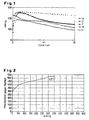
- FIG. 1 shows the cycle behavior of samples A and N and comparative samples E and F according to the prior art (EP 0 793 285) and of comparative sample V, a Co (III), Mn (III) and Al (III) containing nickel hydroxide powder according to EP 0 712 174, in the half-cell test.
- the comparative samples E and F according to EP 0 793 285 contain divalent cobalt as trivalent additional cations, since the starting compounds used are divalent cobalt, for example in combination with trivalent aluminum and furthermore no oxidizing agent is used. No data on cycle behavior and capacitance values can be found in EP 0 793 285, so comparative samples were prepared: Samples E and F were prepared to give divalent for cobalt, once under N 2 atmosphere (E) and once under reducing conditions ( F), and as prior art, the sample A according to the invention compared.
- FIGS. 2 and 3 show the potential profile of sample A, wherein FIG. 2 shows the charging curve and FIG. 3 shows the discharge curve in the 10th cycle, in each case against Hg / HgO.
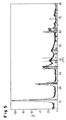
- FIG. 5 shows the X-ray diffraction spectrum of the sample L.
Landscapes
- Chemical & Material Sciences (AREA)
- Organic Chemistry (AREA)
- Chemical Kinetics & Catalysis (AREA)
- Electrochemistry (AREA)
- General Chemical & Material Sciences (AREA)
- Inorganic Chemistry (AREA)
- Inorganic Compounds Of Heavy Metals (AREA)
- Battery Electrode And Active Subsutance (AREA)
Applications Claiming Priority (5)
| Application Number | Priority Date | Filing Date | Title |
|---|---|---|---|
| DE19860143 | 1998-12-24 | ||
| DE19860143 | 1998-12-24 | ||
| DE19939025A DE19939025A1 (de) | 1998-12-24 | 1999-08-18 | Nickel-Mischydroxid, Verfahren zu dessen Herstellung und dessen Verwendung als Kathodenmaterial in alkalischen Batterien |
| DE19939025 | 1999-08-18 | ||
| PCT/EP1999/009912 WO2000039865A1 (de) | 1998-12-24 | 1999-12-14 | Nickel-mischhydroxid, verfahren zu dessen herstellung und dessen verwendung als kathodenmaterial in alkalischen batterien |
Publications (2)
| Publication Number | Publication Date |
|---|---|
| EP1145346A1 EP1145346A1 (de) | 2001-10-17 |
| EP1145346B1 true EP1145346B1 (de) | 2007-02-28 |
Family
ID=26051046
Family Applications (1)
| Application Number | Title | Priority Date | Filing Date |
|---|---|---|---|
| EP99963528A Expired - Lifetime EP1145346B1 (de) | 1998-12-24 | 1999-12-14 | Nickel-mischhydroxid, verfahren zu dessen herstellung und dessen verwendung als kathodenmaterial in alkalischen batterien |
Country Status (12)
| Country | Link |
|---|---|
| US (1) | US6849208B1 (cs) |
| EP (1) | EP1145346B1 (cs) |
| JP (1) | JP4590104B2 (cs) |
| KR (1) | KR100665140B1 (cs) |
| CN (1) | CN1192446C (cs) |
| AU (1) | AU1979000A (cs) |
| BR (1) | BR9916824A (cs) |
| CA (1) | CA2356984C (cs) |
| CZ (1) | CZ302880B6 (cs) |
| DE (2) | DE19939025A1 (cs) |
| TW (1) | TW482742B (cs) |
| WO (1) | WO2000039865A1 (cs) |
Cited By (1)
| Publication number | Priority date | Publication date | Assignee | Title |
|---|---|---|---|---|
| CN101267047B (zh) * | 2007-03-16 | 2010-10-06 | 深圳市力可兴电池有限公司 | 镍氢充电电池 |
Families Citing this family (16)
| Publication number | Priority date | Publication date | Assignee | Title |
|---|---|---|---|---|
| RU2198845C2 (ru) * | 2001-02-23 | 2003-02-20 | Открытое акционерное общество "Чепецкий механический завод" | Гидрат закиси никеля |
| CN100336265C (zh) * | 2005-06-17 | 2007-09-05 | 宜兴新兴锆业有限公司 | 高温镍氢电池 |
| WO2007000075A1 (en) * | 2005-06-27 | 2007-01-04 | Shenzhen Bak Battery Co., Ltd | Method for preparing spherical nickelous hydroxide which is dopped and multiple metal oxides, and lithium ion secondary battery |
| DE102007039471A1 (de) * | 2007-08-21 | 2009-02-26 | H.C. Starck Gmbh | Pulverförmige Verbindungen, Verfahren zu deren Herstellung sowie deren Verwendung in Lithium-Sekundärbatterien |
| JP2009076430A (ja) * | 2007-08-28 | 2009-04-09 | Sanyo Electric Co Ltd | アルカリ蓄電池用負極及びアルカリ蓄電池 |
| DE102007049108A1 (de) * | 2007-10-12 | 2009-04-16 | H.C. Starck Gmbh | Pulverförmige Verbindungen, Verfahren zu deren Herstellung sowie deren Verwendung in Batterien |
| WO2010120560A1 (en) * | 2009-03-31 | 2010-10-21 | Battelle Memorial Institute | Supercapacitor materials and devices |
| KR101296789B1 (ko) * | 2011-06-22 | 2013-08-14 | 한국전기연구원 | 아연계 음극 활물질의 제조방법 |
| CN102931396A (zh) * | 2012-11-05 | 2013-02-13 | 湖南丰日电源电气股份有限公司 | 一种高性能碱性电池正极材料及其制备方法 |
| CN103137962B (zh) * | 2013-03-11 | 2014-11-26 | 广东邦普循环科技有限公司 | 一种制备镍钴锰氢氧化物的方法 |
| CN106207106B (zh) * | 2016-07-12 | 2018-10-19 | 广东工业大学 | 一种α氢氧化镍的制备方法及其应用 |
| CN107512811B (zh) * | 2017-07-31 | 2020-06-23 | 四川思达能环保科技有限公司 | 球形氢氧化镍生产工艺过程废水的处理方法 |
| JP7109723B2 (ja) * | 2019-06-28 | 2022-08-01 | トヨタ自動車株式会社 | ニッケル水酸化物、正極材料、アルカリ電池、およびニッケル水酸化物の製造方法 |
| JP6916333B1 (ja) * | 2020-03-17 | 2021-08-11 | 日本碍子株式会社 | 電解質材料及び電気化学セル |
| JP6916332B1 (ja) * | 2020-03-17 | 2021-08-11 | 日本碍子株式会社 | 電気化学セル |
| JP6916334B1 (ja) * | 2020-03-17 | 2021-08-11 | 日本碍子株式会社 | 電気化学セル |
Family Cites Families (11)
| Publication number | Priority date | Publication date | Assignee | Title |
|---|---|---|---|---|
| FR2645142B1 (fr) * | 1989-03-29 | 1991-07-12 | Centre Nat Etd Spatiales | Procede de preparation d'un hydroxyde de nickel substitue au cobalt de structure (alpha), stable en milieu alcalin et son utilisation dans un generateur electrochimique |
| US5518704A (en) * | 1993-07-06 | 1996-05-21 | Aristech Chemical Corporation | Nickel and cobalt containing hydrotalcite-like materials having a sheet-like morphology and process for production thereof |
| JP3397890B2 (ja) * | 1994-05-20 | 2003-04-21 | 三洋電機株式会社 | アルカリ蓄電池用非焼結式ニッケル極 |
| JP3443209B2 (ja) * | 1994-08-04 | 2003-09-02 | 三洋電機株式会社 | アルカリ蓄電池の非焼結式ニッケル極用活物質粉末及びその作製方法、並びに、アルカリ蓄電池用非焼結式ニッケル極及びその作製方法 |
| DE69505911T2 (de) * | 1994-08-04 | 1999-04-08 | Sanyo Electric Co., Ltd., Moriguchi, Osaka | Aktivmasse Pulver für nichtgesinterte Nickelelektrode, nichtgesinterte Nickelelektrode für alkalische Batterie und Verfahren zu ihrer Herstellung |
| JP2802482B2 (ja) * | 1994-10-28 | 1998-09-24 | 古河電池株式会社 | アルカリ二次電池用ニッケル極 |
| DE4439989C2 (de) | 1994-11-09 | 1997-06-19 | Starck H C Gmbh Co Kg | Mangan-haltige Nickel(II)-hydroxid-Pulver, Verfahren zu ihrer Herstellung sowie deren Verwendung |
| JPH09237630A (ja) | 1996-02-29 | 1997-09-09 | Matsushita Electric Ind Co Ltd | アルカリ蓄電池用活物質および正極 |
| JP3579545B2 (ja) * | 1996-09-20 | 2004-10-20 | 株式会社田中化学研究所 | アルカリ蓄電池用水酸化ニッケル及びその製造法 |
| FR2760567B1 (fr) * | 1997-03-06 | 1999-04-16 | Alsthom Cge Alcatel | Matiere active positive pour electrode de nickel d'accumulateur a electrolyte alcalin |
| JPH10316431A (ja) | 1997-05-14 | 1998-12-02 | Fuji Chem Ind Co Ltd | リチウムニッケル複合酸化物及びその製造方法並びにリチウム二次電池用正極活物質 |
-
1999
- 1999-08-18 DE DE19939025A patent/DE19939025A1/de not_active Withdrawn
- 1999-12-14 JP JP2000591676A patent/JP4590104B2/ja not_active Expired - Fee Related
- 1999-12-14 CN CNB998149780A patent/CN1192446C/zh not_active Expired - Fee Related
- 1999-12-14 EP EP99963528A patent/EP1145346B1/de not_active Expired - Lifetime
- 1999-12-14 WO PCT/EP1999/009912 patent/WO2000039865A1/de not_active Ceased
- 1999-12-14 DE DE59914227T patent/DE59914227D1/de not_active Expired - Lifetime
- 1999-12-14 BR BR9916824-3A patent/BR9916824A/pt not_active Application Discontinuation
- 1999-12-14 US US09/868,995 patent/US6849208B1/en not_active Expired - Fee Related
- 1999-12-14 CZ CZ20012304A patent/CZ302880B6/cs not_active IP Right Cessation
- 1999-12-14 KR KR1020017008099A patent/KR100665140B1/ko not_active Expired - Fee Related
- 1999-12-14 CA CA002356984A patent/CA2356984C/en not_active Expired - Fee Related
- 1999-12-14 AU AU19790/00A patent/AU1979000A/en not_active Abandoned
- 1999-12-20 TW TW088122374A patent/TW482742B/zh not_active IP Right Cessation
Cited By (1)
| Publication number | Priority date | Publication date | Assignee | Title |
|---|---|---|---|---|
| CN101267047B (zh) * | 2007-03-16 | 2010-10-06 | 深圳市力可兴电池有限公司 | 镍氢充电电池 |
Also Published As
| Publication number | Publication date |
|---|---|
| US6849208B1 (en) | 2005-02-01 |
| TW482742B (en) | 2002-04-11 |
| CA2356984A1 (en) | 2000-07-06 |
| KR100665140B1 (ko) | 2007-01-09 |
| CA2356984C (en) | 2009-05-05 |
| WO2000039865A1 (de) | 2000-07-06 |
| CN1331845A (zh) | 2002-01-16 |
| EP1145346A1 (de) | 2001-10-17 |
| DE59914227D1 (de) | 2007-04-12 |
| JP4590104B2 (ja) | 2010-12-01 |
| DE19939025A1 (de) | 2000-06-29 |
| CN1192446C (zh) | 2005-03-09 |
| BR9916824A (pt) | 2001-10-16 |
| CZ20012304A3 (cs) | 2001-11-14 |
| JP2002533907A (ja) | 2002-10-08 |
| AU1979000A (en) | 2000-07-31 |
| KR20010099941A (ko) | 2001-11-09 |
| CZ302880B6 (cs) | 2012-01-04 |
Similar Documents
| Publication | Publication Date | Title |
|---|---|---|
| EP1145346B1 (de) | Nickel-mischhydroxid, verfahren zu dessen herstellung und dessen verwendung als kathodenmaterial in alkalischen batterien | |
| DE112019001579B4 (de) | Negatives electroden-aktivmaterial für fluorid-ionen-sekundärbatterien, negative electrode, die das aktivmaterial verwendet, fluorid-ionen-sekundärbatterie und verfahren zur herstellung des aktivmaterials | |
| DE69712582T2 (de) | Aktives Material für die positive Elektrode alkalischer Speicherbatterien | |
| EP1912899B1 (de) | Anorganische verbindungen | |
| EP3337764B1 (de) | Lithium-nickel-mangan-basierte übergangsmetalloxidpartikel, deren herstellung sowie deren verwendung als elektrodenmaterial | |
| DE112022004680B4 (de) | Dotiertes eisen(iii)-phosphat und verwendung desselben sowie verfahren zur herstellung von kohlenstoffbeschichtetem mangandotiertem lithiumeisenphosphat | |
| DE69602292T2 (de) | Nickelaktives Material zur Verwendung in alkalischen Speicherzellen und Verfahren zur Herstellung | |
| DE4439989C2 (de) | Mangan-haltige Nickel(II)-hydroxid-Pulver, Verfahren zu ihrer Herstellung sowie deren Verwendung | |
| DE4115951A1 (de) | Manganoxidverbindung, verfahren zu ihrer herstellung, elektrochemische zelle, die sie als kathode enthaelt, sowie ihre verwendung zur herstellung einer lithiummanganoxidverbindung und elektrochemische zelle, die diese lithiummanganoxidverbindung als kathode enthaelt | |
| DE69713932T2 (de) | Aktives Material und Positivelektrode für alkalischen Akkumulator | |
| DE69805689T2 (de) | Verfahren zur Herstellung von Lithium-Kobalt Oxid | |
| DE112022002537T5 (de) | Herstellungsverfahren für positives natrium-ionen-batterie-elektrodenmaterial vom p2-typ auf manganbasis | |
| DE60213017T2 (de) | Positives aktives Elektrodenmaterial für alkalische Speicherbatterie, positive Elektrode dafür und Verfahren zu ihrer Herstellung | |
| DE112023000119T5 (de) | Ternärer Vorläufer mit hoher Klopfdichte und Verfahren zu dessen Herstellung | |
| DE60109291T2 (de) | Dotierte mangandioxide | |
| DE112023004512T5 (de) | Material aus einer ternären co-dopierung mit lithium-mangan-eisen-phosphat, verfahren zu seiner herstellung und seine verwendung | |
| DE69626495T2 (de) | Elektrode mit aktivem material für positive platte eines akkus | |
| DE69838209T2 (de) | Nichtgesinterte Positivelektrode für alkalische Speicherbatterie und diese verwendende alkalische Speicherbatterie | |
| DE69411838T2 (de) | Verfahren zur Herstellung einer aktivem Kathodenmaterial-Formmasse für trockene Zellen. | |
| EP1166377B1 (de) | Mit kobalthydroxid beschichtetes nickelhydroxid | |
| EP0483598B1 (de) | Verfahren zur Herstellung von feinteiligem, elektrisch leitfähigem Zinn-IV-Oxid | |
| EP0950023A1 (de) | Verfahren zur herstellung von lithium-mangan-oxiden | |
| DE69801870T2 (de) | Nichtgesinterte Nickelelektrode für alkalische Speicherzelle | |
| DE60200009T2 (de) | Nickelelektrode für alkalische Sekundärbatterie und alkalische Sekundärbatterie | |
| DE19823129A1 (de) | Verfahren zur Herstellung einer hochdichten Formiermasse aus Nickelhydroxid |
Legal Events
| Date | Code | Title | Description |
|---|---|---|---|
| PUAI | Public reference made under article 153(3) epc to a published international application that has entered the european phase |
Free format text: ORIGINAL CODE: 0009012 |
|
| 17P | Request for examination filed |
Effective date: 20010724 |
|
| AK | Designated contracting states |
Kind code of ref document: A1 Designated state(s): AT BE CH CY DE DK ES FI FR GB GR IE IT LI LU MC NL PT SE |
|
| AX | Request for extension of the european patent |
Free format text: AL;LT;LV;MK;RO;SI |
|
| RAP1 | Party data changed (applicant data changed or rights of an application transferred) |
Owner name: H.C. STARCK GMBH |
|
| RBV | Designated contracting states (corrected) |
Designated state(s): DE DK ES FR GB SE |
|
| 17Q | First examination report despatched |
Effective date: 20050127 |
|
| GRAP | Despatch of communication of intention to grant a patent |
Free format text: ORIGINAL CODE: EPIDOSNIGR1 |
|
| RTI1 | Title (correction) |
Free format text: NICKEL MIXED HYDROXIDE, METHOD FOR PRODUCING THE SAME, AND THE USE THEREOF AS A CATHODE MATERIAL IN ALKALINE BATTERIES |
|
| GRAS | Grant fee paid |
Free format text: ORIGINAL CODE: EPIDOSNIGR3 |
|
| RAP1 | Party data changed (applicant data changed or rights of an application transferred) |
Owner name: H.C. STARCK GMBH & CO. KG |
|
| GRAA | (expected) grant |
Free format text: ORIGINAL CODE: 0009210 |
|
| AK | Designated contracting states |
Kind code of ref document: B1 Designated state(s): DE DK ES FR GB SE |
|
| PG25 | Lapsed in a contracting state [announced via postgrant information from national office to epo] |
Ref country code: DK Free format text: LAPSE BECAUSE OF FAILURE TO SUBMIT A TRANSLATION OF THE DESCRIPTION OR TO PAY THE FEE WITHIN THE PRESCRIBED TIME-LIMIT Effective date: 20070228 |
|
| REG | Reference to a national code |
Ref country code: GB Ref legal event code: FG4D Free format text: NOT ENGLISH |
|
| REF | Corresponds to: |
Ref document number: 59914227 Country of ref document: DE Date of ref document: 20070412 Kind code of ref document: P |
|
| PG25 | Lapsed in a contracting state [announced via postgrant information from national office to epo] |
Ref country code: SE Free format text: LAPSE BECAUSE OF FAILURE TO SUBMIT A TRANSLATION OF THE DESCRIPTION OR TO PAY THE FEE WITHIN THE PRESCRIBED TIME-LIMIT Effective date: 20070531 |
|
| PG25 | Lapsed in a contracting state [announced via postgrant information from national office to epo] |
Ref country code: ES Free format text: LAPSE BECAUSE OF FAILURE TO SUBMIT A TRANSLATION OF THE DESCRIPTION OR TO PAY THE FEE WITHIN THE PRESCRIBED TIME-LIMIT Effective date: 20070608 |
|
| ET | Fr: translation filed | ||
| GBV | Gb: ep patent (uk) treated as always having been void in accordance with gb section 77(7)/1977 [no translation filed] |
Effective date: 20070228 |
|
| PG25 | Lapsed in a contracting state [announced via postgrant information from national office to epo] |
Ref country code: GB Free format text: LAPSE BECAUSE OF FAILURE TO SUBMIT A TRANSLATION OF THE DESCRIPTION OR TO PAY THE FEE WITHIN THE PRESCRIBED TIME-LIMIT Effective date: 20070228 |
|
| PLBE | No opposition filed within time limit |
Free format text: ORIGINAL CODE: 0009261 |
|
| STAA | Information on the status of an ep patent application or granted ep patent |
Free format text: STATUS: NO OPPOSITION FILED WITHIN TIME LIMIT |
|
| 26N | No opposition filed |
Effective date: 20071129 |
|
| PGFP | Annual fee paid to national office [announced via postgrant information from national office to epo] |
Ref country code: DE Payment date: 20131211 Year of fee payment: 15 |
|
| PGFP | Annual fee paid to national office [announced via postgrant information from national office to epo] |
Ref country code: FR Payment date: 20131209 Year of fee payment: 15 |
|
| REG | Reference to a national code |
Ref country code: DE Ref legal event code: R119 Ref document number: 59914227 Country of ref document: DE |
|
| REG | Reference to a national code |
Ref country code: FR Ref legal event code: ST Effective date: 20150831 |
|
| PG25 | Lapsed in a contracting state [announced via postgrant information from national office to epo] |
Ref country code: DE Free format text: LAPSE BECAUSE OF NON-PAYMENT OF DUE FEES Effective date: 20150701 |
|
| PG25 | Lapsed in a contracting state [announced via postgrant information from national office to epo] |
Ref country code: FR Free format text: LAPSE BECAUSE OF NON-PAYMENT OF DUE FEES Effective date: 20141231 |