EP1145975B1 - Recipient - Google Patents
Recipient Download PDFInfo
- Publication number
- EP1145975B1 EP1145975B1 EP99936988A EP99936988A EP1145975B1 EP 1145975 B1 EP1145975 B1 EP 1145975B1 EP 99936988 A EP99936988 A EP 99936988A EP 99936988 A EP99936988 A EP 99936988A EP 1145975 B1 EP1145975 B1 EP 1145975B1
- Authority
- EP
- European Patent Office
- Prior art keywords
- lid
- container body
- rupturable
- thin
- lid member
- Prior art date
- Legal status (The legal status is an assumption and is not a legal conclusion. Google has not performed a legal analysis and makes no representation as to the accuracy of the status listed.)
- Expired - Lifetime
Links
Images


Classifications
-
- B—PERFORMING OPERATIONS; TRANSPORTING
- B65—CONVEYING; PACKING; STORING; HANDLING THIN OR FILAMENTARY MATERIAL
- B65D—CONTAINERS FOR STORAGE OR TRANSPORT OF ARTICLES OR MATERIALS, e.g. BAGS, BARRELS, BOTTLES, BOXES, CANS, CARTONS, CRATES, DRUMS, JARS, TANKS, HOPPERS, FORWARDING CONTAINERS; ACCESSORIES, CLOSURES, OR FITTINGS THEREFOR; PACKAGING ELEMENTS; PACKAGES
- B65D5/00—Rigid or semi-rigid containers of polygonal cross-section, e.g. boxes, cartons or trays, formed by folding or erecting one or more blanks made of paper
- B65D5/42—Details of containers or of foldable or erectable container blanks
- B65D5/72—Contents-dispensing means
- B65D5/74—Spouts
-
- B—PERFORMING OPERATIONS; TRANSPORTING
- B65—CONVEYING; PACKING; STORING; HANDLING THIN OR FILAMENTARY MATERIAL
- B65D—CONTAINERS FOR STORAGE OR TRANSPORT OF ARTICLES OR MATERIALS, e.g. BAGS, BARRELS, BOTTLES, BOXES, CANS, CARTONS, CRATES, DRUMS, JARS, TANKS, HOPPERS, FORWARDING CONTAINERS; ACCESSORIES, CLOSURES, OR FITTINGS THEREFOR; PACKAGING ELEMENTS; PACKAGES
- B65D5/00—Rigid or semi-rigid containers of polygonal cross-section, e.g. boxes, cartons or trays, formed by folding or erecting one or more blanks made of paper
- B65D5/42—Details of containers or of foldable or erectable container blanks
- B65D5/72—Contents-dispensing means
- B65D5/74—Spouts
- B65D5/746—Spouts formed separately from the container
- B65D5/747—Spouts formed separately from the container with means for piercing or cutting the container wall or a membrane connected to said wall
- B65D5/749—Spouts formed separately from the container with means for piercing or cutting the container wall or a membrane connected to said wall a major part of the container wall or membrane being removed from the container after the opening
-
- B—PERFORMING OPERATIONS; TRANSPORTING
- B65—CONVEYING; PACKING; STORING; HANDLING THIN OR FILAMENTARY MATERIAL
- B65D—CONTAINERS FOR STORAGE OR TRANSPORT OF ARTICLES OR MATERIALS, e.g. BAGS, BARRELS, BOTTLES, BOXES, CANS, CARTONS, CRATES, DRUMS, JARS, TANKS, HOPPERS, FORWARDING CONTAINERS; ACCESSORIES, CLOSURES, OR FITTINGS THEREFOR; PACKAGING ELEMENTS; PACKAGES
- B65D5/00—Rigid or semi-rigid containers of polygonal cross-section, e.g. boxes, cartons or trays, formed by folding or erecting one or more blanks made of paper
- B65D5/42—Details of containers or of foldable or erectable container blanks
- B65D5/70—Break-in flaps, or members adapted to be torn-off, to provide pouring openings
- B65D5/701—Tearable flaps defined by score-lines or incisions provided in the closure flaps of a tubular container made of a single blank
Definitions
- the present invention relates to a packaging container.
- a lid member made of a resin is welded to the top wall of a container body and is used to repeatedly open and close a discharge opening that is formed upon opening the packaging container.
- a rupturable portion is formed, through reduction of the thickness of a packaging material, in a discharge opening portion that is defined on the top wall at a predetermined position.
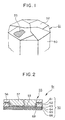
- FIG. 1 is a perspective view of a conventional container body
- FIG. 2 is a cross-sectional view of a main portion of the conventional container body
- FIG. 3 is a perspective view of a second conventional container body
- FIG. 4 is a cross-sectional view of a main portion of the second conventional container body.
- reference numeral 50 denotes a packaging material
- 51 denotes a container body formed of the packaging material 50 and having the shape of, for example, an octagonal prism
- 52 denotes a top wall of the container body 51
- 53 denotes a rupturable portion formed in a discharge opening portion which is defined on the top wall 52 at a predetermined position.
- the rupturable portion 53 is formed through reduction of the thickness of the packaging material 50.
- Reference numeral 55 denotes a lid member made of a resin and welded to the top wall 52.
- the lid member 55 has a main body portion 56, and a lid portion 57, which is swingably supported by the main body portion 56 via an unillustrated hinge.
- the packaging material 50 comprises an outer layer 61, a paper substrate 62, a bonding layer 63, a barrier layer 64, a bonding layer 65, and an inner layer 66, which are formed in this sequence from the outside to the inside of the packaging container.
- the outer layer 61, the bonding layers 63 and 65, and the inner layer 66 are typically formed of a resin such as polyethylene or an ethylene copolymer.
- the outer layer 61 and the inner layer 66 are preferably formed of low-density polyethylene.
- the barrier layer 64 is formed of aluminum foil or the like. If necessary, printing is performed on the outer surface of the outer layer 61 or the outer surface of the paper substrate 62.
- a hole 68 is punched in the paper substrate 62 at a portion corresponding to the rupturable portion 53. Therefore, the rupturable portion 53 is formed of the outer layer 61, the bonding layers 63 and 65, the barrier layer 64, and the inner layer 66, so that the rupturable portion 53 is thinner than the remaining portion by an amount corresponding to the thickness of the paper substrate 62.
- a pull-tab sheet may be used.
- FIGS. 3 and 4 another conventional container is shown, and reference numeral 50 denotes a packaging material; 51 denotes a container body; 52 denotes a top wall of the container body 51; and 73 denotes a rupturable portion.
- the rupturable portion 73 is formed through formation of perforations 76 surrounding a predetermined portion of the packaging material 50.
- Reference numeral 75 denotes a lid member made of a resin and welded to the top wall 52.
- the lid member 75 has a main body portion 56, and an opening flap 77, which is swingably supported by the main body portion 56 via an unillustrated hinge.
- the packaging material 50 comprises an outer layer 61, a paper substrate 62, a bonding layer 63, a barrier layer 64, a bonding layer 65, and an inner layer 66, which are formed in this sequence from the outside to the inside of the packaging container.
- perforations 76 are formed in the paper substrate 62 at a portion corresponding to the rupturable portion 73.
- the outer layer 61 and the bonding layer 63 are difficult to bond together over the entire rupturable portion 53, with the result that pinholes are apt to be generated in an increased area at a bent portion of the outer layer 61; i.e., at the circumferential edge of the punched hole 68.
- the packaging container having the rupturable portion 73 formed through formation of the perforations 76 surrounding a predetermined portion of the packaging material 50, since the strength of the rupturable portion 73 is high, the packaging container cannot be opened unless the rupturable portion 73 is pulled up from the container body 51.
- a container according to the preamble of appended claim 1 can be seen e.g. in the document JP 8-198253.
- an object of the present invention is to provide a packaging container which can improve the quality of a packaging material and which does not restrict the types of usable lid members.
- a packaging container comprises a container body and a lid member welded to a top wall of the container body, in accordance with appended claim 1.
- the lid member is composed of a main body portion having an opening and a lid portion swingably supported by the main body portion.
- a rupturable portion is formed in a discharge opening portion which is defined on the top wall at a predetermined position.
- the rupturable portion is composed of a thin-wall portion and a rupture-line area.
- the thin-wall portion is formed through reduction of the thickness of the packaging material, which constitutes the container body.
- the rupture-line area is formed through formation of a rupture line portion surrounding a predetermined area.
- the area of the thin-wall portion can be decreased by an amount corresponding to the area of the rupture-line area, the area at the inner circumferential edge of the punched hole where pinholes are apt to be generated can be decreased.
- the amount of air that enters the interior of the container body via pinholes can be decreased, resulting in an improvement in the quality of the packaging material.
- the strength of the rupturable portion can be decreased by an amount corresponding to the area of the thin-wall portion, the types of usable lid members are not restricted.
- the rupture-line portion is formed of perforations.
- the rupture-line portion is formed of a half-cut line portion.
- FIG. 1 is a perspective view of a conventional container body
- FIG. 2 is a cross-sectional view of a main portion of the conventional container body
- FIG. 3 is a perspective view of a second conventional container body
- FIG. 4 is a cross-sectional view of a main portion of the second conventional container body
- FIG. 5 is a perspective view of a container body according to a first embodiment of the present invention
- FIG. 6 is a perspective view showing a lid member used in the first embodiment of the present invention, when the lid member is in a closed state
- FIG. 7 is a perspective view showing the lid member used in the first embodiment of the present invention, when the lid member is in an open state
- FIG. 8 is a cross-sectional view of a main portion of the container body according to the first embodiment of the present invention
- FIG. 9 is a perspective view of a container body according to the second embodiment of the present invention
- FIG. 10 is a perspective view showing a lid member used in the second embodiment of the present invention, when the lid member is in a closed state
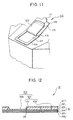
- FIG. 11 is a perspective view showing the lid member used in the second embodiment of the present invention, when the lid member is in an open state
- FIG. 12 is a cross-sectional view taken along line X-X in FIG. 9.
- FIG. 5 is a perspective view of a container body according to a first embodiment of the present invention
- FIG. 6 is a perspective view showing a lid member used in the first embodiment of the present invention, when the lid member is in a closed state
- FIG. 7 is a perspective view showing the lid member used in the first embodiment of the present invention, when the lid member is in an open state
- FIG. 8 is a cross-sectional view of a main portion of the container body according to the first embodiment of the present invention.
- reference numeral 12 denotes a container body having the shape of, for example, an octagonal prism; and 13 denotes a lid member made of a resin and welded to the top wall 12a of the container body 12.
- the lid member 13 is composed of a main body portion 14 and a lid portion 15 swingably supported by the main body portion 14 via a hinge 16, and an opening 21 is formed in the main body portion 14 at a predetermined position. Further, a discharge opening portion is defined on the top wall 12a at a predetermined position, and the lid member 13 is positioned such that the discharge opening portion corresponds to the opening 21.
- a handle 17 is formed at the tip end of the lid portion 15. A consumer can engage his/her finger with the handle 17 and rotate the lid portion 15 in order to place the lid portion 15 at an open position or a closed position.
- a rupturable portion 23 is formed in the discharge opening portion such that the rupturable portion 23 has a shape corresponding to that of the opening 21.
- the rupturable portion 23 is composed of a slit-shaped thin-wall portion 24 and a perforated area 27 serving as a rupture-line area.
- the thin-wall portion 24 is formed by a method by which the thickness of a packaging material 10 that constitutes the container body 12 is reduced over a predetermined area.
- the perforated area 27 is an area surrounded by the thin-wall portion 24 and perforations 26 serving as a rupture line.
- the packaging material 10 comprises an outer layer 61, a paper substrate 62, a bonding layer 63, a barrier layer 64, a bonding layer 65, and an inner layer 66, which are formed in this sequence from the outside to the inside of the packaging container.
- the outer layer 61, the bonding layers 63 and 65, and the inner layer 66 are typically formed of a resin such as polyethylene or an ethylene copolymer.
- the outer layer 61 and the inner layer 66 are preferably formed of low-density polyethylene.
- the barrier layer 64 is formed of aluminum foil or the like. If necessary, printing is performed on the outer surface of the outer layer 61 or the outer surface of the paper substrate 62.
- the thin-wall portion 24 is formed of the outer layer 61, the bonding layers 63 and 65, the barrier layer 64, and the inner layer 66, so that the thin-wall portion 24 is thinner than the remaining portion by an amount corresponding to the thickness of the paper substrate 62.
- the consumer can drink an unillustrated liquid food from the packaging container, while placing his/her lips on a drinking portion 14a formed adjacent to the opening 21 of the main body portion 14.
- the outer layer 61 and the bonding layer 63 can be easily bonded together over the entire thin-wall portion 24, and an area at the inner circumferential edge of the punched hole 28 where pinholes are apt to be generated can be decreased.
- the amount of air that enters the interior of the container body 12 via pinholes can be decreased, resulting in improvement in the quality of the packaging material 10.
- the strength of the rupturable portion 23 can be decreased by an amount corresponding to the area of the thin-wall portion 24, the types of usable lid members 13 are not restricted.
- FIG. 9 is a perspective view of a container body according to the second embodiment of the present invention
- FIG. 10 is a perspective view showing a lid member used in the second embodiment of the present invention, when the lid member is in a closed state
- FIG. 11 is a perspective view showing the lid member used in the second embodiment of the present invention, when the lid member is in an open state
- FIG. 12 is a cross-sectional view taken along line X-X in FIG. 9.
- reference numeral 113 denotes a lid member made of a resin and welded to the top wall 12a of a container body 12.
- the lid member 113 is composed of a main body portion 114 and a lid portion 115 swingably supported by the main body portion 114 via a hinge 116, and an opening 121 is formed in the main body portion 114 at a predetermined position. Further, a discharge opening portion is defined on the top wall 12a at a predetermined position, and the lid member 113 is positioned such that the discharge opening portion corresponds to the opening 121.
- a rupturable portion 123 having a "U"-like shape is formed in a discharge opening portion to correspond to the opening 121.
- the rupturable portion 123 is composed of a slit-shaped thin-wall portion 124 and a half-cut area 127 serving as the rupture-line area.
- the thin-wall portion 124 is formed by a method by which the thickness of a packaging material 10 that constitutes the container body 12 is reduced over a predetermined area.
- the half-cut area 127 is an area surrounded by the thin-wall portion 124 and half-cuts 126 serving as the rupture line portion.
- the half-cuts 126 are formed such that the half-cuts 126 extend from the opposite ends of the thin-wall portion 124 in a direction perpendicular to the thin-wall portion 124. Further, a bonding portion 131 is defined in the half-cut area 127 to cover at least a portion adjacent to the thin-wall portion 124. When the lid member 113 is attached to the container body 12, the lower surface of the lid portion 115 is bonded to the bonding portion 131.
- the packaging material 10 comprises an outer layer 61, a paper substrate 62, a bonding layer 63, a barrier layer 64, a bonding layer 65, and an inner layer 66, which are formed in this sequence from the outside to the inside of the packaging container.
- the outer layer 61, the bonding layers 63 and 65, and the inner layer 66 are typically formed of a resin such as polyethylene or an ethylene copolymer.
- the outer layer 61 and the inner layer 66 are preferably formed of low-density polyethylene.
- the barrier layer 64 is formed of aluminum foil or the like. If necessary, printing is performed on the outer surface of the outer layer 61 or the outer surface of the paper substrate 62.
- the thin-wall portion 124 is formed of the outer layer 61, the bonding layers 63 and 65, the barrier layer 64, and the inner layer 66, so that the thin-wall portion 124 is thinner than the remaining portion of the container by an amount corresponding to the thickness of the paper substrate 62.
- the packaging material 10 is cut to a predetermined depth from the side of the outer layer 61 in order to form the half-cuts 126.
- the half-cuts 126 are formed such that only the barrier layer 64, the bonding layer 65, and the inner layer 66 remain at the half-cuts 126. Therefore, the thickness of the packaging material 10 decreases by an amount corresponding to the total thickness of the outer layer 61, the paper substrate 62, and the bonding layer 63.
- the area of the thin-wall portion 124 can be decreased by an amount corresponding to the area of the half-cut area 127, the outer layer 61 and the bonding layer 63 can be easily bonded together over the entire thin-wall portion 124, and an area at the inner circumferential edge of the punched hole 28 where pinholes are apt to be generated can be decreased.
- the amount of air that enters the interior of the container body 12 via pinholes can be decreased, resulting in improvement in the quality of the packaging material 10.
- the strength of the rupturable portion 123 can be decreased by an amount corresponding to the area of the thin-wall portion 124, the types of usable lid members 113 are not restricted.
- the present invention is applicable to packaging containers for accommodating liquid foods.
Landscapes
- Engineering & Computer Science (AREA)
- Mechanical Engineering (AREA)
- Closures For Containers (AREA)
- Cartons (AREA)
- Packages (AREA)
- Containers Opened By Tearing Frangible Portions (AREA)
Claims (3)
- Récipient d'emballage comportant:(a) un corps de récipient (12); et(b) un élément de couvercle (13) étant soudé à une paroi supérieure (12a) dudit corps de récipient et étant constitué d'une section de corps principale (14) et une section de couvercle (15) qui est supportée pivotante par ladite section de corps principale, ladite section de corps principale ayant une ouverture (21), dans lequel(c) une section déchirable (23, 123) est formée dans une section d'ouverture de dégagement définie sur la paroi supérieure (12a) dans une position prédéterminée et la surface inférieure de la section de couvercle (15) est jointe à ladite section déchirable (23, 123), caractérisé en ce que(d) la section déchirable (23, 123) est constituée d'une section à paroi mince (24, 124) formée par la réduction en épaisseur d'un matériau d'emballage constituant ledit corps de récipient et une région de ligne de déchirure (27, 127) formée via la formation d'une section de ligne de déchirure (26, 126) entourant une région prédéterminée, la surface inférieure de la section de couvercle (15) étant jointe à ladite région prédéterminée dans au moins une section adjacente à ladite section à paroi mince lorsque l'élément de couvercle est attaché audit corps de récipient.
- Récipient d'emballage selon la revendication 1, dans lequel la section de ligne de déchirure est formée par des perforations (26).
- Récipient d'emballage selon la revendication 1, dans lequel la section de ligne de déchirure est formée par une section de ligne semi-coupée (126).
Applications Claiming Priority (3)
| Application Number | Priority Date | Filing Date | Title |
|---|---|---|---|
| JP10221279A JP2000053126A (ja) | 1998-08-05 | 1998-08-05 | 包装容器 |
| JP22127998 | 1998-08-05 | ||
| PCT/JP1999/004227 WO2000007891A1 (fr) | 1998-08-05 | 1999-08-05 | Recipient |
Publications (3)
| Publication Number | Publication Date |
|---|---|
| EP1145975A1 EP1145975A1 (fr) | 2001-10-17 |
| EP1145975A4 EP1145975A4 (fr) | 2003-05-14 |
| EP1145975B1 true EP1145975B1 (fr) | 2004-04-07 |
Family
ID=16764301
Family Applications (1)
| Application Number | Title | Priority Date | Filing Date |
|---|---|---|---|
| EP99936988A Expired - Lifetime EP1145975B1 (fr) | 1998-08-05 | 1999-08-05 | Recipient |
Country Status (10)
| Country | Link |
|---|---|
| US (1) | US6375067B1 (fr) |
| EP (1) | EP1145975B1 (fr) |
| JP (1) | JP2000053126A (fr) |
| KR (1) | KR100712084B1 (fr) |
| CN (1) | CN1120119C (fr) |
| AU (1) | AU5194799A (fr) |
| DE (1) | DE69916323T2 (fr) |
| ES (1) | ES2216549T3 (fr) |
| TW (1) | TW413667B (fr) |
| WO (1) | WO2000007891A1 (fr) |
Cited By (2)
| Publication number | Priority date | Publication date | Assignee | Title |
|---|---|---|---|---|
| DE102008002853A1 (de) * | 2008-05-14 | 2009-12-03 | Sig Technology Ag | Öffnungs- und Ausgießelement für Karton/Kunststoff-Verbundpackungen und damit verwendbare Verbundpackung |
| US7878353B2 (en) | 2004-08-20 | 2011-02-01 | Tetra Laval Holdings & Finance Sa | Opening device for a sealed package containing a pourable food product |
Families Citing this family (29)
| Publication number | Priority date | Publication date | Assignee | Title |
|---|---|---|---|---|
| TW534891B (en) * | 1999-02-17 | 2003-06-01 | Tetra Laval Holdings & Finance | Packing container and method of manufacturing the container |
| BR0110854B1 (pt) | 2000-05-19 | 2017-10-24 | Ciba Specialty Chemicals Holdings Inc | Method for reducing the polypropylene molecular weight, propylene copolymers or polypropylene mixtures, as a compound |
| PT1277662E (pt) * | 2001-07-09 | 2005-09-30 | Tetra Laval Holdings & Finance | Metodo de producao de uma embalagem vedada de um produto alimentar que se pode vazar, e embalagem assim formada |
| DE10204521B4 (de) * | 2002-02-05 | 2006-04-13 | Sig Combibloc Systems Gmbh | Verfahren und Vorrichtung zur Verbesserung der Haftung der einzelnen Schichten eines Verbundmaterials |
| SE523861C2 (sv) * | 2002-05-07 | 2004-05-25 | Tetra Laval Holdings & Finance | Förpackningslaminat, förfarande för tillverkning av detta, samt förpackningsbehållare tillverkad av förpackningslaminatet |
| SE522498C2 (sv) * | 2002-05-07 | 2004-02-10 | Tetra Laval Holdings & Finance | Förpackningslaminat, förfarande för tillverkning av detta, samt förpackningsbehållare tillverkad av förpackningslaminatet |
| US7582058B1 (en) * | 2002-06-26 | 2009-09-01 | Nuvasive, Inc. | Surgical access system and related methods |
| US20040084455A1 (en) * | 2002-11-06 | 2004-05-06 | Haggai Shosheny | Container with peel-off cover |
| SE525597C2 (sv) * | 2002-12-06 | 2005-03-15 | Tetra Laval Holdings & Finance | Öppningsanordning förpackning samt sätt att förse en förpackning med en öppningsanordning |
| AU2004275877B2 (en) * | 2003-09-25 | 2008-09-04 | Nuvasive, Inc. | Surgical access system and related methods |
| US20060186147A1 (en) * | 2005-01-24 | 2006-08-24 | Nossbaum Frits D | Container for liquid substances and lid therefor |
| NZ569065A (en) * | 2005-12-12 | 2010-08-27 | Graphic Packaging Int Inc | Carton having a pivotable dispenser |
| CA2633465A1 (fr) * | 2005-12-21 | 2007-06-28 | Columbus E. Aps | Boite pour boisson jetable |
| USD583663S1 (en) * | 2007-07-05 | 2008-12-30 | Tetra Laval Holdings & Finance S.A. | Product packaging |
| US7681732B2 (en) * | 2008-01-11 | 2010-03-23 | Cryovac, Inc. | Laminated lidstock |
| US20090297070A1 (en) * | 2008-05-29 | 2009-12-03 | Berman Ronald H | Zip sealed flexible pouch |
| US8354132B2 (en) * | 2008-06-06 | 2013-01-15 | Cryovac, Inc. | Laminated lidstock and package made therefrom |
| ES2751978T5 (es) * | 2009-07-08 | 2023-02-16 | Tetra Laval Holdings & Finance | Estratificado de envasado robusto, método para la fabricación del estratificado de envasado y recipiente de envasado producido a partir del mismo |
| JP5912286B2 (ja) * | 2011-05-10 | 2016-04-27 | 昭和アルミニウム缶株式会社 | 蓋部材、飲料容器 |
| WO2013028571A1 (fr) | 2011-08-19 | 2013-02-28 | Lanx, Inc. | Système d'écarteur chirurgical et procédés d'utilisation |
| US10131477B2 (en) * | 2012-05-25 | 2018-11-20 | Stephen Robert | Container top with removable seal |
| US9827729B2 (en) | 2012-05-25 | 2017-11-28 | Phoenix Packaging Operations, LLC | Food container top with integrally formed utensil |
| EP3237293B1 (fr) | 2014-12-22 | 2024-01-17 | Tetra Laval Holdings & Finance SA | Matériau d'emballage et contenant d'emballage produit à partir dudit matériau. |
| WO2016102150A1 (fr) | 2014-12-22 | 2016-06-30 | Tetra Laval Holdings & Finance S.A. | Matériau d'emballage et récipient d'emballage formé au moyen dudit matériau |
| US10273068B2 (en) | 2014-12-23 | 2019-04-30 | Sonoco Development, Inc. | Die cut opening for multi-layer flexible package |
| EP3409464B1 (fr) * | 2017-05-31 | 2020-07-08 | Tetra Laval Holdings & Finance S.A. | Matériau d'emballage stratifié et matériau de membrane d'ouverture, conteneurs d'emballage ainsi fabriqués et procédé de fabrication du matériau stratifié |
| CN111372863A (zh) * | 2017-11-16 | 2020-07-03 | 宝洁公司 | 手指拉舌 |
| KR20250038833A (ko) * | 2019-07-30 | 2025-03-19 | 기쿠오 야마다 | 덮개체 |
| NO349648B1 (en) * | 2021-04-19 | 2026-03-23 | Elopak As | Paper-based or paperboard-based container and metdod of providing a pouring arrangement |
Family Cites Families (16)
| Publication number | Priority date | Publication date | Assignee | Title |
|---|---|---|---|---|
| US4189060A (en) * | 1978-10-05 | 1980-02-19 | Minnesota Mining And Manufacturing Company | Retention means for container closure assembly |
| SE441666B (sv) * | 1984-03-21 | 1985-10-28 | Tetra Pak Int | Oppningsanordning vid forpackningsbehallare samt sett att tillverka densamma |
| SE8401616D0 (sv) * | 1984-03-23 | 1984-03-23 | Tetra Pak Int | Oppningsanordning for forpackningsbehallare samt sett att tillverka densamma |
| SE454685B (sv) * | 1985-06-12 | 1988-05-24 | Tetra Pak Ab | Oppningsanordning for forpackningsbehallare |
| US4770325A (en) * | 1986-07-29 | 1988-09-13 | International Paper Company | Pour spout for containers |
| US5452849A (en) * | 1988-05-19 | 1995-09-26 | Morgan Adhesives Co. | Easy open tab sealer for packages |
| JPH0683136B2 (ja) * | 1988-06-29 | 1994-10-19 | 日本電信電話株式会社 | 移動局無線ゾーン間移行判定方式 |
| JPH0646828Y2 (ja) * | 1988-07-06 | 1994-11-30 | 大日本印刷株式会社 | 紙容器におけるタブ付き注出口 |
| JPH0279513A (ja) * | 1988-09-14 | 1990-03-20 | Sony Corp | アナログディジタル変換回路 |
| GB2224995A (en) * | 1988-11-16 | 1990-05-23 | Hans Rausing | Opening of packages |
| FR2649071B1 (fr) * | 1989-06-28 | 1991-10-25 | Erca Holding | |
| DE4411925A1 (de) * | 1994-04-07 | 1995-10-12 | Ruediger Haaga Gmbh | Verfahren zum Abdecken einer Schnittkante einer Öffnung eines Behälters mit einem Schutzbezug |
| DE4440701A1 (de) * | 1994-11-15 | 1996-05-23 | Ruediger Haaga Gmbh | Behälter mit einem Behältermantel und einer Stirnwand |
| FI954102A7 (fi) * | 1994-11-17 | 1996-05-18 | Toppan Printing Co Ltd | Kartonkirasian kaatonokka, kaatonokalla varustettu kartonkirasia ja menetelmä kaatonokan valmistamiseksi |
| JPH1081361A (ja) * | 1996-09-07 | 1998-03-31 | Komatsu Electron Metals Co Ltd | フィルム包装の開封構造 |
| US6106757A (en) * | 1997-01-31 | 2000-08-22 | Tetra Laval Holdings & Finance S.A. | Beverage can lid and method of making |
-
1998
- 1998-08-05 JP JP10221279A patent/JP2000053126A/ja active Pending
-
1999
- 1999-08-04 TW TW088113301A patent/TW413667B/zh not_active IP Right Cessation
- 1999-08-05 ES ES99936988T patent/ES2216549T3/es not_active Expired - Lifetime
- 1999-08-05 CN CN99809312A patent/CN1120119C/zh not_active Expired - Fee Related
- 1999-08-05 KR KR1020017001476A patent/KR100712084B1/ko not_active Expired - Fee Related
- 1999-08-05 AU AU51947/99A patent/AU5194799A/en not_active Abandoned
- 1999-08-05 DE DE69916323T patent/DE69916323T2/de not_active Expired - Fee Related
- 1999-08-05 EP EP99936988A patent/EP1145975B1/fr not_active Expired - Lifetime
- 1999-08-05 US US09/744,474 patent/US6375067B1/en not_active Expired - Fee Related
- 1999-08-05 WO PCT/JP1999/004227 patent/WO2000007891A1/fr not_active Ceased
Cited By (2)
| Publication number | Priority date | Publication date | Assignee | Title |
|---|---|---|---|---|
| US7878353B2 (en) | 2004-08-20 | 2011-02-01 | Tetra Laval Holdings & Finance Sa | Opening device for a sealed package containing a pourable food product |
| DE102008002853A1 (de) * | 2008-05-14 | 2009-12-03 | Sig Technology Ag | Öffnungs- und Ausgießelement für Karton/Kunststoff-Verbundpackungen und damit verwendbare Verbundpackung |
Also Published As
| Publication number | Publication date |
|---|---|
| ES2216549T3 (es) | 2004-10-16 |
| EP1145975A4 (fr) | 2003-05-14 |
| CN1311742A (zh) | 2001-09-05 |
| DE69916323D1 (de) | 2004-05-13 |
| KR20010072231A (ko) | 2001-07-31 |
| WO2000007891A1 (fr) | 2000-02-17 |
| TW413667B (en) | 2000-12-01 |
| JP2000053126A (ja) | 2000-02-22 |
| DE69916323T2 (de) | 2004-08-05 |
| US6375067B1 (en) | 2002-04-23 |
| AU5194799A (en) | 2000-02-28 |
| EP1145975A1 (fr) | 2001-10-17 |
| CN1120119C (zh) | 2003-09-03 |
| KR100712084B1 (ko) | 2007-05-02 |
Similar Documents
| Publication | Publication Date | Title |
|---|---|---|
| US6375067B1 (en) | Packaging container | |
| EP1035025B1 (fr) | Récipient en carton | |
| US4705197A (en) | Pour spout for containers | |
| EP0530677B1 (fr) | Dispositif d'ouverture pour réceptacle d'emballage | |
| US4453666A (en) | Tamper-evident top closure | |
| US4798296A (en) | Packing container provided with a reclosable opening arrangement | |
| US20100172604A1 (en) | Reclosable Container with Resealable Flexible Cover and Method for Manufacturing the Same | |
| JP3509295B2 (ja) | 押込蓋ユニット付容器、押込蓋ユニット、容器及びその製造方法 | |
| EP0712786B2 (fr) | Structure d'ouverture de décharge pour boíte en papier, boíte en papier avec ouverture de décharge et méthode de fabrication d'une telle ouverture de décharge | |
| EP0312816A1 (fr) | Bec verseur pour récipient à liquides | |
| AU689708B2 (en) | A package comprising a tray-shaped bottom part and a cover | |
| JPH07285552A (ja) | 容器の開口の切断縁を保護被覆層により覆う方法 | |
| JP3660006B2 (ja) | 包装容器 | |
| US20020148886A1 (en) | Composite container | |
| JPH11334753A (ja) | キャップ | |
| EP0141229A1 (fr) | Emballage aseptique refermable | |
| JP4184490B2 (ja) | 紙容器 | |
| EP0995693B1 (fr) | Procédé de fabrication d'un récipient à couvercle refermable et récipient ainsi obtenu | |
| JP2006131263A (ja) | カップ状容器のシート状蓋材 | |
| JPH11193027A (ja) | 注出孔付容器 | |
| JP2575708B2 (ja) | 易開封性容器 | |
| JPS607323Y2 (ja) | 開口の容易な紙容器 | |
| JP5071638B2 (ja) | 振出口付容器 | |
| JPH03212377A (ja) | 易開封性密封容器 | |
| JP2789206B2 (ja) | 金属蓋付容器 |
Legal Events
| Date | Code | Title | Description |
|---|---|---|---|
| PUAI | Public reference made under article 153(3) epc to a published international application that has entered the european phase |
Free format text: ORIGINAL CODE: 0009012 |
|
| 17P | Request for examination filed |
Effective date: 20010203 |
|
| AK | Designated contracting states |
Kind code of ref document: A1 Designated state(s): AT BE CH CY DE DK ES FI FR GB GR IE IT LI LU MC NL PT SE |
|
| A4 | Supplementary search report drawn up and despatched |
Effective date: 20030331 |
|
| GRAP | Despatch of communication of intention to grant a patent |
Free format text: ORIGINAL CODE: EPIDOSNIGR1 |
|
| GRAS | Grant fee paid |
Free format text: ORIGINAL CODE: EPIDOSNIGR3 |
|
| GRAA | (expected) grant |
Free format text: ORIGINAL CODE: 0009210 |
|
| AK | Designated contracting states |
Kind code of ref document: B1 Designated state(s): DE ES FR GB IT |
|
| REG | Reference to a national code |
Ref country code: GB Ref legal event code: FG4D |
|
| REF | Corresponds to: |
Ref document number: 69916323 Country of ref document: DE Date of ref document: 20040513 Kind code of ref document: P |
|
| REG | Reference to a national code |
Ref country code: IE Ref legal event code: FG4D |
|
| REG | Reference to a national code |
Ref country code: ES Ref legal event code: FG2A Ref document number: 2216549 Country of ref document: ES Kind code of ref document: T3 |
|
| ET | Fr: translation filed | ||
| PLBE | No opposition filed within time limit |
Free format text: ORIGINAL CODE: 0009261 |
|
| STAA | Information on the status of an ep patent application or granted ep patent |
Free format text: STATUS: NO OPPOSITION FILED WITHIN TIME LIMIT |
|
| 26N | No opposition filed |
Effective date: 20050110 |
|
| REG | Reference to a national code |
Ref country code: IE Ref legal event code: MM4A |
|
| PGFP | Annual fee paid to national office [announced via postgrant information from national office to epo] |
Ref country code: ES Payment date: 20070827 Year of fee payment: 9 |
|
| PGFP | Annual fee paid to national office [announced via postgrant information from national office to epo] |
Ref country code: GB Payment date: 20070830 Year of fee payment: 9 |
|
| PGFP | Annual fee paid to national office [announced via postgrant information from national office to epo] |
Ref country code: IT Payment date: 20070828 Year of fee payment: 9 Ref country code: DE Payment date: 20071001 Year of fee payment: 9 |
|
| PGFP | Annual fee paid to national office [announced via postgrant information from national office to epo] |
Ref country code: FR Payment date: 20070817 Year of fee payment: 9 |
|
| GBPC | Gb: european patent ceased through non-payment of renewal fee |
Effective date: 20080805 |
|
| REG | Reference to a national code |
Ref country code: FR Ref legal event code: ST Effective date: 20090430 |
|
| PG25 | Lapsed in a contracting state [announced via postgrant information from national office to epo] |
Ref country code: IT Free format text: LAPSE BECAUSE OF NON-PAYMENT OF DUE FEES Effective date: 20080805 Ref country code: FR Free format text: LAPSE BECAUSE OF NON-PAYMENT OF DUE FEES Effective date: 20080901 Ref country code: DE Free format text: LAPSE BECAUSE OF NON-PAYMENT OF DUE FEES Effective date: 20090303 |
|
| REG | Reference to a national code |
Ref country code: ES Ref legal event code: FD2A Effective date: 20080806 |
|
| PG25 | Lapsed in a contracting state [announced via postgrant information from national office to epo] |
Ref country code: GB Free format text: LAPSE BECAUSE OF NON-PAYMENT OF DUE FEES Effective date: 20080805 |
|
| PG25 | Lapsed in a contracting state [announced via postgrant information from national office to epo] |
Ref country code: ES Free format text: LAPSE BECAUSE OF NON-PAYMENT OF DUE FEES Effective date: 20080806 |