EP1146435A2 - Verwalten eines Inhaltsspeichers - Google Patents
Verwalten eines Inhaltsspeichers Download PDFInfo
- Publication number
- EP1146435A2 EP1146435A2 EP01301704A EP01301704A EP1146435A2 EP 1146435 A2 EP1146435 A2 EP 1146435A2 EP 01301704 A EP01301704 A EP 01301704A EP 01301704 A EP01301704 A EP 01301704A EP 1146435 A2 EP1146435 A2 EP 1146435A2
- Authority
- EP
- European Patent Office
- Prior art keywords
- objects
- class
- classes
- properties
- child
- Prior art date
- Legal status (The legal status is an assumption and is not a legal conclusion. Google has not performed a legal analysis and makes no representation as to the accuracy of the status listed.)
- Ceased
Links
Images

Classifications
-
- G—PHYSICS
- G06—COMPUTING OR CALCULATING; COUNTING
- G06F—ELECTRIC DIGITAL DATA PROCESSING
- G06F16/00—Information retrieval; Database structures therefor; File system structures therefor
- G06F16/90—Details of database functions independent of the retrieved data types
- G06F16/95—Retrieval from the web
- G06F16/958—Organisation or management of web site content, e.g. publishing, maintaining pages or automatic linking
Definitions
- This invention relates to a method and apparatus for managing objects in an electronic content store.
- the invention is particularly although not exclusively concerned with storing content for web sites.
- content any information or goods that are delivered electronically to a consumer, either directly or indirectly.
- content may be embodied in HTML pages and their associated images, and delivered directly to users through the World Wide Web.
- eBusiness electronic business
- Such content is generally held in some form of content store.
- the content store may be an ordinary filestore containing prepared HTML pages.
- the content store may be a relational database holding raw data, and publishing may use some dynamic page construction mechanism such as CGI or ASP, or a template rendering mechanism, to construct web pages when required.
- the object of the present invention is to provide a novel technique for managing objects in such a content store.
- a method for managing objects in an electronic content store comprises:
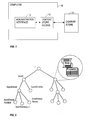
- Figure 1 shows a computer 10, which in this example is assumed to be used for developing new websites or updating existing web pages.
- a content store 11 holds the content for the websites.
- the computer accesses the content store by way of a content store access service 12.
- the computer also incudes an administration interface 13.
- the content store 11 holds all the content for the website. It contains a set of objects, logically organised in a tree structure. Each object represents either an actual item of content (such as a template, dynamic information to be inserted into a template, or a rendered document), or a folder which may contain other objects. As will be described, objects are also used to represent classes defining a resource schema.
- the content store may be distributed, and accessed over a network using the standard WebDAV (Web-based Distributed Authoring and Versioning) protocol, or alternatively may be local.
- WebDAV Web-based Distributed Authoring and Versioning
- the content store may simultaneously include many distinct implementations of the logical model on different media, such as relational database management systems, filesystems, memory, XML documents, and so on.
- Each object in the content store has a hierarchic address, which identifies its position in the tree structure.
- Figure 2 shows a portion of the content store, with objects identified by addresses such as "/sport/news/football".
- the root of the tree is indicated by "/”.
- the objects directly below an object in the tree structure are referred to as its children; for example "/sport” has two children, “/sport/news” and “/sport/articles”.
- the object directly above an object in the tree is referred to as its parent; for example, "/sport” is the parent of "/sport/news" and “/sport/articles”.
- Each object in the content store has an internal structure, comprising a content body, and a number of properties.
- the properties may be further organised into one or more property sheets, so that name clashes between standard properties and those assigned by different groups of individuals are avoided.
- Property sheets provide a convenient visualisation of the concept of XML namespaces as used in WebDAV.
- the properties of an object can be addressed by appending a suffix of the form : propertysheet : property to the object address.
- propertysheet property to the object address.
- /news/speeches/s1234:PUBLIC:speaker addresses the speaker property on the PUBLIC property sheet of the object at /news/speeches/s1234. If the property sheet is not specified, the PUBLIC property sheet is assumed by default.
- An object can model any of the following items:
- the system includes a template-based rendering system for generating web pages.
- a graphic designer generates HTML for the look and feel of a site, but leaves "holes" into which dynamic information can be placed. This is known as a template.
- the template is rendered, by inserting the dynamic information into the holes, to generate pure HTML.
- a template consists of a document (typically HTML) containing embedded commands that identify what information is to be inserted into the template when it is rendered. These commands include WebDAV and other commands, embedded in the document using XML syntax.
- Templates may reside in file store, or may be held in the content store itself.
- the administration interface 13 allows content to be browsed, copied, moved, tagged and similarly managed. It also provides a launchpad for other management functions, such as import/export and publishing.
- the interface displays a screen containing two panels.
- the left panel is a conventional folding-tree view of the content store. It shows content down to the folder level. Folders may be expanded by clicking on a "+" icon, or selected by clicking on their icons.
- the right panel shows details of the folder currently selected in the tree view. Resources (objects) within the selected folder may be selected by clicking on their icons. Tabs are provided to allow viewing of one or more properties sheets and a content sheet for the selected object.
- the interface also provides a toolbar, which allows miscellaneous operations to be performed on the selected object.
- Standard operations include “cut”, “copy”, “paste”, “preview”, “select all”, “import/export” etc.
- class objects which define a set of classes for other objects in the store.
- the set of available classes is collectively referred to herein as a resource schema.
- An important feature of the schema is that it is represented as ordinary objects, and so all the ordinary content operations can apply to it. In particular, it can be accessed and modified by any of the normal methods (WebDAV, the User Interface, templates etc.), can be imported/exported as XML, can have versioning and access control applied, and so on. Furthermore, if an administrator does not have access permission to an object that happens to be part of a schema and describes some property in an object instance, then the administrator will not be able to see the property in HTML forms when he or she updates object instances.
- Figure 3 shows an example of a resource schema.
- the schema includes a "News Folder” class object 30, which describes the attributes of News Folder objects.
- the News Folder class object resides in a special "Classes" directory 31 in the tree structure. This directory may also contain other class objects (not shown).
- the News Folder class object 30 has a set of properties 32, which define attribute values shared by all members of this class.
- one property 33 defines what types of child object a News Folder object may have.
- a News Folder object may have children of the following three classes:
- a class object may itself have a number of child objects, which represent resources owned by the class.
- the News Folder class object 30 has two child objects: a template object 34, used to display the list of news items, and a BGcolour (background colour) object 35, for use in the template.
- the BGcolour object has a set of properties, including a set of permitted background colours that can be used in the template: in this case red, blue or green. Another property of the BGcolour object specifies the default colour: in this case, red.
- FIG 3 also shows a "Sports News” directory object 37, which resides in a "Sports” directory 38.
- the Sports News directory is assumed to be a member of the News Folder class, as defined by the News Folder class object 30, and so inherits the properties of that class.
- it uses the template object 34 as its default template for generating web pages, and uses the BGcolour object 35 to specify its background colours.
- the user When a user desires to create a new object in the content store, the user first uses the administration interface 13 to select an existing object that is to be the parent of the new object.
- the administration interface toolbar includes a "Create new object" option. If this option is selected, the administration interface automatically accesses the class object corresponding to the selected object, to find the permitted classes of child object for the selected object. A drop-down menu is displayed, listing these permitted classes.
- the administration interface then automatically creates a new object of the selected class, giving it the properties of that class as specified by the class object for that class.
- the user can then edit the new object, if desired, for example by inserting text or other content into it.
- the user if the user wishes to create a new object in the Sports News directory, the user first selects this directory and then clicks on the "Create new object" option.
- the administration interface will then access the News Folder class object 30, and display a drop-down menu containing a list of the permitted child objects for this class: namely News Item, Weather Report and News Folder. The user can then select one of these (say News Item), and the administration interface will then automatically create a new object of this class.
Landscapes
- Engineering & Computer Science (AREA)
- Databases & Information Systems (AREA)
- Theoretical Computer Science (AREA)
- Data Mining & Analysis (AREA)
- Physics & Mathematics (AREA)
- General Engineering & Computer Science (AREA)
- General Physics & Mathematics (AREA)
- Information Retrieval, Db Structures And Fs Structures Therefor (AREA)
- Information Transfer Between Computers (AREA)
- Devices For Executing Special Programs (AREA)
- Stored Programmes (AREA)
Applications Claiming Priority (2)
| Application Number | Priority Date | Filing Date | Title |
|---|---|---|---|
| GB0009014 | 2000-04-13 | ||
| GB0009014A GB2361334A (en) | 2000-04-13 | 2000-04-13 | Content store management |
Publications (2)
| Publication Number | Publication Date |
|---|---|
| EP1146435A2 true EP1146435A2 (de) | 2001-10-17 |
| EP1146435A3 EP1146435A3 (de) | 2005-06-15 |
Family
ID=9889770
Family Applications (1)
| Application Number | Title | Priority Date | Filing Date |
|---|---|---|---|
| EP01301704A Ceased EP1146435A3 (de) | 2000-04-13 | 2001-02-26 | Verwalten eines Inhaltsspeichers |
Country Status (3)
| Country | Link |
|---|---|
| US (1) | US20010032208A1 (de) |
| EP (1) | EP1146435A3 (de) |
| GB (1) | GB2361334A (de) |
Families Citing this family (4)
| Publication number | Priority date | Publication date | Assignee | Title |
|---|---|---|---|---|
| EP1747548A4 (de) | 2004-05-17 | 2009-08-05 | Visible Path Corp | System und verfahren zur durchsetzung der privatsphäre in sozialen netzwerken |
| US20060036641A1 (en) | 2004-07-28 | 2006-02-16 | Antony Brydon | System and method for using social networks for the distribution of communications |
| US9135358B2 (en) | 2010-10-20 | 2015-09-15 | Microsoft Technology Licensing, Llc | Result types for conditional data display |
| US20200005345A1 (en) * | 2018-06-27 | 2020-01-02 | Karl A. Talla Demgueu | Web based system and method providing a marketplace for creative digital content discovery and distribution for artists |
Citations (1)
| Publication number | Priority date | Publication date | Assignee | Title |
|---|---|---|---|---|
| US5983234A (en) | 1997-09-17 | 1999-11-09 | Novell, Inc. | Method and apparatus for generically viewing and editing objects |
Family Cites Families (2)
| Publication number | Priority date | Publication date | Assignee | Title |
|---|---|---|---|---|
| US5574901A (en) * | 1993-03-09 | 1996-11-12 | Kabushiki Kaisha Toshiba | Method and apparatus for object traversing suitable for structured memory formed by linked objects |
| US5734597A (en) * | 1995-11-24 | 1998-03-31 | International Business Machines Corporation | Graphical user interface interaction between time and date controls |
-
2000
- 2000-04-13 GB GB0009014A patent/GB2361334A/en not_active Withdrawn
-
2001
- 2001-02-26 EP EP01301704A patent/EP1146435A3/de not_active Ceased
- 2001-03-08 US US09/803,087 patent/US20010032208A1/en not_active Abandoned
Patent Citations (1)
| Publication number | Priority date | Publication date | Assignee | Title |
|---|---|---|---|---|
| US5983234A (en) | 1997-09-17 | 1999-11-09 | Novell, Inc. | Method and apparatus for generically viewing and editing objects |
Non-Patent Citations (1)
| Title |
|---|
| GELLERSEN H-W ET AL.: "WebComposition: an object-oriented support system for the Web engineering lifecycle", COMPUTER NETWORKS AND ISDN SYSTEMS, NORTH HOLLAND PUBLISHING, vol. 29, no. 8-13, September 1997 (1997-09-01), pages 1429 - 1437 |
Also Published As
| Publication number | Publication date |
|---|---|
| EP1146435A3 (de) | 2005-06-15 |
| US20010032208A1 (en) | 2001-10-18 |
| GB0009014D0 (en) | 2000-05-31 |
| GB2361334A (en) | 2001-10-17 |
Similar Documents
| Publication | Publication Date | Title |
|---|---|---|
| US6684227B2 (en) | Electronic content store | |
| US6968512B2 (en) | Electronic content storage | |
| US7496839B2 (en) | Template mechanism for document generation | |
| US10706091B2 (en) | User driven computerized selection, categorization, and layout of live content components | |
| US7028262B2 (en) | Method and system for designing a theme and associating it with a collaboration space user interface | |
| US6996780B2 (en) | Method and system for creating a place type to be used as a template for other places | |
| US5860073A (en) | Style sheets for publishing system | |
| US8572123B2 (en) | Database system, particularly for multimedia objects | |
| US5878421A (en) | Information map | |
| US7458021B2 (en) | System and method for author-driven template switching in the development and modification of web pages | |
| US7555722B2 (en) | Dynamic link control object for dynamically presenting link options in connection with a content management server system | |
| US20080313260A1 (en) | Automated website generation | |
| US20050198202A1 (en) | Method for causing server to provide client computers with annotation functions for enabling users of the client computers to view object-based documents with annotations | |
| JP2009531793A (ja) | ウェブコミュニティおよびウェブアプリケーションのデータを変換するシステムおよび方法 | |
| US7523403B2 (en) | Placeholder control object for creating and viewing content in connection with a content management server system | |
| US7711689B2 (en) | Methods and apparatus for storing, organizing, sharing and rating multimedia objects and documents | |
| US7519617B2 (en) | Dynamic personalized information organizer | |
| US7325197B1 (en) | Method and system for providing page control content | |
| CN1669026B (zh) | 用于提供文档内容多样重现的系统和方法 | |
| EP1146435A2 (de) | Verwalten eines Inhaltsspeichers | |
| Breiteneder et al. | A Re-Usable Software Framework for Authoring and Managing Web Exhibitions. | |
| Moshfeghi et al. | XML in a multi-tier Java/CORBA architecture | |
| Hughes | SharePoint Designer 2010 Unleashed |
Legal Events
| Date | Code | Title | Description |
|---|---|---|---|
| PUAI | Public reference made under article 153(3) epc to a published international application that has entered the european phase |
Free format text: ORIGINAL CODE: 0009012 |
|
| AK | Designated contracting states |
Kind code of ref document: A2 Designated state(s): AT BE CH CY DE DK ES FI FR GB GR IE IT LI LU MC NL PT SE TR |
|
| AX | Request for extension of the european patent |
Free format text: AL;LT;LV;MK;RO;SI |
|
| RAP1 | Party data changed (applicant data changed or rights of an application transferred) |
Owner name: FUJITSU SERVICES LIMITED |
|
| PUAL | Search report despatched |
Free format text: ORIGINAL CODE: 0009013 |
|
| AK | Designated contracting states |
Kind code of ref document: A3 Designated state(s): AT BE CH CY DE DK ES FI FR GB GR IE IT LI LU MC NL PT SE TR |
|
| AX | Request for extension of the european patent |
Extension state: AL LT LV MK RO SI |
|
| 17P | Request for examination filed |
Effective date: 20051210 |
|
| AKX | Designation fees paid |
Designated state(s): DE FR GB |
|
| STAA | Information on the status of an ep patent application or granted ep patent |
Free format text: STATUS: THE APPLICATION HAS BEEN REFUSED |
|
| 18R | Application refused |
Effective date: 20120611 |