EP1146436A2 - Outil pour animer et deboguer des templates - Google Patents
Outil pour animer et deboguer des templates Download PDFInfo
- Publication number
- EP1146436A2 EP1146436A2 EP01301732A EP01301732A EP1146436A2 EP 1146436 A2 EP1146436 A2 EP 1146436A2 EP 01301732 A EP01301732 A EP 01301732A EP 01301732 A EP01301732 A EP 01301732A EP 1146436 A2 EP1146436 A2 EP 1146436A2
- Authority
- EP
- European Patent Office
- Prior art keywords
- template
- partial output
- tags
- tag
- command
- Prior art date
- Legal status (The legal status is an assumption and is not a legal conclusion. Google has not performed a legal analysis and makes no representation as to the accuracy of the status listed.)
- Ceased
Links
Images

Classifications
-
- G—PHYSICS
- G06—COMPUTING OR CALCULATING; COUNTING
- G06F—ELECTRIC DIGITAL DATA PROCESSING
- G06F16/00—Information retrieval; Database structures therefor; File system structures therefor
- G06F16/80—Information retrieval; Database structures therefor; File system structures therefor of semi-structured data, e.g. markup language structured data such as SGML, XML or HTML
-
- G—PHYSICS
- G06—COMPUTING OR CALCULATING; COUNTING
- G06F—ELECTRIC DIGITAL DATA PROCESSING
- G06F40/00—Handling natural language data
- G06F40/10—Text processing
- G06F40/12—Use of codes for handling textual entities
- G06F40/14—Tree-structured documents
- G06F40/143—Markup, e.g. Standard Generalized Markup Language [SGML] or Document Type Definition [DTD]
-
- G—PHYSICS
- G06—COMPUTING OR CALCULATING; COUNTING
- G06F—ELECTRIC DIGITAL DATA PROCESSING
- G06F40/00—Handling natural language data
- G06F40/10—Text processing
- G06F40/166—Editing, e.g. inserting or deleting
-
- G—PHYSICS
- G06—COMPUTING OR CALCULATING; COUNTING
- G06F—ELECTRIC DIGITAL DATA PROCESSING
- G06F40/00—Handling natural language data
- G06F40/10—Text processing
- G06F40/166—Editing, e.g. inserting or deleting
- G06F40/186—Templates
-
- G—PHYSICS
- G06—COMPUTING OR CALCULATING; COUNTING
- G06F—ELECTRIC DIGITAL DATA PROCESSING
- G06F40/00—Handling natural language data
- G06F40/10—Text processing
- G06F40/194—Calculation of difference between files
-
- G—PHYSICS
- G06—COMPUTING OR CALCULATING; COUNTING
- G06F—ELECTRIC DIGITAL DATA PROCESSING
- G06F40/00—Handling natural language data
- G06F40/20—Natural language analysis
- G06F40/205—Parsing
- G06F40/226—Validation
Definitions
- This invention relates to animating and debugging electronic templates.
- the invention is particularly concerned with templates for generating text format documents, especially HTML (Hypertext Markup Language) documents.
- HTML Hypertext Markup Language
- template-based rendering system To help this situation, some form of template-based rendering system is now often used.
- a graphic designer generates HTML for the look and feel of a site, but leaves "holes" into which dynamic information can be placed. This is known as a template.
- the template When required, the template is rendered, by inserting the dynamic information into the holes, to generate pure HTML.
- a template may consist of a document (typically in a text format such as HTML) containing embedded command tags that identify what information is to be inserted into the template when it is rendered.
- a document typically in a text format such as HTML
- embedded command tags that identify what information is to be inserted into the template when it is rendered.
- the object of the present invention is therefore to provide a way of partially rendering a template.
- a method for partially rendering an electronic template containing a plurality of tags, at least some of which have corresponding end tags comprises:
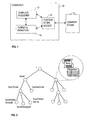
- Figure 1 shows a computer 10, which in this example is assumed to be used for developing new websites.
- a content store 11 holds the content for the websites.
- the computer can access the content store by way of a content store access service 12.
- the computer also includes a template renderer 13 and a template animation/debugging tool 14.
- the components 12-14 may be implemented as Java servlets.
- the content store 11 holds all the content for the websites, including templates and partial results. It contains a set of objects, logically organised in a tree structure. Each object represents either an actual item of content (such as a template, dynamic information to be inserted into a template, or a rendered document), or a folder which may contain other objects.
- the content store may be distributed, and accessed over a network using the standard WebDAV (Web-based Distributed Authoring and Versioning) protocol, or alternatively may be local.
- Each object in the content store has a hierarchic address, which identifies its position in the tree structure.
- Figure 2 shows a portion of the content store, with objects identified by addresses such as "/sport/news/football". The root of the tree is indicated by "/”.
- Each object in the content store has an internal structure, comprising a content body, and a number of properties.
- the properties may be further organised into one or more property sheets, so that name clashes between standard properties and those assigned by different groups of individuals are avoided.
- Property sheets provide a convenient visualisation of the concept of XML namespaces as used in WebDAV.
- the properties of an object can be addressed by appending a suffix of the form : propertysheet : property to the object address.
- propertysheet property to the object address.
- /news/speeches/s1234:PUBLIC:speaker addresses the speaker property on the PUBLIC property sheet of the object at /news/speeches/s1234. If the property sheet is not specified, the PUBLIC property sheet is assumed by default.
- An object can model any of the following items:
- a template consists of a document (typically HTML) containing embedded command tags that identify what information is to be inserted into the template when it is rendered. These commands include WebDAV and other commands, embedded in the document using XML syntax. These embedded command tags are distinguished from conventional HTML tags by a "ds:" namespace.
- Templates may reside in file store, or may be held in the content store itself. Some examples of typical embedded commands that can be used in templates will now be described.
- the insert command retrieves or constructs some text, and then inserts it into an output stream.
- the SourceAddress attribute specifies the content store address of an object or property whose contents are to be retrieved and inserted into the output stream.
- the content attribute may be replaced by a src (source) attribute.
- URL Universal Resource Locator
- the for command is used to specify an iterative loop through a set of objects or values, repeating some processing for each.
- the Filter attribute is an expression involving comparison operators, which specifies a condition for selecting objects from this set. For example, the filter expression: subject EQ football OR subject EQ golf selects objects whose subject property is equal to either "football” or "golf".
- a number of other "programming" commands (loops, conditions, procedures, variables etc.) are also provided, which may be used to produce very sophisticated and adaptive web pages.
- a call to the template renderer 13 specifies the address in the content store of the template to be rendered.
- the template renderer accesses the content store to get the specified template. It then parses the template, to identify any embedded commands in it. Each command is executed, and any text generated by the command is appended to an output string. Any parts of the template that are not embedded commands are simply copied to the output string. The resulting output string is passed back to the caller.
- the template animation tool 14 is web-based, using a conventional browser such as Microsoft Internet Explorer Version 4 to provide its user interface. As shown schematically in Figure 3, the user interface has four windows: control window 31, template window 32, view window 33 and watch window 34.
- the control window 31 allows an object/template combination to be specified, or alternatively these may be preset according to the context when the animator is entered, e.g. by a button on a particular web page or administration screen.
- a toolbar with "VCR” type controls is also provided, for allowing the user to move to a particular step number within the template. These controls include buttons to allow single step (i.e. move forward to the next command), or "fast forward” (i.e. multiple steps, say five at a time). It is also possible to jump to the beginning or end.
- the resulting step number is displayed in a box. Alternatively, a step number can be entered explicitly in the box.
- the template window 32 displays a portion of the template currently being rendered. All the embedded commands are highlighted, and the command which is about to execute is highlighted in a different colour, font or style, or any other suitable method of distinction. Clicking on any of the embedded commands in this window causes a pop-up help window to be displayed for that command.
- the view window 33 displays the result of rendering the template, up to the selected step number.
- the underlying HTML is adjusted to make it well-formed, i.e. to include end tags. This avoids most problems which might arise from passing incomplete HTML sequences to the browser.
- an option is available to view the rendered HTML text instead of the resulting page image.
- the output view contains small hyperlinks known as "locators”; in this embodiment they are represented by small coloured circles containing the letter "L", although it will be appreciated that any other suitable form may be used.
- locators small hyperlinks known as "locators”; in this embodiment they are represented by small coloured circles containing the letter "L", although it will be appreciated that any other suitable form may be used.
- the locator's tool tip shows the command instance and the step number. Clicking on a locator will automatically "rewind" the rendering process and step to the selected command. This is useful for quickly finding the command which generated a particular (possibly erroneous) item of output.
- the watch window 34 displays the current values of selected local variables.
- a default set of variable names can be configured, and others can be entered into the Control Window. This feature is useful for debugging more complex scripts.
- the animation tool enables a particular step number to be specified, by way of the control window, or through the locators.
- the template renderer is called to render the template, starting from the beginning of the template, up to the specified step number. It should be noted that the rendering always restarts from the beginning of the template, even if the "step backwards" or “fast back” button is selected, although the operation will normally be so fast that the user will perceive it as stepping backwards.
- the template renderer parses the template, including both HTML tags and embedded command tags, and constructs a parse tree, which branches at each tag in the template that has a corresponding end tag: i.e. HTML tags such as ⁇ table> and ⁇ tr>, and also embedded command tags such as the ⁇ ds:for ... > command described above.
- HTML tags such as ⁇ table> and ⁇ tr>
- embedded command tags such as the ⁇ ds:for ... > command described above.
- this HTML will generate a 2 X 2 table.
- the data items in the table are retrieved from the content store locations A to D and inserted into the output document as specified by the ⁇ ds:insert ... /> commands.
- Figure 4 shows the parse tree generated as a result of parsing this file. It can be seen that this tree does not contain any HTML end tags; rather, they are implied from the tree structure.
- the template renderer expands the embedded commands, e.g. by replacing the ⁇ ds:insert> commands with the appropriate data items from the content store. If the embedded commands contain a loop (for example, using the ⁇ ds:for> command described above), the loop is iterated as required.
- the renderer keeps track of the number of expansion steps it has performed, and stops when the specified step number is reached, even if this is part way through a loop. (Each iteration around a loop counts as a step). When the required step number is reached, the renderer truncates the remainder of the tree by removing everything later than the last command to be expanded, i.e. everything to the right of the path between the root and this command. For example, referring to Figure 4, if the last command to be expanded was the one shown in bold, then everything to the right of the path shown in bold lines in will be truncated.
- the template renderer then serialises the truncated parse tree, so as produce expanded HTML representing the partial result of rendering the template up to the specified step.
- expanded HTML will be as follows:
- this expanded HTML has all the required end tags (such as ⁇ /table>) and hence is well-formed HTML.
- the expanded HTML is executed and the partial result is displayed in the view window.
- the partial result is displayed in the view window.
- the expanded HTML itself is displayed in the view window.
Landscapes
- Engineering & Computer Science (AREA)
- Theoretical Computer Science (AREA)
- Physics & Mathematics (AREA)
- General Engineering & Computer Science (AREA)
- General Physics & Mathematics (AREA)
- Health & Medical Sciences (AREA)
- Artificial Intelligence (AREA)
- Audiology, Speech & Language Pathology (AREA)
- Computational Linguistics (AREA)
- General Health & Medical Sciences (AREA)
- Databases & Information Systems (AREA)
- Data Mining & Analysis (AREA)
- Information Transfer Between Computers (AREA)
- Processing Or Creating Images (AREA)
- Stored Programmes (AREA)
Applications Claiming Priority (2)
| Application Number | Priority Date | Filing Date | Title |
|---|---|---|---|
| GB0009013 | 2000-04-13 | ||
| GB0009013A GB2361333A (en) | 2000-04-13 | 2000-04-13 | Template animation and debugging tool |
Publications (2)
| Publication Number | Publication Date |
|---|---|
| EP1146436A2 true EP1146436A2 (fr) | 2001-10-17 |
| EP1146436A3 EP1146436A3 (fr) | 2004-12-01 |
Family
ID=9889769
Family Applications (1)
| Application Number | Title | Priority Date | Filing Date |
|---|---|---|---|
| EP01301732A Ceased EP1146436A3 (fr) | 2000-04-13 | 2001-02-26 | Outil pour animer et deboguer des templates |
Country Status (3)
| Country | Link |
|---|---|
| US (1) | US20010032216A1 (fr) |
| EP (1) | EP1146436A3 (fr) |
| GB (1) | GB2361333A (fr) |
Cited By (2)
| Publication number | Priority date | Publication date | Assignee | Title |
|---|---|---|---|---|
| GB2434669A (en) * | 2006-01-30 | 2007-08-01 | Business Integrity Ltd | Debugging a master document used in a document generation system |
| AU2007200386B2 (en) * | 2006-01-30 | 2012-09-20 | Thomson Reuters Enterprise Centre Gmbh | Debugging of master documents |
Families Citing this family (12)
| Publication number | Priority date | Publication date | Assignee | Title |
|---|---|---|---|---|
| GB2361330A (en) * | 2000-04-13 | 2001-10-17 | Int Computers Ltd | Template mechanism for document generation |
| US7647407B2 (en) * | 2000-09-15 | 2010-01-12 | Invensys Systems, Inc. | Method and system for administering a concurrent user licensing agreement on a manufacturing/process control information portal server |
| US7895583B2 (en) * | 2000-12-22 | 2011-02-22 | Oracle International Corporation | Methods and apparatus for grammar-based recognition of user-interface objects in HTML applications |
| US6988240B2 (en) * | 2002-03-29 | 2006-01-17 | Global Knowledge, Inc. | Methods and apparatus for low overhead enhancement of web page and markup language presentations |
| US20050168485A1 (en) * | 2004-01-29 | 2005-08-04 | Nattress Thomas G. | System for combining a sequence of images with computer-generated 3D graphics |
| DE102004036976A1 (de) * | 2004-07-30 | 2006-03-23 | Siemens Ag | Verfahren zur Generierung von Internetseiten, zugehöriges Computerprogramm und Computersystem |
| TWI431492B (zh) * | 2005-06-14 | 2014-03-21 | Koninkl Philips Electronics Nv | 資料處理方法及系統 |
| US20080235258A1 (en) * | 2007-03-23 | 2008-09-25 | Hyen Vui Chung | Method and Apparatus for Processing Extensible Markup Language Security Messages Using Delta Parsing Technology |
| US8949711B2 (en) * | 2010-03-25 | 2015-02-03 | Microsoft Corporation | Sequential layout builder |
| US8977955B2 (en) * | 2010-03-25 | 2015-03-10 | Microsoft Technology Licensing, Llc | Sequential layout builder architecture |
| US8881002B2 (en) | 2011-09-15 | 2014-11-04 | Microsoft Corporation | Trial based multi-column balancing |
| US11562043B1 (en) * | 2021-10-29 | 2023-01-24 | Shopify Inc. | System and method for rendering webpage code to dynamically disable an element of template code |
Family Cites Families (5)
| Publication number | Priority date | Publication date | Assignee | Title |
|---|---|---|---|---|
| US5937417A (en) * | 1996-05-07 | 1999-08-10 | Sun Microsystems, Inc. | Tooltips on webpages |
| US5987480A (en) * | 1996-07-25 | 1999-11-16 | Donohue; Michael | Method and system for delivering documents customized for a particular user over the internet using imbedded dynamic content |
| US6558431B1 (en) * | 1998-09-11 | 2003-05-06 | Macromedia, Inc. | Storing valid and invalid markup language in strict and relaxed tables respectively |
| US6636863B1 (en) * | 1999-09-13 | 2003-10-21 | E. Lane Friesen | System and method for generating persistence on the web |
| US6732331B1 (en) * | 2000-02-15 | 2004-05-04 | Vlad Alexander | System and process for managing content organized in a tag-delimited template using metadata |
-
2000
- 2000-04-13 GB GB0009013A patent/GB2361333A/en not_active Withdrawn
-
2001
- 2001-02-26 EP EP01301732A patent/EP1146436A3/fr not_active Ceased
- 2001-03-08 US US09/803,088 patent/US20010032216A1/en not_active Abandoned
Non-Patent Citations (3)
| Title |
|---|
| ANONYMOUS: "Communicating XML Data over the Web with WebDAV", 1 March 2000 (2000-03-01), pages 1 - 10, XP055489848, Retrieved from the Internet <URL:https://msdn.microsoft.com/en-us/library/ms977859(d=printer).aspx> [retrieved on 20180703] * |
| DAVE RAGGETT, CLEAN UP YOUR WEB PAGES WITH HP'S HTML TIDY, vol. 30, no. 301, 7 April 1998 (1998-04-07), pages 730 - 732 |
| KRISTENSEN A: "Template resolution in XML/HTML", COMPUTER NETWORKS AND ISDN SYSTEMS, NORTH HOLLAND PUBLISHING. AMSTERDAM, NL, vol. 30, no. 1-7, 1 April 1998 (1998-04-01), pages 239 - 249, XP004121423, ISSN: 0169-7552, DOI: 10.1016/S0169-7552(98)00023-3 * |
Cited By (3)
| Publication number | Priority date | Publication date | Assignee | Title |
|---|---|---|---|---|
| GB2434669A (en) * | 2006-01-30 | 2007-08-01 | Business Integrity Ltd | Debugging a master document used in a document generation system |
| US7757160B2 (en) | 2006-01-30 | 2010-07-13 | Business Integrity Limited | Debugging of master documents |
| AU2007200386B2 (en) * | 2006-01-30 | 2012-09-20 | Thomson Reuters Enterprise Centre Gmbh | Debugging of master documents |
Also Published As
| Publication number | Publication date |
|---|---|
| US20010032216A1 (en) | 2001-10-18 |
| EP1146436A3 (fr) | 2004-12-01 |
| GB0009013D0 (en) | 2000-05-31 |
| GB2361333A (en) | 2001-10-17 |
Similar Documents
| Publication | Publication Date | Title |
|---|---|---|
| JP4344693B2 (ja) | ブラウザの文書編集のためのシステムおよびその方法 | |
| US6744447B2 (en) | Method and system for compiling and using placebot agents for automatically accessing, processing, and managing the data in a place | |
| US8091020B2 (en) | System and method for updating a table-of-contents in a frameset | |
| US8887036B2 (en) | Automatic linking of documents | |
| US6950981B2 (en) | Method and system for providing task information in a place | |
| US7194680B1 (en) | Formatting content by example | |
| US6009441A (en) | Selective response to a comment line in a computer file | |
| US7428695B2 (en) | System for automatic generation of arbitrarily indexed hyperlinked text | |
| JP3860347B2 (ja) | リンク処理装置 | |
| US20030110442A1 (en) | Developing documents | |
| US8510647B2 (en) | Computer programming and markup language source code visualization tool | |
| US20070288501A1 (en) | Method and system for importing HTML forms | |
| US20050102612A1 (en) | Web-enabled XML editor | |
| EP1152348A2 (fr) | Mécanisme basé sur des modèles pour la création de documents | |
| US20030028562A1 (en) | Method and system for importing MS office forms | |
| US8387055B1 (en) | System and method for providing information and associating information | |
| US20130185622A1 (en) | Methods and systems for handling annotations and using calculation of addresses in tree-based structures | |
| US9043697B2 (en) | Displaying the same document in different contexts | |
| JP2001243222A (ja) | 構造化文書の表示規則の生成方法、システムおよびプログラムが記録された媒体ならびに構造化文書およびその文書型定義の変更方法、システムおよびプログラムが記録された媒体 | |
| EP1146436A2 (fr) | Outil pour animer et deboguer des templates | |
| US8302075B1 (en) | Methods and systems for selective code collapse | |
| US8225217B2 (en) | Method and system for displaying information on a user interface | |
| US7765472B2 (en) | Method and device for editing SVG type digital graphical documents in particular from a browser | |
| JP2002208022A (ja) | 表示制御方法、情報表示装置および媒体 | |
| KR19990073957A (ko) | 에치티엠엘 문서 작성 방법 |
Legal Events
| Date | Code | Title | Description |
|---|---|---|---|
| PUAI | Public reference made under article 153(3) epc to a published international application that has entered the european phase |
Free format text: ORIGINAL CODE: 0009012 |
|
| AK | Designated contracting states |
Kind code of ref document: A2 Designated state(s): AT BE CH CY DE DK ES FI FR GB GR IE IT LI LU MC NL PT SE TR |
|
| AX | Request for extension of the european patent |
Free format text: AL;LT;LV;MK;RO;SI |
|
| RAP1 | Party data changed (applicant data changed or rights of an application transferred) |
Owner name: FUJITSU SERVICES LIMITED |
|
| PUAL | Search report despatched |
Free format text: ORIGINAL CODE: 0009013 |
|
| AK | Designated contracting states |
Kind code of ref document: A3 Designated state(s): AT BE CH CY DE DK ES FI FR GB GR IE IT LI LU MC NL PT SE TR |
|
| AX | Request for extension of the european patent |
Extension state: AL LT LV MK RO SI |
|
| 17P | Request for examination filed |
Effective date: 20050326 |
|
| AKX | Designation fees paid |
Designated state(s): DE FR GB |
|
| 17Q | First examination report despatched |
Effective date: 20090720 |
|
| STAA | Information on the status of an ep patent application or granted ep patent |
Free format text: STATUS: THE APPLICATION HAS BEEN REFUSED |
|
| 18R | Application refused |
Effective date: 20181209 |