EP1147171B1 - Waschmittelformkörper - Google Patents
Waschmittelformkörper Download PDFInfo
- Publication number
- EP1147171B1 EP1147171B1 EP99965570A EP99965570A EP1147171B1 EP 1147171 B1 EP1147171 B1 EP 1147171B1 EP 99965570 A EP99965570 A EP 99965570A EP 99965570 A EP99965570 A EP 99965570A EP 1147171 B1 EP1147171 B1 EP 1147171B1
- Authority
- EP
- European Patent Office
- Prior art keywords
- tablet
- region
- face
- composition
- peripheral surface
- Prior art date
- Legal status (The legal status is an assumption and is not a legal conclusion. Google has not performed a legal analysis and makes no representation as to the accuracy of the status listed.)
- Revoked
Links
- 239000003599 detergent Substances 0.000 title claims description 48
- 239000000203 mixture Substances 0.000 claims description 127
- 239000004744 fabric Substances 0.000 claims description 58
- 239000000463 material Substances 0.000 claims description 54
- 239000007844 bleaching agent Substances 0.000 claims description 37
- XLYOFNOQVPJJNP-UHFFFAOYSA-N water Substances O XLYOFNOQVPJJNP-UHFFFAOYSA-N 0.000 claims description 31
- 238000005406 washing Methods 0.000 claims description 27
- 230000002093 peripheral effect Effects 0.000 claims description 26
- 238000000034 method Methods 0.000 claims description 22
- 102000004190 Enzymes Human genes 0.000 claims description 20
- 108090000790 Enzymes Proteins 0.000 claims description 20
- 239000004902 Softening Agent Substances 0.000 claims description 19
- 239000012190 activator Substances 0.000 claims description 18
- 239000004927 clay Substances 0.000 claims description 17
- 238000004851 dishwashing Methods 0.000 claims description 13
- 230000008569 process Effects 0.000 claims description 13
- 239000003795 chemical substances by application Substances 0.000 claims description 8
- 230000008961 swelling Effects 0.000 claims description 6
- 239000002245 particle Substances 0.000 description 27
- 238000005056 compaction Methods 0.000 description 25
- 239000010410 layer Substances 0.000 description 24
- 125000004432 carbon atom Chemical group C* 0.000 description 19
- 229940088598 enzyme Drugs 0.000 description 18
- 235000019832 sodium triphosphate Nutrition 0.000 description 18
- 239000000344 soap Substances 0.000 description 17
- -1 alkyl sulphate Chemical compound 0.000 description 16
- 239000004615 ingredient Substances 0.000 description 15
- 125000000217 alkyl group Chemical group 0.000 description 12
- 239000003945 anionic surfactant Substances 0.000 description 11
- 239000000843 powder Substances 0.000 description 11
- 239000011734 sodium Substances 0.000 description 10
- 108010059892 Cellulase Proteins 0.000 description 9
- DGAQECJNVWCQMB-PUAWFVPOSA-M Ilexoside XXIX Chemical compound C[C@@H]1CC[C@@]2(CC[C@@]3(C(=CC[C@H]4[C@]3(CC[C@@H]5[C@@]4(CC[C@@H](C5(C)C)OS(=O)(=O)[O-])C)C)[C@@H]2[C@]1(C)O)C)C(=O)O[C@H]6[C@@H]([C@H]([C@@H]([C@H](O6)CO)O)O)O.[Na+] DGAQECJNVWCQMB-PUAWFVPOSA-M 0.000 description 9
- 239000011230 binding agent Substances 0.000 description 9
- 229940106157 cellulase Drugs 0.000 description 9
- 150000001875 compounds Chemical class 0.000 description 9
- 229910052708 sodium Inorganic materials 0.000 description 9
- 239000002518 antifoaming agent Substances 0.000 description 8
- 239000008187 granular material Substances 0.000 description 8
- 125000001183 hydrocarbyl group Chemical group 0.000 description 8
- 238000004519 manufacturing process Methods 0.000 description 8
- NLJMYIDDQXHKNR-UHFFFAOYSA-K sodium citrate Chemical compound O.O.[Na+].[Na+].[Na+].[O-]C(=O)CC(O)(CC([O-])=O)C([O-])=O NLJMYIDDQXHKNR-UHFFFAOYSA-K 0.000 description 8
- 229960000999 sodium citrate dihydrate Drugs 0.000 description 8
- 239000007787 solid Substances 0.000 description 8
- CDBYLPFSWZWCQE-UHFFFAOYSA-L Sodium Carbonate Chemical compound [Na+].[Na+].[O-]C([O-])=O CDBYLPFSWZWCQE-UHFFFAOYSA-L 0.000 description 7
- 239000007884 disintegrant Substances 0.000 description 7
- 239000002736 nonionic surfactant Substances 0.000 description 7
- 239000007916 tablet composition Substances 0.000 description 7
- FRPJTGXMTIIFIT-UHFFFAOYSA-N tetraacetylethylenediamine Chemical compound CC(=O)C(N)(C(C)=O)C(N)(C(C)=O)C(C)=O FRPJTGXMTIIFIT-UHFFFAOYSA-N 0.000 description 7
- 239000010457 zeolite Substances 0.000 description 7
- 108010084185 Cellulases Proteins 0.000 description 6
- 102000005575 Cellulases Human genes 0.000 description 6
- 229910021536 Zeolite Inorganic materials 0.000 description 6
- DPXJVFZANSGRMM-UHFFFAOYSA-N acetic acid;2,3,4,5,6-pentahydroxyhexanal;sodium Chemical compound [Na].CC(O)=O.OCC(O)C(O)C(O)C(O)C=O DPXJVFZANSGRMM-UHFFFAOYSA-N 0.000 description 6
- 125000003342 alkenyl group Chemical group 0.000 description 6
- 239000001768 carboxy methyl cellulose Substances 0.000 description 6
- KRKNYBCHXYNGOX-UHFFFAOYSA-N citric acid Chemical compound OC(=O)CC(O)(C(O)=O)CC(O)=O KRKNYBCHXYNGOX-UHFFFAOYSA-N 0.000 description 6
- 229940096386 coconut alcohol Drugs 0.000 description 6
- HNPSIPDUKPIQMN-UHFFFAOYSA-N dioxosilane;oxo(oxoalumanyloxy)alumane Chemical compound O=[Si]=O.O=[Al]O[Al]=O HNPSIPDUKPIQMN-UHFFFAOYSA-N 0.000 description 6
- MTNDZQHUAFNZQY-UHFFFAOYSA-N imidazoline Chemical group C1CN=CN1 MTNDZQHUAFNZQY-UHFFFAOYSA-N 0.000 description 6
- 235000019812 sodium carboxymethyl cellulose Nutrition 0.000 description 6
- 229920001027 sodium carboxymethylcellulose Polymers 0.000 description 6
- 108010065511 Amylases Proteins 0.000 description 5
- 102000013142 Amylases Human genes 0.000 description 5
- 108091005804 Peptidases Proteins 0.000 description 5
- 239000004365 Protease Substances 0.000 description 5
- VYPSYNLAJGMNEJ-UHFFFAOYSA-N Silicium dioxide Chemical compound O=[Si]=O VYPSYNLAJGMNEJ-UHFFFAOYSA-N 0.000 description 5
- 150000001412 amines Chemical class 0.000 description 5
- 235000019418 amylase Nutrition 0.000 description 5
- 230000008901 benefit Effects 0.000 description 5
- VTIIJXUACCWYHX-UHFFFAOYSA-L disodium;carboxylatooxy carbonate Chemical compound [Na+].[Na+].[O-]C(=O)OOC([O-])=O VTIIJXUACCWYHX-UHFFFAOYSA-L 0.000 description 5
- 239000001257 hydrogen Substances 0.000 description 5
- 229910052739 hydrogen Inorganic materials 0.000 description 5
- 238000005342 ion exchange Methods 0.000 description 5
- 229920000642 polymer Polymers 0.000 description 5
- 229920001296 polysiloxane Polymers 0.000 description 5
- 235000017281 sodium acetate Nutrition 0.000 description 5
- 229940045872 sodium percarbonate Drugs 0.000 description 5
- 239000004094 surface-active agent Substances 0.000 description 5
- 238000012360 testing method Methods 0.000 description 5
- BDKLKNJTMLIAFE-UHFFFAOYSA-N 2-(3-fluorophenyl)-1,3-oxazole-4-carbaldehyde Chemical compound FC1=CC=CC(C=2OC=C(C=O)N=2)=C1 BDKLKNJTMLIAFE-UHFFFAOYSA-N 0.000 description 4
- 239000004382 Amylase Substances 0.000 description 4
- 244000060011 Cocos nucifera Species 0.000 description 4
- 235000013162 Cocos nucifera Nutrition 0.000 description 4
- 229920000742 Cotton Polymers 0.000 description 4
- ROSDSFDQCJNGOL-UHFFFAOYSA-N Dimethylamine Chemical compound CNC ROSDSFDQCJNGOL-UHFFFAOYSA-N 0.000 description 4
- IAYPIBMASNFSPL-UHFFFAOYSA-N Ethylene oxide Chemical compound C1CO1 IAYPIBMASNFSPL-UHFFFAOYSA-N 0.000 description 4
- 108090001060 Lipase Proteins 0.000 description 4
- 239000004367 Lipase Substances 0.000 description 4
- 102000004882 Lipase Human genes 0.000 description 4
- 229920002535 Polyethylene Glycol 1500 Polymers 0.000 description 4
- 102100037486 Reverse transcriptase/ribonuclease H Human genes 0.000 description 4
- 239000004115 Sodium Silicate Substances 0.000 description 4
- PMZURENOXWZQFD-UHFFFAOYSA-L Sodium Sulfate Chemical compound [Na+].[Na+].[O-]S([O-])(=O)=O PMZURENOXWZQFD-UHFFFAOYSA-L 0.000 description 4
- 239000002253 acid Substances 0.000 description 4
- 150000004996 alkyl benzenes Chemical class 0.000 description 4
- 125000004103 aminoalkyl group Chemical group 0.000 description 4
- 239000002280 amphoteric surfactant Substances 0.000 description 4
- 125000000129 anionic group Chemical group 0.000 description 4
- 238000006243 chemical reaction Methods 0.000 description 4
- 230000003750 conditioning effect Effects 0.000 description 4
- 230000000875 corresponding effect Effects 0.000 description 4
- 235000014113 dietary fatty acids Nutrition 0.000 description 4
- 230000000694 effects Effects 0.000 description 4
- 239000002979 fabric softener Substances 0.000 description 4
- 239000000194 fatty acid Substances 0.000 description 4
- 229930195729 fatty acid Natural products 0.000 description 4
- 125000002768 hydroxyalkyl group Chemical group 0.000 description 4
- 235000019421 lipase Nutrition 0.000 description 4
- 229920005646 polycarboxylate Polymers 0.000 description 4
- 229920001223 polyethylene glycol Polymers 0.000 description 4
- 229940087562 sodium acetate trihydrate Drugs 0.000 description 4
- NTHWMYGWWRZVTN-UHFFFAOYSA-N sodium silicate Chemical compound [Na+].[Na+].[O-][Si]([O-])=O NTHWMYGWWRZVTN-UHFFFAOYSA-N 0.000 description 4
- 229910052911 sodium silicate Inorganic materials 0.000 description 4
- 239000002195 soluble material Substances 0.000 description 4
- 150000003512 tertiary amines Chemical class 0.000 description 4
- VUYXVWGKCKTUMF-UHFFFAOYSA-N tetratriacontaethylene glycol monomethyl ether Chemical compound COCCOCCOCCOCCOCCOCCOCCOCCOCCOCCOCCOCCOCCOCCOCCOCCOCCOCCOCCOCCOCCOCCOCCOCCOCCOCCOCCOCCOCCOCCOCCOCCOCCOCCO VUYXVWGKCKTUMF-UHFFFAOYSA-N 0.000 description 4
- BVKZGUZCCUSVTD-UHFFFAOYSA-L Carbonate Chemical compound [O-]C([O-])=O BVKZGUZCCUSVTD-UHFFFAOYSA-L 0.000 description 3
- PEDCQBHIVMGVHV-UHFFFAOYSA-N Glycerine Chemical compound OCC(O)CO PEDCQBHIVMGVHV-UHFFFAOYSA-N 0.000 description 3
- UFHFLCQGNIYNRP-UHFFFAOYSA-N Hydrogen Chemical compound [H][H] UFHFLCQGNIYNRP-UHFFFAOYSA-N 0.000 description 3
- 229910000503 Na-aluminosilicate Inorganic materials 0.000 description 3
- BPQQTUXANYXVAA-UHFFFAOYSA-N Orthosilicate Chemical compound [O-][Si]([O-])([O-])[O-] BPQQTUXANYXVAA-UHFFFAOYSA-N 0.000 description 3
- 239000002202 Polyethylene glycol Substances 0.000 description 3
- 125000002252 acyl group Chemical group 0.000 description 3
- 229910052783 alkali metal Inorganic materials 0.000 description 3
- 150000001340 alkali metals Chemical class 0.000 description 3
- 239000003054 catalyst Substances 0.000 description 3
- 229920002678 cellulose Polymers 0.000 description 3
- 235000010980 cellulose Nutrition 0.000 description 3
- 239000011248 coating agent Substances 0.000 description 3
- 238000000576 coating method Methods 0.000 description 3
- 239000000470 constituent Substances 0.000 description 3
- 238000002425 crystallisation Methods 0.000 description 3
- IQDGSYLLQPDQDV-UHFFFAOYSA-N dimethylazanium;chloride Chemical compound Cl.CNC IQDGSYLLQPDQDV-UHFFFAOYSA-N 0.000 description 3
- 238000004090 dissolution Methods 0.000 description 3
- 150000002148 esters Chemical class 0.000 description 3
- 150000004665 fatty acids Chemical class 0.000 description 3
- 150000002191 fatty alcohols Chemical class 0.000 description 3
- 238000002844 melting Methods 0.000 description 3
- 230000008018 melting Effects 0.000 description 3
- 125000001997 phenyl group Chemical group [H]C1=C([H])C([H])=C(*)C([H])=C1[H] 0.000 description 3
- 229920000058 polyacrylate Polymers 0.000 description 3
- 239000002243 precursor Substances 0.000 description 3
- 150000003138 primary alcohols Chemical class 0.000 description 3
- 150000003333 secondary alcohols Chemical class 0.000 description 3
- 235000012217 sodium aluminium silicate Nutrition 0.000 description 3
- 229910000029 sodium carbonate Inorganic materials 0.000 description 3
- 239000002689 soil Substances 0.000 description 3
- 229910021653 sulphate ion Inorganic materials 0.000 description 3
- 239000002344 surface layer Substances 0.000 description 3
- 229910052723 transition metal Inorganic materials 0.000 description 3
- 150000003624 transition metals Chemical class 0.000 description 3
- UNXRWKVEANCORM-UHFFFAOYSA-I triphosphate(5-) Chemical compound [O-]P([O-])(=O)OP([O-])(=O)OP([O-])([O-])=O UNXRWKVEANCORM-UHFFFAOYSA-I 0.000 description 3
- QLAJNZSPVITUCQ-UHFFFAOYSA-N 1,3,2-dioxathietane 2,2-dioxide Chemical compound O=S1(=O)OCO1 QLAJNZSPVITUCQ-UHFFFAOYSA-N 0.000 description 2
- XSVSPKKXQGNHMD-UHFFFAOYSA-N 5-bromo-3-methyl-1,2-thiazole Chemical compound CC=1C=C(Br)SN=1 XSVSPKKXQGNHMD-UHFFFAOYSA-N 0.000 description 2
- CURLTUGMZLYLDI-UHFFFAOYSA-N Carbon dioxide Chemical compound O=C=O CURLTUGMZLYLDI-UHFFFAOYSA-N 0.000 description 2
- QXNVGIXVLWOKEQ-UHFFFAOYSA-N Disodium Chemical compound [Na][Na] QXNVGIXVLWOKEQ-UHFFFAOYSA-N 0.000 description 2
- 241000233866 Fungi Species 0.000 description 2
- VEXZGXHMUGYJMC-UHFFFAOYSA-N Hydrochloric acid Chemical compound Cl VEXZGXHMUGYJMC-UHFFFAOYSA-N 0.000 description 2
- CSNNHWWHGAXBCP-UHFFFAOYSA-L Magnesium sulfate Chemical compound [Mg+2].[O-][S+2]([O-])([O-])[O-] CSNNHWWHGAXBCP-UHFFFAOYSA-L 0.000 description 2
- 229910019142 PO4 Inorganic materials 0.000 description 2
- KFSLWBXXFJQRDL-UHFFFAOYSA-N Peracetic acid Chemical compound CC(=O)OO KFSLWBXXFJQRDL-UHFFFAOYSA-N 0.000 description 2
- NBIIXXVUZAFLBC-UHFFFAOYSA-N Phosphoric acid Chemical compound OP(O)(O)=O NBIIXXVUZAFLBC-UHFFFAOYSA-N 0.000 description 2
- VMHLLURERBWHNL-UHFFFAOYSA-M Sodium acetate Chemical compound [Na+].CC([O-])=O VMHLLURERBWHNL-UHFFFAOYSA-M 0.000 description 2
- FAPWRFPIFSIZLT-UHFFFAOYSA-M Sodium chloride Chemical compound [Na+].[Cl-] FAPWRFPIFSIZLT-UHFFFAOYSA-M 0.000 description 2
- 229920002472 Starch Polymers 0.000 description 2
- 240000008042 Zea mays Species 0.000 description 2
- 235000002017 Zea mays subsp mays Nutrition 0.000 description 2
- 230000002378 acidificating effect Effects 0.000 description 2
- 150000007513 acids Chemical class 0.000 description 2
- NIXOWILDQLNWCW-UHFFFAOYSA-N acrylic acid group Chemical group C(C=C)(=O)O NIXOWILDQLNWCW-UHFFFAOYSA-N 0.000 description 2
- 229920006243 acrylic copolymer Polymers 0.000 description 2
- 230000009471 action Effects 0.000 description 2
- 125000001931 aliphatic group Chemical group 0.000 description 2
- 229910052910 alkali metal silicate Inorganic materials 0.000 description 2
- 125000002947 alkylene group Chemical group 0.000 description 2
- 229910000323 aluminium silicate Inorganic materials 0.000 description 2
- 150000001450 anions Chemical class 0.000 description 2
- 239000000440 bentonite Substances 0.000 description 2
- 229910000278 bentonite Inorganic materials 0.000 description 2
- SVPXDRXYRYOSEX-UHFFFAOYSA-N bentoquatam Chemical compound O.O=[Si]=O.O=[Al]O[Al]=O SVPXDRXYRYOSEX-UHFFFAOYSA-N 0.000 description 2
- 125000002091 cationic group Chemical group 0.000 description 2
- 150000001768 cations Chemical class 0.000 description 2
- 239000001913 cellulose Substances 0.000 description 2
- 229920003086 cellulose ether Polymers 0.000 description 2
- 239000007795 chemical reaction product Substances 0.000 description 2
- 229960004106 citric acid Drugs 0.000 description 2
- 238000004140 cleaning Methods 0.000 description 2
- 229920001577 copolymer Polymers 0.000 description 2
- 238000000280 densification Methods 0.000 description 2
- PMPJQLCPEQFEJW-GNTLFSRWSA-L disodium;2-[(z)-2-[4-[4-[(z)-2-(2-sulfonatophenyl)ethenyl]phenyl]phenyl]ethenyl]benzenesulfonate Chemical compound [Na+].[Na+].[O-]S(=O)(=O)C1=CC=CC=C1\C=C/C1=CC=C(C=2C=CC(\C=C/C=3C(=CC=CC=3)S([O-])(=O)=O)=CC=2)C=C1 PMPJQLCPEQFEJW-GNTLFSRWSA-L 0.000 description 2
- 239000006185 dispersion Substances 0.000 description 2
- 239000010419 fine particle Substances 0.000 description 2
- 229940083124 ganglion-blocking antiadrenergic secondary and tertiary amines Drugs 0.000 description 2
- 238000005469 granulation Methods 0.000 description 2
- 230000003179 granulation Effects 0.000 description 2
- 229910001385 heavy metal Inorganic materials 0.000 description 2
- 150000004677 hydrates Chemical class 0.000 description 2
- 230000036571 hydration Effects 0.000 description 2
- 238000006703 hydration reaction Methods 0.000 description 2
- 150000002431 hydrogen Chemical class 0.000 description 2
- 238000007373 indentation Methods 0.000 description 2
- 229910052751 metal Inorganic materials 0.000 description 2
- 239000002184 metal Substances 0.000 description 2
- 229910052757 nitrogen Inorganic materials 0.000 description 2
- 239000002304 perfume Substances 0.000 description 2
- 239000010452 phosphate Substances 0.000 description 2
- 229920005996 polystyrene-poly(ethylene-butylene)-polystyrene Polymers 0.000 description 2
- 239000001267 polyvinylpyrrolidone Substances 0.000 description 2
- 229920000036 polyvinylpyrrolidone Polymers 0.000 description 2
- 235000013855 polyvinylpyrrolidone Nutrition 0.000 description 2
- SCVFZCLFOSHCOH-UHFFFAOYSA-M potassium acetate Chemical compound [K+].CC([O-])=O SCVFZCLFOSHCOH-UHFFFAOYSA-M 0.000 description 2
- BWHMMNNQKKPAPP-UHFFFAOYSA-L potassium carbonate Chemical compound [K+].[K+].[O-]C([O-])=O BWHMMNNQKKPAPP-UHFFFAOYSA-L 0.000 description 2
- 239000000047 product Substances 0.000 description 2
- 239000002994 raw material Substances 0.000 description 2
- 230000000717 retained effect Effects 0.000 description 2
- 150000003839 salts Chemical class 0.000 description 2
- 239000003352 sequestering agent Substances 0.000 description 2
- 239000000377 silicon dioxide Substances 0.000 description 2
- 229920002545 silicone oil Polymers 0.000 description 2
- 229910021647 smectite Inorganic materials 0.000 description 2
- 229910052938 sodium sulfate Inorganic materials 0.000 description 2
- 235000011152 sodium sulphate Nutrition 0.000 description 2
- IBDSNZLUHYKHQP-UHFFFAOYSA-N sodium;3-oxidodioxaborirane;tetrahydrate Chemical compound O.O.O.O.[Na+].[O-]B1OO1 IBDSNZLUHYKHQP-UHFFFAOYSA-N 0.000 description 2
- 238000001694 spray drying Methods 0.000 description 2
- 235000019698 starch Nutrition 0.000 description 2
- 238000003860 storage Methods 0.000 description 2
- 229920005613 synthetic organic polymer Polymers 0.000 description 2
- 239000003760 tallow Substances 0.000 description 2
- 229910009112 xH2O Inorganic materials 0.000 description 2
- JNYAEWCLZODPBN-JGWLITMVSA-N (2r,3r,4s)-2-[(1r)-1,2-dihydroxyethyl]oxolane-3,4-diol Chemical compound OC[C@@H](O)[C@H]1OC[C@H](O)[C@H]1O JNYAEWCLZODPBN-JGWLITMVSA-N 0.000 description 1
- CIOXZGOUEYHNBF-UHFFFAOYSA-N (carboxymethoxy)succinic acid Chemical class OC(=O)COC(C(O)=O)CC(O)=O CIOXZGOUEYHNBF-UHFFFAOYSA-N 0.000 description 1
- PSBDWGZCVUAZQS-UHFFFAOYSA-N (dimethylsulfonio)acetate Chemical compound C[S+](C)CC([O-])=O PSBDWGZCVUAZQS-UHFFFAOYSA-N 0.000 description 1
- JLJNZJNPAYILPJ-XYJRJTJESA-M 1-[1-[(z)-octadec-9-enyl]-4,5-dihydroimidazol-1-ium-1-yl]tetradecan-1-ol;chloride Chemical compound [Cl-].CCCCCCCC\C=C/CCCCCCCC[N+]1(C(O)CCCCCCCCCCCCC)CCN=C1 JLJNZJNPAYILPJ-XYJRJTJESA-M 0.000 description 1
- CFPOJWPDQWJEMO-UHFFFAOYSA-N 2-(1,2-dicarboxyethoxy)butanedioic acid Chemical class OC(=O)CC(C(O)=O)OC(C(O)=O)CC(O)=O CFPOJWPDQWJEMO-UHFFFAOYSA-N 0.000 description 1
- LVVZBNKWTVZSIU-UHFFFAOYSA-N 2-(carboxymethoxy)propanedioic acid Chemical class OC(=O)COC(C(O)=O)C(O)=O LVVZBNKWTVZSIU-UHFFFAOYSA-N 0.000 description 1
- PMUNIMVZCACZBB-UHFFFAOYSA-N 2-hydroxyethylazanium;chloride Chemical compound Cl.NCCO PMUNIMVZCACZBB-UHFFFAOYSA-N 0.000 description 1
- ZTGKHKPZSMMHNM-UHFFFAOYSA-N 3-(2-phenylethenyl)benzene-1,2-disulfonic acid Chemical compound OS(=O)(=O)C1=CC=CC(C=CC=2C=CC=CC=2)=C1S(O)(=O)=O ZTGKHKPZSMMHNM-UHFFFAOYSA-N 0.000 description 1
- YNJSNEKCXVFDKW-UHFFFAOYSA-N 3-(5-amino-1h-indol-3-yl)-2-azaniumylpropanoate Chemical compound C1=C(N)C=C2C(CC(N)C(O)=O)=CNC2=C1 YNJSNEKCXVFDKW-UHFFFAOYSA-N 0.000 description 1
- BIWFJGMQTHQTJE-UHFFFAOYSA-N 3-ethyl-4,5-dihydro-1h-imidazol-3-ium;chloride Chemical compound Cl.CCN1CCN=C1 BIWFJGMQTHQTJE-UHFFFAOYSA-N 0.000 description 1
- YGUMVDWOQQJBGA-VAWYXSNFSA-N 5-[(4-anilino-6-morpholin-4-yl-1,3,5-triazin-2-yl)amino]-2-[(e)-2-[4-[(4-anilino-6-morpholin-4-yl-1,3,5-triazin-2-yl)amino]-2-sulfophenyl]ethenyl]benzenesulfonic acid Chemical compound C=1C=C(\C=C\C=2C(=CC(NC=3N=C(N=C(NC=4C=CC=CC=4)N=3)N3CCOCC3)=CC=2)S(O)(=O)=O)C(S(=O)(=O)O)=CC=1NC(N=C(N=1)N2CCOCC2)=NC=1NC1=CC=CC=C1 YGUMVDWOQQJBGA-VAWYXSNFSA-N 0.000 description 1
- QTBSBXVTEAMEQO-UHFFFAOYSA-M Acetate Chemical compound CC([O-])=O QTBSBXVTEAMEQO-UHFFFAOYSA-M 0.000 description 1
- NIXOWILDQLNWCW-UHFFFAOYSA-M Acrylate Chemical compound [O-]C(=O)C=C NIXOWILDQLNWCW-UHFFFAOYSA-M 0.000 description 1
- 241000607534 Aeromonas Species 0.000 description 1
- QGZKDVFQNNGYKY-UHFFFAOYSA-O Ammonium Chemical compound [NH4+] QGZKDVFQNNGYKY-UHFFFAOYSA-O 0.000 description 1
- NLXLAEXVIDQMFP-UHFFFAOYSA-N Ammonium chloride Substances [NH4+].[Cl-] NLXLAEXVIDQMFP-UHFFFAOYSA-N 0.000 description 1
- 241000750142 Auricula Species 0.000 description 1
- 241000193830 Bacillus <bacterium> Species 0.000 description 1
- KWIUHFFTVRNATP-UHFFFAOYSA-N Betaine Natural products C[N+](C)(C)CC([O-])=O KWIUHFFTVRNATP-UHFFFAOYSA-N 0.000 description 1
- BVKZGUZCCUSVTD-UHFFFAOYSA-M Bicarbonate Chemical compound OC([O-])=O BVKZGUZCCUSVTD-UHFFFAOYSA-M 0.000 description 1
- BHPQYMZQTOCNFJ-UHFFFAOYSA-N Calcium cation Chemical group [Ca+2] BHPQYMZQTOCNFJ-UHFFFAOYSA-N 0.000 description 1
- OKTJSMMVPCPJKN-UHFFFAOYSA-N Carbon Chemical group [C] OKTJSMMVPCPJKN-UHFFFAOYSA-N 0.000 description 1
- VEXZGXHMUGYJMC-UHFFFAOYSA-M Chloride anion Chemical compound [Cl-] VEXZGXHMUGYJMC-UHFFFAOYSA-M 0.000 description 1
- OCUCCJIRFHNWBP-IYEMJOQQSA-L Copper gluconate Chemical class [Cu+2].OC[C@@H](O)[C@@H](O)[C@H](O)[C@@H](O)C([O-])=O.OC[C@@H](O)[C@@H](O)[C@H](O)[C@@H](O)C([O-])=O OCUCCJIRFHNWBP-IYEMJOQQSA-L 0.000 description 1
- 241000237379 Dolabella Species 0.000 description 1
- KCXVZYZYPLLWCC-UHFFFAOYSA-N EDTA Chemical compound OC(=O)CN(CC(O)=O)CCN(CC(O)=O)CC(O)=O KCXVZYZYPLLWCC-UHFFFAOYSA-N 0.000 description 1
- 101710166469 Endoglucanase Proteins 0.000 description 1
- LFQSCWFLJHTTHZ-UHFFFAOYSA-N Ethanol Chemical compound CCO LFQSCWFLJHTTHZ-UHFFFAOYSA-N 0.000 description 1
- 229920000896 Ethulose Polymers 0.000 description 1
- 239000001859 Ethyl hydroxyethyl cellulose Substances 0.000 description 1
- PIICEJLVQHRZGT-UHFFFAOYSA-N Ethylenediamine Chemical compound NCCN PIICEJLVQHRZGT-UHFFFAOYSA-N 0.000 description 1
- 244000020551 Helianthus annuus Species 0.000 description 1
- 235000003222 Helianthus annuus Nutrition 0.000 description 1
- 241000223198 Humicola Species 0.000 description 1
- 241000223200 Humicola grisea var. thermoidea Species 0.000 description 1
- 241001480714 Humicola insolens Species 0.000 description 1
- 241000237852 Mollusca Species 0.000 description 1
- KWIUHFFTVRNATP-UHFFFAOYSA-O N,N,N-trimethylglycinium Chemical compound C[N+](C)(C)CC(O)=O KWIUHFFTVRNATP-UHFFFAOYSA-O 0.000 description 1
- JYXGIOKAKDAARW-UHFFFAOYSA-N N-(2-hydroxyethyl)iminodiacetic acid Chemical class OCCN(CC(O)=O)CC(O)=O JYXGIOKAKDAARW-UHFFFAOYSA-N 0.000 description 1
- KKCBUQHMOMHUOY-UHFFFAOYSA-N Na2O Inorganic materials [O-2].[Na+].[Na+] KKCBUQHMOMHUOY-UHFFFAOYSA-N 0.000 description 1
- 240000007594 Oryza sativa Species 0.000 description 1
- 235000007164 Oryza sativa Nutrition 0.000 description 1
- 108090000854 Oxidoreductases Proteins 0.000 description 1
- 102000004316 Oxidoreductases Human genes 0.000 description 1
- MQNVHUZWFZKETG-UHFFFAOYSA-N P1(OCCCCCO1)=O.NCCNCCN Chemical compound P1(OCCCCCO1)=O.NCCNCCN MQNVHUZWFZKETG-UHFFFAOYSA-N 0.000 description 1
- WFRXSOIFNFJAFL-UHFFFAOYSA-N P1(OCCCCO1)=O.C(CN)N Chemical compound P1(OCCCCO1)=O.C(CN)N WFRXSOIFNFJAFL-UHFFFAOYSA-N 0.000 description 1
- 102000035195 Peptidases Human genes 0.000 description 1
- 229920000388 Polyphosphate Polymers 0.000 description 1
- 229920003110 Primojel Polymers 0.000 description 1
- 235000006894 Primula auricula Nutrition 0.000 description 1
- GOOHAUXETOMSMM-UHFFFAOYSA-N Propylene oxide Chemical compound CC1CO1 GOOHAUXETOMSMM-UHFFFAOYSA-N 0.000 description 1
- 235000019484 Rapeseed oil Nutrition 0.000 description 1
- ULUAUXLGCMPNKK-UHFFFAOYSA-N Sulfobutanedioic acid Chemical class OC(=O)CC(C(O)=O)S(O)(=O)=O ULUAUXLGCMPNKK-UHFFFAOYSA-N 0.000 description 1
- XSQUKJJJFZCRTK-UHFFFAOYSA-N Urea Chemical compound NC(N)=O XSQUKJJJFZCRTK-UHFFFAOYSA-N 0.000 description 1
- 235000005824 Zea mays ssp. parviglumis Nutrition 0.000 description 1
- 235000016383 Zea mays subsp huehuetenangensis Nutrition 0.000 description 1
- 239000011149 active material Substances 0.000 description 1
- PNEYBMLMFCGWSK-UHFFFAOYSA-N aluminium oxide Inorganic materials [O-2].[O-2].[O-2].[Al+3].[Al+3] PNEYBMLMFCGWSK-UHFFFAOYSA-N 0.000 description 1
- ANBBXQWFNXMHLD-UHFFFAOYSA-N aluminum;sodium;oxygen(2-) Chemical compound [O-2].[O-2].[Na+].[Al+3] ANBBXQWFNXMHLD-UHFFFAOYSA-N 0.000 description 1
- 150000001408 amides Chemical class 0.000 description 1
- 229940025131 amylases Drugs 0.000 description 1
- 229940040526 anhydrous sodium acetate Drugs 0.000 description 1
- 230000001153 anti-wrinkle effect Effects 0.000 description 1
- 239000002585 base Substances 0.000 description 1
- 235000015278 beef Nutrition 0.000 description 1
- 230000009286 beneficial effect Effects 0.000 description 1
- 229960003237 betaine Drugs 0.000 description 1
- 238000004061 bleaching Methods 0.000 description 1
- 229910001424 calcium ion Inorganic materials 0.000 description 1
- 239000004202 carbamide Substances 0.000 description 1
- 239000001569 carbon dioxide Substances 0.000 description 1
- 229910002092 carbon dioxide Inorganic materials 0.000 description 1
- 125000006297 carbonyl amino group Chemical group [H]N([*:2])C([*:1])=O 0.000 description 1
- 150000001735 carboxylic acids Chemical class 0.000 description 1
- 125000002057 carboxymethyl group Chemical group [H]OC(=O)C([H])([H])[*] 0.000 description 1
- 239000012876 carrier material Substances 0.000 description 1
- 238000005341 cation exchange Methods 0.000 description 1
- 239000002752 cationic softener Substances 0.000 description 1
- 239000003638 chemical reducing agent Substances 0.000 description 1
- 150000001860 citric acid derivatives Chemical class 0.000 description 1
- 239000002734 clay mineral Substances 0.000 description 1
- 238000003776 cleavage reaction Methods 0.000 description 1
- 235000019864 coconut oil Nutrition 0.000 description 1
- 239000003240 coconut oil Substances 0.000 description 1
- 229910052681 coesite Inorganic materials 0.000 description 1
- 239000003086 colorant Substances 0.000 description 1
- 238000012669 compression test Methods 0.000 description 1
- 238000009833 condensation Methods 0.000 description 1
- 230000005494 condensation Effects 0.000 description 1
- 239000007859 condensation product Substances 0.000 description 1
- 238000010276 construction Methods 0.000 description 1
- 235000005822 corn Nutrition 0.000 description 1
- 238000005260 corrosion Methods 0.000 description 1
- 230000007797 corrosion Effects 0.000 description 1
- 229910052593 corundum Inorganic materials 0.000 description 1
- 229910052906 cristobalite Inorganic materials 0.000 description 1
- 239000002178 crystalline material Substances 0.000 description 1
- 230000001461 cytolytic effect Effects 0.000 description 1
- 230000003111 delayed effect Effects 0.000 description 1
- 230000008021 deposition Effects 0.000 description 1
- 238000013461 design Methods 0.000 description 1
- GUJOJGAPFQRJSV-UHFFFAOYSA-N dialuminum;dioxosilane;oxygen(2-);hydrate Chemical compound O.[O-2].[O-2].[O-2].[Al+3].[Al+3].O=[Si]=O.O=[Si]=O.O=[Si]=O.O=[Si]=O GUJOJGAPFQRJSV-UHFFFAOYSA-N 0.000 description 1
- 235000011180 diphosphates Nutrition 0.000 description 1
- VUJGKADZTYCLIL-YHPRVSEPSA-L disodium;5-[(4-anilino-6-morpholin-4-yl-1,3,5-triazin-2-yl)amino]-2-[(e)-2-[4-[(4-anilino-6-morpholin-4-yl-1,3,5-triazin-2-yl)amino]-2-sulfonatophenyl]ethenyl]benzenesulfonate Chemical compound [Na+].[Na+].C=1C=C(\C=C\C=2C(=CC(NC=3N=C(N=C(NC=4C=CC=CC=4)N=3)N3CCOCC3)=CC=2)S([O-])(=O)=O)C(S(=O)(=O)[O-])=CC=1NC(N=C(N=1)N2CCOCC2)=NC=1NC1=CC=CC=C1 VUJGKADZTYCLIL-YHPRVSEPSA-L 0.000 description 1
- 238000009826 distribution Methods 0.000 description 1
- 125000003438 dodecyl group Chemical group [H]C([H])([H])C([H])([H])C([H])([H])C([H])([H])C([H])([H])C([H])([H])C([H])([H])C([H])([H])C([H])([H])C([H])([H])C([H])([H])C([H])([H])* 0.000 description 1
- 238000000909 electrodialysis Methods 0.000 description 1
- 125000004185 ester group Chemical group 0.000 description 1
- 235000019326 ethyl hydroxyethyl cellulose Nutrition 0.000 description 1
- 229940012017 ethylenediamine Drugs 0.000 description 1
- 239000000835 fiber Substances 0.000 description 1
- 238000009472 formulation Methods 0.000 description 1
- 125000000524 functional group Chemical group 0.000 description 1
- 150000004820 halides Chemical class 0.000 description 1
- 238000010438 heat treatment Methods 0.000 description 1
- 229910000271 hectorite Inorganic materials 0.000 description 1
- KWLMIXQRALPRBC-UHFFFAOYSA-L hectorite Chemical compound [Li+].[OH-].[OH-].[Na+].[Mg+2].O1[Si]2([O-])O[Si]1([O-])O[Si]([O-])(O1)O[Si]1([O-])O2 KWLMIXQRALPRBC-UHFFFAOYSA-L 0.000 description 1
- 210000000514 hepatopancreas Anatomy 0.000 description 1
- 150000004687 hexahydrates Chemical class 0.000 description 1
- 125000004435 hydrogen atom Chemical group [H]* 0.000 description 1
- 230000002209 hydrophobic effect Effects 0.000 description 1
- 125000001165 hydrophobic group Chemical group 0.000 description 1
- 125000004356 hydroxy functional group Chemical group O* 0.000 description 1
- CBOIHMRHGLHBPB-UHFFFAOYSA-N hydroxymethyl Chemical compound O[CH2] CBOIHMRHGLHBPB-UHFFFAOYSA-N 0.000 description 1
- 150000002462 imidazolines Chemical class 0.000 description 1
- 238000011065 in-situ storage Methods 0.000 description 1
- 238000010348 incorporation Methods 0.000 description 1
- 229910052816 inorganic phosphate Inorganic materials 0.000 description 1
- 238000010409 ironing Methods 0.000 description 1
- 238000005304 joining Methods 0.000 description 1
- 238000010412 laundry washing Methods 0.000 description 1
- 238000011068 loading method Methods 0.000 description 1
- 239000000314 lubricant Substances 0.000 description 1
- 230000001050 lubricating effect Effects 0.000 description 1
- 229910052943 magnesium sulfate Inorganic materials 0.000 description 1
- 235000019341 magnesium sulphate Nutrition 0.000 description 1
- 230000014759 maintenance of location Effects 0.000 description 1
- 235000009973 maize Nutrition 0.000 description 1
- 239000011159 matrix material Substances 0.000 description 1
- 238000005259 measurement Methods 0.000 description 1
- 239000000155 melt Substances 0.000 description 1
- 125000005341 metaphosphate group Chemical group 0.000 description 1
- 229920000609 methyl cellulose Polymers 0.000 description 1
- JZMJDSHXVKJFKW-UHFFFAOYSA-M methyl sulfate(1-) Chemical compound COS([O-])(=O)=O JZMJDSHXVKJFKW-UHFFFAOYSA-M 0.000 description 1
- 239000001923 methylcellulose Substances 0.000 description 1
- 235000010981 methylcellulose Nutrition 0.000 description 1
- 229910052618 mica group Inorganic materials 0.000 description 1
- 239000002480 mineral oil Substances 0.000 description 1
- 238000002156 mixing Methods 0.000 description 1
- 229910052901 montmorillonite Inorganic materials 0.000 description 1
- 238000006386 neutralization reaction Methods 0.000 description 1
- IJGRMHOSHXDMSA-UHFFFAOYSA-N nitrogen Substances N#N IJGRMHOSHXDMSA-UHFFFAOYSA-N 0.000 description 1
- QJGQUHMNIGDVPM-UHFFFAOYSA-N nitrogen group Chemical group [N] QJGQUHMNIGDVPM-UHFFFAOYSA-N 0.000 description 1
- JRZJOMJEPLMPRA-UHFFFAOYSA-N olefin Natural products CCCCCCCC=C JRZJOMJEPLMPRA-UHFFFAOYSA-N 0.000 description 1
- 125000001117 oleyl group Chemical group [H]C([*])([H])C([H])([H])C([H])([H])C([H])([H])C([H])([H])C([H])([H])C([H])([H])C([H])([H])/C([H])=C([H])\C([H])([H])C([H])([H])C([H])([H])C([H])([H])C([H])([H])C([H])([H])C([H])([H])C([H])([H])[H] 0.000 description 1
- 230000003287 optical effect Effects 0.000 description 1
- 150000002894 organic compounds Chemical class 0.000 description 1
- 239000011368 organic material Substances 0.000 description 1
- 150000004967 organic peroxy acids Chemical class 0.000 description 1
- 230000003647 oxidation Effects 0.000 description 1
- 238000007254 oxidation reaction Methods 0.000 description 1
- 125000000913 palmityl group Chemical group [H]C([*])([H])C([H])([H])C([H])([H])C([H])([H])C([H])([H])C([H])([H])C([H])([H])C([H])([H])C([H])([H])C([H])([H])C([H])([H])C([H])([H])C([H])([H])C([H])([H])C([H])([H])C([H])([H])[H] 0.000 description 1
- 150000004965 peroxy acids Chemical class 0.000 description 1
- 125000000864 peroxy group Chemical group O(O*)* 0.000 description 1
- 235000019271 petrolatum Nutrition 0.000 description 1
- NBIIXXVUZAFLBC-UHFFFAOYSA-K phosphate Chemical compound [O-]P([O-])([O-])=O NBIIXXVUZAFLBC-UHFFFAOYSA-K 0.000 description 1
- XYFCBTPGUUZFHI-UHFFFAOYSA-O phosphonium Chemical compound [PH4+] XYFCBTPGUUZFHI-UHFFFAOYSA-O 0.000 description 1
- 235000011007 phosphoric acid Nutrition 0.000 description 1
- 125000003703 phosphorus containing inorganic group Chemical group 0.000 description 1
- 229910052615 phyllosilicate Inorganic materials 0.000 description 1
- 230000000704 physical effect Effects 0.000 description 1
- 229920000191 poly(N-vinyl pyrrolidone) Polymers 0.000 description 1
- 229920005596 polymer binder Polymers 0.000 description 1
- 239000002491 polymer binding agent Substances 0.000 description 1
- 239000001205 polyphosphate Substances 0.000 description 1
- 235000011176 polyphosphates Nutrition 0.000 description 1
- 235000011056 potassium acetate Nutrition 0.000 description 1
- 229910000027 potassium carbonate Inorganic materials 0.000 description 1
- 229920001592 potato starch Polymers 0.000 description 1
- 150000003141 primary amines Chemical class 0.000 description 1
- PYNUOAIJIQGACY-UHFFFAOYSA-N propylazanium;chloride Chemical compound Cl.CCCN PYNUOAIJIQGACY-UHFFFAOYSA-N 0.000 description 1
- 239000011253 protective coating Substances 0.000 description 1
- 229910052903 pyrophyllite Inorganic materials 0.000 description 1
- HNJBEVLQSNELDL-UHFFFAOYSA-N pyrrolidin-2-one Chemical compound O=C1CCCN1 HNJBEVLQSNELDL-UHFFFAOYSA-N 0.000 description 1
- 125000001453 quaternary ammonium group Chemical group 0.000 description 1
- 150000003242 quaternary ammonium salts Chemical class 0.000 description 1
- 230000002441 reversible effect Effects 0.000 description 1
- 235000009566 rice Nutrition 0.000 description 1
- 229910000275 saponite Inorganic materials 0.000 description 1
- 239000012047 saturated solution Substances 0.000 description 1
- 230000007017 scission Effects 0.000 description 1
- 238000005204 segregation Methods 0.000 description 1
- 238000007873 sieving Methods 0.000 description 1
- 150000004760 silicates Chemical class 0.000 description 1
- 239000001632 sodium acetate Substances 0.000 description 1
- 229910001388 sodium aluminate Inorganic materials 0.000 description 1
- 239000000429 sodium aluminium silicate Substances 0.000 description 1
- URGAHOPLAPQHLN-UHFFFAOYSA-N sodium aluminosilicate Chemical compound [Na+].[Al+3].[O-][Si]([O-])=O.[O-][Si]([O-])=O URGAHOPLAPQHLN-UHFFFAOYSA-N 0.000 description 1
- UIIMBOGNXHQVGW-UHFFFAOYSA-M sodium bicarbonate Substances [Na+].OC([O-])=O UIIMBOGNXHQVGW-UHFFFAOYSA-M 0.000 description 1
- 229910000030 sodium bicarbonate Inorganic materials 0.000 description 1
- 235000017557 sodium bicarbonate Nutrition 0.000 description 1
- 239000011780 sodium chloride Substances 0.000 description 1
- 229960001922 sodium perborate Drugs 0.000 description 1
- 239000012418 sodium perborate tetrahydrate Substances 0.000 description 1
- 229920003109 sodium starch glycolate Polymers 0.000 description 1
- 239000008109 sodium starch glycolate Substances 0.000 description 1
- 229940079832 sodium starch glycolate Drugs 0.000 description 1
- RSIJVJUOQBWMIM-UHFFFAOYSA-L sodium sulfate decahydrate Chemical compound O.O.O.O.O.O.O.O.O.O.[Na+].[Na+].[O-]S([O-])(=O)=O RSIJVJUOQBWMIM-UHFFFAOYSA-L 0.000 description 1
- YKLJGMBLPUQQOI-UHFFFAOYSA-M sodium;oxidooxy(oxo)borane Chemical compound [Na+].[O-]OB=O YKLJGMBLPUQQOI-UHFFFAOYSA-M 0.000 description 1
- 239000000243 solution Substances 0.000 description 1
- 238000005507 spraying Methods 0.000 description 1
- 239000003381 stabilizer Substances 0.000 description 1
- 229940032147 starch Drugs 0.000 description 1
- 239000008107 starch Substances 0.000 description 1
- 125000004079 stearyl group Chemical group [H]C([*])([H])C([H])([H])C([H])([H])C([H])([H])C([H])([H])C([H])([H])C([H])([H])C([H])([H])C([H])([H])C([H])([H])C([H])([H])C([H])([H])C([H])([H])C([H])([H])C([H])([H])C([H])([H])C([H])([H])C([H])([H])[H] 0.000 description 1
- 229910052682 stishovite Inorganic materials 0.000 description 1
- 239000000126 substance Substances 0.000 description 1
- 150000005846 sugar alcohols Polymers 0.000 description 1
- 229940117986 sulfobetaine Drugs 0.000 description 1
- 238000004448 titration Methods 0.000 description 1
- VZCYOOQTPOCHFL-UHFFFAOYSA-N trans-butenedioic acid Natural products OC(=O)C=CC(O)=O VZCYOOQTPOCHFL-UHFFFAOYSA-N 0.000 description 1
- 230000007704 transition Effects 0.000 description 1
- 229910052905 tridymite Inorganic materials 0.000 description 1
- LWIHDJKSTIGBAC-UHFFFAOYSA-K tripotassium phosphate Chemical class [K+].[K+].[K+].[O-]P([O-])([O-])=O LWIHDJKSTIGBAC-UHFFFAOYSA-K 0.000 description 1
- 239000010455 vermiculite Substances 0.000 description 1
- 229910052902 vermiculite Inorganic materials 0.000 description 1
- 235000019354 vermiculite Nutrition 0.000 description 1
- 229920003169 water-soluble polymer Polymers 0.000 description 1
- 229910001845 yogo sapphire Inorganic materials 0.000 description 1
- 239000002888 zwitterionic surfactant Substances 0.000 description 1
Images




Classifications
-
- C—CHEMISTRY; METALLURGY
- C11—ANIMAL OR VEGETABLE OILS, FATS, FATTY SUBSTANCES OR WAXES; FATTY ACIDS THEREFROM; DETERGENTS; CANDLES
- C11D—DETERGENT COMPOSITIONS; USE OF SINGLE SUBSTANCES AS DETERGENTS; SOAP OR SOAP-MAKING; RESIN SOAPS; RECOVERY OF GLYCEROL
- C11D17/00—Detergent materials or soaps characterised by their shape or physical properties
- C11D17/0047—Detergents in the form of bars or tablets
- C11D17/0065—Solid detergents containing builders
- C11D17/0073—Tablets
- C11D17/0078—Multilayered tablets
Definitions
- the present invention is concerned with detergent compositions in the form of tablets. These tablets may be for the purpose of fabric washing in a laundry washing machine, for dish washing in a mechanical dish washer or for some other cleaning function.
- Tablets of detergent composition may be "homogenous" tablets in which the entire tablet consists of a single composition compacted into tablet form.
- the present invention is concerned with “heterogenous tablets” in which the tablet is subdivided into more than one separate region and normally is made from more than one composition. Tablets which are “heterogenous” in that they are subdivided into two layers have been marketed commercially.
- tablets When tablets are formed by compaction of a particulate composition they are generally made by urging two punches towards each other within a surrounding mould - or possibly one punch is driven into a closed mould.
- the resulting tablet has a pair of end faces spaced apart from each other and a peripheral surface which may be cylindrical. If the tablet has two layers, each end face will be formed by one layer and the periphery will be provided partly by one layer and partly by the other.
- an appropriate procedure is to put the composition for one layer into a mould, lightly compact it, then add the composition for the second layer and compact the entire contents of the mould at a greater pressure which further compacts the first layer as well as compacting the second layer and joining the two layers together.
- aspects of the present invention reside in the provision of tablets wherein each tablet has a pair of opposite faces spaced apart from each other and joined by a peripheral surface of the tablet, wherein the tablet is subdivided into at least two regions which are each visible at a said face, wherein there are distinctive features and/or properties which can be achieved through separate compaction of the regions.
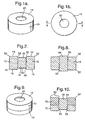
- the present invention provides a detergent tablet of compacted particulate composition which has a pair of opposite faces spaced apart from each other and joined by a peripheral surface of the tablet, wherein the tablet has a first region which provides a first part of a said face and a second region which provides an adjoining part of the face with a discontinuity such as a step or groove at the junction of the said parts of the face.
- the arrangement is such that the first part of the face is not at the same level as the adjacent part, so that there is a step at the junction of the two parts. Even if the two parts are at substantially the same level there is likely to be a groove, a slight step or a line in the surface at their junction.
- the first part may stand out from the adjacent part of the end face or it may be inset from the adjacent part of the end face.
- the first region is a core which is entirely surrounded by another region of the tablet.
- a single such surrounding region may provide the entire peripheral surface of the tablet and the remainder of the tablet end faces.
- Other arrangements are conceivable.
- a first region might for instance extend to the tablet periphery and form a portion of the peripheral surface.
- a region surrounding a core might possibly be split into two layers, and a core could itself have two layers.
- the first region extends through the tablet so as to be visible at both faces, but is inset from the surrounding part of each face. Another possibility is that such a region could be visible as part of one face yet extend only part way through the tablet, so that subdivision into regions would not be visible at the opposite face of the tablet.
- the regions of the tablet will usually be of different composition or different physical properties or both.
- this invention provides a process for producing a detergent tablet which has a pair of opposite faces spaced apart from each other and joined by a peripheral surface of the tablet, wherein the tablet has at least two discrete regions visible at a said face, comprising steps of:
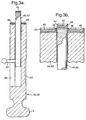
- the process is carried out using a pair of punches which are relatively movable towards each other within the mould cavity and away from each other, wherein each punch encloses or at least partially surrounds a plunger movable axially relative to the punch.
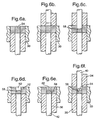
- first compaction step one or both punches may move.
- second compaction step one or both plungers may move.
- the first particulate composition would be delivered into the mould cavity above one punch while the plunger associated with that punch project upwardly from it so as to be surrounded by the particulate composition.
- Compaction of the first particulate composition would then be carried out by urging the two punches relatively towards each other, although one may remain stationary relative to the mould cavity if desired.
- Compaction of the second particulate composition would be carried out by urging the two plungers relatively towards each other, although again one may be driven towards the other which remains immobile.
- Such a process is preferably carried out using a rotary tableting press in which a rotary table defines a plurality of mould cavities and in which a pair of punches each with a respective axially movable plunger is associated with each mould cavity.
- An advantage of the process of this invention is that the core region and surrounding region of the tablet can both be compacted from powder compositions within a single mould cavity. There is no necessity to prefabricate a core region in one mould cavity and somehow position it within another mould cavity.
- a further advantage is that the tableting pressures applied to each of the compositions can be chosen independently.
- the process may lead to tablets in which the compacted second composition provides a part of at least one tablet face which is inset from an adjacent or surrounding part of the tablet face provided by the first composition.
- Recessing the exposed area of a region can be advantageous in itself.
- tablets may be placed in a washing machine together with fabrics with the result that the fabrics may come into direct contact with the tablet before it disintegrates in the wash water.
- Recessing the exposed area of a tablet region will reduce the opportunity for direct contact between fabrics and the exposed surface of that region (especially if that region is a central core) making it possible to incorporate into that recessed (ie inset) region ingredients such as bleach which desirably should not come into direct contact with fabrics before they have - at least to a substantial extent - dispersed in the wash liquor.
- the inset region contains bleach or bleach activator at a greater concentration than in a surrounding region of the tablet.
- a tablet which has a pair of opposite faces spaced apart from each other and joined by a peripheral surface of the tablet also has at least one region visible at a face of the tablet and providing less than half the area of that face, further characterised in that the said region has a mechanical strength which differs from, and preferably is less than, that of the surrounding region (and hence the tablet as a whole).
- the adjoining/surrounding larger region of the tablet will then provide mechanical protection for the more fragile region during storage and transport of the tablet prior to use.
- This region of the tablet is preferably a core, encircled by the larger region. It may disintegrate rapidly on contact with wash water at the time of use, commensurate with its lesser mechanical strength.
- the said region which provides less than half the area of a tablet face may be characterised by a higher porosity (content of air by volume) than the adjoining/surrounding region, as well as or alternatively to, the characteristic of less strength. It may also, or alternatively, be characterised by lower hardness than the surrounding region.
- the porosity of a tablet region in inversely related to its density and is conveniently expressed as the percentage of its volume which is air (i.e. empty space).
- the air content of a tablet region can be calculated from the volume and weight of the tablet region, provided the true density of the solid content is known.
- the latter can be measured by compressing a sample of the material under vacuum with a very high applied force, then measuring the weight and volume of the resulting solid object.
- this invention provides a process of making a tablet which has a pair of opposite faces spaced apart from each other and joined by a peripheral surface, which tablet has at least two discrete regions each of which provides only part of a face of the tablet further characterised in that the maximum pressure applied to the one region to compact it is different from the maximum pressure applied to another region to compact it.
- the regions are a core region and a surrounding region which provides the peripheral surface of the tablet, the pressure applied to the core region may be less than the pressure applied to the surrounding region.
- the mechanical strength of the whole tablet may be denoted as the diametral fracture stress derived from the measurement of force at failure as described in our published application W098/42817.
- the corresponding properties of the core may be measured by measuring the properties of smaller tablets compacted solely from the second composition in a smaller mould and with the appropriate force such that these test tablets have the same size as the core region of a tablet and have been subjected to the same compaction pressure.
- An alternative test for the relative strength of two regions of the tablet is to compact each of the compositions separately into homogenous test tablets, of identical size (which may be the same as the external dimensions of the outer region) using the same compaction pressures as used when making the heterogenous tablets of the invention.
- the strengths of the test tablets are then compared, e.g. by means of a compression test.
- Constructing a tablet with plurality of separate regions and the possibility of compacting them at different pressures facilitates arranging for ingredients in one region of the tablet to be released into the wash liquor before ingredients in the other region of the tablet.
- a core region is compacted at light pressure, so as to disintegrate quickly.
- a core region will have only a very small surface area exposed to the wash water and consequently it may be arranged that such a core region disintegrates more slowly when the tablet is brought into contact with wash water, thus utilising the core region to give delayed release of an ingredient into the wash liquor. Slower disintegration of the core could also be promoted by compacting it at higher pressure.
- compositions used to make regions of the tablet are disclosed.
- An aspect of this invention provides a tablet which has a pair of opposite faces spaced apart from each other and joined by a peripheral surface of the tablet and has at least one region such as a core which provides only part of a face of the tablet, wherein the said region of the tablet contains a material which swells when in contact with water, such material being present at a greater concentration in the said region than in the adjoining or surrounding region.
- swelling of this material in the said region will promote disintegration of that region and also apply force to the surrounding or adjoining region, thus increasing the disintegrating efficacy of the swelling material.
- Whichever region of the tablet dissolves more slowly may incorporate a fabric softening agent, such as softening clay. It is known to incorporate a fabric softening clay in washing powder so as to provide a softening action on the fabrics at the same time that they are washed (so called "softening in the wash”). As we have already acknowledged in an unpublished UK application, it is desirable that fabric softening agent is liberated into a wash liquor somewhat later than the detergent and other ingredients. This can be implemented by a tablet of the present invention, putting the fabric softening agent such as clay in a region which disintegrates more slowly than another region and may have greater mechanical strength.
- a fabric softening agent such as softening clay
- an aspect of this invention provides a tablet which has a pair of opposite faces spaced apart from each other and joined by a peripheral surface of the tablet, which tablet has at least two discrete regions each of which provides only part of a said face of the tablet, wherein one of said regions of the tablet contains a fabric softening agent at a greater concentration than the other region.
- an aspect of this invention provides a tablet which has a pair of opposite faces spaced apart from each other and joined by a peripheral surface of the tablet, which tablet has at least two discrete regions each of which provides only part of a said face of the tablet wherein one region of the tablet contains bleach activator at a greater concentration than the other.
- an aspect of this invention provides a tablet which has a pair of opposite faces spaced apart from each other and joined by a peripheral surface of the tablet, which tablet has at least two discrete regions each of which provides only part of a said face of the tablet wherein one region of the tablet contains an enzyme or enzymes at a greater concentration than the other region, while if a bleach system is present, the said other region preferably contains bleach and/or bleach activator at a greater concentration than the region with the greater concentration of enzyme(s).
- Yet another aspect of this invention provides a tablet which has a pair of opposite faces spaced apart from each other and joined by a peripheral surface of the tablet, which tablet has at least two discrete regions each of which provides only part of a said face of the tablet wherein one region of the tablet generates a different pH on dissolution than the composition of the other region.
- the pH of the resulting wash liquor will be determined by the composition of the whole tablet.
- the pH within and close to each region will be primarily determined by the composition of that region.
- a region which contains bleach activator may be formulated to give a more acidic pH than the other region (and the tablet as a whole). This transiently more acidic pH will promote the reaction of bleach activator to generate peracid while the tablet is disintegrating and dissolving.
- Tablets of this invention will generally contain organic surfactant. This will come from one or more of the categories of surfactant used in detergent compositions for fabric washing. These are most usually anionic and nonionic surfactants and mixtures of the two. Amphoteric (including zwitterionic) and less commonly cationic detergents can also be used.
- anionic surfactants are well known to those skilled in the art.
- the anionic surfactant may comprise, wholly or predominantly, linear alkyl benzene sulphonate of the formula where R is linear alkyl of 8 to 15 carbon atoms and M + is a solubilising cation, especially sodium.
- Primary alkyl sulphate having the formula ROSO 3 - M + in which R is an alkyl or alkenyl chain of 8 to 18 carbon atoms especially 10 to 14 carbon atoms and M + is a solubilising cation, is also commercially significant as an anionic surfactant and may be used in this invention.
- such linear alkyl benzene sulphonate or primary alkyl sulphate of the formula above, or a mixture thereof will be the desired non-soap anionic surfactant and may provide 75 to 100wt% of any anionic non-soap surfactant in the composition.
- non-soap anionic surfactants examples include olefin sulphonates; alkane sulphonates; dialkyl sulphosuccinates; and fatty acid ester sulphonates.
- One or more soaps of fatty acids may also be included in addition to non-soap anionic surfactant.
- Examples are sodium soaps derived from the fatty acids from coconut oil, beef tallow, sunflower or hardened rapeseed oil.
- Nonionic surfactant compounds include in particular the reaction products of compounds having a hydrophobic group and a reactive hydrogen atom, for example, aliphatic alcohols, acids, amides or alkyl phenols with alkylene oxides, especially ethylene oxide.
- Nonionic surfactant compounds are alkyl (C 8-22 ) phenol-ethylene oxide condensates, the condensation products of linear or branched aliphatic C 8-20 primary or secondary alcohols with ethylene oxide, and products made by condensation of ethylene oxide with the reaction products of propylene oxide and ethylene-diamine.
- the primary and secondary alcohol ethoxylates especially the C 9-11 and C 12-15 primary and secondary alcohols ethoxylated with an average of from 3 to 20 moles of ethylene oxide per mole of alcohol.
- Amphoteric surfactants which may be used jointly with anionic or nonionic surfactants or both include amphopropionates of the formula: where RCO is a acyl group of 8 to 18 carbon atoms, especially coconut acyl.
- amphoteric surfactants also includes amine oxides and also zwitterionic surfactants, notably betaines of the general formula where R 4 is an aliphatic hydrocarbon chain which contains 7 to 17 carbon atoms, R 2 and R 3 are independently hydrogen, alkyl of 1 to 4 carbon atoms or hydroxyalkyl of 1 to 4 carbon atoms such as CH 2 OH, Y is CH 2 or of the form CONHCH 2 CH 2 CH 2 (amidopropyl betaine); Z is either a COO - (carboxybetaine), or of the form CHOHCH 2 SO 3 - (sulfobetaine or hydroxy sultaine).
- R 4 is an aliphatic hydrocarbon chain which contains 7 to 17 carbon atoms
- R 2 and R 3 are independently hydrogen, alkyl of 1 to 4 carbon atoms or hydroxyalkyl of 1 to 4 carbon atoms such as CH 2 OH
- Y is CH 2 or of the form CONHCH 2 CH 2 CH 2 (amidoprop
- amphoteric surfactant is amine oxide of the formula where R 1 is C 10 to C 20 alkyl or alkenyl R 2 , R 3 and R 4 are each hydrogen or C 1 to C 4 alkyl while n is from 1 to 5.
- Tablets of this invention will generally include a water-soluble or water-insoluble detergency builder or a mixture of the two.
- Water-soluble phosphorus-containing inorganic detergency builders include the sodium and potassium orthophosphates, metaphosphates, pyrophosphates and polyphosphates.
- Alkali metal aluminosilicates are strongly favoured as environmentally acceptable water-insoluble builders for fabric washing.
- Alkali metal (preferably sodium) aluminosilicates may be either crystalline or amorphous or mixtures thereof, having the general formula: 0.8 - 1.5 Na 2 O.Al 2 O 3 . 0.8 - 6 SiO 2 . xH 2 O
- xH2O xH2O
- xH2O calcium ion exchange capacity
- the preferred sodium aluminosilicates contain 1.5-3.5 SiO 2 units (in the formula above). Both the amorphous and the crystalline materials can be prepared readily by reaction between sodium silicate and sodium aluminate, as amply described in the literature.
- Suitable crystalline sodium aluminosilicate ion-exchange detergency builders are described, for example, in GB 1429143 (Procter & Gamble).
- the preferred sodium aluminosilicates of this type are the well known commercially available zeolites A and X, the zeolite P described and claimed in EP 384070 (Unilever) which is also referred to as zeolite MAP and mixtures thereof.
- Zeolite MAP is available from Crosfields under their designation Zeolite A24.
- water-insoluble detergency builder could be a crystalline layered sodium silicate as described in US 4664839.
- NaSKS-6 is the trademark for a crystalline layered silicate marketed by Hoechst (commonly abbreviated as "SKS-6").
- NaSKS-6 has the delta-Na 2 SiO 5 morphology form of layered silicate. It can be prepared by methods such as described in DE-A-3,417,649 and DE-A-3,742,043.
- Other such layered silicates, which can be used have the general formula NaMSi x O 2x+1 .yH 2 O wherein M is sodium or hydrogen, x is a number from 1.9 to 4, preferably 2, and y is a number from 0 to 20, preferably 0.
- Crystalline layered silicate may be used in the form of granules which also contain citric acid.
- Non-phosphorous water-soluble builders may be organic or inorganic.
- Inorganic builders that may be present include alkali metal (generally sodium) carbonate; while organic builders include polycarboxylate polymers, such as polyacrylates and acrylic/maleic copolymers, monomeric polycarboxylates such as citrates, gluconates, oxydisuccinates, glycerol mono- di- and trisuccinates, carboxymethyloxysuccinates, carboxymethyloxymalonates, dipicolinates and hydroxyethyliminodiacetates.
- alkali metal generally sodium
- organic builders include polycarboxylate polymers, such as polyacrylates and acrylic/maleic copolymers, monomeric polycarboxylates such as citrates, gluconates, oxydisuccinates, glycerol mono- di- and trisuccinates, carboxymethyloxysuccinates, carboxymethyloxymalonates, dipicolinates and hydroxyethyliminodiacetate
- Alkali metal silicate particularly sodium ortho-, meta- or disilicate has detergency building properties and may be used in substantial quantity in tablets for machine dishwashing. It is desirably included in smaller quantities in tablets for fabric washing. The presence of such alkali metal silicates may be advantageous in providing protection against the corrosion of metal parts in washing machines, besides providing some detergency building.
- Tablet compositions preferably include polycarboxylate polymers, more especially polyacrylates and acrylic/maleic copolymers which can function as builders and also inhibit unwanted deposition onto fabric from the wash liquor.
- the amount of inorganic phosphate builder may be less than 5wt% of the tablet composition.
- Detergent tablets according to the invention may contain a bleach system.
- This preferably comprises one or more peroxy bleach compounds, for example, inorganic persalts or organic peroxyacids, which may be employed in conjunction with activators to improve bleaching action at low wash temperatures. If any peroxygen compound is present, the amount is likely to lie in a range from 10 to 25% by weight of the tablet.
- Preferred inorganic persalts are sodium perborate monohydrate and tetrahydrate, and sodium percarbonate.
- Bleach activators have been widely disclosed in the art. Preferred examples include peracetic acid precursors, for example tetraacetylethylene diamine (TAED), and perbenzoic acid precursors.
- TAED tetraacetylethylene diamine
- the quaternary ammonium and phosphonium bleach activators disclosed in US 4751015 and US 4818426 (Lever Brothers Company) are also of interest.
- Another type of bleach activator which may be used, but which is not a bleach precursor is a transition metal catalyst as disclosed in EP-A-458397, EP-A-458398 and EP-A-549272.
- a bleach system may also include a bleach stabiliser (heavy metal sequestrant) such as ethylenediamine tetramethylene phosphonate and diethylenetriamine pentamethylene phosphonate.
- Bleach activator is usually present in an amount from 1 to 10% by weight of the tablet, possibly less in the case of a transition metal catalyst which may be used as 0.1% or more by weight of the tablet.
- a tablet of this invention may include a material which functions as a disintegrant.
- a material which functions as a disintegrant.
- Such a material may be such as to swell on contact with water, thus subjecting the compacted tablet composition to internal pressure.
- a number of materials are known for use as swelling disintegrants in pharmaceutical tablets and these may be used in detergent tablets of this invention.
- examples include organic materials such as starches, for example, corn, maize, rice and potato starches and start derivatives, such as Primojel (Trade Mark) carboxymethyl starch and Explotab (Trade Mark) sodium starch glycolate; celluloses and cellulose derivatives, for example, Courlose (Trade Mark) and Nymcel (Trade Mark) sodium carboxymethyl cellulose, Ac-di-Sol (Trade Mark) cross-linked modified cellulose, and Hanfloc (Trade Mark) microcrystalline cellulosic fibres; and various synthetic organic polymers, notably cross-linked polvinyl pyrrolidone, for example, Polyplasdone (Trade Mark) Xl or Kollidon (Trade Mark) CL.
- Inorganic swelling disintegrants include bentonite clay.
- a combination of an acid and a carbonate which reacts to liberate carbon dioxide when in contact with water.
- a combination is a chemical or effervescent disintegrant.
- sodium carbonate or bicarbonate may be used together with citric or tartatic acid.
- Tablets of this invention may include an organic water-soluble polymer, serving as a binder when the particles are compacted into tablets.
- This polymer may be a polycarboxylate included as a supplementary builder, as mentioned earlier. It may be applied as a coating to some or all of the constituent particles prior to compaction.
- such polymers can function to enhance tablet disintegration at the time of use, as well as acting as a binder to enhance tablet strength prior to use.
- such a binder material should melt at a temperature of at least 35°C, better at 40°C or above, which is above ambient temperatures in many temperate countries.
- the melting temperature is somewhat above 40°C, so as to be above the ambient temperature.
- the melting temperature of the binder material should be below 80°C.
- Preferred binder materials are synthetic organic polymers of appropriate melting temperature, especially polyethylene glycol.
- Polyethylene glycol of average molecular weight 1500 melts at 45°C and has proved suitable.
- Polyethylene glycol of higher molecular weight notably 4000 or 6000, can also be found.
- the binder may suitably be applied to the particles by spraying, e.g. so as a solution or dispersion. It may be applied to particles which contain organic surfactant. If used, the binder is preferably used in an amount within the range from 0.1 to 10% by weight of the tablet composition, more preferably the amount is at least 1% or even at least 3% by weight of the tablets. Preferably the amount is not over 8% or even 6% by weight unless the binder serves some other additional function.
- Such materials include compounds of high water-solubility, a specified form of sodium tripolyphosphate and combinations of these two. Such material may be present as at least 10 or 15% of the composition of a tablet or region thereof, possibly at least 25% up to 50 or 60%, possibly more.
- Highly water soluble materials which are one of the two possibilities are compounds, especially salts, with a solubility at 20°C of at least 50 gms per 100 gms of water.
- Such materials have been mentioned in our published patent applications including EP-A-711827 and EP-A-838519.
- a solubility of at least 50 grams per 100 grams of water at 20°C is an exceptionally high solubility: many materials which are classified so as water soluble are less soluble than this.
- solubilities of some other common materials at 20°C are:- Material Water Solubility (g/100g) Sodium chloride 36 Sodium sulphate decahydrate 21.5 Sodium carbonate anhydrous 8.0 Sodium percarbonate anhydrous 12 Sodium perborate anhydrous 3.7 Sodium tripolyphosphate anhydrous 15
- this highly water soluble material is incorporated so as particles of the material in a substantially pure form (i.e. each such particle contains over 95% by weight of the material).
- the said particles may contain material of such solubility in a mixture with other material, provided that material of the specified solubility provides at least 50% by weight of these particles, better at least 80%.
- a particularly preferred material, sodium acetate trihydrate is normally produced by a crystallisation process, so that the crystallised product contains 3 molecules of water of crystallisation for each sodium and acetate ion pair.
- Sodium acetate in an incompletely hydrated form which may be produced by a spray-drying route, can also be used.
- the said particles which promote disintegration are particles containing sodium tripolyphosphate with more than 50% of it (by weight of the particles) in the anhydrous phase I form.
- Such particles may contain at least 80% by weight tripolyphosphate and possibly at least 95%.
- Detergent tablets containing such material are the subject of our EP-A-839906.
- Sodium tripolyphosphate is very well known so as a sequestering builder in detergent compositions. It exists in a hydrated form and two crystalline anhydrous forms. These are the normal crystalline anhydrous form, known so as phase II which is the low temperature form, and phase I which is stable at high temperature. The conversion of phase II to phase I proceeds fairly rapidly on heating above the transition temperature, which is about 420°C, but the reverse reaction is slow. Consequently phase I sodium tripolyphosphate is metastable at ambient temperature.
- phase I form will often contain the phase I form of sodium tripolyphosphate so as at least 55% by weight of the tripolyphosphate in the particles.
- Other forms of sodium tripolyphosphate will usually be present to a lesser extent.
- Other salts may be included in the particles, although that is not preferred.
- this sodium tripolyphosphate is partially hydrated.
- the extent of hydration should be at least 1% by weight of the sodium tripolyphosphate in the particles. It may lie in a range from 2.5 to 4%, or it may be higher, e.g. up to 8%.
- Suitable material is commercially available. Suppliers include Rhone-Poulenc, France and Albright & Wilson, UK.
- Rhodiaphos HPA 3.5 from Rhone-Poulenc has been found particularly suitable. It is a characteristic of this grade of sodium tripolyphosphate that it hydrates very rapidly in a standard Olten test. We have found that it hydrates so as quickly so as anhydrous sodium tripolyphosphate, yet the prehydration appears to be beneficial in avoiding unwanted crystallisation of the hexahydrate when the material comes into contact with water at the time of use.
- a tablet may incorporate one or more fabric softening agents, preferably in a region which is slower to disintegrate, so that the softening agent is released later in the wash cycle. In this event it is likely to be a requirement that the tablet is placed in the drum of the washing machine with the laundry and not in a dispenser drawer.
- fabric softening agents are organic compounds containing quaternary nitrogen and at least one carbon chain of 6 to 30 carbon atoms, e.g. in an alkyl, alkenyl or aryl substituted alkyl or alkenyl group with at least six aliphatic carbon atoms.
- Suitable fabric softening agents are the analogous tertiary amines and imidazolines, other aliphatic alcohols, esters, amines or carboxylic acids incorporating a C8 to C30 alkyl, alkenyl or acyl group, including esters of sorbitan and esters of polyhydric alcohols, and mineral oils. Certain clays are important as fabric softening agents.
- Another class of materials used as fabric softening agents are hydrophobically modified cellulose ethers.
- fabric softening agents include:
- Some fabric conditioning agents may be included in a region which disintegrates more rapidly than the remainder of the tablet.
- Silicone oils have been proposed as fabric conditioning agents, and more specifically polysiloxanes with amino alkyl side chains have been proposed. Discussions of these materials can be found in GB-A-1549180 where they are included in fabric softener formulations to assist ironing of the fabric and to inhibit wrinkling.
- EP-A-150867 (Procter & Gamble) discloses the incorporation of amino alkyl polysiloxanes into particulate detergent compositions to enhance the softeners and handling of washed fabrics. Their use in particulate compositions is also disclosed in FR-A-2713237 (Rhone-Poulenc) which utilises them as fabric softeners. These materials may be mixed into nonionic detergent before that is incorporated into a particulate composition, as taught by EP-A-150867, or absorbed directly onto a particulate carrier, as taught by FR-A-271237, and mixed with the remainder of a particulate composition. The particulate composition can thereafter be compacted to form a region of a tablet in accordance with the present invention.
- the amino alkyl polysiloxanes function as fibre lubricants. They are desirably incorporated into the more rapidly disintegrating region of a tablet, so as to deposit on fabric at an early stage of the washing cycle.
- Another fabric conditioning agent which could be incorporated in a region of a tablet according to this invention is a curable amine functional silicone (amino alkyl polysiloxane) disclosed in US-A-4911852 (Procter & Gamble) as an anti-wrinkle agent.
- the detergent tablets of the invention may also contain one of the detergency enzymes well known in the art for their ability to degrade various soils and stains and so aid in their removal.
- Suitable enzymes include various proteases, cellulases, lipases, amylases, oxidases and mixtures thereof, which are designed to remove a variety of soils and stains from fabrics or from tableware during dishwashing.
- cellulases have a fabric softening function also.
- Detergency enzymes are commonly employed in the form of particles or marumes, optionally with a protective coating, in amount of from about 0.01% often from 0.1% to about 3% by weight of the tablet. A total enzyme content may exceed 3% but is unlikely to exceed 5%. The amount of any one enzyme is likely to lie in a range from 0.01% to 3% by weight of the tablet.
- the detergent tablets of the invention may also contain a fluorescer (optical brightener), for example, Tinopal (Trade Mark) DMS or Tinopal CBS available from Ciba-Geigy AG, Basel, Switzerland.
- Tinopal DMS is disodium 4,4'bis-(2-morpholino-4-anilino-s-triazin-6-ylamino) stilbene disulphonate
- Tinopal CBS is disodium 2,2'-bis-(phenyl-styryl) disulphonate.
- Antifoam material is advantageously included, especially if a detergent tablet is primarily intended for use in front-loading drum-type automatic washing machines.
- Antifoam materials in granular form are described in EP 266863A (Unilever).
- Such antifoam particles typically comprise a mixture of silicone oil, petroleum jelly, hydrophobic silica and alkyl phosphate so as antifoam active material, sorbed onto a porous absorbed water-soluble carbonate-based inorganic carrier material.
- anti-redeposition agents such so as sodium carboxymethylcellulose, straight-chain polyvinyl pyrrolidone (which can also act as a binder, as mentioned earlier) and the cellulose ethers such as methyl cellulose and ethyl hydroxyethyl cellulose, heavy metal sequestrants such as EDTA; perfumes; soil release polymers and colorants or coloured speckles.
- a tablet of this invention intended for fabric washing will generally contain, overall,
- the amount of anionic surfactant is likely to be from 5 to 50% by weight of the overall tablet composition while the amount of nonionic surfactant is likely to be from 2% to 40%, better from 4 or 5% up to 30% by weight of the overall tablet. Soap may be included in addition to non-soap anionic surfactant.
- a tablet of this invention intended for machine dishwashing will generally be formulated with a small percentage of nonionic surfactant present such so as 1 to 8% by weight, from 20 to 99% detergency builder, and possibly no anionic detergent at all.
- the discrete regions of a tablet may have compositions which lie outside the stated ranges. However, the compositions of regions may well individually conform with the ranges indicated above for a complete tablet of the appropriate character, i.e. machine dishwashing or fabrics washing.
- each discrete region of a tablet will provide from 5% to 95% of the tablet weight, more preferably from 10 to 80% and likewise from 5 or 10% up to 80% or even 95% of the area of a tablet face.
- a region such as a core which provides a first part of a tablet face adjoined or surrounded by a larger second part of the face, is likely to constitute from 10% or 15% up to 35% or 40% of the tablet weight and from 10% or 15% up to 35% or 40% of the area of the tablet face.
- a tablet contains peroxygen bleach, the amount of such bleach in the tablet is likely to be from 10% to 25% by weight of the whole tablet composition.
- peroxygen bleaches can be used without a bleach activator, the amount of bleach activator is likely to be from 1 to 10% by weight of the whole tablet; but if the activator is a transition metal catalyst then the amount present is likely to be from 0.01 to 5% by weight of the whole tablet.
- the discrete regions of a detergent tablet of this invention are a matrix of compacted particles.
- the particulate mixture of particles, from which each tablet region is compacted has an average particle size before compaction in the range from 200 to 2000 ⁇ m, more preferably from 250 to 1400 ⁇ m. Fine particles, smaller than 180 ⁇ m or 200 ⁇ m may be eliminated by sieving before tableting, if desired, although we have observed that this is not always essential.
- the starting particulate composition may in principle have any bulk density
- the present invention is especially relevant to tablets made by compacting powders of relatively high bulk density, because of their greater tendency to exhibit disintegration and dispersion problems.
- Such tablets have the advantage that, as compared with a tablet derived from a low bulk density powder, a given dose of composition can be presented as a smaller tablet.
- the starting particulate composition may suitably have a bulk density of at least 400 g/litre, preferably at least 550 g/litre, and perhaps at least 600 g/litre.
- Granular detergent compositions of high bulk density prepared by granulation and densification in a high-speed mixer/granulator, as described and claimed in EP 340013A (Unilever), EP 352135A (Unilever), and EP 425277A (Unilever), or by the continuous granulation/densification processes described and claimed in EP 367339A (Unilever) and EP 390251A (Unilever), are inherently suitable for use in the present invention.
- the step of compacting the particles reduces the porosity of the composition.
- Porosity is conveniently expressed as the percentage of volume which is air.
- the air content of a tablet or region of a tablet can be calculated from the volume and weight of the tablet or region, provided the air-free density of the solid content is known.
- the latter can be measured by compressing a sample of the material under vacuum with a very high applied force, then measuring the weight and volume of the resulting solid.
- the percentage air content of a tablet or region of a tablet varies inversely with the pressure applied to compact the composition while the strength of the tablet or region varies with the pressure applied to bring about compaction.
- the greater the compaction pressure the stronger the tablet or region becomes but the smaller the air volume within.
- the invention may be applied when compacting particulate detergent composition to give tablets with a wide range of porosities. Specifically included among possible porosities is a porosity of up to 38% air volume, e.g. from 10 or 15 better 25% up to 35% air by volume in the tablet.
- a tablet embodying the present invention has a generally cylindrical shape with a cylindrical peripheral wall 10.
- the tablet has an annular surrounding region 12 which provides the peripheral cylindrical surface 10 and annular parts 14,16 of the end faces of the tablet.
- annular surrounding region 12 which provides the peripheral cylindrical surface 10 and annular parts 14,16 of the end faces of the tablet.
- Located centrally within this region is another discrete region in the form of a cylindrical core 18 which has a pair of end faces 20 recessed inwardly from the end faces 14,16 of the surrounding region.
- Tablets as shown in Figs 1 and 2 can be made in accordance with the process of this invention using a modified form of rotary tabletting press. This is shown by Figs 3 to 5.
- the tabletting press has a rotary table 30 defining a plurality of cavities 32 in which tablet stamping occurs. Associated with each cavity are upper and lower punches 34,36. These move around the table axis in unison with rotation of the table, but can be moved axially relative to the rotary table 30 and each other, so that they can be driven into the cavity in the table or withdrawn from it. Lower punches 36 have the same construction as upper punches 34.
- each punch 34 or 36 is cylindrical and provided with an end piece 39 which is shaped to engage with a cam track (not shown) for moving the punch towards and - away from the rotary table 30 as the table rotates.
- a cam track (not shown) for moving the punch towards and - away from the rotary table 30 as the table rotates.
- Each punch 34,36 has a central bore accommodating an axially moveable plunger 40,42. Attached to each plunger is an arm 44 projecting radially through a slot 38 in the cylindrical punch to engage another cam track (also not shown) which brings about axial motion of the plunger. Each punch 34,36 also has a keyway 37 into which engages a key (not shown) which serves to constrain the punch against unwanted rotation about its own axis i.e. rotation relative to the rotary table 30.
- each plunger and punch where the plunger and/or punch respectively contacts the detergent composition could be formed from the solid metal of the punch or plunger.
- Our published application WO 98/46719 teaches that adhesion of the detergent composition to a punch can be beneficially reduced by providing an elastomeric surface layer to contact the detergent composition.
- the plunger has an elastomeric surface layer 43 retained by an undercut rim 44 around the operative end of the plunger while the punch has likewise an elastomeric surface layer 45 which is retained by undercut rims 46 around the inner and outer boundaries of the annular operative surface of the punch.
- These undercut rims 44,46 are best seen in Fig 3b. They have been omitted, for clarity, from the smaller scale Figs 4 to 7 which will now be described.
- Figs 4 and 5 show a succession of stages of rotation of the table 30 and the associated movements of the punches and plungers.
- the sequence of operations starts with a lower punch 36 in the position shown at Fig 4a while the associated upper punch 34 is raised out of the way.
- the plunger 42 in the lower punch 36 is raised to project through the cavity 32 of the rotary tablet.
- this annular space is filled as shown at Fig 4b with a first detergent composition 50 for compaction and the plunger 42 is raised slightly.
- the upper punch 34 is brought down on top of the composition 50, after which, at Fig 4d the lower punch 36 is urged upwardly, thus compacting the composition 50 around the raised plunger 42 of the lower punch into an annular region 12 of a tablet.
- the upper punch 34 is then raised out of the way and the plunger 42 is lowered as shown at Fig 4e.
- FIG. 1 A detail which is omitted from Fig 4 is shown in Fig 2.
- the rims 46 on the punches 34,36 contact the composition 50 as it is being compacted, they form indentations 52 encircling the inner and outer edges of the annular faces 14,16 of the region 12.
- second composition 54 is introduced into the cavity above the plunger 42.
- the upper punch 34 is lowered onto the previously formed outer region 12 of the tablet but does not apply any substantial pressure to it.
- the upper and lower plungers 40,42 are urged towards each other as shown at Fig 5c so that the particulate composition 54 is compacted between these plungers and is also forced radially outwardly into contact with the surrounding region 12 of the tablet.
- the tablet which is formed has the features shown by Figs 1 and 2 with the faces 20 of the central core 18 set inwardly from the outer faces 14, 16 of the surrounding region 12.
- the composition 54 is compacted into a core region 58 by driving the plunger 40 downwardly while the plunger 42 does not more axially, as shown at Fig 6c.
- the upper punch 34 is then raised out of the way, leaving a cavity 60 above the core region 58 as seen at Fig 6d.
- a further composition 62 is introduced into the cavity 60. It is compacted as shown at Fig 6f to form a tablet with an outer region 12 surrounding a central core which has two layers 58,64.
- the punch 34 is raised and the tablet is ejected by raising the punch 36 and plunger 42 together (not shown).
- Fig 7 shows another variant arrangement leading to the production of a tablet having the form shown in cross-section in Fig 8.
- the tablet has an outer region 12 and an inner core region 68 but the core region 68 stands out from the end faces 14,16 of the first region 12.
- the outer region 12 is first made in accordance with the procedure illustrated by Fig 4.
- the plunger 42 is lowered to below the upper surface of the punch 36.
- the second detergent composition 54 is filled into the cavity above the plunger 42 which is bounded partially by the upper end portion of the punch 36 and partially by the already formed first region 12.
- the upper punch 34 is placed on the already formed region 12 but without applying substantial pressure to it.
- the plungers 40,42 are urged together compacting the detergent composition 54 so as to form the core region 68.
- the upper punch 34 is raised out of the way as illustrated by Fig 7d the compacted core region 68 stands above the upper surface of the rotary table 30.
- the lower punch 36 is raised until it is level with the top of the table 30 and the plunger 42 within it is also raised slightly so that it too is level with the top of the table as seen at Fig 7e.
- Fig 6 has already illustrated the manufacture of a tablet according to this invention in which the core region consists of two layers.
- Figs 9 and 10 illustrate a tablet according to this invention in which the core region 18 consists of a single material but this is surrounded by an annular outer portion which is subdivided into two layers 70,72.
- the outer portion is first manufactured by a variant of the procedure shown in Fig 4. The procedure begins with the lower punch 36 somewhat raised from the position illustrated in Fig 4a so that the cavity 32 above it is shallower. The plunger 42 is raised level with the top of the rotary table 30 as in Fig 4a.
- composition for the layer 72 is filled into the cavity 32, lightly compacted between the punches and pushed downwards in the mould cavity 32 to create an annular cavity around the plunger 42 and above the compacted layer 72. This is filled with composition to form the upper layer 70 and then both the lower layer 72 and the upper layer 70 above it are together compacted between the punches 34,36, analogously to Figs 4c and 4d. After the two layer outer annular portion of the tablet has been formed in this way, the core 18 is formed within it by the procedure of Fig 5.
- Figs. 11 and 12 illustrate a further variant of the invention in which the tablet is not symmetrical around its central axis.
- One region 74 of the tablet is positioned adjacent to the tablet periphery and indeed it forms part 76 of the cylindrical periphery of the tablet. It is surrounded by a second region 78 which is the remainder of the tablet and which provides the remainder of the cylindrical periphery 10 of the tablet.
- the region 78 provides the majority of the area of each end face of the tablet.
- the tablet is formed in a manner analogous to the procedures of Figs 4 and 5 but the punches do not completely encircle a cylindrical plunger. Instead each plunger is shaped to fit in a groove in the cylindrical outer surface of the plunger.
- Tablets do not need to be cylindrical neither do core regions within them.
- Other shapes can be made using punches, plungers and mould cavities of appropriate shape.
- Fig 13 illustrates a five-sided tablet having two core regions 18' which are inset from the surrounding region 12' which is the remainder of the tablet.
- Such a tablet can be made by the procedure described, using five sided punches with two bores accommodating two plungers which are moved in unison.
- Fabric washing tablets with the form generally illustrated by Figs 1 and 2 are prepared using compositions as set out in the following table.
- Composition A is used to make the core region 18 with a radius of 10 mm.
- Composition B is used to make the surrounding region.
- the overall tablet radius is 20 mm, so that compositions A and B are used in a volume ratio of approximately 1:3. Their weight ratio is also approximately 1:3. Tablet weight is approximately 40g.
- Granulated Components A B linear alkyl benzene sulphonate 10.9 10.0 coconut alcohol 3EO 7.0 6.4 coconut alcohol 6EO 6.1 5.6 zeolite A24 37.0 18.7 soap 4.0 3.7 SCMC 1.2 1.1 fluorescer 0.3 0.2 water 7.5 6.9 Postdosed Components PEG 1500 0.0 4.3 sodium perborate tetrahydrate 0.0 19.5 TAED granule 0.0 4.2 protease 3.5 0.0 amylase 2.0 0.0 lipase 1.9 0.0 bentonite clay having a cation exchange capacity of 95 meq/100g 0.0 16.0 antifoam 3.4 3.4 sodium citrate dihydrate 15.2 0.0 TOTAL 100 100
- composition A contains enzymes and also sodium citrate dihydrate which promotes disintegration when the composition is added to water (as disclosed in EP-A-711827);
- composition B contains a fabric softening clay and bleach, but does not contain sodium citrate dihydrate, nor enzymes.
- the materials listed as "granulated components” are mixed in a Fukae (Trade Mark) FS-100 high speed mixer-granulator.
- the soap is prepared in situ by neutralisation of fatty acid.
- the mixture is granulated and densified to give a powder of bulk density greater than 750 g/litre and a mean particle size of approximately 650 ⁇ m.
- the powder is sieved to remove fine particles smaller than 180 ⁇ m and large particles exceeding 1700 ⁇ m.
- the remaining solids are then mixed with the powder in a rotary mixer, after which the PEG is sprayed on at about 80°C with the powder at 35 to 40°C.
- the core region 18 and the surrounding region 12 are each compacted with approximately equal pressures.
- composition A disintegrates first, because of the presence of sodium citrate dihydrate. Consequently, the enzymes are released into the wash liquor ahead of the bleach and fabric softening clay.
- Fabric washing tablets are prepared from the two compositions set out in the following table: % by weight Granulated Components C D coconut primary alkyl sulphate 10.5 8.8 coconut alcohol 3EO 7.0 5.9 coconut alcohol 6EO 6.1 5.1 zeolite A24 37.0 31.0 soap 4.0 3.3 SCMC 1.2 1.0 fluorescer 0.3 0.25 Moisture 6.0 5.0 Postdosed Components PEG 1500 4.0 4.0 sodium percarbonate 0.0 16.0 TAED granule 0.0 4.2 protease 2.5 0.0 amylase 1.5 0.0 lipase 1.5 0.0 tallowyl dimethyl amine 0.0 4.0 antifoam 3.4 1.45 sodium citrate dihydrate 15.0 10.0 TOTAL 100 100 100
- compositions have different post-dosed components: composition C contains enzymes and also has more sodium citrate dihydrate which promotes disintegration when the composition is added to water, whereas composition D contains tertiary amine as a fabric softener and also bleach, but does not contain enzymes.
- the two compositions are used to make tablets with the form shown in Fig 8.
- Each tablet has a radius of 20.mm and a weight of about 40 grams.
- the core 68 has a radius of 8.mm and is made from composition C using a light compaction pressure so that it disintegrates within 2 minutes when the tablet is placed in water.
- the surrounding region 12 is compacted from composition D with a higher compaction pressure, leading to a surrounding region 12 which is mechanically stronger, but less porous. It disintegrates over a period of 8 minutes when the tablet is immersed in water.
- Tablets without enzymes for use in fabric washing were made, starting with spray-dried base powder of the following compositions: Ingredient Parts by weight Sodium linear alkylbenzene sulphonate 9.6 C 13-15 fatty alcohol 7EO 1.1 C 13-15 fatty alcohol 3EO 3.2 Sodium tripolyphosphate 24.3 Sodium silicate 5.9 Soap 0.3 Acrylate/maleate copolymer 1.2 Sodium sulphate, moisture and minor ingredients balance to 55
- Particulate compositions were made by mixing this powder with other ingredients as tabulated below. These included particles of sodium tripolyphosphate specified to contain 70% phase I form and contain 3.5% water of hydration (Rhodia-Phos HPA 3.5 available from Rhone-Poulenc).
- compositions contained the following percentages by weight: Ingredient % by weight E E Base powder 58 45 Sodium percarbonate granules 0 18 TAED granules 0 3.6 Anti-foam granules 4.0 0 Perfume, and other minor ingredients 3.4 3.4 Rhodiaphos HPA3.5 tripolyphosphate 30 30 Sodium carbonate 4.6 0 TOTAL 100 100
- compositions were made into tablets of weight 40 gm generally as shown in Figs 1 and 2.
- Composition F is used for the core and composition E for the surrounding region.
- the core radius is 12 mm and the tablet's overall radius is 20 mm.
- the compaction pressure for the core is less than for the surrounding region, to accelerate dissolution of the core which is also more porous than the surrounding region. Because the bleach is confined to the core, it is less likely to contact the fibres before it dissolves.
- Fabric washing tablets with the form generally illustrated by Figs 1 and 2 are prepared using compositions as set out in the following table.
- Composition G is used to make the core region 18 with a radius of 10 mm.
- Composition H is used to make the surrounding region.
- the overall tablet radius is 20 mm.
- Composition G contains enzymes and also sodium acetate trihydrate which promotes disintegration in water. It is free of anionic detergent. It is compacted to form the core 18 using a light compaction pressure such as 45MPa so as to produce a porous core which dissolves within 3 minutes and serves as an integral pre-wash composition.
- the surrounding region 12 is compacted with a much higher pressure, such as 20 MPa, so that it disintegrates slowly in a washing machine, e.g. over a period of 20 to 30 minutes. It is less porous but is mechanically strong and serves to protect the core during storage.
- the tablet is placed in the drum of an automatic washing machine which is operated on a cycle providing for a pre-wash, to give a delay after water enters the machine, before the water is heated and the main wash begins.
- Tablets for machine dishwashing are made from the following compositions: Ingredient % by weight J K C 13-15 fatty alcohol 7EO 2.0 2.0 Sodium tripolyphosphate 52.0 20.0 Sodium silicate 16.0 20.0 Sodium carbonate 16.0 25.0 sodium perborate monohydrate 0.0 18.0 TAED granule 0.0 5.0 protease 2.0 0.0 amylase 3.0 0.0 Sodium sulphate, moisture and minor ingredients balance to 100% balance to 100 %
- the tablets are made with the shape illustrated by Fig 8 with a tablet weight of 30 gram.
- the core 18, with a radius of 10 mm is made from composition J and compacted lightly so that in use it dissolves quickly and releases the enzymes into the wash liquor.
- the surrounding region 12 is compacted from composition K using greater pressure so as to produce a strong, hard surrounding region which is less porous and which protects the core until the time of use.
Landscapes
- Chemical & Material Sciences (AREA)
- Life Sciences & Earth Sciences (AREA)
- Engineering & Computer Science (AREA)
- Chemical Kinetics & Catalysis (AREA)
- Oil, Petroleum & Natural Gas (AREA)
- Wood Science & Technology (AREA)
- Organic Chemistry (AREA)
- Detergent Compositions (AREA)
- Cosmetics (AREA)
Claims (16)
- Textilwaschmitteltablette oder Geschirrspülmaschinentablette aus verdichteter teilchenförmiger Zusammensetzung, die ein Paar gegenüberliegender voneinander beabstandeter und durch eine periphere Oberfläche der Tablette verbundener Flächen aufweist, wobei die Tablette einen ersten Bereich, der einen ersten Teil von einer genannten Fläche bereitstellt, und einen zweiten Bereich, der einen angrenzenden Teil von der Fläche mit einer Unterbrechung an der Zusammenfügung von den genannten Teilen von der Fläche bereitstellt, aufweist, wobei der erste Teil von der genannten Fläche entweder eingefügt ist oder heraussteht, bezogen auf den benachbarten Teil von jener Fläche.
- Tablette nach Anspruch 1, wobei der erste Bereich ein Kern ist, der von einem Bereich oder von Bereichen, die die gesamte periphere Oberfläche der Tablette bereitstellen, umgeben ist.
- Tablette nach Anspruch 1 oder 2, wobei der erste Bereich sich durch die Tablette erstreckt, sodass er an beiden Seiten freiliegt.
- Tablette nach einem der Ansprüche 1 bis 3, wobei der erste Bereich ein Bleichmittel oder einen Bleichmittelaktivator in einer größeren Konzentration als ein umgebender Bereich enthält.
- Tablette nach einem der Ansprüche 1 bis 4, wobei der genannte erste Teil von einer Fläche der Tablette zwischen 10 und 35% des Bereichs der gesamten Fläche ist.
- Verfahren zur Herstellung einer Textilwaschmitteltablette oder einer Geschirrspülmaschinentablette aus verdichteter teilchenförmiger Zusammensetzung, die ein Paar gegenüberliegender voneinander beabstandeter und durch eine periphere Oberfläche der Tablette verbundener Flächen aufweist, wobei die Tablette in mindestens zwei diskrete Bereiche unterteilt ist, welche den angrenzenden Teil von einer genannten Fläche bereitstellen, umfassend die Schritte von:i) Einführen einer teilchenförmigen Zusammensetzung in einen Formhohlraum um einen Kolben, der in oder durch den Formhohlraum ragt,ii) Treiben von mindestens einem Stempel gegen die Zusammensetzung um den Kolben in den Hohlraum, sodass sie verdichtet wird,iii) Herausziehen des Kolbens aus der verdichteten Zusammensetzung,iv) Einführen einer zweiten teilchenförmigen Zusammensetzung in den Raum, den der Kolben freigegeben hat, undiv) Drücken von mindestens einem Kolben gegen die in diesen Raum eingeführte Zusammensetzung, sodass sie verdichtet wird.
- Verfahren nach Anspruch 6, wobei ein Drehtisch eine Vielzahl von Formhohlräumen definiert und ein Paar von Stempeln zu jedem Hohlraum zugehörig sind, wobei jeder Stempel einen Kolben aufweist, der mindestens teilweise von dem Stempel umgeben ist und axial bezüglich des Stempels beweglich ist.
- Textilwaschmitteltablette oder Geschirrspülmaschinentablette aus verdichteter teilchenförmiger Zusammensetzung, die ein Paar gegenüberliegender voneinander beabstandeter und durch eine periphere Oberfläche der Tablette verbundener Flächen aufweist, mit mindestens einem Bereich, der einen ersten Teil von einer genannten Fläche der Tablette bereitstellt, und einen zweiten Bereich, der einen angrenzenden oder umgebenden zweiten Teil von der Fläche bereitstellt, wobei der zweite Teil größer als der erste Teil ist, wobei der erste Teil eine mechanische Festigkeit oder Härte aufweist, die geringer als jene des zweiten Bereichs ist, und/oder eine Porosität aufweist, die größer als jene des zweiten Bereichs ist.
- Tablette nach Anspruch 8, wobei der erste Bereich ein Kern ist, der von dem zweiten Bereich umschlossen ist.
- Tablette nach Anspruch 9, wobei der Kernbereich eine geringere mechanische Festigkeit und größere Porosität als der zweite Bereich aufweist.
- Verfahren zur Herstellung einer Textilwaschmitteltablette oder Geschirrspülmaschinentablette aus verdichteter teilchenförmiger Zusammensetzung, die ein Paar gegenüberliegender voneinander beabstandeter und durch eine periphere Oberfläche verbundener Flächen aufweist, wobei die Tablette mindestens zwei diskrete Bereiche aufweist, wobei jeder davon nur einen Teil einer Fläche der Tablette bereitstellt, weiterhin dadurch gekennzeichnet, dass der maximale Druck, der auf einen Bereich zum Verdichten derselben angewendet wird, verschieden von dem maximalen Druck ist, der auf einen anderen Bereich zum Verdichten derselben angewendet wird.
- Textilwaschmitteltablette oder Geschirrspülmaschinentablette aus verdichteter teilchenförmiger Zusammensetzung, die ein Paar gegenüberliegender voneinander beabstandeter und durch eine periphere Oberfläche der Tablette verbundener Flächen aufweist, und mindestens einen Kernbereich aufweist, der nur einen Teil einer Fläche der Tablette bereitstellt, dadurch gekennzeichnet, dass der Kernbereich der Tablette ein Material enthält, das bei Kontakt mit Wasser quillt, wobei solches Material bei einer größeren Konzentration in dem Kernbereich als in dem umgebenden Bereich vorliegt.
- Textilwaschmitteltablette oder Geschirrspülmaschinentablette aus verdichteter teilchenförmiger Zusammensetzung, die ein Paar gegenüberliegender voneinander beabstandeter und durch eine periphere Oberfläche der Tablette verbundener Flächen aufweist, wobei die Tablette mindestens zwei diskrete Bereiche aufweist, wobei jeder davon nur einen Teil von einer genannten Fläche von der Tablette bereitstellt, dadurch gekennzeichnet, dass der erste Bereich der Tablette eine größere Konzentration von einem Material, das ein Bleichmittel, einen Bleichmittelaktivator, Enzym, quellendes Mittel oder ein textilweichmachendes Mittel darstellt, als der Bereich enthält, der die gesamte periphere Oberfläche der Tablette bereitstellt.
- Tablette nach Anspruch 13, wobei der Bereich, der die größere Konzentration an textilweichmachendem Mittel enthält, langsamer zerfällt als ein Bereich, der eine geringere Konzentration an textilweichmachendem Mittel enthält, wenn die Tablette in Wasser angeordnet wird.
- Tablette nach Anspruch 13 oder Anspruch 14, wobei das weichmachende Mittel ein textilweichmachender Ton ist.
- Textilwaschmitteltablette oder Geschirrspülmaschinentablette aus verdichteter teilchenförmiger Zusammensetzung, die ein Paar gegenüberliegender voneinander beabstandeter und durch eine periphere Oberfläche der Tablette verbundener Flächen aufweist, wobei die Tablette mindestens zwei diskrete Bereiche aufweist, wobei jeder davon nur einen Teil von einer genannten Fläche von der Tablette bereitstellt, dadurch gekennzeichnet, dass der Bereich, der die gesamte periphere Oberfläche der Tablette bereitstellt, Bleichmittel, Bleichmittelaktivator, Enzym, quellendes Mittel oder ein textilweichmachendes Mittel in einer größeren Konzentration als der andere Bereich enthält.
Applications Claiming Priority (3)
| Application Number | Priority Date | Filing Date | Title |
|---|---|---|---|
| GB9901688 | 1999-01-26 | ||
| GBGB9901688.3A GB9901688D0 (en) | 1999-01-26 | 1999-01-26 | Detergent compositions |
| PCT/EP1999/010432 WO2000044869A1 (en) | 1999-01-26 | 1999-12-23 | Detergent tablets |
Publications (3)
| Publication Number | Publication Date |
|---|---|
| EP1147171A1 EP1147171A1 (de) | 2001-10-24 |
| EP1147171B1 true EP1147171B1 (de) | 2005-12-07 |
| EP1147171B8 EP1147171B8 (de) | 2006-06-28 |
Family
ID=10846522
Family Applications (2)
| Application Number | Title | Priority Date | Filing Date |
|---|---|---|---|
| EP99967989A Revoked EP1147172B1 (de) | 1999-01-26 | 1999-12-23 | Waschmittelformkörper |
| EP99965570A Revoked EP1147171B8 (de) | 1999-01-26 | 1999-12-23 | Waschmittelformkörper |
Family Applications Before (1)
| Application Number | Title | Priority Date | Filing Date |
|---|---|---|---|
| EP99967989A Revoked EP1147172B1 (de) | 1999-01-26 | 1999-12-23 | Waschmittelformkörper |
Country Status (17)
| Country | Link |
|---|---|
| US (4) | US6306814B1 (de) |
| EP (2) | EP1147172B1 (de) |
| CN (2) | CN1334864A (de) |
| AR (2) | AR022407A1 (de) |
| AT (2) | ATE293679T1 (de) |
| AU (2) | AU2434300A (de) |
| BR (2) | BR9916973A (de) |
| CA (2) | CA2359174A1 (de) |
| CZ (1) | CZ20012719A3 (de) |
| DE (2) | DE69928833T2 (de) |
| DK (1) | DK1147171T3 (de) |
| ES (2) | ES2253927T3 (de) |
| GB (1) | GB9901688D0 (de) |
| PL (1) | PL349428A1 (de) |
| TR (2) | TR200102154T2 (de) |
| WO (2) | WO2000044870A1 (de) |
| ZA (2) | ZA200105356B (de) |
Families Citing this family (53)
| Publication number | Priority date | Publication date | Assignee | Title |
|---|---|---|---|---|
| GB9802390D0 (en) | 1998-02-04 | 1998-04-01 | Unilever Plc | Detergent compositions |
| DE19922578C2 (de) * | 1999-05-17 | 2003-12-24 | Benckiser Nv | Verfahren zur Herstellung einer mehrschichtigen Tablette, insbesondere Reinigungsmitteltablette, sowie danach herstellbares Produkt |
| GB9918020D0 (en) * | 1999-07-30 | 1999-09-29 | Unilever Plc | Detergent compositions |
| JP4052771B2 (ja) * | 1999-11-24 | 2008-02-27 | 竹本油脂株式会社 | 合成繊維用処理剤及び合成繊維の処理方法 |
| DE10108153A1 (de) * | 2000-09-28 | 2002-10-24 | Henkel Kgaa | Muldentabletten und Verfahren zu ihrer Herstellung |
| US20040033928A1 (en) * | 2000-10-31 | 2004-02-19 | The Procter & Gamble Company | Method of reblending detergent tablets |
| US20040038849A1 (en) * | 2000-10-31 | 2004-02-26 | The Procter & Gamble Company | Reblending of detergent tablets |
| DE60139499D1 (de) * | 2000-11-24 | 2009-09-17 | Unilever Nv | Reinigungsmittelzusammensetzungen |
| AU2002220733A1 (en) * | 2000-11-24 | 2002-06-11 | Boskamp, Jelles Vincent | Cleaning compositions |
| DE10062262A1 (de) * | 2000-12-14 | 2002-07-04 | Henkel Kgaa | Zuführbare Tablettenkerne" |
| WO2002051975A1 (en) * | 2000-12-22 | 2002-07-04 | Unilever N.V. | Detergent compositions |
| USD476111S1 (en) | 2001-05-04 | 2003-06-17 | Reckitt Benckiser N.V. | Detergent capsule |
| DE10134310A1 (de) * | 2001-07-14 | 2003-01-30 | Henkel Kgaa | Mehrphasiger Formkörper mit schneller Löslichkeit |
| JP3388450B1 (ja) * | 2002-01-11 | 2003-03-24 | 株式会社メンテック | 抄紙機用汚染防止剤、及びそれを使用した汚染防止方法 |
| AU2003242641A1 (en) * | 2002-06-11 | 2003-12-22 | Unilever Plc | Detergent tablets |
| US6664222B1 (en) * | 2002-06-13 | 2003-12-16 | Colgate-Palmolive Co. | Wash cycle unit dose softener |
| US7223981B1 (en) * | 2002-12-04 | 2007-05-29 | Aguila Technologies Inc. | Gamma ray detector modules |
| JP4052114B2 (ja) * | 2002-12-10 | 2008-02-27 | 株式会社日立製作所 | 可変光分散補償器 |
| US6833085B2 (en) * | 2003-02-10 | 2004-12-21 | Kiyoharu Hamasaki | Agent for restricting elution of phosphorus, method for producing the same, and method of restricting elution of phosphorus in sludge |
| US7262160B2 (en) * | 2003-06-30 | 2007-08-28 | Black Robert H | Dye product and method of treating clothing for UV blocking |
| CN100410063C (zh) * | 2003-11-14 | 2008-08-13 | 株式会社三和化学研究所 | 有核成型品的制造方法 |
| GB2410496A (en) * | 2004-01-31 | 2005-08-03 | Reckitt Benckiser Nv | Water softening tablets |
| DE102004051620A1 (de) * | 2004-10-22 | 2006-04-27 | Henkel Kgaa | Wasch- oder Reinigungsmittel |
| DE102004062327A1 (de) * | 2004-12-20 | 2006-06-29 | Henkel Kgaa | Mehrphasiger Wasch- oder Reinigungsmittelformkörper |
| DE102005025964A1 (de) * | 2005-06-03 | 2006-12-07 | Henkel Kgaa | Wasch- oder Reinigungsmittel |
| GB0616444D0 (en) * | 2006-08-18 | 2006-09-27 | Reckitt Benckiser Nv | Detergent composition |
| USD632843S1 (en) | 2007-02-12 | 2011-02-15 | Jeyes Group Limited | Lavatory cleansing block |
| USD650523S1 (en) | 2007-02-12 | 2011-12-13 | Jeyes Group Limited | Lavatory cleansing block |
| US8338352B2 (en) * | 2007-05-07 | 2012-12-25 | Ecolab Usa Inc. | Solidification matrix |
| WO2008152602A1 (en) * | 2007-06-15 | 2008-12-18 | Ecolab Inc. | Liquid fabric conditioner composition and method of use |
| US8759269B2 (en) * | 2007-07-02 | 2014-06-24 | Ecolab Usa Inc. | Solidification matrix including a salt of a straight chain saturated mono-, di-, and tri- carboxylic acid |
| US8889048B2 (en) | 2007-10-18 | 2014-11-18 | Ecolab Inc. | Pressed, self-solidifying, solid cleaning compositions and methods of making them |
| US8198228B2 (en) * | 2008-01-04 | 2012-06-12 | Ecolab Usa Inc. | Solidification matrix using an aminocarboxylate |
| US20090197787A1 (en) * | 2008-02-04 | 2009-08-06 | Eurotab | Multilayer Detergent Tablet |
| US8530403B2 (en) * | 2009-11-20 | 2013-09-10 | Ecolab Usa Inc. | Solidification matrix using a maleic-containing terpolymer binding agent |
| US20110124547A1 (en) * | 2009-11-23 | 2011-05-26 | Ecolab Inc. | Solidification matrix using a sulfonated/carboxylated polymer binding agent |
| US10287535B2 (en) | 2014-04-15 | 2019-05-14 | Ecolab Usa Inc. | Solid block comprising one or more domains of prismatic or cylindrical shape and production thereof |
| FR3021666B1 (fr) * | 2014-05-28 | 2017-12-08 | Eurotab | Tablette multicouches a cavite, dispositif et procede de compaction d'une telle tablette |
| USD743100S1 (en) * | 2014-09-03 | 2015-11-10 | Colgate-Palmolive Company | Soap bar |
| USD754925S1 (en) * | 2014-09-03 | 2016-04-26 | Colgate-Palmolive Company | Soap bar |
| USD754924S1 (en) * | 2014-09-03 | 2016-04-26 | Colgate-Palmolive Company | Soap bar |
| USD752288S1 (en) * | 2014-09-03 | 2016-03-22 | Colgate-Palmolive Company | Soap bar |
| USD752809S1 (en) * | 2014-09-03 | 2016-03-29 | Colgate-Palmolive Company | Soap bar |
| US9725679B2 (en) | 2014-11-21 | 2017-08-08 | Ecolab Usa Inc. | Compositions to boost fabric softener performance |
| US9506015B2 (en) | 2014-11-21 | 2016-11-29 | Ecolab Usa Inc. | Compositions to boost fabric softener performance |
| US9688945B2 (en) | 2014-11-21 | 2017-06-27 | Ecolab Usa Inc. | Compositions to boost fabric softener performance |
| US9839212B2 (en) | 2015-04-16 | 2017-12-12 | Bio-Lab, Inc. | Multicomponent and multilayer compacted tablets |
| DE102015218217A1 (de) * | 2015-09-22 | 2017-03-23 | Henkel Ag & Co. Kgaa | Blisterverpackung mit asymmetrischer Tablette sowie asymmetrische Tablette |
| DE102016109795A1 (de) * | 2016-05-27 | 2017-11-30 | Budich International Gmbh | Reinigungs- und/oder Klarspülmittelformkörper |
| CN106811330B (zh) * | 2016-12-08 | 2019-07-09 | 江苏金太阳纺织科技股份有限公司 | 一种洗衣泡腾片剂及其制备方法 |
| USD861981S1 (en) | 2017-06-22 | 2019-10-01 | The Procter & Gamble Company | Oval dentifrice patch |
| USD861980S1 (en) | 2017-06-22 | 2019-10-01 | The Procter & Gamble Company | Oval dentifrice patch |
| JP2019049004A (ja) * | 2018-11-21 | 2019-03-28 | エコラボ ユーエスエー インコーポレイティド | プリズム又は筒状の形状の一つ又は複数のドメインを含む新規な固体ブロック及びその製造 |
Family Cites Families (37)
| Publication number | Priority date | Publication date | Assignee | Title |
|---|---|---|---|---|
| GB911204A (en) * | 1960-07-28 | 1962-11-21 | Unilever Ltd | Bleaching compositions |
| DE2007413A1 (de) * | 1969-02-18 | 1970-08-20 | Raion Yushi Kabushiki Kaisha, Tokio | Detergentformlinge |
| FR2458582A1 (fr) | 1979-06-07 | 1981-01-02 | Plas Lucien | Savonnette allegee comportant un noyau de faible densite |
| CA1182371A (en) * | 1980-12-18 | 1985-02-12 | Jeyes Group Limited | Lavatory cleansing blocks |
| FR2545499A1 (fr) | 1983-05-04 | 1984-11-09 | Fiedler Charles | Savonnette ou savon a consommation integrale |
| FR2570079A1 (fr) | 1984-09-11 | 1986-03-14 | Taudou Andre | Savon de toilette flottant |
| JPH0674440B2 (ja) * | 1986-03-27 | 1994-09-21 | ライオン株式会社 | 錠剤型洗剤 |
| DE3701129A1 (de) | 1987-01-16 | 1988-07-28 | Henkel Kgaa | Verfahren zur herstellung von desinfizierend wirkenden kontaktlinsen-reinigungsmitteltabletten |
| GB9015503D0 (en) * | 1990-07-13 | 1990-08-29 | Unilever Plc | Detergent composition |
| GB9022724D0 (en) | 1990-10-19 | 1990-12-05 | Unilever Plc | Detergent compositions |
| FR2695134A1 (fr) | 1992-08-26 | 1994-03-04 | Plastra Georges | Dispositif de maintien en suspension dans l'eau d'un savon et permettant sa consommation totale. |
| US5580392A (en) | 1994-04-05 | 1996-12-03 | Allergan | Contact lens cleaning compositions with particles of variable hardness and processes of use |
| DE4431653C2 (de) | 1994-09-06 | 2000-01-20 | Lohmann Therapie Syst Lts | Manteltablette zur kontrollierten Freisetzung von Wirkstoffen, ein Verfahren zu ihrer Herstellung und ihre Verwendung |
| US5759974A (en) | 1994-11-07 | 1998-06-02 | Henkel Kommanditgesellschaft Auf Aktien | Block-form cleaners for flush toilets |
| GB9422895D0 (en) * | 1994-11-14 | 1995-01-04 | Unilever Plc | Detergent compositions |
| US6194368B1 (en) | 1995-07-13 | 2001-02-27 | Joh A. Benckiser, Gmbh | Dishwasher product in tablet form |
| DE29618136U1 (de) * | 1996-10-19 | 1996-12-05 | Rathert, Burkhard, 38518 Gifhorn | Formstück, insbesondere Seifenstück |
| ATE360056T1 (de) | 1996-12-06 | 2007-05-15 | Procter & Gamble | Beschichtetes reinigungsmittels in tablettenform und herstellungsverfahren dafür |
| CA2277220A1 (en) * | 1997-01-10 | 1998-07-16 | Abbott Laboratories | Tablet for the controlled release of active agents |
| AU742565B2 (en) | 1997-03-24 | 2002-01-10 | Unilever Plc | Detergent compositions |
| GB9707614D0 (en) * | 1997-04-15 | 1997-06-04 | Unilever Plc | Detergent compositions |
| GB9711829D0 (en) * | 1997-06-06 | 1997-08-06 | Unilever Plc | Detergent compositions |
| GB9711831D0 (en) * | 1997-06-06 | 1997-08-06 | Unilever Plc | Cleaning compositions |
| GB2327949A (en) | 1997-08-02 | 1999-02-10 | Procter & Gamble | Detergent tablet |
| EP0896053B1 (de) | 1997-08-08 | 2004-09-08 | The Procter & Gamble Company | Waschmitteltablette |
| CA2311715C (en) | 1997-11-26 | 2004-09-21 | The Procter & Gamble Company | Detergent tablet |
| DE19754292A1 (de) * | 1997-12-08 | 1999-06-10 | Henkel Kgaa | Wasch- und Reinigungsmittelformkörper mit verbesserten Zerfallseigenschaften |
| EP1051476A1 (de) | 1998-01-26 | 2000-11-15 | The Procter & Gamble Company | Mehrschichtige waschmitteltablette |
| WO1999040172A1 (en) | 1998-02-09 | 1999-08-12 | Podkomorka Michael P | Reusable bar of soap |
| CA2329618A1 (en) | 1998-04-27 | 1999-11-04 | The Procter & Gamble Company | Coated non-particulate detergent product having contoured surface |
| DE29823506U1 (de) | 1998-05-25 | 1999-06-17 | Henkel KGaA, 40589 Düsseldorf | Wasch- und Reinigungsmittelformkörper mit Mulde |
| GB2340842A (en) * | 1998-08-28 | 2000-03-01 | Procter & Gamble | Detergent tablet |
| DE29911486U1 (de) | 1998-07-17 | 1999-11-18 | The Procter & Gamble Co., Cincinnati, Ohio | Reinigungsmitteltablette |
| DE29823942U1 (de) | 1998-07-29 | 2000-01-20 | Benckiser N.V., Amsterdam | Zusammensetzung zur Verwendung in einer Waschmaschine |
| DE29823505U1 (de) * | 1998-12-05 | 1999-06-17 | Henkel KGaA, 40589 Düsseldorf | Punkttablette |
| DE29911487U1 (de) * | 1999-07-01 | 1999-11-25 | The Procter & Gamble Co., Cincinnati, Ohio | Reinigungsmitteltablette |
| DE29911485U1 (de) * | 1999-07-01 | 1999-11-25 | The Procter & Gamble Co., Cincinnati, Ohio | Reinigungsmitteltablette |
-
1999
- 1999-01-26 GB GBGB9901688.3A patent/GB9901688D0/en not_active Ceased
- 1999-12-23 PL PL99349428A patent/PL349428A1/xx unknown
- 1999-12-23 BR BR9916973-8A patent/BR9916973A/pt not_active IP Right Cessation
- 1999-12-23 AU AU24343/00A patent/AU2434300A/en not_active Abandoned
- 1999-12-23 ES ES99965570T patent/ES2253927T3/es not_active Expired - Lifetime
- 1999-12-23 EP EP99967989A patent/EP1147172B1/de not_active Revoked
- 1999-12-23 DE DE69928833T patent/DE69928833T2/de not_active Revoked
- 1999-12-23 CN CN99815864.XA patent/CN1334864A/zh active Pending
- 1999-12-23 AU AU21033/00A patent/AU2103300A/en not_active Abandoned
- 1999-12-23 AT AT99967989T patent/ATE293679T1/de not_active IP Right Cessation
- 1999-12-23 TR TR2001/02154T patent/TR200102154T2/xx unknown
- 1999-12-23 WO PCT/EP1999/010457 patent/WO2000044870A1/en not_active Ceased
- 1999-12-23 EP EP99965570A patent/EP1147171B8/de not_active Revoked
- 1999-12-23 DE DE69924879T patent/DE69924879T2/de not_active Revoked
- 1999-12-23 TR TR2001/02146T patent/TR200102146T2/xx unknown
- 1999-12-23 WO PCT/EP1999/010432 patent/WO2000044869A1/en not_active Ceased
- 1999-12-23 CN CN99815863.1A patent/CN1334863A/zh active Pending
- 1999-12-23 CA CA002359174A patent/CA2359174A1/en not_active Abandoned
- 1999-12-23 DK DK99965570T patent/DK1147171T3/da active
- 1999-12-23 CA CA002359224A patent/CA2359224A1/en not_active Abandoned
- 1999-12-23 AT AT99965570T patent/ATE312161T1/de not_active IP Right Cessation
- 1999-12-23 BR BR9916974-6A patent/BR9916974A/pt not_active IP Right Cessation
- 1999-12-23 ES ES99967989T patent/ES2241360T3/es not_active Expired - Lifetime
- 1999-12-23 CZ CZ20012719A patent/CZ20012719A3/cs unknown
-
2000
- 2000-01-18 US US09/484,069 patent/US6306814B1/en not_active Expired - Fee Related
- 2000-01-18 US US09/484,812 patent/US6339059B1/en not_active Expired - Fee Related
- 2000-01-24 AR ARP000100294A patent/AR022407A1/es unknown
- 2000-01-24 AR ARP000100295A patent/AR022408A1/es unknown
-
2001
- 2001-06-28 ZA ZA200105356A patent/ZA200105356B/en unknown
- 2001-06-28 ZA ZA200105355A patent/ZA200105355B/en unknown
- 2001-09-07 US US09/948,371 patent/US20020025914A1/en not_active Abandoned
- 2001-09-07 US US09/948,411 patent/US20020028759A1/en not_active Abandoned
Also Published As
Similar Documents
| Publication | Publication Date | Title |
|---|---|---|
| EP1147171B1 (de) | Waschmittelformkörper | |
| US6313080B1 (en) | Detergent compositions | |
| EP1007621B1 (de) | Waschmittelzusammensetzungen | |
| EP1705241B1 (de) | Körperförmige Wasch- oder Reinigungsmittelzusammensetzungen | |
| EP0711827B1 (de) | Detergenszusammensetzungen in Tablettenform | |
| EP1019484B1 (de) | Reinigungsmittel | |
| EP0972824B1 (de) | Wasserenthärtende Zusammensetzungen und Waschmittelzusammensetzungen | |
| EP1382668A1 (de) | Waschmitteltabletten | |
| EP0986634B1 (de) | Reinigungsmittel in tablettenform | |
| EP1511834B1 (de) | Waschmitteltabletten | |
| EP1335968B1 (de) | Reinigungsmittelzusammensetzungen | |
| EP1239029B1 (de) | Wasch- oder Reinigungsmittel | |
| EP1405900A1 (de) | Waschmittelzusammensetzungen | |
| US20020198132A1 (en) | Water-softening and detergent compositions | |
| EP1219700A1 (de) | Waschmittel- und Reiningungsmittelzusammensetzungen | |
| EP1491622B1 (de) | Waschmittel | |
| EP1371721A1 (de) | Waschmitteltabletten | |
| EP1746151A1 (de) | Wasch- und Reinigungsmitteltabletten | |
| EP1522575B1 (de) | Waschmittelzusammensetzungen | |
| US20020132751A1 (en) | Detergent compositions | |
| EP1568762A1 (de) | Waschmitteltabletten und deren Herstellung | |
| EP1496105A1 (de) | Waschmittelzusammensetzungen | |
| EP1496106A1 (de) | Reinigungsmittelzusammensetzung |
Legal Events
| Date | Code | Title | Description |
|---|---|---|---|
| PUAI | Public reference made under article 153(3) epc to a published international application that has entered the european phase |
Free format text: ORIGINAL CODE: 0009012 |
|
| 17P | Request for examination filed |
Effective date: 20010627 |
|
| AK | Designated contracting states |
Kind code of ref document: A1 Designated state(s): AT BE CH CY DE DK ES FI FR GB GR IE IT LI LU MC NL PT SE |
|
| AX | Request for extension of the european patent |
Free format text: AL;LT;LV;MK;RO;SI |
|
| 17Q | First examination report despatched |
Effective date: 20040907 |
|
| GRAP | Despatch of communication of intention to grant a patent |
Free format text: ORIGINAL CODE: EPIDOSNIGR1 |
|
| GRAS | Grant fee paid |
Free format text: ORIGINAL CODE: EPIDOSNIGR3 |
|
| GRAA | (expected) grant |
Free format text: ORIGINAL CODE: 0009210 |
|
| AK | Designated contracting states |
Kind code of ref document: B1 Designated state(s): AT BE CH CY DE DK ES FI FR GB GR IE IT LI LU MC NL PT SE |
|
| PG25 | Lapsed in a contracting state [announced via postgrant information from national office to epo] |
Ref country code: NL Free format text: LAPSE BECAUSE OF FAILURE TO SUBMIT A TRANSLATION OF THE DESCRIPTION OR TO PAY THE FEE WITHIN THE PRESCRIBED TIME-LIMIT Effective date: 20051207 Ref country code: LI Free format text: LAPSE BECAUSE OF FAILURE TO SUBMIT A TRANSLATION OF THE DESCRIPTION OR TO PAY THE FEE WITHIN THE PRESCRIBED TIME-LIMIT Effective date: 20051207 Ref country code: FI Free format text: LAPSE BECAUSE OF FAILURE TO SUBMIT A TRANSLATION OF THE DESCRIPTION OR TO PAY THE FEE WITHIN THE PRESCRIBED TIME-LIMIT Effective date: 20051207 Ref country code: CH Free format text: LAPSE BECAUSE OF FAILURE TO SUBMIT A TRANSLATION OF THE DESCRIPTION OR TO PAY THE FEE WITHIN THE PRESCRIBED TIME-LIMIT Effective date: 20051207 Ref country code: AT Free format text: LAPSE BECAUSE OF FAILURE TO SUBMIT A TRANSLATION OF THE DESCRIPTION OR TO PAY THE FEE WITHIN THE PRESCRIBED TIME-LIMIT Effective date: 20051207 |
|
| REG | Reference to a national code |
Ref country code: GB Ref legal event code: FG4D |
|
| REG | Reference to a national code |
Ref country code: CH Ref legal event code: EP |
|
| PG25 | Lapsed in a contracting state [announced via postgrant information from national office to epo] |
Ref country code: IE Free format text: LAPSE BECAUSE OF NON-PAYMENT OF DUE FEES Effective date: 20051223 Ref country code: CY Free format text: LAPSE BECAUSE OF FAILURE TO SUBMIT A TRANSLATION OF THE DESCRIPTION OR TO PAY THE FEE WITHIN THE PRESCRIBED TIME-LIMIT Effective date: 20051223 |
|
| PGFP | Annual fee paid to national office [announced via postgrant information from national office to epo] |
Ref country code: ES Payment date: 20051226 Year of fee payment: 7 |
|
| REG | Reference to a national code |
Ref country code: IE Ref legal event code: FG4D |
|
| PG25 | Lapsed in a contracting state [announced via postgrant information from national office to epo] |
Ref country code: MC Free format text: LAPSE BECAUSE OF NON-PAYMENT OF DUE FEES Effective date: 20051231 |
|
| RAP2 | Party data changed (patent owner data changed or rights of a patent transferred) |
Owner name: UNILEVER N.V. Owner name: UNILEVER PLC |
|
| REF | Corresponds to: |
Ref document number: 69928833 Country of ref document: DE Date of ref document: 20060112 Kind code of ref document: P |
|
| PGFP | Annual fee paid to national office [announced via postgrant information from national office to epo] |
Ref country code: DE Payment date: 20060131 Year of fee payment: 7 |
|
| PGFP | Annual fee paid to national office [announced via postgrant information from national office to epo] |
Ref country code: BE Payment date: 20060202 Year of fee payment: 7 |
|
| PG25 | Lapsed in a contracting state [announced via postgrant information from national office to epo] |
Ref country code: LU Free format text: LAPSE BECAUSE OF NON-PAYMENT OF DUE FEES Effective date: 20060207 |
|
| NLT2 | Nl: modifications (of names), taken from the european patent patent bulletin |
Owner name: UNILEVER N.V. Effective date: 20060104 |
|
| REG | Reference to a national code |
Ref country code: DK Ref legal event code: T3 |
|
| PG25 | Lapsed in a contracting state [announced via postgrant information from national office to epo] |
Ref country code: SE Free format text: LAPSE BECAUSE OF FAILURE TO SUBMIT A TRANSLATION OF THE DESCRIPTION OR TO PAY THE FEE WITHIN THE PRESCRIBED TIME-LIMIT Effective date: 20060307 Ref country code: GR Free format text: LAPSE BECAUSE OF FAILURE TO SUBMIT A TRANSLATION OF THE DESCRIPTION OR TO PAY THE FEE WITHIN THE PRESCRIBED TIME-LIMIT Effective date: 20060307 |
|
| PG25 | Lapsed in a contracting state [announced via postgrant information from national office to epo] |
Ref country code: PT Free format text: LAPSE BECAUSE OF FAILURE TO SUBMIT A TRANSLATION OF THE DESCRIPTION OR TO PAY THE FEE WITHIN THE PRESCRIBED TIME-LIMIT Effective date: 20060508 |
|
| RAP2 | Party data changed (patent owner data changed or rights of a patent transferred) |
Owner name: UNILEVER N.V. Owner name: UNILEVER PLC |
|
| NLV1 | Nl: lapsed or annulled due to failure to fulfill the requirements of art. 29p and 29m of the patents act | ||
| REG | Reference to a national code |
Ref country code: ES Ref legal event code: FG2A Ref document number: 2253927 Country of ref document: ES Kind code of ref document: T3 |
|
| REG | Reference to a national code |
Ref country code: CH Ref legal event code: PL |
|
| RAP2 | Party data changed (patent owner data changed or rights of a patent transferred) |
Owner name: UNILEVER N.V. Owner name: UNILEVER PLC |
|
| RAP2 | Party data changed (patent owner data changed or rights of a patent transferred) |
Owner name: UNILEVER N.V. Owner name: UNILEVER PLC |
|
| ET | Fr: translation filed | ||
| PLBI | Opposition filed |
Free format text: ORIGINAL CODE: 0009260 |
|
| REG | Reference to a national code |
Ref country code: IE Ref legal event code: MM4A |
|
| 26 | Opposition filed |
Opponent name: THE PROCTER & GAMBLE COMPANY Effective date: 20060906 Opponent name: HENKEL KOMMANDITGESELLSCHAFT AUF AKTIEN Effective date: 20060904 |
|
| PLAX | Notice of opposition and request to file observation + time limit sent |
Free format text: ORIGINAL CODE: EPIDOSNOBS2 |
|
| RDAF | Communication despatched that patent is revoked |
Free format text: ORIGINAL CODE: EPIDOSNREV1 |
|
| PGFP | Annual fee paid to national office [announced via postgrant information from national office to epo] |
Ref country code: IT Payment date: 20061231 Year of fee payment: 8 |
|
| RDAG | Patent revoked |
Free format text: ORIGINAL CODE: 0009271 |
|
| STAA | Information on the status of an ep patent application or granted ep patent |
Free format text: STATUS: PATENT REVOKED |
|
| 27W | Patent revoked |
Effective date: 20061218 |
|
| GBPR | Gb: patent revoked under art. 102 of the ep convention designating the uk as contracting state |
Free format text: 20061218 |
|
| PGFP | Annual fee paid to national office [announced via postgrant information from national office to epo] |
Ref country code: GB Payment date: 20060329 Year of fee payment: 7 |
|
| PGFP | Annual fee paid to national office [announced via postgrant information from national office to epo] |
Ref country code: FR Payment date: 20061005 Year of fee payment: 8 |
|
| PLAB | Opposition data, opponent's data or that of the opponent's representative modified |
Free format text: ORIGINAL CODE: 0009299OPPO |