EP1148407A2 - System und Verfahren zur Einschränkung der Nutzung von mehreren verteilten Anwendungsprogrammen - Google Patents
System und Verfahren zur Einschränkung der Nutzung von mehreren verteilten Anwendungsprogrammen Download PDFInfo
- Publication number
- EP1148407A2 EP1148407A2 EP01117146A EP01117146A EP1148407A2 EP 1148407 A2 EP1148407 A2 EP 1148407A2 EP 01117146 A EP01117146 A EP 01117146A EP 01117146 A EP01117146 A EP 01117146A EP 1148407 A2 EP1148407 A2 EP 1148407A2
- Authority
- EP
- European Patent Office
- Prior art keywords
- volume
- application
- server
- client
- data
- Prior art date
- Legal status (The legal status is an assumption and is not a legal conclusion. Google has not performed a legal analysis and makes no representation as to the accuracy of the status listed.)
- Withdrawn
Links
Images




Classifications
-
- G—PHYSICS
- G06—COMPUTING OR CALCULATING; COUNTING
- G06F—ELECTRIC DIGITAL DATA PROCESSING
- G06F21/00—Security arrangements for protecting computers, components thereof, programs or data against unauthorised activity
- G06F21/10—Protecting distributed programs or content, e.g. vending or licensing of copyrighted material ; Digital rights management [DRM]
- G06F21/109—Protecting distributed programs or content, e.g. vending or licensing of copyrighted material ; Digital rights management [DRM] by using specially-adapted hardware at the client
-
- G—PHYSICS
- G06—COMPUTING OR CALCULATING; COUNTING
- G06F—ELECTRIC DIGITAL DATA PROCESSING
- G06F2211/00—Indexing scheme relating to details of data-processing equipment not covered by groups G06F3/00 - G06F13/00
- G06F2211/007—Encryption, En-/decode, En-/decipher, En-/decypher, Scramble, (De-)compress
-
- G—PHYSICS
- G06—COMPUTING OR CALCULATING; COUNTING
- G06F—ELECTRIC DIGITAL DATA PROCESSING
- G06F2221/00—Indexing scheme relating to security arrangements for protecting computers, components thereof, programs or data against unauthorised activity
- G06F2221/21—Indexing scheme relating to G06F21/00 and subgroups addressing additional information or applications relating to security arrangements for protecting computers, components thereof, programs or data against unauthorised activity
- G06F2221/2107—File encryption
-
- G—PHYSICS
- G06—COMPUTING OR CALCULATING; COUNTING
- G06F—ELECTRIC DIGITAL DATA PROCESSING
- G06F2221/00—Indexing scheme relating to security arrangements for protecting computers, components thereof, programs or data against unauthorised activity
- G06F2221/21—Indexing scheme relating to G06F21/00 and subgroups addressing additional information or applications relating to security arrangements for protecting computers, components thereof, programs or data against unauthorised activity
- G06F2221/2135—Metering
-
- G—PHYSICS
- G11—INFORMATION STORAGE
- G11B—INFORMATION STORAGE BASED ON RELATIVE MOVEMENT BETWEEN RECORD CARRIER AND TRANSDUCER
- G11B20/00—Signal processing not specific to the method of recording or reproducing; Circuits therefor
- G11B20/00086—Circuits for prevention of unauthorised reproduction or copying, e.g. piracy
Definitions
- the invention generally relates to a security system and, more specifically, to a method and system for permitting an authentic user to use charged information which has been distributed via package or transmission media while charging and controlling the use of distributed charged information.
- a user In order to use charged information such as music, movies, games, etc. provided by information providers that provide various programs of such charged information, a user has generally to take two steps.
- the user obtains a desired program from one of the information providers by purchasing a package media such as an FD (floppy disc), an optical disc (e.g., CD-ROM (compact disc read only memory) and DVD (digital versatile disc or video disc)), etc. on which the desired program is recorded (off-line distribution or obtaining) or by down loading the desired program from the server computer of an information provider through a predetermined procedure (on-line distribution or obtaining).
- a package media such as an FD (floppy disc), an optical disc (e.g., CD-ROM (compact disc read only memory) and DVD (digital versatile disc or video disc)
- the user may either play the program while obtaining it (i.e., the two steps are executed in parallel) or store the program while obtaining it in the first step and execute the program later as the second step (or using step).
- the user in the second step the user loads the obtained recording media into an appropriate device and directly plays (or executes) the program or once stores the program into the memory of the device and then plays the program.
- Japanese Patent unexamined publication No. Hei7-295674 (1995) discloses a security system for use in the second or using step for a CD-ROM.
- the user can use encrypted information which is recorded together with a public key of a toll center (a center public key) on a CD-ROM by encrypting with the center public key and sending a code of desired program included in the information and a user-generated key to the information provider and by decrypting the information with an encryption key which has been encrypted with the user-generated key and sent by the information provider.
- the identity of the user is not verified, permitting a mala fide user who have obtained other person's CD-ROM to use it.
- the center public key is pressed together with the encrypted information on the CD-ROM. This makes it difficult to change the center public key. Also, this causes different providers who probably want to use different center public keys to force the CD-ROM manufacturer to use different masters (or stampers) in pressing the CD-ROMs.
- Japanese Patent unexamined publication No. Hei7-288519 (1995) discloses a security system for use in both the first and second steps. However, this system is only applicable to a system in which charged information is distributed on line.
- Japanese Patent unexamined publication No. Hei8-54951 discloses a system in which the quantity of used software is monitored, and further software use by the user is impeded if the quantity exceeds a predetermined quantity. Since a dedicated hardware is necessary for impeding of software use, this system is only suitable for the use in a server in an on-line distribution system.
- the invention is applicable to a system either of a stand-alone type or of a client-server type. It is another object of the invention to provide a security-raised data transmission method and system especially useful for a transmission of precious information such as a credit card number.
- charged information or an application package is distributed, either via package (or recording) media or via transmission media, together with at least control information such as a media title and a media code, etc.
- control information such as a media title and a media code, etc.
- an illustrative embodiment will be described mainly in conjunction with charged information recorded on and distributed by means of the DVD.
- a method for permitting only an authentic user to play an encryption key-encrypted application contained in a distributed application package can be applied to a system provided with means for playing an application contained in the distributed application package.
- the distributed application package further contains, as volume control data, a user's public key-encrypted encryption key so encrypted as to be able to be decrypted with a secret key of the user into the encryption key.
- the user's public key-encrypted encryption key is additionally recorded at a time of distribution of the distributed application package.
- the system reads the user's public key-encrypted encryption key from the distributed application package (the volume) in response to a request for playing the encryption key-encrypted application; obtains the secret key; decrypts the user's public key-encrypted encryption key with the secret key to obtain the encryption key; and decrypts the encryption key-encrypted application with the obtained encryption key into application data while passing the application data to the application playing portion (e.g., 140).
- the application playing portion e.g. 140
- a method for sending desired data from the client to the server is provided.
- a distributor includes a public key of the server in the control data at a time of distribution of the volume.
- the server generates a pseudo random number; and transmits the pseudo random number to the client.
- the client encrypts the desired data with the transmitted pseudo random number into encrypted data; encrypts concatenated data consisting of the pseudo random number and the encrypted data with the public key of the server into double-encrypted data; and sends the double-encrypted data to the server.
- the server decrypts the double-encrypted data with a secret key of the server which corresponds to the public key into decrypted data consisting of a decrypted random number portion and another decrypted portion; and decrypts the another decrypted portion with the transmitted random number to obtain the desired data.
- a method for permitting only an authentic user to play one of encryption key-encrypted applications contained in the distributed application package is provided.
- the distributed application package further contains, as volume control data, a volume ID for identifying the kind of the distributed application package (the volume), an issue number issued to each volume of the kind in an issued order and application IDs.
- the server manages a public key of the authentic user.
- the client in response to a request for playing the one of encryption key-encrypted applications (the requested encryption key-encrypted application), the client reads the volume ID, the issue number and an application ID for the requested encryption key-encrypted application from the volume and sends them to the server. Then, the server retrieves the encryption key by using the volume ID; retrieves the public key of the authentic user by using the volume ID and the issue number; generates a pseudo random number; double-encrypts the encryption key with the pseudo random number and the public key into a double encrypted data; and sends the double-encrypted data to the client.
- the client obtains a secret key of the user which corresponds to the public key; obtains the encryption key by decrypting the double-encrypted data with the secret key; and decrypts the requested encryption key-encrypted application with the obtained encryption key into application data while passing the application data to the means for playing an application.
- Charged information provided by an information provider may be distributed off-line (in off-line distribution) or on-line (in on-line distribution).
- off-line distribution the charged information is recorded on package media or recording media, and distributed through the sales network of the provider, that is, sold at stores in the sales network.
- the package media include all sorts of portable recording media such as various types of magnetic discs, a variety of optical memory discs (e. g., CD, CD-ROM, DVD), and magnetic tapes and cartridges.
- on-line distribution the charged information is transmitted via transmission media from the servers at the service points of the provider and the distributors aligned with the provider to the client device (e.
- the transmission media include any telecommunication channels which permit data communication between the servers and the client device.
- the package media and the transmission media are hereinafter referred to en bloc as "distribution media”.
- the charged information may be any type of software such as music, movies, games, etc. which are each referred to as an "application” without discrimination.
- the distribution unit of charged information is referred to as a "charged information package” or an "application package”. There may be included one or more applications in an application package.
- the present invention relates to a system for permitting a user to use a distributed application package on the terms of use of the package with a higher security.
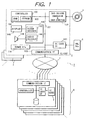
- FIG. 1 is a block diagram showing an arrangement of a system for permitting a user to use the application(s) recorded on a DVD on the terms of use of the DVD with a higher security according to the first illustrative embodiment of the invention.
- the system 1 comprises a client or DVD player 2 which plays a DVD 3, a telecommunication network 4, and a server 8 at a toll center of the provider 6 which provides the application package of the DVD 3.
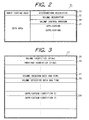
- FIG. 2 is a diagram showing an exemplary structure of an application (or a charged information) package 20 recorded on the DVD 3 used in the inventive system 1.
- the application package 20 comprises at least one application 21, a volume (or package) descriptor 22 comprising data concerning the application package 20, and a distribution descriptor 23 comprising data which is determined mainly at the time of, e. g., distribution or sales after the pressing of the DVD 3.
- the volume descriptor 22 and the distribution descriptor 23 constitutes the volume control data of the volume 20.
- a volume (or package) control program which controls the use of the application package 20 in cooperation with the server 8 is included in and distributed with the application package 20.
- the application package 20 further comprises the package control program 24 suited for the terms of use of the package 20.
- the application(s) 21, the volume descriptor 22 and the package (or volume) control program 24 are recorded in the data area of the DVD 3 at the time of manufacturing the DVD 3, while the distribution descriptor 23 is recorded in the burst cutting area at the time of, e. g., sales of the DVD 3.
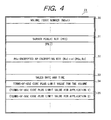
- FIGs. 3 and 4 are diagrams showing, in a detailed form, exemplary data structures of the volume descriptor 22 and the distribution descriptor 23, respectively.
- the volume descriptor 22 at least contains a volume identifier (VID v ) 25 which the title of the application package 20 is probably used for and which is the same as the application identifier if the package or volume 20 contains only one application; a provider identifier 26; volume creation date and time 27 which may be used for the base point by which volume expiration data and time as described later is determined; and volume effective date and time 28 indicative of date and time until which the volume 20 is available.
- the volume descriptor 22 further contains application identifiers (AID a 's) 29.
- the distribution descriptor 23 comprises the fields of: a volume issue number (NO v-i ) 30 which contains a serial number given to each of the distributed application packages of an identical volume identifier (volume ID or title) VID v in the order of distribution; a server public key (PK s ) 31 the data of which is given by the server 6 at a toll center of the provider 6; a PK u (user-public-key)-encrypted application-encrypting key (K v ) 32; and sales date and time 33.
- a volume issue number (NO v-i ) 30 which contains a serial number given to each of the distributed application packages of an identical volume identifier (volume ID or title) VID v in the order of distribution
- PK s server public key
- K u user-public-key
- the key PK s 31 field contains a key which has been used in encrypting each application 21 in the package 20 and which has been encrypted with a user public key (PK u ) of the user who has legally obtained the package 20.
- Appropriate data are recorded in all of the fields 30 through 34 at the time of distribution of the package 20, i.e., at the time of sales of the DVD 3 in this embodiment.
- the distribution descriptor 23 further comprises the field 34 of terms-of-use code (mode code) plus limit value for the volume (the volume limit value field) and, for each of the application IDs 29, the fields 35 of terms-of-use code plus limit value for the application ID 29 (application limit value field). If terms of use are set only to the volume 20, there is no need of the field 35. If terms of use are set to each application, the field is empty.
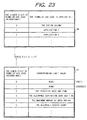
- FIG. 23 is a diagram for explaining the meanings of the terms-of-use (TOU) codes and the corresponding limit values.
- the terms-of-use code may be, e. g., one byte in length.
- the higher digit (X) of the TOU code indicates the target to which the terms of use is applied as shown in table 36. That is, higher digits of 0, 1, 2,... indicate that the TOU codes beginning with those digits are for the entire volume, application 1, application 2 and so on.
- the lower digit (Y) of the above mentioned terms-of-use code indicates the terms of use of the package 20 or the application 21 to which the code is set, and is directly followed by a corresponding limit value as shown in table 37 of FIG. 23.
- the terms-of-use code (or TOU code) of 00H means, for example, that the volume 20 is usable freely after distribution.
- the value '31H' means, for example, that the application 3 to which the TOU code is set can be used by paying per unit of play duration.
- the lower digit of 2H or more means that the volume 20 or the application to which the TOU code is set can be used freely until the corresponding limit value are reached, which disables further use.
- the use-limiting factors determined by the TOU codes whose lower digits are 2H to 5H are the current date and time, the expiration date and time, the amount of used period, and the access count, respectively.
- the DVD player 2 comprises a controller 100 for controlling the entire DVD player 2; data bus 102 connected with the not-shown CPU (central processing unit), not-shown ROM (read-only memory), RAM (random access memory) 101, and EEPROM (electrically erasable programmable ROM) 103 included in the controller 100; human interfaces (IFs) 110 including input devices such as a keyboard, a voice recognition device, a mouse, a remote controller, etc.
- IFs human interfaces
- an IC card interface (IF) 120 for connecting the bus 102 with the ROM (not shown) in a IC card 5; a DVD driver 130 for reading out the data recorded on the DVD 3 and for demodulating and error-correcting the read data; a video and audio output IF 140 for receiving a MPEG 2 bit stream and outputting a video and audio output signals; a display device 146; a loudspeaker 148, and a communication IF 150 for communicating through the public telecommunication network 4.
- IF IC card interface
- the IC card 5 stores a user's password PW u and a user's secret key SK u which corresponds to the user's public key PK u mentioned in conjunction with the PK u -encrypted AP-encrypting key (K v ) contained in the field 32 of the distribution descriptor 23 recorded in the burst cutting area of the DVD 3.
- the video and audio output IF 140 includes a MPEG 2 video decoder 142 and a MPEG 2 audio decoder 144.
- obtaining the DVD 3 there may be some ways. If one is to buy a DVD 3, e. g. , at some book store or through mail order, he or she has to have the PK u -encrypted version of an application-encrypting key (K v ) recorded in the burst cutting area of the desired DVD 3 by notifying his or her public key PK u which corresponds to his or her secret key SK u stored in the IC card 5.
- K v application-encrypting key
- he or she can obtain a DVD with a PK u -encrypted AP-encrypting key recorded without notifying the PK u each time of obtaining because he or she must have notified the PK u when he or she applied for the service.
- the user first sets a desired DVD 3 in the DVD driver 130 of the DVD player 2, and issues a start command to the DVD player 2 through an appropriate human IF 110.
- the controller 100 reads the volume control program 24 from the data area of the DVD 3 through the DVD driver 130 while loading the read program 24 into the RAM 101 of the controller 100, and then executes the volume control program 24.
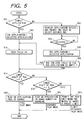
- FIG. 5 is a flow chart of the volume control program 24 for playing the application(s) 21 recorded on the DVD 3 according to the principle of the invention.
- the controller 100 first checks the AID1 field to see if the volume 20 contains a single application in step 500. If not, then the controller 100 displays the application IDs in the field 29 and prompts the user to select a desired one of the applications in step 502, and waits for the selection in step 504. If any application is selected in step 504, the controller 100 registers the application ID of the application as the application to be played in step 506 and proceeds to step 508 to check the field 35 of the terms-of-use (TOU) code plus limit value for the selected application to see if the field is empty. If so, the controller 100 proceeds to step 510 to read the volume limit field 34.
- TOU terms-of-use
- step 500 the controller 100 registers the volume ID as the application to be played in step 512, and reads the volume limit value 34 in step 510.
- step 510 If the step 510 is completed or the test result of step 508 is NO, then the controller 100 checks the terms-of-use (TOU) code to see if the lower digit of the TOU code is 0 in step 514. If so, then the controller 100 plays an application free of charge in step 650, and otherwise makes another check to see if the lower digit of the TOU code is 1 in step 516. if so, the controller 100 plays an application in a usage-sensitive charging in step 700, and otherwise (if the lower digit of the TOU code is 2 or more) play an application only when the software meter of a use-limiting factor is under a preset value in step 800. On completing any of the steps or processes 650 through 800, the controller 100 ends the program 24. Thus, the DVD player 2 plays a program specified by the user according to the terms of use determined by the TOU code which has been set to either the application package or the specified application.
- TOU terms-of-use
- the processes 650, 700 and 800 are executed interactively with an associated server 8.
- the servers 8 need various data for executing these processes, and store such data in the form of tables.
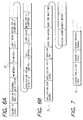
- FIG. 6A is a diagram showing an exemplary structure of a volume data table stored in a server 8.
- Each of the records of the volume data table 60 comprises volume ID (VID v ) and issue No. (NO v-i ) fields.
- the combination of VID v and NO v-i serves as the user ID of the user of the application package 20 or the DVD 3.
- the table 60 has, for the members or subscribers of DVD distribution service or the like, personal data fields which contains, for example, a member ID, a name, an address, etc.
- Each record further comprises a volume minute meter field (VM-METER v-i ) containing a software meter of play duration in minute which is attached to (or associated with) the volume 20; a volume charge meter (VC-METER v-i ) containing a software charge meter which is attached to the volume 20; a limit value (LV v-i ) containing a limit value associated with the TOU code (e.
- a limit value meter (LV-METER v-i ); an application ID (AID v-i-a ) field containing the title of the application; an application minute meter (AM-METER v-i-a ) field containing a software meter of play duration in minute which is attached to the application of AID v- i-a ; an application charge meter (AC-METER v-i-a ) field for a software meter of play duration in minute which is attached to the application of AID v-i-a ; a limit value (LV v-i-a ) containing a limit value associated with the TOU code; and a limit value meter (LV-METER v-i ).
- FIG. 6B is a diagram showing an exemplary structure of a application data table stored in a server 8.
- the application data table 70 comprises the fields of, for example, an application code (ACODE n ), an application title (AID n ), a duration (D), a rate-per-access (RATE/ACCESS), an access count, a minute meter, etc.
- the duration is a period of time what it takes to play the application.
- the rate per access is a charge for a play of the whole application, which is used for informing the user of an expected play duration prior to a play.
- the rate per unit time is a charge for a unit time of play, which is used for the calculation of a charge for an actually timed play duration.
- the access count and minute meter fields contains the number of accesses to the application and a total amount of play time, which are not necessary for the present invention but will be used in statistical calculations for the analysis of, e. g. , the tastes.
- FIG. 7 is a diagram showing a structure of a server table 75 stored in the EEPROM 103 of the client 2.
- the fields of the table 75 comprises a server public key (PK s ), a server ID (SID s ), a server network address (SADD s ), etc.
- this table 75 is used for associating the sever public key (PK s ) contained in the distribution descriptor 23 recorded in the burst cutting area of the DVD with the ID and the network address.
- PK s server public key
- SID s server ID
- SADD s server network address
- the initial routines of the processes 650, 700 and 800 are the same.
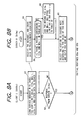
- FIGs. 8A and 8B are flow charts of initial routines 80a and 80b which are executed interactively by the client 2 and the server 8, respectively, at the beginning of the processes 650, 700 and 800.
- the controller 100 of the client or the DVD 2 in step 82, sends a service request with the network address CADD c of the client or DVD 2, the TOU code plus limit value, the volume ID (VID v ), the issue number (NO v-i ), the application ID (AID v-i-a ), and other data to the associated server 8 the ID of which is SID s (SID s is obtained from the table 75 in FIG.
- step 92 waits for a response from the server CSID s ) 8. If there is a response from the server (SID s ), the client 2 proceeds to the next step through a circle with "A" therein.
- the server 8 of SID s receives the message from the client 2, that is, the service request and the accompanying data and stores date in a predetermined location for subsequent use in step 84. Then, the server 8 searches the table 60 for a record which contains VID v and NO v-i in the volume ID and issue No. fields thereof, respectively in step 86. If the search is unsuccessful, then the server 8 adds the record for VID v and N0 v-i and fills relevant fields with AID v-i-a and a limit value, if any, in the table 60 in step 88, and proceeds to step 90.
- step 86 the server 9 proceeds to step 90, where the server 8 selects a routine to execute next according to the value of the TOU code and enters the selected routine through a circle with "B" therein.
- the server 8 selects a routine to execute next according to the value of the TOU code and enters the selected routine through a circle with "B" therein.
- the TOU code x1H (x: an arbitrary HEX number, the letter H in the last position indicates that the preceding number is in hexadecimal)
- a routine for playing an application free of charge is selected.
- the TOU code ⁇ x2H then a routine is selected which plays an application only if the software meter of a use-limiting factor is under a preset value.
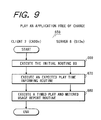
- FIG. 9 is a flow chart showing a procedure of a free play process shown as step 650 in FIG. 5, wherein connecting adjacent blocks by two flow lines indicates that each block is executed interactively by a client of CADD c and an associated server SID s as shown in detail later.
- the server (CADD c ) enters the free play process 650 as shown in FIG. 9, and the client and the server (SID s ) execute the initial routine 80 in block 660.
- they executes an expected play time informing routine, that is, displays an expected play time before playing an specified application.
- block 680 they execute an application play and metered play time report routine. Since the routine 80 has been detailed in FIG. 8, the expected play time informing routine and the application play and metered play time report routine will be detailed in the following.
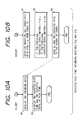
- FIGs. 10A and 10B are flow charts jointly showing a procedure formed of exemplary expected play time informing routines 97a and 97b interactively executed by the client 2 and the associated server 8, respectively.
- the server 8 retrieves the duration (Dn) of the application of AID v-i-a from the table 70 in a well known manner in step 91.
- the server 8 calculates an expected total amount of play time according to the value of the TOU code. Specifically, if the TOU code is 0xH, then the client adds the duration (D n ) and the value of the VM-METER v-i field of the record identified by VID v and NO v-i in the table 60.
- the client adds the duration (D n ) and the value of the AM-METER v-i-a field of the record identified by VID v , NO v-i , and AID v-i-a in the table 60. Then the server 8 sends the result to the client whose network address is CADD c in step 93, and ends the process.
- the client 2 receives the incoming message or the value of the updated meter in step 94. In the next step 95, the value is displayed as the total amount of usage. Then the client 2 ends the process.
- a predetermined value of duration has been used in the just described routines of FIG. 10 (a preset value metering system).
- This arrangement is suited mainly for such applications as it takes a constant time to play, and will not cause a problem unless the user discontinues the play. From this point of view, it is preferable to actually measure the playing time in metering (a timed value metering system).
- the preset value metering system is useful in informing the user of expected play time prior to an actual playing.
- FIGs. 11A and 11B are flow charts jointly showing a procedure formed of exemplary timed play and metered usage report routines 675a and 675b interactively executed by the client and the server, respectively, for playing an application while timing the duration and displaying a timed play duration after the play.
- routine 675 the client and the server call a timed application-play subroutine for playing the application while timing the duration (play time) in step 200.
- step 210 the client updates a relevant meter according to the TOU code in the same manner as in step 92 of FIG. 10B. Specifically, if the TOU code is 0xH, then the play time is added to the value of the VM-METER v-i field of the record identified by VID v and NO v-i in the table 60. If the TOU code is axH (a: the application number of the specified application in the volume), then the play time is added to the value of the AM-METER v-i-a field of the record identified by VID v , NO v-i , and AID v-i-a in the table 60. Then the server 8 sends the play time and the value of the updated meter (i. e., the total amount of play time) to the client whose network address is CADD c in step 212, and ends the process.
- the TOU code is 0xH
- the play time is added to the value of the VM-METER v-i field of
- the client 2 after step 200, make a test to see if there is a response from the server of SID s in step 214. This step is repeated until the client 2 receives a call from the server 8, when the client 2 receives the incoming message or the value of the updated meter in step 216. In the next step 218, the client 2 displays the play time and the total amount of play time, and then ends the routine 675.
- FIGs. 12A and 12B are flow charts jointly showing a procedure formed of exemplary timed application-play subroutines 205a and 205b executed by the client 2 and the server 8, respectively, for playing the application while timing the duration.
- the server 8 of SID s waits for a notice in step 611 to see if the client has started playing the application.
- the client 2 of CADD c informs the server of a start of play in step 610 and immediately call an application play subroutine in step 612. This, causes the server 8 to start a timer in step 613, and waits for a notice of a stop of play from the client 2 in step 615.
- the client informs the server 8 of the stop of play in step 614.
- the server 8 stops and reads the timer as the play time in step 617. After steps 614 and 617, the client and the server return.
- FIGs. 13A and 13B are flow charts jointly showing a procedure formed of alternative timed application-play subroutines 205ac and 205bc interactively executed by the client 2 and the server 8, respectively, in which timing of play time is achieved with a timer in the client.
- the client 2 starts a timer in step 620, calls an application play routine in step 622, stops the timer in step 624, sends the play time to the server 8 in step 626, and then returns.
- the server 8 on entering the subroutine 295b, waits for a call from the client of CADD c in step 621. If there is a call from the client 2, then the server 8 receives the play time in step 623 and then returns.
- FIG. 13 has a possibility of permitting a mala fide user to manipulate the timer of the client 2. From this point of view, the arrangement shown in FIG. 12 is preferable to that of FIG. 13.
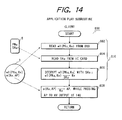
- FIG. 14 is a flow chart of an exemplary application play subroutine called in steps 612 and 622 of FIGs. 12A and 13A, respectively, and executed by the controller 100.
- the controller 100 read the PK u -encrypted application-encrypting (AP-encrypting) key (K v ) or e1(PK u , K v ) from the filed 32 of the distribution descriptor 23 of the DVD in step 602.
- v 1, 2,.... V, where V is the number of kinds of the application package.
- Kl through K v is assigned to respective kinds of applications, that is, volume VID1 through VID v .
- the user secret key SK u is read from the IC card 5.
- the PK u -encrypted AP-encrypting key e1(PK u , K v ) is decrypted with the user secret key SK u to obtain the application encrypting key K v .
- the obtained application data has the form of an MPEG 2 bit stream.
- the video and audio output IF 140 converts the MPEG 2 bit stream of the application data into video and audio output signals through MPEG 2 video and audio decoding.
- the video and audio output signals are applied to the display device 146 and the loudspeaker 148, respectively. Play an Application in Usage-sensitive Charging system
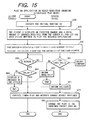
- FIG. 15 is a flow chart showing a procedure of a charged play process 700 shown as step 700 in FIG. 5, wherein connecting adjacent blocks by two flow lines indicates that each block is executed interactively by a client of CADD c and an associated server of SID s .
- the client 2 enters the process 700 via step 516 of FIG. 5 and proceeds to block 630, where the client 2 and the associated server 8 execute the initial routine 80.
- the client 2 displays an expected charge and a total amount of charges received from the server 8, and let the user decide whether to play the desired application.
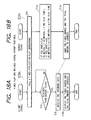
- FIGs. 16A and 16B are flow charts jointly showing a procedure formed of exemplary expected charge informing routines 640a and 640b interactively executed by the client 2 and the associated server 8, respectively.
- the routines 640a and 640b are very similar to the routine 97 except that in the routine 640, the DURATION (D n ) or "play time” has been replaced with RATE PER ACCESS and "charge” ; between steps 92a and 93a, there has been added a step 641 of the server generating and storing a pseudo random number R in a memory location R' ; in step 93a, the server sends the pseudo random number R as well; between steps 94 and 95a there has been added a step 643 of the client storing the received pseudo random number R in a memory location R" for subsequent use.
- step 644 the client 2 makes a check to see if the user decides to play the application; if not, the client 2 sends a quit message to the server of SADD s in step 645, and ends the routine 640; on the other hand, in step 642 following the step 93a, the server 8 of SID s waits for a call from the client 2 of CADD c ; on receiving a call from the client, the server makes another check in step 646 to see if what has been received is a quit message; if so, the client ends the routine 640; and if the user decided to play the application in step 644, which means that what the server has received is not a quit message but an encrypted credit card number as seen from the description below
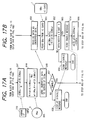
- the server 8 obtains a user's credit card number (CCNOu) through the client 2 keeping the security of the card number as shown in FIGs. 17A and 17B.
- the client 2 encrypts the credit card number of the user which has been input by the user through a human IF 110 with a key, i.e., the pseudo random number R which has been stored in a memory location R" in step 643 of FIG. 16A to obtain e2(R, CCNOu).
- the client 2 further encrypts R + e2(R, CCNOu) with another key or a server public key read from the distribution descriptor 23 recorded in the burst cutting area of the DVD to obtain e 1 (PK s , R + e2(R, CCNOu)).
- the client 2 sends the encrypted data to the server 8.
- the server proceeds to step 650, where the server 8 finds that what was received from the client CADD c is encrypted data.
- the server 8 reads a server secret key SK s from an IC card 7.
- the server 8 makes a check to see if the just obtained pseudo random number R coincides with the random number R which has been stored in a memory location R' of the server. if so, the server 8 sends an enable message to the client of CADD c , and in step 655 decrypts e2(R, CCNOu) with the pseudo random number R to obtain the user's credit card number CCNOu.
- the client 2 in response to a reception of the enable message in step 657, the client 2 exits from the process. After step 655, the server also exits from the process. If the result is NO in step 653, then the server 8 sends a disable message to the client in step 656, and ends the process. In response to a reception of the disable message in step 657, then the client displays a message to this effect in step 658, and then ends the process.
- the client 2 waits, in step 663, for a report from the server on whether the credit card for the transmitted card number (CCNOu) is valid or not, while the server 8 refers to the credit company associated with the card number in step 661 to see if the credit card is valid. if not, the server 8 informs the client 2 of the invalidity of the credit card in step 662, and ends the process. If the card is valid in step 661, the server 8 informs the client of the validity in step 667. If the client 2 receives a report from the server in step 663, the client makes another check in step 664 to see if the report indicates the validity of the card. If not, the client display a message to indicate the invalidity in step 665, and ends the process. If the report indicates the validity in step 664, which means the completion of step 667, then the client 2 and the server 8 proceed to the next block 670.
- the server 8 refers to the credit company associated with the card number in step 661 to see if the credit card is valid. if not
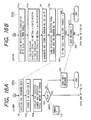
- FIGs. 18A and 18B are flow charts jointly showing a procedure formed of routines 675ac and 675bc interactively executed for playing an application while timing the duration and displaying a charge and a total amount of charges after the play.
- the routines 675ac and 675bc are identical to the routine 675a and 675b in FIGs. 11A and 11B except that "time” has been replaced with "charge”, and accordingly VM-METER and AM-METER have been replaced with VC-METER and AC-METER.
- step 675 of FIG. 15 or step 218a of FIG. 18A The operation, in the client 2, of playing an application on usage-sensitive charging is completed by block 675 of FIG. 15 or step 218a of FIG. 18A.
- the server 8 charges the play to the credit card number CCNOu obtained in step 655 of FIG. 17B in step 680. This completes the whole of the charged application play process of FIG. 15.
- expected time and/or charge are (is) displayed before playing a user specified application. This is helpful for the user to decide whether to play the application. Additionally, charging is done based on the actually timed play duration. This makes the charging reasonable.
- the arrangement is such that the user has to input his or her credit card number CCNOu each time he or she wants to play an application.
- the credit card number CCNOu may be stored in non-volatile memory or EEPROM 103 in a PW u -encrypted form.
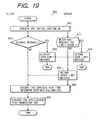
- FIG. 19 is a flow chart showing a procedure interactively executed by the client 2 and the server 8 in the operation block 800 of FIG. 5, wherein blocks connected with two flow lines indicates that operation of the blocks is done by the two elements 2 and 8.
- a preset limit is recorded in or on the application package and is transmitted from client 2 to server each time of play.
- the client 2 proceeds to step 801, where the client 2 and the server 8 executes the initial routines 80.
- routine 80b if there is a record for VID v and NO v-i , then the limit value (LV v-i ) field of the table 60 of FIG. 6A contains the limit value transmitted from the client 2, otherwise, the received limit value is stored in the LV v-i field when the record for VID v and NO v-i is added in step 88.
- step 810 the server 8 makes a check if a meter associated with the TOU code received from the client 2 is under the limit value. This check is made by comparing an LV field and LV-meter field associated with the TOU code in table 60. if the value of the LV-meter is equal to or greater than the LV field value, then the server returns an overlimit massage to the client 2 in step 820. If not, the server 8 returns an underlimit message to the client 2 in step 822, and proceeds to step 828. If the client 2 receives the overlimit message in step 824, then the client 2 displays a message to this effect. If not, the client 2 proceeds to the step 828.
- this feature of the invention it is possible to limit the use of charged information. This feature is especially useful in case when a user who have paid in advance for the use of the application package is permitted to use the application package within a limit value.
- the limit values may be kept in the servers of the provider or distributer from the beginning. In this case, the limit values are fixed. However, if limit values are permitted to be set and recorded in the application package at the time of distribution or sales, the limit values are advantageously set according to an amount paid.
- limit value any use-limiting factors will do that can be measured in quantity.
- limit values are, for example, the effective date and time, the allowable expiration date and time, the maximum amount of play time, the allowable access count.
- an arrangement may be such that the user is permitted to use an application package on usage-sensitive charging only if the value of an LV-meter associated with the TOU is under the value of the corresponding LV or the value recorded in a field 33 or 34 of the distribution descriptor 23.
- applications if more than one, in one volume are encrypted by an identical application encrypting key K v .
- the applications APa in one volume may be encrypted with respective AP-encrypting keys K a , where a lower case "a" following AP and K is a serial number assigned to each application ID.
- each of the AP-encrypting keys K a are encrypted with the user public key PK u , and stored in the PK u -encrypted AP-encrypting key (K a ) fields 32a in the distribution descriptor 23.
- the system may be so arranged that predetermined people, e. g., family members FM 1 , FM 2 ,..., FM N of the purchaser can use the DVD (N is the number of the family members).
- the AP-encrypting key K v has been recorded in a PK u -encrypted form on the DVD 3.
- the AP-encrypting key K v may be managed by the server 8 and transmitted to the client or the DVD player 2 in response to a request issued from the DVD player 2 each time of use of the DVD 3.
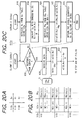
- each of the servers has to store an AP-encrypting key table (or K v table) and a PK u table (shown in FIGs. 20A and 20B) in the hard disc. As shown in FIG.
- the K v table a volume ID (VID v ) field (as the entry of record) and an AP-encrypting key (K v ) field in each record.
- each record of the PK u table comprises a volume ID (VID v ) field (as the entry of record), a volume issue number (NO v-i ) field and a PK u field (Successive same values in the first field are shown by showing only the first appearing one).
- the process (or step) 610 of obtaining the AP-encrypting key K v that is, a group of the steps 602, 604 and 606 in the application play routine 600, has to be replaced with a process of FIG. 20C.
- FIG. 20C is a flow chart of a process in which the client DVD player 2 obtains the application encrypting key K v from the server 8.
- the server 8 retrieves a key K v from the K v table by using VID v .
- the key K v is encrypted with an arbitrary number used only in the current process, e. g. , a pseudo random number R to obtain e2(R, K ).
- the server 8 retrieves a key PK u from the PK u table by reading the PK u field of the record which contains VID v and NO v-i in the VID v and NO v-i fields, respectively.
- R + e2(R, K v ) is encrypted with the retrieved key PK u to obtain a double encrypted AP-encrypting key e1(PK u , R + e2 (R, K v )), which is returned to the client with a client network address CADD c in the next step 624.
- the controller 100 of the client 2 waits for a response from the server 8 of SID s in step 626. If there is any response from the server 8 of SID s in step 626, then the client DVD 3 receives the data e1(PK u , R + e2(R, K v )) from the server 8 in step 628. In the next step 630, the received data is decrypted with the user secret key SK u read from the IC card 5. Specifically, the following calculation is done.
- the applications APa in one volume may be encrypted with respective AP-encrypting keys K a .
- the K v table has to be replaced with a K a table in which each record comprises an application ID (AID a ) field and an AP-encrypting key (K a ) field.
- the controller 100 of the DVD player 2 has to also send the application ID of the application to be played to the server.
- the system may be, again, so arranged that predetermined people, e. g., family members FM 1 , FM 2 , ..., FM N of the purchaser can use the DVD (N is the number of the family members).
- predetermined people e. g., family members FM 1 , FM 2 , ..., FM N of the purchaser can use the DVD (N is the number of the family members).
- the server 8 has to use the member's own public key PK u-n in encrypting the AP-encrypting key K v .
- One way to realize this is to issue a volume issue number NO v-i-n to each member FMn at the time of sales of the DVD, provide the non-volatile memory (not shown) of the DVD player 2 with a table for associating the user's password PWn with the volume issue number NO v-i-n , send the volume issue number (NO v-i-n ) associated with the user's password in step 612, and use not the PK u table but a PK u-n table in which each of the records has the following fields: VID v , NO v-i-n , PK u-n .
- Another way is to issue and record not only a volume issue number NO v-i but also family member numbers FMNn for all members at the time of sales of the DVD, provide the non-volatile memory (not shown) of the DVD player 2 with a table for associating the user's password PWn with the corresponding family member number FMNn, send the volume issue number (NO v-i ) and the family member number FMNn associated with the user's password in step 612, and use another PK u-n table in which each of the records has the following fields: VID v , NO v-i . FMNn. PK u-n .
- the server 8 may be authenticated by means of a public-key cryptosystem using a pair of server secret and public keys (SK s , PK s ).
- the server 8 signs the double-encrypted AP-encrypting key e1(PK u , R + e2 (R, K v )) with a signing key or the server secret key SK s after step 622.
- the client or DVD player 2 tests the signature by the server 8 with a test key or the server public key PK s contained in the PK s field 31 of the distribution descriptor 23 recorded in the burst cutting area of the DVD 2 before step 630.
- the decryption of application is achieved by software.
- the controller 100 has to read the user secret key SK u from the IC card 5 through the bus 102, which leaves the possibility of permitting a breaker to easily steal the user secret key SK u through the bus 102.
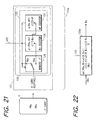
- the process achieved by the steps 604 through 608 may be realized by hardware as shown in FIG. 21, which is a block diagram of an exemplary decipherer-built-in IC card IF.
- the decipherer-built-in IC card IF 120a comprises an IC card receptacle 121 and a printed wiring board 122 extending from and fixed with the receptacle 121.
- the IC 123 is mounted on the printed wiring board 122.
- the IC 123 comprises a memory IF 125 which usually connects the memory of the IC card 5 with the bus 102 and, in response to an instruction from the controller 100, reads and passes the key SK u to the next stage; a K v decoder 126 for receiving the key Sku and encrypting e1(PK u , K v ) with the key SK u to yield K v ; and an AP decoder 127 for receiving the key K v and encrypting e(K v , AP) to yield application data (AP).
- the printed wiring board 122 portion may be preferably molded together with the IC card receptacle 121 portion so as to make the whole a single body. By doing this, leaking of the user secret key SK u can be prevented.
- This modification can be also applied to a system 1 using the cryptosystem of FIG. 20C.
- the K v decoder 126 of FIG. 21 has to be replaced with a K v decoder 126a as shown in FIG. 22.
- the K v decoder 126a decrypts the input data, e1(PK u , R + e2(R, K v )), from the bus 102 by using the user secret key SK u passed by the memory IF 125 to obtain R + e2(R, K v ), while decrypting the obtained data e2(R, K v )) with the obtained random number R and outputting the key K v .
- FIG. 24 is a block diagram showing an arrangement of a system capable of playing a distributed application package, e. g., a DVD on the terms of use of the DVD without communicating with any server according to a second illustrative embodiment of the invention.
- the system 1a is identical to the client 2 of FIG. 1 except that the communication IF 150 has been eliminated because of no need of communication with a server and the controller 100 has been replaced with a controller 100a.
- a not-shown ROM for storing a control program as described later and the EEPROM 103 have been also replaced with a new ROM (not shown) and an EEPROM 103a.
- the system 1a has to have table 60 of FIG. 6A in any non-volatile memory, e. g., the EEPROM 103a and an application duration (play time) for each application as defined in table 70 of FIG. 6B has to be included in the control data of each application package.
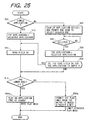
- FIG. 25 schematically shows an exemplary control program executed by the controller 100a shown in FIG. 24.
- the control program of FIG. 25 is also identical to that of FIG. 5 except that the decision step 516 and the step 700 has been eliminated because the limit-attached play mode is not supported by the system 1a in this embodiment, and the steps 650 and 800 are replaced with steps 650a and 800a. Accordingly, operation after step 514 will be described in the following.
- step 650a the controller 100a plays, in the free play mode, the application stored in the selected application in step 506 or 512 and ends the operation. It should be noted that since the system 1a does not have the charged play mode, the lower digit of the TOU code is defined as follows.
- step 800a the controller 100a plays, in the limit-attached play mode, the application stored in the selected application in step 506 or 512 and ends the operation.
- FIGs. 26 and 27 show an operation of a free play mode shown in step 650a of FIG. 25 in a detailed form and a further detailed form, respectively.
- the controller 100a executes an initial routine 80a in step 660a, in step 670a executes an expected play time informing routine, and in step 680a executes an application play and metered play time report routine.
- the controller 100a searches the table 60 for a record which contains VID v and NO v-i in the volume ID and issue No. fields thereof, respectively in step 86. If the search is unsuccessful, then the controller 100a adds the record for VID v and NO v-i and fills relevant fields with AID v-i-a and a limit value, if any, in the table 60 in step 88, and proceeds to step 90. Also, If the search in step 86 is successful, the server 9 proceeds to step 90, where the controller 100a selects a routine to execute next according to the value of the TOU code and enters the selected routine.
- the TOU code x0H (x: an arbitrary HEX number, the letter H in the last position indicates that the preceding number is in hexadecimal), then a routine for playing an application free of charge is selected. If the TOU code ⁇ x1H, then a routine is selected which plays an application only if the software meter of a use-limiting factor is under a preset value.
- the expected play time informing routine 670a is identical to the routines 97 (FIG. 10) minus communication steps 93 and 94, comprising the above described steps 91, 92 and 95. Similarly, it is seen from FIGs. 11 and 13A that the above described steps 620, 622, 624, 210 and 218 are executed in this order in the timed play and metered usage report routine 680a. In this way, the system 1a permits the user to play the application stored in the selected application (steps 506 and 512 of FIG. 25) free of charge.
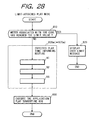
- FIG. 28 is a flow chart showing an operation of a limit-attached play mode shown in step 800a of FIG. 25. Since this operation is very similar to that of FIG. 19, only the flow is briefly described, omitting the details of each step.
- the system 1a permits the user to play the application stored in the selected application (steps 506 and 512 of FIG. 25) only if the limit value associated with the TOU code assigned to the volume or the user-specified application has not been reached.
- the system 1a can operate in either of the free play mode and the limit-attached play mode without the need of communication with a server.
- the system 1a may be made portable.
- the present invention is also applicable to application packages distributed via transmission media.
- the distributed application packages are stored in a bulk storage in the user's device.
- An application package comprises one or more application and application control data, that is, an application descriptor and distribution descriptor.
- One volume is stored as a file. Since a plurality of application package may be stored in a single storage, each application package does not have to contain a control program.
- One control program which may be distributed via either package or transmission media, is enough for one user device.
- the folder or directory in which the application packages are stored is set for a user specified one in the control program when the control program is installed.
- the data to be recorded in the distribution descriptor is included in the application package by the provider according to the information given by the user.
- an application package As described above, one who is permitted to use an application package is limited to an owner of the IC card which stores a user secret key SK u corresponding to the user public key PK u used for encryption of the AP-encrypting key K v in the application package. For this, even if someone has unjustly obtained an application package, for example, by copying the whole volume from the DVD on which the volume is recorded, he or she can not use it without the IC card of the owner of the DVD. Thus the inventive system can prevent unjust use of an application package (DVD in this case) by any other person than the regular owner of the application package.
- the inventive system is so arranged that most part of the application package is recorded by pressing in manufacturing process of the DVDs, whereas at least a part of the volume control data (i. e., the distribution descriptor) can be determined at the time of, e. g., distribution of each of the DVDs after the manufacturing process.
- the volume control data i. e., the distribution descriptor
- the data transmitted with the service request may be encrypted in the same manner as in case of the transmission of user's credit card number shown in FIG. 17.
- the data to be encrypted are D1, D2,... then they are first encrypted with a key R as follows: e2(R, D1), e2(R, D2),... Then further encryption is made with a server public key PK s as follows: e1(PK s , R + e2(R, D1) + e2(R, D2),.).
- the user may be authenticated by means of a public-key cryptosystem using a pair of user secret and public keys (SK u , PK u ).
- the client 2 signs the double-encrypted credit card number e1(PK s , R + e2(P, CCNOu)) with a signing key or the user secret key SK u after step 648.
- the server tests the signature by the client 2 with a test key or the user public key PK u before step 650.
- a plurality of server public keys or all the server public keys may be recorded. By doing this, it is possible, for example, to setting a different charge depending on the server public key which the user have selected by appropriately combining the tables 70 and 75.
- application packages with an identical volume ID can have different server public keys recorded.
- a plurality of toll center may be advantageously provided for application packages of the same title.
- step 604 In order to prevent any use of IC card by other person than the owner of the IC card, it is possible to add, before the Sku reading step 604, the steps of prompting the user to enter a password through a human IF 110 and proceeding to step 604 only if the entered password coincides with the user password PW u stored in the IC card.
- the IC card IF 120 may be replaced with a magnetic card reader to permitting the use of the magnetic card.
- the arrangement may be such that the user enters his or her password each time the user uses the DVD.
- the key Sku may be stored in non-volatile memory in a PW u -encrypted form.
- the key SK u is obtained by decrypting PW u -encrypted SK u with a password entered by the user.
- the system comprises a client for playing an application under the control of a server connected with the client through a communication network.
- the application package (the volume) includes control data and/or a control program. Some pieces of the control data such as an issue number (30) issued to each volume of the kind in an issued order, a user's public key-encrypted encryption key, server's public key, etc. are added by a distributor at the time of distribution of the volume. This feature makes the system flexible.
- a stand-alone system and a security-raised data transmission technique suited for a transmission of precious information such as a credit card number.
- the invention also relates to an application package for use in a system for playing an application contained in the application package (the volume), the application package comprising: application data for at least one application, and volume control data for use in controlling the system, wherein the volume control data at least comprises a volume ID for identifying the kind of the application package (the volume), an issue number assigned in order of issue to each of the volumes of the kind and application IDs each assigned to one of the at least one application contained in the volume, and wherein at least a part of the volume control data is to be added to the volume after the creation of the volume and the at least a part of the volume control data includes the issue number.
- the invention also relates to a package media on which an application package as defined above has been recorded.
- the package media can be of a write-once type. At least a part of the volume control data can be recorded in an area different from data area where the application data is recorded on the package media.
- the invention also relates to a method for sending data with a raised security from a first device to a second device through a public telecommunication network, comprising the steps of: in the second device, generating a pseudo random number, and transmitting the pseudo random number to the first device; in the first device, encrypting the data with the transmitted pseudo random number into encrypted data, encrypting concatenated data consisting of the pseudo random number and the encrypted data with a public key of the second device into double-encrypted data, and sending the double-encrypted data to the second device; in the second device, decrypting the double-encrypted data with a secret key of the second device which corresponds to the public key into decrypted data consisting of a decrypted random number portion and another decrypted portion, and decrypting the another decrypted portion with the transmitted random number to obtain the data.
- the invention also relates to a method for sending a plurality of pieces of data with a raised security from a first device to a second device through a public telecommunication network, comprising the steps of: in the second device, generating a pseudo random number, and transmitting the pseudo random number to the first device; in the first device, encrypting each of the pieces of data with the transmitted pseudo random number into an encrypted piece of data, encrypting concatenated data consisting of the pseudo random number and the encrypted pieces of data with a public key of the second device into double-encrypted data, and sending the double-encrypted data to the second device; in the second device, decrypting the double-encrypted data with a secret key of the second device which corresponds to the public key into decrypted data consisting of a decrypted random number portion and the plurality of decrypted data portions, and decrypting each of the decrypted portions with the transmitted random number to obtain the pieces of data.
- the invention also relates to a method for permitting a user to play an encrypting key-encrypted application contained in a distributed application package in a system provided with means for playing an application contained in an application package, wherein the application package further contains, as volume control data, a user's public key-encrypted encrypting key so encrypted as to be able to be decrypted with a secret key of the user into the encrypting key, the method comprising the steps of: reading the user's public key-encrypted encrypting key from the distributed application package (the volume), obtaining the secret key, decrypting the user's public key-encrypted encrypting key with the secret key to obtain the encrypting key, and decrypting the encrypting key-encrypted application with the obtained encrypting key into application data while passing the application data to the means for playing an application.
- the invention also relates to a method for permitting a user to play one of encrypting key-encrypted applications contained in a distributed application package in a system comprising a client provided with means for playing an application contained in an application package and a server connected with the client through a communication network, wherein the application package further contains, as volume control data, a volume ID for identifying the kind of the distributed application package (the volume), an issue number issued to each volume of the kind in an issued order and application IDs, the method comprising the steps of: the client reading the volume ID, the issue number and an application ID for the one of encrypting key-encrypted applications (the encrypting key-encrypted application) from the volume and sending to the server; in the server, retrieving the encrypting key by using the volume ID, retrieving a public key of the user by using the volume ID and the issue number, generating a pseudo random number, double-encrypting the encrypting key with the pseudo random number and the public key into a double encrypted data, sending
- the invention also relates to a method for controlling the amount of play time in a system
- a client provided with means for playing an application package and a server connected with the client through a communication network for controlling the client, the application package (the volume) containing, as volume control data, a volume ID and an issue number issued to each of the volumes of the volume ID in an issued order
- the method comprising the steps of: the client sending the volume ID and the issue number to the server, the server retrieving an expected play time associated with the volume ID and the issue number, and the server adding the expected play time to the value of a total play time associated with the volume ID and the issue number.
- the invention also relates to a method for controlling the amount of play time in a system
- a client provided with means for playing an application contained in an application package and a server connected with the client through a communication network for controlling the client
- the application package (the volume) containing, as volume control data, a volume ID, an issue number issued to each of the volumes of the volume ID in an issued order and an application ID for the application
- the method comprising the steps of: the client sending the volume ID, the issue number and the application ID to the server, the server retrieving an expected play time associated with the volume ID, the issue number and the application ID, and the server adding the expected play time to the value of a total play time associated with the volume ID and the issue number.
- the invention also relates to a method for controlling the amount of play time in a system
- a client provided with means for playing an application contained in an application package and a server connected with the client through a communication network for controlling the client
- the application package (the volume) containing, as volume control data, a volume ID and an issue number issued to each of the volumes of the volume ID in an issued order
- the method comprising the steps of: the client and the server interactively measuring, as a measured play time, a play time of the application, and the server adding the measured play time to the value of a total play time associated with the volume ID and the issue number.
- the invention also relates to a method for sending desired data from one side of a client and a server to the other side in a system comprising a client for playing an application package and a server connected with the client through a communication network, wherein the application package (the volume) comprises application data and control data and at least a part of the control data has been added to the volume after the creation of the volume, the method comprising the steps of: including a secret key of the other side in the at least a part of the control data; in the other side, generating a pseudo random number, and transmitting the pseudo random number to the one side; in the one side, encrypting the desired data with the transmitted pseudo random number into encrypted data, encrypting concatenated data consisting of the pseudo random number and the encrypted data with the public key of the other side into double-encrypted data, and sending the double-encrypted data to the other side; in the other side, decrypting the double-encrypted data with a secret key of the other side which corresponds to the public key
- the invention also relates to a method for permitting a user to play an application contained in a distributed application package in a system comprising a client provided with means for playing an application contained in an application package and a server connected with the client through a communication network, wherein the application package further contains, as volume control data, a volume ID for identifying the kind of the distributed application package (the volume), an issue number issued to each volume of the kind in an issued order, and an application ID for the application, the method comprising the steps of: proceeding to a next step only if the value of a meter field associated with the volume ID, the issue number and the application ID is under the value of a limit value field associated with the volume ID, the issue number and the application ID in a volume data table, and displaying a message informing an overlimit on a display device of the client and quit the operation otherwise.
- the invention also relates to a method for permitting a user to play an application contained in a distributed application package in a system
- a client provided with means for playing an application contained in an application package and a server connected with the client through a communication network
- the application package further contains, as volume control data, a volume ID for identifying the kind of the distributed application package (the volume), an issue number issued to each volume of the kind in an issued order, an application ID for the application and a limit value for limiting the play of the application
- the method comprising the steps of: proceeding to a next step only if the value of a meter field associated with the volume ID, the issue number and the application ID in a volume data table is under the limit value, and displaying a message informing an overlimit on a display device of the client and quit the operation otherwise.
- the invention also relates to a system for sending data with a raised security from a first device to a second device through a public telecommunication network, comprising: means provided in the second device for generating a pseudo random number, means provided in the second device for transmitting the pseudo random number to the first device, means provided in the first device for encrypting the data with the transmitted pseudo random number into an encrypted data, means provided in the first device for encrypting concatenated data consisting of the pseudo random number and the encrypted data with a public key of the second device into double-encrypted data, means provided in the first device for sending the double-encrypted data to the second device, means provided in the second device for decrypting the double-encrypted data with a secret key of the second device which corresponds to the public key into decrypted data consisting of a decrypted random number portion and another decrypted portion, and means provided in the second device for decrypting the another decrypted portion with the transmitted random number to obtain the data.
- the invention also relates to a system for sending a plurality of pieces of data with a raised security from a first device to a second device through a public telecommunication network, comprising: means provided in the second device for generating a pseudo random number, means provided in the second device for transmitting the pseudo random number to the first device, means provided in the first device for encrypting each of the pieces of data with the transmitted pseudo random number into an encrypted piece of data, means provided in the first device for encrypting concatenated data consisting of the pseudo random number and the encrypted pieces of data with a public key of the second device into double-encrypted data, means provided in the first device for sending the double-encrypted data to the second device, means provided in the second device for decrypting the double-encrypted data with a secret key of the second device which corresponds to the public key into decrypted data consisting of a decrypted random number portion and the plurality of decrypted data portions, and means provided in the second device for decrypting each of
- the invention also relates to a system for playing an encrypting key-encrypted application contained in a distributed application package which further contains, as volume control data, a user's public key-encrypted encrypting key so encrypted as to be able to be decrypted with a secret key of the user into the encrypting key, the system comprising: means for reading the user's public key-encrypted encrypting key from the distributed application package (the volume), means for obtaining the secret key, means for decrypting the user's public key-encrypted encrypting key with the secret key to obtain the encrypting key, means for decrypting the encrypting key-encrypted application with the obtained encrypting key to provide application data, and means for using the application data for playing.
- the invention also relates to a system for permitting a user to play an encrypting key-encrypted application contained in a distributed application package which further contains, as volume control data, a volume ID for identifying the kind of the distributed application package (the volume), an issue number issued to each volume of the kind in an issued order and application IDs, the system comprising: a client for playing an application by using application data, and a server for controlling the client through a communication network; wherein the client comprises means for reading and sending the volume ID, the issue number and an application ID for the one of encrypting key-encrypted applications (the encrypting key-encrypted application) from the volume to the server; and the server comprises means for retrieving the encrypting key by using the volume ID, means for retrieving a public key of the user by using the volume ID and the issue number, means for generating a pseudo random number, means for double-encrypting the encrypting key with the pseudo random number and the public key into a double encrypted data, and means for sending the
- the invention also relates to a system for permitting a user to play a distributed application package which further contains, as volume control data, a volume ID for identifying the kind of the distributed application package (the volume) and an issue number issued to each volume of the kind in an issued order, the system comprising: a client for playing the distributed application package, and a server for controlling the client through a communication network; wherein the client comprises means for sending the volume ID and the issue number to the server; and the server comprises means for retrieving an expected play time associated with the volume ID and the issue number, and means for adding the expected play time to the value of a total play time associated with the volume ID and the issue number.
- the invention also relates to a system for permitting a user to play an application contained in a distributed application package which further contains, as volume control data, a volume ID for identifying the kind of the distributed application package (the volume), an issue number issued to each volume of the kind in an issued order and an application ID for the application, the system comprising: a client for playing the application, and a server for controlling the client through a communication network; wherein the client comprises means for sending the volume ID, the issue number and the application ID to the server; and the server comprises means for retrieving an expected play time associated with the volume ID, the issue number and the application ID, and means for adding the expected play time to the value of a total play time associated with the volume ID and the issue number.
- the invention also relates to a system for permitting a user to play an application contained in a distributed application package which further contains, as volume control data, a volume ID for identifying the kind of the distributed application package (the volume), an issue number issued to each volume of the kind in an issued order and an application ID for the application, the system comprising: a client for playing the application, and a server for controlling the client through a communication network; wherein the client and the server comprise means for interactively measuring, as a measured play time, a play time of the application; and the server further comprises means for adding the measured play time to the value of a total play time associated with the volume ID and the issue number.
- the invention also relates to a system for permitting a user to play an application package (the volume) comprising application data and control data wherein at least a part of the control data has been added to the volume after the creation of the volume, the system comprising: a client for playing the volume, and a server for controlling the client through a communication network, wherein the server comprises means for storing a secret key of the server and the at least a part of the control data includes a public key corresponding to the secret key; and wherein the system comprises means provided in the server for generating a pseudo random number, means for storing the pseudo random number, means provided in the server for transmitting the pseudo random number to the client, means provided in the client for encrypting desired data with the transmitted pseudo random number into encrypted data, means provided in the client for encrypting concatenated data consisting of the pseudo random number and the encrypted data with the public key into double-encrypted data, means provided in the client for sending the double-encrypted data to the server, means provided in the server for decrypting
- the invention also relates to a system for permitting a user to play an application contained in a distributed application package which further contains, as volume control data, a volume ID for identifying the kind of the distributed application package (the volume), an issue number issued to each volume of the kind in an issued order and application IDs, the system comprising: a client for playing an application by using application data, and a server for controlling the client through a communication network; wherein the client comprises means for reading and sending the volume ID, the issue number and an application ID for the one of encrypting key-encrypted applications (the encrypting key-encrypted application) from the volume to the server; and the server comprises means for proceeding to next step only if the value of a meter field associated with the volume ID, the issue number and the application ID is under the value of a limit value field associated with the volume ID, the issue number and the application ID in a volume data table, and means for causing the client to display a message informing an overlimit on a display device of the client and quit the operation otherwise.
- the invention also relates to a system for permitting a user to play an application contained in a distributed application package which further contains, as volume control data, a volume ID for identifying the kind of the distributed application package (the volume), an issue number issued to each volume of the kind in an issued order, application IDs and limit values associated with respective application IDs for limiting the play of respective applications, the system comprising: a client for playing an application by using application data, and a server for controlling the client through a communication network; wherein the client comprises means for reading and sending the volume ID, the issue number, an application ID for the one of encrypting key-encrypted applications (the encrypting key-encrypted application) and a limit value associated with the application ID from the volume to the server; and wherein the server comprises means for proceeding to a next step only if the value of a meter field associated with the volume ID, the issue number and the application ID in a volume data table is under the limit value, and means for causing the client to display a message informing an overlimit on
- the invention also relates to a method for permitting an authentic user to play a desired one of the applications contained in a distributed application package in a system capable of playing an application, wherein the application package (the volume) contains volume control data including mode codes assigned to the volume and the applications of the volume, the method comprising the steps of: deciding to use one of predetermined play modes specified by one of the mode codes associated with the desired application, and playing the desired application in the specified play mode.
- the invention also relates to a system for permitting an authentic user to play a desired one of the applications contained in a distributed application package, wherein the application package (the volume) contains volume control data including mode codes assigned to the volume and the applications of the volume, the system comprising: means for deciding to use one of predetermined play modes specified by one of the mode codes associated with the desired application, and means for playing the desired application in the specified play mode.
- the invention also relates to a method for permitting an authentic user to play a desired one of the applications contained in a distributed application package in a system comprising a client capable of playing an application and a server connected with the client through a communication network, wherein the application package (hereinafter referred to as "the volume") contains volume control data including mode codes assigned to the volume and the applications of the volume, the method comprising the steps of: the client deciding to use one of predetermined play modes specified by one of the mode codes associated with the desired application, and playing the desired application in the specified play mode by means of cooperation between the client and the server.
- the volume contains volume control data including mode codes assigned to the volume and the applications of the volume
- the invention also relates to a system for playing a distributed application package in one of predetermined play modes in concert with a server, wherein the application package contains a data set encrypted with an encrypting key (a K-encrypted data set) for each of at least one application and volume control data for use in controlling operation of the system and the server and the volume control data includes mode codes defining the play modes, the system comprising: means for permitting a user to select one of the at least one application of the volume, means for deciding to use one of the predetermined play modes associated with one of the mode codes assigned to the selected application, and means for playing the selected application in the selected play mode in concert with the server.
- a K-encrypted data set a K-encrypted data set
- the invention also relates to a system for controlling through a communication network a client device to play a distributed application package in one of predetermined play modes, wherein the application package contains a data set encrypted with an encrypting key (a K-encrypted data set) for each of at least one application and volume control data for use in controlling operation of the system and the client and the volume control data includes a volume ID, an issue number, an application ID for each of the applications, and a mode code for the volume or mode codes for the applications, the system comprising: volume data table for storing, for each volume, the volume ID, the issue number, the mode code for the volume, and the application ID and the mode code for each of the applications, means for receiving a service request, a volume ID, an issue number, an application ID and a mode code and other data from the client, means for storing the received application ID, the received mode code and other data in appropriate fields of a record identified by the volume ID and the issue number, means responsive to a determination that there is no record identified by the volume ID and the issue
- the system comprises a client for playing an application under the control of a server connected with the client through a communication network.
- the application package (the volume) includes control data and/or a control program. Some pieces of the control data such as an issue number (30) issued to each volume of the kind in an issued order, a user's public key-encrypted encryption key, server's public key, etc. are added by a distributor at the time of distribution of the volume. This feature makes the system flexible.
- a stand-alone system and a security-raised data transmission technique suited for a transmission of precious information such as a credit card number.
Landscapes
- Engineering & Computer Science (AREA)
- Theoretical Computer Science (AREA)
- Software Systems (AREA)
- Computer Security & Cryptography (AREA)
- General Physics & Mathematics (AREA)
- Computer Hardware Design (AREA)
- Physics & Mathematics (AREA)
- General Engineering & Computer Science (AREA)
- Technology Law (AREA)
- Multimedia (AREA)
- Signal Processing (AREA)
- Storage Device Security (AREA)
- Computer And Data Communications (AREA)
- Management, Administration, Business Operations System, And Electronic Commerce (AREA)
- Information Transfer Between Computers (AREA)
- Signal Processing For Digital Recording And Reproducing (AREA)
Applications Claiming Priority (3)
| Application Number | Priority Date | Filing Date | Title |
|---|---|---|---|
| JP28634596 | 1996-10-29 | ||
| JP28634596A JPH10133955A (ja) | 1996-10-29 | 1996-10-29 | 可搬型メディア駆動装置とその方法、及び可搬型メディアとネットワークの連携装置とその方法 |
| EP97108754A EP0840194B1 (de) | 1996-10-29 | 1997-06-02 | System und Verfahren zur Benutzungssteuerung von mehreren verteilten Anwendungsprogrammen |
Related Parent Applications (1)
| Application Number | Title | Priority Date | Filing Date |
|---|---|---|---|
| EP97108754A Division EP0840194B1 (de) | 1996-10-29 | 1997-06-02 | System und Verfahren zur Benutzungssteuerung von mehreren verteilten Anwendungsprogrammen |
Publications (2)
| Publication Number | Publication Date |
|---|---|
| EP1148407A2 true EP1148407A2 (de) | 2001-10-24 |
| EP1148407A3 EP1148407A3 (de) | 2005-08-17 |
Family
ID=17703193
Family Applications (2)
| Application Number | Title | Priority Date | Filing Date |
|---|---|---|---|
| EP01117146A Withdrawn EP1148407A3 (de) | 1996-10-29 | 1997-06-02 | System und Verfahren zur Einschränkung der Nutzung von mehreren verteilten Anwendungsprogrammen |
| EP97108754A Expired - Lifetime EP0840194B1 (de) | 1996-10-29 | 1997-06-02 | System und Verfahren zur Benutzungssteuerung von mehreren verteilten Anwendungsprogrammen |
Family Applications After (1)
| Application Number | Title | Priority Date | Filing Date |
|---|---|---|---|
| EP97108754A Expired - Lifetime EP0840194B1 (de) | 1996-10-29 | 1997-06-02 | System und Verfahren zur Benutzungssteuerung von mehreren verteilten Anwendungsprogrammen |
Country Status (7)
| Country | Link |
|---|---|
| US (1) | US6470085B1 (de) |
| EP (2) | EP1148407A3 (de) |
| JP (1) | JPH10133955A (de) |
| KR (1) | KR100291709B1 (de) |
| CN (2) | CN1201243C (de) |
| AU (1) | AU695948B2 (de) |
| DE (1) | DE69718277T2 (de) |
Cited By (1)
| Publication number | Priority date | Publication date | Assignee | Title |
|---|---|---|---|---|
| WO2004100152A3 (en) * | 2003-05-05 | 2005-03-31 | Music Public Broadcasting Inc | Method and system for controlling presentation of digital content |
Families Citing this family (103)
| Publication number | Priority date | Publication date | Assignee | Title |
|---|---|---|---|---|
| US6963859B2 (en) | 1994-11-23 | 2005-11-08 | Contentguard Holdings, Inc. | Content rendering repository |
| JPH08263438A (ja) | 1994-11-23 | 1996-10-11 | Xerox Corp | ディジタルワークの配給及び使用制御システム並びにディジタルワークへのアクセス制御方法 |
| JPH10164046A (ja) * | 1996-11-29 | 1998-06-19 | Canon Inc | 送信方法、受信方法、送信装置、受信装置、伝送システム及び媒体 |
| US6233684B1 (en) | 1997-02-28 | 2001-05-15 | Contenaguard Holdings, Inc. | System for controlling the distribution and use of rendered digital works through watermaking |
| EP0989557A4 (de) * | 1998-01-26 | 2009-12-23 | Panasonic Corp | Verfahren und system zur aufzeichnung /wiedergabe von daten, vorrichtung zur aufzeichung/wiedergabe undaufzeichungsmedium |
| US7809138B2 (en) * | 1999-03-16 | 2010-10-05 | Intertrust Technologies Corporation | Methods and apparatus for persistent control and protection of content |
| EP1014618A1 (de) * | 1998-07-30 | 2000-06-28 | Sony Corporation | Vorrichtung zur verarbeitung eines inhalts |
| EP0989743A1 (de) * | 1998-09-25 | 2000-03-29 | CANAL+ Société Anonyme | Applikationsdatentabelle für digitales Multiservice-Übertragungssystem |
| CN1196075C (zh) | 1998-10-05 | 2005-04-06 | 佳能株式会社 | 图象读取装置 |
| KR100717980B1 (ko) * | 1998-10-15 | 2007-05-16 | 소니 가부시끼 가이샤 | 정보 제공 시스템 |
| JP4794707B2 (ja) * | 1998-11-17 | 2011-10-19 | ソニー株式会社 | 端末装置、課金システム、データ処理方法 |
| EP1061516A1 (de) * | 1999-06-08 | 2000-12-20 | Deutsche Thomson-Brandt Gmbh | Wiedergabeverfahren von einer auf einem Informationsträger augezeichnete N verschlüsselte N Information sowie Wiedergabegerät zur Anwendung des Verfahrens |
| JP4127587B2 (ja) * | 1999-07-09 | 2008-07-30 | 株式会社東芝 | コンテンツ管理方法およびコンテンツ管理装置および記録媒体 |
| JP2001057019A (ja) * | 1999-08-17 | 2001-02-27 | Sony Corp | 情報記録媒体および情報処理装置 |
| JP2001211161A (ja) * | 1999-11-15 | 2001-08-03 | Pumpkin House:Kk | コンテンツ配信方法,コンテンツ配信システムのためのコンピュータおよび装置ならびにその制御方法 |
| AU1414501A (en) * | 1999-11-17 | 2001-05-30 | Fujitsu Limited | Data distributing system and recording medium used for it |
| US7065506B1 (en) * | 1999-11-19 | 2006-06-20 | Macrovision Corporation | Method and apparatus to inhibit illicit copying from a record carrier to a computer-readable data storage device |
| WO2001050691A2 (en) * | 1999-12-30 | 2001-07-12 | Tumbleweed Communications Corp. | Sender-controlled post delivery handling of digitally delivered documents in a computer network |
| JP2001237819A (ja) * | 2000-02-24 | 2001-08-31 | Nec Corp | 著作物再生システム,著作物復号装置,およびユーザ固有情報格納装置 |
| JP3980355B2 (ja) | 2000-03-30 | 2007-09-26 | 三洋電機株式会社 | ライセンス情報記憶装置、コンテンツ再生装置およびライセンス情報配信システム |
| US7200230B2 (en) * | 2000-04-06 | 2007-04-03 | Macrovision Corporation | System and method for controlling and enforcing access rights to encrypted media |
| JP4626784B2 (ja) * | 2000-05-19 | 2011-02-09 | ソニー株式会社 | 通信装置および通信方法、並びに記録媒体 |
| JP4774582B2 (ja) * | 2000-06-30 | 2011-09-14 | ソニー株式会社 | コンテンツ管理装置、コンテンツ管理方法及びプログラム格納媒体 |
| US20020007350A1 (en) * | 2000-07-11 | 2002-01-17 | Brian Yen | System and method for on-demand data distribution in a P2P system |
| US20030196109A1 (en) | 2000-08-28 | 2003-10-16 | Contentguard Holdings, Inc. | Method and apparatus for content transaction aggregation |
| US7743259B2 (en) | 2000-08-28 | 2010-06-22 | Contentguard Holdings, Inc. | System and method for digital rights management using a standard rendering engine |
| JP2002091452A (ja) * | 2000-09-11 | 2002-03-27 | Nec Corp | データ配信システム及びその配信方法 |
| JP2002132614A (ja) * | 2000-10-18 | 2002-05-10 | Nec Corp | データ配信システム |
| US7343324B2 (en) | 2000-11-03 | 2008-03-11 | Contentguard Holdings Inc. | Method, system, and computer readable medium for automatically publishing content |
| GB0031663D0 (en) * | 2000-12-27 | 2001-02-07 | Internet Extra Ltd | Method and apparatus for controlling access to multimedia files design and implementation |
| US6912294B2 (en) | 2000-12-29 | 2005-06-28 | Contentguard Holdings, Inc. | Multi-stage watermarking process and system |
| US7774279B2 (en) | 2001-05-31 | 2010-08-10 | Contentguard Holdings, Inc. | Rights offering and granting |
| US7028009B2 (en) | 2001-01-17 | 2006-04-11 | Contentguardiholdings, Inc. | Method and apparatus for distributing enforceable property rights |
| US8069116B2 (en) | 2001-01-17 | 2011-11-29 | Contentguard Holdings, Inc. | System and method for supplying and managing usage rights associated with an item repository |
| US8458754B2 (en) | 2001-01-22 | 2013-06-04 | Sony Computer Entertainment Inc. | Method and system for providing instant start multimedia content |
| US7174568B2 (en) * | 2001-01-31 | 2007-02-06 | Sony Computer Entertainment America Inc. | Method and system for securely distributing computer software products |
| US20020116283A1 (en) | 2001-02-20 | 2002-08-22 | Masayuki Chatani | System and method for transfer of disc ownership based on disc and user identification |
| US7228342B2 (en) | 2001-02-20 | 2007-06-05 | Sony Computer Entertainment America Inc. | System for utilizing an incentive point system based on disc and user identification |
| US6876984B2 (en) | 2001-05-31 | 2005-04-05 | Contentguard Holdings, Inc. | Method and apparatus for establishing usage rights for digital content to be created in the future |
| US6895503B2 (en) | 2001-05-31 | 2005-05-17 | Contentguard Holdings, Inc. | Method and apparatus for hierarchical assignment of rights to documents and documents having such rights |
| US8275716B2 (en) | 2001-05-31 | 2012-09-25 | Contentguard Holdings, Inc. | Method and system for subscription digital rights management |
| US8275709B2 (en) | 2001-05-31 | 2012-09-25 | Contentguard Holdings, Inc. | Digital rights management of content when content is a future live event |
| US8099364B2 (en) | 2001-05-31 | 2012-01-17 | Contentguard Holdings, Inc. | Digital rights management of content when content is a future live event |
| US8001053B2 (en) | 2001-05-31 | 2011-08-16 | Contentguard Holdings, Inc. | System and method for rights offering and granting using shared state variables |
| US7725401B2 (en) | 2001-05-31 | 2010-05-25 | Contentguard Holdings, Inc. | Method and apparatus for establishing usage rights for digital content to be created in the future |
| US7774280B2 (en) | 2001-06-07 | 2010-08-10 | Contentguard Holdings, Inc. | System and method for managing transfer of rights using shared state variables |
| CA2432189A1 (en) | 2001-06-07 | 2002-12-19 | Contentguard Holdings, Inc. | Cryptographic trust zones in digital rigths management |
| JP2003069551A (ja) * | 2001-08-24 | 2003-03-07 | Sony Corp | 暗号化装置および方法、復号装置および方法、記録媒体、並びにプログラム |
| US7974923B2 (en) | 2001-11-20 | 2011-07-05 | Contentguard Holdings, Inc. | Extensible rights expression processing system |
| AU2002350209A1 (en) | 2001-11-20 | 2003-06-10 | Contentguard Holdings, Inc. | An extensible rights expression processing system |
| US7840488B2 (en) | 2001-11-20 | 2010-11-23 | Contentguard Holdings, Inc. | System and method for granting access to an item or permission to use an item based on configurable conditions |
| EP1452027B1 (de) * | 2001-12-10 | 2006-08-02 | International Business Machines Corporation | Zugriff auf verschlüsselten rundsendeinhalt |
| TW564986U (en) * | 2002-03-05 | 2003-12-01 | Carry Computer Eng Co Ltd | Video playing unit capable of supporting plural kinds of silicon storage cards |
| US7805371B2 (en) | 2002-03-14 | 2010-09-28 | Contentguard Holdings, Inc. | Rights expression profile system and method |
| CN1653463B (zh) | 2002-03-14 | 2013-03-06 | 康坦夹德控股股份有限公司 | 用于处理使用权利表达的方法和装置 |
| US20030191718A1 (en) * | 2002-04-08 | 2003-10-09 | Blair Timothy P. | Method and data processing system providing a pay-for-usage managed print service |
| JP2003308661A (ja) * | 2002-04-12 | 2003-10-31 | Toshiba Corp | 情報記録方法、情報記録媒体、情報再生方法、及び情報再生装置 |
| US7890771B2 (en) * | 2002-04-17 | 2011-02-15 | Microsoft Corporation | Saving and retrieving data based on public key encryption |
| WO2003094076A1 (en) | 2002-04-29 | 2003-11-13 | Contentguard Holdings, Inc. | Rights management system using legality expression language |
| US7386618B2 (en) * | 2002-05-09 | 2008-06-10 | Matsushita Electric Industrial Co., Ltd. | Distribution system, distribution apparatus, and reception apparatus for distributing contents having usage expiry |
| US20040025012A1 (en) * | 2002-07-30 | 2004-02-05 | Burks David Patrick | System for processing coded content and associated decoding instructions on a removable storage medium |
| US7020636B2 (en) * | 2002-09-05 | 2006-03-28 | Matsushita Electric Industrial, Co., Ltd. | Storage-medium rental system |
| JP2004118327A (ja) * | 2002-09-24 | 2004-04-15 | Sony Corp | コンテンツ使用制御装置及びコンテンツ使用制御方法、並びにコンピュータ・プログラム |
| JP4660073B2 (ja) * | 2002-10-18 | 2011-03-30 | 株式会社東芝 | 暗号化記録装置、再生装置及びプログラム |
| US8204226B2 (en) | 2002-10-18 | 2012-06-19 | Kabushiki Kaisha Toshiba | Encoding and recording apparatus, playback apparatus, and program |
| US7996907B2 (en) | 2003-02-18 | 2011-08-09 | International Business Machines Corporation | Data recording method, data recording system, data recording apparatus, data reading method, data reading system, counting method, counting system, method of supplying encryption key, system for supplying encryption key and program |
| KR101030203B1 (ko) | 2003-06-05 | 2011-04-22 | 인터트러스트 테크놀로지즈 코포레이션 | P2p 서비스 편성을 위한 상호운용 시스템 및 방법 |
| US7685642B2 (en) | 2003-06-26 | 2010-03-23 | Contentguard Holdings, Inc. | System and method for controlling rights expressions by stakeholders of an item |
| CN1607589A (zh) * | 2003-10-13 | 2005-04-20 | 皇家飞利浦电子股份有限公司 | 光盘、播放光盘的播放器及其播放方法 |
| JP3747470B2 (ja) * | 2003-10-29 | 2006-02-22 | 船井電機株式会社 | 光ディスク再生装置 |
| US20050273780A1 (en) * | 2004-05-14 | 2005-12-08 | Nokia Corporation | System, device, method and computer code product for partially sharing digital media |
| WO2005114857A1 (en) * | 2004-05-21 | 2005-12-01 | Matsushita Electric Industrial Co., Ltd. | Wireless communications terminal, communications protocol switching method, communications protocol switching program, and integrated circuit of wireless communications terminal |
| US8660961B2 (en) | 2004-11-18 | 2014-02-25 | Contentguard Holdings, Inc. | Method, system, and device for license-centric content consumption |
| KR100640449B1 (ko) * | 2005-04-20 | 2006-10-30 | 삼성전자주식회사 | 이동 통신 단말의 부가 기능 제한 방법 및 시스템 |
| JP4886428B2 (ja) | 2005-09-15 | 2012-02-29 | 株式会社東芝 | 情報提供システムとコンテンツ情報複製装置、ユーザ端末装置及びユーザ管理装置 |
| US9626667B2 (en) | 2005-10-18 | 2017-04-18 | Intertrust Technologies Corporation | Digital rights management engine systems and methods |
| US20070185815A1 (en) * | 2005-10-18 | 2007-08-09 | Intertrust Technologies Corporation | Digital rights management engine systems and methods |
| US7720767B2 (en) | 2005-10-24 | 2010-05-18 | Contentguard Holdings, Inc. | Method and system to support dynamic rights and resources sharing |
| CN1881869B (zh) * | 2005-11-01 | 2010-05-05 | 华为技术有限公司 | 一种实现加密通信的方法 |
| US7818811B2 (en) * | 2005-12-05 | 2010-10-19 | Microsoft Corporation | Off-line economies for digital media |
| EP1830294A1 (de) * | 2006-01-05 | 2007-09-05 | Alcatel Lucent | Lizenzschutzsystem, Abrechnungssystem damit und Verfahren zur Lizenzierung einer Software |
| JP4489044B2 (ja) * | 2006-03-27 | 2010-06-23 | 株式会社リコー | 情報記録装置、情報記録方法およびその方法をコンピュータに実行させるプログラムを記録したコンピュータ読み取り可能な記録媒体 |
| US8996409B2 (en) | 2007-06-06 | 2015-03-31 | Sony Computer Entertainment Inc. | Management of online trading services using mediated communications |
| US9070129B2 (en) * | 2007-09-04 | 2015-06-30 | Visa U.S.A. Inc. | Method and system for securing data fields |
| US9483405B2 (en) | 2007-09-20 | 2016-11-01 | Sony Interactive Entertainment Inc. | Simplified run-time program translation for emulating complex processor pipelines |
| TWI448134B (zh) * | 2007-12-12 | 2014-08-01 | Hui Lin | A method for reading a portable data storage device for a playback platform |
| JP5393038B2 (ja) * | 2008-03-04 | 2014-01-22 | キヤノン株式会社 | 情報処理装置、情報処理方法及びシステム |
| WO2009152639A1 (zh) * | 2008-06-17 | 2009-12-23 | Lin Hui | 可供播放平台读取可移植性资料储存装置的方法 |
| US8290604B2 (en) * | 2008-08-19 | 2012-10-16 | Sony Computer Entertainment America Llc | Audience-condition based media selection |
| US8447421B2 (en) * | 2008-08-19 | 2013-05-21 | Sony Computer Entertainment Inc. | Traffic-based media selection |
| US10325266B2 (en) | 2009-05-28 | 2019-06-18 | Sony Interactive Entertainment America Llc | Rewarding classes of purchasers |
| US20110016182A1 (en) * | 2009-07-20 | 2011-01-20 | Adam Harris | Managing Gifts of Digital Media |
| US8433759B2 (en) | 2010-05-24 | 2013-04-30 | Sony Computer Entertainment America Llc | Direction-conscious information sharing |
| US8484219B2 (en) | 2010-09-21 | 2013-07-09 | Sony Computer Entertainment America Llc | Developing a knowledge base associated with a user that facilitates evolution of an intelligent user interface |
| US8504487B2 (en) | 2010-09-21 | 2013-08-06 | Sony Computer Entertainment America Llc | Evolution of a user interface based on learned idiosyncrasies and collected data of a user |
| EP2697929A4 (de) | 2011-04-11 | 2014-09-24 | Intertrust Tech Corp | Informationssicherheitssysteme und -verfahren |
| US9105178B2 (en) | 2012-12-03 | 2015-08-11 | Sony Computer Entertainment Inc. | Remote dynamic configuration of telemetry reporting through regular expressions |
| CN103078858B (zh) * | 2012-12-31 | 2015-08-26 | 上海同岩土木工程科技有限公司 | 基于web服务和签名证书的软件授权试用方法 |
| KR102064253B1 (ko) * | 2013-04-09 | 2020-01-09 | 에스케이플래닛 주식회사 | 통합 인증을 위한 인증 정보 관리 방법 |
| US10996945B1 (en) * | 2014-09-17 | 2021-05-04 | Amazon Technologies, Inc. | Splitting programs into distributed parts |
| US10250385B2 (en) * | 2016-02-18 | 2019-04-02 | Cloud9 Technologies, LLC | Customer call logging data privacy in cloud infrastructure |
| US11194922B2 (en) * | 2018-02-28 | 2021-12-07 | International Business Machines Corporation | Protecting study participant data for aggregate analysis |
| KR102950579B1 (ko) | 2020-07-07 | 2026-04-10 | 삼성전자 주식회사 | 메시지의 암호화 방법 및 전자 장치 |
Family Cites Families (20)
| Publication number | Priority date | Publication date | Assignee | Title |
|---|---|---|---|---|
| CA1219930A (en) * | 1983-07-21 | 1987-03-31 | Takashi Kamitake | Information transmission system |
| US4827508A (en) * | 1986-10-14 | 1989-05-02 | Personal Library Software, Inc. | Database usage metering and protection system and method |
| GB2204975B (en) * | 1987-05-19 | 1990-11-21 | Gen Electric Co Plc | Authenticator |
| US5058162A (en) * | 1990-08-09 | 1991-10-15 | Hewlett-Packard Company | Method of distributing computer data files |
| US5222134A (en) * | 1990-11-07 | 1993-06-22 | Tau Systems Corporation | Secure system for activating personal computer software at remote locations |
| US5182770A (en) * | 1991-04-19 | 1993-01-26 | Geza Medveczky | System and apparatus for protecting computer software |
| US5142578A (en) * | 1991-08-22 | 1992-08-25 | International Business Machines Corporation | Hybrid public key algorithm/data encryption algorithm key distribution method based on control vectors |
| JP3073590B2 (ja) * | 1992-03-16 | 2000-08-07 | 富士通株式会社 | 電子化データ保護システム、使用許諾者側装置および使用者側装置 |
| US5440631A (en) * | 1992-04-24 | 1995-08-08 | Fijitsu Limited | Information distribution system wherein storage medium storing ciphered information is distributed |
| US5319705A (en) * | 1992-10-21 | 1994-06-07 | International Business Machines Corporation | Method and system for multimedia access control enablement |
| JP2942913B2 (ja) * | 1993-06-10 | 1999-08-30 | ケイディディ株式会社 | 相手認証/暗号鍵配送方式 |
| US5337357A (en) * | 1993-06-17 | 1994-08-09 | Software Security, Inc. | Method of software distribution protection |
| IL110891A (en) * | 1993-09-14 | 1999-03-12 | Spyrus | System and method for controlling access to data |
| JP3276032B2 (ja) | 1994-04-19 | 2002-04-22 | 日本電信電話株式会社 | ディジタル情報通信システム及びその方法 |
| JP3412709B2 (ja) | 1994-04-28 | 2003-06-03 | 日本電信電話株式会社 | 情報流通装置および方法 |
| JPH0822390A (ja) * | 1994-07-05 | 1996-01-23 | Advance Co Ltd | ソフトウエア防衛方式 |
| JPH0854951A (ja) | 1994-08-10 | 1996-02-27 | Fujitsu Ltd | ソフトウェア使用量管理装置 |
| US5638443A (en) * | 1994-11-23 | 1997-06-10 | Xerox Corporation | System for controlling the distribution and use of composite digital works |
| CA2223409A1 (en) * | 1995-06-07 | 1996-12-19 | Digital River, Inc. | Try before you buy software distribution and marketing system |
| US5857020A (en) * | 1995-12-04 | 1999-01-05 | Northern Telecom Ltd. | Timed availability of secured content provisioned on a storage medium |
-
1996
- 1996-10-29 JP JP28634596A patent/JPH10133955A/ja active Pending
-
1997
- 1997-06-02 EP EP01117146A patent/EP1148407A3/de not_active Withdrawn
- 1997-06-02 DE DE69718277T patent/DE69718277T2/de not_active Expired - Lifetime
- 1997-06-02 EP EP97108754A patent/EP0840194B1/de not_active Expired - Lifetime
- 1997-06-30 AU AU28394/97A patent/AU695948B2/en not_active Ceased
- 1997-08-21 US US08/915,665 patent/US6470085B1/en not_active Expired - Lifetime
- 1997-10-29 CN CNB971224153A patent/CN1201243C/zh not_active Expired - Fee Related
- 1997-10-29 KR KR1019970055868A patent/KR100291709B1/ko not_active Expired - Fee Related
-
2002
- 2002-09-13 CN CNB021427224A patent/CN1255741C/zh not_active Expired - Fee Related
Cited By (2)
| Publication number | Priority date | Publication date | Assignee | Title |
|---|---|---|---|---|
| US8250663B2 (en) | 2002-09-04 | 2012-08-21 | Music Public Broadcasting, Inc. | Method and system for controlling presentation of media on a media storage device |
| WO2004100152A3 (en) * | 2003-05-05 | 2005-03-31 | Music Public Broadcasting Inc | Method and system for controlling presentation of digital content |
Also Published As
| Publication number | Publication date |
|---|---|
| AU2839497A (en) | 1998-05-07 |
| CN1201243C (zh) | 2005-05-11 |
| KR19980033266A (ko) | 1998-07-25 |
| JPH10133955A (ja) | 1998-05-22 |
| CN1255741C (zh) | 2006-05-10 |
| CN1182916A (zh) | 1998-05-27 |
| EP1148407A3 (de) | 2005-08-17 |
| CN1420443A (zh) | 2003-05-28 |
| DE69718277D1 (de) | 2003-02-13 |
| EP0840194A3 (de) | 1998-10-07 |
| EP0840194A2 (de) | 1998-05-06 |
| DE69718277T2 (de) | 2003-08-28 |
| US6470085B1 (en) | 2002-10-22 |
| KR100291709B1 (ko) | 2001-06-01 |
| EP0840194B1 (de) | 2003-01-08 |
| AU695948B2 (en) | 1998-08-27 |
Similar Documents
| Publication | Publication Date | Title |
|---|---|---|
| EP0840194B1 (de) | System und Verfahren zur Benutzungssteuerung von mehreren verteilten Anwendungsprogrammen | |
| CN1312593C (zh) | 分布系统、半导体存储卡、接收装置、计算机可读记录介质和接收方法 | |
| US6912528B2 (en) | Rechargeable media distribution and play system | |
| US6477649B2 (en) | Information recording apparatus, information reproducing apparatus, and information distribution system | |
| CA2212813C (en) | Method and apparatus for cryptographically protecting data | |
| US5857020A (en) | Timed availability of secured content provisioned on a storage medium | |
| US8577808B2 (en) | Methods for securely distributing computer software products | |
| US7325139B2 (en) | Information processing device, method, and program | |
| US20040049464A1 (en) | Storage-medium rental system | |
| US20020076051A1 (en) | Method for providing multimedia files and terminal therefor | |
| US20040243488A1 (en) | Storage medium rental system | |
| WO1997021162A1 (en) | Time-based availability of data on a storage medium | |
| JPH11283327A (ja) | 情報記録装置および情報再生装置および課金装置および判定装置および更新装置および情報利用装置および鍵配信装置および記録媒体 | |
| WO2002044971A1 (en) | Electronic content transacting method and system therefor | |
| US20040133600A1 (en) | Rechargeable media distribution and play system | |
| EP1486852A2 (de) | Gerät, Verfahren und System zum Verarbeiten von Informationen | |
| JP2007143022A (ja) | コンテンツデータ配信方法及びこれに用いられる通信端末 | |
| GB2406922A (en) | System for authorising access to encoded content by an approved application and authorised user | |
| KR100595717B1 (ko) | 디지털 컨텐츠의 재생 제어 방법 | |
| AU2002316727A1 (en) | Rechargeable media distribution and play system | |
| EP1250674A1 (de) | Wiederaufladbares medienverteil- und abspielsystem | |
| HUP0303783A2 (hu) | Médialejátszó eszköz és rendszer digitális tartalom lejátszására, valamint eljárás médialejátszó eszköz díjszámláló eszközének lejátszási egységekkel történő feltöltésére |
Legal Events
| Date | Code | Title | Description |
|---|---|---|---|
| PUAI | Public reference made under article 153(3) epc to a published international application that has entered the european phase |
Free format text: ORIGINAL CODE: 0009012 |
|
| AC | Divisional application: reference to earlier application |
Ref document number: 840194 Country of ref document: EP |
|
| AK | Designated contracting states |
Kind code of ref document: A2 Designated state(s): DE FR GB |
|
| PUAL | Search report despatched |
Free format text: ORIGINAL CODE: 0009013 |
|
| AK | Designated contracting states |
Kind code of ref document: A3 Designated state(s): DE FR GB |
|
| 17P | Request for examination filed |
Effective date: 20051117 |
|
| AKX | Designation fees paid |
Designated state(s): DE FR GB |
|
| 17Q | First examination report despatched |
Effective date: 20060905 |
|
| 17Q | First examination report despatched |
Effective date: 20060905 |
|
| STAA | Information on the status of an ep patent application or granted ep patent |
Free format text: STATUS: THE APPLICATION IS DEEMED TO BE WITHDRAWN |
|
| 18D | Application deemed to be withdrawn |
Effective date: 20070814 |