EP1148410A2 - Ordinateur mobile - Google Patents
Ordinateur mobile Download PDFInfo
- Publication number
- EP1148410A2 EP1148410A2 EP00123789A EP00123789A EP1148410A2 EP 1148410 A2 EP1148410 A2 EP 1148410A2 EP 00123789 A EP00123789 A EP 00123789A EP 00123789 A EP00123789 A EP 00123789A EP 1148410 A2 EP1148410 A2 EP 1148410A2
- Authority
- EP
- European Patent Office
- Prior art keywords
- computer
- housing
- heat
- computer system
- user
- Prior art date
- Legal status (The legal status is an assumption and is not a legal conclusion. Google has not performed a legal analysis and makes no representation as to the accuracy of the status listed.)
- Withdrawn
Links
Images

Classifications
-
- G—PHYSICS
- G06—COMPUTING OR CALCULATING; COUNTING
- G06F—ELECTRIC DIGITAL DATA PROCESSING
- G06F1/00—Details not covered by groups G06F3/00 - G06F13/00 and G06F21/00
-
- G—PHYSICS
- G06—COMPUTING OR CALCULATING; COUNTING
- G06F—ELECTRIC DIGITAL DATA PROCESSING
- G06F1/00—Details not covered by groups G06F3/00 - G06F13/00 and G06F21/00
- G06F1/16—Constructional details or arrangements
- G06F1/20—Cooling means
-
- G—PHYSICS
- G06—COMPUTING OR CALCULATING; COUNTING
- G06F—ELECTRIC DIGITAL DATA PROCESSING
- G06F1/00—Details not covered by groups G06F3/00 - G06F13/00 and G06F21/00
- G06F1/16—Constructional details or arrangements
- G06F1/1613—Constructional details or arrangements for portable computers
- G06F1/163—Wearable computers, e.g. on a belt
-
- G—PHYSICS
- G06—COMPUTING OR CALCULATING; COUNTING
- G06F—ELECTRIC DIGITAL DATA PROCESSING
- G06F1/00—Details not covered by groups G06F3/00 - G06F13/00 and G06F21/00
- G06F1/16—Constructional details or arrangements
- G06F1/20—Cooling means
- G06F1/203—Cooling means for portable computers, e.g. for laptops
Definitions
- This invention relates to a mobile computer and, more specifically, to a user-supported mobile computer according to the preamble of claim 1.
- Parent application SN 09/092,261 discloses a user-supported hands free activated computer constructed of heat-insulating materials.
- Computers have been known and used involving wearable computers and displays. The feature of these prior art computers is that they permit the user to have freedom to use his or her hands for repairing or other functions while using a fully functional computer.
- the above object is accomplished, generally speaking, by a computer structure that has all of the components of a conventional computer and a battery all in the same housing where the battery provides the bonus function of acting as an insulating layer.
- the computer structure of this invention in one embodiment has a computer housing that can be worn around the waist of the user and is curved on its inner side (the side that contacts the user's waist) to be contoured in accordance with the curvature of the user's waist. Obviously, it does not need to be curved if some other configuration is more desirable. It has structural dimensions or area that occupies only a portion of said user's waistline. Thus, unlike Janik I and II above discussed, the computer housing of the present invention does not encircle the entire waist of the user.
- the embodiment of this invention that includes voice activation when the computer is body-worn also includes a body-worn display screen such as a head-worn (or arm-worn display) or the display can be a flip up or other monitor located on the computer housing.
- the computer housing in the present invention includes all of the components found in a conventional computer such as a storage means, processor means, audio transducer and converter means and recognizing means, all of which are described in detail in U.S. Patent No. 5,305,244. Also included in this embodiment are means for mounting the computer housing onto a user. Generally, attachment is made on a belt worn by a user such as around the waist, over the shoulder or onto a vest torso.
- a heat sink comprising ribbed or louvered sections to permit heat to be dissipated from the interior of the housing and to allow a proper internal temperature best suited for computer operation. Also, it is imperative that this body-worn computer be maintained at temperatures safe and suitable to be worn for extended periods of time.
- the computer housing bottom section generally is made of a lightweight yet rigid plastic or other suitable non-heat conducting material.
- a substantial or major portion of the top and side sections of the housing are constructed of a heat-dissipating material which transmits or conducts the heat from the internal portion of the housing away from the user and to the atmosphere.
- top and side outer sections (away from the body of the user), together with the above-noted heat sink located in a front raised portion, efficiently dissipates heat from the internal portion of the housing and safe for the user.
- the housing is contoured or somewhat curved to follow the curvature of the human body such as the torso or waistline.
- the portion of the computer housing that contacts the user's body has rubber feet or other insulating material that doubles as a belt loop anchor (when used as a body-worn computer).
- the front underside of the housing will, as mentioned in the preferred embodiment, also have loops attached to the legs through which a belt will fit when attaching to a user.
- the conduits or connection means which are preferably located in the rear side of the housing are used for cable connection to power means, peripherals, and the body or head-mounted display or conventional monitor.
- the display used in the present invention can be any type monitor such as head-mounted display, flat panel monitor, wrist or hand-mounted monitor or any other suitable display or monitor.
- the structure of this invention When the structure of this invention is used as a conventional computer, there are located on the top section of the housing three movable levers, joy sticks or buttons or other means; one to operate a mouse and the other two for program execution or cursor manipulation.
- the top, movable button or lever When the mobile function is desired, the top, movable button or lever will always be used in the same manner whether worn on the right or left-hand side of the user.
- the specific configuration of the presently defined wearable computer provides several improvements over the Newman et al, U.S. 5,305,244, and other known mobile computers.
- a unique problem encountered with wearable computers that is not a problem with stand-alone conventional desk computers is that heat generated by the CPU could harm the computer or the wearer because of the proximity of the wearer and computer.
- the upper or top portion of the computer (the part away from the user's body) and sides are constructed of a heat-conducting material such as magnesium, aluminum, copper, steel or other suitable known heat conducting materials. This material conducts heat from the interior of the housing and away from the user to the atmosphere.
- a heat sink made up of several louvers or ribs is positioned on an extended projecting front section of the housing, thereby diverting the heat away from the user's body. Since the heat generated by the CPU chip and other components is substantial, especially in a body-worn computer, it is extremely important for any successful wearable product to effectively minimize this problem.
- all sides of the computer housing except the bottom utilize effective heat sinks; the front, top portion and side portions have heat sinks in the form of heat-conducting materials, and the bottom portion (closest the wearer) is constructed of a substantially non-heat conducting material such as some plastics such as ABS resin, FRP resin, rubber, wood, silk, Styrofoam, fiberglass or any other suitable heat-insulating material.
- the portion of the housing closest the wearer be constructed of a material that will not transmit heat or will minimize the transmission of heat; some of these materials are, as noted, plastics or fiberglass.
- the extended front section of the housing made up of a heat sink with a plurality of ribs or louvers will also direct heat away from the user's body and assist in maintaining the heat generated to a very tolerable level for the user. This feature of efficient heat dissipating is not present or known in any of the prior art wearable computers. It is important to this invention that this heat sink be constructed so that it acts as an air scoop as the wearer walks forward. The air flow into the heat sink is best accomplished if the heat sink is located in the front of the housing for maximum air intake.
- the battery with a heat insulating cover could be used in the present invention, either inside the housing or outside the housing.
- Another way of dissipating heat is by using a small fan.
- placing a fan internally within the computer unit potentially makes the computer vulnerable to ingesting particulates into the computer unit, thereby contaminating and harming the entire system.
- using a fan adds to the system another potential failure point. Therefore, the use of passive cooling mechanisms is most desirable. If however, there are some instances where a fan is suitable in addition to the heat sinks and insulation of this invention, obviously a fan may be considered. In the highly preferred embodiment of this invention, a fan is not used nor required.
- One embodiment of this invention includes a voice activation body-supported computer using a body supported display screen such as a head-worn, arm-worn, chest-supported, waist mounted, or neck-hung display.
- the computer housing in the present invention includes all of the components found in a conventional computer such as a storage means, processor means, audio transducer and converter means, and recognizing means, all of which are described in detail in U.S. Patent 5,305,244.
- torso-worn means for mounting the computer housing onto a user; generally, attachment is made on a belt worn by a user such as around the waist, in a vest, over the shoulder, hereinafter "torso-worn.”
- the outside side of the computer housing adjacent the user is made of a highly insulating material and has adjacent the corresponding inner side wall a battery for supplying power to the system.
- the battery provides the bonus effect of a double insulating layer (together with the insulating wall) to minimize any heat generated within the housing.
- Using an internal (inside the computer housing) battery provides several very important advantages:
- At least the computer housing wall adjacent to a user when in use be made of a highly heat-insulating material and that the battery is positioned immediately adjacent the inner face of said wall. It is further critical to this invention that the battery cover be heat insulating to provide a double insulating layer to protect the user and minimize the heat generated from reaching the user's body.
- the sides of the computer housing are ribbed or louvered to permit heat to be dissipated from the interior of the housing and to allow proper internal temperature best suited for computer operation.
- Other suitable heat sinks may be used.
- the computer housing generally is made of a lightweight, highly heat sensitive yet rigid plastic or other suitable material. It is contoured or curved to follow the curvature of the human body such as the waistline. The portion of the computer housing that contacts the user's body has the above noted two layers of heat insulation.
- the electrical cord conduit connections found in the back portion of the housing are also contoured to parallel the curvature of the waist. Means are provided to recharge or change the battery when required. Any suitable known means may be used.
- the computer of this invention may be combined with or contain communication means.
- This communication means would be extremely helpful to the user to order parts or convey other information while using the mobile computer of this invention. Thus, the user does not need to detach him or herself from the mobile computer to call a parts supplier or consultant to assist at the task at hand.
- This type of communication hookup may be accomplished as follows.
- the computer apparatus of this invention may be interfaced with a telephone system in such a way as to provide hands-free telephone communication between multiple persons and/or computers.
- a telephone system may be interfaced with a telephone system in such a way as to provide hands-free telephone communication between multiple persons and/or computers.
- One or more of these may be performing telephone communications by using the present computer apparatus.
- communications may include but are not limited to: voice, data, including interrogation and control of built-in test codes, video images and sounds. Operation may be hands-free using the voice activated feature of the present computer apparatus, manually-activated using a keypad, a mouse, a touchpad or a combination of any of these.
- Telephone systems that may be interfaced include, but are not limited to, voice over internet protocol (VoIP), RJ-11 wall jacks commonly found in homes and small businesses, multiple line telephone switching systems found in medium and large businesses, cellular communications, radio frequency communications interfaces and cordless accessories to any of the above.
- VoIP voice over internet protocol
- RJ-11 wall jacks commonly found in homes and small businesses
- multiple line telephone switching systems found in medium and large businesses
- cellular communications radio frequency communications interfaces and cordless accessories to any of the above.
- the basic system incorporates the apparatus of this invention, i.e. hands-free body-worn computer with voice activation and a head-mounded display, a telephone system and a unique electronic interface between the two that integrates both traditional analog voice signals and computer data between the two components.
- a voice/data modem (modulator/demodulator) as now used with existing computing systems.
- the modem is either built-in to the host computer or it can be inserted as a "PCMCIA" or "PC Card” into the host computer.
- communication means in the headset can also utilize a built-in modem to interface through communications means to a remote device. Using the communication means of the system, data and voice can be transmitted and received between headsets and mobile systems as well as between mobile systems.
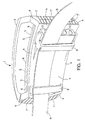
- the computer system 1 has a computer housing 2 which contains all of the components of a general purpose computer as listed earlier.
- a battery 3 is positioned in computer housing 2 to provide power to the computer system 1.
- a side is broken away to illustrate the location of the battery 3 adjacent to highly heat insulating side wall or layer 4 which will contact a user when body supported.
- An additional heat insulating layer (or air) 5 is optionally located between the battery 3 and the inner wall of insulating side 5 to provide triple heat insulating layers.
- the cover 6 of battery 3 is made of a heat insulating material to provide a double insulating layer, i.e., battery plus side wall 4.
- air sink vents 7 are located in at least one side of the computer housing 2 to further dissipate heat generated within computer housing 2. These side vents or louvers 7 help reduce the inside heat which could cause malfunctioning or slowing down of the computer functions. In addition, these vents 7 together with the double (or sometimes triple) heat insulating layers provide excellent means to reduce any heat generated that could reach the user.
- Fig. 1 with a side removed clearly shows the battery 3 position and also other features of the computer housing 2.
- Belt loops 8 are used to attach computer 1 to the user's body or to a strap or belt 9.
- Outlet ports 10 are used to connect peripherals or other items to the computer 1.
- the computer 1 is shown connected to a belt 9 for attachment to a user's body.
- the cables 11 extend to peripherals such as a head set, display, printer or additional power supply.
- peripherals such as a head set, display, printer or additional power supply.
- side wall or layer 4 will be in touch with a user's body and as such requires the maximum insulation provided by this invention.
- the internal battery 3 provide both power and additional heat insulation to the computer 1 of this invention.
- FIG. 4 computer 1 of this invention is shown as worn over the torso or shoulder of the user.
- the computer housing 2 is contacting the user's body and the optimized heat insulation of this invention is a significant improvement over the prior art.
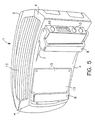
- Fig. 5 shows computer housing 2 with side air vents or louvers 12 positioned on sides of computer housing 2 rather than front and back as shown in Fig. 1. Also a door 13 is located in the side wall 4; this door 13 is used to remove the battery 6 for replacement or recharging.
Landscapes
- Engineering & Computer Science (AREA)
- Theoretical Computer Science (AREA)
- Physics & Mathematics (AREA)
- General Engineering & Computer Science (AREA)
- General Physics & Mathematics (AREA)
- Computer Hardware Design (AREA)
- Human Computer Interaction (AREA)
- Cooling Or The Like Of Electrical Apparatus (AREA)
- Power Sources (AREA)
- Secondary Cells (AREA)
- Casings For Electric Apparatus (AREA)
- Professional, Industrial, Or Sporting Protective Garments (AREA)
Applications Claiming Priority (2)
| Application Number | Priority Date | Filing Date | Title |
|---|---|---|---|
| US550133 | 2000-04-17 | ||
| US09/550,133 US6262889B1 (en) | 1998-06-05 | 2000-04-17 | Insulated mobile computer |
Publications (2)
| Publication Number | Publication Date |
|---|---|
| EP1148410A2 true EP1148410A2 (fr) | 2001-10-24 |
| EP1148410A3 EP1148410A3 (fr) | 2004-05-12 |
Family
ID=24195878
Family Applications (1)
| Application Number | Title | Priority Date | Filing Date |
|---|---|---|---|
| EP00123789A Withdrawn EP1148410A3 (fr) | 2000-04-17 | 2000-11-02 | Ordinateur mobile |
Country Status (10)
| Country | Link |
|---|---|
| US (1) | US6262889B1 (fr) |
| EP (1) | EP1148410A3 (fr) |
| JP (1) | JP3588051B2 (fr) |
| KR (1) | KR20010096497A (fr) |
| CN (1) | CN1318779A (fr) |
| AU (1) | AU742713B2 (fr) |
| CA (1) | CA2325152C (fr) |
| HK (1) | HK1041331A1 (fr) |
| IL (1) | IL140463A0 (fr) |
| TW (1) | TW495661B (fr) |
Cited By (3)
| Publication number | Priority date | Publication date | Assignee | Title |
|---|---|---|---|---|
| EP3430490A4 (fr) * | 2016-07-22 | 2019-11-13 | Hewlett-Packard Development Company, L.P. | Boîtiers extérieurs pour dispositifs informatiques |
| TWI784461B (zh) * | 2021-03-31 | 2022-11-21 | 賴志峯 | 一種用於手機的可穿戴式設備 |
| US11644870B2 (en) | 2014-11-28 | 2023-05-09 | Semiconductor Energy Laboratory Co., Ltd. | Electronic device |
Families Citing this family (27)
| Publication number | Priority date | Publication date | Assignee | Title |
|---|---|---|---|---|
| US20020040377A1 (en) * | 1998-09-25 | 2002-04-04 | Newman Edward G. | Computer with audio interrupt system |
| US6470587B1 (en) * | 1999-07-09 | 2002-10-29 | Vought Aircraft Industries, Inc. | Method and system for part measurement and verification |
| US20050166220A1 (en) * | 2001-08-30 | 2005-07-28 | Mckay Brent | Visual Network Appliance System |
| US6552899B2 (en) * | 2001-05-08 | 2003-04-22 | Xybernaut Corp. | Mobile computer |
| US6958905B2 (en) * | 2001-06-12 | 2005-10-25 | Xybernaut Corporation | Mobile body-supported computer with battery |
| US6529372B1 (en) * | 2001-08-17 | 2003-03-04 | Xybernaut Corp. | Wearable computer-battery system |
| US20030154291A1 (en) * | 2002-02-05 | 2003-08-14 | International Business Machines Corporation | Mobile modular computer |
| US20060039116A1 (en) * | 2004-08-03 | 2006-02-23 | Egbon Electronics Ltd. | Heat-sinking base plate and its manufacturing method |
| US20080082363A1 (en) * | 2005-10-07 | 2008-04-03 | Nader Habashi | On-line healthcare consultation services system and method of using same |
| US7848093B2 (en) * | 2006-02-06 | 2010-12-07 | Hardson Winston B | Digital video and music player belt buckles |
| US8586233B2 (en) * | 2008-09-22 | 2013-11-19 | Panasonic Corporation | Portable electronic device |
| JPWO2010032487A1 (ja) * | 2008-09-22 | 2012-02-09 | パナソニック株式会社 | 携帯電子機器 |
| WO2011017175A2 (fr) * | 2009-07-28 | 2011-02-10 | Voicelever International, Llc | Dispositif de calcul monté sur une sangle |
| US8941981B2 (en) * | 2010-10-22 | 2015-01-27 | Xplore Technologies Corp. | Computer with high intensity screen |
| US9813776B2 (en) | 2012-06-25 | 2017-11-07 | Pin Pon Llc | Secondary soundtrack delivery |
| US9265458B2 (en) | 2012-12-04 | 2016-02-23 | Sync-Think, Inc. | Application of smooth pursuit cognitive testing paradigms to clinical drug development |
| US9380976B2 (en) | 2013-03-11 | 2016-07-05 | Sync-Think, Inc. | Optical neuroinformatics |
| CN104460829A (zh) * | 2013-09-12 | 2015-03-25 | 纬创资通股份有限公司 | 电子装置模块、电子装置、保护组件及工作频率提高方法 |
| US9986655B1 (en) * | 2013-11-13 | 2018-05-29 | VCE IP Holding Company LLC | Converged infrastructure strap |
| US9626899B2 (en) | 2013-12-24 | 2017-04-18 | Seiko Epson Corporation | Electro-optical apparatus and electronic apparatus |
| US9529396B2 (en) * | 2014-11-28 | 2016-12-27 | Asia Vital Components Co., Ltd. | Heat dissipation structure of intelligent wearable device |
| US9652005B2 (en) * | 2015-07-13 | 2017-05-16 | Qualcomm Incorporated | Thermal solution for wearable devices by using wrist band as heat sink |
| KR101753731B1 (ko) | 2015-08-31 | 2017-07-06 | 이솔정보통신(주) | 전자칠판에서 문서공유를 위한 파일변환장치 |
| KR20170025747A (ko) | 2015-08-31 | 2017-03-08 | 이솔정보통신(주) | 전자칠판에서 이기종간 문서공유를 통한 다인 학습장치 |
| EP3933547B1 (fr) | 2016-11-16 | 2023-12-27 | Magic Leap, Inc. | Systèmes de gestion thermique pour composants pouvant être portés |
| CN109152304A (zh) * | 2018-10-11 | 2019-01-04 | 郑州莱兹电子科技有限公司 | 一种新型手机散热装置 |
| US12315360B2 (en) * | 2023-07-13 | 2025-05-27 | Royce Hutain | Gender reveal system |
Family Cites Families (10)
| Publication number | Priority date | Publication date | Assignee | Title |
|---|---|---|---|---|
| JPH04162347A (ja) * | 1990-10-26 | 1992-06-05 | Nippon Telegr & Teleph Corp <Ntt> | 電池パック |
| US5305244B2 (en) * | 1992-04-06 | 1997-09-23 | Computer Products & Services I | Hands-free user-supported portable computer |
| US5572401A (en) * | 1993-12-13 | 1996-11-05 | Key Idea Development L.L.C. | Wearable personal computer system having flexible battery forming casing of the system |
| US5719743A (en) * | 1996-08-15 | 1998-02-17 | Xybernaut Corporation | Torso worn computer which can stand alone |
| US5774338A (en) * | 1996-09-20 | 1998-06-30 | Mcdonnell Douglas Corporation | Body integral electronics packaging |
| JP2001506779A (ja) * | 1996-11-01 | 2001-05-22 | ヴィーア・インコーポレイテッド | 可撓性のある着用可能なコンピュータシステム |
| ES2184253T3 (es) * | 1997-04-15 | 2003-04-01 | Michael T Perkins | Sistema de cinturon de soporte que integra ordenadores, interfaces y otros dispositivos. |
| US6304459B1 (en) * | 1997-05-22 | 2001-10-16 | Xybernaut Corp. | Mobile computer |
| US6055155A (en) * | 1998-02-18 | 2000-04-25 | International Business Machines Corporation | Case for portable computers for enhanced heat dissipation |
| JP2000357030A (ja) * | 1999-06-16 | 2000-12-26 | Matsushita Electric Ind Co Ltd | 情報処理装置 |
-
2000
- 2000-04-17 US US09/550,133 patent/US6262889B1/en not_active Expired - Lifetime
- 2000-10-11 AU AU65448/00A patent/AU742713B2/en not_active Ceased
- 2000-10-19 TW TW089121982A patent/TW495661B/zh not_active IP Right Cessation
- 2000-10-30 CN CN00133706A patent/CN1318779A/zh active Pending
- 2000-11-02 EP EP00123789A patent/EP1148410A3/fr not_active Withdrawn
- 2000-11-06 KR KR1020000065499A patent/KR20010096497A/ko not_active Ceased
- 2000-11-06 CA CA002325152A patent/CA2325152C/fr not_active Expired - Fee Related
- 2000-12-21 IL IL14046300A patent/IL140463A0/xx unknown
-
2001
- 2001-01-09 JP JP2001001703A patent/JP3588051B2/ja not_active Expired - Fee Related
-
2002
- 2002-04-15 HK HK02102829.1A patent/HK1041331A1/zh unknown
Cited By (5)
| Publication number | Priority date | Publication date | Assignee | Title |
|---|---|---|---|---|
| US11644870B2 (en) | 2014-11-28 | 2023-05-09 | Semiconductor Energy Laboratory Co., Ltd. | Electronic device |
| US11977415B2 (en) | 2014-11-28 | 2024-05-07 | Semiconductor Energy Laboratory Co., Ltd. | Electronic device |
| US12360568B2 (en) | 2014-11-28 | 2025-07-15 | Semiconductor Energy Laboratory Co., Ltd. | Electronic device |
| EP3430490A4 (fr) * | 2016-07-22 | 2019-11-13 | Hewlett-Packard Development Company, L.P. | Boîtiers extérieurs pour dispositifs informatiques |
| TWI784461B (zh) * | 2021-03-31 | 2022-11-21 | 賴志峯 | 一種用於手機的可穿戴式設備 |
Also Published As
| Publication number | Publication date |
|---|---|
| JP3588051B2 (ja) | 2004-11-10 |
| TW495661B (en) | 2002-07-21 |
| HK1041331A1 (zh) | 2002-07-05 |
| IL140463A0 (en) | 2002-02-10 |
| CA2325152A1 (fr) | 2001-10-17 |
| US6262889B1 (en) | 2001-07-17 |
| CA2325152C (fr) | 2003-05-20 |
| JP2001306187A (ja) | 2001-11-02 |
| CN1318779A (zh) | 2001-10-24 |
| AU742713B2 (en) | 2002-01-10 |
| KR20010096497A (ko) | 2001-11-07 |
| AU6544800A (en) | 2001-10-18 |
| EP1148410A3 (fr) | 2004-05-12 |
Similar Documents
| Publication | Publication Date | Title |
|---|---|---|
| US6262889B1 (en) | Insulated mobile computer | |
| AU753586B1 (en) | Mobile computer | |
| US6304459B1 (en) | Mobile computer | |
| KR100361110B1 (ko) | 모듈식 핸즈-프리 이동 컴퓨터 | |
| US5719744A (en) | Torso-worn computer without a monitor | |
| US6351388B1 (en) | Mobile computer with PC housing for PC card and dongle | |
| EP0827061B1 (fr) | Ordinateur mobile | |
| HK1051731A (en) | Mobile computer | |
| HK1008250B (en) | Mobile computer |
Legal Events
| Date | Code | Title | Description |
|---|---|---|---|
| PUAI | Public reference made under article 153(3) epc to a published international application that has entered the european phase |
Free format text: ORIGINAL CODE: 0009012 |
|
| 17P | Request for examination filed |
Effective date: 20001110 |
|
| AK | Designated contracting states |
Kind code of ref document: A2 Designated state(s): AT BE CH CY DE DK ES FI FR GB GR IE IT LI LU MC NL PT SE TR |
|
| AX | Request for extension of the european patent |
Free format text: AL;LT;LV;MK;RO;SI |
|
| PUAL | Search report despatched |
Free format text: ORIGINAL CODE: 0009013 |
|
| AK | Designated contracting states |
Kind code of ref document: A3 Designated state(s): AT BE CH CY DE DK ES FI FR GB GR IE IT LI LU MC NL PT SE TR |
|
| AX | Request for extension of the european patent |
Extension state: AL LT LV MK RO SI |
|
| AKX | Designation fees paid |
Designated state(s): AT BE CH CY DE DK ES FI FR GB GR IE IT LI LU MC NL PT SE TR |
|
| 17Q | First examination report despatched |
Effective date: 20050201 |
|
| 17Q | First examination report despatched |
Effective date: 20050201 |
|
| STAA | Information on the status of an ep patent application or granted ep patent |
Free format text: STATUS: THE APPLICATION IS DEEMED TO BE WITHDRAWN |
|
| 18D | Application deemed to be withdrawn |
Effective date: 20061208 |