EP1148657A2 - Appareil de demodulation et procédé de demodulation pour communication mobile - Google Patents
Appareil de demodulation et procédé de demodulation pour communication mobile Download PDFInfo
- Publication number
- EP1148657A2 EP1148657A2 EP20010108938 EP01108938A EP1148657A2 EP 1148657 A2 EP1148657 A2 EP 1148657A2 EP 20010108938 EP20010108938 EP 20010108938 EP 01108938 A EP01108938 A EP 01108938A EP 1148657 A2 EP1148657 A2 EP 1148657A2
- Authority
- EP
- European Patent Office
- Prior art keywords
- threshold
- signals
- path
- mobile communication
- section
- Prior art date
- Legal status (The legal status is an assumption and is not a legal conclusion. Google has not performed a legal analysis and makes no representation as to the accuracy of the status listed.)
- Withdrawn
Links
Images







Classifications
-
- H—ELECTRICITY
- H04—ELECTRIC COMMUNICATION TECHNIQUE
- H04B—TRANSMISSION
- H04B1/00—Details of transmission systems, not covered by a single one of groups H04B3/00 - H04B13/00; Details of transmission systems not characterised by the medium used for transmission
- H04B1/69—Spread spectrum techniques
- H04B1/707—Spread spectrum techniques using direct sequence modulation
- H04B1/7097—Interference-related aspects
- H04B1/711—Interference-related aspects the interference being multi-path interference
- H04B1/7115—Constructive combining of multi-path signals, i.e. RAKE receivers
-
- H—ELECTRICITY
- H04—ELECTRIC COMMUNICATION TECHNIQUE
- H04B—TRANSMISSION
- H04B1/00—Details of transmission systems, not covered by a single one of groups H04B3/00 - H04B13/00; Details of transmission systems not characterised by the medium used for transmission
- H04B1/69—Spread spectrum techniques
- H04B1/707—Spread spectrum techniques using direct sequence modulation
- H04B1/7097—Interference-related aspects
- H04B1/711—Interference-related aspects the interference being multi-path interference
- H04B1/7113—Determination of path profile
-
- H—ELECTRICITY
- H04—ELECTRIC COMMUNICATION TECHNIQUE
- H04B—TRANSMISSION
- H04B1/00—Details of transmission systems, not covered by a single one of groups H04B3/00 - H04B13/00; Details of transmission systems not characterised by the medium used for transmission
- H04B1/69—Spread spectrum techniques
- H04B1/707—Spread spectrum techniques using direct sequence modulation
- H04B1/7097—Interference-related aspects
- H04B1/711—Interference-related aspects the interference being multi-path interference
- H04B1/7115—Constructive combining of multi-path signals, i.e. RAKE receivers
- H04B1/7117—Selection, re-selection, allocation or re-allocation of paths to fingers, e.g. timing offset control of allocated fingers
-
- H—ELECTRICITY
- H04—ELECTRIC COMMUNICATION TECHNIQUE
- H04B—TRANSMISSION
- H04B1/00—Details of transmission systems, not covered by a single one of groups H04B3/00 - H04B13/00; Details of transmission systems not characterised by the medium used for transmission
- H04B1/69—Spread spectrum techniques
- H04B1/707—Spread spectrum techniques using direct sequence modulation
- H04B1/7097—Interference-related aspects
- H04B1/711—Interference-related aspects the interference being multi-path interference
- H04B1/7115—Constructive combining of multi-path signals, i.e. RAKE receivers
- H04B1/712—Weighting of fingers for combining, e.g. amplitude control or phase rotation using an inner loop
Definitions
- the present invention relates to a demodulation apparatus and a demodulation method for mobile communication.
- it relates to a demodulation apparatus and a demodulation method for mobile communication adopting CDMA (Code Division Multiple Access).
- CDMA Code Division Multiple Access
- the technique disclosed in document 1 involves using at least one of the receiving fingers for search.
- the technique disclosed in document 2 involves saving the maximum value among previous correlation values and using the maximum value in selecting high values out of correlation values.
- the technique disclosed in document 3 involves detecting reception levels from reception signals, to compare them with a predetermined threshold, and to determine whether or not a correlation signal of an internal memory should be outputted to a reception path timing generation section depending on the comparison result.
- the technique disclosed in the document 4 involves reading a sequence of measurements, deriving a timing offset having a resolution higher than a predetermined timing resolution of a searcher unit, and assigning a finger processing element to the best candidate path using the timing offset.
- a first aspect of the present invention is the demodulation apparatus for mobile communication having capability of cyclically selecting signals that meet a predetermined condition out of signals incoming via different paths, combining the signals, and outputting the combined signals, wherein the apparatus comprises threshold setting means, and signal selecting means for comparing an incoming signal with a threshold set by the threshold setting means and for selecting the compared signal according to the comparison result even if the signal does not meet the predetermined condition.
- a second aspect of the present invention is the demodulation method for mobile communication providing capability of cyclically selecting signals that meet a predetermined condition out of signals incoming via different paths, combining the signals, and outputting the combined signals, wherein the method comprises a first step of setting a threshold, and a second step of comparing an incoming signal with the threshold set by the first step and selecting the compared signals according to the comparison result even if the signal does not meet the predetermined condition.
- a third aspect of the present invention is the recording medium on which a control program for a demodulation method for mobile communication is recorded, the demodulation method providing capability of cyclically selecting signals that meet a predetermined condition out of signals incoming via different paths, combining the signals, and outputting the combined signals, wherein the control program is recorded on the recording medium and comprises a first step of setting a threshold, and a second step of comparing an incoming signal with the threshold set by the first step and selecting the compared signals according to the comparison result even if the signal does not meet the predetermined condition.
- the first, second, and third aspects allow for reception of a path immediately after the path appears and providing good receiving characteristics, since these aspect are configured to compare the incoming signals with the threshold set by the threshold setting means and to select the compared signals according to the comparison result even if the signals do not meet the predetermined condition.
- a demodulation circuit for CDMA mobile communication receives a path immediately after the path appears to provide good receiving characteristics by path search processing that involves adaptively controlling a guard level for finger assignment according to a correlation peak value obtained by calculation of a delay profile.
- Fig. 1 shows a configuration of the demodulation circuit to which outputs of quadrature detection are input.
- a path comparing section 3 compares correlation peak values and their path timings detected from a delay profile with correlation peak values and their path timings assigned to fingers in the previous cycle. If a path timing determining section 4 determines from the comparison result that a path with high intensity level has newly appeared, it immediately assigns the path to one of the fingers 5. This allows for maintaining good receiving characteristics.
- Fig. 1 is a block diagram of the first embodiment of the present invention. It shows a configuration of the demodulation circuit, which is adapted for a common demodulation scheme in which fingers /a RAKE are used.
- the demodulation circuit comprises a delay profile calculating section 1, a correlation peak detecting section 2, a path comparing section 3, a path timing determining section 4, fingers 5, a RAKE receiver section 6, and a received data processing section 7.
- I component signals and Q component signals that have been quadrature-detected and demodulated are respectively input to the delay profile calculating section 1.
- the delay profile calculating section 1 correlation calculation is performed using known data portions of the signals to be received, and a delay profile averaged by in-phase addition and power addition is created.
- peak search is performed for the delay profile created in the delay profile calculating section 1 to select path locations with high power level for candidate path locations to be assigned to the fingers, and their path timings and correlation values are input to the path comparing section 3.
- path timings assigned to the fingers in the previous cycle and their correlation value information have been fed back from the path timing determining section 4 to the path comparing section3, and a threshold is determined from the correlation value information.
- the path comparing section 3 compares the information that is input from the correlation peak detecting section 2 with the information fed back from the path timing determining section 4 to determine whether or not there is a path exceeding the threshold among the path timings that have not been assigned to the fingers. Then, it outputs the comparison result to the path timing determining section 4.
- the path timing determining section 4 is provided with a guard level to prevent flapping of paths to be assigned to the fingers. Thus, the path timing determining section 4 assigns a path timing to a finger if its peak is detected at a certain path location for more than once, and excludes a path timing from assignment to a finger if its peak is not detected for more than once. This processing in the path timing determining section 4 is well known.
- the path comparing section 3 controls the guard level (i.e. the guard level is decreased or caused to be disregarded for that path timing), and the path timing determining section 4 immediately assigns the intense path to a finger.
- This processing by the path comparing section 3 and the path timing determining section 4 is the novel part of this invention.
- the fingers section 5 performs de-spreading with the timings of the paths assigned respectively to the fingers, and the RAKE receiver section 6 combines the de-spreading result of each finger. Then, from the signals combined and provided with a path diversity effect, the received data processing section 7 obtains a desired demodulation result for outputting.
- the guard level is used to prevent flapping of paths to be assigned to the fingers.
- the feature of the present invention is that, when a path with high intensity level that could be an intense interfering component if not RAKE-combined appeared, the path is assigned to a finger in preference to other paths. Assigning such a path with high intensity level to a finger in preference to other paths enables maintaining good receiving characteristics.
- Fig. 2 is a block diagram of an example of the path comparing section 3.
- the path comparing section 3 comprises a path location comparing section 31, a threshold calculating section 32, a level comparing section 33, and a guard level controlling section 34.
- Correlation peak detection data D1 obtained in the correlation peak detecting section 2 as well as finger assignment data D2 of the previous cycle obtained in the path timing determining section 4 are input to the path location comparing section 31 to compare the path locations of both data D1 and D2.
- the threshold calculating section 32 calculates a threshold D3 based on the finger assignment data D2.
- the level comparing section 33 compares the outputs of the path location comparing section 31, i.e. the level of the data D1 and the threshold D3, where the path location of the data D1 is determined to be unmatched with the path location of the data D2 of the previous cycle. Then, the comparison result is input to the guard level controlling section 34.
- the controlling section 34 controls the guard level in the path timing determining section 4 according to the comparison result. That is, if the level of the data D1 is determined to be equal to or above the threshold D3, the guard level controlling section 34 decreases the guard level in the path timing determining section 4 or causes the guard level to be disregarded. On the other hand, if the level of the data D1 is determined to be below the threshold D3, the guard level controlling section 34 causes the guard level in the path timing determining section 4 to be executed.
- the value for B can be one or above one (B ⁇ 1; e.g. 1.1). However, it is not to be limited to this value, but it may be a value below one (0 ⁇ B ⁇ 1; e.g. 0.9). In other words, different values can be set for B, depending on the purpose.
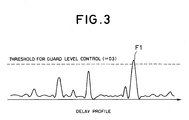
- Fig. 3 is a diagram of a delay profile waveform indicating the processing in the level comparing section 33.
- the level comparing section 33 detects that the level of the data F1, which was determined to be unmatched with the path location of the data of the previous cycle, is equal to or above the threshold D3
- the guard level controlling section 34 controls the guard level in the path timing determining section 4. Then, the path timing determining section 4 assigns the data F1 to one of the fingers 5 in preference to other data.
- Fig. 4 is a flow chart showing the operations of the path comparing section 3.
- the correlation peak detecting section 2 detects a correlation peak value and a peak location from the delay profile obtained in the delay profile calculating section 1 (step 20).
- the path comparing section 3 (specifically the path location comparing section 31) determines whether or not the detected peak location has been already assigned to a finger (step 21).
- a mask width M M is a real number
- M is set so as not to cause excess switches of assignment in the finger assignment processing. If the detected timing is within M (if Yes in step 21), the path is considered as an identical path, and it is determined that tracking is performed (step 22).
- the path comparing section 3 (specifically the threshold calculating section 32) also has the threshold D3 prepared for determining whether or not the path is a newly generated candidate path having high power. If the peak value is determined to be that of a different path in step 21 (if No in step 21), the peak value is compared with the threshold D3 in the path comparing section 3 (specifically in the level comparing section 33) (step 23). Then, if the peak value is equal to or above the threshold D3 (if Yes in step 23), the guard level controlling section 34 controls the guard level in the path timing determining section 4 (step 25). On the other hand, if the peak value is below the threshold D3 (if No in step 23), the guard level controlling section 34 does not control the guard level in the path timing determining section 4 (step 24).
- the path timing determining section 4 uses the information (information of whether controlling the guard level or not) from the path comparing section 3 (specifically the guard level controlling section 34). If the detected peak is below the threshold D3, the path timing determining section 4 determines whether or not the path can be assigned to a finger without the guard level condition being controlled (see step 24). If the peak is equal to or above the threshold D3, it controls the guard level conditions (see step 25) to assign the path to a finger in preference to other paths with the decreased guard level that is less than the guard level of step 24. Then, the path to be assigned to a finger is determined from the results of step 22, 24, and 25 (step 26).
- the maximum peak value A is detected in the finger assignment data D2 of the previous cycle to determine the threshold D3 based on the maximum peak value A.
- this embodiment is not limited by the data D2 of "the previous cycle", but it can be configured to determine the threshold D3 based on the average of maximum peak values for the past several cycles, for example.
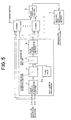
- Fig. 5 is a block diagram of the second embodiment.
- components similar to those in the configuration of the first embodiment will be labeled with the like reference numbers, and description about them will be omitted.
- the second embodiment is different from the first embodiment in that the feedback line from the path timing determining section 4 to the path comparing section 3 is eliminated. In other words, it is different from the first embodiment in that the path comparing section 3 does not determine the threshold D3 based on the finger assignment data D2 of the previous cycle. In the second embodiment, the path comparing section 3 uses a fixed value D4 as the threshold.
- Fig. 6 is a block diagram of the path comparing section 3 in the second embodiment.
- components similar to those in the configuration of the path comparing section 3 in the first embodiment (see Fig. 2) will be labeled with the like reference numbers, and description about them will be omitted.
- the path comparing section 3 comprises the threshold calculating section 32, the level comparing section 33, and the guard level controlling section 34. That is, the path location comparing section 31 is eliminated.
- the threshold calculating section 32 do not specially calculate the threshold, since the above mentioned fixed value D4 is input to the threshold calculating section 32 and adopted directly as the threshold.
- the level comparing section 33 compares the correlation peak detection data D1 from the correlation peak detecting section 2 with the threshold D4. If the data D1 is equal to or above the threshold D4, the level comparing section 33 causes the guard level controlling section 34 to control the guard level. Accordingly, the correlation peak detection data D1 is assigned to a finger in the path timing determining section 4. On the other hand, if the data D1 is below the threshold D4, the level comparing section 33 does not cause the guard level controlling section 34 to control the guard level. Accordingly, the guard level processing is performed in the path timing determining section 4.
- Fig. 7 and 8 are diagrams of profile waveforms indicating the processing in the path comparing section 3. They show that the threshold D4 is fixed in both cases where it is compared with the delay profile of the previous cycle and where it is compared with the current delay profile. They also show that a data having the maximum peak value F2 that is above the threshold D4 (data of a path location that is different from a path location assigned to a finger in the previous cycle) was detected by the path comparing section 3 in the current comparison.
- the path comparing section 3 controls the guard level so that the data having the maximum peak value F2 is assigned to one of the fingers 5 in preference to other data in the path timing determining section 4.
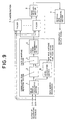
- Fig. 9 is a block diagram of the third embodiment.
- components similar to those in the configuration of the first embodiment will be labeled with the like reference numbers, and description about them will be omitted.
- the third embodiment is different from the second embodiment (see Fig. 5) in that a level calculating section 8 is provided instead of the fixed value D4.
- Output of the delay profile calculating section 1 is input to the level calculating section 8, and output of the level calculating section 8 is input to the path comparing section 3.
- the level calculating section 8 detects data having the maximum peak value F3 from the delay profile of the current cycle (not of the previous cycle).
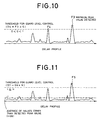
- Fig. 10 is a diagram of a delay profile waveform indicating the processing in the path comparing section 3. It shows that the maximum peak value F4 that is equal to or above the threshold D5 (data of a path location that is different from a path location assigned to a finger in the previous cycle) was detected in the current cycle.
- the path comparing section 3 controls the guard level so that the data having the maximum peak value F4 is assigned to one of the fingers 5 in preference to other data in the path timing determining section 4.
- a block diagram of the fourth embodiment is similar to the block diagram of the third embodiment (Fig. 9).
- Fig. 11 is a diagram of a delay profile waveform indicating the processing in the path comparing section 3. It shows that the maximum peak value F5 that is equal to or above the threshold D7 (data of a path location that is different from a path location assigned to a finger in the previous cycle) was detected by the path comparing section 3 in comparing the current cycle. Thus, the path comparing section 3 controls the guard level so that the data having the maximum peak value F5 is assigned to one of the fingers 5 in preference to other data in the path timing determining section 4.
- Fig. 12 is a block diagram of the fifth embodiment.
- the fifth embodiment is different from the third and fourth embodiments in that a delay section 9 is added to the output side of the level calculating section 8, and that the output of the delay section 9 is input to the path comparing section 3. This means that the calculation result of the level calculating section 8 is delayed by one cycle in the delay section 9 and then input to the path comparing section 3.
- the path comparing section 3 compares the delay profile of the current cycle with the threshold of the previous cycle.
- Fig. 13 is a diagram of a delay profile waveform indicating the processing in the path comparing section 3. It shows that data having the maximum peak value F7 that is equal to or above the threshold D8 (data of a path location that is different from a path location of data of the previous cycle) was detected by the path comparing section 3 in the current cycle by comparing the delay profile of the current cycle with the threshold D8 determined based on the delay profile of the previous cycle.
- the path comparing section 3 controls the guard level so that the data having the maximum peak value F7 is assigned to one of the fingers 5 in preference to other data in the path timing determining section 4.
- the configuration of the sixth embodiment is similar to the configuration of the fifth embodiment (see Fig. 12).
- Fig. 14 is a diagram of a delay profile waveform indicating the processing in the path comparing section 3. It shows that data having the maximum peak value F8 that is equal to or above the threshold D10 (data of a path location that is different from a path location of data of the previous cycle) was detected by the path comparing section 3 in the current cycle by comparing the delay profile of the current cycle with the threshold D10 determined based on the delay profile of the previous cycle.
- the path comparing section 3 controls the guard level so that the data having the maximum peak value F8 is assigned to one of the fingers 5 in preference to other data in the path timing detecting section 4.
- Fig. 15 is a flow chart indicating the operations of the second embodiment through the sixth embodiment.
- the threshold is set based on the delay profile determined in the delay profile calculating section 1 (step 31). Then, it is determined whether or not a correlation peak value detected in the correlation peak detecting section 2 is equal to or above the threshold (step 32). If the correlation peak value is equal to or above the threshold (if Yes in step 32), the guard level is controlled (step 33). On the other hand, if it is below the threshold (if No in step 32), the guard level is not controlled (step 34). Then, the path to be assigned to a finger is determined by the results of steps 33 and 34 (step 35).
- the seventh embodiment relates to a recording medium on which a control program for the demodulation method is recorded.
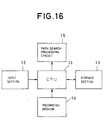
- Fig. 16 is a block diagram of an example of a recording medium drive.
- the recording medium drive consists of a CPU (Central Processing Unit) 11, an input section 12, a storage section 13, and a path search processing circuit 15.
- the path search processing circuit 15 represents the above described path search processing section that consists of the delay profile calculating section 1, the correlation peak detecting section 2, the path comparing section 3, the path timing determining section 4, and so on.
- Recorded on the recording medium 14 is the control program represented by the above described flow charts of Fig. 4 and 15.
- the first invention is the demodulation apparatus for mobile communication having capability of cyclically selecting signals that meet a predetermined condition out of signals incoming via different paths, combining the signals, and outputting the combined signals, wherein the demodulation apparatus comprises threshold setting means, and signals selecting means for comparing the incoming signals with a threshold set by the threshold setting means and for selecting the compared signals according to the comparison result even if the signals do not meet the predetermined condition.
- a first advantage is the ability of quickly tracking changes in paths to be received and providing good receiving characteristics. This is provided by the fact that it is possible to respond to paths to be received immediately after they appear by assigning a new path with high power to a finger in preference to other paths if such a path is detected from the delay profile.
- a second advantage is the ability of reducing the influence of erroneous detection of path timings caused by noise, and providing good receiving characteristics. This is provided by the fact that it is possible to control the guard level in an appearance of a path with a sufficiently high level of intensity using a threshold for the guard level control.
- the second invention is the demodulation method for mobile communication providing capability of cyclically selecting signals that meet a predetermined condition out of signals incoming via different paths, combining the signals, and outputting the combined signals, wherein the demodulation method comprises a first step of setting a threshold, and a second step of comparing the incoming signals with the threshold set by the first step and selecting the compared signals according to the comparison result even if the signals do not meet the predetermined condition.
- the third invention is the recording medium on which a control program for a demodulation method for mobile communication is recorded, the demodulation method providing capability of cyclically selecting signals that meet a predetermined condition out of signals incoming via different paths, combining the signals, and outputting the combined signals, wherein the control program is recorded on the recording medium and comprises a first step of setting a threshold, and a second step of comparing the incoming signals with the threshold set by the first step and selecting the compared signals according to the comparison result even if the signals do not meet the predetermined condition.
Landscapes
- Engineering & Computer Science (AREA)
- Computer Networks & Wireless Communication (AREA)
- Signal Processing (AREA)
- Mobile Radio Communication Systems (AREA)
- Radio Transmission System (AREA)
- Synchronisation In Digital Transmission Systems (AREA)
Applications Claiming Priority (2)
| Application Number | Priority Date | Filing Date | Title |
|---|---|---|---|
| JP2000117370A JP2001308744A (ja) | 2000-04-19 | 2000-04-19 | 移動通信復調装置及びその復調方法並びにその制御プログラムを記録した記録媒体 |
| JP2000117370 | 2000-04-19 |
Publications (2)
| Publication Number | Publication Date |
|---|---|
| EP1148657A2 true EP1148657A2 (fr) | 2001-10-24 |
| EP1148657A3 EP1148657A3 (fr) | 2003-07-09 |
Family
ID=18628692
Family Applications (1)
| Application Number | Title | Priority Date | Filing Date |
|---|---|---|---|
| EP20010108938 Withdrawn EP1148657A3 (fr) | 2000-04-19 | 2001-04-10 | Appareil de démodulation et procédé de démodulation pour communication mobile |
Country Status (4)
| Country | Link |
|---|---|
| US (1) | US7039099B2 (fr) |
| EP (1) | EP1148657A3 (fr) |
| JP (1) | JP2001308744A (fr) |
| CN (1) | CN1318922A (fr) |
Cited By (4)
| Publication number | Priority date | Publication date | Assignee | Title |
|---|---|---|---|---|
| EP1229666A1 (fr) * | 2001-01-30 | 2002-08-07 | Nec Corporation | Circuit et procédé de démodulation pour communication mobile à AMDC |
| GB2390001A (en) * | 2002-06-19 | 2003-12-24 | Nec Corp | CDMA demodulation circuit |
| WO2004028021A1 (fr) * | 2002-09-18 | 2004-04-01 | Telefonaktiebolaget Lm Ericsson (Publ) | Systeme evolue de commande de temps de propagation dans un recepteur de rake |
| EP1447914A1 (fr) * | 2003-02-05 | 2004-08-18 | Infineon Technologies AG | Détection de voies de transmissions de données |
Families Citing this family (5)
| Publication number | Priority date | Publication date | Assignee | Title |
|---|---|---|---|---|
| JP3565269B2 (ja) * | 2001-08-22 | 2004-09-15 | 日本電気株式会社 | Cdma受信装置とパスサーチ方法およびプログラム |
| JP4165238B2 (ja) * | 2003-01-29 | 2008-10-15 | 日本電気株式会社 | パスサーチ回路及びその方法ならびにプログラム |
| TW200520407A (en) | 2003-03-13 | 2005-06-16 | Interdigital Tech Corp | Wireless communication method and system for assigning multi-paths to Rake receiver fingers |
| JP2004343542A (ja) * | 2003-05-16 | 2004-12-02 | Sony Ericsson Mobilecommunications Japan Inc | 携帯情報通信端末、プログラムおよび記録媒体 |
| JP4224105B2 (ja) | 2007-01-19 | 2009-02-12 | 日本電波工業株式会社 | 信号処理部及び無線機 |
Citations (1)
| Publication number | Priority date | Publication date | Assignee | Title |
|---|---|---|---|---|
| US5530716A (en) * | 1994-06-30 | 1996-06-25 | Motorola, Inc. | Method and apparatus for identifying a coded communication signal |
Family Cites Families (6)
| Publication number | Priority date | Publication date | Assignee | Title |
|---|---|---|---|---|
| JP2853705B2 (ja) | 1997-05-07 | 1999-02-03 | 日本電気株式会社 | スペクトラム拡散通信受信機 |
| KR100268677B1 (ko) * | 1998-04-04 | 2000-10-16 | 윤종용 | 코드 분할 다중 접속 통신 시스템에서 확산 코드의 위상 획득 방법과 그 장치 |
| US6389067B1 (en) * | 1999-06-10 | 2002-05-14 | Qualcomm, Inc. | Method and apparatus for using frame energy metrics to improve rate determination |
| JP3370955B2 (ja) * | 1999-07-19 | 2003-01-27 | 株式会社日立国際電気 | Cdma基地局装置 |
| CN1118201C (zh) * | 1999-08-11 | 2003-08-13 | 信息产业部电信科学技术研究院 | 一种基于智能天线的干扰抵销方法 |
| US6683924B1 (en) * | 1999-10-19 | 2004-01-27 | Ericsson Inc. | Apparatus and methods for selective correlation timing in rake receivers |
-
2000
- 2000-04-19 JP JP2000117370A patent/JP2001308744A/ja active Pending
-
2001
- 2001-04-10 US US09/829,048 patent/US7039099B2/en not_active Expired - Fee Related
- 2001-04-10 EP EP20010108938 patent/EP1148657A3/fr not_active Withdrawn
- 2001-04-19 CN CN01117078A patent/CN1318922A/zh active Pending
Patent Citations (1)
| Publication number | Priority date | Publication date | Assignee | Title |
|---|---|---|---|---|
| US5530716A (en) * | 1994-06-30 | 1996-06-25 | Motorola, Inc. | Method and apparatus for identifying a coded communication signal |
Non-Patent Citations (1)
| Title |
|---|
| RAPPAPORT; GRIECO: "SPREAD-SPECTRUM SIGNAL ACQUISITION: METHODS AND TECHNOLOGY", IEEE COMMUNICATIONS MAGAZINE, vol. 22, no. 6, 1 June 1984 (1984-06-01), pages 6 - 21 * |
Cited By (9)
| Publication number | Priority date | Publication date | Assignee | Title |
|---|---|---|---|---|
| EP1229666A1 (fr) * | 2001-01-30 | 2002-08-07 | Nec Corporation | Circuit et procédé de démodulation pour communication mobile à AMDC |
| US6977955B2 (en) | 2001-01-30 | 2005-12-20 | Nec Corporation | Demodulation circuit for CDMA mobile communications and demodulation method therefor |
| GB2390001A (en) * | 2002-06-19 | 2003-12-24 | Nec Corp | CDMA demodulation circuit |
| GB2390001B (en) * | 2002-06-19 | 2006-03-15 | Nec Corp | CDMA demodulation circuit,CDMA mobile communication demodulation method used therefor,and storage medium recording program thereof |
| US7313169B2 (en) | 2002-06-19 | 2007-12-25 | Nec Corporation | CDMA demodulation circuit, CDMA mobile communication demodulation method used therefor, and storage medium recording program thereof |
| WO2004028021A1 (fr) * | 2002-09-18 | 2004-04-01 | Telefonaktiebolaget Lm Ericsson (Publ) | Systeme evolue de commande de temps de propagation dans un recepteur de rake |
| US7197063B2 (en) | 2002-09-18 | 2007-03-27 | Telefonaktiebolaget Lm Ericsson (Publ) | Advanced rake delay control |
| EP1447914A1 (fr) * | 2003-02-05 | 2004-08-18 | Infineon Technologies AG | Détection de voies de transmissions de données |
| US7313171B2 (en) | 2003-02-05 | 2007-12-25 | Infineon Technologies Ag | Apparatus for data transmission path detection |
Also Published As
| Publication number | Publication date |
|---|---|
| US7039099B2 (en) | 2006-05-02 |
| US20010033609A1 (en) | 2001-10-25 |
| JP2001308744A (ja) | 2001-11-02 |
| CN1318922A (zh) | 2001-10-24 |
| EP1148657A3 (fr) | 2003-07-09 |
Similar Documents
| Publication | Publication Date | Title |
|---|---|---|
| US6222834B1 (en) | Spread spectrum communication receiver | |
| US20020163896A1 (en) | Radio communication terminal and interference canceling method | |
| JP4242343B2 (ja) | Rake受信機、およびrake受信機におけるチャネルのマルチパスサーチを制御する方法 | |
| KR100384097B1 (ko) | 개선된 경로 타이밍 검출 방법 및 그것을 이용한 cdma수신 장치 | |
| JP3943062B2 (ja) | Cdma受信装置、cdma受信方法、cdma受信プログラム、及び、プログラム記録媒体 | |
| JP2001024551A (ja) | 通信端末装置及び無線受信方法 | |
| EP1148657A2 (fr) | Appareil de demodulation et procédé de demodulation pour communication mobile | |
| JP3879595B2 (ja) | Cdma復調回路及びそれに用いるcdma移動体通信復調方法 | |
| US7359399B2 (en) | CDMA path protection method based on path protection information | |
| EP1229666B1 (fr) | Circuit et procédé de démodulation pour communication mobile à AMDC | |
| JP2003347968A (ja) | パス位置検出方法およびcdma受信装置 | |
| US6522686B1 (en) | Receiving apparatus of spectrum spread communication system | |
| US7269437B2 (en) | Transmission power control circuit using W-CDMA method | |
| JP4807527B2 (ja) | パスサーチ処理回路及びパスサーチ方法並びに制御プログラム | |
| EP1154585B1 (fr) | Récepteur pour un dispositif de communication pour un canal radio à multi-voies | |
| EP1137193A2 (fr) | Procédé et circuit de mésure du profile de retard | |
| JP4720439B2 (ja) | 移動体通信復調回路及びそれに用いるパスサーチ方法 | |
| HK1041379A (en) | Demodulation apparatus and demodulation method for mobile communication | |
| JP4661560B2 (ja) | 同期追跡回路及びcdma受信装置 | |
| JP2004104575A (ja) | パス・タイミング検出装置 |
Legal Events
| Date | Code | Title | Description |
|---|---|---|---|
| PUAI | Public reference made under article 153(3) epc to a published international application that has entered the european phase |
Free format text: ORIGINAL CODE: 0009012 |
|
| AK | Designated contracting states |
Kind code of ref document: A2 Designated state(s): AT BE CH CY DE DK ES FI FR GB GR IE IT LI LU MC NL PT SE TR |
|
| AX | Request for extension of the european patent |
Free format text: AL;LT;LV;MK;RO;SI |
|
| PUAL | Search report despatched |
Free format text: ORIGINAL CODE: 0009013 |
|
| AK | Designated contracting states |
Designated state(s): AT BE CH CY DE DK ES FI FR GB GR IE IT LI LU MC NL PT SE TR |
|
| AX | Request for extension of the european patent |
Extension state: AL LT LV MK RO SI |
|
| 17P | Request for examination filed |
Effective date: 20030605 |
|
| 17Q | First examination report despatched |
Effective date: 20030923 |
|
| AKX | Designation fees paid |
Designated state(s): DE FR GB IT |
|
| STAA | Information on the status of an ep patent application or granted ep patent |
Free format text: STATUS: THE APPLICATION HAS BEEN WITHDRAWN |
|
| 18W | Application withdrawn |
Effective date: 20050623 |