EP1149879A2 - Mikroemulsionstechniken für Tintenstrahldrucktinten - Google Patents
Mikroemulsionstechniken für Tintenstrahldrucktinten Download PDFInfo
- Publication number
- EP1149879A2 EP1149879A2 EP01303530A EP01303530A EP1149879A2 EP 1149879 A2 EP1149879 A2 EP 1149879A2 EP 01303530 A EP01303530 A EP 01303530A EP 01303530 A EP01303530 A EP 01303530A EP 1149879 A2 EP1149879 A2 EP 1149879A2
- Authority
- EP
- European Patent Office
- Prior art keywords
- solvent
- dye
- ink composition
- inkjet ink
- aqueous
- Prior art date
- Legal status (The legal status is an assumption and is not a legal conclusion. Google has not performed a legal analysis and makes no representation as to the accuracy of the status listed.)
- Granted
Links
Images



Classifications
-
- C—CHEMISTRY; METALLURGY
- C09—DYES; PAINTS; POLISHES; NATURAL RESINS; ADHESIVES; COMPOSITIONS NOT OTHERWISE PROVIDED FOR; APPLICATIONS OF MATERIALS NOT OTHERWISE PROVIDED FOR
- C09D—COATING COMPOSITIONS, e.g. PAINTS, VARNISHES OR LACQUERS; FILLING PASTES; CHEMICAL PAINT OR INK REMOVERS; INKS; CORRECTING FLUIDS; WOODSTAINS; PASTES OR SOLIDS FOR COLOURING OR PRINTING; USE OF MATERIALS THEREFOR
- C09D11/00—Inks
- C09D11/30—Inkjet printing inks
Definitions
- the invention relates to aqueous inkjet inks with oil-soluble dyes that are made more soluble in the aqueous vehicle by making a microemulsion in the ink of solvent moieties with both solubilizing groups and hydrophobic groups.
- inkjet printing systems has grown dramatically in recent years. This growth may be attributed to substantial improvements in print resolution and overall print quality coupled with appreciable reduction in cost.
- Today's inkjet printers offer acceptable print quality for many commercial, business, and household applications at costs fully an order of magnitude lower than comparable products available just a few years ago. Notwithstanding their recent success, intensive research and development efforts continue toward improving inkjet print quality, while further lowering cost to the consumer.
- An inkjet image is formed when a precise pattern of dots is ejected from a drop-generating device known as a "printhead" onto a printing medium.
- the typical inkjet printhead has an array of precisely formed nozzles located on a nozzle plate and attached to an inkjet printhead substrate.
- the substrate incorporates an array of firing chambers that receive liquid ink (colorants dissolved or dispersed in a solvent) through fluid communication with one or more ink reservoirs.
- Each chamber has a thin-film resistor, known as a "firing resistor,” located opposite the nozzle so ink can collect between the firing resistor and the nozzle.
- each resistor element which is typically a pad of a resistive material, measures about 35 ⁇ m x 35 ⁇ m.
- the printhead is held and protected by an outer packaging referred to as a print cartridge, i.e., inkjet pen.
- a droplet of ink is expelled through the nozzle toward the print medium, whether paper, transparent film or the like.
- the firing of ink droplets is typically under the control of a microprocessor, the signals of which are conveyed by electrical traces to the resistor elements, thereby forming alphanumeric and other characters on the print medium.
- Water is the most attractive solvent for inkjet ink. Because of this, drop-on-demand inkjet inks are 50-90% water. Accordingly, most of the inkjet ink formulations are based on water-soluble colorants, that is, water-soluble dyes or water-dispersible pigments. This comes at the price that inkjet images are not stable to water, in particular, to the action of water combined with rubbing (so-called wet smudge).
- inks in the art that are stable to the action of water. These inks are based on organic solvents and use solvent-soluble dyes or solvent-dispersible pigments. These inks are widely used in such areas as continuous inkjet and gravure printing inks.
- the solvent systems used in these applications are methylethylketone, methylbutylketone, acetone, toluene, ethyl acetate, as well as solvent mixtures, such as 40% ethyl acetate, 40% ethyl alcohol, and 20% toluene. These solvents however are hard to use in drop-on-demand inkjet.
- Emulsions represent a plurality of droplets of one liquid in another.
- Emulsions can be of two different types, e.g., oil-in-water (O/W) or water-in-oil (W/O).
- emulsions can be microemulsions and macroemulsions.
- Microemulsions are thermodynamically equilibrium systems. Some microemulsions are also known as "swollen micelles", which means that they represent surfactant micelles with the oil solubilized inside. Typical microemulsion particle size is 5-50 nm. Microemulsions are normally transparent or slightly bluish because of the very small particle size.
- macroemulsions are not in thermodynamic equilibrium and do not form spontaneously, that is , they require mechanical agitation for preparation. Furthermore, their particle size is larger, 50 nm and up. One of the common examples of macroemulsions is milk. Finally, 'miniemulsions' are a special case of macroemulsions with smaller particle size, below 1 ⁇ m. They are not thermodynamically stable and do not form spontaneously; however, they can be made kinetically stable, so that the particle size does not change with time.
- a major formulation problem involved in this approach is the limited solubility of the solvent dyes in the microemulsion formulations. Indeed, in order to get the full benefits of water-based inks, that is, the good bubble nucleation and temperature control, low toxicity and smell, and moderate viscosity, the weight percentage of the solvent in the ink should not exceed 50%; more preferably, it should not exceed 20%. If one further assumes that the solvent dye is completely water-insoluble and dissolves only in the solvent domains of the microemulsion, then, in order to get the dye load of 3%, typical for drop-on-demand inkjet, one needs the solubility of the dye in the solvent to be at least 6%, preferably at least 15%.
- solubility of the dye is highly desirable.
- most solvent dyes cannot be dissolved to such a degree in apolar oils conventionally used in microemulsion formulations. The reason for this is the fact that most of the solvent dyes conventionally used in inkjet inks are not soluble in both water and hydrocarbons.
- the present invention relates to an aqueous inkjet ink composition
- an aqueous inkjet ink composition comprising:
- the present invention further relates to a method of making an aqueous inkjet ink composition comprising the steps of:
- Figure 1 shows the dye molecule (filled ellipse) on the left in non-structured solution of the dye solubilizing group, S, (unfilled ellipse) in water (filled black circles).
- S dye solubilizing group
- R grafted hydrophobic tails
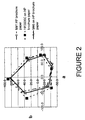
- Figures 2 and 3 are color gamut charts showing the color performance of Microemulsion # 6 compared to the color performance of Hewlett Packard HP2000C Ink Jet Printer on Hewlett Packard Professional Brochure & Flyer Paper, Two-Sided Gloss (Fig. 2) and Champion Data Copy office paper (Champion) (Fig. 3) respectively.
- Figure 4 plots drops per 1/600 dpi against optical density for Microemulsion #6/Savinyl NS Black on Hewlett Packard Professional Brochure & Flyer Paper, Two-Sided Gloss, Hewlett Packard Premium Inkjet Paper, and Champion Data Copy office paper (Champion) papers.
- the present invention described herein is directed to inkjet inks for printing inkjet images using commercially available inkjet printers such as, for example but not limited to, HP DeskJet® printers, manufactured by Hewlett-Packard Company, of Palo Alto, California.
- the inks enable production of near photographic images having little or no coalescence, excellent waterfastness, and reduced dry time, on a range of print media, in particular, for example but not limited to, plain white, 8 1 ⁇ 2" X 11", 20 lb. weight, printer paper conventionally used for office and home computers.
- Microemulsions represent single-phase thermodynamically equilibrium mixtures of a surfactant, optionally, a co-surfactant, an oil and water.
- Surfactant molecules consist of two blocks: a hydrocarbon tail, and a polar head.
- the term "oil” is broadly used in this application and means any water-immiscible solvent, such as alkanes, esters or ethers. Some other solvents that have more distinct surfactant-like structures, e.g., alcohols, are normally classified as “co-surfactants”.
- water here means an aqueous solution of salts, or other water-compatible solvents such as glycols or glycerol, or their water-soluble derivatives.
- the structure of a microemulsion represents water domains separated from the oil domains by a surfactant monolayer film. If a co-surfactant is present in the system, it tends to assemble together with the co-surfactant, forming a mixed monolayer. Normally, the system represents small 1-10 nm oil drops ("swollen micelles") dispersed in water, with the surfactant molecules assembled at the interface. However, other surfactant assemblies, such as bilayer aggregates (lamellar phase, vesicles) are also possible. After the structure is formed, the solvent soluble dye can be solubilized into the hydrophobic interior of the drops.
- Solvent dyes are defined as dyes soluble in organic solvents and virtually insoluble in water. An extensive list of solvent dyes can be found in Colour Index, Third edition, Volume 3, 1971, published by The society of Dyers and Colourists, pp 3563 - 3648. For some of the solvent dyes, the solubility properties in a wide variety of organic solvents have been determined. Thus, Clariant GmbH, Division of Pigments and Additives, BU Pigments, Frankfurt, Germany, offers solvent dyes sold under the tradename Savinyl® Dyes. For all these dyes, the solubility in 19 solvents of various polarity, such as water, hydrocarbons, alcohols, ketones, ethers and esters has been evaluated and this data is supplied by the manufacturer.
- the solvent dyes do not dissolve neither in water nor in hydrocarbons (e. g., toluene or white spirit), but dissolve well in rather polar solvents, such as methanol, ethanol, cyclohexanone, 2-pyrrolidone, methylethylketone or in oligoethylene or oligopropylene glycols.
- solvents such as methanol, ethanol, cyclohexanone, 2-pyrrolidone, methylethylketone or in oligoethylene or oligopropylene glycols.
- specific chemical moieties in the structure of the solvent can drastically improve the solubility. These chemical moieties are 5-6 membered rings (both saturated and aromatic), ether, and keto-groups.
- the Savinyl solvent dyes have 250-500 g/l solubility in cyclohexanone, and most of them dissolve at > 100g/l in benzyl alcohol.
- 2-pyrrolidinone, tetraethylene glycol, and polyethylene glycol dissolve Savinyl Yellow RLS, Savinyl Pink 6BLS, Savinyl Blue GLS, and Savinyl Black NS at ⁇ > 33 wt%.
- these solvents will be called below "dye solubilizers" and abbreviated as S.
- the mechanism of their solvent action is unclear, but apparently represents a combination of polarity match plus specific interactions with the dye chromophores.
- the present inventor has found that in order to effectively solubilize the solvent dyes in aqueous solution with dye-solubilizing solvents in a microemulsion system, it is important to induce the microscopic separation of dye solubilizing groups of the solvent from the water.
- One way to achieve this is to graft hydrophobic groups, R, to the dye-solubilizing moieties, S.
- the hydrophobic groups self-associate and form a micelle, with the dye-solubilizing groups at the surface of the micelle, this micelle surface known as the "palisade layer" 1 .
- the dyes can then be solubilized into the micellar palisade layer.
- the dyes have a much higher solubility in this system, because direct contact of the dye with water is avoided.
- this solvent having both dye-solubilizing solvents and grafted hydrophobic groups is alkyl-substituted 2-pyrrolidinones (also known as alkyl-substituted 2-pyrrolidones). These solvents have very little smell, no toxicity and dissolve many solvent dyes. Non-substituted 2-pyrrolidinone itself is polar and completely miscible with water. Alkyl-substituted 2-pyrrolidinones must be therefore regarded as weak surfactants themselves, akin to microemulsion "co-surfactants", which are normally medium-chain alcohols.
- anionic surfactants can be used. Nonlimiting examples of such anionic surfactants are alkylsulfates, alkylcarboxylates and alkylsulfonates, as well as nonionic surfactants.
- the present invention relates to an aqueous inkjet ink composition
- an aqueous inkjet ink composition comprising:
- the present invention relates to a method of making an aqueous inkjet ink composition comprising the steps of:
- the micelle further comprises surfactants. In more preferred embodiments, the micelle further comprises co-surfactants.
- the dye-solubilizing groups are derived from oligoethylene glycols selected from the group consisting of diethylene glycol, tetraethylene glycol and octaethylene glycol. In other more preferred embodiments, the dye-solubilizing groups are derived from oligopropylene glycols selected from the group consisting of dipropylene glycol, tetrapropylene glycol and octapropylene glycol. In yet other more preferred embodiments, the hydrophobic groups have from 4 to 20 carbon atoms.
- the hydrophobic group (R) and the solubilizing group (S) form the solvent of the formula R-S with a bond between R and S selected from a carbon-carbon bond, a carbon-oxygen ether bond, a carbon-oxygen ester bond, a carbon-nitrogen amine bond and a carbon-nitrogen amide bond.
- the aqueous inkjet ink composition is comprised of from 1 to 5 wt. percent dye.
- the aqueous inkjet ink composition is comprised of from 5 to 50 wt. percent of the solvent having the formula R-S.
- the aqueous inkjet ink composition is comprised of from 50 to 80 wt. percent of the aqueous vehicle.
- the dye molecules are selected from the group consisting of Cl Solvent Yellow 79, Cl Solvent Yellow 83:1, Cl Solvent Yellow 83, Cl Solvent Yellow 62, Cl Solvent Orange 41, Cl Solvent Orange 62, Cl Solvent Red 92, Cl Solvent Red 124, Cl Solvent Red 8, Cl Solvent Red 91, Cl Solvent Red 127, Cl Acid Violet 66, Cl Solvent Blue 45, Cl Solvent Blue 44, Cl Solvent Black 45, Cl Solvent Black 27, Solvent Red 217, Solvent Red 218, Neozapon Red 395, Solvent Blue 35, Solvent Black 27, Savinyl Yellow RLS, Savinyl Pink 6BLS, Savinyl Blue GLS, and Savinyl Black NS.
- Example 1 Typical Microemulsion Formulations.
- microemulsion formulations studied are shown in Tables 1 through 11 below.
- S in R-S-solvents 2-pyrrolidonyl and oligo(ethylene oxide) groups were used.
- the systems additionally contained humectants and, in some cases, surfactants. All the systems studied were water-based and were in single-phase state at room temperature.
- Microemulsion #1 Component wt% 1-Octyl-2-pyrrolidone (Aldrich) 7 Dodecane (Aldrich) 3 Sodium dodecyl sulfate (Sigma) 1 Diethylene glycol (Aldrich) 3.6 2-Pyrrolidone (Aldrich) 3.6 Glycerol (Aldrich) 9 Trizma Base (Aldrich) 0.18 Proxel GXL (ICI) 0.18 EDTA disodium salt (Aldrich) 0.18 water balance Microemulsion #2 Component wt% 1-Octyl-2-pyrrolidone (Aldrich) 20 Dodecane (Aldrich) 2.6 Sodium dodecyl sulfate (Sigma) 2 Diethylene glycol (Aldrich) 3 2-Pyrrolidone (Aldrich) 3 Glycerol (Aldrich) 7.5 Trizma Base (Aldrich) 0.15 Proxe
- Viscosities shown in Table 12, were measured using a VE System (Vilastic Scientific, Inc.) at 25 °C. Ten measurements were made over the range of shear rates from 10 to 200 s -1 . The flow was Newtonian in all cases.
- Microemulsions #1 and #6 were subjected to thermal variations between 5 °C and 60°C, and to freeze-thaw cycle between -30 °C and room temperature. No phase separation occurred. After freeze-thaw cycle, the systems remained single-phase and became slightly opalescent; the turbidity disappeared on standing..
- Solubility of dyes in microemulsions was accessed the following way. Dry dye was added to a microemulsion at around 3 wt%. The sample was placed on rollers and mixed overnight. A 100 ⁇ l sample of supernatant was collected and filtered through 0.22 ⁇ m filter, after which it was diluted by ethanol by a factor of 1:1000 - 1: 10000 w/w. The concentration of the dye was determined spectrophotometrically by using a calibration constructed with solutions of the dye in ethanol. The results are shown in Tables 13. In some cases, the solubility was accessed visually as judged by complete dissolution of the solid dye; these data are shown in Table 14.
- Solubility of Savinyl Solvent Dyes from Clariant in various microemulsion systems wt% (spectrophotometric data) Dye M #1 M #5 M #6 M #7 M #2 M #11 M #13 M #18 M #32 M #33 Savinyl blue GLS (668 1.2 >2.66 >2.36 >2.45 >2.85 0.83 1.02 1.90 0.84 0.89 nm) Savinyl Pink 6BLS 1.7 >3.47 >3.43 >3.33 >3.30 1.88 2.52 >3.14 0.90 1.08 (542 nm) Savinyl yellow 2.0 >2.97 >2.64 >2.71 >2.91 0.45 0.79 1.48 1.46 1.60 RLS(430 nm) Savinyl black NS(580 nm) No data >2.97 >3.09 >2.89 >2.95 0.47 0.49 0.92 >4.17 2.44 Solubility of Savinyl Solvent Dyes from Clariant in Microemulsion #6, wt% (visual inspection) Dye M #6 Savin
- Example 5 (comparative). Solubility of Savinyl dyes in microemulsions versus solubility in non-structured solvents and solvent mixtures
- Solubility of Savinyl Dyes in water,2-pyrrolidone, water-2-pyrrolidone binary mixtures, and octyl-2-pyrrolidone-based microemulsions Solvent Savinyl Yellow RLS Savinyl Pink BLS Savinyl Blue GLS Savinyl Black NS Water ⁇ 0.1% ⁇ 0.1% ⁇ 0.1% 2-Pyrrolidone (2-P) >33% >33% >33% >33% >33% >33% 20% 2P-80% water 0.3% 0.2% 0.1% 0.3% 50% 2P-50% water 0.3% 0.2% 0.1% 0.3%
- Microemulsion #1 (containing 7% octyl-2-pyrrolidone) 2.0% 1.7% 1.2% no data
- Microemulsion #2 (containing 20% octyl-2-pyrrolidone) >2.91% >3.3% >2.85% >2.95%
- 2-Pyrrolidone (2-P) is an excellent solvent for Savinyl solvent dyes, and water is a very poor solvent.
- microemulsion systems containing 7 and 20 wt% of octyl-2P, respectively, dissolve the dyes on the level of several percents.
- Example 6 (comparative). Solubility of Savinyl dyes in microemulsions versus solubility in non-structured solvents and solvent mixtures
- Solubility of Savinyl Dyes in water, tetraethylene glycol, water-tetraethylene glycol binary mixtures, and aqueous solutions of ethoxylated surfactants Solvent Savinyl Yellow RLS Savinyl Pink BLS Savinyl Blue GLS Savinyl Black NS Water ⁇ 0.1% ⁇ 0.1% ⁇ 0.1% Tetra(ethylene glycol), ⁇ TEG ⁇ , (Aldrich) >33% >33% >33% >33% >33% >33% 20% TEG-80% water 0.07% 0.03% 0.05% 0.16% 50% TEG-50% water 0.23% 0.31% 0.15% 0.48% Microemulsion #13 (containing 10% of Tergitol NP-10, Union Carbide) 0.79% 2.52% 1.02% 0.49% Microemulsion #18 (containing 20% n-octyl-OCH 2 CH 2 ) 5 OH 1.48% 3.14% 1.90% 0.92%
- tetraethylene glycol is an excellent solvent for Savinyl solvent dyes, and water is a poor solvent. Their binary mixtures are not effective solvents, and even 50-50 mixture of water and TEG dissolves less than 1% of the dyes.
- solutions of surfactants such as Tergitol NP-10 and n-octyl(OCH 2 CH 2 ) 5 OH have a significantly higher solubilization capacity at much lower concentration in the formulation.
- Tergitol NP-10 surfactant represents a nonylphenol ether of ethylene oxide, containing on average 10 ethylene oxide groups.
- Savinyl dyes from Clariant Savinyl Blue GLS, Savinyl Yellow RLS, and Savinyl Pink 6BLS were dissolved in Microemulsions #1 and #6. In order to dissolve the dye, 3% of a dry dye was added to the microemulsion and the system was left on rolls overnight. For Microemulsion #6, the dissolution was complete; for Microemulsion #1, the dissolution was not complete and the inks were filtered from the excess dye. The inks were then filled into color printheads of an HP 2000c Hewlett Packard printer. Th inks showed good print quality on office and special inkjet papers, specifically, no missing nozzles, controlled wicking and almost instant drying.
- the color gamut volume was somewhat less than that of the HP2000c, as shown in Figures 2 and 3.
- the ink flux per unit area was 8 pL per 1/600 sq. inch for primary and 16 pL per 1/600pL secondary colors for HP2000c default inks and for Microemulsion #6; it was x2 higher for Microemulsion #1 inks.
- Example 8 Performance of a microemulsion-based black
- Example 9 Durability of microemulsion inks (waterfastness, wet smudge, highlighter smear).
- Savinyl dyes from Clariant Savinyl Blue GLS, Savinyl Yellow RLS, and Savinyl Pink 6BLS were dissolved in Microemulsions #6 and #7 at 3 wt%. Waterfastness to passive water drip was evaluated by dripping 200 ml of water on a printout tilted at 45 degrees. The optical density transfer between the rectangular bars was measured using a MacBeth spectrophotometer. Wet smudge was measured similarly, with the difference that after dripping the water, the image was smudged by finger in a rubber glove. Alkaline highlighter smear was measured by using a Major Accent Highlighter (Sanford). The results of testing are summarized in Tables 17 and 18.
- the inks of the current invention conserve the gloss of the paper to a considerable degree, while LaserJet substantially reduces the gloss.
- the Savinyl dyes from Clariant: Black RLSN, Blue RLS, Red 3 BLS, Fire Red 3 GLS, Yellow 2 GLS, Yellow 2 RLS, and Yellow RLSN have been dissolved in Microemulsion #6 at 3% . The dissolution was complete for all the dyes except for the blue. The solutions were filtered through 0.45 ⁇ m filter and were filled into color pens of HP 2000c Hewlett Packard printer. The inks printed well and did not show significant wicking on office paper. The inks showed excellent lightfastness, as measured by the method described in Example 10, (Table 21), and durability , as measured by the methods described in Example 9 (Table 22). Lightfastness of Savinyl Dyes in Microemulsion #6 (1 yr.
- Savinyl Black RLSN 1.52 0.975 1.52 0.947 1.00 0.97 2.
- Savinyl Blue RLS 0.389 0.099 0.336 0.099 0.86 1.00 3.
- Savinyl Red 3 BLS 1.2 0.282 1.18 0.293 0.98 1.04 4.
- Savinyl Fire Red 3 GLS 1.52 0.362 1.5 0.288 0.99 0.80 5.
Landscapes
- Chemical & Material Sciences (AREA)
- Life Sciences & Earth Sciences (AREA)
- Engineering & Computer Science (AREA)
- Materials Engineering (AREA)
- Wood Science & Technology (AREA)
- Organic Chemistry (AREA)
- Inks, Pencil-Leads, Or Crayons (AREA)
- Ink Jet Recording Methods And Recording Media Thereof (AREA)
- Ink Jet (AREA)
Applications Claiming Priority (2)
| Application Number | Priority Date | Filing Date | Title |
|---|---|---|---|
| US552145 | 2000-04-19 | ||
| US09/552,145 US6432183B1 (en) | 2000-04-19 | 2000-04-19 | Microemulsion techniques for ink jet inks |
Publications (3)
| Publication Number | Publication Date |
|---|---|
| EP1149879A2 true EP1149879A2 (de) | 2001-10-31 |
| EP1149879A3 EP1149879A3 (de) | 2002-08-28 |
| EP1149879B1 EP1149879B1 (de) | 2007-11-21 |
Family
ID=24204102
Family Applications (1)
| Application Number | Title | Priority Date | Filing Date |
|---|---|---|---|
| EP01303530A Expired - Lifetime EP1149879B1 (de) | 2000-04-19 | 2001-04-18 | Mikroemulsionstechniken für Tintenstrahldrucktinten |
Country Status (4)
| Country | Link |
|---|---|
| US (1) | US6432183B1 (de) |
| EP (1) | EP1149879B1 (de) |
| JP (1) | JP4375915B2 (de) |
| DE (1) | DE60131489T2 (de) |
Cited By (2)
| Publication number | Priority date | Publication date | Assignee | Title |
|---|---|---|---|---|
| EP1282670A2 (de) * | 2000-05-16 | 2003-02-12 | Yissum Research Development Company of the Hebrew University of Jerusalem | Tintenstrahl-tintenzusammensetzungen auf basis von öl-in-wasser-mikroemulsion, welche nanoteilchen bilden beim auftragen auf eine oberfläche |
| EP2184102A1 (de) | 2008-11-11 | 2010-05-12 | Stichting Dutch Polymer Institute | Partikelherstellungsverfahren, Partikelbibliotheken und ihre Verwendung |
Families Citing this family (9)
| Publication number | Priority date | Publication date | Assignee | Title |
|---|---|---|---|---|
| US6881250B2 (en) * | 2003-01-15 | 2005-04-19 | Xerox Corporation | Tailored ink for piston driven electrostatic liquid drop modulator |
| US7674328B2 (en) | 2003-03-25 | 2010-03-09 | Hewlett-Packard Development Company, L.P. | Dye-based ink |
| US20050227096A1 (en) * | 2004-04-06 | 2005-10-13 | Phil Harding | Emulsion with discontinouous phase including particle sol |
| US20050232974A1 (en) * | 2004-04-19 | 2005-10-20 | Gore Makarand P | System and a method for pharmaceutical dosage preparation using jettable microemulsions |
| WO2005113694A1 (en) * | 2004-05-21 | 2005-12-01 | Noveon, Inc. | Emulsion composition and vehicle and ink compositions and printing process and method thereof |
| US20090033834A1 (en) * | 2005-02-18 | 2009-02-05 | Takashi Kuroda | Liquid crystal layer forming ink composition, and optical film, polarizing film and liquid crystal display produced with the ink composition |
| EP2670810A4 (de) | 2011-01-31 | 2014-04-16 | Hewlett Packard Development Co | Thermische tinten auf emulsionsbasis für tintenstrahldrucker |
| JP6194116B2 (ja) * | 2013-08-16 | 2017-09-06 | キャボット コーポレイションCabot Corporation | 限定された溶解度を有する界面活性剤を含むインク組成物 |
| US11292933B2 (en) | 2018-01-15 | 2022-04-05 | South Dakota Board Of Regents | Stable oil-in-water nanoemulsion containing upconverting nanoparticles |
Family Cites Families (11)
| Publication number | Priority date | Publication date | Assignee | Title |
|---|---|---|---|---|
| US4783220A (en) * | 1986-12-18 | 1988-11-08 | Xerox Corporation | Vesicle ink compositions |
| US5275647A (en) * | 1991-11-25 | 1994-01-04 | Xerox Corporation | Ink compositions |
| US5226957A (en) * | 1992-03-17 | 1993-07-13 | Hewlett-Packard Company | Solubilization of water-insoluble dyes via microemulsions for bleedless, non-threading, high print quality inks for thermal ink-jet printers |
| US5484475A (en) * | 1994-08-29 | 1996-01-16 | Xerox Corporation | Micellar-based ink compositions |
| US5492559A (en) * | 1994-10-19 | 1996-02-20 | Xerox Corporation | Liquid crystalline microemulsion ink compositions |
| US5565022A (en) * | 1995-09-14 | 1996-10-15 | Hewlett-Packard Company | Fast drying, bleed-free ink-jet ink compositions |
| US5626654A (en) * | 1995-12-05 | 1997-05-06 | Xerox Corporation | Ink compositions containing liposomes |
| US5643357A (en) | 1995-12-08 | 1997-07-01 | Xerox Corporation | Liquid crystalline ink compositions |
| DE69820897T2 (de) * | 1997-10-31 | 2004-12-09 | Hewlett-Packard Co. (N.D.Ges.D.Staates Delaware), Palo Alto | Haltbare, filmformende, wasserdispergierbare polymere |
| US6245137B1 (en) * | 1999-04-30 | 2001-06-12 | Hewlett-Packard Company | Surfactants for improved ink-jet performance |
| US6342094B1 (en) * | 2000-01-31 | 2002-01-29 | Hewlett-Packard Company | Miniemulsion techniques for ink jet inks |
-
2000
- 2000-04-19 US US09/552,145 patent/US6432183B1/en not_active Expired - Lifetime
-
2001
- 2001-04-06 JP JP2001108884A patent/JP4375915B2/ja not_active Expired - Fee Related
- 2001-04-18 DE DE60131489T patent/DE60131489T2/de not_active Expired - Lifetime
- 2001-04-18 EP EP01303530A patent/EP1149879B1/de not_active Expired - Lifetime
Cited By (3)
| Publication number | Priority date | Publication date | Assignee | Title |
|---|---|---|---|---|
| EP1282670A2 (de) * | 2000-05-16 | 2003-02-12 | Yissum Research Development Company of the Hebrew University of Jerusalem | Tintenstrahl-tintenzusammensetzungen auf basis von öl-in-wasser-mikroemulsion, welche nanoteilchen bilden beim auftragen auf eine oberfläche |
| US7115161B2 (en) | 2000-05-16 | 2006-10-03 | Yissum Research Development Company Of The Hebrew University Of Jerusalem | Ink-jet ink compositions based on oil-in-water microemulsion forming nanoparticles upon application on a surface |
| EP2184102A1 (de) | 2008-11-11 | 2010-05-12 | Stichting Dutch Polymer Institute | Partikelherstellungsverfahren, Partikelbibliotheken und ihre Verwendung |
Also Published As
| Publication number | Publication date |
|---|---|
| DE60131489T2 (de) | 2008-06-12 |
| EP1149879A3 (de) | 2002-08-28 |
| EP1149879B1 (de) | 2007-11-21 |
| DE60131489D1 (de) | 2008-01-03 |
| JP4375915B2 (ja) | 2009-12-02 |
| JP2002012804A (ja) | 2002-01-15 |
| US6432183B1 (en) | 2002-08-13 |
Similar Documents
| Publication | Publication Date | Title |
|---|---|---|
| JP4030721B2 (ja) | インクジェットインクのためのミニエマルジョン技術 | |
| EP0863189B1 (de) | Tintenstrahltinten für eine verbesserte Bildqualität | |
| JP4312273B2 (ja) | インクジェット用インクセット及びブリード低減法 | |
| JP3507535B2 (ja) | 熱インクジェットインク及びその製造方法 | |
| EP1696005B1 (de) | Wasserbasistinte und sie benutzende tintenpatrone, verfahren zur tintenstrahlaufzeichnung sowie aufzeichnungen | |
| JPH05194893A (ja) | インク組成物 | |
| JPH10130551A (ja) | インクジェット・インク | |
| US6432183B1 (en) | Microemulsion techniques for ink jet inks | |
| US6818048B2 (en) | Ink-jet inks for improved image quality and reliability | |
| EP0947569B1 (de) | Tintenstrahldrucktinten und Verfahren zum Drucken | |
| JP4158323B2 (ja) | 記録用インク | |
| JP2002285048A (ja) | インクジェット記録用インク | |
| JP3932820B2 (ja) | インクジェット記録用水性インク | |
| JPH1088050A (ja) | インク | |
| JP4366558B2 (ja) | インクジェット用水性インクセット及びインクジェット記録方法 | |
| EP1308488B1 (de) | Tintenstrahltinten für eine verbesserte Bildqualität und Zuverlässigkeit | |
| EP0763579B1 (de) | Zerfliessungsverminderte wässrige Tintenstrahl-Tintenzusammensetzungen auf Pigment-Dispersionsbasis | |
| JP2003089763A (ja) | インクジェット記録用インクセット | |
| JP2006524746A (ja) | インクジェット印刷方法 | |
| HK1051554B (en) | Ink-jet inks for improved image quality and reliability | |
| HK1000127B (en) | Black to color bleed control in thermal ink-jet printing |
Legal Events
| Date | Code | Title | Description |
|---|---|---|---|
| PUAI | Public reference made under article 153(3) epc to a published international application that has entered the european phase |
Free format text: ORIGINAL CODE: 0009012 |
|
| AK | Designated contracting states |
Kind code of ref document: A2 Designated state(s): AT BE CH CY DE DK ES FI FR GB GR IE IT LI LU MC NL PT SE TR |
|
| AX | Request for extension of the european patent |
Free format text: AL;LT;LV;MK;RO;SI |
|
| PUAL | Search report despatched |
Free format text: ORIGINAL CODE: 0009013 |
|
| AK | Designated contracting states |
Kind code of ref document: A3 Designated state(s): AT BE CH CY DE DK ES FI FR GB GR IE IT LI LU MC NL PT SE TR |
|
| AX | Request for extension of the european patent |
Free format text: AL;LT;LV;MK;RO;SI |
|
| 17P | Request for examination filed |
Effective date: 20030114 |
|
| AKX | Designation fees paid |
Designated state(s): DE FR GB NL |
|
| 17Q | First examination report despatched |
Effective date: 20050331 |
|
| GRAP | Despatch of communication of intention to grant a patent |
Free format text: ORIGINAL CODE: EPIDOSNIGR1 |
|
| GRAS | Grant fee paid |
Free format text: ORIGINAL CODE: EPIDOSNIGR3 |
|
| GRAA | (expected) grant |
Free format text: ORIGINAL CODE: 0009210 |
|
| AK | Designated contracting states |
Kind code of ref document: B1 Designated state(s): DE FR GB NL |
|
| REG | Reference to a national code |
Ref country code: GB Ref legal event code: FG4D |
|
| REF | Corresponds to: |
Ref document number: 60131489 Country of ref document: DE Date of ref document: 20080103 Kind code of ref document: P |
|
| ET | Fr: translation filed | ||
| PLBE | No opposition filed within time limit |
Free format text: ORIGINAL CODE: 0009261 |
|
| STAA | Information on the status of an ep patent application or granted ep patent |
Free format text: STATUS: NO OPPOSITION FILED WITHIN TIME LIMIT |
|
| 26N | No opposition filed |
Effective date: 20080822 |
|
| REG | Reference to a national code |
Ref country code: GB Ref legal event code: 732E Free format text: REGISTERED BETWEEN 20120329 AND 20120404 |
|
| REG | Reference to a national code |
Ref country code: NL Ref legal event code: SD Effective date: 20120731 |
|
| REG | Reference to a national code |
Ref country code: FR Ref legal event code: PLFP Year of fee payment: 16 |
|
| PGFP | Annual fee paid to national office [announced via postgrant information from national office to epo] |
Ref country code: NL Payment date: 20160321 Year of fee payment: 16 |
|
| REG | Reference to a national code |
Ref country code: FR Ref legal event code: PLFP Year of fee payment: 17 |
|
| PGFP | Annual fee paid to national office [announced via postgrant information from national office to epo] |
Ref country code: FR Payment date: 20170322 Year of fee payment: 17 |
|
| PGFP | Annual fee paid to national office [announced via postgrant information from national office to epo] |
Ref country code: GB Payment date: 20170324 Year of fee payment: 17 |
|
| PGFP | Annual fee paid to national office [announced via postgrant information from national office to epo] |
Ref country code: DE Payment date: 20170321 Year of fee payment: 17 |
|
| REG | Reference to a national code |
Ref country code: NL Ref legal event code: MM Effective date: 20170501 |
|
| PG25 | Lapsed in a contracting state [announced via postgrant information from national office to epo] |
Ref country code: NL Free format text: LAPSE BECAUSE OF NON-PAYMENT OF DUE FEES Effective date: 20170501 |
|
| REG | Reference to a national code |
Ref country code: DE Ref legal event code: R119 Ref document number: 60131489 Country of ref document: DE |
|
| GBPC | Gb: european patent ceased through non-payment of renewal fee |
Effective date: 20180418 |
|
| PG25 | Lapsed in a contracting state [announced via postgrant information from national office to epo] |
Ref country code: DE Free format text: LAPSE BECAUSE OF NON-PAYMENT OF DUE FEES Effective date: 20181101 |
|
| PG25 | Lapsed in a contracting state [announced via postgrant information from national office to epo] |
Ref country code: GB Free format text: LAPSE BECAUSE OF NON-PAYMENT OF DUE FEES Effective date: 20180418 |
|
| PG25 | Lapsed in a contracting state [announced via postgrant information from national office to epo] |
Ref country code: FR Free format text: LAPSE BECAUSE OF NON-PAYMENT OF DUE FEES Effective date: 20180430 |