EP1151740A2 - Biberon d'allaitement - Google Patents
Biberon d'allaitement Download PDFInfo
- Publication number
- EP1151740A2 EP1151740A2 EP20010420099 EP01420099A EP1151740A2 EP 1151740 A2 EP1151740 A2 EP 1151740A2 EP 20010420099 EP20010420099 EP 20010420099 EP 01420099 A EP01420099 A EP 01420099A EP 1151740 A2 EP1151740 A2 EP 1151740A2
- Authority
- EP
- European Patent Office
- Prior art keywords
- bottle
- intermediate element
- bottle according
- teat
- base
- Prior art date
- Legal status (The legal status is an assumption and is not a legal conclusion. Google has not performed a legal analysis and makes no representation as to the accuracy of the status listed.)
- Withdrawn
Links
Images


Classifications
-
- A—HUMAN NECESSITIES
- A61—MEDICAL OR VETERINARY SCIENCE; HYGIENE
- A61J—CONTAINERS SPECIALLY ADAPTED FOR MEDICAL OR PHARMACEUTICAL PURPOSES; DEVICES OR METHODS SPECIALLY ADAPTED FOR BRINGING PHARMACEUTICAL PRODUCTS INTO PARTICULAR PHYSICAL OR ADMINISTERING FORMS; DEVICES FOR ADMINISTERING FOOD OR MEDICINES ORALLY; BABY COMFORTERS; DEVICES FOR RECEIVING SPITTLE
- A61J11/00—Teats
- A61J11/001—Teats having means for regulating the flow rate
- A61J11/002—Teats having means for regulating the flow rate by using valves
-
- A—HUMAN NECESSITIES
- A61—MEDICAL OR VETERINARY SCIENCE; HYGIENE
- A61J—CONTAINERS SPECIALLY ADAPTED FOR MEDICAL OR PHARMACEUTICAL PURPOSES; DEVICES OR METHODS SPECIALLY ADAPTED FOR BRINGING PHARMACEUTICAL PRODUCTS INTO PARTICULAR PHYSICAL OR ADMINISTERING FORMS; DEVICES FOR ADMINISTERING FOOD OR MEDICINES ORALLY; BABY COMFORTERS; DEVICES FOR RECEIVING SPITTLE
- A61J9/00—Feeding-bottles in general
- A61J9/04—Feeding-bottles in general with means for supplying air
-
- A—HUMAN NECESSITIES
- A61—MEDICAL OR VETERINARY SCIENCE; HYGIENE
- A61J—CONTAINERS SPECIALLY ADAPTED FOR MEDICAL OR PHARMACEUTICAL PURPOSES; DEVICES OR METHODS SPECIALLY ADAPTED FOR BRINGING PHARMACEUTICAL PRODUCTS INTO PARTICULAR PHYSICAL OR ADMINISTERING FORMS; DEVICES FOR ADMINISTERING FOOD OR MEDICINES ORALLY; BABY COMFORTERS; DEVICES FOR RECEIVING SPITTLE
- A61J9/00—Feeding-bottles in general
- A61J9/06—Holders for bottles
-
- A—HUMAN NECESSITIES
- A61—MEDICAL OR VETERINARY SCIENCE; HYGIENE
- A61J—CONTAINERS SPECIALLY ADAPTED FOR MEDICAL OR PHARMACEUTICAL PURPOSES; DEVICES OR METHODS SPECIALLY ADAPTED FOR BRINGING PHARMACEUTICAL PRODUCTS INTO PARTICULAR PHYSICAL OR ADMINISTERING FORMS; DEVICES FOR ADMINISTERING FOOD OR MEDICINES ORALLY; BABY COMFORTERS; DEVICES FOR RECEIVING SPITTLE
- A61J9/00—Feeding-bottles in general
- A61J9/06—Holders for bottles
- A61J9/0607—Holders for bottles having aesthetic features, e.g. toy-like or imitating a female breast
-
- A—HUMAN NECESSITIES
- A61—MEDICAL OR VETERINARY SCIENCE; HYGIENE
- A61J—CONTAINERS SPECIALLY ADAPTED FOR MEDICAL OR PHARMACEUTICAL PURPOSES; DEVICES OR METHODS SPECIALLY ADAPTED FOR BRINGING PHARMACEUTICAL PRODUCTS INTO PARTICULAR PHYSICAL OR ADMINISTERING FORMS; DEVICES FOR ADMINISTERING FOOD OR MEDICINES ORALLY; BABY COMFORTERS; DEVICES FOR RECEIVING SPITTLE
- A61J9/00—Feeding-bottles in general
- A61J9/06—Holders for bottles
- A61J9/063—Holders for bottles having a particular supporting function
- A61J9/0646—Holders for bottles having a particular supporting function for supporting only in a non-feeding position
-
- A—HUMAN NECESSITIES
- A61—MEDICAL OR VETERINARY SCIENCE; HYGIENE
- A61J—CONTAINERS SPECIALLY ADAPTED FOR MEDICAL OR PHARMACEUTICAL PURPOSES; DEVICES OR METHODS SPECIALLY ADAPTED FOR BRINGING PHARMACEUTICAL PRODUCTS INTO PARTICULAR PHYSICAL OR ADMINISTERING FORMS; DEVICES FOR ADMINISTERING FOOD OR MEDICINES ORALLY; BABY COMFORTERS; DEVICES FOR RECEIVING SPITTLE
- A61J9/00—Feeding-bottles in general
- A61J9/06—Holders for bottles
- A61J9/0653—Holders for bottles characterised by the type of support
- A61J9/0684—Holders for bottles characterised by the type of support having a self-supporting base
Definitions
- the present invention relates to a nursing bottle.
- such a bottle comprises a body, for example made of plastic, intended to receive a liquid for feeding an infant, especially milk.
- This body is surmounted by a flexible nipple, which is secured to this body by means of a threaded ring, called screw ring, cooperating with an external thread formed on the upper body.
- the invention relates more particularly to such a bottle , which is fitted with a non-return valve, arranged in the vicinity of the teat, as well as admission means of air in the interior volume of this bottle, provided upstream non-return valve, in the direction of flow of the liquid.
- a non-return valve arranged in the vicinity of the teat, as well as admission means of air in the interior volume of this bottle, provided upstream non-return valve, in the direction of flow of the liquid.
- the air intake in the bottle takes place through the thread which ensures the retention of the nipple fixing ring, on the upper part body open.
- the more or less accentuated deformation of the teat then provides an adjustable closure of the inlet allowing the modification of the flow and the filling speed.
- the invention proposes to produce a nursing bottle allowing to overcome all of these drawbacks.
- a nursing bottle comprising a body intended to be filled with a liquid food, in particular milk, a teat attached to the body, a non-return valve, provided in the vicinity of the teat and means for admitting air into the interior volume of the bottle, provided upstream of said valve in the direction of flow liquid, characterized in that this bottle includes in addition to an intermediate element, having first and second open ends, as well as first and second removable fixing means, respectively on the body and on the teat, this intermediate element being provided with the valve non-return and air intake means.
- the bottle shown in Figure 1, and designated in its together by reference 2 includes a base 4 of stabilization, which is shaped so as to form a figurine, namely a rabbit.
- This base 4 is hollowed out with a opening 6 into which the body of the bottle, as will be described below.
- the base 4 can form a figurine different from a rabbit.
- the opening 6 may not be through, and be replaced by a blind housing.
- Two 12 cylindrical gripping rods coming from material with base, extend from ends side of this base 4.
- Each of these rods 12 comprises, at its free end, a peripheral bead 14, more particularly visible in Figure 3.
- the bottle also includes a body 16, produced by plastic example.
- This body which has a oval cross section, has a closed bottom 18, from from which side walls 20 extend, which define a open end 22, opposite the bottom 18. This oval shape provides easy grip on the body 16.
- the bottom 18 can, in variant, be opening and constitute a second end body open.
- the inner surface 24 of the walls 20 is perfectly smooth and continuous, as shown in particular in FIGS. 1, 2 and 4. Furthermore, the walls 20 define, in the vicinity from the end 22, a substantially frustoconical portion 26, whose thickness increases opposite the end 22 and which is terminated by a shoulder 28, as shown in especially figure 4.
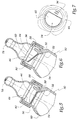
- the bottle 2 is also provided with an intermediate element, designated as a whole by the reference 30, which has a curved profile. It has a first end open 32, of large transverse dimension, communication with the interior volume of the body 16 (see in particular figure 2).
- This element 30 is provided, in the vicinity of this first end 32, of a sleeve 34 whose wall interior includes a frustoconical portion intended for cooperate with the frustoconical portion 26 of the body ( Figure 4).
- this open end 32 is bordered by a peripheral flange 38, visible in particular at the Figure 2, which is dug with two blind holes 40.
- the the periphery of each of these is hollowed out, so as to form a peripheral notch 42, intended to cooperate with the bead 14 of each rod 12.
- the intermediate element also has a second open end 44, the transverse dimensions of which are substantially lower than those of the first end 32.
- This second end 44 is defined by a cylindrical barrel 46, provided with a thread.
- This barrel is extended by a portion main 48, roughly frustoconical, the end of which opposite the barrel 46 is provided with the collar 38.
- the inner wall of the barrel 46 is provided with a re-entrant shoulder 50, in which an opening 52 is made, of non-circular section, by rectangular example.
- an opening 52 is made, of non-circular section, by rectangular example.
- a body removable insert designated as a whole by the reference 54, roughly circular in shape.
- This organ 54 includes a gripping finger 56 as well as a nipple 58, opposite to this finger, allowing the attachment of the member 54 in the opening 52 cited above.
- This member includes a track 60 articulated at in the vicinity of finger 56, so as to form a non-return valve.
- the outer wall of the main portion 48 is provided with a flat 62, in which is made an orifice 64.
- the latter is intended for receiving a tablet 66, illustrated in FIGS. 8 to 12 but not shown in Figure 1.
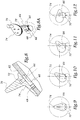
- Lateral recesses 68 are provided in the semi-circular portion of this patch 66, portion located bottom in Figures 9 to 12. So, once this pellet housed in the orifice 64, these recesses 68 form, with the periphery of the orifice 64, passages through 70, or vents.
- passages which ensure the admission of air into the inside volume of the bottle 2
- the pad 66 is equipped with a pin 72, allowing the mounting of a flap pivoting 74 provided with a gripping projection 76.
- the bottle 2 finally comprises a teat 78, of known type.
- the latter can be secured on the intermediate element 30, thanks to a ring 80 provided with a tapping, with a view to screwing it onto the barrel 46.
- the body 16 is first filled with a liquid food. Then, we plug the bottom 18 of this body 16 into the opening 6 of the base 4. The element is then brought back intermediate 30 on the body 16, as illustrated in the figures 3 and 4, while securing the rods 12 on this element intermediate 30. The attached member 54 is then fixed in the opening 52, as shown in FIGS. 5 to 7, and we screw the pacifier 78 onto the barrel 46.
- the shutter 74 is then activated, so as to allow the admission of outside air, by at least one of the passages 70. As indicated in FIGS. 10 to 12, it is possible to modulate the intensity of this pressurization atmospheric, depending on the number of passages 70 maintained closed by shutter 74.
- the child then rocks the bottle and starts sucking.
- the internal volume of the nipple 78 arranged in downstream of the valve 60, is filled with a dose of liquid, which does not can return to the interior volume of the intermediate element 30, due to the presence of the valve 60.
- the latter also prevents any outside air from entering the teat 78. In this way, the child is not able to swallow air, which makes it possible to remedy the problems of aerophagia in the baby.
- passages 70 are very small dimension of the passages 70, only air, not liquid, can communicate through these passages. As a result, any flow of liquid, particularly unpleasant, is obscured, especially since, under the baby's sucking effect, the bottle is constantly in depression. Thanks to the presence of the flap, the passages 70 can be released individually and added together to each other gradually.
- the invention makes it possible to achieve the objectives previously mentioned.
- the presence of the intermediate element 30 allows to realize the body of the bottle according to an arrangement particularly simple.
- this body can be devoid of threads, and do not present the shapes specific, intended in the prior art for fixing the nipple.
- this intermediate element is provided, in service, both air intake means and valve non-return, which allows the bottle according to the invention to simulate maternal feeding.
- the means of air intake which is provided with the bottle of the invention, allow effective adjustment of the amount of air admitted into the bottle, and therefore the flow of liquid ingested by the infant.
- teats physiological the cross section of which is not circular, but for example oval. This was impossible in the prior art, which required rotation of the teat in the child's mouth.
- a stabilization base is also advantageous. Indeed, the latter ensures a balance satisfying the entire bottle, especially when is made using a curved intermediate element. Through elsewhere, it is possible to conform this base, so that it represents a figurine, which gives it a additional playfulness.
- rods forming handles guarantees the bottle of the invention a particularly easy grip, both by the infant and by the nurse.
Landscapes
- Health & Medical Sciences (AREA)
- Life Sciences & Earth Sciences (AREA)
- Animal Behavior & Ethology (AREA)
- General Health & Medical Sciences (AREA)
- Public Health (AREA)
- Veterinary Medicine (AREA)
- Physics & Mathematics (AREA)
- Fluid Mechanics (AREA)
- Medical Preparation Storing Or Oral Administration Devices (AREA)
- Devices For Dispensing Beverages (AREA)
Abstract
Description
- l'élément intermédiaire est muni de moyens de fixation amovible d'un organe rapporté muni dudit clapet anti-retour ;
- les moyens de fixation amovible du clapet comprennent une ouverture ménagée dans une paroi intérieure dudit élément intermédiaire, ladite ouverture étant apte à coopérer avec un téton de fixation dont est pourvu ledit organe rapporté ;
- les moyens d'admission d'air comprennent au moins un passage traversant, ménagé dans une paroi dudit élément intermédiaire ;
- le ou chaque passage est formé par au moins un renfoncement latéral ménagé sur une pastille amovible, le ou chaque renfoncement coopérant avec un pourtour en regard d'un orifice dans lequel est rapportée ladite pastille ;
- la dimension transversale de chaque passage est inférieure à 8 micromètres ;
- il est prévu un volet d'obturation sélective du ou de chaque passage ;
- la première extrémité ouverte dudit élément intermédiaire, mise en communication avec le volume intérieur du corps, possède des dimensions transversales nettement supérieures à celles de la seconde extrémité ouverte, mise en communication avec le volume intérieur de la tétine ;
- le biberon comprend en outre une embase de stabilisation, pourvue de moyens permettant de fixer le corps sur cette embase ;
- les moyens de fixation comprennent une ouverture, ménagée dans ladite embase et apte à emmancher un fond dudit corps ;
- il est prévu au moins une tige de préhension, s'étendant entre ladite embase de stabilisation et l'élément intermédiaire ;
- chaque tige de préhension est venue de matière avec l'embase et comprend des moyens de fixation amovible sur l'élément intermédiaire.
- la figure 1 est une vue en perspective éclatée, illustrant les différents éléments constitutifs du biberon d'allaitement selon l'invention ;
- la figure 2 est une vue de côté, partiellement en coupe, illustrant le biberon de la figure 1 une fois monté ;
- les figures 3 et 4 sont des vues en coupe à plus grande échelle, illustrant la fixation d'un élément intermédiaire du biberon, respectivement sur des tiges de préhension et sur le corps de ce biberon ;
- les figures 5 et 6 sont des vues en coupe partielle, illustrant la mise en oeuvre d'un clapet anti-retour dont est pourvu le biberon de la figure 1 ;
- la figure 7 est une vue de dessus du clapet anti-retour illustré aux figures 5 et 6 ;
- la figure 8 est une vue en coupe, illustrant des moyens d'admission d'air dont est pourvu le biberon de la figure 1 ;
- la figure 8A est une vue en perspective éclatée, illustrant les moyens d'admission d'air de la figure 8 ;
- les figures 9 à 12 sont des vues schématiques, illustrant le fonctionnement des moyens d'admission représentés à la figure 8.
Claims (12)
- Biberon d'allaitement (2), comprenant un corps (16) destiné à être rempli d'un liquide alimentaire, en particulier de lait, une tétine (78) solidaire du corps (16), un clapet anti-retour (60), prévu au voisinage de la tétine (78) et des moyens (70) d'admission d'air dans le volume intérieur du biberon (2), prévus en amont dudit clapet (60) selon le sens d'écoulement du liquide, caractérisé en ce que ce biberon comprend en outre un élément intermédiaire (30), possédant des première (32) et seconde (44) extrémités ouvertes, ainsi que des premier (34) et second moyens de fixation amovible, respectivement sur le corps (16) et sur la tétine (78), cet élément intercalaire (30) étant pourvu du clapet anti-retour (60) et des moyens d'admission d'air (70).
- Biberon selon la revendication 1, caractérisé en ce que l'élément intermédiaire (30) est muni de moyens (52) de fixation amovible d'un organe rapporté (54) muni dudit clapet anti-retour (60).
- Biberon selon la revendication 2, caractérisé en ce que les moyens de fixation amovible du clapet (60) comprennent une ouverture (52) ménagée dans une paroi intérieure dudit élément intermédiaire (30), ladite ouverture (52) étant apte à coopérer avec un téton de fixation (58) dont est pourvu ledit organe rapporté (54).
- Biberon selon l'une des revendications précédentes, caractérisé en ce que les moyens d'admission d'air comprennent au moins un passage traversant (70), ménagé dans une paroi dudit élément intermédiaire (30).
- Biberon selon la revendication 4, caractérisé en ce que le ou chaque passage (70) est formé par au moins un renfoncement latéral (68) ménagé sur une pastille amovible (66), le ou chaque renfoncement coopérant avec un pourtour en regard d'un orifice (64) dans lequel est rapportée ladite pastille (66).
- Biberon selon la revendication 4 ou 5, caractérisé en ce que la dimension transversale de chaque passage (70) est inférieure à 8 micromètres.
- Biberon selon l'une des revendications 4 à 6, caractérisé en ce qu'il est prévu un volet (74) d'obturation sélective du ou de chaque passage (70).
- Biberon selon l'une des revendications précédentes, caractérisé en ce que la première extrémité ouverte (32) dudit élément intermédiaire (30), mise en communication avec le volume intérieur du corps (16), possède des dimensions transversales nettement supérieures à celles de la seconde extrémité ouverte (44), mise en communication avec le volume intérieur de la tétine (78).
- Biberon selon l'une quelconque des revendications précédentes, caractérisé en ce qu'il comprend en outre une embase de stabilisation (4), pourvue de moyens (6) permettant de fixer le corps (16) sur cette embase.
- Biberon selon la revendication 9, caractérisé en ce que les moyens de fixation comprennent une ouverture (6), ménagée dans ladite embase (4) et apte à emmancher un fond (18) dudit corps (16).
- Biberon selon l'une des revendications 9 ou 10, caractérisé en ce qu'il est prévu au moins une tige de préhension (12), s'étendant entre ladite embase de stabilisation (4) et l'élément intermédiaire (30).
- Biberon selon la revendication 11, caractérisé en ce que chaque tige de préhension (12) est venue de matière avec l'embase (4) et comprend des moyens (14) de fixation amovible sur l'élément intermédiaire (30).
Applications Claiming Priority (2)
| Application Number | Priority Date | Filing Date | Title |
|---|---|---|---|
| FR0005663 | 2000-05-03 | ||
| FR0005663A FR2808439B1 (fr) | 2000-05-03 | 2000-05-03 | Biberon d'allaitement |
Publications (2)
| Publication Number | Publication Date |
|---|---|
| EP1151740A2 true EP1151740A2 (fr) | 2001-11-07 |
| EP1151740A3 EP1151740A3 (fr) | 2002-05-08 |
Family
ID=8849855
Family Applications (1)
| Application Number | Title | Priority Date | Filing Date |
|---|---|---|---|
| EP20010420099 Withdrawn EP1151740A3 (fr) | 2000-05-03 | 2001-05-02 | Biberon d'allaitement |
Country Status (2)
| Country | Link |
|---|---|
| EP (1) | EP1151740A3 (fr) |
| FR (1) | FR2808439B1 (fr) |
Citations (1)
| Publication number | Priority date | Publication date | Assignee | Title |
|---|---|---|---|---|
| FR2446632A1 (fr) | 1979-01-19 | 1980-08-14 | Grasset Joseph | Perfectionnements aux biberons d'allaitement |
Family Cites Families (4)
| Publication number | Priority date | Publication date | Assignee | Title |
|---|---|---|---|---|
| FR384615A (fr) * | 1907-12-03 | 1908-04-15 | Mederic Rousseau | Biberon stérilisateur à tétine aseptique |
| US2442656A (en) * | 1946-11-29 | 1948-06-01 | Joseph W Less | Nursing nipple for bottles |
| GB1453968A (en) * | 1972-12-07 | 1976-10-27 | Tonkin S L | Artificial baby feeding |
| US5791503A (en) * | 1996-02-05 | 1998-08-11 | Lyons; Richard A. | Nursing bottle with anti-air ingestion valve |
-
2000
- 2000-05-03 FR FR0005663A patent/FR2808439B1/fr not_active Expired - Fee Related
-
2001
- 2001-05-02 EP EP20010420099 patent/EP1151740A3/fr not_active Withdrawn
Patent Citations (1)
| Publication number | Priority date | Publication date | Assignee | Title |
|---|---|---|---|---|
| FR2446632A1 (fr) | 1979-01-19 | 1980-08-14 | Grasset Joseph | Perfectionnements aux biberons d'allaitement |
Also Published As
| Publication number | Publication date |
|---|---|
| FR2808439A1 (fr) | 2001-11-09 |
| FR2808439B1 (fr) | 2002-07-12 |
| EP1151740A3 (fr) | 2002-05-08 |
Similar Documents
| Publication | Publication Date | Title |
|---|---|---|
| BE1000939A3 (fr) | Biberon avec garniture jetable. | |
| EP0116003B1 (fr) | Article pour nourrissons propre à former simultanément sucette et anneau dentaire | |
| CA2656149C (fr) | Montage d'un tube de gastrostomie sur une embase et bouton de gastrostomie | |
| EP0555165B1 (fr) | Biberon à débit variable pour l'alimentation des nourrissons | |
| EP1354579A1 (fr) | Biberon d'allaitement | |
| CH675681A5 (fr) | ||
| EP0951825B1 (fr) | Mangeoire pour volailles, utilisée notamment dans une installation d'alimentation de vollailes | |
| EP1151740A2 (fr) | Biberon d'allaitement | |
| CA2163567A1 (fr) | Support de sucette pour nouveau-ne | |
| EP1515679A1 (fr) | Dispositif de biberon | |
| FR2919177A1 (fr) | Embout adaptable sur des goulots de bouteilles de differents diametres et apte a recevoir une tetine pour faciliter la mise a disposition de boissons aux jeunes enfants. | |
| EP1444051B1 (fr) | Distributeur de produit fluide | |
| FR2837437A1 (fr) | Coussin de soutien cervical, notamment pour le passager d'un vehicule | |
| BE1015792A5 (fr) | Tetine de biberon. | |
| FR2549730A1 (fr) | Masque de protection contre les gaz | |
| EP1785126B1 (fr) | Biberon comportant un dispositif de mise à l'air latéral | |
| BE1004721A5 (fr) | Tetine d'alimentation et bouteille pourvue d'une telle tetine. | |
| FR2804490A1 (fr) | Raccord rapide pour le gonflage d'un pneumatique, et pompe de bicyclette comportant un tel raccord | |
| FR3080091A1 (fr) | Embarcation gonflable comportant un organe de flottaison, une unite de direction et une unite de propulsion | |
| FR2747032A1 (fr) | Faux moignon destine a servir de base pour la realisation d'une prothese dentaire | |
| FR2517079A1 (fr) | Plaquette nasale, en matiere plastique souple pour monture de lunettes | |
| EP1493420A2 (fr) | Biberon d'allaitement | |
| EP1466577A1 (fr) | Support de biberon | |
| EP2491826B1 (fr) | Coussin d'allaitement et son procédé de pose | |
| FR2842727A1 (fr) | Appareil orthodontique pour enfants |
Legal Events
| Date | Code | Title | Description |
|---|---|---|---|
| PUAI | Public reference made under article 153(3) epc to a published international application that has entered the european phase |
Free format text: ORIGINAL CODE: 0009012 |
|
| AK | Designated contracting states |
Kind code of ref document: A2 Designated state(s): AT BE CH CY DE DK ES FI FR GB GR IE IT LI LU MC NL PT SE TR |
|
| AX | Request for extension of the european patent |
Free format text: AL;LT;LV;MK;RO;SI |
|
| PUAL | Search report despatched |
Free format text: ORIGINAL CODE: 0009013 |
|
| AK | Designated contracting states |
Kind code of ref document: A3 Designated state(s): AT BE CH CY DE DK ES FI FR GB GR IE IT LI LU MC NL PT SE TR |
|
| AX | Request for extension of the european patent |
Free format text: AL;LT;LV;MK;RO;SI |
|
| 17P | Request for examination filed |
Effective date: 20021104 |
|
| AKX | Designation fees paid |
Designated state(s): AT BE CH CY DE DK ES FI FR GB GR IE IT LI LU MC NL PT SE TR |
|
| STAA | Information on the status of an ep patent application or granted ep patent |
Free format text: STATUS: THE APPLICATION HAS BEEN WITHDRAWN |
|
| 18W | Application withdrawn |
Effective date: 20030326 |