EP1151846A2 - Verfahren zur Einstellung der Wasserdampfdurchlässigkeit von Polyolefinfolien - Google Patents
Verfahren zur Einstellung der Wasserdampfdurchlässigkeit von Polyolefinfolien Download PDFInfo
- Publication number
- EP1151846A2 EP1151846A2 EP01117606A EP01117606A EP1151846A2 EP 1151846 A2 EP1151846 A2 EP 1151846A2 EP 01117606 A EP01117606 A EP 01117606A EP 01117606 A EP01117606 A EP 01117606A EP 1151846 A2 EP1151846 A2 EP 1151846A2
- Authority
- EP
- European Patent Office
- Prior art keywords
- film
- polyolefin
- film composite
- composite
- pair
- Prior art date
- Legal status (The legal status is an assumption and is not a legal conclusion. Google has not performed a legal analysis and makes no representation as to the accuracy of the status listed.)
- Withdrawn
Links
- 229920000098 polyolefin Polymers 0.000 title claims abstract description 87
- 238000000034 method Methods 0.000 title claims abstract description 39
- 230000008569 process Effects 0.000 title claims abstract description 26
- 239000002131 composite material Substances 0.000 claims abstract description 95
- 239000000945 filler Substances 0.000 claims abstract description 57
- 239000002243 precursor Substances 0.000 claims abstract description 37
- 239000000203 mixture Substances 0.000 claims abstract description 36
- 229920001971 elastomer Polymers 0.000 claims abstract description 19
- XLYOFNOQVPJJNP-UHFFFAOYSA-N water Chemical compound O XLYOFNOQVPJJNP-UHFFFAOYSA-N 0.000 claims abstract description 19
- 239000000806 elastomer Substances 0.000 claims abstract description 17
- -1 polyethylene Polymers 0.000 claims description 32
- 229920000642 polymer Polymers 0.000 claims description 20
- 239000004698 Polyethylene Substances 0.000 claims description 16
- 239000000463 material Substances 0.000 claims description 16
- 229920000573 polyethylene Polymers 0.000 claims description 16
- VTYYLEPIZMXCLO-UHFFFAOYSA-L Calcium carbonate Chemical group [Ca+2].[O-]C([O-])=O VTYYLEPIZMXCLO-UHFFFAOYSA-L 0.000 claims description 14
- 239000004743 Polypropylene Substances 0.000 claims description 14
- 229920001155 polypropylene Polymers 0.000 claims description 14
- 238000004049 embossing Methods 0.000 claims description 11
- 229920000092 linear low density polyethylene Polymers 0.000 claims description 10
- 239000004707 linear low-density polyethylene Substances 0.000 claims description 9
- 230000005540 biological transmission Effects 0.000 claims description 8
- 229910000019 calcium carbonate Inorganic materials 0.000 claims description 7
- VSKJLJHPAFKHBX-UHFFFAOYSA-N 2-methylbuta-1,3-diene;styrene Chemical compound CC(=C)C=C.C=CC1=CC=CC=C1.C=CC1=CC=CC=C1 VSKJLJHPAFKHBX-UHFFFAOYSA-N 0.000 claims description 6
- 229920000034 Plastomer Polymers 0.000 claims description 5
- 229920001577 copolymer Polymers 0.000 claims description 5
- 239000004745 nonwoven fabric Substances 0.000 claims description 4
- 239000004744 fabric Substances 0.000 claims description 3
- 229920000468 styrene butadiene styrene block copolymer Polymers 0.000 claims 4
- FACXGONDLDSNOE-UHFFFAOYSA-N buta-1,3-diene;styrene Chemical compound C=CC=C.C=CC1=CC=CC=C1.C=CC1=CC=CC=C1 FACXGONDLDSNOE-UHFFFAOYSA-N 0.000 claims 3
- 235000010216 calcium carbonate Nutrition 0.000 claims 1
- 239000002759 woven fabric Substances 0.000 claims 1
- 239000007788 liquid Substances 0.000 abstract description 18
- 238000009877 rendering Methods 0.000 abstract 1
- 238000005096 rolling process Methods 0.000 description 16
- 239000010410 layer Substances 0.000 description 14
- 238000001125 extrusion Methods 0.000 description 11
- 230000035699 permeability Effects 0.000 description 8
- 239000000843 powder Substances 0.000 description 7
- 239000004711 α-olefin Substances 0.000 description 7
- VYPSYNLAJGMNEJ-UHFFFAOYSA-N Silicium dioxide Chemical compound O=[Si]=O VYPSYNLAJGMNEJ-UHFFFAOYSA-N 0.000 description 5
- 230000004888 barrier function Effects 0.000 description 5
- 238000002156 mixing Methods 0.000 description 5
- 238000012360 testing method Methods 0.000 description 5
- VXNZUUAINFGPBY-UHFFFAOYSA-N 1-Butene Chemical compound CCC=C VXNZUUAINFGPBY-UHFFFAOYSA-N 0.000 description 4
- VGGSQFUCUMXWEO-UHFFFAOYSA-N Ethene Chemical compound C=C VGGSQFUCUMXWEO-UHFFFAOYSA-N 0.000 description 4
- 239000005977 Ethylene Substances 0.000 description 4
- PPBRXRYQALVLMV-UHFFFAOYSA-N Styrene Chemical compound C=CC1=CC=CC=C1 PPBRXRYQALVLMV-UHFFFAOYSA-N 0.000 description 4
- 238000013329 compounding Methods 0.000 description 4
- 239000011256 inorganic filler Substances 0.000 description 4
- 229910003475 inorganic filler Inorganic materials 0.000 description 4
- 238000004519 manufacturing process Methods 0.000 description 4
- 239000002245 particle Substances 0.000 description 4
- 206010021639 Incontinence Diseases 0.000 description 3
- 239000000654 additive Substances 0.000 description 3
- 238000000576 coating method Methods 0.000 description 3
- 238000010276 construction Methods 0.000 description 3
- 239000000835 fiber Substances 0.000 description 3
- 229920001903 high density polyethylene Polymers 0.000 description 3
- 239000004700 high-density polyethylene Substances 0.000 description 3
- 229920001519 homopolymer Polymers 0.000 description 3
- 230000000704 physical effect Effects 0.000 description 3
- LIKMAJRDDDTEIG-UHFFFAOYSA-N 1-hexene Chemical compound CCCCC=C LIKMAJRDDDTEIG-UHFFFAOYSA-N 0.000 description 2
- WSSSPWUEQFSQQG-UHFFFAOYSA-N 4-methyl-1-pentene Chemical compound CC(C)CC=C WSSSPWUEQFSQQG-UHFFFAOYSA-N 0.000 description 2
- KAKZBPTYRLMSJV-UHFFFAOYSA-N Butadiene Chemical compound C=CC=C KAKZBPTYRLMSJV-UHFFFAOYSA-N 0.000 description 2
- VYZAMTAEIAYCRO-UHFFFAOYSA-N Chromium Chemical compound [Cr] VYZAMTAEIAYCRO-UHFFFAOYSA-N 0.000 description 2
- CSNNHWWHGAXBCP-UHFFFAOYSA-L Magnesium sulfate Chemical compound [Mg+2].[O-][S+2]([O-])([O-])[O-] CSNNHWWHGAXBCP-UHFFFAOYSA-L 0.000 description 2
- 239000004708 Very-low-density polyethylene Substances 0.000 description 2
- XLOMVQKBTHCTTD-UHFFFAOYSA-N Zinc monoxide Chemical compound [Zn]=O XLOMVQKBTHCTTD-UHFFFAOYSA-N 0.000 description 2
- 239000000853 adhesive Substances 0.000 description 2
- 230000001070 adhesive effect Effects 0.000 description 2
- 238000005054 agglomeration Methods 0.000 description 2
- 230000002776 aggregation Effects 0.000 description 2
- TZCXTZWJZNENPQ-UHFFFAOYSA-L barium sulfate Chemical compound [Ba+2].[O-]S([O-])(=O)=O TZCXTZWJZNENPQ-UHFFFAOYSA-L 0.000 description 2
- 230000015572 biosynthetic process Effects 0.000 description 2
- CJZGTCYPCWQAJB-UHFFFAOYSA-L calcium stearate Chemical class [Ca+2].CCCCCCCCCCCCCCCCCC([O-])=O.CCCCCCCCCCCCCCCCCC([O-])=O CJZGTCYPCWQAJB-UHFFFAOYSA-L 0.000 description 2
- OSGAYBCDTDRGGQ-UHFFFAOYSA-L calcium sulfate Chemical compound [Ca+2].[O-]S([O-])(=O)=O OSGAYBCDTDRGGQ-UHFFFAOYSA-L 0.000 description 2
- 125000004432 carbon atom Chemical group C* 0.000 description 2
- 229910052804 chromium Inorganic materials 0.000 description 2
- 239000011651 chromium Substances 0.000 description 2
- 239000004927 clay Substances 0.000 description 2
- 239000011248 coating agent Substances 0.000 description 2
- 230000003247 decreasing effect Effects 0.000 description 2
- 229920001038 ethylene copolymer Polymers 0.000 description 2
- 239000012467 final product Substances 0.000 description 2
- 230000002209 hydrophobic effect Effects 0.000 description 2
- 239000000395 magnesium oxide Substances 0.000 description 2
- CPLXHLVBOLITMK-UHFFFAOYSA-N magnesium oxide Inorganic materials [Mg]=O CPLXHLVBOLITMK-UHFFFAOYSA-N 0.000 description 2
- AXZKOIWUVFPNLO-UHFFFAOYSA-N magnesium;oxygen(2-) Chemical compound [O-2].[Mg+2] AXZKOIWUVFPNLO-UHFFFAOYSA-N 0.000 description 2
- 239000000155 melt Substances 0.000 description 2
- 230000036961 partial effect Effects 0.000 description 2
- 229920005606 polypropylene copolymer Polymers 0.000 description 2
- 150000003254 radicals Chemical class 0.000 description 2
- 230000002829 reductive effect Effects 0.000 description 2
- 239000005060 rubber Substances 0.000 description 2
- 230000035945 sensitivity Effects 0.000 description 2
- 239000000377 silicon dioxide Substances 0.000 description 2
- 238000010998 test method Methods 0.000 description 2
- 238000012549 training Methods 0.000 description 2
- 229920001866 very low density polyethylene Polymers 0.000 description 2
- AFFLGGQVNFXPEV-UHFFFAOYSA-N 1-decene Chemical compound CCCCCCCCC=C AFFLGGQVNFXPEV-UHFFFAOYSA-N 0.000 description 1
- SMZOUWXMTYCWNB-UHFFFAOYSA-N 2-(2-methoxy-5-methylphenyl)ethanamine Chemical compound COC1=CC=C(C)C=C1CCN SMZOUWXMTYCWNB-UHFFFAOYSA-N 0.000 description 1
- NIXOWILDQLNWCW-UHFFFAOYSA-N 2-Propenoic acid Natural products OC(=O)C=C NIXOWILDQLNWCW-UHFFFAOYSA-N 0.000 description 1
- 238000003855 Adhesive Lamination Methods 0.000 description 1
- 239000005995 Aluminium silicate Substances 0.000 description 1
- 239000004215 Carbon black (E152) Substances 0.000 description 1
- 206010012444 Dermatitis diaper Diseases 0.000 description 1
- 208000003105 Diaper Rash Diseases 0.000 description 1
- 244000043261 Hevea brasiliensis Species 0.000 description 1
- 239000004831 Hot glue Substances 0.000 description 1
- 239000005909 Kieselgur Substances 0.000 description 1
- 229920010126 Linear Low Density Polyethylene (LLDPE) Polymers 0.000 description 1
- 239000004594 Masterbatch (MB) Substances 0.000 description 1
- 239000004677 Nylon Substances 0.000 description 1
- 239000005062 Polybutadiene Substances 0.000 description 1
- BQCADISMDOOEFD-UHFFFAOYSA-N Silver Chemical compound [Ag] BQCADISMDOOEFD-UHFFFAOYSA-N 0.000 description 1
- 229920006362 Teflon® Polymers 0.000 description 1
- GWEVSGVZZGPLCZ-UHFFFAOYSA-N Titan oxide Chemical compound O=[Ti]=O GWEVSGVZZGPLCZ-UHFFFAOYSA-N 0.000 description 1
- RTAQQCXQSZGOHL-UHFFFAOYSA-N Titanium Chemical compound [Ti] RTAQQCXQSZGOHL-UHFFFAOYSA-N 0.000 description 1
- XTXRWKRVRITETP-UHFFFAOYSA-N Vinyl acetate Chemical compound CC(=O)OC=C XTXRWKRVRITETP-UHFFFAOYSA-N 0.000 description 1
- 229910021536 Zeolite Inorganic materials 0.000 description 1
- 239000002253 acid Substances 0.000 description 1
- 125000005396 acrylic acid ester group Chemical group 0.000 description 1
- 239000012190 activator Substances 0.000 description 1
- WNROFYMDJYEPJX-UHFFFAOYSA-K aluminium hydroxide Chemical compound [OH-].[OH-].[OH-].[Al+3] WNROFYMDJYEPJX-UHFFFAOYSA-K 0.000 description 1
- PNEYBMLMFCGWSK-UHFFFAOYSA-N aluminium oxide Inorganic materials [O-2].[O-2].[O-2].[Al+3].[Al+3] PNEYBMLMFCGWSK-UHFFFAOYSA-N 0.000 description 1
- 235000012211 aluminium silicate Nutrition 0.000 description 1
- 239000003963 antioxidant agent Substances 0.000 description 1
- 235000006708 antioxidants Nutrition 0.000 description 1
- 239000002216 antistatic agent Substances 0.000 description 1
- AYJRCSIUFZENHW-DEQYMQKBSA-L barium(2+);oxomethanediolate Chemical compound [Ba+2].[O-][14C]([O-])=O AYJRCSIUFZENHW-DEQYMQKBSA-L 0.000 description 1
- 125000000484 butyl group Chemical group [H]C([*])([H])C([H])([H])C([H])([H])C([H])([H])[H] 0.000 description 1
- BRPQOXSCLDDYGP-UHFFFAOYSA-N calcium oxide Chemical compound [O-2].[Ca+2] BRPQOXSCLDDYGP-UHFFFAOYSA-N 0.000 description 1
- 239000000292 calcium oxide Substances 0.000 description 1
- ODINCKMPIJJUCX-UHFFFAOYSA-N calcium oxide Inorganic materials [Ca]=O ODINCKMPIJJUCX-UHFFFAOYSA-N 0.000 description 1
- 235000013539 calcium stearate Nutrition 0.000 description 1
- 239000008116 calcium stearate Substances 0.000 description 1
- 230000015556 catabolic process Effects 0.000 description 1
- 239000003054 catalyst Substances 0.000 description 1
- 239000001913 cellulose Substances 0.000 description 1
- 229920002678 cellulose Polymers 0.000 description 1
- 229910052570 clay Inorganic materials 0.000 description 1
- 239000003086 colorant Substances 0.000 description 1
- 238000001816 cooling Methods 0.000 description 1
- 230000001186 cumulative effect Effects 0.000 description 1
- 238000005520 cutting process Methods 0.000 description 1
- 238000006731 degradation reaction Methods 0.000 description 1
- 230000001419 dependent effect Effects 0.000 description 1
- 239000010432 diamond Substances 0.000 description 1
- 150000001993 dienes Chemical class 0.000 description 1
- 235000014113 dietary fatty acids Nutrition 0.000 description 1
- HNPSIPDUKPIQMN-UHFFFAOYSA-N dioxosilane;oxo(oxoalumanyloxy)alumane Chemical compound O=[Si]=O.O=[Al]O[Al]=O HNPSIPDUKPIQMN-UHFFFAOYSA-N 0.000 description 1
- 239000006185 dispersion Substances 0.000 description 1
- 230000000694 effects Effects 0.000 description 1
- 238000005516 engineering process Methods 0.000 description 1
- 238000007765 extrusion coating Methods 0.000 description 1
- 239000000194 fatty acid Substances 0.000 description 1
- 229930195729 fatty acid Natural products 0.000 description 1
- 239000010408 film Substances 0.000 description 1
- 238000009472 formulation Methods 0.000 description 1
- 239000011521 glass Substances 0.000 description 1
- 229930195733 hydrocarbon Natural products 0.000 description 1
- 150000002430 hydrocarbons Chemical class 0.000 description 1
- 230000001939 inductive effect Effects 0.000 description 1
- 239000011147 inorganic material Substances 0.000 description 1
- 229920000554 ionomer Polymers 0.000 description 1
- 230000001678 irradiating effect Effects 0.000 description 1
- NLYAJNPCOHFWQQ-UHFFFAOYSA-N kaolin Chemical compound O.O.O=[Al]O[Si](=O)O[Si](=O)O[Al]=O NLYAJNPCOHFWQQ-UHFFFAOYSA-N 0.000 description 1
- 238000010030 laminating Methods 0.000 description 1
- 238000003475 lamination Methods 0.000 description 1
- 239000004816 latex Substances 0.000 description 1
- 229920000126 latex Polymers 0.000 description 1
- 230000000670 limiting effect Effects 0.000 description 1
- 229920001684 low density polyethylene Polymers 0.000 description 1
- 239000004702 low-density polyethylene Substances 0.000 description 1
- ZLNQQNXFFQJAID-UHFFFAOYSA-L magnesium carbonate Chemical compound [Mg+2].[O-]C([O-])=O ZLNQQNXFFQJAID-UHFFFAOYSA-L 0.000 description 1
- 239000001095 magnesium carbonate Substances 0.000 description 1
- 229910000021 magnesium carbonate Inorganic materials 0.000 description 1
- 229910052943 magnesium sulfate Inorganic materials 0.000 description 1
- 235000019341 magnesium sulphate Nutrition 0.000 description 1
- 238000010128 melt processing Methods 0.000 description 1
- 239000012968 metallocene catalyst Substances 0.000 description 1
- 239000010445 mica Substances 0.000 description 1
- 229910052618 mica group Inorganic materials 0.000 description 1
- 238000012986 modification Methods 0.000 description 1
- 230000004048 modification Effects 0.000 description 1
- 239000000178 monomer Substances 0.000 description 1
- 229920003052 natural elastomer Polymers 0.000 description 1
- 229920001194 natural rubber Polymers 0.000 description 1
- 229920001778 nylon Polymers 0.000 description 1
- 229920006285 olefinic elastomer Polymers 0.000 description 1
- 239000012766 organic filler Substances 0.000 description 1
- 239000011368 organic material Substances 0.000 description 1
- YWAKXRMUMFPDSH-UHFFFAOYSA-N pentene Chemical compound CCCC=C YWAKXRMUMFPDSH-UHFFFAOYSA-N 0.000 description 1
- 229920002857 polybutadiene Polymers 0.000 description 1
- 229920000728 polyester Polymers 0.000 description 1
- 229920013716 polyethylene resin Polymers 0.000 description 1
- 229920002959 polymer blend Polymers 0.000 description 1
- 229920006254 polymer film Polymers 0.000 description 1
- 229920005629 polypropylene homopolymer Polymers 0.000 description 1
- 239000011148 porous material Substances 0.000 description 1
- 238000012545 processing Methods 0.000 description 1
- 238000004080 punching Methods 0.000 description 1
- 238000010791 quenching Methods 0.000 description 1
- 239000005871 repellent Substances 0.000 description 1
- 230000002940 repellent Effects 0.000 description 1
- 239000011347 resin Substances 0.000 description 1
- 229920005989 resin Polymers 0.000 description 1
- 230000004044 response Effects 0.000 description 1
- 230000000717 retained effect Effects 0.000 description 1
- 238000007789 sealing Methods 0.000 description 1
- 229910052710 silicon Inorganic materials 0.000 description 1
- 239000010703 silicon Substances 0.000 description 1
- 229910052709 silver Inorganic materials 0.000 description 1
- 239000004332 silver Substances 0.000 description 1
- 239000002356 single layer Substances 0.000 description 1
- 239000002002 slurry Substances 0.000 description 1
- 239000004834 spray adhesive Substances 0.000 description 1
- 239000000126 substance Substances 0.000 description 1
- 239000000454 talc Substances 0.000 description 1
- 229910052623 talc Inorganic materials 0.000 description 1
- 229920001169 thermoplastic Polymers 0.000 description 1
- 239000004416 thermosoftening plastic Substances 0.000 description 1
- 229910052719 titanium Inorganic materials 0.000 description 1
- 239000010936 titanium Substances 0.000 description 1
- OGIDPMRJRNCKJF-UHFFFAOYSA-N titanium oxide Inorganic materials [Ti]=O OGIDPMRJRNCKJF-UHFFFAOYSA-N 0.000 description 1
- 239000002023 wood Substances 0.000 description 1
- 239000010457 zeolite Substances 0.000 description 1
- 239000011787 zinc oxide Substances 0.000 description 1
Images
Classifications
-
- B—PERFORMING OPERATIONS; TRANSPORTING
- B32—LAYERED PRODUCTS
- B32B—LAYERED PRODUCTS, i.e. PRODUCTS BUILT-UP OF STRATA OF FLAT OR NON-FLAT, e.g. CELLULAR OR HONEYCOMB, FORM
- B32B27/00—Layered products comprising a layer of synthetic resin
- B32B27/12—Layered products comprising a layer of synthetic resin next to a fibrous or filamentary layer
-
- B—PERFORMING OPERATIONS; TRANSPORTING
- B29—WORKING OF PLASTICS; WORKING OF SUBSTANCES IN A PLASTIC STATE IN GENERAL
- B29C—SHAPING OR JOINING OF PLASTICS; SHAPING OF MATERIAL IN A PLASTIC STATE, NOT OTHERWISE PROVIDED FOR; AFTER-TREATMENT OF THE SHAPED PRODUCTS, e.g. REPAIRING
- B29C55/00—Shaping by stretching, e.g. drawing through a die; Apparatus therefor
- B29C55/02—Shaping by stretching, e.g. drawing through a die; Apparatus therefor of plates or sheets
- B29C55/023—Shaping by stretching, e.g. drawing through a die; Apparatus therefor of plates or sheets using multilayered plates or sheets
-
- B—PERFORMING OPERATIONS; TRANSPORTING
- B29—WORKING OF PLASTICS; WORKING OF SUBSTANCES IN A PLASTIC STATE IN GENERAL
- B29C—SHAPING OR JOINING OF PLASTICS; SHAPING OF MATERIAL IN A PLASTIC STATE, NOT OTHERWISE PROVIDED FOR; AFTER-TREATMENT OF THE SHAPED PRODUCTS, e.g. REPAIRING
- B29C55/00—Shaping by stretching, e.g. drawing through a die; Apparatus therefor
- B29C55/02—Shaping by stretching, e.g. drawing through a die; Apparatus therefor of plates or sheets
- B29C55/18—Shaping by stretching, e.g. drawing through a die; Apparatus therefor of plates or sheets by squeezing between surfaces, e.g. rollers
-
- B—PERFORMING OPERATIONS; TRANSPORTING
- B32—LAYERED PRODUCTS
- B32B—LAYERED PRODUCTS, i.e. PRODUCTS BUILT-UP OF STRATA OF FLAT OR NON-FLAT, e.g. CELLULAR OR HONEYCOMB, FORM
- B32B27/00—Layered products comprising a layer of synthetic resin
- B32B27/32—Layered products comprising a layer of synthetic resin comprising polyolefins
-
- B—PERFORMING OPERATIONS; TRANSPORTING
- B29—WORKING OF PLASTICS; WORKING OF SUBSTANCES IN A PLASTIC STATE IN GENERAL
- B29K—INDEXING SCHEME ASSOCIATED WITH SUBCLASSES B29B, B29C OR B29D, RELATING TO MOULDING MATERIALS OR TO MATERIALS FOR MOULDS, REINFORCEMENTS, FILLERS OR PREFORMED PARTS, e.g. INSERTS
- B29K2023/00—Use of polyalkenes or derivatives thereof as moulding material
-
- B—PERFORMING OPERATIONS; TRANSPORTING
- B29—WORKING OF PLASTICS; WORKING OF SUBSTANCES IN A PLASTIC STATE IN GENERAL
- B29K—INDEXING SCHEME ASSOCIATED WITH SUBCLASSES B29B, B29C OR B29D, RELATING TO MOULDING MATERIALS OR TO MATERIALS FOR MOULDS, REINFORCEMENTS, FILLERS OR PREFORMED PARTS, e.g. INSERTS
- B29K2023/00—Use of polyalkenes or derivatives thereof as moulding material
- B29K2023/04—Polymers of ethylene
- B29K2023/08—Copolymers of ethylene
- B29K2023/083—EVA, i.e. ethylene vinyl acetate copolymer
-
- B—PERFORMING OPERATIONS; TRANSPORTING
- B29—WORKING OF PLASTICS; WORKING OF SUBSTANCES IN A PLASTIC STATE IN GENERAL
- B29K—INDEXING SCHEME ASSOCIATED WITH SUBCLASSES B29B, B29C OR B29D, RELATING TO MOULDING MATERIALS OR TO MATERIALS FOR MOULDS, REINFORCEMENTS, FILLERS OR PREFORMED PARTS, e.g. INSERTS
- B29K2105/00—Condition, form or state of moulded material or of the material to be shaped
- B29K2105/06—Condition, form or state of moulded material or of the material to be shaped containing reinforcements, fillers or inserts
- B29K2105/16—Fillers
Definitions
- This invention relates generally a process of adjusting the water vapor transmission/porosity of films and film composites, while maintaining general resistance to liquid transmission (strikethrough). More specifically this invention is directed towards a process for producing films, film composites, and articles made therefrom, that are made permeable to water vapor, by passing them through interdigitating grooved rollers.
- Polyolefin films which are rendered more permeable to water vapor using filler loading and orientation are known.
- Such films or film composites are said to be more breathable, that is to have improved, increased permeability to water vapors, while maintaining a resistance to liquid strikethrough (defined herein).
- Uses of such films or film composites include on a diaper the permeability of which may permit the passage of moisture vapor and air, while substantially preventing the passage of liquid.
- the advantages of such a film used in a diaper are that after the wearer voids, the liquid is generally retained, while much of the liquid vapor can escape decreasing the "wet feeling", and lowering the possibility of uncomfortable diaper rash.
- U.S. Patent No. 4,472,328 assigned to Mitsubishi Chemical Industries, Ltd., suggests a breathable polyolefin film prepared from a polyolefin/filler composition having from 20 percent to 80 percent by weight of a filler such as a surface treated calcium carbonate.
- a liquid or waxy hydrocarbon polymer elastomer such as a hydroxyl-terminated liquid polybutadiene was purported to produce a precursor film that could be mono-axially or biaxially stretched to make a film breathable.
- the breathable film described by Mitsubishi is also described in Great Britain Patent No. 2,115,702, assigned to Kao Corporation.
- the Kao patent further describes a disposable diaper prepared with a breathable film as disclosed by the Mitsubishi patent. The breathable film is used as a backing for the diaper to contain liquid.
- U.S Patent No. 4,350,655 assigned to Biax Fiber Film, describes a porous polyolefin film containing at least 50 percent by weight of a coated inorganic filler.
- the precursor film is formed without the addition of an elastomer by employing an inorganic filler surface coated with a fatty acid ester of only silicon or titanium.
- the precursor film is then rolled between horizontally grooved rollers. Cold stretching of the precursor film at a temperature below 70° C, produces a porous film.
- Some of the resulting films were stated to be both vapor and liquid permeable, however, at least one film (Example 3) was stated to be permeable to air.
- US 4,777,073 suggests a breathable film produced by stretching of a precursor film prepared from a polyolefin/filler composition.
- the document suggests that the permeability and strength, especially tear strength are improved by melt embossing the precursor film with a patterned melt embossing roller and stretching the film to impart a pattern of different film thickness having greater permeability within the areas of reduced thickness compared to the areas of greater thickness.
- a polyolefin film or film composite comprises at least one layer of a disposable article and is rendered breathable by passing the film, film composite or fabricated article through interdigitating grooved rollers.
- the film, film composite or fabricated article will have either a single layer or multilayer construction and the polyolefin/filler combination can be co-extruded, laminated or blended with other polymers or polymer based fabricated articles.
- a film (“precursor film”) is made, utilizing a polyolefin or a polyolefin blend with a relatively higher filler loading, generally including embossing a pattern thereupon, such that its subsequent manipulation, either by itself, in a film composite or as a part of a disposable article, will render the film breathable (hereinafter defined as water vapor permeable, within certain limits of water vapor transmission rates (WVTR), while maintaining a certain level of liquid impermeability) while maintaining a minimum level of physical properties, elongation/tensile strength being of most importance.
- WVTR water vapor transmission rates
- the manipulation of the film, film composite, and/or fabricated disposable article includes passing all or parts of the film, film composite, and/or fabricated disposable article through a grooved roller and/or interdigitating grooved rollers, at a rate sufficient to develop a minimum level of breathability to the film or film portion of the article, at a commercial and economical rate.
- the tear strength, elasticity, and softness of a film prepared from the polyolefin/filler composition may be improved by addition of small amounts of an olefinic elastomer.
- the WVTR desired is above 100 g/m 2 /day @ 38° C, 90% RH preferably above 200 g, and can be easily greater than 1000 g/m 2 /day.
- High WVTR films, high WVTR film composites, and disposable articles made therefrom of our invention are produced from a precursor film that is prepared from a polymer composition that comprises at least one polyolefin component, at least one filler component, and optionally an elastomeric component.
- the polyolefin component may be any polyolefin which is suitable for film formation such as homo or co-polymer polypropylene, homo or co-polymer polyethylenes or blends thereof.
- a preferred polyolefin is a copolymer of propylene and low density polyethylene, particularly preferred is linear low density polyethylene.
- the linear low density polyethylene may be a polymer made from either traditional Ziegler-Natta or metallocene catalysts, or combinations thereof.
- the films, film composites, and articles made therefrom based on polyolefin filler combinations when passed through a nip of interdigitating grooved rollers (hereinafter used interchangeably with "ring rolling") would surprisingly and unexpectedly have improved water vapor transmission rates while maintaining resistance to liquid permeability; and retaining film integrity.
- ring rolling interdigitating grooved rollers
- films and film composites of certain embodiments of the present invention can be combined with other polymers or polymer based fabricated articles such as films, fibers, fabrics (including non-woven fabrics) and the like, depending on the intended function of the resulting film or, or structure.
- Films or film composites employing the polyolefin/filler blends of certain embodiments of the present invention can be oriented, annealed, or crosslinked Additionally, polyolefin/filler combinations of the present invention can be made into film by processes including blown or cast film manufacturing techniques.
- the blend components can function to modify barrier, opacity, sealing, cost, or other functions that will be known to those of ordinary skill in the art.
- films or composite structures are often used in infant diapers, toddler training pants, adult incontinence devices, medical drapes and apparel, such as surgical gowns, feminine hygiene articles, and the like.
- film composites may include one or more film and/or non-woven layers bonded mechanically, thermally, or adhesively to the film.
- non-woven materials include spun-bonded-meltblown (SM), SMS, each individually.
- Such non-woven materials are most often made from polyolefins, such as homopolymer polyethylene, copolymer polyethylene (including one or more of ⁇ -olefins of 4-10 carbon atoms, vinyl acetate, ethylincally unsaturated acrylic acid esters, acrylic acid, methacryclic acid, ionomers, polypropylene homopolymers, polypropylene copolymers including one or more of ethylene and ⁇ -olefins of 4-10 carbon atoms, homopolymer and copolymer polypropylene).
- polyolefins such as homopolymer polyethylene, copolymer polyethylene (including one or more of ⁇ -olefins of 4-10 carbon atoms, vinyl acetate, ethylincally unsaturated acrylic acid esters, acrylic acid, methacryclic acid, ionomers, polypropylene homopolymers, polypropylene copolymers including one or more of
- film forming polyolefins and combinations of film forming polyolefins may be used in embodiments of our invention.
- Linear low density polyethylenes are among the materials favored in embodiments of our invention.
- Linear low density polyethylene generally that having density between 0.910 to 0.935 g/cc and a melt index from 0.01 to 10 dg/min.
- Another polyolefin that may be considered in such composites is very low density polyethylene (VLDPE, also plastomer) which will have densities in the range of from 0.860 to 0.910 g/cc.
- High density polyethylene (HDPE) having densities in the range of from 0.935 to 0.970 g/cc may also be considered.
- Such polyethylenes may be produced by copolymerizing ethylene with one or more C 4 to C 20 ⁇ -olefin.
- the preferred ⁇ -olefins include those selected from the group consisting of butene-1, pentene-1, 4-methyl-1-pentene, hexene-1, octene-1, decene-1 and combinations thereof. Most preferred are ethylene copolymers of butene-1, hexene-1, octene-1 and combinations thereof.
- the comonomers may be present in amounts up to 20 mole percent. The amount of comonomer or comonomers will generally determine density, for instance HDPE will have from 0 to 1 mole percent comonomer, while plastomers with densities lower than 0.900g/cc will have up to 15 or even 20 mole percent comonomer (s).
- Such polyethylenes may be made utilizing traditional Ziegler-Natta, chromium based, metallocene (both alumoxane and ionic activators). Processes useful for preparing such polyethylenes include gas phase, slurry, solution and the like.
- the density of polyethylenes such as these, in preferred embodiments, will generally be in the range of from 0.900 and 0.935 g/cm 3 , preferably in the range of from 0.910 to 0.925 g/cm 3 , most preferably from 0.915 to 0.920 gm/cm 3 .
- the polyethylenes will have a melt index in the range of from 0.1 to 10 g/10 min, preferably 0.5 to 5 g/10 min., generally consistent with film forming conditions.
- Polypropylene may be used in conjunction with one or more polyethylenes, or by itself as the polyolefin component of the precursor film.
- Polypropylene may be made from many of the catalysts and processes discussed supra, including optional inclusion of one or more ⁇ -olefins.
- One or more elastomers may be included in the polyolefin component.
- elastomers include, but are not limited to natural rubber, ethylene alpha olefin rubber (EPM), ethylene, alpha olefin diene monomer rubber (EPDM), styreneisoprene-styrene (SIS), styrene, butadiene, styrene (SBS), butyl and the like. Of these SIS and SBS are preferred, with SBS more particularly preferred.
- the range of elastomer inclusion are generally between 5-40, preferably 5-30, more preferably 5-25 parts per hundred parts polyolefin.
- Amounts of each component can vary with the desired properties for the precursor film or film composite. For instance, a nominal 0.917 g/cc density LLDPE may be combined with 15 parts of an elastomer per hundred parts of LLDPE. Such a combination might provide improved elastic behavior.
- ком ⁇ онент may include additives such as anti-oxidants, anti-static agents, colors and the like, well known to those of ordinary skill.
- blending of polyolefins with polymers is also contemplated.
- blending of traditional Z-N catalyzed, chromium catalyzed (CR), metallocene catalyzed (MCN) and free radical initiated (FR) polyolefins using one or all in a blend as the film forming component is contemplated.
- CR chromium catalyzed
- MCN metallocene catalyzed
- FR free radical initiated polyolefins
- Other free radical initiated polyethylenes, high pressure polyethylene, ethylene homopolymers as well as ethylene copolymers may be included.
- polyolefin will mean the polyolefin, any combination of polyolefins, elastomers, additives, and the like.
- fillers may be incorporated at relatively high levels, limited only by the ability of the combination (polyolefin/filler) to be formed into a film. Further, it is believed that useful films may not be made with an amount of the filler in excess of 250 parts filler per hundred parts polyolefin (pphp) (or polyolefin blend of the film forming composition. While at lower than 20 pphp of filler, the polyolefin/filler composition may not have sufficient breathability. Higher amounts of filler may cause difficulty in compounding and losses in strength of the final breathable film. Generally, the range of filler may be in the range of from 35 to 200, preferably from in the range of from 50 to 150. The minimum amount of filler is needed to insure the interconnection within the film of voids created at the situs of the filler, particularly by the stretching operation to be subsequently performed
- Fillers useful in certain embodiments of our invention may be any inorganic or organic material or combinations thereof having a low affinity for and a significantly lower elasticity than the polyolefin component or the optional elastomeric component.
- the filler should be a rigid material having a non-smooth surface, or a material which is treated to render its surface hydrophobic.
- the mean average particle size of the filler is between 0.5 to 7 microns, preferably between 1 to 5, more preferably from 2 to 3.5 microns. It should be understood that smaller particle sizes, such as 0.75 to 2, will provide the best balance of compoundability and eventual breathability, but there relative economics makes them generally less useful than particle sizes of 3 microns and above.
- Such particle sizes are preferred for films having a thickness of between 0.5-6 mils.
- the inorganic fillers include calcium carbonate, talc, clay, kaolin, silica diatomaceous earth, magnesium carbonate, barium carbonate, magnesium sulfate, barium sulfate, calcium sulfate, aluminum hydroxide, zinc oxide, magnesium oxide, calcium oxide, magnesium oxide, titanium oxide, alumina, mica, glass powder, zeolite, silica clay, and combinations thereof, and the like. Calcium carbonate is particularly preferred.
- the inorganic fillers such as calcium carbonate are preferably surface treated to be hydrophobic so that the filler can repel water to reduce agglomeration of the filler.
- the surface coating should improve binding of the filler to the polymer while allowing the filler to be pulled away from the polyolefin when the film formed from the polyolefin/filler combination is stretched or oriented.
- Preferred coatings are stearates, such as calcium stearate, which are generally compliant with FDA regulations.
- Organic fillers such as wood powder, pulp powder, and other cellulose type powders may be used.
- Polymer powders such as Teflon® powder and Keviar® powder may also be included. Combinations of these fillers are also contemplated.
- Polyolefin/filler compositions usable in this invention may be compounded in several different ways.
- the components may be brought into intimate contact by, for example, dry blending these materials and then passing the overall composition through a compounding extruder.
- the polyolefin and filler components may be fed directly to a mixing device such as a compounding extruder, higher shear continuous mixer, two roll mill or an internal mixer such as a Banbury mixer.
- a mixing device such as a compounding extruder, higher shear continuous mixer, two roll mill or an internal mixer such as a Banbury mixer.
- the objective is to obtain a uniform dispersion of the filler in the polymer without agglomeration, and this is readily achieved by inducing sufficient shear and heat to cause the polyolefin component to melt.
- time and temperature of mixing should be controlled as is normally done to avoid molecular weight degradation.
- the film forming composition may be manufactured into a precursor film by conventional tubular extrusion (blown bubble process) or by cast extrusion. Film formation by cast extrusion may be more convenient, as the film can be immediately melt embossed as described below.
- the molten resin is extruded from an elongate die in the form of a web.
- the web may be pulled over at least one patterned embossing roller to chill and solidify the film with an embossed pattern for reasons discussed further below.
- the precursor film is may be produced to a gauge of between 0.5 to 6 mils, preferably from 0.75 to 5 mils, more preferably from 1 to 4 mils, most preferably from 1.5 to 3 mils, which allows for further stretching as described below.
- a gauge of between 0.5 to 6 mils, preferably from 0.75 to 5 mils, more preferably from 1 to 4 mils, most preferably from 1.5 to 3 mils, which allows for further stretching as described below.
- those of ordinary skill in the art will understand that many factors affect the response of the precursor film to the ring rolling process.
- the film or film part of a film composite will have breathability, and at least a minimum of physical properties to maintain its function, that is the film after ring rolling (either as part of a composite or by itself) should have the ability to perform its function.
- the film might even have substantial voids, providing excellent breathability, but having enough strength to maintain the physical form of the diaper or other article during its use.
- extrusion temperatures, die temperatures, and embossing roll (if used) temperatures will depend on the composition employed, but generally will be in the following ranges for compositions of the present invention prepared by cast extrusion: Melt Temperature (°F.) 350-550 Die Temperature (°F.) 350-550 Embossing Roll Temperature (°F.) 50-130
- Embossing may be used on the surface of polyolefin films to reduce gloss, although such will not be the films primary function in a ring rolling process. Embossing can be imposed on the precursor film surface at the time of the film fabrication for cast extrusion, or at a subsequent time for cast or tubular extrusion by procedures well known in the art.
- embossing may impose a pattern of different film thicknesses within the precursor film, and can be conducted with an micro/macro pattern, e.g. cross-hatching, dots, lines, circles, diamonds, hexagons, etc. The pattern can be either in line and/or off line and the rolls can be engraved with either pin up and/or pin down type configurations.
- breathable film has been made using such film precursors as described above, and then orienting the film by a variety of techniques, such as tentering in one or both of the machine direction(MD) or cross or transverse direction (TD).
- the oriented and breathable film could then be used for a variety of end use articles, such as diapers (usually back sheets, but also top sheets), feminine hygiene items, bandages, catamenial pads, panty liners, incontinent briefs, and the like.
- end use articles such as diapers (usually back sheets, but also top sheets), feminine hygiene items, bandages, catamenial pads, panty liners, incontinent briefs, and the like.
- use of certain embodiments of the present invention will include the precursor film either by itself or a film composite in an interdigitating grooved roller process.
- film composite we intend that one or more additional layers or materials are added or laminated to the film.
- Such additional materials and layers include synthetic woven, synthetic non-woven, synthetic knit, non-woven, apertured film, macroscopically expanded three-dimensional formed film, filled compositions or laminates and/or a combination of these items.
- the nonwovens may be made by processes including, but not limited to spunlace, spunbond, meltblown, carded and or air-through or calendar bonded.
- the materials or layers of the composite can be combined by many method known to those of ordinary skill. For instance, adhesives (including spray adhesives, hot melt adhesives, latex based adhesives and the like), thermal bonding, ultra-sonic bonding, extrusion lamination, needle punching, and the like.
- parts or all of the final product may be assembled (by for instance heat or adhesive lamination) then the partial or finished construction is passed through one or more interdigitating pairs of rollers to render the precursor film high in WVTR.
- High WVTR film, film composites or fabricated articles made therefrom may achieved by stretching the precursor film to form interconnected voids prior to ring rolling. Stretching or "orientation" of the film may be carried out monoaxially in the machine direction (MD) or the transverse direction (TD) or in both directions (biaxially) either simultaneously or sequentially using conventional equipment and processes following cooling of the precursor film.
- MD machine direction
- TD transverse direction
- Blown films are preferably stretched in the machine direction or in both directions whereas cast films are preferably stretched in the transverse direction.
- the precursor film is passed around two rollers driven at different surface speeds and finally to a take up roller.
- the second driven roller which is closest to the take up roll is driven faster than the first driven roller. As a consequence the film is stretched between the driven rollers.
- Stretching of melt embossed precursor films either using both a tentering device and a directly in a ring rolling device or just the ring rolling device produces breathable films having the desired water vapor permeability.
- the resulting films had greater permeability in the areas of reduced thickness in comparison to the areas of greater thickness.
- strain on the film during stretching is believed to be important to controlling the WVTR.
- strain is controlled for a given stretch ratio by adjusting the film speed and the stretching distance. The stretching distance is measured, between the point where the film starts to increase in width to the closest point where the film is fully stretched.
- strain is controlled for a given stretch ratio by controlling film speed and the gap between the first and second driven rollers.
- a range of stretching ratios from 1:2 to 1:5 prove satisfactory for MD stretching with a ratio of 1:4 being preferred.
- a range of stretching ratios of 1:2 to 1:5 prove satisfactory for TD stretching with a ratio of 1:4 being preferred.
- the process of ring rolling also may activate the elasticity of the web (dependent upon specific ring rolling pattern used), in addition to imparting breathability to the web.
- Precursor webs containing elastomeric components add to the elasticity developed during the ring rolling process.
- the term web or webs are used.
- the term web will include a precursor film and optionally one or more additional webs or layers, as discussed above, for instance one or more non-woven webs and/or one or more film webs.
- Such web components can be pre-assembled or laminated.
- Prior to ring rolling, at least one additional web may be added.
- Web 10 and alternatively 11 may be webs of a precursor film with either another film or fabric (11) the precursor film will have a thickness from 0.5 to 6 mils.
- the second (11) web may be melt-blown webs of the type taught in the article entitled "Superfine Thermoplastic Fibers" by Van A. Wente, appearing in Industrial Engineering Chemistry, August, 1956, Vol. 48, No.
- melt-blown material may be nylon, polyester, or any polymer or polymer blend capable of being melt-blown, a melt-blown polypropylene web is preferred.
- a melt-blown web could comprise two or more zones of different melt-blown polymers.
- Melt-blown webs having a basis weight of up to 30 g/m 2 or greater can be used in the present invention, but lower weight webs are generally preferred in order to minimize the cost of the barrier layer produced therefrom.
- Technology provides for the production of melt-blown webs with a minimum basis weight of 3 g/m 2 , but available commercial melt-blown webs generally have a basis weight of 10 g/m 2 or more.
- the preferred basis weight for optional web 11 is from 10 g/m 2 to 30 g/m 2 ; most preferably from 10 g/m 2 to 20 g/m 2 .
- the density of melt-blown web 11 is preferably up to 0.15 g/cc and most preferably up to 0.1 g/cc.
- Webs 10 and 11 may be the same or different.
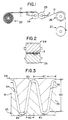
- Web 10 and (when present) 11 have preferably been rolled up together as plies with adjacent surfaces on feed roll 20. They are unrolled from feed roll 20 retaining their contiguous relationship and passed into the nip of interdigitating grooved rolls 24 and 25. Grooved rolls 24 and 25 have grooves perpendicular to the axis of the rolls (parallel to the machine direction) as shown in FIG. 2 which is a sectional view of grooved rolls 24 and 25 taken along line 2-2 of FIG. 1.
- FIG 1 shows a preferred arrangement of interdigitating grooved rolls 24 and 25 being located with their centers in a horizontal plane and webs 10 and 11 contacting the surface of roll 24 for one-fourth of a revolution before entering the nip between rolls 24 and 25; this provides an opportunity for the web or webs 10 and 11 to be heated prior to entering the nip.
- interdigitating grooved rolls 24 and 25 could be positioned with their centers in a vertical plan or at any other angle and webs 10 and 11 could be fed directly into the nip of the rolls. Preheating of webs 10 and 11 if found to be necessary in order to avoid tearing of the webs, could be accomplished in any conventional manner.
- the amount of lateral stretch imparted to web plies by the grooved rolls 24 and 25 will depend on the shape and depth of the grooves of the rolls, and on the gap spacing between the rolls.
- U.S. Pat. No. 4,223,059 issued to Eckhard C.A. Schwarz on Sept. 16, 1980 discloses interdigitating rolls having grooves of generally sine-wave shape cross-section which may be used for the present invention.
- U.S. Pat. No. 4,153,664 issued to Rinehardt N. Sabee on May 8, 1979, discloses the stretching of polymeric webs by ring-rolling with rolls having grooves with a variety of shapes. The shape of the grooves of the rolls will generally determine whether the web is stretched uniformly or at incremental, spaced portions of the web. Incremental stretching of the web is more likely to cause some local tearing of film or film composites which would damage the liquid strikethrough resistance of the film and, therefore, is not preferred for the present invention.
- FIG. 3 is an enlarged view of area 3 of FIG. 2.
- FIG. 3 shows a partial cutaway view of interdigitating rolls 24 and 25.
- Teeth 54 and 55 of grooved roll 24 intermesh with teeth 51, 52 and 53 of grooved roll 25.
- the length 60 of the teeth is 3.81 mm., and the distance 61 between the centerlines of adjacent teeth on each roll is 2.54 mm.
- the teeth have generally straight sides which are at an angle 62 from a plane perpendicular to the axis of rolls 24 and 25 of 9' 17".
- the land at the base of the teeth has a radius 63 of 0.51 mm. Sharp corners 66 at the ends of the teeth are removed.
- the interdigitating grooves of rolls 24 and 25 be perpendicular to the axis of the rolls. In this way, the maximum number of grooves of a given size will engage the web 10 and 11 at the same time and impact stretch to the webs. By having the maximum number of teeth engage the web at a given time, a more uniform stretching of the webs is achieved so that local tearing of the film or film composite is minimized.
- the stretched film 12 can be easily smoothed in the cross-machine direction.
- a reproducible gap setting between grooved rolls 24 and 25 can be achieved by having the bearing of one of the grooved rolls, e.g. 24, stationary while those of the other grooved roll 25 can be moved in the horizontal direction. Groove roll 25 is moved in the horizontal direction. Groove roll 25 is moved toward roll 24 until its teeth are intermeshed with those of grooved roll 25 and it will move no further. The bearings of grooved roll 25 are then moved away from grooved roll 24 a measured distance, the gap setting.
- the preferred gap setting for practicing the present invention are from 0.76 mm. to 1.65 mm. With grooved rolls 24 and 25 having a tooth configuration as shown in FIG.
- the maximum width of film or film composite layer 12 which can be 4 achieved for a single pass is 21 ⁇ 2 to 3 times the width of starting webs 10 and 11.
- the width of film or film composite 12 compared to the width of starting web can be varied for a single pass between grooved rolls 24 and 25 from a maximum increase of 21 ⁇ 2 to 3 times to no increase by the appropriate gap setting.
- grooved rolls 24 and 25 can be used.
- Basis weight is generally an important property desired to be controlled for film or film composite layer (total ring rolled web) 12. For cost reasons, the lightest film or film composite that will provide sufficient breathability is desired.
- a basis weight of the film produced by itself will be generally above 20 g/cm 2 .
- the desired basis weight can be obtained by controlling the amount of stretch imparted to web 10 and optional web 11 by grooved rolls 24 and 25 as described above, and by the selection of the basis weights of the starting webs 10 and 11.
- starting webs 10 and 11 have a cumulative basis weight in the range of 1.1 to 4 times the ultimate desired basis weight, preferably in the range of 1.5 to 3 times the desired basis weight, most preferably 2 times the desired basis weight.
- the desired width of breathable film or film composite 12 can be achieved by selecting a proper combination of stretch imparted by the grooved rolls 24 and 25 and initial width of starting webs 10 and 11.
- the initial width of starting webs 10 and 11 before passing between grooved rolls 24 and 25 is within the range of 0.9 to 0.25 times the desired width, preferably within the range of 0.7 to 0.3 times the desired width, most preferably 0.5 times the desired width.
- test procedures used to determine the unique properties of the layers of the present invention and to provide the test results in the examples below are as follows:
- films of m-polyethylene resins of certain embodiments of the present invention can be combined with other materials, depending on the intended function of the resulting film.
- the liquid strikethrough resistance test is a method for determining the water pressure in millimeters of water at which water penetrates a repellent barrier layer at a specified fill rate and with the water and barrier layer at a specified temperature. Such a test is described in INDA Journal, Vol. 5, No. 2, Karen K. Leon as; the strikethrough resistance of embodiments of our invention are from 50 - 500 cm.
- LLDPE/CaCO 3 films are made utilizing the following conditions, materials and equipment shown in Table 1.
- Examples 1-12 used LL3003.09 (a 3 melt index 0.917 g/cc polyethylene (Z-N) available from Exxon Chemical Co., Houston, TX.) examples: containing levels of CaCO 3 as shown in Table 1, blended with 100 parts of LL-3003.
- Example 13-16 were made under the conditions shown in Table 1, examples 1-12, but with Exceed® ECD-112 a 3.4 MI, 0.917 g/cc density m-LLDPE from Exxon Chemical Co., Houston, TX with filler, master batch (MB) and elastomer levels as shown in Table 2.
- Examples 1-4, 9, 10, 11, 12, 13, 14 and 15 were run on a Davis Standard cast line. Examples 9, 10, 11, 12, 14, and 15 were oriented in the TD, Example 9, 10, 11, 12, and 15 were further MD drawn. Excamples 5, 6, 7, 8, and 16 were run on a blown film extruder.
Landscapes
- Engineering & Computer Science (AREA)
- Mechanical Engineering (AREA)
- Laminated Bodies (AREA)
- Absorbent Articles And Supports Therefor (AREA)
- Processing And Handling Of Plastics And Other Materials For Molding In General (AREA)
- Treatments Of Macromolecular Shaped Articles (AREA)
- Manufacture Of Macromolecular Shaped Articles (AREA)
- Shaping By String And By Release Of Stress In Plastics And The Like (AREA)
- Extrusion Moulding Of Plastics Or The Like (AREA)
- Processes Specially Adapted For Manufacturing Cables (AREA)
Applications Claiming Priority (3)
| Application Number | Priority Date | Filing Date | Title |
|---|---|---|---|
| US690136 | 1996-07-31 | ||
| US08/690,136 US6776947B2 (en) | 1996-07-31 | 1996-07-31 | Process of adjusting WVTR of polyolefin film |
| EP97935262A EP0927096B1 (de) | 1996-07-31 | 1997-07-31 | Verfahren zur einstellung der wasserdampfdurchlässigkeit von polyolefinfolie |
Related Parent Applications (1)
| Application Number | Title | Priority Date | Filing Date |
|---|---|---|---|
| EP97935262A Division EP0927096B1 (de) | 1996-07-31 | 1997-07-31 | Verfahren zur einstellung der wasserdampfdurchlässigkeit von polyolefinfolie |
Publications (2)
| Publication Number | Publication Date |
|---|---|
| EP1151846A2 true EP1151846A2 (de) | 2001-11-07 |
| EP1151846A3 EP1151846A3 (de) | 2008-06-04 |
Family
ID=24771240
Family Applications (2)
| Application Number | Title | Priority Date | Filing Date |
|---|---|---|---|
| EP01117606A Withdrawn EP1151846A3 (de) | 1996-07-31 | 1997-07-31 | Verfahren zur Einstellung der Wasserdampfdurchlässigkeit von Polyolefinfolien |
| EP97935262A Revoked EP0927096B1 (de) | 1996-07-31 | 1997-07-31 | Verfahren zur einstellung der wasserdampfdurchlässigkeit von polyolefinfolie |
Family Applications After (1)
| Application Number | Title | Priority Date | Filing Date |
|---|---|---|---|
| EP97935262A Revoked EP0927096B1 (de) | 1996-07-31 | 1997-07-31 | Verfahren zur einstellung der wasserdampfdurchlässigkeit von polyolefinfolie |
Country Status (8)
| Country | Link |
|---|---|
| US (1) | US6776947B2 (de) |
| EP (2) | EP1151846A3 (de) |
| AT (1) | ATE217251T1 (de) |
| AU (1) | AU735415B2 (de) |
| CA (1) | CA2260791A1 (de) |
| DE (1) | DE69712498T2 (de) |
| DK (1) | DK0927096T3 (de) |
| WO (1) | WO1998004397A1 (de) |
Cited By (6)
| Publication number | Priority date | Publication date | Assignee | Title |
|---|---|---|---|---|
| US6881375B2 (en) | 2002-08-30 | 2005-04-19 | Kimberly-Clark Worldwide, Inc. | Method of forming a 3-dimensional fiber into a web |
| US6896843B2 (en) | 2002-08-30 | 2005-05-24 | Kimberly-Clark Worldwide, Inc. | Method of making a web which is extensible in at least one direction |
| US7220478B2 (en) | 2003-08-22 | 2007-05-22 | Kimberly-Clark Worldwide, Inc. | Microporous breathable elastic films, methods of making same, and limited use or disposable product applications |
| US7320948B2 (en) | 2002-12-20 | 2008-01-22 | Kimberly-Clark Worldwide, Inc. | Extensible laminate having improved stretch properties and method for making same |
| US7651653B2 (en) | 2004-12-22 | 2010-01-26 | Kimberly-Clark Worldwide, Inc. | Machine and cross-machine direction elastic materials and methods of making same |
| US7932196B2 (en) | 2003-08-22 | 2011-04-26 | Kimberly-Clark Worldwide, Inc. | Microporous stretch thinned film/nonwoven laminates and limited use or disposable product applications |
Families Citing this family (35)
| Publication number | Priority date | Publication date | Assignee | Title |
|---|---|---|---|---|
| US6258308B1 (en) | 1996-07-31 | 2001-07-10 | Exxon Chemical Patents Inc. | Process for adjusting WVTR and other properties of a polyolefin film |
| US6909028B1 (en) | 1997-09-15 | 2005-06-21 | Kimberly-Clark Worldwide, Inc. | Stable breathable elastic garments |
| US6953510B1 (en) | 1998-10-16 | 2005-10-11 | Tredegar Film Products Corporation | Method of making microporous breathable film |
| DE69911446T2 (de) * | 1998-10-16 | 2004-07-01 | Exxonmobil Chemical Patents Inc., Baytown | Verfahren zur herstellung von mikroporösen, atmungsfähigen polyethylenfolien |
| US6368444B1 (en) | 1998-11-17 | 2002-04-09 | Kimberly-Clark Worldwide, Inc. | Apparatus and method for cross-directional stretching of polymeric film and other nonwoven sheet material and materials produced therefrom |
| IT1316296B1 (it) * | 2000-01-24 | 2003-04-10 | Nuova Pansac Spa | Apparato e procedimento per la stiratura di materiali in film inmovimento |
| US6472084B1 (en) * | 2000-02-15 | 2002-10-29 | Tredegar Film Products Corporation | Tear-resistant low set elastic film and method of making |
| US20030045844A1 (en) * | 2000-04-14 | 2003-03-06 | Taylor Jack Draper | Dimensionally stable, breathable, stretch-thinned, elastic films |
| US7972981B2 (en) * | 2002-03-15 | 2011-07-05 | Fiberweb, Inc. | Microporous composite sheet material |
| US20040043214A1 (en) * | 2002-08-30 | 2004-03-04 | Kimberly-Clark Worldwide, Inc. | Method of forming a 3-dimensional fiber and a web formed from such fibers |
| US20040110442A1 (en) * | 2002-08-30 | 2004-06-10 | Hannong Rhim | Stretchable nonwoven materials with controlled retraction force and methods of making same |
| US20060151914A1 (en) * | 2002-08-30 | 2006-07-13 | Gerndt Robert J | Device and process for treating flexible web by stretching between intermeshing forming surfaces |
| US7226880B2 (en) | 2002-12-31 | 2007-06-05 | Kimberly-Clark Worldwide, Inc. | Breathable, extensible films made with two-component single resins |
| US7270723B2 (en) | 2003-11-07 | 2007-09-18 | Kimberly-Clark Worldwide, Inc. | Microporous breathable elastic film laminates, methods of making same, and limited use or disposable product applications |
| US7514591B2 (en) * | 2003-12-10 | 2009-04-07 | Kimberly-Clark Worldwide, Inc. | Interlabial absorbent article with improved flushability characteristics |
| US20060147685A1 (en) * | 2004-12-30 | 2006-07-06 | Kimberly-Clark Worldwide, Inc. | Multilayer film structure with higher processability |
| US20060147716A1 (en) * | 2004-12-30 | 2006-07-06 | Jaime Braverman | Elastic films with reduced roll blocking capability, methods of making same, and limited use or disposable product applications incorporating same |
| DE202007019212U1 (de) | 2007-01-19 | 2011-02-24 | Forschungsinstitut für Leder und Kunststoffbahnen gGmbH | Offenporige mikroporöse Folie |
| US8152902B2 (en) * | 2009-09-30 | 2012-04-10 | Cellresin Technologies, Llc | Packaging material such as film, fiber, woven and nonwoven fabric with adsorbancy |
| EP3124236A1 (de) | 2011-06-17 | 2017-02-01 | Fiberweb, Inc. | Dampfdurchlässiger und im wesentlichen wasserundurchlässiger mehrschichtiger artikel |
| EP2723568B1 (de) | 2011-06-23 | 2017-09-27 | Fiberweb, LLC | Dampfdurchlässiger und im wesentlichen wasserundurchlässiger mehrschichtiger artikel |
| US10369769B2 (en) | 2011-06-23 | 2019-08-06 | Fiberweb, Inc. | Vapor-permeable, substantially water-impermeable multilayer article |
| EP2723567A4 (de) | 2011-06-24 | 2014-12-24 | Fiberweb Inc | Dampfdurchlässiger und im wesentlichen wasserundurchlässiger mehrschichtiger artikel |
| US9394637B2 (en) | 2012-12-13 | 2016-07-19 | Jacob Holm & Sons Ag | Method for production of a hydroentangled airlaid web and products obtained therefrom |
| JP6580036B2 (ja) | 2013-10-25 | 2019-09-25 | ダウ グローバル テクノロジーズ エルエルシー | 改善された水蒸気透過速度を有するポリオレフィン系フィルム |
| WO2015138785A1 (en) * | 2014-03-13 | 2015-09-17 | First Quality Print & Packaging, Llc | Multi-layer film |
| CN106457806B (zh) | 2014-06-12 | 2020-07-10 | 陶氏环球技术有限责任公司 | 多层薄膜及由其制造的制品 |
| CN107920926A (zh) | 2015-07-10 | 2018-04-17 | 比瑞全球有限公司 | 微孔透气膜和制造该微孔透气膜的方法 |
| KR20180090835A (ko) | 2015-12-11 | 2018-08-13 | 다우 글로벌 테크놀로지스 엘엘씨 | 단층 필름, 및 이로 제조된 물품 |
| US10857703B2 (en) | 2015-12-11 | 2020-12-08 | Dow Global Technologies Llc | Mutilayer polyethylene films, and articles made therefrom |
| EP3421654B1 (de) * | 2017-06-27 | 2021-04-07 | Reifenhäuser GmbH & Co. KG Maschinenfabrik | Vorrichtung mit zumindest einer teilchen- und/oder fasererzeugungseinrichtung und mit zumindest einem endlos-band |
| TWI815919B (zh) | 2018-07-19 | 2023-09-21 | 美商陶氏全球科技有限責任公司 | 透氣彈性膜與層壓材料以及由其製備之製品 |
| WO2020163079A1 (en) * | 2019-02-06 | 2020-08-13 | Exxonmobil Chemical Patents Inc. | Films and backsheets for hygiene articles |
| CN119546440A (zh) | 2022-05-06 | 2025-02-28 | Ddp 特种电子材料美国有限责任公司 | 通过挤出层压和顺序拉伸的防水且透气的聚烯烃屋顶膜 |
| WO2025096184A1 (en) | 2023-11-03 | 2025-05-08 | Ddp Specialty Electronic Materials Us, Llc | Stretched microporous laminates |
Family Cites Families (34)
| Publication number | Priority date | Publication date | Assignee | Title |
|---|---|---|---|---|
| DK97537C (da) | 1961-06-09 | 1963-12-09 | Ole-Bendt Rasmussen | Fremgangsmåde ved lægdestrækning i kold tilstand af et orienterbart foliemateriale. |
| JPS5523734B2 (de) | 1971-12-01 | 1980-06-25 | ||
| US4223059A (en) | 1975-03-31 | 1980-09-16 | Biax Fiberfilm Corporation | Process and product thereof for stretching a non-woven web of an orientable polymeric fiber |
| US4116892A (en) * | 1975-03-31 | 1978-09-26 | Biax-Fiberfilm Corporation | Process for stretching incremental portions of an orientable thermoplastic substrate and product thereof |
| US4144008A (en) | 1975-03-31 | 1979-03-13 | Biax-Fiberfilm Corporation | Apparatus for stretching a tubularly-formed sheet of thermoplastic material |
| US4289832A (en) | 1975-03-31 | 1981-09-15 | Biax Fiberfilm Corp. | Chemically-impregnated microporous films |
| US4153664A (en) | 1976-07-30 | 1979-05-08 | Sabee Reinhardt N | Process for pattern drawing of webs |
| US4350655A (en) | 1977-05-05 | 1982-09-21 | Biax Fiberfilm | Process for producing highly porous thermoplastic films |
| US4368565A (en) * | 1978-03-28 | 1983-01-18 | Biax-Fiberfilm Corporation | Grooved roller assembly for laterally stretching film |
| DE3277120D1 (en) | 1981-06-09 | 1987-10-08 | Mitsubishi Chem Ind | Process for producing porous film or sheet |
| DE3306843A1 (de) | 1982-03-02 | 1983-09-15 | Kao Corp., Tokyo | Absorbierendes erzeugnis |
| US4517714A (en) | 1982-07-23 | 1985-05-21 | The Procter & Gamble Company | Nonwoven fabric barrier layer |
| AU551948B2 (en) | 1983-12-16 | 1986-05-15 | Mitsui Toatsu Chemicals Inc. | Producing porous film |
| JPS62148537A (ja) | 1985-12-23 | 1987-07-02 | Mitsui Toatsu Chem Inc | 多孔性フイルムの製造法 |
| NZ218971A (en) * | 1986-01-21 | 1989-05-29 | Mitsui Toatsu Chemicals | Porous polyolefin films and their preparation |
| JPS63108041A (ja) | 1986-06-12 | 1988-05-12 | Tokuyama Soda Co Ltd | 微多孔性フィルム及びその製法 |
| US4777073A (en) * | 1987-03-11 | 1988-10-11 | Exxon Chemical Patents Inc. | Breathable films prepared from melt embossed polyolefin/filler precursor films |
| US5055338A (en) * | 1987-03-11 | 1991-10-08 | Exxon Chemical Patents Inc. | Metallized breathable films prepared from melt embossed polyolefin/filler precursor films |
| US4929303A (en) * | 1987-03-11 | 1990-05-29 | Exxon Chemical Patents Inc. | Composite breathable housewrap films |
| EP0288021B1 (de) | 1987-04-24 | 1992-12-16 | Ppg Industries, Inc. | Verstrecktes mikroporöses Material |
| JPS6449619A (en) * | 1987-08-20 | 1989-02-27 | Mitsui Toatsu Chemicals | Manufacture of holey film |
| JPH01266150A (ja) * | 1988-04-19 | 1989-10-24 | Showa Electric Wire & Cable Co Ltd | 透湿性フィルム |
| US4923650A (en) | 1988-07-27 | 1990-05-08 | Hercules Incorporated | Breathable microporous film and methods for making it |
| US5202173A (en) * | 1990-02-12 | 1993-04-13 | Clopay Corporation | Ultra soft cloth-like embossed plastic film having post-embossed stretched areas |
| ES2086111T5 (es) | 1992-11-17 | 2000-06-01 | Pantex Srl | Metodo y aparato para la fabricacion de una membrana o una pelicula para el recubrimiento de compresas higienicas o para sistemas de filtracion o similares. |
| US5518801A (en) | 1993-08-03 | 1996-05-21 | The Procter & Gamble Company | Web materials exhibiting elastic-like behavior |
| CA2116081C (en) | 1993-12-17 | 2005-07-26 | Ann Louise Mccormack | Breathable, cloth-like film/nonwoven composite |
| US5665452A (en) * | 1994-03-03 | 1997-09-09 | The Procter & Gamble Company | Three-dimensional, macroscopically expanded, apertured laminate webs |
| CA2148392A1 (en) | 1994-06-06 | 1995-12-07 | Ann Louise Mccormack | Stretch-thinned film and nonwoven laminate |
| US5575785A (en) * | 1995-06-07 | 1996-11-19 | Kimberly-Clark Corporation | Absorbent article including liquid containment beams and leakage barriers |
| US5865926A (en) * | 1996-02-15 | 1999-02-02 | Clopay Plastic Products Company, Inc. | Method of making a cloth-like microporous laminate of a nonwoven fibrous web and thermoplastic film having air and moisture vapor permeabilities with liquid-barrier properties |
| US6258308B1 (en) * | 1996-07-31 | 2001-07-10 | Exxon Chemical Patents Inc. | Process for adjusting WVTR and other properties of a polyolefin film |
| USH1955H1 (en) * | 1996-07-31 | 2001-04-03 | Exxon Chemical Patents Inc. | Polyolefin/filler films having increased WVTR and method for making |
| USH2000H1 (en) * | 1996-08-01 | 2001-11-06 | Exxon Chemical Patents, Inc. | Method for making polyolefin/filler films having increased WVTR |
-
1996
- 1996-07-31 US US08/690,136 patent/US6776947B2/en not_active Expired - Fee Related
-
1997
- 1997-07-31 EP EP01117606A patent/EP1151846A3/de not_active Withdrawn
- 1997-07-31 WO PCT/US1997/013579 patent/WO1998004397A1/en not_active Ceased
- 1997-07-31 DE DE69712498T patent/DE69712498T2/de not_active Revoked
- 1997-07-31 CA CA002260791A patent/CA2260791A1/en not_active Abandoned
- 1997-07-31 EP EP97935262A patent/EP0927096B1/de not_active Revoked
- 1997-07-31 AU AU38246/97A patent/AU735415B2/en not_active Ceased
- 1997-07-31 DK DK97935262T patent/DK0927096T3/da active
- 1997-07-31 AT AT97935262T patent/ATE217251T1/de not_active IP Right Cessation
Non-Patent Citations (1)
| Title |
|---|
| None |
Cited By (6)
| Publication number | Priority date | Publication date | Assignee | Title |
|---|---|---|---|---|
| US6881375B2 (en) | 2002-08-30 | 2005-04-19 | Kimberly-Clark Worldwide, Inc. | Method of forming a 3-dimensional fiber into a web |
| US6896843B2 (en) | 2002-08-30 | 2005-05-24 | Kimberly-Clark Worldwide, Inc. | Method of making a web which is extensible in at least one direction |
| US7320948B2 (en) | 2002-12-20 | 2008-01-22 | Kimberly-Clark Worldwide, Inc. | Extensible laminate having improved stretch properties and method for making same |
| US7220478B2 (en) | 2003-08-22 | 2007-05-22 | Kimberly-Clark Worldwide, Inc. | Microporous breathable elastic films, methods of making same, and limited use or disposable product applications |
| US7932196B2 (en) | 2003-08-22 | 2011-04-26 | Kimberly-Clark Worldwide, Inc. | Microporous stretch thinned film/nonwoven laminates and limited use or disposable product applications |
| US7651653B2 (en) | 2004-12-22 | 2010-01-26 | Kimberly-Clark Worldwide, Inc. | Machine and cross-machine direction elastic materials and methods of making same |
Also Published As
| Publication number | Publication date |
|---|---|
| US6776947B2 (en) | 2004-08-17 |
| WO1998004397A1 (en) | 1998-02-05 |
| DE69712498D1 (de) | 2002-06-13 |
| DE69712498T2 (de) | 2002-09-12 |
| DK0927096T3 (da) | 2002-07-01 |
| AU3824697A (en) | 1998-02-20 |
| EP0927096A1 (de) | 1999-07-07 |
| CA2260791A1 (en) | 1998-02-05 |
| EP1151846A3 (de) | 2008-06-04 |
| EP0927096B1 (de) | 2002-05-08 |
| AU735415B2 (en) | 2001-07-05 |
| ATE217251T1 (de) | 2002-05-15 |
| US20030071391A1 (en) | 2003-04-17 |
Similar Documents
| Publication | Publication Date | Title |
|---|---|---|
| EP0927096B1 (de) | Verfahren zur einstellung der wasserdampfdurchlässigkeit von polyolefinfolie | |
| US6843949B2 (en) | Process for adjusting WVTR and other properties of a polyolefin film | |
| EP1011966B1 (de) | Atmungsfähiger, elastischer film und mehrschichtwerkstoff | |
| EP0309073B1 (de) | Atmende Verbundlaminate für Gehäuseeinwickelung | |
| US6045900A (en) | Breathable filled film laminate | |
| AU765784B2 (en) | High speed method of making plastic film and nonwoven laminates | |
| EP1078013B1 (de) | Hochgeschwindigkeitsverfahren zur herstellung einer mikroporösen folie | |
| EP1578847B1 (de) | Atmungsfähige streckfolien mit zweikomponenten-harzen hergestellte | |
| US6740184B2 (en) | High speed method of making plastic film and nonwoven laminates | |
| AU734378B2 (en) | Stretched-filled microporous films and methods of making the same | |
| EP1218181B1 (de) | Atmungsfähige mehrschichtfolie mit zerbrechbarer aussenschicht | |
| EP0934161B1 (de) | Verfahren zum herstellen eines textilartigen mikroporösen verbundmaterials aus einem faserigen vliesstoff und einer thermoplastischen folie | |
| WO2001051546A1 (en) | INCREMENTALLY STRETCHED NON-EMBOSSED FILMS HAVING HIGH MOISTURE VAPOR TRANSMISSION RATES (MVTRs) |
Legal Events
| Date | Code | Title | Description |
|---|---|---|---|
| PUAI | Public reference made under article 153(3) epc to a published international application that has entered the european phase |
Free format text: ORIGINAL CODE: 0009012 |
|
| 17P | Request for examination filed |
Effective date: 20010723 |
|
| AC | Divisional application: reference to earlier application |
Ref document number: 927096 Country of ref document: EP |
|
| AK | Designated contracting states |
Kind code of ref document: A2 Designated state(s): AT BE CH DE DK FR GB IT LI NL SE |
|
| PUAL | Search report despatched |
Free format text: ORIGINAL CODE: 0009013 |
|
| AK | Designated contracting states |
Kind code of ref document: A3 Designated state(s): AT BE CH DE DK FR GB IT LI NL SE |
|
| AKX | Designation fees paid |
Designated state(s): AT BE CH DE DK FR GB IT LI NL SE |
|
| 17Q | First examination report despatched |
Effective date: 20090511 |
|
| RAP1 | Party data changed (applicant data changed or rights of an application transferred) |
Owner name: TREDEGAR FILM PRODUCTS CORPORATION |
|
| GRAP | Despatch of communication of intention to grant a patent |
Free format text: ORIGINAL CODE: EPIDOSNIGR1 |
|
| GRAJ | Information related to disapproval of communication of intention to grant by the applicant or resumption of examination proceedings by the epo deleted |
Free format text: ORIGINAL CODE: EPIDOSDIGR1 |
|
| GRAJ | Information related to disapproval of communication of intention to grant by the applicant or resumption of examination proceedings by the epo deleted |
Free format text: ORIGINAL CODE: EPIDOSDIGR1 |
|
| GRAP | Despatch of communication of intention to grant a patent |
Free format text: ORIGINAL CODE: EPIDOSNIGR1 |
|
| GRAP | Despatch of communication of intention to grant a patent |
Free format text: ORIGINAL CODE: EPIDOSNIGR1 |
|
| STAA | Information on the status of an ep patent application or granted ep patent |
Free format text: STATUS: THE APPLICATION IS DEEMED TO BE WITHDRAWN |
|
| 18D | Application deemed to be withdrawn |
Effective date: 20121108 |