EP1152627A2 - Procédé de réutilisation de fréquences dans un réseau fixe à accès sans fil - Google Patents
Procédé de réutilisation de fréquences dans un réseau fixe à accès sans fil Download PDFInfo
- Publication number
- EP1152627A2 EP1152627A2 EP01303979A EP01303979A EP1152627A2 EP 1152627 A2 EP1152627 A2 EP 1152627A2 EP 01303979 A EP01303979 A EP 01303979A EP 01303979 A EP01303979 A EP 01303979A EP 1152627 A2 EP1152627 A2 EP 1152627A2
- Authority
- EP
- European Patent Office
- Prior art keywords
- cells
- mod
- frequency
- specified
- interference
- Prior art date
- Legal status (The legal status is an assumption and is not a legal conclusion. Google has not performed a legal analysis and makes no representation as to the accuracy of the status listed.)
- Withdrawn
Links
- 238000000034 method Methods 0.000 title claims abstract description 42
- 230000002452 interceptive effect Effects 0.000 claims abstract description 17
- 238000012546 transfer Methods 0.000 claims abstract description 3
- 230000007935 neutral effect Effects 0.000 claims description 11
- 230000010287 polarization Effects 0.000 abstract description 13
- 230000005540 biological transmission Effects 0.000 description 5
- 230000001413 cellular effect Effects 0.000 description 5
- 230000006870 function Effects 0.000 description 4
- 238000004088 simulation Methods 0.000 description 4
- 238000001228 spectrum Methods 0.000 description 4
- 238000004891 communication Methods 0.000 description 3
- 238000002955 isolation Methods 0.000 description 3
- 238000000926 separation method Methods 0.000 description 2
- 229930091051 Arenine Natural products 0.000 description 1
- RYGMFSIKBFXOCR-UHFFFAOYSA-N Copper Chemical compound [Cu] RYGMFSIKBFXOCR-UHFFFAOYSA-N 0.000 description 1
- 238000005094 computer simulation Methods 0.000 description 1
- 238000005388 cross polarization Methods 0.000 description 1
- 230000007423 decrease Effects 0.000 description 1
- 230000007812 deficiency Effects 0.000 description 1
- 238000013461 design Methods 0.000 description 1
- 230000000694 effects Effects 0.000 description 1
- 230000002708 enhancing effect Effects 0.000 description 1
- 239000000835 fiber Substances 0.000 description 1
- 230000010363 phase shift Effects 0.000 description 1
- 238000012545 processing Methods 0.000 description 1
- 230000005855 radiation Effects 0.000 description 1
- 238000004064 recycling Methods 0.000 description 1
- 230000003068 static effect Effects 0.000 description 1
Images



Classifications
-
- H—ELECTRICITY
- H04—ELECTRIC COMMUNICATION TECHNIQUE
- H04W—WIRELESS COMMUNICATION NETWORKS
- H04W16/00—Network planning, e.g. coverage or traffic planning tools; Network deployment, e.g. resource partitioning or cells structures
- H04W16/02—Resource partitioning among network components, e.g. reuse partitioning
- H04W16/12—Fixed resource partitioning
-
- H—ELECTRICITY
- H04—ELECTRIC COMMUNICATION TECHNIQUE
- H04W—WIRELESS COMMUNICATION NETWORKS
- H04W16/00—Network planning, e.g. coverage or traffic planning tools; Network deployment, e.g. resource partitioning or cells structures
- H04W16/02—Resource partitioning among network components, e.g. reuse partitioning
-
- H—ELECTRICITY
- H04—ELECTRIC COMMUNICATION TECHNIQUE
- H04W—WIRELESS COMMUNICATION NETWORKS
- H04W84/00—Network topologies
- H04W84/02—Hierarchically pre-organised networks, e.g. paging networks, cellular networks, WLAN [Wireless Local Area Network] or WLL [Wireless Local Loop]
- H04W84/10—Small scale networks; Flat hierarchical networks
- H04W84/14—WLL [Wireless Local Loop]; RLL [Radio Local Loop]
Definitions
- the present invention relates to fixed wireless communication networks and more particularly to a method of frequency reuse in such a communications network.
- a Local Multi-point Distribution System (LMDS) 8 is a fixed access wireless system comprised of a collection of base transceiver stations (BTS) 10 which broadcast and receive signals from a large number of terminal radio stations (TS) 12.
- the terminal stations are fixed and equipped with directional antennas (not shown), each of which are oriented toward a serving BTS.
- the base transceiver stations 10 can accommodate omni-directional transmission in which case they are equipped with omni-directional antennas, or they can be sectorized in which case they are equipped with directional sector antennas.
- a specified base transceiver station 10 and its associated terminal radio stations 12 comprise a "cell" 14 the basic building block in a wireless network.
- the cells 14 are theoretically considered to be circular in shape.
- the base transceiver stations 10 are each connected to a backbone network 16, which may be a computer network, a cable television network, a public telephone network or the like. Connection to backbone network 16 may be accomplished using copper wire, fibre optics, wireless transmission or a combination of these communication means.
- An LMDS 8 typically operates in the frequency range of 24.0 GHz to 42.0 GHz.
- LMDS system architectures generally differ in terms of cell size, modulation format and BTS antenna type.
- Other system design parameters include antenna patterns, antenna heights, antenna pointing, cell spacing, frequency reuse plan, polarization reuse plan and link budget.
- a two-way multiple access LMDS system described by Texas Instruments (TI) to the FCC Negotiated Rulemaking Committee (NRMC) on the LMDS/FSS 28 GHz band, July-September 1994 utilizes 52 Mbps Quadrature Phase Shift Keying (QPSK) and four directional sector antennas at each BTS to provide omni-directional cell coverage with a nominal cell radius of 5 km.
- QPSK Quadrature Phase Shift Keying
- multiple TSs within a cell are serviced by their associated BTS in accordance with time and frequency division multiplexing techniques.
- a given BTS broadcasts on a number of assigned frequencies with each TS antenna programmed to receive on one designated frequency
- a broadband fixed wireless network as described above provides the physical infrastructure to provide wireless access to services ranging from one-way video distribution and telephony to fully-interactive switched broadband multimedia applications.
- Various techniques are employed to maximize the amount of traffic which can be carried in the network.
- efficient modulation schemes from QPSK to Quadrature Amplitude Modulation e.g. 64QAM
- 64QAM Quadrature Amplitude Modulation
- frequency reuse is employed for re-assigning available frequencies between cells in a fixed wireless network.
- a network manager utilizing a programmed general purpose computer would determine the manner in which frequencies will be allotted between the cells 14 in an LMDS 8.
- Frequency reuse is a method of optimizing spectrum usage, enhancing channel capacity, and reducing interference. It will be appreciated by those in the art, interference can also be reduced using other techniques such as space separation of transmitting equipment, time separation of broadcasts and signal polarization. Frequency reuse involves channel numbering, channel grouping into subsets, and assigning particular channels to particular cells. A plurality of cells are then associated together into clusters and utilize all of the assigned frequency channels in a prescribed manner. Groups of clusters are then used to provide coverage over a defined geographic area and the frequency channels allocated to one cluster are reused in other clusters. The scheme for recycling or reassigning the frequency channels throughout the coverage area is referred to as a reuse plan. The distance between a first cell within a cluster using a particular frequency channel and a second cell using the same frequency channel is further known as a reuse distance. The principal objective of such a reuse scheme is to ensure adequate channel isolation to reduce channel interference while maintaining a high channel capacity.
- the reuse of the same frequency channels by a number of different cells implies that cells may suffer from co-channel interferences.
- the terminal station directional antenna can have a high gain in the range of 25 to 45 dbi. Therefore, the directional antenna will reject most of the interfering radio signals from nearby BTSs, except those signals arriving at the TS from distant BTSs lying in the same direction as the BTS serving the TS.
- the higher the carrier to interference (C/I) ratio the better the data transmission quality.
- a higher C/I value is obtained partly by controlling the channel reuse distance.
- the C/I ratio is related to the frequency reuse plan (N/F) where N indicates the number of cells included within a single cluster and F indicates the number of frequency groups.
- N indicates the number of cells included within a single cluster and F indicates the number of frequency groups.
- the larger the F value the greater the reuse distance.
- N/F high frequency reuse plan
- 9/27 9/27
- the mobile cellular radio system has to resort to a lower frequency reuse plan, such as a 7/21 or 4/12, to allocate more frequency channels per cell.
- a prior art method of symmetrical frequency reuse in a mobile cellular radio system begins with two integers, i and j, that are referred to as shift parameters.
- the frequency plan is established by starting with a reference cell and moving over i cells along the chain of cells. After reaching the i th cell, a counter-clockwise turn of 60° is made and another move of j cells is made.
- the j th cell can safely be a co-channel cell.
- the frequency plan can also be established by moving j cells before turning i cells or by turning 60° clockwise.
- the cells thus established by the above procedure form a reuse pattern of i 2 +ij+j 2 cells.
- the number of cells in this reuse pattern is a predominant concern of the cellular industry since this number determines how many different channel groups can be formed out of the frequency spectrum allocated to the network.
- a low number of cells in a reuse pattern means more channel groups can be formed and more users accommodated.
- LMDS Local Multi-point Distribution System
- the frequency reuse schemes developed for mobile cellular networks have been created for radio access systems where subscriber terminal radio stations are equipped with non-directive antennas.
- the terminal radio stations are equipped with highly directive antenna, which reject most of the intra-system interfering signals coming from other than the serving base station i.e. there is generally less interference arising which offers different possibilities from a frequency reuse perspective.
- Frequency reuse schemes need to be developed which exploit the directivity of the terminal station antennas.
- the present invention serves to overcome the deficiencies of the prior art by providing a method of assigning frequencies to a fixed wireless network, specifically an LMDS.
- the method serves to increase overall traffic capacity in an LMDS where a specified number of frequencies have been assigned.
- a wireless network comprising i x j cells
- each cell is divided into an even number of at least four sectors.
- Within each sector there exist interference zones, the number and magnitude of which are a function of the number and location of cells in the network and the minimum required C/I in the network.
- the cells Given a desired carrier to interference ratio, the cells are grouped into clusters, the cluster size defining the interference boundary for a given cell in the cluster.
- a high frequency reuse factor is achieved by controlling the frequency reuse assignments to interference zones within each sector of the cells within a cluster.
- a method of frequency reuse comprising the steps of: receiving input data including: (i) a desired carrier to interference ratio; (ii) the number of cells in the network; and (iii) the number of frequency channels available; calculating a reuse distance based on the desired carrier to interference ratio; calculating a cluster size based on the calculated reuse distance; determining the position and number of interference zones within each of the sectors, wherein the interference zones are a function of the cluster size; assigning frequency channels to the interference zones; determining which of the allotted frequency channels cannot be used within a specified one of the cells; determining which of the allotted frequency channels cannot be used within a specified one of the sectors; and assigning any remaining ones of the allotted frequency channels to one or more
- a system for facilitating data transfer comprising: a backbone network; a fixed wireless network utilizing an assigned a group of frequency channels and comprising i x j cells, wherein each of the cells is divided into an even number of at least four sectors, and wherein each of the cells includes a base station in radio frequency contact with a plurality of terminal stations located in the cell, the base station also communicating with the backbone network; and means for maximizing the data traffic which can be processed through the fixed wireless network, wherein (c) comprises at least a method of frequency reuse comprising the steps of: receiving input data including: (i) a desired carrier to interference ratio; (ii) the number of cells in the network; and (iii) the number of frequency channels available; calculating a reuse distance based on the desired carrier to interference ratio; calculating a cluster size based on the calculated reuse distance; determining the position and number of interference zones within each of the sectors, wherein the interference zones are a function of the cluster size; assigning frequency channels to
- a computer readable medium having stored thereon, computer-executable instructions which, when executed by a processor, cause the processor to perform the steps of: receiving input data including: (i) a desired carrier to interference ratio; (ii) the number of cells i x j in a fixed wireless network; and (iii) the number of frequency channels assigned to the network, wherein each of the cells includes a base station in radio frequency contact with a plurality of terminal stations located in the cell; calculating a reuse distance based on the desired carrier to interference ratio; calculating a cluster size based on the calculated reuse distance; determining the position and number of interference zones within each sector of the cells, wherein the interference zones are a function of the cluster size, and wherein each of the cells is divided into an even number of at least four sectors; assigning frequency channels to the interference zones; determining which of the allotted frequency channels cannot be used within a specified one of the cells; determining which of the allotted frequency channels cannot be used within a specified
- the preferred embodiment of the present invention is implemented as a software module which may be executed in a conventional manner on a variety of hardware platforms.
- the software is stored in the memory and subsequently loaded into and executed by the processor integral to the hardware platform. Once initiated, the software of the preferred embodiment operates in the manner which will be described below.
- such a device comprises a bus for communicating instructions, a processor coupled to the bus for processing the instructions, random access memory coupled to the bus for storing volatile information and instructions for the processor, read only memory coupled to the bus for storing static information and instructions for the processor, a display device coupled to the bus for displaying information to a user, an alphanumeric input device coupled to the bus for communicating information and command selections to the processor, and a mass storage device (hard disk, floppy disk, etc.) for storing information and instructions.
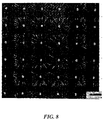
- Figure 2 depicts, using computer simulation, the interference pattern which arises when a single frequency is used in a typical LMDS. It can be seen that the C/I level is lowest in the areas where the TS antennas receive interfering signals from BTSs, which are co-linear with the TS and serving BTS.
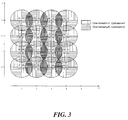
- Each cell is divided into four sectors and given alternating polarization.
- polarization can be used to assist in frequency planning.
- the downlink (from BTS to TS) and uplink (TS to BTS) signals can have the same polarization (both horizontal or both vertical, co-polarized) or they can be orthogonally polarized (down - H and up -V or down -V and up -H, cross -polarized).
- sectors within a cell can be co-polarized or cross-polarized.
- Using the cross-polarized solution decreases the isolation requirements between: (a) the uplink and downlink; and (b) adjacent sectors.
- the cross polarized solution is assumed to be used.
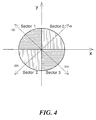
- the method of the present invention is equally valid for the co-polarized solution. Because the sectors of a cell use alternating polarization, each BTS must have an even number of sectors. For the purposes of describing the present invention a four sector configuration as shown in figure 3 is assumed, with the four sectors oriented as shown in figure 4. However, the method of the present invention is also suitable for configurations with a larger number of sectors (e.g. 6, 8, 12, etc.).
- the use of alternate polarization in adjacent sectors means that if information of one type is broadcast into a sector on an assigned frequency, it will not inadvertently be picked by a TS in an adjacent sector because the TS antenna allows cross polarization discrimination in the range of 25db and up.
- the minimum frequency reuse distance is the minimum distance at which the same frequency channel can be reused for a BTS to TS link in a second cell and the interference caused by the second radio link maintained below a desired C/I level.
- the base stations in the network are arranged in groups or clusters.
- Each cluster is basically a square area containing K 2 BTSs (and associated TSs).
- the network configuration for a theoretical network of infinite size can be generated by repeating or "tilling" the original cluster along directions parallel with the axes of the xy plane.
- the configuration of the entire network can then be defined with the frequency assignments managed in such a way that they can be repeated seamlessly across the surrounding clusters as many times as required.
- B i,j the base stations
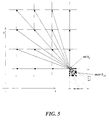
- figure 2 it can be seen that, if all cells use the same frequency channel, a number of zones with high levels of interference would exist within each sector.
- the areas with interference extend radially from the base station, with the interference level growing stronger as the distance to the serving base station increases.
- the number of relevant interference zones depends on: (1) the C/I threshold considered acceptable; and (2) the directivity of the base station sector antennas.
- the angular width or "thickness" of the interference zones depends on the directivity of the terminal station antennae.
- Problematic interference zones appear where distant BTSs are co-linear with a TS and its serving BTS. The interfering signal from the distant BTS cannot be excluded by the directional antenna of the TS.
- the frequency reuse plan integral to the present invention is used. The frequency channel or channels assigned to the terminal stations within an interference area are not be used at any possible interfering distant BTS. Additionally, TSs which are located outside the problematic interference zones (i.e. the "neutral" zones) are assigned any of the frequencies determined to be acceptable for use within that sector.
- the total available frequency spectrum (i.e. the total number of radio channels) is divided into a number C groups of subsets of frequency channels. From the total number of frequency groups, K 2 groups are used for frequency assignments within the interference areas, as well as the rest of the network area. Obviously C must be greater than or equal with K 2 . The rest of the groups C-K 2 are assigned only to links outside the interference zones.
- a set of frequency groups are assigned to each sector B i,j,s
- a set containing only one frequency group is assigned to each interference zone B i,j,s,z .
- the method of the present invention dictates that the frequency group assignments must respect the following restrictions:
- the frequency which can be assigned to all the interference zones created by the B i,j cell is generally given as: f (i mod K) + 4(j mod K) ⁇ F i,j,s for an i, j, s
- K 4 f (i mod 4) + 4(j mod 4) ⁇ F i,j,s for an i, j, s
- equation (2) determines the frequency which cannot be used in that cell, but which is available to be assigned to the interference zones which are produced by that cell.
- the frequency group corresponding to the closest interfering cell is assigned to the common interference zone. Additional frequency groups have to be reserved or "forbidden" at the other sectors affected.
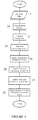
- Figure 6 depicts a flow chart describing generally the method of the present invention.
- the necessary data to determine the frequency reuse plan is obtained. This includes: (a) the required C/I; (b) the network layout (i.e. m x n base stations); and (c) the frequencies which are available to be assigned.
- Example 1 Frequency reuse scheme for 16.9 dB
- the target C/I level is assumed 16.9db.
- the network sectorization and polarization structure is assumed to be the one shown in figure 4.
- the available frequency spectrum is assumed to be channelized into 17 available radio frequency groups, 0 to 16.
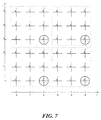
- the "Type" column in Table 1 indicates the position of the base station relative to the cluster to which it belongs.
- the cluster configuration and cell type of Table 1 are graphically depicted in figure 7. It can be seen that base stations located in the same position in adjoining clusters (e.g. B 2,0 , B 5,0, B 5,3 and B 2,3 ) receive identical frequency assignments.
Landscapes
- Engineering & Computer Science (AREA)
- Computer Networks & Wireless Communication (AREA)
- Signal Processing (AREA)
- Mobile Radio Communication Systems (AREA)
Applications Claiming Priority (2)
| Application Number | Priority Date | Filing Date | Title |
|---|---|---|---|
| US561867 | 2000-05-01 | ||
| US09/561,867 US6553234B1 (en) | 2000-05-01 | 2000-05-01 | Method of frequency reuse in a fixed access wireless network |
Publications (2)
| Publication Number | Publication Date |
|---|---|
| EP1152627A2 true EP1152627A2 (fr) | 2001-11-07 |
| EP1152627A3 EP1152627A3 (fr) | 2002-01-16 |
Family
ID=24243811
Family Applications (1)
| Application Number | Title | Priority Date | Filing Date |
|---|---|---|---|
| EP01303979A Withdrawn EP1152627A3 (fr) | 2000-05-01 | 2001-05-01 | Procédé de réutilisation de fréquences dans un réseau fixe à accès sans fil |
Country Status (2)
| Country | Link |
|---|---|
| US (1) | US6553234B1 (fr) |
| EP (1) | EP1152627A3 (fr) |
Cited By (2)
| Publication number | Priority date | Publication date | Assignee | Title |
|---|---|---|---|---|
| CN100340132C (zh) * | 2004-06-25 | 2007-09-26 | 大唐移动通信设备有限公司 | 确定小区覆盖范围边界的方法 |
| GB2491362A (en) * | 2011-05-31 | 2012-12-05 | Fujitsu Ltd | Improving SIR in the inter-cell area by varying re-use distances in dependence on traffic load values |
Families Citing this family (29)
| Publication number | Priority date | Publication date | Assignee | Title |
|---|---|---|---|---|
| JP3414698B2 (ja) * | 2000-05-17 | 2003-06-09 | 日本電気株式会社 | アレーアンテナ送受信装置 |
| US6847820B1 (en) * | 2000-07-24 | 2005-01-25 | Alcatel Canada Inc. | Slanted hub layout for wireless networks |
| GB0019852D0 (en) * | 2000-08-11 | 2000-09-27 | Nokia Networks Oy | Apparatus and method of measuring interference |
| MXPA03005307A (es) * | 2000-12-15 | 2004-12-02 | Adaptix Inc | Comunicaciones de multiportadores con asignacion de subportadora con base en grupos. |
| US6947748B2 (en) | 2000-12-15 | 2005-09-20 | Adaptix, Inc. | OFDMA with adaptive subcarrier-cluster configuration and selective loading |
| GB2370452B (en) * | 2000-12-19 | 2004-10-20 | Inmarsat Ltd | Communication method and apparatus |
| US6675022B2 (en) * | 2001-08-31 | 2004-01-06 | Motorola Inc. | Method and apparatus for providing localized information to a communication device in a wide area communication system |
| US7965693B2 (en) * | 2002-05-28 | 2011-06-21 | Zte (Usa) Inc. | Interworking mechanism between wireless wide area network and wireless local area network |
| US7453837B2 (en) | 2002-08-15 | 2008-11-18 | Zteit Usa, Inc. | Trunking system for CDMA wireless communication |
| CA2529788A1 (fr) * | 2003-06-19 | 2004-12-29 | Ipr Licensing, Inc. | Guidage d'antenne pour une station 802.11 |
| US9585023B2 (en) | 2003-10-30 | 2017-02-28 | Qualcomm Incorporated | Layered reuse for a wireless communication system |
| US8526963B2 (en) * | 2003-10-30 | 2013-09-03 | Qualcomm Incorporated | Restrictive reuse for a wireless communication system |
| KR100943572B1 (ko) | 2003-12-23 | 2010-02-24 | 삼성전자주식회사 | 직교 주파수 분할 다중 접속 시스템에서 주파수재사용율을 고려한 적응적 부채널 할당 장치 및 방법 |
| US7474895B1 (en) * | 2004-03-04 | 2009-01-06 | Zte (Usa) Inc. | Frequency reuse in wireless communication networks |
| CA2563696A1 (fr) * | 2004-04-19 | 2005-10-27 | Zteit Usa, Inc. | Mecanisme de commutation automatique de canaux et d'alternat pour radiocommunications wcdma |
| WO2005109920A2 (fr) * | 2004-05-05 | 2005-11-17 | Nextg Networks | Reduction de la distance de reutilisation de la frequence de reseau sans fil |
| US8059589B2 (en) * | 2004-06-09 | 2011-11-15 | Qualcomm Incorporated | Dynamic restrictive reuse scheduler |
| US7680475B2 (en) | 2004-06-09 | 2010-03-16 | Qualcomm Incorporated | Dynamic ASBR scheduler |
| US7729303B2 (en) | 2004-06-30 | 2010-06-01 | Zteit Usa, Inc. | Global open trunking system for CDMA wireless communication |
| US8032145B2 (en) | 2004-07-23 | 2011-10-04 | Qualcomm Incorporated | Restrictive reuse set management algorithm for equal grade of service on FL transmission |
| US7573851B2 (en) | 2004-12-07 | 2009-08-11 | Adaptix, Inc. | Method and system for switching antenna and channel assignments in broadband wireless networks |
| US7548752B2 (en) * | 2004-12-22 | 2009-06-16 | Qualcomm Incorporated | Feedback to support restrictive reuse |
| US7738875B2 (en) * | 2005-12-22 | 2010-06-15 | Wichorus Inc | Method and apparatus to estimate relative base station and subscriber terminal locations and using it to increase frequency reuse |
| US7929460B2 (en) * | 2006-09-14 | 2011-04-19 | Vanu, Inc. | Communication network topology determination |
| US20080139231A1 (en) * | 2006-12-07 | 2008-06-12 | Rehan Jalil | method and system for spectrum reuse in the downlink in a wireless communication network |
| US8694011B2 (en) * | 2006-12-07 | 2014-04-08 | Wichorus Inc. | Method and system for spectrum reuse in the uplink in a wireless communication network |
| US20090323578A1 (en) * | 2008-06-25 | 2009-12-31 | Robert Bosch Gmbh | Wireless Vehicle Communication Method Utilizing Wired Backbone |
| US20120127970A1 (en) * | 2010-01-29 | 2012-05-24 | Anil Gupta | Wireless Network System And Method Configured To Mitigate Co-channel Interference |
| US9509466B2 (en) | 2012-04-27 | 2016-11-29 | Hewlett Packard Enterprise Development Lp | Overlapping sub-channels in a network |
Family Cites Families (6)
| Publication number | Priority date | Publication date | Assignee | Title |
|---|---|---|---|---|
| US5247699A (en) | 1990-04-12 | 1993-09-21 | Telefonaktiebolaget L M Ericsson | Cellular frequency reuse cell plan |
| CA2023053C (fr) | 1990-08-10 | 1994-06-28 | Frank D. Benner | Methode d'attribution des voies de telecommunication dans un systeme telephonique cellulaire |
| US5365571A (en) * | 1993-05-24 | 1994-11-15 | Hughes Aircraft Company | Cellular system having frequency plan and cell layout with reduced co-channel interference |
| US5483667A (en) | 1993-07-08 | 1996-01-09 | Northern Telecom Limited | Frequency plan for a cellular network |
| US5734983A (en) | 1996-06-20 | 1998-03-31 | Northern Telecom Limited | Frequency assignment in a cellular radio system |
| US5838670A (en) * | 1997-01-29 | 1998-11-17 | Telefonaktiebolaget L M Ericsson | Point to multipoint radio access system |
-
2000
- 2000-05-01 US US09/561,867 patent/US6553234B1/en not_active Expired - Fee Related
-
2001
- 2001-05-01 EP EP01303979A patent/EP1152627A3/fr not_active Withdrawn
Non-Patent Citations (1)
| Title |
|---|
| None * |
Cited By (4)
| Publication number | Priority date | Publication date | Assignee | Title |
|---|---|---|---|---|
| CN100340132C (zh) * | 2004-06-25 | 2007-09-26 | 大唐移动通信设备有限公司 | 确定小区覆盖范围边界的方法 |
| GB2491362A (en) * | 2011-05-31 | 2012-12-05 | Fujitsu Ltd | Improving SIR in the inter-cell area by varying re-use distances in dependence on traffic load values |
| US8879441B2 (en) | 2011-05-31 | 2014-11-04 | Fujitsu Limited | Dynamic resource allocation for reducing inter-cell interference |
| GB2491362B (en) * | 2011-05-31 | 2015-09-09 | Fujitsu Ltd | Dynamic resource allocation for reducing inter-cell interference |
Also Published As
| Publication number | Publication date |
|---|---|
| EP1152627A3 (fr) | 2002-01-16 |
| US6553234B1 (en) | 2003-04-22 |
Similar Documents
| Publication | Publication Date | Title |
|---|---|---|
| US6553234B1 (en) | Method of frequency reuse in a fixed access wireless network | |
| US5649292A (en) | Obtaining improved frequency reuse in wireless communication systems | |
| US5946625A (en) | Method for improving co-channel interference in a cellular system | |
| US7877061B2 (en) | Method and system for reducing channel interference in a frame-synchronized wireless communication system | |
| JP4589287B2 (ja) | パワー制御と有向チャネル割当てを併用して隣接チャネル干渉の管理を行なうためのシステムおよび方法 | |
| US6339708B1 (en) | Method and apparatus for communications resource allocation for a wireless communications system | |
| US6400697B1 (en) | Method and apparatus for sector based resource allocation in a broadhand wireless communications system | |
| KR100331006B1 (ko) | 채널동적할당방법및무선통신네트워크 | |
| US6262980B1 (en) | Dynamic resource allocation method and apparatus for broadband services in a wireless communications system | |
| US6400955B1 (en) | Radio communication system | |
| US5850608A (en) | Directional frequency assignment in a cellular radio system | |
| EP1178641A1 (fr) | Schéma de réutilisation de fréquences pour systèmes de multiplexage à répartition de fréquence orthogonale (OFDM) | |
| US20070042778A1 (en) | Cellular radio network reusing frequencies | |
| EP2290889B1 (fr) | Terminal d'utilisation de la communication sans fil | |
| JPH09233536A (ja) | チャネル化されたセルラシステム内の隣接チャネル干渉を管理するためのシステムおよび方法 | |
| US6128497A (en) | High capacity cell planning based on fractional frequency reuse | |
| US6542746B1 (en) | Frequency reuse scheme for point to multipoint radio communication | |
| US20120094655A1 (en) | Adaptive capacity and quality improvements in cellular radio services by the removal of strong interference sources | |
| US7200407B1 (en) | Multiple reuse patterns for channels of wireless networks | |
| US20060198339A1 (en) | Wireless communication method and system for minimizing interference by determining mobile station zone locations and potential conflicts between cell zones | |
| US5802474A (en) | Directional frequency allocation in an N=6 cellular radio system | |
| US5970411A (en) | N=4 directional frequency assignment in a cellular radio system | |
| Srivastava et al. | Sector-based resource allocation for broadband fixed wireless networks | |
| AU750523B2 (en) | Cellular radio communication system with a channel quality criterion | |
| MXPA99003325A (en) | Method for improving co-channel interference in a cellular system |
Legal Events
| Date | Code | Title | Description |
|---|---|---|---|
| PUAI | Public reference made under article 153(3) epc to a published international application that has entered the european phase |
Free format text: ORIGINAL CODE: 0009012 |
|
| AK | Designated contracting states |
Kind code of ref document: A2 Designated state(s): AT BE CH CY DE DK ES FI FR GB GR IE IT LI LU MC NL PT SE TR Kind code of ref document: A2 Designated state(s): DE ES FR GB IT |
|
| AX | Request for extension of the european patent |
Free format text: AL;LT;LV;MK;RO;SI |
|
| PUAL | Search report despatched |
Free format text: ORIGINAL CODE: 0009013 |
|
| AK | Designated contracting states |
Kind code of ref document: A3 Designated state(s): AT BE CH CY DE DK ES FI FR GB GR IE IT LI LU MC NL PT SE TR |
|
| AX | Request for extension of the european patent |
Free format text: AL;LT;LV;MK;RO;SI |
|
| 17P | Request for examination filed |
Effective date: 20020412 |
|
| AKX | Designation fees paid |
Free format text: DE ES FR GB IT |
|
| 17Q | First examination report despatched |
Effective date: 20061129 |
|
| STAA | Information on the status of an ep patent application or granted ep patent |
Free format text: STATUS: THE APPLICATION IS DEEMED TO BE WITHDRAWN |
|
| 18D | Application deemed to be withdrawn |
Effective date: 20061201 |