EP1153373B1 - Verfahren und system zur authentifizierung von artikeln - Google Patents
Verfahren und system zur authentifizierung von artikeln Download PDFInfo
- Publication number
- EP1153373B1 EP1153373B1 EP99965372A EP99965372A EP1153373B1 EP 1153373 B1 EP1153373 B1 EP 1153373B1 EP 99965372 A EP99965372 A EP 99965372A EP 99965372 A EP99965372 A EP 99965372A EP 1153373 B1 EP1153373 B1 EP 1153373B1
- Authority
- EP
- European Patent Office
- Prior art keywords
- image
- data
- marking
- code
- control center
- Prior art date
- Legal status (The legal status is an assumption and is not a legal conclusion. Google has not performed a legal analysis and makes no representation as to the accuracy of the status listed.)
- Expired - Lifetime
Links
Images




Classifications
-
- H—ELECTRICITY
- H04—ELECTRIC COMMUNICATION TECHNIQUE
- H04L—TRANSMISSION OF DIGITAL INFORMATION, e.g. TELEGRAPHIC COMMUNICATION
- H04L9/00—Cryptographic mechanisms or cryptographic arrangements for secret or secure communications; Network security protocols
- H04L9/32—Cryptographic mechanisms or cryptographic arrangements for secret or secure communications; Network security protocols including means for verifying the identity or authority of a user of the system or for message authentication, e.g. authorization, entity authentication, data integrity or data verification, non-repudiation, key authentication or verification of credentials
-
- G—PHYSICS
- G06—COMPUTING OR CALCULATING; COUNTING
- G06K—GRAPHICAL DATA READING; PRESENTATION OF DATA; RECORD CARRIERS; HANDLING RECORD CARRIERS
- G06K19/00—Record carriers for use with machines and with at least a part designed to carry digital markings
- G06K19/06—Record carriers for use with machines and with at least a part designed to carry digital markings characterised by the kind of the digital marking, e.g. shape, nature, code
- G06K19/08—Record carriers for use with machines and with at least a part designed to carry digital markings characterised by the kind of the digital marking, e.g. shape, nature, code using markings of different kinds or more than one marking of the same kind in the same record carrier, e.g. one marking being sensed by optical and the other by magnetic means
- G06K19/083—Constructional details
- G06K19/086—Constructional details with markings consisting of randomly placed or oriented elements, the randomness of the elements being useable for generating a unique identifying signature of the record carrier, e.g. randomly placed magnetic fibers or magnetic particles in the body of a credit card
-
- G—PHYSICS
- G07—CHECKING-DEVICES
- G07D—HANDLING OF COINS OR VALUABLE PAPERS, e.g. TESTING, SORTING BY DENOMINATIONS, COUNTING, DISPENSING, CHANGING OR DEPOSITING
- G07D7/00—Testing specially adapted to determine the identity or genuineness of valuable papers or for segregating those which are unacceptable, e.g. banknotes that are alien to a currency
- G07D7/004—Testing specially adapted to determine the identity or genuineness of valuable papers or for segregating those which are unacceptable, e.g. banknotes that are alien to a currency using digital security elements, e.g. information coded on a magnetic thread or strip
-
- G—PHYSICS
- G07—CHECKING-DEVICES
- G07D—HANDLING OF COINS OR VALUABLE PAPERS, e.g. TESTING, SORTING BY DENOMINATIONS, COUNTING, DISPENSING, CHANGING OR DEPOSITING
- G07D7/00—Testing specially adapted to determine the identity or genuineness of valuable papers or for segregating those which are unacceptable, e.g. banknotes that are alien to a currency
- G07D7/20—Testing patterns thereon
-
- G—PHYSICS
- G07—CHECKING-DEVICES
- G07F—COIN-FREED OR LIKE APPARATUS
- G07F7/00—Mechanisms actuated by objects other than coins to free or to actuate vending, hiring, coin or paper currency dispensing or refunding apparatus
- G07F7/08—Mechanisms actuated by objects other than coins to free or to actuate vending, hiring, coin or paper currency dispensing or refunding apparatus by coded identity card or credit card or other personal identification means
- G07F7/12—Card verification
- G07F7/122—Online card verification
-
- H—ELECTRICITY
- H04—ELECTRIC COMMUNICATION TECHNIQUE
- H04L—TRANSMISSION OF DIGITAL INFORMATION, e.g. TELEGRAPHIC COMMUNICATION
- H04L9/00—Cryptographic mechanisms or cryptographic arrangements for secret or secure communications; Network security protocols
- H04L9/32—Cryptographic mechanisms or cryptographic arrangements for secret or secure communications; Network security protocols including means for verifying the identity or authority of a user of the system or for message authentication, e.g. authorization, entity authentication, data integrity or data verification, non-repudiation, key authentication or verification of credentials
- H04L9/3226—Cryptographic mechanisms or cryptographic arrangements for secret or secure communications; Network security protocols including means for verifying the identity or authority of a user of the system or for message authentication, e.g. authorization, entity authentication, data integrity or data verification, non-repudiation, key authentication or verification of credentials using a predetermined code, e.g. password, passphrase or PIN
Definitions
- the present invention relates to the technique of protection of articles from counterfeiting, and may be used for protection from counterfeiting and unauthorized copying of goods documents, securities, etc.
- such marks are made of a special material having specific properties, e.g., a material that may be fluorescent in a particular light spectrum (US Patent 5,719,948 Apparatus and methods for fluorescent imaging and optical character reading), a material with magnetic features (US Patent 5.697,649 Articles employing a magnetic securities feature), or a material exhibiting anisotropy during absorption, reflection, transmission (US Patent 5,568,251 Authenticating system..), etc. Such materials may be also applied or included into a composition of a mark forming a particular figure. combination etc.
- the other group of methods is based on the unique physical or chemical characteristics of a surface of a document or a product.
- a section of the surface to be protected is scanned in accordance with the selected physical characteristic of a surface (WO97/24699 Authentication of articles).
- the scanned image is encoded and/or encrypted, and the obtained result is applied to the surface of an article or a document in the form of a numeral or a code.
- the surface is scanned by the testing device.
- the data obtained after scanning are processed by the same method, the code applied to the surface is decoded and/or is decrypted and compared to the result of processing of scanning.
- Scanning of physical characteristics requires elaborated physical devices.
- the characteristics can have a wide physical range of variations and a high level of background characteristics. This fact makes their use rather expensive and reduces the degree of estimation validity.
- the major problem consists in determining the area of scanning, since use of the physical characteristics of a surface does not limit the scanning area to the proper physical characteristics impeding possibility of re-getting to the same region.
- the encoding systems now in use fail to provide a sufficient crypto-resistance of encoding, and the used keys may be restored for counterfeiting.
- Specially structured materials comprising randomly distributed fibers or other contrast inclusions that are easily readout by optical devices set for transmission or reflection (WO98/57299 Document with an authentication feature), are used for more reliable determination of random characteristics of a surface.
- the scanning area is limited to special patterns or windows, that are applied to the surface of a label made of a structured material.
- the labels of the kind may be manufactured and tagged to articles or documents.
- the bulk structure and optical characteristics of fibers may cause errors leading to uncertainty of identification, on the account of errors in determining scanning areas, as well as because of inaccuracy in measuring medium characteristics..
- identification system requires elaborated equipment for precise determining of spatial optical characteristics.
- the similar system uses a label with randomly (irregularly) disposed dichroic fibers. Information on the producer, characteristics of the goods and information on the encoded result of scanning is disposed next on a label (WO99/17486 System and method for authentication of goods).
- the system requires special reading equipment for determining the optical characteristic of dichroity of fibers.
- disposition of fibers in the medium and inaccuracy in determining binding of fibers may result in considerable inaccuracies during re-readout while testing.
- tags may be counterfeited or simply transferred from original goods to counterfeited articles.
- Prior art also discloses methods of protection of documents from copying by means of applying nonreplicable pitches to an image, e.g. press printed lineatures, etc.
- US Patents 5,018,767 Counterfeited protected document; 5,193,853 Nonreplicable document and method for making same).
- the printed contrast image facilitates readout and increases reliability of identification of marking. Moreover, such methods provide a rather reliable control of document passage. However, the marking of the kind may be copied and applied onto another document, i.e. it may be counterfeited by substituting a document.
- the prior art authentication systems generally comprise at least two remote scanners, a printing device, data processing means and communication means.
- a printing device imprints information and a code.
- the printing device imprints an encoded image, as well as a sequence of bar codes or terminal codes.
- the described systems require the elaborated scanning equipment and special composite mediums (materials) for reliable re-scanning under testing.
- increase of image contrast and reproducibility of repeated scanning in existing systems magnifies probability for copying and counterfeiting.
- a close technical solution for the system under the present invention is the system and method of marking goods disclosed in the US-A-5,592,561.
- the said system comprises a control computer, a main computer, a marking system and a testing reader, all of the devices being compatible and connected by a communication system.
- the marking system comprises a printer, a reader, and a processing and control unit that is connected to the main computer by a modem. Marks in the form of a two-dimensional encrypted image are imprinted on an article or on a material the product is made of.
- the image may be scanned by a reading device and encrypted In the form of encrypted data. Then the data are compared with the authentication data of the database, or the data are decoded and compared with the data stored in the central database of the main computer.
- the marking system ensures control of image printing by means of a certain number of authentication codes, which should be applied prior to that, when the reauthentication is required.
- the encoded image is scanned and recognized as a true one in the central database. Then the image may be stored in the database together with the relevant information referring to the said particular product.
- the system provides a fairly sharp and easily readout image. Nevertheless, the system is not able to defend the producer from counterfeiting in a full scope, since an image is easily reproduced, and a counterfeited copy of a product may happen to be the first one during re-testing of mass goods.
- the aim of the invention is the development of a reliable method and system for recognizing of marking, uniqueness of marking, as well as control of movement of goods.
- the present invention develops new methods for marking articles and authentication the same, as well as a system for checking and authenticating, i.e. checking the genuiness of origin of goods, articles and documents.
- the main aim of the invention is providing a marking means that is, on one hand, capable of ensuring a unique marking and impossibility for counterfeiting of the marking, and, on the other hand, is satisfactory secure and simple in technicality of recognizing unique marking.
- the aim of the invention is realized in the following way. Marking of articles is performed by the steps of:
- the method is also characterized by that a unique image is generated as a random at least two-dimensional image; and the said generated random two-dimensional image is applied on to a selected area, made of a material that has a rough surface with random characteristics;
- Various materials may be used, e.g. materials having a rough surface, fibrous, porous material, materials with inclusions of particles, etc.
- the cheapest materials are fibrous materials, including rough paper, cloths and other household materials.
- the said materials ensure impossibility of any copying, whereas a completely another image is produced, under re-applying any image on a surface of a random texture.
- a distribution of coloring or any other marking agent is essentially influenced by the texture.
- the intensity of reflected light also substantially influences image characteristics during reading.
- the image of this kind may produce a completely different identification data when readout. In this case the counterfeited article will be immediately identified.
- marking of this type provides both the unique character of marking and impossibility for any replication by modem technical means, providing also the unique character of the identification code applied next to the marking image.
- the abovementioned distribution of functions provides protection from counterfeiting by safe storing the encryption keys, which are designed for creating protection codes applied onto a label next to the identification image.
- the individuality of keys prevents possibility of encrypting any other randomly generated counterfeiting images.
- a producer or a supplier may take up the running of protecting marking.
- the functions may be distributed as follows:
- control center provides only the monitoring and checking function.
- the other method for obtaining a unique marking image that frames conditions for impossibility of reproducing and counterfeiting is a variant of embodiment, according to which, using the same actions and data processing sequence, a random image is applied onto a surface, that is further modified for forming a texture with random parameters.
- a random two-dimensional image is applied to the surface, which is further modified, gaining as a result the similar anti-counterfeiting features as in the previous case.
- the surface therewith is modified until a steady texture with random parameters is formed.
- the aforementioned surface modification may be effected by any of the beneath disclosed methods or by equivalent techniques, e.g. by perforating.
- the texture and its random parameters are formed at the edge of openings on account of both - erosion of the edge and it's matching with random image elements and their parts.
- Perforating may be also performed by electrospark machining. In this case distribution of openings is also random and nonreproducible.
- the surface may be also modified by texture impression, by analogy with seals, pressing means, etc.
- Further means for image modifying and providing nonreproducibility may be the use of a porous material with capillary features.
- porosity defines a texture existence, while the image is modified in a random way on the account of irregular redistribution of a liquid colorant throughout irregular layout of capillaries.
- the criterion of existence of a respective texture on an image is specified, when identifying, thereafter the image is readout.
- functions between the checking terminal and the control center are distributed as follows:
- the whole process of identification of articles starting from marking to making decision on authenticity of an article, together with testing passing of products and search for counterfeiting products, comprises the following steps:
- the said embodiment of the invention is preferable, as it reduces the traffic value for communication network.
- image data at the checking terminal i.e. at the unit of storing direct information on the checked article and its state, one may estimate the situation more objectively.
- considerable deviations in quantitative characteristics are registered, it is possible to check some other articles from the series.
- image data may be also transferred to the control center for comparing the data obtained at check scanning with the data, recovered against the obtained code.
- the said method is characterized by that a unique marking image is obtained by the steps of.
- control center stores data on the checks performed, a number of checks of one and the same code being registered, when the set value of checks being exceeded, a signal informing on the recurring request is produced.
- the system for authentication of articles comprises a marking means including a printer, a printer control device, a readout device, an image processing unit, a communication means and a remote control center and a checking terminal comprising a key generating unit, encoding/decoding unit, a memory unit, a compare facility (decision-making unit), and blank parts for labels.
- the marking device further includes a random image generating device, means for applying an encrypted code; as blank parts for labels are used substrates made of material having a texture with random parameters.
- the scanning area of the protective image is precisely localized, since the applied image has a good contrast in comparison with the remaining surface.
- storing of the private keys in remote processing center magnifies the degree of reliability for storing private keys, which are never transmitted to open checking terminals, and in general, may be transmitted nowhere at all.
- a label is a card attached to an article or a document and may be coupled to it in a one-piece fashion.
- a label may contain general information 2, i.e. a trademark, kind of an article, its parameters etc. Additionally, a label may also comprise an identifying image 3 and its encrypted image in the form of a bar code 4. The said bar code may also contain some other service information about keys, a serial number, etc. The surface in the area of the identification image may be covered by a special material providing roughness of the said surface.
- the identification system may be delivered in a computer variant with of special or universal processors.
- the system comprises a marking device, which includes at least a printer 5, a scanner 6 and a marking processor 7 that functions for random image generating, for data processing and printer control, and a means for data transmitting 8 over a distributed or local network 9.
- the control center comprises a central processing unit 10 and at least a memory device 11 for storing of databases, and an encoding/decoding unit 12. Over communication means 8 the said center is also inline (online) to the worldwide or local data transmitting network 9.
- the said center is further connected to the remote checking devices, each of them comprising at least a communications means 8, a scanner 6 and a data processor for checking 13.
- the system may also comprise a set of blank parts for labels.
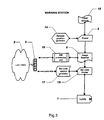
- an image is generated by the image generator 14 in the marking station, as shown in Fig. 3.
- the image comprises dots, randomly “scattered” within the limits of the set area of dots (pixels), or fully consists of the said dots; each dot is assigned its own color, which is randomly sampled every time from an n-color palette.
- the generated image is imprinted on to a surface of a label with the help of a jet or laser printer 5 having a 300 dpi resolution.
- the substrate 15 for a label is made of a material with a relief surface, such as friable paper, fabric or porous material.
- the obtained image may be randomly transformed by means of a special device in the process of printing or after the same.
- the surface texture of these materials is distributed in a random way. Therefore, unlike a generated image, dyes or printer toner filling surface irregularities is re-distributed. Additionally, in the process of further readout reflection characteristics vary according to texture inclination.
- the image has still one more advantage.
- toner particles arrive in other conditions, and, accordingly, the image varies again, and cannot be copied in facsimile on a similar surface because of mismatch of a random surface texture with the image element of the original.
- the imprinted image may also be transformed in another way, e.g. by perforating, expansion or compression, heat treatment, etc.
- the area is scanned by the scanner 16 of a 300dpi resolution, 256 shades of gray.
- the resulting array is processed in DIB (device independent bitmap)- processo16 according to the preset rule, e.g. by interleaving to fractions according to colors. Pixels of some fractions are excluded from the total number of the array pixels.
- the line of symbols obtained by concatenation of line expressions of hexadecimal representation of N 1 and N 2 is the image representation.
- the said line of symbols is encrypted by a private key, e.g. as disclosed in PCT/99BY/00004 (MZ4).
- a private key may be either generated in the marking station or transmitted to control center, or it may be obtained from the control center, shown in the Fig. 4.
- an individual private key is generated by the key generator 19 for every marking terminal.
- an image representation may be sent for encrypting to the control center. Then, the obtained encrypted image representation is transmitted from the control center to the marking station.
- the bar code generator 17 transforms the encrypted image representation into a bar code. which is imprinted by printer 18 to the label surface next to the image as a bar code 3.
- control center includes input/output communication units (modem) 8, a code generator 19, an encoder/decoder 20, a compare facility 22 (that may be also located at the checking terminal), a memory device 23 for storing data on the carried out tests, etc.
- modem input/output communication units
- code generator encoder/decoder
- compare facility 22 that may be also located at the checking terminal
- memory device 23 for storing data on the carried out tests, etc.
- the key generator 19 When data on the testing image arrive from the marking terminal at the input of the control center, the key generator 19 generates a private key, which is stored in the database 21. Then the private key is transferred to the encoder/decoder 20, where the image representation is coded and transferred back to the marking station for imprinting to a label as a bar code 3.
- the encoder/decoder 20 requests the database for a key in accordance with ID of the bar code.
- the respective key arrives at the decoder 20, which recovers (decodes) the image data. Thereafter, the said data are transferred through the compare facility 22 to the decision-making unit 25 of the checking terminal, as shown in the Fig. 5.
- Testing data are stored in the database 23. In case some bar codes occur often, the unit 22 blocks transmission of the recovered image representation and issues a counterfeit signal.
- the checking terminal is equipped with a bar code reader 24, an image scanner 6, a DIB (device independent bitmap) processor 16 for image identification, an input/output unit of the communication channel 8, and a compare and decision-making device 25.
- a bar code reader 24 an image scanner 6
- DIB device independent bitmap
- the protective image 2 is scanned, and the protective bar code 3 is readout.
- the value of a bar code 3 of the encrypted image representation is readout and sent over a communication channel 9 to the control center.
- the control center selects the relevant key from the memory device 21 of the key database, decodes the set value, recovering thereby the image representation expressed by the N 1 'and N 2 ' parameters.
- the recovered image representation is transferred back to the checking terminal.
- the comparing and decision-making device 25 compares the said image with the image representation obtained as a result of check scanning by the scanner 6 of the imprinted image and processing in the DIB processor 16 by the N1 and N2 parameters.
- the result of comparing of the N 1 ' and N 2 ' parameters with the N 1 and N 2 parameters is analyzed for making decision on authenticity or counterfeit of an article. In the process are estimated permissible deviations of parameters values caused by wearout of a label, inaccuracy of scanning, etc.
- a marking station may be located either at an enterprise-producer or at a centralized storage, or in special station for certifying documents, e.g. notary's office, etc.
- the identification station should be reasonably secure to ensure protection of the stored information, keys and testing data and other information.
- the checking terminal may be arranged as accessible to public terminals, such as bancomats, located in large shopping centers or other public facilities.
- the Internet, telephone, designated local or other networks may be used for communication.
- Protected communication channels are preferable.
- the system provides counterfeit-protection of goods and documents without using any complex and specific physical protection means. This fact makes the system obtainable, moderate and cheap.
Landscapes
- Engineering & Computer Science (AREA)
- Physics & Mathematics (AREA)
- General Physics & Mathematics (AREA)
- Computer Security & Cryptography (AREA)
- Signal Processing (AREA)
- Computer Networks & Wireless Communication (AREA)
- Theoretical Computer Science (AREA)
- Editing Of Facsimile Originals (AREA)
- Credit Cards Or The Like (AREA)
- Labeling Devices (AREA)
- Management, Administration, Business Operations System, And Electronic Commerce (AREA)
- Storage Device Security (AREA)
- Financial Or Insurance-Related Operations Such As Payment And Settlement (AREA)
Claims (20)
- Verfahren zum Markieren von Gegenständen zur sicheren Authentifizierung, mit folgenden Schritten:dadurch gekennzeichnet, dassErzeugen privater Schlüssel,Speichern der Schlüssel in einer Datenbank,Erzeugen eines Bildes für jede Probe eines Gegenstandes,Aufbringen des Bildes auf eine markierte Oberfläche,Lesen des resultierenden Bildes,Gewinnen von Daten über das ausgelesene Bild,Verschlüsseln,je Probe eines Gegenstandes ein Bild als eindeutiges und zumindest zweidimensionales Zufallsbild erzeugt wird,das erzeugte zweidimensionale Zufallsbild auf eine gewählte Fläche aus einem Material mit rauer Oberfläche mit Zufallsparametern aufgebracht wird,die Daten über das ausgelesene Bild verschlüsselt werden undder sich ergebende Code auf die Markieroberfläche aufgebracht wird.
- Verfahren zum Markieren von Gegenständen zur sicheren Authentifizierung, mit folgenden Schritten:dadurch gekennzeichnet, dassErzeugen privater Schlüssel,Speichern der Schlüssel in einer Datenbank,Erzeugen eines Bildes für jede Probe eines Gegenstandes,Aufbringen des Bildes auf eine markierte Oberfläche,Lesen des resultierenden Bildes,Gewinnen von Daten über das ausgelesene Bild,Verschlüsseln,je Probe eines Gegenstandes ein Bild als eindeutiges und zumindest zweidimensionales Zufallsbild erzeugt wird,das erzeugte zweidimensionale Zufallsbild auf eine gewählte Oberfläche aufgebracht wird und danach,die Oberfläche mit dem aufgebrachten Bild modifiziert wird, bis eine unregelmäßige dreidimensionale Textur gebildet wird,das sich ergebende Bild nach Modifizieren der Oberfläche ausgelesen wird und danachdie Daten über das ausgelesene Bild verschlüsselt werden undder sich ergebende Code auf die Markieroberfläche aufgebracht wird.
- Verfahren nach Anspruch 2, dadurch gekennzeichnet, dass die Oberfläche modifiziert wird, bis eine beständige Textur von Zufallsparametern gebildet ist.
- Verfahren nach Anspruch 2, dadurch gekennzeichnet, dass die Oberfläche durch Perforation modifiziert wird.
- Verfahren nach Anspruch 2, dadurch gekennzeichnet, dass die Oberfläche durch Prägen modifiziert wird.
- Verfahren nach Anspruch 2, dadurch gekennzeichnet, dass die Oberfläche durch Funkenbehandlung modifiziert wird.
- Verfahren nach Anspruch 1 oder 2, dadurch gekennzeichnet, dass als Markiermaterial ein Aufkleber mit einer gewählten Fläche eines dreidimensionalen gemusterten Materials verwendet wird, z.B. poröses Material mit Kapillareigenschaften.
- Verfahren nach einem der Ansprüche 1 bis 7, dadurch gekennzeichnet, dassdas Erzeugen privater Schlüssel, die Datenverschlüsselung und die Datenspeicherung in einem entfernten Kontrollzentrum erfolgen,das Aufbringen des Bildes, Abtasten des sich ergebenden Bildes und Aufbringen des verschlüsselten Code durch eine Markiereinrichtung erfolgen,die Markiereinrichtung Daten über das Bild zum Kontrollzentrum überträgt, während das Kontrollzentrum das Verschlüsselungsergebnis zur Markiereinrichtung überträgt, wobei die Datenübertragung zwischen der Markiereinrichtung und dem Kontrollzentrum über Nachrichtenkanäle erfolgt.
- Verfahren nach einem der Ansprüche 1 bis 7, dadurch gekennzeichnet, dassdie Erzeugung privater Schlüssel, die Datenverschlüsselung, die Erzeugung eines Zufallsbildes, das Anbringen des Bildes auf der markierten Oberfläche, das Lesen des resultierenden Bildes und das Anbringen des verschlüsselten Code auf der markierten Oberfläche durch eine Markiereinrichtung erfolgen,die Datenübertragung zum Kontrollzentrum ebenfalls durch die Markiereinrichtung ausgeführt wird, während zumindest Schlüssel zum Kontrollzentrum über einen Vertraulichkeit gewährleistenden Weg übertragen werden,das Kontrollzentrum die Schlüssel und Codes in der Datenbank speichert.
- Verfahren nach einem der Ansprüche 2 bis 6, dadurch gekennzeichnet, dassdas Erzeugen privater Schlüssel, die Datenverschlüsselung und die Speicherung in einem entfernten Kontrollzentrum erfolgen,das Anbringen des Bildes, das Modifizieren der Oberflächentextur mit dem aufgebrachten Bild, das Abtasten des sich ergebenden Bildes und das Anbringen des Code durch die Markiereinrichtung ausgeführt werden,ein Datenaustausch zwischen der Markiereinrichtung und dem Kontrollzentrum über Nachrichtenkanäle erfolgt.
- Verfahren nach Anspruch 1, dadurch gekennzeichnet, dassdas Erzeugen privater Schlüssel, die Datenverschlüsselung sowie das Anbringen des Bildes, das Abtasten des sich ergebenden Bildes und das Anbringen des Code durch eine Markiereinrichtung erfolgen,die Markiereinrichtung die Daten über das Bild zum Kontrollzentrum überträgt, die sie in der Datenbank speichert, wobei wenigstens die Schlüssel über den Vertraulichkeit gewährleistenden Übertragungskanal zum Kontrollzentrum übertragen werden.
- Verfahren zur Authentifizierung von nach einem der Ansprüche 1 bis 11 markierten Gegenständen an einem Gegenstands-Prüfterminal, mit folgenden Schritten:dadurch gekennzeichnet, dassLesen eines Markierbildes und Transformieren desselben in Daten,Lesen eines verschlüsselten Code,Entschlüsseln zur Wiedergewinnung der Bilddaten vom ausgelesenen Code,Vergleichen der gewonnenen Daten mit den ausgelesenen Bilddaten,die Existenz einer jeweiligen Textur auf dem Bild als zusätzliches Kriterium spezifiziert wird, wenn Authentifizierung ausgeführt wird, wonach das Bild ausgelesen wird.
- Verfahren nach Anspruch 12, dadurch gekennzeichnet, dassdas Lesen des Markierbildes, das Lesen des verschlüsselten Code und das Spezifizieren des Kriteriums der Texturgegenwart am Prüfterminal ausgeführt werden, die ausgelesenen Bilddaten und der ausgelesene verschlüsselte Code zum Kontrollzentrum übertragen werden,das Entschlüsseln zur Wiedergewinnung der Bilddaten aus dem ausgelesenen Code und das Vergleichen des gewonnenen Bildes mit den Daten des ausgelesenen Bildes im entfernten Kontrollzentrum erfolgen.
- Verfahren nach Anspruch 12, dadurch gekennzeichnet, dassdas Lesen des Markierbildes, das Lesen des verschlüsselten Code und das Spezifizieren des Kriteriums der Texturgegenwart am Prüfterminal erfolgen, wobei die ausgelesenen Codedaten zum Kontrollzentrum übertragen werden,das Entschlüsseln zur Gewinnung der Bilddaten aus dem Auslesecode im entfernten Zentrum erfolgt und das gewonnene Prüfergebnis zum Prüfterminal übertragen wird,das Vergleichen der gewonnenen Daten mit den Daten des ausgelesenen Authentifizierungsbildes im Prüfterminal erfolgt.
- Verfahren nach einem der Ansprüche 12 bis 14, dadurch gekennzeichnet, dass im Verlauf des Vergleichs Fehler geschätzt werden und eine Entscheidung auf der Basis eines vorgegebenen Kriteriums erfolgt.
- Verfahren zur Authentifizierung und Erfassung gefälschter Gegenstände mit folgenden Schritten:Erzeugen eines eindeutigen Bildes als wenigstens zweidimensionales Zufallsbild,Aufbringen des erzeugten Zufallsbildes auf eine Oberfläche mit einer Textur mit unregelmäßigen Parametern,Lesen des resultierenden Bildes,Übertragen der Daten über das ausgelesene Bild zu einem entfernten Kontrollzentrum,Erzeugen privater Schlüssel,Verschlüsseln der erhaltenen eindeutigen Bilddaten durch die privaten Schlüssel,Übertragen des sich ergebenden Code zu einer Markierstation,Aufbringen des resultierenden Code auf die Markieroberfläche,Speichern der Schlüssel in der Datenbank des Kontrollzentrums,Verifizieren der Gegenwart und des Texturmusters auf der Markieroberfläche in einem Prüfterminal und daraufTest-Lesen des Markierbildes und des aufgebrachten Code,Übertragen der Codedaten zum Kontrollzentrum,Entschlüsseln der Codedaten und Gewinnen der Daten über das ausgelesene Bild,Übertragen der gewonnenen Daten zum Prüfterminal,Vergleichen der gewonnenen Daten mit den Daten über das ausgelesene Bild,Entscheiden über die Authentizität Gegenstandes.
- Verfahren zur Authentifizierung und Erfassung gefälschter Gegenstände mit folgenden Schritten:Erzeugen eines eindeutigen Bildes als wenigstens zweidimensionales Zufallsbild,Aufbringen des erzeugten Zufallsbildes auf eine Oberfläche mit einer Textur mit unregelmäßigen Parametern,Lesen des resultierenden Bildes,Übertragen der Daten über das ausgelesene Bild zu einem entfernten Kontrollzentrum,Erzeugen privater Schlüssel,Codieren der erhaltenen eindeutigen Bilddaten durch die privaten Schlüssel,Übertragen des sich ergebenden Code zu einer Markierstation,Aufbringen des resultierenden Code auf die Markieroberfläche,Speichern der Schlüssel in der Datenbank des Kontrollzentrums,Verifizieren der Gegenwart und des Texturmusters auf der Markieroberfläche und daraufTest-Lesen des Markierbildes und des aufgebrachten Code,Übertragen der ausgelesenen Bilddaten und des Code zum Kontrollzentrum,Entschlüsseln der Codedaten und Gewinnen der Daten über das ausgelesene Bild,Übertragen der gewonnenen Daten zum Prüfterminal,Vergleichen der gewonnenen Daten mit dem nach dem Test-Lesen empfangenen Bild,Übertragen der Vergleichsergebnisse zum Prüfterminal.
- Verfahren nach Anspruch 16 oder 17, dadurch gekennzeichnet, dass die Daten über die ausgeführten Tests im Kontrollzentrum gespeichert werden, wobei die Anzahl der gleichen Codetests zusammengefasst wird, und, wenn ein voreingestellter Wert überschritten wird, ein Alarmsignal über die Überschreitung erzeugt wird.
- System zur Authentifizierung von nach Anspruch 1 markierten Gegenständen, mit einer Markiereinrichtung enthaltend:dadurch gekennzeichnet, dass die Markiereinrichtung ferner enthält:einen Drucker (5),eine Druckersteuerung,ein Auslesegerät (6),eine Bildverarbeitungseinheit (16),eine Kommunikationseinrichtung (8, 9), undein entferntes Verarbeitungs- und Speicherzentrum miteiner Schlüssel-Erzeugungseinheit (19),einer Verschlüsselungs-/Entschlüsselungseinheit (20),einer Speichereinheit (23),einer Vergleichseinrichtung (22) und freie Teile für Aufkleber (1),eine Zufallsbild-Erzeugungseinrichtung (14),eine Einrichtung (18) zum Anbringen eines verschlüsselten Code, undSubstrate aus einem Material mit einer Textur mit Zufallsparametern, die als leere Teile für Aufkleber verwendet werden.
- System zur Authentifizierung von nach Anspruch 2 markierten Gegenständen, mit einer Markiereinrichtung enthaltend:dadurch gekennzeichnet, dass die Markiereinrichtung ferner enthält:einen Drucker (5),eine Druckersteuerung,ein Auslesegerät (6),eine Bildverarbeitungseinheit (16),eine Kommunikationseinrichtung (8, 9), undein entferntes Verarbeitungs- und Speicherzentrum miteiner Schlüssel-Erzeugungseinheit (19),einer Verschlüsselungs-/Entschlüsselungseinheit (20),einer Speichereinheit (23),einer Vergleichseinrichtung (22) und freie Teile für Aufkleber (1),eine Zufallsbild-Erzeugungseinrichtung (14),eine Einrichtung (18) zum Anbringen eines verschlüsselten Code, undEinrichtungen zum Umformen von Aufkleberflächen in eine dreidimensionale Textur mit Zufallsparametern.
Applications Claiming Priority (1)
| Application Number | Priority Date | Filing Date | Title |
|---|---|---|---|
| PCT/BY1999/000011 WO2001043086A1 (en) | 1999-12-08 | 1999-12-08 | Method and system for authentication of articles |
Publications (2)
| Publication Number | Publication Date |
|---|---|
| EP1153373A1 EP1153373A1 (de) | 2001-11-14 |
| EP1153373B1 true EP1153373B1 (de) | 2003-05-28 |
Family
ID=4083774
Family Applications (1)
| Application Number | Title | Priority Date | Filing Date |
|---|---|---|---|
| EP99965372A Expired - Lifetime EP1153373B1 (de) | 1999-12-08 | 1999-12-08 | Verfahren und system zur authentifizierung von artikeln |
Country Status (7)
| Country | Link |
|---|---|
| US (1) | US6928552B1 (de) |
| EP (1) | EP1153373B1 (de) |
| AT (1) | ATE241834T1 (de) |
| AU (1) | AU2087200A (de) |
| DE (1) | DE69908425T2 (de) |
| EA (1) | EA003919B1 (de) |
| WO (1) | WO2001043086A1 (de) |
Families Citing this family (56)
| Publication number | Priority date | Publication date | Assignee | Title |
|---|---|---|---|---|
| GB0129369D0 (en) * | 2001-12-07 | 2002-01-30 | Filtrona United Kingdom Ltd | Method and apparatus for marking articles |
| FR2835128B1 (fr) * | 2002-01-21 | 2005-03-04 | Patricia Etienne | Procede et dispositif de protection et utilisation du procede dans le suivi d'un objet produit |
| CN1669046B (zh) | 2002-05-14 | 2012-03-14 | 施赖纳集团两合公司 | 用于印刷文档的可视鉴别图案 |
| US6782116B1 (en) * | 2002-11-04 | 2004-08-24 | Mediasec Technologies, Gmbh | Apparatus and methods for improving detection of watermarks in content that has undergone a lossy transformation |
| US8171567B1 (en) | 2002-09-04 | 2012-05-01 | Tracer Detection Technology Corp. | Authentication method and system |
| US7118026B2 (en) * | 2003-06-26 | 2006-10-10 | International Business Machines Corporation | Apparatus, method, and system for positively identifying an item |
| CN2715245Y (zh) * | 2003-09-22 | 2005-08-03 | 兆日科技(深圳)有限公司 | 一种纹理密码标签 |
| US20050097335A1 (en) * | 2003-10-31 | 2005-05-05 | Hewlett-Packard Development Company, L.P. | Secure document access method and apparatus |
| US8943325B2 (en) | 2004-02-06 | 2015-01-27 | Signoptic Technologies Savoie Technolac | Use of a digital signature obtained from at least one structural characteristic of a material element to protect the direct reading of sensitive data and method for reading this protected data |
| US7497379B2 (en) | 2004-02-27 | 2009-03-03 | Microsoft Corporation | Counterfeit and tamper resistant labels with randomly occurring features |
| ATE433164T1 (de) | 2004-03-12 | 2009-06-15 | Ingenia Technology Ltd | Verfahren und vorrichtungen zur erzeugung authentifizierbarer gegenstände und ihrer nachfolgenden überprüfung |
| GB2411954B (en) * | 2004-03-12 | 2006-08-09 | Ingenia Technology Ltd | Authenticity verification methods,products and apparatuses |
| KR101168001B1 (ko) | 2004-03-12 | 2012-07-26 | 인제니아 홀딩스 리미티드 | 인증 확인 방법, 제품 및 장치 |
| US7577844B2 (en) | 2004-03-17 | 2009-08-18 | Microsoft Corporation | Systems and methods for encoding randomly distributed features in an object |
| US7336806B2 (en) | 2004-03-22 | 2008-02-26 | Microsoft Corporation | Iris-based biometric identification |
| GB2417592B (en) * | 2004-08-13 | 2006-07-26 | Ingenia Technology Ltd | Authenticity verification of articles |
| GB2444139B (en) * | 2004-08-13 | 2008-11-12 | Ingenia Technology Ltd | Authenticity verification methods products and apparatuses |
| GB0505319D0 (en) * | 2005-03-15 | 2005-04-20 | Kiz Llp | Authentication method employing colour signature |
| US20060294583A1 (en) * | 2005-05-11 | 2006-12-28 | Ingenia Holdings (U.K.) Limited | Authenticity Verification |
| KR101223204B1 (ko) * | 2005-07-27 | 2013-01-17 | 인제니아 홀딩스 리미티드 | 진품 검증 |
| ES2561058T3 (es) | 2005-09-05 | 2016-02-24 | Alpvision S.A. | Método para el uso de la microestructura de la superficie de materiales como identificador único |
| US9208394B2 (en) | 2005-09-05 | 2015-12-08 | Alpvision S.A. | Authentication of an article of manufacture using an image of the microstructure of it surface |
| RU2435218C2 (ru) * | 2005-12-19 | 2011-11-27 | Интернэшнл Фронтьер Текнолоджи Лэборетери, Инк. | Карта с возможностью аутентификации |
| EP1965341A4 (de) | 2005-12-19 | 2010-04-28 | Internat Frontier Technology Ltd | Karte mit der fähigkeit zur authentifikation |
| GB2434642B (en) * | 2005-12-23 | 2008-10-22 | Ingenia Holdings | Optical authentication |
| GB2434442A (en) * | 2006-01-16 | 2007-07-25 | Ingenia Holdings | Verification of performance attributes of packaged integrated circuits |
| WO2007111548A1 (en) * | 2006-03-29 | 2007-10-04 | Trackway Oy | Versatile authenticity investigation |
| GB2440386A (en) * | 2006-06-12 | 2008-01-30 | Ingenia Technology Ltd | Scanner authentication |
| US12094286B2 (en) | 2006-09-05 | 2024-09-17 | Alpvision S.A. | Means for using microstructure of materials surface as a unique identifier |
| JP4810413B2 (ja) * | 2006-12-05 | 2011-11-09 | キヤノン株式会社 | 画像処理装置及び画像処理方法 |
| JP4732315B2 (ja) * | 2006-12-05 | 2011-07-27 | キヤノン株式会社 | 画像処理装置及び方法 |
| GB0704947D0 (en) * | 2007-03-15 | 2007-04-25 | Wesby Philip B | System and method for encoding and authentication |
| FR2915600B1 (fr) * | 2007-04-27 | 2009-08-21 | Att Sa | Procede et dispositif d'identification d'objets ou documents |
| EP2259930A2 (de) * | 2008-02-05 | 2010-12-15 | Bayer Technology Services GmbH | Sicherheitselement |
| DE102008053798A1 (de) * | 2008-10-29 | 2010-05-06 | Bayer Technology Services Gmbh | Sicherheitselement |
| GB2460625B (en) * | 2008-05-14 | 2010-05-26 | Ingenia Holdings | Two tier authentication |
| FR2931979B1 (fr) * | 2008-06-02 | 2014-02-28 | Advanced Track & Trace | Procede et dispositif d'identification d'une plaque d'impression d'un document |
| US20100179914A1 (en) * | 2008-12-08 | 2010-07-15 | Basf Se | Marking of products |
| GB2466311B (en) | 2008-12-19 | 2010-11-03 | Ingenia Holdings | Self-calibration of a matching algorithm for determining authenticity |
| GB2466465B (en) * | 2008-12-19 | 2011-02-16 | Ingenia Holdings | Authentication |
| US20100317431A1 (en) * | 2009-06-15 | 2010-12-16 | Kuan Yi-Hui | Game card and game playing method |
| GB2476226B (en) | 2009-11-10 | 2012-03-28 | Ingenia Holdings Ltd | Optimisation |
| CH704091A1 (fr) | 2010-11-06 | 2012-05-15 | Haute Ecole D Ingenieurie Et De Gestion Du Canton De Vaud | Clés à membranes jumelées. |
| WO2012083769A1 (zh) * | 2010-12-24 | 2012-06-28 | 深圳兆日科技股份有限公司 | 一种利用物质自身物理特征的防伪方法和系统 |
| FR2996660B1 (fr) * | 2012-10-08 | 2017-01-27 | Novatec | Support d'identification et procede de realisation d'un support d'identification et procede de verification d'authenticite |
| TWI622969B (zh) * | 2012-12-17 | 2018-05-01 | 印奈克斯托股份有限公司 | 用以使用物理特性來標記製造物品的方法及設備 |
| AT17151U1 (de) * | 2014-03-18 | 2021-07-15 | Binder Consulting Gmbh | Sicherheitsmerkmal mit einem Markierungs- und einem Codeabschnitt |
| DE102014004349A1 (de) | 2014-03-27 | 2015-10-15 | Friedrich Kisters | Authentifikationssystem |
| DE102014007976A1 (de) | 2014-06-04 | 2015-12-31 | Friedrich Kisters | Sicherheitsvorrichtung und Authentifizierungsverfahren mit dynamischen Sicherheitsmerkmalen |
| CN104794519B (zh) * | 2015-05-07 | 2018-08-31 | 闫霄龙 | 一种云鉴别系统及云鉴别方法 |
| WO2017004347A1 (en) * | 2015-07-02 | 2017-01-05 | Opsec Security Group, Inc. | Authentication device and associated authentication method |
| CN106682912B (zh) | 2015-11-10 | 2021-06-15 | 艾普维真股份有限公司 | 3d结构的认证方法 |
| WO2018118534A1 (en) * | 2016-12-19 | 2018-06-28 | Hang Li | Item authentication using composite label |
| CN122016296A (zh) * | 2017-09-11 | 2026-05-12 | 特瑞堡密封系统德国有限责任公司 | 一种密封检测系统和方法 |
| CN111797084B (zh) * | 2020-06-16 | 2022-11-29 | 中国人民解放军92493部队参谋部 | 基于武器装备试验流程的数据编码贯标检查方法及系统 |
| DE102021110607A1 (de) * | 2021-04-26 | 2022-10-27 | Semikron Elektronik Gmbh & Co. Kg | Gerät mit Funktionskomponente und Kunststoffgehäuseelement und Verfahren zur Überprüfung der Echtheit eines solches Geräts |
Family Cites Families (12)
| Publication number | Priority date | Publication date | Assignee | Title |
|---|---|---|---|---|
| EP0369412B1 (de) | 1988-11-14 | 1996-09-11 | Sumitomo Electric Industries, Ltd. | Fluiddruckregler |
| DE4344471A1 (de) | 1993-12-21 | 1995-08-17 | Francotyp Postalia Gmbh | Verfahren und Anordnung zur Erzeugung und Überprüfung eines Sicherheitsabdruckes |
| US5568251A (en) | 1994-03-23 | 1996-10-22 | National Research Council Of Canada | Authenticating system |
| US5592561A (en) | 1994-04-14 | 1997-01-07 | Moore; Lewis J. | Anti-counterfeiting system |
| US5475205A (en) | 1994-06-22 | 1995-12-12 | Scientific Games Inc. | Document verification system |
| US5719948A (en) | 1994-06-24 | 1998-02-17 | Angstrom Technologies, Inc. | Apparatus and methods for fluorescent imaging and optical character reading |
| US5697649A (en) | 1995-05-11 | 1997-12-16 | Crane & Co., Inc. | Articles employing a magnetic security feature |
| AU4311896A (en) | 1995-12-29 | 1997-07-28 | S. E. Axis Limited | Authentication of articles |
| NL1004433C2 (nl) * | 1996-11-05 | 1998-05-08 | Iai Bv | Beveiligingskenmerk in de vorm van een perforatiepatroon. |
| AU7749998A (en) | 1997-06-11 | 1998-12-30 | Nova-Technik Entwicklung Von Und Handel mit Medizinischen Ge raten GmbH | Document with an authentication feature |
| US6904525B1 (en) | 1997-07-01 | 2005-06-07 | Pitney Bowes Inc. | Method for preventing counterfeiting of articles of manufacture |
| US5974150A (en) | 1997-09-30 | 1999-10-26 | Tracer Detection Technology Corp. | System and method for authentication of goods |
-
1999
- 1999-12-08 US US09/890,846 patent/US6928552B1/en not_active Expired - Fee Related
- 1999-12-08 DE DE69908425T patent/DE69908425T2/de not_active Expired - Fee Related
- 1999-12-08 AU AU20872/00A patent/AU2087200A/en not_active Abandoned
- 1999-12-08 WO PCT/BY1999/000011 patent/WO2001043086A1/en not_active Ceased
- 1999-12-08 AT AT99965372T patent/ATE241834T1/de not_active IP Right Cessation
- 1999-12-08 EA EA200100875A patent/EA003919B1/ru not_active IP Right Cessation
- 1999-12-08 EP EP99965372A patent/EP1153373B1/de not_active Expired - Lifetime
Also Published As
| Publication number | Publication date |
|---|---|
| AU2087200A (en) | 2001-06-18 |
| EP1153373A1 (de) | 2001-11-14 |
| WO2001043086A1 (en) | 2001-06-14 |
| US6928552B1 (en) | 2005-08-09 |
| DE69908425D1 (de) | 2003-07-03 |
| EA200100875A1 (ru) | 2002-06-27 |
| EA003919B1 (ru) | 2003-10-30 |
| DE69908425T2 (de) | 2004-05-06 |
| ATE241834T1 (de) | 2003-06-15 |
Similar Documents
| Publication | Publication Date | Title |
|---|---|---|
| US6928552B1 (en) | Method and system for authentication of articles | |
| US12212690B2 (en) | Authentication method and system | |
| US10089478B1 (en) | Authentication method and system | |
| US7080041B2 (en) | System and method for production and authentication of original documents | |
| US10291411B1 (en) | Authentication method and system | |
| US9811671B1 (en) | Authentication method and system | |
| CN101537751A (zh) | 一种新型防伪印刷的处理方法 | |
| US6636614B1 (en) | Method for preventing the falsification of documents comprising a photograph, preferably a facial-view photograph | |
| CN105740928A (zh) | 二维码图片防伪方法 | |
| CN109472335A (zh) | 一种彩票防伪系统及防伪方法 | |
| Fournel et al. | Self-encryption for paper document authentication |
Legal Events
| Date | Code | Title | Description |
|---|---|---|---|
| PUAI | Public reference made under article 153(3) epc to a published international application that has entered the european phase |
Free format text: ORIGINAL CODE: 0009012 |
|
| 17P | Request for examination filed |
Effective date: 20010907 |
|
| AK | Designated contracting states |
Kind code of ref document: A1 Designated state(s): AT BE CH CY DE DK ES FI FR GB GR IE IT LI LU MC NL PT SE |
|
| AX | Request for extension of the european patent |
Free format text: AL;LT;LV;MK;RO;SI |
|
| 17Q | First examination report despatched |
Effective date: 20020319 |
|
| GRAH | Despatch of communication of intention to grant a patent |
Free format text: ORIGINAL CODE: EPIDOS IGRA |
|
| GRAH | Despatch of communication of intention to grant a patent |
Free format text: ORIGINAL CODE: EPIDOS IGRA |
|
| GRAA | (expected) grant |
Free format text: ORIGINAL CODE: 0009210 |
|
| AK | Designated contracting states |
Designated state(s): AT BE CH CY DE DK ES FI FR GB GR IE IT LI LU MC NL PT SE |
|
| PG25 | Lapsed in a contracting state [announced via postgrant information from national office to epo] |
Ref country code: NL Free format text: LAPSE BECAUSE OF FAILURE TO SUBMIT A TRANSLATION OF THE DESCRIPTION OR TO PAY THE FEE WITHIN THE PRESCRIBED TIME-LIMIT Effective date: 20030528 Ref country code: IT Free format text: LAPSE BECAUSE OF FAILURE TO SUBMIT A TRANSLATION OF THE DESCRIPTION OR TO PAY THE FEE WITHIN THE PRE;WARNING: LAPSES OF ITALIAN PATENTS WITH EFFECTIVE DATE BEFORE 2007 MAY HAVE OCCURRED AT ANY TIME BEFORE 2007. THE CORRECT EFFECTIVE DATE MAY BE DIFFERENT FROM THE ONE RECORDED.SCRIBED TIME-LIMIT Effective date: 20030528 Ref country code: FI Free format text: LAPSE BECAUSE OF FAILURE TO SUBMIT A TRANSLATION OF THE DESCRIPTION OR TO PAY THE FEE WITHIN THE PRESCRIBED TIME-LIMIT Effective date: 20030528 |
|
| REG | Reference to a national code |
Ref country code: GB Ref legal event code: FG4D |
|
| REG | Reference to a national code |
Ref country code: CH Ref legal event code: EP |
|
| REG | Reference to a national code |
Ref country code: IE Ref legal event code: FG4D |
|
| REF | Corresponds to: |
Ref document number: 69908425 Country of ref document: DE Date of ref document: 20030703 Kind code of ref document: P |
|
| PG25 | Lapsed in a contracting state [announced via postgrant information from national office to epo] |
Ref country code: SE Free format text: LAPSE BECAUSE OF FAILURE TO SUBMIT A TRANSLATION OF THE DESCRIPTION OR TO PAY THE FEE WITHIN THE PRESCRIBED TIME-LIMIT Effective date: 20030828 Ref country code: PT Free format text: LAPSE BECAUSE OF FAILURE TO SUBMIT A TRANSLATION OF THE DESCRIPTION OR TO PAY THE FEE WITHIN THE PRESCRIBED TIME-LIMIT Effective date: 20030828 Ref country code: GR Free format text: LAPSE BECAUSE OF FAILURE TO SUBMIT A TRANSLATION OF THE DESCRIPTION OR TO PAY THE FEE WITHIN THE PRESCRIBED TIME-LIMIT Effective date: 20030828 Ref country code: DK Free format text: LAPSE BECAUSE OF FAILURE TO SUBMIT A TRANSLATION OF THE DESCRIPTION OR TO PAY THE FEE WITHIN THE PRESCRIBED TIME-LIMIT Effective date: 20030828 |
|
| PG25 | Lapsed in a contracting state [announced via postgrant information from national office to epo] |
Ref country code: ES Free format text: LAPSE BECAUSE OF FAILURE TO SUBMIT A TRANSLATION OF THE DESCRIPTION OR TO PAY THE FEE WITHIN THE PRESCRIBED TIME-LIMIT Effective date: 20030908 |
|
| NLV1 | Nl: lapsed or annulled due to failure to fulfill the requirements of art. 29p and 29m of the patents act | ||
| LTIE | Lt: invalidation of european patent or patent extension |
Effective date: 20030528 |
|
| PG25 | Lapsed in a contracting state [announced via postgrant information from national office to epo] |
Ref country code: LU Free format text: LAPSE BECAUSE OF NON-PAYMENT OF DUE FEES Effective date: 20031208 Ref country code: CY Free format text: LAPSE BECAUSE OF FAILURE TO SUBMIT A TRANSLATION OF THE DESCRIPTION OR TO PAY THE FEE WITHIN THE PRESCRIBED TIME-LIMIT Effective date: 20031208 Ref country code: AT Free format text: LAPSE BECAUSE OF NON-PAYMENT OF DUE FEES Effective date: 20031208 |
|
| PG25 | Lapsed in a contracting state [announced via postgrant information from national office to epo] |
Ref country code: MC Free format text: LAPSE BECAUSE OF NON-PAYMENT OF DUE FEES Effective date: 20031231 Ref country code: LI Free format text: LAPSE BECAUSE OF NON-PAYMENT OF DUE FEES Effective date: 20031231 Ref country code: CH Free format text: LAPSE BECAUSE OF NON-PAYMENT OF DUE FEES Effective date: 20031231 Ref country code: BE Free format text: LAPSE BECAUSE OF NON-PAYMENT OF DUE FEES Effective date: 20031231 |
|
| REG | Reference to a national code |
Ref country code: CH Ref legal event code: NV Representative=s name: ISLER & PEDRAZZINI AG |
|
| PLBE | No opposition filed within time limit |
Free format text: ORIGINAL CODE: 0009261 |
|
| STAA | Information on the status of an ep patent application or granted ep patent |
Free format text: STATUS: NO OPPOSITION FILED WITHIN TIME LIMIT |
|
| ET | Fr: translation filed | ||
| 26N | No opposition filed |
Effective date: 20040302 |
|
| BERE | Be: lapsed |
Owner name: *MISCHENKO VALENTIN ALEXANDROVICH Effective date: 20031231 |
|
| PG25 | Lapsed in a contracting state [announced via postgrant information from national office to epo] |
Ref country code: DE Free format text: LAPSE BECAUSE OF NON-PAYMENT OF DUE FEES Effective date: 20040701 |
|
| REG | Reference to a national code |
Ref country code: CH Ref legal event code: PL |
|
| REG | Reference to a national code |
Ref country code: FR Ref legal event code: ST |
|
| REG | Reference to a national code |
Ref country code: FR Ref legal event code: RN |
|
| REG | Reference to a national code |
Ref country code: FR Ref legal event code: FC |
|
| REG | Reference to a national code |
Ref country code: GB Ref legal event code: 711B |
|
| REG | Reference to a national code |
Ref country code: FR Ref legal event code: RM |
|
| REG | Reference to a national code |
Ref country code: GB Ref legal event code: 711G |
|
| PGFP | Annual fee paid to national office [announced via postgrant information from national office to epo] |
Ref country code: IE Payment date: 20081227 Year of fee payment: 10 |
|
| PGFP | Annual fee paid to national office [announced via postgrant information from national office to epo] |
Ref country code: FR Payment date: 20081211 Year of fee payment: 10 |
|
| PGFP | Annual fee paid to national office [announced via postgrant information from national office to epo] |
Ref country code: GB Payment date: 20081217 Year of fee payment: 10 |
|
| GBPC | Gb: european patent ceased through non-payment of renewal fee |
Effective date: 20091208 |
|
| REG | Reference to a national code |
Ref country code: FR Ref legal event code: ST Effective date: 20100831 |
|
| REG | Reference to a national code |
Ref country code: IE Ref legal event code: MM4A |
|
| PG25 | Lapsed in a contracting state [announced via postgrant information from national office to epo] |
Ref country code: IE Free format text: LAPSE BECAUSE OF NON-PAYMENT OF DUE FEES Effective date: 20091208 Ref country code: FR Free format text: LAPSE BECAUSE OF NON-PAYMENT OF DUE FEES Effective date: 20091231 |
|
| PG25 | Lapsed in a contracting state [announced via postgrant information from national office to epo] |
Ref country code: GB Free format text: LAPSE BECAUSE OF NON-PAYMENT OF DUE FEES Effective date: 20091208 |