EP1154285A2 - System und Protokol zur Etikettenkommunikation - Google Patents
System und Protokol zur Etikettenkommunikation Download PDFInfo
- Publication number
- EP1154285A2 EP1154285A2 EP01303997A EP01303997A EP1154285A2 EP 1154285 A2 EP1154285 A2 EP 1154285A2 EP 01303997 A EP01303997 A EP 01303997A EP 01303997 A EP01303997 A EP 01303997A EP 1154285 A2 EP1154285 A2 EP 1154285A2
- Authority
- EP
- European Patent Office
- Prior art keywords
- tag
- radar
- wake
- call
- pulse width
- Prior art date
- Legal status (The legal status is an assumption and is not a legal conclusion. Google has not performed a legal analysis and makes no representation as to the accuracy of the status listed.)
- Withdrawn
Links
Images

Classifications
-
- G—PHYSICS
- G01—MEASURING; TESTING
- G01S—RADIO DIRECTION-FINDING; RADIO NAVIGATION; DETERMINING DISTANCE OR VELOCITY BY USE OF RADIO WAVES; LOCATING OR PRESENCE-DETECTING BY USE OF THE REFLECTION OR RERADIATION OF RADIO WAVES; ANALOGOUS ARRANGEMENTS USING OTHER WAVES
- G01S13/00—Systems using the reflection or reradiation of radio waves, e.g. radar systems; Analogous systems using reflection or reradiation of waves whose nature or wavelength is irrelevant or unspecified
- G01S13/74—Systems using reradiation of radio waves, e.g. secondary radar systems; Analogous systems
- G01S13/76—Systems using reradiation of radio waves, e.g. secondary radar systems; Analogous systems wherein pulse-type signals are transmitted
- G01S13/767—Responders; Transponders
-
- G—PHYSICS
- G01—MEASURING; TESTING
- G01S—RADIO DIRECTION-FINDING; RADIO NAVIGATION; DETERMINING DISTANCE OR VELOCITY BY USE OF RADIO WAVES; LOCATING OR PRESENCE-DETECTING BY USE OF THE REFLECTION OR RERADIATION OF RADIO WAVES; ANALOGOUS ARRANGEMENTS USING OTHER WAVES
- G01S13/00—Systems using the reflection or reradiation of radio waves, e.g. radar systems; Analogous systems using reflection or reradiation of waves whose nature or wavelength is irrelevant or unspecified
- G01S13/74—Systems using reradiation of radio waves, e.g. secondary radar systems; Analogous systems
- G01S13/76—Systems using reradiation of radio waves, e.g. secondary radar systems; Analogous systems wherein pulse-type signals are transmitted
- G01S13/765—Systems using reradiation of radio waves, e.g. secondary radar systems; Analogous systems wherein pulse-type signals are transmitted with exchange of information between interrogator and responder
Definitions
- the present invention generally relates to radio frequency communications and more particularly to a radio frequency communication protocol between an interrogator and a tag.
- Radio frequency (RF) tags are used for tracking of ground-based inventory by an overhead vehicle such as an aircraft or satellite. Upon interrogation by the radar of the aircraft or satellite, the radar responsive tag will transmit a unique identifier. The unique identifier provides information about the tag. As such, RF tags are used to control inventory of assets on land and sea.
- the RF tags are interrogated at unscheduled times. Accordingly, the RF tag must be turned on continuously to listen for the interrogator's signal. However, the tag's power consumption limits the tag's battery life to only a few hours when continuously listening for the interrogator. This deficiency is amplified by the fact that interrogation times are irregular and scheduling is impractical and/or impossible. The prior art RF tags typically remain in a state of readiness for interrogation thereby leading to a substantial amount of power consumption.
- Prior art RF tags that allow unscheduled communications with an interrogator have limited signal processing and can only operate at short ranges.
- the limited signal processing ability of these prior art RF tags limits the tags to the processing of very strong signals. Weak and noisy signals are not useable with the prior art RF tag. This results in a limited operating range from as little as 1 meter to at most 100 meters for the prior art RF tag.
- the present invention addresses the above-mentioned deficiencies in the prior art RF tags by providing a RF tag communications protocol between an interrogator and the RF tag.
- the communications protocol of the present invention provides a method whereby power consumption within the RF tag is adjusted thereby providing a power savings within the RF tag and extending the battery lifetime thereof.
- the RF communications protocol of the present invention provides a method whereby the RF tag will respond only to an interrogator that is within a prescribed range.
- the RF communications protocol of the present invention provides a method of communication between an RF tag and an interrogator that is power efficient.
- a method of communicating to a RF tag having a low power mode and a scan mode with a radar and an interrogator comprises the steps of alternating the RF tag between the low power mode and the scan mode and then transmitting a wake-up call to the RF tag with the radar.
- the wake-up call is received from the radar by the RF tag when the RF tag is in the scan mode.
- the radar will transmit a downlink message to the RF tag.
- the RF tag Upon receipt of the downlink message, the RF tag will send an uplink message to the radar. After the uplink message has been sent to the radar, the RF tag will return to the low power mode.
- the RF tag is alternated between the low powered mode for 977 milliseconds and the scan mode for 23 milliseconds.
- the uplink message will not be sent to the radar until a prescribed period of time has passed.
- the prescribed period of time is specified in the downlink message received by the RF tag.
- the RF tag will be returned to the low power mode after a prescribed period of time in order to conserve power.
- the prescribed period of time is about four hours.
- a wake-up call is modulated with a linear frequency modulation.
- the radar will transmit the wake-up call in a left beam, a center beam, and a right beam.
- the pulse width of the left beam is 20 ⁇ s
- the pulse width of the center beam is 30 ⁇ s
- the pulse width of the right beam is 40 ⁇ s.
- the downlink message and the uplink message are transmitted when the radar transmits a wake-up call in the center beam.
- the RF tag will receive and transmit information to the radar when the beam from the radar is aligned with the RF tag.
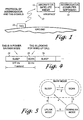
- FIG. 1 illustrates a radar responsive tag system 10 utilizing a tag communications protocol of the present invention.
- the radar responsive tag system 10 comprises a radar 12 disposed on an aircraft or satellite.
- the radar 12 is in electrical communication with an interrogator 14 configured as computer software for the radar 12 of the aircraft or satellite.
- the radar 12 of the aircraft or satellite communicates via radio frequencies to a tag 16 that is disposed on the object to be identified.
- the tag 16 can receive and transmit radio frequency (RF) signals to the radar 12 of the aircraft or satellite.
- RF radio frequency
- the radar 12 can interrogate the tag 16 such that the tag 16 will transmit a unique identifier to the radar 12 that identifies the object.
- the radar responsive tag system 10 utilizing the communication protocol of the present invention can communicate with a medium range satellite that has a slant range in excess of one-hundred miles. Accordingly, the radar 12 can track ground based inventory by interrogating the tag 16 disposed on ground or sea assets.
- the interrogator 14 is not an integral part of the radar 12 of the aircraft or satellite.
- the interrogator 14 communicates with the radar 12 using a computer server 18 and a ground station 20.
- the ground station 20 transmits the signals from the interrogator 14 via a data communication channel to the radar 12 of the satellite or aircraft.
- the interrogator 14 is connected to the ground station 20 via the computer server 18 and a telecommunication line 22. Therefore, in the alternative configuration of the radar responsive tag system 10, changes to the interrogator 14 (i.e., software) may be easily implemented because the interrogator 14 is located on the ground.
- the tag 16 begins in a sniff mode 24 consisting of a low power sleep stage 26 and a scan stage 28, as seen in Figure 4.
- the tag 16 is in a power saving mode.
- the sleep stage 26 lasts for about 977 ms and the tag 16 consumes about 10 micro amps of current at 3 volts.
- the scan stage 28, typically lasts about 23 ms such that the tag 16 consumes about 1 Watt of power.
- the sleep stage 26 and the scan stage 28 alternate during the sniff mode 24 until a valid wake-up call 30 is received during the scan stage 28 of the sniff mode 24, as will be explained below. Accordingly, if the tag 16 does not receive a wake-up call 30 during the scan stage 28, the tag 16 will return to the sleep stage 26.
- the tag 16 once the tag 16 receives a valid wake-up call 30, the tag 16 goes into a downlink mode and waits for a downlink message 32.
- the radar 12 is programmable such that it will perform a wake-up call 30 and then send a downlink message 32 a prescribed number of times (e.g., three times). After the radar 12 has completed sending the wake-up call 30 and downlink message 32, the radar 12 will wait a programmable amount of time (e.g., typically four hours) before transmitting a new wake-up call 30.
- the tag 16 will wait a specified amount of time before transmitting an uplink message 34 to the radar 12. This delay allows the tag 16 to skip over redundant wake-up calls 30 and multiple downlink messages 32 that are repeated in the message group.
- the time interval between receiving a downlink message 32 and transmission of an uplink message 34 may be specified in the downlink message 32 received by the tag 16.
- the tag 16 sets a programmable lock out timer that enables the tag 16 to ignore any new wake-up calls 30 and downlink messages 32.
- the lock out timer is nominally set to four hours and prevents the batteries in the tag 16 from depleting as a result of multiple interrogations or false signals. Accordingly, this feature restricts the tag 16 from sending any new uplink messages 34 before a prescribed minimum time period has passed (i.e., about four hours).
- the tag 16 determines that the signal from the radar 12 is invalid, the tag 16 will enter the sleep stage 26. This improves the power savings in the tag 16 when the signals from the radar 12 may be false or erroneous.
- the period of the sleep stage 26 may be programmable such that the tag 16 will be in the power savings mode for a prescribed period of time.
- the tag 16 transitions between multiple states. Accordingly, the tag 16 transitions between each major state as shown in Figure 5 and described by the following table: Definitions of Tag State Transitions. Transition No. 1 Sleep timer expires, begin scan for interrogator. 2 Interrogator not found, return to sleep. 3 Detects interrogator, look for downlink. 4 Downlink fails, return to sleep. 5 Successful downlink, prepare for uplink. 6 Uplink complete, return to sleep.
- the communications protocol of the present invention provides a method of informing the tag 16 whether or not it is receiving the main beam of the radar 12.
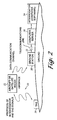
- the radar 12 will steer its antenna (i.e., transmission source) during the wake-up call 30 to a left position 36, a center position 38, and a right position 40.
- Each of the positions 36, 38, 40 overlap the beam from the radar 12 at the -3db power point.
- the radar 12 expects to communicate with the tag 16 while the radar antenna and hence the beam from the radar 12 is in the center position 38. Accordingly, the radar 12 will only transmit a downlink message 32 and the tag 16 will only transmit an uplink message 34 while the beam is in the center position 38.
- the wake-up call 30 from the radar 12 will be of a pulse width (PW) and linear frequency modulated (LFM) according to the following table: Typical Radar Modulation in a Wake-Up Call.
- the tag 16 will contain a suitable receiver to receive and measure the PW and LFM of the wake-up call 30.
- the pulse width and linear frequency modulation of the wake-up call 30 is deviated in order to inform the tag 16 of the position 36, 38, or 40 of the beam from the radar 12. Accordingly, when the beam from the radar 12 is in the left position 36, the wake-up call 30 will have a pulse width of approximately 20 ⁇ s, while a wake-up call 30 from a beam of the radar 12 in the center position 38 will have a pulse width of approximately 30 ⁇ s and a wake-up call 30 from a beam of the radar 12 in the right position 40 will have a pulse width of approximately 40 ⁇ s.
- the linear frequency modulation (LFM) of the wake-up call 30 will be approximately 100 MHz for the left position 36, the center position 38, and the right position 40.
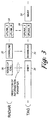
- the duration of the wake-up call 30 depends on the number of radar pulses and the pulse repetition frequency (PRF) thereof.
- PRF pulse repetition frequency
- the wake-up call 30 will contain 300 pulses with a PRF of 300 Hz thereby resulting in a wake-up call 30 that is approximately one second long.
- the tag 16 will measure the signal strength, pulse width, and LFM deviation of the wake-up call 30 during the scan stage 28 of the sniff mode 24. During the time that the tag 16 receives the wake-up call 30, the tag 16 will receive approximately seven pulses from the radar 12. This will result in slightly more than two sub-sequences of the wake-up call 30 shown in Figure 7.
- the left position 36, center position 38, and right position 40 of the beam from the radar 12 generate a characteristic signal. Accordingly, the following table shows the signal strength that is received at the tag 16 for different distances between the tag 16 and the radar 12.
- the tag 16 measures the relative strength of the signal from the radar 12 to determine the relative distance from the tag 16 to the radar 12. Accordingly, the tag 16 can determine if the signal from the radar 12 has enough strength to be a valid signal.
- the tag 16 will next identify the corresponding PW and LFM according to Table 2.
- the tag 16 determines whether the beam from the radar 12 is in the left position 36, center position 38, or right position 40. Therefore, if the tag 16 determines that the wake-up call 30 has sufficient strength according to Table 3 and is from the center position 38 according to Table 2, then the tag 16 has received a valid wake-up call 30.
- the tag 16 After determining that the wake-up call 30 is valid, the tag 16 will start a programmable downlink wait timer that is set to the same duration as the wake-up call 30 (i.e., typically one second). If the programmable downlink wait timer of the tag 16 expires before a downlink message 32 is received thereby, then the tag 16 will resume the sniff mode 24, as previously described. Otherwise, the tag 16 will read the downlink message 32 and transmit an uplink message 34, as seen in transmission state number 5 of Figure 5. After transmitting the uplink message 34, the tag will return to the low power sniff mode 24 as previously described.
- a programmable downlink wait timer that is set to the same duration as the wake-up call 30 (i.e., typically one second). If the programmable downlink wait timer of the tag 16 expires before a downlink message 32 is received thereby, then the tag 16 will resume the sniff mode 24, as previously described. Otherwise, the tag 16 will read the downlink message 32 and transmit an uplink message 34, as seen in
- the tag communications protocol of the present invention provides a power savings for the tag 16.
- the tag 16 operates using standard 3 volt lithium batteries.
- the tag 16 When the tag 16 is in the sleep stage 26 it typically draws 10 micro amperes of current at three volts.
- the tag 16 nominally dissipates approximately one watt of power for a scan duration of 23 milliseconds occurring every second.
- the duration of the downlink message 32 is typically 1.1 seconds and occurs every four hours such that the power dissipated during the downlink message 32 is nominally two watts.
- the duration of the uplink message 34 is nominally ten seconds and occurs every four hours such that five watts is dissipated.
- E T E SLEEP + E SCAN + E DOWNLINK + E UPLINK
- the energy for each of the states (E SLEEP , E SCAN , E DOWNLINK , and E UPLINK ) is typically stated in units of Watt-hours and is shown below in Equations 2 to 6.
- the usage factor in Equations 2 to 6 typically has a range of between about 0 to 1 and indicates how much time the tag 16 spends in that corresponding mode.
- the usage factor is weighted for a four hour interval (i.e., the time between wake-up calls 30).
- the time duration of the uplink and downlink are nominally 1 second and 2 seconds, respectively.
- the communications protocol of the present invention provides longer battery life in the tag 16 because the tag 16 spends a majority of time in the low power sleep stage 26.
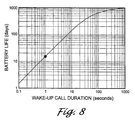
- the main factor in the power consumption of the tag 16 is the frequency of the scan stage 28, which as previously mentioned, is set by the sleep timer. Therefore, by changing the duration of future wake-up calls 30 and by sending a new value to the sleep timer via the downlink message 32, the power savings of the tag 16 can be adjusted accordingly. Therefore, in the process of modifying the duration of the wake-up call 30, the interrogator 14 of the radar 12 can change the power consumption in the tag 16. The change in the power consumption of the tag 16 will follow the curve shown in Figure 8.
Landscapes
- Engineering & Computer Science (AREA)
- Radar, Positioning & Navigation (AREA)
- Remote Sensing (AREA)
- Computer Networks & Wireless Communication (AREA)
- Physics & Mathematics (AREA)
- General Physics & Mathematics (AREA)
- Mobile Radio Communication Systems (AREA)
- Radar Systems Or Details Thereof (AREA)
Applications Claiming Priority (2)
| Application Number | Priority Date | Filing Date | Title |
|---|---|---|---|
| US569931 | 2000-05-12 | ||
| US09/569,931 US6329944B1 (en) | 2000-05-12 | 2000-05-12 | Tag communication protocol & system |
Publications (2)
| Publication Number | Publication Date |
|---|---|
| EP1154285A2 true EP1154285A2 (de) | 2001-11-14 |
| EP1154285A3 EP1154285A3 (de) | 2003-10-22 |
Family
ID=24277501
Family Applications (1)
| Application Number | Title | Priority Date | Filing Date |
|---|---|---|---|
| EP01303997A Withdrawn EP1154285A3 (de) | 2000-05-12 | 2001-05-01 | System und Protokol zur Etikettenkommunikation |
Country Status (2)
| Country | Link |
|---|---|
| US (1) | US6329944B1 (de) |
| EP (1) | EP1154285A3 (de) |
Cited By (3)
| Publication number | Priority date | Publication date | Assignee | Title |
|---|---|---|---|---|
| WO2007049011A1 (en) * | 2005-10-27 | 2007-05-03 | Oxloc Limited | Tracking device |
| EP3455644A1 (de) * | 2016-05-13 | 2019-03-20 | Google LLC | Systeme, verfahren und vorrichtungen zur verwendung von radar mit intelligenten vorrichtungen |
| US11122398B2 (en) | 2016-05-13 | 2021-09-14 | Google Llc | Systems, methods, and devices for utilizing radar-based touch interfaces |
Families Citing this family (34)
| Publication number | Priority date | Publication date | Assignee | Title |
|---|---|---|---|---|
| US6445936B1 (en) * | 1999-11-16 | 2002-09-03 | Agere Systems Guardian Corp. | Low power consumption quick charge for wireless device |
| AU2002950973A0 (en) * | 2002-08-22 | 2002-09-12 | Magellan Technology Pty Ltd | A radio frequency identification ("rfid") device |
| US7002472B2 (en) * | 2002-09-04 | 2006-02-21 | Northrop Grumman Corporation | Smart and secure container |
| US7864053B2 (en) * | 2006-04-12 | 2011-01-04 | Visible Assets, Inc. | Visibility radio cap and network |
| US8714457B2 (en) * | 2003-04-09 | 2014-05-06 | Visible Assets, Inc. | Networked loyalty cards |
| US7911344B2 (en) * | 2003-04-09 | 2011-03-22 | Visible Assets, Inc. | Smartbeam visibility network |
| US20110163882A1 (en) * | 2003-04-09 | 2011-07-07 | Visible Assets, Inc. | Passive Low Frequency Inductive Tagging |
| US7489245B2 (en) * | 2003-04-09 | 2009-02-10 | Visible Assets, Inc | Networked RF tag for tracking baggage |
| US7663494B2 (en) * | 2003-04-09 | 2010-02-16 | Visible Assets, Inc | Networked RF tag for tracking people by means of loyalty cards |
| US7489244B2 (en) * | 2003-04-09 | 2009-02-10 | Visible Assets, Inc. | Networked RF tag for tracking baggage |
| US8026819B2 (en) * | 2005-10-02 | 2011-09-27 | Visible Assets, Inc. | Radio tag and system |
| US7049963B2 (en) * | 2003-04-09 | 2006-05-23 | Visible Assets, Inc. | Networked RF tag for tracking freight |
| US8378841B2 (en) * | 2003-04-09 | 2013-02-19 | Visible Assets, Inc | Tracking of oil drilling pipes and other objects |
| US7675422B2 (en) * | 2003-04-09 | 2010-03-09 | Visible Assets, Inc. | Networked RF Tag for tracking people by means of loyalty cards |
| US20110163857A1 (en) * | 2003-04-09 | 2011-07-07 | Visible Assets, Inc. | Energy Harvesting for Low Frequency Inductive Tagging |
| US8681000B2 (en) * | 2003-04-09 | 2014-03-25 | Visible Assets, Inc. | Low frequency inductive tagging for lifecycle management |
| US7190907B2 (en) * | 2004-01-27 | 2007-03-13 | Northrop Grumman Corporation | Dynamic optical tag |
| US7146136B2 (en) * | 2004-02-04 | 2006-12-05 | Northrop Grumman Corporation | E-band radio transceiver architecture and chip set |
| US7071866B2 (en) * | 2004-03-26 | 2006-07-04 | Northrop Grumman Corporation | 2-d range hopping spread spectrum encoder/decoder system for RF tags |
| US7548153B2 (en) | 2004-07-09 | 2009-06-16 | Tc License Ltd. | Multi-protocol or multi-command RFID system |
| US7030805B2 (en) * | 2004-07-23 | 2006-04-18 | Sandia Corporation | Methods and system suppressing clutter in a gain-block, radar-responsive tag system |
| US7330117B2 (en) * | 2004-08-25 | 2008-02-12 | Caterpillar Inc. | Systems and methods for radio frequency trigger |
| US7221308B2 (en) * | 2005-04-19 | 2007-05-22 | Northrop Grumman Corporation | Joint stars embedded data link |
| US9069933B1 (en) | 2005-09-28 | 2015-06-30 | Visible Assets, Inc. | Secure, networked portable storage device |
| US8548098B2 (en) * | 2005-12-15 | 2013-10-01 | Intelleflex Corporation | Clock-free activation circuit |
| US20080061943A1 (en) * | 2006-08-11 | 2008-03-13 | Ke-Li Wu | RFID systems and methods of operating the same in power-saving modes |
| US7688181B2 (en) * | 2006-09-06 | 2010-03-30 | Savi Technology, Inc. | Method and apparatus for avoiding overpolling |
| US8204036B2 (en) * | 2007-02-28 | 2012-06-19 | Motorola Mobility, Inc. | Method and apparatus for coexistence |
| US8554271B2 (en) * | 2007-06-30 | 2013-10-08 | Motorola Mobility Llc | Method and apparatus for performing neighbor scans on a wide area network in a mobile communication device operating a personal area network |
| US8831675B2 (en) * | 2007-06-30 | 2014-09-09 | Motorola Mobility Llc | Method for operating a wide area network modem and a personal area network modem in a mobile communication device |
| DE102007034592A1 (de) * | 2007-07-25 | 2009-02-05 | Identec Solutions Ag | Verfahren und Vorrichtung zum stromsparenden Betrieb von RFID-Datenträgern |
| US7801066B2 (en) * | 2007-07-31 | 2010-09-21 | Motorola Mobility, Inc. | Method for transitioning a wide area network modem of a mobile communication device between a power saving mode and a scan mode |
| WO2010008378A1 (en) * | 2008-07-15 | 2010-01-21 | Optoelectronics Co., Ltd. | Power management system for electronic shelf labels and the like |
| US11372099B2 (en) * | 2017-03-10 | 2022-06-28 | Thales Alenia Space Italia S.P.A. Con Unico Socio | Innovative locator system, related low power consumption regenerative transponder and related localization method and service |
Citations (8)
| Publication number | Priority date | Publication date | Assignee | Title |
|---|---|---|---|---|
| EP0467036A2 (de) | 1990-06-15 | 1992-01-22 | Savi Technology, Inc. | Verfahren und Gerät zur Radioidentifizierung und Zielverfolgung |
| EP0613108A1 (de) * | 1993-02-23 | 1994-08-31 | Texas Instruments Incorporated | Identifikationssystem |
| US5471212A (en) | 1994-04-26 | 1995-11-28 | Texas Instruments Incorporated | Multi-stage transponder wake-up, method and structure |
| US5497140A (en) | 1992-08-12 | 1996-03-05 | Micron Technology, Inc. | Electrically powered postage stamp or mailing or shipping label operative with radio frequency (RF) communication |
| WO1998027441A1 (en) * | 1996-12-19 | 1998-06-25 | Micron Communications, Inc. | Methods of processing wireless communication, methods of processing radio frequency communication, and related systems |
| US5790946A (en) | 1993-07-15 | 1998-08-04 | Rotzoll; Robert R. | Wake up device for a communications system |
| US5887176A (en) * | 1996-06-28 | 1999-03-23 | Randtec, Inc. | Method and system for remote monitoring and tracking of inventory |
| US6045652A (en) | 1992-06-17 | 2000-04-04 | Micron Communications, Inc. | Method of manufacturing an enclosed transceiver |
Family Cites Families (24)
| Publication number | Priority date | Publication date | Assignee | Title |
|---|---|---|---|---|
| GB1479616A (en) | 1974-10-15 | 1977-07-13 | Standard Telephones Cables Ltd | Train position indication |
| US4242663A (en) | 1979-02-01 | 1980-12-30 | Lockheed Electronics Corporation | Electronic identification system |
| GB2052908A (en) | 1979-05-23 | 1981-01-28 | Secr Defence | Radar transponders |
| US4359733A (en) | 1980-09-23 | 1982-11-16 | Neill Gerard K O | Satellite-based vehicle position determining system |
| JPH0756511B2 (ja) | 1984-01-31 | 1995-06-14 | 三菱電機株式会社 | レ−ダ応答装置 |
| FR2644420B1 (fr) | 1989-03-17 | 1991-07-05 | Aigle Azur Concept | Systeme de commande de la progression de plusieurs convois ferroviaires sur un reseau |
| US5640151A (en) | 1990-06-15 | 1997-06-17 | Texas Instruments Incorporated | Communication system for communicating with tags |
| CA2089123A1 (en) | 1992-03-04 | 1993-09-05 | Robert Edwin Penny, Jr. | Position locating transceiver |
| US5787174A (en) | 1992-06-17 | 1998-07-28 | Micron Technology, Inc. | Remote identification of integrated circuit |
| US5776278A (en) * | 1992-06-17 | 1998-07-07 | Micron Communications, Inc. | Method of manufacturing an enclosed transceiver |
| US5387916A (en) | 1992-07-31 | 1995-02-07 | Westinghouse Electric Corporation | Automotive navigation system and method |
| US5557280A (en) | 1992-08-26 | 1996-09-17 | British Technology Group Limited | Synchronized electronic identification system |
| US5453747A (en) * | 1993-06-28 | 1995-09-26 | Texas Instruments Deutschland Gmbh | Transponder systems for automatic identification purposes |
| FR2713849B1 (fr) | 1993-12-10 | 1996-01-05 | Thomson Csf | Dispositif d'identification à distance. |
| CA2135856A1 (en) * | 1993-12-10 | 1995-06-11 | Steven Peter Allen | Low power, addressable data communication device and method |
| US5486830A (en) | 1994-04-06 | 1996-01-23 | The United States Of America As Represented By The United States Department Of Energy | Radar transponder apparatus and signal processing technique |
| US5602538A (en) | 1994-07-27 | 1997-02-11 | Texas Instruments Incorporated | Apparatus and method for identifying multiple transponders |
| US5525992A (en) | 1994-11-14 | 1996-06-11 | Texas Instruments Deutschland Gmbh | Method and system for conserving power in a recognition system |
| US5521601A (en) | 1995-04-21 | 1996-05-28 | International Business Machines Corporation | Power-efficient technique for multiple tag discrimination |
| US5629691A (en) | 1995-05-26 | 1997-05-13 | Hughes Electronics | Airport surface monitoring and runway incursion warning system |
| US5627517A (en) | 1995-11-01 | 1997-05-06 | Xerox Corporation | Decentralized tracking and routing system wherein packages are associated with active tags |
| US5856788A (en) | 1996-03-12 | 1999-01-05 | Single Chips Systems Corp. | Method and apparatus for radiofrequency identification tags |
| US5895436A (en) | 1996-04-26 | 1999-04-20 | Savoie; Paul-Andreroland | Vehicle tracking system using cellular network |
| US6064320A (en) * | 1997-04-04 | 2000-05-16 | Texas Instruments Incorporated | Automatic vehicle identification system capable of vehicle lane discrimination |
-
2000
- 2000-05-12 US US09/569,931 patent/US6329944B1/en not_active Expired - Lifetime
-
2001
- 2001-05-01 EP EP01303997A patent/EP1154285A3/de not_active Withdrawn
Patent Citations (9)
| Publication number | Priority date | Publication date | Assignee | Title |
|---|---|---|---|---|
| EP0467036A2 (de) | 1990-06-15 | 1992-01-22 | Savi Technology, Inc. | Verfahren und Gerät zur Radioidentifizierung und Zielverfolgung |
| US6045652A (en) | 1992-06-17 | 2000-04-04 | Micron Communications, Inc. | Method of manufacturing an enclosed transceiver |
| US5497140A (en) | 1992-08-12 | 1996-03-05 | Micron Technology, Inc. | Electrically powered postage stamp or mailing or shipping label operative with radio frequency (RF) communication |
| EP0613108A1 (de) * | 1993-02-23 | 1994-08-31 | Texas Instruments Incorporated | Identifikationssystem |
| US5790946A (en) | 1993-07-15 | 1998-08-04 | Rotzoll; Robert R. | Wake up device for a communications system |
| US5471212A (en) | 1994-04-26 | 1995-11-28 | Texas Instruments Incorporated | Multi-stage transponder wake-up, method and structure |
| US5621412A (en) * | 1994-04-26 | 1997-04-15 | Texas Instruments Incorporated | Multi-stage transponder wake-up, method and structure |
| US5887176A (en) * | 1996-06-28 | 1999-03-23 | Randtec, Inc. | Method and system for remote monitoring and tracking of inventory |
| WO1998027441A1 (en) * | 1996-12-19 | 1998-06-25 | Micron Communications, Inc. | Methods of processing wireless communication, methods of processing radio frequency communication, and related systems |
Cited By (6)
| Publication number | Priority date | Publication date | Assignee | Title |
|---|---|---|---|---|
| WO2007049011A1 (en) * | 2005-10-27 | 2007-05-03 | Oxloc Limited | Tracking device |
| EP3455644A1 (de) * | 2016-05-13 | 2019-03-20 | Google LLC | Systeme, verfahren und vorrichtungen zur verwendung von radar mit intelligenten vorrichtungen |
| US11122398B2 (en) | 2016-05-13 | 2021-09-14 | Google Llc | Systems, methods, and devices for utilizing radar-based touch interfaces |
| US11272335B2 (en) | 2016-05-13 | 2022-03-08 | Google Llc | Systems, methods, and devices for utilizing radar with smart devices |
| US11516630B2 (en) | 2016-05-13 | 2022-11-29 | Google Llc | Techniques for adjusting operation of an electronic device |
| US12262289B2 (en) | 2016-05-13 | 2025-03-25 | Google Llc | Systems, methods, and devices for utilizing radar with smart devices |
Also Published As
| Publication number | Publication date |
|---|---|
| US6329944B1 (en) | 2001-12-11 |
| EP1154285A3 (de) | 2003-10-22 |
Similar Documents
| Publication | Publication Date | Title |
|---|---|---|
| US6329944B1 (en) | Tag communication protocol & system | |
| US5929779A (en) | Read/write protocol for radio frequency identification tags | |
| EP1527616B1 (de) | Gepulstes leistungsversorgungsverfahren mit vergrössertem lesebereich für ein rfid-lesegerät | |
| US6034603A (en) | Radio tag system and method with improved tag interference avoidance | |
| US6995652B2 (en) | System and method for controlling remote devices | |
| EP0420180B1 (de) | Antwortgerät für Fahrzeugerkennungseinrichtung | |
| US5850181A (en) | Method of transporting radio frequency power to energize radio frequency identification transponders | |
| CA2190546C (en) | Enhanced uplink modulated backscatter system | |
| US5491482A (en) | Electronic system and method for remote identification of coded articles and the like | |
| US6914528B2 (en) | Wireless communication systems, radio frequency identification devices, methods of enhancing a communications range of a radio frequency identification device, and wireless communication methods | |
| US20020113709A1 (en) | Method and apparatus for improving the interrogation range of an RF-Tag | |
| AU2005224650A1 (en) | Multi-resolution object location system and method | |
| JP2003536150A (ja) | 多周波通信のシステムおよび方法 | |
| JP2003536302A (ja) | 遠隔通信のシステムおよび方法 | |
| WO2004032027A1 (en) | System and method to identify multiple rf tags | |
| US6731199B1 (en) | Non-contact communication system | |
| US7817742B2 (en) | Power supply apparatus and power supply method | |
| CN112203255A (zh) | 车载单元的控制方法和系统、存储介质及电子装置 | |
| JPH04268479A (ja) | 反射増幅器を備えたマイクロ波バッジ用モデム | |
| JPH03504433A (ja) | 呼掛け器局と応答器から成るヘルツ波使用の識別システム | |
| US5606574A (en) | Mobile unit identifying system and method of demodulating for the same | |
| JPH07287065A (ja) | 遠隔識別装置 | |
| US20200029272A1 (en) | Method for geographic-based radiofrequency band selection | |
| EP1946147B1 (de) | Entfernungsbestimmungssystem für kurze distanzen | |
| JP4478648B2 (ja) | 無線周波数識別システムにおける受動タグの長距離読取り方法及び装置 |
Legal Events
| Date | Code | Title | Description |
|---|---|---|---|
| PUAI | Public reference made under article 153(3) epc to a published international application that has entered the european phase |
Free format text: ORIGINAL CODE: 0009012 |
|
| AK | Designated contracting states |
Kind code of ref document: A2 Designated state(s): AT BE CH CY DE DK ES FI FR GB GR IE IT LI LU MC NL PT SE TR |
|
| AX | Request for extension of the european patent |
Free format text: AL;LT;LV;MK;RO;SI |
|
| PUAL | Search report despatched |
Free format text: ORIGINAL CODE: 0009013 |
|
| AK | Designated contracting states |
Kind code of ref document: A3 Designated state(s): AT BE CH CY DE DK ES FI FR GB GR IE IT LI LU MC NL PT SE TR |
|
| AX | Request for extension of the european patent |
Extension state: AL LT LV MK RO SI |
|
| RIC1 | Information provided on ipc code assigned before grant |
Ipc: 7G 01S 17/74 A Ipc: 7G 01S 13/76 B |
|
| 17P | Request for examination filed |
Effective date: 20040303 |
|
| AKX | Designation fees paid |
Designated state(s): DE GB |
|
| 17Q | First examination report despatched |
Effective date: 20060817 |
|
| RAP1 | Party data changed (applicant data changed or rights of an application transferred) |
Owner name: NORTHROP GRUMMAN SYSTEMS CORPORATION |
|
| GRAP | Despatch of communication of intention to grant a patent |
Free format text: ORIGINAL CODE: EPIDOSNIGR1 |
|
| INTG | Intention to grant announced |
Effective date: 20160805 |
|
| STAA | Information on the status of an ep patent application or granted ep patent |
Free format text: STATUS: GRANT OF PATENT IS INTENDED |
|
| STAA | Information on the status of an ep patent application or granted ep patent |
Free format text: STATUS: THE APPLICATION IS DEEMED TO BE WITHDRAWN |
|
| 18D | Application deemed to be withdrawn |
Effective date: 20161216 |