EP1154751B1 - Preparations capillaires cosmetiques - Google Patents
Preparations capillaires cosmetiques Download PDFInfo
- Publication number
- EP1154751B1 EP1154751B1 EP00906310A EP00906310A EP1154751B1 EP 1154751 B1 EP1154751 B1 EP 1154751B1 EP 00906310 A EP00906310 A EP 00906310A EP 00906310 A EP00906310 A EP 00906310A EP 1154751 B1 EP1154751 B1 EP 1154751B1
- Authority
- EP
- European Patent Office
- Prior art keywords
- weight
- polymers
- alkyl
- acid
- monomers
- Prior art date
- Legal status (The legal status is an assumption and is not a legal conclusion. Google has not performed a legal analysis and makes no representation as to the accuracy of the status listed.)
- Expired - Lifetime
Links
- 239000000203 mixture Substances 0.000 title claims abstract 15
- 238000009472 formulation Methods 0.000 title claims abstract 9
- 239000003676 hair preparation Substances 0.000 title 1
- 229920000642 polymer Polymers 0.000 claims abstract 32
- 239000000178 monomer Substances 0.000 claims abstract 28
- 239000004721 Polyphenylene oxide Substances 0.000 claims abstract 15
- 229920000570 polyether Polymers 0.000 claims abstract 15
- 230000007062 hydrolysis Effects 0.000 claims abstract 14
- 238000006460 hydrolysis reaction Methods 0.000 claims abstract 14
- 150000001875 compounds Chemical class 0.000 claims abstract 12
- 150000002148 esters Chemical group 0.000 claims abstract 12
- 229920001567 vinyl ester resin Polymers 0.000 claims abstract 12
- 238000010526 radical polymerization reaction Methods 0.000 claims abstract 10
- 239000002537 cosmetic Substances 0.000 claims abstract 9
- 229910052739 hydrogen Inorganic materials 0.000 claims 9
- 239000001257 hydrogen Substances 0.000 claims 9
- 125000004435 hydrogen atom Chemical class [H]* 0.000 claims 9
- 238000006116 polymerization reaction Methods 0.000 claims 6
- 125000002947 alkylene group Chemical group 0.000 claims 5
- -1 amino, carboxyl Chemical group 0.000 claims 5
- 239000000470 constituent Substances 0.000 claims 5
- XLYOFNOQVPJJNP-UHFFFAOYSA-N water Substances O XLYOFNOQVPJJNP-UHFFFAOYSA-N 0.000 claims 5
- 125000004400 (C1-C12) alkyl group Chemical group 0.000 claims 4
- 125000006686 (C1-C24) alkyl group Chemical group 0.000 claims 4
- 125000004169 (C1-C6) alkyl group Chemical group 0.000 claims 4
- LFQSCWFLJHTTHZ-UHFFFAOYSA-N Ethanol Chemical compound CCO LFQSCWFLJHTTHZ-UHFFFAOYSA-N 0.000 claims 4
- 125000002496 methyl group Chemical group [H]C([H])([H])* 0.000 claims 4
- 229920001296 polysiloxane Polymers 0.000 claims 4
- 239000004971 Cross linker Substances 0.000 claims 3
- 229920002873 Polyethylenimine Polymers 0.000 claims 3
- 229920006037 cross link polymer Polymers 0.000 claims 3
- 229920000233 poly(alkylene oxides) Polymers 0.000 claims 3
- SOGAXMICEFXMKE-UHFFFAOYSA-N Butylmethacrylate Chemical compound CCCCOC(=O)C(C)=C SOGAXMICEFXMKE-UHFFFAOYSA-N 0.000 claims 2
- GDFCSMCGLZFNFY-UHFFFAOYSA-N Dimethylaminopropyl Methacrylamide Chemical compound CN(C)CCCNC(=O)C(C)=C GDFCSMCGLZFNFY-UHFFFAOYSA-N 0.000 claims 2
- IAYPIBMASNFSPL-UHFFFAOYSA-N Ethylene oxide Chemical compound C1CO1 IAYPIBMASNFSPL-UHFFFAOYSA-N 0.000 claims 2
- VZCYOOQTPOCHFL-OWOJBTEDSA-N Fumaric acid Chemical compound OC(=O)\C=C\C(O)=O VZCYOOQTPOCHFL-OWOJBTEDSA-N 0.000 claims 2
- BAPJBEWLBFYGME-UHFFFAOYSA-N Methyl acrylate Chemical compound COC(=O)C=C BAPJBEWLBFYGME-UHFFFAOYSA-N 0.000 claims 2
- PPBRXRYQALVLMV-UHFFFAOYSA-N Styrene Chemical compound C=CC1=CC=CC=C1 PPBRXRYQALVLMV-UHFFFAOYSA-N 0.000 claims 2
- QYKIQEUNHZKYBP-UHFFFAOYSA-N Vinyl ether Chemical class C=COC=C QYKIQEUNHZKYBP-UHFFFAOYSA-N 0.000 claims 2
- 150000001252 acrylic acid derivatives Chemical class 0.000 claims 2
- 150000001299 aldehydes Chemical class 0.000 claims 2
- 150000001642 boronic acid derivatives Chemical class 0.000 claims 2
- 125000004432 carbon atom Chemical group C* 0.000 claims 2
- 238000006243 chemical reaction Methods 0.000 claims 2
- 238000004132 cross linking Methods 0.000 claims 2
- 239000003380 propellant Substances 0.000 claims 2
- 150000005846 sugar alcohols Polymers 0.000 claims 2
- VZCYOOQTPOCHFL-UHFFFAOYSA-N trans-butenedioic acid Natural products OC(=O)C=CC(O)=O VZCYOOQTPOCHFL-UHFFFAOYSA-N 0.000 claims 2
- UUGXDEDGRPYWHG-UHFFFAOYSA-N (dimethylamino)methyl 2-methylprop-2-enoate Chemical compound CN(C)COC(=O)C(C)=C UUGXDEDGRPYWHG-UHFFFAOYSA-N 0.000 claims 1
- IAUGBVWVWDTCJV-UHFFFAOYSA-N 1-(prop-2-enoylamino)propane-1-sulfonic acid Chemical compound CCC(S(O)(=O)=O)NC(=O)C=C IAUGBVWVWDTCJV-UHFFFAOYSA-N 0.000 claims 1
- LAYAKLSFVAPMEL-UHFFFAOYSA-N 1-ethenoxydodecane Chemical class CCCCCCCCCCCCOC=C LAYAKLSFVAPMEL-UHFFFAOYSA-N 0.000 claims 1
- BDHGFCVQWMDIQX-UHFFFAOYSA-N 1-ethenyl-2-methylimidazole Chemical compound CC1=NC=CN1C=C BDHGFCVQWMDIQX-UHFFFAOYSA-N 0.000 claims 1
- UHKIGXVNMXYBOP-UHFFFAOYSA-M 1-ethenyl-3-methylimidazol-3-ium;chloride Chemical compound [Cl-].C[N+]=1C=CN(C=C)C=1 UHKIGXVNMXYBOP-UHFFFAOYSA-M 0.000 claims 1
- BZVFPIHTRLNAQA-UHFFFAOYSA-M 1-ethenyl-3-methylimidazol-3-ium;methyl sulfate Chemical compound COS([O-])(=O)=O.C[N+]=1C=CN(C=C)C=1 BZVFPIHTRLNAQA-UHFFFAOYSA-M 0.000 claims 1
- OSSNTDFYBPYIEC-UHFFFAOYSA-N 1-ethenylimidazole Chemical compound C=CN1C=CN=C1 OSSNTDFYBPYIEC-UHFFFAOYSA-N 0.000 claims 1
- SMZOUWXMTYCWNB-UHFFFAOYSA-N 2-(2-methoxy-5-methylphenyl)ethanamine Chemical compound COC1=CC=C(C)C=C1CCN SMZOUWXMTYCWNB-UHFFFAOYSA-N 0.000 claims 1
- JKNCOURZONDCGV-UHFFFAOYSA-N 2-(dimethylamino)ethyl 2-methylprop-2-enoate Chemical compound CN(C)CCOC(=O)C(C)=C JKNCOURZONDCGV-UHFFFAOYSA-N 0.000 claims 1
- GOXQRTZXKQZDDN-UHFFFAOYSA-N 2-Ethylhexyl acrylate Chemical compound CCCCC(CC)COC(=O)C=C GOXQRTZXKQZDDN-UHFFFAOYSA-N 0.000 claims 1
- NIXOWILDQLNWCW-UHFFFAOYSA-N 2-Propenoic acid Natural products OC(=O)C=C NIXOWILDQLNWCW-UHFFFAOYSA-N 0.000 claims 1
- OMIGHNLMNHATMP-UHFFFAOYSA-N 2-hydroxyethyl prop-2-enoate Chemical compound OCCOC(=O)C=C OMIGHNLMNHATMP-UHFFFAOYSA-N 0.000 claims 1
- RUMACXVDVNRZJZ-UHFFFAOYSA-N 2-methylpropyl 2-methylprop-2-enoate Chemical compound CC(C)COC(=O)C(C)=C RUMACXVDVNRZJZ-UHFFFAOYSA-N 0.000 claims 1
- CFVWNXQPGQOHRJ-UHFFFAOYSA-N 2-methylpropyl prop-2-enoate Chemical compound CC(C)COC(=O)C=C CFVWNXQPGQOHRJ-UHFFFAOYSA-N 0.000 claims 1
- MXRGSJAOLKBZLU-UHFFFAOYSA-N 3-ethenylazepan-2-one Chemical compound C=CC1CCCCNC1=O MXRGSJAOLKBZLU-UHFFFAOYSA-N 0.000 claims 1
- GNSFRPWPOGYVLO-UHFFFAOYSA-N 3-hydroxypropyl 2-methylprop-2-enoate Chemical class CC(=C)C(=O)OCCCO GNSFRPWPOGYVLO-UHFFFAOYSA-N 0.000 claims 1
- QZPSOSOOLFHYRR-UHFFFAOYSA-N 3-hydroxypropyl prop-2-enoate Chemical class OCCCOC(=O)C=C QZPSOSOOLFHYRR-UHFFFAOYSA-N 0.000 claims 1
- JTHZUSWLNCPZLX-UHFFFAOYSA-N 6-fluoro-3-methyl-2h-indazole Chemical compound FC1=CC=C2C(C)=NNC2=C1 JTHZUSWLNCPZLX-UHFFFAOYSA-N 0.000 claims 1
- JIGUQPWFLRLWPJ-UHFFFAOYSA-N Ethyl acrylate Chemical compound CCOC(=O)C=C JIGUQPWFLRLWPJ-UHFFFAOYSA-N 0.000 claims 1
- WOBHKFSMXKNTIM-UHFFFAOYSA-N Hydroxyethyl methacrylate Chemical compound CC(=C)C(=O)OCCO WOBHKFSMXKNTIM-UHFFFAOYSA-N 0.000 claims 1
- CERQOIWHTDAKMF-UHFFFAOYSA-N Methacrylic acid Chemical compound CC(=C)C(O)=O CERQOIWHTDAKMF-UHFFFAOYSA-N 0.000 claims 1
- VVQNEPGJFQJSBK-UHFFFAOYSA-N Methyl methacrylate Chemical compound COC(=O)C(C)=C VVQNEPGJFQJSBK-UHFFFAOYSA-N 0.000 claims 1
- WHNWPMSKXPGLAX-UHFFFAOYSA-N N-Vinyl-2-pyrrolidone Chemical compound C=CN1CCCC1=O WHNWPMSKXPGLAX-UHFFFAOYSA-N 0.000 claims 1
- OFOBLEOULBTSOW-UHFFFAOYSA-N Propanedioic acid Natural products OC(=O)CC(O)=O OFOBLEOULBTSOW-UHFFFAOYSA-N 0.000 claims 1
- GOOHAUXETOMSMM-UHFFFAOYSA-N Propylene oxide Chemical compound CC1CO1 GOOHAUXETOMSMM-UHFFFAOYSA-N 0.000 claims 1
- WYURNTSHIVDZCO-UHFFFAOYSA-N Tetrahydrofuran Chemical compound C1CCOC1 WYURNTSHIVDZCO-UHFFFAOYSA-N 0.000 claims 1
- 150000001338 aliphatic hydrocarbons Chemical class 0.000 claims 1
- 150000001450 anions Chemical class 0.000 claims 1
- 125000003118 aryl group Chemical group 0.000 claims 1
- 125000000732 arylene group Chemical group 0.000 claims 1
- CQEYYJKEWSMYFG-UHFFFAOYSA-N butyl acrylate Chemical compound CCCCOC(=O)C=C CQEYYJKEWSMYFG-UHFFFAOYSA-N 0.000 claims 1
- 125000000484 butyl group Chemical group [H]C([*])([H])C([H])([H])C([H])([H])C([H])([H])[H] 0.000 claims 1
- 239000003795 chemical substances by application Substances 0.000 claims 1
- NEHMKBQYUWJMIP-NJFSPNSNSA-N chloro(114C)methane Chemical compound [14CH3]Cl NEHMKBQYUWJMIP-NJFSPNSNSA-N 0.000 claims 1
- 230000003750 conditioning effect Effects 0.000 claims 1
- 229920001577 copolymer Polymers 0.000 claims 1
- LDHQCZJRKDOVOX-NSCUHMNNSA-N crotonic acid Chemical compound C\C=C\C(O)=O LDHQCZJRKDOVOX-NSCUHMNNSA-N 0.000 claims 1
- DENRZWYUOJLTMF-UHFFFAOYSA-N diethyl sulfate Chemical compound CCOS(=O)(=O)OCC DENRZWYUOJLTMF-UHFFFAOYSA-N 0.000 claims 1
- 229940008406 diethyl sulfate Drugs 0.000 claims 1
- 239000003995 emulsifying agent Substances 0.000 claims 1
- UYMKPFRHYYNDTL-UHFFFAOYSA-N ethenamine Chemical compound NC=C UYMKPFRHYYNDTL-UHFFFAOYSA-N 0.000 claims 1
- SUPCQIBBMFXVTL-UHFFFAOYSA-N ethyl 2-methylprop-2-enoate Chemical compound CCOC(=O)C(C)=C SUPCQIBBMFXVTL-UHFFFAOYSA-N 0.000 claims 1
- 125000001495 ethyl group Chemical group [H]C([H])([H])C([H])([H])* 0.000 claims 1
- LYCAIKOWRPUZTN-UHFFFAOYSA-N ethylene glycol Natural products OCCO LYCAIKOWRPUZTN-UHFFFAOYSA-N 0.000 claims 1
- 239000001530 fumaric acid Substances 0.000 claims 1
- WGCNASOHLSPBMP-UHFFFAOYSA-N hydroxyacetaldehyde Natural products OCC=O WGCNASOHLSPBMP-UHFFFAOYSA-N 0.000 claims 1
- VZCYOOQTPOCHFL-UPHRSURJSA-N maleic acid Chemical compound OC(=O)\C=C/C(O)=O VZCYOOQTPOCHFL-UPHRSURJSA-N 0.000 claims 1
- 239000011976 maleic acid Substances 0.000 claims 1
- FPYJFEHAWHCUMM-UHFFFAOYSA-N maleic anhydride Chemical compound O=C1OC(=O)C=C1 FPYJFEHAWHCUMM-UHFFFAOYSA-N 0.000 claims 1
- JZMJDSHXVKJFKW-UHFFFAOYSA-M methyl sulfate(1-) Chemical compound COS([O-])(=O)=O JZMJDSHXVKJFKW-UHFFFAOYSA-M 0.000 claims 1
- 150000007522 mineralic acids Chemical class 0.000 claims 1
- PNLUGRYDUHRLOF-UHFFFAOYSA-N n-ethenyl-n-methylacetamide Chemical compound C=CN(C)C(C)=O PNLUGRYDUHRLOF-UHFFFAOYSA-N 0.000 claims 1
- ZQXSMRAEXCEDJD-UHFFFAOYSA-N n-ethenylformamide Chemical compound C=CNC=O ZQXSMRAEXCEDJD-UHFFFAOYSA-N 0.000 claims 1
- AWGZKFQMWZYCHF-UHFFFAOYSA-N n-octylprop-2-enamide Chemical compound CCCCCCCCNC(=O)C=C AWGZKFQMWZYCHF-UHFFFAOYSA-N 0.000 claims 1
- XFHJDMUEHUHAJW-UHFFFAOYSA-N n-tert-butylprop-2-enamide Chemical compound CC(C)(C)NC(=O)C=C XFHJDMUEHUHAJW-UHFFFAOYSA-N 0.000 claims 1
- HMZGPNHSPWNGEP-UHFFFAOYSA-N octadecyl 2-methylprop-2-enoate Chemical compound CCCCCCCCCCCCCCCCCCOC(=O)C(C)=C HMZGPNHSPWNGEP-UHFFFAOYSA-N 0.000 claims 1
- PNJWIWWMYCMZRO-UHFFFAOYSA-N pent‐4‐en‐2‐one Natural products CC(=O)CC=C PNJWIWWMYCMZRO-UHFFFAOYSA-N 0.000 claims 1
- 125000001273 sulfonato group Chemical group [O-]S(*)(=O)=O 0.000 claims 1
- 150000003460 sulfonic acids Chemical class 0.000 claims 1
- 239000004094 surface-active agent Substances 0.000 claims 1
- SJMYWORNLPSJQO-UHFFFAOYSA-N tert-butyl 2-methylprop-2-enoate Chemical compound CC(=C)C(=O)OC(C)(C)C SJMYWORNLPSJQO-UHFFFAOYSA-N 0.000 claims 1
- ISXSCDLOGDJUNJ-UHFFFAOYSA-N tert-butyl prop-2-enoate Chemical compound CC(C)(C)OC(=O)C=C ISXSCDLOGDJUNJ-UHFFFAOYSA-N 0.000 claims 1
- LDHQCZJRKDOVOX-UHFFFAOYSA-N trans-crotonic acid Natural products CC=CC(O)=O LDHQCZJRKDOVOX-UHFFFAOYSA-N 0.000 claims 1
Classifications
-
- A—HUMAN NECESSITIES
- A61—MEDICAL OR VETERINARY SCIENCE; HYGIENE
- A61K—PREPARATIONS FOR MEDICAL, DENTAL OR TOILETRY PURPOSES
- A61K8/00—Cosmetics or similar toiletry preparations
- A61K8/18—Cosmetics or similar toiletry preparations characterised by the composition
- A61K8/72—Cosmetics or similar toiletry preparations characterised by the composition containing organic macromolecular compounds
- A61K8/84—Cosmetics or similar toiletry preparations characterised by the composition containing organic macromolecular compounds obtained by reactions otherwise than those involving only carbon-carbon unsaturated bonds
- A61K8/89—Polysiloxanes
- A61K8/891—Polysiloxanes saturated, e.g. dimethicone, phenyl trimethicone, C24-C28 methicone or stearyl dimethicone
- A61K8/894—Polysiloxanes saturated, e.g. dimethicone, phenyl trimethicone, C24-C28 methicone or stearyl dimethicone modified by a polyoxyalkylene group, e.g. cetyl dimethicone copolyol
-
- A—HUMAN NECESSITIES
- A61—MEDICAL OR VETERINARY SCIENCE; HYGIENE
- A61Q—SPECIFIC USE OF COSMETICS OR SIMILAR TOILETRY PREPARATIONS
- A61Q5/00—Preparations for care of the hair
-
- C—CHEMISTRY; METALLURGY
- C08—ORGANIC MACROMOLECULAR COMPOUNDS; THEIR PREPARATION OR CHEMICAL WORKING-UP; COMPOSITIONS BASED THEREON
- C08F—MACROMOLECULAR COMPOUNDS OBTAINED BY REACTIONS ONLY INVOLVING CARBON-TO-CARBON UNSATURATED BONDS
- C08F283/00—Macromolecular compounds obtained by polymerising monomers on to polymers provided for in subclass C08G
- C08F283/12—Macromolecular compounds obtained by polymerising monomers on to polymers provided for in subclass C08G on to polysiloxanes
-
- C—CHEMISTRY; METALLURGY
- C08—ORGANIC MACROMOLECULAR COMPOUNDS; THEIR PREPARATION OR CHEMICAL WORKING-UP; COMPOSITIONS BASED THEREON
- C08G—MACROMOLECULAR COMPOUNDS OBTAINED OTHERWISE THAN BY REACTIONS ONLY INVOLVING UNSATURATED CARBON-TO-CARBON BONDS
- C08G65/00—Macromolecular compounds obtained by reactions forming an ether link in the main chain of the macromolecule
- C08G65/02—Macromolecular compounds obtained by reactions forming an ether link in the main chain of the macromolecule from cyclic ethers by opening of the heterocyclic ring
- C08G65/32—Polymers modified by chemical after-treatment
- C08G65/329—Polymers modified by chemical after-treatment with organic compounds
- C08G65/331—Polymers modified by chemical after-treatment with organic compounds containing oxygen
- C08G65/3311—Polymers modified by chemical after-treatment with organic compounds containing oxygen containing a hydroxy group
- C08G65/3312—Polymers modified by chemical after-treatment with organic compounds containing oxygen containing a hydroxy group acyclic
-
- C—CHEMISTRY; METALLURGY
- C08—ORGANIC MACROMOLECULAR COMPOUNDS; THEIR PREPARATION OR CHEMICAL WORKING-UP; COMPOSITIONS BASED THEREON
- C08G—MACROMOLECULAR COMPOUNDS OBTAINED OTHERWISE THAN BY REACTIONS ONLY INVOLVING UNSATURATED CARBON-TO-CARBON BONDS
- C08G77/00—Macromolecular compounds obtained by reactions forming a linkage containing silicon with or without sulfur, nitrogen, oxygen or carbon in the main chain of the macromolecule
- C08G77/42—Block-or graft-polymers containing polysiloxane sequences
- C08G77/442—Block-or graft-polymers containing polysiloxane sequences containing vinyl polymer sequences
-
- C—CHEMISTRY; METALLURGY
- C08—ORGANIC MACROMOLECULAR COMPOUNDS; THEIR PREPARATION OR CHEMICAL WORKING-UP; COMPOSITIONS BASED THEREON
- C08G—MACROMOLECULAR COMPOUNDS OBTAINED OTHERWISE THAN BY REACTIONS ONLY INVOLVING UNSATURATED CARBON-TO-CARBON BONDS
- C08G77/00—Macromolecular compounds obtained by reactions forming a linkage containing silicon with or without sulfur, nitrogen, oxygen or carbon in the main chain of the macromolecule
- C08G77/42—Block-or graft-polymers containing polysiloxane sequences
- C08G77/46—Block-or graft-polymers containing polysiloxane sequences containing polyether sequences
-
- C—CHEMISTRY; METALLURGY
- C08—ORGANIC MACROMOLECULAR COMPOUNDS; THEIR PREPARATION OR CHEMICAL WORKING-UP; COMPOSITIONS BASED THEREON
- C08L—COMPOSITIONS OF MACROMOLECULAR COMPOUNDS
- C08L71/00—Compositions of polyethers obtained by reactions forming an ether link in the main chain; Compositions of derivatives of such polymers
- C08L71/02—Polyalkylene oxides
-
- C—CHEMISTRY; METALLURGY
- C08—ORGANIC MACROMOLECULAR COMPOUNDS; THEIR PREPARATION OR CHEMICAL WORKING-UP; COMPOSITIONS BASED THEREON
- C08L—COMPOSITIONS OF MACROMOLECULAR COMPOUNDS
- C08L83/00—Compositions of macromolecular compounds obtained by reactions forming in the main chain of the macromolecule a linkage containing silicon with or without sulfur, nitrogen, oxygen or carbon only; Compositions of derivatives of such polymers
- C08L83/10—Block- or graft-copolymers containing polysiloxane sequences
- C08L83/12—Block- or graft-copolymers containing polysiloxane sequences containing polyether sequences
-
- A—HUMAN NECESSITIES
- A61—MEDICAL OR VETERINARY SCIENCE; HYGIENE
- A61Q—SPECIFIC USE OF COSMETICS OR SIMILAR TOILETRY PREPARATIONS
- A61Q5/00—Preparations for care of the hair
- A61Q5/02—Preparations for cleaning the hair
-
- A—HUMAN NECESSITIES
- A61—MEDICAL OR VETERINARY SCIENCE; HYGIENE
- A61Q—SPECIFIC USE OF COSMETICS OR SIMILAR TOILETRY PREPARATIONS
- A61Q5/00—Preparations for care of the hair
- A61Q5/06—Preparations for styling the hair, e.g. by temporary shaping or colouring
Definitions
- the present invention relates to aqueous or aqueous / alcoholic hair cosmetic formulations containing as Film formers, produced by the polymerization of Vinyl esters and optionally other radically copolymerizable Monomers in the presence of a polyether-containing compound, and subsequent at least partial saponification.
- the aim of the invention was therefore hair cosmetic formulations with film-forming polymers that match the hairstyle give strong strengthening with high elasticity.
- DE 1 077 430 describes a process for the production of graft polymers from vinyl esters to polyalkylene glycols.
- DE 1 094 457 and DE 1 081 229 describe processes for the production of graft polymers of polyvinyl alcohol on polyalkylene glycols by saponification of the vinyl esters and their use as protective colloids, water-soluble packaging films, as Sizing and finishing agents for textiles and cosmetics.
- polyether-containing compounds (b) In the production of the polymers used according to the invention can be grafted onto the polymer during the polymerization polyether-containing compounds (b) come to what is advantageous Properties of the polymers can lead. However, there are mechanisms other than grafting are also conceivable.
- the structural units can be both homopolymers as well as statistical copolymers and block copolymers act.
- terminal primary hydroxyl groups of the polyethers produced on the basis of polyalkylene oxides and the secondary OH groups of polyglycerol can both be free in unprotected form and etherified with alcohols with a chain length of C 1 -C 24 or with carboxylic acids with a chain length of C 1 -C 24 or are esterified or reacted with isocyanates to form urethanes.
- alkyl radicals for R 1 and R 5 to R 7 are branched or unbranched C 1 -C 24 alkyl chains, preferably methyl, ethyl, n-propyl, 1-methylethyl, n-butyl, 1-methylpropyl, 2-methylpropyl, 1 , 1-dimethylethyl, n-pentyl, 1-methylbutyl, 2-methylbutyl, 3-methylbutyl, 2,2-dimethylpropyl, 1-ethylpropyl, n-hexyl, 1,1-dimethylpropyl, 1,2-dimethylpropyl, 1-methylpentyl , 2-methylpentyl, 3-methylpentyl, 4-methylpentyl, 1,1-dimethylbutyl, 1,2-dimethylbutyl, 1,3-dimethylbutyl, 2,2-dimethylbutyl, 2,3-dimethylbutyl, 3,3-dimethylbutyl, 1 -Ethyl
- alkyl radicals mentioned above branched or unbranched C 1 -C 12 -, particularly preferably C 1 -C 6 -alkyl chains are mentioned.
- the molecular weight of the polyethers is smaller 1000000 (by number average), preferably in the range from 300 to 100,000, particularly preferably in the range from 500 to 50,000, entirely particularly preferably in the range from 800 to 40,000.
- Homopolymers of ethylene oxide are advantageously used or copolymers with an ethylene oxide content of 40 up to 99% by weight.
- ethylene oxide polymers is thus the proportion of copolymerized ethylene oxide 40 to 100 mol%.
- a comonomer for these copolymers come in propylene oxide, butylene oxide and / or isobutylene oxide -Betracht.
- Copolymers of, for example, are suitable Ethylene oxide and propylene oxide, copolymers of ethylene oxide and butylene oxide and copolymers of ethylene oxide and propylene oxide and at least one butylene oxide.
- the ethylene oxide content the copolymer is preferably 40 to 99 mol%, the Propylene oxide proportion 1 to 60 mol% and the proportion of butylene oxide in the copolymers 1 to 30 mol%.
- the ethylene oxide content the copolymer is preferably 40 to 99 mol%, the Propylene oxide proportion 1 to 60 mol% and the proportion of butylene oxide in the copolymers 1 to 30 mol%.
- straight chain also branched homopolymers or copolymers as polyether-containing ones Compounds b) are used.
- Branched polymers can be prepared by e.g. on polyalcohol residues, e.g. to pentaerythritol, Glycerin or on sugar alcohols such as D-sorbitol and D-marinite also on polysaccharides such as cellulose and starch, ethylene oxide and optionally also propylene oxide and / or butylene oxides.
- the alkylene oxide units can be randomly distributed in the polymer be or be in the form of blocks.
- polyalkylene oxides and polyesters aliphatic or aromatic dicarboxylic acids e.g. oxalic acid, Succinic acid, adipic acid and terephthalic acid with molecular weights of 1500 to 25000, e.g. described in EP-A-0 743 962, as polyether-containing To use connection.
- polyether-containing To use connection e.g. polyether-containing To use connection.
- Polycarbonates by reacting polyalkylene oxides with phosgene or carbonates such as Diphenyl carbonate, as well as polyurethanes by reacting polyalkylene oxides with aliphatic and aromatic diisocyanates can be used.
- silicone derivatives can also be used as the polyether become.
- Suitable silicone derivatives are those under the INCI name Dimethicone copolyols or silicone surfactants known compounds such as those under the brand names Abil® (from T. Goldschmidt), Alkasil® (from Rhône-Poulenc), silicone Polyol Copolymer® (from Genesee), Belsil® (from Wacker), Silwet® (from Witco, Greenwich, CT, USA) or Dow Corning (from Dow Corning) available. These include connections with CAS numbers 64365-23-7; 68937-54-2; 68938-54-5; 68937-55-3.
- Silicones are generally used for improvement in hair cosmetics of the handle used.
- the use of polyether Silicone derivatives as polyether (b) in the inventive Polymers can therefore be an improvement of the handle of the hair.
- Preferred radicals R 9 and R 12 are those in which the sum of c + d is between 5 and 30.
- the groups R 8 are preferably selected from the following group: methyl, ethyl, propyl, butyl, isobutyl; Pentyl, isopentyl, hexyl, octyl, decyl, dodecyl and octadecyl, cycloaliphatic radicals, especially cyclohexyl, aromatic groups, especially phenyl or naphthyl, mixed aromatic-aliphatic radicals such as benzyl or phenylethyl as well as tolyl and xylyl and R 12 .
- Particularly preferred polyether-containing silicone derivatives are those of the general structure:
- homopolymers and copolymers can also be used as polyether (b) from polyalkylene oxide-containing ethylenically unsaturated Monomers such as polyalkylene oxide (meth) acrylates, Polyalkylene oxide vinyl ether, polyalkylene oxide (meth) acrylamides, Polyalkylene oxide allyamides or polyalkylene oxide vinyl amides are used become.
- Copolymers can of course also be used such monomers with other ethylenically unsaturated monomers be used.
- reaction products can also be used as polyether-containing compounds b) of polyethyleneimines with Akylenoxiden used become.
- preferred alkylene oxides are ethylene oxide, Propylene oxide, butylene oxide and mixtures thereof, particularly preferably used ethylene oxide.
- polyethyleneimines can polymers with number average molecular weights of 300 to 20,000, preferably 500 to 10,000, very particularly preferably 500 up to 5000.
- the weight ratio between inserted Alkylene oxide and polyethyleneimine are in the range of 100: 1 to 0.1: 1, preferably in the range 50: 1 to 0.5: 1, very particularly preferably in the range from 20: 1 to 0.5: 1.
- Vinyl esters of the abovementioned C 1 -C 12 carboxylic acids, in particular the C 1 -C 6 carboxylic acids, are preferably used. Vinyl acetate is very particularly preferred.
- the vinyl esters (a) can also be mixed with one or several, ethylenically unsaturated copolymerizable comonomers (c) are used, the proportion of these additional Monomers should be limited to a maximum of 50% by weight. Prefers are proportions from 0 to 20% by weight.
- ethylenically unsaturated means that the monomers are at least one radical have polymerizable carbon-carbon double bond, which can be mono-, di-, tri- or tetrasubstituted.
- R 15 and R 14 are independently selected from the group consisting of: -H, C 1 -C 8 linear or branched chain alkyl chains, methoxy, ethoxy, 2-hydroxyethoxy, 2-methoxyethoxy and 2-ethoxyethyl.
- Monomers (c) are, for example, acrylic acid or methacrylic acid and their salts, esters and amides.
- the salts can be used by anyone any non-toxic metal, ammonium or substituted Ammonium counterions.
- the esters can be derived from C 1 -C 40 linear, C 3 -C 40 branched or C 3 -C 40 carbocyclic alcohols, from polyfunctional alcohols with 2 to about 8 hydroxyl groups such as ethylene glycol, hexylene glycol, glycerol and 1,2,6- Hexantriol, from amino alcohols or from alcohol ethers such as methoxyethanol and ethoxyethanol, (alkyl) polyethylene glycols, (alkyl) polypropylene glycols or ethoxylated fatty alcohols, for example C 12 -C 24 fatty alcohols reacted with 1 to 200 ethylene oxide units.
- the amides can be unsubstituted, N-alkyl or N-alkylamino monosubstituted or N, N-dialkyl-substituted or N, N-dialkylamino-substituted, where the alkyl or alkylamino groups of C 1 -C 40 linear, C 3 -C 40 branched, or C 3 -C 40 carbocyclic units are derived.
- the alkylamino groups can be quaternized.
- Preferred comonomers of the formula III are N, N-dimethylaminomethyl (meth) acrylate, N, N-diethylaminomethyl (meth) acrylate, N, N-dimethylaminoethyl (meth) acrylate, N, N-diethylaminoethyl (meth) acrylate, N- [3- (dimethylamino) propyl] methacrylamide and N- [3- (dimethylamino) propyl] acrylamide.
- Comonomers (c) which can also be used are substituted acrylic acids and salts, esters and amides thereof, where the substituents on the carbon atoms are in the two or three positions of acrylic acid and are selected independently of one another from the group consisting of C 1 -C 4 alkyl, -CN, COOH particularly preferably methacrylic acid, ethacrylic acid and 3-cyanoacrylic acid.
- These salts, esters and amides of these substituted acrylic acids can be selected as described above for the salts, esters and amides of acrylic acid.
- Suitable comonomers (c) are allyl esters of C 1 -C 40 linear, C 3 -C 40 branched-chain or C 3 -C 40 carbocyclic carboxylic acids, vinyl or allyl halides, preferably vinyl chloride and allyl chloride, vinyl ethers, preferably methyl, ethyl, Butyl or dodecyl vinyl ether, vinyl formamide, vinyl methylacetamide, vinyl amine; Vinyl lactams, preferably vinyl pyrrolidone and vinyl caprolactam, vinyl or allyl-substituted heterocyclic compounds, preferably vinyl pyridine, vinyl oxazoline and allyl pyridine.
- N-vinylimidazoles of the general formula IV in which R 22 to R 24 independently of one another are hydrogen, C 1 -C 4 -alkyl or phenyl:
- Suitable comonomers (c) are vinylidene chloride; and Hydrocarbons with at least one carbon-carbon Double bond, preferably styrene, alpha-methylstyrene, tert-butylstyrene, Butadiene, isoprene, cyclohexadiene, ethylene, propylene, 1-butene, 2-butene, isobutylene, vinyl toluene and mixtures of these monomers.
- Particularly suitable comonomers (c) are acrylic acid, methacrylic acid, ethyl acrylic acid, methyl acrylate, ethyl acrylate, propyl acrylate, n-butyl acrylate, isobutyl acrylate, t-butyl acrylate, 2-ethylhexyl acrylate, decyl acrylate, methyl methacrylate, ethyl methacrylate, propyl methacrylate, propyl methacrylate, propyl methacrylate , t-butyl methacrylate, 2-ethylhexyl methacrylate, decyl methacrylate, methylethacrylate, ethylethacrylate, n-butylethacrylate, iso-butylethacrylate, t-butylethacrylate, 2-ethylhexylethacrylate, decylethacrylate, stearyl (meth) acryl
- vinyl ether for example: methyl, ethyl, butyl or dodecyl vinyl ether
- Vinyl formamide vinyl methylacetamide
- vinyl amine methyl vinyl ketone
- Maleimide vinylpyridine, vinylimidazole, vinylfuran, Styrene, styrene sulfonate, allyl alcohol, and mixtures thereof.
- Monomers with a basic nitrogen atom can be quartered in the following ways:
- alkyl halides are suitable with 1 to 24 carbon atoms in the alkyl group, e.g. Methyl chloride, methyl bromide, methyl iodide, ethyl chloride, ethyl bromide, Propyl chloride, hexyl chloride, dodecyl chloride, lauryl chloride and benzyl halides, especially benzyl chloride and Benzyl bromide.
- Other suitable quaternizing agents are Dialkyl sulfates, especially dimethyl sulfate or diethyl sulfate.
- the quaternization of the basic amines can also be carried out with alkylene oxides such as ethylene oxide or propylene oxide in the presence of acids become.
- alkylene oxides such as ethylene oxide or propylene oxide
- Preferred quaternizing agents are: methyl chloride, Dimethyl sulfate or diethyl sulfate.
- the quaternization can take place before the polymerization or after the Polymerization can be carried out.
- the basic monomers can also be cationized by: with mineral acids, e.g. Sulfuric acid, hydrochloric acid, Hydrobromic acid, hydroiodic acid, phosphoric acid or Nitric acid, or with organic acids, e.g. formic acid, Acetic acid, lactic acid, or citric acid, neutralized become.
- mineral acids e.g. Sulfuric acid, hydrochloric acid, Hydrobromic acid, hydroiodic acid, phosphoric acid or Nitric acid
- organic acids e.g. formic acid, Acetic acid, lactic acid, or citric acid
- comonomers can be used as comonomers (c) so-called macromonomers such as silicone-containing ones Macromonomers with one or more radically polymerizable Groups or alkyloxazoline macromonomers can be used, such as they are described for example in EP 408 311.
- macromonomers such as silicone-containing ones Macromonomers with one or more radically polymerizable Groups or alkyloxazoline macromonomers
- fluorine-containing monomers such as, for example are described in EP 558423, crosslinking or the molecular weight regulating compounds in combination or used alone.
- sulfur compounds e.g. mercaptoethanol, 2-ethylhexyl thioglycolate, thioglycolic acid or dodecyl mercaptan
- tribromochloromethane or other compounds which regulate the molecular weight of the polymers obtained act, are used.
- silicone compounds containing thiol groups can also be used. Silicone-free controllers are preferably used.
- Crosslinking monomers include compounds with at least two ethylenically unsaturated double bonds are used, such as for example esters of ethylenically unsaturated carboxylic acids, such as acrylic acid or methacrylic acid and polyhydric alcohols, Ethers of at least dihydric alcohols, such as Vinyl ether or allyl ether.
- Examples of the underlying alcohols are dihydric Alcohols such as 1,2-ethanediol, 1,2-propanediol, 1,3-propanediol, 1,2-butanediol, 1,3-butanediol, 2,3-butanediol, 1,4-butanediol, But-2-en-1,4-diol, 1,2-pentanediol, 1,5-pentanediol, 1,2-hexanediol, 1,6-hexanediol, 1,10-decanediol, 1,2-dodecanediol, 1,12-dodecanediol, Neopentyl glycol, 3-methylpentane-1,5-diol, 2,5-dimethyl-1,3-hexanediol, 2,2,4-trimethyl-1,3-pentanediol, 1,2-cyclohexanedi
- ethylene oxide or propylene oxide also block copolymers of ethylene oxide or propylene oxide or Copolymers incorporating ethylene oxide and propylene oxide groups included, used.
- underlying Alcohols with more than two OH groups are trimethylolpropane, Glycerin, pentaerythritol, 1,2,5-pentanetriol, 1,2,6-hexanetriol, Triethoxycyanuric acid, sorbitan, sugars such as sucrose, glucose, Mannose.
- the polyhydric alcohols can of course also after reaction with ethylene oxide or propylene oxide as the corresponding ones Ethoxylates or propoxylates are used.
- the Polyhydric alcohols can also be initially reacted with Epichlorohydrin converted into the corresponding glycidyl ether become.
- crosslinkers are the vinyl esters or the esters monohydric, unsaturated alcohols with ethylenically unsaturated C3 to C6 carboxylic acids, for example acrylic acid, methacrylic acid, Itaconic acid, maleic acid or fumaric acid.
- examples for such alcohols are allyl alcohol, 1-buten-3-ol, 5-hexen-1-ol, 1-octen-3-ol, 9-decen-1-ol, dicyclopentenyl alcohol, 10-undecen-1-ol, Cinnamon alcohol, citronellol, crotyl alcohol or cis-9-octadecen-1-ol.
- you can also use the monovalent, unsaturated Esterify alcohols with polyvalent carboxylic acids for example Malonic acid, tartaric acid, trimellitic acid, phthalic acid, terephthalic acid, Citric acid or succinic acid.
- crosslinkers are esters of unsaturated carboxylic acids with the polyhydric alcohols described above, for example oleic acid, crotonic acid, cinnamic acid or 10-undecenoic acid.
- Straight-chain or branched, linear or cyclic aliphatic or aromatic hydrocarbons the have at least two double bonds, which in the aliphatic hydrocarbons must not be conjugated, e.g. Divinylbenzene, divinyltoluene, 1,7-octadiene, 1,9-decadiene, 4-vinyl-1-cyclohexene, trivinylcyclohexene or polybutadienes with Molecular weights from 200 to 20,000.
- Amides of unsaturated carboxylic acids such as e.g. Acrylic and methacrylic acid, itaconic acid, maleic acid and N-allylamines of at least divalent amines, e.g. 1,2-diaminomethane, 1,2-diaminoethane, 1,3-diaminopropane, 1,4-diaminobutane, 1,6-diaminohexane, 1,12-dodecanediamine, piperazine, Diethylenetriamine or isophoronediamine.
- amides from allylamine and unsaturated carboxylic acids such as acrylic acid, Methacrylic acid, itaconic acid, maleic acid, or at least dibasic carboxylic acids as described above.
- Triallylamine or corresponding ammonium salts e.g. Triallylmethylammonium chloride or methyl sulfate, as a crosslinker suitable.
- N-vinyl compounds of urea derivatives at least divalent amides, cyanurates or urethanes, for example of urea, ethylene urea, propylene urea or tartaric acid diamide, e.g. N, N'-divinylethylene urea or N, N'-divinylpropyleneurea can be used.
- crosslinkers are divinyl dioxane and tetraallylsilane or tetravinylsilane.
- crosslinkers are, for example, methylenebisacrylamide, Divinylbenzene, triallylamine and triallylammonium salts, Divinylimidazole, N, N'-divinylethylene urea, reaction products polyhydric alcohols with acrylic acid or methacrylic acid, Methacrylic acid esters and acrylic acid esters of polyalkylene oxides or polyhydric alcohols with ethylene oxide and / or Propylene oxide and / or epichlorohydrin have been implemented, as well Allyl or vinyl ethers of polyhydric alcohols, for example 1,2-ethanediol, 1,4-butanediol, diethylene glycol, trimethylolpropane, Glycerin, pentaerythritol, sorbitan and sugar such as sucrose, Glucose, mannose.
- polyhydric alcohols for example 1,2-ethanediol, 1,4-butanediol, diethylene glycol, trimethylo
- Pentaerythritol triallyl ethers are very particularly preferred as crosslinkers, Allyl ethers of sugars such as sucrose, glucose, Mannose, divinylbenzene, methylenebisacrylamide, N, N'-divinylethyleneurea, and (meth) acrylic acid esters of glycol, butanediol, Trimethylolpropane or glycerin or (meth) acrylic acid ester of glycol reacted with ethylene oxide and / or epichlorohydrin, Butanediol, trimethylolpropane or glycerin.
- Allyl ethers of sugars such as sucrose, glucose, Mannose, divinylbenzene, methylenebisacrylamide, N, N'-divinylethyleneurea
- acrylic acid esters of glycol, butanediol, Trimethylolpropane or glycerin or (meth) acrylic acid ester of glycol reacted with ethylene oxide and
- the proportion of the crosslinking monomers is 0 to 10 % By weight, preferably 0.1 to 5% by weight, very particularly preferably 0.2 up to 2% by weight.
- Polymers can optionally also other polymers, such as Example polyamides, polyurethanes, polyesters, homo- and copolymers of ethylenically unsaturated monomers.
- Examples for such polymers, some of which are also used in cosmetics are the Amerhold TM polymers known under the trade names, Ultrahold TM, Ultrahold Strong TM, Luviflex TM VBM, Luvimer TM, Acronal TM, Acudyne TM, Stepanhold TM, Lovocryl TM, Versatyl TM, Amphomer TM or Eastma AQ TM.
- the comonomers (c) according to the invention provided that they are ionizable Groups contain, before or after the polymerization, to Partially or completely neutralized with acids or bases, for example, water solubility or dispersibility to a desired dimension.
- a neutralizing agent for monomers bearing acid groups can for example mineral bases such as sodium carbonate, alkali hydroxides as well as ammonia, organic bases such as amino alcohols especially 2-amino-2-methyl-1-propanol, monoethanolamine, diethanolamine, Triethanolamine, triisopropanolamine, tri [(2-hydroxy) 1-propyl] amine, 2-amino-2-methyl-1,3-propanediol, 2-amino-2-hydroxymethyl-1,3-propanediol and diamines, such as lysine, be used.
- mineral bases such as sodium carbonate, alkali hydroxides as well as ammonia
- organic bases such as amino alcohols especially 2-amino-2-methyl-1-propanol, monoethanolamine, diethanolamine, Triethanolamine, triisopropanolamine, tri [(2-hydroxy) 1-propyl] amine, 2-amino-2-methyl-1,3-propanediol, 2-amino-2-hydroxymethyl-1
- the monomers of the component can be used to prepare the polymers a) in the presence of the polyether both with the help of radicals initiators as well as by the action of high-energy Radiation, including the action of high-energy electrons should be understood to be polymerized.
- the Peroxo and / or azo compounds customary for this are, for example alkali or ammonium peroxydisulfates, Diacetyl peroxide, dibenzoyl peroxide, succinyl peroxide, di-tert.butyl peroxide, tert-butyl perbenzoate, tert-butyl perpivalate, tert-butyl peroxy-2-ethylhexanoate, tert-butyl permaleinate, cumene hydroperoxide, Diisopropyl peroxidicarbamate, bis (o-toluoyl) peroxide, Didecanoyl peroxide, dioctanoyl peroxide, dilauroyl peroxide, tert-butyl perisobutyrate, tert-butyl peracetate, di-tert-amyl peroxide, tert-butyl hydroperoxide,
- Initiator mixtures or redox initiator systems are also suitable, such as. Ascorbic acid / iron (II) sulfate / -Natriumperoxodisulfat, tert-butyl hydroperoxide / sodium disulfite, tert-butyl hydroperoxide / sodium hydroxymethanesulfinate. Organic peroxides are preferably used.
- the amounts of initiator or initiator mixtures used based on the monomer used are between 0.01 and 10% by weight, preferably between 0.1 and 5% by weight.
- the polymerization takes place in the temperature range from 40 to 200 ° C, preferably in the range of 50 to 140 ° C, particularly preferred in the range of 60 to 110 ° C. It is usually under Atmospheric pressure performed, but can also be reduced or increased pressure, preferably between 1 and 5 bar, expire.
- the polymerization can be, for example, solution polymerization, Bulk polymerization, emulsion polymerization, reverse Emulsion polymerization, suspension polymerization, reverse Suspension polymerization or precipitation polymerization carried out without the methods that can be used are limited.
- the polyether-containing compound b) in at least one monomer from group a) and possibly further comonomers from group c) dissolves and after the addition of a polymerization initiator the mixture polymerized.
- the polymerization can also be semi-continuous be carried out by first of all a part, e.g. 10% of the mixture to be polymerized from the polyether-containing compound b), at least one monomer from group a), possibly further comonomers of group c) and initiator that Mixture heated to polymerization temperature and after Starting the polymerization the rest of the to be polymerized Mixture is added according to the progress of the polymerization.
- the polymers can also be obtained by the polyether Presents compounds of group b) in a reactor, heated to the polymerization temperature and at least a monomer of group a), possibly other comonomers of Group c) and polymerization initiator either all at once, batchwise or preferably continuously added and polymerized.
- the polymerization described above can also be carried out in a solvent.
- suitable solvents are, for example, alcohols, such as methanol, ethanol, n-propanol, Isopropanol, n-butanol, sec-butanol, tert-butanol, n-hexanol and cyclohexanol and glycols, such as ethylene glycol, propylene glycol and butylene glycol and the methyl or ethyl ether of the divalent Alcohols, diethylene glycol, triethylene glycol, glycerin and dioxane.
- the polymerization can also be carried out in water as a solvent be performed.
- the emulsifiers used are, for example, ionic or nonionic Surfactants whose HLB value is in the range from 3 to 13.
- the definition of the HLB value is based on the publication of WC. Griffin, J. Soc. Cosmetic Chem., Volume 5, 249 (1954).
- the amount of surfactants, based on the polymer, is 0.1 up to 10% by weight.
- water As a solvent solutions or dispersions of the polymers. Unless you Manufactures solutions of the polymer in an organic solvent or in mixtures of an organic solvent and Water is used per 100 parts by weight of the polymer 5 to 2000, preferably 10 to 500 parts by weight of the organic Solvent or the solvent mixture.
- the ester groups of the original monomers a) and optionally further monomers after the polymerization by hydrolysis, Alcoholysis or aminolysis split In the following this is Process step generally referred to as saponification.
- the saponification takes place in a manner known per se by adding a Base, preferably by adding a sodium or potassium hydroxide solution in water and / or alcohol. Be particularly preferred methanolic sodium or potassium hydroxide solutions used,
- the saponification is carried out at temperatures in the range from 10 to 80 ° C. preferably in the range from 20 to 60 ° C.
- the degree of saponification depends on the amount of base used, on the saponification temperature, the saponification time and the water content the solution.
- the degree of saponification of the polyvinyl ester groups is in the range from 1 to 100%, preferably in the range from 40 to 100%, particularly preferably in the range from 65 to 100%, very particularly preferably in the range of 80 to 100%.
- the hydroxyl groups of the polyvinyl alcohol units and vinylamine units, formed by hydrolysis of vinylformamide, can preferably be reacted with the epoxides.
- the epoxides of the formula VI can also be produced in situ by reacting the corresponding chlorohydrins with bases, for example sodium hydroxide. 2,3-Epoxypropyl-trimethylammonium chloride or 3-chloro-2-hydroxypropyl-trimethylammonium chloride is preferably used.
- the K values of the polymers should be in the range from 10 to 300, preferably 25 to 250, particularly preferably 25 to 200, very particularly preferably in the range from 30 and 150.
- the K value desired in each case can be set in a manner known per se by the composition of the starting materials.
- the K values are determined according to Fikentscher, Cellulosechemie, Vol. 13, pp. 58 to 64, and 71 to 74 (1932) in N-methylpyrrolidone at 25 ° C and polymer concentrations, which, depending on the K value range between 0, 1% by weight and 5% by weight.
- the polymer solutions can be removed be steam distilled from solvents. After Steam distillation is obtained depending on the degree of saponification, Type of polyether b), the vinyl ester a) and possibly Monomers used c) aqueous solutions or dispersions.
- the polymers obtained can also be crosslinked subsequently be by the hydroxyl groups or amino groups in Polymer reacted with at least bifunctional reagents. at low degrees of crosslinking, water-soluble products are obtained, at high degrees of crosslinking, water swellable or insoluble Products.
- the polymers of the invention Aldehydes, dialdehydes, ketones and diketones, e.g. Formaldehyde, Acetaldehyde, glyoxal, glutaraldehyde, succinic dialdehyde or terephthalaldehyde.
- suitable aliphatic or aromatic carboxylic acids for example Maleic acid, oxalic acid, malonic acid, succinic acid or citric acid, or carboxylic acid derivatives such as carboxylic acid esters, anhydrides or halides.
- Polyfunctional epoxides are also suitable e.g.
- Diisocyanates are also suitable, for example Hexamethylene diisocyanate, isophorone diisocyanate, methylene diphenyl diisocyanate, Toluene diisocyanate or divinyl sulfone.
- Inorganic compounds such as boric acid are also suitable or boric acid salts, hereinafter collectively as borates are referred to, for example sodium metaborate, borax (Disodium tetraborate), and salts of polyvalent cations, e.g. Copper (II) salts such as copper (II) acetate or zinc, aluminum, Titanium salts.
- borates are referred to, for example sodium metaborate, borax (Disodium tetraborate), and salts of polyvalent cations, e.g. Copper (II) salts such as copper (II) acetate or zinc, aluminum, Titanium salts.
- Boric acid or boric acid salts such as sodium metaborate or disodium tetraborate are preferably suitable for subsequent crosslinking.
- the boric acid or boric acid salts preferably as salt solutions, added to the solutions of the polymers according to the invention become.
- the boric acid or boric acid salts are preferred added to the aqueous polymer solutions.
- boric acid or boric acid salts can directly the polymer solutions added after manufacture. But it is also possible the boric acid or boric acid salts subsequently the cosmetic Adding formulations with the polymers according to the invention, or during the manufacturing process of the cosmetic Formulations.
- the proportion of boric acid or boric acid salts based on the Polymers according to the invention is 0 to 15% by weight, preferably 0.1 to 10% by weight, particularly preferably 0.5 to 5% by weight.
- the polymer solutions and dispersions can by various Drying processes such as Spray drying, fluidized Spray drying, roller drying or freeze drying in powder form be transferred.
- the preferred drying method is Spray drying used. From the polymer dry powder thus obtained can be repeated by dissolving or redispersing in water prepare an aqueous solution or dispersion.
- the flyover in powder form has the advantage of better storability, easier transportation and less Tendency for germ infestation.
- the water-soluble or water-dispersible according to the invention Polymers containing polyalkylene oxide or polyglycerol are ideal for use in hair cosmetics Formulations.
- the polymers of the invention produced by radical Polymerization of vinyl esters and optionally other polymerizable ones Monomer in the presence of polyether-containing compounds and subsequent at least partial saponification of the ester functions the original vinyl esters, are suitable as Styling agents and / or conditioning agents in hair cosmetics Preparations such as hair treatments, hair lotions, hair rinses, hair emulsions, Tip fluids, leveling agents for perms, "Hot oil treatment" preparations, conditioners, lotions or lotions Hairsprays.
- the hair cosmetic Preparations applied as a spray, foam, gel, gel spray or mousse become.
- Alcohol includes all alcohols commonly used in cosmetics understand, e.g. Ethanol, isopropanol, n-propanol.
- additives for example blowing agents, defoamers, surfactant compounds, i.e. Surfactants, emulsifiers, Foaming agents and solubilizers.
- surfactants used Compounds can be anionic, cationic, amphoteric or be neutral.
- Other common ingredients can also be e.g.
- Preservatives perfume oils, opacifiers, active ingredients, UV filters, care substances such as panthenol, collagen, vitamins, Protein hydrolyzates, alpha and beta hydroxycarboxylic acids, protein hydrolyzates, Stabilizers, pH regulators, dyes, Viscosity regulators, gelling agents, dyes, salts, humectants, Refatting agents and other common additives.
- conventional hair cosmetic polymers are suitable anionic polymers.
- anionic polymers are homo- and Copolymers of acrylic acid and methacrylic acid or their Salts, copolymers of acrylic acid and acrylamide and their salts; Sodium salts of polyhydroxycarboxylic acids, water soluble or water-dispersible polyester, polyurethane (Luviset® P.U.R.) and Polyureas.
- Particularly suitable polymers are copolymers of t-butyl acrylate, ethyl acrylate, methacrylic acid (e.g.
- Luvimer® 100P Copolymers of N-tert-butylacrylamide, ethyl acrylate, acrylic acid (Ultrahold® 8, strong), copolymers of vinyl acetate, crotonic acid and possibly other vinyl esters (e.g. Luviset® brands), Maleic anhydride copolymers, optionally reacted with alcohols, anionic polysiloxanes, e.g. carboxy-functional copolymers Vinyl pyrrolidone, t-butyl acrylate, methacrylic acid (e.g. Luviskol® VBM).
- Acrylates are very particularly preferred as anionic polymers with an acid number greater than or equal to 120 and copolymers of t-butyl acrylate, Ethyl acrylate, methacrylic acid.
- Suitable hair cosmetic polymers are cationic polymers with the designation Polyquaternium according to INCI, e.g. copolymers from vinyl pyrrolidone / N-vinyl imidazolium salts (Luviquat® FC, Luviquat® HM, Luviquat® MS, Luviquat® Care), copolymers N-vinyl pyrrolidone / dimethylaminoethyl methacrylate, quaternized with diethyl sulfate (Luviquat® PQ 11), copolymers of N-vinylcaprolactam N-vinyl pyrrolidone / N-vinyl imidazolium salts (Luviquat® Hold); cationic cellulose derivatives (Polyquaternium-4 and -10), Acrylamide copolymers (Polyquaternium-7).
- Polyquaternium e.g. copolymers from vinyl pyrrolidone / N-vinyl imi
- Neutral polymers are also suitable as further hair cosmetic polymers such as polyvinyl pyrrolidones, copolymers of N-vinyl pyrrolidone and vinyl acetate and / or vinyl propionate, polysiloxanes, polyvinylcaprolactam and copolymers with N-vinylpyrrolidone, polyethyleneimines and their salts, polyvinylamines and their salts, cellulose derivatives, Polyaspartic acid salts and derivatives.
- the preparations can be used to set certain properties also conditioning substances based on Contain silicone compounds.
- Suitable silicone compounds are for example polyalkylsiloxanes, polyarylsiloxanes, polyarylalkylsiloxanes, Polyether siloxanes, silicone resins or dimethicone Copolyols (CTFA) and amino functional silicone compounds such as Amodimethicone (CTFA).
- Propellants are common for hair sprays or aerosol foams used blowing agents. Mixtures of propane / butane are preferred, Pentane, dimethyl ether, 1,1-difluoroeth (HFC-152 a), Carbon dioxide, nitrogen or compressed air.
- emulsifiers commonly used in hair foams can be used as emulsifiers.
- Suitable emulsifiers can be nonionic, cationic or anionic.
- nonionic emulsifiers are Laurethe, for example Laureth-4; Cetethe, for example cetheth-1, polyethylene glycol cetyl ether; Cetearethe, for example cetheareth-25, polyglycol fatty acid glycerides, hydroxylated lecithin, lactyl esters of fatty acids, alkyl polyglycosides.
- cationic emulsifiers are cetyldimethyl-2-hydroxyethylammonium dihydrogen phosphate, cetyltrimonium chloride, cetyltrimmonium bromide, cocotrimonium methyl sulfate, quaternium-1 to x (INCI).
- Anionic emulsifiers can be selected, for example, from the group of the alkyl sulfates, alkyl ether sulfates, alkyl sulfonates, alkyl aryl sulfonates, alkyl succinates, alkyl sulfosuccinates, N-alkoyl sarcosinates, acyl taurates, acyl isethionates, alkyl phosphates, alkyl ether phosphates, alkyl ether carboxylates, sodium and alkali metal alkali metal sulfates, in particular alkali metal alkali metal sulfate, alpha-alkali metal sulfate, Potassium, magnesium, calcium, as well as ammonium and triethanolamine salts.
- the alkyl ether sulfates, alkyl ether phosphates and alkyl ether carboxylates can have between 1 and 10 ethylene oxide or prop
- gel formers customary in cosmetics can be used as gel formers be used. These include slightly cross-linked polyacrylic acid, e.g. carbomer (INCI), cellulose derivatives e.g. hydroxypropyl cellulose, Hydroxyethyl cellulose, cationically modified Celluloses, polysaccharides, e.g.
- Xanthum gum Caprylic / Capric Triglycerides, sodium acrylates copolymer, polyquaternium-32 (and) Paraffinum Liquidum (INCI), Sodium Acrylates Copolymer (and) Paraffinum Liquidum (and) PPG-1 Trideceth-6, acrylamidopropyl Trimonium Chloride / Acrylamide Copolymer, Steareth-10 Allyl Ether Acrylates Copolymer, Polyquaternium-37 (and) Paraffinum Liquidum (and) PPG-1 Trideceth-6, Polyquaternium 37 (and) Propylene Glycole Dicaprate Dicaprylate (and) PPG-1 Trideceth-6, Polyquaternium-7, Polyquaternium-44th
- shampoos usually used anionic, neutral, amphoteric or cationic surfactants can be used.
- Suitable anionic surfactants are, for example, alkyl sulfates, Alkyl ether sulfates, alkyl sulfonates, alkyl aryl sulfonates, alkyl succinates, Alkyl sulfosuccinates, N-alkoyl sarcosinates, acyl taurates, Acyl isethionates, alkyl phosphates, alkyl ether phosphates, alkyl ether carboxylates, Alpha olefin sulfonates, especially the alkali and Alkaline earth metal salts, e.g. Sodium, potassium, magnesium, calcium, as well as ammonium and triethanolamine salts.
- the alkyl ether sulfates, Alkyl ether phosphates and alkyl ether carboxylates can be between 1 to 10 ethylene oxide or propylene oxide units, preferably 1 to Have 3 ethylene oxide units in the molecule.
- Suitable amphoteric surfactants are, for example, alkyl betaines, Alkylamidopropylbetaines, alkylsulfobetaines, alkylglycinates, Alkyl carboxyglycinace, alkyl amphoacetates or propionates, Alkyl amphodiacetates or dipropionates.
- cocodimethylsulfopropyl betaine cocodimethylsulfopropyl betaine, lauryl betaine, Cocamidopropyl betaine or sodium cocamphopropionate be used.
- reaction products are suitable, for example, as nonionic surfactants of aliphatic alcohols or alkylphenols with 6 to 20 carbon atoms in the alkyl chain, which is linear or branched can be with ethylene oxide and / or propylene oxide.
- the amount of alkylene oxide is about 6 to 60 moles per mole of alcohol.
- alkylamine oxides, mono- or dialkylalkanolamides, Fatty acid esters of polyethylene glycols, alkyl polyglycosides or Sorbitan ether esters are suitable.
- the shampoo formulations can be conventional cationic Contain surfactants such as quaternary ammonium compounds, for example cetyltrimethylammonium chloride.
- the shampoo formulations can be used to achieve certain Effects of conventional conditioning agents in combination with the polymers according to the invention are used.
- Protein hydrolyzates can also be used as well as conditioning substances based on silicone compounds, for example polyalkylsiloxanes, polyarylsiloxanes, Polyarylalkylsiloxanes, polyether siloxanes or silicone resins.
- silicone compounds for example polyalkylsiloxanes, polyarylsiloxanes, Polyarylalkylsiloxanes, polyether siloxanes or silicone resins.
- Other suitable silicone compounds are dimethicone copolyols (CTFA) and amino-functional silicone compounds such as amodimethicone (CTFA).
- the polyether-containing compound is in a polymerization vessel submitted and with stirring and a gentle stream of nitrogen heated to 80 ° C. With stirring, vinyl acetate and optionally the other monomers were metered in in 3 h. At the same time a solution of 1.4 g of tert-butyl perpivalate in 30 g of methanol also added in 3 h. The mixture is then stirred at 80 ° C for 2 h. After cooling, the polymer is in 450 ml of methanol solved. For saponification, 50 ml of a 10% strength solution are added at 30 ° C methanolic sodium hydroxide solution. After approx. 40 min. becomes the reaction was stopped by adding 750 ml of 1% acetic acid. The methanol is removed by distillation.
- the K values were determined in 1% strength in N-methylpyrrolidone.
- a 5% aqueous solution of disodium tetraborate decahydrate (Borax) is added to a 19.3% aqueous solution of the polymer from Example 28 at room temperature with stirring within half an hour. An increase in viscosity is observed.
- Amount of 5% borax solution added [g] Brookfield viscosity (LVF, spindle 2, 30 rpm, 23 ° C) [mPas] 0 110 14.9 128 18.0 216 21.0 534 24.0 2228 26.9 7520 29.8 29190
- Formulation of aerosol hair foam 2.00% copolymer from Example 3 2.00% Luviquat Mono LS (Coco trimonium methyl sulfate) 67.7% water 10.0 propane / butane 3.5 bar (20 ° C) q.s. perfume oil
- Luviquat Hold (Polquaternium-46) 2.00% Luviquat Mono LS (Coco trimonium methyl sulfate) 67.7% water 10.0 propane / butane 3.5 bar (20 ° C) q.s. perfume oil
- Example 36 Half-side tests were carried out using Example 36 and Example 37 (comparative example) performed on model heads. The assessment was made subjectively by trained hairdressers and laboratory staff.
- Example 36 Example 37 (comparative example) foaming: 1 1
- Foam consistency 1 1
- spreadability 1 1
- Handle wet hair 1- 2
- Wet combability 1- 2+ consolidation: 1 2+ dry combing: 2+ 2 stickiness: 1 1-
- Dry hair handle 1- 2+ Hair elasticity 1 2
- Example 36 compared to Formulation from Example 37 (comparative example) a better one Strengthening, better wet combability, less stickiness as well as increased elasticity of the hair.
- Aerosol hair mousse INCI 4.00% copolymer from Example 19 0.20% Cremophor A 25 Ceteareth-25 1.00% Luviquat Mono CP Hydroxyethyl cetyldimonium phosphate 5.00% ethanol 1.00% panthenol 10.0 propane / butane 3.5 bar (20 ° C) q.s. perfume oil ad 100% water
- Hair spray VOC 55% 3.00% copolymer from Example 4 7.00% Luviset P.U.R. Polyurethane-1 40.00% dimethyl ether 15.00% ethanol q.s. perfume oil ad 100% water
- hair gel 0.5% Carbopol 980 Cabomer 3.00% copolymer from Example 18 0.10% phythanetriol 0.50% panthenol q.s. perfume oil q.s preservative ad 100% water
Landscapes
- Chemical & Material Sciences (AREA)
- Health & Medical Sciences (AREA)
- Chemical Kinetics & Catalysis (AREA)
- Medicinal Chemistry (AREA)
- Polymers & Plastics (AREA)
- Organic Chemistry (AREA)
- Life Sciences & Earth Sciences (AREA)
- Public Health (AREA)
- Animal Behavior & Ethology (AREA)
- General Health & Medical Sciences (AREA)
- Veterinary Medicine (AREA)
- Birds (AREA)
- Epidemiology (AREA)
- General Chemical & Material Sciences (AREA)
- Cosmetics (AREA)
- Addition Polymer Or Copolymer, Post-Treatments, Or Chemical Modifications (AREA)
Claims (31)
- Utilisation de polymères obtenus par polymérisation radicalaire desuivie d'une saponification au moins partielle des fonctions ester des monomères initiaux a), dans des compositions cosmétiques capillaires.a) au moins un ester vinylique d'acide carboxylique en C1-C24 en présence deb) des composés contenant des polyéthers etc) le cas échéant un ou plusieurs autres monomères copolymérisables,
- Utilisation de polymères selon la revendication 1, caractérisé par le fait qu'ils sont obtenus par polymérisation radicalaire desuivie d'une saponification au moins partielle des fonctions ester des monomères initiaux a).a) au moins un ester vinylique d'acide carboxylique en C1-C24 en présence deb) des composés contenant des polyéthers et répondant à la formule générale Idans laquelle les symboles ont, indépendamment les uns des autres, les significations suivantes :
 etR1 : l'hydrogène, un groupe alkyle en C1-C24, R6-C(=O)-, R6-NH-C(=O)-, un radical de polyalcool ;R5 : l'hydrogène, un groupe alkyle en C1-C24, R6-C(=O)-, R6-NH-C(=O)- ;R2 à R4 :
-(CH2)2-, -(CH2)3-, -(CH2)4-, -CH2-CH(R6)-, -CH2-CHOR7-CH2-;R6 : un groupe alkyle en C1-C24 ;R7 : l'hydrogène, un groupe alkyle en C1-C24, R6-C(=O)-, R6-NH-C(=O)- ;A : -C(=O)-O, -C(=O)-B-C(=O)-O-,
-C(=O)-NH-B-NH-C(=O)-O ;B : -(CH2)t-, arylène, éventuellement substituén : 1 à 1000 ;s : 0 à 1000 ;t : 1 à 12 ;u : 1 à 5000 ;v : 0 à 5000 ;w : 0 à 5000 ;x : 0 à 5000 ;y : 0 à 5000 ;z : 0 à 5000 ;c) le cas échéant un ou plusieurs autres monomères copolymérisables, - Utilisation de polymères selon la revendication 2, caractérisée par le fait que ces polymères sont obtenus par polymérisation radicalaire desuivie d'une saponification au moins partielle des fonctions ester des monomères initiaux a).a) au moins un ester vinylique d'acide carboxylique en C1-C24 en présence deb) des composés contenant des polyéthers de formule générale I à un poids moléculaire moyen (moyenne en nombre) de 300 à 100 000, les symboles de la formule ayant, indépendamment les uns des autres, les significations suivantes :etR1 : l'hydrogène, un groupe alkyle en C1-C12, R6-C(=O)-, R6-NH-C(=O), un radical de polyalcool ;R5 : l'hydrogène, un groupe alkyle en C1-C12, R6-C(=O)-, R6-NH-C(=O)- ;R2 à R4 :
-(CH2)2-, -(CH2)3-, -(CH2)4-, -CH2-CH(R6)-, -CH2-CHOR7-CH2- ;R6 : un groupe alkyle en C1-C12 ;R7 : l'hydrogène, un groupe alkyle en C1-C12, R6-C(=O)-, R6-NH-C(=O)- ;n : 1 à 8 ;s : 0 ;u : 2 à 2000 ;v : 0 à 2000 ;w : 0 à 2000 ;c) le cas échéant un ou plusieurs autres monomères copolymérisables, - Utilisation de polymères selon la revendication 2, caractérisée par le fait que ces polymères sont obtenus par polymérisation radicalaire desuivie d'une saponification au moins partielle des fonctions ester des monomères initiaux a), dans des compositions cosmétiques capillaires.a) au moins un ester vinylique d'acide carboxylique en C1-C24 en présence deb) des composés contenant des polyéthers, de formule générale I, à un poids moléculaire moyen (moyenne en nombre) de 500 à 50 000, les symboles de la formule ayant, indépendamment les uns des autres, les significations suivantes :etR1 : l'hydrogène, un groupe alkyle en C1-C6, R6-C(=O)-, R6-NH-C(=O)- ;R5 : l'hydrogène, un groupe alkyle en C1-C6, R6-(=O)-, R6-NH-C(=O)- ;R2 à R4 :
-(CH2)2-, -(CH2)3-, -(CH2)4-, -CH2-CH(R6)-, -CH2-CHOR7-CH2- ;R6 : un groupe alkyle en C1-C6 ;R7 : l'hydrogène, un groupe alkyle en C1-C6, R6-(=O)-, R6-NH-C(=O)- ;n : 1 ;s : 0 ;u : 5 à 500 ;v : 0 à 500 ;w : 0 à 500 ;c) le cas échéant un ou plusieurs autres monomères copolymérisables, - Utilisation de polymères selon la revendication 1, caractérisée par le fait que les polymères sont obtenus par polymérisation radicalaire decopolymérisables, suivie d'une saponification au moins partielle des fonctions ester des monomères initiaux a).a) au moins un ester vinylique d'acide carboxylique en C1-C24 en présence deb) des dérivés de silicones contenant des polyéthers etc) le cas échéant, un ou plusieurs autres monomères
- Utilisation de polymères selon la revendication 5, caractérisée par le fait que ces polymères sont obtenus par polymérisation radicalaire dedans laquellea) au moins un ester vinylique d'acide carboxylique en C1-C24 en présence deb) des dérivés de silicones contenant des polyéthers de formule générale II

R9 =CH3 ouR10 = CH3 ou R9
R11 = H, CH3, R13 représente un radical organique en C1-C40 qui peut contenir des groupes amino, acide carboxylique ou sulfonate, ou bien encore, lorsque e= 0, l'anion d'un acide inorganique,
les groupes R8, pouvant être identiques ou différents, appartiennent aux groupes des hydrocarbures aliphatiques en C1-C20, sont des hydrocarbures aliphatiques cycliques en C3-C20, sont de nature aromatique ou sont égaux à R12, défini par :
R12 =sous réserve que l'un au moins des groupes R8, R9 ou R10 est un groupe contenant un oxyde de polyalkylène selon la définition donnée ci-dessus,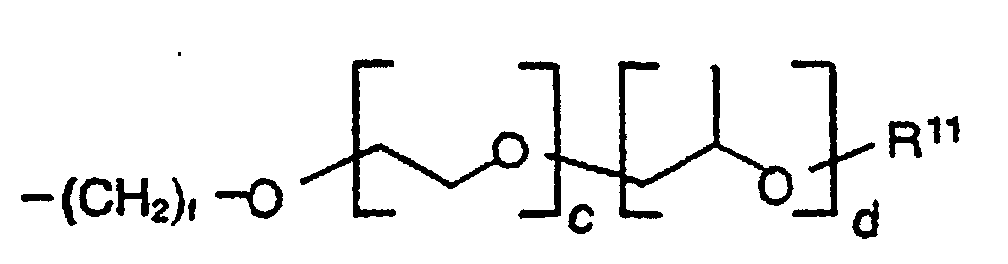
et f est un nombre entier allant de 1 à 6,
a et b sont des nombres entiers tels que le poids moléculaire du bloc de polysiloxane se situe entre 300 et 30 000,
c et d sont des nombres entiers qui peuvent aller de 0 à 50, sous réserve que la somme de ce et d est supérieure à 0, et e est égal à 0 ou 1,
et
le cas échéant un ou plusieurs autres monomères copolymérisables, suivie d'une saponification au moins partielle des fonctions ester des monomères initiaux a). - Utilisation de polymères selon la revendication 6, caractérisée par le fait que la formule II est la suivante :
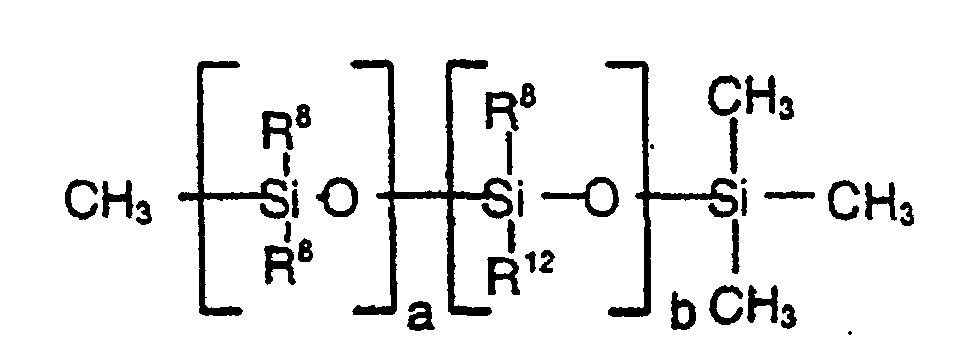
- Utilisation selon la revendication 1, caractérisé par le fait que les polymères sont obtenus par polymérisation radicalaire desuivie d'une saponification au moins partielle des fonctions ester des monomères initiaux a).a) au moins un ester vinylique d'acide carboxylique en C1-C24 en présence deb) des composés contenant des polyéthers obtenus par réaction de polyéthylène-imines avec des oxydes d'alkylènec) le cas échéant un ou plusieurs autres monomères copolymérisables,
- Utilisation de polymères selon la revendication 8, caractérisée par le fait que les oxydes d'alkylène utilisés sont l'oxyde d'éthylène, l'oxyde de propylène, l'oxyde de butylène ou leurs mélanges.
- Utilisation de polymères selon les revendications 8 et 9, caractérisée par le fait que l'oxyde d'alkylène utilisé est l'oxyde d'éthylène.
- Utilisation de polymères selon les revendications 8, 9 et 10, caractérisée par le fait que la polyéthylène-imine a un poids moléculaire de 300 à 20 000.
- Utilisation de polymères selon la revendication 1, caractérisée par le fait que les composés contenant des polyéthers b) ont été préparés par polymérisation de monomères à insaturation éthylénique contenant des oxydes d'alkylène et le cas échéant d'autres monomères copolymérisables.
- Utilisation de polymères selon la revendication 12, caractérisée par le fait que les composés contenant des polyéthers b) ont été préparés par polymérisation d'éthers vinyliques d'oxydes de polyalkylène et le cas échéant d'autres monomères copolymérisables.
- Utilisation de polymères selon la revendication 12, caractérisée par le fait que les composés contenant des polyéthers b) ont été préparés par polymérisation de (méth) acrylates d'oxydes de polyalkylène et le cas échéant d'autres monomères copolymérisables.
- Utilisation de polymères selon les revendications 1 à 14, caractérisée par le fait que le composant c) est choisi dans le groupe suivant :acide acrylique, acide méthacrylique, acide maléique, acide fumarique, acide crotonique, anhydride maléique et son hémi-ester, acrylate de méthyle, méthacrylate de méthyle, acrylate d'éthyle, méthacrylate d'éthyle, acrylate de n-butyle, méthacrylate de n-butyle, acrylate de tert-butyle, méthacrylate de tert-butyle, acrylate d'isobutyle, méthacrylate d'isobutyle, acrylate de 2-éthylhexyle, acrylate de stéaryle, méthacrylate de stéaryle, N-tert-butylacrylamide, N-octylacrylamide, acrylate de 2-hydroxyéthyle, acrylates d'hydroxypropyle, méthacrylate de 2-hydroxyéthyle, méthacrylates d'hydroxypropyle, (méth)acrylates d'alkylèneglycols, styrène, acides sulfoniques insaturés, par exemple acide acrylamidopropanesulfonique, vinylpyrrolidone, vinylcaprolactame, éthers vinyliques (par exemple oxyde de méthyle, d'éthyle, de butyle ou de dodécyle et de vinyle), vinylformamide, vinylméthylacétamide, vinylamine, 1-vinylimidazole, 1-vinyl-2-méthylimidazole, méthacrylate de N,N-diméthylaminométhyle et N-[3-(diméthylamino)propyl]méthacrylamide ; chlorure de 3-méthyl-1-vinylimidazolium, méthylsulfate de 3-méthyl-1-vinylimidazolium, méthacrylate de N,N-diméthylaminoéthyle, N-[3-(diméthylamino)propyl]méthacrylamide quaternisé par le chlorure de méthyle, le sulfate de méthyle ou le sulfate de diéthyle.
- Utilisation de polymères selon les revendications 1 à 15, caractérisée par le fait que les proportions mutuelles sont dea) 10 à 90 % en poidsb) 2 à 90 % en poidsc) 0 à 50 % en poids
- Utilisation de polymères selon les revendications 1 à 15, caractérisée par le fait que les proportions mutuelles sont dea) 50 à 97 % en poidsb) 3 à 50 % en poidsc) 0 à 30 % en poids
- Utilisation de polymères selon les revendications 1 à 15, caractérisée par le fait que les proportions mutuelles sont dea) 60 à 97 % en poidsb) 3 à 40 % en poidsc) 0 à 20 % en poids
- Utilisation selon les revendications 1 à 18, dans laquelle, à la suite de la saponification, on procède à une réticulation.
- Utilisation selon les revendications 19, dans laquelle la réticulation est réalisée à l'aide d'aldéhydes, de dialdéhydes ou de borates.
- Compositions cosmétiques capillaires caractérisées par la composition suivantes :a) 0,05 à 20 % en poids du polymère selon la revendication 1b) 20 à 99,95 % en poids d'eau et/ou d'alcoolc) 0 à 79,05 % en poids d'autres constituants.
- Compositions cosmétiques capillaires caractérisées par la composition suivante :a) 0,1 à 10 % en poids du polymère selon la revendication 1b) 20 à 99,9 % en poids d'eau et/ou d'alcoolc) 0 à 70 % en poids d'un agent propulseur,d) 0 à 20 % en poids d'autres constituants.
- Compositions cosmétiques capillaires caractérisées par la composition suivante :a) 0,1 à 10 % en poids du polymère selon la revendication 1b) 55 à 94,8 % en poids d'eau et/ou d'alcoolc) 5 à 20 % en poids d'un agent propulseurd) 0,1 à 5 % en poids d'un agent émulsionnante) 0 à 10 % en poids d'autres constituants.
- Compositions cosmétiques capillaires caractérisées par la composition suivante :a) 0,1 à 10 % en poids du polymère selon la revendication 1b) 60 à 99,85 % en poids d'eau et/ou d'alcoolc) 0,05 à 10 % en poids d'un agent gélifiantd) 0 à 20 % en poids d'autres constituants.
- Compositions cosmétiques capillaires caractérisées par la composition suivante :a) 0,05 à 10 % en poids du polymère selon la revendication 1b) 25 à 94,95 % en poids d'eauc) 5 à 50 % d'agents tensio-actifsd) 0 à 5 % en poids d'un autre agent conditionnante) 0 à 10 % en poids d'autres constituants cosmétiques.
- Polymères obtenus par polymérisation radicalaire dea) au moins un ester vinylique d'acide carboxylique en C1-C24 en présence deb) des dérivés de silicones contenant des polyéthers etc) le cas échéant un ou plusieurs autres monomères copolymérisables, suivie d'une saponification au moins partielle des fonctions ester des monomères initiaux a).
- Polymères obtenus par polymérisation radicalaire desuivie d'une saponification au moins partielle des fonctions ester des monomères initiaux a).a) un ester vinylique d'acide carboxylique en C1-C24 en présence deb) des composés contenant des polyéthers obtenus par réaction de polyéthylène-imines avec des oxydes d'alkylène etc) le cas échéant un ou plusieurs autres monomères copolymérisables,
- Polymères obtenus par polymérisation radicalaire desuivie d'une saponification au moins partielle des fonctions ester des monomères initiaux a).a) un ester vinylique d'acide carboxylique en C1-C24 en présence deb) des homo- et co-polymères de composés à insaturation éthylénique contenant des polyéthers etc) le cas échéant, un ou plusieurs autres monomères copolymérisables,
- Polymères réticulés obtenus par polymérisation radicalaire desuivie d'une saponification au moins partielle des fonctions ester des monomères initiaux a), l'agent réticulant utilisé étant déjà présent au cours de polymérisation ou étant ajouté à la suite de la polymérisation et de la saponification.a) au moins un ester vinylique d'acide carboxylique en C1-C24 en présence deb) des composés contenant des polyéthers etc) le cas échéant un ou plusieurs autres monomères copolymérisables,
- Polymères réticulés selon la revendication 29, pour lesquels les agents réticulants utilisés sont des aldéhydes, des dialdéhydes ou des borates.
- Polymères réticulés selon la revendication 29, caractérisés par le fait que l'agent réticulant est déjà présent à la polymérisation.
Applications Claiming Priority (3)
| Application Number | Priority Date | Filing Date | Title |
|---|---|---|---|
| DE19907587 | 1999-02-22 | ||
| DE19907587A DE19907587A1 (de) | 1999-02-22 | 1999-02-22 | Haarkosmetische Formulierungen |
| PCT/EP2000/001070 WO2000049998A1 (fr) | 1999-02-22 | 2000-02-10 | Preparations capillaires cosmetiques |
Publications (2)
| Publication Number | Publication Date |
|---|---|
| EP1154751A1 EP1154751A1 (fr) | 2001-11-21 |
| EP1154751B1 true EP1154751B1 (fr) | 2002-08-28 |
Family
ID=7898444
Family Applications (1)
| Application Number | Title | Priority Date | Filing Date |
|---|---|---|---|
| EP00906310A Expired - Lifetime EP1154751B1 (fr) | 1999-02-22 | 2000-02-10 | Preparations capillaires cosmetiques |
Country Status (10)
| Country | Link |
|---|---|
| US (1) | US6964774B1 (fr) |
| EP (1) | EP1154751B1 (fr) |
| JP (1) | JP2002537315A (fr) |
| AT (1) | ATE222746T1 (fr) |
| CA (1) | CA2363079A1 (fr) |
| DE (2) | DE19907587A1 (fr) |
| DK (1) | DK1154751T3 (fr) |
| ES (1) | ES2182784T3 (fr) |
| PT (1) | PT1154751E (fr) |
| WO (1) | WO2000049998A1 (fr) |
Families Citing this family (30)
| Publication number | Priority date | Publication date | Assignee | Title |
|---|---|---|---|---|
| GB0019493D0 (en) * | 2000-08-08 | 2000-09-27 | Unilever Plc | Hair styling compositions |
| DE10041163A1 (de) * | 2000-08-21 | 2002-03-07 | Basf Ag | Haarkosmetische Formulierungen |
| DE10041211A1 (de) | 2000-08-22 | 2002-03-07 | Basf Ag | Verwendung hydrophiler Pfropfcopolymere mit N-Vinylamin-und /oder offenkettigen n-Vinylamdeinheiten in kosmetischen Formulierungen |
| DE10059832A1 (de) | 2000-12-01 | 2002-06-13 | Clariant Gmbh | Gepfropfte Copolymere auf Basis von Acryloyldimethyltaurinsäure |
| DE10059826A1 (de) | 2000-12-01 | 2002-06-13 | Clariant Gmbh | Kosmetische, pharmazeutische und dermatologische Mittel |
| DE10059818A1 (de) | 2000-12-01 | 2002-06-13 | Clariant Gmbh | Dekorative kosmetische und dermatologische Mittel |
| DE10059830A1 (de) | 2000-12-01 | 2002-06-13 | Clariant Gmbh | Kationisch modifizierte Kammpolymere auf Basis von Acryloyldimethyltaurinsäure |
| DE10059831A1 (de) | 2000-12-01 | 2002-06-13 | Clariant Gmbh | Siliziummodifizierte Kammpolymere auf Basis von Acryloyldimethyltaurinsäure |
| DE10059821A1 (de) | 2000-12-01 | 2002-06-13 | Clariant Gmbh | Tensidfreie kosmetische, dermatologische und pharmazeutische Mittel |
| DE10059819A1 (de) | 2000-12-01 | 2002-06-13 | Clariant Gmbh | Tensidhaltige kosmetische, dermatologische und pharmazeutische Mittel |
| DE10059829A1 (de) | 2000-12-01 | 2002-06-13 | Clariant Gmbh | Gepfropfte Kammpolymere auf Basis von Acryloyldimethyltaurinsäure |
| DE10059828A1 (de) * | 2000-12-01 | 2002-06-13 | Clariant Gmbh | Kammförmige Copolymere auf Basis von Acryloyldimethyltaurinsäure |
| DE10059825A1 (de) | 2000-12-01 | 2002-06-13 | Clariant Gmbh | Verwendung von kammförmigen Copolymeren auf Basis von Acryloyldimethyltaurinsäure in kosmetischen, pharmazeutischen und dermatologischen Mitteln |
| DE10118478A1 (de) * | 2001-04-12 | 2002-10-17 | Basf Ag | Polysiloxanhaltige Polymere zur Antiknitterausrüstung von cellulosehaltigen Textilien |
| FR2832156B1 (fr) * | 2001-11-15 | 2004-05-28 | Oreal | Preparation de composes de type betainates de polysaccharides, composes obtenus, leur utilisation et les compositions les comprenant |
| GB0128951D0 (en) * | 2001-12-03 | 2002-01-23 | Unilever Plc | Hair styling composition |
| DE10163118A1 (de) * | 2001-12-21 | 2003-07-03 | Basf Ag | Verfahren zur Herstellung von Polymerisaten |
| DE10163523A1 (de) * | 2001-12-21 | 2003-07-03 | Basf Ag | Verfahren zur Herstellung von Polymerisaten |
| DE10163902A1 (de) * | 2001-12-22 | 2003-07-03 | Clariant Gmbh | Kristallisationsinhibitor für Pflanzenschutz-Formulierungen |
| CA2479557A1 (fr) * | 2002-03-21 | 2003-10-02 | Basf Aktiengesellschaft | Polymerisats cationiques et leur utilisation dans des formulations cosmetiques |
| DE10213142A1 (de) | 2002-03-23 | 2003-10-02 | Clariant Gmbh | Stabile Dispersionskonzentrate |
| EP1369104A1 (fr) * | 2002-06-08 | 2003-12-10 | Clariant GmbH | Compositions de soins cosmétiques monophasées |
| DE10259036A1 (de) * | 2002-12-17 | 2004-07-08 | Basf Ag | Allylgruppen-haltiges Polyetherurethan |
| US7744859B2 (en) * | 2005-04-29 | 2010-06-29 | L'oreal S.A. | Semipermanent hair shaping method |
| DE102005063376B4 (de) * | 2005-11-26 | 2018-10-11 | Tougas Oilfield Solutions Gmbh | Pfropfcopolymere und deren Verwendung |
| WO2007127065A2 (fr) * | 2006-04-21 | 2007-11-08 | Living Proof, Inc. | Polymérisation in situ pour traitement capillaire |
| US20070286833A1 (en) * | 2006-06-13 | 2007-12-13 | Keller Kathleen V | Multistage polymer composition and method of use |
| JP6599903B2 (ja) * | 2014-06-23 | 2019-10-30 | ローム アンド ハース カンパニー | パーソナルケア組成物におけるオイルフリーエモリエント剤 |
| US10245225B2 (en) * | 2014-06-23 | 2019-04-02 | Rohm And Haas Company | Oil-free emollients in sunscreen compositions |
| EP3228689B1 (fr) * | 2016-04-08 | 2019-05-22 | The Procter & Gamble Company | Nettoyants de surfaces dures comprenant un copolymère |
Family Cites Families (4)
| Publication number | Priority date | Publication date | Assignee | Title |
|---|---|---|---|---|
| LU65552A1 (fr) | 1972-06-20 | 1973-12-27 | ||
| LU86430A1 (fr) * | 1986-05-16 | 1987-12-16 | Oreal | Utilisation d'alcool polyvinylique partiellement acetyle comme agent de moussage dans les compositions sous forme d'aerosols |
| LU86585A1 (fr) * | 1986-09-15 | 1988-04-05 | Oreal | Composition sous forme de mousse aerosol a base d'un polymere derive de cellulose quaternise et de polymere anionique |
| EP0998254B1 (fr) * | 1997-07-23 | 2008-12-24 | Basf Se | Utilisation de polymeres contenant du polysiloxane pour des formulations cosmetiques |
-
1999
- 1999-02-22 DE DE19907587A patent/DE19907587A1/de not_active Withdrawn
-
2000
- 2000-02-10 PT PT00906310T patent/PT1154751E/pt unknown
- 2000-02-10 US US09/913,980 patent/US6964774B1/en not_active Expired - Fee Related
- 2000-02-10 CA CA002363079A patent/CA2363079A1/fr not_active Abandoned
- 2000-02-10 WO PCT/EP2000/001070 patent/WO2000049998A1/fr not_active Ceased
- 2000-02-10 ES ES00906310T patent/ES2182784T3/es not_active Expired - Lifetime
- 2000-02-10 AT AT00906310T patent/ATE222746T1/de not_active IP Right Cessation
- 2000-02-10 JP JP2000600610A patent/JP2002537315A/ja not_active Withdrawn
- 2000-02-10 DK DK00906310T patent/DK1154751T3/da active
- 2000-02-10 DE DE50000418T patent/DE50000418D1/de not_active Expired - Fee Related
- 2000-02-10 EP EP00906310A patent/EP1154751B1/fr not_active Expired - Lifetime
Also Published As
| Publication number | Publication date |
|---|---|
| WO2000049998A1 (fr) | 2000-08-31 |
| CA2363079A1 (fr) | 2000-08-31 |
| DE19907587A1 (de) | 2000-08-24 |
| ES2182784T3 (es) | 2003-03-16 |
| US6964774B1 (en) | 2005-11-15 |
| EP1154751A1 (fr) | 2001-11-21 |
| DE50000418D1 (de) | 2002-10-02 |
| JP2002537315A (ja) | 2002-11-05 |
| DK1154751T3 (da) | 2002-10-14 |
| PT1154751E (pt) | 2003-01-31 |
| ATE222746T1 (de) | 2002-09-15 |
Similar Documents
| Publication | Publication Date | Title |
|---|---|---|
| EP1313444B1 (fr) | Formulations cosmetiques pour la peau contenant des copolymeres de carboxylates de vinyle, des composants polyether et des monomeres additionels | |
| EP1313432B1 (fr) | Utilisation de copolymeres greffes a motifs n-vinylamine et/ou n-vinylamide a chaine ouverte dans des formulations cosmetiques | |
| EP1154751A1 (fr) | Preparations capillaires cosmetiques | |
| EP1313431B1 (fr) | Formulations cosmetiques pour cheveux | |
| DE10311616A1 (de) | Pfropfpolymerisate und ihre Verwendung | |
| EP1490016B1 (fr) | Polymerisats cationiques et leur utilisation dans des formulations cosmetiques | |
| DE10245586A1 (de) | Verwendung von Polymerisaten auf Basis von N-Vinylcaprolactam | |
| EP1476482B1 (fr) | Copolymeres greffes pour preparations cosmetiques | |
| EP1603960A2 (fr) | Produits polymeres et leur utilisation dans des preparations cosmetiques | |
| DE10311120A1 (de) | Polymere Produkte und ihre Verwendung in kosmetischen Zubereitungen | |
| WO2003106522A1 (fr) | Alkylenediamines substituees par des groupes polyoxyalkylene et leur utilisation dans des formulations cosmetiques | |
| DE10163523A1 (de) | Verfahren zur Herstellung von Polymerisaten | |
| DE10212705A1 (de) | Kationische Polymerisate und deren Verwendung in kosmetischen Formulierungen | |
| DE10227500A1 (de) | Kationische Polymerisate und deren Verwendung in kosmetischen Formulierungen | |
| MXPA01008439A (en) | Formulations of hair cosmetics |
Legal Events
| Date | Code | Title | Description |
|---|---|---|---|
| PUAI | Public reference made under article 153(3) epc to a published international application that has entered the european phase |
Free format text: ORIGINAL CODE: 0009012 |
|
| 17P | Request for examination filed |
Effective date: 20010821 |
|
| AK | Designated contracting states |
Kind code of ref document: A1 Designated state(s): AT BE CH CY DE DK ES FI FR GB GR IE IT LI LU MC NL PT SE |
|
| GRAG | Despatch of communication of intention to grant |
Free format text: ORIGINAL CODE: EPIDOS AGRA |
|
| 17Q | First examination report despatched |
Effective date: 20011218 |
|
| GRAG | Despatch of communication of intention to grant |
Free format text: ORIGINAL CODE: EPIDOS AGRA |
|
| GRAG | Despatch of communication of intention to grant |
Free format text: ORIGINAL CODE: EPIDOS AGRA |
|
| GRAH | Despatch of communication of intention to grant a patent |
Free format text: ORIGINAL CODE: EPIDOS IGRA |
|
| RIN1 | Information on inventor provided before grant (corrected) |
Inventor name: LEINENBACH, ALFRED Inventor name: GOTSCHE, MICHAEL Inventor name: DIEING, REINHOLD Inventor name: HOESSEL, PETER Inventor name: SANNER, AXEL Inventor name: RUTHERFORD, KEITH LESLIE |
|
| GRAH | Despatch of communication of intention to grant a patent |
Free format text: ORIGINAL CODE: EPIDOS IGRA |
|
| GRAH | Despatch of communication of intention to grant a patent |
Free format text: ORIGINAL CODE: EPIDOS IGRA |
|
| GRAA | (expected) grant |
Free format text: ORIGINAL CODE: 0009210 |
|
| AK | Designated contracting states |
Kind code of ref document: B1 Designated state(s): AT BE CH CY DE DK ES FI FR GB GR IE IT LI LU MC NL PT SE |
|
| PG25 | Lapsed in a contracting state [announced via postgrant information from national office to epo] |
Ref country code: FI Free format text: LAPSE BECAUSE OF FAILURE TO SUBMIT A TRANSLATION OF THE DESCRIPTION OR TO PAY THE FEE WITHIN THE PRESCRIBED TIME-LIMIT Effective date: 20020828 |
|
| REF | Corresponds to: |
Ref document number: 222746 Country of ref document: AT Date of ref document: 20020915 Kind code of ref document: T |
|
| REG | Reference to a national code |
Ref country code: GB Ref legal event code: FG4D Free format text: NOT ENGLISH |
|
| REG | Reference to a national code |
Ref country code: CH Ref legal event code: EP Ref country code: CH Ref legal event code: NV Representative=s name: SCHMAUDER & PARTNER AG PATENTANWALTSBUERO |
|
| REF | Corresponds to: |
Ref document number: 50000418 Country of ref document: DE Date of ref document: 20021002 |
|
| REG | Reference to a national code |
Ref country code: IE Ref legal event code: FG4D Free format text: GERMAN |
|
| GBT | Gb: translation of ep patent filed (gb section 77(6)(a)/1977) |
Effective date: 20020916 |
|
| REG | Reference to a national code |
Ref country code: DK Ref legal event code: T3 |
|
| REG | Reference to a national code |
Ref country code: GR Ref legal event code: EP Ref document number: 20020402856 Country of ref document: GR |
|
| PGFP | Annual fee paid to national office [announced via postgrant information from national office to epo] |
Ref country code: PT Payment date: 20030122 Year of fee payment: 4 Ref country code: SE Payment date: 20030122 Year of fee payment: 4 |
|
| PGFP | Annual fee paid to national office [announced via postgrant information from national office to epo] |
Ref country code: IE Payment date: 20030123 Year of fee payment: 4 |
|
| PGFP | Annual fee paid to national office [announced via postgrant information from national office to epo] |
Ref country code: GR Payment date: 20030124 Year of fee payment: 4 |
|
| PGFP | Annual fee paid to national office [announced via postgrant information from national office to epo] |
Ref country code: AT Payment date: 20030128 Year of fee payment: 4 Ref country code: DK Payment date: 20030128 Year of fee payment: 4 |
|
| REG | Reference to a national code |
Ref country code: PT Ref legal event code: SC4A Free format text: AVAILABILITY OF NATIONAL TRANSLATION Effective date: 20021126 |
|
| PG25 | Lapsed in a contracting state [announced via postgrant information from national office to epo] |
Ref country code: LU Free format text: LAPSE BECAUSE OF NON-PAYMENT OF DUE FEES Effective date: 20030210 Ref country code: CY Free format text: LAPSE BECAUSE OF FAILURE TO SUBMIT A TRANSLATION OF THE DESCRIPTION OR TO PAY THE FEE WITHIN THE PRESCRIBED TIME-LIMIT Effective date: 20030210 |
|
| PGFP | Annual fee paid to national office [announced via postgrant information from national office to epo] |
Ref country code: BE Payment date: 20030214 Year of fee payment: 4 |
|
| PG25 | Lapsed in a contracting state [announced via postgrant information from national office to epo] |
Ref country code: MC Free format text: LAPSE BECAUSE OF NON-PAYMENT OF DUE FEES Effective date: 20030228 |
|
| REG | Reference to a national code |
Ref country code: ES Ref legal event code: FG2A Ref document number: 2182784 Country of ref document: ES Kind code of ref document: T3 |
|
| ET | Fr: translation filed | ||
| PLBE | No opposition filed within time limit |
Free format text: ORIGINAL CODE: 0009261 |
|
| STAA | Information on the status of an ep patent application or granted ep patent |
Free format text: STATUS: NO OPPOSITION FILED WITHIN TIME LIMIT |
|
| 26N | No opposition filed |
Effective date: 20030530 |
|
| PG25 | Lapsed in a contracting state [announced via postgrant information from national office to epo] |
Ref country code: AT Free format text: LAPSE BECAUSE OF NON-PAYMENT OF DUE FEES Effective date: 20040210 Ref country code: IE Free format text: LAPSE BECAUSE OF NON-PAYMENT OF DUE FEES Effective date: 20040210 |
|
| PG25 | Lapsed in a contracting state [announced via postgrant information from national office to epo] |
Ref country code: SE Free format text: LAPSE BECAUSE OF NON-PAYMENT OF DUE FEES Effective date: 20040211 |
|
| PG25 | Lapsed in a contracting state [announced via postgrant information from national office to epo] |
Ref country code: BE Free format text: LAPSE BECAUSE OF NON-PAYMENT OF DUE FEES Effective date: 20040228 |
|
| PG25 | Lapsed in a contracting state [announced via postgrant information from national office to epo] |
Ref country code: CH Free format text: LAPSE BECAUSE OF NON-PAYMENT OF DUE FEES Effective date: 20040229 Ref country code: LI Free format text: LAPSE BECAUSE OF NON-PAYMENT OF DUE FEES Effective date: 20040229 |
|
| BERE | Be: lapsed |
Owner name: *BASF A.G. Effective date: 20040228 |
|
| PG25 | Lapsed in a contracting state [announced via postgrant information from national office to epo] |
Ref country code: DK Free format text: LAPSE BECAUSE OF NON-PAYMENT OF DUE FEES Effective date: 20040831 Ref country code: PT Free format text: LAPSE BECAUSE OF NON-PAYMENT OF DUE FEES Effective date: 20040831 |
|
| PG25 | Lapsed in a contracting state [announced via postgrant information from national office to epo] |
Ref country code: NL Free format text: LAPSE BECAUSE OF NON-PAYMENT OF DUE FEES Effective date: 20040901 |
|
| PG25 | Lapsed in a contracting state [announced via postgrant information from national office to epo] |
Ref country code: GR Free format text: LAPSE BECAUSE OF NON-PAYMENT OF DUE FEES Effective date: 20040903 |
|
| REG | Reference to a national code |
Ref country code: DK Ref legal event code: EBP |
|
| EUG | Se: european patent has lapsed | ||
| REG | Reference to a national code |
Ref country code: CH Ref legal event code: PL |
|
| NLV4 | Nl: lapsed or anulled due to non-payment of the annual fee |
Effective date: 20040901 |
|
| REG | Reference to a national code |
Ref country code: IE Ref legal event code: MM4A |
|
| PGFP | Annual fee paid to national office [announced via postgrant information from national office to epo] |
Ref country code: ES Payment date: 20090317 Year of fee payment: 10 |
|
| PGFP | Annual fee paid to national office [announced via postgrant information from national office to epo] |
Ref country code: DE Payment date: 20090206 Year of fee payment: 10 |
|
| PGFP | Annual fee paid to national office [announced via postgrant information from national office to epo] |
Ref country code: GB Payment date: 20090204 Year of fee payment: 10 |
|
| PGFP | Annual fee paid to national office [announced via postgrant information from national office to epo] |
Ref country code: IT Payment date: 20090213 Year of fee payment: 10 |
|
| PGFP | Annual fee paid to national office [announced via postgrant information from national office to epo] |
Ref country code: FR Payment date: 20090213 Year of fee payment: 10 |
|
| GBPC | Gb: european patent ceased through non-payment of renewal fee |
Effective date: 20100210 |
|
| REG | Reference to a national code |
Ref country code: FR Ref legal event code: ST Effective date: 20101029 |
|
| PG25 | Lapsed in a contracting state [announced via postgrant information from national office to epo] |
Ref country code: FR Free format text: LAPSE BECAUSE OF NON-PAYMENT OF DUE FEES Effective date: 20100301 |
|
| PG25 | Lapsed in a contracting state [announced via postgrant information from national office to epo] |
Ref country code: DE Free format text: LAPSE BECAUSE OF NON-PAYMENT OF DUE FEES Effective date: 20100901 |
|
| PG25 | Lapsed in a contracting state [announced via postgrant information from national office to epo] |
Ref country code: IT Free format text: LAPSE BECAUSE OF NON-PAYMENT OF DUE FEES Effective date: 20100210 Ref country code: GB Free format text: LAPSE BECAUSE OF NON-PAYMENT OF DUE FEES Effective date: 20100210 |
|
| REG | Reference to a national code |
Ref country code: ES Ref legal event code: FD2A Effective date: 20110406 |
|
| PG25 | Lapsed in a contracting state [announced via postgrant information from national office to epo] |
Ref country code: ES Free format text: LAPSE BECAUSE OF NON-PAYMENT OF DUE FEES Effective date: 20110324 |
|
| PG25 | Lapsed in a contracting state [announced via postgrant information from national office to epo] |
Ref country code: ES Free format text: LAPSE BECAUSE OF NON-PAYMENT OF DUE FEES Effective date: 20100211 |