EP1155281B1 - Schaumformulierung - Google Patents
Schaumformulierung Download PDFInfo
- Publication number
- EP1155281B1 EP1155281B1 EP00904769A EP00904769A EP1155281B1 EP 1155281 B1 EP1155281 B1 EP 1155281B1 EP 00904769 A EP00904769 A EP 00904769A EP 00904769 A EP00904769 A EP 00904769A EP 1155281 B1 EP1155281 B1 EP 1155281B1
- Authority
- EP
- European Patent Office
- Prior art keywords
- composition according
- foam
- group
- surfactant
- valence
- Prior art date
- Legal status (The legal status is an assumption and is not a legal conclusion. Google has not performed a legal analysis and makes no representation as to the accuracy of the status listed.)
- Expired - Lifetime
Links
Images





Classifications
-
- A—HUMAN NECESSITIES
- A62—LIFE-SAVING; FIRE-FIGHTING
- A62D—CHEMICAL MEANS FOR EXTINGUISHING FIRES OR FOR COMBATING OR PROTECTING AGAINST HARMFUL CHEMICAL AGENTS; CHEMICAL MATERIALS FOR USE IN BREATHING APPARATUS
- A62D1/00—Fire-extinguishing compositions; Use of chemical substances in extinguishing fires
- A62D1/0071—Foams
-
- F—MECHANICAL ENGINEERING; LIGHTING; HEATING; WEAPONS; BLASTING
- F42—AMMUNITION; BLASTING
- F42D—BLASTING
- F42D1/00—Blasting methods or apparatus, e.g. loading or tamping
- F42D1/08—Tamping methods; Methods for loading boreholes with explosives; Apparatus therefor
- F42D1/24—Tamping methods; Methods for loading boreholes with explosives; Apparatus therefor characterised by the tamping material
- F42D1/26—Tamping with foaming agents
-
- C—CHEMISTRY; METALLURGY
- C09—DYES; PAINTS; POLISHES; NATURAL RESINS; ADHESIVES; COMPOSITIONS NOT OTHERWISE PROVIDED FOR; APPLICATIONS OF MATERIALS NOT OTHERWISE PROVIDED FOR
- C09K—MATERIALS FOR MISCELLANEOUS APPLICATIONS, NOT PROVIDED FOR ELSEWHERE
- C09K23/00—Use of substances as emulsifying, wetting, dispersing, or foam-producing agents
-
- F—MECHANICAL ENGINEERING; LIGHTING; HEATING; WEAPONS; BLASTING
- F42—AMMUNITION; BLASTING
- F42D—BLASTING
- F42D5/00—Safety arrangements
- F42D5/04—Rendering explosive charges harmless, e.g. destroying ammunition; Rendering detonation of explosive charges harmless
- F42D5/045—Detonation-wave absorbing or damping means
-
- C—CHEMISTRY; METALLURGY
- C09—DYES; PAINTS; POLISHES; NATURAL RESINS; ADHESIVES; COMPOSITIONS NOT OTHERWISE PROVIDED FOR; APPLICATIONS OF MATERIALS NOT OTHERWISE PROVIDED FOR
- C09K—MATERIALS FOR MISCELLANEOUS APPLICATIONS, NOT PROVIDED FOR ELSEWHERE
- C09K23/00—Use of substances as emulsifying, wetting, dispersing, or foam-producing agents
- C09K23/02—Alkyl sulfonates or sulfuric acid ester salts derived from monohydric alcohols
-
- Y—GENERAL TAGGING OF NEW TECHNOLOGICAL DEVELOPMENTS; GENERAL TAGGING OF CROSS-SECTIONAL TECHNOLOGIES SPANNING OVER SEVERAL SECTIONS OF THE IPC; TECHNICAL SUBJECTS COVERED BY FORMER USPC CROSS-REFERENCE ART COLLECTIONS [XRACs] AND DIGESTS
- Y10—TECHNICAL SUBJECTS COVERED BY FORMER USPC
- Y10S—TECHNICAL SUBJECTS COVERED BY FORMER USPC CROSS-REFERENCE ART COLLECTIONS [XRACs] AND DIGESTS
- Y10S588/00—Hazardous or toxic waste destruction or containment
- Y10S588/901—Compositions
Definitions
- This invention relates to foam formulations having blast-suppressant/containment capabilities.
- Improvised explosive devices(IEDs) represent an increasingly dangerous threat to society, particularly when they contain a toxic chemical/biological (CB) agent. It is vital that both the blast effects (pressure wave, heat and shrapnel) and the CB agent-containing aerosols resulting from the initiation of such devices are contained. CB agents also present a decontamination problem when deposited on the surfaces of various equipment and vehicles, or spilled on the ground.
- CB agents also present a decontamination problem when deposited on the surfaces of various equipment and vehicles, or spilled on the ground.
- US Patent 4,964,329 assigned to Broken Hill Ltd. describes a composition consisting of a mixture of foamable liquid and a particulate additive to be supported as a dispersion in the foam.
- the dispersion is claimed to be effective in sound attenuation and shock wave dispersion.
- Such composition comprises a combination of water soluble polymer of the polyacrylic acid type, a foam stabilizer of dodecyl alcohol, a surfactant, a solvent.
- a very interesting US Patent No. 5,434,192 describes a composition of surfactants and stabilizers consisting of a mixture of modified natural and synthetic polymer and solvents capable of producing foam viable for 12 hours to several days at 75 - 105 degrees F. Such foam is used to suppress the emission of volatile gases and vapours.
- a foam-forming composition having blast suppressant capability comprising (a) a surfactant 40-80%/w; (b) a foam stabilizer 0-7 %/w; (c) a polyalkyleneglycol 10-30%/w; and (d) water balance to 100%.
- the polyalkylene glycol has the chemical formula R 1 -(OCH(CH 3 )CH 2 ) n -OR 2 , where R 1 and R 2 are independently H, an alkyl, or an ester group and n>1.
- the alkyl group may consist of a methyl, ethyl, propyl, butyl or a mixture thereof.
- R 1 , or R 2 is hydrogen. In another example, both R 1 and R 2 are hydrogens.
- the polypropylene glycol is a partially etherified polypropylene glycol derivative having the same formula R 1 -(OCH(CH 3 )CH 2 ) n -OR 2 , but where only one of R 1 or R 2 is independently H, or an alkyl group and n>1.
- R 1 or R 2 may be a methyl, ethyl, propyl, butyl group or a mixture thereof.
- the blast suppressant composition according to the invention includes:
- the requisite properties include:
- Coupling agents solubilize the surfactants, couple them with the stabilizers, and act as foam boosters and stabilizers.
- the coupling agents are glycol ethers.
- alkyl ether sulfates group specifically the C12-C14 alkyl ether sulfates and the shorter chain C8-C10 analogs were found to perform well in both fresh and seawater.
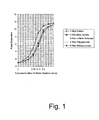
- the fatty alcohol commonly known as "lauryl alcohol” (C12-C14 linear alcohol 70:30) provided the best stabilizer for the group of surfactants under study. It was found that maximal foam stability could be achieved with a concentration of lauryl alcohol equivalent to about 15 ⁇ 2% of weight of surfactant (on an active basis). Use of lauryl alcohol above these levels resulted in a significant drop in foam expansion (Figure 3.).
- co-solvent is used herein to define organic-based chemicals that solubilize CB agents e.g. from alkalyd-coated (painted) surfaces.
- the co-solvent was incorporated into a few formulations and the resulting foaming characteristics were evaluated. Generally, it can be said that the co-solvent did not depress the foaming characteristics (foam expansion and drainage) significantly so it was decided to use it as a solvent instead of looking for a substitute for the glycol ethers and having to repeat the screening process.
- the co-solvent is a polyalkylene glycol e.g. polypropyleneglycol monomethyl ether (PPG 425).
- Bio-Terge AS-90 which is a sodium salt of C14-C16 ⁇ -olefin sulfonate
- Stepantan AS-12 which is also a C14-C16 ⁇ -olefin sulfonate at the same concentration.
- FA-406 which is an ammonium alkyl (C8-C10) ether sulfate
- TD-407 which is a sodium alkyl (C12-C14) ether sulfate, at a slightly higher concentration (i.e. 30.0% w/v).
- Steol CS-460 which is a sodium salt of a linear fatty alcohol ether sulfate, could replace TD-407, also at 30%/w/w.
- GCE-3 The preferred formulation (GCE-3) is as given in Table 3.
- the optimized concentrate using GCE-3 was aged in an oven at 65°C for 30 days and examined thereafter; there was no sign of stratification or phase separation.
- the material was diluted at one per cent and the foam characteristics were unchanged.
- a 1% dilute solution of the optimized concentrate using GCE-3 was aged for 24 hours and its foaming properties examined. There was no decrease in foaming characteristics for over a period of about four hours after which there was a slight decrease (less than 5%) in foam characteristics followed by stabilization overnight.
- Foam properties (expansion and drainage rate) were characterized using modified formulation GCE-3 at one percent (1%) dilution in tap water.
- the metals or alloys examined were:
- the recommended formulation will consist of the ingredients listed in Table 4.
- INGREDIENTS % W/V Alkyl Ether Sulfate Na 4 + Salt eg. Steol CS-460 30.0 ⁇ - Olefin Sulfonate Na Salt (eg. Bio-Terge AS-90) 15.5 Docecanol, (Lauryl Alcohol) (eg. Lorol C70/30%)
- Polypropylene glycol monomethyl ether PPG 425) 20.0 Sodium Tolyltriazole 0.05 Ammonium Dimolybdate 0.20 Sodium Pentahydrate Silicate 0.05 Citric Acid to pH 7.5 Water QS to 100%
- test series(1 and 2) were conducted in 1994-96 to determine the mitigation capacities of this foam system to contain CB agents.
- the first series of tests(series 1, below) in 1994 were done with non-fragmenting explosive dissemination models designed to project CB simulants.
- the second series(series 2, below) in 1996 examined the performance of the system when challenged by non-explosive dispersal models as well as high energy devices.
- the high energy explosive dispersal models gave us an indication of the upper device limits that we could contain.
- the bottle was filled with approximately 950 milliliters of methyl salicylate, a chemical agent simulant for mustard agent .
- This test series was conducted in a cylindrical shaped blast test chamber that is 32 feet in diameter and 20 feet high.
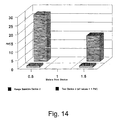
- DSF Dispersal Suppressant Foam
- the DSF is SILVEX foam concentrate diluted to 1.7 %/w in water. It will be appreciated by those skilled in the art that these results can be extrapolated to other foam formulations according to the invention ie. the DSF formulations described above, based on the evaluation of various physical properties of the foam produced with these formulations as compared to SILVEX foams, and a blast test with one of these formulations (GCE-3) against an actual improvised chemical dispersant device containing weapons grade material, in which we observed similar blast mitigation properties. Confirmatory tests are underway.
- MIRAN Magnetic Concentration Miniature Infra-red Gas Analyzer
- ENDEVCO Piezoresistive Pressure Transducer and Anderson Blast Gauges
- the agent simulant selected was Methyl Salicylate (MS). We did not conduct any tests with bio simulant as we felt the chemical provided a worst case scenario to challenge our mitigation systems, and a bio shot would simply be an unecessary duplication.
- the devices used are as follows:
- Dome shaped enclosure structure filled with DSF foam (approx. 570 cubic ft.)made of a five layer textile composite.
- the outside and inside layers are of a light rip stop nylon and the three inner layers are of a ballistic material called DYNEEMA.
- the DSF is the same as in test series 1.
- MIRAN Chemical Concentration - Chamber Miniature Infra-red Gas Analyzer
- DAAMS Depot Area Air Monitoring System
- a 250 ml Nalgene bottle filled with DEM (diethylmalonate) was placed on the floor of a steel containment tray which was inside a wood frame enclosure sealed with polyethylene vapour barrier material.
- the bottle was equipped with a 18 cm length of 150 grain Det Cord and a No. 12 electronic detonator.
- the enclosure had dimensions 12 ft x 12 ft by 10 ft height.
- the MIRANs were set as follows:
- the CADS Station CAMs were set for G-mode as DEM produces responses in this mode.
- the tent head space and containment shelter air were examined using portable CAMs and the Hapsite GC/MS Analyser. These air samples were acquired at 10 minutes after detonation of the DEM-filled bottle. The temperature of the head space was measured with a portable infrared temperature "gun”. Further surveys with CAMs were conducted at the 30 minute mark.
- the tent was opened and the contents were allowed to drain into the containment tray. Further CAM air surveys were conducted close to the fluid to determine the presence of residual DEM.
- the tent head space and containment shelter air were examined using portable CAMs and the Hapsite GC/MS Analyser at 10 minutes following the functioning of the dispersal device.
- the head space air temperature was measured with the portable infrared temperature gun.
- a second survey using CAMS was carried out at the 30 minute mark.
- the tent contents were allowed to stand for one hour before the tent was opened and the contents allowed to discharge into the containment tray.
- the air above the residual fluid was again surveyed using CAMs.
- the small tent used in this trial took less than 5 minutes to completely fill using the Irvin Aerospace pumping system.
- the foam-filled tent was able to completely contain the bottle fragments and dispersed DEM with no visible signs of damage or leakage. Very little movement of the tent was observed on high speed video recordings of the tent at the moment the dispersal device was functioned.
- the larger tent used in this trial took approximately 5 minutes to completely fill using the Irvin Aerospace pumping system. Personnel experienced no difficulty in placing the tent over the dispersal device mounted on the ring stand. The foam-filled tent was able to completely contain the bottle fragments and dispersed mustard with no visible signs of damage or leakage. Very little movement of the tent was observed on high speed video recordings of the tent at the moment the dispersal device was functioned.
- the foaming characteristics based upon the same foam delivery parameters ie. Expansion ratio of 20-25 and flow rate of the nozzle of 60 US gallons/ minute, are not altered by this modification.
- the aged dilute solution does not show any change in foaming characteristics.
- the concentrate performs equally well in sea as in fresh water.
- composition shown in Table 5 has a slight advantage on the same formulation with 0% w/w of alcohol as far as gelling is concerned.
Landscapes
- Chemical & Material Sciences (AREA)
- Engineering & Computer Science (AREA)
- General Engineering & Computer Science (AREA)
- General Chemical & Material Sciences (AREA)
- Emergency Management (AREA)
- Materials Engineering (AREA)
- Organic Chemistry (AREA)
- Chemical Kinetics & Catalysis (AREA)
- Life Sciences & Earth Sciences (AREA)
- Business, Economics & Management (AREA)
- General Life Sciences & Earth Sciences (AREA)
- Emulsifying, Dispersing, Foam-Producing Or Wetting Agents (AREA)
- Agricultural Chemicals And Associated Chemicals (AREA)
- Manufacture Of Porous Articles, And Recovery And Treatment Of Waste Products (AREA)
- Detergent Compositions (AREA)
- Compositions Of Macromolecular Compounds (AREA)
- Fire-Extinguishing Compositions (AREA)
- Organic Low-Molecular-Weight Compounds And Preparation Thereof (AREA)
Claims (20)
- Eine schaumbildende Komposition bestehend aus
(a) einem Tensid 40-80 Gew.-% (b) einem Schaumstabilisator 0-7 Gew.-% (c) einem Polyalkylenglykol 10-30 Gew.-% (d) Wasser Rest bis 100% - Eine Komposition gemäß Anspruch 1, bestehend aus
(a) einem Tensid 41,5-76 Gew.-% (b) einem Schaumstabilisator 3-7 Gew.-% (c) einem Polyalkylenglykol 10-30 Gew.-% (d) Wasser Rest bis 100 % - Eine Komposition gemäß Anspruch 1, bestehend aus
(a) einem Tensid 18,5-28,5 Gew.-% (b) einem Schaumstabilisator 3-5 Gew.-% (c) einem Polyalkylenglykol 10-30 Gew.-% (d) Wasser Rest bis 100 % - Eine Komposition gemäß Anspruch 1, bestehend aus
(a) einem Tensid 22,75 Gew.-% (b) einem Schaumstabilisator 0-1 Gew.-% (c) einem Polyalkylenglykol 20-40 Gew.-% (d) Wasser Rest bis 100% - Eine Komposition gemäß Anspruch 5, bestehend aus 25 Gew.-% eines Polyalkylenglykols.
- Eine Komposition gemäß Anspruch 1, dadurch gekennzeichnet, dass das Tensid entweder aus einer Komposition nach der Formel [R(OCH2CH2OnX]aMb besteht, wobei R eine Alkylgruppe mit acht bis achtzehn Kohlenstoffatomen darstellt, n eine ganze Zahl zwischen 1 und 10 darstellt, X aus der Gruppe SO3 2-, SO4 2-, CO3 2- und PO4 3- gewählt ist; M ein Alkalimetall, ein alkalines Erdmetall, Ammoniumoder Amin-Derivat darstellt, a die Valenz von M darstellt, und b die Valenz von [R(OCH2CH2)nX] darstellt, oder aus einer Komposition nach der Formel [R-CH=CH(CH2)m-X]aMb besteht, wobei R eine Alkylgruppe mit acht bis achtzehn Kohlenstoffatomen darstellt, m eine ganze Zahl zwischen 0 und 3 darstellt, X aus der Gruppe SO3 2-, SO4 2-, CO3 2- und PO4 3-gewählt ist, M ein Alkalimetall, ein alkalines Erdmetall, Ammonium- oder Aminderivat darstellt, a die Valenz von M darstellt, und b die Valenz von [R-CH=CH(CH2)m-X]darstellt, oder aus einer Komposition nach einer Mischung derselben besteht.
- Eine Komposition gemäß Anspruch 6, dadurch gekennzeichnet, dass das Polyalkylenglykol die Formel R1-(OCH(CH3)CH2)n-OR2 aufweist, wobei R1 und R2 unabhängig aus H, einem Alkyl oder einer Estergruppe und n> 1 besteht, wobei die Alkylgruppe eine Methyl-, Ethyl-, Propyl- oder Butylgruppe oder eine Mischung derselben sein kann oder ein partiell ätherisiertes Derivat derselben Formel R1-(OCH(CH3)CH2)n-OR2 darstellt, wobei entweder R1 oder R2 unabhängig H oder eine Alkylgruppe und n>1 und die R1 und R2 darstellende Alkylgruppe eine Methyl-, Ethyl-, Propyl- oder Butylgruppe oder eine Mischung derselben darstellen kann.
- Eine Komposition gemäß Anspruch 7, dadurch gekennzeichnet, dass das Polyalkylenglykol einen Polypropylenglykol-Monomethyläther darstellt.
- Eine Komposition gemäß Anspruch 8, dadurch gekennzeichnet, dass das der Polypropylenglykol-Monomethyläther ein Molekulargewicht von 425 aufweist.
- Eine Komposition gemäß Anspruch 1, dadurch gekennzeichnet, dass das Tensid aus der Gruppe gewählt wird, die aus Alkyläthersulfaten, Alpha-Olefinsulfonaten und Alkylsulfosuccinaten besteht.
- Eine Komposition gemäß Anspruch 10, dadurch gekennzeichnet, dass das Tensid ein Alkyläthersulfat darstellt.
- Eine Komposition gemäß Anspruch 11, dadurch gekennzeichnet, dass das Alkyläthersulfat die Formel[R(OCH2CH2)nX]aMb aufweist, wobei R eine Alkylgruppe mit zwischen acht und achtzehn Kohlenstoffatomen darstellt, n eine ganze Zahl zwischen 0 und 10 darstellt, X aus der Gruppe ausgewählt ist, welche aus SO3 2-, SO4 2-, CO3 2- und PO4 3-gewählt ist, wobei M ein Alkalimetall, ein alkalines Erdmetall, ein Ammonium- oder Aminderivat darstellt, a die Valenz von M und b die Valenz von [R(OCH2CH2)nX] oder Mischungen derselben darstellt.
- Eine Komposition gemäß Anspruch 11, dadurch gekennzeichnet, dass das Alkyläthersulfat die Formel [R-CH=CH(CH2)mX]aMb aufweist, wobei R eine Alkylgruppe mit zwischen acht und achtzehn Kohlenstoffatomen darstellt, m eine ganze Zahl zwischen 0 und 3 darstellt, X aus der Gruppe ausgewählt ist, welche aus SO3 2-, SO4 2-, CO3 2- und PO4 3-gewählt ist, wobei M ein Alkalimetall, ein alkalines Erdmetall, ein Ammonium- oder Aminderivat darstellt, a die Valenz von M und b die Valenz von [R-CH=CH(CH2)m-X] oder Mischungen derselben darstellt.
- Eine Komposition gemäß Anspruch 11, dadurch gekennzeichnet, dass das Polyalkylenglykol ein partiell ätherisiertes Polypropylenglykol darstellt.
- Eine Komposition gemäß Anspruch 14, dadurch gekennzeichnet, dass das partiell ätherisierte Polypropylenglykol die Formel [R1-(OCH2CH2CH2)n-OR2 aufweist, wobei R1 oder R2 unabhängig H oder eine Alkylgruppe und n>1 darstellt.
- Eine Komposition gemäß Anspruch 11, dadurch gekennzeichnet, dass der Schaumstabilisator einen langkettigen [höheren] Fettalkohol darstellt.
- Eine Komposition gemäß Anspruch 16, dadurch gekennzeichnet, dass der langkettige Fettalkohol C12-Alkohol (97 %) darstellt.
- Eine Komposition gemäß Anspruch 1, die zusätzlich einen Korrosionsinhibitor aufweist.
- Eine Komposition gemäß Anspruch 1, bestehend aus
(a) einem Alkyläthersulfat 25,75 Gew.-% (b) einem aliphatischen Alkohol C12(97%) 1 Gew.-% (c) einem Polyalkylenglykol-Monomethyläther 25,0 Gew.-% (d) einem Korrosionsinhibitor 0,3 Gew.-% (e) Wasser Rest bis 100 % - Anwendung eines mit einer schaumbildenden Komposition gemäß Anspruch 1 hergestellten Schaumes zur Unterdrückung und Verdämmung der Blastwirkung von Sprengkörpern.
Applications Claiming Priority (3)
| Application Number | Priority Date | Filing Date | Title |
|---|---|---|---|
| US12087499P | 1999-02-19 | 1999-02-19 | |
| US120874P | 1999-02-19 | ||
| PCT/CA2000/000160 WO2000049363A1 (en) | 1999-02-19 | 2000-02-18 | Foam formulations |
Publications (2)
| Publication Number | Publication Date |
|---|---|
| EP1155281A1 EP1155281A1 (de) | 2001-11-21 |
| EP1155281B1 true EP1155281B1 (de) | 2003-06-04 |
Family
ID=22393040
Family Applications (1)
| Application Number | Title | Priority Date | Filing Date |
|---|---|---|---|
| EP00904769A Expired - Lifetime EP1155281B1 (de) | 1999-02-19 | 2000-02-18 | Schaumformulierung |
Country Status (8)
| Country | Link |
|---|---|
| US (1) | US6553887B1 (de) |
| EP (1) | EP1155281B1 (de) |
| AT (1) | ATE242474T1 (de) |
| AU (1) | AU766681B2 (de) |
| CA (1) | CA2298971C (de) |
| DE (1) | DE60003159T2 (de) |
| IL (1) | IL144961A0 (de) |
| WO (1) | WO2000049363A1 (de) |
Families Citing this family (14)
| Publication number | Priority date | Publication date | Assignee | Title |
|---|---|---|---|---|
| AU2003297808A1 (en) | 2002-12-09 | 2004-06-30 | The Trustees Of Columbia University In The City Of New York | Peptides and methods for deactivation of organophosphorus-based nerve agents and insecticides |
| US20050150369A1 (en) * | 2003-12-12 | 2005-07-14 | Chris Lacombe | Apparatus and method for blast suppression |
| CA2489112A1 (en) * | 2004-12-06 | 2006-06-06 | Vanguard Response Systems Inc. | Method of, and apparatus for defoaming |
| CA2593972A1 (en) * | 2005-01-11 | 2006-07-20 | Clean Earth Technologies, Llc | Formulations for the decontamination of toxic chemicals |
| CA2504925A1 (en) * | 2005-04-22 | 2006-10-22 | Allen-Vanguard Corporation | Adaptable containment system (acs) |
| US7866248B2 (en) * | 2006-01-23 | 2011-01-11 | Intellectual Property Holdings, Llc | Encapsulated ceramic composite armor |
| US20080236378A1 (en) * | 2007-03-30 | 2008-10-02 | Intellectual Property Holdings, Llc | Affixable armor tiles |
| US20100282062A1 (en) * | 2007-11-16 | 2010-11-11 | Intellectual Property Holdings, Llc | Armor protection against explosively-formed projectiles |
| US7810421B2 (en) * | 2008-01-25 | 2010-10-12 | Alliant Techsystems Inc. | Methods of preventing initiation of explosive devices |
| US7850865B1 (en) * | 2008-05-27 | 2010-12-14 | Sandia Corporation | Highly concentrated foam formulation for blast mitigation |
| US20110239890A1 (en) * | 2010-04-06 | 2011-10-06 | Spritzer Michael H | Thermite-Metal Foam |
| FR3069631B1 (fr) * | 2017-07-27 | 2019-09-06 | David Eberard | Procede de fabrication d'un corps d'obturation d'un logement, corps d'obturation et utilisation d'une composition en tant que materiau d'obturation |
| US10843154B1 (en) * | 2017-08-14 | 2020-11-24 | National Technology & Engineering Solutions Of Sandia, Llc | Blast mitigation foam concentrates and foams made therefrom |
| CN109307459B (zh) * | 2018-12-06 | 2020-08-04 | 中电建路桥集团有限公司 | 一种爆破激波水泡快速降尘方法 |
Family Cites Families (16)
| Publication number | Priority date | Publication date | Assignee | Title |
|---|---|---|---|---|
| US69533A (en) | 1867-10-08 | Improvement in deilling machines | ||
| DE2110750A1 (de) * | 1970-03-17 | 1971-10-07 | Colgate Palmolive Co | Teppichreinigungsmittel und Verfahren zu seiner Herstellung |
| GB1510216A (en) * | 1975-05-08 | 1978-05-10 | Canadian Ind | Stabilized foamed water gel explosives |
| US4451947A (en) | 1980-08-14 | 1984-06-05 | A T & T Bell Telephone Laboratories | Electrical wire handling tool |
| US4442018A (en) * | 1982-11-01 | 1984-04-10 | The United States Of America As Represented By The United States Department Of Energy | Stabilized aqueous foam systems and concentrate and method for making them |
| US4589341A (en) | 1984-02-10 | 1986-05-20 | Rockwood Systems Corporation | Method for explosive blast control using expanded foam |
| US4795590A (en) * | 1985-05-28 | 1989-01-03 | Minnesota Mining And Manufacturing Company | Treatment of hazardous material with vapor suppressing, persistent, water-containing, polymeric air foam |
| US4795530A (en) * | 1985-11-05 | 1989-01-03 | Kimberly-Clark Corporation | Process for making soft, strong cellulosic sheet and products made thereby |
| US4770794A (en) * | 1986-07-07 | 1988-09-13 | Wormald Canada Inc. | Foam fire extinguishing compositions for aerial fire extinguishing |
| GB2199869B (en) | 1986-11-21 | 1991-02-27 | Broken Hill Pty Co Ltd | Sound attenuation with foam |
| US4849117A (en) * | 1987-06-17 | 1989-07-18 | Sanitek Products, Inc. | Concentrated composition for forming an aqueous foam |
| US4847398A (en) | 1987-09-09 | 1989-07-11 | Union Carbide Corporation | Process for the preparation of siloxane-oxyalkylene copolymers |
| US5434192A (en) | 1990-09-19 | 1995-07-18 | Atlantic Richfield Company | High-stability foams for long-term suppression of hydrocarbon vapors |
| GB9118628D0 (en) | 1991-08-30 | 1991-10-16 | Ici Canada | Mixed surfactant system |
| US5716925A (en) * | 1993-08-04 | 1998-02-10 | Colgate Palmolive Co. | Microemulsion all purpose liquid cleaning compositions comprising partially esterified, fully esterified and non-esterified polyhydric alcohol and grease release agent |
| GB9420037D0 (en) | 1994-10-05 | 1994-11-16 | Johnson & Son Inc S C | (Carpet) foam cleaning composition |
-
2000
- 2000-02-18 US US09/507,081 patent/US6553887B1/en not_active Expired - Fee Related
- 2000-02-18 AT AT00904769T patent/ATE242474T1/de not_active IP Right Cessation
- 2000-02-18 CA CA002298971A patent/CA2298971C/en not_active Expired - Fee Related
- 2000-02-18 IL IL14496100A patent/IL144961A0/xx not_active IP Right Cessation
- 2000-02-18 EP EP00904769A patent/EP1155281B1/de not_active Expired - Lifetime
- 2000-02-18 DE DE60003159T patent/DE60003159T2/de not_active Expired - Lifetime
- 2000-02-18 AU AU26545/00A patent/AU766681B2/en not_active Ceased
- 2000-02-18 WO PCT/CA2000/000160 patent/WO2000049363A1/en not_active Ceased
Also Published As
| Publication number | Publication date |
|---|---|
| DE60003159T2 (de) | 2004-05-06 |
| ATE242474T1 (de) | 2003-06-15 |
| DE60003159D1 (de) | 2003-07-10 |
| CA2298971A1 (en) | 2000-08-19 |
| US6553887B1 (en) | 2003-04-29 |
| AU766681B2 (en) | 2003-10-23 |
| WO2000049363A1 (en) | 2000-08-24 |
| IL144961A0 (en) | 2002-06-30 |
| EP1155281A1 (de) | 2001-11-21 |
| AU2654500A (en) | 2000-09-04 |
| CA2298971C (en) | 2008-07-22 |
Similar Documents
| Publication | Publication Date | Title |
|---|---|---|
| US6405626B1 (en) | Decontaminating and dispersion suppressing foam formulation | |
| US6553887B1 (en) | Foam formulations | |
| US3258423A (en) | Method of extinguishing liquid hydrocarbon fires | |
| Ni et al. | Application of water@ silica core-shell particles for suppressing gasoline pool fires | |
| AU655518B2 (en) | Fire retarding and extinguishing composite | |
| US11712592B2 (en) | Wetting agent composition for extinguishing fires | |
| EP3524326A1 (de) | Feuerlöschmittel | |
| US6518345B2 (en) | Fire extinguishing composition | |
| Kibert et al. | Solid particulate aerosol fire suppressants | |
| EP1287855A1 (de) | Feuerlöschende chemikalie | |
| US20170225020A1 (en) | Method to mitigate the consequences of an unconfined or partially confined vapor cloud explosion | |
| GB2265309A (en) | Fire extinguishing methods using fluorinated hydrocarbons | |
| CA2299259C (en) | Decontamination and dispersion suppressing foam formulation | |
| US20180250541A1 (en) | Enhanced dry chemical fire extinguishing composition, apparatus, and method | |
| US20020030176A1 (en) | Freeze-protected, firefighting foam composition | |
| EP1275417B1 (de) | Feuerlöschende Zusammensetzung | |
| JP4524503B2 (ja) | 消火薬剤 | |
| SE521179C2 (sv) | Sätt att simulera en attack med kemiska stridsmedel, övningssubstans för användning vid sättet samt komposition för framställning av övningssubstansen | |
| Kim | Recent development in fire suppression systems | |
| EP0703808B1 (de) | Schäumende zusammensetzung zur verminderung des drucks der stosswellen bei explosionen | |
| KR20250108207A (ko) | 수성막포 에어로졸 소화기용 소화약제 | |
| Okunrounmu | Full Scale Tests on the Discharge Characteristics, Drainage Characteristics and Fire Suppression Performance of Portable Compressed Air Foam System | |
| KR100777764B1 (ko) | 소화약제 | |
| CN114452582A (zh) | 一种水基高分子微包囊灭火降烟抑爆剂制备方法与应用 | |
| Heinonen et al. | Aerosol Technology Overview and Bibliography. |
Legal Events
| Date | Code | Title | Description |
|---|---|---|---|
| PUAI | Public reference made under article 153(3) epc to a published international application that has entered the european phase |
Free format text: ORIGINAL CODE: 0009012 |
|
| 17P | Request for examination filed |
Effective date: 20010816 |
|
| AK | Designated contracting states |
Kind code of ref document: A1 Designated state(s): AT BE CH CY DE DK ES FI FR GB GR IE IT LI LU MC NL PT SE |
|
| AX | Request for extension of the european patent |
Free format text: AL;LT;LV;MK;RO;SI |
|
| GRAH | Despatch of communication of intention to grant a patent |
Free format text: ORIGINAL CODE: EPIDOS IGRA |
|
| GRAH | Despatch of communication of intention to grant a patent |
Free format text: ORIGINAL CODE: EPIDOS IGRA |
|
| GRAA | (expected) grant |
Free format text: ORIGINAL CODE: 0009210 |
|
| AK | Designated contracting states |
Designated state(s): AT BE CH CY DE DK ES FI FR GB GR IE IT LI LU MC NL PT SE |
|
| PG25 | Lapsed in a contracting state [announced via postgrant information from national office to epo] |
Ref country code: AT Free format text: LAPSE BECAUSE OF FAILURE TO SUBMIT A TRANSLATION OF THE DESCRIPTION OR TO PAY THE FEE WITHIN THE PRESCRIBED TIME-LIMIT Effective date: 20030604 Ref country code: CY Free format text: LAPSE BECAUSE OF FAILURE TO SUBMIT A TRANSLATION OF THE DESCRIPTION OR TO PAY THE FEE WITHIN THE PRESCRIBED TIME-LIMIT Effective date: 20030604 |
|
| REG | Reference to a national code |
Ref country code: GB Ref legal event code: FG4D |
|
| REG | Reference to a national code |
Ref country code: CH Ref legal event code: EP |
|
| REG | Reference to a national code |
Ref country code: IE Ref legal event code: FG4D |
|
| REF | Corresponds to: |
Ref document number: 60003159 Country of ref document: DE Date of ref document: 20030710 Kind code of ref document: P |
|
| REG | Reference to a national code |
Ref country code: SE Ref legal event code: TRGR |
|
| PG25 | Lapsed in a contracting state [announced via postgrant information from national office to epo] |
Ref country code: GR Free format text: LAPSE BECAUSE OF FAILURE TO SUBMIT A TRANSLATION OF THE DESCRIPTION OR TO PAY THE FEE WITHIN THE PRESCRIBED TIME-LIMIT Effective date: 20030904 Ref country code: PT Free format text: LAPSE BECAUSE OF FAILURE TO SUBMIT A TRANSLATION OF THE DESCRIPTION OR TO PAY THE FEE WITHIN THE PRESCRIBED TIME-LIMIT Effective date: 20030904 Ref country code: DK Free format text: LAPSE BECAUSE OF FAILURE TO SUBMIT A TRANSLATION OF THE DESCRIPTION OR TO PAY THE FEE WITHIN THE PRESCRIBED TIME-LIMIT Effective date: 20030904 |
|
| PG25 | Lapsed in a contracting state [announced via postgrant information from national office to epo] |
Ref country code: ES Free format text: LAPSE BECAUSE OF FAILURE TO SUBMIT A TRANSLATION OF THE DESCRIPTION OR TO PAY THE FEE WITHIN THE PRESCRIBED TIME-LIMIT Effective date: 20030915 |
|
| REG | Reference to a national code |
Ref country code: CH Ref legal event code: NV Representative=s name: JACOBACCI & PARTNERS S.P.A. |
|
| LTIE | Lt: invalidation of european patent or patent extension |
Effective date: 20030604 |
|
| PG25 | Lapsed in a contracting state [announced via postgrant information from national office to epo] |
Ref country code: LU Free format text: LAPSE BECAUSE OF NON-PAYMENT OF DUE FEES Effective date: 20040218 Ref country code: IE Free format text: LAPSE BECAUSE OF NON-PAYMENT OF DUE FEES Effective date: 20040218 |
|
| PG25 | Lapsed in a contracting state [announced via postgrant information from national office to epo] |
Ref country code: MC Free format text: LAPSE BECAUSE OF NON-PAYMENT OF DUE FEES Effective date: 20040228 |
|
| ET | Fr: translation filed | ||
| PLBE | No opposition filed within time limit |
Free format text: ORIGINAL CODE: 0009261 |
|
| STAA | Information on the status of an ep patent application or granted ep patent |
Free format text: STATUS: NO OPPOSITION FILED WITHIN TIME LIMIT |
|
| 26N | No opposition filed |
Effective date: 20040305 |
|
| REG | Reference to a national code |
Ref country code: IE Ref legal event code: MM4A |
|
| PGFP | Annual fee paid to national office [announced via postgrant information from national office to epo] |
Ref country code: IT Payment date: 20120217 Year of fee payment: 13 |
|
| PGFP | Annual fee paid to national office [announced via postgrant information from national office to epo] |
Ref country code: DE Payment date: 20130227 Year of fee payment: 14 Ref country code: SE Payment date: 20130220 Year of fee payment: 14 Ref country code: FI Payment date: 20130219 Year of fee payment: 14 Ref country code: CH Payment date: 20130214 Year of fee payment: 14 Ref country code: FR Payment date: 20130315 Year of fee payment: 14 Ref country code: GB Payment date: 20130206 Year of fee payment: 14 |
|
| PGFP | Annual fee paid to national office [announced via postgrant information from national office to epo] |
Ref country code: NL Payment date: 20130227 Year of fee payment: 14 Ref country code: BE Payment date: 20130204 Year of fee payment: 14 |
|
| BERE | Be: lapsed |
Owner name: *PURDON GARFIELD J. Effective date: 20140228 Owner name: *CUNDASAMY EDWARD N. Effective date: 20140228 Owner name: *COWAN GEORGE Effective date: 20140228 Owner name: *BUREAUX JOHN G. Effective date: 20140228 |
|
| REG | Reference to a national code |
Ref country code: DE Ref legal event code: R119 Ref document number: 60003159 Country of ref document: DE |
|
| REG | Reference to a national code |
Ref country code: NL Ref legal event code: V1 Effective date: 20140901 |
|
| REG | Reference to a national code |
Ref country code: CH Ref legal event code: PL Ref country code: SE Ref legal event code: EUG |
|
| GBPC | Gb: european patent ceased through non-payment of renewal fee |
Effective date: 20140218 |
|
| PG25 | Lapsed in a contracting state [announced via postgrant information from national office to epo] |
Ref country code: FI Free format text: LAPSE BECAUSE OF NON-PAYMENT OF DUE FEES Effective date: 20140218 Ref country code: NL Free format text: LAPSE BECAUSE OF NON-PAYMENT OF DUE FEES Effective date: 20140901 Ref country code: LI Free format text: LAPSE BECAUSE OF NON-PAYMENT OF DUE FEES Effective date: 20140228 Ref country code: CH Free format text: LAPSE BECAUSE OF NON-PAYMENT OF DUE FEES Effective date: 20140228 |
|
| REG | Reference to a national code |
Ref country code: FR Ref legal event code: ST Effective date: 20141031 |
|
| PG25 | Lapsed in a contracting state [announced via postgrant information from national office to epo] |
Ref country code: SE Free format text: LAPSE BECAUSE OF NON-PAYMENT OF DUE FEES Effective date: 20140219 |
|
| REG | Reference to a national code |
Ref country code: DE Ref legal event code: R119 Ref document number: 60003159 Country of ref document: DE Effective date: 20140902 |
|
| PG25 | Lapsed in a contracting state [announced via postgrant information from national office to epo] |
Ref country code: GB Free format text: LAPSE BECAUSE OF NON-PAYMENT OF DUE FEES Effective date: 20140218 Ref country code: DE Free format text: LAPSE BECAUSE OF NON-PAYMENT OF DUE FEES Effective date: 20140902 Ref country code: BE Free format text: LAPSE BECAUSE OF NON-PAYMENT OF DUE FEES Effective date: 20140228 Ref country code: FR Free format text: LAPSE BECAUSE OF NON-PAYMENT OF DUE FEES Effective date: 20140228 |
|
| PG25 | Lapsed in a contracting state [announced via postgrant information from national office to epo] |
Ref country code: IT Free format text: LAPSE BECAUSE OF NON-PAYMENT OF DUE FEES Effective date: 20140218 |