EP1156098A2 - Elektrochrome Anzeigevorrichtung mit hoher Kantenschärfe - Google Patents
Elektrochrome Anzeigevorrichtung mit hoher Kantenschärfe Download PDFInfo
- Publication number
- EP1156098A2 EP1156098A2 EP01110171A EP01110171A EP1156098A2 EP 1156098 A2 EP1156098 A2 EP 1156098A2 EP 01110171 A EP01110171 A EP 01110171A EP 01110171 A EP01110171 A EP 01110171A EP 1156098 A2 EP1156098 A2 EP 1156098A2
- Authority
- EP
- European Patent Office
- Prior art keywords
- electrochromic
- independently
- alkyl
- another
- bridge
- Prior art date
- Legal status (The legal status is an assumption and is not a legal conclusion. Google has not performed a legal analysis and makes no representation as to the accuracy of the status listed.)
- Withdrawn
Links
- 239000000126 substance Substances 0.000 claims abstract description 37
- 239000011888 foil Substances 0.000 claims abstract description 14
- 239000011521 glass Substances 0.000 claims abstract description 12
- 239000011248 coating agent Substances 0.000 claims abstract description 9
- 238000000576 coating method Methods 0.000 claims abstract description 9
- 238000007789 sealing Methods 0.000 claims abstract description 7
- 239000004033 plastic Substances 0.000 claims abstract description 4
- 229920003023 plastic Polymers 0.000 claims abstract description 4
- 239000012799 electrically-conductive coating Substances 0.000 claims abstract description 3
- 239000002985 plastic film Substances 0.000 claims abstract description 3
- 229920006255 plastic film Polymers 0.000 claims abstract description 3
- -1 R 48 Chemical compound 0.000 claims description 20
- 150000001875 compounds Chemical class 0.000 claims description 20
- 125000003118 aryl group Chemical group 0.000 claims description 19
- 229910052739 hydrogen Inorganic materials 0.000 claims description 16
- 239000001257 hydrogen Substances 0.000 claims description 16
- UFHFLCQGNIYNRP-UHFFFAOYSA-N Hydrogen Chemical compound [H][H] UFHFLCQGNIYNRP-UHFFFAOYSA-N 0.000 claims description 15
- 125000000217 alkyl group Chemical group 0.000 claims description 15
- 125000003342 alkenyl group Chemical group 0.000 claims description 10
- 125000000753 cycloalkyl group Chemical group 0.000 claims description 10
- 150000001450 anions Chemical class 0.000 claims description 9
- 229910052717 sulfur Inorganic materials 0.000 claims description 9
- 150000002431 hydrogen Chemical class 0.000 claims description 8
- 125000004093 cyano group Chemical group *C#N 0.000 claims description 6
- 229910052736 halogen Inorganic materials 0.000 claims description 6
- 150000002367 halogens Chemical class 0.000 claims description 6
- 229910052760 oxygen Inorganic materials 0.000 claims description 6
- 229910052698 phosphorus Inorganic materials 0.000 claims description 6
- 125000001495 ethyl group Chemical group [H]C([H])([H])C([H])([H])* 0.000 claims description 5
- 125000000449 nitro group Chemical group [O-][N+](*)=O 0.000 claims description 4
- 125000004433 nitrogen atom Chemical group N* 0.000 claims description 3
- 229910052711 selenium Inorganic materials 0.000 claims description 3
- QGZKDVFQNNGYKY-UHFFFAOYSA-O Ammonium Chemical compound [NH4+] QGZKDVFQNNGYKY-UHFFFAOYSA-O 0.000 claims description 2
- 229910052783 alkali metal Inorganic materials 0.000 claims description 2
- 150000001340 alkali metals Chemical class 0.000 claims description 2
- 125000000129 anionic group Chemical group 0.000 claims description 2
- 125000004104 aryloxy group Chemical group 0.000 claims description 2
- 150000001768 cations Chemical class 0.000 claims description 2
- KTWOOEGAPBSYNW-UHFFFAOYSA-N ferrocene Chemical compound [Fe+2].C=1C=C[CH-]C=1.C=1C=C[CH-]C=1 KTWOOEGAPBSYNW-UHFFFAOYSA-N 0.000 claims description 2
- 125000005842 heteroatom Chemical group 0.000 claims description 2
- 125000000623 heterocyclic group Chemical group 0.000 claims description 2
- 150000002500 ions Chemical class 0.000 claims description 2
- 238000009792 diffusion process Methods 0.000 abstract description 8
- 238000003384 imaging method Methods 0.000 abstract description 2
- 239000000243 solution Substances 0.000 description 15
- WEVYAHXRMPXWCK-UHFFFAOYSA-N Acetonitrile Chemical compound CC#N WEVYAHXRMPXWCK-UHFFFAOYSA-N 0.000 description 9
- YXFVVABEGXRONW-UHFFFAOYSA-N Toluene Chemical compound CC1=CC=CC=C1 YXFVVABEGXRONW-UHFFFAOYSA-N 0.000 description 9
- 239000000203 mixture Substances 0.000 description 8
- 230000003647 oxidation Effects 0.000 description 8
- 238000007254 oxidation reaction Methods 0.000 description 8
- FMRHJJZUHUTGKE-UHFFFAOYSA-N Ethylhexyl salicylate Chemical compound CCCCC(CC)COC(=O)C1=CC=CC=C1O FMRHJJZUHUTGKE-UHFFFAOYSA-N 0.000 description 7
- 238000010276 construction Methods 0.000 description 7
- 238000012217 deletion Methods 0.000 description 7
- 230000037430 deletion Effects 0.000 description 7
- 150000003254 radicals Chemical class 0.000 description 7
- 150000003839 salts Chemical class 0.000 description 7
- 239000002904 solvent Substances 0.000 description 7
- 0 Cc(cc1*)c(C)c(*)c1Nc1cc(*)c(*)c(*)c1S Chemical compound Cc(cc1*)c(C)c(*)c1Nc1cc(*)c(*)c(*)c1S 0.000 description 6
- ZMXDDKWLCZADIW-UHFFFAOYSA-N N,N-Dimethylformamide Chemical compound CN(C)C=O ZMXDDKWLCZADIW-UHFFFAOYSA-N 0.000 description 6
- 239000006096 absorbing agent Substances 0.000 description 6
- 125000002496 methyl group Chemical group [H]C([H])([H])* 0.000 description 6
- CDBYLPFSWZWCQE-UHFFFAOYSA-L Sodium Carbonate Chemical compound [Na+].[Na+].[O-]C([O-])=O CDBYLPFSWZWCQE-UHFFFAOYSA-L 0.000 description 5
- 239000012299 nitrogen atmosphere Substances 0.000 description 5
- 239000011734 sodium Substances 0.000 description 5
- WYURNTSHIVDZCO-UHFFFAOYSA-N Tetrahydrofuran Chemical compound C1CCOC1 WYURNTSHIVDZCO-UHFFFAOYSA-N 0.000 description 4
- 239000000853 adhesive Substances 0.000 description 4
- 230000001070 adhesive effect Effects 0.000 description 4
- 239000002168 alkylating agent Substances 0.000 description 4
- 229940100198 alkylating agent Drugs 0.000 description 4
- 239000000463 material Substances 0.000 description 4
- 230000002441 reversible effect Effects 0.000 description 4
- XLYOFNOQVPJJNP-UHFFFAOYSA-N water Substances O XLYOFNOQVPJJNP-UHFFFAOYSA-N 0.000 description 4
- XEKOWRVHYACXOJ-UHFFFAOYSA-N Ethyl acetate Chemical compound CCOC(C)=O XEKOWRVHYACXOJ-UHFFFAOYSA-N 0.000 description 3
- DGAQECJNVWCQMB-PUAWFVPOSA-M Ilexoside XXIX Chemical compound C[C@@H]1CC[C@@]2(CC[C@@]3(C(=CC[C@H]4[C@]3(CC[C@@H]5[C@@]4(CC[C@@H](C5(C)C)OS(=O)(=O)[O-])C)C)[C@@H]2[C@]1(C)O)C)C(=O)O[C@H]6[C@@H]([C@H]([C@@H]([C@H](O6)CO)O)O)O.[Na+] DGAQECJNVWCQMB-PUAWFVPOSA-M 0.000 description 3
- KWYUFKZDYYNOTN-UHFFFAOYSA-M Potassium hydroxide Chemical compound [OH-].[K+] KWYUFKZDYYNOTN-UHFFFAOYSA-M 0.000 description 3
- HEMHJVSKTPXQMS-UHFFFAOYSA-M Sodium hydroxide Chemical compound [OH-].[Na+] HEMHJVSKTPXQMS-UHFFFAOYSA-M 0.000 description 3
- 239000000654 additive Substances 0.000 description 3
- JFDZBHWFFUWGJE-UHFFFAOYSA-N benzonitrile Chemical compound N#CC1=CC=CC=C1 JFDZBHWFFUWGJE-UHFFFAOYSA-N 0.000 description 3
- 230000015572 biosynthetic process Effects 0.000 description 3
- 125000000484 butyl group Chemical group [H]C([*])([H])C([H])([H])C([H])([H])C([H])([H])[H] 0.000 description 3
- 238000004040 coloring Methods 0.000 description 3
- 125000004051 hexyl group Chemical group [H]C([H])([H])C([H])([H])C([H])([H])C([H])([H])C([H])([H])C([H])([H])* 0.000 description 3
- 239000011159 matrix material Substances 0.000 description 3
- 238000000034 method Methods 0.000 description 3
- MHYFEEDKONKGEB-UHFFFAOYSA-N oxathiane 2,2-dioxide Chemical compound O=S1(=O)CCCCO1 MHYFEEDKONKGEB-UHFFFAOYSA-N 0.000 description 3
- 239000012476 oxidizable substance Substances 0.000 description 3
- NLKNQRATVPKPDG-UHFFFAOYSA-M potassium iodide Chemical compound [K+].[I-] NLKNQRATVPKPDG-UHFFFAOYSA-M 0.000 description 3
- 230000002035 prolonged effect Effects 0.000 description 3
- 229910052708 sodium Inorganic materials 0.000 description 3
- JVBXVOWTABLYPX-UHFFFAOYSA-L sodium dithionite Chemical compound [Na+].[Na+].[O-]S(=O)S([O-])=O JVBXVOWTABLYPX-UHFFFAOYSA-L 0.000 description 3
- RYHBNJHYFVUHQT-UHFFFAOYSA-N 1,4-Dioxane Chemical compound C1COCCO1 RYHBNJHYFVUHQT-UHFFFAOYSA-N 0.000 description 2
- VEPOHXYIFQMVHW-XOZOLZJESA-N 2,3-dihydroxybutanedioic acid (2S,3S)-3,4-dimethyl-2-phenylmorpholine Chemical compound OC(C(O)C(O)=O)C(O)=O.C[C@H]1[C@@H](OCCN1C)c1ccccc1 VEPOHXYIFQMVHW-XOZOLZJESA-N 0.000 description 2
- 125000000094 2-phenylethyl group Chemical group [H]C1=C([H])C([H])=C(C([H])=C1[H])C([H])([H])C([H])([H])* 0.000 description 2
- CMJLMPKFQPJDKP-UHFFFAOYSA-N 3-methylthiolane 1,1-dioxide Chemical compound CC1CCS(=O)(=O)C1 CMJLMPKFQPJDKP-UHFFFAOYSA-N 0.000 description 2
- YEJRWHAVMIAJKC-UHFFFAOYSA-N 4-Butyrolactone Chemical compound O=C1CCCO1 YEJRWHAVMIAJKC-UHFFFAOYSA-N 0.000 description 2
- IJGRMHOSHXDMSA-UHFFFAOYSA-N Atomic nitrogen Chemical compound N#N IJGRMHOSHXDMSA-UHFFFAOYSA-N 0.000 description 2
- 125000006539 C12 alkyl group Chemical group [H]C([H])([H])C([H])([H])C([H])([H])C([H])([H])C([H])([H])C([H])([H])C([H])([H])C([H])([H])C([H])([H])C([H])([H])C([H])([H])C([H])([H])* 0.000 description 2
- VEXZGXHMUGYJMC-UHFFFAOYSA-M Chloride anion Chemical compound [Cl-] VEXZGXHMUGYJMC-UHFFFAOYSA-M 0.000 description 2
- XTHFKEDIFFGKHM-UHFFFAOYSA-N Dimethoxyethane Chemical compound COCCOC XTHFKEDIFFGKHM-UHFFFAOYSA-N 0.000 description 2
- VEXZGXHMUGYJMC-UHFFFAOYSA-N Hydrochloric acid Chemical compound Cl VEXZGXHMUGYJMC-UHFFFAOYSA-N 0.000 description 2
- SECXISVLQFMRJM-UHFFFAOYSA-N N-Methylpyrrolidone Chemical compound CN1CCCC1=O SECXISVLQFMRJM-UHFFFAOYSA-N 0.000 description 2
- JCXJVPUVTGWSNB-UHFFFAOYSA-N Nitrogen dioxide Chemical class O=[N]=O JCXJVPUVTGWSNB-UHFFFAOYSA-N 0.000 description 2
- PCNDJXKNXGMECE-UHFFFAOYSA-N Phenazine Natural products C1=CC=CC2=NC3=CC=CC=C3N=C21 PCNDJXKNXGMECE-UHFFFAOYSA-N 0.000 description 2
- VYPSYNLAJGMNEJ-UHFFFAOYSA-N Silicium dioxide Chemical compound O=[Si]=O VYPSYNLAJGMNEJ-UHFFFAOYSA-N 0.000 description 2
- UIIMBOGNXHQVGW-UHFFFAOYSA-M Sodium bicarbonate Chemical compound [Na+].OC([O-])=O UIIMBOGNXHQVGW-UHFFFAOYSA-M 0.000 description 2
- WQDUMFSSJAZKTM-UHFFFAOYSA-N Sodium methoxide Chemical compound [Na+].[O-]C WQDUMFSSJAZKTM-UHFFFAOYSA-N 0.000 description 2
- 238000010521 absorption reaction Methods 0.000 description 2
- 239000003513 alkali Substances 0.000 description 2
- 229910052784 alkaline earth metal Inorganic materials 0.000 description 2
- 230000029936 alkylation Effects 0.000 description 2
- 238000005804 alkylation reaction Methods 0.000 description 2
- 239000002585 base Substances 0.000 description 2
- 125000001797 benzyl group Chemical group [H]C1=C([H])C([H])=C(C([H])=C1[H])C([H])([H])* 0.000 description 2
- 229910052794 bromium Inorganic materials 0.000 description 2
- NIKBCKTWWPVAIC-UHFFFAOYSA-N butyl benzenesulfonate Chemical compound CCCCOS(=O)(=O)C1=CC=CC=C1 NIKBCKTWWPVAIC-UHFFFAOYSA-N 0.000 description 2
- 125000004432 carbon atom Chemical group C* 0.000 description 2
- 238000006243 chemical reaction Methods 0.000 description 2
- 229910052801 chlorine Inorganic materials 0.000 description 2
- MVPPADPHJFYWMZ-UHFFFAOYSA-N chlorobenzene Chemical compound ClC1=CC=CC=C1 MVPPADPHJFYWMZ-UHFFFAOYSA-N 0.000 description 2
- 230000000052 comparative effect Effects 0.000 description 2
- 238000005520 cutting process Methods 0.000 description 2
- 238000002484 cyclic voltammetry Methods 0.000 description 2
- 238000004042 decolorization Methods 0.000 description 2
- IPZJQDSFZGZEOY-UHFFFAOYSA-N dimethylmethylene Chemical compound C[C]C IPZJQDSFZGZEOY-UHFFFAOYSA-N 0.000 description 2
- 239000012039 electrophile Substances 0.000 description 2
- 229920006332 epoxy adhesive Polymers 0.000 description 2
- ZTOMUSMDRMJOTH-UHFFFAOYSA-N glutaronitrile Chemical compound N#CCCCC#N ZTOMUSMDRMJOTH-UHFFFAOYSA-N 0.000 description 2
- 125000003187 heptyl group Chemical group [H]C([*])([H])C([H])([H])C([H])([H])C([H])([H])C([H])([H])C([H])([H])C([H])([H])[H] 0.000 description 2
- 229910052740 iodine Inorganic materials 0.000 description 2
- RBTARNINKXHZNM-UHFFFAOYSA-K iron trichloride Chemical compound Cl[Fe](Cl)Cl RBTARNINKXHZNM-UHFFFAOYSA-K 0.000 description 2
- 239000007788 liquid Substances 0.000 description 2
- 239000002105 nanoparticle Substances 0.000 description 2
- QGLKJKCYBOYXKC-UHFFFAOYSA-N nonaoxidotritungsten Chemical group O=[W]1(=O)O[W](=O)(=O)O[W](=O)(=O)O1 QGLKJKCYBOYXKC-UHFFFAOYSA-N 0.000 description 2
- 239000012038 nucleophile Substances 0.000 description 2
- QUAMTGJKVDWJEQ-UHFFFAOYSA-N octabenzone Chemical compound OC1=CC(OCCCCCCCC)=CC=C1C(=O)C1=CC=CC=C1 QUAMTGJKVDWJEQ-UHFFFAOYSA-N 0.000 description 2
- 229910052763 palladium Inorganic materials 0.000 description 2
- KDLHZDBZIXYQEI-UHFFFAOYSA-N palladium Substances [Pd] KDLHZDBZIXYQEI-UHFFFAOYSA-N 0.000 description 2
- 150000002988 phenazines Chemical class 0.000 description 2
- 125000004344 phenylpropyl group Chemical group 0.000 description 2
- 238000000016 photochemical curing Methods 0.000 description 2
- XPRFSCYQMCEBJW-UHFFFAOYSA-N propyl 2-cyano-2-(5,6-dimethoxy-3,3-dimethyl-2h-inden-1-ylidene)acetate Chemical compound COC1=C(OC)C=C2C(=C(C#N)C(=O)OCCC)CC(C)(C)C2=C1 XPRFSCYQMCEBJW-UHFFFAOYSA-N 0.000 description 2
- 125000001436 propyl group Chemical group [H]C([*])([H])C([H])([H])C([H])([H])[H] 0.000 description 2
- RUOJZAUFBMNUDX-UHFFFAOYSA-N propylene carbonate Chemical compound CC1COC(=O)O1 RUOJZAUFBMNUDX-UHFFFAOYSA-N 0.000 description 2
- 238000010992 reflux Methods 0.000 description 2
- 229910000029 sodium carbonate Inorganic materials 0.000 description 2
- HXJUTPCZVOIRIF-UHFFFAOYSA-N sulfolane Chemical compound O=S1(=O)CCCC1 HXJUTPCZVOIRIF-UHFFFAOYSA-N 0.000 description 2
- DZLFLBLQUQXARW-UHFFFAOYSA-N tetrabutylammonium Chemical compound CCCC[N+](CCCC)(CCCC)CCCC DZLFLBLQUQXARW-UHFFFAOYSA-N 0.000 description 2
- JRMUNVKIHCOMHV-UHFFFAOYSA-M tetrabutylammonium bromide Chemical compound [Br-].CCCC[N+](CCCC)(CCCC)CCCC JRMUNVKIHCOMHV-UHFFFAOYSA-M 0.000 description 2
- YLQBMQCUIZJEEH-UHFFFAOYSA-N tetrahydrofuran Natural products C=1C=COC=1 YLQBMQCUIZJEEH-UHFFFAOYSA-N 0.000 description 2
- 229910001930 tungsten oxide Inorganic materials 0.000 description 2
- JGTNAGYHADQMCM-UHFFFAOYSA-M 1,1,2,2,3,3,4,4,4-nonafluorobutane-1-sulfonate Chemical compound [O-]S(=O)(=O)C(F)(F)C(F)(F)C(F)(F)C(F)(F)F JGTNAGYHADQMCM-UHFFFAOYSA-M 0.000 description 1
- YFSUTJLHUFNCNZ-UHFFFAOYSA-M 1,1,2,2,3,3,4,4,5,5,6,6,7,7,8,8,8-heptadecafluorooctane-1-sulfonate Chemical compound [O-]S(=O)(=O)C(F)(F)C(F)(F)C(F)(F)C(F)(F)C(F)(F)C(F)(F)C(F)(F)C(F)(F)F YFSUTJLHUFNCNZ-UHFFFAOYSA-M 0.000 description 1
- LZDKZFUFMNSQCJ-UHFFFAOYSA-N 1,2-diethoxyethane Chemical compound CCOCCOCC LZDKZFUFMNSQCJ-UHFFFAOYSA-N 0.000 description 1
- FSSPGSAQUIYDCN-UHFFFAOYSA-N 1,3-Propane sultone Chemical compound O=S1(=O)CCCO1 FSSPGSAQUIYDCN-UHFFFAOYSA-N 0.000 description 1
- MEZZCSHVIGVWFI-UHFFFAOYSA-N 2,2'-Dihydroxy-4-methoxybenzophenone Chemical compound OC1=CC(OC)=CC=C1C(=O)C1=CC=CC=C1O MEZZCSHVIGVWFI-UHFFFAOYSA-N 0.000 description 1
- ZXDDPOHVAMWLBH-UHFFFAOYSA-N 2,4-Dihydroxybenzophenone Chemical compound OC1=CC(O)=CC=C1C(=O)C1=CC=CC=C1 ZXDDPOHVAMWLBH-UHFFFAOYSA-N 0.000 description 1
- JLZIIHMTTRXXIN-UHFFFAOYSA-N 2-(2-hydroxy-4-methoxybenzoyl)benzoic acid Chemical compound OC1=CC(OC)=CC=C1C(=O)C1=CC=CC=C1C(O)=O JLZIIHMTTRXXIN-UHFFFAOYSA-N 0.000 description 1
- VQMHSKWEJGIXGA-UHFFFAOYSA-N 2-(benzotriazol-2-yl)-6-dodecyl-4-methylphenol Chemical compound CCCCCCCCCCCCC1=CC(C)=CC(N2N=C3C=CC=CC3=N2)=C1O VQMHSKWEJGIXGA-UHFFFAOYSA-N 0.000 description 1
- FXKMTSIKHBYZSZ-UHFFFAOYSA-N 2-chloroethanesulfonic acid Chemical compound OS(=O)(=O)CCCl FXKMTSIKHBYZSZ-UHFFFAOYSA-N 0.000 description 1
- LBLYYCQCTBFVLH-UHFFFAOYSA-M 2-methylbenzenesulfonate Chemical compound CC1=CC=CC=C1S([O-])(=O)=O LBLYYCQCTBFVLH-UHFFFAOYSA-M 0.000 description 1
- FPPLREPCQJZDAQ-UHFFFAOYSA-N 2-methylpentanedinitrile Chemical compound N#CC(C)CCC#N FPPLREPCQJZDAQ-UHFFFAOYSA-N 0.000 description 1
- BCGCCTGNWPKXJL-UHFFFAOYSA-N 3-(2-cyanoethoxy)propanenitrile Chemical compound N#CCCOCCC#N BCGCCTGNWPKXJL-UHFFFAOYSA-N 0.000 description 1
- DHXNZYCXMFBMHE-UHFFFAOYSA-N 3-bromopropanoic acid Chemical compound OC(=O)CCBr DHXNZYCXMFBMHE-UHFFFAOYSA-N 0.000 description 1
- PLSZXAJVVZBNAF-UHFFFAOYSA-N 4-(chloromethyl)benzenesulfonic acid Chemical compound OS(=O)(=O)C1=CC=C(CCl)C=C1 PLSZXAJVVZBNAF-UHFFFAOYSA-N 0.000 description 1
- FTZIAYNPUAFERJ-UHFFFAOYSA-N 4-chlorobutane-1-sulfonic acid Chemical compound OS(=O)(=O)CCCCCl FTZIAYNPUAFERJ-UHFFFAOYSA-N 0.000 description 1
- 229910002012 Aerosil® Inorganic materials 0.000 description 1
- 229910000497 Amalgam Inorganic materials 0.000 description 1
- 229910000567 Amalgam (chemistry) Inorganic materials 0.000 description 1
- 241000526960 Amaranthus acanthochiton Species 0.000 description 1
- SLZPWQUCNNGRIN-FXUQRDQZSA-N CCN(c(ccc(S(O)(=O)=O)c1)c1S1)/C1=N\N=C1/Sc2cc([S](C)(O)(=O)=O)ccc2N1CC Chemical compound CCN(c(ccc(S(O)(=O)=O)c1)c1S1)/C1=N\N=C1/Sc2cc([S](C)(O)(=O)=O)ccc2N1CC SLZPWQUCNNGRIN-FXUQRDQZSA-N 0.000 description 1
- XZMCDFZZKTWFGF-UHFFFAOYSA-N Cyanamide Chemical compound NC#N XZMCDFZZKTWFGF-UHFFFAOYSA-N 0.000 description 1
- 229910021578 Iron(III) chloride Inorganic materials 0.000 description 1
- WHXSMMKQMYFTQS-UHFFFAOYSA-N Lithium Chemical compound [Li] WHXSMMKQMYFTQS-UHFFFAOYSA-N 0.000 description 1
- AFVFQIVMOAPDHO-UHFFFAOYSA-N Methanesulfonic acid Chemical compound CS(O)(=O)=O AFVFQIVMOAPDHO-UHFFFAOYSA-N 0.000 description 1
- 229910002651 NO3 Inorganic materials 0.000 description 1
- NHNBFGGVMKEFGY-UHFFFAOYSA-N Nitrate Chemical compound [O-][N+]([O-])=O NHNBFGGVMKEFGY-UHFFFAOYSA-N 0.000 description 1
- YBGZDTIWKVFICR-JLHYYAGUSA-N Octyl 4-methoxycinnamic acid Chemical compound CCCCC(CC)COC(=O)\C=C\C1=CC=C(OC)C=C1 YBGZDTIWKVFICR-JLHYYAGUSA-N 0.000 description 1
- 229910019142 PO4 Inorganic materials 0.000 description 1
- ZLMJMSJWJFRBEC-UHFFFAOYSA-N Potassium Chemical compound [K] ZLMJMSJWJFRBEC-UHFFFAOYSA-N 0.000 description 1
- 206010037867 Rash macular Diseases 0.000 description 1
- 241000220317 Rosa Species 0.000 description 1
- XUIMIQQOPSSXEZ-UHFFFAOYSA-N Silicon Chemical compound [Si] XUIMIQQOPSSXEZ-UHFFFAOYSA-N 0.000 description 1
- QAOWNCQODCNURD-UHFFFAOYSA-L Sulfate Chemical compound [O-]S([O-])(=O)=O QAOWNCQODCNURD-UHFFFAOYSA-L 0.000 description 1
- 239000002390 adhesive tape Substances 0.000 description 1
- 238000005273 aeration Methods 0.000 description 1
- 150000001298 alcohols Chemical class 0.000 description 1
- 150000001342 alkaline earth metals Chemical class 0.000 description 1
- 238000000149 argon plasma sintering Methods 0.000 description 1
- 125000003710 aryl alkyl group Chemical group 0.000 description 1
- 239000011324 bead Substances 0.000 description 1
- SRSXLGNVWSONIS-UHFFFAOYSA-M benzenesulfonate Chemical compound [O-]S(=O)(=O)C1=CC=CC=C1 SRSXLGNVWSONIS-UHFFFAOYSA-M 0.000 description 1
- 229940077388 benzenesulfonate Drugs 0.000 description 1
- VBQDSLGFSUGBBE-UHFFFAOYSA-N benzyl(triethyl)azanium Chemical compound CC[N+](CC)(CC)CC1=CC=CC=C1 VBQDSLGFSUGBBE-UHFFFAOYSA-N 0.000 description 1
- KXHPPCXNWTUNSB-UHFFFAOYSA-M benzyl(trimethyl)azanium;chloride Chemical compound [Cl-].C[N+](C)(C)CC1=CC=CC=C1 KXHPPCXNWTUNSB-UHFFFAOYSA-M 0.000 description 1
- 238000004061 bleaching Methods 0.000 description 1
- 238000009835 boiling Methods 0.000 description 1
- 238000005282 brightening Methods 0.000 description 1
- 150000004649 carbonic acid derivatives Chemical class 0.000 description 1
- 239000003638 chemical reducing agent Substances 0.000 description 1
- JOYKCMAPFCSKNO-UHFFFAOYSA-N chloro benzenesulfonate Chemical compound ClOS(=O)(=O)C1=CC=CC=C1 JOYKCMAPFCSKNO-UHFFFAOYSA-N 0.000 description 1
- FOCAUTSVDIKZOP-UHFFFAOYSA-N chloroacetic acid Chemical compound OC(=O)CCl FOCAUTSVDIKZOP-UHFFFAOYSA-N 0.000 description 1
- 229940106681 chloroacetic acid Drugs 0.000 description 1
- 238000004140 cleaning Methods 0.000 description 1
- 238000001816 cooling Methods 0.000 description 1
- 238000001723 curing Methods 0.000 description 1
- 238000002845 discoloration Methods 0.000 description 1
- 239000012153 distilled water Substances 0.000 description 1
- YRIUSKIDOIARQF-UHFFFAOYSA-N dodecyl benzenesulfonate Chemical compound CCCCCCCCCCCCOS(=O)(=O)C1=CC=CC=C1 YRIUSKIDOIARQF-UHFFFAOYSA-N 0.000 description 1
- 229940071161 dodecylbenzenesulfonate Drugs 0.000 description 1
- CCIVGXIOQKPBKL-UHFFFAOYSA-M ethanesulfonate Chemical compound CCS([O-])(=O)=O CCIVGXIOQKPBKL-UHFFFAOYSA-M 0.000 description 1
- 150000002170 ethers Chemical class 0.000 description 1
- IAJNXBNRYMEYAZ-UHFFFAOYSA-N ethyl 2-cyano-3,3-diphenylprop-2-enoate Chemical compound C=1C=CC=CC=1C(=C(C#N)C(=O)OCC)C1=CC=CC=C1 IAJNXBNRYMEYAZ-UHFFFAOYSA-N 0.000 description 1
- 229910052731 fluorine Inorganic materials 0.000 description 1
- 239000000446 fuel Substances 0.000 description 1
- 239000000499 gel Substances 0.000 description 1
- 230000004313 glare Effects 0.000 description 1
- 230000005283 ground state Effects 0.000 description 1
- 150000004761 hexafluorosilicates Chemical class 0.000 description 1
- 150000004679 hydroxides Chemical class 0.000 description 1
- AMGQUBHHOARCQH-UHFFFAOYSA-N indium;oxotin Chemical compound [In].[Sn]=O AMGQUBHHOARCQH-UHFFFAOYSA-N 0.000 description 1
- 239000012442 inert solvent Substances 0.000 description 1
- WOFDVDFSGLBFAC-UHFFFAOYSA-N lactonitrile Chemical compound CC(O)C#N WOFDVDFSGLBFAC-UHFFFAOYSA-N 0.000 description 1
- 229910052744 lithium Inorganic materials 0.000 description 1
- 239000000395 magnesium oxide Substances 0.000 description 1
- CPLXHLVBOLITMK-UHFFFAOYSA-N magnesium oxide Inorganic materials [Mg]=O CPLXHLVBOLITMK-UHFFFAOYSA-N 0.000 description 1
- AXZKOIWUVFPNLO-UHFFFAOYSA-N magnesium;oxygen(2-) Chemical compound [O-2].[Mg+2] AXZKOIWUVFPNLO-UHFFFAOYSA-N 0.000 description 1
- 230000007257 malfunction Effects 0.000 description 1
- MJGFBOZCAJSGQW-UHFFFAOYSA-N mercury sodium Chemical compound [Na].[Hg] MJGFBOZCAJSGQW-UHFFFAOYSA-N 0.000 description 1
- 229910052757 nitrogen Inorganic materials 0.000 description 1
- FMJSMJQBSVNSBF-UHFFFAOYSA-N octocrylene Chemical compound C=1C=CC=CC=1C(=C(C#N)C(=O)OCC(CC)CCCC)C1=CC=CC=C1 FMJSMJQBSVNSBF-UHFFFAOYSA-N 0.000 description 1
- 239000003921 oil Substances 0.000 description 1
- XSXHWVKGUXMUQE-UHFFFAOYSA-N osmium dioxide Inorganic materials O=[Os]=O XSXHWVKGUXMUQE-UHFFFAOYSA-N 0.000 description 1
- DXGLGDHPHMLXJC-UHFFFAOYSA-N oxybenzone Chemical compound OC1=CC(OC)=CC=C1C(=O)C1=CC=CC=C1 DXGLGDHPHMLXJC-UHFFFAOYSA-N 0.000 description 1
- TWBKZBJAVASNII-UHFFFAOYSA-N pentadecane-1-sulfonic acid Chemical compound CCCCCCCCCCCCCCCS(O)(=O)=O TWBKZBJAVASNII-UHFFFAOYSA-N 0.000 description 1
- VLTRZXGMWDSKGL-UHFFFAOYSA-M perchlorate Inorganic materials [O-]Cl(=O)(=O)=O VLTRZXGMWDSKGL-UHFFFAOYSA-M 0.000 description 1
- VLTRZXGMWDSKGL-UHFFFAOYSA-N perchloric acid Chemical compound OCl(=O)(=O)=O VLTRZXGMWDSKGL-UHFFFAOYSA-N 0.000 description 1
- 239000003444 phase transfer catalyst Substances 0.000 description 1
- 125000001997 phenyl group Chemical group [H]C1=C([H])C([H])=C(*)C([H])=C1[H] 0.000 description 1
- NBIIXXVUZAFLBC-UHFFFAOYSA-K phosphate Chemical compound [O-]P([O-])([O-])=O NBIIXXVUZAFLBC-UHFFFAOYSA-K 0.000 description 1
- 239000010452 phosphate Substances 0.000 description 1
- 229920000058 polyacrylate Polymers 0.000 description 1
- 239000004417 polycarbonate Substances 0.000 description 1
- 229920001692 polycarbonate urethane Polymers 0.000 description 1
- 229920000867 polyelectrolyte Polymers 0.000 description 1
- 229920000193 polymethacrylate Polymers 0.000 description 1
- 239000004814 polyurethane Substances 0.000 description 1
- 229920002635 polyurethane Polymers 0.000 description 1
- 239000011591 potassium Substances 0.000 description 1
- LPNYRYFBWFDTMA-UHFFFAOYSA-N potassium tert-butoxide Chemical compound [K+].CC(C)(C)[O-] LPNYRYFBWFDTMA-UHFFFAOYSA-N 0.000 description 1
- 239000000843 powder Substances 0.000 description 1
- 238000002360 preparation method Methods 0.000 description 1
- FVSKHRXBFJPNKK-UHFFFAOYSA-N propionitrile Chemical compound CCC#N FVSKHRXBFJPNKK-UHFFFAOYSA-N 0.000 description 1
- 150000005837 radical ions Chemical class 0.000 description 1
- 239000002516 radical scavenger Substances 0.000 description 1
- 238000005215 recombination Methods 0.000 description 1
- 230000006798 recombination Effects 0.000 description 1
- 238000005204 segregation Methods 0.000 description 1
- 239000000741 silica gel Substances 0.000 description 1
- 229910002027 silica gel Inorganic materials 0.000 description 1
- 229910052710 silicon Inorganic materials 0.000 description 1
- 239000010703 silicon Substances 0.000 description 1
- 229910001023 sodium amalgam Inorganic materials 0.000 description 1
- 229910000030 sodium bicarbonate Inorganic materials 0.000 description 1
- 235000017557 sodium bicarbonate Nutrition 0.000 description 1
- 239000007787 solid Substances 0.000 description 1
- 238000001228 spectrum Methods 0.000 description 1
- 239000007858 starting material Substances 0.000 description 1
- 230000003068 static effect Effects 0.000 description 1
- 239000000725 suspension Substances 0.000 description 1
- 150000005621 tetraalkylammonium salts Chemical class 0.000 description 1
- DPKBAXPHAYBPRL-UHFFFAOYSA-M tetrabutylazanium;iodide Chemical compound [I-].CCCC[N+](CCCC)(CCCC)CCCC DPKBAXPHAYBPRL-UHFFFAOYSA-M 0.000 description 1
- MYOWBHNETUSQPA-UHFFFAOYSA-N tetradecane-1-sulfonic acid Chemical compound CCCCCCCCCCCCCCS(O)(=O)=O MYOWBHNETUSQPA-UHFFFAOYSA-N 0.000 description 1
- CBXCPBUEXACCNR-UHFFFAOYSA-N tetraethylammonium Chemical compound CC[N+](CC)(CC)CC CBXCPBUEXACCNR-UHFFFAOYSA-N 0.000 description 1
- QEMXHQIAXOOASZ-UHFFFAOYSA-N tetramethylammonium Chemical compound C[N+](C)(C)C QEMXHQIAXOOASZ-UHFFFAOYSA-N 0.000 description 1
- 239000002562 thickening agent Substances 0.000 description 1
- ITMCEJHCFYSIIV-UHFFFAOYSA-M triflate Chemical compound [O-]S(=O)(=O)C(F)(F)F ITMCEJHCFYSIIV-UHFFFAOYSA-M 0.000 description 1
- UZPUXLRDLVOKTB-UHFFFAOYSA-N trifluoromethyl benzenesulfonate Chemical compound FC(F)(F)OS(=O)(=O)C1=CC=CC=C1 UZPUXLRDLVOKTB-UHFFFAOYSA-N 0.000 description 1
Images
Classifications
-
- C—CHEMISTRY; METALLURGY
- C09—DYES; PAINTS; POLISHES; NATURAL RESINS; ADHESIVES; COMPOSITIONS NOT OTHERWISE PROVIDED FOR; APPLICATIONS OF MATERIALS NOT OTHERWISE PROVIDED FOR
- C09K—MATERIALS FOR MISCELLANEOUS APPLICATIONS, NOT PROVIDED FOR ELSEWHERE
- C09K9/00—Tenebrescent materials, i.e. materials for which the range of wavelengths for energy absorption is changed as a result of excitation by some form of energy
- C09K9/02—Organic tenebrescent materials
-
- G—PHYSICS
- G02—OPTICS
- G02F—OPTICAL DEVICES OR ARRANGEMENTS FOR THE CONTROL OF LIGHT BY MODIFICATION OF THE OPTICAL PROPERTIES OF THE MEDIA OF THE ELEMENTS INVOLVED THEREIN; NON-LINEAR OPTICS; FREQUENCY-CHANGING OF LIGHT; OPTICAL LOGIC ELEMENTS; OPTICAL ANALOGUE/DIGITAL CONVERTERS
- G02F1/00—Devices or arrangements for the control of the intensity, colour, phase, polarisation or direction of light arriving from an independent light source, e.g. switching, gating or modulating; Non-linear optics
- G02F1/01—Devices or arrangements for the control of the intensity, colour, phase, polarisation or direction of light arriving from an independent light source, e.g. switching, gating or modulating; Non-linear optics for the control of the intensity, phase, polarisation or colour
- G02F1/15—Devices or arrangements for the control of the intensity, colour, phase, polarisation or direction of light arriving from an independent light source, e.g. switching, gating or modulating; Non-linear optics for the control of the intensity, phase, polarisation or colour based on an electrochromic effect
- G02F1/1503—Devices or arrangements for the control of the intensity, colour, phase, polarisation or direction of light arriving from an independent light source, e.g. switching, gating or modulating; Non-linear optics for the control of the intensity, phase, polarisation or colour based on an electrochromic effect caused by oxidation-reduction reactions in organic liquid solutions, e.g. viologen solutions
-
- G—PHYSICS
- G02—OPTICS
- G02F—OPTICAL DEVICES OR ARRANGEMENTS FOR THE CONTROL OF LIGHT BY MODIFICATION OF THE OPTICAL PROPERTIES OF THE MEDIA OF THE ELEMENTS INVOLVED THEREIN; NON-LINEAR OPTICS; FREQUENCY-CHANGING OF LIGHT; OPTICAL LOGIC ELEMENTS; OPTICAL ANALOGUE/DIGITAL CONVERTERS
- G02F1/00—Devices or arrangements for the control of the intensity, colour, phase, polarisation or direction of light arriving from an independent light source, e.g. switching, gating or modulating; Non-linear optics
- G02F1/01—Devices or arrangements for the control of the intensity, colour, phase, polarisation or direction of light arriving from an independent light source, e.g. switching, gating or modulating; Non-linear optics for the control of the intensity, phase, polarisation or colour
- G02F1/15—Devices or arrangements for the control of the intensity, colour, phase, polarisation or direction of light arriving from an independent light source, e.g. switching, gating or modulating; Non-linear optics for the control of the intensity, phase, polarisation or colour based on an electrochromic effect
- G02F2001/1502—Devices or arrangements for the control of the intensity, colour, phase, polarisation or direction of light arriving from an independent light source, e.g. switching, gating or modulating; Non-linear optics for the control of the intensity, phase, polarisation or colour based on an electrochromic effect complementary cell
-
- G—PHYSICS
- G02—OPTICS
- G02F—OPTICAL DEVICES OR ARRANGEMENTS FOR THE CONTROL OF LIGHT BY MODIFICATION OF THE OPTICAL PROPERTIES OF THE MEDIA OF THE ELEMENTS INVOLVED THEREIN; NON-LINEAR OPTICS; FREQUENCY-CHANGING OF LIGHT; OPTICAL LOGIC ELEMENTS; OPTICAL ANALOGUE/DIGITAL CONVERTERS
- G02F1/00—Devices or arrangements for the control of the intensity, colour, phase, polarisation or direction of light arriving from an independent light source, e.g. switching, gating or modulating; Non-linear optics
- G02F1/01—Devices or arrangements for the control of the intensity, colour, phase, polarisation or direction of light arriving from an independent light source, e.g. switching, gating or modulating; Non-linear optics for the control of the intensity, phase, polarisation or colour
- G02F1/15—Devices or arrangements for the control of the intensity, colour, phase, polarisation or direction of light arriving from an independent light source, e.g. switching, gating or modulating; Non-linear optics for the control of the intensity, phase, polarisation or colour based on an electrochromic effect
- G02F1/1514—Devices or arrangements for the control of the intensity, colour, phase, polarisation or direction of light arriving from an independent light source, e.g. switching, gating or modulating; Non-linear optics for the control of the intensity, phase, polarisation or colour based on an electrochromic effect characterised by the electrochromic material, e.g. by the electrodeposited material
- G02F2001/15145—Devices or arrangements for the control of the intensity, colour, phase, polarisation or direction of light arriving from an independent light source, e.g. switching, gating or modulating; Non-linear optics for the control of the intensity, phase, polarisation or colour based on an electrochromic effect characterised by the electrochromic material, e.g. by the electrodeposited material the electrochromic layer comprises a mixture of anodic and cathodic compounds
-
- G—PHYSICS
- G02—OPTICS
- G02F—OPTICAL DEVICES OR ARRANGEMENTS FOR THE CONTROL OF LIGHT BY MODIFICATION OF THE OPTICAL PROPERTIES OF THE MEDIA OF THE ELEMENTS INVOLVED THEREIN; NON-LINEAR OPTICS; FREQUENCY-CHANGING OF LIGHT; OPTICAL LOGIC ELEMENTS; OPTICAL ANALOGUE/DIGITAL CONVERTERS
- G02F1/00—Devices or arrangements for the control of the intensity, colour, phase, polarisation or direction of light arriving from an independent light source, e.g. switching, gating or modulating; Non-linear optics
- G02F1/01—Devices or arrangements for the control of the intensity, colour, phase, polarisation or direction of light arriving from an independent light source, e.g. switching, gating or modulating; Non-linear optics for the control of the intensity, phase, polarisation or colour
- G02F1/15—Devices or arrangements for the control of the intensity, colour, phase, polarisation or direction of light arriving from an independent light source, e.g. switching, gating or modulating; Non-linear optics for the control of the intensity, phase, polarisation or colour based on an electrochromic effect
- G02F1/1514—Devices or arrangements for the control of the intensity, colour, phase, polarisation or direction of light arriving from an independent light source, e.g. switching, gating or modulating; Non-linear optics for the control of the intensity, phase, polarisation or colour based on an electrochromic effect characterised by the electrochromic material, e.g. by the electrodeposited material
- G02F1/1516—Devices or arrangements for the control of the intensity, colour, phase, polarisation or direction of light arriving from an independent light source, e.g. switching, gating or modulating; Non-linear optics for the control of the intensity, phase, polarisation or colour based on an electrochromic effect characterised by the electrochromic material, e.g. by the electrodeposited material comprising organic material
- G02F2001/1518—Ferrocene compounds
-
- Y—GENERAL TAGGING OF NEW TECHNOLOGICAL DEVELOPMENTS; GENERAL TAGGING OF CROSS-SECTIONAL TECHNOLOGIES SPANNING OVER SEVERAL SECTIONS OF THE IPC; TECHNICAL SUBJECTS COVERED BY FORMER USPC CROSS-REFERENCE ART COLLECTIONS [XRACs] AND DIGESTS
- Y10—TECHNICAL SUBJECTS COVERED BY FORMER USPC
- Y10T—TECHNICAL SUBJECTS COVERED BY FORMER US CLASSIFICATION
- Y10T428/00—Stock material or miscellaneous articles
- Y10T428/23—Sheet including cover or casing
- Y10T428/239—Complete cover or casing
Definitions
- Type 1 is used, for example, for electrically darkened window panes or electrically dimmable car mirrors application. Such devices are for example known from US-A 4 902 108.
- Type 2 is used for segment and matrix displays. Such displays are proposed, for example, in German patent application DE-A 196 31 728 been. Such devices can be transmissive or with mirroring be considered reflective.
- the pair is tungsten oxide / palladium hydride as the electrochromic material The most popular.
- viologens have been described as electrochromic substances. These devices are not self-extinguishing, so the image generated remains switching off the current and can only be done by reversing the voltage be deleted again. Such devices are not particularly durable and do not allow a high number of switching cycles.
- those with tungsten oxide / palladium hydride in particular are constructed Cells not in the electrochromic layers due to the light scattering to operate transmitted light, but only reflective.
- An electrochemically reversibly reducible and a reversibly oxidizable substance are used as a pair of electrochromic substances. Both are colorless in the ground state or only weakly colored. Under the influence of an electrical voltage, one substance is reduced, the other is oxidized, both becoming colored. After switching off the voltage, the basic state of both substances regresses, with discoloration or color brightening occurring.
- the diffusion of the electrochromic substances in the solution causes unsharp color boundaries and causes high power consumption to maintain the colored state, since the colored substances by recombination and Reaction at the opposite electrode are permanently reduced.
- electrochromic cells of the construction type c are different Applications.
- they can be used as automobile rear view mirrors be formed, which darkens when driving at night by applying a voltage can be and therefore the glare from headlights subsequent Prevents vehicles (see, for example, US-A 3 280 701, US-A 4 902 108, EP-A 0 435 689).
- Prevents vehicles see, for example, US-A 3 280 701, US-A 4 902 108, EP-A 0 435 689.
- Such cells can also be found in window panes or car sunroofs are used where they darken the sunlight after applying a voltage.
- the use of such devices as electrochromic is also described Display devices, for example in segment or matrix displays with structured Electrodes (DE-A 196 31 728).
- the electrochromic cells usually consist of a pair of glass plates, from which is mirrored in the case of the car mirror.
- One side of these disks is with a translucent, electrically conductive layer, for example indium tin oxide (ITO), coated surface, whereby in the case of the display devices this conductive coating is divided into electrically separate segments that are contacted individually.
- ITO indium tin oxide
- a cell is now built from these slices, by coating them with their facing electrically conductive Side to be connected to a cell via a sealing ring. In this cell Now fill an electrochromic liquid through an opening and the cell is sealed locked. Over the ITO layers, the two disks are covered with one Power source connected.
- the problem is less clear Imaging by diffusion, especially lateral diffusion of the at the Electrodes formed colored forms of the electrochromic substances. Associated with it is also a problem with self-extinguishing of the device after switching off of the current according to the scheme above.
- n and m are 2.
- OX 2 n + or RED 1 m- Associated with these reduction or oxidation processes, in particular with the one-electron reduction or oxidation, is usually a change in the absorption of the electrochromic substances in the visible part of the spectrum. At least one of the two electrochromic substances OX 2 n + or RED 1 m- requires such a change in absorption.
- OX 2 n + or RED 1 m can be colorless or weakly colored and can be colored by reduction or oxidation or vice versa. However, the color can also change, for example from red to blue.
- the possibly colored product formed by one-electron reduction of OX 2 n + on the cathode carries the charge (n-1) +
- the possibly colored product formed on the anode by one-electron oxidation of RED 1 m- carries the charge (m-1) - . This means that the amount of charge changes during oxidation or reduction, but not its sign.
- a suitable RED 1 ' is also ferrocene.
- P is preferably a direct bond, - (CH 2 ) p -, - (CH 2 ) q -O- (CH 2 ) s -, (CH 2 ) q -C 6 H 4 - (CH 2 ) s - or -C 6 H 4 -, in which p, q and s independently of one another are an integer from 1 to 12, preferably from 2 to 4 and q or s can also be 0.
- M + preferably represents an ion of an alkali metal, for example Li + , Na + , K + , an ammonium ion, for example tetramethylammonium, tetraethylammonium, tetrabutylammonium, methyltricaprylammonium, benzyltriethylammonium, or an equivalent of OX 2 m + .
- an alkali metal for example Li + , Na + , K +
- an ammonium ion for example tetramethylammonium, tetraethylammonium, tetrabutylammonium, methyltricaprylammonium, benzyltriethylammonium, or an equivalent of OX 2 m + .
- RED 1 m- are particularly preferred wherein p, R 28 , R 29 , R 31 , R 34 and R 35 have the meaning given above.
- Examples are chloroacetic acid, 3-bromopropionic acid, 2-chloroethanesulfonic acid, 4-chlorobutanesulfonic acid, 4-chloromethylbenzenesulfonic acid.
- alkylating agents are those in which F and Y form a functional unit, but ultimately lead to the formation of a -PY - substituent.
- alkylating agents are those in which F and Y form a functional unit, but ultimately lead to the formation of a -PY - substituent.
- cyclic sulfonic acid esters such as propane sultone and butane sultone.
- Suitable solvents are all solvents that are not with the alkylating agent react. Examples are toluene, chlorobenzene, dimethylformamide, N-methylpyrrolidone, Acetonitrile, dioxane, tetrahydrofuran, sulfolane, ethyl acetate. Possibly can, for example, improve water or solubility Alcohols are added.
- phase transfer catalysts can also be added, for example Tetrabutylammonium bromide, trimethylbenzylammonium chloride, Methyl tricaprylammonium chloride.
- the reaction is preferably carried out at room temperature up to the boiling point of the medium at 40 to 120 ° C.
- Such a reduction can take place, for example, with alkali or alkaline earth metals or their amalgams, for example sodium, sodium / potassium or sodium amalgam.
- Suitable solvents for this case are ethers such as tetrahydrofuran, dioxane, ethylene glycol dimethyl ether, ethylene glycol diethyl ether.
- the electrochromic device contains in its electrochromic Medium preferably at least one solvent in which the electrochromic Substances, optionally a conductive salt and optionally other additives are dissolved are.
- the solvent can also be thickened in gel form, for example by Polyelectrolytes, porous solids or nanoparticles with a large active surface.
- Suitable solvents are all redox-inert under the selected voltages Solvents that cannot release electrophiles or nucleophiles, or themselves react as sufficiently strong electrophiles or nucleophiles and thus with the colored radical ions could react.
- Examples are propylene carbonate, ⁇ -butyrolactone, Acetonitrile, propionitrile, glutaronitrile, methylglutaronitrile, 3,3'-oxydipropionitrile, Hydroxypropionitrile, benzonitrile, dimethylformamide, N-methylpyrrolidone, Sulfolane, 3-methylsulfolane or mixtures thereof.
- Propylene carbonate is preferred and mixtures thereof with glutaronitrile or 3-methylsulfolane.
- the electrochromic solution can contain at least one inert conductive salt.
- Lithium, sodium and tetraalkylammonium salts are suitable as inert conductive salts, in particular the latter.
- the alkyl groups can have between 1 and 18 carbon atoms and can be the same or different. Tetrabutylammonium is preferred. All redox-inert, colorless anions are suitable as anions to these salts, but also as anions X - in the formulas (I) to (V).
- Examples are tetrafluoroborate, tetraphenylborate, cyano-triphenylborate, tetramethoxyborate, Tetrapropoxyborate, tetraphenoxyborate, perchlorate, chloride, nitrate, sulfate, Phosphate, methanesulfonate, ethanesulfonate, tetradecanesulfonate, pentadecanesulfonate, Trifluoromethanesulfonate, perfluorobutanesulfonate, perfluorooctanesulfonate, benzenesulfonate, Chlorobenzenesulfonate, toluenesulfonate, butylbenzenesulfonate, tert.
- the conductive salt can also arise from the counterions of OX 2 2+ and RED 1 n- .
- the conductive salts are preferably used in the range 0 to 1 mol / 1.
- thickeners can be used to reduce the viscosity of the control electroactive solution. This can be important to avoid Segregation, i.e. the formation of streaky or blotchy color formation with prolonged Operation of the electrochromic device in the on state, and for control the bleaching rate after turning off the power.
- All compounds customary for this purpose such as e.g. Polyacrylate, polymethacrylate (Luctite L ®), polycarbonate or polyurethane.
- UVINUL® 3000 (2,4-dihydroxybenzophenone, BASF)
- SANDUVOR® 3035 (2-hydroxy-4-n-octyloxybenzophenone, Clariant)
- Tinuvin® 571 (2- (2H-benzotriazol-2-yl) -6-dodecyl-4-methylphenol, Ciba
- Cyasorb 24 TM (2,2'-dihydroxy-4-methoxybenzophenone, American Cyanamid Company
- UVINUL® 3035 ethyl 2-cyano-3,3-diphenyl acrylate, BASF
- UVINUL® 3039 (2-ethylhexyl-2-cyano-3,3-diphenylacrylate, BASF
- UVINUL® 3088 (2-ethylhexyl p-methoxycinnamate, BASF)
- CHIMASSORB® 90 (2-hydroxy-4-meth
- the last five are preferred. Mixtures of are also preferred UV absorbers, for example the last five.
- the UV absorbers are in the range of 0.01 to 2 mol / l, preferably 0.04 to 1 mol / l used.
- the UV absorbers can also be in the plates or foils of the electrochromic device or be contained in a coating of these plates or foils. In These application forms also include inorganic nanoparticles as UV absorbers well suited. In addition, other light protection materials such as Quenchers or radical scavengers are used, as is common in the plastics sector are, e.g. B. UVINUL® 4049H (BASF), UVINUL® 4050H (BASF).
- BASF UVINUL® 4049H
- BASF UVINUL® 4050H
- the electrochromic solution contains the electrochromic substances OX 2 n + and RED 1 m- , in particular those of the formulas (I), (II) and (XV), in which RED 1 'is a radical of the formulas (XX), (XXII) and (XXVI ) corresponds, in each case in a concentration of at least 10 -4 mol / l, preferably 0.001 to 0.5 mol / l.
- the total concentration of all electrochromic substances contained is preferably below 1 mol / l.
- a constant, pulsed or amplitude-changing, for example sinusoidally changing, direct current is used to operate the electrochromic device according to the invention.
- the voltage depends on the desired color depth, but in particular on the reduction or oxidation potentials of the OX 2 n + and RED 1 m- used .
- Such potentials can be found, for example, in Topics in Current Chemistry, Volume 92, pp. 1-44, (1980) or Angew. Chem. 90 , 927 (1978) or the literature cited therein.
- the difference in their potentials is a guideline for the required voltage, but the electrochromic device can be operated at a lower or even a higher voltage.
- this potential difference required for operation is ⁇ 1V.
- Such electrochromic devices can therefore be easily supplied with the current from photovoltaic silicon cells.
- the electrochromic device according to the invention goes back to its original state. This deletion can be significantly accelerated if the contacted segments or plates are short-circuited become. Also by reversing the voltage several times, if necessary Even if the voltage is reduced at the same time, the display can be very powerful be deleted quickly.
- the viscosity of the electrochromic solution and / or the diffusion or drift ability of the electrochromic can be substances influence within wide limits. For example, show thin layers shorter switching times than thick ones. So it can be switched quickly and slowly Build devices and thus optimally adapt to the respective purposes.
- Slow devices can be used to maintain the information displayed when the device is switched on or refresh mode can be used.
- This low frequency can range, for example, from 10 Hz or lower, the duration of the switch-on and switch-off phases do not need to be the same length, but for example the switch-off phases can be significantly longer.
- current pulses are relatively short enough to reduce these losses in the subsequent Compensate refresh phase again. You get a flicker-free picture with almost constant color depth, but only a fraction of the current to maintain it is needed, which would arise with permanent current flow.
- analog voltage displays e.g. B. as a battery tester, Fuel gauges, temperature gauges, etc.
- Type 1 (mirrored)
- Mirrors of any kind e.g. for road vehicles, railways, especially tarpaulins, spherical, aspherical mirrors and combinations thereof, e.g. spherical / aspherical, Mirror glazing in furniture.
- Display devices of any kind e.g. Segment or matrix displays, e.g. For Clocks, computers, electrical devices, electronic devices such as radios, amplifiers, televisions, CD player etc., destination display in buses and trains, departure or departure displays in Railway stations and airports, flat screens, all applications listed under type 1 and 2 are mentioned, the at least one switchable, static or variable display device included, e.g. Cutting discs, the displays such as "Please do not disturb ",” switch not occupied “, e.g. car mirror, the displays of any Type included, such as Display of temperature, malfunctions in the vehicle (e.g. oil temperature, open doors), time, cardinal direction etc.
- the at least one switchable, static or variable display device included, e.g. Cutting discs, the displays such as "Please do not disturb "," switch not occupied “, e.g. car mirror, the displays of any Type included, such as Display of temperature, malfunctions in the vehicle (e.g. oil temperature, open doors), time, cardinal direction etc.
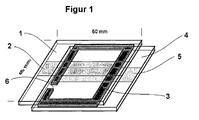
- Two ITO coated glass plates (50x45 mm 2 ) were taped on the ITO coated side with an adhesive tape strip (Tesapack 124 from Beiersdorf, Hamburg), which was approx. 7 mm wide, in the middle across the entire width of the plate.
- the glass plates prepared in this way were placed in an aqueous bath containing 47.5% concentrated hydrochloric acid and 5% iron (III) chloride, which had been heated to approximately 40.degree. After 10 minutes, the glass plates were removed and rinsed with distilled water. The tape was removed. In this way two glass plates (1) and (4) were obtained, which only carried a 50x7 mm 2 ITO strip (2) and (5).
- the cell was then placed under a nitrogen atmosphere with the opening (6) downwards vertically in a dish which contained a solution containing 0.02 molar of the electrochromic compound of the formula and 0.02 molar of the electrochromic compound of the formula and finally 0.2 molar of UV absorber of the formula in anhydrous, oxygen-free N-methylpryrrolidone.
- the opening (6) of the cell was located below the liquid level in the bowl.
- the bowl with the cell was placed in a desiccator. This was evacuated to 0.05 mbar and then carefully aerated with nitrogen. During the aeration, the electrochromic solution rose into the cell and filled the entire volume apart from a small bubble.
- the cell was removed from the solution, cleaned under a nitrogen atmosphere at the opening (6) by cleaning it with a paper towel, and then with the photo-curing epoxy adhesive DELO-Katiobond® 4594, DELO industrial adhesive, Landsberg, thickened with 2% silica gel aerosil , locked. Finally, exposure to daylight near a window was carried out for 10 minutes and curing at room temperature overnight.
- a cell was made as described in Example 2, but a solution was used instead of the electrochromic compound of the formula the electrochromic compound of the formula (also 0.02 molar) contained.
- the cell 2 according to the invention shows a signal even during long operation sharp image of the switched segment and a quick deletion after Turn off the power and short circuit.
- Example 2 As in Example 2, a cell was built which contained a solution containing 0.002 molar of the electrochromic compound of the formula and 0.002 molar of the electrochromic compound of the formula in anhydrous, oxygen-free N-methylpryrrolidone.
- a cell was built analogously to Example 4, but instead of the electrochromic compound of the formula 0.002 molar of the electrochromic compound of the formula was.
- the cell 4 according to the invention shows a sharp edge even during prolonged operation Image of the switched segment and a quick deletion after switching off of current and short circuit.
Landscapes
- Chemical & Material Sciences (AREA)
- Physics & Mathematics (AREA)
- Nonlinear Science (AREA)
- Chemical Kinetics & Catalysis (AREA)
- General Physics & Mathematics (AREA)
- Optics & Photonics (AREA)
- Engineering & Computer Science (AREA)
- Materials Engineering (AREA)
- Organic Chemistry (AREA)
- Electrochromic Elements, Electrophoresis, Or Variable Reflection Or Absorption Elements (AREA)
- Pyridine Compounds (AREA)
Abstract
worin
- n und m
- unabhängig voneinander eine ganze Zahl von 2 bis 4 bedeuten,
Description
- Typ 1:
- vollflächige elektrochrome Vorrichtung
- Typ 2:
- elektrochrome Anzeigevorrichtungen mit strukturierten Elektroden
- Bauweise a:
- Die elektrochromen Substanzen liegen als Film oder Schicht fest auf den Elektroden (vgl. Ullmann, s.o.).
- Bauweise b:
- Die elektrochromen Substanzen werden beim Redoxprozeß auf den Elektroden als Schicht abgeschieden (vgl. Ullmann, s.o.).
- Bauweise c:
- Die elektrochromen Substanzen bleiben permanent in Lösung.

worin
- n und m
- unabhängig voneinander eine ganze Zahl von 2 bis 4 bedeuten,
worin
- n und m
- unabhängig voneinander eine ganze Zahl von 2 bis 4 bedeuten.


- R2 bis R5, R8 und R9
- unabhängig voneinander C1- bis C18-Alkyl, C2- bis C12-Alkenyl, C4- bis C7-Cycloalkyl, C7- bis C15-Aralkyl oder C6-bis C10-Aryl bedeuten oder
- R4; R5 bzw. R8; R9
- gemeinsam eine -(CH2)2- oder -(CH2)3-Brücke bilden können,
- R6 und R7
- unabhängig voneinander Wasserstoff, C1- bis C4-Alkyl, C1- bis C4-Alkoxy, Halogen, Cyan, Nitro oder C1- bis C4-Alkoxycarbonyl bedeuten,
- R10; R11, R10; R13, R12; R13 und R14; R15
- unabhängig voneinander Wasserstoff oder paarweise eine -(CH2)2-, -(CH2)3- oder -CH=CH-Brücke bedeuten,
- R69 bis R74, R80 und R81
- unabhängig voneinander Wasserstoff oder C1- bis C6-Alkyl bedeuten und
- R69 bis R74
- unabhängig voneinander zusätzlich Aryl bedeuten oder
- R69; R12, R70; R13, R73; R80 und/oder R74; R81
- gemeinsam eine -CH=CH-CH=CH-Brücke bilden,
- E1 und E2
- unabhängig voneinander O, S, NR1 oder C(CH3)2 bedeuten oder
- E1 und E2
- gemeinsam eine -N-(CH2)2-N-Brücke bilden,
- R1
- C1- bis C18-Alkyl, C2- bis C12-Alkenyl, C4- bis C7-Cycloalkyl, C7- bis C15-Aralkyl, C6- bis C10-Aryl bedeutet,
- Z1
- eine direkte Bindung, -CH=CH-, -C(CH3)=CH-, -C(CN)=CH-, -CCl=CCl-, -C(OH)=CH-, -CCl=CH-, -C≡C-, -CH=N-N=CH-, -C(CH3)=N-N=C(CH3)-, -CCl=N-N=CCl- oder -C6H4- bedeutet,
- Z2
- -(CH2)r- oder -CH2-C6H4-CH2- bedeutet,
- r
- eine ganze Zahl von 1 bis 10 bedeutet und
- X-
- ein unter den Bedingungen redox-inertes Anion bedeutet.
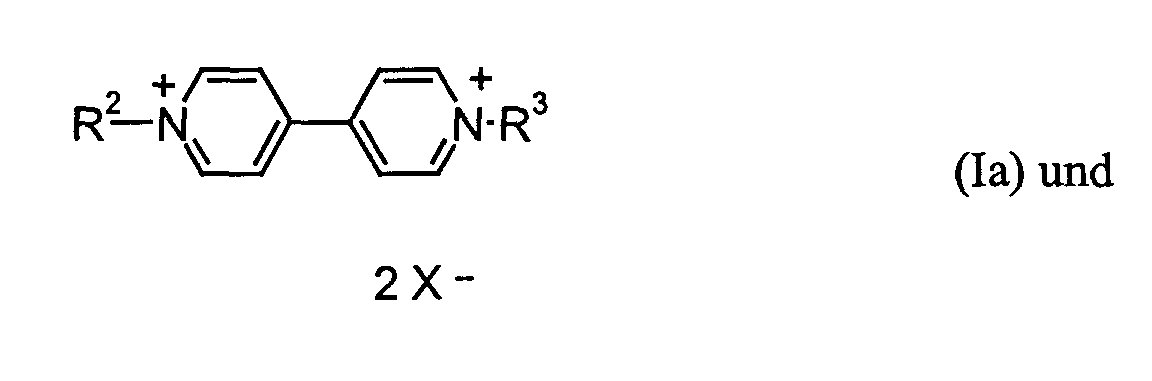

- R2 und R3
- C1- bis C12-Alkyl, C7- bis C12-Aralkyl oder C6- bis C10-Aryl bedeuten,
- Z2
- -(CH2)3-, -(CH2)4-, -(CH2)5- oder -CH2-C6H4-CH2- bedeutet und
- X-
- ein Anion bedeutet.
- R2 und R3
- für Methyl, Ethyl, Propyl, Butyl, Heptyl, 2-Ethyl-hexyl, Benzyl, Phenethyl oder Phenylpropyl und
- Z2
- für -(CH2)3-, -(CH2)4- oder o-(-CH2-C6H4-CH2-).
- X-
- kann aber auch ein Äquivalent von RED1 m- bedeuten.


- RED1'
- den m-wertigen Rest einer reversibel oxidierbaren elektrochromen Verbindung bedeutet,
- P
- eine Brücke bedeutet,
- Y-
- eine anionische Gruppierung bedeutet,
- M+
- ein Kation bedeutet und
- m
- eine ganze Zahl von 2 bis 4, vorzugsweise 2 bedeutet.


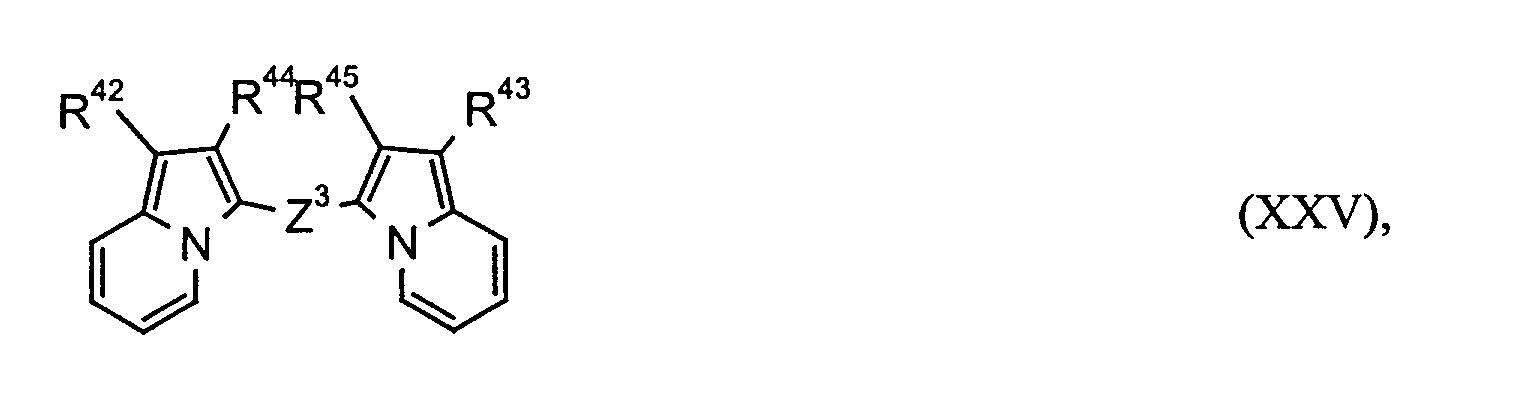

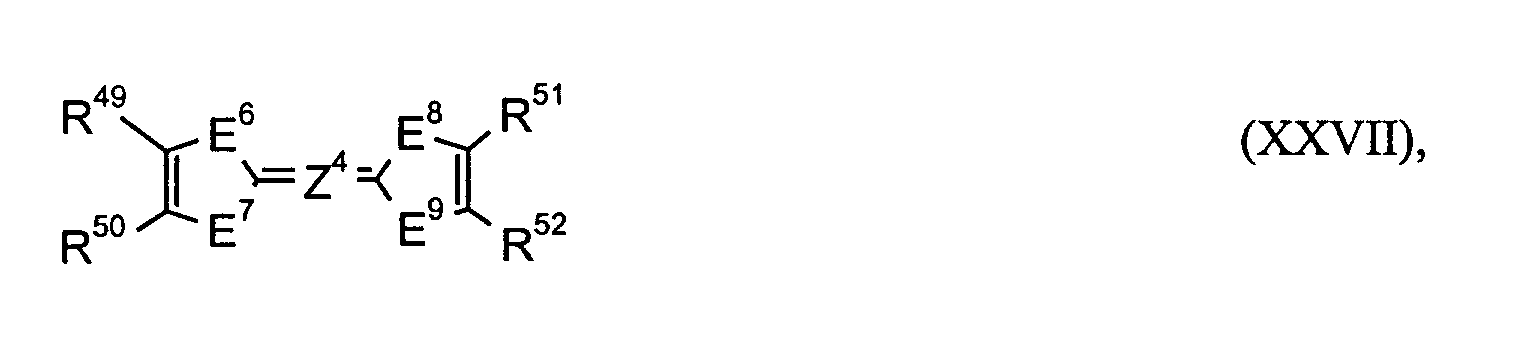


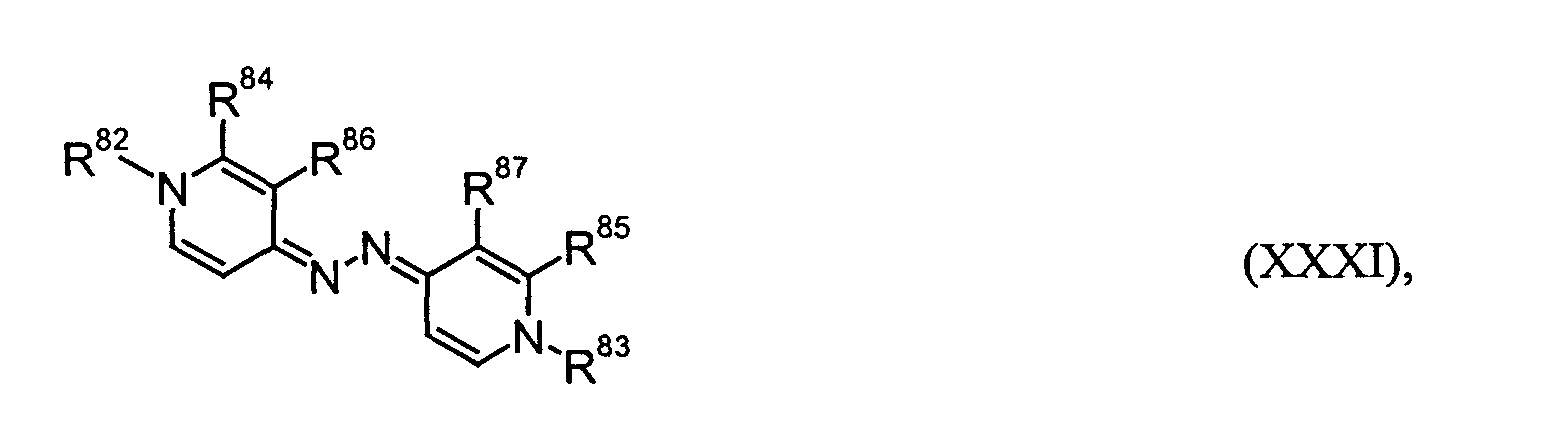


- R28 bis R31, R34, R35, R38, R39, R46, R53 und R54
- unabhängig voneinander C1- bis C18-Alkyl, C2- bis C12-Alkenyl, C4- bis C7-Cycloalkyl, C7- bis C15-Aralkyl oder C6- bis C10-Aryl bedeuten,
- R32, R33, R36, R37, R40, R41, R42 bis R45, R47, R48, R49 bis R52, R55 bis R58 und R97 bis R100
- unabhängig voneinander Wasserstoff, C1- bis C4-Alkyl, C1- bis C4-Alkoxy, Halogen, Cyan, Nitro, C1- bis C4-Alkoxycarbonyl, C6- bis C10-Aryl oder C6- bis C10-Aryloxy bedeuten
- R57 und R58
- zusätzlich einen aromatischen oder quasiaromatischen fünf- oder sechsgliedrigen heterocyclischen Ring, der gegebenenfalls benzanneliert ist, bedeuten und R48 zusätzlich NR75R76 bedeutet oder
- R49; R50, R51; R52 und/oder R48; R97 oder R48; R99, R97; R98 oder R98; R100
- unabhängig voneinander eine -(CH2)3-, -(CH2)4-, -(CH2)5- oder -CH=CH-CH=CH-Brücke bilden,
- Z3
- eine direkte Bindung, eine -CH=CH- oder -N=N-Brücke bedeutet,
- =Z4=
- eine direkte Doppelbindung, eine =CH-CH= oder =N-N=-Brücke bedeutet,
- E3 bis E5, E10 und E11
- unabhängig voneinander O, S, NR59 oder C(CH3)2 bedeuten und
- E5
- zusätzlich C=O oder SO2 bedeutet,
- E3 und E4
- unabhängig voneinander zusätzlich -CH=CH- bedeuten können,
- E6 bis E9
- unabhängig voneinander S, Se oder NR59 bedeuten,
- R59, R75 und R76
- unabhängig voneinander C1- bis C12-Alkyl, C2- bis C8-Alkenyl, C4-bis C7-Cycloalkyl, C7- bis C15-Aralkyl, C6- bis C10-Aryl bedeuten,
- R75
- zusätzlich Wasserstoff bedeutet oder R75 und R76 in der Bedeutung von NR75R76 gemeinsam mit dem N-Atom, an das sie gebunden sind, einen fünfoder sechsgliedrigen Ring bedeuten, der gegebenenfalls weitere Heteroatome enthält,
- R61 bis R68
- unabhängig voneinander Wasserstoff, C1- bis C6-Alkyl, C1- bis C4-Alkoxy, Cyan, C1- bis C4-Alkoxycarbonyl oder C6- bis C10-Aryl bedeuten und
- R61; R62 und R67; R68
- unabhängig voneinander zusätzlich eine -(CH2)3-, -(CH2)4- oder -CH=CH-CH=CH-Brücke bilden oder
- R62; R63, R64; R65 und R66; R67
- eine -O-CH2CH2-O- oder -O-CH2CH2CH2-O-Brücke bilden,
- v
- eine ganze Zahl zwischen 0 und 100 bedeutet,
- R82, R83, R88 und R89
- unabhängig voneinander C1- bis C18-Alkyl, C2- bis C12-Alkenyl, C4- bis C7-Cycloalkyl, C7- bis C15-Aralkyl oder C6- bis C10-Aryl bedeuten,
- R84 bis R87 und R90 bis R93
- unabhängig voneinander Wasserstoff oder C1- bis C6-Alkyl bedeuten oder
- R84; R86, R85; R87, R90; R92 und/oder R91; R93
- gemeinsam eine -CH=CH-CH=CH-Brücke bilden.

worin
- Z
- für eine Brücke steht, beispielsweise für -O-C(R101R102)-O-, -N(R103)-CO-N(R104)-, -N(R103)-SO2-N(R104)- steht,
- R101 bis R104
- unabhängig voneinander für Alkyl oder Aryl stehen.
- Y-
- steht besonders bevorzugt für SO3 -.

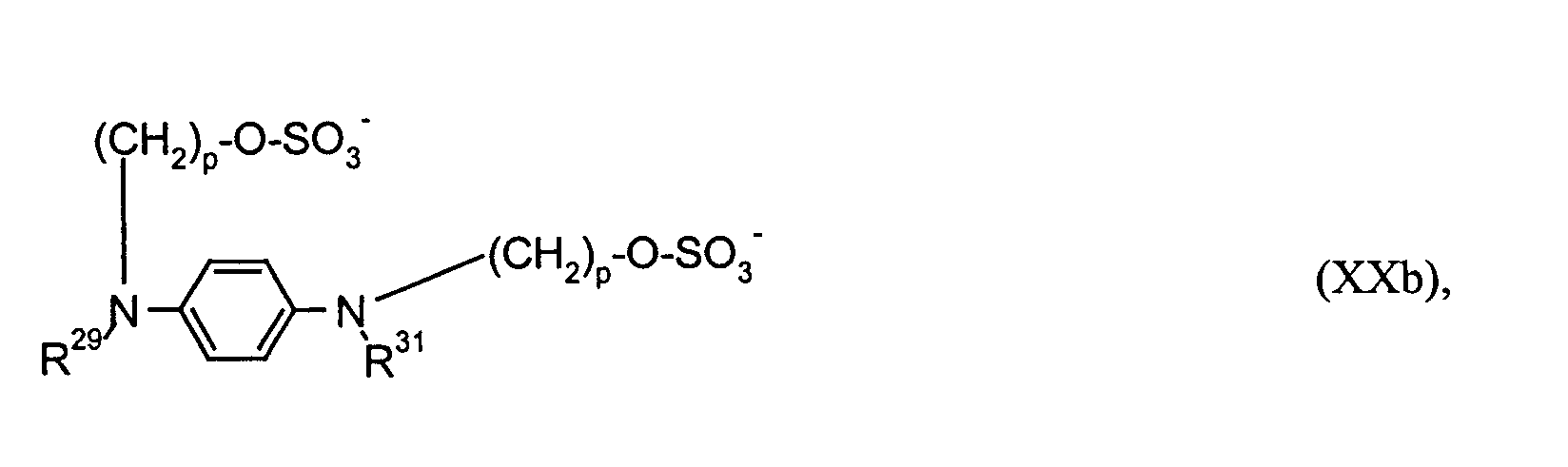

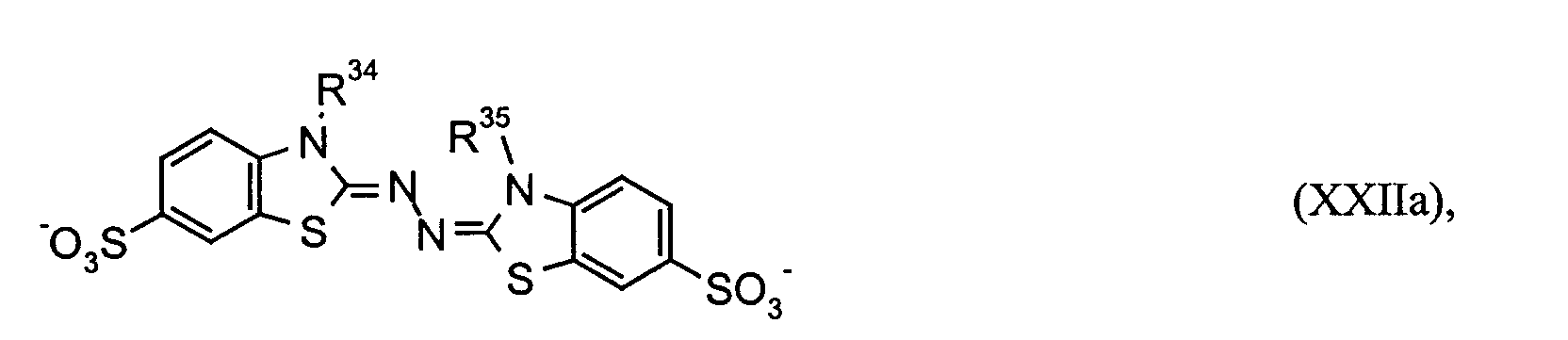
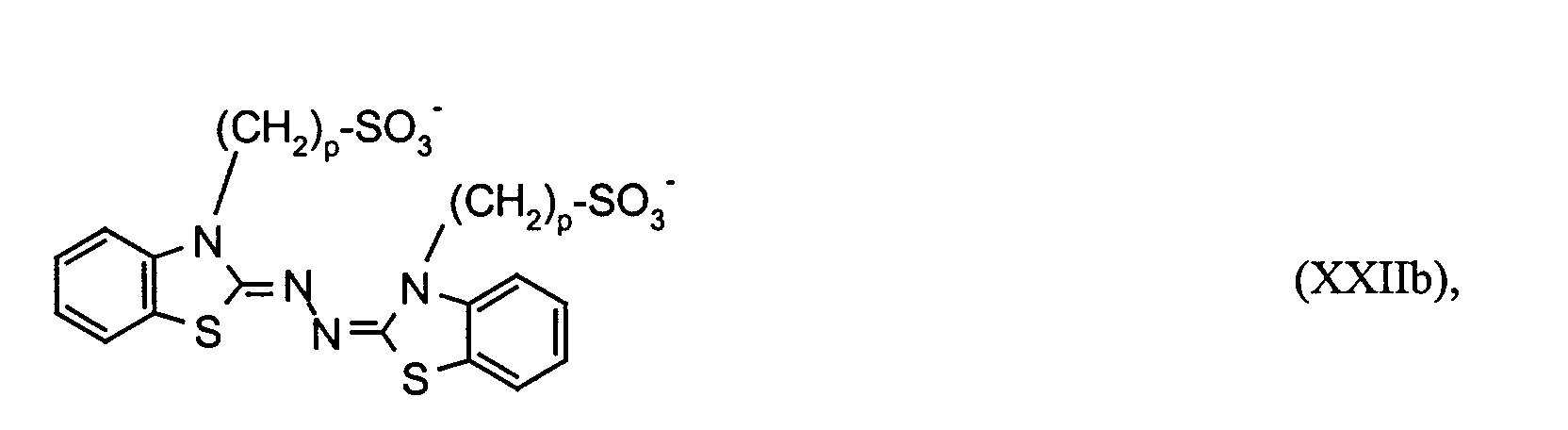

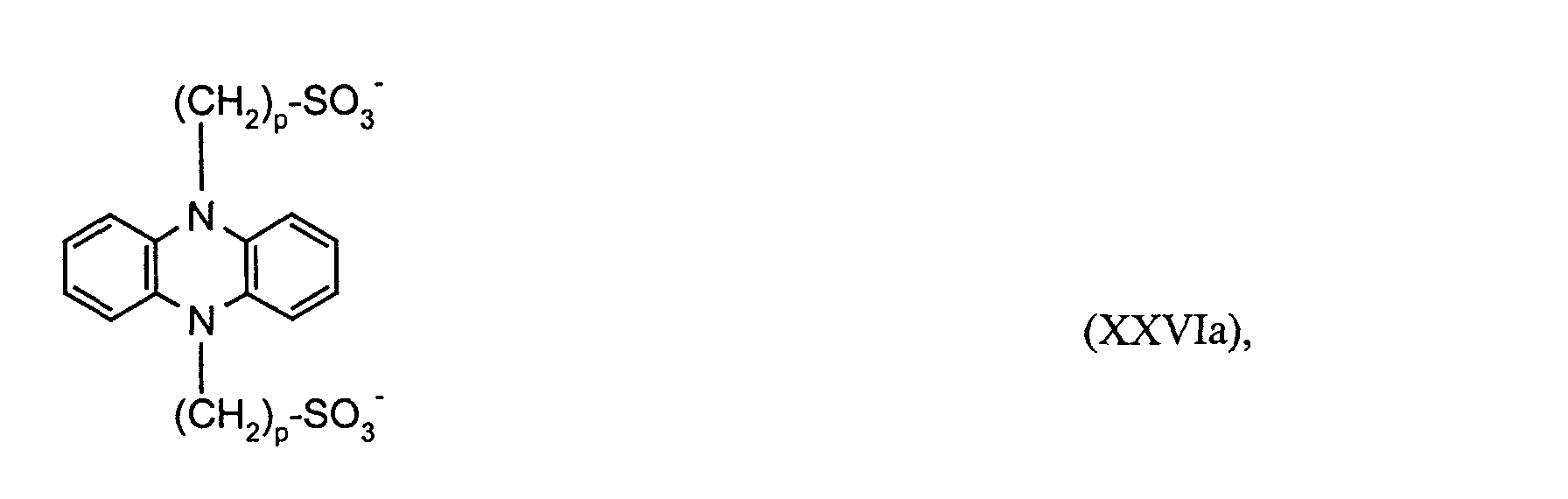


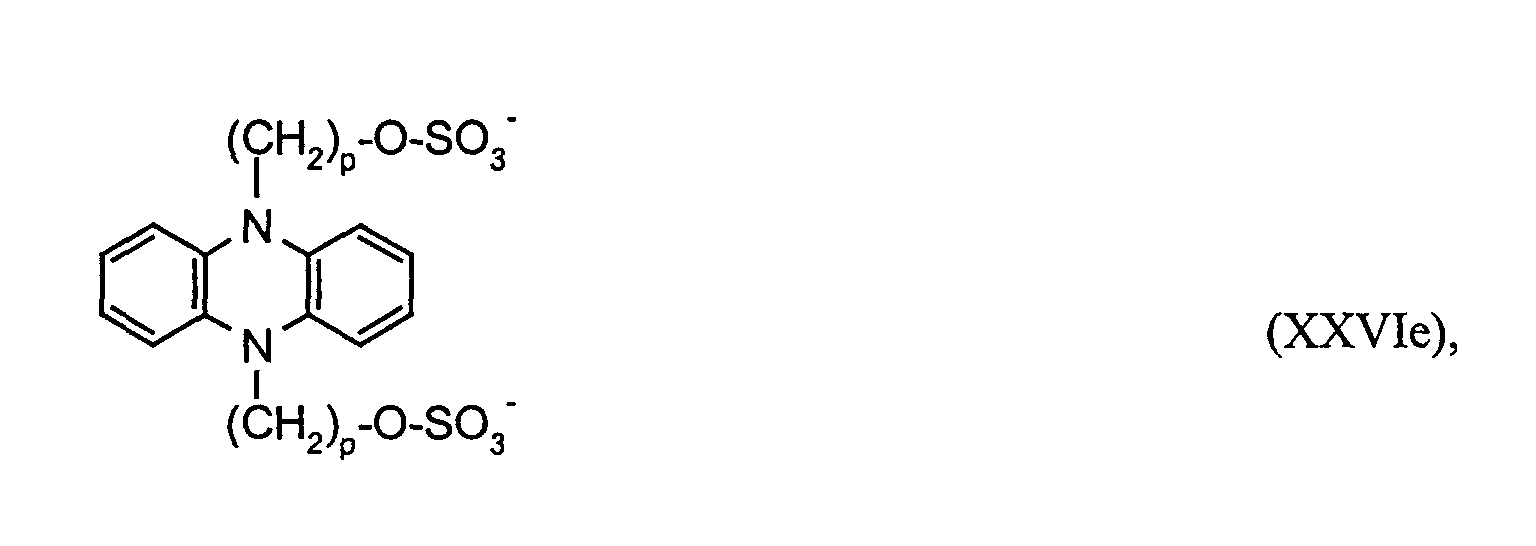
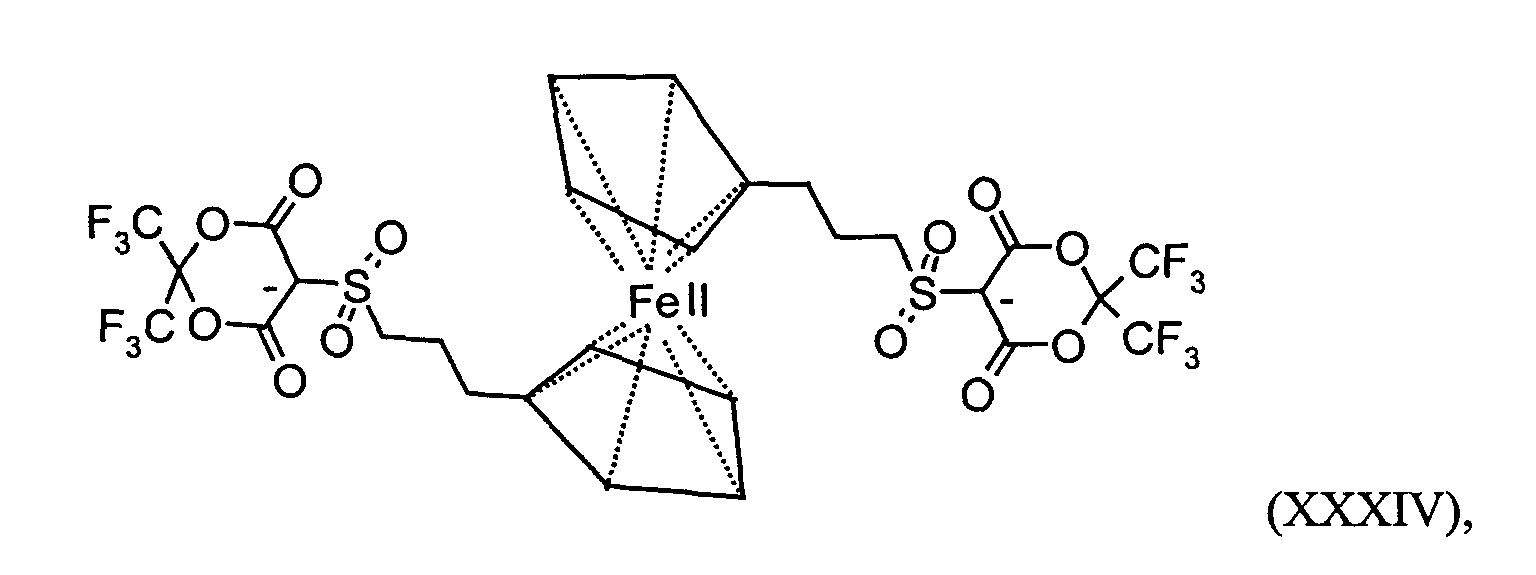
p, R28, R29, R31, R34 und R35 die oben angegebene Bedeutung besitzen.

- OX2n+ und RED1m-
- eine der oben angegebenen allgemeinen oder bevorzugten oder besonders bevorzugten Bedeutungen besitzen.

- RED1', P, Y- und OX2n+
- die oben angegebenen Bedeutungen besitzen und m und n 2 bedeuten.


- RED1', P, Y-, m und M+
- die oben angegebene allgemeine, bevorzugte und besonders bevorzugte Bedeutung besitzen.

- m und n
- gleich sind, bevorzugt jeweils 2 bedeuten, und
- OX2n+ und RED1m-
- eine der oben angegebenen allgemeinen oder bevorzugten oder besonders bevorzugten Bedeutungen besitzen.
wobei
- F
- für eine Abgangsgruppe steht und
- P und Y-
- die oben angegebene Bedeutung besitzen.
- F
- steht beispielsweise für Cl, Br, I, OSO2CH3.

- MS (ESI):
- m/e = 475 (M2-+Na+), 452 (M-), 226 (M2-) mit M2- = dem Dianion der oben stehenden Formel.


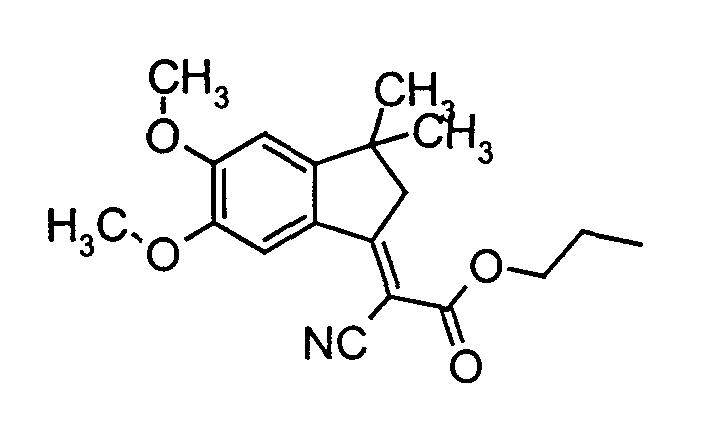

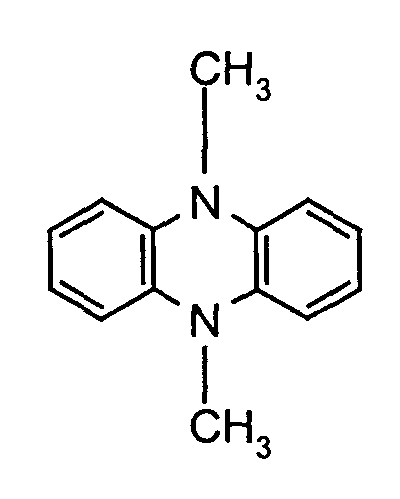
- Zelle gemäß Beispiel 2:
- Der blaustichig grüne Streifen blieb nach 20 min und 2 h Betrieb randscharf, und die Zellenteile außerhalb blieben ungefärbt. Nach Abklemmen der Spannung und Kurzschließen war der Streifen nach 20 s entfärbt.
- Zelle gemäß Beispiel 3:
- Seitlich des blaustichig grünen Streifens zeigte sich beidseitig bereits nach 20 min Betrieb eine grünlich gelbe Zone. Nach 2 h Betrieb war der gesamte Teil der Zelle außerhalb des Streifens grünlich gelb gefärbt. Der Streifen selbst zeigte nun eine grünlich blaue Färbung. Nach Abklemmen der Spannung und Kurzschließen dauerte die komplette Entfärbung des Streifens nach 20 min Betrieb 5 min, nach 2 h Betrieb bereits 15 min.


- Zelle gemäß Beispiel 4:
- Der blaue Streifen blieb nach 20 min und 2 h Betrieb randscharf, und die Zellenteile außerhalb blieben ungefärbt. Nach Abklemmen der Spannung und Kurzschließen war der Streifen nach 20 s entfärbt.
- Zelle gemäß Beispiel 5:
- Seitlich des blauen Streifens zeigte sich beidseitig bereits nach 20 min Betrieb eine schwach grünlich gelbe Zone. Nach 2 h Betrieb war der gesamte Teil der Zelle außerhalb des Streifens schwach grünlich gelb gefärbt. Nach Abklemmen der Spannung und Kurzschließen dauerte die komplette Entfärbung des Streifens nach 20 min Betrieb 5 min, nach 2 h Betrieb bereits 15 min.
Claims (10)
- Elektrochrome Vorrichtung, enthaltend ein Paar Glas- oder Kunststoffplatten oder Kunststoffolien, von denen mindestens eine Platte oder Folie, vorzugsweise beide Platten oder Folien auf jeweils einer Seite mit einer elektrisch leitfähigen Beschichtung versehen sind, von denen wenigstens eine Platte oder Folie und ihre leitfähige Beschichtung transparent sind, von denen die andere verspiegelt sein kann und von denen wenigstens bei einer der beiden Platten oder Folien die elektrisch leitfähige Schicht in getrennte, einzeln kontaktierte Flächensegmente aufgeteilt sein kann, wobei die Platten oder Folien über einen Dichtungsring auf den Seiten ihrer leitfähigen Beschichtung zusammengefügt sind, und das Volumen, gebildet aus den beiden Platten oder Folien und dem Dichtungsring, mit einem elektrochromen Medium gefüllt ist, dadurch gekennzeichnet, dass das elektrochrome Medium ein Paar elektrochromer Substanzen OX2 n+ und RED1 m- enthält,
worin- n und m
- unabhängig voneinander eine ganze Zahl von 2 bis 4 bedeuten.
- Elektrochrome Vorrichtung gemäß Anspruch 1, dadurch gekennzeichnet, dass wenigstens bei einer der beiden Platten oder Folien die elektrisch leitfähige Schicht in getrennte, einzeln kontaktierte Flächensegmente aufgeteilt ist.
- Elektrochrome Vorrichtung gemäß einem der Ansprüche 1 oder 2, dadurch gekennzeichnet, dass n und m 2 bedeuten.
- Elektrochrome Vorrichtung gemäß einem oder mehrerer der Ansprüche 1 bis 3, dadurch gekennzeichnet, dass als elektrochrome Substanzen der Formel OX2 n+ solche der Formeln


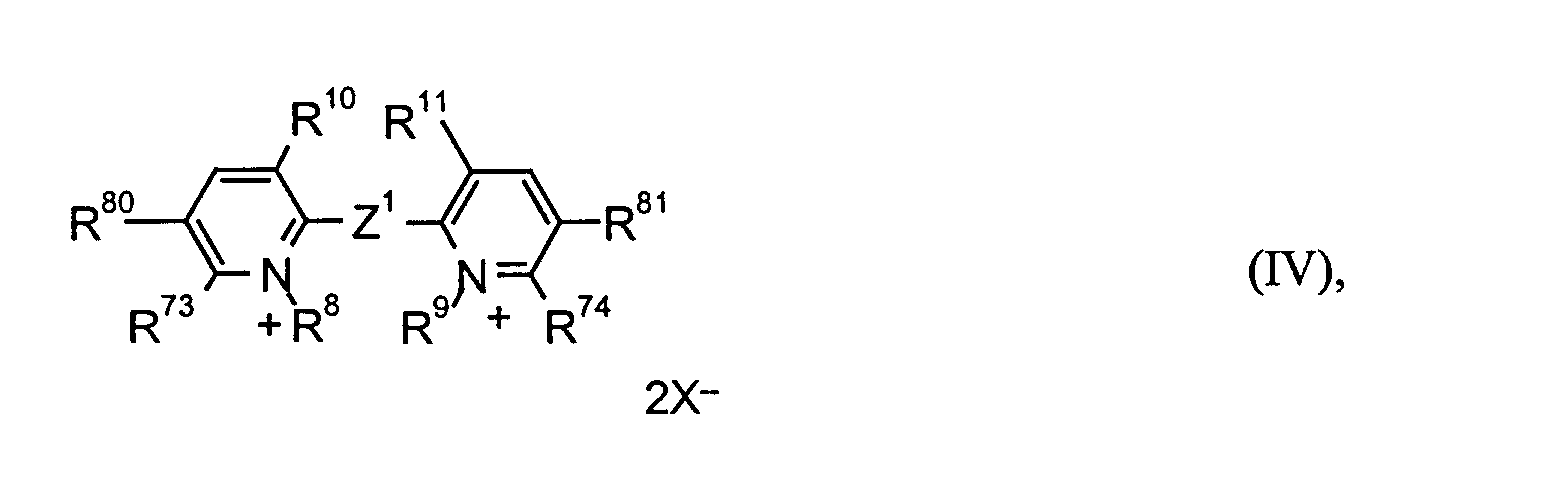 worin
worin
- R2 bis R5, R8 und R9
- unabhängig voneinander C1- bis C18-Alkyl, C2- bis C12-Alkenyl, C4- bis C7-Cycloalkyl, C7- bis C15-Aralkyl oder C6- bis C10-Aryl bedeuten oder
- R4; R5 bzw. R8; R9
- gemeinsam eine -(CH2)2- oder -(CH2)3-Brücke bilden können,
- R6 und R7
- unabhängig voneinander Wasserstoff, C1- bis C4-Alkyl, C1- bis C4-Alkoxy, Halogen, Cyan, Nitro oder C1- bis C4-Alkoxycarbonyl bedeuten,
- R10; R11, R10; R13, R12; R13 und R14; R15
- unabhängig voneinander Wasserstoff oder paarweise eine -(CH2)2-, -(CH2)3- oder -CH=CH-Brücke bedeuten,
- R69 bis R74, R80 und R81
- unabhängig voneinander Wasserstoff oder C1- bis C6-Alkyl bedeuten und
- R69 bis R74
- unabhängig voneinander zusätzlich Aryl bedeuten oder
- R69; R12, R70; R13, R73; R80 und/oder R74; R81
- gemeinsam eine -CH=CH-CH=CH-Brücke bilden,
- E1 und E2
- unabhängig voneinander O, S, NR1 oder C(CH3)2 bedeuten oder
- E1 und E2
- gemeinsam eine -N-(CH2)2-N-Brücke bilden,
- R1
- C1- bis C18-Alkyl, C2- bis C12-Alkenyl, C4- bis C7-Cycloalkyl, C7- bis C15-Aralkyl, C6- bis C10-Aryl bedeutet,
- Z1
- eine direkte Bindung, -CH=CH-, -C(CH3)=CH-, -C(CN)=CH-,-CCl=CCl-, -C(OH)=CH-, -CCL=CH-, -C≡C-, -CH=N-N=CH-, -C(CH3)=N-N=C(CH3)-, -CCI=N-N=CCI- oder -C6H4- bedeutet,
- Z2
- -(CH2)r- oder -CH2-C6H4-CH2- bedeutet,
- r
- eine ganze Zahl von 1 bis 10 bedeutet und
- X-
- ein unter den Bedingungen redox-inertes Anion bedeutet,
- Elektrochrome Vorrichtung gemäß einem oder mehrerer der Ansprüche 1 bis 3, dadurch gekennzeichnet, dass als elektrochrome Substanzen der Formel RED1 m- solche der Formelnworin

- RED1'
- den m-wertigen Rest einer reversibel oxidierbaren elektrochromen Verbindung bedeutet,
- P
- eine Brücke bedeutet,
- Y-
- eine anionische Gruppierung bedeutet,
- M+
- ein Kation bedeutet und
- m
- eine ganze Zahl von 2 bis 4, vorzugsweise 2 bedeutet,
- Elektrochrome Vorrichtung gemäß Anspruch 5, dadurch gekennzeichnet, dass
- P
- eine direkte Bindung, -(CH2)p- oder -C6H4- bedeutet,
- p
- eine ganze Zahl von 1 bis 12 bedeutet,
- Y-
- SO3 -, OSO3 -, COO-, PO3 -, OPO2 - oder für einen Rest der Formel
oder einer mesomeren Form davon bedeutet,
worin- Z
- für eine Brücke steht, beispielsweise für ―O-C(R101R102)-O-, -N(R103)-CO-N(R104)-, -N(R103)-SO2-N(R104)- steht,
- R101 bis R104
- unabhängig voneinander für Alkyl oder Aryl stehen und
- M+
- ein Ion eines Alkalimetalls, ein Ammoniumion oder für ein Äquivalent von OX2 m+ bedeutet.
- Elektrochrome Vorrichtung gemäß Anspruch 5 oder 6, dadurch gekennzeichnet, dass
RED1` einen Rest der Formeln


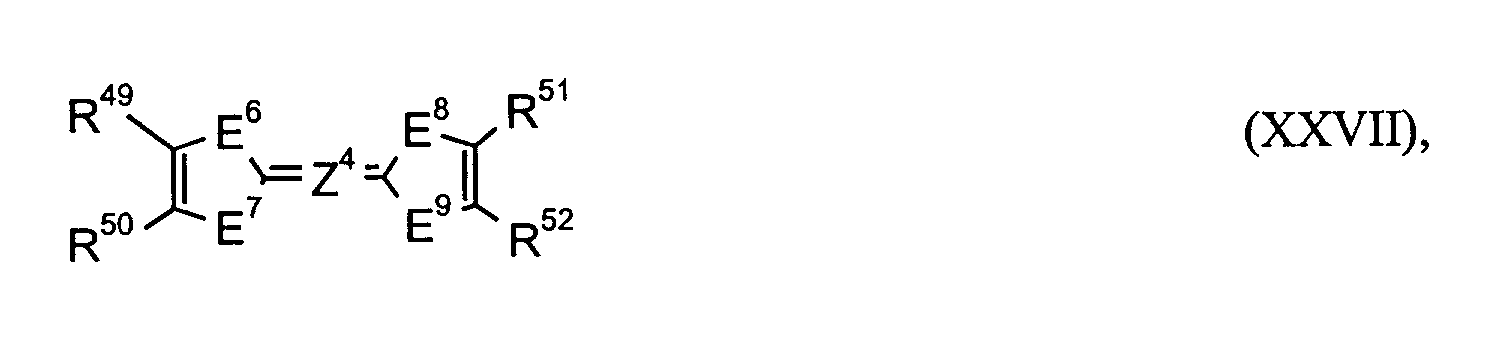


 oder Ferrocen
bedeutet,
worin- R28 bis R31, R34, R35, R38, R39, R46, R53 und R54
- unabhängig voneinander C1-bis C18-Alkyl, C2- bis C12-Alkenyl, C4- bis C7-Cycloalkyl, C7- bis C15-Aralkyl oder C6- bis C10-Aryl bedeuten,
- R32, R33 R36, R37, R40, R41, R42 bis R45, R47, R48, R49 bis R52, R55 bis R58 und R97 bis R100
- unabhängig voneinander Wasserstoff, C1- bis C4-Alkyl, C1- bis C4-Alkoxy, Halogen, Cyan, Nitro, C1- bis C4-Alkoxycarbonyl, C6- bis C10-Aryl oder C6- bis C10-Aryloxy bedeuten
- R57 und R58
- zusätzlich einen aromatischen oder quasiaromatischen fünf- oder sechsgliedrigen heterocyclischen Ring, der gegebenenfalls benzanneliert ist, bedeuten und R48 zusätzlich NR75R76 bedeutet oder
- R49; R50, R51; R52 und/oder R48; R97 oder R48; R99, R97; R98 oder R98; R100
- unabhängig voneinander eine -(CH2)3-, -(CH2)4-, -(CH2)5- oder -CH=CH-CH=CH-Brücke bilden,
- Z3
- eine direkte Bindung, eine -CH=CH- oder -N=N-Brücke bedeutet,
- =Z4=
- eine direkte Doppelbindung, eine =CH-CH= oder =N-N=-Brücke bedeutet,
- E3 bis E5, E10 und E11
- unabhängig voneinander O, S, NR59 oder C(CH3)2 bedeuten und
- E5
- zusätzlich C=O oder SO2 bedeutet,
- E3 und E4
- unabhängig voneinander zusätzlich -CH=CH- bedeuten können,
- E6 bis E9
- unabhängig voneinander S, Se oder NR59 bedeuten,
- R59, R75 und R76
- unabhängig voneinander C1- bis C12-Alkyl, C2- bis C8-Alkenyl, C4- bis C7-Cycloalkyl, C7- bis C15-Aralkyl, C6-bis C10-Aryl bedeuten,
- R75
- zusätzlich Wasserstoff bedeutet oder R75 und R76 in der Bedeutung von NR75R76 gemeinsam mit dem N-Atom, an das sie gebunden sind, einen fünf- oder sechsgliedrigen Ring bedeuten, der gegebenenfalls weitere Heteroatome enthält,
- R61 bis R68
- unabhängig voneinander Wasserstoff, C1- bis C6-Alkyl, C1- bis C4-Alkoxy, Cyan, C1- bis C4-Alkoxycarbonyl oder C6- bis C10-Aryl bedeuten und
- R61; R62 und R67; R68
- unabhängig voneinander zusätzlich eine -(CH2)3-, -(CH2)4- oder -CH=CH-CH=CH-Brücke bilden oder
- R62; R63, R64; R65 und R66; R67
- eine -O-CH2CH2-O- oder -O-CH2CH2CH2-O-Brücke bilden,
- v
- eine ganze Zahl zwischen 0 und 100 bedeutet,
- R82, R83, R88 und R89
- unabhängig voneinander C1- bis C18-Alkyl, C2- bis C12-Alkenyl, C4- bis C7-Cycloalkyl, C7- bis C15-Aralkyl oder C6- bis C10-Aryl bedeuten,
- R84 bis R87 und R90 bis R93
- unabhängig voneinander Wasserstoff oder C1- bis C6-Alkyl bedeuten oder
- R84; R86, R85; R87, R90; R92 und/oder R91; R93
- gemeinsam eine -CH=CH-CH=CH-Brücke bilden und
- Elektrochrome Vorrichtung gemäß einem oder mehrerer der Ansprüche 1 bis 7, dadurch gekennzeichnet, dass sie in dem elektrochromen Medium eine elektrochrome Substanz der Formel OX2 2+ RED1 2- enthält.
- Elektrochrome Substanzen der Formelworin

- RED1', P, Y-, m und M+
- die in den Ansprüchen 5, 6 und 7 angegebene Bedeutung besitzen und die Verbindungen der Formeln

 worin
worin
R34 und R35 Ethyl bedeuten,
ausgenommen sind. - Elektrochrome Substanzen der Formelworin
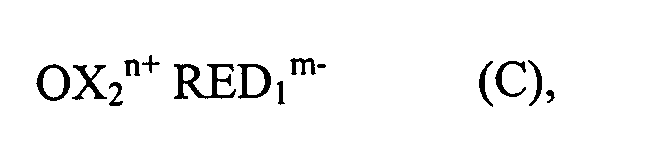
- RED1m- und OX2n+
- die in den Ansprüchen 4 bis 7 angegebene Bedeutung besitzen und
- m und n
- 2 bedeuten.
Applications Claiming Priority (2)
| Application Number | Priority Date | Filing Date | Title |
|---|---|---|---|
| DE10023744A DE10023744A1 (de) | 2000-05-15 | 2000-05-15 | Elektrochrome Anzeigevorrichtung mit hoher Kantenschärfe |
| DE10023744 | 2000-05-15 |
Publications (2)
| Publication Number | Publication Date |
|---|---|
| EP1156098A2 true EP1156098A2 (de) | 2001-11-21 |
| EP1156098A3 EP1156098A3 (de) | 2002-01-09 |
Family
ID=7642103
Family Applications (1)
| Application Number | Title | Priority Date | Filing Date |
|---|---|---|---|
| EP01110171A Withdrawn EP1156098A3 (de) | 2000-05-15 | 2001-05-07 | Elektrochrome Anzeigevorrichtung mit hoher Kantenschärfe |
Country Status (4)
| Country | Link |
|---|---|
| US (1) | US20020027700A1 (de) |
| EP (1) | EP1156098A3 (de) |
| JP (1) | JP2002049061A (de) |
| DE (1) | DE10023744A1 (de) |
Cited By (6)
| Publication number | Priority date | Publication date | Assignee | Title |
|---|---|---|---|---|
| WO2010136267A1 (de) * | 2009-05-29 | 2010-12-02 | Siemens Aktiengesellschaft | Elektrochrome formulierung, herstellungsverfahren dazu und elektrochromes organisches bauelement |
| WO2010136314A1 (de) | 2009-05-29 | 2010-12-02 | Siemens Aktiengesellschaft | Elektrochrome formulierung, herstellungsverfahren dazu und elektrochromes organisches bauelement |
| EP2848668A1 (de) * | 2013-09-17 | 2015-03-18 | ESSILOR INTERNATIONAL (Compagnie Générale d'Optique) | Elektrochrome zweikernige Viologenderivate und optische Artikel damit |
| US9785030B2 (en) | 2013-09-17 | 2017-10-10 | Essilor International (Compagnie Generale D'optique) | Electrochromic composition |
| US9823534B2 (en) | 2013-09-17 | 2017-11-21 | Essilor International (Compagnie Generale D'optique) | Electrochromic single and two-core viologens and optical articles containing them |
| US9841652B2 (en) | 2013-09-17 | 2017-12-12 | Essilor International (Compagnie Generale D'optique) | Electrochromic composition |
Families Citing this family (8)
| Publication number | Priority date | Publication date | Assignee | Title |
|---|---|---|---|---|
| DE19905797A1 (de) * | 1999-02-12 | 2000-08-17 | Bayer Ag | Elektrochrome Vorrichtung mit Nanoteilchen und UV-Absorber in der Schutzschicht |
| WO2005062110A1 (en) | 2003-12-22 | 2005-07-07 | Lg Chem, Ltd. | Electrochromic material with improved lifetime |
| CN101069124B (zh) * | 2004-11-15 | 2013-10-16 | 金泰克斯公司 | 电致变色化合物和相关介质与器件 |
| JP4700385B2 (ja) * | 2005-03-25 | 2011-06-15 | 株式会社リコー | エレクトロクロミック表示素子 |
| US7619803B2 (en) | 2005-05-31 | 2009-11-17 | Konica Minolta Holdings, Inc. | Electrochromic display element and full-color electrochromic display element |
| KR100851640B1 (ko) * | 2007-01-26 | 2008-08-13 | 엘지전자 주식회사 | 후드 겸용 전자레인지의 도어 |
| CN108997427B (zh) * | 2018-08-01 | 2021-06-15 | 南方科技大学 | 电致变色化合物、用途以及其制备的电致变色器件和用途 |
| EP4098946B1 (de) * | 2020-01-30 | 2026-03-11 | Sharp Kabushiki Kaisha | Heizungsherd |
Family Cites Families (3)
| Publication number | Priority date | Publication date | Assignee | Title |
|---|---|---|---|---|
| US5239405A (en) * | 1991-09-06 | 1993-08-24 | Donnelly Corporation | Electrochemichromic solutions, processes for preparing and using the same, and devices manufactured with the same |
| JP4823401B2 (ja) * | 1996-12-30 | 2011-11-24 | イドロ―ケベック | 過フッ化アミド塩及びイオン伝導物質としてのその使用方法 |
| ES2232177T3 (es) * | 1998-09-08 | 2005-05-16 | Bayer Innovation Gmbh | Dispositivo electrocromico con filtro amarillo. |
-
2000
- 2000-05-15 DE DE10023744A patent/DE10023744A1/de active Pending
-
2001
- 2001-05-07 EP EP01110171A patent/EP1156098A3/de not_active Withdrawn
- 2001-05-10 US US09/853,163 patent/US20020027700A1/en not_active Abandoned
- 2001-05-14 JP JP2001143561A patent/JP2002049061A/ja active Pending
Cited By (9)
| Publication number | Priority date | Publication date | Assignee | Title |
|---|---|---|---|---|
| WO2010136267A1 (de) * | 2009-05-29 | 2010-12-02 | Siemens Aktiengesellschaft | Elektrochrome formulierung, herstellungsverfahren dazu und elektrochromes organisches bauelement |
| WO2010136314A1 (de) | 2009-05-29 | 2010-12-02 | Siemens Aktiengesellschaft | Elektrochrome formulierung, herstellungsverfahren dazu und elektrochromes organisches bauelement |
| EP2848668A1 (de) * | 2013-09-17 | 2015-03-18 | ESSILOR INTERNATIONAL (Compagnie Générale d'Optique) | Elektrochrome zweikernige Viologenderivate und optische Artikel damit |
| WO2015040031A1 (en) * | 2013-09-17 | 2015-03-26 | Essilor International (Compagnie Generale D'optique) | Electrochromic two-core viologen derivatives and optical articles containing them |
| JP2016539177A (ja) * | 2013-09-17 | 2016-12-15 | エシロール アンテルナシオナル (コンパニー ジェネラル ドプティック) | エレクトロクロミック性2核ビオロゲン誘導体及びそれらを含有する光学物品 |
| US9785030B2 (en) | 2013-09-17 | 2017-10-10 | Essilor International (Compagnie Generale D'optique) | Electrochromic composition |
| US9823534B2 (en) | 2013-09-17 | 2017-11-21 | Essilor International (Compagnie Generale D'optique) | Electrochromic single and two-core viologens and optical articles containing them |
| US9841652B2 (en) | 2013-09-17 | 2017-12-12 | Essilor International (Compagnie Generale D'optique) | Electrochromic composition |
| US10179768B2 (en) | 2013-09-17 | 2019-01-15 | Essilor International | Electrochromic two-core viologen derivatives and optical articles containing them |
Also Published As
| Publication number | Publication date |
|---|---|
| JP2002049061A (ja) | 2002-02-15 |
| DE10023744A1 (de) | 2001-12-13 |
| US20020027700A1 (en) | 2002-03-07 |
| EP1156098A3 (de) | 2002-01-09 |
Similar Documents
| Publication | Publication Date | Title |
|---|---|---|
| EP0880568B1 (de) | Elektrochromes system | |
| EP0917556B1 (de) | Elektrochrome anzeigevorrichtung | |
| EP1285040B1 (de) | Elektrochrome vorrichtung | |
| EP0917555B1 (de) | Elektrochromes system | |
| EP1116767B1 (de) | Elektrochrome Vorrichtung | |
| EP1027397A1 (de) | Elektrochrome polymersysteme | |
| DE19906655A1 (de) | Elektrochrome Vorrichtung mit verbesserter Lichtechtheit | |
| EP0880567B1 (de) | Elektrochromes system | |
| EP1007602B1 (de) | Uv-geschützte elektrochrome lösung | |
| EP1156098A2 (de) | Elektrochrome Anzeigevorrichtung mit hoher Kantenschärfe | |
| EP1114117B1 (de) | Elektrochrome vorrichtung mit gelbfilter | |
| EP1042427B1 (de) | Uv-geschützte elektrochrome vorrichtung | |
| EP1015524A1 (de) | Elektrochromes system mit gekoppeltem red-ox-system und speziellen anionen | |
| DE10249054A1 (de) | Elektrochrome Vorrichtung und neue elektrochrome Verbindungen | |
| EP1169667B1 (de) | Elektrochrome vorrichtung mit nanoteilchen und uv-absorber in der schutzschicht | |
| DE10148438B4 (de) | Elektrochrome Vorrichtung | |
| DE19840938A1 (de) | Elektrochrome Vorrichtung mit Gelbfilter | |
| DE19801638A1 (de) | Elektrochrome Polymersysteme | |
| DE19920360A1 (de) | Elektrochrome Vorrichtung mit Gelbfilter |
Legal Events
| Date | Code | Title | Description |
|---|---|---|---|
| PUAI | Public reference made under article 153(3) epc to a published international application that has entered the european phase |
Free format text: ORIGINAL CODE: 0009012 |
|
| AK | Designated contracting states |
Kind code of ref document: A2 Designated state(s): AT BE CH CY DE DK ES FI FR GB GR IE IT LI LU MC NL PT SE TR |
|
| AX | Request for extension of the european patent |
Free format text: AL;LT;LV;MK;RO;SI |
|
| PUAL | Search report despatched |
Free format text: ORIGINAL CODE: 0009013 |
|
| AK | Designated contracting states |
Kind code of ref document: A3 Designated state(s): AT BE CH CY DE DK ES FI FR GB GR IE IT LI LU MC NL PT SE TR |
|
| AX | Request for extension of the european patent |
Free format text: AL;LT;LV;MK;RO;SI |
|
| STAA | Information on the status of an ep patent application or granted ep patent |
Free format text: STATUS: THE APPLICATION HAS BEEN WITHDRAWN |
|
| 18W | Application withdrawn |
Withdrawal date: 20020305 |