EP1157775A2 - Appareil de soudage laser - Google Patents
Appareil de soudage laser Download PDFInfo
- Publication number
- EP1157775A2 EP1157775A2 EP01304202A EP01304202A EP1157775A2 EP 1157775 A2 EP1157775 A2 EP 1157775A2 EP 01304202 A EP01304202 A EP 01304202A EP 01304202 A EP01304202 A EP 01304202A EP 1157775 A2 EP1157775 A2 EP 1157775A2
- Authority
- EP
- European Patent Office
- Prior art keywords
- workpieces
- workpiece
- circular
- supported
- lower tool
- Prior art date
- Legal status (The legal status is an assumption and is not a legal conclusion. Google has not performed a legal analysis and makes no representation as to the accuracy of the status listed.)
- Withdrawn
Links
- 238000003466 welding Methods 0.000 title claims abstract description 47
- 230000013011 mating Effects 0.000 claims abstract description 32
- 239000000155 melt Substances 0.000 claims description 6
- 230000000981 bystander Effects 0.000 claims description 2
- NJPPVKZQTLUDBO-UHFFFAOYSA-N novaluron Chemical compound C1=C(Cl)C(OC(F)(F)C(OC(F)(F)F)F)=CC=C1NC(=O)NC(=O)C1=C(F)C=CC=C1F NJPPVKZQTLUDBO-UHFFFAOYSA-N 0.000 description 8
- 230000000295 complement effect Effects 0.000 description 2
- 238000013459 approach Methods 0.000 description 1
- 230000000903 blocking effect Effects 0.000 description 1
- 238000010276 construction Methods 0.000 description 1
- 239000002184 metal Substances 0.000 description 1
- 230000000087 stabilizing effect Effects 0.000 description 1
Images




Classifications
-
- B—PERFORMING OPERATIONS; TRANSPORTING
- B23—MACHINE TOOLS; METAL-WORKING NOT OTHERWISE PROVIDED FOR
- B23K—SOLDERING OR UNSOLDERING; WELDING; CLADDING OR PLATING BY SOLDERING OR WELDING; CUTTING BY APPLYING HEAT LOCALLY, e.g. FLAME CUTTING; WORKING BY LASER BEAM
- B23K26/00—Working by laser beam, e.g. welding, cutting or boring
- B23K26/08—Devices involving relative movement between laser beam and workpiece
- B23K26/0823—Devices involving rotation of the workpiece
Definitions
- This invention relates generally to a rotary welding apparatus for joining two metallic workpieces together by forming a circular or semi-circular weld at a semi-circular interface formed at mating surfaces of the workpieces.
- Welding machines that join metallic workpieces together by forming circular or semi-circular welds at circular or semi-circular interfaces formed at mating surfaces of the workpieces are known in the art. Some of these machines are known to rotate workpieces on a common central axis while directing a laser beam at a circular or semi-circular interface between respective mating surfaces of the workpieces. The laser beam melts the first and second workpieces along the respective mating surfaces and welds the first and second workpieces together forming a circular or semi-circular weld along the circular or semi-circular interface.
- a rotary welder to include a turntable supported for rotation about a turntable axis and rotatably driven by a turntable drive.
- a lower tool is supported on the turntable and supports workpieces for coaxial rotation about a workpiece axis that extends through both workpieces.
- the turntable and lower tool support the workpieces for indexed movement along a circular workpiece path around the turntable axis between a load station and a weld station.
- a workpiece rotary drive connects to the lower tool when the lower tool is disposed at the weld station and rotates the lower tool about the workpiece axis.
- a laser emitter is supported adjacent the weld station and directs a laser beam from a laser generator toward a circular or semi-circular interface between respective mating surfaces of the workpieces as the workpiece rotary drive rotates the lower tool about the workpiece axis.
- the laser emitter is suspended over the turntable on an arm of a laser emitter mount.
- the laser emitter mount has a single support point displaced laterally from the laser emitter and outside the turntable. This laser emitter mounting arrangement allows a small but significant amount of movement between the laser emitter and the target workpieces during welding which can reduce the precision of the welding operation.
- a rotary drive that, in addition to engaging and rotating a lower tool, raises the tool to a welding position within a stationary shroud before lasing.
- Such shrouds are designed to protect the eyes of operators and bystanders by blocking laser energy reflected from the workpieces during welding.
- the rotary drive includes a vertically reciprocating pedestal that engages whichever of the tools is located at the weld station and lifts that tool and its supported workpieces into a shroud supported above the weld station. The pedestal rotates the tool and workpieces within the shroud.
- a laser emitter supported adjacent the weld station directs a laser beam from a laser generator toward a circular or semi-circular interface between respective mating surfaces of the workpieces, welding the workpieces together within the shroud.
- a rotary welding apparatus for joining two metallic workpieces together by forming a circular or semi-circular weld at a semi-circular interface formed at mating surfaces of the workpieces.
- a lower tool is configured to support first and second workpieces for coaxial rotation about a workpiece axis extending through the workpieces.
- the apparatus also includes a workpiece rotary drive operatively connectable to the lower tool and configured to rotate the lower tool about the workpiece axis.
- a laser emitter is supported adjacent the workpiece axis and is configured to direct a laser beam at a circular or semi-circular interface between respective mating surfaces of the first and second workpieces such that the laser beam melts the first and second workpieces along the respective mating surfaces and welds the first and second workpieces together.
- the resulting weld is coaxially disposed around the workpiece axis.
- a laser emitter mount is disposed adjacent the workpiece axis and includes a first support point displaced laterally from the laser emitter.
- the laser emitter mount of the rotary welding apparatus also includes a second support point spaced radially from the first support point relative to the laser emitter to improve weld accuracy by positively locating the laser emitter relative to the workpieces.
- Objects, features and advantages of this invention include rotatably supporting an upper tool on the head in a position to sandwich the workpieces between the upper tool and the lower tool before welding; including a gage block that advances radially inward to engage and hold a workpiece disposed on the lower tool during welding; and incorporating support shafts, guide rods and guide pins that maintain lateral positioning of the head and other components during axial movement.
- a rotary welding apparatus for joining two metallic workpieces together by forming a circular or semicircular weld at a circular or semicircular weld interface formed at mating surfaces of the workpieces is generally shown at 10, Figures 1A through 3B.
- the apparatus 10 includes a turntable 12 supported for rotation in about a turntable axis 14.
- the turntable 12 is rotatably driven by a turntable drive 16.
- each of the lower tools 18 is roughly cylindrical in shape and is configured to support first and second workpieces 22, 24 for a coaxial rotation about a workpiece axis 26 that extends through the workpieces 22, 24.
- each of the lower tools 18 is supported for rotation on one of three circular roller bearing rings 29.
- Each roller bearing ring 29 is supported on a fixture ring 31 that is connected to the turntable.
- an outer race of each bearing ring 29 is secured to its respective fixture ring 31 by a top clamp ring 35.
- An inner race of each bearing ring 29 is secured to its respective lower tool 18 by a bottom clamp ring 37.
- the radius of each bearing ring 29 is greater than the radius of the weld interface defined by workpieces 22, 24 supported on a corresponding lower tool 18.
- a base rim 39 of each lower tool 18 includes a pair of diametrically opposed key slots 41 shaped to slidably engage a circular rail 43.
- the circular rail 43 is supported beneath the turntable 12 in a concentric position relative to the turntable axis 14 that allows the lower tools 18 to "ride” the rail 43 as the turntable 12 is rotated.
- the rail 43 thus causes the lower tool 18 to rotate once during each turntable revolution and prevents the lower tools 18 from "free-wheeling", i.e., from rotating on their own.
- the lower tool includes three vertically or axially-extending cylindrical anti-rotation pins 27 configured to be received into complementary openings in one or both workpieces 22, 24.
- the configuration of the lower tools 18 and number and location of anti-rotation pins 27 may vary from that shown in the figures to complement the shapes and to securely engage workpieces of different shapes.
- the lower tool and turntable 12 support the workpieces 22, 24 for indexed movement along a circular workpiece path around the turntable axis 14 between a load station shown at 28 in Figure 1B and a weld station shown at 30 in Figure 1A.
- the apparatus 10 also includes a workpiece rotary drive 32 that is operatively connectable to the lower tool 18 when the lower tool 18 is disposed at the weld station 30 along the circular path.
- the workpiece rotary drive 32 includes a pedestal 33 that engages and rotates the lower tool 18 about the workpiece axis 26.
- the pedestal 33 includes a diametrically oriented key 45 that extends integrally upward from an upper surface of the pedestal 33.
- the key 45 is shaped to engage both diametrically opposed key slots 41 of each lower tool 18 when each lower tool 18 is disposed at the weld station 30.
- the key 45 is both vertically and laterally aligned with the circular rail 43 and fits within a gap in the rail 43 at the weld station 30.
- the laser emitter 34 is supported adjacent the weld station 30 on a horizontal beam 36 of a bridge structure 38.
- the laser emitter 34 includes optics configured to direct a laser beam 40 from a laser generator (not shown) toward a circular or semicircular interface between respective mating surfaces of the first and second workpieces 22, 24.
- the laser emitter 34 is configured to emit a beam of laser energy toward such an interface.
- the laser beam melts a portion of the first and second workpieces 22, 24 along their respective mating surfaces, welding the workpieces 22, 24 together.
- the resulting weld is either circular or semicircular in shape depending on the shape of the interface and whether or not the laser emitter 34 applied a laser beam to the workpieces 22, 24 continuously or intermittently as the workpiece rotary drive 32 rotated the lower tool about the workpiece axis 26. In either case, the resulting weld is coaxially disposed around the workpiece axis 26.
- the horizontal portion of the bridge 38 comprises a laser emitter mount and is disposed vertically adjacent the weld station 30.
- the bridge 38 includes a first support point 42 displaced latterly from the laser emitter 34.
- the bridge 38 also includes a second support point 44 spaced radially from the first support point 42 relative to the laser emitter 34.
- the use of two support points 42, 44 and the radial spacing of the support points 42, 44 improves welding accuracy by stabilizing the laser emitter 34 as the workpiece rotary drive 32 rotates the workpieces 22, 24 about the workpiece axis 26 during welding.
- a shroud 46 is supported about the weld station 30 and includes interlocking upper and lower shroud portions 48, 50.
- the shroud 46 also includes a smaller, annular inner shroud ring 52 having a lower edge that rests on an upper surface of the uppermost of the two workpieces 22, 24 during welding.
- the lower shroud portion 50 is supported for axial movement between a retracted position separated from the upper shroud portion 48 and a cover position engaged with the upper shroud portion 48.
- the lower shroud portion 50 In the retracted position, as shown in phantom in Figures 1A, 1B, 3A and 3B, the lower shroud portion 50 is axially spaced from the workpieces 22, 24 to be welded.
- the cover position shown in solid lines in the above Figures, the upper and lower shroud portions cooperate to conceal the interface of the workpiece mating surfaces.
- An upper tool 54 is supported within an upper tool casing 53 for rotation about the workpiece axis 26.
- a circumferential array of vertically-oriented needle bearings 57 is disposed between respective facing circumferential sidewalls of the upper tool 54 and the upper tool casing 53.
- the upper tool casing 53 and the upper tool 54 are supported on the bridge 38 for reciprocal axial movement between a retracted position and an engaged position. In the retracted position, shown in phantom in Figures 1A, 1B, 3A and 3B, the upper tool 54 is axially spaced from the workpieces 22, 24.
- a clamp ring 55 of the upper tool 54 axially abuts one of the workpieces 22, 24, cooperating with the lower tool to clamp the workpieces 22, 24 together.
- a thrust bearing 59 is disposed between respective facing circumferential end surfaces of the upper tool 54 and the upper tool casing 53.
- a reciprocator 56 mounted on the horizontal portion of the bridge 38, as shown in Figure 1A, is operatively connected to the upper tool 54 and drives the reciprocating axial movement of the upper tool 54.
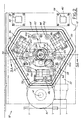
- the lower shroud portion 50 and the upper tool 54 are supported on a generally planar, general hexagonal head or head plate 58.
- the head 58 is supported on a horizontal beam 36 of the bridge 38 for reciprocal axial motion relative to the bridge 38.
- the reciprocal axial motion of the head 58 includes alternating downstrokes and upstrokes.
- the upper shroud portion 48 is supported on the horizontal beam 36 portion of the bridge 38 in a position above and axially aligned with the lower shroud portion 50.
- the lower shroud portion 50 is supported on the head 58 and is configured to cooperate with the upper shroud portion 48 to seal the apparatus 10 against the escape of laser light during lasing by sealingly engaging the upper shroud portion 48 when the head 58 is at the end of its downstroke.
- a lower rim 60 of the upper shroud portion 48 includes an upwardly bent hem 62 and an upper rim 64 of the lower shroud portion 50 includes a downwardly bent hem 66 configured to engage the upwardly bent hem 62 of the upper shroud portion 48 when the head 58 is at the end of its downstroke.
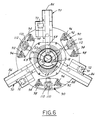
- gage blocks 68 are supported in circumferentially spaced positions around each of the three upper tools 54 for radial motion between a withdrawn position and an engaged position. In the withdrawn position the gage blocks 68 are spaced radially from the workpieces 22, 24. In the engaged position, a portion of a lower surface of each gage block 68 is disposed on a corresponding machined upper surface 69 of a workpiece 24 disposed on the lower tool 18.
- the three gage blocks 68 cooperate with the upper and lower tools 54, 18 to maintain a critical vertical tolerance between certain respective structures of the workpieces 22, 24 to be welded together.
- gage blocks 68 insure that the workpieces 22, 24 are welded together in a proper vertical orientation and are positively located relative to one another.
- the rotary welding apparatus 10 may not include guide blocks.
- each gage block 68 is operatively connected to the head 58 and is configured to advance laterally to its engaged position in response to each downstroke of the head 58.
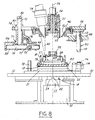
- the gage blocks 68 are supported for downward axial motion with the head 58 for a first portion of each downstroke.
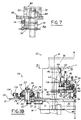
- Figure 8 shows the position of the gage blocks 68 and the head 58 at the beginning of the first portion of a downstroke and
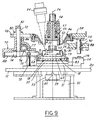
- Figure 9 shows position of the gage block and the head 58 at the end of the first portion of a downstroke.
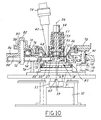
- the gage block is supported for lateral motion to the engaged position during a second portion of each downstroke as shown in Figure 10.
- gage block drives 70 operatively connect the respective gage blocks 68 to the head 58 and are each configured to convert head motion into lateral gage block motion during the second portion of each downstroke.
- the gage block drive is supported on the head 58 for downward axial motion with the head 58 during the first part of each downstroke.
- Each gage block drive includes a driving element including a vertical toothed rack 72 that is operatively connected to a driven element.
- the driven element includes a horizontal toothed rack 74 and a pinion gear 76.
- the horizontal toothed rack 74 of each gage block drive is connected to a corresponding gage block 68 in an end-to-end disposition when the rotary drive 32 is not rotating the lower tool 18.
- a keeper knob 77 extends integrally from an inward end of each horizontal toothed rack 74 in a radially inward direction.
- Each gage block 68 includes a circumferentially-directed key slot 75 sized and positioned to engage any one of the keeper knobs 77 to allow the horizontal toothed racks 74 to drive the gage blocks 68 radially into and out of their respective engaged positions.
- Each key slot 75 is also sized and positioned to allow the keeper knobs 77 to pass through the key slots 75 when the rotary drive 32 is rotating the lower tool 18, the workpieces, and the gage blocks 68.
- gage block key slots 75 are large enough to allow the keeper knobs 77 to pass through with sufficient clearance to prevent the knobs 77 from striking and dislodging the gage blocks 68 as the gage blocks 68 rotate with the lower tool 18 during welding.
- a gage block keeper ring 79 is supported on each of the three lower tools 18 to support the gage blocks 68 when the lower tools 18 are rotating and the keeper knobs 77 have released the gage blocks 68.
- Each gage block keeper ring 79 is concentrically supported on an outer circumferential flange 83 of one of the lower tools 18.
- Each keeper ring 79 includes three rectangular through holes 81 sized to slidably receive respective ones of the gage blocks 68 as the gage block drives 70 push the gage blocks axially inward to their respective engaged positions.
- the driving element i.e., the vertical rack 72 of each gage block drive is connected to and is downwardly movable with the head 58 during both the first and second portions of each downstroke.
- Three stops 78 are supported on the turntable 12 in respective positions adjacent the three lower tools 18.
- Each of the three stops 78 is a vertically oriented post having a flat upper end surface and a hexagonal cross-section.
- Each stop 78 is positioned to arrest downward motion of the gage blocks 68 and a driven element of the gage block drive at the end of the first portion of each downstroke as shown in Figure 9.
- the driven element of the gage block drive is configured to convert subsequent relative axial motion between the driving element and the arrested driven element during the second portion of each downstroke into lateral gage block motion to the respective engaged positions as shown in Figure 10.
- the vertical rack 72 of the driving element of each gage block drive is fixed to the head 58 as best shown in Figures 7 through 9.
- Three generally rectangular metal blocks 80, 82, 84 are fastened together to form a bridge structure that is disposed over an upper end of the vertical rack 72.
- the bridge structure is fastened to the upper end of the vertical rack 72 and to an upper surface of the head 58.
- the pinion 76 includes radially extending teeth meshed with teeth extending vertically from the horizontal tooth rack 74. Laterally extending teeth of the vertical rack 72 are also meshed with the pinion teeth. Consequently, downward motion of the head 58 during the second portion of each downstroke causes the vertical rack 72 of each gage block drive to move downward and to turn their respective pinions 76.
- the resulting rotation of the pinions 76 drives the respective horizontal racks 74 and corresponding gage blocks 68 laterally.
- the head 58 pulls the vertical racks 72 upward, turning the pinions 76 in the opposite direction and withdrawing the horizontal racks 74 and gage blocks 68. This moves the gage blocks 68 from their respective engaged positions and into their respective disengaged positions.
- the head 58 continues upward to the top of its upstroke it carries the gage blocks 68 and the gage blocks 68 with it and lifts them, along with the upper tool 54, clear of the workpieces 22, 24.
- the racks 72, 74 and the pinions 76 of the gage block drives 70 are housed in respective gearboxes 86.
- the gearboxes 86 are supported on a common platform 88 that is suspended from the head 58 by three platform supports 90.
- the platform supports 90 are connected to the head 58 and extend between the head 58 and the platform 88.
- the platform supports 90 are configured to support the platform 88 from the head 58 in a suspended position during the first portion of each downstroke.
- the platform supports 90 are also configured to guide axial relative motion between the platform 88 and the head 58 during the second portion of each downstroke between suspended position and a compressed position adjacent the head 58.
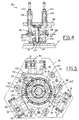
- the suspended position is best shown in Figures 8 and 9 and the compressed position is best shown in Figure 10.
- Each platform support 90 includes two parallel, vertically oriented support shafts 92, 94 received in and passing through corresponding circular apertures 96, 98 in the platform 88.
- An upper end of each support shaft 92, 94 is fixed to the head 58 by respective upwardly extending generally cylindrical spring housings 100, 102.
- a lower end of each support shaft 92, 94 includes a stop detent in the form of a radially extending flange 104.
- the flanges 104 support the platform 88 in its suspended position.
- Each platform support 90 includes two springs 106, 108 concentrically disposed on respective support shafts 92, 94 and within respective spring housings 100, 102.
- the springs 106 are disposed between the head 58 and the platform 88 to axially spring bias the platform 88 toward the suspended position below the head 58.
- Each platform support 90 includes an elongated cylindrical guide pin 110 fastened to a lower surface of the head 58 and extending vertically downward through a guide pin opening 112 disposed in the platform 88.
- the guide pin opening 112 in the platform 88 axially and slidably receives the guide pin 110 and allows the guide pin 110 to slide downward through the opening as the head 58 moves downward during the second portion of its downstroke. This helps to positively locate the platform 88 and gage blocks 68 relative to the head 58.
- Each platform support 90 also includes a guide pin receptacle 114 supported on an upper surface of the turntable 12.
- the guide pin receptacles 114 each include a locator bushing 116 positioned to axially receive the guide pin 110 as the head 58 approaches the end of its downstroke.
- the guide pin receptacles 114 help to positively locate the platform 88 and gage blocks 68 relative to the turntable 12, a lower tool and the workpieces 22, 24.
- Two vertically oriented parallel guide rods 118, 120 have respective upper ends supported on the cross beam portion 36 of the bridge 38.
- the head 58 includes corresponding through holes 122, 124 configured and positioned to slidably receive the respective vertical guide rods 118, 120.
- the head 58 is therefore slidably supported on the guide rods 118, 120 for generally vertical receptacle movement.
- metallic workpieces 22, 24 can be welded together along circular or semicircular interfaces by stacking two workpieces 22, 24 in vertically adjacent coaxial positions on one of the three lower tools 18 on the turntable 12 at the load position.
- the turntable drive 16 then indexes the turntable 12 until the workpieces 22, 24 are positioned at the welding station.
- the guide rail 43 maintains a proper rotational orientation of the lower tool 18 and workpieces 22, 24 as the turntable 12 rotates.
- the diametrically opposed key slots 41 of the lower tool 18 slide off the guide rail 43 and onto the pedestal key 45 of the workpiece rotary drive 32.
- the head 58 moves downward on its downstroke, carrying with it the lower portion of the shroud 46 and the upper tool 54.
- the hem 66 of the lower shroud portion 50 engages the hem 62 of the upper shroud portion 48 and the inner shroud ring 52 engages an upper surface of an uppermost one of the two workpieces 22, 24.
- the workpiece rotary drive 32 then rotates the lower tool about the workpiece axis 26 as the laser generator provides a laser beam to the laser optics portion of the laser emitter 34 and the laser emitter 34 directs the laser beam at the interface of the workpiece meeting surfaces.
- the laser beam forms a single circular weld or a series spaced-apart semicircular welds along the interface of the workpiece mating surfaces.
- the rotary drive ceases rotation with the pedestal key 45 aligned with the guide rail 43 and disposed within the gap in the guide rail 43.
- the head 58 moves upward on its upstroke.
- the vertical racks 72 of the gage block drives 70 moves upwards relative to the driven elements of the gage block drives 70 which causes the respective pinion gears 76 to rotate and the respective horizontal racks 74 to move radially outwards, drawing with them the gage blocks 68.
- the remainder of the upstroke carries the gage block drives 70 upward with the head 58 and the lower portion of the shroud 46 until they are clear of the workpieces 22, 24.
- the turntable drive 16 then indexes the turntable 12 to move the welded workpieces 22, 24 to an unload position which may or may not be the same as the load position.
- the turntable 12 begins to rotate the lower tool 18 slides onto the guide rail 43 which again maintains the lower tool 18 in a proper rotational orientation. Once the lower tool 18 reaches the unload position the welded workpieces 22, 24 are removed from the lower tool 18.
Landscapes
- Physics & Mathematics (AREA)
- Optics & Photonics (AREA)
- Engineering & Computer Science (AREA)
- Plasma & Fusion (AREA)
- Mechanical Engineering (AREA)
- Laser Beam Processing (AREA)
Applications Claiming Priority (2)
| Application Number | Priority Date | Filing Date | Title |
|---|---|---|---|
| US578772 | 2000-05-25 | ||
| US09/578,772 US6369352B1 (en) | 2000-05-25 | 2000-05-25 | Laser welding apparatus |
Publications (2)
| Publication Number | Publication Date |
|---|---|
| EP1157775A2 true EP1157775A2 (fr) | 2001-11-28 |
| EP1157775A3 EP1157775A3 (fr) | 2003-12-17 |
Family
ID=24314251
Family Applications (1)
| Application Number | Title | Priority Date | Filing Date |
|---|---|---|---|
| EP01304202A Withdrawn EP1157775A3 (fr) | 2000-05-25 | 2001-05-10 | Appareil de soudage laser |
Country Status (3)
| Country | Link |
|---|---|
| US (1) | US6369352B1 (fr) |
| EP (1) | EP1157775A3 (fr) |
| CA (1) | CA2347287A1 (fr) |
Cited By (2)
| Publication number | Priority date | Publication date | Assignee | Title |
|---|---|---|---|---|
| CN103350292A (zh) * | 2008-05-13 | 2013-10-16 | 柯马公司 | 高密度焊接组装机器 |
| CN111185668A (zh) * | 2020-02-25 | 2020-05-22 | 浙江创新激光设备有限公司 | 一种汽车锁盒激光焊接装置 |
Families Citing this family (21)
| Publication number | Priority date | Publication date | Assignee | Title |
|---|---|---|---|---|
| SE526767C2 (sv) * | 2003-10-16 | 2005-11-01 | Sandvik Intellectual Property | Skärverktyg med tillsatskropp med serrationsyta samt förfarande för tillverkning av skärverktyg |
| US20060053613A1 (en) * | 2004-09-16 | 2006-03-16 | Savoy Mark A | System and method for hemming vehicle closures |
| DE102004051356A1 (de) * | 2004-10-19 | 2006-04-27 | Carl Zeiss Jena Gmbh | Mikroskop mit Laserlichtquelle und Schutzvorrichtung gegen Augenschäden |
| CN108857096A (zh) * | 2018-08-16 | 2018-11-23 | 马鞍山市中亚机床制造有限公司 | 一种切割精度高的激光切割机及其使用方法 |
| CN109014581B (zh) * | 2018-09-25 | 2024-01-30 | 无锡汉神电气股份有限公司 | 汽车密封件全自动连续环焊机 |
| CN109158787B (zh) * | 2018-10-15 | 2021-07-09 | 江苏铭度户外用品有限公司 | 一种可多角度焊接铝合金的焊接装置 |
| CN109663836B (zh) * | 2019-02-21 | 2024-03-01 | 苏州凌创电子系统有限公司 | 传感器引脚的自动整形结构 |
| CN110202794B (zh) * | 2019-05-15 | 2024-01-02 | 南京帝耐激光科技有限公司 | 用于圆桶型塑料工件的激光焊接设备及方法 |
| CN113118653B (zh) * | 2019-12-31 | 2025-02-18 | 广东利元亨智能装备股份有限公司 | 焊接治具 |
| CN111375894A (zh) * | 2020-03-03 | 2020-07-07 | 苏州领裕电子科技有限公司 | 曲面衔接补偿焊接装置 |
| CN111730203A (zh) * | 2020-07-10 | 2020-10-02 | 东莞市吉和金属制品有限公司 | 一种激光焊接定位旋转治具 |
| CN111745243B (zh) * | 2020-07-20 | 2025-05-27 | 济宁市海富电子科技有限公司 | 一种插接件激光焊锡球装置及焊接方法 |
| CN114083218B (zh) * | 2020-08-24 | 2024-10-15 | 上海君屹工业自动化股份有限公司 | 两轴旋转伺服变位机 |
| CN113510433B (zh) * | 2021-04-16 | 2022-08-09 | 睿信泰智能科技(昆山)有限公司 | 组合式对胀芯工装 |
| CN113857662A (zh) * | 2021-08-02 | 2021-12-31 | 大族激光科技产业集团股份有限公司 | 激光焊接夹具及焊接方法 |
| CN115625422B (zh) * | 2022-09-30 | 2025-05-16 | 上海杭和智能科技有限公司 | 箱体导轨激光穿透焊接的夹具结构及方法 |
| CN115555697A (zh) * | 2022-11-07 | 2023-01-03 | 南通东顺杰运动科技有限公司 | 一种辅助精准对位的自动焊接装置 |
| CN115781147B (zh) * | 2022-12-21 | 2024-06-07 | 南通康比电子有限公司 | 一种片式二极管焊接装置 |
| CN117532162B (zh) * | 2024-01-10 | 2024-04-05 | 武汉创恒激光智能装备有限公司 | 一种水泵叶轮组件激光自动焊接装置 |
| CN118989852B (zh) * | 2024-10-24 | 2024-12-27 | 中车沈阳机车车辆有限公司 | 手制动轴杆自动转动焊接工装 |
| CN120228440B (zh) * | 2025-04-11 | 2025-09-26 | 宁波梨铭金属制造有限公司 | 一种新能源汽车零部件激光焊接设备 |
Family Cites Families (15)
| Publication number | Priority date | Publication date | Assignee | Title |
|---|---|---|---|---|
| US3555239A (en) * | 1966-11-16 | 1971-01-12 | William J Kerth | Welding machine with digital pulse control |
| US4229638A (en) * | 1975-04-01 | 1980-10-21 | Dresser Industries, Inc. | Unitized rotary rock bit |
| DE2900595A1 (de) * | 1979-01-09 | 1980-07-17 | Schmalbach Lubeca | Vorrichtung zum herstellen von dosen |
| JPS5855188A (ja) * | 1981-09-28 | 1983-04-01 | Hitachi Ltd | 自動レ−ザシ−ム溶接装置 |
| US4617446A (en) * | 1984-10-09 | 1986-10-14 | Smith International, Inc. | Welding fixture for rotary cone rock bits with belleville seals |
| US5066846A (en) * | 1990-06-26 | 1991-11-19 | Westinghouse Electric Corp. | System and method for laser welding the inner surface of heat exchanger tubes |
| EP0476501B1 (fr) * | 1990-09-17 | 1996-12-18 | Hitachi, Ltd. | Conteneur métallique ayant un tuyau tronc et un tuyau de branchement et son procédé de fabrication. |
| US5168142A (en) | 1991-05-28 | 1992-12-01 | Ford Motor Company | Method for fabricating a clutch cylinder-drum assembly |
| FR2677567A1 (fr) * | 1991-06-13 | 1992-12-18 | Framatome Sa | Procede et dispositif de controle du fonctionnement d'une chaine optique, pour faisceau laser, portee par un outil de soudage. |
| US5371337A (en) | 1992-10-09 | 1994-12-06 | General Motors Corporation | Welding process and apparatus |
| US5430270A (en) * | 1993-02-17 | 1995-07-04 | Electric Power Research Institute, Inc. | Method and apparatus for repairing damaged tubes |
| GB9321866D0 (en) | 1993-10-22 | 1993-12-15 | Kinsman Grant | Fuzzy logic control of laser welding |
| JPH08215876A (ja) * | 1995-02-14 | 1996-08-27 | Nikon Corp | 基板の位置決め方法及びその装置 |
| DE19736042A1 (de) * | 1997-08-20 | 1999-02-25 | Alsthom Cge Alcatel | Vorrichtung zum Längsnahtschweißen von Metallrohren |
| JP3433084B2 (ja) * | 1998-01-07 | 2003-08-04 | 株式会社ユタカ技研 | ハニカム筒体及びハウジング用レーザ溶接装置 |
-
2000
- 2000-05-25 US US09/578,772 patent/US6369352B1/en not_active Expired - Fee Related
-
2001
- 2001-05-09 CA CA002347287A patent/CA2347287A1/fr not_active Abandoned
- 2001-05-10 EP EP01304202A patent/EP1157775A3/fr not_active Withdrawn
Cited By (2)
| Publication number | Priority date | Publication date | Assignee | Title |
|---|---|---|---|---|
| CN103350292A (zh) * | 2008-05-13 | 2013-10-16 | 柯马公司 | 高密度焊接组装机器 |
| CN111185668A (zh) * | 2020-02-25 | 2020-05-22 | 浙江创新激光设备有限公司 | 一种汽车锁盒激光焊接装置 |
Also Published As
| Publication number | Publication date |
|---|---|
| US6369352B1 (en) | 2002-04-09 |
| EP1157775A3 (fr) | 2003-12-17 |
| CA2347287A1 (fr) | 2001-11-25 |
Similar Documents
| Publication | Publication Date | Title |
|---|---|---|
| US6369352B1 (en) | Laser welding apparatus | |
| US4205216A (en) | Laser welding system and method | |
| US3958739A (en) | Weld centering workpiece holder | |
| US6264418B1 (en) | Workpiece positioner | |
| EP1000696B1 (fr) | Appareil pour le soudage par friction | |
| CA2552120C (fr) | Plaque tournante compacte | |
| CN116748785B (zh) | 搅拌车封头组对焊接的定位夹紧装置 | |
| CN112475362A (zh) | 一种基于机器视觉的阀片自动加工设备 | |
| CN112171252A (zh) | 带有定矩拧紧机构的多功能装配回转台及装配方法 | |
| US5678749A (en) | Friction welding tooling | |
| US5797306A (en) | Lamination notching apparatus | |
| CN110744254B (zh) | 一种焊接用板材自动拼装与夹持夹具 | |
| MXPA01005119A (en) | Laser welding apparatus | |
| US7638963B2 (en) | Rotary indexing table driven by an induction motor | |
| CN114850863B (zh) | 一种行星轮组装检测系统 | |
| US20090218771A1 (en) | Bristle and plate subassembly fixture and manufacturing method | |
| CN110802349A (zh) | 一种大型钢管的焊接装置 | |
| CN216680841U (zh) | 一种焊接变位装置及自动焊接设备 | |
| CN116921909A (zh) | 一种环形钣金壳体的加工方法 | |
| CN219684458U (zh) | 焊接装置及电机加工设备 | |
| JP2000141062A (ja) | インデックスタレット | |
| CN116252276B (zh) | 一种航空发动机装配平台 | |
| RU2197368C2 (ru) | Станок для завинчивания шпилек | |
| CN120715514B (zh) | 一种灭火器钢瓶生产用的智能焊接设备 | |
| CN223506471U (zh) | 一种基于机械手的筒体法兰焊接组对装置 |
Legal Events
| Date | Code | Title | Description |
|---|---|---|---|
| PUAI | Public reference made under article 153(3) epc to a published international application that has entered the european phase |
Free format text: ORIGINAL CODE: 0009012 |
|
| AK | Designated contracting states |
Kind code of ref document: A2 Designated state(s): AT BE CH CY DE DK ES FI FR GB GR IE IT LI LU MC NL PT SE TR |
|
| AX | Request for extension of the european patent |
Free format text: AL;LT;LV;MK;RO;SI |
|
| RIC1 | Information provided on ipc code assigned before grant |
Ipc: 7B 23K 26/42 B Ipc: 7B 23K 37/00 B Ipc: 7B 23K 26/24 B Ipc: 7B 23K 26/28 B Ipc: 7B 23K 26/12 B Ipc: 7B 23K 37/053 B Ipc: 7B 23K 26/08 A |
|
| PUAL | Search report despatched |
Free format text: ORIGINAL CODE: 0009013 |
|
| AK | Designated contracting states |
Kind code of ref document: A3 Designated state(s): AT BE CH CY DE DK ES FI FR GB GR IE IT LI LU MC NL PT SE TR |
|
| AX | Request for extension of the european patent |
Extension state: AL LT LV MK RO SI |
|
| AKX | Designation fees paid |
Designated state(s): DE ES FR GB SE |
|
| STAA | Information on the status of an ep patent application or granted ep patent |
Free format text: STATUS: THE APPLICATION IS DEEMED TO BE WITHDRAWN |
|
| 18D | Application deemed to be withdrawn |
Effective date: 20040618 |