EP1158809A2 - Codierung variabler Länge - Google Patents
Codierung variabler Länge Download PDFInfo
- Publication number
- EP1158809A2 EP1158809A2 EP01304387A EP01304387A EP1158809A2 EP 1158809 A2 EP1158809 A2 EP 1158809A2 EP 01304387 A EP01304387 A EP 01304387A EP 01304387 A EP01304387 A EP 01304387A EP 1158809 A2 EP1158809 A2 EP 1158809A2
- Authority
- EP
- European Patent Office
- Prior art keywords
- mapping
- code
- symbol
- information
- data
- Prior art date
- Legal status (The legal status is an assumption and is not a legal conclusion. Google has not performed a legal analysis and makes no representation as to the accuracy of the status listed.)
- Granted
Links
Images




Classifications
-
- H—ELECTRICITY
- H03—ELECTRONIC CIRCUITRY
- H03M—CODING; DECODING; CODE CONVERSION IN GENERAL
- H03M7/00—Conversion of a code where information is represented by a given sequence or number of digits to a code where the same, similar or subset of information is represented by a different sequence or number of digits
- H03M7/30—Compression; Expansion; Suppression of unnecessary data, e.g. redundancy reduction
- H03M7/40—Conversion to or from variable length codes, e.g. Shannon-Fano code, Huffman code, Morse code
- H03M7/4031—Fixed length to variable length coding
-
- H—ELECTRICITY
- H03—ELECTRONIC CIRCUITRY
- H03M—CODING; DECODING; CODE CONVERSION IN GENERAL
- H03M7/00—Conversion of a code where information is represented by a given sequence or number of digits to a code where the same, similar or subset of information is represented by a different sequence or number of digits
- H03M7/30—Compression; Expansion; Suppression of unnecessary data, e.g. redundancy reduction
- H03M7/40—Conversion to or from variable length codes, e.g. Shannon-Fano code, Huffman code, Morse code
-
- H—ELECTRICITY
- H04—ELECTRIC COMMUNICATION TECHNIQUE
- H04N—PICTORIAL COMMUNICATION, e.g. TELEVISION
- H04N19/00—Methods or arrangements for coding, decoding, compressing or decompressing digital video signals
- H04N19/10—Methods or arrangements for coding, decoding, compressing or decompressing digital video signals using adaptive coding
- H04N19/102—Methods or arrangements for coding, decoding, compressing or decompressing digital video signals using adaptive coding characterised by the element, parameter or selection affected or controlled by the adaptive coding
- H04N19/13—Adaptive entropy coding, e.g. adaptive variable length coding [AVLC] or context adaptive binary arithmetic coding [CABAC]
-
- H—ELECTRICITY
- H04—ELECTRIC COMMUNICATION TECHNIQUE
- H04N—PICTORIAL COMMUNICATION, e.g. TELEVISION
- H04N19/00—Methods or arrangements for coding, decoding, compressing or decompressing digital video signals
- H04N19/10—Methods or arrangements for coding, decoding, compressing or decompressing digital video signals using adaptive coding
- H04N19/134—Methods or arrangements for coding, decoding, compressing or decompressing digital video signals using adaptive coding characterised by the element, parameter or criterion affecting or controlling the adaptive coding
- H04N19/146—Data rate or code amount at the encoder output
- H04N19/149—Data rate or code amount at the encoder output by estimating the code amount by means of a model, e.g. mathematical model or statistical model
-
- H—ELECTRICITY
- H04—ELECTRIC COMMUNICATION TECHNIQUE
- H04N—PICTORIAL COMMUNICATION, e.g. TELEVISION
- H04N19/00—Methods or arrangements for coding, decoding, compressing or decompressing digital video signals
- H04N19/10—Methods or arrangements for coding, decoding, compressing or decompressing digital video signals using adaptive coding
- H04N19/134—Methods or arrangements for coding, decoding, compressing or decompressing digital video signals using adaptive coding characterised by the element, parameter or criterion affecting or controlling the adaptive coding
- H04N19/157—Assigned coding mode, i.e. the coding mode being predefined or preselected to be further used for selection of another element or parameter
-
- H—ELECTRICITY
- H04—ELECTRIC COMMUNICATION TECHNIQUE
- H04N—PICTORIAL COMMUNICATION, e.g. TELEVISION
- H04N19/00—Methods or arrangements for coding, decoding, compressing or decompressing digital video signals
- H04N19/60—Methods or arrangements for coding, decoding, compressing or decompressing digital video signals using transform coding
- H04N19/625—Methods or arrangements for coding, decoding, compressing or decompressing digital video signals using transform coding using discrete cosine transform [DCT]
-
- H—ELECTRICITY
- H04—ELECTRIC COMMUNICATION TECHNIQUE
- H04N—PICTORIAL COMMUNICATION, e.g. TELEVISION
- H04N19/00—Methods or arrangements for coding, decoding, compressing or decompressing digital video signals
- H04N19/90—Methods or arrangements for coding, decoding, compressing or decompressing digital video signals using coding techniques not provided for in groups H04N19/10-H04N19/85, e.g. fractals
- H04N19/91—Entropy coding, e.g. variable length coding [VLC] or arithmetic coding
Definitions
- the present invention relates to a variable length coding method for coding a data signal, the method comprising receiving a symbol and semantic information concerning said symbol and generating a codeword in dependence on said symbol and said semantic information, to a variable length coding apparatus for coding a data signal, the method comprising: means for receiving a symbol and semantic information concerning said symbol and means for generating a codeword in dependence on said symbol and said semantic information, and to a corresponding decoding method and apparatus.
- the International Telecommunication Union Telecommunication Standardization Sector (ITU-T) has been working on international standard H.26L for videophones. Although a series of moving picture coding methods related to videophones, such as H.261, H.263, H.263+, and later H.263++ and MPEG-4, have been established as ITU-T international standards, these international standards cannot meet newly appearing requirements. Therefore the H.26L standard is being prepared in order to cope with the new requirements. The new requirements are as follows:-
- Figure 1 illustrates the structure of a prior art decoding apparatus.
- a decoding unit 10 receives a coded bit stream (coded data), which is coded in a coding apparatus (not shown).
- the decoding unit 10 extracts each codeword from the received bit stream and then outputs code numbers, each corresponding to a distinct codeword.
- the method of extracting each codeword from the received bit stream is explained below.
- a symbol extracting unit 11 receives a code number corresponding to each codeword and an element type signal for determining the kind of symbol, and outputs the corresponding symbol in the form of decoded data.
- the decoding step of the decoding unit 10 uses a universal variable length coding table (UVLC), and the UVLC is formed using the rule shown in Figure 2.
- X n has a value of "0" or "1".
- This INFO data is made into a bit stream as shown in Figure 2, in which every odd numbered bit is "0" except the last bit which is "1".
- the length of the final codeword, which is made from INFO is obtained by adding "1" to twice the number of bits of INFO, except when a code number is "0".
- the codeword thus formed can be numbered in the direction of increasing length and the number is referred to as the code number.
- An example is shown in Figure 3.
- Decoding can be very easily performed using this rule in reverse. That is, a UVLC table formed as described above has a predetermined characteristic in that an odd numbered bit of each codeword is always the binary number "0", except for the last bit of each codeword which is always the binary number "1". Therefore, the decoding apparatus 10 of Figure 1 refers to odd numbered bits of an input bit stream, and if the binary number "1" is found, it can be determined that the bits up to the binary number "1" correspond to one codeword. After one codeword is found in this way, only even numbered bits in the found codeword are read, and those bits form a code number. This step is performed by the decoding apparatus 10 of Figure 1.
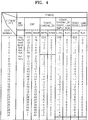
- the decoding apparatus 10 of Figure 1 If the decoding apparatus 10 of Figure 1 outputs the code number, it needs to decode an actual symbol corresponding to the code number, that is, a symbol corresponding to the found INFO. Decoding is simply performed with reference to a table by a symbol extracting unit 11 of Figure 1. That is, the symbol extracting unit 11 stores, for example, data as shown in Figure 4. That is, if a code number and an element type (element_type), which indicates the kind of symbol, are received, the symbol extracting unit 11 outputs a symbol corresponding to the code number and the element type, and by doing so, performs decoding.
- element_type is MB-TYPE information which indicates a macro block type is currently being decoded.
- MB-TYPE information can be a skip type, which indicates substitution of video data of a corresponding location of a reference video for a motion vector, or can specify the size and form of a macro block, such as 16 x 16, 16 x 8, 8 x 16, 8 x 4, etc.
- the conventional method described above has the following drawbacks.
- One kind of UVLC table is used for a plurality of symbols (for example, MT_TYPE, CBP (coded block pattern), etc.).
- the compression efficiency of the variable length coding method is closely related to how well a codeword table accords with the probability distribution of symbols which are actually used.
- code numbers and symbols are mapped to each other uniformly by a UVLC table, as shown in Figure 4, regardless of the probability distribution of the actual symbols, and therefore the conventional method has a serious problem realizing the basic goal of maximum compression. That is, the UVLC table described above can be appropriate for certain kinds of symbols, but can cause lowered coding efficiency for other kinds of symbols.
- a table optimized for each kind of symbol can be prepared to improve the efficiency, but in this case, the beneficial effects of the UVLC described above is sacrificed.
- a coding method is characterised in that the generation of said code comprises coding the symbol to produce a first code, mapping the first code onto a second code in dependence on said semantic information and producing said codeword from said second code and said semantic information.
- said mapping comprises selecting a table from a plurality of tables in dependence on said semantic information. More preferably, tables are selected in dependence on the quantization step used to produce a symbol and which is indicated by the semantic information and/or includes empirically determining efficient mappings for said tables.
- a method for decoding a data signal coded according to the present invention comprising:
- said mapping comprises selecting a table from a plurality of tables in dependence on said semantic information. More preferably, tables are selected in dependence on the quantization step used to produce the received coded symbol and which is indicated by the semantic information.
- a coding apparatus is characterised in that the means for generating a code comprises means for coding the symbol to produce a first code, means for mapping the first code onto a second code in dependence on said semantic information and means for producing said codeword from said second code and said semantic information.
- said means for mapping comprises means for selecting a table from a plurality of tables in dependence on said semantic information. More preferably, tables are selected in dependence on the quantization step used to produce a symbol and which is indicated by the semantic information.
- an apparatus for decoding a data signal coded according to the present invention comprising:
- said means for mapping comprises means for selecting a table from a plurality of tables in dependence on said semantic information. More preferably, tables are selected in dependence on the quantization step used to produce the received coded symbol and which is indicated by the semantic information.
- a coding apparatus comprises a coding unit 50, a mapper unit 60, and a codeword generating unit 70.
- the operation of the coding apparatus of the present invention will now be explained.
- Element type information indicates the syntax element of a symbol currently coded (that is, indicates a symbol's kind). More generally, element type information indicates various related syntax element information of a unit of data currently coded. For example, element type information can be information on symbol data currently encoded, including information on macro block type, such as size and shape, information on whether or not motion compensation is performed, information on whether the data is brightness information or colour information, or information on whether the data is the DC component or AC component of a DCT coefficient.
- the coding unit 50 generates and outputs a code number using INFO bits corresponding to a symbol to be coded, and the code number will be referred to as code number A.
- the output code number is converted into code number B by the mapper unit 60.
- Code number A output by the coding unit 50 is a code number corresponding to a symbol to be coded.
- the relative probability of occurrence of a symbol changes greatly. That is, when a UVLC table, as shown in Figure 6A, was designed, it was thought that a symbol corresponding to code number 2 would occur more frequently than a symbol corresponding to code number 5. In reality, the symbol corresponding to code number 5 may occur more frequently. This can be easily checked by experiments.
- each number in parenthesis indicates the length of the codeword corresponding to a symbol.
- the column UVLC indicates the symbol corresponding to a code number of the first column. That is, in the ULVC table, the codeword of code number 1 is assigned to a 16 x 16 symbol of the MB type, and at this time the length of the codeword is 3 bits.
- Qp indicates a quantization interval.
- a codeword of code number 2 (3) having a length of 3 bits is used, and therefore the compression efficiency is lowered.
- the present invention prepares one or more mapping tables, which are designed with respect to changes of quantization interval Qp values, as illustrated in Figures 6A and 6B, and uses the mapping tables so that code number A generated by the coding unit 50 is mapped into code number B corresponding to a more efficient codeword. By doing so, the goal of maintaining the advantages of UVLC and improving compression efficiency can be realized. Since the mapping tables need to simply store code number regardless of coding, the mapping tables do not cause additional complexity in implementation.
- a fixed re-association table (FRAT) 81 observes or predicts optimal coding mapping with respect to conditions, for example, with respect to Qp values, which are provided through the analysis as shown in Figure 6B, and determines a mapping relation, which is optimized to the prevailing conditions, in the form of a table.
- FRAT 81 A specific example of FRAT 81 is shown in Figure 6B.
- the selecting unit 90 receives code number B from FRATs 81 of respective conditions corresponding to code number A, and then selects code number B output from an appropriate FRAT 81 according to an output signal of a selection determining unit 80 and outputs the selected code number B as the final output code number B.
- the selection determining unit 80 receives information on element type (Element type 1 ⁇ Element type N) related to data to be coded and generates and outputs a signal for selecting an optimal FRAT 81 output based on the received information on element types.
- the selection determining unit 80 receives information on a plurality of element types related to data currently being coded and generates and outputs a signal for selecting an optimal FRAT based on the received element type information. For example, if data currently being decoded is an MB type symbol, the selection determining unit 80 finds element type information which has the greatest influence on the statistical characteristic of the MB type among the provided several element type information.
- An example is Qp. That is, a plurality of mapping table FRATs 81, each of which corresponds to one Qp value, can be implemented.
- the range of Qp values can be divided into a plurality of subranges so that if Qp is between a and b, FRAT 1 is selected, and if Qp is between c and d, FRAT N is selected. Selecting a FRAT 81 using a Qp value is just an example, and the selection determining unit 80 can be implemented in various ways according to necessity using other element type information or using all information on the plurality of element types. Another implementation is shown in Figure 9.
- a corresponding decoding unit 101 receives binary data, coded using the mapper-based variable length coding apparatus as shown in Figure 5.
- the decoding unit 101 divides each codeword from the received bit stream and outputs a code number corresponding to each codeword.
- the code number will be referred to as code number A.
- This code number is converted into code number B, which is the actual code number used in the coding apparatus, by a mapper unit 110.
- the mapper unit 110 receives a signal of element type information, which indicates what symbol is being mapped.
- Code number B, output by the mapper unit 110 is input to a symbol extracting unit 120, and the symbol extracting unit 120 finds and outputs a predetermined symbol corresponding to the code number B. By doing so, the decoding is performed.
- the operation of the mapper unit 110 is the same as that of the mapper 60 of the coding apparatus in Figure 5.
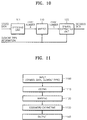
- a symbol to be coded and element type information indicating the kind of symbol are received in step 1100.
- coding by generating a code number corresponding to the INFO bits is performed in step 1110.
- the generated code number is mapped into another code number which is observationally or theoretically appropriate according to predetermined coding conditions in step 1120.
- a codeword corresponding to the mapped code number is generated and the codeword is extracted in step 1130.
- The, extracted codeword is output in step 1140.
- the mapping step 1120 uses the code number generated in the coding step 1110 and element type information related to the current data. For explanation of the specific operation of coding method of the present invention, refer to the explanation of the operation of the coding apparatus of the present invention.
- step 1200 binary data, coded using the coding apparatus, and element type information, which indicates the kind of data, are received in step 1200.
- decoding by finding a code number corresponding to the input data is performed in step 1210.
- Symbol extraction for finding the original symbol using the code number determined in the mapping step is performed in step 1230.
- the extracted symbol is output in step 1240.
- the mapping step 1220 uses the code number generated in the decoding step 1210 and element type information related to the current data.
- the main fields which the present invention is expected to be applied to in the future include real-time interactive applications for videophones, audio/video communications over mobile networks, video application services in the Internet, real-time signal language and lip-reading communication video transmission, video storage and retrieval for video-on-demand (VOD) services, video storage and forwarding applications for video mail applications, and multipoint communications over heterogeneous networks.
- real-time interactive applications for videophones audio/video communications over mobile networks
- video application services in the Internet real-time signal language and lip-reading communication video transmission
- video storage and retrieval for video-on-demand (VOD) services video storage and forwarding applications for video mail applications
- multipoint communications over heterogeneous networks.
- the advantages of a universal variable length code table can be maintained while preventing efficiency lowering of compression coding.
Landscapes
- Engineering & Computer Science (AREA)
- Signal Processing (AREA)
- Multimedia (AREA)
- General Physics & Mathematics (AREA)
- Physics & Mathematics (AREA)
- Theoretical Computer Science (AREA)
- Discrete Mathematics (AREA)
- Algebra (AREA)
- Mathematical Analysis (AREA)
- Mathematical Optimization (AREA)
- Pure & Applied Mathematics (AREA)
- Compression, Expansion, Code Conversion, And Decoders (AREA)
- Compression Or Coding Systems Of Tv Signals (AREA)
Applications Claiming Priority (2)
| Application Number | Priority Date | Filing Date | Title |
|---|---|---|---|
| KR2000026274 | 2000-05-17 | ||
| KR20000026274A KR100856398B1 (ko) | 2000-05-17 | 2000-05-17 | 복수 매핑 테이블을 이용한 가변장 부호화 및 복호화방법과 그 장치 |
Publications (3)
| Publication Number | Publication Date |
|---|---|
| EP1158809A2 true EP1158809A2 (de) | 2001-11-28 |
| EP1158809A3 EP1158809A3 (de) | 2003-03-12 |
| EP1158809B1 EP1158809B1 (de) | 2013-07-03 |
Family
ID=19668847
Family Applications (1)
| Application Number | Title | Priority Date | Filing Date |
|---|---|---|---|
| EP20010304387 Expired - Lifetime EP1158809B1 (de) | 2000-05-17 | 2001-05-17 | Codierung variabler Länge |
Country Status (5)
| Country | Link |
|---|---|
| US (1) | US6919828B2 (de) |
| EP (1) | EP1158809B1 (de) |
| JP (1) | JP3517224B2 (de) |
| KR (1) | KR100856398B1 (de) |
| CN (1) | CN100492916C (de) |
Cited By (1)
| Publication number | Priority date | Publication date | Assignee | Title |
|---|---|---|---|---|
| CN1327712C (zh) * | 2003-11-05 | 2007-07-18 | 华为技术有限公司 | 一种视频宏块模式编码方法 |
Families Citing this family (34)
| Publication number | Priority date | Publication date | Assignee | Title |
|---|---|---|---|---|
| KR100462060B1 (ko) * | 2001-12-21 | 2004-12-17 | 에스케이 텔레콤주식회사 | 유니버셜 가변 길이 코드 부호어 다중 추출 방법 및 그를위한 룩-업 테이블 구성 방법 |
| WO2003063510A1 (en) * | 2002-01-22 | 2003-07-31 | Broadcom Corporation | System and method of transmission and display of progressive video with hints for interlaced display |
| US9497452B2 (en) | 2002-01-22 | 2016-11-15 | Broadcom Corporation | System and method of transmission and reception of video using compressed differential time stamps |
| US7702986B2 (en) * | 2002-11-18 | 2010-04-20 | Qualcomm Incorporated | Rate-compatible LDPC codes |
| US20040125951A1 (en) * | 2002-12-26 | 2004-07-01 | Sun Microsystems, Inc., A Delaware Corporation | Bitstreaming for unreadable redundancy |
| US7630440B2 (en) * | 2003-05-28 | 2009-12-08 | Broadcom Corporation | Context adaptive binary arithmetic code decoding engine |
| US7657429B2 (en) * | 2003-06-16 | 2010-02-02 | Panasonic Corporation | Coding apparatus and coding method for coding with reference to a codebook |
| US7457363B2 (en) * | 2004-06-30 | 2008-11-25 | Intel Corporation | Method and apparatus for multi-threaded variable length coding |
| US8599926B2 (en) | 2006-10-12 | 2013-12-03 | Qualcomm Incorporated | Combined run-length coding of refinement and significant coefficients in scalable video coding enhancement layers |
| US8325819B2 (en) | 2006-10-12 | 2012-12-04 | Qualcomm Incorporated | Variable length coding table selection based on video block type for refinement coefficient coding |
| US9319700B2 (en) | 2006-10-12 | 2016-04-19 | Qualcomm Incorporated | Refinement coefficient coding based on history of corresponding transform coefficient values |
| US8565314B2 (en) * | 2006-10-12 | 2013-10-22 | Qualcomm Incorporated | Variable length coding table selection based on block type statistics for refinement coefficient coding |
| US8335261B2 (en) * | 2007-01-08 | 2012-12-18 | Qualcomm Incorporated | Variable length coding techniques for coded block patterns |
| JP2010103969A (ja) * | 2008-09-25 | 2010-05-06 | Renesas Technology Corp | 画像復号方法、画像復号装置、画像符号化方法及び画像符号化装置 |
| US9532059B2 (en) | 2010-10-05 | 2016-12-27 | Google Technology Holdings LLC | Method and apparatus for spatial scalability for video coding |
| MX2013003557A (es) | 2010-10-05 | 2013-05-01 | Gen Instrument Corp | Codificacion y decodificacion utilizando seleccion de modelo adaptativo al contexto con escaneo en zigzag. |
| KR20120084639A (ko) * | 2011-01-20 | 2012-07-30 | 한국전자통신연구원 | 엔트로피 부호화를 위한 적응적 정렬 테이블 |
| US8938001B1 (en) | 2011-04-05 | 2015-01-20 | Google Inc. | Apparatus and method for coding using combinations |
| US8989256B2 (en) | 2011-05-25 | 2015-03-24 | Google Inc. | Method and apparatus for using segmentation-based coding of prediction information |
| US8891616B1 (en) | 2011-07-27 | 2014-11-18 | Google Inc. | Method and apparatus for entropy encoding based on encoding cost |
| US8610604B2 (en) | 2011-11-24 | 2013-12-17 | International Business Machines Corporation | Compression algorithm incorporating a feedback loop for dynamic selection of a predefined Huffman dictionary |
| US8610606B2 (en) | 2011-11-24 | 2013-12-17 | International Business Machines Corporation | Compression algorithm incorporating dynamic selection of a predefined huffman dictionary |
| US8542135B2 (en) | 2011-11-24 | 2013-09-24 | International Business Machines Corporation | Compression algorithm incorporating automatic generation of a bank of predefined huffman dictionaries |
| US9247257B1 (en) | 2011-11-30 | 2016-01-26 | Google Inc. | Segmentation based entropy encoding and decoding |
| US9094681B1 (en) | 2012-02-28 | 2015-07-28 | Google Inc. | Adaptive segmentation |
| US11039138B1 (en) | 2012-03-08 | 2021-06-15 | Google Llc | Adaptive coding of prediction modes using probability distributions |
| US8593308B1 (en) | 2012-05-31 | 2013-11-26 | International Business Machines Corporation | Method of accelerating dynamic Huffman decompaction within the inflate algorithm |
| US9774856B1 (en) | 2012-07-02 | 2017-09-26 | Google Inc. | Adaptive stochastic entropy coding |
| US9332276B1 (en) | 2012-08-09 | 2016-05-03 | Google Inc. | Variable-sized super block based direct prediction mode |
| US9380298B1 (en) | 2012-08-10 | 2016-06-28 | Google Inc. | Object-based intra-prediction |
| US9509998B1 (en) | 2013-04-04 | 2016-11-29 | Google Inc. | Conditional predictive multi-symbol run-length coding |
| US9392288B2 (en) | 2013-10-17 | 2016-07-12 | Google Inc. | Video coding using scatter-based scan tables |
| US9179151B2 (en) | 2013-10-18 | 2015-11-03 | Google Inc. | Spatial proximity context entropy coding |
| WO2016171472A1 (ko) * | 2015-04-23 | 2016-10-27 | 김정훈 | 데이터 부호화 및 복호화 방법과 장치 |
Family Cites Families (20)
| Publication number | Priority date | Publication date | Assignee | Title |
|---|---|---|---|---|
| US3694813A (en) * | 1970-10-30 | 1972-09-26 | Ibm | Method of achieving data compaction utilizing variable-length dependent coding techniques |
| US4044347A (en) * | 1975-05-19 | 1977-08-23 | International Business Machines Corporation | Variable-length to fixed-length conversion of minimum-redundancy codes |
| JPH04239225A (ja) | 1991-01-11 | 1992-08-27 | Sony Corp | 可変長符号化装置 |
| EP0574746A1 (de) * | 1992-06-19 | 1993-12-22 | Intel Corporation | Verfahren und Vorrichtung zur Echtzeitkompression und -dekompression eines digitalen bewegten Videosignals mit unveränderlicher Huffman-Tabelle |
| KR0129558B1 (ko) | 1992-10-26 | 1998-04-10 | 배순훈 | 적응적 가변길이 부호화 방법 및 장치 |
| KR0155784B1 (ko) * | 1993-12-16 | 1998-12-15 | 김광호 | 영상데이타의 적응형 가변장 부호화/복호화방법 |
| KR970009408B1 (ko) | 1994-01-18 | 1997-06-13 | 대우전자 주식회사 | 인터/인트라 테이블 선택 회로 |
| JPH08116447A (ja) * | 1994-10-18 | 1996-05-07 | Fuji Xerox Co Ltd | 画像信号の符号化装置 |
| US5831559A (en) * | 1996-01-24 | 1998-11-03 | Intel Corporation | Encoding/decoding video signals using multiple run-val mapping tables |
| US6011499A (en) * | 1996-06-27 | 2000-01-04 | Intel Corporation | Encoding/decoding video signals using multiple run-val mapping tables |
| US5828426A (en) | 1996-08-20 | 1998-10-27 | Samsung Electronics Co., Ltd. | Apparatus for decoding variable length coded data of both MPEG-1 and MPEG-2 standards |
| US6668088B1 (en) * | 1997-02-25 | 2003-12-23 | British Broadcasting Corporation | Digital signal compression encoding with improved quantisation |
| KR100265229B1 (en) * | 1997-05-20 | 2000-09-15 | Samsung Electronics Co Ltd | Variable length coding device and the decoding device using selective symbol/codeword real location of symbol table |
| US6111914A (en) * | 1997-12-01 | 2000-08-29 | Conexant Systems, Inc. | Adaptive entropy coding in adaptive quantization framework for video signal coding systems and processes |
| US6118822A (en) | 1997-12-01 | 2000-09-12 | Conexant Systems, Inc. | Adaptive entropy coding in adaptive quantization framework for video signal coding systems and processes |
| US6570876B1 (en) * | 1998-04-01 | 2003-05-27 | Hitachi, Ltd. | Packet switch and switching method for switching variable length packets |
| JP2000013794A (ja) * | 1998-06-23 | 2000-01-14 | Mitsubishi Electric Corp | 動画像符号化装置、動画像符号化方法、動画像復号装置、および動画像復号方法 |
| KR100618972B1 (ko) * | 1999-08-02 | 2006-09-01 | 삼성전자주식회사 | 가변장 코딩 방법 및 장치 |
| US6636830B1 (en) * | 2000-11-22 | 2003-10-21 | Vialta Inc. | System and method for noise reduction using bi-orthogonal modified discrete cosine transform |
| US6552674B2 (en) * | 2001-03-19 | 2003-04-22 | Texas Instruments Incorporated | Automatic configuration of universal variable length code for video coding |
-
2000
- 2000-05-17 KR KR20000026274A patent/KR100856398B1/ko not_active Expired - Fee Related
-
2001
- 2001-05-02 JP JP2001135608A patent/JP3517224B2/ja not_active Expired - Fee Related
- 2001-05-17 US US09/858,872 patent/US6919828B2/en not_active Expired - Fee Related
- 2001-05-17 EP EP20010304387 patent/EP1158809B1/de not_active Expired - Lifetime
- 2001-05-17 CN CNB011177934A patent/CN100492916C/zh not_active Expired - Fee Related
Cited By (1)
| Publication number | Priority date | Publication date | Assignee | Title |
|---|---|---|---|---|
| CN1327712C (zh) * | 2003-11-05 | 2007-07-18 | 华为技术有限公司 | 一种视频宏块模式编码方法 |
Also Published As
| Publication number | Publication date |
|---|---|
| JP3517224B2 (ja) | 2004-04-12 |
| JP2002016500A (ja) | 2002-01-18 |
| KR20010105629A (ko) | 2001-11-29 |
| US20020009153A1 (en) | 2002-01-24 |
| EP1158809A3 (de) | 2003-03-12 |
| CN1332522A (zh) | 2002-01-23 |
| EP1158809B1 (de) | 2013-07-03 |
| KR100856398B1 (ko) | 2008-09-04 |
| CN100492916C (zh) | 2009-05-27 |
| US6919828B2 (en) | 2005-07-19 |
Similar Documents
| Publication | Publication Date | Title |
|---|---|---|
| EP1158809B1 (de) | Codierung variabler Länge | |
| US5473376A (en) | Method and apparatus for adaptive entropy encoding/decoding of quantized transform coefficients in a video compression system | |
| US9698822B2 (en) | Method and arrangement for coding transform coefficients in picture and/or video coders and decoders and a corresponding computer program and a corresponding computer-readable storage medium | |
| US8401321B2 (en) | Method and apparatus for context adaptive binary arithmetic coding and decoding | |
| CN1327395C (zh) | 基于上下文的自适应二进制算术编码的方法和系统 | |
| EP1033036B1 (de) | Adaptive entropie-kodierung im rahmen adaptiver quantisierung für videosignalkodiersysteme und -verfahren | |
| US7564384B2 (en) | Binarizing method and device thereof | |
| JP3807342B2 (ja) | デジタル信号符号化装置、デジタル信号復号装置、デジタル信号算術符号化方法、およびデジタル信号算術復号方法 | |
| US7324699B2 (en) | Extension of two-dimensional variable length coding for image compression | |
| JP4981927B2 (ja) | Svccgs拡張層コーディングに関するcavlc拡張 | |
| Yang et al. | Generalized rate-distortion optimization for motion-compensated video coders | |
| CN1631043A (zh) | 用于数字视频内容的自适应通用可变长度码字编码 | |
| US7796825B2 (en) | Losslessly improving compression of compressed image data | |
| EP0847650A1 (de) | Verfahren und vorrichtung zur grenzwertbasierten adaptiven entropiecodierung und -decodierung | |
| JP2003535496A (ja) | 画像シーケンスを符号化する方法または復号する方法および装置 | |
| JPH0697834A (ja) | 可変多値算術符号化方法 | |
| Sezer et al. | A scalable representation for motion vectors for rate adaptation to network constraints |
Legal Events
| Date | Code | Title | Description |
|---|---|---|---|
| PUAI | Public reference made under article 153(3) epc to a published international application that has entered the european phase |
Free format text: ORIGINAL CODE: 0009012 |
|
| AK | Designated contracting states |
Kind code of ref document: A2 Designated state(s): AT BE CH CY DE DK ES FI FR GB GR IE IT LI LU MC NL PT SE TR |
|
| AX | Request for extension of the european patent |
Free format text: AL;LT;LV;MK;RO;SI |
|
| PUAL | Search report despatched |
Free format text: ORIGINAL CODE: 0009013 |
|
| AK | Designated contracting states |
Kind code of ref document: A3 Designated state(s): AT BE CH CY DE DK ES FI FR GB GR IE IT LI LU MC NL PT SE TR |
|
| AX | Request for extension of the european patent |
Extension state: AL LT LV MK RO SI |
|
| 17P | Request for examination filed |
Effective date: 20030509 |
|
| AKX | Designation fees paid |
Designated state(s): AT BE CH CY DE DK ES FI FR GB GR IE IT LI LU MC NL PT SE TR |
|
| RAP1 | Party data changed (applicant data changed or rights of an application transferred) |
Owner name: SAMSUNG ELECTRONICS CO., LTD. |
|
| 17Q | First examination report despatched |
Effective date: 20090514 |
|
| RAP1 | Party data changed (applicant data changed or rights of an application transferred) |
Owner name: SAMSUNG ELECTRONICS CO., LTD. |
|
| REG | Reference to a national code |
Ref country code: DE Ref legal event code: R079 Ref document number: 60148119 Country of ref document: DE Free format text: PREVIOUS MAIN CLASS: H04N0007500000 Ipc: H04N0007260000 |
|
| RIC1 | Information provided on ipc code assigned before grant |
Ipc: H04N 7/26 20060101AFI20121113BHEP Ipc: H04N 7/50 20060101ALI20121113BHEP Ipc: H03M 7/40 20060101ALI20121113BHEP |
|
| GRAP | Despatch of communication of intention to grant a patent |
Free format text: ORIGINAL CODE: EPIDOSNIGR1 |
|
| GRAS | Grant fee paid |
Free format text: ORIGINAL CODE: EPIDOSNIGR3 |
|
| GRAA | (expected) grant |
Free format text: ORIGINAL CODE: 0009210 |
|
| AK | Designated contracting states |
Kind code of ref document: B1 Designated state(s): AT BE CH CY DE DK ES FI FR GB GR IE IT LI LU MC NL PT SE TR |
|
| REG | Reference to a national code |
Ref country code: GB Ref legal event code: FG4D |
|
| REG | Reference to a national code |
Ref country code: CH Ref legal event code: EP Ref country code: AT Ref legal event code: REF Ref document number: 620330 Country of ref document: AT Kind code of ref document: T Effective date: 20130715 |
|
| REG | Reference to a national code |
Ref country code: IE Ref legal event code: FG4D |
|
| REG | Reference to a national code |
Ref country code: DE Ref legal event code: R096 Ref document number: 60148119 Country of ref document: DE Effective date: 20130829 |
|
| REG | Reference to a national code |
Ref country code: AT Ref legal event code: MK05 Ref document number: 620330 Country of ref document: AT Kind code of ref document: T Effective date: 20130703 |
|
| REG | Reference to a national code |
Ref country code: NL Ref legal event code: VDEP Effective date: 20130703 |
|
| PG25 | Lapsed in a contracting state [announced via postgrant information from national office to epo] |
Ref country code: PT Free format text: LAPSE BECAUSE OF FAILURE TO SUBMIT A TRANSLATION OF THE DESCRIPTION OR TO PAY THE FEE WITHIN THE PRESCRIBED TIME-LIMIT Effective date: 20131104 Ref country code: AT Free format text: LAPSE BECAUSE OF FAILURE TO SUBMIT A TRANSLATION OF THE DESCRIPTION OR TO PAY THE FEE WITHIN THE PRESCRIBED TIME-LIMIT Effective date: 20130703 Ref country code: CY Free format text: LAPSE BECAUSE OF NON-PAYMENT OF DUE FEES Effective date: 20130424 Ref country code: BE Free format text: LAPSE BECAUSE OF FAILURE TO SUBMIT A TRANSLATION OF THE DESCRIPTION OR TO PAY THE FEE WITHIN THE PRESCRIBED TIME-LIMIT Effective date: 20130703 Ref country code: SE Free format text: LAPSE BECAUSE OF FAILURE TO SUBMIT A TRANSLATION OF THE DESCRIPTION OR TO PAY THE FEE WITHIN THE PRESCRIBED TIME-LIMIT Effective date: 20130703 |
|
| PG25 | Lapsed in a contracting state [announced via postgrant information from national office to epo] |
Ref country code: ES Free format text: LAPSE BECAUSE OF FAILURE TO SUBMIT A TRANSLATION OF THE DESCRIPTION OR TO PAY THE FEE WITHIN THE PRESCRIBED TIME-LIMIT Effective date: 20131014 Ref country code: FI Free format text: LAPSE BECAUSE OF FAILURE TO SUBMIT A TRANSLATION OF THE DESCRIPTION OR TO PAY THE FEE WITHIN THE PRESCRIBED TIME-LIMIT Effective date: 20130703 Ref country code: GR Free format text: LAPSE BECAUSE OF FAILURE TO SUBMIT A TRANSLATION OF THE DESCRIPTION OR TO PAY THE FEE WITHIN THE PRESCRIBED TIME-LIMIT Effective date: 20131004 Ref country code: NL Free format text: LAPSE BECAUSE OF FAILURE TO SUBMIT A TRANSLATION OF THE DESCRIPTION OR TO PAY THE FEE WITHIN THE PRESCRIBED TIME-LIMIT Effective date: 20130703 |
|
| PG25 | Lapsed in a contracting state [announced via postgrant information from national office to epo] |
Ref country code: CY Free format text: LAPSE BECAUSE OF NON-PAYMENT OF DUE FEES Effective date: 20130703 |
|
| PG25 | Lapsed in a contracting state [announced via postgrant information from national office to epo] |
Ref country code: DK Free format text: LAPSE BECAUSE OF FAILURE TO SUBMIT A TRANSLATION OF THE DESCRIPTION OR TO PAY THE FEE WITHIN THE PRESCRIBED TIME-LIMIT Effective date: 20130703 |
|
| PLBE | No opposition filed within time limit |
Free format text: ORIGINAL CODE: 0009261 |
|
| STAA | Information on the status of an ep patent application or granted ep patent |
Free format text: STATUS: NO OPPOSITION FILED WITHIN TIME LIMIT |
|
| PG25 | Lapsed in a contracting state [announced via postgrant information from national office to epo] |
Ref country code: IT Free format text: LAPSE BECAUSE OF FAILURE TO SUBMIT A TRANSLATION OF THE DESCRIPTION OR TO PAY THE FEE WITHIN THE PRESCRIBED TIME-LIMIT Effective date: 20130703 |
|
| 26N | No opposition filed |
Effective date: 20140404 |
|
| REG | Reference to a national code |
Ref country code: DE Ref legal event code: R097 Ref document number: 60148119 Country of ref document: DE Effective date: 20140404 |
|
| PGFP | Annual fee paid to national office [announced via postgrant information from national office to epo] |
Ref country code: GB Payment date: 20140423 Year of fee payment: 14 |
|
| PGFP | Annual fee paid to national office [announced via postgrant information from national office to epo] |
Ref country code: FR Payment date: 20140423 Year of fee payment: 14 Ref country code: DE Payment date: 20140423 Year of fee payment: 14 |
|
| PG25 | Lapsed in a contracting state [announced via postgrant information from national office to epo] |
Ref country code: LU Free format text: LAPSE BECAUSE OF FAILURE TO SUBMIT A TRANSLATION OF THE DESCRIPTION OR TO PAY THE FEE WITHIN THE PRESCRIBED TIME-LIMIT Effective date: 20140517 |
|
| REG | Reference to a national code |
Ref country code: CH Ref legal event code: PL |
|
| PG25 | Lapsed in a contracting state [announced via postgrant information from national office to epo] |
Ref country code: MC Free format text: LAPSE BECAUSE OF FAILURE TO SUBMIT A TRANSLATION OF THE DESCRIPTION OR TO PAY THE FEE WITHIN THE PRESCRIBED TIME-LIMIT Effective date: 20130703 Ref country code: LI Free format text: LAPSE BECAUSE OF NON-PAYMENT OF DUE FEES Effective date: 20140531 Ref country code: CH Free format text: LAPSE BECAUSE OF NON-PAYMENT OF DUE FEES Effective date: 20140531 |
|
| REG | Reference to a national code |
Ref country code: IE Ref legal event code: MM4A |
|
| PG25 | Lapsed in a contracting state [announced via postgrant information from national office to epo] |
Ref country code: IE Free format text: LAPSE BECAUSE OF NON-PAYMENT OF DUE FEES Effective date: 20140517 |
|
| REG | Reference to a national code |
Ref country code: DE Ref legal event code: R119 Ref document number: 60148119 Country of ref document: DE |
|
| GBPC | Gb: european patent ceased through non-payment of renewal fee |
Effective date: 20150517 |
|
| REG | Reference to a national code |
Ref country code: FR Ref legal event code: ST Effective date: 20160129 |
|
| PG25 | Lapsed in a contracting state [announced via postgrant information from national office to epo] |
Ref country code: GB Free format text: LAPSE BECAUSE OF NON-PAYMENT OF DUE FEES Effective date: 20150517 Ref country code: DE Free format text: LAPSE BECAUSE OF NON-PAYMENT OF DUE FEES Effective date: 20151201 |
|
| PG25 | Lapsed in a contracting state [announced via postgrant information from national office to epo] |
Ref country code: FR Free format text: LAPSE BECAUSE OF NON-PAYMENT OF DUE FEES Effective date: 20150601 |
|
| PG25 | Lapsed in a contracting state [announced via postgrant information from national office to epo] |
Ref country code: TR Free format text: LAPSE BECAUSE OF FAILURE TO SUBMIT A TRANSLATION OF THE DESCRIPTION OR TO PAY THE FEE WITHIN THE PRESCRIBED TIME-LIMIT Effective date: 20130703 |