EP1159839B1 - Priorität mit reduzierter verzögerung für hintergrundrauschen - Google Patents
Priorität mit reduzierter verzögerung für hintergrundrauschen Download PDFInfo
- Publication number
- EP1159839B1 EP1159839B1 EP00919197A EP00919197A EP1159839B1 EP 1159839 B1 EP1159839 B1 EP 1159839B1 EP 00919197 A EP00919197 A EP 00919197A EP 00919197 A EP00919197 A EP 00919197A EP 1159839 B1 EP1159839 B1 EP 1159839B1
- Authority
- EP
- European Patent Office
- Prior art keywords
- information
- priority
- speech
- packets
- sid
- Prior art date
- Legal status (The legal status is an assumption and is not a legal conclusion. Google has not performed a legal analysis and makes no representation as to the accuracy of the status listed.)
- Expired - Lifetime
Links
- 238000000034 method Methods 0.000 claims abstract description 45
- 230000005540 biological transmission Effects 0.000 claims abstract description 30
- 238000012545 processing Methods 0.000 claims abstract description 17
- 238000012546 transfer Methods 0.000 claims description 18
- 230000001934 delay Effects 0.000 description 9
- 230000001413 cellular effect Effects 0.000 description 7
- 238000004891 communication Methods 0.000 description 7
- 230000000694 effects Effects 0.000 description 7
- 238000012913 prioritisation Methods 0.000 description 5
- 230000003111 delayed effect Effects 0.000 description 3
- 238000001514 detection method Methods 0.000 description 3
- 208000030979 Language Development disease Diseases 0.000 description 2
- 230000003044 adaptive effect Effects 0.000 description 2
- 230000007812 deficiency Effects 0.000 description 2
- 238000010295 mobile communication Methods 0.000 description 2
- 210000004271 bone marrow stromal cell Anatomy 0.000 description 1
- 230000010267 cellular communication Effects 0.000 description 1
- 238000005265 energy consumption Methods 0.000 description 1
- 238000011156 evaluation Methods 0.000 description 1
- 230000010354 integration Effects 0.000 description 1
- 230000000630 rising effect Effects 0.000 description 1
- 238000001228 spectrum Methods 0.000 description 1
- 230000001360 synchronised effect Effects 0.000 description 1
Images


Classifications
-
- H—ELECTRICITY
- H04—ELECTRIC COMMUNICATION TECHNIQUE
- H04W—WIRELESS COMMUNICATION NETWORKS
- H04W72/00—Local resource management
- H04W72/50—Allocation or scheduling criteria for wireless resources
- H04W72/56—Allocation or scheduling criteria for wireless resources based on priority criteria
- H04W72/566—Allocation or scheduling criteria for wireless resources based on priority criteria of the information or information source or recipient
- H04W72/569—Allocation or scheduling criteria for wireless resources based on priority criteria of the information or information source or recipient of the traffic information
-
- H—ELECTRICITY
- H04—ELECTRIC COMMUNICATION TECHNIQUE
- H04W—WIRELESS COMMUNICATION NETWORKS
- H04W76/00—Connection management
- H04W76/20—Manipulation of established connections
- H04W76/28—Discontinuous transmission [DTX]; Discontinuous reception [DRX]
Definitions
- the present invention relates generally to radiocommunication systems and, more particularly, to techniques and structures for reducing the delay priority of comfort noise transmissions.
- remote units have been designed to actuate the transmission circuitry only during the voice-active portion of a call and render the transmission circuitry inoperative during periods of silence.
- This has been implemented, for example, using a detector for detecting voice activity and a discontinuous transmitter (DTX) that becomes inoperative when the voice activity detector (VAD) detects a pause in the user's speech.
- DTX discontinuous transmitter
- VAD voice activity detector
- the DTX technique also reduces power consumption of the remote units by turning off the transmitting circuitry for extended periods of time.
- the document US 5, 754, 537 (TELEFONAKTIEBOLAGET L M ERICSSON) 19 May 1998 (19.05.1998) discloses a method for transmitting background noise data according to the DTX technique. Additional information regarding the use of a VAD in a discontinuous transmission system is described in commonly assigned, U.S. Patent Serial No. 08/697,569 (US-5881373) to R. Elofsson et al., filed August 28, 1996 and entitled "Muting the Microphone in Radiocommunication Systems,"
- Comfort noise can be generated by adaptive functions that monitor the background noise picked up by the microphone of a remote unit. When a pause in speech is detected, the comfort noise functions generate comfort noise information that is transmitted over the air interface instead of speech information. This information takes relatively little time to transmit, thereby allowing the transmitter to be turned off during most of each period of silence. At the receiving end, the comfort noise information is used to generate background noise so that the listener is not troubled by the discontinuity in transmission.
- Such a comfort noise generation technique is currently available in GSM.
- a comfort noise evaluation algorithm is used in a remote unit's speech encoder to create parameters that include information on the level and spectrum of the background noise.
- the evaluated comfort noise parameters are then encoded into a Silence Descriptor (SID) frame for transmission to the receiver.
- SID Silence Descriptor
- the SID frame is transmitted at the end of a speech burst, i.e., before the transmitter is switched off.
- the SID frame also serves to initiate the comfort noise generation on the receiver side.
- SID update frames are transmitted by the remote unit.
- a SID update frame performs several functions. It indicates not only that the period of speech inactivity continues, but also that the cellular connection is still present. Moreover, the SID update frame serves to update the background noise detected at the remote unit.
- AMR Adaptive Multi-Rate
- the conventional DTX technique within GSM is not conducive to such prioritization.
- the conventional DTX technique in GSM specifies specific intervals at which SID update frames are transmitted. Under the conventional DTX scheme, these SID update frames, which are not as delay-sensitive as actual speech frames, are processed by the base transceiver station and base station controller at the same level of priority as speech frames.
- a base transceiver station assigns priority indicators to information received therein.
- a high priority indicator is assigned.
- a SID update frame is assigned.
- the information is transferred from the base transceiver station to a base station controller in an order determined by the priority indicators. As such, the delay in transferring and processing speech information is reduced.
- Figure 1 illustrates an exemplary system into which the prioritization technique of the present invention may be employed.
- the exemplary system includes a plurality of mobile stations (MS) 100 1 -100 N , a plurality of base transceiver stations (BTS) 110 1 -110 N , two base station controllers (BSC) 115 and 116, a mobile services switching center (MSC) 120, a packet mobile services switching center (PMSC) 130 that is connected to a packet network 140, such as the Internet, and a public switched telephone network (PSTN) 150.
- the plurality of mobile stations 100 1 -100 N communicates with a respective base transceiver station in a well known manner.
- each mobile station comprises a discontinuous transmitter and voice activity detector (not shown) that operate in the manner described above.
- each mobile station transmits speech frames, as well as SID frames.
- Each mobile station is also capable of transmitting packet data and fax/modem information.
- the base transceiver stations 110 1 -110 N in conjunction with the base station controllers 115 and 116, receive information from the mobile stations, process the information and forward the processed information to the MSC 120.
- a BTS and BSC pair also receives information from MSC 120 and transfers such information to one or more mobile stations.
- information from the base station controller is routed to its destination (e.g., the PSTN 150 when the information is speech or fax/modem data and through the PMSC 130 to its destination on the packet data network 140 when the information is packet data).
- the network illustrated in Figure 1 would typically include other components, such as routers (not shown), that aid in the reception, processing and transmission of information in the network.
- the number of each of the components depicted in Figure 1 is reduced for the sake of simplicity.
- Radio communication systems generally include multiple base station controllers, MSCs, PMSCs, etc.
- FIG. 2 illustrates a base transceiver station and base station controller for processing mobile station transmissions according to the conventional DTX scheme.
- the base transceiver station 210 receives information from, and transmits information to, a group of mobile stations using a plurality of transceivers TRX1-TRXx. Each transceiver is capable of handling speech communications.
- Base transceiver station 210 also comprises a router 212 which controls the routing of information over the interface 230 (known in GSM as the "Abis" interface) that connects the base transceiver station 210 and the base station controller 215.
- the base station controller 215 comprises a transcoder (TRA) 220 that processes information received in the base station controller 215.
- TRA transcoder
- One skilled in the art will appreciate that a typical base transceiver station and base station controller would generally include more components than those illustrated in Figure 2 that aid in receiving, transmitting, and processing of information.
- each of the plurality of transceivers TRX1-TRXx receives either speech frames or SID frames during a first time slot.
- the received frames are decoded by a respective TRX, placed into packets and transferred to the router 212. If the base transceiver station's internal bandwidth (i.e., the bandwidth of the bus connecting a respective TRX to the router) is high enough to allow for a TRX's entire packet to be transferred, then internal queuing within the TRX can be avoided. If the bandwidth is not high enough, then each TRX will contain an internal queue (not shown) that allows for temporary storage of the packet.
- a typical bandwidth of a base transceiver station's internal bus is generally greater than 2 Mbps.
- the packets formed by the TRXs containing information received during the first time slot are then transferred to the base station controller.
- some packets may have to be queued in the router prior to transfer (i.e, if the Abis interface bandwidth is less than x*bandwidth of the internal bus, packets will be queued prior to transfer).
- a typical bandwidth on the Abis interface is 2 Mbps.
- the transcoder 220 processes the packets received during the first time slot irrespective of the packet's contents. That is, the transcoder 220 processes packets that contain only SID update information with the same priority as it processes packets containing speech information. As such, processing of speech information, which is the most delay-sensitive traffic, is delayed in those instances where packets containing SID update information have been received prior to the speech information.
- the present invention seeks to overcome the above-identified deficiencies by providing a system and method that prioritizes the information received at a transceiver of a base transceiver station. For example, the present invention recognizes that SID update frames are not as delay-sensitive as speech information. In fact, in those instances where SID update frames are not received, a slow muting procedure is generally initiated to provide acceptable background sound. As such, delays in processing SID update frames are not the most significant factor in providing acceptable received signal quality to cellular users.
- the conventional DTX scheme is split into at least two different processes.
- a first process handles high priority transfers (i.e., those packets that contain either speech information or the first SID frame) while a second process handles lower priority transfers (i.e., those packets that contain lower priority information, such as SID update frames, packet data, etc.).
- FIG 3 illustrates an exemplary base transceiver station and base station controller in which the prioritization technique of the present invention may be employed.
- the base transceiver station 310 comprises a plurality of transceivers 312 1 312 x which are connected to a router 314 via separate internal buses.
- the router 314 comprises a priority detection unit 316 and a queue 318. Similar to the conventional system described above with respect to Figure 2, the router 314 is connected to the base station controller via the Abis interface 330.
- the base station controller 315 comprises a transcoder 320 which includes two speech decoder processes: a high priority process for handling speech decoding and comfort noise generation for the first SID frame and a low priority process for handling lower priority information, such as comfort noise updates (i.e., SID update frames).
- transcoder 320 could actually be two separate transcoders, one for handling high priority packets and one for handling low priority packets.
- the router in Figure 3 is depicted as having a single queue, it will be appreciated that the router could, alternatively, comprise multiple queues for storing together packets having the same priority. In such an event, the base transceiver station may also include a scheduler for scheduling the routing of the packets stored in the multiple queues over the Abis interface.
- transceivers 312 1 -312 x receive speech frames or SID frames from a plurality of mobile stations during a first time slot.
- the received frames are decoded by a respective transceiver.
- the transceiver determines whether the received information is speech information, a first SID frame which, as set forth above, signals the switching from a speech state to a comfort noise state and carries comfort noise information, or lower priority information such as a SID update frame which, among other things, updates the comfort noise.
- the decoded information is then placed into a packet.
- packets generally contain a header that provides such information as the type of speech service (e.g., full rate), control information, and the like.
- a priority information field is added to the packet's header.
- the priority information contained therein indicates, for example, whether the information being transmitted within the packet is one of speech information, the first SID frame or a SID update frame.
- the priority information may be a plurality of bits in order to allow for multiple levels of priority to be assigned or simply a single bit. Where the priority information is a single bit (i.e., a "1" or a "0"), the priority information indicates one of "high” or "low” priority.
- the priority bit is set so as to indicate high priority (e.g., setting the priority bit to a "1" could indicate high priority).
- the priority bit is set to indicate low priority (e.g., a "0").
- a priority detection unit 316 detects the level of priority for each packet stored.
- the router 314 transfers packets to the base station controller 315 in an order of priority determined by the priority detection unit 316.
- the router 314 transfers high priority packets (i.e., those packets containing speech information or a first SID frame) via the Abis interface 330 to the transcoder 320 for processing ahead of low priority packets (i.e., those packets containing, for example, SID update information).
- high priority packets are processed by the high priority process 322 of transcoder 320 and low priority packets are processed by the low priority process 324.
- speech transfer delays are reduced.
- speech processing delays can also be reduced.
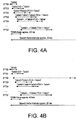
- FIGs 4A and 4B illustrate exemplary time charts that depict the queuing and Abis interface transmission delay, according to the present invention, associated with packets transferred from the router to the base station controller when speech frames are received over each of a plurality of time slots and when SID update frames are received over one of a plurality of time slots, respectively.
- the queuing and Abis interface transmission delay is denoted "Tabis".
- Tabis is a function of, for example, the speech activity, time slot number (TS: 0 ,..., 7), the number of TRXs (x), and the existence of an active call using any given time slot (since some channels may be inactive).
- each of the x transceivers depicted in Figure 3 are in an active speech state (i.e., they are receiving speech information).
- each packet transferred from the transceivers to the router over all 8 time slots are designated by the transceivers as high priority.
- the groups of packets are sequentially transferred to the base station controller (i.e., the packets for TS0 are transferred first, the packets for TS1 are transferred second, etc.).
- the transfer of the TS0 packets to the base station controller is delayed by the value Tabis0 (i.e., the queuing and Abis interface transmission delay for time slot 0).
- the delay for the TS1 packets is Tabis0 - 0.6 + Tabis1.
- the value 0.6 is the time, in milliseconds, at which the packets for the next time slot are ready for transfer in this exemplary GSM embodiment.
- the time chart illustrated in Figure 4A would also represent transmission delays for the conventional system described above with respect to Figure 2 wherein the groups of packets are sequentially transferred irrespective of the contents of the packets.
- Figure 4B illustrates the advantages of the present invention.
- the transceivers receive either speech information or the first SID frame.
- the transfer of the group of packets for time slot TS2 is delayed so that the higher priority packets received during TS3-TS7 can be immediately processed. Therefore, the higher priority packets from TS3-TS7 experience reduced delay while the lower priority packets of TS2 experience longer delays. As a result, speech processing delays are reduced.
- the extra delay due to queuing will not cause problems at the transcoder since the speech decoding process is de-coupled from the comfort noise update process. That means that the comfort noise will be updated somewhat later, which does not impact the speech quality, since the coding of the comfort noise is averaged over several 20 ms frames in the speech coder side.
- the priority assignment technique of the present invention is equally applicable to those situations where, during a single time slot, some of the transceivers receive, for example, speech information (i.e., high priority information) while others receive, for example, SID update information (i.e., lower priority information). In such situations, it is possible to delay the transfer of the lower priority packets for a specific time slot while the higher priority packets from that time slot are transferred to and processed by the base station controller.
- speech information i.e., high priority information
- SID update information i.e., lower priority information
- transceivers 1-3 receive speech information while transceivers 4 and 5 receive SID update information.
- Each transceiver forms a packet and assigns the appropriate priority information (i.e., a high priority indication for the packets formed by transceivers 1-3 and a low priority indication for the packets formed by transceivers 4 and 5).
- the transceivers transfer the packets to the router where they are stored in the queue.
- each transceiver i.e., transceivers 1-5) receives speech information.
- each transceiver forms a packet having a high priority indication.
- the router delays the transfer of the low priority packets from time slot 1 and transfers the high priority packets from time slot 2.
- the "round-trip delay" for the Abis interface is, when using 16 kbps STM, 23.85 ms for circuit-switched transmissions. This value should also be the goal when using packet-oriented transmissions.
- the distribution of the delays for the uplink and downlink will be different. For instance, it has been determined that the Tabisd (i.e., the Tabis for the downlink) should be less than 17.4 ms, but Tabisu will probably exceed 4.0 ms (see the GSM Recommendation 03.05, Version 5.0.0, November 1996, p. 16 and 17). If a symmetrical traffic load is assumed, then the Tabisu and Tabisd could be defined as 12 ms. As set forth above, the bandwidth of the Abis interface and the delay due to queuing are both factors to be considered in reaching this 12 ms goal.
- the present invention applies equally well to downlink transmissions (i.e. transmissions from the base station controller to the base transceiver station).
- the base station controller's transcoder assigns priority information to the packets transmitted to the base transceiver station. Thereafter, the base transceiver station prioritizes the transmission of the information contained in the packets over the air interface.
- the present invention provides better utilization of transmission resources due to a more efficient statistical multiplexing of the speech information. As a result, a higher payload per link or lower speech delays can be achieved. Moreover, by using separate processes in the base station controller for processing high priority packets (e.g., those packets containing speech information or the first SID frame) and low priority packets (e.g., those packets containing SID update information) speech processing delays are reduced.
- high priority packets e.g., those packets containing speech information or the first SID frame
- low priority packets e.g., those packets containing SID update information
Landscapes
- Engineering & Computer Science (AREA)
- Computer Networks & Wireless Communication (AREA)
- Signal Processing (AREA)
- Mobile Radio Communication Systems (AREA)
- Control Of Indicators Other Than Cathode Ray Tubes (AREA)
- Ultra Sonic Daignosis Equipment (AREA)
- Stereo-Broadcasting Methods (AREA)
Claims (9)
- System zum Übertragen von Paketen nach einer nicht kontinuierlichen Übertragungs-Anordnung, gekennzeichnet durch:Mittel (316) um Paketen, die einen ersten Ruhe-Deskriptor-Rahmen enthalten, der Ruhe-Deskriptor wird im Folgenden als SID bezeichnet, einen Indikator für hohe Priorität zuzuordnen:Mittel (316) um Paketen, die SID-Aktualisierungsinformationen enthalten, einen Indikator für niedrige Priorität zuzuordnen; undMittel (330) zum Übertragen der Pakete in Übereinstimmung mit den Prioritätsindikatoren.
- Das System nach Anspruch 1, wobei die Indikatoren für hohe und niedrige Priorität durch einen Sendeempfänger (310) zugeordnet werden.
- Das System nach Anspruch 1, wobei das Mittel zum Übertragen ein Router (314) ist.
- Das System gemäß der Ansprüche 1 - 3. weiter bestehend aus:einer Warteschlange (318) zum Speichern der Pakete vor der Übertragung; undMittel (315) zum Bestimmen einer Reihenfolge der Übertragung der Pakete auf der Grundlage der Prioritätsindikatoren.
- Das System gemäß der Ansprüche 1 - 4, weiter bestehend aus Mitteln (316) um Paketen, die Sprachinformationen enthalten, einen Indikator für hohe Priorität zuzuordnen.
- Das System nach Anspruch 1, weiter bestehend aus:mindestens einem Sendeemptainger (310) zum Empfangen von Informationen. wobei die Informationen Sprachinformationen, einen ersten SID-Rahmen und einen SID-Aktualisierungsrahmen enthalten, und den Informationen eine Priorität zuordnen, die darauf beruht ob die Informationen Sprachinformationen, ein erster SID-Rahmen oder ein SID-Aktualisierungsrahmen sind:einem Router (314) zum Lenken der Informationen in einer Reihenfolge basierend auf der genannten Priorität: undeinem Transcoder (320) zum Verarbeiten der Informationen in einem Prozess hoher Priorität (322), wenn die Informationen Sprachinformationen oder dem ersten SID-Rahmen entsprechen, und zum Verarbeiten der Informationen in einem Prozess niedriger Priorität (324), wenn die Informationen dem SID-Alaualisierungsrahmen entsprechen.
- Das System nach Anspruch 6, wobei der Prozess hoher Priorität und der Prozess niedriger Priorität separate Prozesse sind.
- Das System nach Anspruch 6, wobei der Transcoder (320) sich aus zwei Transcodern zusammensetzt. einer zum Durchführen des Prozesses hoher Priorität und einer zum Durchführen des Prozesses niedriger Priorität.
- Das System nach Anspruch 1, bestehend aus:einer Basisstation-Steuerung (315), um Informationen einen Prioritätsindikator zuzuordnen und zum Übertragen der Informationen zusammen mit dem Prioritätsindikator, wobei Sprachinformationen mit einem höheren Prioritätsindikator versehen werden und SID-Aktualisierungsinfomiationen mit einem niedrigeren Prioritätsindikator versehen werden; undeiner Basis-Sendeempfänger-Station (310) zum Empfangen der Informationen und des Prioritätsindikators und zum Übertragen der Informationen an eine mobile Station (100) in einer Reihenfolge auf der Grundlage der Prioritätsindikatoren.
Applications Claiming Priority (3)
| Application Number | Priority Date | Filing Date | Title |
|---|---|---|---|
| US09/268,751 US6519260B1 (en) | 1999-03-17 | 1999-03-17 | Reduced delay priority for comfort noise |
| US268751 | 1999-03-17 | ||
| PCT/SE2000/000434 WO2000056094A1 (en) | 1999-03-17 | 2000-03-03 | Reduced delay priority for comfort noise |
Publications (2)
| Publication Number | Publication Date |
|---|---|
| EP1159839A1 EP1159839A1 (de) | 2001-12-05 |
| EP1159839B1 true EP1159839B1 (de) | 2006-06-21 |
Family
ID=23024308
Family Applications (1)
| Application Number | Title | Priority Date | Filing Date |
|---|---|---|---|
| EP00919197A Expired - Lifetime EP1159839B1 (de) | 1999-03-17 | 2000-03-03 | Priorität mit reduzierter verzögerung für hintergrundrauschen |
Country Status (8)
| Country | Link |
|---|---|
| US (1) | US6519260B1 (de) |
| EP (1) | EP1159839B1 (de) |
| CN (1) | CN1121802C (de) |
| AT (1) | ATE331399T1 (de) |
| AU (1) | AU3990700A (de) |
| DE (1) | DE60028945T2 (de) |
| WO (1) | WO2000056094A1 (de) |
| ZA (1) | ZA200107285B (de) |
Families Citing this family (42)
| Publication number | Priority date | Publication date | Assignee | Title |
|---|---|---|---|---|
| US5949017A (en) * | 1996-06-18 | 1999-09-07 | Abb Power T&D Company Inc. | Electrical transformers containing electrical insulation fluids comprising high oleic acid oil compositions |
| US6493338B1 (en) | 1997-05-19 | 2002-12-10 | Airbiquity Inc. | Multichannel in-band signaling for data communications over digital wireless telecommunications networks |
| US6690681B1 (en) | 1997-05-19 | 2004-02-10 | Airbiquity Inc. | In-band signaling for data communications over digital wireless telecommunications network |
| US6069882A (en) * | 1997-07-30 | 2000-05-30 | Bellsouth Intellectual Property Corporation | System and method for providing data services using idle cell resources |
| US7046643B1 (en) * | 1997-07-30 | 2006-05-16 | Bellsouth Intellectual Property Corporation | Method for dynamic multi-level pricing for wireless communications according to quality of service |
| US7050445B1 (en) * | 1997-07-30 | 2006-05-23 | Bellsouth Intellectual Property Corporation | System and method for dynamic allocation of capacity on wireless networks |
| US7349333B2 (en) * | 1997-07-30 | 2008-03-25 | At&T Delaware Intellectual Property, Inc. | Associated systems and methods for providing data services using idle cell resources |
| FI109402B (fi) * | 1999-09-29 | 2002-07-15 | Nokia Corp | Matkaviestinjärjestelmä |
| FR1094446T (fr) * | 1999-10-18 | 2007-01-05 | Lucent Technologies Inc | Enregistrement de la parole avec compression du silence et génération de bruit de confort pour appareil de communication digitale |
| US6577862B1 (en) * | 1999-12-23 | 2003-06-10 | Ericsson Inc. | System and method for providing comfort noise in a mobile communication network |
| US6832265B1 (en) | 2000-01-07 | 2004-12-14 | Cisco Technology, Inc. | Methods and apparatus for moving data elements within a data communications device |
| US6898195B1 (en) * | 2000-05-09 | 2005-05-24 | Telefonaktiebolaget Lm Ericsson (Publ) | Method and apparatus for sustaining conversational services in a packet switched radio access network |
| US20090111457A1 (en) * | 2007-10-31 | 2009-04-30 | Raze Technologies, Inc. | Wireless communication system and device for coupling a base station and mobile stations |
| US7668176B2 (en) * | 2001-01-18 | 2010-02-23 | Alcatel-Lucent Usa Inc. | Universal mobile telecommunications system (UMTS) quality of service (QoS) supporting variable QoS negotiation |
| GB2371438B (en) * | 2001-01-19 | 2004-06-30 | Ericsson Telefon Ab L M | Telecommunications systems |
| US7941313B2 (en) * | 2001-05-17 | 2011-05-10 | Qualcomm Incorporated | System and method for transmitting speech activity information ahead of speech features in a distributed voice recognition system |
| US7031916B2 (en) * | 2001-06-01 | 2006-04-18 | Texas Instruments Incorporated | Method for converging a G.729 Annex B compliant voice activity detection circuit |
| US7203643B2 (en) * | 2001-06-14 | 2007-04-10 | Qualcomm Incorporated | Method and apparatus for transmitting speech activity in distributed voice recognition systems |
| US6829745B2 (en) * | 2001-06-28 | 2004-12-07 | Koninklijke Philips Electronics N.V. | Method and system for transforming an XML document to at least one XML document structured according to a subset of a set of XML grammar rules |
| KR100644504B1 (ko) * | 2001-08-24 | 2006-11-10 | 지멘스 악티엔게젤샤프트 | 무선통신시스템에서 데이터 패킷을 전송하기 위한 방법 |
| US7215965B2 (en) | 2001-11-01 | 2007-05-08 | Airbiquity Inc. | Facility and method for wireless transmission of location data in a voice channel of a digital wireless telecommunications network |
| US7457287B1 (en) | 2001-12-31 | 2008-11-25 | Cisco Technology, Inc. | System and method for assigning call priority |
| US8699505B2 (en) * | 2002-05-31 | 2014-04-15 | Qualcomm Incorporated | Dynamic channelization code allocation |
| US7006831B2 (en) * | 2002-09-27 | 2006-02-28 | Bellsouth Intellectual Property Corporation | Apparatus and method for providing dynamic communications network traffic control |
| US7933250B2 (en) * | 2003-06-23 | 2011-04-26 | Qualcomm Incorporated | Code channel management in a wireless communications system |
| US8072942B2 (en) * | 2003-11-26 | 2011-12-06 | Qualcomm Incorporated | Code channel management in a wireless communications system |
| US7453903B2 (en) | 2004-01-07 | 2008-11-18 | Proxim Wireless Corporation | System and method for determining priorities in a wireless network |
| US7508810B2 (en) | 2005-01-31 | 2009-03-24 | Airbiquity Inc. | Voice channel control of wireless packet data communications |
| US7770061B2 (en) * | 2005-06-02 | 2010-08-03 | Avaya Inc. | Fault recovery in concurrent queue management systems |
| US20060287003A1 (en) * | 2005-06-15 | 2006-12-21 | Kamyar Moinzadeh | Concomitant inband signaling for data communications over digital wireless telecommunications network |
| CA2609945C (en) * | 2005-06-18 | 2012-12-04 | Nokia Corporation | System and method for adaptive transmission of comfort noise parameters during discontinuous speech transmission |
| KR101336531B1 (ko) | 2006-01-25 | 2013-12-03 | 텔레폰악티에볼라겟엘엠에릭슨(펍) | 멀티-섹터, 옴니-기지국에서 결합기 손실을 감소시키는 방법 및 장치 |
| US7924934B2 (en) | 2006-04-07 | 2011-04-12 | Airbiquity, Inc. | Time diversity voice channel data communications |
| US20080287163A1 (en) * | 2007-05-17 | 2008-11-20 | Telefonaktiebolaget Lm Ericsson (Publ), | Method and apparatus for converting between a multi-sector, omni-base station configuration and a multi-sector base station configuration |
| KR101340302B1 (ko) * | 2007-08-24 | 2013-12-11 | 알까뗄 루슨트 | 리소스, 네트워크 요소 및 사용자 장비를 스케줄링하기 위한 방법 |
| MX2010003700A (es) | 2007-10-20 | 2010-04-21 | Airbiquity Inc | Se?alizacion en banda inalambrica con sistemas instalados en un vehiculo. |
| US7983310B2 (en) | 2008-09-15 | 2011-07-19 | Airbiquity Inc. | Methods for in-band signaling through enhanced variable-rate codecs |
| US8594138B2 (en) | 2008-09-15 | 2013-11-26 | Airbiquity Inc. | Methods for in-band signaling through enhanced variable-rate codecs |
| US8036600B2 (en) | 2009-04-27 | 2011-10-11 | Airbiquity, Inc. | Using a bluetooth capable mobile phone to access a remote network |
| US8418039B2 (en) | 2009-08-03 | 2013-04-09 | Airbiquity Inc. | Efficient error correction scheme for data transmission in a wireless in-band signaling system |
| US8249865B2 (en) | 2009-11-23 | 2012-08-21 | Airbiquity Inc. | Adaptive data transmission for a digital in-band modem operating over a voice channel |
| US8848825B2 (en) | 2011-09-22 | 2014-09-30 | Airbiquity Inc. | Echo cancellation in wireless inband signaling modem |
Family Cites Families (24)
| Publication number | Priority date | Publication date | Assignee | Title |
|---|---|---|---|---|
| US5130985A (en) * | 1988-11-25 | 1992-07-14 | Hitachi, Ltd. | Speech packet communication system and method |
| JPH02288520A (ja) | 1989-04-28 | 1990-11-28 | Hitachi Ltd | 背景音再生機能付き音声符号復号方式 |
| US5537509A (en) | 1990-12-06 | 1996-07-16 | Hughes Electronics | Comfort noise generation for digital communication systems |
| US5680508A (en) | 1991-05-03 | 1997-10-21 | Itt Corporation | Enhancement of speech coding in background noise for low-rate speech coder |
| US5630016A (en) | 1992-05-28 | 1997-05-13 | Hughes Electronics | Comfort noise generation for digital communication systems |
| JP2897551B2 (ja) | 1992-10-12 | 1999-05-31 | 日本電気株式会社 | 音声復号化装置 |
| CA2110090C (en) | 1992-11-27 | 1998-09-15 | Toshihiro Hayata | Voice encoder |
| SE470577B (sv) | 1993-01-29 | 1994-09-19 | Ericsson Telefon Ab L M | Förfarande och anordning för kodning och/eller avkodning av bakgrundsljud |
| US5559832A (en) | 1993-06-28 | 1996-09-24 | Motorola, Inc. | Method and apparatus for maintaining convergence within an ADPCM communication system during discontinuous transmission |
| FI97517C (fi) | 1993-09-06 | 1996-12-27 | Nokia Mobile Phones Ltd | Pakettidatan siirto digitaalisessa solukkoverkossa |
| US5521925A (en) * | 1993-09-09 | 1996-05-28 | Hughes Aircraft Company | Method and apparatus for providing mixed voice and data communication in a time division multiple access radio communication system |
| JPH07129195A (ja) | 1993-11-05 | 1995-05-19 | Nec Corp | 音声復号化装置 |
| CA2153170C (en) | 1993-11-30 | 2000-12-19 | At&T Corp. | Transmitted noise reduction in communications systems |
| JP3182032B2 (ja) | 1993-12-10 | 2001-07-03 | 株式会社日立国際電気 | 音声符号化通信方式及びその装置 |
| DE4342425A1 (de) | 1993-12-13 | 1995-06-14 | Philips Patentverwaltung | Verfahren und Anordnung zum Übertragen von Sprachsignalen |
| GB2288102B (en) * | 1994-03-23 | 1997-10-08 | Motorola Ltd | Mobile radio with transmit command control and mobile radio system |
| FR2739995B1 (fr) | 1995-10-13 | 1997-12-12 | Massaloux Dominique | Procede et dispositif de creation d'un bruit de confort dans un systeme de transmission numerique de parole |
| US5878036A (en) | 1995-12-20 | 1999-03-02 | Spartz; Michael K. | Wireless telecommunications system utilizing CDMA radio frequency signal modulation in conjunction with the GSM A-interface telecommunications network protocol |
| US5794199A (en) | 1996-01-29 | 1998-08-11 | Texas Instruments Incorporated | Method and system for improved discontinuous speech transmission |
| US5722086A (en) | 1996-02-20 | 1998-02-24 | Motorola, Inc. | Method and apparatus for reducing power consumption in a communications system |
| US5754537A (en) | 1996-03-08 | 1998-05-19 | Telefonaktiebolaget L M Ericsson (Publ) | Method and system for transmitting background noise data |
| KR100212060B1 (ko) * | 1997-03-31 | 1999-08-02 | 윤종용 | 시분할다중접속방식 통신시스템에 사용하기 위한 프레임 구조방법 |
| US6067301A (en) * | 1998-05-29 | 2000-05-23 | Cabletron Systems, Inc. | Method and apparatus for forwarding packets from a plurality of contending queues to an output |
| US6125110A (en) * | 1998-07-31 | 2000-09-26 | Motorola Inc. | Method and system for determining a packet transmission order |
-
1999
- 1999-03-17 US US09/268,751 patent/US6519260B1/en not_active Expired - Lifetime
-
2000
- 2000-03-03 WO PCT/SE2000/000434 patent/WO2000056094A1/en not_active Ceased
- 2000-03-03 DE DE60028945T patent/DE60028945T2/de not_active Expired - Lifetime
- 2000-03-03 CN CN00807701A patent/CN1121802C/zh not_active Expired - Fee Related
- 2000-03-03 AT AT00919197T patent/ATE331399T1/de not_active IP Right Cessation
- 2000-03-03 EP EP00919197A patent/EP1159839B1/de not_active Expired - Lifetime
- 2000-03-03 AU AU39907/00A patent/AU3990700A/en not_active Abandoned
-
2001
- 2001-09-03 ZA ZA200107285A patent/ZA200107285B/xx unknown
Also Published As
| Publication number | Publication date |
|---|---|
| WO2000056094A1 (en) | 2000-09-21 |
| ATE331399T1 (de) | 2006-07-15 |
| CN1351803A (zh) | 2002-05-29 |
| EP1159839A1 (de) | 2001-12-05 |
| DE60028945T2 (de) | 2007-02-08 |
| ZA200107285B (en) | 2002-11-27 |
| DE60028945D1 (de) | 2006-08-03 |
| US6519260B1 (en) | 2003-02-11 |
| CN1121802C (zh) | 2003-09-17 |
| AU3990700A (en) | 2000-10-04 |
Similar Documents
| Publication | Publication Date | Title |
|---|---|---|
| EP1159839B1 (de) | Priorität mit reduzierter verzögerung für hintergrundrauschen | |
| US5513183A (en) | Method for exploitation of voice inactivity to increase the capacity of a time division multiple access radio communications system | |
| AU744348B2 (en) | Mobile terminal and base station in a packet radio services network | |
| US6804520B1 (en) | Temporary service interruption for high speed data transfer | |
| FI105306B (fi) | Radiojärjestelmä | |
| JP3464453B2 (ja) | データ送信方法 | |
| US5299198A (en) | Method and apparatus for exploitation of voice inactivity to increase the capacity of a time division multiple access radio communications system | |
| JPH11501185A (ja) | マルチチャンネル高速データ転送方法 | |
| US20030016643A1 (en) | Simultaneous transmission of speech and data on a mobile communications system | |
| EP1142376A1 (de) | Prioritätsübertragung für verschiedene sprachformen im netzwerk-verkehr | |
| US8213343B2 (en) | Communicating conversational data between signals between terminals | |
| US8369273B2 (en) | Method and apparatus for discriminating between control messages and speech payload | |
| US20080176576A1 (en) | Fast Indication of Uplink Voice Activity | |
| US7103033B2 (en) | Robust vocoder rate control in a packet network | |
| US20060293075A1 (en) | Method to improve outer loop power control | |
| US6041230A (en) | Transmission method and a cellular radio system | |
| US7295817B2 (en) | Wireless data communication unit | |
| JP2007235932A (ja) | 無線基地局装置、無線通信システム、およびトラフィック制御方法 | |
| Wong et al. | Low delay, high quality wireless digital speech communications by shared time division duplexing | |
| Moorhead et al. | Resource allocation schemes to provide QoS for VoIP over GPRS |
Legal Events
| Date | Code | Title | Description |
|---|---|---|---|
| PUAI | Public reference made under article 153(3) epc to a published international application that has entered the european phase |
Free format text: ORIGINAL CODE: 0009012 |
|
| 17P | Request for examination filed |
Effective date: 20010725 |
|
| AK | Designated contracting states |
Kind code of ref document: A1 Designated state(s): AT BE CH CY DE DK ES FI FR GB GR IE IT LI LU MC NL PT SE |
|
| AX | Request for extension of the european patent |
Free format text: AL;LT;LV;MK;RO;SI |
|
| RAP1 | Party data changed (applicant data changed or rights of an application transferred) |
Owner name: TELEFONAKTIEBOLAGET LM ERICSSON (PUBL) |
|
| 17Q | First examination report despatched |
Effective date: 20050322 |
|
| GRAP | Despatch of communication of intention to grant a patent |
Free format text: ORIGINAL CODE: EPIDOSNIGR1 |
|
| GRAS | Grant fee paid |
Free format text: ORIGINAL CODE: EPIDOSNIGR3 |
|
| GRAA | (expected) grant |
Free format text: ORIGINAL CODE: 0009210 |
|
| AK | Designated contracting states |
Kind code of ref document: B1 Designated state(s): AT BE CH CY DE DK ES FI FR GB GR IE IT LI LU MC NL PT SE |
|
| PG25 | Lapsed in a contracting state [announced via postgrant information from national office to epo] |
Ref country code: IT Free format text: LAPSE BECAUSE OF FAILURE TO SUBMIT A TRANSLATION OF THE DESCRIPTION OR TO PAY THE FEE WITHIN THE PRESCRIBED TIME-LIMIT;WARNING: LAPSES OF ITALIAN PATENTS WITH EFFECTIVE DATE BEFORE 2007 MAY HAVE OCCURRED AT ANY TIME BEFORE 2007. THE CORRECT EFFECTIVE DATE MAY BE DIFFERENT FROM THE ONE RECORDED. Effective date: 20060621 Ref country code: NL Free format text: LAPSE BECAUSE OF FAILURE TO SUBMIT A TRANSLATION OF THE DESCRIPTION OR TO PAY THE FEE WITHIN THE PRESCRIBED TIME-LIMIT Effective date: 20060621 Ref country code: BE Free format text: LAPSE BECAUSE OF FAILURE TO SUBMIT A TRANSLATION OF THE DESCRIPTION OR TO PAY THE FEE WITHIN THE PRESCRIBED TIME-LIMIT Effective date: 20060621 Ref country code: AT Free format text: LAPSE BECAUSE OF FAILURE TO SUBMIT A TRANSLATION OF THE DESCRIPTION OR TO PAY THE FEE WITHIN THE PRESCRIBED TIME-LIMIT Effective date: 20060621 Ref country code: FI Free format text: LAPSE BECAUSE OF FAILURE TO SUBMIT A TRANSLATION OF THE DESCRIPTION OR TO PAY THE FEE WITHIN THE PRESCRIBED TIME-LIMIT Effective date: 20060621 Ref country code: LI Free format text: LAPSE BECAUSE OF FAILURE TO SUBMIT A TRANSLATION OF THE DESCRIPTION OR TO PAY THE FEE WITHIN THE PRESCRIBED TIME-LIMIT Effective date: 20060621 Ref country code: CH Free format text: LAPSE BECAUSE OF FAILURE TO SUBMIT A TRANSLATION OF THE DESCRIPTION OR TO PAY THE FEE WITHIN THE PRESCRIBED TIME-LIMIT Effective date: 20060621 |
|
| REG | Reference to a national code |
Ref country code: GB Ref legal event code: FG4D |
|
| REG | Reference to a national code |
Ref country code: CH Ref legal event code: EP |
|
| REG | Reference to a national code |
Ref country code: IE Ref legal event code: FG4D |
|
| REF | Corresponds to: |
Ref document number: 60028945 Country of ref document: DE Date of ref document: 20060803 Kind code of ref document: P |
|
| PG25 | Lapsed in a contracting state [announced via postgrant information from national office to epo] |
Ref country code: SE Free format text: LAPSE BECAUSE OF FAILURE TO SUBMIT A TRANSLATION OF THE DESCRIPTION OR TO PAY THE FEE WITHIN THE PRESCRIBED TIME-LIMIT Effective date: 20060921 Ref country code: DK Free format text: LAPSE BECAUSE OF FAILURE TO SUBMIT A TRANSLATION OF THE DESCRIPTION OR TO PAY THE FEE WITHIN THE PRESCRIBED TIME-LIMIT Effective date: 20060921 |
|
| PG25 | Lapsed in a contracting state [announced via postgrant information from national office to epo] |
Ref country code: ES Free format text: LAPSE BECAUSE OF FAILURE TO SUBMIT A TRANSLATION OF THE DESCRIPTION OR TO PAY THE FEE WITHIN THE PRESCRIBED TIME-LIMIT Effective date: 20061002 |
|
| PG25 | Lapsed in a contracting state [announced via postgrant information from national office to epo] |
Ref country code: PT Free format text: LAPSE BECAUSE OF FAILURE TO SUBMIT A TRANSLATION OF THE DESCRIPTION OR TO PAY THE FEE WITHIN THE PRESCRIBED TIME-LIMIT Effective date: 20061121 |
|
| NLV1 | Nl: lapsed or annulled due to failure to fulfill the requirements of art. 29p and 29m of the patents act | ||
| REG | Reference to a national code |
Ref country code: CH Ref legal event code: PL |
|
| ET | Fr: translation filed | ||
| PLBE | No opposition filed within time limit |
Free format text: ORIGINAL CODE: 0009261 |
|
| STAA | Information on the status of an ep patent application or granted ep patent |
Free format text: STATUS: NO OPPOSITION FILED WITHIN TIME LIMIT |
|
| 26N | No opposition filed |
Effective date: 20070322 |
|
| PG25 | Lapsed in a contracting state [announced via postgrant information from national office to epo] |
Ref country code: MC Free format text: LAPSE BECAUSE OF NON-PAYMENT OF DUE FEES Effective date: 20070331 Ref country code: IE Free format text: LAPSE BECAUSE OF NON-PAYMENT OF DUE FEES Effective date: 20070305 |
|
| PG25 | Lapsed in a contracting state [announced via postgrant information from national office to epo] |
Ref country code: GR Free format text: LAPSE BECAUSE OF FAILURE TO SUBMIT A TRANSLATION OF THE DESCRIPTION OR TO PAY THE FEE WITHIN THE PRESCRIBED TIME-LIMIT Effective date: 20060922 |
|
| PG25 | Lapsed in a contracting state [announced via postgrant information from national office to epo] |
Ref country code: LU Free format text: LAPSE BECAUSE OF NON-PAYMENT OF DUE FEES Effective date: 20070303 Ref country code: CY Free format text: LAPSE BECAUSE OF FAILURE TO SUBMIT A TRANSLATION OF THE DESCRIPTION OR TO PAY THE FEE WITHIN THE PRESCRIBED TIME-LIMIT Effective date: 20060621 |
|
| REG | Reference to a national code |
Ref country code: FR Ref legal event code: PLFP Year of fee payment: 16 |
|
| PGFP | Annual fee paid to national office [announced via postgrant information from national office to epo] |
Ref country code: DE Payment date: 20150327 Year of fee payment: 16 |
|
| PGFP | Annual fee paid to national office [announced via postgrant information from national office to epo] |
Ref country code: FR Payment date: 20150317 Year of fee payment: 16 Ref country code: GB Payment date: 20150327 Year of fee payment: 16 |
|
| REG | Reference to a national code |
Ref country code: DE Ref legal event code: R119 Ref document number: 60028945 Country of ref document: DE |
|
| GBPC | Gb: european patent ceased through non-payment of renewal fee |
Effective date: 20160303 |
|
| REG | Reference to a national code |
Ref country code: FR Ref legal event code: ST Effective date: 20161130 |
|
| PG25 | Lapsed in a contracting state [announced via postgrant information from national office to epo] |
Ref country code: FR Free format text: LAPSE BECAUSE OF NON-PAYMENT OF DUE FEES Effective date: 20160331 Ref country code: DE Free format text: LAPSE BECAUSE OF NON-PAYMENT OF DUE FEES Effective date: 20161001 Ref country code: GB Free format text: LAPSE BECAUSE OF NON-PAYMENT OF DUE FEES Effective date: 20160303 |