EP1161035A1 - Verfahren zur gegenseitige Übertragung von Steuerungsparametern durch einem Kommunikationsnetz - Google Patents
Verfahren zur gegenseitige Übertragung von Steuerungsparametern durch einem Kommunikationsnetz Download PDFInfo
- Publication number
- EP1161035A1 EP1161035A1 EP01401324A EP01401324A EP1161035A1 EP 1161035 A1 EP1161035 A1 EP 1161035A1 EP 01401324 A EP01401324 A EP 01401324A EP 01401324 A EP01401324 A EP 01401324A EP 1161035 A1 EP1161035 A1 EP 1161035A1
- Authority
- EP
- European Patent Office
- Prior art keywords
- modules
- distributed
- function
- information
- messages
- Prior art date
- Legal status (The legal status is an assumption and is not a legal conclusion. Google has not performed a legal analysis and makes no representation as to the accuracy of the status listed.)
- Granted
Links
- 238000012546 transfer Methods 0.000 title claims abstract description 89
- 238000000034 method Methods 0.000 title claims abstract description 45
- 238000004891 communication Methods 0.000 title claims abstract description 25
- 230000006870 function Effects 0.000 claims abstract description 403
- 238000012545 processing Methods 0.000 claims abstract description 58
- 230000004044 response Effects 0.000 claims description 186
- 230000005540 biological transmission Effects 0.000 claims description 89
- 238000000926 separation method Methods 0.000 claims description 10
- 238000010200 validation analysis Methods 0.000 claims description 6
- 230000002776 aggregation Effects 0.000 claims description 5
- 238000004220 aggregation Methods 0.000 claims description 5
- 238000010348 incorporation Methods 0.000 claims description 3
- 230000008569 process Effects 0.000 abstract description 14
- 238000004364 calculation method Methods 0.000 abstract description 8
- 238000005315 distribution function Methods 0.000 abstract 1
- 238000013459 approach Methods 0.000 description 21
- 102100026808 Mitochondrial import inner membrane translocase subunit Tim8 A Human genes 0.000 description 12
- 238000006243 chemical reaction Methods 0.000 description 5
- 238000010586 diagram Methods 0.000 description 5
- 230000009467 reduction Effects 0.000 description 5
- 238000007792 addition Methods 0.000 description 3
- 230000007246 mechanism Effects 0.000 description 3
- 241000566613 Cardinalis Species 0.000 description 2
- 102100038002 Dolichyl-diphosphooligosaccharide-protein glycosyltransferase subunit STT3A Human genes 0.000 description 2
- 101000661592 Homo sapiens Dolichyl-diphosphooligosaccharide-protein glycosyltransferase subunit STT3A Proteins 0.000 description 2
- 240000008042 Zea mays Species 0.000 description 2
- 238000011161 development Methods 0.000 description 2
- 230000002441 reversible effect Effects 0.000 description 2
- YBJHBAHKTGYVGT-ZKWXMUAHSA-N (+)-Biotin Chemical compound N1C(=O)N[C@@H]2[C@H](CCCCC(=O)O)SC[C@@H]21 YBJHBAHKTGYVGT-ZKWXMUAHSA-N 0.000 description 1
- 241000897276 Termes Species 0.000 description 1
- 230000004931 aggregating effect Effects 0.000 description 1
- 229940110602 allerest Drugs 0.000 description 1
- 230000001174 ascending effect Effects 0.000 description 1
- 230000006399 behavior Effects 0.000 description 1
- 230000002457 bidirectional effect Effects 0.000 description 1
- 230000001186 cumulative effect Effects 0.000 description 1
- 229940082150 encore Drugs 0.000 description 1
- 230000000737 periodic effect Effects 0.000 description 1
- 238000012797 qualification Methods 0.000 description 1
- 230000008707 rearrangement Effects 0.000 description 1
- FEPMHVLSLDOMQC-UHFFFAOYSA-N virginiamycin-S1 Natural products CC1OC(=O)C(C=2C=CC=CC=2)NC(=O)C2CC(=O)CCN2C(=O)C(CC=2C=CC=CC=2)N(C)C(=O)C2CCCN2C(=O)C(CC)NC(=O)C1NC(=O)C1=NC=CC=C1O FEPMHVLSLDOMQC-UHFFFAOYSA-N 0.000 description 1
Images






Classifications
-
- H—ELECTRICITY
- H04—ELECTRIC COMMUNICATION TECHNIQUE
- H04Q—SELECTING
- H04Q11/00—Selecting arrangements for multiplex systems
- H04Q11/04—Selecting arrangements for multiplex systems for time-division multiplexing
- H04Q11/0428—Integrated services digital network, i.e. systems for transmission of different types of digitised signals, e.g. speech, data, telecentral, television signals
- H04Q11/0478—Provisions for broadband connections
-
- H—ELECTRICITY
- H04—ELECTRIC COMMUNICATION TECHNIQUE
- H04L—TRANSMISSION OF DIGITAL INFORMATION, e.g. TELEGRAPHIC COMMUNICATION
- H04L12/00—Data switching networks
- H04L12/54—Store-and-forward switching systems
- H04L12/56—Packet switching systems
- H04L12/5601—Transfer mode dependent, e.g. ATM
- H04L2012/5638—Services, e.g. multimedia, GOS, QOS
- H04L2012/564—Connection-oriented
- H04L2012/5642—Multicast/broadcast/point-multipoint, e.g. VOD
Definitions
- the invention relates to data communication systems, and more precisely the transfer of control parameters through the network of communication used to transfer this data.
- a communication network is connected or connected to a set of terminal modules.
- Terminal modules are connected or interconnected by the network, and the data is transferred across the network, from the part incoming terminal modules then qualified as incoming terminal modules, towards the outgoing part of the terminal modules then qualified as terminal modules outgoing.
- These qualifications are used to facilitate understanding when refers to the direction of data transfer, it being understood that the terminal modules generally act as both incoming terminal modules for data which they transmit to the communication network, and as terminal modules outgoing for the data they receive from this network.
- the terminal modules also exchange control parameters, which typically allow supervise or control the functioning of the communication system, i.e. that of the network and / or its terminal modules. These control parameters are transferred in dedicated command messages.
- the invention relates to the mutual transfer of such control parameters. between terminal modules.
- corresponding dedicated command messages use data blocks (packets or cells) of inter-module control, which can advantageously be of variable length, such as for example cells with multiple segments.
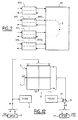
- FIG. 1 of the examples of multi-segment cells.
- the first cell shown is a three segment cell; the first marked SRT in the figure (acronym of English "self routing tag"), is the header of the cell that contains routing information; the following two segments can be used to place the command parameters to be transmitted.
- SRT synchrom of English "self routing tag"
- Each segment typically has a size 64-bit.
- S the number of segments used to place the command parameters in the cell, so that the total size of a cell for a dedicated command message is 1 + S segments and its capacity useful is S times 64 bits available for placing command parameters.
- a first classical approach is based on the point-to-point transfer of dedicated control cells, from each terminal module to each other terminal module; such point-to-point messages can only contain the or the parameters relating to a couple of terminal modules.
- command parameter' information or response
- Another classic approach is based on point-to-multipoint transfer of dedicated control cells, from each terminal module to each set of several (n) given terminal modules; such point-to-multipoint messages can then contain the command parameters relating to several (n) couples of terminal modules.
- these conventional solutions can generate a relatively large traffic of dedicated command messages, which is added to the useful data traffic between terminal modules and which can therefore constitute a network traffic overload; one of the problems encountered is therefore to minimize the impact of this additional traffic due to mutual transfers of control parameters.
- the invention proposes a solution to this problem. It allows you to perform mutual transfer of control parameters across the network, reducing significantly, compared to known solutions of the prior art, the traffic additional caused by the transfer of such control parameters.
- the processing carried out by the function distributed includes the separation of information parameters, relating to a plurality of destination terminal modules, and coming from the same module source terminal, and grouping, in at least one new message information, information parameters relating to the same terminal module recipient and coming from different source terminal modules; the process further includes the step of receiving, by each recipient module, at least an information message from each of the distributed functions with which it is associated.
- the processing performed by the function distributed includes the aggregation of information parameters relating to the same recipient terminal module, and coming from a plurality of terminal modules sources, to develop at least one aggregate parameter relating to each module recipient terminal.
- the generation and transmission step, by the distributed function includes the transmission of at least one message information to each destination terminal module with which it is associated; the process then also includes a reception step, by each terminal module recipient, of at least one information message, carrying at least one aggregated parameter, coming from each of the distributed functions to which it is associated.
- the mutual transfers of information messages between terminal modules are carried out in additionally via recipient functions; a recipient function is then assigned to a set of destination terminal modules, and to a set of distributed functions; each recipient function replaces the said set of recipient terminal modules with regard to final acceptance operations informational messages; the generation and transmission stage by the function distributed includes in this case the transmission of at least one new message information to at least one recipient function, and the method further comprises a step of reception by each recipient function of information messages, carrying at least one aggregated parameter, from distributed functions to which it is assigned.
- each response message transmitted by a destination terminal module includes, for each source terminal module, minus one individual response parameter per source terminal module; and that step of processing performed by the distributed function consists in separating, in each response message received, the individual response parameters intended for a plurality of source terminal modules, and to be grouped, in at least one same new reply message, individual reply parameters relating to a same source terminal module and coming from different terminal modules recipients.
- each response message transmitted by a module destination terminal can include at least one common response parameter identical for all source terminal modules; and the processing step performed by the distributed function consists in regrouping, in at least one same new response message, common response parameters from different recipient terminal modules.
- the method also includes mutual transfers of so-called response control parameters in messages dedicated responses, generated by each of said recipient functions and intended source terminal modules; a recipient function also replaces addressee terminal modules of said set to further perform a step development, for each of the terminal modules of this set, of at least one identical common response parameter for all source terminal modules, a step of generating at least one common response message comprising at least one common response parameter relating to each of the terminal modules recipients of this set, and a step for transmitting these messages to source terminal modules.
- a recipient function transmits at least one message from common response directly to source terminal modules and process further includes a step of receiving, by each of said terminal modules sources, common response parameters relating to a plurality of modules destination terminals, in response messages sent by each function recipient.
- said step of processing, by a distributed function, information parameters also includes a storage operation, in the distributed function, a binary indicator per source terminal module specifying whether it has received a information message from this source terminal module; in this case, said step of reception of information messages in a destination terminal module also includes a storage operation, in the terminal module recipient of a binary indicator by distributed function specifying whether it has received a information message of this distributed function; said step of generating a response message in a recipient terminal module also includes a operation of incorporating, in each response message, a binary indicator by relevant distributed function which specifies, based on indicators locally stored, if this recipient terminal module has received a message or not information from this distributed function; and said processing step, by a distributed function, response parameters, also includes a incorporation operation, in each response message intended for a module source terminal, a binary indicator
- said step of processing, by a distributed function, information parameters then also includes a setting operation memory, in the distributed function, of a binary indicator per terminal module source specifying whether it has received an information message from this terminal module source; said step of receiving information messages in a function recipient also includes a storage operation, in the recipient function, a binary indicator per distributed function specifying whether it has received an information message from this distributed function; said step of generation of a response message in a recipient function includes also an operation of incorporating, in each response message, a binary indicator by distributed function concerned which specifies, on the basis of locally stored indicators, whether or not this recipient function has received a information message from this distributed function; and said step of processing, by a distributed function, of the response parameters, includes also an embedding operation, in each response message intended to a source terminal module, a binary indicator per terminal module recipient who specifies whether each response
- the response messages which carry identical common parameters for all modules source terminals, are identical messages, and their transfer is of point-to-multipoint type when transmitted to multiple destinations.
- each source terminal module transmits in an information message of the information parameters, relating to each of the recipient terminal modules, each information parameter characterizing the volume of data traffic that a source terminal module wishes to transmit to a recipient terminal module; each recipient terminal module, or each recipient function which replaces the latter, then transmits in a message from response of the response parameters, relating to each of the terminal modules recipients, each response parameter allowing each source terminal to determine the volume of data traffic it is allowed to transmit to a recipient terminal module.
- said distributed functions are performed using additional means introduced into at least some of the terminal modules which then also act as a distributed function, and each terminal module which generates command messages to at least one distributed function, knows furthermore the identity of each terminal module which assumes the role of each function distributed data, allowing these messages to be sent to the functions distributed appropriate.
- each distributed function that generates command messages to at least one recipient function also knows the identity of each terminal module which assumes the role of each recipient function, thus making it possible to address these messages to the appropriate recipient functions.
- the invention relates to data communication systems in which control parameters are mutually transferred using dedicated command messages between terminal modules through the same communication network as data. It proposes, to reduce the overload additional traffic generated by these command messages, and for this to carry out mutual transfers of command messages via distributed functions, each of these functions being assigned to a set of source terminal modules and a set of destination terminal modules.
- FIG. 2 provides a collapsed schematic representation of a communication comprising N terminal modules (MT1 to MTn) interconnected by a switching network (RC).
- the internal configuration of the RC network is any; this network provides full accessibility to interconnect all terminal modules.
- Each terminal module generally includes a so-called incoming part, which transmits data to the communication network, and a so-called outgoing party, which receives data from this network.
- the dotted line D illustrates the case of a transfer of data transmitted by the incoming part of an MTi terminal module, denoted MTEi, and received by the outgoing part of a terminal module MTj, denoted MTSj.
- FIG. 3 provides another schematic representation of the same system of communication of FIG. 2, this time unfolded, the distinction between the parties incoming and outgoing terminal modules being shown, for each module MV terminal, by physical separation into two modules called terminal module incoming (MTE) and outgoing terminal module (MTS).
- MTE terminal module incoming
- MTS outgoing terminal module
- the dotted line I illustrates the simple case of a transfer of command message, similar to that illustrated by D in figure 2, transmitted by an incoming terminal module MTEi (i.e. the incoming part of the module MTi terminal), and received by an outgoing terminal module MTSj (i.e. the part incoming from the terminal module MTj).
- Such an order message transferred to the forward direction, called information message is transmitted by a terminal module called source (of the information message), here the incoming part of MTi (MTEi), and received by a terminal module called recipient (of the information message), here the outgoing part of MTj (MTSj).
- IMCMD a parameter representative of the volume of traffic of control messages generated by time period Tr, for each part of a terminal module, that is to say in transmission and in reception, respectively for the incoming and outgoing terminal modules mentioned above.
- This traffic volume per period Tr is noted IMCMD, and it is expressed in number of segments.
- the first classical approach mentioned above assumes the transfer point-to-point command messages containing only one parameter of command relating to a single pair of terminal modules, since in this approach each terminal module transmits a separate message to each other terminal module.
- the value of IMCMD traffic volume is equal to product of the number of terminal modules by the size of the command message expressed in number of segments.
- the command parameter is small enough to be included in the header segment containing the routing information, the cell of such a message has only one segment, and IMCMD has a value equal to the number of terminal modules, i.e. 2048 in the example above.
- the size of the command parameter requires providing a second segment in the message, IMCMD has a value double the total number of terminal modules; this assumes that the command parameter has a size less than cell segment, which is usually the case.
- the second classic approach mentioned above assumes the transfer point-to-multipoint command messages containing the parameters of command relating to several (n) pairs of modules in the same message.
- the value of the IMCMD traffic volume depends on the size (P) of the command parameter transmitted, as well as the size of the cell used for each command message, which determines the number Q of modules recipient terminals concerned in the same message.
- the additional traffic for command messages is calculated by determining the traffic needed to transfer control parameters between all possible pairs of source and destination terminal modules, for direction back and forth, and for each time period Tr.
- We can calculate separately the additional transmission control traffic (noted OVHtm / t in below) or in reception (noted OVHtm / r below). These values are expressed in proportion of the total throughput DT in transmission or reception of a terminal module - by example DT 2.4 Gb / s.
- the additional traffic volume for a receiving terminal module (OVHtm / r) is calculated in the same way.
- Calculation of the volume of additional traffic on reception (OVHtm / r) is done by considering that a dedicated command message received by a module terminal actually contains only one command parameter, which concerns it, the other parameters of the message being relative to other modules.
- each message received contains S.8 / P control parameters, but only one of these parameters concerns the destination terminal module.
- this second approach using transfers from point-to-multipoint control messages, thus allows a significant reduction additional order-to-send traffic; but it also leads to a significant, possibly excessive, increase in additional traffic in reception.
- the invention makes it possible to preserve the advantages of the second approach of the prior art, with regard to the additional transmission traffic generated by transfer of command messages, generating messages containing control parameters for several other terminal modules. She also significantly reduces additional reception traffic compared to this second approach.
- the invention proposes that the mutual transfer of control messages between terminal modules are performed through distributed intermediate processing functions messages, hereinafter called simply distributed functions. These functions are said to be intermediate, in the sense that they perform a processing through command parameters in forwarded messages between the source and destination terminal modules.
- Each source terminal module generates, for each distributed function assigned to it, at least one information message dedicated including information parameters relating to terminal modules recipients who are assigned to this distributed function.
- the messages generated are then transmitted by the source terminal module to the respective distributed functions.
- a distributed function receives information messages from source terminal modules to which it is assigned; it processes the parameters information contained in the information messages received, these parameters being relating to the destination terminal modules to which it is assigned. It generates then at least one information message containing at least one parameter information resulting from the processing carried out on the information parameters received, and then transmits this message.
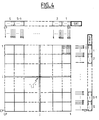
- FIG. 4 gives an example of separation and grouping of information parameters.
- Figure 4 shows an example of processing performed in a function distributed message processing intermediary according to the invention.
- the processing performed by the distributed function includes the separation information parameters relating to a plurality of terminal modules recipients and coming from the same source terminal module, and grouping, in at least one information message of a different type, parameters information relating to the same destination terminal module and coming from different source terminal modules.
- grouping, in command messages intended for functions distributed of several information parameters allows to keep the advantages the second classic approach mentioned above; moreover, at the level of distributed functions, the grouping, in the same information message, of parameters relating to a given destination terminal module makes it possible to avoid the significant increase in additional reception order traffic highlighted earlier in the analysis of the second classical approach.
- FIG. 4 illustrates the case where all the parameters concerning all of these recipient terminal modules are contained in a single information message cell transmitted by each terminal module source. The same principle can be generalized if each terminal module source passes all of these parameters into multiple message cells of information, each of these cells containing a fraction of all the parameters relating to all of these destination terminal modules to which the function distributed is affected.
- a distributed function receives, from the various terminal modules sources to which it is assigned, information messages, each containing information parameters from the source terminal module that transmitted the message, each of these parameters relating to one of the terminal modules recipients to whom the distributed function is assigned. All parameters messages received by the distributed function pass through a temporary storage represented by the square at the bottom left of figure 4. In this square, "i, j" represents the order or the index i of the module source terminal, and the index j of the destination terminal module, to which a parameter information is relative.
- This memory device has as many lines as there are columns in the illustrated example where the cardinal of all terminal modules source to which the distributed function is assigned is chosen equal to the cardinal of all the recipient terminal modules to which the distributed function is affected. It can of course be otherwise, and in this case the square in Figure 4 would be a rectangle, without the treatment otherwise differing.
- the distributed function separates the different information parameters from a source terminal module; it groups the information parameters relating to the same destination terminal module and coming from different modules source terminals.
- the function distributed written first, in each line i of the storage device, all the parameters of the information message received from each module source terminal i; then, in a second step, she reads each column j of the memory device, which contains all the parameters of the new information message intended for each recipient terminal module j, these parameters then being grouped together in a new information message shown vertically on the right side of the figure.
- the message transmitted by the distributed function is intended for the destination terminal module of index j; he can still present the structure described with reference to Figure 1, with a segment header and S segments to contain information parameters grouped together.
- the new information message transmitted by the distributed function in the example in the figure, includes the parameters relating to the terminal module j, and coming from the different source terminal modules to which the distributed function.
- the distributed function transmits the new messages resulting from the processing carried out at the respective destination terminal modules to which it is affected. So we understand that, in the forward direction, each module receiving terminal receives from the distributed function (s) assigned to it assigned new dedicated information messages, containing only (or essentially) information parameters intended for it. We thus avoid significant increase in additional reception order traffic OVHtm / r demonstrated by formula (5).
- Figures 5 and 6 give possible examples of the choice of modularity and the assignment of distributed functions.
- Figure 5 shows a representation schematic of a configuration in the forward direction of the distributed functions of the invention.
- MV terminal modules are grouped into groups called TSUG groups (acronym for "Terminal Switching Unit Group"). These groups are at number of t, and are denoted TSUG1 to TSUG t, each group comprising m modules terminals; the total number of terminal modules N is therefore equal to the product of t per m.
- Figure 5 is an unfolded representation of the same type as that of the Figure 3, which separates the incoming MTE terminal modules, and the terminal modules outgoing MTS, respectively grouped into groups called incoming groups of incoming terminal modules (TSUG i1 to TSUG it) and outgoing groups of modules outgoing terminals (TSUGo1 to TSUGot).
- incoming groups of incoming terminal modules TSUG i1 to TSUG it
- TSUGo1 to TSUGot outgoing groups of modules outgoing terminals
- each MTE is a source terminal module which transmits to each distributed function at least one information message in which or in which are grouped information parameters relating to MTSs which are terminal modules recipients of the outgoing group to which the function is assigned.
- a function distributed receives these messages from all source terminal modules. She separates the parameters and groups them together as explained with reference to FIG. 4, and retransmits to each of the destination terminal modules to which it is affected, new informational messages. Each new message can understand information parameters from various terminal modules sources and relating to the only recipient terminal module for which the message is intended.
- the traffic of command messages processed by an intermediate function may become too important in certain large capacity configurations.
- ICDF1 / 1 to ICDF1 / K and ICDFt / 1 to ICDFt / K assigned respectively to the groups of destination terminal modules TSUG1 and TSUGt.
- This configuration makes it possible to reduce the number of messages that a distributed function receives, by preventing a distributed function from having to receive messages from all of the source terminal modules.
- a distributed function would then receive the messages information from an incoming group of source terminal modules, and would transmit new messages to X outgoing groups of destination terminal modules.
- a configuration of distributed functions like that of FIG. 6, or although its inverse, can also be used to transfer messages from backward response.
- Each distributed function transmits as many information parameters as it receives; thus for each distributed function, on the assumption that the messages received and transmitted by a distributed function are of the same size, the volume of control traffic in transmission is equal to that of control traffic in reception; this value is noted in the OVHicdf suite.
- OVHicdf OVHtm.m / K
- FIGS. 7 to 11 of the invention show different configurations of distributed functions used for both types of mutual transfers of control messages, informational messages (in the forward direction) and response messages (in the return direction).
- ITM source terminal modules are represented twice, for clarity, left as an MTE when transmitting informational messages and right as an MTS when they receive messages Answer.
- each OTM destination terminal module acts as MTS for informational messages it receives functions distributed, and as an MTE for the response messages it transmits to distributed functions.
- Figure 7 shows a schematic representation of an example of setting work of the invention, to transfer, in the forward direction and in the return direction, individual control parameters per terminal module. It can be for example in the forward direction of an information parameter characterizing a request bandwidth allocation to transmit data across the network, transmitted by each source terminal module to each terminal module recipient. In the backward direction, it can for example be a parameter of response characterizing an authorized bandwidth allocation, which is determined by each of the destination terminal modules and for each of the terminal modules sources, based on its total bandwidth currently available and the various bandwidth allocation requests received from all source terminal modules.
- the processing carried out by the distributed functions in the case of FIG. 7 is of the kind of that of FIG. 4 - separation and regrouping of the information parameters in the forward direction and of the response parameters in the return direction.
- the ITM source terminal modules are grouped into TSUG groups with a cardinality of 32.
- a function is provided distributed by group of 32 source terminal modules, and by group of 32 destination terminal modules.
- the first group which includes the distributed functions referenced ICDF1 / 1 to ICDF32 / 1 in FIG.
- a distributed function ICDFi / j receives information messages from the source terminal modules ITM (32.i - 31) to ITM (32.i), and transmits new information messages to the recipient terminal modules OTM (32. d -31) to OTM (32 d ).
- a distributed function ICDFi / j receives response messages from the recipient terminal modules OTM (32.i - 31) to OTM (32.i), and transmits new information messages to the destination terminal modules ITM (32.j-31) to ITM (32d).
- Each information parameter has a size of two bytes, and each segment has a size of 64 bytes.
- An information message can therefore contain the parameters for 32 terminal modules.
- Each ITMi source terminal module therefore generates 32 information messages of 9 segments each, to the 32 functions ICDFi / j assigned to it, j varying from 1 to 32.
- Each information message contains the parameters relating to the OTM destination terminal modules (32.j-31) to OTM (32j) assigned to the distributed function of order j to which the message information is addressed.
- each ICDFi / j distributed function receives, of the 32 ITM source terminal modules (32.i - 31) to ITM (32.i) to which it is assigned, 32 informational messages of 9 segments each.
- the distributed function separates the information parameters from the received messages, and groups, in new messages, the information parameters relating to each terminal module given recipient, as explained with reference to Figure 4.
- the ICDFi / j distributed function groups together the 32 information parameters relating to the OTM recipient terminal module (1 + 32 (d-1)) in a single new message from a total size of 9 segments for each destination terminal module.
- Each distributed function therefore transmits to the destination terminal modules to which it is affected, 32 new information messages of 9 segments each.
- Each recipient terminal module receives information messages from 32 distributed functions assigned to it.
- Each of these 9 posts segments contains the information parameters from 32 terminal modules sources. This explains the size of 32 x 9 segments shown in Figure 7 for messages received by the OTM1 destination terminal module.
- a difference between the forward direction and the return direction should be noted in the example illustrated in Figure 7; it relates to the size assumed for the response parameters.
- the forward direction we have considered parameters two bytes in size.
- the backward direction we considered assuming a smaller response parameter size, i.e., a single byte.
- Response parameters transmitted by a destination terminal module to a given distributed function, relate to the 32 source terminal modules to which this distributed function is affected. These parameters can therefore be contained in a dedicated response message of 5 segments.
- the volume of traffic generated by the transfer of command messages is 32 x 9 + 32 x 5, i.e. 448 segments in transmission as in reception, for each terminal module as for each distributed function.
- FIG. 8 shows a schematic representation of the mutual transfers of control messages via the functions distributed according to the invention, using common response parameters in the return direction; in the forward direction, as in FIG. 7, the information parameters can represent a request for allocation of bandwidth for transmitting data across the network, sent by each source terminal module to each destination terminal module.
- the response parameter is common, that is to say of the same value for all the source terminal modules: it may for example be a coefficient Z indicating that, for each source terminal module, the authorized bandwidth granted to it is equal to the product of the bandwidth requested by this coefficient Z.
- This common response parameter is determined by the destination terminal module as a function of its total bandwidth currently available and of the various requests allocating bandwidth received from all source terminal modules. From the common response parameter it receives from a destination terminal module, each of the source terminal modules uses this response parameter to then determine the authorized bandwidth so that it can transmit data to the corresponding destination terminal module. , taking into account the bandwidth allocation request that he sent to him previously.
- FIG. 8 provides a mask system making it possible to check that each of the destination terminal modules receives information parameters sent by all source terminal modules.
- a mask is not useful: indeed, if a parameter information from a source terminal module is not received (for example in loss of an information message during its transfer through the network), the receiver terminal module can nevertheless transmit a response parameter individual consistent with the absence of information parameter received; in case of fault when forwarding an information message in the forward direction, or even a response message in the return direction, the behavior of the terminal module source depends only on the correct reception of this response parameter individual.
- each distributed function receives information messages from 32 modules source terminals, and the mask can simply include 32 bits, 1 bit for each source terminal module.
- the bit value for a source terminal module indicates whether an information message has been correctly received from the terminal module corresponding source.
- This first mask is stored in the distributed function to be used when receiving reply messages later.
- each terminal module recipient creates a second mask, each bit of this mask being representative a correct reception by this terminal module recipient of a message information from a distributed function.
- each module recipient terminal receives information messages from 32 distributed functions, and this second mask can simply include 32 bits, 1 bit for each distributed function.
- the bit value for a distributed function indicates whether a information message has been correctly received from the distributed function corresponding.
- This second mask is then inserted in the response message common prepared by the destination terminal module to be transmitted to distributed functions.
- the response parameters are common; in the example we have considered a common information parameter with a size of byte. To this common response parameter is added this second 32-bit mask, namely 4 bytes.
- the common response message can therefore have a size of 2 segments.
- This message is transmitted to the 32 distributed functions which are affected to the destination terminal module. There is therefore a point-to-multipoint transfer from a common response message from 2 windows by each destination terminal to 32 distributed functions, as shown in figure 8.
- a distributed function receives a common response message from each of the 32 destination terminal modules to which it is assigned; this message includes on the one hand the common response parameter and on the other hand the second mask developed by the recipient terminal module.
- the distributed function in examining the corresponding bit in the received mask, can know if the module recipient terminal from which the reply message originated correctly received the information message that it had transmitted to it in the forward direction, and can therefore find out if the recipient terminal module was able to take the parameters into account of information transmitted in the forward direction.
- the distributed function then groups together the common response parameters transmitted by the destination termination modules. For 32 terminal modules recipients that each pass a common response parameter, there are therefore 32 response parameters of one byte each, or four segments.
- the distributed function prepares a third mask to be transmitted to the modules source terminals, this third mask being developed from a part of the first mask that it developed and memorized previously during the transfer in the direction go, and on the other hand the second mask that it receives from each terminal module recipient.
- This third mask is representative of the fact that a parameter of information transmitted by a source terminal module has been correctly received by the distributed function recipient concerned, and the fact that the new message of information transmitted by this distributed function has been correctly received by the recipient terminal module.
- this third mask also makes it possible to validate the correct reception of each response message from the modules destination terminals. Since a distributed function is assigned to 32 source terminal modules, this third mask can simply have 32 bits; the entire response message therefore fits into 6 segments.
- Each source terminal module then receives a message of 6 segments of each of the 32 distributed functions assigned to it.
- Each message from a distributed function includes 32 common response parameters relating to the 32 recipient terminal modules assigned to this distributed function, and a mask, each of the 32 bits of which is representative of the integrity of the transfers mutual information parameters transmitted by this source terminal module in the forward direction and response parameters transmitted by the terminal modules recipients in the return direction.
- the volume of traffic additional command messages for each terminal module is 32 x 9 + 1 x 2, i.e. 290 segments in transmission, and 32 x 9 + 32 x 6, i.e. 480 receiving segments; for each distributed function, the message traffic of order is 32 x 9 + 1 x 6, i.e. 294 segments in transmission, and 32 x 9 + 32 x 2, or 352 segments in reception.
- the invention also allows a considerable reduction in additional reception traffic.
- the size of the common response messages transferred directly in point-to-multipoint mode by each destination terminal module to all source terminal modules is of 2 segments. So the volume of additional traffic from control messages for each terminal module is still 32 x 9 + 1 x 2, i.e. 290 segments in transmission, but of 32 x 9 + 1024 x 2, or 2336 segments in reception; for each distributed function, command message traffic is only 32 x 9, i.e. 288 segments in transmission and reception.
- FIG. 9 shows a schematic representation of mutual transfers of control messages via the functions distributed according to the invention, using information parameters aggregated in the forward direction and common response parameters in the backward direction.
- the processing performed by the distributed function includes the aggregation of information parameters relating to the same module destination terminal, and coming from a plurality of source terminal modules, to develop at least one global parameter, called aggregate, relating to each module recipient terminal.
- each information parameter represents as preceding a request for bandwidth allocation for transmit data across the network, sent by each terminal module source to each destination terminal module
- each distributed function may not transmit to a recipient terminal module that the sum of the requests of bandwidth allocation formulated by source terminal modules to which it is assigned, or that the mean and / or standard deviation of these requests.
- each recipient terminal module may as well develop a common response parameter taking into account the aggregated values of bandwidth allocation requests, only based on individual values bandwidth allocation requests as mentioned above.
- Each source terminal module therefore transmits, as in the case of Figure 8, 32 information messages from 9 segments to the 32 functions distributed to him.
- Each distributed function receives information messages from 32 source terminal modules. It separates the information parameters relating to a same recipient terminal module, and from these parameters, elaborates at least an aggregate global parameter relating to this destination terminal module; as explained above, it can be for example a summation, or a calculation of the average of the individual values of information parameters received.
- Each distributed function then transmits to the 32 terminal modules recipients to whom it is assigned new information messages including the respective aggregated parameters thus developed.
- the aggregated parameter has a size of two bytes, like the information parameters transmitted by the source terminal modules.
- the new ones messages transmitted by the function distributed to each of the 32 modules can therefore be informational messages of a size of two segments.
- Each distributed function can also, as in the embodiment of FIG. 8, develop and memorize a first mask representative of the correct reception of the information parameter transmitted by each source terminal module.
- Each recipient terminal module receives from each of the 32 distributed functions assigned to it an information message transmitting the aggregated parameter developed by the distributed function. From the parameters received from the 32 distributed functions assigned to it, each module recipient terminal can develop a common response parameter, as in the case of FIG. 8, as well as a second mask representative of the reception correct aggregate information parameter transmitted by each distributed function.
- the destination terminal modules can then directly transfer these common information parameters in point-to-multipoint mode to all source terminal modules.
- the volume of the additional traffic of command messages for each terminal module is 32 x 9 + 1 x 2, or 290 segments in transmission, and 32 x 2 + 32 x 6, or 256 receiving segments; for each distributed function, the message traffic of order is 32 x 2 + 1 x 6, i.e. 70 segments in transmission, and 32 x 9 + 32 x 2, or 352 windows on reception.
- the invention also allows a considerable reduction in additional reception traffic.
- the size of common response messages transferred in point-to-point mode by each function distributed to the modules source terminals is 5 segments instead of 6. So the traffic volume additional command messages for each terminal module is still 32 x 9 + 1 x 2, i.e. 290 segments in transmission, but 32 x 2 + 32 x 5, i.e. 224 receiving segments; for each distributed function, the message traffic of order is 32 x 2 + 1 x 5, i.e. 69 segments in transmission, and 32 x 9 + 32 x 2, or 352 segments in reception.
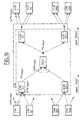
- Figure 10 shows a schematic representation of mutual transfers control messages via functions distributed according to the invention, using common response parameters in the backward direction as in the case of Figures 8 and 9, but in the case where the control processes recipients, made by the recipient terminal modules in the figures above 7 to 9, are here performed by a so-called recipient function, each recipient function being responsible for processing these recipient order processes for a given group of destination terminal modules.
- the embodiment in Figure 10 is based on the finding that the recipient process of develop, for each recipient terminal module, a response parameter common does not necessarily have to be done locally in the terminal module corresponding recipient; alternatively this process can be outsourced and take place in a so-called recipient function which is assigned for this task to a given group of destination terminal modules.
- the term "function”, here used for recipient functions is independent of the hardware realization of the function, namely in the form of server modules intermediaries connected to the network and dedicated by distributed function, or else form of additional means added to certain terminal modules which act then also as an intermediate function.
- a plurality of recipient functions are provided, each being assigned to a set of destination terminal modules, and a set of functions distributed.
- a recipient function is provided by group of 32 destination terminal modules assigned to a set of 32 distributed functions.
- a function intermediate ICDFi / j is assigned to 32 ITM source terminal modules (32.i - 31) to ITM (32.i), and transmits informational messages to a recipient function FDGMTj.
- the indices i and j are whole and vary between 1 and 32.
- a recipient function FDGMTj is assigned to 32 intermediate functions ICDFi / j, i varying from 1 to 32, and is assigned to 32 recipient terminal modules OTM (32.j-31) to OTM (32d).
- Each recipient function knows the parameters premises of the destination terminal modules to which it is assigned, and may Consequently, in place of each of these recipient modules, the recipient processes of calculations necessary to develop parameters of common response from the aggregated information parameters developed and transmitted by intermediate functions.
- an intermediate function is assigned to a group of recipient terminal modules which are represented for this task by a recipient function acting in their place to carry out these ordering processes recipients.
- Each source terminal module transmits, as in the realization of figures 7, 8 or 9, information messages to the 32 functions intermediaries assigned to it.
- Each intermediate function receives messages from 32 modules source terminals to which it is assigned; it treats the parameters received as in the case of Figure 9, by developing aggregated parameters for each recipient terminal module. Unlike the case of Figure 9, instead of transmitting the global parameters for the 32 destination terminal modules to which it is assigned, the intermediate function then transmits a new information message containing these 32 global parameters, to the recipient function assigned to it to represent this group of 32 destination terminal modules. New corresponding message can then have a total size of 9 segments, in the case where the global parameters have a size of 2 bytes.
- a recipient function receives, from each of the 32 intermediate functions, aggregated parameters relating to the 32 destination terminal modules that it represented.
- the recipient function can develop each of the 32 common response parameters, this recipient order process being similar to that developed in the case of Figure 9; each common response parameter relating to a terminal module recipient can, as in the previous example, have a size of 1 byte.
- the recipient function can also develop a second mask representative of a correct reception of information messages from the 32 functions intermediaries. Such a mask, as in the previous cases, has a size of 32 bits.
- the recipient function transmits, in point-to-multipoint to all the intermediate functions assigned to it, a response message including common response parameters calculated for the 32 destination terminal modules, as well as the second mask.
- This message has a size of 6 segments, i.e. a header segment, four segments to transport the 32 bytes of common response parameters and a segment to transport the 4 mask bytes.
- Each intermediary function receives this response message from the recipient function representing the 32 recipient terminal modules to which she is affected. It then has the common response parameters for each destination terminal modules, and the second associated mask. So she can proceed as explained with reference to figure 8, and transmit in point-to-multipoint mode to all the source terminal modules to which it is assigned, the common response parameters relating to these 32 destination terminal modules.
- each source terminal module receives from the 32 functions assigned to it, the common response parameters, and the masks, as explained with reference to FIG. 8.
- the additional traffic volume of control messages for each terminal module is 32 x 9, i.e. 288 segments in transmission, and 32 x 6, or 192 segments in reception.
- the traffic of command messages is 1 x 9 + 1 x 6, i.e. 15 segments in transmission, and 32 x 9 + 1 x 6, i.e. 294 segments in reception.
- the control message traffic is 6 segments in transmission, and 32 x 9, i.e. 288 segments in reception.
- Figure 11 shows a schematic representation similar to that of Figure 10, but without using masks; in the embodiment of FIG. 11, we do not create a mask in the forward direction in the intermediate functions, nor in recipient functions; in the backward direction, the response parameters are then directly transmitted in point-to-multipoint mode from the recipient functions to all source terminal modules.
- the size of these common response messages in this case are 5 segment messages, since no mask is transmitted.
- the volume of traffic additional command messages for each terminal module is 32 x 9, or 288 segments in transmission, and 32 x 5, or 160 segments in reception.
- the traffic of control messages is 1 x 9 segments in transmission, and 32 x 9 or 288 segments in reception.
- control message traffic is 1 x 5 segments in transmission, and 32 x 9 or 288 segments in reception.
- a first solution to implement the distributed functions consists in use a software solution in a processor (microprocessor, a microcontroller or other).
- a software solution involves associating with processor an input / output interface adapted to the protocol for transmitting command messages (information in the forward direction).
- the processing comprises a step of separating the parameters transmitted by the incoming terminal modules MTE, then a step of grouping these parameters according to the module outgoing MTS terminal to which they relate.
- the processor receives these messages and stores command parameters in a data table (of information in the forward direction) which they contain. Each location of this data table corresponds to an order parameter "i, j", i representing the order or the index of an MTE from which a message is received (source terminal module in the direction go), and j representing the index of an MTS to which a message is transmitted (module destination terminal in the forward direction).
- the processor groups the command parameters of order j stored in the data table to successively assemble each new message command to transmit.
- the processing comprises the separation of control parameters (information in the forward direction) from messages received, a step of grouping these parameters according to the MTS (recipient terminal module in the forward direction), and a step of calculating a aggregate global parameter relating to this MTS.
- equivalent treatment may consist in calculating each aggregated parameter gradually upon receipt of each command message.
- the processor manages a data table whose each location corresponds to a current aggregated parameter of order "j", j representing the index of an MTS to which a message is transmitted (terminal module recipient in the forward direction).
- the processor updates the data table by selecting each aggregated current parameter of order "j stored in the data table, by adding the value of this current parameter with the value of each control parameter (information in the forward direction) of order j, then by memorizing the result of this addition as the new value of the current aggregated parameter of order j.
- the processor After receiving the different messages from command, the processor has, in each location of the table data, the value of each aggregated parameter of order j, which it uses to successively generate each new command message to be transmitted.
- the processor To generate each new message to be transmitted, the processor prepares the header segment by placing the appropriate routing information therein, that is, in the forward direction, the address of the destination terminal module, or in the case of FIG. 10 or 11, the address of the recipient function, and in the return direction, the address of the source terminal module (s); command parameters to forward are placed in the following segments of the new message.
- the appropriate routing information that is, in the forward direction, the address of the destination terminal module, or in the case of FIG. 10 or 11, the address of the recipient function, and in the return direction, the address of the source terminal module (s); command parameters to forward are placed in the following segments of the new message.
- Such a software solution is simple to implement, but may not be sufficient fast for very short periods Tr, for example of the order of a millisecond.
- FIG. 12 shows a hardware implementation diagram of a function distributed, in the event that the treatment is a separation and grouping of parameters. Such a material realization makes it possible to obtain shorter treatment times, for applications using a large number of messages to be processed during very short periods Tr.
- the device of the FIG. 12 is now described for the processing of the information parameters in the direction to go.
- This device has a serial / parallel input register 1, which receives on a serial input for information messages from the terminal modules sources and which outputs the segments of the message on a parallel output.
- the header segment is supplied to a message receiving controller 3, while the following segments containing the information parameters are provided at the entry of the message storage and conversion device 5.
- the reception of message 3 has the function of controlling the writing of parameters received in the storage and conversion device 5, as shown schematically by the write validation arrow 7.
- the message storage and conversion device 5 is a memory optimized for the processing performed by the distributed function, having an input parallel and a parallel output, but in which the writing is done according to a line of memory, while reading is done according to a column of the memory.
- a write operation global for all S segments of a message containing parameters an alternative solution consists for example in performing a write operation for each segment received; for each write operation of the parameters of a message, the message reception controller 3 determines the address of the memory required according to the address of the terminal module which transmitted the message.
- the parameters contained in the messages generated by the different source terminal modules are placed in identical order - for example the order increasing identities of recipient terminal modules - just enter the parameters of each message received in the device line directly memory 5 corresponding to the source terminal module of order i which transmitted the message, to then be able to read directly, in each column of the device memory, the parameters relating to a destination terminal module of order j given to forward in a new information message.
- the device of FIG. 12 also comprises a controller for message transmission 9; this controller has the function of controlling, for each new information message to be transmitted, reading, in the device storage and conversion 5, of the information parameters contained in the column of the memory corresponding to the destination terminal module concerned, as shown diagrammatically in FIG. 12 by the arrow 11 for validation of reading.
- the message transmission controller 9 also generates header segment containing the routing information according to the identity of the module destination terminal corresponding to the column read, as symbolized by the arrow 13.
- the multiplexer 15 which receives on the one hand the content of the column read in memory and conversion device 5, and on the other hand the header segment generated by the message transmission controller 9, outputs the content the new message that is applied to a parallel entry in an output register 17 with parallel input and serial output. The output of this register provides the ready message at transmission.
- Figure 13 shows a hardware implementation diagram of a function distributed, in case the processing is an aggregation processing, for example summation, information parameters.
- the processing is an aggregation processing, for example summation, information parameters.
- FIG. 12 we use typically a serial / parallel input register 20, an input register serial / parallel 21, a message reception controller 22, and a message transmission 23.
- the parameters contained in the messages generated by the different modules source terminals are placed in identical order, for example ascending order identities of recipient terminal modules. Summons may be performed by calculating each aggregated parameter gradually during the receipt of each command message.
- the summation of parameters 24 of FIG. 13, which stores Q parameter values aggregated current of order "j", j representing the index of a destination terminal module.
- the corresponding adder 25j receives, on a first input, the parallel output 26j of the input register 20 and, on a second input, the parallel output 27j of the summation register 25, and it outputs the result of the addition which is connected to the parallel input 28j of the register 24 corresponding to this parameter.
- the register of summation of parameters 24 contains the final values of each of the Q aggregated parameters of order j.
- the message transmission controller 23 controls the generation of new information messages to be transmitted, associating one or more aggregated parameters of register 24 with a header segment containing the routing information according to the identity of the module recipient terminal concerned (or in the case of Figure 10 or 11, the address of the recipient function), each new assembled message being provided at the input of the parallel / series output register 21.
- Other embodiments are possible using a reduced number of adder (or even a single adder), a given adder being used successively for several parameters during the receiving a message.
- the present invention is not limited to the examples and modes described and represented, but it is likely to be numerous variants accessible to those skilled in the art.
- the messages received by the function distributed from the source terminal modules, and the messages transmitted by the function distributed to the destination terminal modules have exactly the same structure. This is not essential for setting up work of the invention, and one could imagine for example a number of segments different.
Landscapes
- Engineering & Computer Science (AREA)
- Computer Networks & Wireless Communication (AREA)
- Data Exchanges In Wide-Area Networks (AREA)
- Computer And Data Communications (AREA)
- Air Bags (AREA)
- Communication Control (AREA)
- Coating With Molten Metal (AREA)
Applications Claiming Priority (2)
| Application Number | Priority Date | Filing Date | Title |
|---|---|---|---|
| FR0006696A FR2809559B1 (fr) | 2000-05-25 | 2000-05-25 | Procede de transferts mutuels de parametres de commande a travers un reseau de communication |
| FR0006696 | 2000-05-25 |
Publications (2)
| Publication Number | Publication Date |
|---|---|
| EP1161035A1 true EP1161035A1 (de) | 2001-12-05 |
| EP1161035B1 EP1161035B1 (de) | 2007-03-07 |
Family
ID=8850611
Family Applications (1)
| Application Number | Title | Priority Date | Filing Date |
|---|---|---|---|
| EP01401324A Expired - Lifetime EP1161035B1 (de) | 2000-05-25 | 2001-05-21 | Verfahren zur wechselseitigen Übertragung von Steuerungsparametern durch ein Kommunikationsnetz |
Country Status (7)
| Country | Link |
|---|---|
| US (1) | US7290062B2 (de) |
| EP (1) | EP1161035B1 (de) |
| AT (1) | ATE356496T1 (de) |
| AU (1) | AU6247301A (de) |
| DE (1) | DE60127028T2 (de) |
| FR (1) | FR2809559B1 (de) |
| WO (1) | WO2001091405A2 (de) |
Families Citing this family (9)
| Publication number | Priority date | Publication date | Assignee | Title |
|---|---|---|---|---|
| US6983138B1 (en) * | 1997-12-12 | 2006-01-03 | Richard J. Helferich | User interface for message access |
| TWI229276B (en) * | 2003-07-23 | 2005-03-11 | Tatung Co | Protocol method of reusable hardware IP |
| GB2418269B (en) * | 2004-09-15 | 2010-07-21 | Tatung Co Ltd | Reusable hardware IP protocol method for a system-on-chip device |
| US20090157909A1 (en) * | 2007-12-14 | 2009-06-18 | Pitney Bowes Inc. | Configurable method for connecting one or more devices to a media process system |
| US8727123B1 (en) | 2011-03-11 | 2014-05-20 | Larry Roberts | Suspension packaging assembly |
| US9150343B2 (en) | 2011-03-11 | 2015-10-06 | Larry Roberts | Suspension packaging assembly |
| USD706136S1 (en) | 2012-03-12 | 2014-06-03 | Larry Roberts | Suspension packaging |
| US10252135B1 (en) | 2014-10-27 | 2019-04-09 | Larry Roberts | Exercise assembly |
| US11938372B1 (en) | 2014-10-27 | 2024-03-26 | Larry Roberts | Exercise assembly |
Family Cites Families (7)
| Publication number | Priority date | Publication date | Assignee | Title |
|---|---|---|---|---|
| US5164938A (en) * | 1991-03-28 | 1992-11-17 | Sprint International Communications Corp. | Bandwidth seizing in integrated services networks |
| US5528605A (en) * | 1991-10-29 | 1996-06-18 | Digital Equipment Corporation | Delayed acknowledgement in an asymmetric timer based LAN communications protocol |
| US5822523A (en) * | 1996-02-01 | 1998-10-13 | Mpath Interactive, Inc. | Server-group messaging system for interactive applications |
| US6321270B1 (en) * | 1996-09-27 | 2001-11-20 | Nortel Networks Limited | Method and apparatus for multicast routing in a network |
| US6067567A (en) * | 1997-02-20 | 2000-05-23 | International Business Machines Corporation | Message distribution capability which uses distribution nodes to collect acknowledgements for a primary node |
| US6721334B1 (en) * | 1999-02-18 | 2004-04-13 | 3Com Corporation | Method and apparatus for packet aggregation in packet-based network |
| US6990070B1 (en) * | 1999-12-17 | 2006-01-24 | Nortel Networks Limited | Method and apparatus for adjusting packet transmission volume from a source |
-
2000
- 2000-05-25 FR FR0006696A patent/FR2809559B1/fr not_active Expired - Fee Related
-
2001
- 2001-05-21 WO PCT/FR2001/001555 patent/WO2001091405A2/fr not_active Ceased
- 2001-05-21 AT AT01401324T patent/ATE356496T1/de not_active IP Right Cessation
- 2001-05-21 EP EP01401324A patent/EP1161035B1/de not_active Expired - Lifetime
- 2001-05-21 AU AU62473/01A patent/AU6247301A/en not_active Abandoned
- 2001-05-21 US US10/276,253 patent/US7290062B2/en not_active Expired - Fee Related
- 2001-05-21 DE DE60127028T patent/DE60127028T2/de not_active Expired - Lifetime
Non-Patent Citations (3)
| Title |
|---|
| BOLOT J C ET AL: "DYNAMICAL BEHAVIOR OF RATE-BASED FLOW CONTROL MECHANISMS1", COMPUTER COMMUNICATIONS REVIEW,US,ASSOCIATION FOR COMPUTING MACHINERY. NEW YORK, vol. 20, no. 2, 1 April 1990 (1990-04-01), pages 35 - 49, XP000133726, ISSN: 0146-4833 * |
| CHO K -H ET AL: "SUPERVISORY RATE-BASED FLOW CONTROL OF ATM NETWORKS FOR ABR SERVICES", IEICE TRANSACTIONS ON COMMUNICATIONS,JP,INSTITUTE OF ELECTRONICS INFORMATION AND COMM. ENG. TOKYO, vol. E81-B, no. 6, 1 June 1998 (1998-06-01), pages 1269 - 1271, XP000788976, ISSN: 0916-8516 * |
| PEJHAN S ET AL: "REFINEMENTS TO RATE-BASED FLOW CONTROL WITH EXTENSIONS TO MULTIDROP APPLICATIONS", GB,LONDON, CHAPMAN AND HALL, 1 April 1996 (1996-04-01), pages 147 - 160, XP000702576, ISBN: 0-412-75970-5 * |
Also Published As
| Publication number | Publication date |
|---|---|
| FR2809559B1 (fr) | 2002-08-16 |
| DE60127028T2 (de) | 2007-11-08 |
| EP1161035B1 (de) | 2007-03-07 |
| WO2001091405A2 (fr) | 2001-11-29 |
| FR2809559A1 (fr) | 2001-11-30 |
| US20040024895A1 (en) | 2004-02-05 |
| WO2001091405A3 (fr) | 2002-03-14 |
| US7290062B2 (en) | 2007-10-30 |
| AU6247301A (en) | 2001-12-03 |
| ATE356496T1 (de) | 2007-03-15 |
| DE60127028D1 (de) | 2007-04-19 |
Similar Documents
| Publication | Publication Date | Title |
|---|---|---|
| EP2320603B1 (de) | Kommunikationssystem in einem flugzeug | |
| EP1507374B1 (de) | Verfahren und Vorrichtung zur Prioritätsverwaltung während der Übertragung einer Nachricht. | |
| CA2206737C (fr) | Architecture en reseau de machine informatique | |
| EP0609137B1 (de) | Umwandlungsvorrichtung zwischen Asynchronen- und Synchronen Übertragungsverfahren | |
| EP0084389B1 (de) | Datenübertragungseinrichtung und Nachrichtennetzwerk mit präventiver Massnahme zur Fehlerbeseitigung | |
| EP2263353A1 (de) | Verfahren zur bestimmung eines punkt-zu-mehrpunkt-baums als verbindung eines wurzelknotens mit mehreren blattknoten | |
| FR2773294A1 (fr) | Architecture de reseau d'interconnexion a etages multiples evolutive et procede pour effectuer une extension en service de celle-ci | |
| FR2758036A1 (fr) | Commutateur a mode de transfert asynchrone de cellule de plusieurs canaux d'entree a plusieurs canaux de sortie | |
| EP0112953B1 (de) | Verfahren zur dynamischen Zuweisung von Geschwindigkeiten in einem Multiplexübertragungssystem | |
| EP1161035B1 (de) | Verfahren zur wechselseitigen Übertragung von Steuerungsparametern durch ein Kommunikationsnetz | |
| WO1993007694A1 (fr) | Procede d'allocation de ressources par reservation anticipee dans un reseau satellite a integration de services | |
| FR3065302A1 (fr) | Procede de generation et de controle de trafic de test, port d'entree ou de sortie de commutateur et commutateur associes | |
| FR2769778A1 (fr) | Procede de securisation de la transmission de cellules d'un systeme de telecommunication | |
| FR2659513A1 (fr) | Installation terminale d'abonne pour reseau asynchrone. | |
| EP1557767A1 (de) | Verfahren und System zur Nachrichtenübertragung in einem Verbindungsnetzwerk | |
| EP1788760A1 (de) | System und statisches Paketdatenflusswegeleitverfahren in einem Verbindungsnetzwerk | |
| FR2939992A1 (fr) | Procede d'equilibrage de la latence dans un arbre de communication, dispositif, produit programme d'ordinateur et moyen de stockage correspondants | |
| EP0689371A1 (de) | Kommunikationssystem mit einem Netz und einer Multiplexeinheit | |
| WO2001006702A1 (fr) | Procede de realisation d'une transaction electronique utilisant plusieurs signatures | |
| EP0587468A2 (de) | Photonisches Verbindungsnetz mit Rundschreibfähigkeit | |
| FR2625858A1 (fr) | Procede et dispositif de commutation d'un paquet de donnees | |
| FR2774242A1 (fr) | Systeme et procede de commutation asynchrone de cellules composites, et modules de port d'entree et de port de sortie correspondants | |
| FR2534753A1 (fr) | Systeme d'etablissement de circuits de transmission de donnees a debit constant entre une pluralite de stations | |
| FR2702615A1 (fr) | Réseau local. | |
| EP1355453A1 (de) | Anlage zur zentralisierten Schaltung und Leitweglenkung |
Legal Events
| Date | Code | Title | Description |
|---|---|---|---|
| PUAI | Public reference made under article 153(3) epc to a published international application that has entered the european phase |
Free format text: ORIGINAL CODE: 0009012 |
|
| AK | Designated contracting states |
Kind code of ref document: A1 Designated state(s): AT BE CH CY DE DK ES FI FR GB GR IE IT LI LU MC NL PT SE TR |
|
| AX | Request for extension of the european patent |
Free format text: AL;LT;LV;MK;RO;SI |
|
| 17P | Request for examination filed |
Effective date: 20020605 |
|
| AKX | Designation fees paid |
Free format text: AT BE CH CY DE DK ES FI FR GB GR IE IT LI LU MC NL PT SE TR |
|
| GRAP | Despatch of communication of intention to grant a patent |
Free format text: ORIGINAL CODE: EPIDOSNIGR1 |
|
| GRAS | Grant fee paid |
Free format text: ORIGINAL CODE: EPIDOSNIGR3 |
|
| GRAA | (expected) grant |
Free format text: ORIGINAL CODE: 0009210 |
|
| AK | Designated contracting states |
Kind code of ref document: B1 Designated state(s): AT BE CH CY DE DK ES FI FR GB GR IE IT LI LU MC NL PT SE TR |
|
| PG25 | Lapsed in a contracting state [announced via postgrant information from national office to epo] |
Ref country code: AT Free format text: LAPSE BECAUSE OF FAILURE TO SUBMIT A TRANSLATION OF THE DESCRIPTION OR TO PAY THE FEE WITHIN THE PRESCRIBED TIME-LIMIT Effective date: 20070307 Ref country code: FI Free format text: LAPSE BECAUSE OF FAILURE TO SUBMIT A TRANSLATION OF THE DESCRIPTION OR TO PAY THE FEE WITHIN THE PRESCRIBED TIME-LIMIT Effective date: 20070307 Ref country code: NL Free format text: LAPSE BECAUSE OF FAILURE TO SUBMIT A TRANSLATION OF THE DESCRIPTION OR TO PAY THE FEE WITHIN THE PRESCRIBED TIME-LIMIT Effective date: 20070307 Ref country code: IE Free format text: LAPSE BECAUSE OF FAILURE TO SUBMIT A TRANSLATION OF THE DESCRIPTION OR TO PAY THE FEE WITHIN THE PRESCRIBED TIME-LIMIT Effective date: 20070307 |
|
| REG | Reference to a national code |
Ref country code: GB Ref legal event code: FG4D Free format text: NOT ENGLISH |
|
| REG | Reference to a national code |
Ref country code: CH Ref legal event code: EP |
|
| RAP2 | Party data changed (patent owner data changed or rights of a patent transferred) |
Owner name: ALCATEL LUCENT |
|
| REF | Corresponds to: |
Ref document number: 60127028 Country of ref document: DE Date of ref document: 20070419 Kind code of ref document: P |
|
| REG | Reference to a national code |
Ref country code: IE Ref legal event code: FG4D Free format text: LANGUAGE OF EP DOCUMENT: FRENCH |
|
| NLT2 | Nl: modifications (of names), taken from the european patent patent bulletin |
Owner name: ALCATEL LUCENT Effective date: 20070404 |
|
| GBT | Gb: translation of ep patent filed (gb section 77(6)(a)/1977) |
Effective date: 20070516 |
|
| PG25 | Lapsed in a contracting state [announced via postgrant information from national office to epo] |
Ref country code: SE Free format text: LAPSE BECAUSE OF FAILURE TO SUBMIT A TRANSLATION OF THE DESCRIPTION OR TO PAY THE FEE WITHIN THE PRESCRIBED TIME-LIMIT Effective date: 20070607 |
|
| PG25 | Lapsed in a contracting state [announced via postgrant information from national office to epo] |
Ref country code: ES Free format text: LAPSE BECAUSE OF FAILURE TO SUBMIT A TRANSLATION OF THE DESCRIPTION OR TO PAY THE FEE WITHIN THE PRESCRIBED TIME-LIMIT Effective date: 20070618 |
|
| PG25 | Lapsed in a contracting state [announced via postgrant information from national office to epo] |
Ref country code: PT Free format text: LAPSE BECAUSE OF FAILURE TO SUBMIT A TRANSLATION OF THE DESCRIPTION OR TO PAY THE FEE WITHIN THE PRESCRIBED TIME-LIMIT Effective date: 20070807 |
|
| NLV1 | Nl: lapsed or annulled due to failure to fulfill the requirements of art. 29p and 29m of the patents act | ||
| REG | Reference to a national code |
Ref country code: IE Ref legal event code: FD4D |
|
| BERE | Be: lapsed |
Owner name: ALCATEL Effective date: 20070531 |
|
| PLBE | No opposition filed within time limit |
Free format text: ORIGINAL CODE: 0009261 |
|
| STAA | Information on the status of an ep patent application or granted ep patent |
Free format text: STATUS: NO OPPOSITION FILED WITHIN TIME LIMIT |
|
| REG | Reference to a national code |
Ref country code: CH Ref legal event code: PL |
|
| PG25 | Lapsed in a contracting state [announced via postgrant information from national office to epo] |
Ref country code: MC Free format text: LAPSE BECAUSE OF NON-PAYMENT OF DUE FEES Effective date: 20070531 Ref country code: DK Free format text: LAPSE BECAUSE OF FAILURE TO SUBMIT A TRANSLATION OF THE DESCRIPTION OR TO PAY THE FEE WITHIN THE PRESCRIBED TIME-LIMIT Effective date: 20070307 |
|
| 26N | No opposition filed |
Effective date: 20071210 |
|
| PG25 | Lapsed in a contracting state [announced via postgrant information from national office to epo] |
Ref country code: LI Free format text: LAPSE BECAUSE OF NON-PAYMENT OF DUE FEES Effective date: 20070531 Ref country code: CH Free format text: LAPSE BECAUSE OF NON-PAYMENT OF DUE FEES Effective date: 20070531 |
|
| PG25 | Lapsed in a contracting state [announced via postgrant information from national office to epo] |
Ref country code: BE Free format text: LAPSE BECAUSE OF NON-PAYMENT OF DUE FEES Effective date: 20070531 |
|
| PG25 | Lapsed in a contracting state [announced via postgrant information from national office to epo] |
Ref country code: GR Free format text: LAPSE BECAUSE OF FAILURE TO SUBMIT A TRANSLATION OF THE DESCRIPTION OR TO PAY THE FEE WITHIN THE PRESCRIBED TIME-LIMIT Effective date: 20070608 |
|
| PG25 | Lapsed in a contracting state [announced via postgrant information from national office to epo] |
Ref country code: CY Free format text: LAPSE BECAUSE OF FAILURE TO SUBMIT A TRANSLATION OF THE DESCRIPTION OR TO PAY THE FEE WITHIN THE PRESCRIBED TIME-LIMIT Effective date: 20070307 |
|
| PG25 | Lapsed in a contracting state [announced via postgrant information from national office to epo] |
Ref country code: LU Free format text: LAPSE BECAUSE OF NON-PAYMENT OF DUE FEES Effective date: 20070521 |
|
| PG25 | Lapsed in a contracting state [announced via postgrant information from national office to epo] |
Ref country code: TR Free format text: LAPSE BECAUSE OF FAILURE TO SUBMIT A TRANSLATION OF THE DESCRIPTION OR TO PAY THE FEE WITHIN THE PRESCRIBED TIME-LIMIT Effective date: 20070307 |
|
| PGFP | Annual fee paid to national office [announced via postgrant information from national office to epo] |
Ref country code: GB Payment date: 20140521 Year of fee payment: 14 |
|
| REG | Reference to a national code |
Ref country code: FR Ref legal event code: GC Effective date: 20140717 |
|
| PGFP | Annual fee paid to national office [announced via postgrant information from national office to epo] |
Ref country code: FR Payment date: 20140527 Year of fee payment: 14 Ref country code: IT Payment date: 20140529 Year of fee payment: 14 Ref country code: DE Payment date: 20140521 Year of fee payment: 14 |
|
| REG | Reference to a national code |
Ref country code: FR Ref legal event code: RG Effective date: 20141016 |
|
| REG | Reference to a national code |
Ref country code: FR Ref legal event code: CA Effective date: 20150521 |
|
| REG | Reference to a national code |
Ref country code: FR Ref legal event code: CA Effective date: 20150521 |
|
| REG | Reference to a national code |
Ref country code: DE Ref legal event code: R119 Ref document number: 60127028 Country of ref document: DE |
|
| GBPC | Gb: european patent ceased through non-payment of renewal fee |
Effective date: 20150521 |
|
| PG25 | Lapsed in a contracting state [announced via postgrant information from national office to epo] |
Ref country code: IT Free format text: LAPSE BECAUSE OF NON-PAYMENT OF DUE FEES Effective date: 20150521 |
|
| REG | Reference to a national code |
Ref country code: FR Ref legal event code: ST Effective date: 20160129 |
|
| PG25 | Lapsed in a contracting state [announced via postgrant information from national office to epo] |
Ref country code: DE Free format text: LAPSE BECAUSE OF NON-PAYMENT OF DUE FEES Effective date: 20151201 Ref country code: GB Free format text: LAPSE BECAUSE OF NON-PAYMENT OF DUE FEES Effective date: 20150521 |
|
| PG25 | Lapsed in a contracting state [announced via postgrant information from national office to epo] |
Ref country code: FR Free format text: LAPSE BECAUSE OF NON-PAYMENT OF DUE FEES Effective date: 20150601 |