EP1161435B1 - Verfahren zur herstellung eines formoxysilans - Google Patents
Verfahren zur herstellung eines formoxysilans Download PDFInfo
- Publication number
- EP1161435B1 EP1161435B1 EP00912552A EP00912552A EP1161435B1 EP 1161435 B1 EP1161435 B1 EP 1161435B1 EP 00912552 A EP00912552 A EP 00912552A EP 00912552 A EP00912552 A EP 00912552A EP 1161435 B1 EP1161435 B1 EP 1161435B1
- Authority
- EP
- European Patent Office
- Prior art keywords
- catalyst
- silane
- compound
- formula
- solvent
- Prior art date
- Legal status (The legal status is an assumption and is not a legal conclusion. Google has not performed a legal analysis and makes no representation as to the accuracy of the status listed.)
- Expired - Lifetime
Links
Images

Classifications
-
- C—CHEMISTRY; METALLURGY
- C07—ORGANIC CHEMISTRY
- C07F—ACYCLIC, CARBOCYCLIC OR HETEROCYCLIC COMPOUNDS CONTAINING ELEMENTS OTHER THAN CARBON, HYDROGEN, HALOGEN, OXYGEN, NITROGEN, SULFUR, SELENIUM OR TELLURIUM
- C07F7/00—Compounds containing elements of Groups 4 or 14 of the Periodic Table
- C07F7/02—Silicon compounds
- C07F7/08—Compounds having one or more C—Si linkages
- C07F7/18—Compounds having one or more C—Si linkages as well as one or more C—O—Si linkages
- C07F7/1804—Compounds having Si-O-C linkages
- C07F7/1872—Preparation; Treatments not provided for in C07F7/20
- C07F7/188—Preparation; Treatments not provided for in C07F7/20 by reactions involving the formation of Si-O linkages
Definitions
- the invention relates to a method for producing a Formoxysilane according to the preamble of claim 1 or 2.
- Hydrosylation of carbon dioxide offers the following advantages: carbon dioxide is non-toxic and therefore ecologically harmless; it is also unrivaled inexpensive as a C 1 substrate. Economic advantages can be achieved in particular if a more cost-effective catalyst is found that can be recycled if necessary.
- the invention is therefore based on the object for the method a simpler, easy to manufacture of the type mentioned and thus to find cheaper catalyst that in is accessible on a large scale and has high activity and product selectivity having.
- the catalyst is said to be suitable Procedures can be recyclable.
- R represents an organic or inorganic substituent, preferably an alkyl, alkenyl, aryl, aryloxy group or a halide or R 1 R 2 R 3 SiO radical, where R 1 , R 2 and R 3 are another organic or is an inorganic substituent.
- the index n can take integer values from 0 to 3, preferably 2 or 3.
- ruthenium trichloride (RuCl 3 .xH 2 O) is used as the catalyst.
- an acyloxysilane is placed in a solvent, the catalyst is added and carbon dioxide is injected.
- the reaction temperature should be in the range of 20 ° C to 120 ° C. Pressures in the range from 1 bar to 200 bar are suitable as the carbon dioxide partial pressure; the reaction time is between 0.5 h and 50 h.
- a catalyst of the transition metal is used, which is formed by reacting a halide of the transition metal with a nitrile in the presence of the silane of the formula R n SiH 4-n .
- a preformed catalyst which is prepared from a silane and one of the abovementioned catalysts, preferably ruthenium trichloride.
- the preforming is preferably carried out without pressure.
- the silane and the catalyst preferably RuCl 3 .xH 2 O, can be dissolved in a solvent, for example in acetonitrile, and the solution heated under reflux.
- a preforming forms a catalytically particularly effective compound with the empirical formula C 24 H 36 Cl 6 N 12 Ru 3 .
- the preformed catalyst has the advantage that the temperature the subsequent hydrosilylation, which is given under the Carbon partial pressure is carried out much lower than can be chosen in the first embodiment.
- a solution of the silane can thus placed in a solvent and with the catalyst, especially with ruthenium trichloride, at the specified temperature be transferred.
- carbon dioxide is injected without further cleaning and the reactor while stirring the reactor contents to a temperature heated from 30 ° C to 100 ° C.
- the response time is in generally between 1 and 40 hours.
- the reactor is then cooled, relaxed if necessary and the reaction product isolated by distillation, rectification or extraction.
- Suitable solvents are nitriles, benzoid aromatic compounds, Halogenated hydrocarbons or their mixtures.
- nitriles nitriles, benzoid aromatic compounds, Halogenated hydrocarbons or their mixtures.
- Solvent used for low-boiling products; this has the advantage that the arising Products separated directly from the reaction mixture by distillation can be and the residue that the catalyst contains, can be used for further implementations.
- the yields of products of the formula R n Si [OC (O) H] 4-n depend in particular on the type of catalyst used and the substituents R of the silane. In the best case, almost quantitative yields, based on the silane used, are obtained.
- the TON turn over number , number of reactions per catalyst atom
- the TOF turn over frequency , number of reactions per hour
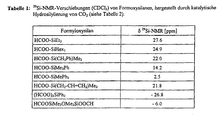
- Table 1 shows the 29 Si NMR shifts of the reaction products (CDCl 3 ). The test conditions are listed in Table 2.
- Table 2 shows reaction parameters for the synthesis of formoxysilanes by catalytic hydrosilylation of carbon dioxide.
Landscapes
- Chemical & Material Sciences (AREA)
- Organic Chemistry (AREA)
- Chemical Kinetics & Catalysis (AREA)
- Low-Molecular Organic Synthesis Reactions Using Catalysts (AREA)
Description
Claims (4)
- Verfahren zur Herstellung eines Formoxysilans, bei dem ein Silan der Formel RnSiH4-n, wobei R einen organischen oder anorganischen Substituenten und n = 0, 1, 2 oder 3 darstellt, in einem Lösungsmittel in Gegenwart eines Katalysators bestehend aus einer Ruthenium-Verbindung mit Kohlendioxid umgesetzt wird,
dadurch gekennzeichnet, daß
als Katalysator Rutheniumtrichlorid eingesetzt wird. - Verfahren zur Herstellung eines Formoxysilans, bei dem ein Silan der Formel RnSiH4-n, wobei R einen organischen oder anorganischen Substituenten und n = 0, 1, 2 oder 3 darstellt, in einem Lösungsmittel in Gegenwart eines Katalysators bestehend aus einer Verbindung eines Übergangsmetalls der Nebengruppe VIIIb des Periodischen Systems mit Kohlendioxid umgesetzt wird,
dadurch gekennzeichnet, daß
als Katalysator eine Verbindung des Übergangsmetalls eingesetzt wird, die durch Umsetzung eines Halogenids des Übergangsmetalls mit einem Nitril in Gegenwart des Silans der Formel RnSiH4-n gebildet wird. - Verfahren nach einem der Ansprüche 1 oder 2,
dadurch gekennzeichnet, daß
pro Äquivalent der Si-H - Gruppe 1/10 bis 1/5000 Äquivalente des Katalysators, bezogen auf das Äquivalent des Übergangsmetalls, eingesetzt werden. - Verfahren nach einem der Ansprüche 1 oder 2,
dadurch gekennzeichnet, daß
als Lösungsmittel ein Nitril, ein benzoider Aromat und/oder ein Halogenkohlenwasserstoff eingesetzt wird.
Applications Claiming Priority (3)
| Application Number | Priority Date | Filing Date | Title |
|---|---|---|---|
| DE19911616A DE19911616C1 (de) | 1999-03-15 | 1999-03-15 | Verfahren zur Herstellung eines Formyloxysilans |
| DE19911616 | 1999-03-15 | ||
| PCT/EP2000/001933 WO2000055163A1 (de) | 1999-03-15 | 2000-03-06 | Verfahren zur herstellung eines formoxysilans |
Publications (2)
| Publication Number | Publication Date |
|---|---|
| EP1161435A1 EP1161435A1 (de) | 2001-12-12 |
| EP1161435B1 true EP1161435B1 (de) | 2002-11-27 |
Family
ID=7901119
Family Applications (1)
| Application Number | Title | Priority Date | Filing Date |
|---|---|---|---|
| EP00912552A Expired - Lifetime EP1161435B1 (de) | 1999-03-15 | 2000-03-06 | Verfahren zur herstellung eines formoxysilans |
Country Status (6)
| Country | Link |
|---|---|
| US (1) | US6518446B1 (de) |
| EP (1) | EP1161435B1 (de) |
| JP (1) | JP3622002B2 (de) |
| AT (1) | ATE228523T1 (de) |
| DE (2) | DE19911616C1 (de) |
| WO (1) | WO2000055163A1 (de) |
Families Citing this family (1)
| Publication number | Priority date | Publication date | Assignee | Title |
|---|---|---|---|---|
| KR101913109B1 (ko) | 2009-03-18 | 2018-10-31 | 리스버로직스 코퍼레이션 | 신규한 소염제 |
Family Cites Families (3)
| Publication number | Priority date | Publication date | Assignee | Title |
|---|---|---|---|---|
| US5013854A (en) * | 1989-02-02 | 1991-05-07 | Eli Lilly And Company | Process for preparing acid halides |
| DE19545093A1 (de) * | 1995-12-04 | 1997-06-05 | Basf Ag | Dialkoxydiformoxysilane, ein Verfahren zu ihrer Herstellung sowie ihre Verwendung |
| JP4222662B2 (ja) * | 1998-09-14 | 2009-02-12 | ダウ・コ−ニング・コ−ポレ−ション | Si−C結合を介してケイ素原子に結合した官能基を有するアシロキシシラン化合物の製造方法 |
-
1999
- 1999-03-15 DE DE19911616A patent/DE19911616C1/de not_active Expired - Fee Related
-
2000
- 2000-03-06 JP JP2000605592A patent/JP3622002B2/ja not_active Expired - Fee Related
- 2000-03-06 WO PCT/EP2000/001933 patent/WO2000055163A1/de not_active Ceased
- 2000-03-06 EP EP00912552A patent/EP1161435B1/de not_active Expired - Lifetime
- 2000-03-06 AT AT00912552T patent/ATE228523T1/de not_active IP Right Cessation
- 2000-03-06 DE DE50000830T patent/DE50000830D1/de not_active Expired - Lifetime
- 2000-03-06 US US09/936,716 patent/US6518446B1/en not_active Expired - Fee Related
Also Published As
| Publication number | Publication date |
|---|---|
| JP3622002B2 (ja) | 2005-02-23 |
| EP1161435A1 (de) | 2001-12-12 |
| US6518446B1 (en) | 2003-02-11 |
| DE50000830D1 (de) | 2003-01-09 |
| DE19911616C1 (de) | 2000-08-17 |
| ATE228523T1 (de) | 2002-12-15 |
| JP2002539215A (ja) | 2002-11-19 |
| WO2000055163A1 (de) | 2000-09-21 |
Similar Documents
| Publication | Publication Date | Title |
|---|---|---|
| DE68919530T2 (de) | Verfahren und Zwischenprodukte für die Herstellung von Bis(aminoalkyl)polydiorganosiloxanen. | |
| DE69516438T2 (de) | Verfahren zur Herstellung von chlororganischen Silizium-Verbindungen | |
| DE69015912T2 (de) | Organosilanverbindungen. | |
| DE69107031T2 (de) | Thexyl-trialkoxysilane, Verfahren zur Herstellung und deren Verwendung. | |
| EP0177454B1 (de) | Silane, Verfahren zu deren Herstellung und deren Verwendung | |
| DE3020446C2 (de) | ||
| EP2550281B1 (de) | Silaoxacyclen | |
| DE1127898B (de) | Verfahren zur Herstellung von ª‰-Cyanaethylphenyldichlorsilan | |
| DE3702631C2 (de) | Verfahren zur Herstellung primärer Aminosiloxane | |
| DE69110839T2 (de) | Silanverbindung und Verfahren zu deren Herstellung. | |
| EP0003514A1 (de) | Verfahren zur Addition von Dialkylhalogenhydrogensilanen an ungesättigte Kohlenwasserstoffverbindungen und die erhaltenen Silane | |
| EP0823434A1 (de) | Verfahren zur kontinuierlichen Herstellung von 3-Halogen-Propyl-Organosilanen | |
| EP1161435B1 (de) | Verfahren zur herstellung eines formoxysilans | |
| DE69130433T2 (de) | Verfahren zur Herstellung von Cyclopentyl-trichlorosilan | |
| DE69219719T2 (de) | Silanverbindung und Verfahren zur deren Herstellung | |
| DE60127202T2 (de) | Organosiliziumverbindungen | |
| EP0806427A2 (de) | Verfahren zur Herstellung von vinylierten Silicium-organischen Verbindungen | |
| DE69311213T2 (de) | Verfahren zur Herstellung von 1-Aza-2-silacyclopentan-Verbindungen | |
| WO1988005778A1 (fr) | Procede pour la fabrication d'oximosilanes | |
| CH661928A5 (de) | Verfahren zur herstellung funktionell substituierter silane. | |
| DE69930733T2 (de) | Herstellung von substituierten (amino)alkoxysilanen | |
| DE69103388T2 (de) | Thexyl-(C1-C4)alkyl-dialkoxysilane, Verfahren zur Herstellung und deren Verwendung. | |
| DD270915A5 (de) | Verfahren zur herstellung von bis-silyl-substituierten cyclepentadienen | |
| EP3577123B1 (de) | Verfahren zur herstellung von aminopropylalkoxysilanen | |
| DE69907094T2 (de) | Organosiliziumverbindungen und deren Herstellung |
Legal Events
| Date | Code | Title | Description |
|---|---|---|---|
| PUAI | Public reference made under article 153(3) epc to a published international application that has entered the european phase |
Free format text: ORIGINAL CODE: 0009012 |
|
| 17P | Request for examination filed |
Effective date: 20010720 |
|
| AK | Designated contracting states |
Kind code of ref document: A1 Designated state(s): AT BE CH CY DE DK ES FI FR GB GR IE IT LI LU MC NL PT SE |
|
| GRAG | Despatch of communication of intention to grant |
Free format text: ORIGINAL CODE: EPIDOS AGRA |
|
| 17Q | First examination report despatched |
Effective date: 20020228 |
|
| GRAG | Despatch of communication of intention to grant |
Free format text: ORIGINAL CODE: EPIDOS AGRA |
|
| GRAH | Despatch of communication of intention to grant a patent |
Free format text: ORIGINAL CODE: EPIDOS IGRA |
|
| GRAH | Despatch of communication of intention to grant a patent |
Free format text: ORIGINAL CODE: EPIDOS IGRA |
|
| GRAA | (expected) grant |
Free format text: ORIGINAL CODE: 0009210 |
|
| AK | Designated contracting states |
Kind code of ref document: B1 Designated state(s): AT BE CH CY DE DK ES FI FR GB GR IE IT LI LU MC NL PT SE |
|
| PG25 | Lapsed in a contracting state [announced via postgrant information from national office to epo] |
Ref country code: IT Free format text: LAPSE BECAUSE OF FAILURE TO SUBMIT A TRANSLATION OF THE DESCRIPTION OR TO PAY THE FEE WITHIN THE PRESCRIBED TIME-LIMIT;WARNING: LAPSES OF ITALIAN PATENTS WITH EFFECTIVE DATE BEFORE 2007 MAY HAVE OCCURRED AT ANY TIME BEFORE 2007. THE CORRECT EFFECTIVE DATE MAY BE DIFFERENT FROM THE ONE RECORDED. Effective date: 20021127 Ref country code: FI Free format text: LAPSE BECAUSE OF FAILURE TO SUBMIT A TRANSLATION OF THE DESCRIPTION OR TO PAY THE FEE WITHIN THE PRESCRIBED TIME-LIMIT Effective date: 20021127 Ref country code: IE Free format text: LAPSE BECAUSE OF FAILURE TO SUBMIT A TRANSLATION OF THE DESCRIPTION OR TO PAY THE FEE WITHIN THE PRESCRIBED TIME-LIMIT Effective date: 20021127 Ref country code: GR Free format text: LAPSE BECAUSE OF FAILURE TO SUBMIT A TRANSLATION OF THE DESCRIPTION OR TO PAY THE FEE WITHIN THE PRESCRIBED TIME-LIMIT Effective date: 20021127 |
|
| REF | Corresponds to: |
Ref document number: 228523 Country of ref document: AT Date of ref document: 20021215 Kind code of ref document: T |
|
| REG | Reference to a national code |
Ref country code: GB Ref legal event code: FG4D Free format text: NOT ENGLISH |
|
| REG | Reference to a national code |
Ref country code: CH Ref legal event code: EP |
|
| REG | Reference to a national code |
Ref country code: CH Ref legal event code: NV Representative=s name: ROTTMANN, ZIMMERMANN + PARTNER AG |
|
| REG | Reference to a national code |
Ref country code: IE Ref legal event code: FG4D Free format text: GERMAN |
|
| REF | Corresponds to: |
Ref document number: 50000830 Country of ref document: DE Date of ref document: 20030109 |
|
| PG25 | Lapsed in a contracting state [announced via postgrant information from national office to epo] |
Ref country code: DK Free format text: LAPSE BECAUSE OF FAILURE TO SUBMIT A TRANSLATION OF THE DESCRIPTION OR TO PAY THE FEE WITHIN THE PRESCRIBED TIME-LIMIT Effective date: 20030227 Ref country code: PT Free format text: LAPSE BECAUSE OF FAILURE TO SUBMIT A TRANSLATION OF THE DESCRIPTION OR TO PAY THE FEE WITHIN THE PRESCRIBED TIME-LIMIT Effective date: 20030227 Ref country code: SE Free format text: LAPSE BECAUSE OF FAILURE TO SUBMIT A TRANSLATION OF THE DESCRIPTION OR TO PAY THE FEE WITHIN THE PRESCRIBED TIME-LIMIT Effective date: 20030227 |
|
| PG25 | Lapsed in a contracting state [announced via postgrant information from national office to epo] |
Ref country code: LU Free format text: LAPSE BECAUSE OF NON-PAYMENT OF DUE FEES Effective date: 20030306 Ref country code: CY Free format text: LAPSE BECAUSE OF FAILURE TO SUBMIT A TRANSLATION OF THE DESCRIPTION OR TO PAY THE FEE WITHIN THE PRESCRIBED TIME-LIMIT Effective date: 20030306 |
|
| PG25 | Lapsed in a contracting state [announced via postgrant information from national office to epo] |
Ref country code: MC Free format text: LAPSE BECAUSE OF NON-PAYMENT OF DUE FEES Effective date: 20030331 |
|
| GBT | Gb: translation of ep patent filed (gb section 77(6)(a)/1977) |
Effective date: 20030331 |
|
| PG25 | Lapsed in a contracting state [announced via postgrant information from national office to epo] |
Ref country code: ES Free format text: LAPSE BECAUSE OF FAILURE TO SUBMIT A TRANSLATION OF THE DESCRIPTION OR TO PAY THE FEE WITHIN THE PRESCRIBED TIME-LIMIT Effective date: 20030529 |
|
| ET | Fr: translation filed | ||
| REG | Reference to a national code |
Ref country code: IE Ref legal event code: FD4D Ref document number: 1161435E Country of ref document: IE |
|
| PLBE | No opposition filed within time limit |
Free format text: ORIGINAL CODE: 0009261 |
|
| STAA | Information on the status of an ep patent application or granted ep patent |
Free format text: STATUS: NO OPPOSITION FILED WITHIN TIME LIMIT |
|
| 26N | No opposition filed |
Effective date: 20030828 |
|
| PGFP | Annual fee paid to national office [announced via postgrant information from national office to epo] |
Ref country code: NL Payment date: 20070319 Year of fee payment: 8 |
|
| PGFP | Annual fee paid to national office [announced via postgrant information from national office to epo] |
Ref country code: AT Payment date: 20070323 Year of fee payment: 8 Ref country code: BE Payment date: 20070323 Year of fee payment: 8 Ref country code: GB Payment date: 20070323 Year of fee payment: 8 |
|
| BERE | Be: lapsed |
Owner name: FORSCHUNGSZENTRUM *KARLSRUHE G.M.B.H. Effective date: 20080331 |
|
| GBPC | Gb: european patent ceased through non-payment of renewal fee |
Effective date: 20080306 |
|
| PG25 | Lapsed in a contracting state [announced via postgrant information from national office to epo] |
Ref country code: NL Free format text: LAPSE BECAUSE OF NON-PAYMENT OF DUE FEES Effective date: 20081001 Ref country code: AT Free format text: LAPSE BECAUSE OF NON-PAYMENT OF DUE FEES Effective date: 20080306 |
|
| NLV4 | Nl: lapsed or anulled due to non-payment of the annual fee |
Effective date: 20081001 |
|
| PG25 | Lapsed in a contracting state [announced via postgrant information from national office to epo] |
Ref country code: BE Free format text: LAPSE BECAUSE OF NON-PAYMENT OF DUE FEES Effective date: 20080331 |
|
| PG25 | Lapsed in a contracting state [announced via postgrant information from national office to epo] |
Ref country code: GB Free format text: LAPSE BECAUSE OF NON-PAYMENT OF DUE FEES Effective date: 20080306 |
|
| PGFP | Annual fee paid to national office [announced via postgrant information from national office to epo] |
Ref country code: CH Payment date: 20100325 Year of fee payment: 11 |
|
| PGFP | Annual fee paid to national office [announced via postgrant information from national office to epo] |
Ref country code: FR Payment date: 20100331 Year of fee payment: 11 |
|
| REG | Reference to a national code |
Ref country code: CH Ref legal event code: PFA Owner name: FORSCHUNGSZENTRUM KARLSRUHE GMBH Free format text: FORSCHUNGSZENTRUM KARLSRUHE GMBH#WEBERSTRASSE 5#76133 KARLSRUHE (DE) -TRANSFER TO- FORSCHUNGSZENTRUM KARLSRUHE GMBH#WEBERSTRASSE 5#76133 KARLSRUHE (DE) |
|
| REG | Reference to a national code |
Ref country code: CH Ref legal event code: PL |
|
| REG | Reference to a national code |
Ref country code: FR Ref legal event code: ST Effective date: 20111130 |
|
| PG25 | Lapsed in a contracting state [announced via postgrant information from national office to epo] |
Ref country code: FR Free format text: LAPSE BECAUSE OF NON-PAYMENT OF DUE FEES Effective date: 20110331 Ref country code: CH Free format text: LAPSE BECAUSE OF NON-PAYMENT OF DUE FEES Effective date: 20110331 Ref country code: LI Free format text: LAPSE BECAUSE OF NON-PAYMENT OF DUE FEES Effective date: 20110331 |
|
| PGFP | Annual fee paid to national office [announced via postgrant information from national office to epo] |
Ref country code: DE Payment date: 20120522 Year of fee payment: 13 |
|
| REG | Reference to a national code |
Ref country code: DE Ref legal event code: R119 Ref document number: 50000830 Country of ref document: DE Effective date: 20131001 |
|
| PG25 | Lapsed in a contracting state [announced via postgrant information from national office to epo] |
Ref country code: DE Free format text: LAPSE BECAUSE OF NON-PAYMENT OF DUE FEES Effective date: 20131001 |