EP1161966A2 - Procédé de signalisation pour un dispositif de stimulation cardiaque implantable et dispositif de stimulation cardiaque - Google Patents
Procédé de signalisation pour un dispositif de stimulation cardiaque implantable et dispositif de stimulation cardiaque Download PDFInfo
- Publication number
- EP1161966A2 EP1161966A2 EP01250201A EP01250201A EP1161966A2 EP 1161966 A2 EP1161966 A2 EP 1161966A2 EP 01250201 A EP01250201 A EP 01250201A EP 01250201 A EP01250201 A EP 01250201A EP 1161966 A2 EP1161966 A2 EP 1161966A2
- Authority
- EP
- European Patent Office
- Prior art keywords
- signal
- cardiac
- designed
- pulse
- trigger
- Prior art date
- Legal status (The legal status is an assumption and is not a legal conclusion. Google has not performed a legal analysis and makes no representation as to the accuracy of the status listed.)
- Granted
Links
- 230000000747 cardiac effect Effects 0.000 title claims description 140
- 230000000638 stimulation Effects 0.000 title claims description 93
- 238000000034 method Methods 0.000 title claims description 60
- 230000011664 signaling Effects 0.000 title claims description 24
- 238000002560 therapeutic procedure Methods 0.000 claims abstract description 33
- 230000004913 activation Effects 0.000 claims description 38
- 238000005259 measurement Methods 0.000 claims description 37
- 230000009849 deactivation Effects 0.000 claims description 20
- 238000012544 monitoring process Methods 0.000 claims description 18
- 238000013194 cardioversion Methods 0.000 claims description 14
- 230000001419 dependent effect Effects 0.000 claims description 10
- 238000012423 maintenance Methods 0.000 claims description 5
- 210000004165 myocardium Anatomy 0.000 claims description 3
- 238000011144 upstream manufacturing Methods 0.000 claims description 3
- 230000010287 polarization Effects 0.000 claims description 2
- 230000003213 activating effect Effects 0.000 claims 1
- 210000005241 right ventricle Anatomy 0.000 abstract description 2
- 230000004936 stimulating effect Effects 0.000 abstract 2
- 210000005245 right atrium Anatomy 0.000 abstract 1
- 230000000694 effects Effects 0.000 description 20
- 238000002565 electrocardiography Methods 0.000 description 18
- 230000002028 premature Effects 0.000 description 6
- 230000033764 rhythmic process Effects 0.000 description 6
- 206010003119 arrhythmia Diseases 0.000 description 5
- 230000008901 benefit Effects 0.000 description 5
- 238000010586 diagram Methods 0.000 description 5
- 230000000737 periodic effect Effects 0.000 description 5
- 230000003111 delayed effect Effects 0.000 description 4
- 230000006870 function Effects 0.000 description 4
- 230000001225 therapeutic effect Effects 0.000 description 4
- 238000002604 ultrasonography Methods 0.000 description 4
- 238000001514 detection method Methods 0.000 description 3
- 230000008569 process Effects 0.000 description 3
- 230000002123 temporal effect Effects 0.000 description 3
- 230000002861 ventricular Effects 0.000 description 3
- 206010011906 Death Diseases 0.000 description 2
- 230000008859 change Effects 0.000 description 2
- 238000002405 diagnostic procedure Methods 0.000 description 2
- 238000004146 energy storage Methods 0.000 description 2
- 238000011156 evaluation Methods 0.000 description 2
- 238000002513 implantation Methods 0.000 description 2
- 238000004519 manufacturing process Methods 0.000 description 2
- 230000001575 pathological effect Effects 0.000 description 2
- 238000012360 testing method Methods 0.000 description 2
- 230000001960 triggered effect Effects 0.000 description 2
- 208000010201 Exanthema Diseases 0.000 description 1
- 108091081062 Repeated sequence (DNA) Proteins 0.000 description 1
- 208000001871 Tachycardia Diseases 0.000 description 1
- 230000006793 arrhythmia Effects 0.000 description 1
- 230000009286 beneficial effect Effects 0.000 description 1
- 230000005540 biological transmission Effects 0.000 description 1
- 230000000903 blocking effect Effects 0.000 description 1
- 210000005242 cardiac chamber Anatomy 0.000 description 1
- 239000004020 conductor Substances 0.000 description 1
- 230000008878 coupling Effects 0.000 description 1
- 238000010168 coupling process Methods 0.000 description 1
- 238000005859 coupling reaction Methods 0.000 description 1
- 238000013461 design Methods 0.000 description 1
- 238000003745 diagnosis Methods 0.000 description 1
- 201000005884 exanthem Diseases 0.000 description 1
- 230000005284 excitation Effects 0.000 description 1
- 210000002837 heart atrium Anatomy 0.000 description 1
- 230000009191 jumping Effects 0.000 description 1
- 230000007774 longterm Effects 0.000 description 1
- 238000013507 mapping Methods 0.000 description 1
- 238000012806 monitoring device Methods 0.000 description 1
- 230000002107 myocardial effect Effects 0.000 description 1
- 238000001208 nuclear magnetic resonance pulse sequence Methods 0.000 description 1
- 230000001536 pro-arrhythmogenic effect Effects 0.000 description 1
- 238000012545 processing Methods 0.000 description 1
- 238000003908 quality control method Methods 0.000 description 1
- 206010037844 rash Diseases 0.000 description 1
- 230000001360 synchronised effect Effects 0.000 description 1
- 230000006794 tachycardia Effects 0.000 description 1
- 238000012549 training Methods 0.000 description 1
Images


Classifications
-
- A—HUMAN NECESSITIES
- A61—MEDICAL OR VETERINARY SCIENCE; HYGIENE
- A61N—ELECTROTHERAPY; MAGNETOTHERAPY; RADIATION THERAPY; ULTRASOUND THERAPY
- A61N1/00—Electrotherapy; Circuits therefor
- A61N1/18—Applying electric currents by contact electrodes
- A61N1/32—Applying electric currents by contact electrodes alternating or intermittent currents
- A61N1/36—Applying electric currents by contact electrodes alternating or intermittent currents for stimulation
- A61N1/372—Arrangements in connection with the implantation of stimulators
- A61N1/37211—Means for communicating with stimulators
- A61N1/37252—Details of algorithms or data aspects of communication system, e.g. handshaking, transmitting specific data or segmenting data
- A61N1/37254—Pacemaker or defibrillator security, e.g. to prevent or inhibit programming alterations by hackers or unauthorised individuals
Definitions
- the invention relates to a method for signaling an internal state of a implantable cardiac stimulation device by a value of a state quantity is defined, according to the preamble of claim 1. Furthermore, the Invention a cardiac stimulation device according to the preamble of the claim 10th
- a disadvantage of this method is that it can only be used if the natural one Heart rhythm completely overruled by using pacemaker therapy is set. Such a method cannot therefore be used with a "demand" pacemaker or cardioverter / defibrillator are used because stimulation pulses are used here are only given in situations in which the metrological monitored state of the heart this requires.
- the object of the invention is a method and a cardiac stimulation device of the type mentioned at the beginning, which do not have the disadvantages mentioned.
- the point in time at which the signal pulse is emitted to a predetermined phase of a periodically recurring sequence of events coupled An event sequence is understood to be a number of events that occur one after the other. One phase of this sequence of events is defined by a particular one of these events. The time of entry of the Phase is the time at which this particular event occurs. The time interval between the individual events the sequence of events may vary by period to period, so that the duration of the sequence of events, i.e. a period can change from time to time.
- the implementation The method according to the invention is not subject to specified boundary conditions bound with regard to the period and therefore more versatile.
- the current period is determined in the course of the execution of the procedure Step c) was measured shortly before the signal pulse was emitted.
- the Time difference between two predetermined, identical phases of successive periods certainly.
- the later of these two phases lies completely within the last passed period before delivery of the signal pulse.
- the determination of the Time of delivery of the signal pulse relative to the periodic sequence of events lie the measured time of the last occurrence of the predetermined phase, based on the measured period and the predetermined time offset.
- the predetermined, measurable pulse parameter used for signaling is a Delay in the delivery of the signal pulse compared to the occurrence of the specific one Phase of the periodic sequence of events.
- the method is preferred for an implanted cardiac stimulation device applied.
- the device is implanted in human Body is neither a sub-step nor a necessary prerequisite for implementation of the method according to the invention.
- the procedure can also apply to a non-implanted cardiac stimulation device, for example for testing purposes as part of the quality control immediately after the Manufacture or immediately before an implantation.
- the periodically recurring sequence of events can be related to the implantable Cardiac stimulation device can be internal or external. Delivery of a signal pulse can, for example, be coupled to an internal one, ie in the heart stimulation device generated, periodic clock signal whose frequency can be preset, that is is independent of the duration of a cardiac period. This frequency can also be variable his.
- the signal pulse is in temporal Relation to an external, i.e. outside of the cardiac stimulation device generated, periodically recurring sequence of events. This is about It is, for example, an external ultrasound pulse, which can be Cardiac stimulation device integrated ultrasound sensor is detected.
- the ultrasonic sensor generates a pulsed electrical corresponding to the ultrasound pulse Signal. The time difference between the same, predetermined phases of two successive phases Impulses of this electrical signal are measured and related to the time Control of the subsequent delivery of the signal pulse used.
- this is periodic recurring sequence of events linked to cardiac activity. It can be in the Sequence of events, for example around the occurrence of a defined phase of a measurement signal act that reflects the temporal course of cardiac activity. Here It is sufficient if this measurement signal only indicates the entry of a certain phase reflects the activity of the heart.
- Step c) of the method according to the invention in this context includes measuring the time difference of the same, predetermined Phases of two consecutive cardiac periods before delivery of the Signal pulse. It plays for the feasibility of the method according to the invention no matter whether the heart activity is stimulated or natural.
- the measurement of the time difference between the same, predetermined phases of two successive phases Cardiac periods are used here only to determine the time of the subsequent delivery of the signal pulse according to step d) of Procedure.
- the measurement data obtained are not used to create a medical Diagnosis of cardiac activity used, but only serve technical purposes Purposes.
- the measurement data obtained with step c) of the method can but can be used for diagnostic measures.
- measures are not related to the claimed Process that only signals the signaling of an internal technical condition Cardiac stimulation device has the content.
- Such an internal state is, for example by a value of the output voltage of an accumulator, or the electrical resistance of an electrical conductor between components of the cardiac stimulation device Are defined.
- the signaling method according to the invention in a cardiac stimulation device used to from a diagnostic procedure that is not the subject of this application, detected cardiac arrhythmias such as tachycardia to signal an external query.
- the invention Method in an on-demand pacemaker therapy trained cardiac stimulation device can be used.
- pacemaker therapy was performed at the time of signaling two cases are possible.
- the signal pulse in the Connection to cardiac stimulation pulses generated as part of pacemaker therapy submitted.
- the signal pulse is emitted in a period of time in which the heart automatically functions without therapy beats.
- the delivery of the signal pulse is in both cases outside of therapeutic measures.
- a significant advantage of the inventive method it works regardless of whether the heart activity is stimulated or natural.
- the signal pulses can be electrical current pulses via a stimulation electrode the cardiac stimulation device to the heart muscle.
- the Signal impulses are given by the pacemaker therapy Cardiac stimulation pulses can be clearly distinguished by the time of the pulse delivery. This point in time corresponds to steps c) and d) of the invention Procedure determined.
- a preferred embodiment of the method according to the invention is started, as soon as a trigger signal is present in the cardiac stimulation device. As long as If the trigger signal is not present, the process is not started.
- the production the trigger signal is preferably to an external event or an external one State change coupled.
- the trigger signal can be generated when a magnetic field or an ultrasound signal with predetermined parameters be detected at the location of the cardiac stimulation device. Such an event can, for example, the readiness of a receiver to receive the signal pulse Show.
- the signaling method is in another embodiment performed again.
- the correct one can be sent to the recipient Receipt of the signal pulse can be checked.
- a pacemaker therapy procedure promotes the repeated execution of the procedure Reliability of the correct interpretation of the signal pulse. Because the signaling the internal state of the heart stimulation device is by the time offset of the signal pulse in comparison with the time interval between two immediately preceding ones Cardiac stimulation pulses recognizable. However, a small time offset can difficult to measure and only after repeated emission of the signal pulse be clearly identifiable.
- Another exemplary embodiment of the method according to the invention is distinguished characterized in that following the delivery of the signal pulse for a predetermined Number of subsequent sequences of events no signal pulse generated becomes. If the trigger signal is present over a longer period of time, arises this way, a periodically repeated sequence of events, the predetermined number which includes periodic events and a subsequent signal pulse. This Event sequence repeats itself as long as the trigger signal is present.
- the use of this embodiment is that the signal pulse by its repetition after a regular, predetermined number of events is recognizable.
- the predetermined number of events between the signal pulses is five. External programmability of this number is preferably provided, so that they can be preset, for example, between two and twelve can be.
- the signaling method according to the invention becomes a physical quantity dependent on the phase of the cardiac cycle measured.
- An electrocardiogram is preferably recorded.
- the recording The electrocardiogram can be made with the help of separate electrodes or at an implanted cardiac stimulation device using the stimulation electrodes be included. Using an electrocardiogram can be done in known The time difference between the same phases of two consecutive cardiac periods be measured. The electrocardiogram is used for this Embodiment - as explained in detail above - no diagnostic Purposes, but only the timely predetermination of the time the delivery of the signal pulse corresponding to step d) of the invention Procedure.
- the measured value to be recorded is the state variable represents, one at the output of one arranged in the cardiac stimulation device
- Energy storage applied voltage is.
- the output voltage of the energy store is taken as a measure of its energy content. If the output voltage drops to or below a specified value over time Comparison value, a signal pulse is generated when the trigger signal is present.
- the existence of internally registered states of the energy store like "EOL" (end-of-life) or "ERI” (elective-replacement-indication) one easily accessible external detection accessible, for example in the case of a Routine control in the practice of a resident doctor.
- the involvement A specialist is only required if one of these conditions is present was actually signaled.
- a cardiac stimulation device with a pulse generator that for the generation of pulses suitable for cardiac stimulation is designed, at least one connected to the pulse generator and used to deliver the pulses trained stimulation electrode, a signal generator that with the pulse generator connected and for the generation and delivery of pulse trigger signals defined times is formed, a cardiac phase sensor, which for Recording of a first measurement value dependent on the current phase of the cardiac cycle is formed with time measuring means with the cardiac phase sensor connected and to determine a cycle time between the occurrence of a predetermined phase of a defined first cardiac cycle and the occurrence of the same phase of the immediately following, second cardiac cycle are, and with the timing equipment and on the output side with the signal generator associated timing means used to predetermined the period between the occurrence of the predetermined phase of the second cardiac cycle and the subsequent ones Generation of a pulse trigger signal are formed.
- the heart stimulation device has timing means. These receive a cycle duration signal from the time measuring means that corresponds to the duration corresponds to the last elapsed heart period.
- the duration of a cardiac period is the time difference between the Entry of a certain phase of a cardiac cycle and the entry of the same Understand phase of the immediately following cardiac cycle.
- the determination the time interval between the same phases of successive cardiac periods is, for example based on the appearance of the R-waves. Is easiest however, to measure the time interval between the Q-waves.
- the Measurement of the period is achieved when a predetermined, in present embodiment started negative voltage threshold and stopped. This method of timekeeping works reliably with both natural as well as with stimulated cardiac activity.
- the period of time is determined by the timing means predetermined from the end of the measured heart period, i.e. from the last entry the specific phase until the subsequent generation of a pulse trigger signal will pass.
- the heart stimulation device is by means of the timing means able after a stimulated as well as especially after a natural, non-stimulated cardiac activity the time of subsequent Predetermine generation of a signal pulse. Whether the cardiac period, its duration was determined with the help of the time measuring means, by a stimulated or a unstimulated, natural cardiac activity is playing for them subsequent signaling does not matter.
- a signal pulse is for cardiac stimulation suitable impulse.
- the signal pulse is preferred as a ventricular stimulation pulse educated.
- the signal pulse has the same pulse parameters as voltage and duration of the cardiac stimulation impulses customary in the context of pacemaker therapy, apart from the time of its submission.
- the signal pulse differs different from stimulation impulses due to its time offset compared to the current phase of cardiac activity.
- the time of the generation of a signal pulse is in the case of the invention Cardiac stimulation device predetermined only shortly before it is triggered. Directly after the last elapsed cardiac period, the duration of which is determined by the time measuring device For example, the time was determined based on the QQ time interval the delivery of the signal pulse calculated using the timing means.
- the time between the end of the last cardiac period, for example the last Q wave, and the time predetermined by the timing means the delivery of the signal pulse differs from the measured period by one significant, measurable time difference. In this way one can with his Delivery time is coordinated with the current cardiac period insofar as "synchronized" signal pulse are generated. Because it is of it assume that the cardiac cycle only varies from one period to the next changes insignificantly.
- the device according to the invention is therefore not based on a fixed stimulation rhythm instructed to deviate from for signaling. Rather, it fits they use the timing means to generate a signal pulse the current, possibly natural heart rhythm. This is before Of particular importance for defibrillator patients, as they are based on an asynchronous Generation of cardiac stimulation pulses respond with a cardiac arrhythmia could.
- the quasi-synchronous generation of a cardiac stimulation pulse used for signaling by the device according to the invention avoids this Risk.
- the timing means are in the heart stimulation device according to the invention trained to immediately after measuring the duration of a cardiac cycle Delivery of a signal pulse, i.e. a delayed cardiac stimulation pulse to cause.
- a signal pulse i.e. a delayed cardiac stimulation pulse to cause.
- the time offset should therefore be sufficient be great that doctors or medical staff by evaluating an EKG can identify a delayed stimulation pulse, and indeed at otherwise more natural as well as with stimulated heart activity.
- the other is Choose the time offset of the signal pulse so that the risk of triggering a Cardiac arrhythmia due to the signal pulse, if not completely avoided, nevertheless is kept particularly low. Allowing the timing of the Signal pulse to the current phase of cardiac activity, stimulated or not stimulated to avoid stimulation in a vulnerable phase is essential Advantage of the invention.
- the signal pulses are preferred as premature ventricular pacing pulses delivered.
- the timing means For a phase-coordinated delivery of the signal pulse ensure the timing means. To do this, they use the timing devices generated measured values of the period. Since the timekeeping means the Period based on the occurrence of a certain phase of cardiac activity measure, the phase position of cardiac activity is also determined with the period. Both pieces of information use the time-tuning tools for a gentle delivery of Signal pulses.
- a non-pro-arrhythmic delivery of the signal pulse is ensured if the time of its delivery the vulnerable phase of the ventricular cardiac cycle avoids.
- the vulnerable phase of the heart chambers coincides with the increasing Flank the T-wave of the EKG together.
- the information on the time offset of the signal pulse is given by the Time measuring means based on the last time the Q wave occurred.
- the value of the time offset would be different if the measurement of the cardiac period is based on another phase of cardiac activity would be.
- the phase position of the point in time determined by the information is important Delivery of the signal pulse relative to the cardiac period.
- the timing means for generating the pulse trigger signal are that for generating the signal pulse by the pulse generator leads no earlier than 300 ms before the end of the specified cycle duration the occurrence of the predetermined phase of the second cardiac cycle. This Time shift compared to the current heart rhythm is easy in the surface ECG to recognize.
- the premature cardiac stimulation pulse not earlier than 200 ms before the end of the specified cycle time generated after the occurrence of the predetermined phase of the second cardiac cycle.
- Stimulation pulses that are given off by approximately 100 to 200 ms are also easy to demonstrate on the surface ECG. To make it recognizable Ensure an early cardiac stimulation pulse on the surface ECG not later than 50 ms before the end of the specified cycle time generated after the occurrence of the predetermined phase of the second cardiac cycle become.
- Another embodiment of the device according to the invention has one the time-measuring means connected to the state sensor for recording at least one state measurement value is formed, which is based on the current value depends on a state variable of the device. It is especially thought that the state sensor is designed so that the state measured value from Energy content of an energy storage device depends. But others too Measurable state variables can be obtained from a suitably trained state sensor are detected, for example the electrical resistance of stimulation electrodes connected to the device. Also diagnostic determined states of the heart of the patient or determined pathological Events such as a cardiac arrhythmia can be measured by a condition sensor detected and signaled to the outside by the cardiac stimulation device become.
- a comparison value memory for recording is at least a comparison value is provided for the state measured value.
- the supervision the state measurement value is preferably carried out by first comparison means, the input side with the condition sensor and the comparison value memory and on the output side are connected to the timing means.
- the means of comparison are for comparing the condition measurement value with the comparison value as well for generating and delivering a status signal dependent on the comparison result educated.
- the timing means activated. Activation of the timing means takes place at a Embodiment of the invention with the aid of a monitoring unit, the input side with the first comparison means and on the output side with the timing means is connected.
- the monitoring unit compares the status signal with at least one pre-stored status setpoint interval and generates a Maintenance signal if the status signal is not included in the status setpoint interval is.
- the maintenance signal is transmitted to the timing device.
- the device is connected to the timing means Activation sensor provided.
- the activation sensor serves for recording measurement values (hereinafter activation measurement values) Activation measure. This can be a magnetic field strength, for example, how they produce common external pacemaker testers. Only if the activation sensor detects a magnetic field of a predetermined field strength in this embodiment, the timing means are activated.
- the evaluation of the measured values recorded by the activation sensor is carried out in a further embodiment with the aid of second comparison means, which is connected on the output side to the monitoring unit.
- the second center of comparison access a sample value memory.
- sample activation values can be stored. This is about are activation metrics with specific parameters that have meaning the readiness of an external receiver to receive the signal pulse assigned.
- the second comparison means compare the current activation measurement value with the pattern activation value contained in the pattern value memory. If the activation measurement value matches the sample activation value the comparison means generate a trigger signal which is generated by the Monitoring unit is received.
- the monitoring unit generates a maintenance signal only if the condition measurement value is outside its normal value range lies and at the same time the activation measurement value indicates that the one to be generated Signal pulse can be detected by an external receiver.
- the cardiac phase sensor is for recording in one embodiment a measurement signal dependent on the electrical polarization of the myocardium, preferably designed to record an electrocardiogram.
- the heart phase sensor can be provided specifically, for example in the form of a or more implanted lead electrodes. Where possible, however, are preferred the stimulation electrodes are simultaneously designed as heart phase sensors, can be used both to stimulate the heart and to receive a EKGs are used.
- a regular sequence of normal and delayed events makes it easier the identification of the signal pulse emitted by the stimulation device when evaluating a surface ECG.
- the device according to the invention with the timing means connected pacemaker control means for optional generation an activation or a deactivation signal for activation or deactivation the operation of the timing means are formed.
- the pacemaker control means are preferably connected to the cardiac phase sensor and for Activation or deactivation of the operation of the timing means for a predeterminable Number of cardiac cycles trained. The number of cardiac cycles after a signal pulse is obtained by evaluating that from the cardiac phase sensor received measurement signal determined.
- the pacemaker control means are additional in a preferred embodiment to activate the operation of the timing means for the duration of only one Cardiac cycle and trained for the immediate subsequent deactivation.
- the duration of the deactivation of the operation of the timing means is preferably between at least two and at most fifteen cardiac cycles.
- the number of cardiac cycles is between two signal pulses in one embodiment by programming the pacemaker control means can be changed externally.
- the pacemaker control means upstream of a heart monitoring unit connected to the time measuring means, to compare the measured period with at least a cycle duration setpoint interval is formed in a cycle setpoint memory is included.
- the heart monitoring unit receives the measurement signal the time measuring device, determines the period and compares it with the period duration setpoint interval.
- the heart monitoring unit in a further embodiment for generating a from Value of the deviation-dependent therapy warning signal is formed.
- the pacemaker control means are preferably for generation and transmission of the deactivation signal to the timing means as soon as it is on Therapy warning signal received from the heart monitoring unit. To this In such situations, the delivery of premature cardiac stimulation pulses becomes wise avoided, in which the heart rhythm deviates from normal values and premature Heart stimulation pulses could trigger or aggravate an arrhythmia.
- the pacemaker control means are in a further embodiment Blocking the generation of an activation signal for a defined period of time trained in the event of receipt of a therapy warning signal. In this way it is ensured that a pacemaker therapy that is primarily required does not go through the delivery of premature stimulation pulses is interrupted.
- the heart stimulation device has compared to the previously known Solutions have the advantage that they come in many different designs is feasible. Your particular advantages can be particularly with training as an "on-demand" pacemaker or integrated cardioverter defibrillator (ICD) Take effect.
- One embodiment of the invention is designed as an ICD and has a cardioversion unit, which is used to generate and deliver Define cardioversion or stimulation pulses suitable for defibrillation Points in time is formed.
- the cardioversion unit is with the pacemaker control means connected, the activation or deactivation of the cardioversion unit check.
- pacemaker control means preferably take over the coordination between Pacemaker therapy and signaling.
- the pacemaker control means are connected to the trigger unit and to the timing means and for Generation and delivery of at least one activation or deactivation signal trained on the trigger unit or the timing means.
- the delivery of activation and deactivation signals can also, for simplicity, be one of the pacemaker control means controlled switching device can be replaced, which either the Timing means or the trigger unit activated.
- the trigger unit is closed too connected in parallel with the timing means.
- the signal generator is therefore either with Help controlled via the timing means or via the trigger unit.
- the signaling pulses are in a device with integrated pacemaker functions also from the pacemaker unit for the sake of simplicity generated so that here on a specially designed for the generation of signal pulses Signal pulse generator can be dispensed with.
- Figure 1 shows a flow chart of an embodiment of the invention Signaling procedure.
- Step S10 measures the output voltage of a battery as the state variable.
- the battery is used to supply energy to an implantable cardiac stimulation device.
- Step S14 the measured output voltage compared with a target value. It goes without saying that instead of one A setpoint interval can also be used for comparison.
- Step S12 If the measured value agrees with the setpoint, the is then again Step S12 executed.
- the loop formed by steps S12 and S14 is used to monitor the battery voltage. Before rerunning of step S12 after the agreement between measured value and A setpoint can also be run through a waiting loop of predetermined duration.
- step S14 It is determined in step S14 that the measured output voltage is not included corresponds to the setpoint or setpoint interval, so in a subsequent Step S16 checks whether there is a magnetic trigger signal.
- this method step S16 is additionally between the Steps S10 and S12 carried out. That is, in this embodiment, one Measurement of the output voltage only after the magnetic trigger signal is carried out.
- step S18 ended.
- a waiting loop of longer duration can also be provided be present after the end of the presence of the magnetic trigger signal is checked.
- the magnetic trigger signal is in a known manner by hanging up a external programming and testing device for the heart stimulation device on the Chest of the patient. However, it is understood that the implantation of the Cardiac stimulation device is not a prerequisite for performing the procedure is. The trigger signal can also be detected if the Cardiac stimulation device is not implanted.
- a subsequent step S22 the point in time t A is calculated at which a signal pulse is to be generated.
- a predetermined time constant ⁇ t is used.
- ⁇ t is 100 ms.
- the sum t (Q ') + T describes the hypothetical point in time of the next occurrence of the Q wave in the event that the cardiac period remains unchanged.
- the exact time of the next Q-wave should not be determined in advance.
- an identical period of two consecutive cardiac periods represents a good assumption that is sufficiently precise for the external recognizability of the signal pulse. It is important that the sum of the occurrence of a specific cardiac phase is calculated in advance in step S22.
- the step t24 is then waited for the time t A to occur.
- a signal pulse is triggered with a step S26.
- step S28 a predetermined number n of cardiac periods waited.
- the Q phases that occur are counted up to n, before jumping back to step S16 to check again if it continues there is a magnetic trigger signal. If this is the case, then steps S20 to S28 again carried out, but there is no magnetic Trigger signal more before, the method is ended with step S18.
- FIG. 2 shows a simplified block diagram of an embodiment of the heart stimulation device according to the invention.
- This is a Integrated cardioverter / defibrillator (ICD) 10, which in addition to performing a two-chamber pacemaker therapy is formed.
- ICD 10 is shown implanted state.
- the ICD 10 has an implantable pulse generator 12 and one with it connected and implanted in a heart 14 stimulation electrode 16.
- the Stimulation electrode 16 is on the right for delivering stimulation pulses Atrium 18 and formed in the right ventricle 20.
- the pulse generator 12 has a central control unit 22. She controls coordinates and monitors the functional features of the pulse generator 12. You for this purpose receives and processes the signals and data from various measuring units.
- the control unit 22 is, on the one hand, with an electrocardiography (EKG) unit 24 connected. This takes place on the stimulation electrode 16 with the aid of two trained measuring electrodes 26 and 28 an intracardiac electrogram (IEGM) on.
- EKG electrocardiography
- IEGM intracardiac electrogram
- the measurement signal is sent to the control unit 22 for further processing. Further details are described with reference to FIG. 3. At the same time the measurement signal from the control unit controls in a region 36.1 Memory 36 are stored later for long-term evaluation if necessary to be accessed.
- control unit 22 receives signals and data from the telemetry unit 30.
- the telemetry unit 30 has a receiver 32 for magnetic Signals from an external interrogation, programming and monitoring device (not shown) on.
- a comparator circuit 34 is connected to the receiver 32 and serves to identify the detected magnetic signals. To do this the comparator circuit 34 to setpoint values stored in a memory area 36.2 and Mapping tables to. Signaled after identification of the received signal the comparator circuit 34 of the control unit 22, which functional feature the pulse generator 12 is queried externally.
- the EOL indicator 38 has a voltmeter connected to the output of battery 40 42 on.
- the battery 40 serves to supply energy to the pulse generator 12 second comparator circuit 44 is used to compare the measured output voltage of the battery 40 with one stored in a storage area 36.3 Setpoint interval. If the output voltage drops below one due to the setpoint interval predetermined lower threshold value, the EOL indicator 38 generates an EOL signal, which is transmitted to the control unit.
- a first value interval corresponds to full functionality, for example the battery
- a third value interval corresponds to an output voltage at which the Maintaining the function of the pulse generator is at risk.
- a pacemaker unit 46 is also connected to the control unit 22 and a cardioversion unit 48. These take over depending on those of the control unit 22 received control signals in a known manner Generation and delivery of cardiac stimulation impulses or cardiversion or Defibrillation pulses.
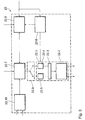
- FIG. 3 shows further details of those essential for the representation of the invention Structural features of the control unit 22 in a simplified block diagram.
- the control unit 22 has a signal generator unit 22.1 with a signal generator 22.2 on.
- the signal generator is used to deliver control pulses to the pacemaker unit 46 or the cardioversion unit 48.
- One from the auto switch generated control pulse causes the pacemaker unit 46 or the cardioversion unit 48 for the immediate generation and delivery of a cardiac stimulation pulse.
- the receiver of the control pulse generated by the signal generator, that is either pacemaker 46 or cardioversion 48 is included With the help of a signaling device 22.2 addresser 22.3.
- a trigger unit 22.4 and one are connected upstream of the addresser Timing unit 22.5. Both are used to determine the time of delivery a control pulse formed by the signal generator 22.2.
- the trigger unit 22.4 generates the control signals after a by a therapy control unit 22.6 predefined program, as is the case with conventional ICDs with pacemaker functions is known.
- the timing unit 22.5 is the determination of the point in time the delivery of control pulses for the generation of delayed cardiac stimulation pulses educated. For this purpose, there are 22.5 procedural steps in the timing unit implemented, which were described with reference to Figure 1.
- the timing unit is not used to emit signal pulses, but is formed by control signals to the signal generator 22.2. she determines the time of delivery of a cardiac stimulation pulse and generates a corresponding control signal.
- the addresser takes this control signal 22.3 that the pacemaker unit 46 is to be controlled by the signal generator 22.2. This in turn takes the control signal from the timing unit 22.5 Time at which the heart stimulation pulse is to be delivered and causes this by delivering an appropriate pulse trigger signal to the pacemaker unit 46.
- the timing unit 22.5 accesses the output signal of a period measurement unit 22.6, which is referred to below as the T measuring unit.
- the Output signal of the T measuring unit 22.6 gives the time interval between the last one and the penultimate Q-wave as well as the time at which the last Q-wave occurred.
- the output signal of the T unit 22.6 thus contains timely information about the Period duration and the phase of cardiac activity.
- the timing unit 22.5 determines the time of delivery of a stimulation pulse by adding the measured period at the time of the Entry of the last Q wave and subsequent subtraction of a predetermined one Time offset of, for example, 100 ms.
- the value of the time offset can be determined by Programming can be specified externally and is stored in the memory 36.
- a therapy control unit 22.7 controls with the aid of a heart monitoring unit 22.8 the state of the heart and determined using known diagnostic methods, which form of therapy is to be used at the moment.
- Therapy control controls access to the trigger unit or the timing unit in the manner of a switching device 22.9.
- the timing unit is controlled by the Therapy control unit only activated if external signaling has been carried out shall be.
- the Trigger unit 22.4 operated using known therapy control methods.
- the therapy control unit 22.6 is additionally on the input side with a device monitoring unit 22.10 connected.
- the device monitoring unit receives in turn, the output signals of the first and second comparator circuits 34 and 44.
- the second comparator circuit 44 indicates that the battery voltage lies below the target value range, and shows the first comparator circuit 34
- Telemetry unit 30 also indicates that the state of the battery is queried from the outside the device monitoring circuit 22.10 conducts the EOL or ERI signal Comparator circuit 44 to the therapy control unit 22.7.
- the therapy control unit 22.7 asks for the reception of an EOL or ERI signal the heart monitoring unit 22.8 for the presence of a pathological State of the heart. If there is one, appropriate therapy is given prompted. Work the heart - stimulated or in a natural rhythm - becomes normal with the help of the switching device 22.9 activated the timing unit.
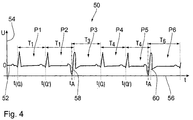
- Figure 4 shows a schematic representation of a during signaling an inventive cardiac stimulation device externally recorded electrocardiogram 50.
- the time t in is not specified Units and on an ordinate 54 is a measurement voltage U, also in indefinite units.
- a resulting ECG curve 52 shows the known course over the duration of five cardiac periods P1 to P5.
- the ECG curve 52 gives the EKG a natural one Heart activity again.
- the period of the periods P1, P3 and P4 is determined by Arrows T1, T3, T4 and T6 marked, their start and end points, respectively coincide with the occurrence of a Q wave in the ECG curve 52.
- the periods of the periods P1 to P5 are due to the natural fluctuations not the same as the heart.
- T4 is slightly shorter than T1, T3 and T6.
- the start and end times of the periods are indicated by vertical, dashed lines P1 to P5 marked.
- the start of period P1 is below the abscissa 56 is denoted by t (Q). This is the time when the Q wave occurs the heart period P1.
- the time of the occurrence of the subsequent Q wave is marked with t (Q ').
- the time period T1 is first determined by the T-measuring unit 22.6 from FIG.
- the timing unit 22.5 determines the triggering time t A for a signal pulse. This is additionally identified in FIG. 4 by a dash-dotted vertical line. An offset of this dash-dotted line t A can be seen relative to the right end of the arrow T1 extending over the heart period P2. This indicates when the time period T1, ie the duration of the cardiac period P1, would have expired again after the start of the period P2.
- a strong deflection 58 towards negative voltage values can be seen in the ECG curve 52 at time t A.
- This rash is the visible sign of an ECG from the pacemaker unit 46. Due to its time offset relative to the time t (Q ') + T1, this cardiac stimulation pulse can be distinguished from a regular, therapeutic cardiac stimulation pulse and can be identified as a signal pulse. This therefore indicates that the battery voltage of the cardiac stimulation device 10 has fallen below a target value.
- the timing unit 22.5 uses the period T4 and the time t (Q ') at the beginning of the period P5, which are determined by the T measuring unit 22.6, to determine the triggering time t A in the period P6.
- the ECG curve 52 accordingly shows a second negative deflection 60.
- This temporal pattern is not shown in the ECG curve 52 for later ones either times shown can be recognized repeatedly as long as the telemetry unit external reception readiness for the signal indicates and the heart activity normal is.
Landscapes
- Health & Medical Sciences (AREA)
- Life Sciences & Earth Sciences (AREA)
- Biophysics (AREA)
- Heart & Thoracic Surgery (AREA)
- Engineering & Computer Science (AREA)
- Biomedical Technology (AREA)
- Nuclear Medicine, Radiotherapy & Molecular Imaging (AREA)
- Radiology & Medical Imaging (AREA)
- Animal Behavior & Ethology (AREA)
- General Health & Medical Sciences (AREA)
- Public Health (AREA)
- Veterinary Medicine (AREA)
- Electrotherapy Devices (AREA)
Applications Claiming Priority (2)
| Application Number | Priority Date | Filing Date | Title |
|---|---|---|---|
| DE10028095A DE10028095A1 (de) | 2000-06-05 | 2000-06-05 | Signalisierungsverfahren für eine implantierbare Herzstimulationsvorrichtung und Herzstimulationsvorrichtung |
| DE10028095 | 2000-06-05 |
Publications (3)
| Publication Number | Publication Date |
|---|---|
| EP1161966A2 true EP1161966A2 (fr) | 2001-12-12 |
| EP1161966A3 EP1161966A3 (fr) | 2004-01-21 |
| EP1161966B1 EP1161966B1 (fr) | 2005-04-06 |
Family
ID=7644939
Family Applications (1)
| Application Number | Title | Priority Date | Filing Date |
|---|---|---|---|
| EP01250201A Expired - Lifetime EP1161966B1 (fr) | 2000-06-05 | 2001-06-05 | Procédé de signalisation pour un dispositif de stimulation cardiaque implantable et dispositif de stimulation cardiaque |
Country Status (4)
| Country | Link |
|---|---|
| US (1) | US6553261B2 (fr) |
| EP (1) | EP1161966B1 (fr) |
| AT (1) | ATE292495T1 (fr) |
| DE (2) | DE10028095A1 (fr) |
Families Citing this family (3)
| Publication number | Priority date | Publication date | Assignee | Title |
|---|---|---|---|---|
| US7630767B1 (en) * | 2004-07-14 | 2009-12-08 | Pacesetter, Inc. | System and method for communicating information using encoded pacing pulses within an implantable medical system |
| US11484719B2 (en) | 2019-02-13 | 2022-11-01 | Medtronic, Inc. | Electrical stimulation rate modulation for communication of data values in a medical device system |
| CN114652426B (zh) * | 2020-12-23 | 2025-06-06 | 上海微创电生理医疗科技股份有限公司 | 脉冲消融设备、系统、控制方法及可读存储介质 |
Citations (1)
| Publication number | Priority date | Publication date | Assignee | Title |
|---|---|---|---|---|
| US5899928A (en) | 1996-05-14 | 1999-05-04 | Pacesetter, Inc. | Descriptive transtelephonic pacing intervals for use by an emplantable pacemaker |
Family Cites Families (11)
| Publication number | Priority date | Publication date | Assignee | Title |
|---|---|---|---|---|
| US4276883A (en) | 1978-11-06 | 1981-07-07 | Medtronic, Inc. | Battery monitor for digital cardiac pacemaker |
| US4488555A (en) * | 1982-12-13 | 1984-12-18 | Mieczyslaw Mirowski | Battery condition warning system for medical implant |
| WO1986005698A1 (fr) * | 1985-03-27 | 1986-10-09 | Siemens-Elema Ab | Mesure de l'intervalle de stimulation d'un coeur, stimulateur adaptatif et mode de fonctionnement |
| US4788980A (en) * | 1986-07-18 | 1988-12-06 | Siemens-Pacesetter, Inc. | Pacemaker having PVC response and PMT terminating features |
| US4809697A (en) * | 1987-10-14 | 1989-03-07 | Siemens-Pacesetter, Inc. | Interactive programming and diagnostic system for use with implantable pacemaker |
| DE4213993A1 (de) * | 1991-05-14 | 1992-12-03 | Straube Juergen Dr Med | Integriertes patientenwarnsystem fuer energiebetriebene implantate |
| US5413593A (en) * | 1994-01-31 | 1995-05-09 | Cardiac Pacemakers, Inc. | Using sub-threshold unipolar pacing markers to improve the interpretation of surface EKG in pacemaker patients |
| SE9400622D0 (sv) * | 1994-02-23 | 1994-02-23 | Siemens Elema Ab | Medicinskt implantat |
| US6067469A (en) * | 1998-06-23 | 2000-05-23 | Cardiac Pacemakers, Inc. | Method and system for detecting dislodgment of an implanted right atrial endocardial lead using a sensing period derived from a ventricular lead |
| US6148235A (en) * | 1998-07-17 | 2000-11-14 | Vitatron Medical, B.V. | Implantable stimulator with battery status measurement |
| US5944746A (en) * | 1998-10-30 | 1999-08-31 | Pacesetter, Inc. | ICD with continuous regular testing of defibrillation lead status |
-
2000
- 2000-06-05 DE DE10028095A patent/DE10028095A1/de not_active Withdrawn
-
2001
- 2001-06-01 US US09/872,159 patent/US6553261B2/en not_active Expired - Lifetime
- 2001-06-05 AT AT01250201T patent/ATE292495T1/de not_active IP Right Cessation
- 2001-06-05 EP EP01250201A patent/EP1161966B1/fr not_active Expired - Lifetime
- 2001-06-05 DE DE50105804T patent/DE50105804D1/de not_active Expired - Lifetime
Patent Citations (1)
| Publication number | Priority date | Publication date | Assignee | Title |
|---|---|---|---|---|
| US5899928A (en) | 1996-05-14 | 1999-05-04 | Pacesetter, Inc. | Descriptive transtelephonic pacing intervals for use by an emplantable pacemaker |
Also Published As
| Publication number | Publication date |
|---|---|
| EP1161966A3 (fr) | 2004-01-21 |
| DE50105804D1 (de) | 2005-05-12 |
| ATE292495T1 (de) | 2005-04-15 |
| US20020022865A1 (en) | 2002-02-21 |
| US6553261B2 (en) | 2003-04-22 |
| EP1161966B1 (fr) | 2005-04-06 |
| DE10028095A1 (de) | 2001-12-06 |
Similar Documents
| Publication | Publication Date | Title |
|---|---|---|
| DE3233718C2 (fr) | ||
| DE69127984T2 (de) | Gerät zur Antitachykardiereizung beim Zweikammer-Arrhythmienkontrollsystem | |
| EP2060299B1 (fr) | Stimulateur cardiaque bi-ventriculaire | |
| DE69429838T2 (de) | Herzschrittmacher mit Hysterese zum Schutz vor vorzeitigen Ventrikelkontraktionen | |
| DE60122820T2 (de) | Vorrichtung zur Verringerung der Effekte von evozierten Potentialen bei Polarisationsmessungen in einem Herzschrittmachersystem mit automatischer Erfassung des Einfanges | |
| DE69919983T2 (de) | System zum einleiten von herzkammerflimmern unter verwendung von nahfeldwellenabtastung | |
| DE69700748T2 (de) | Egm aufzeichnungssystem für implantierbare medizinische vorrichtung | |
| DE3321695C2 (de) | Elektrostimulations-Vorrichtung zum Behandeln von Herzarrhythmien | |
| DE60132407T2 (de) | Implantierbarer Herzschrittmacher mit automatischer Auswahl der Elektrodenanordnung zur Detektion der evozierten Reaktion | |
| DE69727063T2 (de) | Implantierbares gerät | |
| DE69117410T2 (de) | System zur Erkennung und Beendung von durch einen Herzschrittmacher induzierten Tachykardien | |
| DE69619190T2 (de) | Implantierbarer Vorhof-Defibrillator und System mit mehrkanaliger Telemetrie von Elektrogrammen | |
| DE69917758T2 (de) | Vorrichtung zur behandlung von vorhofsarrythmien | |
| DE69625925T2 (de) | Vorrichtung zur hämodynamischen stimulation bei einer ventrikulären tachykardie | |
| DE3117075C2 (de) | Vorhofsynchroner Herzschrittmacher | |
| DE69917629T2 (de) | Vorrichtung zum speichern von physiologischen signalen | |
| DE60308203T2 (de) | Gerät zur bestimmung des stimulationschwellwertes | |
| DE602004006228T2 (de) | Identifikation alternierender t-wellen | |
| DE102008002331A1 (de) | Elektrotherapieeinrichtung zur Behandlung tachykarder Rythmusstörungen eines Herzens | |
| EP1582234B1 (fr) | Stimulateur cardiaque | |
| EP1774988B1 (fr) | Dispositif implantable pour la détermination des vecteurs cardiaques | |
| EP1277492A2 (fr) | Stimulateur cardiaque double chambre | |
| EP1161966B1 (fr) | Procédé de signalisation pour un dispositif de stimulation cardiaque implantable et dispositif de stimulation cardiaque | |
| DE602004009431T2 (de) | Selbstanpassende fibrillationsinduktion | |
| EP2803383B1 (fr) | Dispositif doté d'un stimulateur cardiaque externe |
Legal Events
| Date | Code | Title | Description |
|---|---|---|---|
| PUAI | Public reference made under article 153(3) epc to a published international application that has entered the european phase |
Free format text: ORIGINAL CODE: 0009012 |
|
| AK | Designated contracting states |
Kind code of ref document: A2 Designated state(s): AT BE CH CY DE DK ES FI FR GB GR IE IT LI LU MC NL PT SE TR |
|
| AX | Request for extension of the european patent |
Free format text: AL;LT;LV;MK;RO;SI |
|
| RIC1 | Information provided on ipc code assigned before grant |
Ipc: 7A 61N 1/372 B Ipc: 7A 61N 1/37 A Ipc: 7A 61N 1/39 B |
|
| PUAL | Search report despatched |
Free format text: ORIGINAL CODE: 0009013 |
|
| AK | Designated contracting states |
Kind code of ref document: A3 Designated state(s): AT BE CH CY DE DK ES FI FR GB GR IE IT LI LU MC NL PT SE TR |
|
| AX | Request for extension of the european patent |
Extension state: AL LT LV MK RO SI |
|
| 17P | Request for examination filed |
Effective date: 20040721 |
|
| GRAP | Despatch of communication of intention to grant a patent |
Free format text: ORIGINAL CODE: EPIDOSNIGR1 |
|
| AKX | Designation fees paid |
Designated state(s): AT BE CH CY DE DK ES FI FR GB GR IE IT LI LU MC NL PT SE TR |
|
| GRAS | Grant fee paid |
Free format text: ORIGINAL CODE: EPIDOSNIGR3 |
|
| GRAA | (expected) grant |
Free format text: ORIGINAL CODE: 0009210 |
|
| AK | Designated contracting states |
Kind code of ref document: B1 Designated state(s): AT BE CH CY DE DK ES FI FR GB GR IE IT LI LU MC NL PT SE TR |
|
| PG25 | Lapsed in a contracting state [announced via postgrant information from national office to epo] |
Ref country code: IE Free format text: LAPSE BECAUSE OF FAILURE TO SUBMIT A TRANSLATION OF THE DESCRIPTION OR TO PAY THE FEE WITHIN THE PRESCRIBED TIME-LIMIT Effective date: 20050406 Ref country code: TR Free format text: LAPSE BECAUSE OF FAILURE TO SUBMIT A TRANSLATION OF THE DESCRIPTION OR TO PAY THE FEE WITHIN THE PRESCRIBED TIME-LIMIT Effective date: 20050406 Ref country code: FI Free format text: LAPSE BECAUSE OF FAILURE TO SUBMIT A TRANSLATION OF THE DESCRIPTION OR TO PAY THE FEE WITHIN THE PRESCRIBED TIME-LIMIT Effective date: 20050406 |
|
| REG | Reference to a national code |
Ref country code: GB Ref legal event code: FG4D Free format text: NOT ENGLISH |
|
| REG | Reference to a national code |
Ref country code: CH Ref legal event code: NV Representative=s name: BRAUNPAT BRAUN EDER AG Ref country code: CH Ref legal event code: EP |
|
| GBT | Gb: translation of ep patent filed (gb section 77(6)(a)/1977) |
Effective date: 20050406 |
|
| REG | Reference to a national code |
Ref country code: IE Ref legal event code: FG4D Free format text: LANGUAGE OF EP DOCUMENT: GERMAN |
|
| REF | Corresponds to: |
Ref document number: 50105804 Country of ref document: DE Date of ref document: 20050512 Kind code of ref document: P |
|
| REG | Reference to a national code |
Ref country code: SE Ref legal event code: TRGR |
|
| PG25 | Lapsed in a contracting state [announced via postgrant information from national office to epo] |
Ref country code: CY Free format text: LAPSE BECAUSE OF FAILURE TO SUBMIT A TRANSLATION OF THE DESCRIPTION OR TO PAY THE FEE WITHIN THE PRESCRIBED TIME-LIMIT Effective date: 20050605 Ref country code: LU Free format text: LAPSE BECAUSE OF NON-PAYMENT OF DUE FEES Effective date: 20050605 Ref country code: AT Free format text: LAPSE BECAUSE OF NON-PAYMENT OF DUE FEES Effective date: 20050605 |
|
| PG25 | Lapsed in a contracting state [announced via postgrant information from national office to epo] |
Ref country code: BE Free format text: LAPSE BECAUSE OF NON-PAYMENT OF DUE FEES Effective date: 20050630 Ref country code: MC Free format text: LAPSE BECAUSE OF NON-PAYMENT OF DUE FEES Effective date: 20050630 |
|
| PG25 | Lapsed in a contracting state [announced via postgrant information from national office to epo] |
Ref country code: DK Free format text: LAPSE BECAUSE OF FAILURE TO SUBMIT A TRANSLATION OF THE DESCRIPTION OR TO PAY THE FEE WITHIN THE PRESCRIBED TIME-LIMIT Effective date: 20050706 Ref country code: GR Free format text: LAPSE BECAUSE OF FAILURE TO SUBMIT A TRANSLATION OF THE DESCRIPTION OR TO PAY THE FEE WITHIN THE PRESCRIBED TIME-LIMIT Effective date: 20050706 |
|
| PG25 | Lapsed in a contracting state [announced via postgrant information from national office to epo] |
Ref country code: ES Free format text: LAPSE BECAUSE OF FAILURE TO SUBMIT A TRANSLATION OF THE DESCRIPTION OR TO PAY THE FEE WITHIN THE PRESCRIBED TIME-LIMIT Effective date: 20050717 |
|
| PG25 | Lapsed in a contracting state [announced via postgrant information from national office to epo] |
Ref country code: PT Free format text: LAPSE BECAUSE OF FAILURE TO SUBMIT A TRANSLATION OF THE DESCRIPTION OR TO PAY THE FEE WITHIN THE PRESCRIBED TIME-LIMIT Effective date: 20050908 |
|
| REG | Reference to a national code |
Ref country code: IE Ref legal event code: FD4D |
|
| PLBE | No opposition filed within time limit |
Free format text: ORIGINAL CODE: 0009261 |
|
| STAA | Information on the status of an ep patent application or granted ep patent |
Free format text: STATUS: NO OPPOSITION FILED WITHIN TIME LIMIT |
|
| ET | Fr: translation filed | ||
| 26N | No opposition filed |
Effective date: 20060110 |
|
| BERE | Be: lapsed |
Owner name: BIOTRONIK MESS- UND THERAPIEGERATE G.M.B.H. & CO I Effective date: 20050630 |
|
| PGFP | Annual fee paid to national office [announced via postgrant information from national office to epo] |
Ref country code: IT Payment date: 20080625 Year of fee payment: 8 |
|
| PGFP | Annual fee paid to national office [announced via postgrant information from national office to epo] |
Ref country code: NL Payment date: 20080618 Year of fee payment: 8 |
|
| NLV4 | Nl: lapsed or anulled due to non-payment of the annual fee |
Effective date: 20100101 |
|
| PG25 | Lapsed in a contracting state [announced via postgrant information from national office to epo] |
Ref country code: NL Free format text: LAPSE BECAUSE OF NON-PAYMENT OF DUE FEES Effective date: 20100101 |
|
| PG25 | Lapsed in a contracting state [announced via postgrant information from national office to epo] |
Ref country code: IT Free format text: LAPSE BECAUSE OF NON-PAYMENT OF DUE FEES Effective date: 20090605 |
|
| REG | Reference to a national code |
Representative=s name: RANDOLL, SOEREN, DIPL.-CHEM. UNIV. DR. RER. NA, DE Ref country code: DE Ref legal event code: R082 Ref document number: 50105804 Country of ref document: DE |
|
| REG | Reference to a national code |
Ref country code: DE Ref legal event code: R081 Ref document number: 50105804 Country of ref document: DE Owner name: BIOTRONIK SE & CO. KG, DE Free format text: FORMER OWNER: BIOTRONIK MESS- UND THERAPIEGERAETE GMBH & CO. INGENIEURBUERO BERLIN, 12359 BERLIN, DE Effective date: 20111219 |
|
| PGFP | Annual fee paid to national office [announced via postgrant information from national office to epo] |
Ref country code: SE Payment date: 20120625 Year of fee payment: 12 Ref country code: GB Payment date: 20120621 Year of fee payment: 12 Ref country code: FR Payment date: 20120705 Year of fee payment: 12 |
|
| PG25 | Lapsed in a contracting state [announced via postgrant information from national office to epo] |
Ref country code: SE Free format text: LAPSE BECAUSE OF NON-PAYMENT OF DUE FEES Effective date: 20130606 |
|
| REG | Reference to a national code |
Ref country code: SE Ref legal event code: EUG |
|
| GBPC | Gb: european patent ceased through non-payment of renewal fee |
Effective date: 20130605 |
|
| REG | Reference to a national code |
Ref country code: FR Ref legal event code: ST Effective date: 20140228 |
|
| PG25 | Lapsed in a contracting state [announced via postgrant information from national office to epo] |
Ref country code: GB Free format text: LAPSE BECAUSE OF NON-PAYMENT OF DUE FEES Effective date: 20130605 |
|
| PG25 | Lapsed in a contracting state [announced via postgrant information from national office to epo] |
Ref country code: FR Free format text: LAPSE BECAUSE OF NON-PAYMENT OF DUE FEES Effective date: 20130701 |
|
| PGFP | Annual fee paid to national office [announced via postgrant information from national office to epo] |
Ref country code: CH Payment date: 20160621 Year of fee payment: 16 Ref country code: DE Payment date: 20160620 Year of fee payment: 16 |
|
| REG | Reference to a national code |
Ref country code: DE Ref legal event code: R119 Ref document number: 50105804 Country of ref document: DE |
|
| REG | Reference to a national code |
Ref country code: CH Ref legal event code: PL |
|
| PG25 | Lapsed in a contracting state [announced via postgrant information from national office to epo] |
Ref country code: DE Free format text: LAPSE BECAUSE OF NON-PAYMENT OF DUE FEES Effective date: 20180103 Ref country code: LI Free format text: LAPSE BECAUSE OF NON-PAYMENT OF DUE FEES Effective date: 20170630 Ref country code: CH Free format text: LAPSE BECAUSE OF NON-PAYMENT OF DUE FEES Effective date: 20170630 |