EP1163668B1 - Adaptive postfiltertechnik auf basis eines yule-walkerfilters - Google Patents
Adaptive postfiltertechnik auf basis eines yule-walkerfilters Download PDFInfo
- Publication number
- EP1163668B1 EP1163668B1 EP00917635A EP00917635A EP1163668B1 EP 1163668 B1 EP1163668 B1 EP 1163668B1 EP 00917635 A EP00917635 A EP 00917635A EP 00917635 A EP00917635 A EP 00917635A EP 1163668 B1 EP1163668 B1 EP 1163668B1
- Authority
- EP
- European Patent Office
- Prior art keywords
- filter
- estimating
- formants
- poles
- formant
- Prior art date
- Legal status (The legal status is an assumption and is not a legal conclusion. Google has not performed a legal analysis and makes no representation as to the accuracy of the status listed.)
- Expired - Lifetime
Links
Images



Classifications
-
- G—PHYSICS
- G10—MUSICAL INSTRUMENTS; ACOUSTICS
- G10L—SPEECH ANALYSIS TECHNIQUES OR SPEECH SYNTHESIS; SPEECH RECOGNITION; SPEECH OR VOICE PROCESSING TECHNIQUES; SPEECH OR AUDIO CODING OR DECODING
- G10L19/00—Speech or audio signals analysis-synthesis techniques for redundancy reduction, e.g. in vocoders; Coding or decoding of speech or audio signals, using source filter models or psychoacoustic analysis
- G10L19/04—Speech or audio signals analysis-synthesis techniques for redundancy reduction, e.g. in vocoders; Coding or decoding of speech or audio signals, using source filter models or psychoacoustic analysis using predictive techniques
- G10L19/06—Determination or coding of the spectral characteristics, e.g. of the short-term prediction coefficients
Definitions
- time-domain post-filtering techniques use modified LPC synthesis, inverse, and high pass filters that are derived from an LPC spectrum and are configured by the constants: ⁇ (for modified synthesis filter), ⁇ (for modified inverse filter) and ⁇ (for high pass filter). See, Juiun-Hwey Chen, Allen Gersho "Adaptive Post-filtering For Quality Enhancement of Coded Speech", IEEE Trans. Speech & Audio Proc., vol. 3, no. 1, pp. 59-71, 1995.
- Such a filter has been used successfully in low bit rate coders, but it is very hard to adapt the coefficients from one frame to another and still produce a post-filter frequency response without spectral tilt.
- the result is time-domain post-filtering which produces varying and unpredictable spectral tilt from one frame to another which causes unnecessary attenuation or amplification of some frequency components, and a muffling of speech quality. This effect increases when voice coders are tandemed together.
- it is very hard to adapt these coefficients from one frame to another and still produce a post-filter frequency response without spectral tilt.
- Conventional time-domain post-filtering produces varying spectral tilt from one frame to another affecting speech quality.
- Another problem with conventional time-domain post-filtering is that, when two formants are close together, the frequency response may have a peak rather than a null between the two formants hence altering the formant information. Yet another effect is that in the original speech, the first formant may have a much higher peak than the second formant, however, the frequency response of the post-filter may have a second formant with a higher peak than the first formant. These phenomena are completely undesirable because they affect the output speech quality.
- an object of the invention to provide a new time-domain post-filtering technique which eliminates the problems above, particularly the problem of spectral tilt in speech spectrum, and that can be applied to various speech coders, including both time and frequency domain speech coders.
- the locations of poles of an LPC spectrum of said speech signal are determined, the location and bandwidth of formants of said speech signal are estimated based on the pole information, by first arranging the poles in a predetermined order (e.g., according to increasing radius) and applying an estimation algorithm to the ordered poles.
- the filter coefficients are estimated, a desired filter response characteristic is compared to the filter response characteristic resulting from said estimated filter coefficients to obtain a difference value, the filter coefficients are adjusted to minimize said difference value according to a least squares approach.
- the formant estimation algorithm comprises calculating a magnitude and slope of said LPC spectrum at at least some of said arranged poles, calculating first and second slopes m1 and m2, respectively, of said LPC spectrum on either side of the arranged poles, and then (i) estimating first and second adjacent poles to represent different formants if m1 is less than zero and if m2 is greater than zero, (ii) estimating first and second adjacent poles to represent a common formant if the criteria of step (i) are not met and if a difference in magnitudes of said LPC spectrum is less than a threshold value, e.g., 3 dB, and (iii) estimating the larger of said first and second poles to represent a formant if the criteria of steps (i) and (ii) are not met. If the bandwidths assigned to adjacent formants in this process are overlapping, the formants are combined into a single bandwidth.
- the (MYW) filter coefficients are estimated using a least squares fit in the time domain.
- the denominator coefficients of the filter ( a (1), a (2), ..., a ( N )) are computed by the Modified Yule-Walker equations using non-recursive correlation coefficients computed by inverse Fourier transformation of the specified frequency response of the post-filter.
- the numerator coefficients of the filter (b(1), b(2), ..., b(N)) are computed by a 4 step procedure: first, a numerator polynomial corresponding to an additive decomposition of the power frequency response is computed. The complete frequency response corresponding to the numerator and denominator polynomials is then evaluated. As a result, a spectral factorization technique is used to obtain the impulse response of the filter. Finally, the numerator polynomial is obtained by a least squares fit to this impulse response.
- the filter according to the present invention uses a new time-domain post-filtering technique, and has a flat frequency response at the formant peaks of the speech spectrum. Instead of looking at the modified LPC synthesis, inverse, and high pass filtering in the conventional time-domain technique, the technique according to this invention gathers information about the poles of the LPC spectrum, uses this information to estimate formants and nulls, then uses the estimated locations of formants and number of poles for each formant to compute the bandwidths of the formants and eventually the frequency response of the desired post-filter.
- pole angles in an LPC spectrum have information about formant locations and associated bandwidths.
- an LPC spectrum is defined as 1/(1 - A(z)) where is the i-th LPC coefficient and M is the order of the LPC predictor
- a 14 th order LPC filter is assumed.
- 1 - A(z) is turned into a companion matrix, e.g., as described by J. H. Wilkinson and C. Reinsch, "Linear Algebra: Hand Book for Automatic Computation” Springer-Verlag New York Heidelberg Berlin 1971.
- the companion matrix is used to find the eigenvalues which are the roots of 1 - A(z).
- poles exist in conjugate pairs, although two real poles might exist. If two real poles exist, they always have an angle of 0 and ⁇ . Noting this symmetrical property, the poles can be divided into a group of positive angles and a group of negative angles. For each group, the radii can be arranged in descending order so that r 1 is the longest radius in the positive group and r 8 is the longest radius in the negative group. Notice also that the longest radius has the shortest distance to the unit circle since all the radii are less than 1. With this arrangement, r 1 and r 8 have the same radius and occur in conjugate angles.
- a typical LPC spectrum is plotted with the pole angles located on the normalized frequency axis as shown in Fig. 1.
- the locations of poles 1 through 7 are noted by P1 through P7.
- Poles P1, P2 and P3 indicate the exact locations of the formant peaks.
- the first 3 poles are not always located at the peaks as shown in this example.
- a wide formant bandwidth has two or three poles that are close together. This fact can be observed in Fig. 1 where the bandwidth of the first formant is wider than the second formant.
- the first formant has poles P4 and P5 that are close together while the other formants only have a single pole.
- poles P6 and P7 are still considered because these poles might be a part of a formant themselves. With knowledge of the locations of the seven poles, estimation of the formants and nulls can begin.
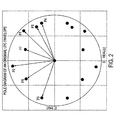
- the positive angles of the poles are arranged in ascending order.
- the negative angles are omitted due to the symmetrical property of the angles as mentioned previously. This arrangement may be as generally illustrated in Fig. 2.
- the bandwidth of the corresponding formant will cover the frequency range from ⁇ 1 - ⁇ b to ⁇ 1 + ⁇ b .
- poles P1, P2 and P3 are the single pole formants.
- the bandwidth of the corresponding formant should cover all of the corresponding pole locations.
- poles P4 and P5 correspond to the first formant of the spectrum and the bandwidth of this formant ranges from ⁇ 4 - ⁇ b to ⁇ 5 + ⁇ b , where ⁇ 4 and ⁇ 5 are the locations of poles P4 and P5 respectively.
- the bandwidth of 2 formants might overlap each other when 2 formants are very close. This overlapping creates a problem in designing this post-filter. In order to avoid this problem, the bandwidths of these two formants are combined together to form only one band.
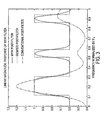
- the frequency response of the desired post-filter is shown in Fig. 3 for the envelope illustrated in Fig. 1.
- an adaptive multi band pass filter is required.
- Such an adaptive multi band pass filter can be implemented using a modified Yule-Walker (MYW) recursive filter.
- MYW Yule-Walker
- the (MYW) filter coefficients are estimated using a least squares fit in the time domain.
- the denominator coefficients of the filter ( a (1), a (2), ..., a ( N )) are computed by the Modified Yule-Walker equations using non-recursive correlation coefficients computed by inverse Fourier transformation of the specified frequency response of the post-filter, as described by Friedlander and Porat, cited above.
- the numerator coefficients of the filter ( b (1), b (2), ..., b (N)) are computed by a 4 step procedure: first, a numerator polynomial corresponding to an additive decomposition of the power frequency response is computed. The complete frequency response corresponding to the numerator and denominator polynomials is then evaluated.
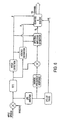
- Fig. 4 illustrates the method according to this invention, wherein the desired frequency response is specified, the denominator coefficients A(z) are determined according to a least squares approach at 106, based on non-recursive correlation coefficients Rw(n) computed by inverse Fourier Transformation (IFFT) of the specified frequency response.
- the numerator polynomial is determined by additive decomposition at 108, spectral; factorization is applied at 110 to enable the impulse response to be calculated at 112, and the method of least squares is used to determine the final denominator polynomial B(z) at 114
- This post-filter described above has a flat frequency response that overcomes the spectral tilt and other problems present in conventional post-filters as mention earlier herein.
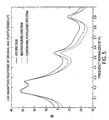
- the frequency responses of these filters applied to the LPC spectrum shown in Fig. 1 are given in Fig. 5.
- the new and the conventional post-filtered LPC spectra are shown in Fig. 5: For the conventional post-filter, it is clear that there is a spectral tilt compared with the original LPC spectrum. For the new post-filter, there is not any spectral tilt at all.
- the new filter preserves the formant peaks and attenuates the nulls which is the desired phenomenon. In addition, the attenuation of nulls can be more controllable in the new post-filter than in the conventional post-filter.
- the post-filter according to this invention has been incorporated into a 4 kb/s Harmonic Excitation Linear Predictive Coder (HE-LPC).
- HE-LPC Harmonic Excitation Linear Predictive Coder
- the approach to represent the speech signals s(n) is to use the speech production model in which speech is viewed as the result of passing an excitation, e(n) through a linear time-varying filter (LPC), h(n), that models the resonant characteristics of the speech spectral envelope.
- LPC linear time-varying filter
- the h(n) is represented by 14 LPC coefficients which are quantized in the form of Line Spectral Frequency (LSF) parameters.
- LSF Line Spectral Frequency
- the excitation signal e(n) is specified by a fundamental frequency or pitch, its spectral amplitudes, and a voicing probability.
- the voicing probability defines a cut-off frequency that separates low frequency components as voiced and high frequency components as unvoiced.
- the computed model parameters are quantized and encoded for transmission.
- the information bits are decoded, and hence, the model parameters are recovered.
- the voiced part of the excitation spectrum is determined as the sum of harmonic sine waves.
- the harmonic phases of sine waves are predicted using the phase information of the previous frames.
- a white random noise spectrum normalized to unvoiced excitation spectral harmonic amplitudes is used for the unvoiced part of the excitation spectrum.
- the voiced and unvoiced excitation signals are then added together to form the overall synthesized excitation signal.
- the resultant excitation is then shaped by the linear time-varying filter, h(n), to form the final synthesized speech.
- the synthesized speech was passed through the new and conventional post-filters, in order to evaluate the performance of each of these filters.
- the overall arrangement of the HE-LPC encoder is illustrated in Fig. 6, with the decoder illustrated in Fig. 7.
Landscapes
- Engineering & Computer Science (AREA)
- Physics & Mathematics (AREA)
- Audiology, Speech & Language Pathology (AREA)
- Computational Linguistics (AREA)
- Signal Processing (AREA)
- Health & Medical Sciences (AREA)
- Spectroscopy & Molecular Physics (AREA)
- Human Computer Interaction (AREA)
- Acoustics & Sound (AREA)
- Multimedia (AREA)
- Compression, Expansion, Code Conversion, And Decoders (AREA)
- Filters That Use Time-Delay Elements (AREA)
- Processing Of Color Television Signals (AREA)
- Picture Signal Circuits (AREA)
- Noise Elimination (AREA)
Claims (17)
- Verfahren zum Gestalten eines Filters zum Filtern eines Sprachsignals, wobei das Verfahren die Schritte aufweist:Bestimmen der Polinformation, welche die Orte der Pole eines LPC-Spektrums des Sprachsignals aufweist;Abschätzen des Ortes und der Bandbreite der Formanten des Sprachsignals basierend auf der Polinformation, um eine Filterantwort auf ein gewünschtes Filter zu bilden; Abschätzen der Filterkoeffizienten;Vergleichen der gewünschten Filterantwortcharakteristik mit einer Filterantwortcharakteristik, welche aus den geschätzten Filterkoeffizienten resultiert, um einen Differenzwert zu erhalten; undEinstellen der Filterkoeffizienten, um den Differenzwert zu minimieren.
- Verfahren nach Anspruch 1, wobei der Schritt des Justierens das Minimieren des Differenzwertes entsprechend einer Fehlerquadratmethode aufweist.
- Verfahren nach Anspruch 1, wobei der Schritt des Abschätzens des Ortes und der Bandbreite der Formanten aufweist:Anordnen von wenigstens einigen der Pole in einer vorher festgelegten Ordnung;Berechnen einer Größe des LPC-Spektrums bei wenigstens einigen der angeordneten Pole;Berechnen der ersten und zweiten jeweiligen Flanken m1 und m2 des LPC-Spektrums auf beiden Seiten der wenigstens einigen der angeordneten Pole; undAbschätzen des Ortes und der Bandbreite der Formanten, basierend auf dem Ort, der Größe und der benachbarten Flanken der LPC-Spektrumspole.
- Verfahren nach Anspruch 3, wobei der Schritt des Abschätzens des Ortes und der Bandbreite der Formanten aufweist:(i) Abschätzen erster und zweiter benachbarter Pole, um verschiedene Formanten zu repräsentieren, wenn die Flanke an dem ersten Pol negativ in einer ersten Richtung auf den zweiten Pol zu ist und wenn die Flanke an dem zweiten Pol positiv in der ersten Richtung ist, welche von dem ersten Pol kommt.
- Verfahren nach Anspruch 4, wobei der Schritt des Abschätzens des Ortes und der Bandbreite der Formanten ferner aufweist:(ii) Abschätzen erster und zweiter benachbarter Pole, um einen gewöhnlichen Formanten darzustellen, wenn die Kriterien des Schrittes (i) nicht eingehalten werden bzw. nicht zutreffen und wenn eine Differenz in den Größen des LPC-Spektrums kleiner als ein Schwellwert ist.
- Verfahren nach Anspruch 5, wobei der Schwellwert ungefähr 3 dB beträgt.
- Verfahren nach Anspruch 5, wobei der Schritt des Abschätzens des Ortes und der Bandbreite der Formanten ferner aufweist:(iii) Abschätzen des größeren des ersten und zweiten Poles, um einen Formanten zu darzustellen, wenn die Kriterien der Schritte (i) und (ii) nicht eingehalten werden bzw. zutreffen.
- verfahren nach Anspruch 7, wobei der Schritt des Abschätzens des Ortes und der Bandbreite der Formanten ferner aufweist:Zuweisen einer Bandbreite für jeden Formanten; undKombinieren von zwei Formanten in einem Formanten mit geschätztem Signal, wenn deren zugewiesene Bandbreiten einander überlappen.
- Verfahren nach Anspruch 1, wobei das Filter ein modifiziertes Yule-Walker-Filter ist, welches eine Impulsantwort der Form besitzt:
- Verfahren nach Anspruch 9, wobei der Schritt des Abschätzens der Filterkoeffizienten das Abschätzen der Koeffizienten (a(1), a(2), ..., a(N)) entsprechend den Modifizierten Yule-Walker-Gleichungen aufweist, welche nichtrekursive Korrelationskoeffizienten nutzen, welche durch inverse Fourier-Transformation der gewünschten Filterfrequenzantwort berechnet sind.
- Verfahren nach Anspruch 9, wobei der Schritt des Abschätzens der Filterkoeffizienten das Abschätzen der Koeffizienten (b(1), b(2), ..., b(N)) entsprechend der Schritte aufweist:Berechnen eines Dividenden-Polynoms, entsprechend einer additiven Zerlegung der Leistungsfrequenzantwort; Auswerten einer vollständigen Frequenzantwort des Filters; Abschätzen einer Impulsantwort des Filters; undEinstellen des Dividendenpolynoms entsprechend einer Fehlerquadratanpassung an die Impulsantwort.
- Verfahren nach Anspruch 11, wobei die Impulsantwort des Filters entsprechend einer spektralen Faktorenzerlegungstechnik abgeschätzt wird.
- verfahren nach Anspruch 1, wobei der Schritt des Abschätzens der Filterkoeffizienten das Zuweisen eines Einheitsverstärkungsfaktors für das Filter in dem Bereich jedes Formanten aufweist.
- Verfahren nach Anspruch 13, wobei der Schritt des Abschätzens der Filterkoeffizienten ferner das Zuweisen eines Dämpfungs- bzw. Abschwächungsfaktors τ für das Filter außerhalb eines Bereiches jedes Formanten aufweist.
- Verfahren nach Anspruch 14, wobei der Dämpfungsfaktor τ ungefähr 0,6 ist.
- Verfahren nach Anspruch 14, wobei der Dämpfungsfaktor τ sich von einem Frame bzw. Rahmen zum anderen des Sprachsignals ändern kann.
- Filter, welches in Übereinstimmung mit dem Verfahren entsprechend einem der Ansprüche 1 bis 6 gestaltet ist.
Applications Claiming Priority (3)
| Application Number | Priority Date | Filing Date | Title |
|---|---|---|---|
| US266770 | 1994-06-28 | ||
| US09/266,770 US6233552B1 (en) | 1999-03-12 | 1999-03-12 | Adaptive post-filtering technique based on the Modified Yule-Walker filter |
| PCT/US2000/003718 WO2000055845A1 (en) | 1999-03-12 | 2000-03-13 | An adaptive post-filtering technique based on the modified yule-walker filter |
Publications (3)
| Publication Number | Publication Date |
|---|---|
| EP1163668A1 EP1163668A1 (de) | 2001-12-19 |
| EP1163668A4 EP1163668A4 (de) | 2004-03-31 |
| EP1163668B1 true EP1163668B1 (de) | 2005-02-02 |
Family
ID=23015937
Family Applications (1)
| Application Number | Title | Priority Date | Filing Date |
|---|---|---|---|
| EP00917635A Expired - Lifetime EP1163668B1 (de) | 1999-03-12 | 2000-03-13 | Adaptive postfiltertechnik auf basis eines yule-walkerfilters |
Country Status (6)
| Country | Link |
|---|---|
| US (1) | US6233552B1 (de) |
| EP (1) | EP1163668B1 (de) |
| AT (1) | ATE288616T1 (de) |
| AU (1) | AU3858200A (de) |
| DE (1) | DE60017880T2 (de) |
| WO (1) | WO2000055845A1 (de) |
Families Citing this family (6)
| Publication number | Priority date | Publication date | Assignee | Title |
|---|---|---|---|---|
| AU2003289107A1 (en) * | 2003-02-25 | 2004-09-17 | Yokohama Tlo Company Ltd | Pulse waveform producing method |
| KR100900438B1 (ko) * | 2006-04-25 | 2009-06-01 | 삼성전자주식회사 | 음성 패킷 복구 장치 및 방법 |
| US8311812B2 (en) * | 2009-12-01 | 2012-11-13 | Eliza Corporation | Fast and accurate extraction of formants for speech recognition using a plurality of complex filters in parallel |
| KR102060208B1 (ko) * | 2011-07-29 | 2019-12-27 | 디티에스 엘엘씨 | 적응적 음성 명료도 처리기 |
| US9576590B2 (en) * | 2012-02-24 | 2017-02-21 | Nokia Technologies Oy | Noise adaptive post filtering |
| US20150162014A1 (en) * | 2013-12-06 | 2015-06-11 | Qualcomm Incorporated | Systems and methods for enhancing an audio signal |
Family Cites Families (13)
| Publication number | Priority date | Publication date | Assignee | Title |
|---|---|---|---|---|
| US4764963A (en) | 1983-04-12 | 1988-08-16 | American Telephone And Telegraph Company, At&T Bell Laboratories | Speech pattern compression arrangement utilizing speech event identification |
| US5054085A (en) * | 1983-05-18 | 1991-10-01 | Speech Systems, Inc. | Preprocessing system for speech recognition |
| NL8603163A (nl) * | 1986-12-12 | 1988-07-01 | Philips Nv | Werkwijze en inrichting voor het afleiden van formantfrekwenties uit een gedeelte van een spraaksignaal. |
| US5235669A (en) * | 1990-06-29 | 1993-08-10 | At&T Laboratories | Low-delay code-excited linear-predictive coding of wideband speech at 32 kbits/sec |
| EP1998319B1 (de) * | 1991-06-11 | 2010-08-11 | Qualcomm Incorporated | Vocoder mit veränderlicher Bitrate |
| WO1995015550A1 (en) | 1993-11-30 | 1995-06-08 | At & T Corp. | Transmitted noise reduction in communications systems |
| KR100518470B1 (ko) | 1993-12-23 | 2005-12-27 | 코닌클리케 필립스 일렉트로닉스 엔.브이. | 적응성디더감산,숨겨진채널비트삽입및필터링을통한다중비트코드화디지탈음향의엔코딩방법및장치와,이방법과함께사용하기위한엔코딩및디코딩장치 |
| US5615298A (en) * | 1994-03-14 | 1997-03-25 | Lucent Technologies Inc. | Excitation signal synthesis during frame erasure or packet loss |
| US5574825A (en) * | 1994-03-14 | 1996-11-12 | Lucent Technologies Inc. | Linear prediction coefficient generation during frame erasure or packet loss |
| US5675701A (en) * | 1995-04-28 | 1997-10-07 | Lucent Technologies Inc. | Speech coding parameter smoothing method |
| US5729694A (en) * | 1996-02-06 | 1998-03-17 | The Regents Of The University Of California | Speech coding, reconstruction and recognition using acoustics and electromagnetic waves |
| US6026357A (en) * | 1996-05-15 | 2000-02-15 | Advanced Micro Devices, Inc. | First formant location determination and removal from speech correlation information for pitch detection |
| US6041297A (en) * | 1997-03-10 | 2000-03-21 | At&T Corp | Vocoder for coding speech by using a correlation between spectral magnitudes and candidate excitations |
-
1999
- 1999-03-12 US US09/266,770 patent/US6233552B1/en not_active Expired - Fee Related
-
2000
- 2000-03-13 AT AT00917635T patent/ATE288616T1/de not_active IP Right Cessation
- 2000-03-13 AU AU38582/00A patent/AU3858200A/en not_active Abandoned
- 2000-03-13 WO PCT/US2000/003718 patent/WO2000055845A1/en not_active Ceased
- 2000-03-13 DE DE60017880T patent/DE60017880T2/de not_active Expired - Lifetime
- 2000-03-13 EP EP00917635A patent/EP1163668B1/de not_active Expired - Lifetime
Also Published As
| Publication number | Publication date |
|---|---|
| WO2000055845A1 (en) | 2000-09-21 |
| AU3858200A (en) | 2000-10-04 |
| EP1163668A1 (de) | 2001-12-19 |
| EP1163668A4 (de) | 2004-03-31 |
| DE60017880T2 (de) | 2006-01-12 |
| DE60017880D1 (de) | 2005-03-10 |
| ATE288616T1 (de) | 2005-02-15 |
| US6233552B1 (en) | 2001-05-15 |
Similar Documents
| Publication | Publication Date | Title |
|---|---|---|
| US7680653B2 (en) | Background noise reduction in sinusoidal based speech coding systems | |
| EP0770988B1 (de) | Verfahren zur Sprachdekodierung und tragbares Endgerät | |
| AU656787B2 (en) | Auditory model for parametrization of speech | |
| US7191123B1 (en) | Gain-smoothing in wideband speech and audio signal decoder | |
| EP1105871B1 (de) | Sprachkodierer und Verfahren für einen Sprachkodierer | |
| JP3234609B2 (ja) | 32Kb/sワイドバンド音声の低遅延コード励起線型予測符号化 | |
| EP1031141B1 (de) | Verfahren zur Grundfrequenzbestimmung unter Verwendung von Warnehmungsbasierter Analyse durch Synthese | |
| JP4100721B2 (ja) | 励起パラメータの評価 | |
| US6912495B2 (en) | Speech model and analysis, synthesis, and quantization methods | |
| JP3475446B2 (ja) | 符号化方法 | |
| US20060064301A1 (en) | Parametric speech codec for representing synthetic speech in the presence of background noise | |
| US20050108007A1 (en) | Perceptual weighting device and method for efficient coding of wideband signals | |
| KR19990088582A (ko) | 신호의기본주파수를추정하기위한방법및장치 | |
| CN1550001A (zh) | 用于语音质量评估的听觉发音分析 | |
| US6253171B1 (en) | Method of determining the voicing probability of speech signals | |
| US6233552B1 (en) | Adaptive post-filtering technique based on the Modified Yule-Walker filter | |
| CN1550000A (zh) | 用于语音质量评估的与讲话相关的发音补偿 | |
| Mustapha et al. | An adaptive post-filtering technique based on the modified Yule-Walker filter | |
| CN118230741A (zh) | 一种基于正弦谐波模型的低速率语音编解码方法 | |
| JP3163206B2 (ja) | 音響信号符号化装置 | |
| Yeldener | AN ADAPTIVE POST-FILTERING TECHNIQUE BASED ON THE MODIFIED YULE-WALKER FILTER | |
| JPH08202399A (ja) | 復号音声の後処理方法 | |
| Yeldener et al. | A background noise reduction technique based on sinusoidal speech coding systems | |
| Farsi | A novel postfiltering technique using adaptive spectral decomposition for quality enhancement of coded speech | |
| Tan et al. | Real-time implementation of MELP vocoder |
Legal Events
| Date | Code | Title | Description |
|---|---|---|---|
| PUAI | Public reference made under article 153(3) epc to a published international application that has entered the european phase |
Free format text: ORIGINAL CODE: 0009012 |
|
| 17P | Request for examination filed |
Effective date: 20010827 |
|
| AK | Designated contracting states |
Kind code of ref document: A1 Designated state(s): AT BE CH CY DE DK ES FI FR GB GR IE IT LI LU MC NL PT SE |
|
| RIN1 | Information on inventor provided before grant (corrected) |
Inventor name: MUSTAPHA, AZHAR Inventor name: YELDENER, SUAT |
|
| A4 | Supplementary search report drawn up and despatched |
Effective date: 20040213 |
|
| RIC1 | Information provided on ipc code assigned before grant |
Ipc: 7G 10L 19/14 B Ipc: 7G 10L 19/04 A |
|
| GRAP | Despatch of communication of intention to grant a patent |
Free format text: ORIGINAL CODE: EPIDOSNIGR1 |
|
| GRAS | Grant fee paid |
Free format text: ORIGINAL CODE: EPIDOSNIGR3 |
|
| GRAA | (expected) grant |
Free format text: ORIGINAL CODE: 0009210 |
|
| AK | Designated contracting states |
Kind code of ref document: B1 Designated state(s): AT BE CH CY DE DK ES FI FR GB GR IE IT LI LU MC NL PT SE |
|
| PG25 | Lapsed in a contracting state [announced via postgrant information from national office to epo] |
Ref country code: LI Free format text: LAPSE BECAUSE OF FAILURE TO SUBMIT A TRANSLATION OF THE DESCRIPTION OR TO PAY THE FEE WITHIN THE PRESCRIBED TIME-LIMIT Effective date: 20050202 Ref country code: CH Free format text: LAPSE BECAUSE OF FAILURE TO SUBMIT A TRANSLATION OF THE DESCRIPTION OR TO PAY THE FEE WITHIN THE PRESCRIBED TIME-LIMIT Effective date: 20050202 Ref country code: BE Free format text: LAPSE BECAUSE OF FAILURE TO SUBMIT A TRANSLATION OF THE DESCRIPTION OR TO PAY THE FEE WITHIN THE PRESCRIBED TIME-LIMIT Effective date: 20050202 Ref country code: ES Free format text: LAPSE BECAUSE OF FAILURE TO SUBMIT A TRANSLATION OF THE DESCRIPTION OR TO PAY THE FEE WITHIN THE PRESCRIBED TIME-LIMIT Effective date: 20050202 Ref country code: AT Free format text: LAPSE BECAUSE OF FAILURE TO SUBMIT A TRANSLATION OF THE DESCRIPTION OR TO PAY THE FEE WITHIN THE PRESCRIBED TIME-LIMIT Effective date: 20050202 Ref country code: NL Free format text: LAPSE BECAUSE OF FAILURE TO SUBMIT A TRANSLATION OF THE DESCRIPTION OR TO PAY THE FEE WITHIN THE PRESCRIBED TIME-LIMIT Effective date: 20050202 |
|
| REG | Reference to a national code |
Ref country code: GB Ref legal event code: FG4D |
|
| REG | Reference to a national code |
Ref country code: CH Ref legal event code: EP |
|
| REG | Reference to a national code |
Ref country code: IE Ref legal event code: FG4D |
|
| REF | Corresponds to: |
Ref document number: 60017880 Country of ref document: DE Date of ref document: 20050310 Kind code of ref document: P |
|
| PG25 | Lapsed in a contracting state [announced via postgrant information from national office to epo] |
Ref country code: CY Free format text: LAPSE BECAUSE OF FAILURE TO SUBMIT A TRANSLATION OF THE DESCRIPTION OR TO PAY THE FEE WITHIN THE PRESCRIBED TIME-LIMIT Effective date: 20050313 Ref country code: LU Free format text: LAPSE BECAUSE OF NON-PAYMENT OF DUE FEES Effective date: 20050313 |
|
| PG25 | Lapsed in a contracting state [announced via postgrant information from national office to epo] |
Ref country code: MC Free format text: LAPSE BECAUSE OF NON-PAYMENT OF DUE FEES Effective date: 20050331 |
|
| PG25 | Lapsed in a contracting state [announced via postgrant information from national office to epo] |
Ref country code: DK Free format text: LAPSE BECAUSE OF FAILURE TO SUBMIT A TRANSLATION OF THE DESCRIPTION OR TO PAY THE FEE WITHIN THE PRESCRIBED TIME-LIMIT Effective date: 20050502 Ref country code: GR Free format text: LAPSE BECAUSE OF FAILURE TO SUBMIT A TRANSLATION OF THE DESCRIPTION OR TO PAY THE FEE WITHIN THE PRESCRIBED TIME-LIMIT Effective date: 20050502 |
|
| REG | Reference to a national code |
Ref country code: SE Ref legal event code: TRGR |
|
| NLV1 | Nl: lapsed or annulled due to failure to fulfill the requirements of art. 29p and 29m of the patents act | ||
| REG | Reference to a national code |
Ref country code: CH Ref legal event code: PL |
|
| PLBE | No opposition filed within time limit |
Free format text: ORIGINAL CODE: 0009261 |
|
| STAA | Information on the status of an ep patent application or granted ep patent |
Free format text: STATUS: NO OPPOSITION FILED WITHIN TIME LIMIT |
|
| 26N | No opposition filed |
Effective date: 20051103 |
|
| ET | Fr: translation filed | ||
| PG25 | Lapsed in a contracting state [announced via postgrant information from national office to epo] |
Ref country code: PT Free format text: LAPSE BECAUSE OF NON-PAYMENT OF DUE FEES Effective date: 20050702 |
|
| PGFP | Annual fee paid to national office [announced via postgrant information from national office to epo] |
Ref country code: FR Payment date: 20120406 Year of fee payment: 13 Ref country code: IE Payment date: 20120326 Year of fee payment: 13 |
|
| PGFP | Annual fee paid to national office [announced via postgrant information from national office to epo] |
Ref country code: FI Payment date: 20120328 Year of fee payment: 13 Ref country code: IT Payment date: 20120326 Year of fee payment: 13 Ref country code: GB Payment date: 20120326 Year of fee payment: 13 Ref country code: SE Payment date: 20120328 Year of fee payment: 13 |
|
| PGFP | Annual fee paid to national office [announced via postgrant information from national office to epo] |
Ref country code: DE Payment date: 20120328 Year of fee payment: 13 |
|
| REG | Reference to a national code |
Ref country code: SE Ref legal event code: EUG |
|
| PG25 | Lapsed in a contracting state [announced via postgrant information from national office to epo] |
Ref country code: FI Free format text: LAPSE BECAUSE OF NON-PAYMENT OF DUE FEES Effective date: 20130313 Ref country code: SE Free format text: LAPSE BECAUSE OF NON-PAYMENT OF DUE FEES Effective date: 20130314 |
|
| GBPC | Gb: european patent ceased through non-payment of renewal fee |
Effective date: 20130313 |
|
| REG | Reference to a national code |
Ref country code: FR Ref legal event code: ST Effective date: 20131129 |
|
| REG | Reference to a national code |
Ref country code: IE Ref legal event code: MM4A |
|
| REG | Reference to a national code |
Ref country code: DE Ref legal event code: R119 Ref document number: 60017880 Country of ref document: DE Effective date: 20131001 |
|
| PG25 | Lapsed in a contracting state [announced via postgrant information from national office to epo] |
Ref country code: FR Free format text: LAPSE BECAUSE OF NON-PAYMENT OF DUE FEES Effective date: 20130402 Ref country code: DE Free format text: LAPSE BECAUSE OF NON-PAYMENT OF DUE FEES Effective date: 20131001 Ref country code: IE Free format text: LAPSE BECAUSE OF NON-PAYMENT OF DUE FEES Effective date: 20130313 Ref country code: GB Free format text: LAPSE BECAUSE OF NON-PAYMENT OF DUE FEES Effective date: 20130313 |
|
| PG25 | Lapsed in a contracting state [announced via postgrant information from national office to epo] |
Ref country code: IT Free format text: LAPSE BECAUSE OF NON-PAYMENT OF DUE FEES Effective date: 20130313 |