EP1164351A2 - Procédé et appareil pour la mesure d' une protubérance sur un substrat - Google Patents
Procédé et appareil pour la mesure d' une protubérance sur un substrat Download PDFInfo
- Publication number
- EP1164351A2 EP1164351A2 EP01113541A EP01113541A EP1164351A2 EP 1164351 A2 EP1164351 A2 EP 1164351A2 EP 01113541 A EP01113541 A EP 01113541A EP 01113541 A EP01113541 A EP 01113541A EP 1164351 A2 EP1164351 A2 EP 1164351A2
- Authority
- EP
- European Patent Office
- Prior art keywords
- bumps
- rays
- intensity
- work
- detecting
- Prior art date
- Legal status (The legal status is an assumption and is not a legal conclusion. Google has not performed a legal analysis and makes no representation as to the accuracy of the status listed.)
- Withdrawn
Links
Images



Classifications
-
- G—PHYSICS
- G01—MEASURING; TESTING
- G01B—MEASURING LENGTH, THICKNESS OR SIMILAR LINEAR DIMENSIONS; MEASURING ANGLES; MEASURING AREAS; MEASURING IRREGULARITIES OF SURFACES OR CONTOURS
- G01B15/00—Measuring arrangements characterised by the use of electromagnetic waves or particle radiation, e.g. by the use of microwaves, X-rays, gamma rays or electrons
- G01B15/02—Measuring arrangements characterised by the use of electromagnetic waves or particle radiation, e.g. by the use of microwaves, X-rays, gamma rays or electrons for measuring thickness
-
- H—ELECTRICITY
- H10—SEMICONDUCTOR DEVICES; ELECTRIC SOLID-STATE DEVICES NOT OTHERWISE PROVIDED FOR
- H10W—GENERIC PACKAGES, INTERCONNECTIONS, CONNECTORS OR OTHER CONSTRUCTIONAL DETAILS OF DEVICES COVERED BY CLASS H10
- H10W72/00—Interconnections or connectors in packages
- H10W72/01—Manufacture or treatment
- H10W72/012—Manufacture or treatment of bump connectors, dummy bumps or thermal bumps
-
- H—ELECTRICITY
- H10—SEMICONDUCTOR DEVICES; ELECTRIC SOLID-STATE DEVICES NOT OTHERWISE PROVIDED FOR
- H10W—GENERIC PACKAGES, INTERCONNECTIONS, CONNECTORS OR OTHER CONSTRUCTIONAL DETAILS OF DEVICES COVERED BY CLASS H10
- H10W72/00—Interconnections or connectors in packages
- H10W72/20—Bump connectors, e.g. solder bumps or copper pillars; Dummy bumps; Thermal bumps
- H10W72/241—Dispositions, e.g. layouts
- H10W72/242—Dispositions, e.g. layouts relative to the surface, e.g. recessed, protruding
-
- H—ELECTRICITY
- H10—SEMICONDUCTOR DEVICES; ELECTRIC SOLID-STATE DEVICES NOT OTHERWISE PROVIDED FOR
- H10W—GENERIC PACKAGES, INTERCONNECTIONS, CONNECTORS OR OTHER CONSTRUCTIONAL DETAILS OF DEVICES COVERED BY CLASS H10
- H10W72/00—Interconnections or connectors in packages
- H10W72/20—Bump connectors, e.g. solder bumps or copper pillars; Dummy bumps; Thermal bumps
- H10W72/251—Materials
- H10W72/252—Materials comprising solid metals or solid metalloids, e.g. PbSn, Ag or Cu
Definitions
- the present invention relates to a method and an apparatus for advantageously measuring heights of bumps, such as connecting terminals provided on a semiconductor package, such as BGA (ball grid array) package, or flip-chip connection bumps by which a semiconductor chip is mounted on a substrate.
- bumps such as connecting terminals provided on a semiconductor package, such as BGA (ball grid array) package, or flip-chip connection bumps by which a semiconductor chip is mounted on a substrate.
- a surface-mount type semiconductor device such as a BGA substrate, is commonly provided on a surface of the substrate with semi-spherical bumps formed as external connecting terminals. These bumps can be formed by adhering solder balls to lands provided on the surface of the substrate.
- the bumps are generally formed as follows. That is to say, a solder paste is supplied onto the lands by a printing method to reflow the solder paste so as to form the bumps on the substrate. In this case, however, if the amount of solder paste to be supplied onto the lands fluctuates, the height or size of the bumps will not uniform.
- the height of the bumps must be measured by a suitable measuring device after the bumps are formed on the substrate.
- a suitable measuring device In a measuring device known in the prior art, an optical method is generally used to detect the height of the bumps.
- Fig. 6 schematically shows a method for optically detecting the height of the bumps 12 formed on a substrate 10.
- the height of the bumps 12 is measured by a suitable measuring device after the bumps are formed on the substrate.
- One of the methods for optically detecting the height of the bumps is a method in which a surface of protective film 14, such as solder resist film, covering the surface of the substrate 10 is defined as a reference surface and a distance from this reference surface to the top of the bumps 12 is then optically detected.
- a surface of protective film 14, such as solder resist film covering the surface of the substrate 10 is defined as a reference surface and a distance from this reference surface to the top of the bumps 12 is then optically detected.
- a method in which the shape of the top of bumps is flattened by a coining process and then the flattened top portion of the bump is optically detected to measure the height of bumps.
- the optical reflection rate is significantly different case by case and greatly depends on a gloss of the bumps and, therefore, the accuracy of the measured results may fluctuate due to a fluctuation of the state of the bumps.
- the height of bumps are measured on the basis of a surface of the protective film 14, as the reference surface, the measuring accuracy is lowered since the height of bumps from the referenced surface fluctuates because the thickness of the solder resist as the protective film fluctuates.
- the optical focus is deviated and therefore an accurate measurements cannot be expected.
- the deviations of the height of bumps are caused by the fact that the amount of solder paste which should be supplied to the individual lands fluctuates or the amount of flux contained in the solder paste fluctuates.
- the amount of solder paste which should be supplied to the individual lands fluctuates or the amount of flux contained in the solder paste fluctuates.
- a deviation in the amount of solder paste is not a significant problem.
- the bumps have a lower height, such as the heights of bumps being several tens of ⁇ m, the height and size of the bumps are greatly affected by even small deviations in the amount of solder paste.
- An object of the present invention is to provide a method and an apparatus for accurately measuring the height of bumps formed on a semiconductor package or substrate.
- Another object of the present invention is to provide a method and an apparatus for measuring the height of bumps in which the above-mentioned drawbacks in the prior art can be overcome.
- a method for measuring a height of a bump formed on a work of substrate comprising: irradiating X-rays having a predetermined wavelength and incident intensity toward a first work of substrate which is the same as the above-mentioned work of substrate, but no bump is formed thereon, and detecting a first X-ray transmitted intensity at a position on which the bump is to be formed; irradiating X-rays having the same wavelength and incident intensity toward a material constituting the bumps and detecting a linear absorption coefficient of the X-rays; memorizing the first X-ray transmitted intensity and the linear absorption coefficient as known data; and irradiating X-rays having the same wavelength and the same incident intensity toward a second work of substrate which is the same as the above-mentioned work of substrate, but a bump is formed thereon, and detecting a second X-ray transmitted intensity at a position on which the bump is formed; and determining the height of the bump
- a method for measuring heights of first and second bumps formed on first and second surfaces, respectively, of a work of substrate in which materials of the first and second bumps are different from each other, a planar arrangement of the first bumps is the same as that of the second bumps comprising: irradiating at least two kinds of X-rays having different wavelengths toward the materials constituting the first and second bumps, respectively, and detecting first and second linear absorption coefficients of the X-ray; memorizing the first and second linear absorption coefficients of the X-rays as known data; and irradiating the two kinds of X-ray toward the first and second works respectively, and detecting the first and second X-ray transmitted intensities at a position on which the first and second bumps are formed; and determining the heights of the first and second bumps from the first and second X-ray transmitted intensities on the basis of the known data.
- an apparatus for detecting a height of bumps comprising: a stage on which a work of substrate having a plurality of bumps formed thereon is disposed; a X-ray generating unit for generating X-rays incident to the work; and a detecting unit for detecting an intensity of X-rays transmitted through the work at a position where the bump is located.
- the detecting unit may comprise a CCD camera for detecting the intensity of X-rays transmitted through the work, and an analyzing unit for analyzing an image data output from the CCD camera to detect the intensity of X-rays transmitted through the bump.
- the detecting unit may comprise an image intensifier for detecting the intensity of X-rays transmitted through the work, and an analyzing unit for analyzing an image data output from the image intensifier to detect the intensity of X-rays transmitted through the bump.
- the detecting unit may comprise a photomultiplier tube for detecting the intensity of X-ray transmitted through the work, and an analyzing unit for analyzing an image data output from the photomultiplier tube to detect the intensity of X-rays transmitted through the bump.
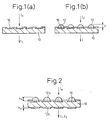
- Figs. 1(a) and 1(b) show a method for measuring the height of the bumps provided on a semiconductor substrate using X-rays according to the present invention.
- X-rays are irradiated onto the work and the intensity of X-rays which transmit through the work is measured to determine the heights of the bumps.
- the measurement results for one sample, wherein a bump 12 is not formed on the land 16 of the substrate 10 and the measurement results for another sample, wherein a bump 12 is formed on the land 16 of the substrate 10, are compared to each other to determine the height of bump 12.
- the intensity I 1 of transmitted X-rays in the state that no bumps 12 are formed on the lands 16 is measured beforehand and, on the other hand, if the linear absorption coefficient ⁇ B of the material constituting the bumps 12 is measured beforehand, the height (h) of bumps can be detected by only measuring the intensity of transmitted X-rays in the state that the bumps 12 are formed on the lands 16.
- the thickness of the lands 16 formed on the substrate 10 is relatively thin, about 18 ⁇ m, the deviation of the thickness is relatively small, and in general the linear absorption coefficient is relatively small. Therefore, the lands 16 do not result in a great influence to the measuring results. Therefore, it is sufficient to measure the intensity (I 1 ) of transmitted X-rays with respect to the samples of substrate having no bumps to use the measured results as a reference value.
- the intensity I 1 of transmitted X-rays with respect to the samples of substrate having no bumps 12 formed on the lands 16 reflects the intensity of transmitted X-rays through the land 16 as well as the intensity of transmitted X-rays through the base body of the substrate 10. Therefore, the measuring method of this embodiment can be used for detecting the height of bumps 12, either for a substrate having no inner conductive layer other than the lands 16, as well as a substrate having such an inner conductive layer. This is because the height of bumps 12 can be determined in such a manner that the intensity of transmitted X-ray with respect to the substrate having no bumps 12 is defined as a reference value and then the difference is determined.
- the wavelength of the X-rays which transmit through the work can be optionally selected. Therefore, depending on the bumps to be measured, the absorption spectrum of X-ray is measured beforehand and the wavelength of X-ray which is the most favorable for measuring can be determined. For example, if the bumps 12 are formed of solder, the absorption spectrum of X-ray with respect to solder is measured beforehand. Thus, it is possible to measure using X-rays having such a wavelength of large linear absorption coefficient. Since the absorption spectrum may be different depending on the products even if the substrate itself is the same kind, it is effective to measure the absorption spectrum of X-rays to use the optimum wavelength.
- Fig. 2 shows an example wherein the bumps 12a and 12b are provided on the respective surfaces of a substrate 10.
- a substrate having the respective surfaces of a substrate 10 on which the bumps 12a and 12b are formed.
- the materials of the bumps 12a and 12b formed on the respective surfaces of the substrate are different from each other, such as, if the bumps 12a on one of the surfaces are formed of tin-lead and the bumps 12b on the other surface are formed of tin-silver, the respective heights h a and h b of the bumps 12a and 12b can be detected.
- two or more types of X-rays having different wavelength can be used to measure the intensity of the transmitted X-ray.
- I 1 and I 2 are given by the following representations.
- I 1 I 0 exp(- ⁇ a1 h a )•exp(- ⁇ b1 h b )
- I 2 I 0 exp(- ⁇ a2 h a )•exp(- ⁇ b2 h b )
- ⁇ a1 , ⁇ a2 , ⁇ b1 , and ⁇ b2 are given beforehand by measurements and I 1 and I 2 can be given as the results of measurements. Therefore, the heights ha and h b of the bumps 12a and 12b can thus be obtained from the above-mentioned representations (4) and (5).
- Figs. 3 to 5 show some examples of measuring apparatus for measuring the intensity of the transmitted X-ray.
- the embodiment shown in Fig. 3 uses an X-ray CCD camera
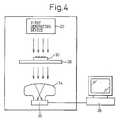
- the embodiment shown in Fig. 4 uses X-ray image intensifier
- the embodiment shown in Fig. 5 is a measuring apparatus using a photomultiplier tube.
- the bump detecting apparatus shown in Fig. 3 comprises a X-ray generating device for generating X-rays which should be incident to the work 30 and a CCD camera 22 for detecting X-ray transmitted through the work 30.
- the image data detected by the X-ray CCD camera 22 is converted to a digital value by an AD converter 24 and detected by a computer 26 as an intensity of transmitted X-ray.
- the apparatus further includes a stage 28 on which works are set and a stage guide 29 for moving the stage 28 in the direction parallel to the optical axis of the CCD camera to regulate the focus position of the work 30.
- the height of the bumps can be determined by detecting the intensity of transmitted X-rays transmitted through the work 30.
- the respective intensities (I) of X-ray transmitted through the respective bumps of the work 30 and the linear absorption coefficient ( ⁇ B ) and the intensities (I 1 ) of transmitted X-rays are analyzed to determined the height (h B ) of bumps. From these detected results, whether the bumps have a predetermined dimension of height or not can be determined to discriminate allowable and non-allowable products.
- the CCD camera 22 and the AD converter 24 constitute detecting means and the computer 26 constitutes an analyzing means.
- a standard sample 32 can be provided for correcting the intensity of X-rays.
- the standard sample 32 is disposed on the stage 28 and the X-ray transmitted intensity with respect to the standard sample 32 is detected by the X-ray CCD camera 22, thereby the intensity of the incident X-rays can be regulated. Otherwise, the results of measurements can be revised in accordance with the intensity of the incident X-rays.
- X-rays are incident toward the work 30 from the X-ray generating device 20 and the X-rays transmitted through the work 30 are incident on the X-ray image intensifier 34.
- the X-ray image intensifier 34 converts the weak X-ray image into a visible image and a digital CCD camera 36 is arranged at the optical output side.
- the X-ray transmitted image of the work 30 can be output to the computer 26 as a digital image.
- the X-ray permeability of the respective bumps are analyzed from the digital image of the works 30 and the heights of the respective bumps can thus be detected on the basis of these data.
- the X-ray image intensifier 34 Since the X-ray image intensifier 34 has a high image quality, even though a large number of fine bumps are highly densely arranged on the work 30, the bumps can be accurately detected. Also, as the X-ray image intensifier 34 can detect a relatively wide image range, if the work itself is small in size, as a semiconductor device, it is possible to measure at all the bumps once. In this embodiment, a standard sample can be used for correcting the intensity of the incident X-rays. In this embodiment, the X-ray image intensifier 34, the digital CCD camera 36 and the computer 26 constitute a detecting device.
- Fig. 5 shows a further embodiment of a measuring apparatus for detecting the transmitted X-ray intensity, in which X-rays are incident toward the work 30 from the X-ray generating device 20, the X-rays transmitted through the work 30 are detected by a photomultiplier tube 38 and thus the intensity of X-rays transmitted through the work can be measured.
- the photomultiplier tube 38 serves to amplify the photoelectron energized by the X-rays and the data counted by a photon counter 40 is input into the computer 26.
- a high voltage power 39 supplies power to actuate the photomultiplier tube 38.
- the count number of the respective bumps of the work are individually measured to detect the intensity of transmitted X-rays. Therefore, the work 30 must be moved for each bump with respect to the photomultiplier tube 38.
- a stage 28 is supported on a movable stage 42 and the position of the movable stage 42 is controlled by the computer 26.
- the output (count number) from the photomultiplier tube 38 is memorized by the computer for each bump of the work 30 and thus the intensity of transmitted X-rays can be measured for all of the bumps of the work 30.
- the process for detecting the height of the individual bumps from the intensity of transmitted X-ray is the same as that of the previous embodiments.
- the detecting method using the photomultiplier tube 38 is complicated as the detecting process must be performed for each bump, a more precise measurement can be expected.
- the photomultiplier tube 38, the photon counter 40 and the computer 26 constitute a detecting device.
- the height of the bumps is measured using X-rays transmitted through the work, the following advantages can be obtained. That is to say, a precise measurement can be effected regardless of the nature of the object, such as the gloss of the bumps. Also, as the height of the bumps from the land can be measured by using transmitted X-rays, it is no longer necessary to measure the height of bumps using a protective film, such as a solder resist, as in the prior art. Therefore, there are no fluctuations in the measurement results due to deviations in the thickness of protective film. This is particularly advantageous when a semiconductor element is mounted on a substrate by flip-chip connection using bumps densely arranged on the substrate.
- any warps of the substrate do not affect the measured heights of bumps.
Landscapes
- Physics & Mathematics (AREA)
- Electromagnetism (AREA)
- General Physics & Mathematics (AREA)
- Length-Measuring Devices Using Wave Or Particle Radiation (AREA)
- Testing Or Measuring Of Semiconductors Or The Like (AREA)
- Length Measuring Devices By Optical Means (AREA)
Priority Applications (1)
| Application Number | Priority Date | Filing Date | Title |
|---|---|---|---|
| EP09002532A EP2058623A3 (fr) | 2000-06-14 | 2001-06-12 | Procédé et appareil pour mesurer une secousse sur un substrat |
Applications Claiming Priority (2)
| Application Number | Priority Date | Filing Date | Title |
|---|---|---|---|
| JP2000177916 | 2000-06-14 | ||
| JP2000177916A JP3517388B2 (ja) | 2000-06-14 | 2000-06-14 | バンプの検査方法及びバンプの検査装置 |
Related Child Applications (1)
| Application Number | Title | Priority Date | Filing Date |
|---|---|---|---|
| EP09002532A Division EP2058623A3 (fr) | 2000-06-14 | 2001-06-12 | Procédé et appareil pour mesurer une secousse sur un substrat |
Publications (2)
| Publication Number | Publication Date |
|---|---|
| EP1164351A2 true EP1164351A2 (fr) | 2001-12-19 |
| EP1164351A3 EP1164351A3 (fr) | 2003-01-02 |
Family
ID=18679436
Family Applications (2)
| Application Number | Title | Priority Date | Filing Date |
|---|---|---|---|
| EP01113541A Withdrawn EP1164351A3 (fr) | 2000-06-14 | 2001-06-12 | Procédé et appareil pour la mesure d' une protubérance sur un substrat |
| EP09002532A Withdrawn EP2058623A3 (fr) | 2000-06-14 | 2001-06-12 | Procédé et appareil pour mesurer une secousse sur un substrat |
Family Applications After (1)
| Application Number | Title | Priority Date | Filing Date |
|---|---|---|---|
| EP09002532A Withdrawn EP2058623A3 (fr) | 2000-06-14 | 2001-06-12 | Procédé et appareil pour mesurer une secousse sur un substrat |
Country Status (3)
| Country | Link |
|---|---|
| US (1) | US6522719B2 (fr) |
| EP (2) | EP1164351A3 (fr) |
| JP (1) | JP3517388B2 (fr) |
Cited By (1)
| Publication number | Priority date | Publication date | Assignee | Title |
|---|---|---|---|---|
| CN121075945A (zh) * | 2025-11-05 | 2025-12-05 | 北京电子量检测装备有限责任公司 | 一种半导体芯片的三维检测方法及装置、电子设备 |
Families Citing this family (12)
| Publication number | Priority date | Publication date | Assignee | Title |
|---|---|---|---|---|
| DE10224195B4 (de) * | 2002-05-31 | 2013-03-14 | Advanced Micro Devices, Inc. | Verfahren zur objektiven und genauen Dickenmessung von dünnen Filmen im mikroskopischen Maßstab |
| JP3969337B2 (ja) * | 2003-04-15 | 2007-09-05 | 株式会社島津製作所 | バンプ検査装置 |
| EP1886257A1 (fr) | 2005-05-11 | 2008-02-13 | Optosecurity Inc. | Procede et systeme d'inspection de bagages, de conteneurs de fret ou de personnes |
| US7991242B2 (en) | 2005-05-11 | 2011-08-02 | Optosecurity Inc. | Apparatus, method and system for screening receptacles and persons, having image distortion correction functionality |
| US7899232B2 (en) | 2006-05-11 | 2011-03-01 | Optosecurity Inc. | Method and apparatus for providing threat image projection (TIP) in a luggage screening system, and luggage screening system implementing same |
| US8494210B2 (en) | 2007-03-30 | 2013-07-23 | Optosecurity Inc. | User interface for use in security screening providing image enhancement capabilities and apparatus for implementing same |
| JP5350604B2 (ja) * | 2007-05-16 | 2013-11-27 | スパンション エルエルシー | 半導体装置及びその製造方法 |
| US9111331B2 (en) | 2011-09-07 | 2015-08-18 | Rapiscan Systems, Inc. | X-ray inspection system that integrates manifest data with imaging/detection processing |
| MY180533A (en) * | 2014-03-17 | 2020-12-01 | Shinetsu Chemical Co | Methods for working synthetic quartz glass substrate having a mirror-like surface and method for sensing synthetic quartz glass substrate |
| JP6359474B2 (ja) * | 2015-03-10 | 2018-07-18 | 株式会社東芝 | 放射線を用いたろう付け接合長さの定量評価のための装置および方法 |
| PL3764281T3 (pl) | 2016-02-22 | 2025-02-10 | Rapiscan Systems, Inc. | Sposoby identyfikacji broni palnej na obrazach radiograficznych |
| TWI684017B (zh) * | 2018-02-13 | 2020-02-01 | 矽品精密工業股份有限公司 | 凸塊測試設備及方法 |
Citations (11)
| Publication number | Priority date | Publication date | Assignee | Title |
|---|---|---|---|---|
| JPS60227108A (ja) * | 1984-04-25 | 1985-11-12 | Sumitomo Metal Ind Ltd | 多層積層材の厚み測定方法 |
| US4607380A (en) | 1984-06-25 | 1986-08-19 | General Electric Company | High intensity microfocus X-ray source for industrial computerized tomography and digital fluoroscopy |
| JPS6391505A (ja) * | 1986-10-06 | 1988-04-22 | Kawasaki Steel Corp | 金属板の板厚測定方法及び装置 |
| US4910757A (en) | 1987-11-06 | 1990-03-20 | Hitachi, Ltd. | Method and apparatus for X-ray imaging |
| US5099504A (en) * | 1987-03-31 | 1992-03-24 | Adaptive Technologies, Inc. | Thickness/density mesuring apparatus |
| US5493594A (en) * | 1988-08-26 | 1996-02-20 | Hitachi, Ltd. | Method and apparatus for inspection of solder joints by x-ray fluoroscopic imaging |
| US5561696A (en) * | 1987-10-30 | 1996-10-01 | Hewlett-Packard Company | Method and apparatus for inspecting electrical connections |
| US5621811A (en) | 1987-10-30 | 1997-04-15 | Hewlett-Packard Co. | Learning method and apparatus for detecting and controlling solder defects |
| US5687209A (en) * | 1995-04-11 | 1997-11-11 | Hewlett-Packard Co. | Automatic warp compensation for laminographic circuit board inspection |
| WO2000013228A1 (fr) | 1998-09-01 | 2000-03-09 | Robert Bosch Gmbh | Procede permettant de monter des composants electroniques sur un substrat et procede de verification dudit montage |
| DE19951793A1 (de) * | 1999-01-26 | 2000-08-10 | Hewlett Packard Co | Verbesserte Dickenkalibrierung und Schattierungskorrektur für eine automatische Röntgeninspektion |
Family Cites Families (7)
| Publication number | Priority date | Publication date | Assignee | Title |
|---|---|---|---|---|
| US4119846A (en) * | 1977-02-03 | 1978-10-10 | Sangamo Weston, Inc. | Non-contacting gage apparatus and method |
| JPH0455743A (ja) * | 1990-06-26 | 1992-02-24 | Fujitsu Ltd | エックス線検査装置 |
| JPH04315006A (ja) * | 1991-04-12 | 1992-11-06 | Fujitsu Ltd | フリップチップのボンディング検査方法 |
| JPH05251535A (ja) * | 1992-03-05 | 1993-09-28 | Fujitsu Ltd | バンプ検査装置 |
| JPH10253550A (ja) * | 1997-03-12 | 1998-09-25 | Nagoya Denki Kogyo Kk | 実装基板の半田付け検査装置 |
| JP4031113B2 (ja) * | 1998-07-27 | 2008-01-09 | 独立行政法人科学技術振興機構 | X線検査方法およびx線検査装置 |
| JP2000249532A (ja) * | 1999-02-26 | 2000-09-14 | Nagoya Electric Works Co Ltd | X線検査方法およびその装置 |
-
2000
- 2000-06-14 JP JP2000177916A patent/JP3517388B2/ja not_active Expired - Fee Related
-
2001
- 2001-06-12 EP EP01113541A patent/EP1164351A3/fr not_active Withdrawn
- 2001-06-12 EP EP09002532A patent/EP2058623A3/fr not_active Withdrawn
- 2001-06-14 US US09/881,004 patent/US6522719B2/en not_active Expired - Fee Related
Patent Citations (11)
| Publication number | Priority date | Publication date | Assignee | Title |
|---|---|---|---|---|
| JPS60227108A (ja) * | 1984-04-25 | 1985-11-12 | Sumitomo Metal Ind Ltd | 多層積層材の厚み測定方法 |
| US4607380A (en) | 1984-06-25 | 1986-08-19 | General Electric Company | High intensity microfocus X-ray source for industrial computerized tomography and digital fluoroscopy |
| JPS6391505A (ja) * | 1986-10-06 | 1988-04-22 | Kawasaki Steel Corp | 金属板の板厚測定方法及び装置 |
| US5099504A (en) * | 1987-03-31 | 1992-03-24 | Adaptive Technologies, Inc. | Thickness/density mesuring apparatus |
| US5561696A (en) * | 1987-10-30 | 1996-10-01 | Hewlett-Packard Company | Method and apparatus for inspecting electrical connections |
| US5621811A (en) | 1987-10-30 | 1997-04-15 | Hewlett-Packard Co. | Learning method and apparatus for detecting and controlling solder defects |
| US4910757A (en) | 1987-11-06 | 1990-03-20 | Hitachi, Ltd. | Method and apparatus for X-ray imaging |
| US5493594A (en) * | 1988-08-26 | 1996-02-20 | Hitachi, Ltd. | Method and apparatus for inspection of solder joints by x-ray fluoroscopic imaging |
| US5687209A (en) * | 1995-04-11 | 1997-11-11 | Hewlett-Packard Co. | Automatic warp compensation for laminographic circuit board inspection |
| WO2000013228A1 (fr) | 1998-09-01 | 2000-03-09 | Robert Bosch Gmbh | Procede permettant de monter des composants electroniques sur un substrat et procede de verification dudit montage |
| DE19951793A1 (de) * | 1999-01-26 | 2000-08-10 | Hewlett Packard Co | Verbesserte Dickenkalibrierung und Schattierungskorrektur für eine automatische Röntgeninspektion |
Cited By (1)
| Publication number | Priority date | Publication date | Assignee | Title |
|---|---|---|---|---|
| CN121075945A (zh) * | 2025-11-05 | 2025-12-05 | 北京电子量检测装备有限责任公司 | 一种半导体芯片的三维检测方法及装置、电子设备 |
Also Published As
| Publication number | Publication date |
|---|---|
| EP2058623A3 (fr) | 2009-12-02 |
| US6522719B2 (en) | 2003-02-18 |
| EP1164351A3 (fr) | 2003-01-02 |
| EP2058623A2 (fr) | 2009-05-13 |
| JP2001358161A (ja) | 2001-12-26 |
| JP3517388B2 (ja) | 2004-04-12 |
| US20010053197A1 (en) | 2001-12-20 |
Similar Documents
| Publication | Publication Date | Title |
|---|---|---|
| US6522719B2 (en) | Method and apparatus for measuring a bump on a substrate | |
| US11481887B2 (en) | Apparatuses and methods for warpage measurement | |
| US7126699B1 (en) | Systems and methods for multi-dimensional metrology and/or inspection of a specimen | |
| JP5722861B2 (ja) | 検査方法及び検査装置 | |
| US20210279878A1 (en) | Methods and Systems for Printed Circuit Board Design Based on Automatic Corrections | |
| US5465152A (en) | Method for coplanarity inspection of package or substrate warpage for ball grid arrays, column arrays, and similar structures | |
| WO1989008926A1 (fr) | Agencement a vernier pour dispositifs a liaison flip-chip | |
| US20070286344A1 (en) | Target alignment for x-ray scattering measurements | |
| KR20090083374A (ko) | 광 디바이스용 검사장치 | |
| CN101187783A (zh) | 调焦调平测量系统及其测量方法 | |
| US7265343B2 (en) | Apparatus and method for calibration of an optoelectronic sensor and for mensuration of features on a substrate | |
| US5444758A (en) | Beam position detecting device | |
| US4884890A (en) | Method for normalizing the detection signals of magnified images of fluorescing materials | |
| EP1021704B1 (fr) | Methode pour la detection de condensation sur des surfaces | |
| US20130193603A1 (en) | Inspection apparatus, lithography apparatus, imprint apparatus, and method of manufacturing article | |
| US20190137422A1 (en) | X-ray fluorescence spectrometer | |
| Colvin | BGA and advanced package wire to wire bonding for backside emission microscopy | |
| Teramoto et al. | Development of an automated X-ray inspection method for microsolder bumps | |
| GB2215912A (en) | Aligning the components of flip-chip bonded devices | |
| JP2943343B2 (ja) | 微粒子測定装置 | |
| EP0592520A1 (fr) | Appareil et procede de calibrage d'un appareil de mesure d'epaisseur de couche par rayons x. | |
| JPS6361155A (ja) | 内部欠陥検査方法及びその装置 | |
| JP4966160B2 (ja) | 膜厚測定方法 | |
| Delgado et al. | Integrated design of a smart analog sun sensor with CMOS technology | |
| Kong et al. | Known void size micro-bump, a novel standard of 3D X-ray computed tomography in-line metrology for accuracy assessment and monitoring |
Legal Events
| Date | Code | Title | Description |
|---|---|---|---|
| PUAI | Public reference made under article 153(3) epc to a published international application that has entered the european phase |
Free format text: ORIGINAL CODE: 0009012 |
|
| AK | Designated contracting states |
Kind code of ref document: A2 Designated state(s): AT BE CH CY DE DK ES FI FR GB GR IE IT LI LU MC NL PT SE TR |
|
| AX | Request for extension of the european patent |
Free format text: AL;LT;LV;MK;RO;SI |
|
| PUAL | Search report despatched |
Free format text: ORIGINAL CODE: 0009013 |
|
| AK | Designated contracting states |
Kind code of ref document: A3 Designated state(s): AT BE CH CY DE DK ES FI FR GB GR IE IT LI LU MC NL PT SE TR |
|
| AX | Request for extension of the european patent |
Free format text: AL;LT;LV;MK;RO;SI |
|
| RIC1 | Information provided on ipc code assigned before grant |
Free format text: 7G 01B 15/02 A, 7G 01F 15/02 B |
|
| 17P | Request for examination filed |
Effective date: 20030109 |
|
| AKX | Designation fees paid |
Designated state(s): DE |
|
| 17Q | First examination report despatched |
Effective date: 20081030 |
|
| STAA | Information on the status of an ep patent application or granted ep patent |
Free format text: STATUS: THE APPLICATION IS DEEMED TO BE WITHDRAWN |
|
| 18D | Application deemed to be withdrawn |
Effective date: 20100309 |