EP1164509A2 - Index de jointures d'aggrégats pour des bases de données relationnelles - Google Patents
Index de jointures d'aggrégats pour des bases de données relationnelles Download PDFInfo
- Publication number
- EP1164509A2 EP1164509A2 EP01304927A EP01304927A EP1164509A2 EP 1164509 A2 EP1164509 A2 EP 1164509A2 EP 01304927 A EP01304927 A EP 01304927A EP 01304927 A EP01304927 A EP 01304927A EP 1164509 A2 EP1164509 A2 EP 1164509A2
- Authority
- EP
- European Patent Office
- Prior art keywords
- aggregate
- query
- join index
- join
- tables
- Prior art date
- Legal status (The legal status is an assumption and is not a legal conclusion. Google has not performed a legal analysis and makes no representation as to the accuracy of the status listed.)
- Withdrawn
Links
Images

Classifications
-
- G—PHYSICS
- G06—COMPUTING OR CALCULATING; COUNTING
- G06F—ELECTRIC DIGITAL DATA PROCESSING
- G06F16/00—Information retrieval; Database structures therefor; File system structures therefor
- G06F16/20—Information retrieval; Database structures therefor; File system structures therefor of structured data, e.g. relational data
- G06F16/24—Querying
- G06F16/245—Query processing
- G06F16/2455—Query execution
- G06F16/24553—Query execution of query operations
- G06F16/24554—Unary operations; Data partitioning operations
- G06F16/24556—Aggregation; Duplicate elimination
-
- G—PHYSICS
- G06—COMPUTING OR CALCULATING; COUNTING
- G06F—ELECTRIC DIGITAL DATA PROCESSING
- G06F16/00—Information retrieval; Database structures therefor; File system structures therefor
- G06F16/20—Information retrieval; Database structures therefor; File system structures therefor of structured data, e.g. relational data
- G06F16/24—Querying
- G06F16/245—Query processing
- G06F16/2455—Query execution
- G06F16/24553—Query execution of query operations
- G06F16/24558—Binary matching operations
- G06F16/2456—Join operations
-
- G—PHYSICS
- G06—COMPUTING OR CALCULATING; COUNTING
- G06F—ELECTRIC DIGITAL DATA PROCESSING
- G06F16/00—Information retrieval; Database structures therefor; File system structures therefor
- G06F16/20—Information retrieval; Database structures therefor; File system structures therefor of structured data, e.g. relational data
- G06F16/24—Querying
- G06F16/245—Query processing
- G06F16/2455—Query execution
- G06F16/24553—Query execution of query operations
- G06F16/24561—Intermediate data storage techniques for performance improvement
-
- Y—GENERAL TAGGING OF NEW TECHNOLOGICAL DEVELOPMENTS; GENERAL TAGGING OF CROSS-SECTIONAL TECHNOLOGIES SPANNING OVER SEVERAL SECTIONS OF THE IPC; TECHNICAL SUBJECTS COVERED BY FORMER USPC CROSS-REFERENCE ART COLLECTIONS [XRACs] AND DIGESTS
- Y10—TECHNICAL SUBJECTS COVERED BY FORMER USPC
- Y10S—TECHNICAL SUBJECTS COVERED BY FORMER USPC CROSS-REFERENCE ART COLLECTIONS [XRACs] AND DIGESTS
- Y10S707/00—Data processing: database and file management or data structures
- Y10S707/99931—Database or file accessing
- Y10S707/99932—Access augmentation or optimizing
Definitions
- This invention relates in general to computerized relational databases, and in particular, to a method, apparatus and program product for performing queries against a relational database using an aggregate join index.
- RDBMS Relational DataBase Management Systems
- SQL Structured Query Language
- ANSI American National Standards Institute
- ISO International Standards Organization
- a table in a relational database is two dimensional, consisting of rows and columns. Each column has a name, typically describing the type of data held in that column. As new data is added, more rows are inserted into the table.
- a user query selects some rows of the table by specifying clauses that qualify the rows to be retrieved based on the values in one or more of the columns.
- the SQL interface allows users to formulate relational operations on the tables either interactively, in batch files, or embedded in host languages such as C, COBOL, etc. Operators are provided in SQL that allow the user to manipulate the data, wherein each operator performs functions on one or more tables and produces a new table as a result.
- the power of SQL lies on its ability to link information from multiple tables or views together to perform complex sets of procedures with a single statement.
- the SQL interface allows users to formulate relational operations on the tables.
- One of the most common SQL queries executed by the RDBMS is the SELECT statement.
- the SELECT statement generally comprises the format: "SELECT ⁇ clause> FROM ⁇ clause> WHERE ⁇ clause> GROUP BY ⁇ clause> HAVING ⁇ clause> ORDER BY ⁇ clause>.”
- the clauses generally must follow this sequence, but only the SELECT and FROM clauses are required.
- the result of a SELECT statement is a subset of data retrieved by the RDBMS from one or more existing tables stored in the relational database, wherein the FROM clause identifies the name of the table or tables from which data is being selected.
- the subset of data is treated as a new table, termed the result table.
- join operation is usually implied by naming more than one table in the FROM clause of a SELECT statement.
- a join operation makes it possible to combine tables by combining rows from one table with another table.
- the rows, or portions of rows, from the different tables are concatenated horizontally.
- join operations normally include a WHERE clause that identifies the columns through which the rows can be combined.
- the WHERE clause may also include a predicate comprising one or more conditional operators that are used to select the rows to be joined.
- join indexes have been used to improve the performance of join operations in RDBMS's. Techniques have been developed for maximizing performance using join indexes. However, there remains a need in the art for additional optimization techniques through the use of join indexes.
- the invention resides in a method of optimizing retrieval of data from a database in a computerized database management system, characterized by computing one or more aggregation expressions from one or more columns of one or more tables in the database; and creating an aggregate join index for the tables by combining one or more commonly-used columns of the tables with results from the aggregation expressions.
- the invention resides in a computerized database management system for optimizing retrieval of data from a database, comprising means for computing one or more aggregation expressions from one or more columns of one or more tables in the database; and means for creating an aggregate join index for the tables by combining one or more commonly-used columns of the tables with results from the aggregation expressions.
- a definition of the aggregate join index specifies the aggregate expressions and the aggregate join index is created by performing a join operation on the tables.
- the aggregate join index is preferably incrementally updated when the tables are updated.
- a query into a computer On receiving a query into a computer, it is processed using the aggregate join index for one or more tables referenced in the query.
- the query is preferably satisfied with the results from the aggregate expressions stored in the aggregate join index rather than the tables referenced in the query.
- the results from the aggregate expressions stored in the aggregate join index are used to satisfy the query, when the query includes the aggregate expressions, the aggregate join index is created by a same set of join operations as specified in the query, the aggregate expressions are defined by a same set or a superset of GROUP BY fields as specified in the query, and the aggregate join index contains all fields selected by the query.
- the results from the aggregate expressions stored in the aggregate join index are used to satisfy the query, when the query includes the aggregate expressions, the aggregate join index is created by a subset of join operations as specified in the query, the aggregate join index is created by a same set or a superset of GROUP BY fields and SELECT fields as specified in the query with respect to a set of tables defined by a subset of join conditions, and the aggregate join index contains fields needed by any remaining join conditions specified in the query.
- the results from the aggregate expressions stored in the aggregate join index are used to satisfy the query, when the query includes the aggregate expressions, the aggregate join index is created by a same set or subset of join operations as specified in the query, and the query does not specify a GROUP BY clause.
- the invention may also be expressed as a data structure stored in a memory for use by a database management system executed by a computer, the data structure comprising instructions for optimizing retrieval of data from the database which when executed cause the computer to perform the method described above.
- the invention also resides in a computer program comprising program instructions for optimizing retrieval of data from a database in a computerized database management system and in an article including one or more machine-readable storage media containing instructions for optimizing retrieval of data from a database in a computerized database management system, the instructions when executed causing the system to perform the method described above.
- the present invention describes aggregate join indexes, which provide dramatic performance improvements to queries that involve aggregation operations.
- a query having one or more aggregate expressions is expensive to perform, because it requires sorting the data by a grouping key before the aggregate expression can be computed.
- extra costs for processing the query are incurred when a single processor does not have all the rows that belong to the same group. In this situation, global aggregation that involves redistributing data across processors is also needed.
- the present invention allows users to perform some or all of the aggregation operations (and possibly join operations as well) when the aggregate join index is defined, by specifying aggregate expressions in the definition of the aggregate join index.
- the results of the aggregate expressions are computed from one or more tables and then stored in the aggregate join index across multiple processors, along with the columns that are used as the aggregation key and a row count of each aggregated group.
- the results are incrementally updated using the updated data in the tables, and then the aggregate join index is incrementally updated using the results.
- the update maintenance overhead associated with the aggregate join index can be justified by dramatic improvements to the query response time resulting from the use of aggregate join index.
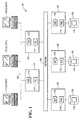
- FIG. 1 illustrates an exemplary hardware and software environment that could be used with the preferred embodiment of the present invention.
- a computer system 100 is comprised of one or more processing units (PUs) 102, also known as processors or nodes, which are interconnected by a network 104.
- PUs processing units
- DSUs removable data storage units
- Each of the PUs 102 is coupled to zero or more fixed and/or removable data storage units (DSUs) 106, such as disk drives, that store one or more relational databases.
- DSUs fixed and/or removable data storage units
- DCUs data communications units
- Operators of the computer system 100 typically use a workstation 110, terminal, computer, or other input device to interact with the computer system 100.
- This interaction generally comprises queries that conform to the Structured Query Language (SQL) standard, and invoke functions performed by a Relational DataBase Management System (RDBMS) executed by the system 100.
- SQL Structured Query Language
- RDBMS Relational DataBase Management System
- the RDBMS comprises the Teradata® product offered by NCR Corporation, and includes one or more Parallel Database Extensions (PDEs) 112, Parsing Engines (PEs) 114, and Access Module Processors (AMPs) 116. These components of the RDBMS perform the functions necessary to implement the RDBMS and SQL standards, i.e., definition, compilation, interpretation, optimization, database access control, database retrieval, and database update.
- PDEs Parallel Database Extensions
- PEs Parsing Engines
- AMPs Access Module Processors
- a DSU 106 may store only a subset of rows that comprise a table in the partitioned database 118 and work is managed by the system 100 so that the task of operating on each subset of rows is performed by the AMP 116 managing the DSUs 106 that store the subset of rows.
- the PEs 114 handle communications, session control, optimization and query plan generation and control.
- the PEs 114 fully parallelize all functions among the AMPs 116.
- the system of FIG. 1 applies a multiple instruction stream, multiple data stream (MIMD) concurrent processing architecture to implement a relational database management system 100.
- MIMD multiple instruction stream, multiple data stream
- Both the PEs 114 and AMPs 116 are known as “virtual processors" or “vprocs”.
- the vproc concept is accomplished by executing multiple threads or processes in a PU 102, wherein each thread or process is encapsulated within a vproc.
- the vproc concept adds a level of abstraction between the multi-threading of a work unit and the physical layout of the parallel processing computer system 100.
- the vproc concept provides for intra-node as well as the inter-node parallelism.
- the vproc concept results in better system 100 availability without undue programming overhead.
- the vprocs also provide a degree of location transparency, in that vprocs communicate with each other using addresses that are vproc-specific, rather than node-specific. Further, vprocs facilitate redundancy by providing a level of isolation/abstraction between the physical node 102 and the thread or process. The result is increased system 100 utilization and fault tolerance.
- the system 100 does face the issue of how to divide a query or other unit of work into smaller sub-units, each of which can be assigned to an AMP 116.
- data partitioning and repartitioning may be performed, in order to enhance parallel processing across multiple AMPs 116.
- the data may be hash partitioned, range partitioned, or not partitioned at all (i.e., locally processed).
- Hash partitioning is a partitioning scheme in which a predefined hash function and map is used to assign records to AMPs 116, wherein the hashing function generates a hash "bucket" number and the hash bucket numbers are mapped to AMPs 116.
- Range partitioning is a partitioning scheme in which each AMP 116 manages the records falling within a range of values, wherein the entire data set is divided into as many ranges as there are AMPs 116. No partitioning means that a single AMP 116 manages all of the records.
- the PDEs 112, PEs 114, and AMPs 116 are tangibly embodied in and/or accessible from a device, media, carrier, or signal, such as RAM, ROM, one or more of the DSUs 106, and/or a remote system or device communicating with the computer system 100 via one or more of the DCUs 108.
- the PDEs 112, PEs 114, and AMPs 116 each comprise logic and/or data which, when executed, invoked, and/or interpreted by the PUs 102 of the computer system 100, cause the necessary steps or elements of the present invention to be performed
- FIG. 1 is not intended to limit the present invention. Indeed, those skilled in the art will recognize that other alternative environments may be used without departing from the scope of the present invention. In addition, it should be understood that the present invention may also apply to components other than those disclosed herein.
- a standard join index is extended to a new structure known as an aggregate join index.
- the aggregate join index stores the results from one or more aggregation expressions computed from one or more columns of one or more tables, along with the columns that are used as the aggregation key and a row count of each aggregated group. These pre-computed results stored in the aggregate join index can then be used to satisfy a subsequent query, rather than having to compute the aggregate expressions from columns of the tables referenced in the query.
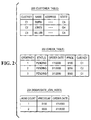
- FIG. 2 illustrates the structure of two base tables, CUSTOMER_TABLE 200 and ORDER_TABLE 202, and an aggregate join index, AGGREGATE_JOIN_INDEX 204.
- the base tables 200 and 202 are created using the following SQL statements:
- a simple query comprising a SELECT statement can be defined on the base tables 200 and 202, wherein the query performs a join operation:
- an aggregate join index 204 can be defined on a binary join result of the two base tables 200 and 202 as follows:
- the RDBMS can generate a new access plan for the above query that accesses the aggregate join index 204, rather than the tables 200 and 202, which is much smaller than either one of the base tables 200 and 202.
- the access plan could correspond to the query shown below:
- FIGS. 3 and 4 Flowcharts which illustrate the logic of the RDBMS creating and using an aggregate join index according to the present invention are shown in FIGS. 3 and 4. Those skilled in the art will recognize that this logic is provided for illustrative purposes only and that different logic may be used to accomplish the same results.
- FIG. 3 is a flowchart illustrating the steps performed by the RDBMS to create an aggregate join index according to the present invention.
- Block 300 represents the RDBMS identifying the base tables from which to create the aggregate join index.
- Block 302 represents the RDBMS performing one or more SQL statements to create the aggregate join index, wherein the query comprises, for example, the following:
- Block 304 represents the RDBMS storing the results of the executed SQL statement in the aggregate join index for later use.
- FIG. 4 is a flowchart illustrating the steps performed by the RDBMS to use an aggregate join index for accessing data according to the present invention.
- Block 400 represents the RDBMS receiving one or more SQL statements comprising, for example, a query against one or more base tables in the relational database.
- Block 402 represents the RDBMS interpreting the SQL statements.
- Block 404 is a decision block that represents the RDBMS determining whether an aggregate join index can be used to answer the SQL statements, wherein the RDBMS compares the definition of the aggregate join index with the SQL statements to determine whether the rules described above are satisfied. If not, control transfers to Block 412, which represents the RDBMS performing standard processing for the SQL statements; otherwise, control transfers to Block 406.
- Block 406 is a decision block that represents the RDBMS determining whether the SQL statements access only data that can be found in the aggregate join index. If so, control transfers to Block 408, which represents the RDBMS modifying the SQL statements to access data only from the aggregate join index rather than the base tables; otherwise, control transfers to Block 410, which represents the RDBMS modifying the SQL statements to retrieve data from the base tables using the aggregate join index.
- Block 412 represents the RDBMS generating an access plan that enables the RDBMS to access the data from the relational database.
- Block 414 represents the RDBMS executing the plan, retrieving the results from the relational database, and then returning the result to the user or client application.
- any type of computer such as a mainframe, minicomputer, or personal computer, could be used to implement the present invention.
- any database management system (DBMS) that performs join operations or aggregation operations could benefit from the present invention.
- DBMS database management system
- the present invention discloses methods, apparatus, articles of manufacture, and data structures related to the creation and use of an aggregate join index.
- the aggregate join index combines one or more commonly-used columns of one or more tables with the results from one or more aggregation expressions pre-computed from one or more columns of the tables.
Landscapes
- Engineering & Computer Science (AREA)
- Theoretical Computer Science (AREA)
- Computational Linguistics (AREA)
- Data Mining & Analysis (AREA)
- Databases & Information Systems (AREA)
- Physics & Mathematics (AREA)
- General Engineering & Computer Science (AREA)
- General Physics & Mathematics (AREA)
- Information Retrieval, Db Structures And Fs Structures Therefor (AREA)
Applications Claiming Priority (2)
| Application Number | Priority Date | Filing Date | Title |
|---|---|---|---|
| US594964 | 1996-01-31 | ||
| US09/594,964 US6505189B1 (en) | 2000-06-15 | 2000-06-15 | Aggregate join index for relational databases |
Publications (2)
| Publication Number | Publication Date |
|---|---|
| EP1164509A2 true EP1164509A2 (fr) | 2001-12-19 |
| EP1164509A3 EP1164509A3 (fr) | 2005-07-06 |
Family
ID=24381138
Family Applications (1)
| Application Number | Title | Priority Date | Filing Date |
|---|---|---|---|
| EP01304927A Withdrawn EP1164509A3 (fr) | 2000-06-15 | 2001-06-06 | Index de jointures d'aggrégats pour des bases de données relationnelles |
Country Status (2)
| Country | Link |
|---|---|
| US (1) | US6505189B1 (fr) |
| EP (1) | EP1164509A3 (fr) |
Cited By (8)
| Publication number | Priority date | Publication date | Assignee | Title |
|---|---|---|---|---|
| EP1677209A1 (fr) * | 2004-12-30 | 2006-07-05 | Sap Ag | Recherche basée sur les relations entre des objets |
| US7149736B2 (en) * | 2003-09-26 | 2006-12-12 | Microsoft Corporation | Maintaining time-sorted aggregation records representing aggregations of values from multiple database records using multiple partitions |
| EP1860603A3 (fr) * | 2006-05-15 | 2008-02-27 | Sap Ag | Calcul efficace d'ensembles de résultats distincts |
| US20100036799A1 (en) * | 2008-08-05 | 2010-02-11 | Teradata Us, Inc. | Query processing using horizontal partial covering join index |
| US10169404B2 (en) | 2014-11-11 | 2019-01-01 | International Business Machines Corporation | Automatically aggregating data in database tables |
| CN110619002A (zh) * | 2019-09-12 | 2019-12-27 | 北京百度网讯科技有限公司 | 数据处理方法、装置及存储介质 |
| CN112199407A (zh) * | 2020-10-12 | 2021-01-08 | 上海达梦数据库有限公司 | 一种数据分组排序方法、装置、设备及存储介质 |
| CN112486979A (zh) * | 2019-09-12 | 2021-03-12 | 阿里巴巴集团控股有限公司 | 数据处理方法、装置和系统、电子设备以及计算机可读存储介质 |
Families Citing this family (46)
| Publication number | Priority date | Publication date | Assignee | Title |
|---|---|---|---|---|
| JP3631680B2 (ja) * | 2001-02-06 | 2005-03-23 | 株式会社ビーコンインフォメーションテクノロジー | データ処理システム、データ処理方法及びコンピュータプログラム |
| US6757677B2 (en) * | 2001-09-28 | 2004-06-29 | Ncr Corporation | Providing a join plan using group-by operator |
| US6907422B1 (en) * | 2001-12-18 | 2005-06-14 | Siebel Systems, Inc. | Method and system for access and display of data from large data sets |
| US7181460B2 (en) * | 2002-06-18 | 2007-02-20 | International Business Machines Corporation | User-defined aggregate functions in database systems without native support |
| US7444344B2 (en) * | 2003-06-27 | 2008-10-28 | Microsoft Corporation | Method to increase subscription scalability |
| US6944633B1 (en) * | 2003-12-10 | 2005-09-13 | Ncr Corporation | Performing a join in a partitioned database system |
| US7725455B1 (en) | 2003-12-31 | 2010-05-25 | Teradata Us, Inc. | Computing aggregates on distinct attribute values |
| US7254574B2 (en) * | 2004-03-08 | 2007-08-07 | Microsoft Corporation | Structured indexes on results of function applications over data |
| US7606792B2 (en) * | 2004-03-19 | 2009-10-20 | Microsoft Corporation | System and method for efficient evaluation of a query that invokes a table valued function |
| US8583657B2 (en) * | 2004-05-06 | 2013-11-12 | Oracle International Corporation | Method and apparatus for using a hash-partitioned index to access a table that is not partitioned or partitioned independently of the hash partitioned index |
| US7319997B1 (en) * | 2004-06-07 | 2008-01-15 | Ncr Corp. | Dynamic partition enhanced joining |
| US7640244B1 (en) * | 2004-06-07 | 2009-12-29 | Teredata Us, Inc. | Dynamic partition enhanced joining using a value-count index |
| US7873629B1 (en) * | 2004-06-07 | 2011-01-18 | Teradata Us, Inc. | Dynamic partition enhanced inequality joining using a value-count index |
| US20070094233A1 (en) * | 2005-10-24 | 2007-04-26 | Wolfgang Otter | Translating time-independent data using database operations |
| US7464083B2 (en) * | 2005-10-24 | 2008-12-09 | Wolfgang Otter | Combining multi-dimensional data sources using database operations |
| US8694524B1 (en) | 2006-08-28 | 2014-04-08 | Teradata Us, Inc. | Parsing a query |
| US8484220B2 (en) | 2007-03-06 | 2013-07-09 | Mcafee, Inc. | Clustered index with differentiated subfields |
| US20100198830A1 (en) * | 2008-03-06 | 2010-08-05 | Nitrosecurity, Inc. | Dynamic data distribution aggregation |
| US7991765B2 (en) * | 2008-07-31 | 2011-08-02 | Teradata Us, Inc. | Cost-based query rewrite using materialized views |
| US8032503B2 (en) * | 2008-08-05 | 2011-10-04 | Teradata Us, Inc. | Deferred maintenance of sparse join indexes |
| US7912833B2 (en) * | 2008-08-05 | 2011-03-22 | Teradata Us, Inc. | Aggregate join index utilization in query processing |
| US8914354B2 (en) * | 2009-07-28 | 2014-12-16 | Teradata Us, Inc. | Cardinality and selectivity estimation using a single table join index |
| US8943058B1 (en) | 2009-12-14 | 2015-01-27 | Teradata Us, Inc. | Calculating aggregates of multiple combinations of a given set of columns |
| US8990186B2 (en) | 2011-12-28 | 2015-03-24 | Teradata Us, Inc. | Techniques for updating join indexes |
| US9141646B1 (en) * | 2011-12-30 | 2015-09-22 | Teradata Us, Inc. | Database redistribution in dynamically-configured database systems |
| EP2682878A1 (fr) * | 2012-07-04 | 2014-01-08 | Software AG | Procédé de traitement de requêtes relationnelles dans un système de base de données et système de base de données correspondante |
| EP2693349A1 (fr) * | 2012-08-03 | 2014-02-05 | Tata Consultancy Services Limited | Système et procédé de stockage et récupération de données d'appel massif |
| US9087209B2 (en) * | 2012-09-26 | 2015-07-21 | Protegrity Corporation | Database access control |
| US9317548B2 (en) | 2013-01-30 | 2016-04-19 | International Business Machines Corporation | Reducing collisions within a hash table |
| US9311359B2 (en) | 2013-01-30 | 2016-04-12 | International Business Machines Corporation | Join operation partitioning |
| US10268639B2 (en) | 2013-03-15 | 2019-04-23 | Inpixon | Joining large database tables |
| US9471710B2 (en) | 2013-06-14 | 2016-10-18 | International Business Machines Corporation | On-the-fly encoding method for efficient grouping and aggregation |
| US9367556B2 (en) | 2013-06-14 | 2016-06-14 | International Business Machines Corporation | Hashing scheme using compact array tables |
| US9672248B2 (en) | 2014-10-08 | 2017-06-06 | International Business Machines Corporation | Embracing and exploiting data skew during a join or groupby |
| US10303791B2 (en) | 2015-03-20 | 2019-05-28 | International Business Machines Corporation | Efficient join on dynamically compressed inner for improved fit into cache hierarchy |
| US9922064B2 (en) | 2015-03-20 | 2018-03-20 | International Business Machines Corporation | Parallel build of non-partitioned join hash tables and non-enforced N:1 join hash tables |
| US10650011B2 (en) | 2015-03-20 | 2020-05-12 | International Business Machines Corporation | Efficient performance of insert and point query operations in a column store |
| US10108653B2 (en) | 2015-03-27 | 2018-10-23 | International Business Machines Corporation | Concurrent reads and inserts into a data structure without latching or waiting by readers |
| US10831736B2 (en) | 2015-03-27 | 2020-11-10 | International Business Machines Corporation | Fast multi-tier indexing supporting dynamic update |
| US9836495B2 (en) | 2015-05-14 | 2017-12-05 | Illumon Llc | Computer assisted completion of hyperlink command segments |
| US10198469B1 (en) | 2017-08-24 | 2019-02-05 | Deephaven Data Labs Llc | Computer data system data source refreshing using an update propagation graph having a merged join listener |
| US11561993B2 (en) * | 2018-08-08 | 2023-01-24 | Ab Initio Technology Llc | Generating real-time aggregates at scale for inclusion in one or more modified fields in a produced subset of data |
| US10570863B1 (en) | 2018-09-18 | 2020-02-25 | Caterpillar Inc. | Fuel injector having cam-actuated plunger and plunger cavity metering edge for valvetrain noise suppression |
| US11782924B2 (en) * | 2018-10-18 | 2023-10-10 | Sindice Limited | Distributed join index for shared-nothing and log-structured databases |
| CN115391424A (zh) * | 2022-08-26 | 2022-11-25 | 北京人大金仓信息技术股份有限公司 | 数据库查询的处理方法、存储介质与计算机设备 |
| CN115391346A (zh) * | 2022-08-26 | 2022-11-25 | 北京人大金仓信息技术股份有限公司 | 数据库聚合索引的生成方法、存储介质与计算机设备 |
Family Cites Families (10)
| Publication number | Priority date | Publication date | Assignee | Title |
|---|---|---|---|---|
| US5241648A (en) | 1990-02-13 | 1993-08-31 | International Business Machines Corporation | Hybrid technique for joining tables |
| US5440730A (en) * | 1990-08-09 | 1995-08-08 | Bell Communications Research, Inc. | Time index access structure for temporal databases having concurrent multiple versions |
| US5742806A (en) * | 1994-01-31 | 1998-04-21 | Sun Microsystems, Inc. | Apparatus and method for decomposing database queries for database management system including multiprocessor digital data processing system |
| US5537589A (en) * | 1994-06-30 | 1996-07-16 | Microsoft Corporation | Method and system for efficiently performing database table aggregation using an aggregation index |
| US5666525A (en) | 1995-09-21 | 1997-09-09 | The Trustees Of Columbia University In The City Of New York | System and method for performing an efficient join operation on large tables with a small main memory |
| US5710915A (en) * | 1995-12-21 | 1998-01-20 | Electronic Data Systems Corporation | Method for accelerating access to a database clustered partitioning |
| US5870747A (en) | 1996-07-09 | 1999-02-09 | Informix Software, Inc. | Generalized key indexes |
| US5987453A (en) | 1997-04-07 | 1999-11-16 | Informix Software, Inc. | Method and apparatus for performing a join query in a database system |
| US5983215A (en) | 1997-05-08 | 1999-11-09 | The Trustees Of Columbia University In The City Of New York | System and method for performing joins and self-joins in a database system |
| US6023696A (en) * | 1997-10-31 | 2000-02-08 | Oracle Corporation | Summary table query routing |
-
2000
- 2000-06-15 US US09/594,964 patent/US6505189B1/en not_active Expired - Lifetime
-
2001
- 2001-06-06 EP EP01304927A patent/EP1164509A3/fr not_active Withdrawn
Cited By (12)
| Publication number | Priority date | Publication date | Assignee | Title |
|---|---|---|---|---|
| US7149736B2 (en) * | 2003-09-26 | 2006-12-12 | Microsoft Corporation | Maintaining time-sorted aggregation records representing aggregations of values from multiple database records using multiple partitions |
| EP1677209A1 (fr) * | 2004-12-30 | 2006-07-05 | Sap Ag | Recherche basée sur les relations entre des objets |
| US8027969B2 (en) | 2005-12-29 | 2011-09-27 | Sap Ag | Efficient calculation of sets of distinct results in an information retrieval service |
| EP1860603A3 (fr) * | 2006-05-15 | 2008-02-27 | Sap Ag | Calcul efficace d'ensembles de résultats distincts |
| US20100036799A1 (en) * | 2008-08-05 | 2010-02-11 | Teradata Us, Inc. | Query processing using horizontal partial covering join index |
| US10169404B2 (en) | 2014-11-11 | 2019-01-01 | International Business Machines Corporation | Automatically aggregating data in database tables |
| US11232099B2 (en) | 2014-11-11 | 2022-01-25 | International Business Machines Corporation | Automatically aggregating data in database tables |
| CN110619002A (zh) * | 2019-09-12 | 2019-12-27 | 北京百度网讯科技有限公司 | 数据处理方法、装置及存储介质 |
| CN112486979A (zh) * | 2019-09-12 | 2021-03-12 | 阿里巴巴集团控股有限公司 | 数据处理方法、装置和系统、电子设备以及计算机可读存储介质 |
| CN112486979B (zh) * | 2019-09-12 | 2023-12-22 | 阿里巴巴集团控股有限公司 | 数据处理方法、装置和系统、电子设备以及计算机可读存储介质 |
| CN112199407A (zh) * | 2020-10-12 | 2021-01-08 | 上海达梦数据库有限公司 | 一种数据分组排序方法、装置、设备及存储介质 |
| CN112199407B (zh) * | 2020-10-12 | 2023-10-27 | 上海达梦数据库有限公司 | 一种数据分组排序方法、装置、设备及存储介质 |
Also Published As
| Publication number | Publication date |
|---|---|
| US6505189B1 (en) | 2003-01-07 |
| EP1164509A3 (fr) | 2005-07-06 |
Similar Documents
| Publication | Publication Date | Title |
|---|---|---|
| US6505189B1 (en) | Aggregate join index for relational databases | |
| US6505188B1 (en) | Virtual join index for relational databases | |
| US4769772A (en) | Automated query optimization method using both global and parallel local optimizations for materialization access planning for distributed databases | |
| US6618729B1 (en) | Optimization of a star join operation using a bitmap index structure | |
| US7171399B2 (en) | Method for efficient query execution using dynamic queries in database environments | |
| US6957222B1 (en) | Optimizing an outer join operation using a bitmap index structure | |
| US7092954B1 (en) | Optimizing an equi-join operation using a bitmap index structure | |
| US5761657A (en) | Global optimization of correlated subqueries and exists predicates | |
| US6625593B1 (en) | Parallel query optimization strategies for replicated and partitioned tables | |
| EP1107135B1 (fr) | Déclencheurs parallèles optimisés dans des systèmes de bases de données à traitement parallèle des données | |
| US8126870B2 (en) | System and methodology for parallel query optimization using semantic-based partitioning | |
| US5864842A (en) | Optimization of SQL queries using hash star join operations | |
| US6289334B1 (en) | Apparatus and method for decomposing database queries for database management system including multiprocessor digital data processing system | |
| US6249783B1 (en) | Method and apparatus for efficiently executing built-in functions | |
| US6826562B1 (en) | Method of simplifying and optimizing scalar subqueries and derived tables that return exactly or at most one tuple | |
| EP0747839A1 (fr) | Système de gestion de base de données à accès indexé amélioré | |
| US6697794B1 (en) | Providing database system native operations for user defined data types | |
| Chatziantoniou et al. | The MD-join: An operator for complex OLAP | |
| JP2002507795A (ja) | 関係型データベース・テーブルにおける構成変更方法 | |
| US6957210B1 (en) | Optimizing an exclusion join operation using a bitmap index structure | |
| US6704724B1 (en) | Parallel optimizer hints with a direct manipulation user interface | |
| US6470331B1 (en) | Very large table reduction in parallel processing database systems | |
| US6618720B1 (en) | Common spool files for maintaining join indexes | |
| US6253196B1 (en) | Generalized model for the exploitation of database indexes | |
| WO1996021190A1 (fr) | Systeme et procede de traitement parallele des interrogations de donnees |
Legal Events
| Date | Code | Title | Description |
|---|---|---|---|
| PUAI | Public reference made under article 153(3) epc to a published international application that has entered the european phase |
Free format text: ORIGINAL CODE: 0009012 |
|
| AK | Designated contracting states |
Kind code of ref document: A2 Designated state(s): AT BE CH CY DE DK ES FI FR GB GR IE IT LI LU MC NL PT SE TR |
|
| AX | Request for extension of the european patent |
Free format text: AL;LT;LV;MK;RO;SI |
|
| PUAL | Search report despatched |
Free format text: ORIGINAL CODE: 0009013 |
|
| AK | Designated contracting states |
Kind code of ref document: A3 Designated state(s): AT BE CH CY DE DK ES FI FR GB GR IE IT LI LU MC NL PT SE TR |
|
| AX | Request for extension of the european patent |
Extension state: AL LT LV MK RO SI |
|
| 17P | Request for examination filed |
Effective date: 20060109 |
|
| AKX | Designation fees paid |
Designated state(s): DE FR GB |
|
| 17Q | First examination report despatched |
Effective date: 20070116 |
|
| RAP1 | Party data changed (applicant data changed or rights of an application transferred) |
Owner name: TERADATA US, INC. |
|
| STAA | Information on the status of an ep patent application or granted ep patent |
Free format text: STATUS: THE APPLICATION HAS BEEN WITHDRAWN |
|
| 18W | Application withdrawn |
Effective date: 20081229 |