EP1165738B1 - Composition et procede pour blanchir un substrat - Google Patents
Composition et procede pour blanchir un substrat Download PDFInfo
- Publication number
- EP1165738B1 EP1165738B1 EP00918830A EP00918830A EP1165738B1 EP 1165738 B1 EP1165738 B1 EP 1165738B1 EP 00918830 A EP00918830 A EP 00918830A EP 00918830 A EP00918830 A EP 00918830A EP 1165738 B1 EP1165738 B1 EP 1165738B1
- Authority
- EP
- European Patent Office
- Prior art keywords
- pyridin
- alkyl
- optionally substituted
- ligand
- composition according
- Prior art date
- Legal status (The legal status is an assumption and is not a legal conclusion. Google has not performed a legal analysis and makes no representation as to the accuracy of the status listed.)
- Expired - Lifetime
Links
- 0 CCCC(*C)C1*C(CC2C=C(CC)CC2)C1 Chemical compound CCCC(*C)C1*C(CC2C=C(CC)CC2)C1 0.000 description 7
Classifications
-
- C—CHEMISTRY; METALLURGY
- C07—ORGANIC CHEMISTRY
- C07D—HETEROCYCLIC COMPOUNDS
- C07D401/00—Heterocyclic compounds containing two or more hetero rings, having nitrogen atoms as the only ring hetero atoms, at least one ring being a six-membered ring with only one nitrogen atom
- C07D401/14—Heterocyclic compounds containing two or more hetero rings, having nitrogen atoms as the only ring hetero atoms, at least one ring being a six-membered ring with only one nitrogen atom containing three or more hetero rings
-
- C—CHEMISTRY; METALLURGY
- C07—ORGANIC CHEMISTRY
- C07D—HETEROCYCLIC COMPOUNDS
- C07D213/00—Heterocyclic compounds containing six-membered rings, not condensed with other rings, with one nitrogen atom as the only ring hetero atom and three or more double bonds between ring members or between ring members and non-ring members
- C07D213/02—Heterocyclic compounds containing six-membered rings, not condensed with other rings, with one nitrogen atom as the only ring hetero atom and three or more double bonds between ring members or between ring members and non-ring members having three double bonds between ring members or between ring members and non-ring members
- C07D213/04—Heterocyclic compounds containing six-membered rings, not condensed with other rings, with one nitrogen atom as the only ring hetero atom and three or more double bonds between ring members or between ring members and non-ring members having three double bonds between ring members or between ring members and non-ring members having no bond between the ring nitrogen atom and a non-ring member or having only hydrogen or carbon atoms directly attached to the ring nitrogen atom
- C07D213/24—Heterocyclic compounds containing six-membered rings, not condensed with other rings, with one nitrogen atom as the only ring hetero atom and three or more double bonds between ring members or between ring members and non-ring members having three double bonds between ring members or between ring members and non-ring members having no bond between the ring nitrogen atom and a non-ring member or having only hydrogen or carbon atoms directly attached to the ring nitrogen atom with substituted hydrocarbon radicals attached to ring carbon atoms
- C07D213/36—Radicals substituted by singly-bound nitrogen atoms
- C07D213/38—Radicals substituted by singly-bound nitrogen atoms having only hydrogen or hydrocarbon radicals attached to the substituent nitrogen atom
-
- C—CHEMISTRY; METALLURGY
- C07—ORGANIC CHEMISTRY
- C07D—HETEROCYCLIC COMPOUNDS
- C07D213/00—Heterocyclic compounds containing six-membered rings, not condensed with other rings, with one nitrogen atom as the only ring hetero atom and three or more double bonds between ring members or between ring members and non-ring members
- C07D213/02—Heterocyclic compounds containing six-membered rings, not condensed with other rings, with one nitrogen atom as the only ring hetero atom and three or more double bonds between ring members or between ring members and non-ring members having three double bonds between ring members or between ring members and non-ring members
- C07D213/04—Heterocyclic compounds containing six-membered rings, not condensed with other rings, with one nitrogen atom as the only ring hetero atom and three or more double bonds between ring members or between ring members and non-ring members having three double bonds between ring members or between ring members and non-ring members having no bond between the ring nitrogen atom and a non-ring member or having only hydrogen or carbon atoms directly attached to the ring nitrogen atom
- C07D213/24—Heterocyclic compounds containing six-membered rings, not condensed with other rings, with one nitrogen atom as the only ring hetero atom and three or more double bonds between ring members or between ring members and non-ring members having three double bonds between ring members or between ring members and non-ring members having no bond between the ring nitrogen atom and a non-ring member or having only hydrogen or carbon atoms directly attached to the ring nitrogen atom with substituted hydrocarbon radicals attached to ring carbon atoms
- C07D213/54—Radicals substituted by carbon atoms having three bonds to hetero atoms with at the most one bond to halogen, e.g. ester or nitrile radicals
- C07D213/55—Acids; Esters
-
- C—CHEMISTRY; METALLURGY
- C11—ANIMAL OR VEGETABLE OILS, FATS, FATTY SUBSTANCES OR WAXES; FATTY ACIDS THEREFROM; DETERGENTS; CANDLES
- C11D—DETERGENT COMPOSITIONS; USE OF SINGLE SUBSTANCES AS DETERGENTS; SOAP OR SOAP-MAKING; RESIN SOAPS; RECOVERY OF GLYCEROL
- C11D3/00—Other compounding ingredients of detergent compositions covered in group C11D1/00
- C11D3/16—Organic compounds
- C11D3/26—Organic compounds containing nitrogen
- C11D3/28—Heterocyclic compounds containing nitrogen in the ring
-
- C—CHEMISTRY; METALLURGY
- C11—ANIMAL OR VEGETABLE OILS, FATS, FATTY SUBSTANCES OR WAXES; FATTY ACIDS THEREFROM; DETERGENTS; CANDLES
- C11D—DETERGENT COMPOSITIONS; USE OF SINGLE SUBSTANCES AS DETERGENTS; SOAP OR SOAP-MAKING; RESIN SOAPS; RECOVERY OF GLYCEROL
- C11D3/00—Other compounding ingredients of detergent compositions covered in group C11D1/00
- C11D3/39—Organic or inorganic per-compounds
- C11D3/3902—Organic or inorganic per-compounds combined with specific additives
- C11D3/3905—Bleach activators or bleach catalysts
- C11D3/3932—Inorganic compounds or complexes
-
- D—TEXTILES; PAPER
- D06—TREATMENT OF TEXTILES OR THE LIKE; LAUNDERING; FLEXIBLE MATERIALS NOT OTHERWISE PROVIDED FOR
- D06L—DRY-CLEANING, WASHING OR BLEACHING FIBRES, FILAMENTS, THREADS, YARNS, FABRICS, FEATHERS OR MADE-UP FIBROUS GOODS; BLEACHING LEATHER OR FURS
- D06L4/00—Bleaching fibres, filaments, threads, yarns, fabrics, feathers or made-up fibrous goods; Bleaching leather or furs
- D06L4/10—Bleaching fibres, filaments, threads, yarns, fabrics, feathers or made-up fibrous goods; Bleaching leather or furs using agents which develop oxygen
- D06L4/12—Bleaching fibres, filaments, threads, yarns, fabrics, feathers or made-up fibrous goods; Bleaching leather or furs using agents which develop oxygen combined with specific additives
-
- D—TEXTILES; PAPER
- D06—TREATMENT OF TEXTILES OR THE LIKE; LAUNDERING; FLEXIBLE MATERIALS NOT OTHERWISE PROVIDED FOR
- D06L—DRY-CLEANING, WASHING OR BLEACHING FIBRES, FILAMENTS, THREADS, YARNS, FABRICS, FEATHERS OR MADE-UP FIBROUS GOODS; BLEACHING LEATHER OR FURS
- D06L4/00—Bleaching fibres, filaments, threads, yarns, fabrics, feathers or made-up fibrous goods; Bleaching leather or furs
- D06L4/10—Bleaching fibres, filaments, threads, yarns, fabrics, feathers or made-up fibrous goods; Bleaching leather or furs using agents which develop oxygen
- D06L4/13—Bleaching fibres, filaments, threads, yarns, fabrics, feathers or made-up fibrous goods; Bleaching leather or furs using agents which develop oxygen using inorganic agents
-
- D—TEXTILES; PAPER
- D06—TREATMENT OF TEXTILES OR THE LIKE; LAUNDERING; FLEXIBLE MATERIALS NOT OTHERWISE PROVIDED FOR
- D06L—DRY-CLEANING, WASHING OR BLEACHING FIBRES, FILAMENTS, THREADS, YARNS, FABRICS, FEATHERS OR MADE-UP FIBROUS GOODS; BLEACHING LEATHER OR FURS
- D06L4/00—Bleaching fibres, filaments, threads, yarns, fabrics, feathers or made-up fibrous goods; Bleaching leather or furs
- D06L4/10—Bleaching fibres, filaments, threads, yarns, fabrics, feathers or made-up fibrous goods; Bleaching leather or furs using agents which develop oxygen
- D06L4/15—Bleaching fibres, filaments, threads, yarns, fabrics, feathers or made-up fibrous goods; Bleaching leather or furs using agents which develop oxygen using organic agents
Definitions
- Precursor systems are generally effective but still exhibit several disadvantages. For example, organic precursors are moderately sophisticated molecules requiring multi-step manufacturing processes resulting in high capital costs. Also, precursor systems have large formulation space requirements so that a significant proportion of a laundry powder must be devoted to the bleach components, leaving less room for other active ingredients and complicating the development of concentrated powders. Moreover, precursor systems do not bleach very efficiently in countries where consumers have wash habits entailing low dosage, short wash times, cold temperatures and low wash liquor to substrate ratios.
- the present invention provides a dry textile having a ligand as defined above applied or deposited thereon, whereby bleaching by atmospheric oxygen is catalysed on the textile.
- Non-coordinated group T preferably represents hydrogen, hydroxy, methyl, ethyl, benzyl, or methoxy.
- the ligand L is selected from: 1,1-bis(pyridin-2-yl)-N-methyl-N-(pyridin-2-ylmethyl)methylamine 1,1-bis(pyridin-2-yl)-N,N-bis(6-methyl-pyridin-2-ylmethyl)methylamine 1,1-bis(pyridin-2-yl)-N,N-bis(5-carboxymethyl-pyridin-2-ylmethyl)methylamine 1,1-bis(pyridin-2-yl)-1-benzyl-N,N-bis(pyridin-2-ylmethyl)methylamine 1,1-bis(pyridin-2yl)-N,N-bis(benzimidazol-2-ylmethyl)methylamine
- the present invention provides a ligand L as defined above, with the proviso that T in formula (I) is not benzyl.
- the ligand is selected from:
- the present invention provides a transition-metal complex of the general formula (A1): [M a L k X n ]Y m in which:
- the metal ion in the complex of this aspect is selected from Fe(II)-(III)-(IV). Mn(II)-(III)-(IV)-(V), Cu(I)-(II)-(III) and Co(I)-(II)-(III), more preferably Fe(II)-(III) or Mn(II)-(III)-(IV).
- an iron salt such as FeSO 4 can be mixed in solution with the ligand L, or a ligand L-generating species, to form the active complex.
- the ligand L, or a ligand L-generating species can be mixed with metal M ions present in the substrate or wash liquor to form the active catalyst in situ .
- Suitable ligand L-generating species include metal-free compounds or metal coordination complexes that comprise the ligand L and can be substituted by metal M ions to form the active complex according the formula (A1).
- bleaching should be understood as relating generally to the decolourisation of stains or of other materials attached to or associated with a substrate.
- the present invention can be applied where a requirement is the removal and/or neutralisation by an oxidative bleaching reaction of malodours or other undesirable components attached to or otherwise associated with a substrate.
- bleaching is to be understood as being restricted to any bleaching mechanism or process that does not require the presence of light or activation by light.
- photobleaching compositions and processes relying on the use of photobleach catalysts or photobleach activators and the presence of light are excluded from the present invention.
- the level of the catalyst is such that the in-use level is from 0.05 ⁇ M to 50mM, with preferred in-use levels for domestic laundry operations falling in the range 0.5 ⁇ M to 100 ⁇ M, more preferably from 1 ⁇ M to 10 ⁇ M. Higher levels may be desired and applied in industrial bleaching processes, such as textile and paper pulp bleaching.
- the bleaching composition of the present invention has particular application in detergent formulations, especially for laundry cleaning. Accordingly, in another preferred embodiment, the present invention provides a detergent bleach composition comprising a bleaching composition as defined above and additionally a surface-active material, optionally together with detergency builder.
- the bleach composition according to the present invention may for example contain a surface-active material in an amount of from 10 to 50% by weight.
- the surface-active material may be naturally derived, such as soap, or a synthetic material selected from anionic, nonionic, amphoteric, zwitterionic, cationic actives and mixtures thereof.
- suitable actives are commercially available and are fully described in the literature, for example in "Surface Active Agents and Detergents", Volumes I and II, by Schwartz, Perry and Berch.
- Typical synthetic anionic surface-actives are usually water-soluble alkali metal salts of organic sulfates and sulfonates having alkyl groups containing from about 8 to about 22 carbon atoms, the term "alkyl” being used to include the alkyl portion of higher aryl groups.
- suitable synthetic anionic detergent compounds are sodium and ammonium alkyl sulfates, especially those obtained by sulfating higher (C 8 -C 18 ) alcohols produced, for example, from tallow or coconut oil; sodium and ammonium alkyl (C 9 -C 20 ) benzene sulfonates, particularly sodium linear secondary alkyl (C 10 -C 15 ) benzene sulfonates; sodium alkyl glyceryl ether sulfates, especially those ethers of the higher alcohols derived from tallow or coconut oil fatty acid monoglyceride sulfates and sulfonates; sodium and ammonium salts of sulfuric acid esters of higher (C 9 -C 18 ) fatty alcohol alkylene oxide, particularly ethylene oxide, reaction products; the reaction products of fatty acids such as coconut fatty acids esterified with isethionic acid and neutralised with sodium hydroxide: sodium and ammonium salts of fatty acid amides of
- nonionic surface-active compounds which may be used, preferably together with the anionic surface-active compounds, include, in particular, the reaction products of alkylene oxides, usually ethylene oxide, with alkyl (C 6 -C 22 ) phenols, generally 5-25 EO, i.e . 5-25 units of ethylene oxides per molecule; and the condensation products of aliphatic (C 8 -C 18 ) primary or secondary linear or branched alcohols with ethylene oxide, generally 2-30 EO.
- nonionic surface-actives include alkyl polyglycosides, sugar esters, long-chain tertiary amine oxides, long-chain tertiary phosphine oxides and dialkyl sulfoxides.
- Amphoteric or zwitterionic surface-active compounds can also be used in the compositions of the invention but this is not normally desired owing to their relatively high cost. If any amphoteric or zwitterionic detergent compounds are used, it is generally in small amounts in compositions based on the much more commonly used synthetic anionic and nonionic actives.
- the detergent bleach composition of the invention will preferably comprise from 1 to 15 % wt of anionic surfactant and from 10 to 40 % by weight of nonionic surfactant.
- the detergent active system is free from C 16 -C 12 fatty acid soaps.
- Examples of calcium sequestrant builder materials include alkali metal polyphosphates, such as sodium tripolyphosphate; nitrilotriacetic acid and its water-soluble salts; the alkali metal salts of carboxymethyloxy succinic acid, ethylene diamine tetraacetic acid, oxydisuccinic acid, mellitic acid, benzene polycarboxylic acids, citric acid; and polyacetal carboxylates as disclosed in US-A-4,144,226 and US-A-4,146,495.
- alkali metal polyphosphates such as sodium tripolyphosphate
- the alkali metal salts of carboxymethyloxy succinic acid ethylene diamine tetraacetic acid, oxydisuccinic acid, mellitic acid, benzene polycarboxylic acids, citric acid
- polyacetal carboxylates as disclosed in US-A-4,144,226 and US-
- the composition contains not more than 5% by weight of a carbonate builder, expressed as sodium carbonate, more preferably not more than 2.5 % by weight to substantially nil, if the composition pH lies in the lower alkaline region of up to 10.
- the bleach composition of the present invention can contain any of the conventional additives in amounts of which such materials arc normally employed in fabric washing detergent compositions.
- these additives include buffers such as carbonates, lather boosters, such as alkanolamides, particularly the monoethanol amides derived from palmkernel fatty acids and coconut fatty acids; lather depressants, such as alkyl phosphates and silicones; antiredeposition agents, such as sodium carboxymethyl cellulose and alkyl or substituted alkyl cellulose ethers; stabilisers, such as phosphonic acid derivatives ( i.e .
- Dequest® types fabric softening agents; inorganic salts and alkaline buffering agents, such as sodium sulfate and sodium silicate; and, usually in very small amounts, fluorescent agents; perfumes; enzymes, such as proteases, cellulases, lipases, amylases and oxidases; germicides and colourants.
- the present invention is based on the catalytic bleaching of a substrate by atmospheric oxygen or air, it will be appreciated that small amounts of hydrogen peroxide or peroxy-based or -generating systems may be included in the composition, if desired. Therefore, by “substantially devoid of peroxygen bleach or peroxy-based or - generating bleach systems" is meant that the composition contains from 0 to 50 %, preferably from 0 to 10 %, more preferably from 0 to 5 %, and optimally from 0 to 2 % by molar weight on an oxygen basis, of peroxygen bleach or peroxy-based or - generating bleach systems. Preferably, however, the composition will be wholly devoid of peroxygen bleach or peroxy-based or -generating bleach systems.
- At least 10 %, preferably at least 50 % and optimally at least 90 % of any bleaching of the substrate is effected by oxygen sourced from the air.
- any suitable textile that is susceptible to bleaching or one that one might wish to subject to bleaching may be used.
- the textile is a laundry fabric or garment.
- Suitable pre-treatment means for application of the catalyst to the textile material prior to the main wash include sprays, pens, roller-ball devices, bars, soft solid applicator sticks and impregnated cloths or cloths containing microcapsules.
- Such means are well known in the analogous art of deodorant application and/or in spot treatment of textiles.
- Similar means for application are employed in those embodiments where the catalyst is applied after the main washing and/or conditioning steps have been performed, e.g. prior to or after ironing or drying of the cloth.
- the catalyst may be applied using tapes, sheets or sticking plasters coated or impregnated with the substance, or containing microcapsules of the substance.
- the yellow precipitate was washed 2 times 10 ml of water and 2 times of 5 ml of methanol.
- the compound was recrystallised from hot water and dried under vacuum over siccapent. Yield 3.1g (52.%); m.p.
- Methyl 6-methylnicotinate (10 g. 66.2 mmol) was dissolved in dichloromethane (150 ml). 3-Chloroperoxybenzoic acid (17 g. 112 mmol) was added and the mixture was stirred for 3 hours at room temperature. Saturated NaHCO 3 solution (200 ml) was added and the mixture was stirred for an additional hour. The dichloromethane layer was separated and the aqueous layer was extracted with dichloromethane (2 ⁇ 100 ml). The combined dichloromethane layers were washed with saturated NaHCO 3 (aq) (100 ml), brine (100 ml) and dried (Na 2 SO 4 ).
- TPIP 1,3,3-tris(2-pyridyl)-3 H -imidazo[1,5- a ]pyridin-4-ium
Landscapes
- Chemical & Material Sciences (AREA)
- Organic Chemistry (AREA)
- Engineering & Computer Science (AREA)
- Textile Engineering (AREA)
- Inorganic Chemistry (AREA)
- Life Sciences & Earth Sciences (AREA)
- Chemical Kinetics & Catalysis (AREA)
- Oil, Petroleum & Natural Gas (AREA)
- Wood Science & Technology (AREA)
- Detergent Compositions (AREA)
- Pyridine Compounds (AREA)
- Catalysts (AREA)
Claims (41)
- Composition de blanchiment comprenant, dans un milieu aqueux, de l'oxygène atmosphérique et un ligand qui forme un complexe avec un métal de transition, le complexe catalysant le blanchiment d'un substrat par l'oxygène atmosphérique, dans laquelle le milieu aqueux est substantiellement dénué de système de blanchiment peroxygéné ou de système de blanchiment générant ou à base de peroxy,
dans laquelle le ligand forme un complexe de formule générale (A1) :ou son analogue protoné ou déprotoné :M représente un métal choisi parmi Mn(II)-(III)-(IV)-(V), Cu(I)-(II)-(III), Fe(II)-(III)-(IV)-(V), Co(I)-(II)-(III), Ti(II)-(III)-(IV), V(II)-(III)-(IV)-(V), Mo(II)-(III)-(IV)-(V)-(VI) et W(IV)-(V)-(VI) ;X représente une espèce coordinante choisie parmi des anions mono-, bi- ou tri-chargés quelconques et des molécules neutres quelconques capables de coordiner le métal d'une manière mono-, bi- ou tri-dentale ;Y représente un contre-ion quelconque non coordiné ;a représente un entier de 1 à 10 ;k représente un entier de 1 à 10 ;n représente un entier de 1 à 10 ;m représente zéro ou un entier de 1 à 20 ; etL représente un ligand de formule générale (I),dans lequel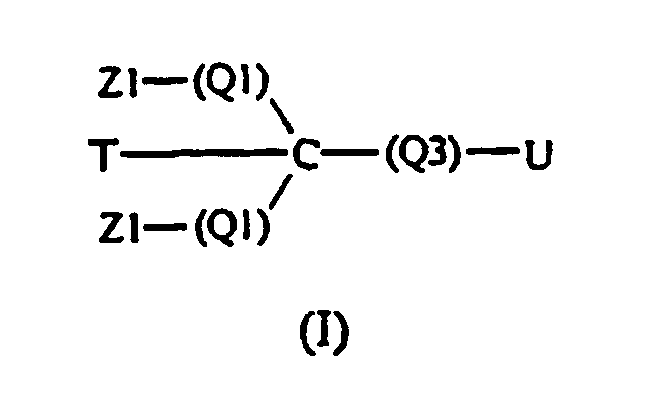
les groupes Z1 représentent indépendamment un groupe coordinant choisi parmi un hydroxy, amino, -NHR ou -N(R)2 (dans lequel R = alkyle en C1 à C6), carboxylate, amido, -NH-C(NH)NH2, hydroxyphényle, un cycle hétérocyclique éventuellement substitué par un ou plusieurs groupes fonctionnels E ou un cycle hétéroaromatique éventuellement substitué par un ou plusieurs groupes fonctionnels E, le cycle hétéroaromatique étant choisi parmi les groupes pyridine, pyrimidine, pyrazine, pyrazole, imidazole, benzimidazole, quinoléine, quinoxaline, triazole, isoquinoléine, carbazole, indole, isoindole, oxazole et thiazole ;
Q1 et Q3 représentent indépendamment un groupe de formule :dans laquelle
5 ≥ a + b + c ≥ 1 ; a = 0-5 ; b = 0-5 ; c = 0-5 ; n = 0 ou 1 (de préférence n = 0) ;
Y représente indépendamment un groupe choisi parmi -O-, -S-, -SO-, -SO2-, -C(O)-, arylène, alkylène, hétéroarylène, hétérocycloalkylène, -(G)P-, -P(O)- et -(G)N-, dans lequel G est choisi parmi un hydrogène, alkyle, aryle, arylalkyle, cycloalkyle, chacun sauf l'hydrogène étant éventuellement substitué par un ou plusieurs groupes fonctionnels E ;
R5, R6, R7, R8 représentent indépendamment un groupe choisi parmi un hydrogène, hydroxyle, halogène, -R et -OR, dans lesquels R représente un alkyle, alcényle, cycloalkyle, hétérocycloalkyle, aryle, hétéroaryle ou un groupe dérivé de carbonyle, R étant éventuellement substitué par un ou plusieurs groupes fonctionnels E,
ou R5 ensemble avec R6, ou R7 ensemble avec R8, ou les deux, représentent l'oxygène,
ou R5 ensemble avec R7 et/ou indépendamment R6 ensemble avec R8, ou R5 ensemble avec R8 et/ou indépendamment R6 ensemble avec R7, représentent un alkylène en C1 à C6 éventuellement substitué par un alkyle en C1 à C4, -F, -Cl, -Br ou -I ;
E représente indépendamment un groupe fonctionnel choisi parmi -F, -Cl, -Br, -I, -OH, -OR', -NH2, -NHR', -N(R')2, -N(R')3, -C(O)R', -OC(O)R', -COOH, -COO-(Na+,K+) , -COOR' , -C(O)NH2, -C (O) NHR', -C(O)N(R')2, hétéroaryle, -R', -SR', -SH, -P(R')2, -P(O) (R')2, -P(O) (OH)2, P(O) (OR')2, -NO2, -SO3H, -SO3 -(Na+,K+), -S(O)2R', -NHC(O)R' et -N(R')C(O)R', dans lesquels R' représente un cycloalkyle, aryle, arylalkyle ou alkyle éventuellement substitué par -F, -C1, -Br, -I, -NH3 +, -SO3H, -SO3 -(Na+,K+), -COOH, -COO-(Na+,K+), -P(O) (OH)2 ou P (O) (O-(Na+,K+))2 ;
T représente un groupe non coordiné choisi parmi un hydrogène, hydroxyle, halogène, -R et -OR, dans lesquels R représente un alkyle, alcényle, cycloalkyle, hétérocycloalkyle, aryle, hétéroaryle ou un groupe dérivé de carbonyle, R étant éventuellement substitué par un ou plusieurs groupes fonctionnels E ;
U représente un groupe non coordiné T indépendamment défini comme ci-dessus ou un groupe coordinant de formule générale (II), (III) ou (IV) :
 dans laquelle
Q2 et Q4 sont indépendamment définis comme pour Q1 et Q3 ;
Q représente -N(T)- (dans lequel T est indépendamment défini comme ci-dessus), ou un cycle hétérocyclique éventuellement substitué ou un cycle hétéroaromatique éventuellement substitué choisi parmi les groupes pyridine, pyrimidine, pyrazine, pyrazole, imidazole, benzimidazole, quinoléine, quinoxaline, triazole, isoquinoléine, carbazole, indole, isoindole, oxazole et thiazole ;
Z2 est indépendamment défini comme pour Z1 ;
les groupes Z3 indépendamment représentent -N(T)- (dans lequel T est indépendamment défini comme ci-dessus) ;
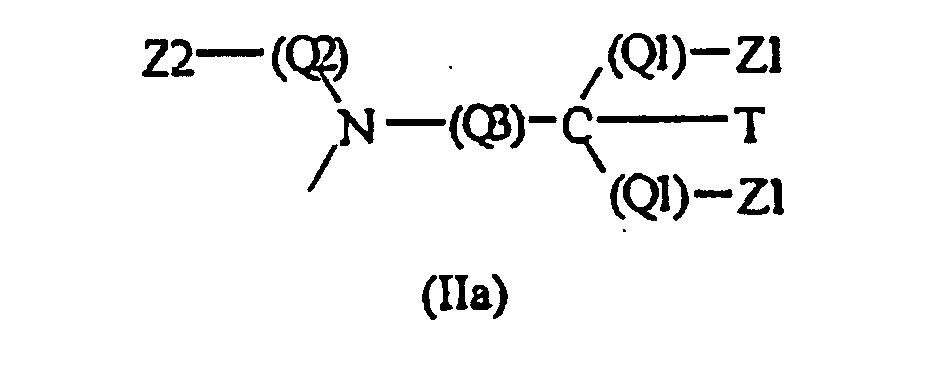
Z4 représente un groupe coordinant ou non coordinant choisi parmi un hydrogène, hydroxyle, halogène, -NH-C(NH)NH2, -R et -OR, dans lesquels R = alkyle, alcényle, cycloalkyle, hétérocycloalkyle, aryle, hétéroaryle ou un groupe dérivé de carbonyle, R étant éventuellement substitué par un ou plusieurs groupes fonctionnels E, ou Z4 représente un groupe de formule générale (IIa) :et
1 ≤ j < 4. - Composition de blanchiment selon la revendication 1, dans laquelle le milieu a une valeur de pH dans la gamme de pH 6 à 11, de préférence dans la gamme de pH 8 à 10.
- Composition de blanchiment selon la revendication 1 ou la revendication 2, dans laquelle le milieu est essentiellement dénué d'un séquestrant des métaux de transition.
- Composition de blanchiment selon l'une quelconque des revendications 1 à 3, dans laquelle le milieu comprend en outre un agent tensio-actif.
- Composition de blanchiment selon l'une quelconque des revendications 1 à 4, dans laquelle le milieu comprend en outre un adjuvant.
- Composition de blanchiment selon l'une quelconque des revendications 1 à 5, dans laquelle la composition comprend un complexe préformé du ligand et d'un métal de transition.
- Composition de blanchiment selon l'une quelconque des revendications 1 à 5, dans laquelle le ligand est présent sous forme de ligand libre qui se complexe avec un métal de transition présent dans l'eau.
- Composition de blanchiment selon l'une quelconque des revendications 1 à 5, dans laquelle le ligand est présent sous forme de ligand libre qui se complexe avec un métal de transition présent dans le substrat.
- Composition de blanchiment selon l'une quelconque des revendications 1 à 5, dans laquelle la composition comprend le ligand présent sous forme d'un ligand libre ou d'un complexe métal de transition-métal substituable-ligand, et une source de métal de transition.
- Composition de blanchiment selon l'une quelconque des revendications précédentes, dans laquelle Z1, Z2 et Z4 représentent indépendamment un cycle hétérocyclique éventuellement substitué ou un cycle hétéroaromatique éventuellement substitué choisi parmi les groupes pyridine, pyrimidine, pyrazine, pyrazole, imidazole, benzimidazole, quinoléine, quinoxaline, triazole, isoquinoléine, carbazole, indole, isoindole, oxazole et thiazole.
- Composition de blanchiment selon l'une quelconque des revendications précédentes, dans laquelle Z1, Z2 et Z4 représentent indépendamment des groupes choisis parmi le pyridin-2-yle éventuellement substitué, imidazol-2-yle éventuellement substitué, imidazol-4-yle éventuellement substitué, pyrazol-1-yle éventuellement substitué et quinoléin-2-yle éventuellement substitué.
- Composition de blanchiment selon l'une quelconque des revendications précédentes, dans laquelle Z1, Z2 et Z4 représentent chacun le pyridin-2-yle éventuellement substitué.
- Composition de blanchiment selon l'une quelconque des revendications précédentes, dans laquelle Z1, Z2 et Z4 sont éventuellement substitués par un groupe choisi parmi un alkyle en C1 à C4, aryle, arylalkyle, hétéroaryle, méthoxy, hydroxy, nitro, amino, carboxyle, halogéno et carbonyle.
- Composition de blanchiment selon l'une quelconque des revendications précédentes, dans laquelle un ou plusieurs de Z1, Z2 et Z4 sont substitués par un groupe méthyle.
- Composition de blanchiment selon l'une quelconque des revendications précédentes, dans laquelle les groupes Z1 représentent des groupes identiques.
- Composition de blanchiment selon l'une quelconque des revendications précédentes, dans laquelle R5, R6, R7, R8 représentent indépendamment un groupe choisi parmi -H, un hydroxy-alkyle en C0 à C20, halogéno-alkyle en C0 à C20, nitroso, formyl-alkyle en C0 à C20, carboxyl-alkyle en C0 à C20 et leurs esters et sels, carbamoyl-alkyle en C0 à C20, sulfo-alkyle en C0 à C20 et leurs esters et sels, sulfamoyl-alkyle en C0 à C20, amino-alkyle en C0 à C20, aryl-alkyle en C0 à C20, alkyle en C0 à C20, alcoxy-alkyle en C0 à C8, carbonyl-alcoxy en C0 à C6 et alkylamide en C0 à C20.
- Composition de blanchiment selon l'une quelconque des revendications précédentes, dans laquelle chaque Q1 représente une liaison covalente ou un alkylène en C1 à C4, de préférence une liaison covalente, un méthylène ou éthylène, mieux encore une liaison covalente.
- Composition de blanchiment selon l'une quelconque des revendications précédentes, dans laquelle chaque Q3 représente une liaison covalente ou un alkylène en C1 à C4, de préférence une liaison covalente.
- Composition de blanchiment selon l'une quelconque des revendications précédentes, dans laquelle T représente un hydrogène, hydroxy, méthyle, éthyle, benzyle ou méthoxy.
- Composition de blanchiment selon l'une quelconque des revendications 1 à 19, dans laquelle U représente un groupe coordinant de formule générale (II) :

- Composition de blanchiment selon la revendication 20, dans laquelle Z2 représente un cycle hétérocyclique éventuellement substitué ou un cycle hétéroaromatique éventuellement substitué choisi parmi les groupes pyridine, pyrimidine, pyrazine, pyrazole, imidazole, benzimidazole, quinoléine, quinoxaline, triazole, isoquinoléine, carbazole, indole, isoindole, oxazole et thiazole, de préférence pyridin-2-yle éventuellement substitué ou benzimidazol-2-yle éventuellement substitué, et dans laquelle Z4 représente un cycle hétérocyclique éventuellement substitué ou un cycle hétéroaromatique éventuellement substitué choisi parmi les groupes pyridine, pyrimidine, pyrazine, pyrazole, imidazole, benzimidazole, quinoléine, quinoxaline, triazole, isoquinoléine, carbazole, indole, isoindole, oxazole et thiazole, de préférence pyridin-2-yle éventuellement substitué, ou un groupe non coordinant choisi parmi un hydrogène, hydroxy, alcoxy, alkyle, alcényle, cycloalkyle, aryle ou benzyle.
- Composition de blanchiment selon la revendication 21, dans laquelle L représente un ligand choisi parmi :1,1-bis(pyridin-2-yl)-N-méthyl-N-(pyridin-2-ylméthyl)-méthylamine ;1,1-bis(pyridin-2-yl)-N,N-bis(6-méthyl-pyridin-2-yl-méthyl)méthylamine ;1,1-bis(pyridin-2-yl)-N,N-bis(5-carboxyméthyl-pyridin-2-ylméthyl)méthylamine ;1,1-bis(pyridin-2-yl)-1-benzyl-N,N-bis(pyridin-2-yl-méthyl)méthylamine ; et1,1-bis(pyridin-2-yl)-N,N-bis(benzimidazol-2-yl-méthyl)-méthylamine.
- Composition de blanchiment selon la revendication 20, dans laquelle Z4 représente un groupe de formule générale (IIa) :et Q4 représente un alkylène éventuellement substitué, de préférence -CH2-CHOH-CH2- ou -CH2-CH2-CH2-.
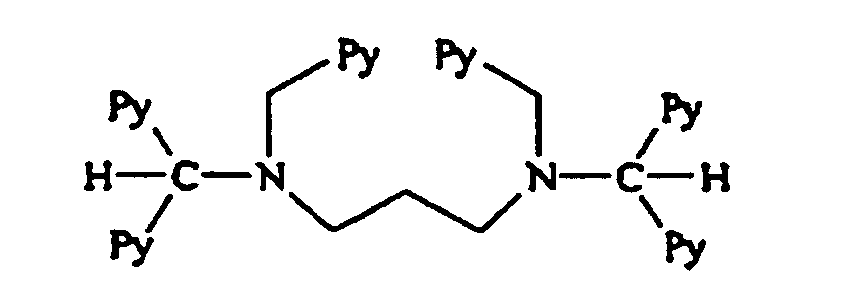
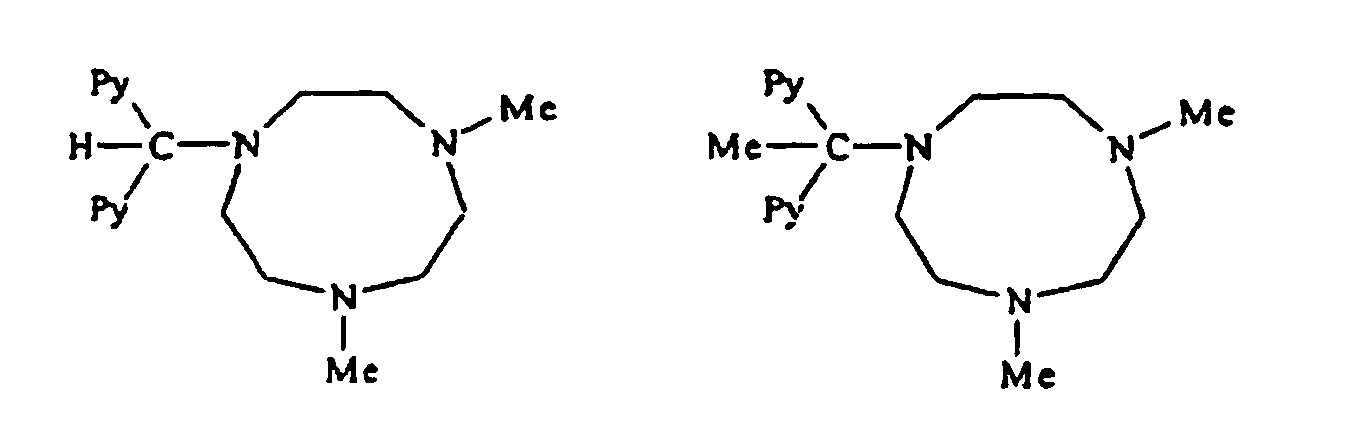
- Composition de blanchiment selon la revendication 23, dans laquelle L représente le ligand :dans lequel -Py représente le pyridin-2-yle.
- Composition de blanchiment selon l'une quelconque des revendications 1 à 19, dans laquelle U représente un groupe coordinant de formule générale (III) :dans laquelle j est 1 ou 2, de préférence 1.

- Composition de blanchiment selon la revendication 25, dans laquelle chaque Q2 représente -(CH2)n- (n = 2-4), et chaque Z3 représente -N(R)- dans lequel R = -H ou alkyle en C1 à C4.
- Composition de blanchiment selon la revendication 26, dans laquelle L représente un ligand choisi parmi :dans lesquels -Py représente le pyridin-2-yle.

- Composition de blanchiment selon l'une quelconque des revendications 1 à 19, dans laquelle U représente un groupe coordinant de formule générale (IV) :

- Composition de blanchiment selon la revendication 28, dans laquelle chaque Q représente -N(T)- (dans lequel T = -H, méthyle ou benzyle) ou un pyridine-diyle.
- Composition de blanchiment selon la revendication 29, dans laquelle L représente un ligand choisi parmi :
 dans lesquels -Py représente le pyridin-2-yle, et Q représente le pyridin-2,6-diyle.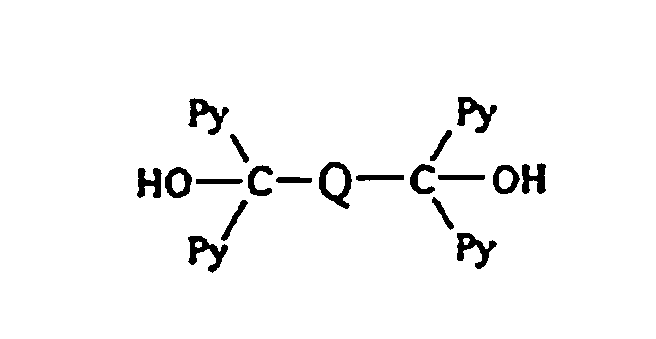
- Composition de blanchiment selon l'une quelconque' des revendications précédentes, dans laquelle la composition comprend un mélange du ligand L et d'un sel métallique MXn dans lequel n = 1-5, de préférence 1-3.
- Un ligand L tel que défini dans l'une quelconque des revendications précédentes sous réserve que U représente un groupe non coordiné T ou un groupe coordiné de formule (II) ou (III), et si U représente un groupe coordinant de formule (II) et Z1 = Z2 = Z4 = pyridin-2-yle non substitué, T n'est pas un hydrogène, méthyle ni benzyle.
- Ligand choisi parmi :1,1-bis(pyridin-2-yl)-N-méthyl-N-(pyridin-2-ylméthyl)-méthylamine ;1,1-bis(pyridin-2-yl)-N,N-bis(6-méthyl-pyridin-2-yl-méthyl)méthylamine ;1,1-bis(pyridin-2-yl)-N,N-bis(5-carboxyméthyl-pyridin-2-ylméthyl)méthylamine ;1,1-bis(pyridin-2-yl)-N,N-bis(benzimidazol-2-yl-méthyl)méthylamine ;2,6-bis(pyridin-2-ylméthyl)-1,1,7,7-tétrakis(pyridin-2-yl)-2,6-diazaheptane ; ou un ligand choisi parmi :dans lesquels -Py représente le pyridin-2-yle.
- Complexe de métal de transition de formule générale (A1) :M représente un métal choisi parmi Mn(II)-(III)-(IV)-(V), Cu(I)-(II)-(III), Fe(II)-(III)-(IV)-(V), Co(I)-(II)-(III), Ti(II)-(III)-(IV), V(II)-(III)-(IV)-(V), Mo(II)-(III)-(IV)-(V)-(VI) et W(IV)-(V)-(VI) ;X représente une espèce coordinante choisie parmi des anions quelconques mono-, bi- ou tri-chargés et des molécules neutres quelconques capables de coordiner le métal d'une manière mono-, bi- ou tri-dentale ;Y représente un contre-ion quelconque non coordiné ;a représente un entier de 1 à 10 ;k représente un entier de 1 à 10 ;n représente un entier de 1 à 10 ;m représente zéro ou un entier de 1 à 20 ; etL représente un ligand tel que défini à la revendication 32 ou 33 ou son analogue protoné ou déprotoné.
- Procédé de blanchiment d'un substrat comprenant l'application au substrat, dans un milieu aqueux, d'un ligand qui forme un complexe avec un métal de transition, le complexe catalysant le blanchiment du substrat par l'oxygène atmosphérique, le ligand étant tel que défini dans l'une quelconque des revendications 1 à 33.
- Procédé selon la revendication 35, dans lequel la majorité des espèces de blanchiment dans le milieu (ou un équivalent sur la base du poids) dérive de l'oxygène atmosphérique.
- Procédé selon la revendication 35 ou la revendication 36, dans lequel le milieu est essentiellement dénué d'agent de blanchiment peroxygène ou de système de blanchiment générant ou à base de peroxy.
- Procédé selon l'une quelconque des revendications 35 à 37, dans lequel le milieu aqueux est agité.
- Procédé selon l'une quelconque des revendications 35 à 38, dans lequel le milieu est tel que défini dans l'une quelconque des revendications 2 à 5.
- Utilisation d'un ligand qui forme un complexe avec un métal de transition comme agent de blanchiment catalytique pour un substrat dans un milieu aqueux essentiellement dénué d'agent de blanchiment peroxygène ou de système de blanchiment générant ou à base de peroxy, le complexe catalysant le blanchiment du substrat par l'oxygène atmosphérique, le ligand étant tel que défini dans l'une quelconque des revendications 1 à 33.
- Textile sec ayant un ligand tel que défini dans l'une quelconque des revendications 1 à 33 appliqué ou déposé dessus, ce faisant le blanchiment par l'oxygène atmosphérique est catalysé sur le textile.
Applications Claiming Priority (11)
| Application Number | Priority Date | Filing Date | Title |
|---|---|---|---|
| GB9907713 | 1999-04-01 | ||
| GBGB9907714.1A GB9907714D0 (en) | 1999-04-01 | 1999-04-01 | Composition and method for bleaching a substrate |
| GBGB9907713.3A GB9907713D0 (en) | 1999-04-01 | 1999-04-01 | Method of treating a textile |
| GB9907714 | 1999-04-01 | ||
| WOPCT/GB99/02876 | 1999-09-01 | ||
| PCT/GB1999/002876 WO2000012667A1 (fr) | 1998-09-01 | 1999-09-01 | Composition et procede de blanchiment d'un substrat |
| PCT/GB1999/002878 WO2000012808A1 (fr) | 1998-09-01 | 1999-09-01 | Procede de traitement d'un textile |
| WOPCT/GB99/02878 | 1999-09-01 | ||
| GB0004850A GB0004850D0 (en) | 2000-02-29 | 2000-02-29 | Compositon and method for bleaching a substrate |
| GB0004850 | 2000-02-29 | ||
| PCT/EP2000/002590 WO2000060044A1 (fr) | 1999-04-01 | 2000-03-22 | Composition et procede pour blanchir un substrat |
Publications (2)
| Publication Number | Publication Date |
|---|---|
| EP1165738A1 EP1165738A1 (fr) | 2002-01-02 |
| EP1165738B1 true EP1165738B1 (fr) | 2005-07-27 |
Family
ID=27515926
Family Applications (1)
| Application Number | Title | Priority Date | Filing Date |
|---|---|---|---|
| EP00918830A Expired - Lifetime EP1165738B1 (fr) | 1999-04-01 | 2000-03-22 | Composition et procede pour blanchir un substrat |
Country Status (9)
| Country | Link |
|---|---|
| EP (1) | EP1165738B1 (fr) |
| AU (1) | AU3963600A (fr) |
| BR (1) | BR0009457A (fr) |
| CA (1) | CA2364605A1 (fr) |
| DE (1) | DE60021545T2 (fr) |
| ES (1) | ES2244424T3 (fr) |
| HU (1) | HUP0200672A2 (fr) |
| TR (1) | TR200102775T2 (fr) |
| WO (1) | WO2000060044A1 (fr) |
Cited By (2)
| Publication number | Priority date | Publication date | Assignee | Title |
|---|---|---|---|---|
| WO2016198891A1 (fr) | 2015-06-10 | 2016-12-15 | Chemsenti Limited | Procédé oxydatif |
| WO2025191283A1 (fr) | 2024-03-15 | 2025-09-18 | Catexel Gmbh | Procédé oxydatif |
Families Citing this family (13)
| Publication number | Priority date | Publication date | Assignee | Title |
|---|---|---|---|---|
| GB9930695D0 (en) * | 1999-12-24 | 2000-02-16 | Unilever Plc | Composition and method for bleaching a substrate |
| GB9930697D0 (en) * | 1999-12-24 | 2000-02-16 | Unilever Plc | Method of treating a textile |
| GB0004988D0 (en) | 2000-03-01 | 2000-04-19 | Unilever Plc | Composition and method for bleaching a substrate |
| GB0005087D0 (en) * | 2000-03-01 | 2000-04-26 | Unilever Plc | Method for reducing dye fading of fabrics in laundry bleaching compositions |
| GB0011527D0 (en) | 2000-05-12 | 2000-06-28 | Unilever Plc | Bleach catalyst and composition and method for bleaching a substrate |
| GB0030877D0 (en) | 2000-12-18 | 2001-01-31 | Unilever Plc | Enhancement of air bleaching catalysts |
| GB0103871D0 (en) | 2001-02-16 | 2001-04-04 | Unilever Plc | Bleaching composition of enhanced stability and a process for making such a composition |
| GB0104979D0 (en) * | 2001-02-28 | 2001-04-18 | Unilever Plc | Unit dose cleaning product |
| GB0108737D0 (en) * | 2001-04-06 | 2001-05-30 | Unilever Plc | Composition and method for bleaching a substrate |
| GB0212989D0 (en) * | 2002-06-06 | 2002-07-17 | Unilever Plc | Enhancement of bleaching catalysts |
| AR104939A1 (es) | 2015-06-10 | 2017-08-23 | Chemsenti Ltd | Método oxidativo para generar dióxido de cloro |
| JP7523883B2 (ja) * | 2015-08-13 | 2024-07-29 | ザ ジェネラル ホスピタル コーポレイション | 分子mrイメージング用マンガン系キレートコンジュゲート |
| AU2024310586A1 (en) | 2023-06-30 | 2026-02-12 | Chong Kun Dang Pharmaceutical Corp. | New preparation method of compound and new crystalline form |
Family Cites Families (9)
| Publication number | Priority date | Publication date | Assignee | Title |
|---|---|---|---|---|
| US5686014A (en) * | 1994-04-07 | 1997-11-11 | The Procter & Gamble Company | Bleach compositions comprising manganese-containing bleach catalysts |
| EP0765381B1 (fr) * | 1994-06-13 | 1999-08-11 | Unilever N.V. | Activation de blanchiment |
| AU3077495A (en) * | 1994-08-19 | 1996-03-14 | Unilever Plc | Detergent bleach composition |
| DE69705041T2 (de) * | 1996-04-10 | 2001-09-13 | Unilever N.V., Rotterdam | Reinigungsverfahren |
| CA2257891A1 (fr) * | 1996-06-19 | 1997-12-24 | Roelant Mathijs Hermant | Activation d'un agent de blanchiment par un catalyseur de fer comprenant un ligand polydentate contenant au moins six heteroatomes |
| DE19714122A1 (de) * | 1997-04-05 | 1998-10-08 | Clariant Gmbh | Bleichaktive Metall-Komplexe |
| WO1999065905A1 (fr) * | 1998-06-15 | 1999-12-23 | Unilever Plc | Catalyseurs de blanchiment et formulations les contenant |
| PH11999002190B1 (en) * | 1998-09-01 | 2007-08-06 | Unilever Nv | Composition and method for bleaching a substrate |
| PH11999002188B1 (en) * | 1998-09-01 | 2007-08-06 | Unilever Nv | Method of treating a textile |
-
2000
- 2000-03-22 DE DE60021545T patent/DE60021545T2/de not_active Expired - Fee Related
- 2000-03-22 TR TR2001/02775T patent/TR200102775T2/xx unknown
- 2000-03-22 HU HU0200672A patent/HUP0200672A2/hu unknown
- 2000-03-22 BR BR0009457-9A patent/BR0009457A/pt not_active Application Discontinuation
- 2000-03-22 AU AU39636/00A patent/AU3963600A/en not_active Abandoned
- 2000-03-22 EP EP00918830A patent/EP1165738B1/fr not_active Expired - Lifetime
- 2000-03-22 ES ES00918830T patent/ES2244424T3/es not_active Expired - Lifetime
- 2000-03-22 WO PCT/EP2000/002590 patent/WO2000060044A1/fr not_active Ceased
- 2000-03-22 CA CA002364605A patent/CA2364605A1/fr not_active Abandoned
Cited By (2)
| Publication number | Priority date | Publication date | Assignee | Title |
|---|---|---|---|---|
| WO2016198891A1 (fr) | 2015-06-10 | 2016-12-15 | Chemsenti Limited | Procédé oxydatif |
| WO2025191283A1 (fr) | 2024-03-15 | 2025-09-18 | Catexel Gmbh | Procédé oxydatif |
Also Published As
| Publication number | Publication date |
|---|---|
| WO2000060044A1 (fr) | 2000-10-12 |
| HUP0200672A2 (hu) | 2002-07-29 |
| EP1165738A1 (fr) | 2002-01-02 |
| CA2364605A1 (fr) | 2000-10-12 |
| DE60021545D1 (de) | 2005-09-01 |
| BR0009457A (pt) | 2002-01-08 |
| DE60021545T2 (de) | 2006-03-02 |
| ES2244424T3 (es) | 2005-12-16 |
| TR200102775T2 (tr) | 2001-12-21 |
| AU3963600A (en) | 2000-10-23 |
Similar Documents
| Publication | Publication Date | Title |
|---|---|---|
| EP1109884B1 (fr) | Composition et procede de blanchiment d'un substrat | |
| US6245115B1 (en) | Method of treating a textile | |
| US6610641B2 (en) | Composition and method for bleaching a substrate | |
| EP1165738B1 (fr) | Composition et procede pour blanchir un substrat | |
| WO2001016271A1 (fr) | Composition et procede de blanchiment d'un substrat | |
| US6537959B2 (en) | Bleach catalyst and composition and method for bleaching a substrate | |
| WO2000060043A1 (fr) | Composition et procede pour le blanchissage d'un substrat | |
| US6617299B1 (en) | Composition and method for bleaching a substrate | |
| US6432900B1 (en) | Ligand and complex for catalytically bleaching a substrate | |
| EP1208186B1 (fr) | Composition et procede permettant le blanchiment d'un substrat | |
| WO2001016261A2 (fr) | Composition et procede de blanchiment d'un substrat | |
| EP1208107A2 (fr) | Ligand et complexe servant a blanchir un substrat selon un procede catalytique | |
| AU6571600A (en) | Composition and method for bleaching a substrate | |
| ZA200106939B (en) | Composition and method for bleaching a substrate. | |
| AU7410400A (en) | Composition and method for bleaching a substrate | |
| CA2401651A1 (fr) | Procede pour diminuer la perte d'eclat des couleurs des tissus dans les compositions de blanchiment du linge |
Legal Events
| Date | Code | Title | Description |
|---|---|---|---|
| PUAI | Public reference made under article 153(3) epc to a published international application that has entered the european phase |
Free format text: ORIGINAL CODE: 0009012 |
|
| 17P | Request for examination filed |
Effective date: 20010817 |
|
| AK | Designated contracting states |
Kind code of ref document: A1 Designated state(s): AT BE CH CY DE DK ES FI FR GB GR IE IT LI LU MC NL PT SE |
|
| AX | Request for extension of the european patent |
Free format text: AL;LT;LV;MK;RO;SI |
|
| GRAP | Despatch of communication of intention to grant a patent |
Free format text: ORIGINAL CODE: EPIDOSNIGR1 |
|
| GRAS | Grant fee paid |
Free format text: ORIGINAL CODE: EPIDOSNIGR3 |
|
| GRAA | (expected) grant |
Free format text: ORIGINAL CODE: 0009210 |
|
| AK | Designated contracting states |
Kind code of ref document: B1 Designated state(s): AT BE CH CY DE DK ES FI FR GB GR IE IT LI LU MC NL PT SE |
|
| PG25 | Lapsed in a contracting state [announced via postgrant information from national office to epo] |
Ref country code: AT Free format text: LAPSE BECAUSE OF FAILURE TO SUBMIT A TRANSLATION OF THE DESCRIPTION OR TO PAY THE FEE WITHIN THE PRESCRIBED TIME-LIMIT Effective date: 20050727 Ref country code: NL Free format text: LAPSE BECAUSE OF FAILURE TO SUBMIT A TRANSLATION OF THE DESCRIPTION OR TO PAY THE FEE WITHIN THE PRESCRIBED TIME-LIMIT Effective date: 20050727 Ref country code: LI Free format text: LAPSE BECAUSE OF FAILURE TO SUBMIT A TRANSLATION OF THE DESCRIPTION OR TO PAY THE FEE WITHIN THE PRESCRIBED TIME-LIMIT Effective date: 20050727 Ref country code: CH Free format text: LAPSE BECAUSE OF FAILURE TO SUBMIT A TRANSLATION OF THE DESCRIPTION OR TO PAY THE FEE WITHIN THE PRESCRIBED TIME-LIMIT Effective date: 20050727 Ref country code: FI Free format text: LAPSE BECAUSE OF FAILURE TO SUBMIT A TRANSLATION OF THE DESCRIPTION OR TO PAY THE FEE WITHIN THE PRESCRIBED TIME-LIMIT Effective date: 20050727 |
|
| REG | Reference to a national code |
Ref country code: GB Ref legal event code: FG4D |
|
| REG | Reference to a national code |
Ref country code: CH Ref legal event code: EP |
|
| REG | Reference to a national code |
Ref country code: IE Ref legal event code: FG4D |
|
| REF | Corresponds to: |
Ref document number: 60021545 Country of ref document: DE Date of ref document: 20050901 Kind code of ref document: P |
|
| PG25 | Lapsed in a contracting state [announced via postgrant information from national office to epo] |
Ref country code: GR Free format text: LAPSE BECAUSE OF FAILURE TO SUBMIT A TRANSLATION OF THE DESCRIPTION OR TO PAY THE FEE WITHIN THE PRESCRIBED TIME-LIMIT Effective date: 20051027 Ref country code: DK Free format text: LAPSE BECAUSE OF FAILURE TO SUBMIT A TRANSLATION OF THE DESCRIPTION OR TO PAY THE FEE WITHIN THE PRESCRIBED TIME-LIMIT Effective date: 20051027 Ref country code: SE Free format text: LAPSE BECAUSE OF FAILURE TO SUBMIT A TRANSLATION OF THE DESCRIPTION OR TO PAY THE FEE WITHIN THE PRESCRIBED TIME-LIMIT Effective date: 20051027 |
|
| REG | Reference to a national code |
Ref country code: ES Ref legal event code: FG2A Ref document number: 2244424 Country of ref document: ES Kind code of ref document: T3 |
|
| PG25 | Lapsed in a contracting state [announced via postgrant information from national office to epo] |
Ref country code: PT Free format text: LAPSE BECAUSE OF FAILURE TO SUBMIT A TRANSLATION OF THE DESCRIPTION OR TO PAY THE FEE WITHIN THE PRESCRIBED TIME-LIMIT Effective date: 20051227 |
|
| REG | Reference to a national code |
Ref country code: CH Ref legal event code: PL |
|
| NLV1 | Nl: lapsed or annulled due to failure to fulfill the requirements of art. 29p and 29m of the patents act | ||
| PGFP | Annual fee paid to national office [announced via postgrant information from national office to epo] |
Ref country code: FR Payment date: 20060317 Year of fee payment: 7 |
|
| PG25 | Lapsed in a contracting state [announced via postgrant information from national office to epo] |
Ref country code: IE Free format text: LAPSE BECAUSE OF NON-PAYMENT OF DUE FEES Effective date: 20060322 |
|
| PGFP | Annual fee paid to national office [announced via postgrant information from national office to epo] |
Ref country code: GB Payment date: 20060329 Year of fee payment: 7 |
|
| PG25 | Lapsed in a contracting state [announced via postgrant information from national office to epo] |
Ref country code: LU Free format text: LAPSE BECAUSE OF NON-PAYMENT OF DUE FEES Effective date: 20060331 Ref country code: MC Free format text: LAPSE BECAUSE OF NON-PAYMENT OF DUE FEES Effective date: 20060331 |
|
| PGFP | Annual fee paid to national office [announced via postgrant information from national office to epo] |
Ref country code: IT Payment date: 20060331 Year of fee payment: 7 |
|
| ET | Fr: translation filed | ||
| PGFP | Annual fee paid to national office [announced via postgrant information from national office to epo] |
Ref country code: BE Payment date: 20060428 Year of fee payment: 7 |
|
| PGFP | Annual fee paid to national office [announced via postgrant information from national office to epo] |
Ref country code: DE Payment date: 20060502 Year of fee payment: 7 |
|
| PLBE | No opposition filed within time limit |
Free format text: ORIGINAL CODE: 0009261 |
|
| STAA | Information on the status of an ep patent application or granted ep patent |
Free format text: STATUS: NO OPPOSITION FILED WITHIN TIME LIMIT |
|
| 26N | No opposition filed |
Effective date: 20060428 |
|
| REG | Reference to a national code |
Ref country code: IE Ref legal event code: MM4A |
|
| GBPC | Gb: european patent ceased through non-payment of renewal fee |
Effective date: 20070322 |
|
| BERE | Be: lapsed |
Owner name: *UNILEVER N.V. Effective date: 20070331 |
|
| PG25 | Lapsed in a contracting state [announced via postgrant information from national office to epo] |
Ref country code: BE Free format text: LAPSE BECAUSE OF NON-PAYMENT OF DUE FEES Effective date: 20070331 |
|
| REG | Reference to a national code |
Ref country code: FR Ref legal event code: ST Effective date: 20071130 |
|
| PG25 | Lapsed in a contracting state [announced via postgrant information from national office to epo] |
Ref country code: DE Free format text: LAPSE BECAUSE OF NON-PAYMENT OF DUE FEES Effective date: 20071002 |
|
| PG25 | Lapsed in a contracting state [announced via postgrant information from national office to epo] |
Ref country code: GB Free format text: LAPSE BECAUSE OF NON-PAYMENT OF DUE FEES Effective date: 20070322 |
|
| REG | Reference to a national code |
Ref country code: ES Ref legal event code: FD2A Effective date: 20070323 |
|
| PG25 | Lapsed in a contracting state [announced via postgrant information from national office to epo] |
Ref country code: FR Free format text: LAPSE BECAUSE OF NON-PAYMENT OF DUE FEES Effective date: 20070402 Ref country code: ES Free format text: LAPSE BECAUSE OF NON-PAYMENT OF DUE FEES Effective date: 20070323 |
|
| PG25 | Lapsed in a contracting state [announced via postgrant information from national office to epo] |
Ref country code: CY Free format text: LAPSE BECAUSE OF FAILURE TO SUBMIT A TRANSLATION OF THE DESCRIPTION OR TO PAY THE FEE WITHIN THE PRESCRIBED TIME-LIMIT Effective date: 20050727 |
|
| PG25 | Lapsed in a contracting state [announced via postgrant information from national office to epo] |
Ref country code: IT Free format text: LAPSE BECAUSE OF NON-PAYMENT OF DUE FEES Effective date: 20070322 |