EP1165748B1 - Vorrichtung und verfahren zur ultraschall-lyse biologischer zellen - Google Patents
Vorrichtung und verfahren zur ultraschall-lyse biologischer zellen Download PDFInfo
- Publication number
- EP1165748B1 EP1165748B1 EP00915279A EP00915279A EP1165748B1 EP 1165748 B1 EP1165748 B1 EP 1165748B1 EP 00915279 A EP00915279 A EP 00915279A EP 00915279 A EP00915279 A EP 00915279A EP 1165748 B1 EP1165748 B1 EP 1165748B1
- Authority
- EP
- European Patent Office
- Prior art keywords
- sonotrode
- receptacle
- sample
- lysis
- sonication
- Prior art date
- Legal status (The legal status is an assumption and is not a legal conclusion. Google has not performed a legal analysis and makes no representation as to the accuracy of the status listed.)
- Expired - Lifetime
Links
- 230000009089 cytolysis Effects 0.000 title claims abstract description 82
- 238000000034 method Methods 0.000 title claims abstract description 39
- 239000000523 sample Substances 0.000 claims abstract description 59
- 238000002604 ultrasonography Methods 0.000 claims abstract description 26
- 239000012472 biological sample Substances 0.000 claims abstract description 9
- 239000012530 fluid Substances 0.000 claims abstract description 5
- 238000000527 sonication Methods 0.000 claims description 89
- 240000004808 Saccharomyces cerevisiae Species 0.000 claims description 43
- 239000011324 bead Substances 0.000 claims description 34
- 239000011521 glass Substances 0.000 claims description 21
- 241000894006 Bacteria Species 0.000 claims description 18
- 230000003321 amplification Effects 0.000 claims description 12
- 238000003199 nucleic acid amplification method Methods 0.000 claims description 12
- 230000004913 activation Effects 0.000 claims description 5
- 230000002934 lysing effect Effects 0.000 claims description 4
- 230000003213 activating effect Effects 0.000 claims 2
- 230000002045 lasting effect Effects 0.000 claims 1
- 108020004707 nucleic acids Proteins 0.000 description 54
- 102000039446 nucleic acids Human genes 0.000 description 54
- 150000007523 nucleic acids Chemical class 0.000 description 50
- 238000012360 testing method Methods 0.000 description 41
- 239000007788 liquid Substances 0.000 description 22
- 238000013019 agitation Methods 0.000 description 20
- 238000003776 cleavage reaction Methods 0.000 description 20
- 230000007017 scission Effects 0.000 description 20
- 230000008878 coupling Effects 0.000 description 15
- 238000010168 coupling process Methods 0.000 description 15
- 238000005859 coupling reaction Methods 0.000 description 15
- 239000006166 lysate Substances 0.000 description 12
- 230000035945 sensitivity Effects 0.000 description 11
- 244000005700 microbiome Species 0.000 description 10
- 238000003756 stirring Methods 0.000 description 8
- 238000004458 analytical method Methods 0.000 description 7
- 239000000499 gel Substances 0.000 description 7
- 239000004033 plastic Substances 0.000 description 7
- 229920003023 plastic Polymers 0.000 description 7
- 239000000725 suspension Substances 0.000 description 7
- 241000235645 Pichia kudriavzevii Species 0.000 description 6
- 239000002253 acid Substances 0.000 description 6
- 238000001514 detection method Methods 0.000 description 6
- 238000010438 heat treatment Methods 0.000 description 6
- 238000011282 treatment Methods 0.000 description 6
- 241001639412 Verres Species 0.000 description 5
- -1 acids nucleic acid Chemical class 0.000 description 5
- 239000011543 agarose gel Substances 0.000 description 5
- 239000000872 buffer Substances 0.000 description 5
- 238000006243 chemical reaction Methods 0.000 description 5
- 125000004122 cyclic group Chemical group 0.000 description 5
- ZMMJGEGLRURXTF-UHFFFAOYSA-N ethidium bromide Chemical compound [Br-].C12=CC(N)=CC=C2C2=CC=C(N)C=C2[N+](CC)=C1C1=CC=CC=C1 ZMMJGEGLRURXTF-UHFFFAOYSA-N 0.000 description 5
- 229960005542 ethidium bromide Drugs 0.000 description 5
- 238000010186 staining Methods 0.000 description 5
- XLYOFNOQVPJJNP-UHFFFAOYSA-N water Substances O XLYOFNOQVPJJNP-UHFFFAOYSA-N 0.000 description 5
- KCXVZYZYPLLWCC-UHFFFAOYSA-N EDTA Chemical compound OC(=O)CN(CC(O)=O)CCN(CC(O)=O)CC(O)=O KCXVZYZYPLLWCC-UHFFFAOYSA-N 0.000 description 4
- XEEYBQQBJWHFJM-UHFFFAOYSA-N Iron Chemical compound [Fe] XEEYBQQBJWHFJM-UHFFFAOYSA-N 0.000 description 4
- 241000191963 Staphylococcus epidermidis Species 0.000 description 4
- 230000015556 catabolic process Effects 0.000 description 4
- 210000004027 cell Anatomy 0.000 description 4
- 230000006835 compression Effects 0.000 description 4
- 238000007906 compression Methods 0.000 description 4
- 238000006731 degradation reaction Methods 0.000 description 4
- 239000012895 dilution Substances 0.000 description 4
- 238000010790 dilution Methods 0.000 description 4
- 230000000694 effects Effects 0.000 description 4
- JKMHFZQWWAIEOD-UHFFFAOYSA-N 2-[4-(2-hydroxyethyl)piperazin-1-yl]ethanesulfonic acid Chemical compound OCC[NH+]1CCN(CCS([O-])(=O)=O)CC1 JKMHFZQWWAIEOD-UHFFFAOYSA-N 0.000 description 3
- 101800004419 Cleaved form Proteins 0.000 description 3
- 239000007995 HEPES buffer Substances 0.000 description 3
- 238000000246 agarose gel electrophoresis Methods 0.000 description 3
- 238000003556 assay Methods 0.000 description 3
- 230000008901 benefit Effects 0.000 description 3
- 238000001962 electrophoresis Methods 0.000 description 3
- 230000002349 favourable effect Effects 0.000 description 3
- 230000001965 increasing effect Effects 0.000 description 3
- YFVGRULMIQXYNE-UHFFFAOYSA-M lithium;dodecyl sulfate Chemical compound [Li+].CCCCCCCCCCCCOS([O-])(=O)=O YFVGRULMIQXYNE-UHFFFAOYSA-M 0.000 description 3
- 239000003550 marker Substances 0.000 description 3
- 239000000463 material Substances 0.000 description 3
- 238000005259 measurement Methods 0.000 description 3
- 238000004321 preservation Methods 0.000 description 3
- 230000008569 process Effects 0.000 description 3
- 238000000746 purification Methods 0.000 description 3
- 108020004418 ribosomal RNA Proteins 0.000 description 3
- 108091032973 (ribonucleotides)n+m Proteins 0.000 description 2
- 229920000936 Agarose Polymers 0.000 description 2
- 238000012408 PCR amplification Methods 0.000 description 2
- 229920005654 Sephadex Polymers 0.000 description 2
- 239000012507 Sephadex™ Substances 0.000 description 2
- FAPWRFPIFSIZLT-UHFFFAOYSA-M Sodium chloride Chemical compound [Na+].[Cl-] FAPWRFPIFSIZLT-UHFFFAOYSA-M 0.000 description 2
- 240000008042 Zea mays Species 0.000 description 2
- 230000005540 biological transmission Effects 0.000 description 2
- 238000004140 cleaning Methods 0.000 description 2
- 230000003749 cleanliness Effects 0.000 description 2
- 238000009833 condensation Methods 0.000 description 2
- 230000005494 condensation Effects 0.000 description 2
- 238000011109 contamination Methods 0.000 description 2
- 230000006378 damage Effects 0.000 description 2
- 229910052742 iron Inorganic materials 0.000 description 2
- 238000013508 migration Methods 0.000 description 2
- 230000005012 migration Effects 0.000 description 2
- 230000003287 optical effect Effects 0.000 description 2
- 238000002360 preparation method Methods 0.000 description 2
- 239000004743 Polypropylene Substances 0.000 description 1
- 239000004793 Polystyrene Substances 0.000 description 1
- RTAQQCXQSZGOHL-UHFFFAOYSA-N Titanium Chemical compound [Ti] RTAQQCXQSZGOHL-UHFFFAOYSA-N 0.000 description 1
- 239000007983 Tris buffer Substances 0.000 description 1
- 150000007513 acids Chemical class 0.000 description 1
- 230000006978 adaptation Effects 0.000 description 1
- 229910052782 aluminium Inorganic materials 0.000 description 1
- XAGFODPZIPBFFR-UHFFFAOYSA-N aluminium Chemical compound [Al] XAGFODPZIPBFFR-UHFFFAOYSA-N 0.000 description 1
- 238000013459 approach Methods 0.000 description 1
- 238000009529 body temperature measurement Methods 0.000 description 1
- 239000006285 cell suspension Substances 0.000 description 1
- 230000008859 change Effects 0.000 description 1
- 238000012512 characterization method Methods 0.000 description 1
- 238000010276 construction Methods 0.000 description 1
- 230000007423 decrease Effects 0.000 description 1
- 238000007872 degassing Methods 0.000 description 1
- 230000000593 degrading effect Effects 0.000 description 1
- 238000004925 denaturation Methods 0.000 description 1
- 230000036425 denaturation Effects 0.000 description 1
- 230000001627 detrimental effect Effects 0.000 description 1
- 238000007598 dipping method Methods 0.000 description 1
- 238000011156 evaluation Methods 0.000 description 1
- 238000013210 evaluation model Methods 0.000 description 1
- 238000001704 evaporation Methods 0.000 description 1
- 230000008020 evaporation Effects 0.000 description 1
- 238000002474 experimental method Methods 0.000 description 1
- 238000011049 filling Methods 0.000 description 1
- 238000013467 fragmentation Methods 0.000 description 1
- 238000006062 fragmentation reaction Methods 0.000 description 1
- 238000000265 homogenisation Methods 0.000 description 1
- 238000009396 hybridization Methods 0.000 description 1
- 230000001939 inductive effect Effects 0.000 description 1
- 238000002955 isolation Methods 0.000 description 1
- 238000002844 melting Methods 0.000 description 1
- 230000008018 melting Effects 0.000 description 1
- 229910052751 metal Inorganic materials 0.000 description 1
- 239000002184 metal Substances 0.000 description 1
- 238000013021 overheating Methods 0.000 description 1
- 239000013610 patient sample Substances 0.000 description 1
- 229920001155 polypropylene Polymers 0.000 description 1
- 229920002223 polystyrene Polymers 0.000 description 1
- 238000012545 processing Methods 0.000 description 1
- 230000000750 progressive effect Effects 0.000 description 1
- 102000004169 proteins and genes Human genes 0.000 description 1
- 108090000623 proteins and genes Proteins 0.000 description 1
- 238000011084 recovery Methods 0.000 description 1
- 230000009467 reduction Effects 0.000 description 1
- 238000007430 reference method Methods 0.000 description 1
- 238000011160 research Methods 0.000 description 1
- 230000000717 retained effect Effects 0.000 description 1
- 230000035939 shock Effects 0.000 description 1
- 239000011780 sodium chloride Substances 0.000 description 1
- 239000000243 solution Substances 0.000 description 1
- 239000010936 titanium Substances 0.000 description 1
- 229910052719 titanium Inorganic materials 0.000 description 1
- 230000026683 transduction Effects 0.000 description 1
- 238000010361 transduction Methods 0.000 description 1
- 239000012780 transparent material Substances 0.000 description 1
- LENZDBCJOHFCAS-UHFFFAOYSA-N tris Chemical compound OCC(N)(CO)CO LENZDBCJOHFCAS-UHFFFAOYSA-N 0.000 description 1
Images

Classifications
-
- B—PERFORMING OPERATIONS; TRANSPORTING
- B01—PHYSICAL OR CHEMICAL PROCESSES OR APPARATUS IN GENERAL
- B01J—CHEMICAL OR PHYSICAL PROCESSES, e.g. CATALYSIS OR COLLOID CHEMISTRY; THEIR RELEVANT APPARATUS
- B01J19/00—Chemical, physical or physico-chemical processes in general; Their relevant apparatus
- B01J19/08—Processes employing the direct application of electric or wave energy, or particle radiation; Apparatus therefor
- B01J19/10—Processes employing the direct application of electric or wave energy, or particle radiation; Apparatus therefor employing sonic or ultrasonic vibrations
-
- B—PERFORMING OPERATIONS; TRANSPORTING
- B06—GENERATING OR TRANSMITTING MECHANICAL VIBRATIONS IN GENERAL
- B06B—METHODS OR APPARATUS FOR GENERATING OR TRANSMITTING MECHANICAL VIBRATIONS OF INFRASONIC, SONIC, OR ULTRASONIC FREQUENCY, e.g. FOR PERFORMING MECHANICAL WORK IN GENERAL
- B06B3/00—Methods or apparatus specially adapted for transmitting mechanical vibrations of infrasonic, sonic, or ultrasonic frequency
-
- C—CHEMISTRY; METALLURGY
- C12—BIOCHEMISTRY; BEER; SPIRITS; WINE; VINEGAR; MICROBIOLOGY; ENZYMOLOGY; MUTATION OR GENETIC ENGINEERING
- C12M—APPARATUS FOR ENZYMOLOGY OR MICROBIOLOGY; APPARATUS FOR CULTURING MICROORGANISMS FOR PRODUCING BIOMASS, FOR GROWING CELLS OR FOR OBTAINING FERMENTATION OR METABOLIC PRODUCTS, i.e. BIOREACTORS OR FERMENTERS
- C12M47/00—Means for after-treatment of the produced biomass or of the fermentation or metabolic products, e.g. storage of biomass
- C12M47/06—Hydrolysis; Cell lysis; Extraction of intracellular or cell wall material
Definitions
- the present invention relates to an apparatus and a method for generating ultrasound of greater or lesser power in a container at the level of a sample at lysing with or without the presence of glass beads within it.
- the frequency range ultrasound varies from 20 to 50 kilohertz (kHz) approximately.
- the state of the art consists essentially of two techniques, which use ultrasound in biology as a method of lysis of microorganisms.
- the first technique consists of direct sonification by dipping the sonotrode in the liquid sample to be lysed.
- the principle used in this case consists in contact the sonotrode directly with the liquid and generate continuously or in pulse mode high power ultrasound inducing a very cavitation intense in the middle.
- the sonotrodes used are usually of high power (100 to 1000 Watts (W)) and allow you to lyse a wide variety of well-known samples difficult to lyse in a very short time (of the order of a minute).
- the cavitation phenomenon is a very difficult phenomenon controllable, the percentage of lysis on a large number of tests will not be reproducible.
- the second technique consists of bath sonication, which is well exposed in US Pat. No. 5,374,522.
- the principle is to use a cleaning bath at ultrasound filled with water, and in which bathes the lower part of the tubes containing the samples to be lysed.
- the samples are subjected to an ultrasonic field, in constant general, for a period of about 15 minutes (min).
- the present beads in the tubes are then subjected to strong agitation resulting in shocks and shear stresses sufficient to lyse microorganisms.
- this second technique requires the use of glass beads to obtain satisfactory lysis efficiency. Compared to the previous technique of direct insonication, this technique solves some of the problems mentioned previously.
- the samples being contained in a closed tube there is no contamination of the vibratory element since the ultrasound is transmitted via the water (which is an excellent ultrasonic coupler) from the bottom of the tank to the inside of the tube sample.
- the volume density of energy (expressed in Watt per milliliter (W / ml)) released in the medium being about 300-fold lower for the same Frequency, the cavitation phenomenon is less important.
- the major disadvantage of this technique lies in its difficulty in being automated because of the management of the liquid (filling and emptying of the tank), the degassing necessary before sonication and management of wet tubes after sonication, dripping, which is detrimental to cleanliness.
- the contact between the container and the sonotrode is constituted by a flat surface which does not allow to ensure a homogeneous lysis throughout the sample to lyse.
- Such devices do not meet the lysate quality requirements necessary to the release of nucleic acids.
- the only solution is then to increase considerably the duration of this lysis, at least double the time, with the risks of denaturation, or even destruction, of the nucleic acids most exposed to this heterogeneous sonication.
- the proposed apparatus makes it possible to respond to all of the above problems by controlling the cleavage of acids nucleic acid, while preserving the integrity of the tube containing the sample.
- the cleanliness of the set is perfect since there is no contact between the outside of the tube and a any liquid, the contents of said tube being completely isolated from the outside. This Isolation prohibits projections to the outside when the tube undergoes sonification, and greatly limits condensation and evaporation.
- the present invention relates to an apparatus, comprising a sonotrode for generating ultrasound of greater or lesser power in at least one biological sample containing cells to be lysed, which sample is contained in at least one container adapted for this purpose the sonotrode is in direct contact with the receptacle (s), containing the sample to be lysed, in the absence of fluid between said surfaces in contact between the sonotrode and the receptacle, characterized in that the sonotrode has an active surface which marries the shape of all or part of each container containing the sample to be lysed; the active surface of the sonotrode in contact with the container is of concave shape.
- the active surface of the sonotrode in contact with the container is convex.
- the surface of the container which cooperates with the sonotrode, is flexible so that it comes to marry the active surface of said sonotrode.
- the sonotrode cooperates with at least one ball of glass in the sample contained in a container.
- Each ball has a diameter of 90 to 150 and preferably 100 micrometers ( ⁇ m) in the case of lysis of bacteria, and a diameter of 150 to 1500 and preferably 500 ⁇ m in the case of lysis of yeasts.
- the apparatus has at least two sonotrodes.
- each container is in physical contact with the sonotrode (s) by pressurizing means.
- Each sonotrode has a frequency of ultrasound emission included between 20 and 50 kHz, more precisely between 30 and 40 kHz and preferably between substantially 35 kHz.
- the container is pressed against the active surface of said sonotrode (s).
- each sonotrode consists of a series of pulses whose duration is between 5 and 20 seconds, and preferably between 10 and 15 seconds.
- the present invention relates to a device for lysis of microorganisms by ultrasound, without the use of coupling fluid between the ultrasonic transmitter and the biological sample.
- This device can be used for the release of acids nucleic acid by controlling their cleavage and maximizing the amount of genetic material released.
- Another object of the present invention is a new principle of sonication whose originality comes from the fact that the transduction takes place directly, also called direct sonication. It consists in directly coupling the tube or tubes or any other suitable receptacle, containing the sample to be lysed, on a suitable sonotrode to the shape of the tube or tubes. In this case, there is no more coupling liquid.
- Yet another object of the present invention is to find parameters sonication method for efficiently lysing the sample with cleavage controlled nucleic acids released into the medium.
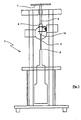
- a first lysis apparatus 1 was evaluated. This type of device 1 is good represented in FIG.
- the apparatus 1 comprises a model 2 VIA sonotrode operating at 20 kHz whose diameter is 4 millimeters (mm) at its end.
- the generator 3 used to excite the sonotrode 2 is a 300W generator 3 (BioBlock, Type VibraCell, Model 72401) that can operate in continuous or pulsed mode.
- the output power as well as the duty cycle of the pulses (10 to 90%) are adjustable.
- a weight 7 placed on the plate 6 allows to have a more or less important coupling between the end of the sonotrode 2 and the tube 4, in weight of the mass 7.
- the tubes 4 used for all the tests are of the type NUNC Cryo Tube 1.8 ml with a hemispherical bottom substantially U-shaped. Other shapes or brands of tubes may also be used.
- the tube 4 is subjected to ultrasound during a variable duration generally between 1 and 15 minutes (mn).
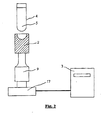
- a second lysis apparatus 1 has been realized, it relates to a sonication system direct at 35kHz, instead of 20kHz.
- This apparatus 1 is shown in FIG. the external structure is identical for these two sonotrodes respectively 20 and 35 kHz, the 35 kHz sonotrode has many advantages.
- the cavitation threshold that is to say the power limit between two areas with or without cavitation, increases substantially parabolically according to the frequency.
- the cavitation is a bit less important at 35 kHz than at 20 kHz.
- This sonotrode 2 operating at 35 kHz, is powered by a generator 3 of 500W type MW 1000 GSIP (SODEVA company).
- the same plate 6 allows to put the tube 4 under pressure so as to adjust the coupling between said tube 4 and the sonotrode 2.
- a booster 9 allows, according to its section ratio and the position in which it is placed, to amplify or to attenuate the vibratory amplitude at the end of the probe 2.
- the booster 9 is constituted by a metal cylinder, which is in a same material as the rest of the probe, usually titanium or aluminum. This has a progressive diameter change in its middle part.
- the length of said booster 9 corresponds to the half-acoustic wavelength for acoustic adaptation issues.
- booster 9 The role of booster 9 is to amplify the amplitude of vibration at the end of the probe and therefore the sound power delivered to the middle. This Vibration amplification is directly proportional to the ratio of the two diameters booster 9.
- FIG. 2 describes the different elements of the probe 2, the mechanical support and the pressurizing plate 6 are not shown.
- the process can also be implemented on several tubes 4. It is therefore possible to have a third embodiment of the apparatus 1, which makes it possible to lyse simultaneously the contents of at least two tubes, as shown in Figure 3.
- the frequency is identical and the shape of the coupling is similar to the second device 1 35 kHz, whose active surface is hemispherical, as will be described later.
- a spring system allows to individually adjust the pressure exerted on each tube 4 in order to have an identical coupling force for all the positions of the sonotrode 2.
- the first embodiment is of course constituted by a tube 4, all classical example, as is well represented in Figures 1 to 3. Nevertheless the shape of the 4 tubes shown in these figures is not limiting, and many other forms, more or less flared, with or without at least one frustoconical zone which is inverted or no, etc. can be used by the invention.
- the first lysis apparatus 1 is less effective than the second. So, with the second lysis apparatus, the coupling between the sonotrode 2 and the tube 4 is improved by producing a concave end adapted to the U-shape of said tube 4.
- the acoustic power being transmitted through a larger contact surface, a wider range of power can be used without degrading the tube 4 because of excessive Joule dissipation due to a power density that is too high, the contact area being too small.
- the active surface 8 of the sonotrode 2 is U-shaped, this shape allows to have a perfect positioning is constant of the container 4 with respect to the sonotrode 2, which allows better reproducibility from one test to another. With the first device, this reproducibility of the results was more difficult to control.
- this form also makes it possible to distribute in a much more homogeneous ultrasound and thus to obtain better agitation in the container or 4. It is possible and even preferential to have, in said container 4, balls 9. There again the result of the lysis is reproducible.
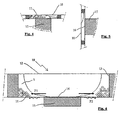
- FIGS. 4 to 6 This is a map 10 of plastic material, which comprises at least one transverse hole or well 13, tranversant through the card 10.
- the well 13 is delimited, at its two openings by films 12 in a generally flexible and transparent material, which circumscribes a cavity where sonication can be performed.
- the shape of the probe can be convex so that its application against one of the films 12, induces a deformation of the film 12 concerned and increases the coupling, synonymous with improved lysis.
- This device comprises therefore a sonotrode at 20 kHz, powered by a generator, on which is positioned a tube lysis, and a weight establishing contact between the sonotrode and the tube.
- Candida krusei yeasts were treated by direct sonication with the device described above, varying different parameters of the protocol, and in order to maximize their lysis and release of nucleic acids, and to minimize the cleavage of these nucleic acids .
- the sensitivity study was performed on a range of yeast dilutions of 10 7 to 10 2 yeasts / test. These yeasts were treated by direct sonication under the optimal conditions determined in the first part. In comparison, the same range of dilutions was treated by a reference lysis method, the vortex, described in the patent application WO9915621.
- the lysates are purified on Sephadex G-50 columns (Quick spin columns for DNA purification, Boehringer Mannheim) according to the supplier's protocol, then an amplification of 10 ⁇ l of lysate by PCR is carried out, according to the protocol described by Makimura et al. J. Med Microbiol ., 1994; 40: 358-364). 20 .mu.l of PCR product are then analyzed by electrophoresis on 1.2% agarose gel and ethidium bromide (BET) staining.
- BET ethidium bromide
- the sonication device used is shown in Figure 2, and is very well described in chapter I-B "Second embodiment" of the lysis apparatus. Benefits sonication at 35 kHz instead of 20 kHz are explained in this same chapter. Through elsewhere, this lysis device has a larger contact area between tube and sonotrode; the advantages of this are explained in chapter II-A "First mode of realization of the container containing the sample to be treated.
- the goal was to identify sonication parameters to maximize lysis bacteria and yeasts, and thus maximize the release of nucleic acids into perfectly controlling their cleavage.
- the acoustic power is defined by the vibration amplitude ultrasound generated by the sonotrode. This amplitude is given as a percentage of the power of the generator supplying the electric energy to the sonicator.
- nucleic acids - absent, + visible, ++ visible and intense, +++ visible and very intense.
- nucleic acids - absent, + visible, ++ visible and intense, +++ visible and very intense
- Power 15 W amplitude 50%: homogeneous agitation of the balls in the lower half of the volume of the liquid, forming a stirring dome in the center.
- the balls undergo small movements, rubbing between them.
- Power 20 W (amplitude 80%): agitation more violent; the balls make larger movements, occupying a larger volume of the liquid.
- the heating of the liquid is more important as well.
- the lysates are purified on Sephadex G-50 columns (Quick spin columns for DNA purification, Boehringer Mannheim) according to the supplier's protocol, then an amplification of 10 ⁇ l of lysate by PCR is carried out, according to the protocol described by Makimura et al. J. Med Microbiol ., 1994; 40: 358-364). 20 ⁇ l of PCR product are then analyzed by electrophoresis on 1.2% agarose gel and ethidium bromide (BET) staining.
- BET ethidium bromide
- the sonication conditions cleaving nucleic acids more strongly are slightly less favorable for PCR amplification. Nevertheless, a strong cleavage of the acids nucleic acid can be very favorable to some other applications in molecular biology, as P. ex. for purification of nucleic acids using hybridization processes which are favored by prior fragmentation of the nucleic acids.
- the sensor is connected to a digital indicator (48 x 96 programmable type, supplier C2AI, France) in order to visualize a voltage representative of the force of compression.
- the setting of the support force is then carried out for each position in presence of the sensor by adjusting the compression spring of each support axis.
- the movement of the balls presents the same character in each of the twelve tubes: homogeneous agitation of the balls in half lower volume of the liquid, forming a stirring dome in the center.
- the beads undergo small movements, rubbing between them.
- the card-based sonication device is shown in FIGS. 4 to 6. These figures also show two possibilities of positioning as well as the behavior of the liquid and beads during sonication.
- the sonotrode used for this device is that described in chapter I-A "First embodiment" of the lysis apparatus, but adapting a flat tip diameter 13 mm.
- the card-size consumable is described in the chapter II-B "Second embodiment” of the container containing the sample to be treated.
- This Consumable is polystyrene (other plastics compatible with biological analyzes can be used), has the dimensions 40 x 40 x 4 mm and has a circular opening in the center, called well, of variable diameter, to accommodate the sample and the balls of glass.
- the bottom of this well consists of either plastic 0.3 mm thick or a film polypropylene sticker. This film is also used to close the consumable.
- the cleaved nucleic acids appear below these bands.
- nucleic acids - absent, + visible, ++ visible and intense Note: for conditions 3 and 4, the sonication time is 10 minutes.
Landscapes
- Chemical & Material Sciences (AREA)
- Engineering & Computer Science (AREA)
- Health & Medical Sciences (AREA)
- Life Sciences & Earth Sciences (AREA)
- Organic Chemistry (AREA)
- Bioinformatics & Cheminformatics (AREA)
- Wood Science & Technology (AREA)
- Zoology (AREA)
- General Health & Medical Sciences (AREA)
- Biotechnology (AREA)
- Biochemistry (AREA)
- General Engineering & Computer Science (AREA)
- Mechanical Engineering (AREA)
- Biomedical Technology (AREA)
- Microbiology (AREA)
- Sustainable Development (AREA)
- Cell Biology (AREA)
- Toxicology (AREA)
- Molecular Biology (AREA)
- Chemical Kinetics & Catalysis (AREA)
- Genetics & Genomics (AREA)
- Apparatus Associated With Microorganisms And Enzymes (AREA)
- Measuring Or Testing Involving Enzymes Or Micro-Organisms (AREA)
- Micro-Organisms Or Cultivation Processes Thereof (AREA)
- Immobilizing And Processing Of Enzymes And Microorganisms (AREA)
- Sampling And Sample Adjustment (AREA)
Claims (13)
- Eine Vorrichtung (1), die eine Sonotrode (2) umfasst, die dafür bestimmt ist, Ultraschall von mehr oder weniger starker Intensität in mindestens einer biologischen Probe (5), die aufzulösende Zellen enthält, zu erzeugen, wobei die Probe (5) in mindestens einem Behälter (4), der zweckgemäß ausgeführt ist, enthalten ist, wobei die Sonotrode (2) direkt mit dem/den Behälter(n) (4), der/die die aufzulösende Probe (5) enthält/enthalten, in Kontakt ist, wenn sich zwischen den Flächen, die mit der Sonotrode (2) und dem Behälter (4) in Kontakt ist, kein Fluid befindet, dadurch gekennzeichnet, dass die Sonotrode (2) eine wirksame Fläche (8) aufweist, die sich der Form der Außenfläche des gesamten oder eines Teils jedes Behälters (4), der die aufzulösende Probe enthält, anpasst; wobei die wirksame Fläche (8) der Sonotrode (2), die mit dem Behälter (4) in Kontakt ist, eine konkave Form aufweist.
- Eine Vorrichtung, die eine Sonotrode (15) umfasst, die dafür bestimmt ist, Ultraschall von mehr oder weniger starker Intensität in mindestens einer biologischen Probe (5), die aufzulösende Zellen enthält, zu erzeugen, wobei die Probe (5) in mindestens einem Behälter (10) der zweckgemäß ausgeführt ist, enthalten ist, wobei die Sonotrode (15) direkt mit dem/den Behälter(n) (10), der/die die aufzulösende Probe (5) enthält/enthalten, in Kontakt ist, wenn sich zwischen den Flächen, die mit der Sonotrode (15) und dem Behälter (10) in Kontakt sind, kein Fluid befindet, dadurch gekennzeichnet, dass die Sonotrode (15) eine wirksame Fläche (16) aufweist, die sich der Form der Außenfläche des gesamten oder eines Teils jedes Behälters (10), der die aufzulösende Probe enthält, anpasst; wobei die wirksame Fläche (16) der Sonotrode (15), die mit der Außenfläche des Behälters (10) in Kontakt ist, eine konvexe Form aufweist.
- Vorrichtung gemäß Anspruch 1 oder 2, dadurch gekennzeichnet, dass die Fläche des Behälters (10), die mit der Sonotrode (15) zusammenwirkt, biegsam ist, so dass sie sich an die wirksame Fläche (16) der Sonotrode (15) anpasst.
- Vorrichtung gemäß einem der Ansprüche 1 bis 3, dadurch gekennzeichnet, dass die Sonotrode (2 oder 15) mit mindestens einer Glasperle (11), die sich in der in einem Behälter (4 oder 10) enthaltenen Probe (5) befindet, zusammenwirkt.
- Vorrichtung gemäß einem der Ansprüche 1 bis 4, dadurch gekennzeichnet, dass jede Perle (11), im Falle einer Lyse von Bakterien, einen Durchmesser von 90 bis 150 und vorzugsweise von 100 Mikrometern (µm) aufweist und, im Falle einer Lyse von Hefepilzen, einen Durchmesser von 150 bis 1500 und vorzugsweise von 500 µm aufweist.
- Vorrichtung gemäß einem der Ansprüche 1 bis 5, dadurch gekennzeichnet, dass sie mindestens zwei Sonotroden (2 oder 15) beinhaltet.
- Vorrichtung gemäß einem der Ansprüche 1 bis 6, dadurch gekennzeichnet, dass jeder Behälter (4 oder 10) mit der/den Sonotrode(n) (2 oder 15) mittels eines unter Druck setzenden Mittels (6) in physikalischem Kontakt ist.
- Vorrichtung gemäß einem der Ansprüche 1 bis 7, dadurch gekennzeichnet, dass jede Sonotrode (2 oder 15) eine Ultraschallsendefrequenz von zwischen 20 und 50 kHz, genauer zwischen 30 und 40 kHz und vorzugsweise von ungefähr 35 kHz aufweist.
- Ein Verfahren zur Lyse von Zellen durch Ultraschall, die in einer biologischen Probe (5), welche in einem Behälter (4 oder 10) vorhanden ist, enthalten sind, das mindestens eine Sonotrode (2 oder 15) verwendet, dadurch gekennzeichnet, dass es aus Folgendem besteht:Positionieren des Behälters (4 oder 10) in direkten Kontakt mit der konkaven oder konvexen wirksamen Fläche der Sonotrode(n) (2 oder 15), undAktivieren der Sonotrode(n) (2 oder 15) während eines Zeitraums, der ausreicht, um die in der Probe (5) enthaltenen Zellen aufzulösen, indem die freigesetzten DNA und/oder RNA konserviert werden, um die nachträgliche Verwendung, beispielsweise in einem Amplifikationsschritt, zu gewährleisten.
- Ein Verfahren zur Lyse von Zellen durch Ultraschall, die in einer biologischen Probe (5), welche in einem Behälter (4 oder 10) vorhanden ist, enthalten sind, das mindestens eine Sonotrode (2 oder 15) verwendet, dadurch gekennzeichnet, dass es aus Folgendem besteht:Positionieren des Behälters (4 oder 10) in direkten Kontakt mit der konkaven oder konvexen wirksamen Fläche der Sonotrode(n) (2 oder 15), undAktivieren der Sonotrode(n) (2 oder 15) während eines Zeitraums, der ausreicht, um die in der Probe (5) enthaltenen Zellen aufzulösen, indem die freigesetzten DNA und/oder RNA gespalten werden, während ihre nachträgliche Verwendung, beispielsweise in einem Amplifikationsschritt, gewährleistet wird.
- Verfahren gemäß Anspruch 9 oder 10, dadurch gekennzeichnet, dass vor der Aktivierung der Sonotrode(n) (2 oder 15) der Behälter (4 oder 10) gegen die wirksame Fläche (8 oder 16) der Sonotrode(n) (2 oder 15) gepresst wird.
- Verfahren gemäß einem der Ansprüche 9 bis 11, dadurch gekennzeichnet, dass die Aktivierung jeder Sonotrode (2 oder 15) unter folgenden Bedingungen vorgenommen wird:Ultraschalldesintegrationsdauer 10 bis 15 Minuten,Tastverhältnis zwischen 40 und 60 % und vorzugsweise 50 %, undLeistung 10 bis 30 W.
- Verfahren gemäß Anspruch 12, dadurch gekennzeichnet, dass die Aktivierung jeder Sonotrode (2 oder 15) aus einer Impulsfolge besteht, deren Dauer zwischen 5 und 20 Sekunden und vorzugsweise zwischen 10 und 15 Sekunden liegt.
Priority Applications (1)
| Application Number | Priority Date | Filing Date | Title |
|---|---|---|---|
| EP04012952A EP1466966A1 (de) | 1999-04-01 | 2000-04-03 | Apparat und Prozess für Lysis durch biologische Ultraschall der Zellen |
Applications Claiming Priority (3)
| Application Number | Priority Date | Filing Date | Title |
|---|---|---|---|
| FR9904289A FR2791697B1 (fr) | 1999-04-01 | 1999-04-01 | Appareil et procede de lyse par ultrasons de cellules biologiques |
| FR9904289 | 1999-04-01 | ||
| PCT/FR2000/000832 WO2000060049A1 (fr) | 1999-04-01 | 2000-04-03 | Appareil et procede de lyse par ultrasons de cellules biologiques |
Related Child Applications (1)
| Application Number | Title | Priority Date | Filing Date |
|---|---|---|---|
| EP04012952A Division EP1466966A1 (de) | 1999-04-01 | 2000-04-03 | Apparat und Prozess für Lysis durch biologische Ultraschall der Zellen |
Publications (2)
| Publication Number | Publication Date |
|---|---|
| EP1165748A1 EP1165748A1 (de) | 2002-01-02 |
| EP1165748B1 true EP1165748B1 (de) | 2004-06-02 |
Family
ID=9544079
Family Applications (2)
| Application Number | Title | Priority Date | Filing Date |
|---|---|---|---|
| EP04012952A Withdrawn EP1466966A1 (de) | 1999-04-01 | 2000-04-03 | Apparat und Prozess für Lysis durch biologische Ultraschall der Zellen |
| EP00915279A Expired - Lifetime EP1165748B1 (de) | 1999-04-01 | 2000-04-03 | Vorrichtung und verfahren zur ultraschall-lyse biologischer zellen |
Family Applications Before (1)
| Application Number | Title | Priority Date | Filing Date |
|---|---|---|---|
| EP04012952A Withdrawn EP1466966A1 (de) | 1999-04-01 | 2000-04-03 | Apparat und Prozess für Lysis durch biologische Ultraschall der Zellen |
Country Status (10)
| Country | Link |
|---|---|
| US (1) | US6686195B1 (de) |
| EP (2) | EP1466966A1 (de) |
| JP (1) | JP2002540783A (de) |
| AT (1) | ATE268376T1 (de) |
| AU (1) | AU763480B2 (de) |
| CA (1) | CA2365493C (de) |
| DE (1) | DE60011253T2 (de) |
| ES (1) | ES2222190T3 (de) |
| FR (1) | FR2791697B1 (de) |
| WO (1) | WO2000060049A1 (de) |
Cited By (1)
| Publication number | Priority date | Publication date | Assignee | Title |
|---|---|---|---|---|
| US11426727B2 (en) | 2020-04-28 | 2022-08-30 | Siemens Healthcare Diagnostics Inc. | Acoustophoretic lysis devices and methods |
Families Citing this family (62)
| Publication number | Priority date | Publication date | Assignee | Title |
|---|---|---|---|---|
| US20040200909A1 (en) * | 1999-05-28 | 2004-10-14 | Cepheid | Apparatus and method for cell disruption |
| US8815521B2 (en) | 2000-05-30 | 2014-08-26 | Cepheid | Apparatus and method for cell disruption |
| US9073053B2 (en) * | 1999-05-28 | 2015-07-07 | Cepheid | Apparatus and method for cell disruption |
| DE60022025T2 (de) | 1999-05-28 | 2006-06-29 | Cepheid, Sunnyvale | Anlage zum brechen von zellen |
| FR2812303B1 (fr) * | 2000-07-27 | 2002-12-06 | Biomerieux Sa | Procede de lyse cellulaire de procaryotes ou d'eucaryotes ou de lyse cellulaire simultanee de procaryotes et d'eucaryotes |
| US7338805B2 (en) | 2001-05-04 | 2008-03-04 | Bio Merieux | Labeling reagents, methods for synthesizing such reagents and methods for detecting biological molecules |
| US6739531B2 (en) * | 2001-10-04 | 2004-05-25 | Cepheid | Apparatus and method for rapid disruption of cells or viruses |
| US20040151059A1 (en) * | 2002-05-01 | 2004-08-05 | Roberts Ii William Leroy | Deagglomerator apparatus and method |
| WO2003092711A1 (en) * | 2002-05-02 | 2003-11-13 | E-L Management Corp. | Method of enhancing biological activity of plant extracts |
| FR2868071B1 (fr) | 2004-03-26 | 2006-06-09 | Biomerieux Sa | Reactifs de marquage, procedes de synthese de tels reactifs et procedes de detection de molecules biologiques |
| JP4469928B2 (ja) * | 2004-09-22 | 2010-06-02 | ベックマン・コールター・インコーポレーテッド | 攪拌容器 |
| DK1817423T3 (en) * | 2004-11-30 | 2015-01-26 | Merial Ltd | Mixing units for chemical light ring of cells |
| GB2425974A (en) * | 2005-05-09 | 2006-11-15 | Orion Diagnostica Oy | Sonication of a medium |
| FR2886735B1 (fr) | 2005-06-01 | 2015-09-11 | Biomerieux Sa | Procede de marquage ou de traitement d'un echantillon biologique contenant des molecules biologiques d'interet, notamment des acides nucleiques |
| FR2902430B1 (fr) | 2005-11-25 | 2012-11-02 | Biomerieux Sa | Oligonucleotides, utilisation, methode de detection et kit permettant de diagnostiquer la presence des genes h5 et n1 du virus d'influenza a |
| US7943352B2 (en) * | 2006-03-29 | 2011-05-17 | Bacoustics, Llc | Apparatus and methods for vaccine development using ultrasound technology |
| DE102006032637A1 (de) * | 2006-07-13 | 2008-01-17 | Qiagen Gmbh | Vorrichtung zum Aufschluß einer biologischen Probe |
| DE102007017450A1 (de) * | 2007-04-02 | 2008-10-09 | Niro-Plan Ag | Verfahren und Vorrichtung zur Herstellung von Caffe Latte Macchiato |
| FR2917090B1 (fr) | 2007-06-11 | 2012-06-15 | Biomerieux Sa | Reactifs de marquage portant des fonctions diazo et nitro, procedes de synthese de tels reactifs et procedes de detection de molecules biologiques |
| FR2921064A1 (fr) * | 2007-09-14 | 2009-03-20 | Biomerieux Sa | Oligonucleotides, utilisation, methode de detection et kit permettant de diagnostiquer la presence du gene e1 du virus du chikungunya |
| AU2008317307A1 (en) * | 2007-10-25 | 2009-04-30 | Novartis Ag | Powder conditioning of unit dose drug packages |
| US20090324786A1 (en) * | 2008-06-25 | 2009-12-31 | Mcnaughton James L | Underwater Pressure Arc Discharge System for Disinfection of Food and Food Products |
| US20100008178A1 (en) * | 2008-07-14 | 2010-01-14 | Dale Fahrion | Acoustic Beverage Mixer |
| FR2934595B1 (fr) | 2008-07-29 | 2013-04-05 | Biomerieux Sa | Reactifs de marquage ayant un noyau pyridine portant une fonction diazomethyle, procedes de synthese de tels reactifs et procedes de detection de molecules biologiques |
| EP2187209B1 (de) * | 2008-11-12 | 2018-03-28 | Roche Diagnostics GmbH | Hämolysator |
| AU2009322692A1 (en) * | 2008-12-03 | 2011-06-30 | Integrated Nano-Technologies, Llc. | Universal biological sample processing |
| US9347086B2 (en) | 2009-04-03 | 2016-05-24 | Integrated Nano-Technologies, Llc | Method and system for sample preparation |
| US20100280233A1 (en) * | 2009-05-04 | 2010-11-04 | Connolly Dennis M | Method for sample preparation |
| ES2628453T3 (es) | 2009-05-22 | 2017-08-02 | Integrated Nano-Technologies, Inc. | Método y sistema para preparación de muestras |
| US8518681B2 (en) * | 2009-12-04 | 2013-08-27 | Sound Surgical Technologies Llc | Selective lysing of cells using ultrasound |
| US8563298B2 (en) | 2010-10-22 | 2013-10-22 | T2 Biosystems, Inc. | NMR systems and methods for the rapid detection of analytes |
| CA2815085C (en) | 2010-10-22 | 2022-06-21 | T2 Biosystems, Inc. | Nmr systems and methods for the rapid detection of analytes |
| US8409807B2 (en) | 2010-10-22 | 2013-04-02 | T2 Biosystems, Inc. | NMR systems and methods for the rapid detection of analytes |
| EP2489427A1 (de) * | 2011-02-16 | 2012-08-22 | Helmholtz-Zentrum für Infektionsforschung GmbH | Vorrichtung und Verfahren zur Herstellung und Analyse von Prionen |
| WO2012125708A2 (en) * | 2011-03-15 | 2012-09-20 | E. I. Du Pont De Nemours And Company | Device for shearing nucleic acids and particulates |
| EP2839038B1 (de) | 2012-04-20 | 2019-01-16 | T2 Biosystems, Inc. | Zusammensetzungen und verfahren für den nachweis einer candida-spezies |
| US9873921B2 (en) | 2012-10-22 | 2018-01-23 | Qiagen Gaithersburg, Inc. | Ultrasonic biological sample analysis apparatus and methods |
| DE102012219576B4 (de) | 2012-10-25 | 2024-05-02 | Robert Bosch Gmbh | Vorrichtung, Anordnung und Verfahren zum Übertragen von Energie zum Lysieren |
| DE102012219575A1 (de) * | 2012-10-25 | 2014-04-30 | Robert Bosch Gmbh | Zum Lysieren einsetzbare Vorrichtungen, Verfahren und System |
| US9587236B2 (en) | 2013-01-18 | 2017-03-07 | Folim G. Halaka | Continuous sonication for biotechnology applications and biofuel production |
| US9789483B2 (en) | 2013-03-11 | 2017-10-17 | Cue Inc. | System for portable and easy-to-use detection of analytes with mobile computing device |
| US9623409B2 (en) | 2013-03-11 | 2017-04-18 | Cue Inc. | Cartridges, kits, and methods for enhanced mixing for detection and quantification of analytes |
| US10545161B2 (en) | 2013-03-11 | 2020-01-28 | Cue Health Inc. | Systems and methods for detection and quantification of analytes |
| CN105102110B (zh) * | 2013-03-15 | 2018-01-26 | 默克专利股份公司 | 用于执行声处理的设备 |
| US9416356B2 (en) | 2013-03-15 | 2016-08-16 | Abbott Molecular Inc. | Compositions and methods for nucleic acid extraction |
| USD745423S1 (en) | 2014-05-12 | 2015-12-15 | Cue Inc. | Automated analyzer test cartridge and sample collection device for analyte detection |
| US10799914B2 (en) | 2014-06-02 | 2020-10-13 | Luminex Corporation | Methods and systems for ultrasonic lysis |
| EP3169451B1 (de) | 2014-07-17 | 2020-04-01 | University of Washington | Ultraschallsystem zum scheren von zellmaterial |
| EP3215260B1 (de) | 2014-11-03 | 2020-01-15 | Tangen Biosciences Inc. | Vorrichtung und verfahren für zellen-, sporen- oder viruserfassung und unterbrechung |
| FR3036799A1 (fr) * | 2015-05-28 | 2016-12-02 | Biomerieux Sa | Dispositif pour la preparation d'echantillons biologiques |
| CA2992596C (en) | 2015-07-17 | 2023-08-22 | Cue Inc. | Systems and methods for enhanced detection and quantification of analytes |
| JP7523776B2 (ja) | 2016-01-21 | 2024-07-29 | ティー2 バイオシステムズ,インコーポレーテッド | 細菌を迅速に検出するnmr法及びシステム |
| US10625263B2 (en) | 2016-03-28 | 2020-04-21 | Tangen Biosciences, Inc. | Apparatus and method for extracting pathogens from biological samples |
| WO2018140540A1 (en) | 2017-01-25 | 2018-08-02 | Cue Health Inc. | Systems and methods for enhanced detection and quantification of analytes |
| US11690388B2 (en) | 2017-02-28 | 2023-07-04 | The Coca-Cola Company | Waterless ice crystal nucleator for supercooled beverages |
| EP3549664A1 (de) * | 2018-04-05 | 2019-10-09 | F. Hoffmann-La Roche AG | Verfahren und vorrichtung zur beschallung einer biologischen probe |
| SG11202110981VA (en) * | 2019-04-02 | 2021-10-28 | Coca Cola Co | Waterless ice crystal nucleator with convex ultrasonic transmitter |
| CN111215215A (zh) * | 2020-03-31 | 2020-06-02 | 宁波集智生物科技有限公司 | 一种通过超声波实现的非接触性组织破碎仪 |
| KR102901910B1 (ko) * | 2020-04-06 | 2025-12-18 | 샤힌 이노베이션즈 홀딩 리미티드 | 세포 용해 시스템 및 방법 |
| CA3180786A1 (en) | 2020-06-01 | 2021-05-28 | Imad Lahoud | An infectious disease screening system |
| WO2021245391A1 (en) | 2020-06-01 | 2021-12-09 | Shaheen Innovations Holding Limited | An infectious disease screening device |
| CN121852190A (zh) * | 2023-12-19 | 2026-04-14 | 山东省公共卫生临床中心 | 一种微生物病原学检验用痰样本预处理装置 |
Family Cites Families (10)
| Publication number | Priority date | Publication date | Assignee | Title |
|---|---|---|---|---|
| GB938163A (en) * | 1960-09-20 | 1963-10-02 | Boots Pure Drug Co Ltd | Improvements in or relating to particle size reduction or cellular disruption |
| CH667599A5 (fr) * | 1986-12-11 | 1988-10-31 | Battelle Memorial Institute | Enceinte destinee a contenir un milieu liquide. |
| US4942868A (en) * | 1988-03-30 | 1990-07-24 | Malmros Holding, Inc. | Ultrasonic treatment of animals |
| US4983523A (en) * | 1988-04-08 | 1991-01-08 | Gene-Trak Systems | Methods for preparing sample nucleic acids for hybridization |
| DE4117638A1 (de) * | 1990-05-30 | 1991-12-05 | Toshiba Kawasaki Kk | Stosswellengenerator mit einem piezoelektrischen element |
| US6071480A (en) * | 1994-12-22 | 2000-06-06 | Abbott Laboratories | Method for generating a standing sonic wave, methods of sonication with a standing sonic wave, and a standing sonic wave sonicator |
| JPH09108676A (ja) * | 1995-10-17 | 1997-04-28 | Rimoderingu Touenteiwan:Kk | 水の浄化方法及びその装置 |
| US5779985A (en) * | 1995-12-18 | 1998-07-14 | Solid Phase Sciences Corporation | Reaction plenum |
| US6100084A (en) * | 1998-11-05 | 2000-08-08 | The Regents Of The University Of California | Micro-sonicator for spore lysis |
| DE60138247D1 (de) * | 2000-07-13 | 2009-05-20 | Panasonic Corp | Akustische Linse und zugehöriges Herstellungsverfahren |
-
1999
- 1999-04-01 FR FR9904289A patent/FR2791697B1/fr not_active Expired - Fee Related
-
2000
- 2000-04-03 EP EP04012952A patent/EP1466966A1/de not_active Withdrawn
- 2000-04-03 EP EP00915279A patent/EP1165748B1/de not_active Expired - Lifetime
- 2000-04-03 CA CA2365493A patent/CA2365493C/fr not_active Expired - Fee Related
- 2000-04-03 ES ES00915279T patent/ES2222190T3/es not_active Expired - Lifetime
- 2000-04-03 JP JP2000609541A patent/JP2002540783A/ja active Pending
- 2000-04-03 US US09/937,992 patent/US6686195B1/en not_active Expired - Fee Related
- 2000-04-03 AT AT00915279T patent/ATE268376T1/de not_active IP Right Cessation
- 2000-04-03 AU AU36649/00A patent/AU763480B2/en not_active Ceased
- 2000-04-03 DE DE60011253T patent/DE60011253T2/de not_active Expired - Lifetime
- 2000-04-03 WO PCT/FR2000/000832 patent/WO2000060049A1/fr not_active Ceased
Cited By (1)
| Publication number | Priority date | Publication date | Assignee | Title |
|---|---|---|---|---|
| US11426727B2 (en) | 2020-04-28 | 2022-08-30 | Siemens Healthcare Diagnostics Inc. | Acoustophoretic lysis devices and methods |
Also Published As
| Publication number | Publication date |
|---|---|
| CA2365493A1 (fr) | 2000-10-12 |
| JP2002540783A (ja) | 2002-12-03 |
| US6686195B1 (en) | 2004-02-03 |
| AU763480B2 (en) | 2003-07-24 |
| DE60011253T2 (de) | 2005-07-07 |
| CA2365493C (fr) | 2010-07-13 |
| FR2791697B1 (fr) | 2003-02-28 |
| ATE268376T1 (de) | 2004-06-15 |
| EP1466966A1 (de) | 2004-10-13 |
| AU3664900A (en) | 2000-10-23 |
| EP1165748A1 (de) | 2002-01-02 |
| WO2000060049A1 (fr) | 2000-10-12 |
| ES2222190T3 (es) | 2005-02-01 |
| DE60011253D1 (de) | 2004-07-08 |
| FR2791697A1 (fr) | 2000-10-06 |
Similar Documents
| Publication | Publication Date | Title |
|---|---|---|
| EP1165748B1 (de) | Vorrichtung und verfahren zur ultraschall-lyse biologischer zellen | |
| WO2016189259A1 (fr) | Dispositif pour la preparation d'echantillons biologiques et son utilisation | |
| US20100011845A1 (en) | Methods and systems for modulating acoustic energy delivery | |
| EP3059300B1 (de) | Vorrichtung zur manipulation von biologischen zellen mithilfe einer schwingenden halterung | |
| JPH0240244A (ja) | 細胞の超音波破砕装置 | |
| FR2979353A1 (fr) | Procedes d'ensemencement de milieux de culture sur boites de petri par frequences vibratoires | |
| EP2084702B1 (de) | Verfahren zur erzeugung mechanischer wellen durch herstellung einer akustischen grenzflächen-strahlungskraft | |
| FR2910826A1 (fr) | Dispositif pour la production de vibrations ultrasoniques | |
| FR2777293A1 (fr) | Procede d'electro-separation d'un echantillon biologique et dispositif de mise en oeuvre | |
| WO2008114116A1 (fr) | Procede et dispositif pour la sterilisation d'un liquide | |
| US7198809B2 (en) | Method and system for removing harmful gases from wines and other beverages | |
| EP0271448A2 (de) | Behälter, bestimmt zur Aufnahme eines flüssigen Mediums | |
| US20120238736A1 (en) | Device for shearing nucleic acids and particulates | |
| EP3260530A1 (de) | System und verfahren zum lysieren einer biologischen probe | |
| US7608440B2 (en) | Apparatus for ultrasonic microbial disruption | |
| WO2007118285A1 (en) | Ultrasonic transducer systems | |
| JPS5855756A (ja) | 超音波による細胞の破砕装置 | |
| JPH023799Y2 (de) | ||
| Tamura et al. | Effect of ultrasonic cavitation on force acting on solid object in water | |
| VAN BAMBEKE | L'OOCYTE DE PHOLCUS PHALANGIOIDES FUESSL. | |
| CA2443599A1 (fr) | Appareil et procede de compaction aux ultrasons pour former une croute pour produits alimentaires | |
| CA2075049A1 (fr) | Procede et appareil pour generer une onde ultrasonore | |
| WO1999031498A1 (fr) | Procede et dispositif pour le suivi de transitions de phase |
Legal Events
| Date | Code | Title | Description |
|---|---|---|---|
| PUAI | Public reference made under article 153(3) epc to a published international application that has entered the european phase |
Free format text: ORIGINAL CODE: 0009012 |
|
| 17P | Request for examination filed |
Effective date: 20011005 |
|
| AK | Designated contracting states |
Kind code of ref document: A1 Designated state(s): AT BE CH CY DE DK ES FI FR GB GR IE IT LI LU MC NL PT SE |
|
| AX | Request for extension of the european patent |
Free format text: AL;LT;LV;MK;RO;SI |
|
| GRAP | Despatch of communication of intention to grant a patent |
Free format text: ORIGINAL CODE: EPIDOSNIGR1 |
|
| GRAS | Grant fee paid |
Free format text: ORIGINAL CODE: EPIDOSNIGR3 |
|
| GRAA | (expected) grant |
Free format text: ORIGINAL CODE: 0009210 |
|
| AK | Designated contracting states |
Kind code of ref document: B1 Designated state(s): AT BE CH CY DE DK ES FI FR GB GR IE IT LI LU MC NL PT SE |
|
| PG25 | Lapsed in a contracting state [announced via postgrant information from national office to epo] |
Ref country code: FI Free format text: LAPSE BECAUSE OF FAILURE TO SUBMIT A TRANSLATION OF THE DESCRIPTION OR TO PAY THE FEE WITHIN THE PRESCRIBED TIME-LIMIT Effective date: 20040602 Ref country code: AT Free format text: LAPSE BECAUSE OF FAILURE TO SUBMIT A TRANSLATION OF THE DESCRIPTION OR TO PAY THE FEE WITHIN THE PRESCRIBED TIME-LIMIT Effective date: 20040602 Ref country code: NL Free format text: LAPSE BECAUSE OF FAILURE TO SUBMIT A TRANSLATION OF THE DESCRIPTION OR TO PAY THE FEE WITHIN THE PRESCRIBED TIME-LIMIT Effective date: 20040602 Ref country code: IE Free format text: LAPSE BECAUSE OF FAILURE TO SUBMIT A TRANSLATION OF THE DESCRIPTION OR TO PAY THE FEE WITHIN THE PRESCRIBED TIME-LIMIT Effective date: 20040602 |
|
| REG | Reference to a national code |
Ref country code: GB Ref legal event code: FG4D Free format text: NOT ENGLISH |
|
| REG | Reference to a national code |
Ref country code: CH Ref legal event code: EP |
|
| REF | Corresponds to: |
Ref document number: 60011253 Country of ref document: DE Date of ref document: 20040708 Kind code of ref document: P |
|
| REG | Reference to a national code |
Ref country code: IE Ref legal event code: FG4D Free format text: FRENCH |
|
| PG25 | Lapsed in a contracting state [announced via postgrant information from national office to epo] |
Ref country code: SE Free format text: LAPSE BECAUSE OF FAILURE TO SUBMIT A TRANSLATION OF THE DESCRIPTION OR TO PAY THE FEE WITHIN THE PRESCRIBED TIME-LIMIT Effective date: 20040902 Ref country code: DK Free format text: LAPSE BECAUSE OF FAILURE TO SUBMIT A TRANSLATION OF THE DESCRIPTION OR TO PAY THE FEE WITHIN THE PRESCRIBED TIME-LIMIT Effective date: 20040902 Ref country code: GR Free format text: LAPSE BECAUSE OF FAILURE TO SUBMIT A TRANSLATION OF THE DESCRIPTION OR TO PAY THE FEE WITHIN THE PRESCRIBED TIME-LIMIT Effective date: 20040902 |
|
| GBT | Gb: translation of ep patent filed (gb section 77(6)(a)/1977) |
Effective date: 20040831 |
|
| LTIE | Lt: invalidation of european patent or patent extension |
Effective date: 20040602 |
|
| NLV1 | Nl: lapsed or annulled due to failure to fulfill the requirements of art. 29p and 29m of the patents act | ||
| RIN2 | Information on inventor provided after grant (corrected) |
Inventor name: COLIN, BRUNO Inventor name: INCARDONA, SANDRA Inventor name: CLEUZIAT, PHILIPPE Inventor name: BROYER, PATRICK Inventor name: MABILAT, CLAUDE |
|
| REG | Reference to a national code |
Ref country code: IE Ref legal event code: FD4D |
|
| REG | Reference to a national code |
Ref country code: ES Ref legal event code: FG2A Ref document number: 2222190 Country of ref document: ES Kind code of ref document: T3 |
|
| PG25 | Lapsed in a contracting state [announced via postgrant information from national office to epo] |
Ref country code: CY Free format text: LAPSE BECAUSE OF FAILURE TO SUBMIT A TRANSLATION OF THE DESCRIPTION OR TO PAY THE FEE WITHIN THE PRESCRIBED TIME-LIMIT Effective date: 20050403 Ref country code: LU Free format text: LAPSE BECAUSE OF NON-PAYMENT OF DUE FEES Effective date: 20050403 |
|
| PLBE | No opposition filed within time limit |
Free format text: ORIGINAL CODE: 0009261 |
|
| STAA | Information on the status of an ep patent application or granted ep patent |
Free format text: STATUS: NO OPPOSITION FILED WITHIN TIME LIMIT |
|
| PG25 | Lapsed in a contracting state [announced via postgrant information from national office to epo] |
Ref country code: MC Free format text: LAPSE BECAUSE OF NON-PAYMENT OF DUE FEES Effective date: 20050430 Ref country code: BE Free format text: LAPSE BECAUSE OF NON-PAYMENT OF DUE FEES Effective date: 20050430 |
|
| 26N | No opposition filed |
Effective date: 20050303 |
|
| BERE | Be: lapsed |
Owner name: S.A. *BIOMERIEUX Effective date: 20050430 |
|
| REG | Reference to a national code |
Ref country code: GB Ref legal event code: 711B |
|
| REG | Reference to a national code |
Ref country code: GB Ref legal event code: 711G |
|
| BERE | Be: lapsed |
Owner name: S.A. *BIOMERIEUX Effective date: 20050430 |
|
| PG25 | Lapsed in a contracting state [announced via postgrant information from national office to epo] |
Ref country code: PT Free format text: LAPSE BECAUSE OF NON-PAYMENT OF DUE FEES Effective date: 20041102 |
|
| REG | Reference to a national code |
Ref country code: CH Ref legal event code: NV Representative=s name: MURGITROYD & COMPANY |
|
| PGFP | Annual fee paid to national office [announced via postgrant information from national office to epo] |
Ref country code: GB Payment date: 20100329 Year of fee payment: 11 |
|
| PGFP | Annual fee paid to national office [announced via postgrant information from national office to epo] |
Ref country code: ES Payment date: 20100427 Year of fee payment: 11 Ref country code: FR Payment date: 20100521 Year of fee payment: 11 |
|
| PGFP | Annual fee paid to national office [announced via postgrant information from national office to epo] |
Ref country code: IT Payment date: 20100427 Year of fee payment: 11 Ref country code: DE Payment date: 20100412 Year of fee payment: 11 |
|
| PGFP | Annual fee paid to national office [announced via postgrant information from national office to epo] |
Ref country code: CH Payment date: 20100413 Year of fee payment: 11 |
|
| REG | Reference to a national code |
Ref country code: CH Ref legal event code: PL |
|
| GBPC | Gb: european patent ceased through non-payment of renewal fee |
Effective date: 20110403 |
|
| REG | Reference to a national code |
Ref country code: FR Ref legal event code: ST Effective date: 20111230 |
|
| PG25 | Lapsed in a contracting state [announced via postgrant information from national office to epo] |
Ref country code: CH Free format text: LAPSE BECAUSE OF NON-PAYMENT OF DUE FEES Effective date: 20110430 Ref country code: DE Free format text: LAPSE BECAUSE OF NON-PAYMENT OF DUE FEES Effective date: 20111101 Ref country code: FR Free format text: LAPSE BECAUSE OF NON-PAYMENT OF DUE FEES Effective date: 20110502 Ref country code: LI Free format text: LAPSE BECAUSE OF NON-PAYMENT OF DUE FEES Effective date: 20110430 |
|
| PG25 | Lapsed in a contracting state [announced via postgrant information from national office to epo] |
Ref country code: GB Free format text: LAPSE BECAUSE OF NON-PAYMENT OF DUE FEES Effective date: 20110403 Ref country code: IT Free format text: LAPSE BECAUSE OF NON-PAYMENT OF DUE FEES Effective date: 20110403 |
|
| REG | Reference to a national code |
Ref country code: DE Ref legal event code: R119 Ref document number: 60011253 Country of ref document: DE Effective date: 20111101 |
|
| REG | Reference to a national code |
Ref country code: ES Ref legal event code: FD2A Effective date: 20120604 |
|
| PG25 | Lapsed in a contracting state [announced via postgrant information from national office to epo] |
Ref country code: ES Free format text: LAPSE BECAUSE OF NON-PAYMENT OF DUE FEES Effective date: 20110404 |