EP1165749B1 - VERFAHREN ZUR HERSTELLUNG VON PORöSEN, BIOLOGISCH ABBAUBAREN UND BIOKOMPATIBLEN POLYMEREN STüTZGEWEBEN ZUR GEWEBETECHNOLOGIE - Google Patents
VERFAHREN ZUR HERSTELLUNG VON PORöSEN, BIOLOGISCH ABBAUBAREN UND BIOKOMPATIBLEN POLYMEREN STüTZGEWEBEN ZUR GEWEBETECHNOLOGIE Download PDFInfo
- Publication number
- EP1165749B1 EP1165749B1 EP00905419A EP00905419A EP1165749B1 EP 1165749 B1 EP1165749 B1 EP 1165749B1 EP 00905419 A EP00905419 A EP 00905419A EP 00905419 A EP00905419 A EP 00905419A EP 1165749 B1 EP1165749 B1 EP 1165749B1
- Authority
- EP
- European Patent Office
- Prior art keywords
- salt
- polymer
- organic solvent
- acid
- set forth
- Prior art date
- Legal status (The legal status is an assumption and is not a legal conclusion. Google has not performed a legal analysis and makes no representation as to the accuracy of the status listed.)
- Expired - Lifetime
Links
- 238000000034 method Methods 0.000 title claims abstract description 35
- 150000003839 salts Chemical class 0.000 claims abstract description 69
- 229920000642 polymer Polymers 0.000 claims abstract description 59
- 239000003960 organic solvent Substances 0.000 claims abstract description 27
- 239000000243 solution Substances 0.000 claims abstract description 25
- 239000007864 aqueous solution Substances 0.000 claims abstract description 14
- XLYOFNOQVPJJNP-UHFFFAOYSA-N water Chemical compound O XLYOFNOQVPJJNP-UHFFFAOYSA-N 0.000 claims abstract description 14
- 239000012153 distilled water Substances 0.000 claims abstract description 11
- 239000002002 slurry Substances 0.000 claims abstract description 8
- 239000003929 acidic solution Substances 0.000 claims abstract description 5
- -1 poly(L-lactic acid) Polymers 0.000 claims description 34
- YMWUJEATGCHHMB-UHFFFAOYSA-N Dichloromethane Chemical group ClCCl YMWUJEATGCHHMB-UHFFFAOYSA-N 0.000 claims description 30
- LFQSCWFLJHTTHZ-UHFFFAOYSA-N Ethanol Chemical compound CCO LFQSCWFLJHTTHZ-UHFFFAOYSA-N 0.000 claims description 21
- HEDRZPFGACZZDS-UHFFFAOYSA-N Chloroform Chemical compound ClC(Cl)Cl HEDRZPFGACZZDS-UHFFFAOYSA-N 0.000 claims description 18
- RTZKZFJDLAIYFH-UHFFFAOYSA-N Diethyl ether Chemical compound CCOCC RTZKZFJDLAIYFH-UHFFFAOYSA-N 0.000 claims description 18
- KRKNYBCHXYNGOX-UHFFFAOYSA-N citric acid Chemical compound OC(=O)CC(O)(C(O)=O)CC(O)=O KRKNYBCHXYNGOX-UHFFFAOYSA-N 0.000 claims description 16
- IAZDPXIOMUYVGZ-UHFFFAOYSA-N Dimethylsulphoxide Chemical compound CS(C)=O IAZDPXIOMUYVGZ-UHFFFAOYSA-N 0.000 claims description 14
- 229920002988 biodegradable polymer Polymers 0.000 claims description 13
- 239000004621 biodegradable polymer Substances 0.000 claims description 11
- ZWEHNKRNPOVVGH-UHFFFAOYSA-N 2-Butanone Chemical compound CCC(C)=O ZWEHNKRNPOVVGH-UHFFFAOYSA-N 0.000 claims description 9
- CSCPPACGZOOCGX-UHFFFAOYSA-N Acetone Chemical compound CC(C)=O CSCPPACGZOOCGX-UHFFFAOYSA-N 0.000 claims description 9
- WEVYAHXRMPXWCK-UHFFFAOYSA-N Acetonitrile Chemical compound CC#N WEVYAHXRMPXWCK-UHFFFAOYSA-N 0.000 claims description 9
- XEKOWRVHYACXOJ-UHFFFAOYSA-N Ethyl acetate Chemical compound CCOC(C)=O XEKOWRVHYACXOJ-UHFFFAOYSA-N 0.000 claims description 9
- OKKJLVBELUTLKV-UHFFFAOYSA-N Methanol Chemical compound OC OKKJLVBELUTLKV-UHFFFAOYSA-N 0.000 claims description 9
- ZMXDDKWLCZADIW-UHFFFAOYSA-N N,N-Dimethylformamide Chemical compound CN(C)C=O ZMXDDKWLCZADIW-UHFFFAOYSA-N 0.000 claims description 9
- ATRRKUHOCOJYRX-UHFFFAOYSA-N Ammonium bicarbonate Chemical compound [NH4+].OC([O-])=O ATRRKUHOCOJYRX-UHFFFAOYSA-N 0.000 claims description 8
- 239000001099 ammonium carbonate Substances 0.000 claims description 8
- 229920000954 Polyglycolide Polymers 0.000 claims description 7
- 230000002378 acidificating effect Effects 0.000 claims description 7
- QTBSBXVTEAMEQO-UHFFFAOYSA-N Acetic acid Chemical compound CC(O)=O QTBSBXVTEAMEQO-UHFFFAOYSA-N 0.000 claims description 6
- 229910000013 Ammonium bicarbonate Inorganic materials 0.000 claims description 6
- WYURNTSHIVDZCO-UHFFFAOYSA-N Tetrahydrofuran Chemical compound C1CCOC1 WYURNTSHIVDZCO-UHFFFAOYSA-N 0.000 claims description 6
- 235000012538 ammonium bicarbonate Nutrition 0.000 claims description 6
- VLKZOEOYAKHREP-UHFFFAOYSA-N n-Hexane Chemical compound CCCCCC VLKZOEOYAKHREP-UHFFFAOYSA-N 0.000 claims description 6
- 239000011833 salt mixture Substances 0.000 claims description 6
- RYHBNJHYFVUHQT-UHFFFAOYSA-N 1,4-Dioxane Chemical compound C1COCCO1 RYHBNJHYFVUHQT-UHFFFAOYSA-N 0.000 claims description 5
- SECXISVLQFMRJM-UHFFFAOYSA-N N-Methylpyrrolidone Chemical compound CN1CCCC1=O SECXISVLQFMRJM-UHFFFAOYSA-N 0.000 claims description 5
- 238000002156 mixing Methods 0.000 claims description 5
- VEXZGXHMUGYJMC-UHFFFAOYSA-N Hydrochloric acid Chemical compound Cl VEXZGXHMUGYJMC-UHFFFAOYSA-N 0.000 claims description 4
- CDBYLPFSWZWCQE-UHFFFAOYSA-L Sodium Carbonate Chemical compound [Na+].[Na+].[O-]C([O-])=O CDBYLPFSWZWCQE-UHFFFAOYSA-L 0.000 claims description 4
- UIIMBOGNXHQVGW-UHFFFAOYSA-M Sodium bicarbonate Chemical compound [Na+].OC([O-])=O UIIMBOGNXHQVGW-UHFFFAOYSA-M 0.000 claims description 4
- 229920003232 aliphatic polyester Polymers 0.000 claims description 4
- WPYMKLBDIGXBTP-UHFFFAOYSA-N benzoic acid Chemical compound OC(=O)C1=CC=CC=C1 WPYMKLBDIGXBTP-UHFFFAOYSA-N 0.000 claims description 4
- BDAGIHXWWSANSR-UHFFFAOYSA-N methanoic acid Natural products OC=O BDAGIHXWWSANSR-UHFFFAOYSA-N 0.000 claims description 4
- 239000002245 particle Substances 0.000 claims description 4
- 239000003208 petroleum Substances 0.000 claims description 4
- YGSDEFSMJLZEOE-UHFFFAOYSA-N salicylic acid Chemical compound OC(=O)C1=CC=CC=C1O YGSDEFSMJLZEOE-UHFFFAOYSA-N 0.000 claims description 4
- 229920001244 Poly(D,L-lactide) Polymers 0.000 claims description 3
- 229920000331 Polyhydroxybutyrate Polymers 0.000 claims description 3
- 239000002253 acid Substances 0.000 claims description 3
- 229940093499 ethyl acetate Drugs 0.000 claims description 3
- 235000019439 ethyl acetate Nutrition 0.000 claims description 3
- 238000004108 freeze drying Methods 0.000 claims description 3
- 239000005015 poly(hydroxybutyrate) Substances 0.000 claims description 3
- 229920001610 polycaprolactone Polymers 0.000 claims description 3
- YLQBMQCUIZJEEH-UHFFFAOYSA-N tetrahydrofuran Natural products C=1C=COC=1 YLQBMQCUIZJEEH-UHFFFAOYSA-N 0.000 claims description 3
- OSWFIVFLDKOXQC-UHFFFAOYSA-N 4-(3-methoxyphenyl)aniline Chemical compound COC1=CC=CC(C=2C=CC(N)=CC=2)=C1 OSWFIVFLDKOXQC-UHFFFAOYSA-N 0.000 claims description 2
- 239000005711 Benzoic acid Substances 0.000 claims description 2
- FEWJPZIEWOKRBE-JCYAYHJZSA-N Dextrotartaric acid Chemical compound OC(=O)[C@H](O)[C@@H](O)C(O)=O FEWJPZIEWOKRBE-JCYAYHJZSA-N 0.000 claims description 2
- WHUUTDBJXJRKMK-UHFFFAOYSA-N Glutamic acid Natural products OC(=O)C(N)CCC(O)=O WHUUTDBJXJRKMK-UHFFFAOYSA-N 0.000 claims description 2
- WHUUTDBJXJRKMK-VKHMYHEASA-N L-glutamic acid Chemical compound OC(=O)[C@@H](N)CCC(O)=O WHUUTDBJXJRKMK-VKHMYHEASA-N 0.000 claims description 2
- FEWJPZIEWOKRBE-UHFFFAOYSA-N Tartaric acid Natural products [H+].[H+].[O-]C(=O)C(O)C(O)C([O-])=O FEWJPZIEWOKRBE-UHFFFAOYSA-N 0.000 claims description 2
- 235000011054 acetic acid Nutrition 0.000 claims description 2
- 235000012501 ammonium carbonate Nutrition 0.000 claims description 2
- 235000010233 benzoic acid Nutrition 0.000 claims description 2
- 235000015165 citric acid Nutrition 0.000 claims description 2
- 229920001577 copolymer Polymers 0.000 claims description 2
- 235000019253 formic acid Nutrition 0.000 claims description 2
- 239000004220 glutamic acid Substances 0.000 claims description 2
- 235000013922 glutamic acid Nutrition 0.000 claims description 2
- 235000011167 hydrochloric acid Nutrition 0.000 claims description 2
- FJKROLUGYXJWQN-UHFFFAOYSA-N papa-hydroxy-benzoic acid Natural products OC(=O)C1=CC=C(O)C=C1 FJKROLUGYXJWQN-UHFFFAOYSA-N 0.000 claims description 2
- 229960004889 salicylic acid Drugs 0.000 claims description 2
- 229920006395 saturated elastomer Polymers 0.000 claims description 2
- 229910000030 sodium bicarbonate Inorganic materials 0.000 claims description 2
- 235000017557 sodium bicarbonate Nutrition 0.000 claims description 2
- 229910000029 sodium carbonate Inorganic materials 0.000 claims description 2
- 235000017550 sodium carbonate Nutrition 0.000 claims description 2
- 239000011975 tartaric acid Substances 0.000 claims description 2
- 235000002906 tartaric acid Nutrition 0.000 claims description 2
- 238000005406 washing Methods 0.000 claims description 2
- 230000001376 precipitating effect Effects 0.000 claims 1
- 239000011148 porous material Substances 0.000 abstract description 40
- 239000012141 concentrate Substances 0.000 abstract description 2
- 210000004027 cell Anatomy 0.000 description 21
- 239000000499 gel Substances 0.000 description 19
- 210000003494 hepatocyte Anatomy 0.000 description 15
- 238000004626 scanning electron microscopy Methods 0.000 description 12
- 239000002904 solvent Substances 0.000 description 11
- 230000006835 compression Effects 0.000 description 10
- 238000007906 compression Methods 0.000 description 10
- 210000001519 tissue Anatomy 0.000 description 10
- JVTAAEKCZFNVCJ-REOHCLBHSA-N L-lactic acid Chemical compound C[C@H](O)C(O)=O JVTAAEKCZFNVCJ-REOHCLBHSA-N 0.000 description 9
- 229920001432 poly(L-lactide) Polymers 0.000 description 9
- 238000002360 preparation method Methods 0.000 description 8
- 238000002054 transplantation Methods 0.000 description 7
- 230000008901 benefit Effects 0.000 description 6
- 230000035899 viability Effects 0.000 description 6
- 238000001704 evaporation Methods 0.000 description 5
- 230000008020 evaporation Effects 0.000 description 5
- 238000005259 measurement Methods 0.000 description 5
- QSHDDOUJBYECFT-UHFFFAOYSA-N mercury Chemical compound [Hg] QSHDDOUJBYECFT-UHFFFAOYSA-N 0.000 description 5
- 229910052753 mercury Inorganic materials 0.000 description 5
- 238000002459 porosimetry Methods 0.000 description 5
- 102000009027 Albumins Human genes 0.000 description 4
- 108010088751 Albumins Proteins 0.000 description 4
- AEMRFAOFKBGASW-UHFFFAOYSA-N Glycolic acid Chemical compound OCC(O)=O AEMRFAOFKBGASW-UHFFFAOYSA-N 0.000 description 4
- 238000004113 cell culture Methods 0.000 description 4
- JVTAAEKCZFNVCJ-UHFFFAOYSA-N lactic acid Chemical compound CC(O)C(O)=O JVTAAEKCZFNVCJ-UHFFFAOYSA-N 0.000 description 4
- 239000004809 Teflon Substances 0.000 description 3
- 229920006362 Teflon® Polymers 0.000 description 3
- 239000012300 argon atmosphere Substances 0.000 description 3
- 238000009835 boiling Methods 0.000 description 3
- 238000009826 distribution Methods 0.000 description 3
- 229940079593 drug Drugs 0.000 description 3
- 239000003814 drug Substances 0.000 description 3
- 230000000694 effects Effects 0.000 description 3
- 230000005684 electric field Effects 0.000 description 3
- PCHJSUWPFVWCPO-UHFFFAOYSA-N gold Chemical compound [Au] PCHJSUWPFVWCPO-UHFFFAOYSA-N 0.000 description 3
- 229910052737 gold Inorganic materials 0.000 description 3
- 239000010931 gold Substances 0.000 description 3
- 229910001867 inorganic solvent Inorganic materials 0.000 description 3
- 239000003049 inorganic solvent Substances 0.000 description 3
- 238000002386 leaching Methods 0.000 description 3
- 239000000463 material Substances 0.000 description 3
- 239000000843 powder Substances 0.000 description 3
- 238000000134 MTT assay Methods 0.000 description 2
- FAPWRFPIFSIZLT-UHFFFAOYSA-M Sodium chloride Chemical compound [Na+].[Cl-] FAPWRFPIFSIZLT-UHFFFAOYSA-M 0.000 description 2
- 229920000249 biocompatible polymer Polymers 0.000 description 2
- 239000012620 biological material Substances 0.000 description 2
- 230000015572 biosynthetic process Effects 0.000 description 2
- 230000021164 cell adhesion Effects 0.000 description 2
- 230000003833 cell viability Effects 0.000 description 2
- 230000008859 change Effects 0.000 description 2
- 238000010438 heat treatment Methods 0.000 description 2
- 238000000338 in vitro Methods 0.000 description 2
- 238000011534 incubation Methods 0.000 description 2
- 239000004310 lactic acid Substances 0.000 description 2
- 235000014655 lactic acid Nutrition 0.000 description 2
- 238000002844 melting Methods 0.000 description 2
- 230000008018 melting Effects 0.000 description 2
- 239000000178 monomer Substances 0.000 description 2
- 238000005191 phase separation Methods 0.000 description 2
- 229920000747 poly(lactic acid) Polymers 0.000 description 2
- 238000000710 polymer precipitation Methods 0.000 description 2
- 239000002244 precipitate Substances 0.000 description 2
- YFBKQHDAKFOTLB-UHFFFAOYSA-N 2-(1,3-diphenyl-1h-tetrazol-1-ium-2-yl)-4,5-dimethyl-1,3-thiazole;bromide Chemical compound [Br-].S1C(C)=C(C)N=C1N1[NH+](C=2C=CC=CC=2)N=CN1C1=CC=CC=C1 YFBKQHDAKFOTLB-UHFFFAOYSA-N 0.000 description 1
- 229910001369 Brass Inorganic materials 0.000 description 1
- 241001441571 Hiodontidae Species 0.000 description 1
- 231100000002 MTT assay Toxicity 0.000 description 1
- GLNADSQYFUSGOU-GPTZEZBUSA-J Trypan blue Chemical compound [Na+].[Na+].[Na+].[Na+].C1=C(S([O-])(=O)=O)C=C2C=C(S([O-])(=O)=O)C(/N=N/C3=CC=C(C=C3C)C=3C=C(C(=CC=3)\N=N\C=3C(=CC4=CC(=CC(N)=C4C=3O)S([O-])(=O)=O)S([O-])(=O)=O)C)=C(O)C2=C1N GLNADSQYFUSGOU-GPTZEZBUSA-J 0.000 description 1
- 150000007513 acids Chemical class 0.000 description 1
- 230000001464 adherent effect Effects 0.000 description 1
- 238000003556 assay Methods 0.000 description 1
- 239000012298 atmosphere Substances 0.000 description 1
- 229920000229 biodegradable polyester Polymers 0.000 description 1
- 239000004622 biodegradable polyester Substances 0.000 description 1
- 230000005540 biological transmission Effects 0.000 description 1
- 210000000988 bone and bone Anatomy 0.000 description 1
- 239000010951 brass Substances 0.000 description 1
- 239000000969 carrier Substances 0.000 description 1
- 210000000845 cartilage Anatomy 0.000 description 1
- 230000015556 catabolic process Effects 0.000 description 1
- 230000005779 cell damage Effects 0.000 description 1
- 230000024245 cell differentiation Effects 0.000 description 1
- 208000037887 cell injury Diseases 0.000 description 1
- 230000001413 cellular effect Effects 0.000 description 1
- 238000006243 chemical reaction Methods 0.000 description 1
- 210000004748 cultured cell Anatomy 0.000 description 1
- 230000003247 decreasing effect Effects 0.000 description 1
- 238000006731 degradation reaction Methods 0.000 description 1
- 238000012377 drug delivery Methods 0.000 description 1
- 238000001035 drying Methods 0.000 description 1
- 239000000839 emulsion Substances 0.000 description 1
- 230000007717 exclusion Effects 0.000 description 1
- 239000000835 fiber Substances 0.000 description 1
- 239000007789 gas Substances 0.000 description 1
- 230000002496 gastric effect Effects 0.000 description 1
- 230000009477 glass transition Effects 0.000 description 1
- 239000003102 growth factor Substances 0.000 description 1
- 239000000122 growth hormone Substances 0.000 description 1
- 210000003709 heart valve Anatomy 0.000 description 1
- 229940088597 hormone Drugs 0.000 description 1
- 210000004185 liver Anatomy 0.000 description 1
- 238000012986 modification Methods 0.000 description 1
- 230000004048 modification Effects 0.000 description 1
- 235000015097 nutrients Nutrition 0.000 description 1
- 238000000879 optical micrograph Methods 0.000 description 1
- 229920000218 poly(hydroxyvalerate) Polymers 0.000 description 1
- 230000008569 process Effects 0.000 description 1
- 230000035484 reaction time Effects 0.000 description 1
- 230000009467 reduction Effects 0.000 description 1
- 230000028327 secretion Effects 0.000 description 1
- 239000011780 sodium chloride Substances 0.000 description 1
- 239000000126 substance Substances 0.000 description 1
- 238000003786 synthesis reaction Methods 0.000 description 1
- 238000009827 uniform distribution Methods 0.000 description 1
Images



Classifications
-
- A—HUMAN NECESSITIES
- A61—MEDICAL OR VETERINARY SCIENCE; HYGIENE
- A61L—METHODS OR APPARATUS FOR STERILISING MATERIALS OR OBJECTS IN GENERAL; DISINFECTION, STERILISATION OR DEODORISATION OF AIR; CHEMICAL ASPECTS OF BANDAGES, DRESSINGS, ABSORBENT PADS OR SURGICAL ARTICLES; MATERIALS FOR BANDAGES, DRESSINGS, ABSORBENT PADS OR SURGICAL ARTICLES
- A61L27/00—Materials for grafts or prostheses or for coating grafts or prostheses
- A61L27/50—Materials characterised by their function or physical properties, e.g. injectable or lubricating compositions, shape-memory materials, surface modified materials
- A61L27/56—Porous materials, e.g. foams or sponges
-
- A—HUMAN NECESSITIES
- A61—MEDICAL OR VETERINARY SCIENCE; HYGIENE
- A61L—METHODS OR APPARATUS FOR STERILISING MATERIALS OR OBJECTS IN GENERAL; DISINFECTION, STERILISATION OR DEODORISATION OF AIR; CHEMICAL ASPECTS OF BANDAGES, DRESSINGS, ABSORBENT PADS OR SURGICAL ARTICLES; MATERIALS FOR BANDAGES, DRESSINGS, ABSORBENT PADS OR SURGICAL ARTICLES
- A61L27/00—Materials for grafts or prostheses or for coating grafts or prostheses
- A61L27/14—Macromolecular materials
- A61L27/18—Macromolecular materials obtained otherwise than by reactions only involving carbon-to-carbon unsaturated bonds
Definitions
- the present invention relates, in general, to a method for preparing three-dimensional porous scaffolds which can be used as supports or culture matrices for in-vitro tissue culture and, more particularly, to the use of effervescent salts in preparing scaffolds through a gel phase, thereby allowing the scaffolds to be molded in desirable forms and to have a desirable pore size and porosity.
- polymers are basically required to be of biocompatibility and biodegradability.
- the aliphatic polyesters which bear lactic acid or glycolic acid as a backbone unit were approved as being satisfactory to the requirement by the Food and Drug Administration (FDA), U.S.A., and most widely used now.
- FDA Food and Drug Administration
- U.S.A. Food and Drug Administration
- examples of such biocompatible and biodegradable aliphatic polyesters include poly(lactic acid) (PLA) poly(glycolic acid) (PGA), poly(D,L-lactic-co-glycolic acid) (PLGA), poly(caprolactone), poly(valerolactone), poly(hydroxybutyrate), poly(hydroxy valerate), etc.
- the aliphatic polyesters have been widely used as drug delivery carriers or sutures for a long period of time.
- PLGA is found to afford biodegradable polymers with various degradation periods by controlling the ratio of lactic acid monomer and glycolic acid monomer and/or modifying the synthesis procedure thereof.
- porous polymeric scaffolds fulfilling the above requirements are prepared as follows.
- scaffolds consisting of PGA sutures (unwoven PGA fiber mesh). They are made in three-dimensional shapes by thermally treating randomly entangled threads of suture.
- the mesh exhibits very high porosity and sufficiently large pore size in addition to being of high interconnectivity, but finds a limited range of applications on account of poor mechanical strength (see: A. G. Mikos, Y. Bao, L. G. Cima, D. E. Ingber, J. P. Vacanti, and R. Langer, J. Biomed. Mater. Res. (1993) 27, 183-189 ).
- Another preparing method of the porous polymeric scaffolds is of particulate leaching, favored by A. G. Mikos et al. (See: A. G. Mikos, G. Sarakinos, S. M. Leite, J. P. Vacanti, and R. Langer, Biomaterials (1993) 14, 5, 323-330 ; A. G. Mikos, A. J. Thorsen, L. A. Czerwonka, Y. Bao, R, Langer, D. N. Winslow, and J. P. Vacanti, Polymer (1994) 35, 5, 1068-1077 ).
- the particulate leaching method has an advantage of easily controlling pore sizes of the scaffolds in dependence on the size of the salt (NaCl) employed, but suffers from a disadvantage in that salts remaining in the scaffolds or their rough morphology cause cell damage.
- the above object could be accomplished by a provision of a method for preparing biodegradable, three-dimensional, porous scaffolds for tissue culture, comprising the steps of dissolving a biodegradable polymer in an organic solvent to prepare a polymeric solution of high viscosity, homogeneously mixing an effervescent salt in the polymeric solution to give a polymer/salt/organic solvent mixed gel, removing the organic solvent from the polymer/salt/organic solvent mixed gel, submerging the organic solvent-free polymer/salt gel slurry in a hot aqueous solution or acidic solution to render the salt to effervesce at room temperature to afford a three-dimensional polymeric structure, and washing with distilled water and freeze-drying the polymeric structure.
- the preparation of biodegradable and biocompatible, three-dimensional, porous scaffolds for tissue culture is based on phase separation and particulate leaching.
- a biodegradable and biocompatible polymer is dissolved in an inorganic solvent to give a highly concentrated solution with high viscosity.
- the polymer solution is further mixed with an organic solvent which does not dissolve the polymer, so as to concentrate the solution into a gel phase of a concentrated solution.
- the polymeric solution is homogeneously mixed with an effervescent salt, followed by the removal of the organic solvent from the resulting polymer/salt/organic solvent mixed gel.
- Submergence of the organic solvent-free polymeric/salt gel slurry in a hot aqueous solution or acidic solution effervesces the salt, resulting in a porous structure.
- this structure is washed with distilled water and freeze-dried to yield a scaffold, which is suitable for cell or tissue culture.
- biodegradable and biocompatible polymer in the present invention is one selected from the group consisting of poly(L-lactic acid) (PLLA), amorphous poly(D,L-lactic acid) (PDLLA), poly(glycolic acid), poly (D,L-lactic-co-glycolic acid) (PLGA), poly(caprolactone), poly(hydroxy butyrate), and copolymers of these polymers. They may be used irrespective of molecular weight, but better results are obtained from those whose molecular weight is in the range of 5,000-500,000.
- organic solvent for use in dissolving the biodegradable polymers examples include methylene chloride, chloroform, acetone, dimethylsulfoxide, dimethylformamide, N-methylpyrrolidone, dioxane, tetrahydrofuran, ethylacetate, methylethylketone, and acetonitrile.
- the organic solvent used for the concentration of the polymeric solution is exemplified by ethanol, methanol, aqueous ethanol, ethyl ether, diethyl ether, hexane, petroleum ether, and aqueous petroleum ether.
- the effervescent salt is selected from the group consisting of ammonium carbonate, ammonium bicarbonate, sodium carbonate, and sodium bicarbonate. It is preferred to use the salt at such an amount that the weight ratio of the polymer to the effervescent salt may be in the range from 1:1 to 1:100.
- Organic solvents with relatively low boiling points such as methylene chloride, chloroform and dioxane
- high-boiling point solvents such as dimethylsulfoxide (DMSO) and methylpyrrolidone
- low boiling point solvents such as ethanol and methanol
- the acid selected from the group consisting of citric acid, hydrochloric acid, acetic acid, formic acid, tartaric acid, salicylic acid, benzoic acid, and glutamic acid.
- these acids are dissolved to the concentration of 1 % or supersaturation in water or in an aqueous solution saturated with an organic solvent, such as methylene chloride, chloroform, dioxane, dimethylsulfoxide (DMSO), and methyl pyrrolidone.
- the salt-free polymeric scaffold thus obtained was dried in a vacuum drier and measured for porosity and total pore volume with the aid of mercury intrusion porosimetry (Porous Materials, Inc., Ithaca, NY). The results are given in Table 1, below. TABLE 1 Porosity and Total Pore Volume of Polymeric Scaffold Salt:Polymer (weight ratio) Salt Size ( ⁇ m) Porosity (%) Pore Volume (cm 3 /g) 6:1 100-500 86.60 7.82
- the polymeric scaffold was coated with gold in an argon atmosphere at 5 psi for 5 min under an electric field of 5 mA.
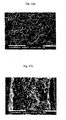
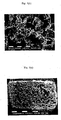
- the scaffold was photographed for its whole figure, structures of surface and cross section, and configuration of inner pores by use of a scanning electron microscopy (SEM) (Phillips 535M) and these are shown in Figs. 1a and 1b.
- SEM scanning electron microscopy
- PLLA with a weight average molecular weight of 300,000 was dissolved at a weight ratio of PLLA:chloroform ranging 1:10 to 1:20.
- ammonium bicarbonate particles which had size distributions of 100-180 ⁇ m, 180-300 ⁇ m and 300-500 ⁇ m, were added at mass ratios of 1:10, 1:15 and 1:20 polymer:salt, respectively, followed by homogeneously mixing to yield polymer/salt/solvent gels.
- a sputter Hamers, techniques U.S.A.
- the polymeric scaffolds were coated with gold in an argon atmosphere at 5 psi for 5 min under an electric field of 5 mA.
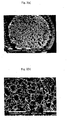
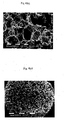
- the scaffold was photographed for its whole figure, structures of surface and cross section, and configuration of inner pores by use of a scanning electron microscopy (SEM) (Phillips 535M) and the surface and cross section structures of the polymeric scaffolds are shown in Fig. 2.
- Figs. 2a and 2b are for the scaffold utilizing the mass ratio of 1:10 PLLA:salt while Figs. 2c and 2d are for the mass ratio of 1:20 PLLA:salt.
- higher salt ratios result in larger pore sizes.
- the change of thermal properties in the polymeric scaffold was analyzed with the aid of a differential scanning calorimeter, such as that sold by DuPont, identified as Model 2000, while the temperature of the scaffold was raised at an elevation rate of 10 ° C/min from -10°C to 200 °C.
- An MTT (3-(4,5-dimethylthiazol-2-yl)-2,5-diphenyltetrazolium bromide) assay was conducted to analyze the activity of the hepatocytes adherent to the scaffold.
- the cells were cultured for 24 hours at 37 °C at the atmospheric pressure in a mixed atmosphere of 95% O 2 and 5% CO 2 ,
- the activity was about 40 % while a population of 4.8x10 5 cells/device resulted in 30 %.
- the activity of the hepatocytes was gradually decreased as greater numbers of cells were transplanted.
- ammonium bicarbonate particles ranging, in size, from 180 to 300 ⁇ m were added at mass ratios of 1:10, 1:15 and 1:20 polymer:salt, respectively, followed by homogeneously mixing to yield polymer/salt/solvent gels.
- the polymeric scaffolds were coated with gold in an argon atmosphere at 5 psi for 5 min under an electric field of 5 mA by using a sputter (Hummers, techniques U.S.A.).
- ammonium bicarbonate particles ranging, in size, from 180 to 300 ⁇ m were added at a mass ratio of 1:10 polymer:salt.
- the polymer/salt/solvent gel slurry prepared contained an even less amount of organic solvent than did that of Example III.
- the gel After being introduced into two Teflon molds which were 2 mm and 5 mm in thickness with a diameter of 5 mm, respectively, the gel was deprived of the solvent by evaporation at the atmospheric pressure.
- the polymer/salt mixtures separated from the molds were mixed to 3 liters of supersaturated citric acid solution and stirred to effervesce the salt.
- the porous polymeric scaffolds thus prepared were drawn off, washed with distilled water and dried in a vacuum drier.
- the porous scaffolds prepared according to the invention have pores of uniform sizes superior in interconnectivity and uniformly distributed over the themselves regardless of the pore sizes.
- Porous polymeric scaffolds were prepared in similar manners to that of Example IV, except that PLGA 50/50 and PLGA 75/25 were used instead of the biodegradable polymer PLGA 65/35. With the aid of a mercury intrusion porosimetry, the polymeric scaffolds were measured for porosity, pore diameter and surface area and the results are given in Table 8, below.
- Example IV has an advantage over that of Example III in that even smaller amounts of inorganic solvents are contained in the polymer/salt/inorganic solvent gels and thus, can be more readily removed, thereby allowing various drugs to be introduced effectively thereinto, later.
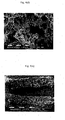
- rat hepatocytes were transplanted into the porous, polymeric scaffold according to a well-known technique ( P. M. Kaufmann, et al., Cell Transplantation (1997) 6, 5, 463-468 ) and cultured for 7 days (Fig. 6).
- the number of the hepatocytes to be transplanted was in the range of 7x10 4 to 8x10 4 per porous scaffold. As many hepatocytes as in this range were found to be about 90-95 % in transplantation efficiency. This was believed to result from the uniform distribution of the introduced hepatocytes over the porous scaffolds which were superior in the interconnectivity among the pores.
- porous polymeric scaffolds into which the hepatocytes were transplanted were incubated for 7 days at 37 °C in the presence of 5 % CO 2 in an incubator to examine the viability of the cells.
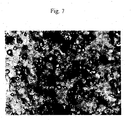
- an MTT (3-(4,5-dimethylthiazol-2-yl)-2,4 diphenyltetrazolium bromide) assay was conducted. As shown in Fig. 7, viable cells were uniformly distributed over the whole scaffold structure.
- the number of viable cells was reduced by about 20-30 % after 7 day-incubation in the porous polymeric scaffold and both the viability and the albumin secretion of hepatocytes cultured in the scaffold are lowered as the number of the inoculated cells increases.
- the present invention provides a method for preparing biodegradable and biocompatible, porous polymeric scaffolds which are so porous and interconnective among pores as to accommodate and culture cells isolated from the tissues which are to be artificially regenerated in vitro, such as cartilage, bone, liver, heart valve, gastrointestinal duct, urethral canal, etc.
- the scaffolds serve as excellent matrixes for the artificial culture of various cultures.
- the method has an advantage of easily controlling the pore size and porosity of the three-dimensional porous, polymeric scaffolds by controlling the amount and size of the effervescent salts and the concentration of the acidic aqueous solutions by which the effervescence and leaching-off of the salts are induced.
Landscapes
- Health & Medical Sciences (AREA)
- Chemical & Material Sciences (AREA)
- Life Sciences & Earth Sciences (AREA)
- Animal Behavior & Ethology (AREA)
- Medicinal Chemistry (AREA)
- Oral & Maxillofacial Surgery (AREA)
- Transplantation (AREA)
- Epidemiology (AREA)
- Veterinary Medicine (AREA)
- Dermatology (AREA)
- General Health & Medical Sciences (AREA)
- Public Health (AREA)
- Chemical Kinetics & Catalysis (AREA)
- Dispersion Chemistry (AREA)
- Manufacture Of Porous Articles, And Recovery And Treatment Of Waste Products (AREA)
- Materials For Medical Uses (AREA)
- Biological Depolymerization Polymers (AREA)
Claims (12)
- Verfahren zur Herstellung eines biologisch abbaubaren und biologisch verträglichen porösen polymeren Gerüsts für Tissue-Engineering, die folgenden Schritte umfassend:Auflösen eines biologisch abbaubaren Polymers in einem organischen Lösungsmittel zur Herstellung einer Polymerlösung mit hoher Viskosität;das homogene Mischen eines Brausesalzes in der Polymerlösung unter Bildung eines Mischgels aus Polymer/Salz/organischem Lösungsmittel;Entfernen des organischen Lösungsmittels aus dem aus Polymer/Salz/organischem Lösungsmittel bestehenden Mischgel;Eintauchen der vom organischen Lösungsmittel befreiten Polymer/Salz-Gelaufschlämmung in eine heiße wässrige Lösung oder saure Lösung, so dass das Salz bei Raumtemperatur aufschäumt und man eine dreidimensionale polymere Struktur erhält; undWaschen mit destilliertem Wasser und Gefriertrocknen der polymeren Struktur.
- Verfahren gemäß Anspruch 1, das nach dem Schritt des Auflösens weiterhin den Schritt des Ausfällens und Konzentrierens des Polymers in einem organischen Lösungsmittel, welches das Polymer nicht auflöst, umfasst.
- Verfahren gemäß Anspruch 1, wobei das biologisch abbaubare Polymer ein aliphatischer Polyester ist, der aus der Gruppe ausgewählt ist, die aus Poly-L-milchsäure, Poly-D,L-milchsäure, Polyglycolsäure, Poly(D,L-milchsäure-co-glycolsäure), Polycaprolacton, Polyhydroxybutyrat und Copolymeren dieser Polymere besteht.
- Verfahren gemäß Anspruch 1, wobei das organische Lösungsmittel zur Verwendung beim Auflösen des biologisch abbaubaren Polymers aus der Gruppe ausgewählt ist, die aus Methylenchlorid, Chloroform, Aceton, Dimethylsulfoxid, Dimethylformamid, N-Methylpyrrolidon, Dioxan, Tetrahydrofuran, Ethylacetat, Methylethylketon und Acetonitril besteht.
- Verfahren gemäß Anspruch 2, wobei das organische Lösungsmittel, welches das Polymer nicht auflöst, aus der Gruppe ausgewählt ist, die aus Wasser, Ethanol, Methanol, wässrigem Ethanol, Ethylether, Diethylether, Hexan, Petrolether und wässrigem Petrolether besteht.
- Verfahren gemäß Anspruch 1, wobei das Brausesalz aus der Gruppe ausgewählt ist, die aus Ammoniumcarbonat, Ammoniumhydrogencarbonat, Natriumcarbonat und Natriumhydrogencarbonat besteht.
- Verfahren gemäß Anspruch 1, wobei die saure wässrige Lösung zur Verwendung zum Aufschäumenlassen des Salzes in der Polymer/Salz-Gemisch-Gelaufschlämmung eine wässrige Lösung von Zitronensäure, Chlorwasserstoffsäure, Essigsäure, Ameisensäure, Weinsäure, Salicylsäure, Benzoesäure und Glutaminsäure ist.
- Verfahren gemäß Anspruch 1 oder 3, wobei das Molekulargewicht des biologisch abbaubaren Polymers im Bereich von 5000 bis 500 000 liegt.
- Verfahren gemäß Anspruch 1 oder 6, wobei die Teilchengröße des Brausesalzes im Bereich von 100 bis 500 µm liegt.
- Verfahren gemäß Anspruch 1 oder 6, wobei das Brausesalz in einer solchen Menge hinzugefügt wird, dass das Gewichtsverhältnis des Salzes zu dem Polymer im Bereich von 1:1 bis 1: 100 liegen kann.
- Verfahren gemäß Anspruch 1 oder 7, wobei die saure wässrige Lösung hergestellt wird, indem man die Säure in Wasser oder in einer wässrigen Lösung löst, die mit einem organischen Lösungsmittel gesättigt ist, das das biologisch abbaubare Polymer auflösen kann und aus der Gruppe ausgewählt ist, die aus Methylenchlorid, Chloroform, Aceton, Dimethylsulfoxid, Dimethylformamid, N-Methylpyrrolidon, Dioxan, Tetrahydrofuran, Ethylacetat, Methylethylketon und Acetonitril besteht.
- Verfahren gemäß Anspruch 1 oder 7, wobei die Konzentration der sauren wässrigen Lösung im Bereich von 1% bis zur Übersättigung liegt.
Applications Claiming Priority (5)
| Application Number | Priority Date | Filing Date | Title |
|---|---|---|---|
| KR9909263 | 1999-03-18 | ||
| KR1019990009263A KR100288488B1 (ko) | 1999-03-18 | 1999-03-18 | 발포성 염을 이용한 생체조직공학용 다공성 고분자 지지체의 제조방법 |
| KR9950922 | 1999-11-16 | ||
| KR10-1999-0050922A KR100372751B1 (ko) | 1999-11-16 | 1999-11-16 | 생체조직공학용 다공성 생분해성 고분자 지지체의 제조방법 |
| PCT/KR2000/000106 WO2000055300A1 (en) | 1999-03-18 | 2000-02-12 | Method for preparing porous, biodegradable and biocompatible, polymeric scaffolds for tissue engineering |
Publications (2)
| Publication Number | Publication Date |
|---|---|
| EP1165749A1 EP1165749A1 (de) | 2002-01-02 |
| EP1165749B1 true EP1165749B1 (de) | 2007-08-01 |
Family
ID=26634842
Family Applications (1)
| Application Number | Title | Priority Date | Filing Date |
|---|---|---|---|
| EP00905419A Expired - Lifetime EP1165749B1 (de) | 1999-03-18 | 2000-02-12 | VERFAHREN ZUR HERSTELLUNG VON PORöSEN, BIOLOGISCH ABBAUBAREN UND BIOKOMPATIBLEN POLYMEREN STüTZGEWEBEN ZUR GEWEBETECHNOLOGIE |
Country Status (7)
| Country | Link |
|---|---|
| US (1) | US6586246B1 (de) |
| EP (1) | EP1165749B1 (de) |
| JP (1) | JP2002538914A (de) |
| AT (1) | ATE368728T1 (de) |
| DE (1) | DE60035775T2 (de) |
| ES (1) | ES2291189T3 (de) |
| WO (1) | WO2000055300A1 (de) |
Families Citing this family (39)
| Publication number | Priority date | Publication date | Assignee | Title |
|---|---|---|---|---|
| US20030086975A1 (en) * | 2001-11-08 | 2003-05-08 | Timothy Ringeisen | Method for making a porous Polymeric material |
| US8697108B2 (en) | 1994-05-13 | 2014-04-15 | Kensey Nash Corporation | Method for making a porous polymeric material |
| KR100372751B1 (ko) * | 1999-11-16 | 2003-02-17 | 한국과학기술원 | 생체조직공학용 다공성 생분해성 고분자 지지체의 제조방법 |
| KR100355563B1 (ko) * | 2000-06-23 | 2002-10-11 | 주식회사 바이오메드랩 | 비등성 혼합물을 이용한 조직공학용 생분해성의 다공성고분자 지지체 및 그의 제조방법 |
| KR20030032420A (ko) * | 2001-10-18 | 2003-04-26 | 한국과학기술연구원 | 손상된 안구 조직의 재생을 위한 생분해성 고분자로제조된 다공성 지지체 |
| EP1325755B1 (de) * | 2002-01-02 | 2005-10-26 | Industrial Technology Research Institute | Prozess zur Herstellung poröser bioresorbierbarer Materialien mit miteinander in Verbindung stehenden Poren |
| WO2003065996A2 (en) * | 2002-02-05 | 2003-08-14 | Cambridge Scientific, Inc. | Bioresorbable osteoconductive compositions for bone regeneration |
| KR100486367B1 (ko) * | 2003-01-14 | 2005-04-29 | 학교법인연세대학교 | 외벽에 반투막이 형성된 생분해성 이중 다공성 스캐폴드및 이를 이용한 조직세포 배양방법 |
| CA2544779A1 (en) * | 2003-11-03 | 2005-05-12 | Medtronic, Inc. | Hydrogel providing cell-specific ingrowth |
| US20060281068A1 (en) * | 2005-06-09 | 2006-12-14 | Chemimage Corp. | Cytological methods for detecting a disease condition such as malignancy by Raman spectroscopic imaging |
| CN100355405C (zh) * | 2004-06-24 | 2007-12-19 | 同济大学 | 组织工程多孔支架制备方法 |
| JP4738800B2 (ja) * | 2004-10-15 | 2011-08-03 | 株式会社ジーシー | ブロック状細胞工学用支持体の製造方法 |
| US8253936B2 (en) * | 2008-08-08 | 2012-08-28 | Chemimage Corporation | Raman characterization of transplant tissue |
| CN100431622C (zh) * | 2005-12-08 | 2008-11-12 | 东南大学 | 组织工程用聚合物多孔支架材料的方法及其制备装置 |
| KR20090003208A (ko) * | 2006-03-20 | 2009-01-09 | 가부시끼가이샤 제이엠에스 | 다공질 생체 흡수성 재료 및 그의 제조방법 |
| US7507286B2 (en) * | 2006-06-08 | 2009-03-24 | Sanatis Gmbh | Self-foaming cement for void filling and/or delivery systems |
| JP4821466B2 (ja) * | 2006-07-03 | 2011-11-24 | 富士ゼロックス株式会社 | 液滴吐出ヘッド |
| TWI362925B (en) * | 2006-11-09 | 2012-05-01 | Kci Licensing Inc | Method for preparing a bioresorbable dressing comprising bioresorbable microparticles and method for preparing a bioresorbable dressing comprising bioresorbable microspheres |
| EP2200931B1 (de) | 2007-09-19 | 2017-06-07 | The Charles Stark Draper Laboratory, Inc. | Mikrofluidstrukturen mit kreisförmigem querschnitt |
| US20090234332A1 (en) * | 2008-03-17 | 2009-09-17 | The Charles Stark Draper Laboratory, Inc | Artificial microvascular device and methods for manufacturing and using the same |
| US8685432B2 (en) * | 2008-03-25 | 2014-04-01 | University Of Utah Research Foundation | Controlled release tissue graft combination biomaterials |
| KR100963435B1 (ko) | 2008-06-19 | 2010-06-17 | 한국과학기술연구원 | 서방형 약물전달 및 조직재생용 덮인 다공성 생분해성고분자 미립구의 제조 방법 |
| US8416405B2 (en) * | 2008-08-08 | 2013-04-09 | Chemimage Corporation | Raman chemical imaging of implantable drug delivery devices |
| US20110294215A1 (en) * | 2008-10-22 | 2011-12-01 | Regenemed, Inc. | Culture systems |
| US20100331979A1 (en) | 2009-06-30 | 2010-12-30 | Mcdade Robert L | Biphasic implant device transmitting mechanical stimulus |
| US9744123B2 (en) | 2009-06-30 | 2017-08-29 | Kensey Nash Corporation | Biphasic implant device providing gradient |
| US20110082563A1 (en) * | 2009-10-05 | 2011-04-07 | The Charles Stark Draper Laboratory, Inc. | Microscale multiple-fluid-stream bioreactor for cell culture |
| US20110186165A1 (en) * | 2009-10-05 | 2011-08-04 | Borenstein Jeffrey T | Three-dimensional microfluidic platforms and methods of use and manufacture thereof |
| CN101856510B (zh) * | 2010-05-14 | 2012-11-21 | 浙江理工大学 | 丝素蛋白和硅酸钙复合纳米纤维支架材料的制备方法 |
| CN102068716B (zh) * | 2010-12-29 | 2014-01-08 | 中国科学院长春应用化学研究所 | 组织工程支架的制备方法 |
| US9828583B2 (en) | 2012-01-13 | 2017-11-28 | The General Hospital Corporation | Isolated human lung progenitor cells and uses thereof |
| US10245306B2 (en) | 2012-11-16 | 2019-04-02 | Isto Technologies Ii, Llc | Flexible tissue matrix and methods for joint repair |
| EP2953581B1 (de) | 2013-02-05 | 2020-09-16 | University of Utah Research Foundation | Implantierbare vorrichtungen für knochen- oder gelenkdefekte |
| CN105377355A (zh) | 2013-03-14 | 2016-03-02 | 拇趾公司 | 治疗甲单元的感染、疾病或病症的方法 |
| CN103433493B (zh) * | 2013-08-30 | 2015-09-16 | 西北工业大学 | 一种组织工程细胞培养支架的制备方法 |
| US10179191B2 (en) | 2014-10-09 | 2019-01-15 | Isto Technologies Ii, Llc | Flexible tissue matrix and methods for joint repair |
| US20190160198A1 (en) * | 2016-07-18 | 2019-05-30 | Duke University | Bioabsorbable dermal regeneration matrix and methods of making and using same |
| KR102002206B1 (ko) * | 2016-11-09 | 2019-10-02 | 단국대학교 천안캠퍼스 산학협력단 | 줄기세포 배양, 분화 및 이식 가능한 신경 재생을 위한 생분해성 다공성 마이크로패턴 신경도관의 제조 방법과 이에 의해 제조된 생분해성 다공성 마이크로패턴 신경도관 |
| WO2019083855A1 (en) * | 2017-10-23 | 2019-05-02 | Endologix, Inc. | ENDOLUMINAL DEVICE AND POLYMER |
Family Cites Families (6)
| Publication number | Priority date | Publication date | Assignee | Title |
|---|---|---|---|---|
| JPH0734817B2 (ja) * | 1992-06-01 | 1995-04-19 | 新田ゼラチン株式会社 | 医科用および歯科用硬化性材料および多孔性材料 |
| US5502092A (en) * | 1994-02-18 | 1996-03-26 | Minnesota Mining And Manufacturing Company | Biocompatible porous matrix of bioabsorbable material |
| US5723508A (en) * | 1996-01-25 | 1998-03-03 | Northwestern University | Method of fabricating emulsion freeze-dried scaffold bodies and resulting products |
| EP0907721A1 (de) * | 1996-05-28 | 1999-04-14 | Brown University Research Foundation | Biologisch abbaubarer träger auf basis von hyaluronan für die gewebewiederherstellung |
| US6143293A (en) * | 1998-03-26 | 2000-11-07 | Carnegie Mellon | Assembled scaffolds for three dimensional cell culturing and tissue generation |
| US6165486A (en) * | 1998-11-19 | 2000-12-26 | Carnegie Mellon University | Biocompatible compositions and methods of using same |
-
2000
- 2000-02-12 US US09/700,458 patent/US6586246B1/en not_active Expired - Lifetime
- 2000-02-12 DE DE60035775T patent/DE60035775T2/de not_active Expired - Lifetime
- 2000-02-12 WO PCT/KR2000/000106 patent/WO2000055300A1/en not_active Ceased
- 2000-02-12 ES ES00905419T patent/ES2291189T3/es not_active Expired - Lifetime
- 2000-02-12 AT AT00905419T patent/ATE368728T1/de not_active IP Right Cessation
- 2000-02-12 EP EP00905419A patent/EP1165749B1/de not_active Expired - Lifetime
- 2000-02-12 JP JP2000605718A patent/JP2002538914A/ja active Pending
Also Published As
| Publication number | Publication date |
|---|---|
| ES2291189T3 (es) | 2008-03-01 |
| DE60035775D1 (de) | 2007-09-13 |
| JP2002538914A (ja) | 2002-11-19 |
| WO2000055300A1 (en) | 2000-09-21 |
| ATE368728T1 (de) | 2007-08-15 |
| EP1165749A1 (de) | 2002-01-02 |
| DE60035775T2 (de) | 2008-04-30 |
| US6586246B1 (en) | 2003-07-01 |
Similar Documents
| Publication | Publication Date | Title |
|---|---|---|
| EP1165749B1 (de) | VERFAHREN ZUR HERSTELLUNG VON PORöSEN, BIOLOGISCH ABBAUBAREN UND BIOKOMPATIBLEN POLYMEREN STüTZGEWEBEN ZUR GEWEBETECHNOLOGIE | |
| AU780321B2 (en) | Method for preparing biocompatible scaffold and scaffold prepared therefrom | |
| Oh et al. | Degradation behavior of hydrophilized PLGA scaffolds prepared by melt-molding particulate-leaching method: comparison with control hydrophobic one | |
| KR100355563B1 (ko) | 비등성 혼합물을 이용한 조직공학용 생분해성의 다공성고분자 지지체 및 그의 제조방법 | |
| EP1964583A1 (de) | Verfahren zur Herstellung eines Kollagen/Hydroxyapatitverbundgerüsts | |
| KR100408458B1 (ko) | 생분해성 글리콜라이드/ε-카프로락톤 공중합체로부터 제조된 조직공학용 다공성 지지체 | |
| CN101920043B (zh) | 一种孔壁带有微沟槽的多孔支架及其制备方法 | |
| EP2413981B1 (de) | Dicke schaumstoffe für biomedizinische anwendungen und herstellungsverfahren | |
| US8431623B2 (en) | Process for forming a porous PVA scaffold using a pore-forming agent | |
| US7842305B2 (en) | Method of preparing biodegradable dual pore polymer scaffolds for tissue engineering | |
| KR100288488B1 (ko) | 발포성 염을 이용한 생체조직공학용 다공성 고분자 지지체의 제조방법 | |
| KR100979628B1 (ko) | 균일한 다공구조를 갖는 조직공학용 다공성 입자 및 이의제조방법 | |
| Şaşmazel et al. | Comparison of cellular proliferation on dense and porous PCL scaffolds | |
| KR100499096B1 (ko) | 조직공학용 다공성 고분자 지지체의 제조방법 | |
| CN1394654A (zh) | 组织工程用聚乳酸多孔支架的制备方法 | |
| KR100429000B1 (ko) | 약물이 봉입된 다공성 생분해성 고분자 지지체의 제조방법 | |
| US20240287450A1 (en) | Micro carrier, cell composite, and medical composition, cosmetic composition, medical articles and cosmetic articles using the same | |
| KR100517097B1 (ko) | 생분해성 락타이드/ε-카프로락톤 공중합체로부터 제조된 조직공학용 다공성 지지체 | |
| WO2001082988A1 (fr) | Procede de fabrication d'un support multipore de reparation de tissus et d'organes faisant appel a un filtre de separation | |
| CN108939167A (zh) | 韧性好易成型可降解细胞支架材料的制备方法 |
Legal Events
| Date | Code | Title | Description |
|---|---|---|---|
| PUAI | Public reference made under article 153(3) epc to a published international application that has entered the european phase |
Free format text: ORIGINAL CODE: 0009012 |
|
| 17P | Request for examination filed |
Effective date: 20011018 |
|
| AK | Designated contracting states |
Kind code of ref document: A1 Designated state(s): AT BE CH CY DE DK ES FI FR GB GR IE IT LI LU MC NL PT SE |
|
| AX | Request for extension of the european patent |
Free format text: AL;LT;LV;MK;RO;SI |
|
| RAP1 | Party data changed (applicant data changed or rights of an application transferred) |
Owner name: KOREA ADVANCED INSTITUTE OF SCIENCE AND TECHNOLOGY Owner name: INNOTECH MEDICAL, INC. |
|
| GRAP | Despatch of communication of intention to grant a patent |
Free format text: ORIGINAL CODE: EPIDOSNIGR1 |
|
| GRAS | Grant fee paid |
Free format text: ORIGINAL CODE: EPIDOSNIGR3 |
|
| GRAA | (expected) grant |
Free format text: ORIGINAL CODE: 0009210 |
|
| RAP1 | Party data changed (applicant data changed or rights of an application transferred) |
Owner name: KOREA ADVANCED INSTITUTE OF SCIENCE AND TECHNOLOGY Owner name: REGEN BIOTECH, INC. |
|
| AK | Designated contracting states |
Kind code of ref document: B1 Designated state(s): AT BE CH CY DE DK ES FI FR GB GR IE IT LI LU MC NL PT SE |
|
| REG | Reference to a national code |
Ref country code: GB Ref legal event code: FG4D |
|
| REG | Reference to a national code |
Ref country code: CH Ref legal event code: EP |
|
| REG | Reference to a national code |
Ref country code: IE Ref legal event code: FG4D |
|
| REF | Corresponds to: |
Ref document number: 60035775 Country of ref document: DE Date of ref document: 20070913 Kind code of ref document: P |
|
| REG | Reference to a national code |
Ref country code: CH Ref legal event code: NV Representative=s name: KIRKER & CIE S.A. |
|
| PG25 | Lapsed in a contracting state [announced via postgrant information from national office to epo] |
Ref country code: FI Free format text: LAPSE BECAUSE OF FAILURE TO SUBMIT A TRANSLATION OF THE DESCRIPTION OR TO PAY THE FEE WITHIN THE PRESCRIBED TIME-LIMIT Effective date: 20070801 Ref country code: NL Free format text: LAPSE BECAUSE OF FAILURE TO SUBMIT A TRANSLATION OF THE DESCRIPTION OR TO PAY THE FEE WITHIN THE PRESCRIBED TIME-LIMIT Effective date: 20070801 |
|
| NLV1 | Nl: lapsed or annulled due to failure to fulfill the requirements of art. 29p and 29m of the patents act | ||
| ET | Fr: translation filed | ||
| PG25 | Lapsed in a contracting state [announced via postgrant information from national office to epo] |
Ref country code: AT Free format text: LAPSE BECAUSE OF FAILURE TO SUBMIT A TRANSLATION OF THE DESCRIPTION OR TO PAY THE FEE WITHIN THE PRESCRIBED TIME-LIMIT Effective date: 20070801 |
|
| REG | Reference to a national code |
Ref country code: ES Ref legal event code: FG2A Ref document number: 2291189 Country of ref document: ES Kind code of ref document: T3 |
|
| PG25 | Lapsed in a contracting state [announced via postgrant information from national office to epo] |
Ref country code: BE Free format text: LAPSE BECAUSE OF FAILURE TO SUBMIT A TRANSLATION OF THE DESCRIPTION OR TO PAY THE FEE WITHIN THE PRESCRIBED TIME-LIMIT Effective date: 20070801 |
|
| PG25 | Lapsed in a contracting state [announced via postgrant information from national office to epo] |
Ref country code: DK Free format text: LAPSE BECAUSE OF FAILURE TO SUBMIT A TRANSLATION OF THE DESCRIPTION OR TO PAY THE FEE WITHIN THE PRESCRIBED TIME-LIMIT Effective date: 20070801 Ref country code: GR Free format text: LAPSE BECAUSE OF FAILURE TO SUBMIT A TRANSLATION OF THE DESCRIPTION OR TO PAY THE FEE WITHIN THE PRESCRIBED TIME-LIMIT Effective date: 20071102 |
|
| PG25 | Lapsed in a contracting state [announced via postgrant information from national office to epo] |
Ref country code: PT Free format text: LAPSE BECAUSE OF FAILURE TO SUBMIT A TRANSLATION OF THE DESCRIPTION OR TO PAY THE FEE WITHIN THE PRESCRIBED TIME-LIMIT Effective date: 20080102 |
|
| PLBE | No opposition filed within time limit |
Free format text: ORIGINAL CODE: 0009261 |
|
| STAA | Information on the status of an ep patent application or granted ep patent |
Free format text: STATUS: NO OPPOSITION FILED WITHIN TIME LIMIT |
|
| PG25 | Lapsed in a contracting state [announced via postgrant information from national office to epo] |
Ref country code: SE Free format text: LAPSE BECAUSE OF FAILURE TO SUBMIT A TRANSLATION OF THE DESCRIPTION OR TO PAY THE FEE WITHIN THE PRESCRIBED TIME-LIMIT Effective date: 20071101 |
|
| 26N | No opposition filed |
Effective date: 20080506 |
|
| PG25 | Lapsed in a contracting state [announced via postgrant information from national office to epo] |
Ref country code: MC Free format text: LAPSE BECAUSE OF NON-PAYMENT OF DUE FEES Effective date: 20080228 |
|
| PG25 | Lapsed in a contracting state [announced via postgrant information from national office to epo] |
Ref country code: IE Free format text: LAPSE BECAUSE OF NON-PAYMENT OF DUE FEES Effective date: 20080212 |
|
| PG25 | Lapsed in a contracting state [announced via postgrant information from national office to epo] |
Ref country code: CY Free format text: LAPSE BECAUSE OF FAILURE TO SUBMIT A TRANSLATION OF THE DESCRIPTION OR TO PAY THE FEE WITHIN THE PRESCRIBED TIME-LIMIT Effective date: 20070801 |
|
| PG25 | Lapsed in a contracting state [announced via postgrant information from national office to epo] |
Ref country code: LU Free format text: LAPSE BECAUSE OF NON-PAYMENT OF DUE FEES Effective date: 20080212 |
|
| PGFP | Annual fee paid to national office [announced via postgrant information from national office to epo] |
Ref country code: ES Payment date: 20150218 Year of fee payment: 16 Ref country code: CH Payment date: 20150213 Year of fee payment: 16 Ref country code: DE Payment date: 20150211 Year of fee payment: 16 Ref country code: IT Payment date: 20150212 Year of fee payment: 16 |
|
| PGFP | Annual fee paid to national office [announced via postgrant information from national office to epo] |
Ref country code: GB Payment date: 20150213 Year of fee payment: 16 |
|
| REG | Reference to a national code |
Ref country code: FR Ref legal event code: PLFP Year of fee payment: 17 |
|
| PGFP | Annual fee paid to national office [announced via postgrant information from national office to epo] |
Ref country code: FR Payment date: 20160126 Year of fee payment: 17 |
|
| REG | Reference to a national code |
Ref country code: DE Ref legal event code: R119 Ref document number: 60035775 Country of ref document: DE |
|
| REG | Reference to a national code |
Ref country code: CH Ref legal event code: PL |
|
| GBPC | Gb: european patent ceased through non-payment of renewal fee |
Effective date: 20160212 |
|
| PG25 | Lapsed in a contracting state [announced via postgrant information from national office to epo] |
Ref country code: LI Free format text: LAPSE BECAUSE OF NON-PAYMENT OF DUE FEES Effective date: 20160229 Ref country code: CH Free format text: LAPSE BECAUSE OF NON-PAYMENT OF DUE FEES Effective date: 20160229 |
|
| PG25 | Lapsed in a contracting state [announced via postgrant information from national office to epo] |
Ref country code: IT Free format text: LAPSE BECAUSE OF NON-PAYMENT OF DUE FEES Effective date: 20160212 |
|
| PG25 | Lapsed in a contracting state [announced via postgrant information from national office to epo] |
Ref country code: GB Free format text: LAPSE BECAUSE OF NON-PAYMENT OF DUE FEES Effective date: 20160212 Ref country code: DE Free format text: LAPSE BECAUSE OF NON-PAYMENT OF DUE FEES Effective date: 20160901 |
|
| PG25 | Lapsed in a contracting state [announced via postgrant information from national office to epo] |
Ref country code: ES Free format text: LAPSE BECAUSE OF NON-PAYMENT OF DUE FEES Effective date: 20160213 |
|
| REG | Reference to a national code |
Ref country code: FR Ref legal event code: ST Effective date: 20171031 |
|
| PG25 | Lapsed in a contracting state [announced via postgrant information from national office to epo] |
Ref country code: FR Free format text: LAPSE BECAUSE OF NON-PAYMENT OF DUE FEES Effective date: 20170228 |