EP1167215B1 - Faltschachtel, insbesondere aus Karton, und Verfahren zur Herstellung derselben - Google Patents
Faltschachtel, insbesondere aus Karton, und Verfahren zur Herstellung derselben Download PDFInfo
- Publication number
- EP1167215B1 EP1167215B1 EP01401419A EP01401419A EP1167215B1 EP 1167215 B1 EP1167215 B1 EP 1167215B1 EP 01401419 A EP01401419 A EP 01401419A EP 01401419 A EP01401419 A EP 01401419A EP 1167215 B1 EP1167215 B1 EP 1167215B1
- Authority
- EP
- European Patent Office
- Prior art keywords
- box
- adhesive
- closing device
- coated
- blank
- Prior art date
- Legal status (The legal status is an assumption and is not a legal conclusion. Google has not performed a legal analysis and makes no representation as to the accuracy of the status listed.)
- Expired - Lifetime
Links
Images


Classifications
-
- B—PERFORMING OPERATIONS; TRANSPORTING
- B65—CONVEYING; PACKING; STORING; HANDLING THIN OR FILAMENTARY MATERIAL
- B65D—CONTAINERS FOR STORAGE OR TRANSPORT OF ARTICLES OR MATERIALS, e.g. BAGS, BARRELS, BOTTLES, BOXES, CANS, CARTONS, CRATES, DRUMS, JARS, TANKS, HOPPERS, FORWARDING CONTAINERS; ACCESSORIES, CLOSURES, OR FITTINGS THEREFOR; PACKAGING ELEMENTS; PACKAGES
- B65D5/00—Rigid or semi-rigid containers of polygonal cross-section, e.g. boxes, cartons or trays, formed by folding or erecting one or more blanks made of paper
- B65D5/02—Rigid or semi-rigid containers of polygonal cross-section, e.g. boxes, cartons or trays, formed by folding or erecting one or more blanks made of paper by folding or erecting a single blank to form a tubular body with or without subsequent folding operations, or the addition of separate elements, to close the ends of the body
- B65D5/0227—Rigid or semi-rigid containers of polygonal cross-section, e.g. boxes, cartons or trays, formed by folding or erecting one or more blanks made of paper by folding or erecting a single blank to form a tubular body with or without subsequent folding operations, or the addition of separate elements, to close the ends of the body with end closures formed by inward folding of flaps and securing them by heat-sealing, by applying adhesive to the flaps or by staples
Definitions
- the present invention relates to a box, in particular cardboard, plastic, or similar material, as used for the packaging of certain objects such as tubes or pots, in particular of cosmetic products or skincare products, according to the invention.
- a box in particular cardboard, plastic, or similar material, as used for the packaging of certain objects such as tubes or pots, in particular of cosmetic products or skincare products, according to the invention.
- the present invention relates more particularly to a box of the type comprising a body of square or rectangular section comprising a front panel and a rear panel connected by two side panels.
- the body of the box has at least one opening and an associated closure device.
- such boxes are formed from a pre-cut blank made of a material such as cardboard, possibly plasticized and coated with an external decoration.
- the blank is assembled to, after folding the sheet material around parallel fold lines, forming a body. At least one opening delimited by the body at one of its ends is reversibly closed by a cover.
- the cardboard box containing the product is itself packaged inside a transparent plastic film, in particular polyethylene, which film contributes to perfecting the conditions of preservation of the product contained in the box.
- a transparent plastic film in particular polyethylene
- it is an indicator of burglary, its presence on the box indicating to the user that the box has not been opened beforehand.
- the presence of this film prevents the lid of the box from bulging, which, in addition to aesthetic problems, poses problems when it comes to stack such boxes.
- a film however causes a significant additional cost, and complicates the overall process of packaging the product.
- a box having a body whose opening is intended to be closed by a cover, forming either an element separate from the body of the box, or hinged to the latter.
- the lid and the body of the box comprise areas glued by means of a hot-melt adhesive or thermo-adhesive which is such that when a glued area is disposed opposite a non-glued area, the gluing is temporary, ie reversible without damaging the box, especially by defibering cardboard.
- a hot-melt adhesive or thermo-adhesive which is such that when a glued area is disposed opposite a non-glued area, the gluing is temporary, ie reversible without damaging the box, especially by defibering cardboard.
- the gluing is final, and therefore not reversible, except to risk damaging the box.
- the gluing of the elements constituting the box can be done only at the time of the closing of the latter fault of which, the manipulation of unfolded blanks, or semi-finished boxes, in pre-glued form, in particular their stacking, would be rendered the most difficult because of the unwanted collages that would not fail to occur each time a glued area of a box would be next to a glued area or not another box.
- EP-A-0 499 916 describes a box whose assembly is obtained by gluing with a glue whose adhesive power is activated by contacting two glued areas. According to this document, the closure is achieved by means of a simple flap hinged to the rest of the box. No means is provided to secure it, especially to constitute an indicator of burglary.
- G 86 16 037.0 discloses a box with a closure associated with a system for forming a tamper indicator.
- a system for forming a tamper indicator comprises a glued area on which, when closing the box, is positioned a non-glued area, surrounded by a precut line. At the first opening, the area delimited by the pre-cut line, tears, and remains stuck on the glued area.
- Such a configuration is not without problems when it comes to using such a box on an automated packaging line.
- a box comprising a body obtained by folding a pre-cut blank, in particular cardboard, said body comprising a front panel and a rear panel connected by two side panels, the body of the box comprising at least a first opening at a first end of the body, and a first associated closure device, closing the box before its first use, being secured by gluing in at least one area, the glue used for said gluing being such, that the latter results from the engagement of two areas glued by means of said glue, said glue being inoperative when a glued area of the box is engaged with a non-glued surface.
- the nature of the bonding contemplated by the present invention is such that the peeling off of two elements bonded to one another is liable, particularly in the case of a cardboard box, to cause damage to the carton, in particular by defibration of the latter. The finding of such damage indicates that the box has already been opened.
- the handling of the boxes, in particular their stacking in semi-finished form will not be hindered by the presence of the glued areas, the gluing being only involved during the superposition of two glued areas. .
- the sizing steps can take place upstream of the product packaging process, without having to wait for the final assembly of the box.
- the adhesive is adhesive, even at room temperature, that is to say between about 20 ° C and 30 ° C.
- a latex glue in aqueous phase ammoniacal base.
- a glue sold are used under reference ENVATEX 292 ® by National Starch & Chemical Company.
- the pre-cut blank comprises a first element having a first surface of which at least one glued area is intended, in the mounted position of the box, to be engaged with a glued area covering at least partly a second surface of a second element of said blank, said first and second surfaces being suitable before complete formation of the box, to be arranged in an offset manner with respect to each other and turned in the same direction.
- a configuration allows the realization of the two glued areas in a single pass, as part of a continuous manufacturing process.
- the first and second surfaces are arranged substantially next to one another and oriented along the same axis.
- said first and second surfaces are substantially in the same plane.
- the word "substantially” reflects an offset that may in particular correspond to the thickness of the material forming the blank precut.
- the pre-cut blank comprises two end panels and two central panels arranged between the two end panels, said first and second surfaces being arranged offset with respect to one another and turned in the same direction, when the end panels of the blank are folded respectively on the central panels.
- the assembly of the two ends of the blank in particular by gluing via a suitable tab, may have been done beforehand. This assembly can be achieved by means of the same type of glue or by means of a conventional glue.
- the first closure device comprises at least one lateral flap made by folding in the extension of a side panel, and a portion forming a lid, to be folded over the flap (s). side (aux), the lid having on its inner surface a first glued area, at least one side flap intended to be opposite said lid when it is in the closed position, comprising a second glued area, arranged to come into engagement with the first glued area when the lid is folded closed.
- the closure device may comprise two lateral flaps which do not overlap substantially when they are folded over the opening, each of these flaps then comprising a glued area intended to engage with a glued area. corresponding lid.
- the bonding can be performed between the "inner” surface of the cover and a corresponding surface portion of the flap which, in the closed position of the box, is positioned above the other component. In the latter case, it can further provide additional bonding between the "inner" surface of the top flap, and the "outer" surface of the flap underneath.
- the closure device comprises two lateral flaps, each made by folding in the extension of a respective lateral panel, a first flap being intended, in the closed position of the box, to be positioned at least in part above a second flap, a first glued area being disposed on a face of the first flap and intended, when closing the box, to come into engagement with a second glued area, disposed on a corresponding side of the second flap .
- the opening of the lid is not prevented.
- it is not possible to access the product because of the presence of side flaps glued to one another.
- the box comprises a second opening at a second end of the body, opposite to the first, and a second associated closure device, the holding in the closed position of said second closure device being provided by mechanical means, in particular in the form of at least one point, or other protruding portion.
- mechanical means in particular in the form of at least one point, or other protruding portion.
- the associated second closure device comprises at least a first glued area intended for closing the box at its second end, to come into engagement with a second glued area of said second closure device.
- the second closure device may be the same or different from the first.
- the pre-cut blank comprises a first element having a first surface of which at least one glued area is intended, in the mounted position of the box, to be engaged with a glued area covering at least partly a second surface of a second element of said blank, the folding operations comprising an intermediate step in which before gluing, said first and second surfaces are arranged in a staggered manner with respect to each other and facing in the same direction.
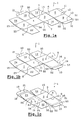
- the blank 1 comprises a front panel 2, a side panel 3, a rear panel 4, and another side panel 5, the four panels are separated from each other by fold lines parallel to each other 6-8.
- the front panel 2 On its side opposite to the side panel 3, the front panel 2 comprises a tab 11 to be glued to the end edge of the side panel 5, so as to form the body of the box.
- the gluing of the lug 11 on the edge of the panel 5 is provided by means of a conventional glue.
- the front panel 2 extends longitudinally to the fold lines 6-8 by a panel 9, able to form a bottom of the box.
- the panel 9 forms at its end opposite to the front panel 2, a flange 10 intended to participate in closing the bottom.
- the rim 10, the bottom 9, and the front panel 2 are separated by fold lines 12, 13, perpendicular to the fold lines 6-8.
- the side panel 3 is integral with a first lateral flap 14 via a fold line 15 parallel to the fold lines 12, 13.
- the side panel 3 is secured to a second lateral flap 16, via a fold line 17 parallel to the fold line 15.
- the rear panel 4 extends longitudinally to the fold lines 6-8, a panel 18, adapted to form a lid of the box.
- the panel 18 forms at its end opposite to the rear panel 4, a flange 19 intended to participate in the closure of the cover 18.
- the flange 19, the cover 18, and the rear panel 4 are separated by fold lines 20, 21, perpendicular to the fold lines 6-8.
- the side panel 5 is secured to a first lateral flap 22 via a fold line 23 parallel to the fold lines 20, 21.
- the side panel 5 is secured to a second lateral flap 24, via a fold line 25 parallel to the fold line 23.
- the bottom 9 and the flange 10 are formed two notches 50, 51 respectively defining a point 52, 53, adapted to be housed in a slot formed, in the mounted position of the box, between the edge of the side flaps 16 and 22 and the rear panel 4, which slot is due to the presence of recesses 54, 55 formed by the corresponding edges of the side flaps 16, 22.
- the points 52 and 53 thanks to their elastic memory, are position beyond the slot defined by the recesses 54 and 55, and therefore, oppose the opening of the bottom 9.
- Such fastening devices are well known, and therefore do not require detailed description additional.
- the front panel 2 has been folded over the side panel 3 around the fold line 6.
- the side panel 5 has been folded over the rear panel 4, around the fold line 8.
- the gluing tab 11 is glued to the free edge of the side panel 5, thus giving the cardboard blank a folded configuration in two parts .
- an adhesive strip 30 is deposited on an "outer" face 41 of the lateral flap 24.
- An adhesive strip 31 is deposited on an "inner” face 40 of the lateral flap 14.
- the two strips 30 and 31 are substantially in the alignment one from the other.
- the adhesive used is an adhesive sold under the reference ENVATEX 292 ® by National Starch & Chemical Company. In this semi-finished state, the boxes can be stacked in folded form, orienting them all in the same direction so that the glue strips 30, 31, of a box are never facing the glue strips of the box. immediately above or immediately below.
- the box 100 is formed.
- the bottom has been closed by folding the side flaps 16 and 22 on the corresponding opening defined by the front panels 2 and rear 4, and the side panels 3 and 5.
- the bottom 9 is folded down on the side flaps 16, 22 , the locking of the bottom 9 in the closed position being ensured by the cooperation of the tips and recesses 50-55.
- the front and rear panels 2, 4 delimit in combination with the side panels 3 and 5, an opening 32 through which a pot (not shown) can be introduced.
- the two lateral flaps 14 and 24 are folded over the opening 32 taking care to arrange the flap 24 below the flap 14 so that the glued areas 30 and 31 are facing one of the other.
- the flaps 24 and 14 are thus glued to one another. After that, it is sufficient to fold the cover 18 on the flaps 24 and 14 thus glued, by inserting the flap 19 in the slot defined between the front panel 2 and the corresponding edge of the flaps 24 and 14. The box is thus complete.
- the assembly of the box is identical to the assembly of the box described with reference to Figures 1a-1d .
- the only difference is in the position of the glue areas 32, 33.
- a first glue area 32 is formed on the "inside" surface 42 of the cover 18.
- a second glue area 33 is formed on the "outer” surface 43 of the flap 14.
Landscapes
- Engineering & Computer Science (AREA)
- Mechanical Engineering (AREA)
- Cartons (AREA)
- Closing Of Containers (AREA)
- Container Filling Or Packaging Operations (AREA)
- Making Paper Articles (AREA)
Claims (10)
- Schachtel (100), die einen Körper aufweist, der durch Falten eines vorausgeschnittenen Schnittteils (1), insbesondere aus Pappe, erhalten wird, wobei der Körper eine Vorderwand (2) und eine Rückwand (4) aufweist, die von zwei Seitenwänden (3, 5) miteinander verbunden werden, wobei der Körper der Schachtel (100) mindestens eine erste Öffnung (32) an einem ersten Ende des Körpers und eine erste zugeordnete Schließvorrichtung (14, 18, 19, 24) aufweist, wobei das Verschließen der Schachtel (100) vor ihrer ersten Benutzung durch Verleimen in mindestens einer Zone (30-31) gesichert wird, dadurch gekennzeichnet, dass der für das Verleimen verwendete Leim so ist, dass das Verleimen aus dem Ineingriffbringen von zwei mittels des Leims verleimten Zonen (30-31) resultiert, wobei der Leim wirkungslos ist, wenn eine verleimte Zone (30, 31) der Schachtel (100) mit einer nicht verleimten Zone in Eingriff gebracht wird, und dass die Schließvorrichtung zwei Elemente (14, 24), die je durch Falten in der Verlängerung einer Seitenwand (3, 5) hergestellt werden, und einen Deckel (18) aufweist, wobei ein erstes Element (14) in der geschlossenen Stellung der Schachtel dazu bestimmt ist, sich zumindest zum Teil über einem zweiten Element (24) zu positionieren, wobei eine erste verleimte Zone (31) auf einer Seite (40) des ersten Elements (14) angeordnet und dazu bestimmt ist, beim Schließen der Schachtel (100) mit einer zweiten verleimten Zone (30) in Eingriff zu kommen, die auf einer entsprechenden Seite (41) des zweiten Elements (24) angeordnet ist, wobei der Deckel auf die so verleimten Elemente umgeklappt werden kann.
- Schachtel (100) nach Anspruch 1, dadurch gekennzeichnet, dass das vorausgeschnittene Schnittteil (1) ein erstes Element (14) aufweist, das eine erste Fläche (40) besitzt, von der mindestens eine verleimte Zone (31) dazu bestimmt ist, in der montierten Stellung der Schachtel mit einer verleimten Zone (30) in Eingriff gebracht zu werden, die zumindest zum Teil eine zweite Fläche (41) eines zweiten Elements (24) des Schnittteils (1) bedeckt, wobei die erste (40) und zweite (41) Fläche vor der vollständigen Formung der Schachtel in der Lage sind, versetzt zueinander und in die gleiche Richtung weisend angeordnet zu werden.
- Schachtel (100) nach Anspruch 2, dadurch gekennzeichnet, dass in der Stellung, in der sie versetzt zueinander und in die gleiche Richtung weisend angeordnet sind, die erste (40) und die zweite Fläche (41) sich im Wesentlichen in der gleichen Ebene befinden.
- Schachtel (100) nach Anspruch 2 oder 3, dadurch gekennzeichnet, dass das vorausgeschnittene Schnittteil (1) in der auseinandergefalteten Form zwei Endwände (2, 5) und zwei mittlere Wände (3, 4) aufweist, die zwischen den zwei Endwänden (2, 5) angeordnet sind, wobei die erste (40) und die zweite (41) Fläche versetzt zueinander und in die gleiche Richtung weisend angeordnet sind, wenn die Endwände (2, 5) des Schnittteils (1) auf die mittleren Wände (3, 4) umgeklappt werden.
- Schachtel (100) nach einem der Ansprüche 1 bis 4, dadurch gekennzeichnet, dass die ersten und zweiten Elemente seitlichen Klappen (14, 24) entsprechen.
- Schachtel (100) nach einem der Ansprüche 1 bis 5, dadurch gekennzeichnet, dass sie eine zweite Öffnung an einem zweiten Ende des Körpers entgegengesetzt zum ersten und eine zweite zugeordnete Schließvorrichtung (9, 10, 16, 22) aufweist, wobei der Halt der zweiten Schließvorrichtung (9, 10, 16, 22) in der geschlossenen Stellung von mechanischen Mitteln (50-55), insbesondere in Form mindestens einer Spitze mit elastischem Gedächtnis, gewährleistet wird.
- Schachtel (100) nach einem der Ansprüche 1 bis 6, dadurch gekennzeichnet, dass sie eine zweite Öffnung an einem zweiten Ende des Körpers entgegengesetzt zum ersten und eine zweite zugeordnete Schließvorrichtung (9, 10, 16, 22) aufweist, wobei die zweite zugeordnete Schließvorrichtung (9, 10, 16, 22) mindestens eine erste verleimte Zone aufweist, die beim Schließen der Schachtel (100) dazu bestimmt ist, mit einer zweiten verleimten Zone der zweiten Schließvorrichtung (9, 10, 16, 22) in Eingriff zu kommen.
- Schachtel (100) nach Anspruch 7, dadurch gekennzeichnet, dass die zweite Schließvorrichtung (9, 10, 16, 22) gleich der ersten (14, 18, 19, 24) ist.
- Verfahren zur Herstellung einer Schachtel (100), das die folgenden Schritte aufweist:a) Falten eines Schnittteils (1), insbesondere aus Pappe, und sein Zusammenbau derart, dass ein Körper geformt wird, der eine Vorderwand (2) und eine Rückwand (4) aufweist, die von zwei Seitenwänden (3, 5) verbunden werden, wobei der Körper der Schachtel mindestens eine erste Öffnung (32) an einem ersten Ende des Körpers und eine erste zugeordnete Schließvorrichtung (14, 18, 19, 24) aufweist, die ein erstes Element (14), ein zweites Element (24) und einen Deckel (18) aufweist, der in der geschlossenen Stellung der Schachtel auf die Elemente umgeklappt werden kann;b) Schließen der so geformten Schachtel (100) mittels der ersten Schließvorrichtung (14. 18, 19, 24), wobei der Verschluss der Schachtel (100) vor ihrer ersten Benutzung gesichert wird, indem ein Element auf das andere umgeklappt wird und die zwei Elemente in mindestens einer Zone verleimt werden, wobei der Leim so ist, dass das Verleimen ausschließlich beim Ineingriffbringen von zwei mit dem Leim verleimten Zonen (30-33) erfolgt, wobei die verleimten Zonen von den Elementen präsentiert werden, und der Leim unwirksam ist, wenn eine verleimte Zone (30-33) der Schachtel (100) mit einer nicht verleimten Zone in Eingriff gebracht wird.
- Verfahren nach Anspruch 9, dadurch gekennzeichnet, dass das vorausgeschnittene Schnittteil (1) das erste Element (14) auf weist, das eine erste Fläche (40) besitzt, von der mindestens eine verleimte Zone (31) dazu bestimmt ist, in der montierten Stellung der Schachtel mit einer verleimten Zone (30) in Eingriff gebracht zu werden, die zumindest zum Teil eine zweite Fläche (41) eines zweiten Elements (24) des Schnittteils (1) bedeckt, wobei die Faltvorgänge einen Zwischenschritt aufweisen, in dem vor dem Verleimen die erste (40) und zweite (41) Fläche versetzt zueinander und in die gleiche Richtung weisend angeordnet werden.
Applications Claiming Priority (2)
| Application Number | Priority Date | Filing Date | Title |
|---|---|---|---|
| FR0008160A FR2810636B1 (fr) | 2000-06-26 | 2000-06-26 | Boite, notamment en carton, et procede de fabrication d'une telle boite |
| FR0008160 | 2000-06-26 |
Publications (2)
| Publication Number | Publication Date |
|---|---|
| EP1167215A1 EP1167215A1 (de) | 2002-01-02 |
| EP1167215B1 true EP1167215B1 (de) | 2008-03-26 |
Family
ID=8851669
Family Applications (1)
| Application Number | Title | Priority Date | Filing Date |
|---|---|---|---|
| EP01401419A Expired - Lifetime EP1167215B1 (de) | 2000-06-26 | 2001-05-31 | Faltschachtel, insbesondere aus Karton, und Verfahren zur Herstellung derselben |
Country Status (5)
| Country | Link |
|---|---|
| EP (1) | EP1167215B1 (de) |
| AT (1) | ATE390363T1 (de) |
| DE (1) | DE60133341T2 (de) |
| ES (1) | ES2302717T3 (de) |
| FR (1) | FR2810636B1 (de) |
Families Citing this family (3)
| Publication number | Priority date | Publication date | Assignee | Title |
|---|---|---|---|---|
| CN103303545A (zh) * | 2013-06-28 | 2013-09-18 | 张家港市天时利包装制品有限公司 | 一种纸箱 |
| GB2580687B (en) * | 2019-01-24 | 2021-11-24 | Ready Case Ltd | A packing case and method of manufacture thereof |
| USD1007302S1 (en) * | 2023-08-29 | 2023-12-12 | Lixin Chen | Folding box |
Family Cites Families (5)
| Publication number | Priority date | Publication date | Assignee | Title |
|---|---|---|---|---|
| US4614297A (en) * | 1984-05-22 | 1986-09-30 | Federal Paper Board Co., Inc. | Tamper resistant carton |
| FR2599340B3 (fr) | 1986-05-29 | 1988-07-29 | Socar | Emballage equipe d'un couvercle pouvant etre ferme de facon provisoire ou de facon definitive et inviolable |
| DE8616037U1 (de) * | 1986-06-13 | 1986-07-31 | Twardy GmbH Biol. pharm. Fabrikation, 5012 Bedburg | Verpackungsschachtel mit Originalitätsgarantie für den Inhalt |
| EP0499916A1 (de) * | 1991-02-15 | 1992-08-26 | Seetal Papier Ag | Aufrichteschachtel |
| FR2718672B1 (fr) * | 1994-04-14 | 1996-06-07 | Tabacs & Allumettes Ind | Procédé pour la réalisation d'un conditionnement tel qu'une boîte par pliage et collage à froid d'un flan prédécoupé. |
-
2000
- 2000-06-26 FR FR0008160A patent/FR2810636B1/fr not_active Expired - Fee Related
-
2001
- 2001-05-31 ES ES01401419T patent/ES2302717T3/es not_active Expired - Lifetime
- 2001-05-31 DE DE60133341T patent/DE60133341T2/de not_active Expired - Fee Related
- 2001-05-31 EP EP01401419A patent/EP1167215B1/de not_active Expired - Lifetime
- 2001-05-31 AT AT01401419T patent/ATE390363T1/de not_active IP Right Cessation
Also Published As
| Publication number | Publication date |
|---|---|
| ES2302717T3 (es) | 2008-08-01 |
| EP1167215A1 (de) | 2002-01-02 |
| DE60133341T2 (de) | 2009-04-23 |
| FR2810636B1 (fr) | 2002-09-06 |
| DE60133341D1 (de) | 2008-05-08 |
| ATE390363T1 (de) | 2008-04-15 |
| FR2810636A1 (fr) | 2001-12-28 |
Similar Documents
| Publication | Publication Date | Title |
|---|---|---|
| CA2313530A1 (fr) | Etui pour produits tels que des lingettes humides | |
| CA2228892A1 (fr) | Contenant livre a plat, puis mis en volume en deux phases distinctes, et portant de l'adhesif a effet prolonge | |
| EP0904235B1 (de) | Verfahren zur herstellung einer verpackung mit einem aufsteckbaren deckel aus einem zuschnitt | |
| EP1167215B1 (de) | Faltschachtel, insbesondere aus Karton, und Verfahren zur Herstellung derselben | |
| EP1136368B1 (de) | Verpackungsmaterialzuschnitt aus Karton oder dergl. zur Bildung eines Verpackungskörpers mit Originalitätsverschluss | |
| EP2436607B1 (de) | Zuschnitt zum Herstellen einer Spende-Verpackung, die zwei ineinander greifende Gleitelemente enthält | |
| FR2483885A1 (fr) | Flan propre a la constitution d'un couvercle a poignee, et emballage correspondant | |
| FR2482048A1 (fr) | Emballage ferme en matiere pliable apte a etre decoupee et procede pour sa fabrication | |
| EP1451792B1 (de) | Label mit mehrfachdaten und verfahren zu seiner herstellung | |
| FR2861370A1 (fr) | Boite d'emballage pliante, renforcee | |
| EP3856650B1 (de) | Versand-/neuversandverpackungseinheit und vorgeschnittene schablone zur herstellung derselben | |
| EP2117373B1 (de) | Anordnung für die ausgabe eines flüssigprodukts | |
| WO2005044675A1 (fr) | Etui comprenant une face rigide et une face souple pouvant etre ferme et maintenu a l'etat ferme | |
| FR2485486A1 (fr) | Emballage en carton a au moins deux couches avec poignee de prehension et couvercle articule | |
| EP3377414B1 (de) | Schachtel mit eingebautem vertikalem flaschenteiler und verfahren zur herstellung davon | |
| FR2723719A1 (fr) | Boite pliante obtenue a partir d'une piece decoupee | |
| WO1991018803A1 (fr) | Caisse en carton du type a enroulement autour d'objets a emballer | |
| FR3077276A1 (fr) | Emballage de type pret a vendre realise en deux elements dont les fonds sont superposes. | |
| FR2741859A1 (fr) | Etui d'emballage pour objet propose a la vente, en particulier pour objet de petite dimension | |
| FR2746766A1 (fr) | Contenant obtenu en volume par redressement de parties articulees d'un flan livre a plat et possedant de l'adhesif a effet prolonge | |
| FR2892708A1 (fr) | Dispositif de protection tubulaire presentant un retrecissement peripherique | |
| EP0628009A1 (de) | Faltschachtel mit flexiblem innenbeutel mit wiederverschliessbarer ausgiesstülle | |
| FR2878828A1 (fr) | Emballage en un materiau semi-rigide, comprenant deux parties assemblables, dont l'une coiffe l'autre, a systeme d'ouverture perfectionne | |
| FR2772723A1 (fr) | Emballage pour caler l'objet qu'il contient | |
| FR2718672A1 (fr) | Procédé pour la réalisation d'un conditionnement tel qu'une boîte par pliage et collage à froid d'un flan prédécoupé. |
Legal Events
| Date | Code | Title | Description |
|---|---|---|---|
| PUAI | Public reference made under article 153(3) epc to a published international application that has entered the european phase |
Free format text: ORIGINAL CODE: 0009012 |
|
| AK | Designated contracting states |
Kind code of ref document: A1 Designated state(s): AT BE CH CY DE DK ES FI FR GB GR IE IT LI LU MC NL PT SE TR |
|
| AX | Request for extension of the european patent |
Free format text: AL;LT;LV;MK;RO;SI |
|
| 17P | Request for examination filed |
Effective date: 20020702 |
|
| AKX | Designation fees paid |
Free format text: AT BE CH CY DE DK ES FI FR GB GR IE IT LI LU MC NL PT SE TR |
|
| 17Q | First examination report despatched |
Effective date: 20030306 |
|
| GRAP | Despatch of communication of intention to grant a patent |
Free format text: ORIGINAL CODE: EPIDOSNIGR1 |
|
| GRAS | Grant fee paid |
Free format text: ORIGINAL CODE: EPIDOSNIGR3 |
|
| GRAA | (expected) grant |
Free format text: ORIGINAL CODE: 0009210 |
|
| AK | Designated contracting states |
Kind code of ref document: B1 Designated state(s): AT BE CH CY DE DK ES FI FR GB GR IE IT LI LU MC NL PT SE TR |
|
| REG | Reference to a national code |
Ref country code: GB Ref legal event code: FG4D Free format text: NOT ENGLISH |
|
| REG | Reference to a national code |
Ref country code: CH Ref legal event code: EP Ref country code: IE Ref legal event code: FG4D Free format text: LANGUAGE OF EP DOCUMENT: FRENCH |
|
| REF | Corresponds to: |
Ref document number: 60133341 Country of ref document: DE Date of ref document: 20080508 Kind code of ref document: P |
|
| PG25 | Lapsed in a contracting state [announced via postgrant information from national office to epo] |
Ref country code: FI Free format text: LAPSE BECAUSE OF FAILURE TO SUBMIT A TRANSLATION OF THE DESCRIPTION OR TO PAY THE FEE WITHIN THE PRESCRIBED TIME-LIMIT Effective date: 20080326 |
|
| PGFP | Annual fee paid to national office [announced via postgrant information from national office to epo] |
Ref country code: DE Payment date: 20080605 Year of fee payment: 8 Ref country code: ES Payment date: 20080619 Year of fee payment: 8 |
|
| REG | Reference to a national code |
Ref country code: ES Ref legal event code: FG2A Ref document number: 2302717 Country of ref document: ES Kind code of ref document: T3 |
|
| PG25 | Lapsed in a contracting state [announced via postgrant information from national office to epo] |
Ref country code: AT Free format text: LAPSE BECAUSE OF FAILURE TO SUBMIT A TRANSLATION OF THE DESCRIPTION OR TO PAY THE FEE WITHIN THE PRESCRIBED TIME-LIMIT Effective date: 20080326 |
|
| NLV1 | Nl: lapsed or annulled due to failure to fulfill the requirements of art. 29p and 29m of the patents act | ||
| PGFP | Annual fee paid to national office [announced via postgrant information from national office to epo] |
Ref country code: IT Payment date: 20080527 Year of fee payment: 8 |
|
| REG | Reference to a national code |
Ref country code: IE Ref legal event code: FD4D |
|
| PG25 | Lapsed in a contracting state [announced via postgrant information from national office to epo] |
Ref country code: SE Free format text: LAPSE BECAUSE OF FAILURE TO SUBMIT A TRANSLATION OF THE DESCRIPTION OR TO PAY THE FEE WITHIN THE PRESCRIBED TIME-LIMIT Effective date: 20080626 Ref country code: PT Free format text: LAPSE BECAUSE OF FAILURE TO SUBMIT A TRANSLATION OF THE DESCRIPTION OR TO PAY THE FEE WITHIN THE PRESCRIBED TIME-LIMIT Effective date: 20080901 |
|
| PG25 | Lapsed in a contracting state [announced via postgrant information from national office to epo] |
Ref country code: NL Free format text: LAPSE BECAUSE OF FAILURE TO SUBMIT A TRANSLATION OF THE DESCRIPTION OR TO PAY THE FEE WITHIN THE PRESCRIBED TIME-LIMIT Effective date: 20080326 |
|
| BERE | Be: lapsed |
Owner name: L'OREAL Effective date: 20080531 |
|
| PG25 | Lapsed in a contracting state [announced via postgrant information from national office to epo] |
Ref country code: MC Free format text: LAPSE BECAUSE OF NON-PAYMENT OF DUE FEES Effective date: 20080531 |
|
| PGFP | Annual fee paid to national office [announced via postgrant information from national office to epo] |
Ref country code: GB Payment date: 20080604 Year of fee payment: 8 |
|
| REG | Reference to a national code |
Ref country code: CH Ref legal event code: PL |
|
| PG25 | Lapsed in a contracting state [announced via postgrant information from national office to epo] |
Ref country code: IE Free format text: LAPSE BECAUSE OF FAILURE TO SUBMIT A TRANSLATION OF THE DESCRIPTION OR TO PAY THE FEE WITHIN THE PRESCRIBED TIME-LIMIT Effective date: 20080326 Ref country code: DK Free format text: LAPSE BECAUSE OF FAILURE TO SUBMIT A TRANSLATION OF THE DESCRIPTION OR TO PAY THE FEE WITHIN THE PRESCRIBED TIME-LIMIT Effective date: 20080326 Ref country code: LI Free format text: LAPSE BECAUSE OF NON-PAYMENT OF DUE FEES Effective date: 20080531 Ref country code: CH Free format text: LAPSE BECAUSE OF NON-PAYMENT OF DUE FEES Effective date: 20080531 |
|
| PLBE | No opposition filed within time limit |
Free format text: ORIGINAL CODE: 0009261 |
|
| STAA | Information on the status of an ep patent application or granted ep patent |
Free format text: STATUS: NO OPPOSITION FILED WITHIN TIME LIMIT |
|
| 26N | No opposition filed |
Effective date: 20081230 |
|
| PG25 | Lapsed in a contracting state [announced via postgrant information from national office to epo] |
Ref country code: BE Free format text: LAPSE BECAUSE OF NON-PAYMENT OF DUE FEES Effective date: 20080531 |
|
| PG25 | Lapsed in a contracting state [announced via postgrant information from national office to epo] |
Ref country code: CY Free format text: LAPSE BECAUSE OF FAILURE TO SUBMIT A TRANSLATION OF THE DESCRIPTION OR TO PAY THE FEE WITHIN THE PRESCRIBED TIME-LIMIT Effective date: 20080326 |
|
| GBPC | Gb: european patent ceased through non-payment of renewal fee |
Effective date: 20090531 |
|
| REG | Reference to a national code |
Ref country code: FR Ref legal event code: ST Effective date: 20100129 |
|
| PG25 | Lapsed in a contracting state [announced via postgrant information from national office to epo] |
Ref country code: FR Free format text: LAPSE BECAUSE OF NON-PAYMENT OF DUE FEES Effective date: 20090602 |
|
| PGFP | Annual fee paid to national office [announced via postgrant information from national office to epo] |
Ref country code: FR Payment date: 20080514 Year of fee payment: 8 |
|
| PG25 | Lapsed in a contracting state [announced via postgrant information from national office to epo] |
Ref country code: GB Free format text: LAPSE BECAUSE OF NON-PAYMENT OF DUE FEES Effective date: 20090531 |
|
| PG25 | Lapsed in a contracting state [announced via postgrant information from national office to epo] |
Ref country code: DE Free format text: LAPSE BECAUSE OF NON-PAYMENT OF DUE FEES Effective date: 20091201 |
|
| REG | Reference to a national code |
Ref country code: ES Ref legal event code: FD2A Effective date: 20090601 |
|
| PG25 | Lapsed in a contracting state [announced via postgrant information from national office to epo] |
Ref country code: LU Free format text: LAPSE BECAUSE OF NON-PAYMENT OF DUE FEES Effective date: 20080531 |
|
| PG25 | Lapsed in a contracting state [announced via postgrant information from national office to epo] |
Ref country code: TR Free format text: LAPSE BECAUSE OF FAILURE TO SUBMIT A TRANSLATION OF THE DESCRIPTION OR TO PAY THE FEE WITHIN THE PRESCRIBED TIME-LIMIT Effective date: 20080326 |
|
| PG25 | Lapsed in a contracting state [announced via postgrant information from national office to epo] |
Ref country code: GR Free format text: LAPSE BECAUSE OF FAILURE TO SUBMIT A TRANSLATION OF THE DESCRIPTION OR TO PAY THE FEE WITHIN THE PRESCRIBED TIME-LIMIT Effective date: 20080627 Ref country code: ES Free format text: LAPSE BECAUSE OF NON-PAYMENT OF DUE FEES Effective date: 20090601 |
|
| PG25 | Lapsed in a contracting state [announced via postgrant information from national office to epo] |
Ref country code: IT Free format text: LAPSE BECAUSE OF NON-PAYMENT OF DUE FEES Effective date: 20090531 |