EP1167445A2 - Schäumbare Poly(meth)acrylatplastisole und Verfahren zu ihrer Herstellung - Google Patents
Schäumbare Poly(meth)acrylatplastisole und Verfahren zu ihrer Herstellung Download PDFInfo
- Publication number
- EP1167445A2 EP1167445A2 EP01114186A EP01114186A EP1167445A2 EP 1167445 A2 EP1167445 A2 EP 1167445A2 EP 01114186 A EP01114186 A EP 01114186A EP 01114186 A EP01114186 A EP 01114186A EP 1167445 A2 EP1167445 A2 EP 1167445A2
- Authority
- EP
- European Patent Office
- Prior art keywords
- weight
- polymers
- foamable plastisol
- foamable
- copolymers
- Prior art date
- Legal status (The legal status is an assumption and is not a legal conclusion. Google has not performed a legal analysis and makes no representation as to the accuracy of the status listed.)
- Withdrawn
Links
Classifications
-
- C—CHEMISTRY; METALLURGY
- C08—ORGANIC MACROMOLECULAR COMPOUNDS; THEIR PREPARATION OR CHEMICAL WORKING-UP; COMPOSITIONS BASED THEREON
- C08J—WORKING-UP; GENERAL PROCESSES OF COMPOUNDING; AFTER-TREATMENT NOT COVERED BY SUBCLASSES C08B, C08C, C08F, C08G or C08H
- C08J9/00—Working-up of macromolecular substances to porous or cellular articles or materials; After-treatment thereof
- C08J9/04—Working-up of macromolecular substances to porous or cellular articles or materials; After-treatment thereof using blowing gases generated by a previously added blowing agent
- C08J9/06—Working-up of macromolecular substances to porous or cellular articles or materials; After-treatment thereof using blowing gases generated by a previously added blowing agent by a chemical blowing agent
- C08J9/10—Working-up of macromolecular substances to porous or cellular articles or materials; After-treatment thereof using blowing gases generated by a previously added blowing agent by a chemical blowing agent developing nitrogen, the blowing agent being a compound containing a nitrogen-to-nitrogen bond
-
- C—CHEMISTRY; METALLURGY
- C08—ORGANIC MACROMOLECULAR COMPOUNDS; THEIR PREPARATION OR CHEMICAL WORKING-UP; COMPOSITIONS BASED THEREON
- C08F—MACROMOLECULAR COMPOUNDS OBTAINED BY REACTIONS ONLY INVOLVING CARBON-TO-CARBON UNSATURATED BONDS
- C08F265/00—Macromolecular compounds obtained by polymerising monomers on to polymers of unsaturated monocarboxylic acids or derivatives thereof as defined in group C08F20/00
- C08F265/04—Macromolecular compounds obtained by polymerising monomers on to polymers of unsaturated monocarboxylic acids or derivatives thereof as defined in group C08F20/00 on to polymers of esters
- C08F265/06—Polymerisation of acrylate or methacrylate esters on to polymers thereof
-
- C—CHEMISTRY; METALLURGY
- C08—ORGANIC MACROMOLECULAR COMPOUNDS; THEIR PREPARATION OR CHEMICAL WORKING-UP; COMPOSITIONS BASED THEREON
- C08L—COMPOSITIONS OF MACROMOLECULAR COMPOUNDS
- C08L33/00—Compositions of homopolymers or copolymers of compounds having one or more unsaturated aliphatic radicals, each having only one carbon-to-carbon double bond, and only one being terminated by only one carboxyl radical, or of salts, anhydrides, esters, amides, imides or nitriles thereof; Compositions of derivatives of such polymers
- C08L33/04—Homopolymers or copolymers of esters
- C08L33/06—Homopolymers or copolymers of esters of esters containing only carbon, hydrogen and oxygen, which oxygen atoms are present only as part of the carboxyl radical
- C08L33/10—Homopolymers or copolymers of methacrylic acid esters
- C08L33/12—Homopolymers or copolymers of methyl methacrylate
-
- C—CHEMISTRY; METALLURGY
- C08—ORGANIC MACROMOLECULAR COMPOUNDS; THEIR PREPARATION OR CHEMICAL WORKING-UP; COMPOSITIONS BASED THEREON
- C08J—WORKING-UP; GENERAL PROCESSES OF COMPOUNDING; AFTER-TREATMENT NOT COVERED BY SUBCLASSES C08B, C08C, C08F, C08G or C08H
- C08J2333/00—Characterised by the use of homopolymers or copolymers of compounds having one or more unsaturated aliphatic radicals, each having only one carbon-to-carbon double bond, and only one being terminated by only one carboxyl radical, or of salts, anhydrides, esters, amides, imides, or nitriles thereof; Derivatives of such polymers
- C08J2333/04—Characterised by the use of homopolymers or copolymers of compounds having one or more unsaturated aliphatic radicals, each having only one carbon-to-carbon double bond, and only one being terminated by only one carboxyl radical, or of salts, anhydrides, esters, amides, imides, or nitriles thereof; Derivatives of such polymers esters
- C08J2333/06—Characterised by the use of homopolymers or copolymers of compounds having one or more unsaturated aliphatic radicals, each having only one carbon-to-carbon double bond, and only one being terminated by only one carboxyl radical, or of salts, anhydrides, esters, amides, imides, or nitriles thereof; Derivatives of such polymers esters of esters containing only carbon, hydrogen, and oxygen, the oxygen atom being present only as part of the carboxyl radical
-
- C—CHEMISTRY; METALLURGY
- C08—ORGANIC MACROMOLECULAR COMPOUNDS; THEIR PREPARATION OR CHEMICAL WORKING-UP; COMPOSITIONS BASED THEREON
- C08L—COMPOSITIONS OF MACROMOLECULAR COMPOUNDS
- C08L51/00—Compositions of graft polymers in which the grafted component is obtained by reactions only involving carbon-to-carbon unsaturated bonds; Compositions of derivatives of such polymers
- C08L51/003—Compositions of graft polymers in which the grafted component is obtained by reactions only involving carbon-to-carbon unsaturated bonds; Compositions of derivatives of such polymers grafted on to macromolecular compounds obtained by reactions only involving unsaturated carbon-to-carbon bonds
Definitions
- the invention relates to foamable poly (meth) acrylate plastisols, a process for their manufacture, their use as well as shaped articles which the have foamed poly (meth) acrylate plastisols.
- the Invention on foamable poly (meth) acrylate plastisols for the production of Plastisol foams with very good resilience can be used.
- Plastisols are colloidal suspensions of one Polymer component (binder) in plasticizer. Plastisols therefore put in generally represent two-phase systems, one component of which is a polymer and the the second is a suitable plasticizer. Plastisols are commonly used in Ambient temperature by brushing, pouring, dipping, spraying and the like brought into the shape of the finished product. Then follows by heating the "gelation"; the plasticizers dissolve the polymer particles on. After cooling, you get a homogeneous, more or less flexible product.
- Foamable plastisols are of great importance Components still contain suitable blowing agents and possibly "kickers".
- a "kicker" is a connection which suits the formation of the foam by decomposing the blowing agent Way supported.
- heating causes decomposition of the blowing agent causes foamed plastisols to be obtained, which can be used, for example, as damping and insulation materials.
- the area of application of the foamed plastisols is due to the cell structure certainly. It can be open or closed, a few large or many small Pores are present. The number of pores as well as their size and size distribution can vary within the foam. Furthermore, inhomogeneities can result incomplete gelling, which worsens the mechanical and optical properties of the foams. Plastisol foams with good elastic properties are desirable, such as for example a good resilience, which have many small pores.
- the foamed layers should be as uniform as possible and free of Be inhomogeneities.
- foamable plastisols partly depending on the intended application - further requirements meet. in this connection play among other things the rheological properties of the foamable Plastisol, especially its viscosity, the storage stability of the foamable Plastisol, the compatibility with plasticizers and the mechanical properties of the products made from the foamable plastisol.
- the ratio of resin (binder or polymer) to plasticizer is also for many applications important.
- foamable plastisols that are light are processable. They are intended to cover the broadest possible range Allow processing techniques and process at the lowest possible temperature his. Only by heating and then cooling the foamable Gel plastisols into a uniform, firm, foamed layer.
- binders based on a wide variety of polymers are conceivable. to However, very few polymers have been used in technical applications. By far the most important class of polymers used for this purpose are derived from polyvinyl chloride (PVC). Under ecological From the point of view, however, it seems very useful, the foamable PVC plastisols to be replaced by more environmentally friendly foamable plastisols. Foamable plastisols based on Poly (meth) acrylates have been available for some time.
- PVC polyvinyl chloride
- JP 11035784 discloses an optionally foamed plastisol having one Combination of acrylic polymer particles and a plasticizer, where the acrylic polymer particles have a core-shell structure.
- the core consists of a cross-linked polymer with a glass transition temperature lower equal to 30 ° C.
- the shell consists of a non-crosslinked polymer with a Glass transition temperature greater than or equal to 50 ° C.
- JP 11035784 thinners or lower viscosity, such as terpenes used to be acceptable To achieve binder contents.
- the use of viscosity thinners is always associated with loss of quality. It can therefore be expected that the resulting layers poor material properties, for example with regard to the modulus of elasticity.
- One object of the invention was to create an inexpensive one To provide binders.
- Another task is to see that a foamable Poly (meth) acrylate plastisol with good compatibility for inexpensive Plasticizers, in particular from the class of the longer-chain diesters of Phthalic acid.
- Another object on which the invention is based is to: to specify foamable plastisol which has a suitable viscosity and Has viscosity stability.
- Another object of the invention was to develop a method for Manufacture of foamable plastisols to indicate which is simple and is inexpensive to carry out.
- Another object of the invention was the use of foamable plastisols for the production of shaped articles, in particular of foils, coatings and floor coverings.
- Another task is the provision of gelled and / or foamed shaped objects that have very good resilience feature.
- Component A) is an essential component. It is a matter of Methyl methacrylate, which is 20 to 100 weight percent of the polymerizable Consists of constituents from which the polymeric binder (I) is obtainable.
- the binder around PMMA homopolymer If their share is 100 percent by weight, it is the binder around PMMA homopolymer. If the proportion is less than 100 percent by weight a co or terpolymer of 3 or more types of monomers. The binder I is then a copolymer or terpolymer.
- Component B) is accordingly optional. It is an acrylic acid or methacrylic acid ester, which is different from methyl methacrylate.
- a linear or branched, aliphatic or aromatic (C 1 -C 18 ) radical is understood to mean a range of radicals which ranges from methyl to ethyl to a radical comprising 18 C atoms. Also included are all binding isomers that are conceivable within the group. N-butyl methacrylate, iso-butyl methacrylate, 2-ethylhexyl methacrylate, cyclohexyl methacrylate, phenyl methacrylate and naphthyl methacrylate are particularly mentioned.
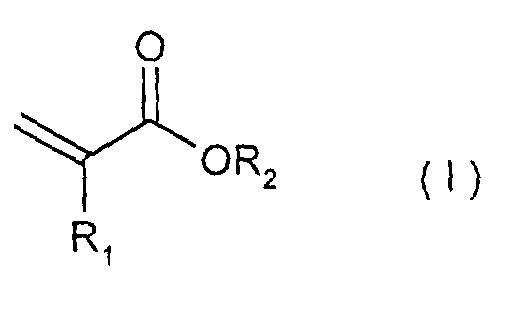
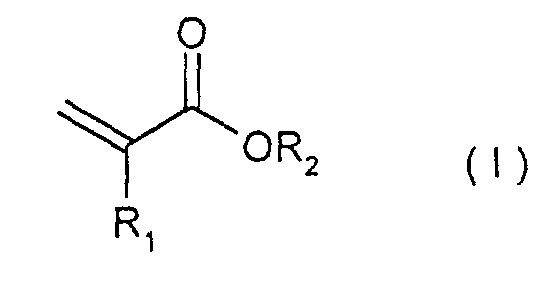
- radical R 2 of the (meth) acrylate of the formula I comprises a linear or branched, aliphatic or aromatic (C 1 -C 8 ) radical.
- R 2 the radical of the (meth) acrylate of the formula I comprises a linear or branched, aliphatic or aromatic (C 1 -C 8 ) radical.
- the methyl, ethyl, i-butyl or n-butyl radical are particularly suitable for R 2 .
- (meth) acrylate means acrylate in the context of the invention and / or methacrylate.
- the polymerizable component C) for obtaining the binder I is optional.
- Monomers different from A) and B) are understood by those skilled in the art to be styrene and its derivatives, vinyl esters such. B. vinyl acetate, vinyl propionate, vinyl ester higher alkyl acids, maleic anhydride, itaconic acid and its esters, olefins such as B. ethene, propene, isobutene and the like.
- the polymerizable component D) of the binder I is optional.
- the adhesion-promoting monomers as constituents of the polymers are understood to mean those radical-polymerizable monomers which have functional groups which can interact with the materials which are to be coated. Such an interaction can e.g. B. by hydrogen bonding, complexation, dipole forces u. ⁇ . come about, in which heteroatoms such as nitrogen or oxygen are usually involved.
- the functional groups which may be mentioned are the amino, in particular the dialkylamino, (cyclic) amide, imide, hydroxyl, oxy, carboxyl, cyano group.
- Such monomers are known per se (cf. H. Rauch Puntigam, Th.
- the adhesion-improving monomers therefore preferably belong to the Monomer class of nitrogen-containing vinyl heterocycles with preferably 5 rings in addition to 6 rings, and / or the copolymerizable vinyl Carboxylic acids and / or the hydroxyalkyl, alkoxyalkyl and aminoalkyl substituents Esters or amides of acrylic and methacrylic acid.
- nitrogen-heterocyclic monomers are those from the Class of vinyl imidazoles, vinyl lactams, vinyl carbazoles and Called vinyl pyridine.
- Examples that are not meant to be any limitation, for these monomeric imidazole compounds are N-vinyl-imidazole (also vinyl-1-imidazole called), N-vinyl-methyl-2-imidazole, N-vinyl-ethyl-2-irnidazole, N-vinyl-phenyl-2-imidazole, N-vinyl-dimethyl-2,4-imidazole, N-vinyl-benzimidazole, N-vinylimidazoline (also called vinyl-1-imidazoline), N-vinyl-methyl-2-imidazoline, N-vinyl-phenyl-2-imidazoline and vinyl-2-imidazole.
- N-vinyl-imidazole also vinyl-1-imidazole
- Examples of monomers derived from the lactams are: in particular list compounds such as the following: N-vinylpyrrolidone, N-vinylmethyl-5-pyrrolidone, N-vinylmethyl-3-pyrrolidone, N-vinylethyl-5-pyrrolidone, N-vinyldimethyl-5,5-pyrrolidone, N-vinylphenyl-5-pyrrolidone, N-allylpyrrolidone, N-vinylthiopyrrolidone, N-vinylpiperidone, N-vinyldiethyl-6,6-piperidone, N-vinylcaprolactam, N-vinylmethyl-7-caprolactam, N-vinylethyl-7-caprolactam, N-vinyldimethyl-7,7-caprolactam, N-allylcaprolactam, N-vinylcapryllactam.
- N-vinylcarbazole N-allylcarbazole, N-butenylcarbazole, N-hexenylcarbazole and N- (methyl-1-ethylene) carbazole.
- copolymerizable vinylic carboxylic acids are in particular the acrylic and called the methacrylic acid or suitable salts thereof.
- alkoxy-substituted alkyl esters are the (Meth) acrylic acid listed: 2-hydroxyethyl (meth) acrylate, Hydroxypropyl (meth) acrylate, 2-methoxy-ethyl (meth) acrylate, 2-ethoxyethyl (meth) acrylate, 2-butoxyethyl (meth) acrylate, 2- (2-butoxyethoxy) ethyl methacrylate, 2- (ethoxyethyloxy) ethyl (meth) acrylate, 4-hydroxybutyl (meth) acrylate, 2- [2- (2-ethoxyethoxy) ethoxy] ethyl (meth) acrylate, 3-methoxybutyl 1- (meth) acrylate, 2-alkoxymethylethyl (meth) acrylate, 2-Hexoxyethyl (meth) acrylate.
- the following amine-substituted alkyl esters of (meth) acrylic acid may also be mentioned: 2-dimethylaminoethyl (meth) acrylate, 2-diethylaminoethyl (meth) acrylate, 3-dimethylamino-2,2-dimethylpropyl-1- (meth) acrylate, 3-dimethylamino-2,2-dimethylpropyl-1- (meth) acrylate , 2-morpholinoethyl (meth) acrylate, 2-tert-butylaminoethyl (meth) acrylate, 3- (dimethylamino) propyl (meth) acrylate, 2- (dimethylaminoethoxyethyl) - (meth) acrylate.
- the following monomers may be mentioned as examples of the (meth) acrylamides: N-methyl (meth) acrylamide, N-dimethylaminoethyl (meth) acrylamide, N-dimethylaminopropyl (meth) acrylamide, N-isopropyl (meth) acrylamide, N-tert-butyl (meth) acrylamide, N-isobutyl (meth) acrylamide, N-decyl (meth) acrylamide, N-cyclohexyl (meth) acrylamide, N- [3- (dimethylamino) 2,2-dimethylpropyl] methacrylamide, N- [2-hydroxyethyl] (meth) acrylamide.
- this Core-shell polymer and / or copolymer exactly one shell.
- At least a shell of the Ken shell polymer and / or copolymer the core completely encloses.
- the core-shell polymers and / or Copolymers also obtained by an emulsion polymerization process in which instead of the seed latex a long-chain, aliphatic Alcohol, preferably having 12 to 20 carbon atoms, is emulsified.
- a long-chain, aliphatic Alcohol preferably having 12 to 20 carbon atoms
- stearyl alcohol long chain, aliphatic alcohol used.
- the core-shell structure becomes analogous to the procedure described above by gradually adding and Polymerization of the corresponding monomers while avoiding formation get new particles. More details on the polymerization process can be found the person skilled in the patent DE 3343766, DE 3210891, DE 2850105, DE Take 2742178 and DE 3701579.
- Aliphatic alcohol based on the monomer anionic, cationic or non-ionic emulsifiers, such as Sodium lauryl sulfate, alkylbenzene sulfonates, alkylation products of alkylated Phenols or their neutralized sulfonation products used. All Polymerizations are preferably carried out at temperatures between 60 and 100 ° C with the help of water-soluble radical formers, such as potassium or Ammonium persulfate or hydrogen peroxide. Before the start of Polymerization of the actual core and the shells can again be the initiator be added, however, little or no additional emulsifier will be added used these process steps.
- monomer anionic, cationic or non-ionic emulsifiers such as Sodium lauryl sulfate, alkylbenzene sulfonates, alkylation products of alkylated Phenols or their neutralized sulfonation products used. All Polymerizations are preferably
- the insert can be used to achieve the desired molecular weights be useful by so-called “controllers”.
- Controllers refer to connections with high transfer constants during radical polymerization. They accelerate chain termination reactions and thus cause one Reduction in the degree of polymerization of the resulting polymers without the To significantly influence gross reaction speed.
- Widely used Regulators are mercaptans, such as 1-dodecanethiol, halomethanes, such as tri- and carbon tetrachloride, aldehydes, acetals and others Degree of polymerization from the ratio of regulator to monomer is that Well known to a person skilled in the art.
- the core preferably consists of inelastic polymers and / or copolymers of (meth) acrylate. Under Inelastic polymers and / or copolymers are used in this Connection between polymers and / or copolymers with a glass transition temperature understood above room temperature, preferably above 30 ° C. It is also preferred that at least shell of the core-shell polymer from inelastic polymers and / or copolymers exist.
- Methods for determining the average molecular weight, in particular the weight average molecular weight M W of the polymers and / or copolymers are known to the person skilled in the art. It can be carried out, for example, by taking a sample each time a polymerization step has ended and characterizing it in a conventional manner using SEC or GPC (size exclusion chromatography or gel permeation chromatography) against polystyrene standards.
- SEC or GPC size exclusion chromatography or gel permeation chromatography
- the SEC or GPC are analytical methods known to those skilled in the art of polymer for determining the average molecular weight.
- the core preferably has polymer chains with a weight average molecular weight M W between 50,000 g / mol and 500,000 g / mol. It is further preferred that a shell of polymer chains with a weight average molecular weight M W greater than 2,000,000 g / mol.
- the core of the core-shell polymer makes and / or copolymers between 25 and 75 wt .-% of entire core-shell polymer and / or copolymer.
- a bowl is made of the core-shell polymer and / or copolymer between 25 and 75 % By weight of the total core-shell polymer and / or copolymer.
- Particularly inexpensive foamable plastisols according to the invention are those containing core-shell polymers and / or copolymers with a have average particle diameter in the range between 300 and 1500 nm.
- a further improvement in the properties of foamable plastisols according to the invention can also be achieved, inter alia, in that the binder, in addition to the core-shell polymers, also has polymers and / or copolymers with a specific molecular weight which are obtainable by a single-stage polymerization process.
- a preferred variant provides that the weight average molecular weight M W this part of the polymers and / or copolymers of the (meth) acrylates is greater than 1,000,000 g / mol.
- Particularly advantageous properties of the foamable plastisols are obtained when the weight average molecular weight M W this part of the polymers and / or copolymers of the (meth) acrylate used in the foamable plastisols is greater than 2,000,000 g / mol. Very particularly advantageous properties are obtained when the weight average molecular weight M W this part of the polymers and / or copolymers of the (meth) acrylate used in the foamable plastisols is greater than 3,000,000 g / mol.
- the weight average molecular weight M W for the purposes of the invention, this polymer is also determined by means of SEC or GPC (size exclusion chromatography or gel permeation chromatography) against standards made of polystyrene.
- SEC or GPC size exclusion chromatography or gel permeation chromatography
- the SEC or GPC are analytical methods known to those skilled in the art of polymer for determining the average molecular weight.
- Viscosity number VZ Another size that can be used in the context of the invention to identify the Molar mass of this part of the polymers and / or copolymers used the viscosity number VZ.
- the viscosity number is based on DIN 51 562 Parts 1 and 3 (as of January 1983 and May 1985), according to DIN 7745 Part 2, Appendix A to C, as of April 1989 determined.
- Foamable plastisols according to the invention thus preferably contain Embodiment available by a one-step polymerization process Polymers and / or copolymers with VZ ⁇ 300, preferably> 300, expediently> 600, particularly preferably> 900, very particularly preferably> 1200.
- polymeric (meth) acrylates with a certain weight average molecular weight M W is known to the person skilled in the art for use in plastisols. It can be carried out, for example, by emulsion polymerization.
- the average particle size of the polymers and / or copolymers of (meth) acrylates with a weight average molecular weight obtainable by a one-stage polymerization process M W greater than 1,000,000 g / mol can also be important.
- Particularly suitable foamable plastisols according to the invention have the corresponding polymers and / or copolymers of the (meth) acrylates with an average particle diameter in the range between 50 and 600 nm.
- the corresponding polymers and / or copolymers of (meth) acrylates with an average particle diameter in the range between 100 and 600 nm have very particularly favorable foamable plastisols according to the invention.
- the foamable plastisols of the present Invention Polymers and / or copolymers of (meth) acrylates with a bioder have multimodal particle size distribution.
- a bi-, more or multimodal distribution of the primary particle sizes of the poly (meth) acrylate in the The meaning of the invention is when a sample of the as or in the binder polymers used in an analysis according to the PIDS method with the Laser particle analyzer Coulter LS230 considering the optical Parameters of the particles and the suspension liquid (at least) two peaks in the Distribution spectrum has.
- the Particle size distribution is the size distribution of primary particles in Based on dispersions.
- the Dispersions After drying the dispersion or the Dispersions can transform the primary particles from the dispersion into secondary particles be agglomerated with a different particle size distribution. However, this has to do with the effect of the binder and in relation to the properties of the plastisol and products available from it have no significant negative influence.
- the plasticizers II which can be used successfully in the context of the invention include compounds from the groups of phthalates, adipates, trimellitates, phosphate esters, sebacates and acetates as well as polyesters and sulfonates. These include dibutyl phthalate, di-isobutyl phthalate, dihexyl phthalate, diheptyl, diisoheptyl phthalate, L79phthalat, L711phthalat, dioctyl phthalate, diisooctyl phthalate, dinonyl phthalate, diisononyl phthalate, didecyl phthalate, diisodecyl phthalate, L911phthalat, diundecylphthalate, phthalate, Undecyldodecylphthalat, didodecyl, diisotridecyl phthalate, butyl benzyl phthalate, diethyl hexyl
- foamable plastisols in which the plasticizer II is a diester of phthalic acid, the Ester groups differ from linear or branched alcohols with 4 to 24 Derive carbon atoms.
- dibutyl phthalate Diisobutyl phthalate, dihexyl phthalate, diheptyl phthalate, diisoheptyl phthalate, L79 phthalate, L711 phthalate, dioctyl phthalate, diisooctyl phthalate, dinonyl phthalate, Diisononyl phthalate, didecyl phthalate, diisodecyl phthalate, L911 phthalate, Diundecyl phthalate, diisoundecyl phthalate, undecyldodecyl phthalate, Didodecyl phthalate, diisotridecyl phthalate, butyl benzyl phthalate and / or Special attention to diethylhexyl phthalate.
- the aforementioned compounds can each be used individually or in mixtures of two or more compounds from the list as component II be used.
- the compounds or groups of compounds mentioned can also be combined with other softening compounds. In particular, the latter need not necessarily be the case Trade ester compounds. Examples include: chlorinated paraffins, Hydrocarbons, trialkyl phosphates, aliphatic or araliphatic polyesters as well as other polymeric plasticizers such.
- a selection of suitable ones Plasticizers can also be found in DE-C 25 43 542.
- the foamable plastisols usually still contain 0 to 87.5% by weight. known inorganic fillers III based on the total weight of the foamable plastisol.
- Calcium carbonate may be mentioned, for example (Chalk), titanium dioxide, titanium dioxide, calcium oxide, pearlite, precipitated and coated Chalk as a rheologically active additive and, if necessary, thixotropic agents such as B. fumed silica.
- the grain size is usually in the range 5 to 25 ⁇ m.
- the foamable plastisols according to the invention contain one or more Propellants IV.
- Suitable propellants are known to the person skilled in the art.
- Prefers include azodicarboxylic acid diamides, sulfohydrazides, Nitroso compounds, triazoles, tetrazoles and sodium hydrogen carbonate. All the use of azodicarboxylic acid diamides is particularly preferred.
- the blowing agents are usually obtained in amounts of 0.1 to 10% by weight to the total weight of the foamable plastisol, preferably one Amount from 1 to 5% by weight.
- the foamable plastisols usually contain auxiliaries V, so-called kickers that support foam formation. Belong to them for example the salts of zinc, lead and cadmium. From ecological Zinc salts are preferred for foamable (meth) acrylate plastisols.
- the kicker is usually used in amounts of 0 to 5% by weight based on the Total weight of the foamable plastisol used, an amount is preferred from 1 to 3% by weight.
- foamable plastisols according to the invention Depending on the application, up to 5% by weight based on the total weight of the foamable plastisol contain other known additives VI.
- This group includes surface-active substances that foamable plastisols can be added to a more regular and to obtain finer cell structure, as well as adhesion promoters, wetting agents, stabilizers, Leveling agents. Mention should be made of e.g. B. calcium stearate as a leveling agent.
- the foamable plastisols according to the invention are for all applications suitable as they are drawn for foamable PVC or PMMA plastisols are.
- Running layers for are particularly suitable as such Floor coverings, free transparent films, car underbody protection, corrosion protection for metals, intermediate layers for floor coverings (foamed), wallpaper, Plastic tarpaulins, car headlining, dashboard trim, bottle caps.
- the use of the foamable material according to the invention is particularly preferred Plastisol for the production of shaped articles, in particular foils, Coatings and floor coverings. That is very particularly preferred Use as a foamed intermediate layer in floor coverings.
- the foamable plastisols according to the invention can be used to prepare foamed layers are used which have very good material properties exhibit.
- the foamed plastisol layers according to the invention have - if at all - only a little stickiness. This represents a big one Advantage for the large-scale production of such inventive foamed plastisol layers because of the handling of these foamed plastisol layers according to the invention is significantly facilitated.
- the foamed plastisol layers according to the invention have a lower one Dirt adhesion and its intermediate storage saves space by stacking possible because two layers of foamed plastisol layers are not together glue, but can be separated again without effort.
- the stickiness is determined in the following way.
- An untreated sheet of paper (80 g / m 2 ; Din A4) is placed on the foamed plastisol layer (surface size: Din A4).
- the foamed plastisol layer covered with the sheet of paper is rotated by 180 degrees, so that the sheet of paper points downwards. If the sheet of paper falls off within a second, the foamed plastisol layer is said to be non-sticky. If the sheet of paper falls between one and 60 seconds, the foamed plastisol layer is said to be slightly sticky. If the sheet of paper sticks to the foamed plastisol layer for more than one minute, the foamed plastisol layer is called sticky.
- the foamed plastisol layers according to the invention furthermore have very good resilience.
- the resilience of the foamed plastisol layers over the Relaxation ability of the foamed plastisol layers after a strong one Thumb pressure assessed.
- Foamed plastisol layers are very good Reset rates if within five seconds of the Relax your thumb pressure completely, d. H. the original shape again accept.
- Foamed plastisol layers have a medium one Resilience when they are between five and 60 for complete relaxation Seconds (after thumb pressure).
- Foamed plastisol layers possess poor resilience if within a minute after relax the thumb pressure only incompletely.
- the foamed plastisol layers according to the invention have a fine-pore structure Structure.
- a fine-pored structure is used understood that the average pore diameter of the pores from the foamed plastisol layers according to the invention is less than or equal to 1 mm. Is the average pore diameter of the pores of the invention foamed plastisol layers larger than 1 mm, such a structure is considered labeled coarse-pored.
- the relationship between the porosity of the foamed plastisol layers according to the invention and a number of Material properties are well known to those skilled in the art.
- the present invention further relates to those by gelling and optionally foaming the foamable plastisol according to the invention available shaped objects.
- the invention also relates to a process for the preparation of foamable plastisols, in which components I, II, III, IV, V and VI, and, if appropriate, further additives known per se are suitably mixed with one another, the process of the invention being distinguished by that one uses polymers and / or copolymers I, some of which have a core-shell structure with a core and at least two shells.
- a physical mixture of two emulsion polymers is used as the polymer and / or copolymer.
- component I is a mixture of a previously dried dispersion of a core-shell polymer having a core and at least 2 shells with a previously dried dispersion of a poly (meth) acrylic polymer having a weight average molecular weight M W greater than 1,000,000 g / mol used.
- stage 2 The product, hereinafter referred to as stage 2, is cooled at room temperature and filtered through a 125 ⁇ m gauze.
- stage 2 The results of the characterization are summarized in Table 2.
- the core-shell polymer was synthesized analogously to Example 1. 5 g of regulator (n-dodecyl mercaptan; 0.2% based on the monomer) were used. The dosing rates were doubled accordingly. The results of the Characterizations of levels 1 and 2 are also summarized in Table 2.
- the core-shell polymer was synthesized analogously to Example 1. Die The amount of seed latex was reduced to 21.0 g. 1.25 g of regulator (n-dodecyl mercaptan; 0.05% based on the monomer) used. The Dosing rates were halved accordingly. The results of the characterization of levels 1 and 2 are also summarized in Table 2.
- the core-shell polymer was synthesized analogously to Example 1. Die The amount of seed latex was reduced to 21.0 g. 2.5 g of regulator (n-dodecyl mercaptan; 0.1% based on the monomer) used. The dosing rates have been retained. The results of characterizing levels 1 and 2 are also summarized in Table 2.
- level 1 The Results of the characterization of the product, hereinafter referred to as level 1 are summarized in Table 2,
- level 1 The Results of the characterization of the product, hereinafter referred to as level 1 are summarized in Table 2.
- level 1 The Results of the characterization of the product, hereinafter referred to as level 1 are summarized in Table 2.
- level 1 The Results of the characterization of the product, hereinafter referred to as level 1 are summarized in Table 2.
- the plastisols are produced using a dissolver according to a method known to the person skilled in the art (DIN 11468).
- the following components were used: 114 g Binder (Examples 1-4; Comparative Examples 1-4) 206 g Santicizer 261 (benzyl octyl phthalate; Solutia Inc.) 80 g Calcite GS0 (synthetic calcium carbonate; Kalktechnike Johannmaschinefer) 8 g Genitron LE (azodicarboxylic acid diamide with Zn kicker; Bayer AG)
- Viscosity / storage stability of the plastisols Viscosity [mPa] directly 1 day 3 days 7 days B 1 5790 6300 6280 6800 B 2 5400 6780 6900 10040 B 3 4798 5001 6200 7161 B 4 4929 5526 5893 6445 VB 1 5890 7890 8400 10056 VB 2 6230 7923 8890 11090 VB 3 4201 4082 3920 3390 VB 4 4523 4780 5230 4983 B: example; VB: comparative example
- the plastisol was applied in a layer thickness of 2 mm on a release paper. It was then gelled at a temperature of 180 ° C. for 10 minutes. The foam height, the stickiness, the porosity and the resilience of the foams were assessed. The data are shown in Table 4.
- Foam height, stickiness, porosity and resilience of the plastisol foams Foam height [mm] stickiness porosity provision B 1 5.1 weak pored very good B 2 3.0 weak pored very good B 3 3.0 no pored very good B 4 4.5 no pored very good VB 1 2.5 no large pores bad VB 2 4.3 no large pores bad VB 3 2.9 weak pored medium VB 4 3.4 weak pored medium
- B example; VB: comparative example Stickiness: paper test (80 g / m 2 ; A4) ⁇ 1 s ⁇ none; 1 - 60 s ⁇ weak; > 60 s ⁇ sticky Porosity: average pore diameter ⁇ 1 mm ⁇ fine-pored; > 1 mm ⁇ coarse-pored
- Resilience complete relaxation after thumb test ⁇ 5 s ⁇ very good; 5 - 60 s ⁇ medium; > 60 s ⁇ bad
Landscapes
- Chemical & Material Sciences (AREA)
- Health & Medical Sciences (AREA)
- Chemical Kinetics & Catalysis (AREA)
- Medicinal Chemistry (AREA)
- Polymers & Plastics (AREA)
- Organic Chemistry (AREA)
- General Chemical & Material Sciences (AREA)
- Engineering & Computer Science (AREA)
- Materials Engineering (AREA)
- Compositions Of Macromolecular Compounds (AREA)
- Graft Or Block Polymers (AREA)
- Addition Polymer Or Copolymer, Post-Treatments, Or Chemical Modifications (AREA)
- Manufacture Of Porous Articles, And Recovery And Treatment Of Waste Products (AREA)
Abstract
sich dadurch auszeichnet, daß wenigstens ein Teil der Polymerisate und/oder Copolymerisate aus I. eine Kern-Schale-Struktur bestehend aus einem Kern und mindestens einer Schale aufweist, wobei
- (i) der Kern Polymerketten mit einem Gewichtsmittel des Molekulargewichts
Mw zwischen 10.000 g/mol und 1.000.000 g/mol aufweist, und - (ii) eine Schale aus Polymerketten mit einem Gewichtsmittel des
Molekulargewichts
MW größer 1.000.000 g/mol besteht.
Description
sich dadurch auszeichnet, daß wenigstens ein Teil der Polymerisate und/oder Copolymerisate aus I. eine Kern-Schale-Struktur bestehend aus einem Kern und mindestens einer Schale aufweist, wobei
- (i) der Kern Polymerketten mit einem Gewichtsmittel des Molekulargewichts
MW zwischen 10.000 g/mol und 1.000.000 g/mol aufweist, und - (ii) eine Schale aus Polymerketten mit einem Gewichtsmittel des
Molekulargewichts
MW größer 1.000.000 g/mol besteht,
- Die Herstellungskosten der erfindungsgemäßen schäumbaren Poly(meth)acrylatplastisole sind im Vergleich mit den in JP 11035784 offenbarten Plastisolen deutlich niedriger.
- Die Lagerstabilität erfindungsgemäßer schäumbarer Poly(meth)acrylat-Plastisole ist hervorragend. Dadurch können Produkte gemäß der Erfindung auch für Anwendungen Einsatz finden, bei denen das schäumbare Plastisol vor dem Verarbeiten länger gelagert werden muß.
- Erfindungsgemäße schäumbare Plastisole können mit einem hohen Bindemittelgehalt hergestellt werden. Ein Zusatz von Verdünnern oder Viskositätserniedriger ist im Gegensatz zum Stand der Technik nicht erforderlich. Der höhere Bindemittelgehalt gemäß der Erfindung ohne Weichmacherersatzstoffe führt dazu, daß die Tendenz der gelierten Schichten, Weichmacher auszudampfen oder gar auszuschwitzen, deutlich eingeschränkt oder gar vollkommen unterbunden wird.
- Durch den höheren Bindemittelgehalt ist es möglich, Dialkylphthalate (z.B. Dioctylphthalat, Di-isononylphthalat, etc.) für schäumbare Poly(meth)acrylat-Plastisole, vorzugsweise schäumbare PMMA-Plastisole, zu verwenden, ohne daß diese zu einer Phasenseparation im gelierten Zustand führen. Durch den Einsatz dieser preiswerten Weichmacher gelingt es, das Gesamtprodukt bestehend aus Bindemittel und Weichmacher für den Verarbeiter deutlich günstiger und einfacher zu gestalten.
- Durch den höheren Bindemittelgehalt gelingt es zudem, gelierte Schichten zu erhalten, die verglichen mit Produkten nach dem Stand der Technik eine signifikant bessere Mechanik besitzen. So steigt beispielsweise die Reißfestigkeit der Schichten.
- Höhere Bindemittelgehalte unter Verzicht auf "Verdünner" bewirken auch wesentliche Verbesserungen im Bezug auf den E-Modul von den resultierenden Schichten.
- Das Eigenschaftsspektrum erfindungsgemäßer schäumbaren Plastisole weist eine große Ausgewogenheit und insbesonders Verbesserungen hinsichtlich einer Kombination von Lagerstabilität, Weichmacherverträglichkeit mit einem erhöhten Bindemittelgehalt bei den schäumbaren Plastisolen und verbesserten mechanischen Eigenschaften, insbesondere einem sehr guten Rückstellvermögen, der daraus hergestellten Schichten auf.
- Schäumbare Plastisole nach der Erfindung verfügen über ein breites und universelles Spektrum von Einsatzmöglichkeiten. Die erfindungsgemäßen schäumbaren Plastisole sind für sämtliche Anwendungen geeignet. Dies betrifft insbesondere die Herstellung geformter Gegenstände, insbesondere von Folien und Beschichtungen.
- Verglichen mit den bekannten Poly(meth)acrylat-Plastisol-Schäumen sind bei gleichem Bindemittelgehalt die Eigenschaften der erfindungsgemäßen Poly(meth)acrylat-Plastisol-Schäume deutlich verbessert. Die Schichten weisen eine geringere Klebrigkeit, eine feinere Porenstruktur und ein wesentlich besseres Rückstellvermögen auf.
2-Dimethylaminoethyl(meth)acrylat, 2-Diethylaminoethyl-(meth)acrylat, 3-Dimethylamino-2,2-dimethylpropyl-1-(meth)acrylat, 3-Dimethylamino-2,2-dimethylpropyl-1-(meth)acrylat, 2-Morpholinoethyl(meth)-acrylat, 2-tert.-Butylaminoethyl(meth)acrylat, 3-(Dimethylamino)propyl-(meth)acrylat, 2-(Dimethylaminoethoxyethyl)-(meth)acrylat.
N-Methyl(meth)acrylamid, N-Dimethylaminoethyl(meth)-acrylamid, N-Dimethylaminopropyl(meth)acrylamid, N-Isopropyl(meth)acrylamid, N-tert.-Butyl(meth)acrylamid, N-Isobutyl(meth)acrylamid, N-Decyl(meth)acrylamid, N-Cyclohexyl(meth)acrylamid, N-[3-(Dimethylamino)2,2-dimethylpropyl]-methacrylamid, N-[2-Hydroxyethyl](meth)-acrylamid.
wobei (a) und (b) 100 Gew.-% der Polymerisate und/oder Copolymerisate aus I. ergeben.
- Bestimmung des Feststoffgehalts der Dispersionen Gravimetrisch
- Bestimmung der Teilchengröße der Partikel (Coulter LS230)
- Bestimmung der Molekulargewichtsverteilung
GPC: 4 hintereinandergeschaltete Säulen mit Porendurchmesser von 106
Å, 105 Å, 104 Å, 103 Å; hersteller Polymer Laboratories; RI-
Detektion; Polymerstandards
| 2495 g | Methylmethacrylat |
| 1073 g | VE-Wasser |
| 22,4 g | Disponil SUS IC875 (Di-2-ethylhexylsulfosuccinat, Natriumsalz (75 % Aktivsubstanz (Hersteller: Henkel KGaA)) |
| Zeitlicher Verlauf der Dosierraten | ||
| t [min] | Emulsionsdosierung [g/min] | Reglerdosierung [g/min] |
| 2 - | 23,3 | 0,03 |
| 17 - | 47,3 | 0,07 |
| 46 - | 47,3 | 0 |
| 86 - | 0 | 0 |
| Molekulargewichte, Teilchengröße, Feststoffgehalt der Emulsionspolymerisate | |||||||
| Stufe 1 | Stufe 2 | Produkt | |||||
| | Mp [kg/mol] | | Mp1 [kg/mol] | Mp2 [kg/mol] | Teilchengröße [nm] | Feststoff-gehalt [%] | |
| B 1 | 181 | 170 | 1.100 | 190 | 1.900 | 495 | 49,8 |
| B 2 | 105 | 101 | 1.100 | 95 | 2.400 | 498 | 48,9 |
| B 3 | 366 | 345 | 1.100 | 400 | 2.200 | 818 | 48,5 |
| B 4 | 150 | 148 | 740 | 170 | 1.900 | 813 | 46,8 |
| VB 1 | 1.200 | 1140 | 493 | 48,3 | |||
| VB 2 | 1.550 | 1483 | 498 | 49,3 | |||
| VB 3 | 1.440 | 1372 | 824 | 47,6 | |||
| VB 4 | 960 | 952 | 832 | 48,1 | |||
| B: Beispiel; VB: Vergleichsbeispiel | |||||||
| Mp; Mp1; Mp2: Molekulargewicht des Peakmaximums (Mp ≈ Mp1) |
| 114 g | Bindemittel (Beispiel 1 - 4; Vergleichsbeispiel 1 - 4) |
| 206 g | Santicizer 261 (Benzyloctylphthalat; Solutia Inc.) |
| 80 g | Calcit GS0 (synth. Calciumcarbonat; Kalkwerke Johann Schäfer) |
| 8 g | Genitron LE (Azodicarbonsäurediamid mit Zn-Kicker; Bayer AG) |
| Viskosität/Lagerstabilität der Plastisole | ||||
| Viskosität [mPa] | ||||
| direkt | 1 Tag | 3 Tage | 7 Tage | |
| B 1 | 5.790 | 6.300 | 6.280 | 6.800 |
| B 2 | 5.400 | 6.780 | 6.900 | 10.040 |
| B 3 | 4.798 | 5.001 | 6.200 | 7.161 |
| B 4 | 4.929 | 5.526 | 5.893 | 6.445 |
| VB 1 | 5.890 | 7.890 | 8.400 | 10.056 |
| VB 2 | 6.230 | 7.923 | 8.890 | 11.090 |
| VB 3 | 4.201 | 4.082 | 3.920 | 3.390 |
| VB 4 | 4.523 | 4.780 | 5.230 | 4.983 |
| B: Beispiel; VB: Vergleichsbeispiel |
| Schaumhöhe, Klebrigkeit, Porosität und Rückstellvermögen der Plastisolschäume | ||||
| Schaumhöhe [mm] | Klebrigkeit | Porosität | Rückstellung | |
| B 1 | 5,1 | schwach | feinporig | sehr gut |
| B 2 | 3,0 | schwach | feinporig | sehr gut |
| B 3 | 3,0 | keine | feinporig | sehr gut |
| B 4 | 4,5 | keine | feinporig | sehr gut |
| VB 1 | 2,5 | keine | grobporig | schlecht |
| VB 2 | 4,3 | keine | grobporig | schlecht |
| VB 3 | 2,9 | schwach | feinporig | mittel |
| VB 4 | 3,4 | schwach | feinporig | mittel |
| B: Beispiel; VB: Vergleichsbeispiel | ||||
| Klebrigkeit: Papier-Test (80 g/m2; Din A4) | ||||
| < 1 s ⇒ keine; 1 - 60 s ⇒ schwach; > 60 s ⇒ klebrig | ||||
| Porosität: mittlerer Porendurchmesser | ||||
| ≤ 1 mm ⇒ feinporig; > 1 mm ⇒ grobporig | ||||
| Rückstellvermögen: vollständige Relaxation nach Daumentest | ||||
| < 5 s ⇒ sehr gut; 5 - 60 s ⇒ mittel; > 60 s ⇒ schlecht |
Claims (14)
- Schäumbares Plastisol für einen Schaum mit verbessertem Rückstellvermögen, enthaltendwobei I. bis VI. 100 Gew.-% des schäumbaren Plastisols ergeben,I. 12,5 bis 99,2 Gew.-% bezogen auf das Gesamtgewicht des schäumbaren Plastisols eines oder mehrerer Polymerisate und/oder Copolymerisate von (Meth)acrylaten erhältlich durch Polymerisation von Zusammensetzungen enthaltend als polymerisierbare BestandteileA) 20 bis 100 Gew.-% Methylmethacrylat,B) 0 bis 80 Gew.-% eines von Methylmethacrylat verschiedenen (Meth)acrylats der Formel I,worin
 R1 für Wasserstoff oder Methyl undR2 für einen linearen oder verzweigten , aliphatischen oder aromatischen Rest mit 1 bis 18 Kohlenstoffatomen steht,C) 0 bis 40 Gew.-% eines weiteren von A) und B) verschiedenen vinylisch ungesättigten Monomeren undD) 0 bis 40 Gew.-% eines haftungsvermittelnden Monomeren, wobei A) bis D) 100 Gew.-% der polymerisierbaren Bestandteile ergeben,II. 0,5 bis 80 Gew.-% mit den Polymerisaten und/oder Copolymerisaten aus I. verträgliche Weichmacher bezogen auf das Gesamtgewicht des schäumbaren Plastisols;III. 0 bis 87,5 Gew.-% anorganische Füllstoffe bezogen auf das Gesamtgewicht des schäumbaren Plastisols;IV. 0,1 bis 10 Gew.-% eines oder mehrerer Treibmittel bezogen auf das Gesamtgewicht des schäumbaren Plastisols;V. 0 bis 5 Gew.-% eines oder mehrerer Kicker bezogen auf das Gesamtgewicht des schäumbaren Plastisols undVI. 0,1 bis 3 Gew.-% eines oder mehrerer Zusatzstoffe in Mengen bezogen auf das Gesamtgewicht des schäumbaren Plastisols,
dadurch gekennzeichnet, daß wenigstens ein Teil der Polymerisate und/oder Copolymerisate aus I. eine Kern-Schale-Struktur bestehend aus einem Kern und mindestens einer Schale aufweist, wobei(i) der Kern Polymerketten mit einem Gewichtsmittel des MolekulargewichtsMW zwischen 10.000 g/mol und 1.000.000 g/mol aufweist, und(ii) eine Schale aus Polymerketten mit einem Gewichtsmittel des MolekulargewichtsMW größer 1.000.000 g/mol besteht. - Schäumbares Plastisol gemäß Anspruch 1, dadurch gekennzeichnet, daß der Kern des Kern-Schale-Polymerisates und/oder Copolymerisates zwischen 25 und 75 Gew.-% des gesamten Kern-Schale-Polymerisats und/oder Copolymerisates ausmacht.
- Schäumbares Plastisol gemäß Anspruch 1 oder 2, dadurch gekennzeichnet, daß eine Schale des Kern-Schale-Polymerisates und/oder Copolymerisates zwischen 25 und 75 Gew.-% des gesamten Kem-Schale-Polymerisats und/oder Copolymerisates ausmacht.
- Schäumbares Plastisol gemäß einem oder mehreren der vorangehenden Ansprüche, dadurch gekennzeichnet, daß die Polymerisate und/oder Copolymerisate I nebenwobei (a) und (b) 100 Gew.-% der Polymerisate und/oder Copolymerisate aus I. ergeben.(a) 99,9 bis 0,1 Gew.-% bezogen auf das Gesamtgewicht der Polymerisate und/oder Copolymerisate aus I. Polymere und/oder Copolymere mit einer Kern-Schale-Struktur bestehend aus einem Kern und mindestens einer Schale,(b) 0,1 bis 99,9 Gew.-% bezogen auf das Gesamtgewicht der Polymerisate und/oder Copolymerisate aus I. durch ein einstufiges Polymerisationsverfahren erhältliche Polymere und/oder Copolymere mit einem Gewichtsmittel des Molekulargewichts
MW größer 1.000.000 g/mol aufweisen, - Schäumbares Plastisol gemäß einem oder mehreren der vorangehenden Ansprüche, dadurch gekennzeichnet, daß der mittlere Teilchendurchmesser der Kern-Schale-Polymerisate und/oder Copolymerisate im Bereich zwischen 300 und 1500 nm ist.
- Schäumbares Plastisol gemäß einem oder mehreren der vorangehenden Ansprüche, dadurch gekennzeichnet, daß der Rest R2 des (Meth)acrylats der Formel I einen linearen oder verzweigten, aliphatischen oder aromatischen (C1-C8)-Rest umfaßt.
- Schäumbares Plastisol gemäß einem oder mehreren der vorangehenden Ansprüche, dadurch gekennzeichnet, daß der Rest R1 des (Meth)acrylats der Formel I Methyl ist.
- Schäumbares Plastisol gemäß einem oder mehreren der vorangehenden Ansprüche, dadurch gekennzeichnet, daß das Polymerisat und/oder Copolymerisat eine physikalische Mischung zweier Emulsionspolymerisate ist.
- Schäumbares Plastisol gemäß einem oder mehreren der vorangehenden Ansprüche, dadurch gekennzeichnet, daß der Weichmacher II ein Diester der Phthalsäure ist, wobei die Estergruppen sich von linearen oder verzweigten Alkoholen mit 4 bis 24 Kohlenstoffatomen ableiten.
- Schäumbares Plastisol gemäß einem oder mehreren der vorangehenden Ansprüche, dadurch gekennzeichnet, daß der Weichmacher II Dibutylphthalat, Diisobutylphthalat, Dihexylphthalat, Diheptylphthalat, Diisoheptylphthalat, L79phthalat, L711phthalat, Dioctylphthalat, Diisooctylphthalat, Dinonylphthalat, Diisononylphthalat, Didecylphthalat, Diisodecylphthalat, L911phthalat, Diundecylphthalat, Diisoundecylphthalat, Undecyldodecylphthalat, Didodecylphthalat, Diisotridecylphthalat, Butylbenzylphthalat und/oder Diethylhexylphthalat ist.
- Schäumbares Plastisol gemäß einem oder mehreren der vorangehenden Ansprüche, dadurch gekennzeichnet, daß die Polymerisate und/oder Copolymerisate der (Meth)acrylate I eine bi- oder multimodale Verteilung der Teilchengröße aufweisen.
- Verfahren zur Herstellung von schäumbarem Plastisol gemäß den vorhergehenden Ansprüchen, bei welchem man die Komponenten I, II, III, IV, V und VI sowie gegebenenfalls weitere an sich bekannte Zusätze, geeignet miteinander mischt.
- Verwendung des schäumbaren Plastisols gemäß den Ansprüchen 1 bis 11 zur Herstellung geformter Gegenstände, insbesondere von Folien, Beschichtungen und Fußbodenbelägen.
- Geformte Gegenstände erhältlich durch Gelieren und gegebenenfalls Schäumen des schäumbaren Plastisols gemäß den Ansprüchen 1 bis 11.
Applications Claiming Priority (2)
| Application Number | Priority Date | Filing Date | Title |
|---|---|---|---|
| DE2000129735 DE10029735B4 (de) | 2000-06-23 | 2000-06-23 | Schäumbare Poly(meth)acrylatplastisole sowie ihre Verwendung |
| DE10029735 | 2000-06-23 |
Publications (2)
| Publication Number | Publication Date |
|---|---|
| EP1167445A2 true EP1167445A2 (de) | 2002-01-02 |
| EP1167445A3 EP1167445A3 (de) | 2002-08-21 |
Family
ID=7645990
Family Applications (1)
| Application Number | Title | Priority Date | Filing Date |
|---|---|---|---|
| EP01114186A Withdrawn EP1167445A3 (de) | 2000-06-23 | 2001-06-12 | Schäumbare Poly(meth)acrylatplastisole und Verfahren zu ihrer Herstellung |
Country Status (2)
| Country | Link |
|---|---|
| EP (1) | EP1167445A3 (de) |
| DE (1) | DE10029735B4 (de) |
Cited By (2)
| Publication number | Priority date | Publication date | Assignee | Title |
|---|---|---|---|---|
| EP2439232A4 (de) * | 2009-06-01 | 2013-02-27 | Kaneka Corp | Vorrichtung zur verbesserung der verarbeitbarkeit zum schaumformen und vinylchlorid-harzzusammensetzung damit |
| CN107438641A (zh) * | 2015-03-31 | 2017-12-05 | 赢创罗姆有限公司 | 使用成核剂制备细孔的pmma泡沫 |
Families Citing this family (2)
| Publication number | Priority date | Publication date | Assignee | Title |
|---|---|---|---|---|
| DE102004035937A1 (de) * | 2004-07-23 | 2006-02-16 | Röhm GmbH & Co. KG | Plastisole mit verringerter Wasseraufnahme |
| DE102006057145A1 (de) * | 2006-11-22 | 2008-05-29 | Evonik Röhm Gmbh | Verfahren zur Herstellung verbesserter Bindemittel für Plastisole |
Family Cites Families (13)
| Publication number | Priority date | Publication date | Assignee | Title |
|---|---|---|---|---|
| GB1090676A (en) * | 1965-04-29 | 1967-11-15 | Elson & Robbins | Improvements in or relating to the production of foamed material |
| DE2722752C3 (de) * | 1977-05-20 | 1987-10-22 | Röhm GmbH, 6100 Darmstadt | Plastisole auf Basis von Methylmethacrylat-Mischpolymerisaten |
| DE4130834A1 (de) * | 1991-09-17 | 1993-03-18 | Roehm Gmbh | Plastisol-systeme mit verbesserter haftung |
| GB9122594D0 (en) * | 1991-10-24 | 1991-12-04 | Ici Plc | Plastisol compositions |
| DE4305355A1 (de) * | 1993-02-20 | 1994-08-25 | Roehm Gmbh | Verbesserte Plastisole |
| IT1271767B (it) * | 1993-05-14 | 1997-06-09 | Toyo Seikan Kaisha Ltd | Composizione di plastisol |
| JPH07233299A (ja) * | 1994-02-23 | 1995-09-05 | Mitsubishi Rayon Co Ltd | アクリルゾル |
| JP3464730B2 (ja) * | 1995-04-26 | 2003-11-10 | 三菱レイヨン株式会社 | アクリルゾル |
| JPH1135784A (ja) * | 1997-07-18 | 1999-02-09 | Mitsubishi Rayon Co Ltd | プラスチゾル |
| DE19827384A1 (de) * | 1997-09-20 | 1999-04-01 | Roehm Gmbh | Thermisch verfilmbare Massen mit einem polymerisierbarem Bestandteil (Reaktivplastisole) |
| DE19814264C1 (de) * | 1998-03-31 | 1999-07-29 | Degussa | Verbesserte Polymethacrylatplastisole |
| JP3621885B2 (ja) * | 1998-07-01 | 2005-02-16 | 三菱レイヨン株式会社 | アクリル系重合体微粒子及びそれを用いたプラスチゾル |
| JP3524805B2 (ja) * | 1999-03-19 | 2004-05-10 | 三菱レイヨン株式会社 | アクリル系プラスチゾル組成物 |
-
2000
- 2000-06-23 DE DE2000129735 patent/DE10029735B4/de not_active Expired - Fee Related
-
2001
- 2001-06-12 EP EP01114186A patent/EP1167445A3/de not_active Withdrawn
Cited By (6)
| Publication number | Priority date | Publication date | Assignee | Title |
|---|---|---|---|---|
| EP2439232A4 (de) * | 2009-06-01 | 2013-02-27 | Kaneka Corp | Vorrichtung zur verbesserung der verarbeitbarkeit zum schaumformen und vinylchlorid-harzzusammensetzung damit |
| US8664338B2 (en) | 2009-06-01 | 2014-03-04 | Kaneka Corporation | Processability improver for foam molding and vinyl chloride resin composition containing same |
| CN107438641A (zh) * | 2015-03-31 | 2017-12-05 | 赢创罗姆有限公司 | 使用成核剂制备细孔的pmma泡沫 |
| US20180079882A1 (en) * | 2015-03-31 | 2018-03-22 | Evonik Roehm Gmbh | Production of fine-pored pmma foams using nucleating agents |
| US10584225B2 (en) * | 2015-03-31 | 2020-03-10 | Evonik Roehm Gmbh | Production of fine-pored PMMA foams using nucleating agents |
| IL254057B (en) * | 2015-03-31 | 2021-12-01 | Roehm Gmbh | Production of fine-pored pmma foams using nucleating agents |
Also Published As
| Publication number | Publication date |
|---|---|
| DE10029735B4 (de) | 2006-09-21 |
| DE10029735A1 (de) | 2002-01-10 |
| EP1167445A3 (de) | 2002-08-21 |
Similar Documents
| Publication | Publication Date | Title |
|---|---|---|
| EP1192220B1 (de) | Bimodale poly(meth) acrylatplastisole und verfahren zu ihrer herstellung | |
| EP0379892B1 (de) | Bindemittel für wässrige Glanzfarben | |
| EP0376096B1 (de) | Mehrphasige, wässrige Kunststoffdispersion und ihre Verwendung in Überzugsmitteln | |
| DE69502791T2 (de) | Latex und Mischungen von fluorenthaltenden Acryl- und Methacryllatex | |
| EP2420412B1 (de) | Antidröhnmasse mit Emulsionspolymerisat und fluorierter Verbindung | |
| DE60104594T2 (de) | Kunststoffaditive, verbessertes Verfahren, Produkte und Gegenstände die diese enthalten | |
| DE4139249A1 (de) | Emulsionspolymerisation mit grosser partikelgroesse | |
| DE69026785T2 (de) | Latex für Beschichtungen mit reduzierten Anlaufcharakteristiken | |
| EP3080175B1 (de) | Verwendung einer polymerdispersion zur herstellung von antidröhnmassen | |
| DE3907019A1 (de) | Thermoplastisch verarbeitbare loesungsmittelbestaendige kunststoffmischungen | |
| EP0279260A2 (de) | Teilchenförmige Mehrphasenpolymerisate | |
| DE4201603A1 (de) | Mischungen fluorhaltiger copolymerisate | |
| DE2503390B2 (de) | Modifizierungsmittelsystem für steife Vinylchloridpolymerschäume und Verfahren zu seiner Herstellung | |
| DE3232827A1 (de) | Opalisierende polymere teilchen und ihre verwendung | |
| DE2515109B2 (de) | Verfahren zur Herstellung einer stabilen Polymeremulsion | |
| EP0960135B2 (de) | Emulgatorsystem für die wässrige emulsionspolymerisation | |
| DE2153886C3 (de) | Verfahren zur Herstellung von Vinylchloridpolymeren mit verbesserten Eigenschaften | |
| DE69905861T2 (de) | Schnell härtbare latexe und daraus hergestellte geschäumte formteile | |
| EP1761587B1 (de) | Plastisole auf basis eines methylmethacrylat-mischpolymerisats | |
| EP0040759B1 (de) | Verwendung eines Vinylchlorid-Pfropf-Copolymerisates in der Plastisolverarbeitung | |
| EP0387664A2 (de) | Wässrige Kunststoffdispersion, Verfahren zu ihrer Herstellung und Anwendung | |
| DE1902076A1 (de) | Verfahren zur Herstellung von Acrylatschaumstoffen | |
| DE10029735B4 (de) | Schäumbare Poly(meth)acrylatplastisole sowie ihre Verwendung | |
| DE2015279A1 (de) | Dispersionspolymerisation von Tetrafluoräthylen | |
| DE2710248A1 (de) | Blockcopolymer-dispersionsstabilisierungsmittel |
Legal Events
| Date | Code | Title | Description |
|---|---|---|---|
| PUAI | Public reference made under article 153(3) epc to a published international application that has entered the european phase |
Free format text: ORIGINAL CODE: 0009012 |
|
| AK | Designated contracting states |
Kind code of ref document: A2 Designated state(s): AT BE CH CY DE DK ES FI FR GB GR IE IT LI LU MC NL PT SE TR |
|
| AX | Request for extension of the european patent |
Free format text: AL;LT;LV;MK;RO;SI |
|
| RIC1 | Information provided on ipc code assigned before grant |
Free format text: 7C 08L 33/06 A, 7C 08J 9/10 B, 7C 08L 51/00 B, 7C 08F 265/04 B, 7C 08F 265/06 B |
|
| PUAL | Search report despatched |
Free format text: ORIGINAL CODE: 0009013 |
|
| AK | Designated contracting states |
Kind code of ref document: A3 Designated state(s): AT BE CH CY DE DK ES FI FR GB GR IE IT LI LU MC NL PT SE TR |
|
| AX | Request for extension of the european patent |
Free format text: AL;LT;LV;MK;RO;SI |
|
| 17P | Request for examination filed |
Effective date: 20021119 |
|
| AKX | Designation fees paid |
Designated state(s): AT BE CH CY DE DK ES FI FR GB GR IE IT LI LU MC NL PT SE TR |
|
| 17Q | First examination report despatched |
Effective date: 20031117 |
|
| RAP1 | Party data changed (applicant data changed or rights of an application transferred) |
Owner name: ROEHM GMBH |
|
| RAP1 | Party data changed (applicant data changed or rights of an application transferred) |
Owner name: EVONIK ROEHM GMBH |
|
| RAP1 | Party data changed (applicant data changed or rights of an application transferred) |
Owner name: EVONIK ROEHM GMBH |
|
| STAA | Information on the status of an ep patent application or granted ep patent |
Free format text: STATUS: THE APPLICATION IS DEEMED TO BE WITHDRAWN |
|
| 18D | Application deemed to be withdrawn |
Effective date: 20110104 |