EP1168068A2 - Procédé et dispositif pour la préparation de grains d'un sel d'argent d'un acide organique et procédé de préparation des matériaux d'enregistrement d'images développés par la chaleur - Google Patents
Procédé et dispositif pour la préparation de grains d'un sel d'argent d'un acide organique et procédé de préparation des matériaux d'enregistrement d'images développés par la chaleur Download PDFInfo
- Publication number
- EP1168068A2 EP1168068A2 EP01115968A EP01115968A EP1168068A2 EP 1168068 A2 EP1168068 A2 EP 1168068A2 EP 01115968 A EP01115968 A EP 01115968A EP 01115968 A EP01115968 A EP 01115968A EP 1168068 A2 EP1168068 A2 EP 1168068A2
- Authority
- EP
- European Patent Office
- Prior art keywords
- organic acid
- silver salt
- grains
- silver
- dispersion
- Prior art date
- Legal status (The legal status is an assumption and is not a legal conclusion. Google has not performed a legal analysis and makes no representation as to the accuracy of the status listed.)
- Granted
Links
- 0 CC=CC=CC(P(CP(c1ccccc1)(c1ccccc1)=O)(c1ccccc1)=O)=* Chemical compound CC=CC=CC(P(CP(c1ccccc1)(c1ccccc1)=O)(c1ccccc1)=O)=* 0.000 description 2
- PEGCITODQASXKH-UHFFFAOYSA-N CP(c1ccccc1)(c1ccccc1)=O Chemical compound CP(c1ccccc1)(c1ccccc1)=O PEGCITODQASXKH-UHFFFAOYSA-N 0.000 description 1
- SXKMBWBNTBRIKH-UHFFFAOYSA-N CP1(c2ccccc2-c2ccccc12)=O Chemical compound CP1(c2ccccc2-c2ccccc12)=O SXKMBWBNTBRIKH-UHFFFAOYSA-N 0.000 description 1
- RDLZJCXTAYHYHX-UHFFFAOYSA-N O=P(Cc1ccccc1)(Cc1ccccc1)Cc1ccccc1 Chemical compound O=P(Cc1ccccc1)(Cc1ccccc1)Cc1ccccc1 RDLZJCXTAYHYHX-UHFFFAOYSA-N 0.000 description 1
Images



Classifications
-
- G—PHYSICS
- G03—PHOTOGRAPHY; CINEMATOGRAPHY; ANALOGOUS TECHNIQUES USING WAVES OTHER THAN OPTICAL WAVES; ELECTROGRAPHY; HOLOGRAPHY
- G03C—PHOTOSENSITIVE MATERIALS FOR PHOTOGRAPHIC PURPOSES; PHOTOGRAPHIC PROCESSES, e.g. CINE, X-RAY, COLOUR, STEREO-PHOTOGRAPHIC PROCESSES; AUXILIARY PROCESSES IN PHOTOGRAPHY
- G03C1/00—Photosensitive materials
- G03C1/494—Silver salt compositions other than silver halide emulsions; Photothermographic systems ; Thermographic systems using noble metal compounds
- G03C1/498—Photothermographic systems, e.g. dry silver
- G03C1/49881—Photothermographic systems, e.g. dry silver characterised by the process or the apparatus
-
- C—CHEMISTRY; METALLURGY
- C07—ORGANIC CHEMISTRY
- C07C—ACYCLIC OR CARBOCYCLIC COMPOUNDS
- C07C51/00—Preparation of carboxylic acids or their salts, halides or anhydrides
- C07C51/41—Preparation of salts of carboxylic acids
- C07C51/412—Preparation of salts of carboxylic acids by conversion of the acids, their salts, esters or anhydrides with the same carboxylic acid part
-
- G—PHYSICS
- G03—PHOTOGRAPHY; CINEMATOGRAPHY; ANALOGOUS TECHNIQUES USING WAVES OTHER THAN OPTICAL WAVES; ELECTROGRAPHY; HOLOGRAPHY
- G03C—PHOTOSENSITIVE MATERIALS FOR PHOTOGRAPHIC PURPOSES; PHOTOGRAPHIC PROCESSES, e.g. CINE, X-RAY, COLOUR, STEREO-PHOTOGRAPHIC PROCESSES; AUXILIARY PROCESSES IN PHOTOGRAPHY
- G03C1/00—Photosensitive materials
- G03C1/494—Silver salt compositions other than silver halide emulsions; Photothermographic systems ; Thermographic systems using noble metal compounds
- G03C1/498—Photothermographic systems, e.g. dry silver
- G03C1/49809—Organic silver compounds
-
- G—PHYSICS
- G03—PHOTOGRAPHY; CINEMATOGRAPHY; ANALOGOUS TECHNIQUES USING WAVES OTHER THAN OPTICAL WAVES; ELECTROGRAPHY; HOLOGRAPHY
- G03C—PHOTOSENSITIVE MATERIALS FOR PHOTOGRAPHIC PURPOSES; PHOTOGRAPHIC PROCESSES, e.g. CINE, X-RAY, COLOUR, STEREO-PHOTOGRAPHIC PROCESSES; AUXILIARY PROCESSES IN PHOTOGRAPHY
- G03C1/00—Photosensitive materials
- G03C1/005—Silver halide emulsions; Preparation thereof; Physical treatment thereof; Incorporation of additives therein
- G03C1/015—Apparatus or processes for the preparation of emulsions
- G03C2001/0157—Ultrafiltration
-
- G—PHYSICS
- G03—PHOTOGRAPHY; CINEMATOGRAPHY; ANALOGOUS TECHNIQUES USING WAVES OTHER THAN OPTICAL WAVES; ELECTROGRAPHY; HOLOGRAPHY
- G03C—PHOTOSENSITIVE MATERIALS FOR PHOTOGRAPHIC PURPOSES; PHOTOGRAPHIC PROCESSES, e.g. CINE, X-RAY, COLOUR, STEREO-PHOTOGRAPHIC PROCESSES; AUXILIARY PROCESSES IN PHOTOGRAPHY
- G03C2200/00—Details
- G03C2200/09—Apparatus
-
- Y—GENERAL TAGGING OF NEW TECHNOLOGICAL DEVELOPMENTS; GENERAL TAGGING OF CROSS-SECTIONAL TECHNOLOGIES SPANNING OVER SEVERAL SECTIONS OF THE IPC; TECHNICAL SUBJECTS COVERED BY FORMER USPC CROSS-REFERENCE ART COLLECTIONS [XRACs] AND DIGESTS
- Y10—TECHNICAL SUBJECTS COVERED BY FORMER USPC
- Y10S—TECHNICAL SUBJECTS COVERED BY FORMER USPC CROSS-REFERENCE ART COLLECTIONS [XRACs] AND DIGESTS
- Y10S430/00—Radiation imagery chemistry: process, composition, or product thereof
- Y10S430/136—Coating process making radiation sensitive element
Definitions
- the method for dispersing a silver salt of an organic acid as fine grains the method of mechanically dispersing it in the presence of a dispersing aid by means of known pulverization mean (e.g., high-speedmixer, homogenizer, high-speedimpactmill, Banbarymixer, homomixer, kneader, ball mill, vibratingballmill, planetary ball mill, attriter, sand mill, bead mill, colloidmill, jet mill, roller mill, trone mill and high-speed stone mill).
- pulverization mean e.g., high-speedmixer, homogenizer, high-speedimpactmill, Banbarymixer, homomixer, kneader, ball mill, vibratingballmill, planetary ball mill, attriter, sand mill, bead mill, colloidmill, jet mill, roller mill, trone mill and high-speed stone mill.
- any method that enables independent control of the grain size and the grain morphology and stably produces monodispersed silver salt of an organic acid providing low fog has not been found yet. That is, any method has not been found yet, in which organic acid silver salt grains are formed by adding and vigorously stirring a solution containing organic acid alkali metal salt and a solution containing silver ions without causing entrainment of air or aggregation of grains, and the obtained primary grains are utilized as they are without preliminarily separating the produced organic acid silver salt as solid content.
- an object of the present invention is to provide an efficient method for producing grains of silver salt of an organic acid, which enables purification of the organic acid silver salt grains produced by mixing an alkali metal salt solution and a solution containing silver ions without separating the organic acid silver salt grains as a solid content.
- Another object of the present invention is to provide a method and apparatus for preparing grains of silver salt of an organic acid that require low facility cost and small facility space and show high productivity.
- Preferred embodiments of this preparation method include embodiments in which at least a part of a mixture obtained after the reaction of the solution containing silver ions and the solution containing an alkali metal salt of an organic acid mixed in the sealed mixing means is circulated and added to the sealed mixing means; at least one kind of dispersing agent is added before starting the reaction or before finishing the purification utilizing an ultrafiltration membrane; at least a nonionic macromolecular dispersing agent having a molecular weight 5-50 times larger than a fractional molecular weight of the ultrafiltration membrane is used as the dispersing agent; the nonionic macromolecular dispersing agent is used at a concentration of 0.1-30 weight % of the solid content of the silver salt of an organic acid; at least one of polyvinyl alcohol, polyvinylpyrrolidone, hydroxyethyl cellulose and hydroxypropyl cellulose is used as the dispersing agent; and the by-product salts are removed by ultrafiltration in which 2- to 20-fold constant volume dilution is attained
- the present invention also provides a method for preparing grains of silver salt of an organic acid by reacting a solution containing silver ions and a solution containing an alkali metal salt of an organic acid, in which the reaction is performed in sealed mixing means and which comprises steps of supplying the solution containing silver ions into a reaction field solution before introduced into the sealed mixing means, and supplying the solution containing an alkali metal salt of an organic acid into the reaction field solution or sealed mixing means to which the solution containing silver ions has been supplied (second preparation method).
- the Reynolds number of the solution containing silver ions is preferably in the range of 500-20000 when the solution containing silver ions is supplied to the reaction field solution.
- the present invention also provides an apparatus for preparing grains of silver salt of anorganic acid, which comprises first supplying means for supplying a solution containing silver ions to sealed mixing means ; second supplying means for supplying a solution containing an alkali metal salt of an organic acid to the sealed mixing means; third supplying means for supplying a reaction field solution to the sealed mixing means; the sealed mixing means for mixing materials supplied from the first, second and third supplying means to form a dispersion containing grains of silver salt of an organic acid; storage means for the formed dispersion containing grains of silver salt of an organic acid from the sealed mixing means; fourth supplying means for supplying the dispersion containing grains of silver salt of an organic acid in the storage means from the storage means to an ultrafiltration process; and purification means for removing by-product salts form the dispersion containing grains of silver salt of an organic acid by ultrafiltration (first preparation apparatus).
- the methods for producing grains of silver salt of an organic acid of the present invention comprise a step of reacting a solution containing silver ions and a solution containing an alkali metal salt of an organic acid.
- Temperature of the liquid contained in the sealed mixing means is preferably 5°C to 75°C, more preferably 6°C to 60°C, most preferably 10°C to 50°C, in order to improve performance as a photographic photosensitive material.
- the reaction temperature is preferably controlled to be a constant temperature selected from the above-defined range. As the case may be, however, the reaction temperature may be controlled in some temperature profiles varying within the above-defined range.
- the temperature difference between the solution containing an alkali metal salt of an organic acid and the liquid in the sealed mixing means is preferably 20°C to 85°C, more preferably 30°C to 80°C. In this case, it is desirable that the temperature of the solution containing an alkali metal salt of an organic acid should be higher than that of the liquid contained in the sealed mixing means.
- the type of the dispersing agent used for the present invention is not particularly limited.
- dispersing agents having a molecular weight of more than 3000 can be used.
- Such a dispersing agent can suitably be selected for use from known polymers, for example, synthetic anionic polymers such as polyacrylic acid, naphthalenesulfonic acid polymers, copolymers of acrylic acid, maleic acid copolymers, maleic acid monoester copolymers and copolymers of acryloylmethylpropanesulfonic acid; semi-synthetic anionic polymers such as carboxymethyl starch and carboxymethyl cellulose; anionic polymers such as alginic acid and pectic acid; other polymers including polyvinyl alcohol (e.g., PVA-217 (trade name) , mean polymerization degree: about 1700), polyvinylpyrrolidone, carboxymethyl cellulose, hydroxypropyl cellulose, hydroxypropylmethyl cellulose etc., naturally occurring macromolecular compounds
- pH of the dispersion must be maintained to be 6 or higher, preferably 6-8, until the electric conductivity reaches a level less than 2,000 ⁇ S/cm and not less than 500 ⁇ S/cm in the desalting operation by ultrafiltration. Even though a dispersing agent is used, pH of the dispersion is preferably controlled within this range.
- the pressure is generally 100 to 600 kg/cm 2 , and the flow rate is generally a few meters/sec to 30 meters/sec.
- some apparatuses are designed wherein the high flow rate area is so modified as to have a serrated configuration, thereby increasing the frequency of collision.
- the concentration of anionic surfactant is preferably maintained at a level 5 to 100 times as high as the critical micelle concentration.
- a solution having the same concentration as the measured concentration may be continuously added as a replenisher, or a solution having a concentration higher than that may be added intermittently.
- a nonionic macromolecular dispersing agent for example, may be added after the desalting is performed by ultrafiltration and thus electric conductivity of the organic acid silver salt dispersion is lowered, but before completion of the desalting operation.
- the conductivity is preferably 2000 ⁇ S/cm or less.
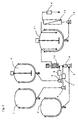
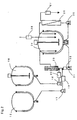
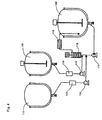
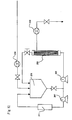
- the reaction mixture discharged from the sealed mixing means is stored in the tank for formed dispersion as storage means, and it may be directly fed to the ultrafiltration unit from the tank as shown in Figs. 1 and 2, or it may be stored in a tank for ultrafiltration process other than the tank for formed dispersion, and then introduced into an ultrafiltration unit as shown in Fig. 3.
- the tank for formed dispersion can be used as a preparation tank, and the tank for ultrafiltration process can be used as a ripening tank. This makes it possible to shorten the ripening time by increase of temperature, and it also becomes possible to wash the preparation tank for the subsequent process during the ripening. Thus, productivity can be improved.
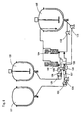
- Fig. 4 shows a specific embodiment of the preparation apparatus suitable for carrying out the third preparation method of the present invention (third preparation apparatus) .
- a solution containing silver ions is put into a tank 111 for Additive component 1
- a solution containing an alkali metal salt of an organic acid is put into a tank 112 for Additive component 2.
- the solutions were fed into a pipeline for a reaction field solution and then sealed mixing means 118 by pumps 115 and 116, respectively.
- the solution containing silver ions is introduced into the pipeline for a reaction field solution at a position upstream from a position at which the solution containing an alkali metal salt of an organic acid is introduced. Further, flow rates of the solutions are measured by flowmeters 113 and 114, and controlled.
- Examples of the pump include pumps in which feedback control is possible based on a measured value obtained by the flowmeter (e.g., rotary pump, sanitary pump, gear pump, mono pump, plunger pump, diaphragm pump etc) , pumps providing stable discharge with a quantification error of less than 1% (e.g., gear pump, mono pump, plunger pump, diaphragm pump etc.) and so forth. Those showing a pulsation ratio of less than 5% are preferred.
- the thermally processed image recording material preferably has an image-recording layer comprising the aforementioned silver salt of an organic acid as a reducible silver salt and a reducing agent for silver ions in a matrix of a binder.
- an image-recording layer comprising the aforementioned silver salt of an organic acid as a reducible silver salt and a reducing agent for silver ions in a matrix of a binder.
- a catalytically active amount of photocatalyst preferably, a photosensitive silver halide
- a toning agent for controlling silver color tone is used as required.
- Such a compound are those compounds having phosphoryl group, sulfoxido group, amido group (provided that it does not have >N-H group, but it is blocked like >N-R (R is a substituent other than H)), urethane group (provided that it does not have >N-H group, but it is blocked like >N-R (R is a substituent other than H) ) , or ureido group (provided that it does not have >N-H group, but it is blocked like >N-R (R is a substituent other than H)).
- R 12 , R 12 and R 13 each independently represent an alkyl group, an aryl group, an alkoxy group, an aryloxy group, an amino group or a heterocyclic group, and these groups may or may not have one or more substituents. Two of R 11 , R 12 and R 13 may be bonded together to form a ring.
- R 11 , R 12 and R 13 have one or more substituents, they can be selected from a halogen atom, an alkyl group, an aryl group, an alkoxy group, an amino group, an acyl group, an acylamino group, an alkylthio group, an arylthio group, a sulfonamide group, an acyloxy group, an oxycarbonyl group, a carbamoyl group, a sulfamoyl group, a sulfonyl group, a phosphoryl group and so forth, and they are preferably selected from an alkyl group and an aryl group.
- Methods for the preparation of the photosensitive silver halide are well known in the art, and there can be used, for example, the methods described in Research Disclosure, No. 17029 (June, 1978) andU.S. Patent No. 3,700,458. More specifically, a method can be used which comprises preparing photosensitive silver halide grains by addition of a silver-supplying compound and a halogen-supplying compound to a solution of gelatin or other polymer, and then mixing the resulting grains with a silver salt of an organic acid.
- the methods disclosed in JP-A-119374, paragraphs 0217 to 0224, Japanese Patent Application Nos. 11-98708 and 11-84182 are also preferred.
- hexacyano-metal complex exists in the form of an ion in an aqueous solution, its counter cation is not critical.
- ions readily mixed with water and suitable for the precipitation operation of silver halide emulsions, for example, alkali metal ions such as sodium ion, potassium ion, rubidium ion, cesium ion and lithium ion, ammonium ions, alkylammonium ions (e.g., tetramethylammonium ions, tetraethylammonium ions, tetrapropylammonium ions, tetra-(n-butyl)ammonium ions) and so forth.
- alkali metal ions such as sodium ion, potassium ion, rubidium ion, cesium ion and lithium ion
- ammonium ions e.g., tetramethylammonium ions, tetraethylammonium
- the photosensitive silver halide grains may contain a metal of Group VIII to Group X in the periodic table of elements (including Group I to Group XVIII) or metal complex thereof.
- the metal of Group VIII to X of the periodic table or the center metal of the metal complex is preferably rhodium, ruthenium or iridium.
- the metal complex may be used alone, or two or more complexes of the same or different metals may also be used in combination.
- the metal complex content is preferably from 1 ⁇ 10 -9 to 1 ⁇ 10 -3 mole per mole of silver.
- the sensitizing dye is added to the silver halide emulsion preferably during the period after the desalting step and before the coating step, more preferably during the period after the desalting step and before the start of the chemical ripening.
- the amount of the sensitizing dye used in the present invention may be selected to be a desired amount depending on the performance including sensitivity and fog, it is preferably 10 -6 to 1 mole, more preferably 10 -4 to 10 -1 mole, per mole of silver halide in the image-forming layer.
- a supersensitizer can be used for the thermally processed image recording material in order to improve spectral sensitization efficiency.
- the supersensitizer include the compounds disclosed in EP587338A, U.S. Patent Nos. 3,877,943, 4,873,184, JP-A-5-341432, JP-A-11-109547, JP-A-10-111543 and so forth.
- Photosensitive silver halide grains are preferably subjected to chemical sensitization by sulfur sensitization, selenium sensitization or tellurium sensitization. Any known compounds can be preferably used for such sulfur, selenium or tellurium sensitization, and for example, the compounds described in JP-A-7-128768 and so forth are usable for that purpose. Tellurium sensitization is particularly preferred, and the compounds described in JP-A-11-65021, paragraph 0030 and the compounds of formulas (II), (III) and (IV) given in JP-A-5-313284 are more preferred.
- the silver halide emulsion may be added with a thiosulfonic acid compound according to the method disclosed in EP293917A.
- the amount of the photosensitive silver halide is preferably 0.03-0.6 g/m 2 , more preferably 0.05-0.4 g/m 2 , most preferably 0.1-0.4g/m 2 , as the amount of coated silver per 1 m 2 of the thermally processed image recording material.
- the amount of the photosensitive silver halide per mole of the silver salt of an organic acid is preferably from 0.01-0.5 mole, more preferably from 0.02-0.3 mole.
- the layer containing the silver salt of an organic acid is formed by using an aqueous coating solution containing 30 weight % or more of water based on a total solvent, further, if the binder of the layer containing the silver salt of an organic acid is soluble or dispersible in an aqueous solvent (water solvent), in particular, if a coating solution containing a polymer latex having an equilibrated moisture content of 2 weight % or less at 25°C and relative humidity of 60% is used, the performance is improved.
- the polymer latex is prepared to have an ion conductivity of 2.5 mS/cm or less.
- An example of a method for preparing such polymer latex includes a method comprising synthesizing a polymer and then purifying the polymer by using a functional membrane for separation.
- polymers dispersible in aqueous solvents are particularly preferred.
- systems in the dispersed state include, for example, polymer latex in which fine solid particles of polymer are dispersed, and a system in which a polymer is dispersed in a molecular state or as micelles, both of which are preferred.
- Dispersed particles preferably have a mean particle size of around 1-50000 nm, more preferably around 5-1000 nm.
- Particle size distribution of the dispersed particles is not particularly limited, and either those having a broad particle size distribution or those having monodispersed particle size distribution may be used.
- polymer latexes mentioned above are also commercially available, and those mentioned below can be used, for example.
- acrylic resins are CEBIAN A-4635, 46583, 4601 (all from Daicel Chemical Industries), Nipol Lx811, 814, 821, 820, 857 (all from Nippon Zeon) etc.
- polyester resins are FINETEX ES650, 611, 675, 850 (all from Dai-Nippon Ink & Chemicals), WD-size, WMS (both from Eastman Chemical) etc.
- examples of polyurethane resins are HYDRAN AP10, 20, 30, 40 (all from Dai-Nippon Ink & Chemicals) etc.
- examples of rubber resins are LACSTAR 7310K, 3307B, 4700H, 7132C (all from Dai-Nippon Ink & Chemicals) , Nipoi Lx416, 410, 438C, 2507 (all from Nippon Zeon) etc.
- the latex used for the present invention preferably has a grass transition temperature (Tg) within the range of 10-80°C, more preferably in the range of 20-60°C.
- Tg grass transition temperature
- the thermally processed image recording material may contain an azolium salt for prevention of fog.
- the azolium salt include, for example, the compounds of the formula (XI) disclosed in JP-A-59-193447, the compounds disclosed in JP-B-55-12581 and the compounds of the formula (II) disclosed in JP-A-60-153039.
- the azolium salt may be added in any site of the thermally processed image recording material, it is preferably added in a layer on the side of an image-forming layer, more preferably in the layer containing silver salt of an organic acid.
- the azolium salt may be added at any time during the preparation of the coating solution.
- the thermally processed image recording material may optionally contain a mercapto compound, disulfide compound or thione compound to accelerate, suppress, or control development, or increase efficiency in spectral sensitivity, or to improve storability before and after development.
- a mercapto compound, disulfide compound or thione compound to accelerate, suppress, or control development, or increase efficiency in spectral sensitivity, or to improve storability before and after development.
- Examples thereof include, for example, those compounds described in JP-A-10-62899, paragraphs 0067 to 0069, compounds of the formula (I) and specific examples thereof mentioned in JP-A-10-186572, paragraphs 0033 to 0052, those described in EP0803764A1, page 20, lines 36 to 56, those described in Japanese Patent Application No. 11-273670.
- mercapto-substituted heteroaromatic compounds are preferred.
- Plasticizers and lubricants that can be used for the image-forming layer are described in JP-A-11-65021, paragraph 0117.
- Ultrahigh contrast agents for forming ultrahigh contrast images and addition methods and amounts therefor are described in the same publication, paragraph 0118, JP-A-11-223898, paragraphs 0136 to 0193, Japanese Patent Application No. 11-87297, compounds of the formula (H), formulas (1) to (3), formulas (A) and (B) and those mentioned in Japanese Patent Application No. 11-91652 as compounds of the formulas (III) to (V) (specific compounds: Chem. 21 to Chem 24); and hardness enhancement promoters are described in JP-A-11-65021, paragraph 0102, and JP-A-11-223898, paragraphs 0194 to 0195.
- the thermally processed image recording material may preferably contain a matting agent for improving the transferability of the material. Matting agents are described in JP-A-11-65021, paragraphs 0126 to 0127.
- the matting agent is preferably added in an amount of 1-400 mg/m 2 , more preferably 5 to 300 mg/m 2 , as the amount per 1 m 2 of the thermally processed image recording material.
- a plate heater system For thermal development for the material, preferred is a plate heater system.
- the method described in JP-A-11-133572 is preferred.
- the plate heater system described in this references is a heat development apparatus wherein a thermally processed image recording material on which a latent image is formed is brought into contact with a heating means in a heat development section to obtain a visible image.
- the heating means comprises a plate heater, and a plurality of presser rollers are disposed facing to one surface of the plate heater. Heat development of the thermally processed image recording material is attained by passing the material between the presser rollers and the plate heater.
- the outside temperature was controlled so that the temperature in the reaction vessel should be 30°C and the liquid temperature should be constant.
- the pipeline of the addition system for the sodium behenate solution was warmed with double pipe and warmed water at 80°C was supplied an outside jacket of the double pipe so that the liquid temperature at the outlet orifice of the addition nozzle end should be maintained at 75°C.
- cold water at 8°C was circulated in an outside jacket of double pipe for the pipeline of the addition system for the aqueous silver nitrate solution, so that the liquid temperature at the outlet orifice at the addition nozzle end should be maintained at 10°C.
- the addition position of the sodium behenate solution and the addition position of the aqueous silver nitrate solution were arranged symmetrically with respect to the stirring axis as the center, and the positions are controlled to be at heights for not contacting with the reaction mixture.
- Constant volume filtration was performed by supplementing pure water at a feeding flow rate of 6 L/minute and a pressure difference before and after the module of 1.0 kg/cm 2 . In this operation, the constant volume dilution ratio was 5 times. Then, the supplementation of water was stopped. At this time, the electric conductivity was 100 ⁇ S/cm. Thereafter, the dispersion was further concentrated to a concentration of 26 weigh %. The solid content was measured by using a digital specific gravimeter, Model DA-300, produced by Kyoto Electronics Manufacturing Co., Ltd., and finally determined based on absolute dry weight.
- the outside temperature was controlled so that the temperature in the reaction vessel should be 30°C and the liquid temperature should be constant.
- the pipeline of the addition system for the sodium behenate solution was warmed with double pipe and warmed water at 80°C was supplied an outside jacket of the double pipe so that the liquid temperature at the outlet orifice of the addition nozzle end should be maintained at 75°C.
- cold water at 8°C was circulated in an outside jacket of double pipe for the pipeline of the addition system for the aqueous silver nitrate solution, so that the liquid temperature at the outlet orifice at the addition nozzle end should be maintained at 10°C.
- the addition position of the sodium behenate solution and the addition position of the aqueous silver nitrate solution were arranged symmetrically with respect to the stirring axis as the center, and the positions are controlled to be at heights for not contacting with the reaction mixture.
- Dispersion D was prepared by using such a facility as shown in Fig. 2.
- 87.6 g of behenic acid (Edenor C22-85R, trade name, manufactured by Henkel Co.)
- 423 mL of distilled water and 120 mL of tert-butanol were added with 49.2 mL of 5 mol/L aqueous solution of NaOH over 5 minutes at 75°C with stirring, and allowed to react at for 60 minutes to obtain a solution of sodium behenate.
- 206.2 mL of an aqueous solution containing 40.4 g of silver nitrate (pH 4.0) was prepared and kept at 10°C in the tank 15.
- the obtained dispersion was continuously fed to the ultrafiltration unit to start the desalting treatment.
- the uitrafiltration unit was basically constituted by the tank 24 for storing the organic acid silver salt grain dispersion, and a circulation pump 25 for supplying the stored dispersion to the ultrafiltration module 26, and further provided with a flowmeter 28 for measurement of supplemented pure water and a flowmeter 27 for measurement of permeated water.
- the membrane module used was a hollow-fiber type one, ACP-1050 produced by Asahi Chemical Industry Co., Ltd., which had a fractional molecular weight of 13,000. Constant volume filtration was performed at a feeding flow rate of 6 L/minute and a pressure difference before and after the module of 1.0 kg/cm 2 . In this operation, the constant volume dilution ratio was 5 times. Then, the supplementation of water was stopped.
- the electric conductivity was 100 ⁇ S/cm.
- the dispersion was further concentrated to a concentration of 26 weigh %.
- the solid content concentration was measured by using a digital specific gravimeter, Model DA-300, produced by Kyoto Electronics Manufacturing Co., Ltd., and finally determined based on absolute dry weight.
- Organic acid silver salt grain dispersion E was prepared in the exactly same manner as that for Organic acid silver salt grain dispersion B except that the macromolecular dispersing agent was changed from the polyvinyl alcohol to polyvinylpyrrolidone (GAF Corporation, trade name: PVPK-30).
- Organic acid silver salt grain dispersion F was prepared in the exactly same manner as that for Organic acid silver salt grain dispersion B except that the macromolecular dispersing agent was changed from the polyvinyl alcohol to hydroxyethyl cellulose (Daicel Chemical Industries, Ltd., trade name: SP550).
- Organic acid silver salt grain dispersion B prepared by the method of the present invention contained finer grains compared with Organic acid silver salt grain dispersion A prepared by a conventional technique. Since the method enabled preparation of such fine grains without complicated procedure including suction filtration, washing with water and dispersion, it was demonstrated to be a preferred method providing high productivity.
- Organic acid silver salt grain dispersion C prepared by a conventional technique was a dispersion in which primary grains were markedly aggregated, and therefore the filtration rate during the ultrafiltration performed after the preparation was slow. Further, a dispersion having a desired solid content concentration could not be obtained due to the pressure elevation during the concentration operation. In contrast, Organic acid silver salt grain dispersions D to F prepared by the method of the present invention showed high filtration rates, and dispersions having desired solid content concentrations could easily be obtained.
- 600 L of pure water was measured in the tank 135, and circulated via the pumps 131 and 132 through the pipeline mixers 133 and 134 (Model PM-10 produced by Mizuho Kogyo Co., Ltd.) at a flow rate of 50 L/minute for each route. While stirring was performed by operating the pipeline mixers at 3,600 rpm, the aqueous solution of silver nitrate was added at a constant flow rate of 1.45 L/minute to each route by using the pumps 123 and 124, and after 5 seconds, addition of the aqueous solution of sodium behenate was started at a constant flow rate of 4.9 L/minute to each route by using the pumps 125 and 126, so that the solutions were stored in the tank 135.
- Cooling water at 10°C was supplied to a jacket of the tank 135 at a flow rate of 200 L/minute, and as a result, the average temperature in the tank was measured to be 30°C.
- the mixture was left with stirring for 20 minutes as it was to lower the temperature to 25°C.
- the solid content was separated by suction filtration and washed with water until electric conductivity of the filtrate became 30 ⁇ S/cm.
- the solid content obtained as described above was stored as a wet cake without being dried.
- Distilled water and polyvinyl alcohol were added to the obtained wet cake of organic acid silver salt according to the composition mentioned below, and centrifuged by using T. K. Homodisper Model 2M-5 (Tokushu Kika Kogyo Co., Ltd.) at 5,000 rpm for 15 minute to obtain a crude dispersion.
- Composition of crude dispersion Distilled water 42.4 kg Organic acid silver salt (wet cake having solid content of 40%) 56 kg Polyvinyl alcohol (PVA-205, Kuraray Co., Ltd.) 2.2 kg
- the obtained crude dispersion was dispersed once by using Microfluidizer (M110S-EH, using G10Z interaction chamber produced by Mizuho Kogyo Co., Ltd.) at a pressure of 1600 kg/cm 2 to obtain Organic acid silver salt grain dispersion AA.
- Microfluidizer M110S-EH, using G10Z interaction chamber produced by Mizuho Kogyo Co., Ltd.
- the inlet temperature immediately before the dispersion and the outlet temperature immediately after the dispersion were controlled to be 5°C and 30°C, respectively.
- 600 L of pure water was measured in the tank 120, and circulated via the pump 117 through the pipeline mixer 118 (Model PM-20 produced by Mizuho Kogyo Co., Ltd.) at a flow rate of 100 L/minute. While stirring was performed by operating the pipeline mixer at 2,400 rpm, the aqueous solution of silver nitrate was added at a constant flow rate of 2.9 L/minute by using the pump 115, and after 5 seconds, addition of the aqueous solution of sodium behenate was started at a constant flow rate of 9.8 L/minute to by using the pump 116, so that the solutions were stored in the tank 120.
- the pipeline mixer 118 Model PM-20 produced by Mizuho Kogyo Co., Ltd.
- Organic acid silver salt grain dispersion EE was prepared by using such a large scale crystallization facility as shown in Fig. 4. That is, to the tank 112, 43.8 kg of behenic acid (Edenor C22-85R, trade name, manufactured by Henkel Co.), 221.5 L of distilled water and 60 L of tert-butanol were added. To the mixture, 24.6 L of 5 mol/L aqueous solution of NaOH was added at 75°C over 5 minutes with stirring, and allowed to react for 60 minutes to obtain a solution of sodium behenate. On the other hand, 103.1 L of an aqueous solution containing 20.2 kg of silver nitrate (pH 4.0) was prepared and kept at 10°C in the tank 111.
- behenic acid Edenor C22-85R, trade name, manufactured by Henkel Co.
- aqueous solution of NaOH was added at 75°C over 5 minutes with stirring, and allowed to react for 60 minutes to obtain a solution of sodium behenate.
- Cooling water at 10°C was supplied to a jacket of the tank 120 at a flow rate of 200 L/minute, and as a result, the average temperature in the tank was measured to be 30°C.
- the mixture was left with stirring for 20 minutes as it was to lower the temperature to 25°C.
- the solid content was separated by suction filtration and washed with water until electric conductivity of the filtrate became 30 ⁇ S/cm.
- the solid content obtained as described above was stored as a wet cake without being dried.
- a reaction vessel containing 635 L of distilled water and 30 L of tert-butanol was maintained at 30°C, and added with the whole volume of the aqueous silver nitrate solution with stirring at a constant flow rate. After 7 minutes, it was started to add the whole volume of the sodium behenate solution at a constant flow rate. The addition times of the aqueous silver nitrate solution and the sodium behenate solution in this operation were 60 minutes and 62 minute, respectively. Therefore, during the last 9 minutes, only the sodium behenate solution was added. The mixture was left with stirring for 20 minutes as it was to lower the temperature to 25°C. Then, the solid content was separated by suction filtration and washed with water until electric conductivity of the filtrate became 30 ⁇ S/cm. The solid content obtained as described above was stored as a wet cake without being dried.
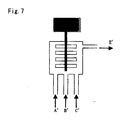
- Organic acid silver salt grain dispersion GG was prepared in such a large scale crystallization facility as shown in Fig. 4 by using the addition section and mixing unit shown in Fig. 7 as the pipeline mixer 118. That is, to the tank 112, 87.6 kg of behenic acid (Edenor C22-85R, trade name, manufactured by Henkel Co.), 423 L of distilled water and 120 L of tert-butanol were added. To the mixture, 49.2 L of 5 mol/L aqueous solution of NaOH was added at 75°C over 5 minutes with stirring, and allowed to react for 60 minutes to obtain a solution of sodium behenate.
- behenic acid Edenor C22-85R, trade name, manufactured by Henkel Co.
- the distance between the silver ion-containing solution addition inlet A' and the organic acid silver salt solution addition inlet B' was adjusted to 400 mm. Cooling water at 10°C was supplied to the heat exchanger and a jacket of the tank 120 at a flow rate of 200 L/minute, and as a result, the average temperature in the tank was measured to be 30°C. The mixture was left with stirring for 20 minutes as it was to lower the temperature to 25°C. Then, the solid content was separated by suction filtration and washed with water until electric conductivity of the filtrate became 30 ⁇ S/cm. The solid content obtained as described above was stored as a wet cake without being dried.
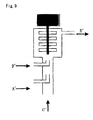
- Organic acid silver salt grain dispersion JJ was prepared in such a large scale crystallization facility as shown in Fig. 4 by using the addition section and mixing unit shown in Fig. 9 as the pipeline mixer 118. That is, to the tank 112, 87.6 kg of behenic acid (Edenor C22-85R, trade name, manufactured by Henkel Co.), 423 L of distilled water and 120 L of tert-butanol were added. To the mixture, 49.2 L of 5 mol/L aqueous solution of NaOH was added at 75°C over 5 minutes with stirring, and allowed to react for 60 minutes to obtain a solution of sodium behenate.
- behenic acid Edenor C22-85R, trade name, manufactured by Henkel Co.
- the aqueous solution of silver nitrate was added from a silver ion-containing solution addition inlet A' (inner diameter: 10 mm) shown in Fig. 9 at a constant flow rate of 2.9 L/minute, and after 5 seconds, addition of the aqueous solution of sodium behenate was started from an organic acid silver salt solution addition inlet B' (inner diameter: 13.3 mm) shown in Fig. 9 at a constant flow rate of 9.8 L/minute, so that the solutions were stored in the tank 120 via the heat exchanger 119.
- the distance between the silver ion-containing solution addition inlet A' and the organic acid silver salt solution addition inlet B' was adjusted to 400 mm.
- Cooling water at 10°C was supplied to the heat exchanger and a jacket of the tank 120 at a flow rate of 200 L/minute, and as a result, the average temperature in the tank was measured to be 30°C.
- the mixture was left with stirring for 20 minutes as it was to lower the temperature to 25°C.
- the solid content was separated by suction filtration and washed with water until electric conductivity of the filtrate became 30 ⁇ S/cm.
- the solid content obtained as described above was stored as a wet cake without being dried.
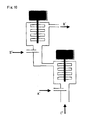
- Organic acid silver salt grain dispersion MM was prepared in such a large scale crystallization facility as shown in Fig. 4 by using the addition section and mixing unit shown in Fig. 10 as the pipeline mixer 118. That is, to the tank 112, 87.6 kg of behenic acid (Edenor C22-85R, trade name, manufactured by Henkel Co.), 423 L of distilled water and 120 L of tert-butanol were added. To the mixture, 49.2 L of 5 mol/L aqueous solution of NaOH was added at 75°C over 5 minutes with stirring, and allowed to react for 60 minutes to obtain a solution of sodium behenate.
- behenic acid Edenor C22-85R, trade name, manufactured by Henkel Co.
- the viscosity of the obtained coating solution for image-forming layer was measured by a B-type viscometer manufactured by Tokyo Keiki K.K. and found to be 85 [mPa•s] at 40°C (Rotor No. 1, 60 rpm).
- the viscosity of the coating solution measured by a B-type viscometer at 40°C was 21 [mPa•s].
- the coating solution was further mixed with 445 ml of an aqueous solution containing 4 weight % of chromium alum and 0.67 weight % of phthalic acid by a static mixer immediately before coating to form a coating solution for protective layer, and fed to a coating die in such an amount that gave a coating amount of 8.3 ml/m 2 .
- the coating solutions were cooled with air blow showing a dry-bulb temperature of 10-20°C. Then, the material was transported without contact, and dried with drying air showing a dry-bulb temperature of 23-45°C and a wet-bulb temperature of 15-21°C in a coil-shaped non-contact type drier.
- the material was conditioned for its moisture content at 25°C and relative humidity of 40-60%, and heated so that the temperature of film surface should become 70-90°C. After the heating, the material was cooled to 25°C as a temperature of film surface.
- the prepared thermally processed image recording material showed matting degree of 550 seconds for the photosensitive layer side, and 130 seconds for the back surface, in terms of Beck's smoothness.
- the film surface pH on the photosensitive layer side was measured to be 6.0.
- Coated surface condition of the image-forming layers of the thermally image recording materials produced by using the organic acid silver salt grain dispersions prepared in Examples 1-3 was evaluated by visual inspection. As a result, it was found that the thermally image recording materials produced by using the organic acid silver salt grain dispersions prepared by the preparation methods of the present invention showed extremely good coated surface condition.
Landscapes
- Chemical & Material Sciences (AREA)
- Engineering & Computer Science (AREA)
- Organic Chemistry (AREA)
- Materials Engineering (AREA)
- Physics & Mathematics (AREA)
- General Physics & Mathematics (AREA)
- Oil, Petroleum & Natural Gas (AREA)
- Non-Silver Salt Photosensitive Materials And Non-Silver Salt Photography (AREA)
- Separation Using Semi-Permeable Membranes (AREA)
- Organic Low-Molecular-Weight Compounds And Preparation Thereof (AREA)
Applications Claiming Priority (8)
| Application Number | Priority Date | Filing Date | Title |
|---|---|---|---|
| JP2000195621 | 2000-06-29 | ||
| JP2000195621A JP3947648B2 (ja) | 1999-07-15 | 2000-06-29 | 非感光性脂肪酸銀塩粒子の調製方法および調製装置 |
| JP2000213813A JP2002031870A (ja) | 2000-07-14 | 2000-07-14 | 有機酸銀塩の調製方法および調製装置 |
| JP2000213813 | 2000-07-14 | ||
| JP2000236044A JP2002049117A (ja) | 2000-08-03 | 2000-08-03 | 有機酸銀塩粒子の水分散物の製造方法および熱現像画像記録材料 |
| JP2000236044 | 2000-08-03 | ||
| JP2000237897 | 2000-08-07 | ||
| JP2000237897A JP2002049118A (ja) | 2000-08-07 | 2000-08-07 | 有機酸銀塩粒子の調製方法および調製装置 |
Publications (3)
| Publication Number | Publication Date |
|---|---|
| EP1168068A2 true EP1168068A2 (fr) | 2002-01-02 |
| EP1168068A3 EP1168068A3 (fr) | 2002-12-18 |
| EP1168068B1 EP1168068B1 (fr) | 2006-04-26 |
Family
ID=27481394
Family Applications (1)
| Application Number | Title | Priority Date | Filing Date |
|---|---|---|---|
| EP01115968A Expired - Lifetime EP1168068B1 (fr) | 2000-06-29 | 2001-06-29 | Procédé et dispositif pour la préparation de grains d'un sel d'argent d'un acide organique et procédé de préparation des matériaux d'enregistrement d'images développés par la chaleur |
Country Status (4)
| Country | Link |
|---|---|
| US (3) | US6737231B2 (fr) |
| EP (1) | EP1168068B1 (fr) |
| AT (1) | ATE324617T1 (fr) |
| DE (1) | DE60119034T2 (fr) |
Cited By (2)
| Publication number | Priority date | Publication date | Assignee | Title |
|---|---|---|---|---|
| EP1355190A1 (fr) * | 2002-04-02 | 2003-10-22 | Fuji Photo Film Co., Ltd. | Matériau photosensible développable par la chaleur |
| CN109096095A (zh) * | 2018-08-23 | 2018-12-28 | 中国乐凯集团有限公司 | 一种长链脂肪酸银盐微晶制备方法及其应用 |
Families Citing this family (4)
| Publication number | Priority date | Publication date | Assignee | Title |
|---|---|---|---|---|
| JP2001192390A (ja) * | 2000-01-11 | 2001-07-17 | Fuji Photo Film Co Ltd | ビスフェノール−燐化合物錯体及びそれを用いた熱現像画像記録材料 |
| KR101371269B1 (ko) * | 2007-02-15 | 2014-03-07 | 도와 일렉트로닉스 가부시키가이샤 | 은 입자 분말의 제조방법 |
| CN102257079A (zh) * | 2008-12-18 | 2011-11-23 | 惠普开发有限公司 | 具有光泽度提高性聚合物的颜料化喷墨油墨 |
| US10522883B2 (en) | 2010-05-10 | 2019-12-31 | Rsr Technologies, Inc. | Recycling electrochemical cells and batteries |
Family Cites Families (6)
| Publication number | Priority date | Publication date | Assignee | Title |
|---|---|---|---|---|
| EP0962812A1 (fr) * | 1998-06-03 | 1999-12-08 | Fuji Photo Film Co., Ltd. | Dispersion aqueuse de particules de sels argentiques d'acides gras, procédé pour redisperser des particules de sels argentiques d'acides gras, produit photothermographique sensible à la lumière et procédé pour sa fabrication |
| IL132466A (en) * | 1999-05-20 | 2002-09-12 | Johnson & Johnson Vision Care | Methods of manufacturing lenses with refractive power are gradually increasing |
| JP3973798B2 (ja) * | 1999-06-25 | 2007-09-12 | 富士フイルム株式会社 | 非感光性脂肪酸銀塩粒子の調製方法 |
| ATE346325T1 (de) * | 1999-07-15 | 2006-12-15 | Fuji Photo Film Co Ltd | Ein verfahren zur herstellung lichtunempfindlicher silberfettsäuresalzkörner und ein apparat dafür |
| EP1069469B1 (fr) * | 1999-07-16 | 2008-03-19 | FUJIFILM Corporation | Matériau formant image traité thermiquement |
| JP2001188313A (ja) * | 1999-10-20 | 2001-07-10 | Fuji Photo Film Co Ltd | 有機酸銀塩の製造方法およびそれを用いた熱現像感光材料 |
-
2001
- 2001-06-29 EP EP01115968A patent/EP1168068B1/fr not_active Expired - Lifetime
- 2001-06-29 AT AT01115968T patent/ATE324617T1/de not_active IP Right Cessation
- 2001-06-29 DE DE60119034T patent/DE60119034T2/de not_active Expired - Lifetime
- 2001-06-29 US US09/893,750 patent/US6737231B2/en not_active Expired - Fee Related
-
2004
- 2004-04-02 US US10/815,957 patent/US7195865B2/en not_active Expired - Fee Related
- 2004-04-02 US US10/815,851 patent/US20040185394A1/en not_active Abandoned
Cited By (3)
| Publication number | Priority date | Publication date | Assignee | Title |
|---|---|---|---|---|
| EP1355190A1 (fr) * | 2002-04-02 | 2003-10-22 | Fuji Photo Film Co., Ltd. | Matériau photosensible développable par la chaleur |
| CN109096095A (zh) * | 2018-08-23 | 2018-12-28 | 中国乐凯集团有限公司 | 一种长链脂肪酸银盐微晶制备方法及其应用 |
| CN109096095B (zh) * | 2018-08-23 | 2021-08-06 | 乐凯医疗科技有限公司 | 一种长链脂肪酸银盐微晶制备方法及其应用 |
Also Published As
| Publication number | Publication date |
|---|---|
| DE60119034T2 (de) | 2006-08-31 |
| US6737231B2 (en) | 2004-05-18 |
| DE60119034D1 (de) | 2006-06-01 |
| ATE324617T1 (de) | 2006-05-15 |
| US20040185394A1 (en) | 2004-09-23 |
| US20020058218A1 (en) | 2002-05-16 |
| EP1168068B1 (fr) | 2006-04-26 |
| US7195865B2 (en) | 2007-03-27 |
| US20040185395A1 (en) | 2004-09-23 |
| EP1168068A3 (fr) | 2002-12-18 |
Similar Documents
| Publication | Publication Date | Title |
|---|---|---|
| US6413712B1 (en) | Photothermographic material | |
| EP1096310B1 (fr) | Matériau photothermographique | |
| US6485898B2 (en) | Photothermographic material | |
| US6630293B1 (en) | Method for producing silver salt of organic acid and photothermographic material utilizing the same | |
| US6783927B2 (en) | Photothermographic material | |
| US6335153B1 (en) | Method for producing image using a photothermographic material | |
| EP1220026B1 (fr) | Matériau d'enregistrement d'image développable par la chaleur | |
| US6573407B2 (en) | Bisphenol-phosphorus compound complex and thermally processed image recording material utilizing the same | |
| US7060423B2 (en) | Heat-developable photosensitive material and image forming method | |
| EP1168068B1 (fr) | Procédé et dispositif pour la préparation de grains d'un sel d'argent d'un acide organique et procédé de préparation des matériaux d'enregistrement d'images développés par la chaleur | |
| US6472138B1 (en) | Black and white photothermographic material and method for fabricating thereof | |
| US6534258B2 (en) | Method for producing grains of aliphatic acid silver salt and thermally processed image recording material | |
| US6482583B1 (en) | Photothermographic material | |
| US6582897B2 (en) | Heat developable light-sensitive material | |
| EP1283440B1 (fr) | Matériau photothermographique | |
| US6468726B2 (en) | Photothermographic image-recording material with polyester sub | |
| US6558894B2 (en) | Photothermographic material | |
| US6830879B2 (en) | Photothermographic material | |
| US6368782B1 (en) | Photothermographic material | |
| JP2002006442A (ja) | 有機酸銀塩の製造方法および熱現像画像記録材料 | |
| JP2002014436A (ja) | 有機酸銀塩の製造方法および熱現像画像記録材料 | |
| JP2002049117A (ja) | 有機酸銀塩粒子の水分散物の製造方法および熱現像画像記録材料 | |
| JP2002072403A (ja) | 熱現像感光材料の製造方法 |
Legal Events
| Date | Code | Title | Description |
|---|---|---|---|
| PUAI | Public reference made under article 153(3) epc to a published international application that has entered the european phase |
Free format text: ORIGINAL CODE: 0009012 |
|
| AK | Designated contracting states |
Kind code of ref document: A2 Designated state(s): AT BE CH CY DE DK ES FI FR GB GR IE IT LI LU MC NL PT SE TR |
|
| AX | Request for extension of the european patent |
Free format text: AL;LT;LV;MK;RO;SI |
|
| PUAL | Search report despatched |
Free format text: ORIGINAL CODE: 0009013 |
|
| AK | Designated contracting states |
Kind code of ref document: A3 Designated state(s): AT BE CH CY DE DK ES FI FR GB GR IE IT LI LU MC NL PT SE TR |
|
| AX | Request for extension of the european patent |
Free format text: AL;LT;LV;MK;RO;SI |
|
| 17P | Request for examination filed |
Effective date: 20030526 |
|
| AKX | Designation fees paid |
Designated state(s): AT BE CH CY DE DK ES FI FR GB GR IE IT LI LU MC NL PT SE TR |
|
| 17Q | First examination report despatched |
Effective date: 20041022 |
|
| GRAP | Despatch of communication of intention to grant a patent |
Free format text: ORIGINAL CODE: EPIDOSNIGR1 |
|
| GRAS | Grant fee paid |
Free format text: ORIGINAL CODE: EPIDOSNIGR3 |
|
| GRAA | (expected) grant |
Free format text: ORIGINAL CODE: 0009210 |
|
| AK | Designated contracting states |
Kind code of ref document: B1 Designated state(s): AT BE CH CY DE DK ES FI FR GB GR IE IT LI LU MC NL PT SE TR |
|
| PG25 | Lapsed in a contracting state [announced via postgrant information from national office to epo] |
Ref country code: IT Free format text: LAPSE BECAUSE OF FAILURE TO SUBMIT A TRANSLATION OF THE DESCRIPTION OR TO PAY THE FEE WITHIN THE PRESCRIBED TIME-LIMIT;WARNING: LAPSES OF ITALIAN PATENTS WITH EFFECTIVE DATE BEFORE 2007 MAY HAVE OCCURRED AT ANY TIME BEFORE 2007. THE CORRECT EFFECTIVE DATE MAY BE DIFFERENT FROM THE ONE RECORDED. Effective date: 20060426 Ref country code: AT Free format text: LAPSE BECAUSE OF FAILURE TO SUBMIT A TRANSLATION OF THE DESCRIPTION OR TO PAY THE FEE WITHIN THE PRESCRIBED TIME-LIMIT Effective date: 20060426 Ref country code: FI Free format text: LAPSE BECAUSE OF FAILURE TO SUBMIT A TRANSLATION OF THE DESCRIPTION OR TO PAY THE FEE WITHIN THE PRESCRIBED TIME-LIMIT Effective date: 20060426 Ref country code: LI Free format text: LAPSE BECAUSE OF FAILURE TO SUBMIT A TRANSLATION OF THE DESCRIPTION OR TO PAY THE FEE WITHIN THE PRESCRIBED TIME-LIMIT Effective date: 20060426 Ref country code: NL Free format text: LAPSE BECAUSE OF FAILURE TO SUBMIT A TRANSLATION OF THE DESCRIPTION OR TO PAY THE FEE WITHIN THE PRESCRIBED TIME-LIMIT Effective date: 20060426 Ref country code: CH Free format text: LAPSE BECAUSE OF FAILURE TO SUBMIT A TRANSLATION OF THE DESCRIPTION OR TO PAY THE FEE WITHIN THE PRESCRIBED TIME-LIMIT Effective date: 20060426 Ref country code: BE Free format text: LAPSE BECAUSE OF FAILURE TO SUBMIT A TRANSLATION OF THE DESCRIPTION OR TO PAY THE FEE WITHIN THE PRESCRIBED TIME-LIMIT Effective date: 20060426 |
|
| REG | Reference to a national code |
Ref country code: GB Ref legal event code: FG4D |
|
| REG | Reference to a national code |
Ref country code: IE Ref legal event code: FG4D |
|
| REF | Corresponds to: |
Ref document number: 60119034 Country of ref document: DE Date of ref document: 20060601 Kind code of ref document: P |
|
| PG25 | Lapsed in a contracting state [announced via postgrant information from national office to epo] |
Ref country code: IE Free format text: LAPSE BECAUSE OF NON-PAYMENT OF DUE FEES Effective date: 20060629 |
|
| PG25 | Lapsed in a contracting state [announced via postgrant information from national office to epo] |
Ref country code: MC Free format text: LAPSE BECAUSE OF NON-PAYMENT OF DUE FEES Effective date: 20060630 |
|
| PG25 | Lapsed in a contracting state [announced via postgrant information from national office to epo] |
Ref country code: SE Free format text: LAPSE BECAUSE OF FAILURE TO SUBMIT A TRANSLATION OF THE DESCRIPTION OR TO PAY THE FEE WITHIN THE PRESCRIBED TIME-LIMIT Effective date: 20060726 Ref country code: DK Free format text: LAPSE BECAUSE OF FAILURE TO SUBMIT A TRANSLATION OF THE DESCRIPTION OR TO PAY THE FEE WITHIN THE PRESCRIBED TIME-LIMIT Effective date: 20060726 Ref country code: GB Free format text: LAPSE BECAUSE OF NON-PAYMENT OF DUE FEES Effective date: 20060726 |
|
| PG25 | Lapsed in a contracting state [announced via postgrant information from national office to epo] |
Ref country code: ES Free format text: LAPSE BECAUSE OF FAILURE TO SUBMIT A TRANSLATION OF THE DESCRIPTION OR TO PAY THE FEE WITHIN THE PRESCRIBED TIME-LIMIT Effective date: 20060806 |
|
| PG25 | Lapsed in a contracting state [announced via postgrant information from national office to epo] |
Ref country code: PT Free format text: LAPSE BECAUSE OF FAILURE TO SUBMIT A TRANSLATION OF THE DESCRIPTION OR TO PAY THE FEE WITHIN THE PRESCRIBED TIME-LIMIT Effective date: 20060926 |
|
| REG | Reference to a national code |
Ref country code: CH Ref legal event code: PL |
|
| NLV1 | Nl: lapsed or annulled due to failure to fulfill the requirements of art. 29p and 29m of the patents act | ||
| PLBE | No opposition filed within time limit |
Free format text: ORIGINAL CODE: 0009261 |
|
| STAA | Information on the status of an ep patent application or granted ep patent |
Free format text: STATUS: NO OPPOSITION FILED WITHIN TIME LIMIT |
|
| RAP2 | Party data changed (patent owner data changed or rights of a patent transferred) |
Owner name: FUJIFILM CORPORATION |
|
| GBPC | Gb: european patent ceased through non-payment of renewal fee |
Effective date: 20060726 |
|
| 26N | No opposition filed |
Effective date: 20070129 |
|
| EN | Fr: translation not filed | ||
| PG25 | Lapsed in a contracting state [announced via postgrant information from national office to epo] |
Ref country code: FR Free format text: LAPSE BECAUSE OF FAILURE TO SUBMIT A TRANSLATION OF THE DESCRIPTION OR TO PAY THE FEE WITHIN THE PRESCRIBED TIME-LIMIT Effective date: 20070309 Ref country code: GR Free format text: LAPSE BECAUSE OF FAILURE TO SUBMIT A TRANSLATION OF THE DESCRIPTION OR TO PAY THE FEE WITHIN THE PRESCRIBED TIME-LIMIT Effective date: 20060727 |
|
| PG25 | Lapsed in a contracting state [announced via postgrant information from national office to epo] |
Ref country code: TR Free format text: LAPSE BECAUSE OF FAILURE TO SUBMIT A TRANSLATION OF THE DESCRIPTION OR TO PAY THE FEE WITHIN THE PRESCRIBED TIME-LIMIT Effective date: 20060426 Ref country code: LU Free format text: LAPSE BECAUSE OF NON-PAYMENT OF DUE FEES Effective date: 20060629 |
|
| PG25 | Lapsed in a contracting state [announced via postgrant information from national office to epo] |
Ref country code: FR Free format text: LAPSE BECAUSE OF FAILURE TO SUBMIT A TRANSLATION OF THE DESCRIPTION OR TO PAY THE FEE WITHIN THE PRESCRIBED TIME-LIMIT Effective date: 20060426 Ref country code: CY Free format text: LAPSE BECAUSE OF FAILURE TO SUBMIT A TRANSLATION OF THE DESCRIPTION OR TO PAY THE FEE WITHIN THE PRESCRIBED TIME-LIMIT Effective date: 20060426 |
|
| PGFP | Annual fee paid to national office [announced via postgrant information from national office to epo] |
Ref country code: DE Payment date: 20100602 Year of fee payment: 10 |
|
| REG | Reference to a national code |
Ref country code: DE Ref legal event code: R119 Ref document number: 60119034 Country of ref document: DE Effective date: 20120103 |
|
| PG25 | Lapsed in a contracting state [announced via postgrant information from national office to epo] |
Ref country code: DE Free format text: LAPSE BECAUSE OF NON-PAYMENT OF DUE FEES Effective date: 20120103 |