EP1168192A2 - Transformée de Fourier discrète et récursive - Google Patents
Transformée de Fourier discrète et récursive Download PDFInfo
- Publication number
- EP1168192A2 EP1168192A2 EP01114884A EP01114884A EP1168192A2 EP 1168192 A2 EP1168192 A2 EP 1168192A2 EP 01114884 A EP01114884 A EP 01114884A EP 01114884 A EP01114884 A EP 01114884A EP 1168192 A2 EP1168192 A2 EP 1168192A2
- Authority
- EP
- European Patent Office
- Prior art keywords
- supplied
- time
- fourier transformation
- data
- complex
- Prior art date
- Legal status (The legal status is an assumption and is not a legal conclusion. Google has not performed a legal analysis and makes no representation as to the accuracy of the status listed.)
- Withdrawn
Links
Images




Classifications
-
- G—PHYSICS
- G06—COMPUTING OR CALCULATING; COUNTING
- G06F—ELECTRIC DIGITAL DATA PROCESSING
- G06F17/00—Digital computing or data processing equipment or methods, specially adapted for specific functions
- G06F17/10—Complex mathematical operations
- G06F17/14—Fourier, Walsh or analogous domain transformations, e.g. Laplace, Hilbert, Karhunen-Loeve, transforms
- G06F17/141—Discrete Fourier transforms
Definitions
- the present invention relates to an arithmetic operation method for Fourier transformation or inverse Fourier transformation and more particularly to an arithmetic operation method for carrying out those transformations with a simple arithmetic operation processing for obtaining a result of the arithmetic operation by those transformations in a short time.
- the Fourier transformation method used in frequency analysis and the like of time-series data stream has been employed in high compression encoding of audio signal and moving picture signal as well as spectrum analysis of signals in audio signal processing field, moving picture data processing field for medical system and the like. Further, inverse Fourier transformation method and Fourier transformation method, which operate in complementary way to each other, have been widely used as modulation technology and demodulation technology in communication field.
- data stream sampled as digital amount is treated as N groups (N is an integer, for example, 1024) and a time interval, in which the N-data stream exist, is assumed as a window period while that window period is assumed to be basic frequency. Then, signal components of data stream existing in the window period are obtained as real number component and imaginary number component of a harmonic signal of the basic frequency.
- the inverse Fourier transformation method is a transformation method, which is complementary to the Fourier transformation method.
- DFT discrete Fourier transformation
- the discrete Fourier transformation technology and the inverse discrete Fourier transformation technology, which are employed in the above manner, are signal conversion technologies, which operate in complementary manner.
- the discrete Fourier transformation of the former supplied signals are sampled at every predetermined time interval and a voltage value obtained by the sampling is obtained as sampled data.
- the Fourier transformation is carried out on supplied data stream just such that its inherent basic function is convoluted in every point to be obtained and an operation for convoluting the basic function is conducted by a plurality of multiplication processings.
- a transformation equation expressed with the aforementioned equation (1) needs multiplications of 4 X N 2 times, so that in case where N is 1024, for example, the multiplication frequency is about 4,200,000 times. Therefore, the load of the arithmetic operation is very large and further, if the number N of points to be handled as the data stream is increased, the multiplication processing frequency is increased by second power, which is unfavorable in terms of actual field.
- FFT fast Fourier transformation
- butterfly operation An arithmetic operation method called butterfly operation is employed for the FFT.
- the butterfly operation is so constructed that a simple integer, for example, 2 is defined as a basic number and supplied binary complex data is subjected to complex operation comprised of a single addition, subtraction and multiplication each so as to output binary complex data.
- the N-point FFT is comprised of log 2 N-step stage and (N/2)log 2 N butterfly operations and an operation result of the FFT can be obtained depending on the number of multiplications of (2N)log 2 N times. Consequently, the N-point FFT is used as a Fourier transformation method ensuring a high operating efficiency.
- the FFT or discrete Fourier transformation (DFT) conducted in the above manner is usually used, so that data stream, sampled successively at a predetermined time interval and then supplied, is subjected to Fourier transformation.
- the sampled data stream is stored in a memory circuit in succession temporarily and when the number of data stored in the memory circuit temporarily reaches N, the Fourier transformation processing for that N data is started.
- a second memory circuit for accumulating N-data stream may be provided as another memory.
- these memory circuits execute temporary storage processing and arithmetic operation processing alternately, so that the Fourier transformation is carried out on continuously supplied time-series data.
- the arithmetic operation is carried out on N-data stream stored temporarily such that the data stream is treated as a block unit. Therefore, in such Fourier transformation processing, a delay of time corresponding to N-data stream is generated, so that a transformation result cannot be obtained at real time.
- the result of the Fourier analysis can be obtained only at N-samplings time interval.
- the delay time is not preferable for application of the Fourier analysis, thereby restricting its application field.
- N-point Fourier transformation processings need to be carried out within a sampling period. Even in case where FFT operation method developed for such fast arithmetic operation processing is employed, N-time operating speed is demanded to secure a Fourier operation result computed continuously from the FFT. In a normal case, it is difficult to conduct such super high speed FFT to supply an obtained operation result.
- the FFT operation processing is carried out on N-point data stream, which is sampled with a clock signal whose sampling frequency is fs, quantitized and supplied, usually at a frequency interval of fs/N.
- this method carries out block processing in which supplied N time-series data are treated as a block, the result of the Fourier transformation on the N-point data fetched in is not outputted until N sampling clock time passes, and the analysis result obtained at that time is only a result of the Fourier transformation processing for every N samples.
- This publication describes a method for Fourier-transforming a vibration waveform value sampled and supplied. According to the same method, a difference between a newly supplied vibration waveform value and an old vibration waveform value already supplied and used for Fourier transformation processing is obtained and a newer complex vibration value than the old complex vibration value provided by the arithmetic operation is obtained each time when a sampling value of the vibration waveform is supplied.
- frequency analysis may be considered as an application using the continuous Fourier transformation, if such application is considered, often any frequency band is analyzed at any resolution and then, that application is executed depending on the result.
- Input data stream described in the same publication refers to only real number. Although if the data stream to be sampled is data stream which can be expressed in time series, it is permitted that the data stream is limited to the real number, imaginary number input signal as well as real number input signal may be sometimes used in Fourier operation for use in communication field, and therefore, supplied complex signals have to be subjected to transformation processing.
- the conventional fast Fourier transformation method in which continuously supplied data is subjected to Fourier transformation to secure an operation result, is not capable of carrying out complex Fourier transformation on data stream supplied in the form of complex number.
- an object of the present invention is to provide a continuous Fourier transformation method suitable for transforming any frequency band desired to be subjected to Fourier analysis at a desired resolution.
- Another object of the present invention is to provide a continuous Fourier transformation method enabling Fourier analysis on data stream supplied in the form of complex number and suitable for transforming any frequency band desired to be subjected to Fourier analysis at a desired resolution.
- a recursive discrete Fourier transformation method wherein data values x(t), x(t+1), x(t+2), x(t+3), ..., x(t+N-1), x(t+N) sampled at times t, t+1, t+2, t+3, ..., t+N-1, t+N (N is a positive integer which is 1 or more) each having an equal interval are supplied and with such N data values supplied since time t as a data stream, a frequency component, which is degree k (k is 0 or a positive integer smaller than N) obtained by carrying out complex Fourier transformation on the data stream, is obtained such that a real part Xr(k, t) thereof and an imaginary part X i (k, t) thereof are complex Fourier coefficients, the method comprising: a first step of storing the data stream x(t), x(t+1), x(t+2), x(t+3),
- data stream comprised of supplied N samples is subjected to complex Fourier transformation and then, the oldest sample value used for complex Fourier transformation is subtracted from the value of a new sample to be supplied next so as to obtain a subtraction value.
- discrete Fourier operation result on new N samples can be obtained based on that subtraction value and the result of the preceding complex Fourier operation.
- a recursive discrete Fourier transformation method wherein with sampling frequency as fs, data values x(t), x(t+1), x(t+2), x(t+3), ..., x(t+N-1), x(t+N) sampled at times t, t+1, t+2, t+3, ..., t+N-1, t+N (N is a positive integer which is 1 or more) each having an equal interval are supplied and with such N data values supplied since time t as a data stream, a frequency interval given with a minimum frequency f1 and a maximum frequency f2 to the data stream is regarded as a measuring frequency interval, a frequency interval obtained by dividing that measuring frequency interval by the N is assumed to be an analysis frequency interval and a result of the frequency analysis obtained by carrying out complex Fourier transformation at every analysis frequency interval is obtained as a frequency component which is k (k is 0 or a positive integer smaller than N) times the frequency interval
- data stream comprised of supplied N samples is subjected to complex Fourier transformation and then, the oldest sample value used for complex Fourier transformation is subtracted from the value of a new sample to be supplied next so as to obtain a subtraction value.
- discrete Fourier operation result on new N samples can be obtained based on that subtraction value and the result of the preceding complex Fourier operation.
- a frequency band for analysis for the discrete Fourier operation is set up with f1 and f2 preliminarily and the Fourier operation is carried out with a basic frequency whose resolution is set to N.
- inverse discrete Fourier transformation data subjected to inverse discrete Fourier transformation using a positive constant a is supplied so as to obtain a complex Fourier transformation coefficient to the supplied inverse discrete Fourier transformation data, the discrete Fourier transformation being carried out using the positive constant A corresponding to the positive constant a.
- the operation can be carried out by FFT in which the positive constant A is set up by selecting appropriately 1, N or a square root of N.
- FFT inverse fast Fourier transformation
- the constant value A corresponding to the constant value a which is, for example, 1, N or the square root of N used for the IFFT operation, is employed in the FFT operation processing circuit, so as to construct the FFT which operates in a complementary way with the IFFT to decode the information signal.
- k indicating a degree of the complex Fourier coefficient is set to a desired value and Fourier transformation to the set value k is repeated at every time having an equal interval.
- a result of the Fourier analysis on a specific frequency determined with the value k can be computed quickly.
- the control of that system can be carried out at a minimum delay time, so that response characteristic of the entire system can be improved.
- system having a better quality can be constructed.
- a recursive discrete Fourier transformation method wherein data values x(t), x(t+1), x(t+2), x(t+3),..., x(t+N-1), x(t+N) sampled at times t, t+1, t+2, t+3, ..., t+N-1, t+N (N is a positive integer which is 1 or more) each having an equal interval are supplied and with such N data values supplied since time t as a data stream, a frequency component, which is degree k (k is 0 or a positive integer smaller than N) obtained by carrying out complex Fourier transformation on the data stream, is obtained such that a real part X r (k, t) thereof and an imaginary part X i (k, t) thereof are complex Fourier coefficients, the method comprising: a first step of storing the data stream x(t), x(t+1), x(t+2), x(t+3)
- data stream comprised of supplied N samples is subjected to complex Fourier transformation and then, the oldest sample value used for complex Fourier transformation is subtracted from the value of a new sample to be supplied next so as to obtain a subtraction value.
- discrete Fourier coefficients to new N samples can be obtained by operation with a predetermined transfer function based on that subtraction value and the preceding complex Fourier operation result.
- a recursive discrete Fourier transformation method wherein with sampling frequency as fs, data values x(t), x(t+1), x(t+2), x(t+3), ..., x(t+N-1), x(t+N) sampled at times t, t+1, t+2, t+3, ..., t+N-1, t+N (N is a positive integer which is 1 or more) each having an equal interval are supplied and with such N data values supplied since time t as a data stream, a frequency interval given with a minimum frequency f1 and a maximum frequency f2 to that data stream is regarded as a measuring frequency interval, a frequency interval obtained by dividing that measuring frequency interval by the N is assumed to be an analysis frequency interval and a result of the frequency analysis provided by carrying out complex Fourier transformation at every analysis frequency interval is obtained as a frequency component which is k (k is 0 or a positive integer smaller than N) times the frequency interval
- data stream comprised of supplied N samples is subjected to complex Fourier transformation and then, the oldest sample value used for complex Fourier transformation is subtracted from the value of a new sample to be supplied next so as to obtain a subtraction value.
- discrete Fourier operation result on new N samples can be obtained based on that subtraction value and the result of preceding the complex Fourier operation.
- a frequency band for analysis for the discrete Fourier operation is set up with f1 and f2 preliminarily and that Fourier operation is carried out with a basic frequency whose resolution is set to N.
- the positive constant value A for providing with an amplitude corresponding to a difference between the x(t+N) and the x(t) is capable of being set selectively with an inverse number of square root of 1, N or 1/N.
- the operation can be carried out by FFT in which the positive constant A is set up by selecting appropriately 1, 1/N or an inverse number of a square root of N.
- This is employed in, for example, communication apparatus.
- IFFT inverse fast Fourier transformation
- the constant value A corresponding to the constant value a which is, for example, 1, 1/N or the inverse number of the square root of N used for the IFFT operation, is employed in the FFT operation processing circuit, so as to construct the FFT which operates in a complementary way with the IFFT to decode the information signal.
- k indicating the degree of the complex Fourier coefficient is set to a desired value and the Fourier transformation to the set value k is repeated at every time having an equal interval.
- a result of the Fourier analysis on a specific frequency determined with the value k can be computed in a short time.
- the control of that system can be carried out at a minimum delay time, so that response characteristic of the entire system can be improved.
- system having a better quality can be constructed.
- a recursive discrete Fourier transformation method for obtaining complex Fourier coefficients, wherein data values x r (t)+jx i (t), x r (t+1) + jx i (t+1), x r (t+2) + jx i (t+2), x r (t+3) + jx i (t+3), ..., x r (t+N-1) + jx i (t+N-1), x r (t+N) + jx i (t+N) sampled at times t, t+1, t+2, t+3, ..., t+N-1, t+N (N is a positive integer which is 1 or more) each having an equal interval are supplied and with such N data values supplied since time t as a data stream, a frequency component, which is degree k (k is 0 or a positive integer smaller than N) obtained by carrying out complex Fourier transformation on the
- data stream comprised of supplied N complex data is subjected to Fourier transformation, so that a Fourier operation result to new N complex data can be obtained based on the preceding Fourier transformation result, data value of new complex data to be supplied next and the oldest complex data used for executing the Fourier transformation. Therefore, different from the conventional case where the Fourier operation is carried out after the N sample data is supplied, the Fourier operation result can be obtained quickly in the period of a single complex data.
- a recursive discrete Fourier transformation method for obtaining complex Fourier coefficient wherein with sampling frequency as fs, data values x r (t)+jx i (t), x r (t+1) + jx i (t+1), x r (t+2) + jx i (t+2), x r (t+3) + jx i (t+3), ..., x r (t+N-1) + jx i (t+N-1), x r (t+N) + jx i (t+N) sampled at times t, t+1, t+2, t+3, ..., t+N-1, t+N (N is a positive integer which is 1 or more) each having an equal interval are supplied and with such N complex data values supplied since time t as a data stream, a frequency interval given with a minimum frequency f1 and a maximum frequency f2 to that data stream is supplied and with such N complex data values supplied since time
- data stream comprised of supplied N complex data is subjected to Fourier transformation and then, when it is intended to obtain a result of the Fourier operation to new N complex data on the basis of the result of the preceding Fourier transformation, data value of new complex data to be supplied next and the oldest complex data used for Fourier, the frequency band to be Fourier-transformed is set up with f1 and f2 preliminarily and further, the Fourier operation is carried out using the basic frequency set with the resolution N. Therefore, different from the conventional case where the frequency band and the resolution are automatically determined when the N sample data are supplied for the Fourier operation, a Fourier operation result to any frequency band and resolution can be obtained quickly and easily in the period of a single sample.
- the Fourier transformation can be carried out such that the positive constant A is set up to 1, N or a square root of N.
- This is employed in, for example, communication apparatus.
- IFFT inverse fast Fourier transformation
- the constant value A corresponding to the constant value B which is, for example, 1, N or the square root of N used for the IFFT operation, is employed in the FFT operation processing circuit, so as to construct the FFT which operates in a complementary way with the IFFT.
- k indicating the degree of the complex Fourier coefficient is set to a desired value and the Fourier transformation to the set value k is repeated at every time having an equal interval.
- the Fourier analysis on a specific frequency determined with the value k can be carried out in a short time.
- the control of that system can be carried out at a minimum delay time, so that response characteristic of the entire system can be improved.
- system whose response characteristic is a short time, having a better quality can be constructed.
- a recursive inverse discrete Fourier transformation method for obtaining complex inverse Fourier coefficient wherein complex data values x r (t) + jx i (t), x r (t+1) + jx i (t+1), x r (t+2) + jx i (t+2), x r (t+3) + jx i (t+3), ..., x r (t+N-1) + jx i (t+N-1), x r (t+N) + jx i (t+N) sampled at times t, t+1, t+2, t+3, ..., t+N-1, t+N (N is a positive integer which is 1 or more) each having an equal interval are supplied and with such N data values supplied since time t as a data stream, an inverse complex Fourier transformation component, which is degree k (k is 0 or a positive integer smaller than N) obtained by
- data stream comprised of supplied N complex data is subjected to inverse Fourier transformation, so that an inverse Fourier operation result to new N complex data can be obtained based on the preceding inverse Fourier transformation result, data value of new complex data to be supplied next and the oldest complex data used for executing the inverse Fourier transformation. Therefore, different from the conventional case where the inverse Fourier operation is carried out after the N sample data is supplied, the inverse Fourier operation result can be obtained quickly in the period of a single complex data.
- a recursive inverse discrete Fourier transformation method for obtaining complex inverse Fourier coefficients wherein with sampling frequency as fs, data values x r (t) + jx i (t), x r (t+1) + jx i (t+1), x r (t+2) + jx i (t+2), x r (t+3) + jx i (t+3), ..., x r (t+N-1) + jx i (t+N-1), x r (t+N) + jx i (t+N) sampled at times t, t+1, t+2, t+3, ..., t+N-1, t+N (N is a positive integer which is 1 or more) each having an equal interval are supplied and with such N data values supplied since time t as a data stream, a frequency interval given with a minimum frequency f1 and a maximum frequency f2 to
- data stream comprised of supplied N complex data is subjected to inverse Fourier transformation and then, when it is intended to obtain a result of the inverse Fourier operation to new N complex data on the basis of the result of the preceding inverse Fourier transformation, data value of new complex data to be supplied next and the oldest complex data used for inverse Fourier, the frequency band to be inverse-Fourier-transformed is set up with f1 and f2 preliminarily and further, the inverse Fourier operation is carried out using the basic frequency set with the resolution N. Therefore, different from the conventional case where the frequency band and the resolution are automatically determined when the N sample data are supplied for the inverse Fourier operation, an inverse Fourier operation result to any frequency band and resolution can be obtained quickly and easily in the period of a single sample.
- k indicating the degree of the complex Fourier coefficient is set to a desired value and the inverse Fourier transformation to the set value k is repeated at every time having an equal interval.
- the inverse Fourier analysis on a specific frequency determined with the value k can be carried out in a short time.
- an operation of that system can be executed at a minimum delay time, so that response characteristic of the entire system can be improved.
- system whose response characteristic is shorter, having an excellent quality can be constructed.
- Fig.1 shows an embodiment of a recursive discrete Fourier transformation device applying the recursive discrete Fourier transformation method, which will be described below with reference to the same Figure.
- the recursive discrete Fourier transformation device comprises a data updating portion 1 to which data sampled in a predetermined time interval is supplied and which stores temporarily supplied new N (N: positive integer) data therein, a basic frequency setting portion 2 in which the basic frequency for carrying out the discrete Fourier transformation is set up, a recursive DFT operating portion 3 for carrying out recursive DFT operation, and a memory 4 for storing temporarily computed data.
- supplied data is sampled with a sampling circuit (not shown) every predetermined time interval and then, the sampled and quantitized discrete data is supplied to the data updating portion 1.
- the sampling circuit samples data values supplied at every time of a predetermined interval, t, t+1, t+2, t+3, ..., t+N-1, t+N (N: natural number) and generates data streams x(t), x(t+1), x(t+2), x(t+3), ..., x(t+N-1), x(t+N) by converting the data values supplied at the respective times to sampling values corresponding to the respective times.
- the operation of the sampling circuit is the same as that of an A/D converter which converts supplied analog signal to digital signal, converting an analog signal voltage value supplied at a predetermined time interval, given in the form of an inverse number of a sampling frequency, to a digital signal value.
- the converted digital signal value is a voltage having an analogous relation with an analog voltage, which gives a pulse amplitude modulation signal or that voltage value is expressed with a binary digital value.
- sampling data x(t) sampled at time t, x(t+1) sampled at time t+1, ..., x(t+N-1) sampled at t+N-1, x(t+N) sampled at time t+N, ..., are supplied to the data updating portion 1.
- the data-updating portion 1 updates the newest N data (N: positive integer) of the supplied data, and stores them temporarily.
- data supply is started from x(t) and when data x(t+1), x(t+2), x(t+3) are supplied, all the supplied data x(t), x(t+1), x(t+2), x(t+3) are stored temporarily. This temporary storage operation is continued until data x(t+N-1) is entered and when data x(t+N-1) is entered, the total data number becomes N, so that data region of the data updating portion 1 becomes full.
- the data updating portion 1 subtracts x(t) from x(t+N) and then supplies data obtained by that subtraction to the recursive DFT operating portion 3 while removing the oldest data x(t) from the memory portion. Consequently, the data updating portion 1 temporarily stores N data x(t+1), x(t+2), x(t+3), ..., x(t+N-1), x(t+N).
- the data updating portion 1 obtains x(t+N+1)-x(t+1) and supplies it to the recursive DFT operating portion 3 while removing x(t+1) from the memory. Consequently, the newest N data of supplied data is always stored in the data-updating portion 1 temporarily.
- the N data stored temporarily is supplied to the recursive DFT operating portion 3 and a last FFT operation result stored in the memory 4 temporarily is supplied to the recursive DFT operating portion 3 as recursive data. Then, the recursive DFT operating portion 3 carries out recursive discrete Fourier transformation according to frequency resolution information set up by the basic frequency setting portion 2 in a manner described later and outputs a result of its arithmetic operation.
- Fig.2 explains schematically a relation between data value obtained by sampling the waveform of supplied signal in a sampling period ts and corresponding DFT operation.
- the same Figure shows a set of N real number data values x(t), x(t+1), x(t+2), x(t+3), ..., x(t+N-1) sampled in a predetermined sampling period from time t and a set of N real number data values x(t+1), x(t+2), x(t+3), ..., x(t+N-1), x(t+N) sampled from time t+1.
- the sampling data stream supplied since the time t+1 is expressed as a set of x(t+1), x(t+2), x(t+3), ..., x(t+N-1), x(t+N). Because data x(t) is deleted from data stream supplied since time t while new data is added, transformation of the real part is expressed in a following equation and that expressed equation is developed as follows.
- Y r (k, t+1) can be expressed with X r (k, t) and likewise, Y i (k, t+1) can be also expressed with X i (k, t).
- Equation (6) and equation (7) are expressed as follows.
- Y r ( k , t + 1) X r ( k , t ) + 1 N [ x ( t + N )- x ( t )]
- Y i ( k , t + 1) X i ( k , t )
- the discrete Fourier transformation at time t+1 can be executed according to the equations (11), (12) by using the result of the discrete Fourier arithmetic operation at time t recursively and further using data value which is a difference between newly fetched sample value x(t+N) and a sample value x(t) to be deleted.
- H(z) Y ( z )/ X ( z )
- 1-Z -N indicates deletion of the oldest data upon updating the input data and a portion expressed with a fraction is so constructed that its numerator and its denominator are IIR filters (cyclic filter) having primary and secondary degrees respectively.
- the DFT is a FIR filter for carrying out processing to a finite point number N, if it is achieved with a IIR filter as shown in the aforementioned equation, it can be constructed with a simpler hardware than the FIR filter.
- Fig.3 shows the structure for carrying out the discrete Fourier transformation achieved with the IIR filter.
- data sampled at a predetermined sampling clock for example, data x(t+N) sampled at time t+N is supplied to a Fourier operating portion 5.
- the supplied sampling data is computed by the characteristic of a transfer function indicated as H(z), so that X r (k, t+1) and jX i (k, t+1) are supplied as real part output and imaginary part output of the Fourier coefficient.
- the Fourier operating portion 5 having the transfer function H(z) indicated by the equation (19) carries out IIR filtering operation in succession for every supplied sampling data and supplies results of the operation of the DFT transformation corresponding to the real part and the imaginary part.
- the Fourier operating portion 5 can carry out Fourier transformation processing on continuously supplied data stream continuously at the sampling time interval. Then, a result of arithmetic operation can be obtained by changing analysis resolution in the Fourier transformation, so that high-resolution frequency analysis can be carried out in time direction by changing the length N of data stream supplied, for example, increasing the value of N.
- the discrete Fourier transformation needs to be analyzed to arbitrary frequency band at an arbitrary resolution (frequency interval).
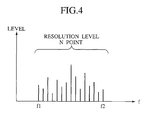
- Fig.4 shows the relation of frequency, which should be obtained by an object discrete Fourier analysis.
- the same Figure shows recursive discrete Fourier transformation in which the minimum frequency of a frequency band to be analyzed is f1 while the maximum frequency thereof is f2 and N-point resolution is provided between f1 and f2. Then, a method of carrying out the DFT under such indicated resolution will be described.
- the basic frequency setting portion 2 represented on the recursive discrete Fourier transformation device shown in Fig. 1 and based on the resolution information set up here, the Fourier transformation is carried out such that while the minimum frequency of arbitrary frequency band is f1 and the maximum frequency is f2, a desired resolution (frequency interval), indicated with any of values which divides an interval between f1 and f2 to N, is N point.
- the values of f1, f2 and fs are set up so that k/N relating to the basic frequency indicated in the circular functions coincides with a desired frequency band.
- Equations for carrying out transformation at an arbitrary frequency resolution which corresponds to the equations (11), (12) are expressed as equations (21), (22).
- Fig.5 shows the structure for carrying out the Fourier transformation at an arbitrary frequency resolution.
- sampling data sampled at every equal time interval is supplied to a Fourier operating portion 6, which is a linearly invariable system, in succession, so that for example, data x(t+N) is supplied at time t+N.
- a basic frequency setting portion 7 sets up a lower limit frequency f1 and a upper limit frequency f2 of an arbitrary frequency band to be analyzed and then a desired resolution N. Then, a basic frequency to be transformed is determined according to the aforementioned equation (20) and supplied to the Fourier operating portion 6, which is a linearly invariable system.
- the Fourier operating portion 6 carries out IIR filter processing having a transfer function indicated by the aforementioned equation (19) according to the basic frequency.
- the Fourier operating portion 6 supplies X r (k, t+1) as the real part of the Fourier coefficient to N sampling data supplied since time t+1 and X i (k, t+1) as the imaginary part thereof. Consequently, the DFT arithmetic operation can be carried out in a desired arbitrary frequency band at a desired resolution at every sampling time interval.
- the basic frequency set by a predetermined k value is capable of obtaining a result of transformation processing independently of analysis on the basic frequency set by other k value, a result of Fourier transformation operation on a specific basic frequency relating to arbitrary k value may be obtained independently.
- the recursive discrete Fourier transformation method shown here is expected to be widely applied as a signal analysis method, which will be employed in more diversified ways in future.
- the recursive discrete Fourier transformation method has been described above. Because this transformation method is capable of selecting a basic frequency preferable for analysis, the number of points to be handled is not restricted to power of 2 unlike in case of the FFT, so that any positive integer can be adopted.
- sampling data to be supplied is real number data, even if the sampling data is complex data like shown below, it can be expanded.
- Fig.6 shows an embodiment of the recursive inverse discrete Fourier transformation device, to which the recursive inverse discrete Fourier transformation method is applied. This embodiment will be described with reference to the same Figure. It is assumed that the sampling data to be supplied is complex data.
- This recursive inverse discrete Fourier transformation device comprises a data updating portion 11, which is supplied with data sampled at every predetermined time interval, for storing supplied new N data (N: positive integer) temporarily, a basic frequency setting portion 12 for setting the basic frequency for carrying out the inverse discrete Fourier transformation, a recursive inverse discrete Fourier transformation (IDFT) operating portion 13 and a memory portion 14 for storing computed data temporarily.
- N positive integer
- supplied complex data is sampled by a sampling circuit (not shown) at every predetermined time interval, so that discrete data of the real part and imaginary part, sampled and quantitized, are supplied to the data updating portion 11.
- the sampling circuit samples data values supplied at times t, t+1, t+2, t+3, ..., t+N-1, t+N (N: natural number) each having an equal interval so as to generate data stream x r (t) + jx i , x r (t+1) + jx i (t+1), x r (t+2) + jx i (t+2), x r (t+3) + jx i (t+3), ..., x r (t+N-1) + jx i (t+N-1), x r (t+N) + jx i (t+N) with data value supplied at each time as sampling value corresponding to each time.
- the data updating portion 11 updates complex data of new N data (N: positive integer) of the supplied data and stores them therein temporarily.
- the N data stored temporarily is supplied to the recursive IDFT operating portion 13 and a last FFT operation result stored in the memory 14 temporarily is supplied to the recursive IDFT operating portion 13 as recursive data. Then, the recursive IDFT operating portion 13 carries out recursive discrete inverse Fourier transformation according to frequency resolution information set up by the basic frequency setting portion 12 in a manner described later and outputs a result of its arithmetic operation.
- the operation result subjected to inverse discrete Fourier transformation by operation by the recursive IDFT operating portion 13 is supplied to the memory portion 14 and stored therein temporarily.
- the temporarily stored operation result is supplied to the recursive IDFT operating portion 13.
- the IDFT operation for next supplied data is carried out, so that the result of the IDFT operation is used recursively.
- the recursive inverse discrete Fourier transformation is carried out for N complex data supplied in this manner and its arithmetic operation is carried out through the same processing as the aforementioned recursive DFT transformation method.
- complex Fourier coefficient X r (k, t+1) + jX i (k, t+1) at sampling time t+1 can be obtained according to following equations (27), (28) by using a difference between newly complex data x r (t+N) + jx i (t+N) sampled and fetched at sampling time t+1 and the oldest complex data x r (t) + jx i (t) of N-data stream and complex Fourier coefficient X r (k, t) + jX i (k, t) already obtained at sampling time t.
- B N , 0 ⁇ k ⁇ N - 1
- the recursive IDFT transformation is carried out in the above way.
- the inverse Fourier transformation is also capable of transforming the newest N-point data stream containing new data, which is sampled successively at every sampling time interval shown in Fig.2.
- equations (29), (30) an equation for carrying out inverse transformation at an arbitrary frequency resolution is expressed in the form of equations (31), (32).
Landscapes
- Physics & Mathematics (AREA)
- Engineering & Computer Science (AREA)
- General Physics & Mathematics (AREA)
- Mathematical Physics (AREA)
- Computational Mathematics (AREA)
- Mathematical Analysis (AREA)
- Mathematical Optimization (AREA)
- Pure & Applied Mathematics (AREA)
- Data Mining & Analysis (AREA)
- Theoretical Computer Science (AREA)
- Discrete Mathematics (AREA)
- Algebra (AREA)
- Databases & Information Systems (AREA)
- Software Systems (AREA)
- General Engineering & Computer Science (AREA)
- Complex Calculations (AREA)
- Solid-Sorbent Or Filter-Aiding Compositions (AREA)
Applications Claiming Priority (6)
| Application Number | Priority Date | Filing Date | Title |
|---|---|---|---|
| JP2000198374 | 2000-06-30 | ||
| JP2000198374A JP2002014948A (ja) | 2000-06-30 | 2000-06-30 | 再帰型離散フーリエ変換方法 |
| JP2000204916 | 2000-07-06 | ||
| JP2000204916 | 2000-07-06 | ||
| JP2000234130A JP2002049611A (ja) | 2000-08-02 | 2000-08-02 | 再帰型離散フーリエ変換方法 |
| JP2000234130 | 2000-08-02 |
Publications (2)
| Publication Number | Publication Date |
|---|---|
| EP1168192A2 true EP1168192A2 (fr) | 2002-01-02 |
| EP1168192A3 EP1168192A3 (fr) | 2004-02-25 |
Family
ID=27343925
Family Applications (1)
| Application Number | Title | Priority Date | Filing Date |
|---|---|---|---|
| EP01114884A Withdrawn EP1168192A3 (fr) | 2000-06-30 | 2001-06-29 | Transformée de Fourier discrète et récursive |
Country Status (3)
| Country | Link |
|---|---|
| US (1) | US20020016807A1 (fr) |
| EP (1) | EP1168192A3 (fr) |
| CN (1) | CN1331533A (fr) |
Cited By (2)
| Publication number | Priority date | Publication date | Assignee | Title |
|---|---|---|---|---|
| EP1176516A3 (fr) * | 2000-07-18 | 2004-03-24 | Victor Company Of Japan Limited | Dispositif de calcul d'une transformée de Fourier discrète et récursive |
| EP2124367A4 (fr) * | 2007-03-13 | 2014-02-26 | Fujitsu Semiconductor Ltd | Appareil de communication multi-porteuse |
Families Citing this family (4)
| Publication number | Priority date | Publication date | Assignee | Title |
|---|---|---|---|---|
| US20090149871A9 (en) * | 2002-11-01 | 2009-06-11 | Jonathan Kagan | Devices and methods for treating morbid obesity |
| US8477885B2 (en) | 2011-01-21 | 2013-07-02 | Northrop Grumman Systems Corporation | Recursive frequency estimation |
| CN108717141B (zh) * | 2018-04-26 | 2020-11-20 | 南京合智电力科技有限公司 | 利用单相电压测量电气量频率的方法、测量系统 |
| CN109117832A (zh) * | 2018-10-12 | 2019-01-01 | 成都理工大学 | 高阶同步提取变换信号时频分析方法 |
Family Cites Families (6)
| Publication number | Priority date | Publication date | Assignee | Title |
|---|---|---|---|---|
| US3778606A (en) * | 1972-02-23 | 1973-12-11 | Sanders Associates Inc | Continuously updating fourier coefficients every sampling interval |
| US4023028A (en) * | 1974-08-20 | 1977-05-10 | The United States Of America As Represented By The Secretary Of The Navy | Method and apparatus for computing the discrete Fourier transform recursively |
| FR2584213B1 (fr) * | 1985-06-28 | 1994-03-11 | Thomson Csf | Dispositif de calcul d'une transformee de fourier discrete, glissante, et son application a un systeme radar. |
| FR2587819B1 (fr) * | 1985-09-24 | 1989-10-06 | Thomson Csf | Dispositif de calcul d'une transformee de fourier discrete, glissante et non recursive, et son application a un systeme radar |
| US4965761A (en) * | 1988-06-03 | 1990-10-23 | General Dynamics Corporation, Pomona Div. | Fast discrete fourier transform apparatus and method |
| US4972358A (en) * | 1989-06-08 | 1990-11-20 | General Electric Company | Computation of discrete fourier transform using recursive techniques |
-
2001
- 2001-06-27 US US09/891,392 patent/US20020016807A1/en not_active Abandoned
- 2001-06-28 CN CN01118882.0A patent/CN1331533A/zh active Pending
- 2001-06-29 EP EP01114884A patent/EP1168192A3/fr not_active Withdrawn
Cited By (3)
| Publication number | Priority date | Publication date | Assignee | Title |
|---|---|---|---|---|
| EP1176516A3 (fr) * | 2000-07-18 | 2004-03-24 | Victor Company Of Japan Limited | Dispositif de calcul d'une transformée de Fourier discrète et récursive |
| EP2124367A4 (fr) * | 2007-03-13 | 2014-02-26 | Fujitsu Semiconductor Ltd | Appareil de communication multi-porteuse |
| US8731084B2 (en) | 2007-03-13 | 2014-05-20 | Fujitsu Semiconductor Limited | Multi-carrier communication apparatus |
Also Published As
| Publication number | Publication date |
|---|---|
| CN1331533A (zh) | 2002-01-16 |
| US20020016807A1 (en) | 2002-02-07 |
| EP1168192A3 (fr) | 2004-02-25 |
Similar Documents
| Publication | Publication Date | Title |
|---|---|---|
| Lu et al. | Optimal design of frequency-response-masking filters using semidefinite programming | |
| Lim et al. | A new algorithm for two-dimensional maximum entropy power spectrum estimation | |
| EP2270981A2 (fr) | Appareil de traitement de signal numérique et procédé de traitement de signal numérique | |
| JPH07202634A (ja) | プログラム可能な分割法または補間法係数を備えたデータコンバータ | |
| EP2658124B1 (fr) | Circuit de filtre numérique et procédé de commande d'un filtre numérique | |
| US5648777A (en) | Data converter with FIFO | |
| EP1176516A2 (fr) | Dispositif de calcul d'une transformée de Fourier discrète et récursive | |
| EP1168192A2 (fr) | Transformée de Fourier discrète et récursive | |
| CN1106074C (zh) | 抽取方法和抽取滤波器 | |
| DE10337782B4 (de) | Methode und Schaltung zur effektiven Konvertierung von PCM-in PWM-Daten | |
| Mitra et al. | New methods of digital ladder realization | |
| La Pastina et al. | Arbitrary-order IIR antiderivative antialiasing | |
| US6295547B1 (en) | Fourier transform apparatus | |
| Trinder | Hardware-software configuration for high performance digital filtering in real-time | |
| JP2002117017A (ja) | 再帰型離散フーリエ変換装置 | |
| EP0663735A2 (fr) | Filtre de synthèse en sous bandes | |
| Principe et al. | Microcomputer-based digital filters for EEG processing | |
| JP2002049611A (ja) | 再帰型離散フーリエ変換方法 | |
| JP2002082928A (ja) | 再帰型離散フーリエ変換方法、及び再帰型逆離散フーリエ変換方法 | |
| Al-Rawi et al. | Novel Simple Approach to Digital Signal Processing of Sinusoids with MATLAB Using Discrete Fourier Transform | |
| JP2002032356A (ja) | 再帰型離散フーリエ変換装置 | |
| KR102866970B1 (ko) | 고속의 stft를 이용한 주파수 진폭 계산 장치 및 그 방법 | |
| JP2002014948A (ja) | 再帰型離散フーリエ変換方法 | |
| de Carvalho et al. | Digital Signal Processing | |
| Chin et al. | Design and Implementaion of a Real-time Digitat signal Processing Algorithm Instruction Developer (DSP-AID) |
Legal Events
| Date | Code | Title | Description |
|---|---|---|---|
| PUAI | Public reference made under article 153(3) epc to a published international application that has entered the european phase |
Free format text: ORIGINAL CODE: 0009012 |
|
| AK | Designated contracting states |
Kind code of ref document: A2 Designated state(s): AT BE CH CY DE DK ES FI FR GB GR IE IT LI LU MC NL PT SE TR |
|
| AX | Request for extension of the european patent |
Free format text: AL;LT;LV;MK;RO;SI |
|
| PUAL | Search report despatched |
Free format text: ORIGINAL CODE: 0009013 |
|
| AK | Designated contracting states |
Kind code of ref document: A3 Designated state(s): AT BE CH CY DE DK ES FI FR GB GR IE IT LI LU MC NL PT SE TR |
|
| AX | Request for extension of the european patent |
Extension state: AL LT LV MK RO SI |
|
| 17P | Request for examination filed |
Effective date: 20040219 |
|
| 17Q | First examination report despatched |
Effective date: 20040512 |
|
| AKX | Designation fees paid |
Designated state(s): DE FR GB |
|
| STAA | Information on the status of an ep patent application or granted ep patent |
Free format text: STATUS: THE APPLICATION IS DEEMED TO BE WITHDRAWN |
|
| 18D | Application deemed to be withdrawn |
Effective date: 20040923 |