EP1168202A2 - Appareil de recouvrement de documents similaires et appareil pour extraire des mots-clés pertinents - Google Patents
Appareil de recouvrement de documents similaires et appareil pour extraire des mots-clés pertinents Download PDFInfo
- Publication number
- EP1168202A2 EP1168202A2 EP01305637A EP01305637A EP1168202A2 EP 1168202 A2 EP1168202 A2 EP 1168202A2 EP 01305637 A EP01305637 A EP 01305637A EP 01305637 A EP01305637 A EP 01305637A EP 1168202 A2 EP1168202 A2 EP 1168202A2
- Authority
- EP
- European Patent Office
- Prior art keywords
- document
- keyword
- feature vector
- extracting
- vector
- Prior art date
- Legal status (The legal status is an assumption and is not a legal conclusion. Google has not performed a legal analysis and makes no representation as to the accuracy of the status listed.)
- Withdrawn
Links
Images


Classifications
-
- G—PHYSICS
- G06—COMPUTING OR CALCULATING; COUNTING
- G06F—ELECTRIC DIGITAL DATA PROCESSING
- G06F16/00—Information retrieval; Database structures therefor; File system structures therefor
- G06F16/30—Information retrieval; Database structures therefor; File system structures therefor of unstructured textual data
-
- Y—GENERAL TAGGING OF NEW TECHNOLOGICAL DEVELOPMENTS; GENERAL TAGGING OF CROSS-SECTIONAL TECHNOLOGIES SPANNING OVER SEVERAL SECTIONS OF THE IPC; TECHNICAL SUBJECTS COVERED BY FORMER USPC CROSS-REFERENCE ART COLLECTIONS [XRACs] AND DIGESTS
- Y10—TECHNICAL SUBJECTS COVERED BY FORMER USPC
- Y10S—TECHNICAL SUBJECTS COVERED BY FORMER USPC CROSS-REFERENCE ART COLLECTIONS [XRACs] AND DIGESTS
- Y10S707/00—Data processing: database and file management or data structures
- Y10S707/99931—Database or file accessing
- Y10S707/99933—Query processing, i.e. searching
- Y10S707/99935—Query augmenting and refining, e.g. inexact access
Definitions
- the present invention relates to a similar document retrieving apparatus which designates one or plural document data from a document database (i.e., set or assembly of document data) which is electronically stored as strings of character codes and machine treatable or processible, or designates an arbitrary sentence not involved in this database, as a typical example.
- the similar document retrieving apparatus retrieves one or more documents similar to the designated typical example from the document database.
- the present invention relates to a relevant keyword extracting apparatus which extracts one or more keywords relating to the "typical example" from the document database.
- the relevant keyword extracting apparatus presents the extracted keywords to the users of this document database as an aid for comprehension of the retrieved document contents, or as a hint for preferable retrieval conditions (i.e., queries).
- the present invention makes it possible to perform highly accurate document retrieval and keyword extraction.
- a Boolean expression of keywords is generally designated as queries. It is checked whether or not a designated keyword appears in the documents. And, a document set satisfying the Boolean expression is obtained as a retrieval result.
- United States patent No. 4,839,853 discloses a conventional method for retrieving similar documents, which is called as LSI (latent semantic indexing) method.
- the LSI method When applied to a document database D containing N document data, the LSI method mechanically extracts a keyword, i.e., a characteristic word representing each document, to record the frequency of occurrence (i.e., the number of times) of each keyword appearing in each document. It is now assumed that a total of M kinds of keywords are extracted from the document database D.
- a keyword i.e., a characteristic word representing each document
- Extracted keywords are aligned according to a dictionary order or an appropriate order. Then, a frequence-of-appearance f dt of a t-th keyword is expressed as an element of d-th line and t-th row of a matrix F. Then, trough a matrix operation called as incomplete singular value decomposition, this matrix F is approximately decomposed into a product of a matrix U of N lines and K rows having document-side singular vector in each row, a diagonal matrix A of K lines and L rows having singular values aligned as diagonal elements, and a matrix V of K lines and M rows having a keyword-side singular vector in each line. In this case, K is sufficiently small compared with N and M. As a result, the original frequency-of-occurrence matrix F can be approximately expressed by a lower-rank matrix.
- a total of K document-side singular vectors are obtained through the above decomposition.
- a feature vector U d of the document d is obtained as a K-dimensional vector containing respective d-th components of the obtained K document-side singular vectors.
- a total of K keyword-side singular vectors are obtained through the above decomposition.
- a feature vector V t of the keyword t is obtained as a K-dimensional vector containing respective t-th components of the obtained K keyword-side singular vectors.
- calculation of similarity and relevancy is performed according to the following three procedures so as to obtain documents and keywords having higher similarities and relevancies, thereby realizing the similar document retrieval and the relevant keyword extraction.
- the feature vector obtained will be somewhat deviated due to presence of longer documents or frequently appearing keywords. This will significantly worsen the accuracy of similar document retrieval.
- the LTC method conventionally used in the relevant ranking of a document retrieving system or a comparative method is introduced to convert or normalize the keyword frequency-of-occurrence f dt . Then, a frequency-of-occurrence matrix F is created so as to contain the normalized frequency-of-occurrence values. Then, the incomplete singular value decomposition is performed to obtain a feature vector.
- the following equation is used to calculate a frequency-of-occurrence LTC (f dt ) based on the actual frequency-of-occurrence f dt the number n t of documents containing the keyword t.
- a matrix containing this value is subjected to the incomplete singular value decomposition.
- the obtained retrieval result will be the ones far from the intent of the retrieval.
- the accuracy of retrieval is greatly worsened.
- the present invention has an object to provide a similar document retrieving apparatus and a relevant keyword extracting apparatus which can normalize both of the document side and the keyword side and maintain higher retrieving accuracy.
- the present invention provides a first similar document retrieving apparatus applicable to a document database D which stores N document data containing a total of M kinds of keywords and is machine processible, for designating a retrieval condition (i.e., query) consisting of a document group including at least one document x 1 , ----, x r selected from the document database D and for retrieving documents similar to the document group of the retrieval condition from the document database D.
- a retrieval condition i.e., query
- the first similar document retrieving apparatus of this invention comprises: keyword frequency-of-occurrence calculating means for calculating a keyword frequency-of-occurrence data F which represents a frequency-of-occurrence f dt of each keyword t appearing in each document d stored in the document database D; document length calculating means for calculating a document length data L which represents a length l d of each document d; keyword weight calculating means for calculating a keyword weight data W which represents a weight w t of each keyword t of the M kinds of keywords appearing in the document database D; document profile vector producing means for producing a M-dimensional document profile vector P d having components respectively representing a relative frequency-of-occurrence p dt of each keyword t in the concerned document d; document principal component analyzing means for performing a principal component analysis on a document profile vector group of a document group in the document database D and for obtaining a predefined (K)-dimensional document feature vector U d corresponding to the document profile vector P d for each document d; and similar document retrieving means
- the present invention provides a second similar document retrieving apparatus applicable to a document database D which stores N document data containing a total of M kinds of keywords and is machine processible, for designating a retrieval condition (i.e., query) consisting of a keyword group including at least one keyword y 1 ,---- , y s selected from the document database D and for retrieving documents relevant to the retrieval condition from the document database D.
- a retrieval condition i.e., query
- the second similar document retrieving apparatus of this invention comprises: keyword profile vector calculating means for calculating a N-dimensional keyword profile vector Q t having components respectively representing a relative frequency-of-occurrence q dt of the concerned keyword t in each document d; document principal component analyzing means for performing a principal component analysis on a document profile vector group of a document group in the document database D and for obtaining a predefined (K)-dimensional document feature vector U d corresponding to the document profile vector P d for each document d; keyword principal component analyzing means for performing a principal component analysis on a keyword profile vector group of a keyword group in the document database D and for obtaining a predefined (K)-dimensional keyword feature vector V t corresponding to the keyword profile vector Q t for each keyword t, the keyword feature vector having the same dimension as that of the document feature vector, as well as for obtaining a
- the present invention provides a first relevant keyword extracting apparatus applicable to a document database D which stores N document data containing a total of M kinds of keywords and is machine processible, for designating an extracting condition consisting of a keyword group including at least one keyword y 1 ,----, y s selected from the document database D and for extracting keywords relevant to the keyword group of the extracting condition from the document database D.
- the second relevant keyword extracting apparatus of this invention comprises: keyword profile vector calculating means for calculating a N-dimensional keyword profile vector Q t having components respectively representing a relative frequency-of-occurrence q dt of the concerned keyword t in each document d; keyword principal component analyzing means for performing a principal component analysis on a keyword profile vector group of a keyword group in the document database D and for obtaining a predefined (K)-dimensional keyword feature vector V t corresponding to the keyword profile vector Q t for each keyword t; and relevant keyword extracting means for receiving the extracting condition consisting of the keyword group including at least one keyword y 1 ,----, y s selected from the document database D, calculating a relevancy between each keyword t and the extracting condition based on a keyword feature vector of the received keyword group and the keyword feature vector of each keyword t in the document database D, and outputting a designated number of relevant
- the present invention provides a second relevant keyword extracting apparatus applicable to a document database D which stores N document data containing a total of M kinds of keywords and is machine processible, for designating an extracting condition consisting of a document group including at least one document x 1 , ----, x r selected from the document database D and for extracting keywords relevant to the document group of the extracting condition from the document database D.
- the second relevant keyword extracting apparatus of this invention comprises: document principal component analyzing means for performing a principal component analysis on a document profile vector group of a document group in the document database D and for obtaining a predefined (K)-dimensional document feature vector U d corresponding to the document profile vector P d for each document d as well as for obtaining a document contribution factor (i.e., eigenvalue of a correlation matrix) ⁇ j of each dimension j; keyword principal component analyzing means for performing a principal component analysis on a keyword profile vector group of a keyword group in the document database D and for obtaining a predefined (K)-dimensional keyword feature vector V t corresponding to the keyword profile vector Q t for each keyword t, the keyword feature vector having the same dimension as that of the document feature vector; extracting condition feature vector calculating means for receiving the extracting
- the frequency-of-occurrence of each keyword in a concerned document is expressed as a document profile vector and the frequency-of-appearance of a concerned keyword in each document as a keyword profile vector.
- a weighted principal component analysis considering the document length and the keyword weight is independently performed to obtain both of a document feature vector and a keyword feature vector.
- the vector representation in the document profile and in the keyword profile is not dependent on the conversion (i.e., normalization) of frequency-of-occurrence.
- the document length data and the keyword weight data, relevant to the conversion of frequency-of-occurrence, are indirectly reflected as the weight in the principal component analysis. Thus, it becomes possible to perform the normalization without depending on the conversion of frequency-of-occurrence.
- the present invention makes it possible to provide the similar document retrieving apparatus and the relevant keyword extracting apparatus which are highly accurate.
- Fig. 1 is a block diagram showing an overall arrangement of a similar document retrieving and relevant keyword extracting system which is realized as a function of a digital electronic computer and acts as a similar document retrieving apparatus and a relevant document extracting apparatus in accordance with a preferred embodiment of the present invention.
- This system comprises a newspaper full text database 101 storing various news documents together with their document numbers, headlines, and text bodies.
- Each news document i.e., individual newspaper article, serves as a retrieval unit.
- a keyword extracting and counting section 102 scans character strings in the text body of each newspaper article stored in the newspaper full text database 101 to extract keywords appearing in each newspaper article and to count each keyword as the frequency of occurrence of this word.
- a keyword frequency-of-occurrence file 103 stores an extraction and counting result obtained by the keyword extracting and counting section 102.
- a document length calculating section 104 calculates a document length of each newspaper article according to a document length calculation mode given as an external parameter based on the number of characters in character strings contained in the body of each newspaper article by accessing the newspaper full text database 101 or based on the total number of keywords appearing in each newspaper article by accessing the keyword frequency-of-occurrence file 103.
- a document length file 105 stores calculation result obtained by the document length calculating section 104.
- a keyword weight calculating section 106 calculates a weighted value of each keyword with reference to the keyword frequency-of-occurrence file 103.
- a keyword weight file 107 stores calculation result obtained by the keyword weight calculating section 106.
- a keyword profile vector producing section 108 produces a keyword profile vector representing the feature of each keyword based on the keyword frequency-of-occurrence file 103 and the document length file 105.
- a keyword profile vector file 109 stores keyword profile vector groups produced by the keyword profile vector producing section 108.
- a document profile vector producing section 110 produces a document profile vector representing the feature of each document based on the keyword frequency-of-occurrence file 103 and the keyword weight file 107.
- a document profile vector file 111 stores document profile vector groups produced by the document profile vector producing section 110.
- a keyword principal component analyzing section 112 performs K-dimensional weighted principal component analysis of the keyword profile vector file 109 with reference to the keyword frequency-of-occurrence file 103, the document length file 105, and the keyword weight file 107, wherein K is a predetermined external parameter.
- K is a predetermined external parameter.
- the keyword principal component analyzing section 112 obtains a total of K principal axes (i.e., eigenvector of correlation matrix) and a contribution factor of each principal axis (i.e., eigenvalue of correlation matrix).
- the keyword principal component analyzing section 112 obtains a feature vector (i.e., component or projection of K principal axes) of each keyword.
- a keyword principal component analysis result file 113 stores analysis result, i.e., feature vector of each keyword and contribution factor of each principal axis, obtained by the keyword principal component analyzing section 112.
- a document principal component analyzing section 114 performs K-dimensional weighted principal component analysis of the document profile vector file 111 with reference to the keyword frequency-of-occurrence file 103, the document length file 105, and the keyword weight file 107. Through the K-dimensional weighted principal component analysis, the document principal component analyzing section 114 obtains a total of K principal axes and a contribution factor of each principal axis. And, the document principal component analyzing section 114 obtains a feature vector (i.e., component or projection of K principal axes) of each document.
- a document principal component analysis result file 115 stores analysis result, i.e., feature vector of each document and contribution factor of each principal axis, obtained by the document principal component analyzing section 114.
- a condition input section 116 allows an operator to input similar article retrieving and relevant keyword extracting conditions for retrieving the newspaper full text database 101 according to the form of either the string of document numbers or the string of keywords.
- a retrieval condition feature vector calculating section 117 calculates a retrieval condition feature vector corresponding to the entered string of document numbers with reference to a corresponding document feature vector in the document principal component analysis result file 115.
- the retrieval condition feature vector calculating section 117 calculates a retrieval condition feature vector corresponding to the entered string of keywords with reference to the keyword weight file 107 and the keyword principal component analysis result file 113.
- an extracting condition feature vector calculating section 118 calculates an extracting condition feature vector corresponding to the entered string of document numbers with reference to the document length file 105 and the document principal component analysis result file 115. Furthermore, when a string of keywords is entered through the condition input section 116, the extracting condition feature vector calculating section 118 calculates an extracting condition feature vector corresponding to the entered string of keywords with reference to a corresponding keyword feature vector in the keyword principal component analysis result file 113.
- a first similar document retrieving section 119 calculates an inner product (a maximum value of the inner product in the case a plurality of documents are designated) between the retrieval condition feature vector calculated by the retrieval condition feature vector calculating section 117 and each document feature vector in the document principal component analysis result file 115. Then, the first similar document retrieving section 119 determines document numbers of 1st to R-th largest documents in the calculated inner product value (R represents the number of acquired documents which is a predetermined external parameter).
- a second similar document retrieving section 120 calculates a distance (a minimum value of the distance in the case a plurality of documents are designated) between the retrieval condition feature vector calculated by the retrieval condition feature vector calculating section 117 and each document feature vector in the document principal component analysis result file 115. Then, the second similar document retrieving section 120 determines document numbers of 1st to R-th smallest documents in the calculated distance value.
- a first relevant keyword extracting section 121 calculates an inner product (a maximum value of the inner product in the case a plurality of keywords are designated) between the extracting condition feature vector calculated by the extracting condition feature vector calculating section 118 and each keyword feature vector in the keyword principal component analysis result file 113. Then, the first relevant keyword extracting section 121 determines 1st to S-th largest keywords in the calculated inner product value (S represents the number of acquired keywords which is a predetermined external parameter).
- a second relevant keyword extracting section 122 calculates a distance (a minimum value of the distance in the case a plurality of keywords are designated) between the extracting condition feature vector calculated by the extracting condition feature vector calculating section 118 and each keyword feature vector in the keyword principal component analysis result file 113. Then, the second relevant keyword extracting section 122 determines 1st to S-th smallest keywords in the calculated distance value.
- a result display section 123 displays the document numbers and titles of retrieved R similar articles as well as the extracted S keywords with their similarities which are displayed in order of the magnitude of similarity.
- This system can retrieve newspaper articles by accessing the newspaper full text database 101.
- This system retrieves articles similar to the designated articles and extracts keywords relevant to the retrieved articles.
- the result display section 123 displays the retrieved similar documents and the extracted relevant keywords.
- an operator designates a string of keywords, e.g., IT, internet, ----, through the condition input section 116, this system retrieves articles similar to the articles containing the designated keywords and extracts keywords relevant to the retrieved articles.
- the result display section 123 displays the retrieved similar documents and the extracted relevant keywords.
- the principal component analysis is performed for respective profile vector data to obtain feature vectors of respective documents and keywords (i.e., vectors having featured components).
- the document length of a concerned newspaper article is calculated based on the number of characters involved in the text body of the concerned article.
- the document length of a concerned newspaper article is calculated based on the total number of keywords (including repetitive counting of the same keyword) obtained from the text body of the concerned article.
- the document length of the concerned newspaper article is calculated by using the document length threshold l 0 instead of using an actual value.
- the document length of a concerned newspaper article is calculated as a ⁇ -th root of the number of characters or the total number of keywords.
- the document length of the concerned newspaper article is calculated as a ⁇ -th root of the document length threshold l 0 .
- the weight of a concerned keyword is calculated according to an expression 1+log 2 (N/n) where N represents the number of all the documents and n represents the number of documents involving the concerned keyword.
- the weight of a concerned keyword is calculated according to an expression log 2 ((N+1)/n).
- a keyword weight offset ⁇ is not 0, the keyword weight is calculated based on corrected values for the entire document number N and the keyword related document number n.
- a keyword weight offset ⁇ is added to each of the entire document number N and the keyword related document number n.
- N+ ⁇ and n+ ⁇ are used as representing the entire document number and the keyword related document number.
- the keyword weight is calculated according to the above-described keyword weight calculating mode.
- K-dimension a total of K (at maximum) sets of eigenvalues and eigenvectors of the correlation matrix data are obtained to express the K-dimensional feature vectors for the document and the keyword.
- the result display section 123 displays the retrieval result obtained by the first similar document retrieving section 119.
- the result display section 123 displays the retrieval result obtained by the second similar document retrieving section 120.
- the result display section 123 displays the extraction result obtained by the first relevant keyword extracting section 121.
- the result display section 123 displays the extraction result obtained by the second relevant keyword extracting section 122.
- a total of ⁇ documents are displayed in order of the magnitude of similarity.
- a total of ⁇ keywords are displayed in order of the magnitude of relevancy.
- the stages (I) and (II) are performed successively based on the thus preset parameters to analyze the newspaper full text database 101, thereby accomplishing the preparation for the similar document retrieval and relevant keyword extraction.
- the stage (III) is performed based on the preset parameters with reference to the analysis result obtained in the stages (I) and (II) to obtain the similar documents and relevant keywords.
- the obtained similar documents and relevant keywords are displayed on the result display section 123.
- the analyzing processing of the stages (I) and (II) is performed only one time and the processing of the stage (III) is performed repetitively as much as necessary.
- stage (I) keywords contained in the newspaper full text database 101 are segmented and processed into three kinds of data: frequency of occurrence of each keyword; length of each document; and weight of each keyword.
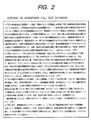
- Fig. 2 shows part of an example of the contents of newspaper full text database 101.
- the newspaper full text database 101 is a text format which is editable and readable through an electronic computer.
- Each newspaper article is regarded as a single document serving as a retrieval unit.
- the newspaper full text database 101 stores a total of 200,000 newspaper articles according to the ascending order of their document numbers.
- Each newspaper article can be classified according to three fields of document number, title, and text body. Three kinds of fields are connected in this order by means of tab character (i.e., a sort of control character indicated as ⁇ TAB> in the drawing).
- One document and the next document are connected by means of form feed character (i.e., a sort of control character indicated as ⁇ FF> in the drawing).
- Document number 1 is assigned to a head or leading (i.e., first) newspaper article.
- Document number 200,000 is assigned to the last (i.e., 200,000th) newspaper article.
- the newspaper full text database is entered into the keyword extracting and counting section 102.
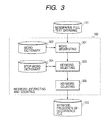
- Fig. 3 is a block diagram showing an internal arrangement of the keyword extracting and counting section 102 which is encircled by a dotted line.
- the keyword extracting and counting section 102 comprises a word segmenting section 301, a word dictionary 302, a keyword selecting section 303, an stop-word dictionary 304, and a keyword counting section 305.
- the word segmenting section 301 reads out one document from the newspaper full text database 101 and picks up any words (morphemes) capable of becoming keyword candidates.
- a similar document retrieving apparatus and a relevant keyword extracting apparatus according to the present invention do not depend on a specific word segmenting method. Hence, various word segmenting methods conventionally known can be used in the present invention.
- words are segmented by using the word dictionary 302, for example, according to the "maximal segmenting" method disclosed in the unexamined Japanese patent publication No. 10-69493.
- the keyword selecting section 303 judges with reference to the stop-word dictionary 304 whether or not each segmented word is an extraneous or unnecessary word in performing the similar document retrieving and relevant keyword extracting operation.
- the segmented word is recognized as a keyword.
- a keyword number is assigned to each newly recognized keyword according to the recognized order.
- the keyword counting section 305 counts the frequency of appearance of each keyword appearing in one document (i.e., one newspaper article). After processing all of the character strings contained in one document, the count result of this document is sent to the keyword frequency-of-occurrence file 103. Then, the processing of the next document is commenced.
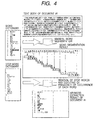
- Fig. 4 shows a practical example of the word segmenting processing.
- word segmentation result shows an example of partial result obtained through the word segmentation performed on a text body field of a document #1 according to the maximal word segmenting method with reference to a left word dictionary.
- Each underlined word i.e., character string
- Each word or character string encircled by a rectangular line is a segmented word or character string.
- stop words such as " " and " ", are removed from the segmentation result. The frequency of occurrence of each word is counted to obtain "keyword extraction result of document #1.”
- Fig. 5 is a flowchart showing a procedure for calculating the document length of a concerned document.
- step 501 it is checked whether the document length calculating mode is the "number of characters" or not.
- the control flow proceeds to step 502.
- the document length calculating mode is the "number of words”
- the control flow proceeds to step 503.
- step 502 i.e., when the document length calculating mode is the "number of characters", 1 is referred to as representing the number of characters contained in a text body field of the concerned document which is obtained with reference to the newspaper full text database 101.
- step 503 i.e., when the document length calculating mode is the "number of words", 1 is referred to as representing the total number of keywords (including repetitive counting of the same keyword) segmented from the text body field of the concerned document which is obtained with reference to the keyword frequency-of-occurrence file 103.
- step 504 it is checked whether or not the calculated value 1 of step 502 or 503 is smaller than the document length threshold l 0 .
- control flow proceeds to step 505 to replace the value l with l 0 .
- step 506 After finishing step 505 or if 1 is not smaller than l 0 , the control flow proceeds to step 506 to further replace the value 1 with a ⁇ -th root of 1.
- the value 1 thus calculated represents the document length of the concerned document and is recorded in the document length file 105.
- the document length calculating mode is set to the "number of characters", the document length threshold l 0 is set to 200, and the document length root ⁇ is 0.5.
- Document #1 shown in Fig. 2 contains 396 characters in the text body field. In this case, the document length 1 of document #1 is calculated as 19.9 through the above-described processing. As document #3 shown in Fig. 2 contains 302 characters in the text body field, the document length 1 of document #3 is calculated as 17.38 through the above-described processing. In this manner, the above-described processing for obtaining the document length 1 is performed for all of the documents in order of the document number, thereby accomplishing the document length file 105.
- the keyword weight calculating section 106 calculates a weight of each keyword according to two kinds of predetermined parameters: the keyword weight calculating mode; and the keyword weight offset ( ⁇ ).
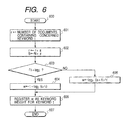
- Fig. 6 is a flowchart showing a procedure for calculating the keyword weight of a specific keyword t.
- step 601 the number r of documents containing the concerned keyword t is calculated with reference to the keyword frequency-of-occurrence file 103.
- step 602 the number r obtained in step 601 is replaced by a sum of the number r and the keyword weight offset ⁇ (i.e. r ⁇ r + ⁇ ). Meanwhile, a value s is given as a sum of the number N of all documents and the keyword weight offset ⁇ (i.e. s ⁇ N + ⁇ ).
- step 603 it is checked whether the keyword weight calculating mode is "l+log” or not.
- the control flow proceeds to step 604.
- the keyword weight calculating mode is "log”
- the control flow proceeds to step 605.
- step 604 i.e., when the keyword weight calculating mode is "l+log", w is represented by an expression 1+log 2 (s/r).
- step 605 i.e., when the keyword weight calculating mode is "log", w is represented by an expression log 2 ((s+1)/r).
- step 606 the calculated value w is sent to the keyword weight file 107 and registered as a keyword weight for the concerned keyword t.
- the above-described processing for obtaining the keyword weight w is performed for all of the keywords in order of the keyword number, thereby accomplishing the keyword weight file 107.
- the keyword weight calculating mode is set to "1+log", and the keyword weight offset ⁇ is set to 10. It is now assumed that a keyword “I T (IT technology)" appears in the text body of a total of 22 newspaper articles. In this case, the keyword weight of "IT (IT technology)” is calculated as 13.61 through the above-described processing. It is also assumed that a keyword “ (domestic)” appears in the text body of a total of 2519 newspaper articles. In this case, the keyword weight of " (domestic)” is calculated as 7.31 through the above-described processing.
- stage (I) the keyword frequency-of-occurrence file 103, the document length file 105, and the keyword weight file 107 are created.
- stage (II) the processing in the stage (II) is explained with reference to the drawings.
- the profile vector data of document/keyword is produced.
- the principal component analysis is performed for respective profile vector data to obtain feature vectors of respective documents and keywords.
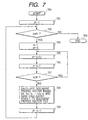
- Fig. 7 is a flowchart showing a procedure for calculating the document profile vector data.
- step 701 to create a document profile vector, a concerned document number d is initialized to 1 (i.e., d ⁇ 1).
- step 702 it is checked whether or not the concerned document number d is equal to or smaller than the number N of all documents. When d is larger than N, the control flow proceeds to step 703 to terminate this calculation processing. When d is equal to or smaller than N, the control flow proceeds to step 704.
- step 704 the keyword number t is initialized to 1, and the normalized factor s is initialized to 0.
- step 705 a frequency-of-occurrence f dt of the keyword t of the document d is obtained with reference to the keyword frequency-of-occurrence file 103. Then, the normalized factor s is replaced with a sum of s and f dt (i.e., s ⁇ s+ f dt ).
- step 706 the concerned keyword number t is incremented by 1 (i.e., t ⁇ t+1).
- step 707 it is checked whether the keyword number t is equal to or smaller than the number M of all keywords. When t is equal to or smaller than M, the control flow returns to step 705 to process the next keyword.
- step 708 After the normalized factor s is obtained according to the document profile vector calculating mode in this manner, the control flow proceeds to step 708.
- step 708 the document profile vector of the document d is calculated based on a relative frequency-of-occurrence vector (i.e., (f d1 /s, ----, f dM /s)) and sent to the document profile vector file 111.
- a relative frequency-of-occurrence vector i.e., (f d1 /s, ----, f dM /s)
- step 709 the concerned document number d is incremented by 1 (d ⁇ d+1). Then, the control flow returns to step 702 to process the next document.
- the document profile vector file 111 is created.
- the document profile vector of the document #1 in the newspaper article full text database shown in Fig. 2 is obtained in the following manner with reference to the keywords numbered in the word dictionary of Fig. 4. (2/92, 1/92, 0, 1/92, 1/92, 0, 0, 1/92, -----) where the first component of the document profile vector corresponds to #1 keyword stored in the word dictionary. Similarly, second and third components correspond to #2 keyword "IT" and #3 keyword "IT " in the word dictionary.
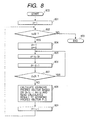
- Fig. 8 is a flowchart showing a procedure for calculating the keyword profile vector data.
- step 801 to produce a keyword profile vector, a concerned keyword number t is initialized to 1 (i.e., t ⁇ 1).
- step 802 it is checked whether or not the concerned keyword number t is equal to or smaller than the number M of all keywords. When t is larger than M, the control flow proceeds to step 803 to terminate this calculation processing. When t is equal to or smaller than M, the control flow proceeds to step 804.
- step 804 the document number d is initialized to 1, and the normalized factor s is initialized to 0.
- step 805 a frequency-of-occurrence f dt of the keyword t of the document d is obtained with reference to the keyword frequency-of-occurrence file 103. Then, the normalized factor s is replaced with a sum of s and f dt (i.e., s ⁇ s+ f dt ).
- step 806 the concerned document number d is incremented by 1 (i.e., d ⁇ d+1).
- step 807 it is checked whether the document number d is equal to or smaller than the number N of all documents. When d is equal to or smaller than N, the control flow returns to step 805 to process the next keyword.
- step 808 After the normalized factor s is obtained according to the keyword profile vector calculating mode in this manner, the control flow proceeds to step 808.
- step 808 the keyword profile vector of the keyword t is calculated based on a relative frequency-of-occurrence vector (i.e., (f 1t /s, ----, f Nt /s)) and sent to the keyword profile vector file 109.
- a relative frequency-of-occurrence vector i.e., (f 1t /s, ----, f Nt /s)
- step 809 the concerned keyword number t is incremented by 1 (t ⁇ t+1). Then, the control flow returns to step 802 to process the next keyword.
- the keyword profile vector file 109 is created.
- the keyword profile vector of #1 keyword in the newspaper article full text database shown in Fig. 2 is obtained in the following manner. (1/283, 0, 0, 0, 0, 1/283,----) where the first component of the keyword profile vector corresponds to a relative frequency-of-occurrence of #1 keyword in a newspaper article of the document #1. Similarly, the second component corresponds to a relative frequency-of-occurrence of the #1 keyword in a newspaper article of the document #2.
- the frequency-of-occurrence of the keyword in the document #1 is converted into different values and incorporated into vectors at the document side and the keyword side. This is apparently different from the conversion of keyword frequency-of-appearance data according to the conventional LSI method.
- the present invention introduces the vector representations for the document and the word which are essentially different from conventional ones.
- each of the document profile vector and the keyword profile vector is stable and not dependent on the document length and the keyword weight.
- the document principal component analyzing section 114 and the keyword principal component analyzing section 112 After creating both of the document and keyword profile vector files, the document principal component analyzing section 114 and the keyword principal component analyzing section 112 perform the principal component analysis on respective profile vector data with reference to the document length and the keyword weight. Through the principal component analysis, feature vectors of K dimensions (K is predetermined as an "analysis dimension") of each document and each keyword are obtained together with the contribution factor of each dimension.
- a square root of h t /f represents a degree of dispersion (i.e., an evaluation value of standard deviation) of components p at and p bt of the document profile vectors P a and P b .
- the above formula (2) contains two factors of weight w t and the square root of h t /f.
- the principal component analysis is executed on the assumption that the document profile vectors of the document d of the document length l d are contained in a document profile vector group serving as an object of the principal component analysis by the number proportional to a ratio g d /l d , where g d represents the total number of all keywords appearing in the document d and l d represents the document length of the document d.
- the procedure (1) is equivalent to obtaining an inner product by assuming that there are a total of M coordinate axes (each corresponding to a keyword) in a space of M-dimensional document profile vector, and the space of M-dimensional document profile vector is a distorted space according to which calibrations of respective M coordinate axes are different from each other. Furthermore, it is assumed that there are a plurality of coordinate axes relating to each keyword t and the number of related coordinate axes is proportional to the weight w t of the keyword.
- the components p at and p bt of two document profile vectors P a and P b are respectively divided by (h t /f) 1/2 and then multiplied with each other. Furthermore, by assuming that the number of products thus produced is equal to w t , the keyword weight is directly reflected to the inner product between the document profile vectors.
- an importance of each document is regarded as g d /l d representing a frequency-of-appearance density of keyword, i.e., "the total number" of keywords appearing per unit document length.
- the statistical analysis processing is performed on the assumption that the profile vectors of each document d are contained by the number corresponding to the importance g d /l d .
- the analysis of this invention is performed by thinking much of the documents having higher importance.
- the feature vectors resulting from this analysis indirectly reflect the importance of each document.
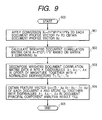
- Fig. 9 is a flowchart of the principal component analysis performed in the document principal component analyzing section 114.
- step 901 a coordinate conversion is performed to deform the "distorted space" of the procedure (1) into an ordinary space which enables to obtain an internal product of vectors as a product-sum of components.
- the coordinate conversion is applied to each document profile vector P d to calculate a document profile vector X d resulting from this coordinate conversion according the following formula.
- X d f 1/2 *W 1/2 *H -1/2 *P d
- f 1/2 represents a square root of "the total number" f of all keywords appearing in the newspaper full text database
- W 1/2 represents a diagonal matrix of M lines ⁇ M rows containing a square root w t 1/2 of the keyword weight w t of the keyword t as an element of t-th line and t-th row
- H -1/2 represents a diagonal matrix of M lines ⁇ M rows containing an inversed square root h t -1/2 of the overall frequency-of-occurrence value of keyword t stored in the newspaper full text database as an element of t-th line and t-th row.
- a weighted document correlation matrix data A is calculated based on a matrix X of M lines ⁇ N rows containing a value X d (refer to formula 3) in the d-th row as well as its transposed matrix X' according to the following formula.
- G represents a diagonal matrix of N lines ⁇ N rows containing "the total number” g d of keywords appearing in the document d as an element of d-th line and d-th row
- L -1 represents a diagonal matrix of N lines ⁇ N rows containing an inverse number l d -1 of the document length l d of the document d as an element of d-th line and d-th row.
- step 903 the obtained matrix A is numerically decomposed into a total of K eigenvalues ⁇ 1, ⁇ 2, ----, ⁇ K successively in order of magnitude as well as a total of K eigenvectors T 1 , T 2 , ----, T k normalized so as to correspond to the decomposed eigenvalues.
- a feature vector U d of each document d is obtained as the following K-dimensional vector of the converted document profile vector X d which has components representing projections to the K eigenvectors obtained in step 903.
- U d (T 1 ⁇ X d , T 2 ⁇ X d , -----, T K ⁇ X d )
- a square root of g d /f represents a degree of dispersion (i.e., an evaluation value of standard deviation) of components q ad and q bd of the keyword profile vectors Q a and Q b .
- the above formula (6) contains two factors of document length l d and the square root of g d /f.
- the principal component analysis is executed on the assumption that the keyword profile vectors of the keyword t of the keyword weight w t are contained in a keyword profile vector group serving as an object of the principal component analysis by the number proportional to a h t *w t , where h t represents an overall frequency-of-occurrence value of keyword t stored in the newspaper full text database 101 and w t represents the keyword weight of the keyword t.
- the procedure (1) is equivalent to obtaining an inner product by assuming that there are a total of N coordinate axes (each corresponding to a document) in a space of N-dimensional keyword profile vector, and the space of N-dimensional keyword profile vector is a distorted space according to which calibrations of respective N coordinate axes are different from each other. Furthermore, it is assumed that there are a plurality of coordinate axes relating to each document d and the number of related coordinate axes is inverse proportional to the document length l d .
- the components q ad and q bd of two keyword profile vectors Q a and Q b are respectively divided by (g d /f) 1/2 and then multiplied with each other. Furthermore, by assuming that the number of products thus produced is equal to l d -1 , the document length is directly reflected to the inner product between the keyword profile vectors.
- an importance of each keyword is regarded as h t /w t .
- the statistical analysis processing is performed on the assumption that the profile vectors of each keyword t are contained by the number corresponding to the importance h t /w t .
- the analysis of this invention is performed by thinking much of the keywords having higher importance.
- the feature vectors resulting from this analysis indirectly reflect the importance of each keyword.
- the keyword analysis processing of this invention can be performed independently without giving any influence to the document analysis processing, and is therefore different from the conventional LSI method.
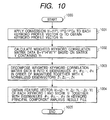
- Fig. 10 is a flowchart of the principal component analysis performed in the keyword principal component analyzing section 112.
- step 1001 a coordinate conversion is performed to deform the "distorted space" of the procedure (1) into an ordinary space which enables to obtain an internal product of vectors as a product-sum of components.
- the coordinate conversion is applied to each keyword profile vector Q t to calculate a keyword profile vector Y t resulting from this coordinate conversion according the following formula.
- Y t f 1/2 *L -1/2 *G -1/2 *Q d
- f 1/2 represents a square root of "the total number" f of all keywords appearing in the newspaper full text database
- L -1/2 represents a diagonal matrix of N lines ⁇ N rows containing an inversed square root l d -1/2 of the document length l d of the document d as an element of d-th line and d-th row
- G -1/2 represents a diagonal matrix of N lines ⁇ N rows containing an inversed square root g d -1/2 of the total number of keywords appearing in the document d as an element of d-th line and d-th row.
- a weighted keyword correlation matrix data B is calculated based on a matrix Y of M lines ⁇ N rows containing a value Y t (refer to formula 7) in the d-th row as well as its transposed matrix Y' according to the following formula.
- B Y*(H*W) *Y'
- H represents a diagonal matrix of M lines ⁇ M rows containing the overall frequency-of-appearance value h t of the keyword t as an element of t-th line and t-th row
- W represents a diagonal matrix of M lines ⁇ M rows containing the weight w t of the keyword t as an element of t-th line and t-th row.
- step 1003 the obtained matrix B is numerically decomposed into a total of K eigenvalues ⁇ 1, ⁇ 2,----, ⁇ K successively in order of magnitude as well as a total of K eigenvectors Z 1 , Z 2 , ----, Z k normalized so as to correspond to the decomposed eigenvalues.
- a feature vector V t of each keyword t is obtained as the following K-dimensional vector of the converted keyword profile vector Y t which has components representing projections to the K eigenvectors obtained in step 1003.
- V t (Z 1 ⁇ Y t , Z 2 ⁇ Y t , -----, Z K ⁇ Y t )
- stage (II) the keyword principal component analysis result file 113 and the document principal component analysis result file 115 are created via the keyword profile vector file 109 and the document profile vector file 111. At this moment, all of the preparations necessary for receiving retrieval/extraction conditions are completed.
- stage (III) the processing of stage (III) is initiated for the similar document retrieval and relevant keyword extraction.
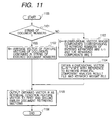
- Fig. 11 is a flowchart showing the procedure for calculating the retrieval condition feature vector performed in the retrieval condition feature vector calculating section 117.
- step 1101 it is checked whether or not a character string entered through the condition input section 116 is a string of document numbers.
- the control flow proceeds to step 1102. Otherwise, the entered character string is regarded as a string of keywords and the control flow proceeds to step 1103. More specifically, if an entered character string consists of numeric characters including at least one of digits "0" to "9" joined by comma ",”, the entered character string is judged as a string of document numbers.
- step 1102 when the entered character string consists of document numbers, a feature vector U d of the document d contained in the entered character string is obtained with reference to the document principal component analysis result file 115. Then, an average vector R of the obtained feature vectors U d is calculated. The average vector R is obtained by multiplying a sum of document feature vectors with an inverse of the document number r.
- step 1103 when the entered character string consists of a total of r keywords, a M-dimensional vector E is created so that a component corresponding to a keyword number of each entered keyword is 1/r and the remaining components are 0.
- a K-dimensional vector R is calculated with reference to the keyword principal component analysis result file 113 and the keyword weight file 107.
- R ⁇ -1 *V*W*E
- ⁇ -1 represents a diagonal matrix of K lines ⁇ K rows containing an inversed contribution factor ⁇ j -1 of each dimension of the keyword feature vector
- V represents a keyword feature matrix of K lines ⁇ M rows containing a keyword feature vector Vt of the keyword t in the t-th row
- W represents a diagonal matrix of M lines ⁇ M rows containing the weight w t of each keyword as an element of t-th line and t-th row.
- step 1105 the K-dimensional vector R created in step 1102 or steps 1103 to 1104 is recognized as a retrieval condition feature vector and sent to the first similar document retrieving section 119 and to the second similar document retrieving section 120.
- step 1104 only necessary thing is to obtain the keyword weight w t corresponding to the component of E which is not 0 and the keyword feature vector V t from the keyword weight file 107 and the keyword principal component analysis result file 113.
- the total number r of input keywords is in the level of several tens or less, calculation of the vector R can be performed speedily.
- the first similar document retrieving section 119 calculates an inner product between the document feature vector U d stored in the document principal component analysis result file 115 and the retrieval condition feature vector R to select 1st to ⁇ -th largest documents in the calculated inner product value, where ⁇ is a predetermined parameter representing a "displayed similar document number.” Then, a total of ⁇ sets, each set being a combination of a document number and an inner product between U d and R, are sent to the result display section 123.
- the second similar document retrieving section 120 calculates a distance between the document feature vector U d stored in the document principal component analysis result file 115 and the retrieval condition feature vector R to select 1st to ⁇ -th smallest documents in the calculated distance value. Then, a total of ⁇ sets, each set being a combination of a document number and a distance between U d and R, are sent to the result display section 123.
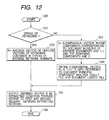
- Fig. 12 is a flowchart showing the procedure for calculating the extracting condition feature vector performed in the extracting condition feature vector calculating section 118.
- step 1201 it is checked whether or not a character string entered through the condition input section 116 is a string of keywords.
- the control flow proceeds to step 1202. Otherwise, the entered character string is regarded as a string of document numbers and the control flow proceeds to step 1203. More specifically, if an entered character string consists of numeric characters including at least one of digits "0" to "9" joined by comma ",”, the entered character string is judged as a string of document numbers. Otherwise, the entered character string is regarded as a string of keywords.
- step 1202 when the entered character string consists of keywords, a feature vector V t of the keyword t contained in the entered character string is obtained with reference to the keyword principal component analysis result file 113. Then, an average vector R of the obtained feature vectors V t is calculated. The average vector R is obtained by multiplying a sum of keyword feature vectors with an inverse of the keyword number r.
- step 1203 when the entered character string consists of a total of r document numbers, a N-dimensional vector E is created so that a component corresponding to a document number of each entered document is 1/r and the remaining components are 0.
- a K-dimensional vector R is calculated with reference to the document principal component analysis result file 115 and the document length file 105.
- R ⁇ -1 *U*L -1 *E
- ⁇ -1 represents a diagonal matrix of K lines ⁇ K rows containing an inversed contribution factor ⁇ j -1 of each dimension of the document feature vector
- U represents a document feature matrix of K lines ⁇ N rows containing a document feature vector U d of the document number d in the d-th row
- L -1 represents a diagonal matrix of N lines ⁇ N rows containing the document length l d of each document d as an element of d-th line and d-th row.
- step 1205 the K-dimensional vector R created in step 1202 or steps 1203 to 1204 is recognized as an extracting condition feature vector and sent to the first relevant keyword extracting section 121 and to the second relevant keyword extracting section 122.
- the first relevant keyword extracting section 121 calculates an inner product between the keyword feature vector V t stored in the keyword principal component analysis result file 113 and the extracting condition feature vector R to select 1st to ⁇ -th largest keywords in the calculated inner product value, where ⁇ is a predetermined parameter representing a "displayed relevant keyword number.” Then, a total of ⁇ sets, each set being a combination of a keyword and an inner product between V t and R, are sent to the result display section 123.
- the second relevant keyword extracting section 122 calculates a distance between the keyword feature vector V t stored in the keyword principal component analysis result file 113 and the extracting condition feature vector R to select 1st to ⁇ -th smallest keywords in the calculated distance value. Then, a total of ⁇ sets, each set being a combination of a keyword and a distance between V t and R, are sent to the result display section 123.
- the result display section 123 selects either the result based on the inner product or the result based on the distance according to the setting values of two kinds of parameters: i.e., the document similarity calculating mode ("inner product” or “distance") and the keyword relevancy calculating mode ("inner product” or “distance”). Then, the result display section 123 displays character strings representing ⁇ keywords together with similarity values of ⁇ keywords as a relevant keyword extraction result. Furthermore, the result display section 123 obtains the titles of the ⁇ similar documents based on their document numbers from the newspaper full text database 101. Then, the result display section 123 displays three items, i.e.,”document number”, “title”, and “similarity”, identifying each of the ⁇ similar documents thus extracted.
- the similar document retrieving apparatus and the relevant keyword extracting apparatus expresses the frequency-of-appearance of each keyword contained in a concerned document as a document profile vector and also expresses the frequency-of-appearance of a concerned keyword in each document as a keyword profile vector.
- the document length data, the keyword weight data, and the component dispersion i.e., standard deviation
- the document length data, the keyword weight data, and the component dispersion are independently reflected to each profile as a weight (i.e., the number of components) in the calculation of the inner product between vectors (as a similarity measure) or as a weight (i.e., the number of vectors) in the principal component analysis.
- the vector representation in the document profile and in the keyword profile is not dependent on the conversion (i.e., normalization) of frequency-of-occurrence.
- the document length data, the keyword weight data, and the component dispersion are relevant to the conversion of frequency-of-occurrence.
- the document length data, the keyword weight data, and the component dispersion are indirectly reflected as the weight in the calculation of the inner product between vectors or as the weight in the principal component analysis.
- the present invention solves the fundamental problems caused in an apparatus employing a conventional LSI method which is used in a statistic analysis on the single matrix data directly converted from the keyword frequency-of-occurrence data F. More specifically, the present invention solves the problem of asymmetry caused in the conversion of keyword frequency-of-occurrence, as well as the problem of non-stability caused by the mergence of documents or keywords with respect to the document similarity or the keyword relevancy. As a result, the present invention makes it possible to provide the similar document retrieving apparatus and the relevant keyword extracting apparatus which are highly accurate.
- the present invention differs from the conventional LSI method in that no adverse effects will be given to the principal component analysis result, as well as to the similar document retrieval result and the relevant keyword extraction result. In this respect, so-called moderate effect will be reflected to the analysis result and retrieval/extraction result.
- the present invention makes it possible to provide a method for segmenting words, extracting keywords, calculating a document length, and calculating a keyword weight according to the type of document database as well as the conditions or purposes for the retrieval and extracting operation without causing adverse reaction.
- a very reliable and robust system is constructed.
- the similar document retrieving apparatus and the relevant keyword extracting apparatus can overcome the problems encountered in the prior art and can realize a highly reliable similar document retrieval and relevant keyword extracting operation.
- the present invention when the present invention is applied to a large-scale document database, it becomes possible without being influenced by adverse reaction to provide a method for segmenting words, extracting keywords, calculating a document length, and calculating a keyword weight according to the type of document database as well as the conditions or purposes for the retrieval and extracting operation. Thus, it becomes possible to construct a very robust and highly accurate system.
Landscapes
- Engineering & Computer Science (AREA)
- Theoretical Computer Science (AREA)
- Data Mining & Analysis (AREA)
- Databases & Information Systems (AREA)
- Physics & Mathematics (AREA)
- General Engineering & Computer Science (AREA)
- General Physics & Mathematics (AREA)
- Information Retrieval, Db Structures And Fs Structures Therefor (AREA)
Applications Claiming Priority (2)
| Application Number | Priority Date | Filing Date | Title |
|---|---|---|---|
| JP2000195075 | 2000-06-28 | ||
| JP2000195075A JP3573688B2 (ja) | 2000-06-28 | 2000-06-28 | 類似文書検索装置及び関連キーワード抽出装置 |
Publications (2)
| Publication Number | Publication Date |
|---|---|
| EP1168202A2 true EP1168202A2 (fr) | 2002-01-02 |
| EP1168202A3 EP1168202A3 (fr) | 2004-01-14 |
Family
ID=18693803
Family Applications (1)
| Application Number | Title | Priority Date | Filing Date |
|---|---|---|---|
| EP01305637A Withdrawn EP1168202A3 (fr) | 2000-06-28 | 2001-06-28 | Appareil de recouvrement de documents similaires et appareil pour extraire des mots-clés pertinents |
Country Status (3)
| Country | Link |
|---|---|
| US (1) | US6671683B2 (fr) |
| EP (1) | EP1168202A3 (fr) |
| JP (1) | JP3573688B2 (fr) |
Cited By (9)
| Publication number | Priority date | Publication date | Assignee | Title |
|---|---|---|---|---|
| WO2004006124A3 (fr) * | 2002-07-03 | 2004-05-06 | Word Data Corp | Text-representation, text-matching and text-classification code, system and method |
| US7003516B2 (en) | 2002-07-03 | 2006-02-21 | Word Data Corp. | Text representation and method |
| US7016895B2 (en) | 2002-07-05 | 2006-03-21 | Word Data Corp. | Text-classification system and method |
| US7024408B2 (en) | 2002-07-03 | 2006-04-04 | Word Data Corp. | Text-classification code, system and method |
| EP1524610A3 (fr) * | 2003-10-15 | 2006-05-24 | Xerox Corporation | Systèmes et méthodes électroniques permettant la recherche d'informations |
| US7181451B2 (en) | 2002-07-03 | 2007-02-20 | Word Data Corp. | Processing input text to generate the selectivity value of a word or word group in a library of texts in a field is related to the frequency of occurrence of that word or word group in library |
| US7386442B2 (en) | 2002-07-03 | 2008-06-10 | Word Data Corp. | Code, system and method for representing a natural-language text in a form suitable for text manipulation |
| CN105468657A (zh) * | 2014-09-26 | 2016-04-06 | 北大方正集团有限公司 | 一种获取领域重要知识点的方法和系统 |
| CN113642026A (zh) * | 2021-08-31 | 2021-11-12 | 立信(重庆)数据科技股份有限公司 | 查询区块链上事件处理数据的方法及其设备 |
Families Citing this family (232)
| Publication number | Priority date | Publication date | Assignee | Title |
|---|---|---|---|---|
| US7047486B1 (en) * | 1999-01-21 | 2006-05-16 | Sony Corporation | Method and device for processing documents and recording medium |
| US6883135B1 (en) | 2000-01-28 | 2005-04-19 | Microsoft Corporation | Proxy server using a statistical model |
| US8645137B2 (en) | 2000-03-16 | 2014-02-04 | Apple Inc. | Fast, language-independent method for user authentication by voice |
| JP2002230035A (ja) * | 2001-01-05 | 2002-08-16 | Internatl Business Mach Corp <Ibm> | 情報整理方法、情報処理装置、情報処理システム、記憶媒体、およびプログラム伝送装置 |
| US8849716B1 (en) * | 2001-04-20 | 2014-09-30 | Jpmorgan Chase Bank, N.A. | System and method for preventing identity theft or misuse by restricting access |
| US7225120B2 (en) * | 2001-05-30 | 2007-05-29 | Hewlett-Packard Development Company, L.P. | Method of extracting important terms, phrases, and sentences |
| US7188141B2 (en) * | 2001-06-29 | 2007-03-06 | International Business Machines Corporation | Method and system for collaborative web research |
| US7117434B2 (en) | 2001-06-29 | 2006-10-03 | International Business Machines Corporation | Graphical web browsing interface for spatial data navigation and method of navigating data blocks |
| US20030004996A1 (en) * | 2001-06-29 | 2003-01-02 | International Business Machines Corporation | Method and system for spatial information retrieval for hyperlinked documents |
| JP2003132090A (ja) * | 2001-10-26 | 2003-05-09 | Olympus Optical Co Ltd | 類似データ検索装置および方法 |
| US6952691B2 (en) * | 2002-02-01 | 2005-10-04 | International Business Machines Corporation | Method and system for searching a multi-lingual database |
| JP2004086845A (ja) * | 2002-06-27 | 2004-03-18 | Oki Electric Ind Co Ltd | 電子文書情報拡充装置、方法及びプログラム、並びに、電子文書情報拡充プログラムを記録した記録媒体 |
| TWI289770B (en) * | 2002-08-16 | 2007-11-11 | Via Tech Inc | Keyword register system of articles and computer readable recording medium |
| US7194455B2 (en) * | 2002-09-19 | 2007-03-20 | Microsoft Corporation | Method and system for retrieving confirming sentences |
| US20040073531A1 (en) * | 2002-10-09 | 2004-04-15 | International Business Machines Corporation | Method, system and program product for automatically linking web documents |
| JP3974511B2 (ja) * | 2002-12-19 | 2007-09-12 | インターナショナル・ビジネス・マシーンズ・コーポレーション | 情報検索のためのデータ構造を生成するコンピュータ・システム、そのための方法、情報検索のためのデータ構造を生成するコンピュータ実行可能なプログラム、情報検索のためのデータ構造を生成するコンピュータ実行可能なプログラムを記憶したコンピュータ可読な記憶媒体、情報検索システム、およびグラフィカル・ユーザ・インタフェイス・システム |
| US20040139042A1 (en) * | 2002-12-31 | 2004-07-15 | Schirmer Andrew L. | System and method for improving data analysis through data grouping |
| US20040133560A1 (en) * | 2003-01-07 | 2004-07-08 | Simske Steven J. | Methods and systems for organizing electronic documents |
| GB0302640D0 (en) * | 2003-02-06 | 2003-03-12 | Rolls Royce Plc | Database arrangement |
| US7421418B2 (en) | 2003-02-19 | 2008-09-02 | Nahava Inc. | Method and apparatus for fundamental operations on token sequences: computing similarity, extracting term values, and searching efficiently |
| US7483877B2 (en) * | 2003-04-11 | 2009-01-27 | International Business Machines Corporation | Dynamic comparison of search systems in a controlled environment |
| JP2004348591A (ja) * | 2003-05-23 | 2004-12-09 | Canon Inc | 文書検索方法及び装置 |
| US7854009B2 (en) * | 2003-06-12 | 2010-12-14 | International Business Machines Corporation | Method of securing access to IP LANs |
| GB2403558A (en) * | 2003-07-02 | 2005-01-05 | Sony Uk Ltd | Document searching and method for presenting the results |
| GB0316806D0 (en) * | 2003-07-17 | 2003-08-20 | Ivis Group Ltd | Improved search engine |
| JP2005043977A (ja) * | 2003-07-23 | 2005-02-17 | Hitachi Ltd | 文書間の類似度算出方法および装置 |
| JP4074564B2 (ja) * | 2003-07-30 | 2008-04-09 | インターナショナル・ビジネス・マシーンズ・コーポレーション | コンピュータ実行可能な次元削減方法、該次元削減方法を実行させるためのプログラム、次元削減装置および該次元削減装置を使用した検索エンジン装置 |
| US8869061B1 (en) | 2003-08-29 | 2014-10-21 | Microsoft Corporation | User interface for searching an electronic document |
| US8014997B2 (en) * | 2003-09-20 | 2011-09-06 | International Business Machines Corporation | Method of search content enhancement |
| US20050065774A1 (en) * | 2003-09-20 | 2005-03-24 | International Business Machines Corporation | Method of self enhancement of search results through analysis of system logs |
| TW200512599A (en) * | 2003-09-26 | 2005-04-01 | Avectec Com Inc | Method for keyword correlation analysis |
| US7590936B1 (en) * | 2003-09-30 | 2009-09-15 | Microsoft Corporation | Method for extracting information associated with a search term |
| US7231399B1 (en) * | 2003-11-14 | 2007-06-12 | Google Inc. | Ranking documents based on large data sets |
| US7725487B2 (en) * | 2003-12-01 | 2010-05-25 | National Institute Of Information And Communications Technology | Content synchronization system and method of similar web pages |
| JP4428036B2 (ja) * | 2003-12-02 | 2010-03-10 | ソニー株式会社 | 情報処理装置および方法、プログラム、並びに、情報処理システムおよび方法 |
| US7584221B2 (en) | 2004-03-18 | 2009-09-01 | Microsoft Corporation | Field weighting in text searching |
| US20060031317A1 (en) * | 2004-06-04 | 2006-02-09 | Wanrong Lin | System for synthesizing instant message and presence attributes from polled, queried and event information sources |
| US8819051B2 (en) * | 2005-09-29 | 2014-08-26 | Yahoo! Inc. | Tagging offline content with context-sensitive search-enabling keywords |
| US20070083429A1 (en) * | 2005-10-11 | 2007-04-12 | Reiner Kraft | Enabling contextually placed ads in print media |
| US20070074102A1 (en) * | 2005-09-29 | 2007-03-29 | Reiner Kraft | Automatically determining topical regions in a document |
| JP4484643B2 (ja) | 2004-09-10 | 2010-06-16 | 独立行政法人科学技術振興機構 | 時系列データ異常判定用プログラム及び時系列データ異常判別方法 |
| US7606793B2 (en) | 2004-09-27 | 2009-10-20 | Microsoft Corporation | System and method for scoping searches using index keys |
| US7827181B2 (en) | 2004-09-30 | 2010-11-02 | Microsoft Corporation | Click distance determination |
| US7739277B2 (en) | 2004-09-30 | 2010-06-15 | Microsoft Corporation | System and method for incorporating anchor text into ranking search results |
| US7761448B2 (en) | 2004-09-30 | 2010-07-20 | Microsoft Corporation | System and method for ranking search results using click distance |
| TWI254880B (en) * | 2004-10-18 | 2006-05-11 | Avectec Com Inc | Method for classifying electronic document analysis |
| US7814105B2 (en) * | 2004-10-27 | 2010-10-12 | Harris Corporation | Method for domain identification of documents in a document database |
| US7440947B2 (en) * | 2004-11-12 | 2008-10-21 | Fuji Xerox Co., Ltd. | System and method for identifying query-relevant keywords in documents with latent semantic analysis |
| US7716198B2 (en) | 2004-12-21 | 2010-05-11 | Microsoft Corporation | Ranking search results using feature extraction |
| US7792833B2 (en) | 2005-03-03 | 2010-09-07 | Microsoft Corporation | Ranking search results using language types |
| JP4524640B2 (ja) * | 2005-03-31 | 2010-08-18 | ソニー株式会社 | 情報処理装置および方法、並びにプログラム |
| US7765208B2 (en) * | 2005-06-06 | 2010-07-27 | Microsoft Corporation | Keyword analysis and arrangement |
| US7599917B2 (en) | 2005-08-15 | 2009-10-06 | Microsoft Corporation | Ranking search results using biased click distance |
| JP2007072646A (ja) * | 2005-09-06 | 2007-03-22 | Internatl Business Mach Corp <Ibm> | 検索装置、検索方法およびプログラム |
| US8677377B2 (en) | 2005-09-08 | 2014-03-18 | Apple Inc. | Method and apparatus for building an intelligent automated assistant |
| US8095876B1 (en) * | 2005-11-18 | 2012-01-10 | Google Inc. | Identifying a primary version of a document |
| JP4923604B2 (ja) * | 2006-02-13 | 2012-04-25 | ソニー株式会社 | 情報処理装置および方法、並びにプログラム |
| JP2007241451A (ja) * | 2006-03-06 | 2007-09-20 | Fuji Xerox Co Ltd | 情報収集支援装置 |
| JP2007241888A (ja) * | 2006-03-10 | 2007-09-20 | Sony Corp | 情報処理装置および方法、並びにプログラム |
| JP2007257369A (ja) * | 2006-03-23 | 2007-10-04 | Fujitsu Ltd | 情報検索装置 |
| US8046363B2 (en) * | 2006-04-13 | 2011-10-25 | Lg Electronics Inc. | System and method for clustering documents |
| US9318108B2 (en) | 2010-01-18 | 2016-04-19 | Apple Inc. | Intelligent automated assistant |
| JP2008217481A (ja) * | 2007-03-05 | 2008-09-18 | Nec Corp | 関連情報提供システム、関連情報提供プログラム、関連情報提供方法 |
| US8977255B2 (en) | 2007-04-03 | 2015-03-10 | Apple Inc. | Method and system for operating a multi-function portable electronic device using voice-activation |
| US7814107B1 (en) | 2007-05-25 | 2010-10-12 | Amazon Technologies, Inc. | Generating similarity scores for matching non-identical data strings |
| US8046372B1 (en) * | 2007-05-25 | 2011-10-25 | Amazon Technologies, Inc. | Duplicate entry detection system and method |
| US7908279B1 (en) | 2007-05-25 | 2011-03-15 | Amazon Technologies, Inc. | Filtering invalid tokens from a document using high IDF token filtering |
| KR101465770B1 (ko) * | 2007-06-25 | 2014-11-27 | 구글 인코포레이티드 | 단어 확률 결정 |
| US8280872B1 (en) * | 2007-08-23 | 2012-10-02 | Adobe Systems Incorporated | Automated routing of forum postings |
| US20090063470A1 (en) * | 2007-08-28 | 2009-03-05 | Nogacom Ltd. | Document management using business objects |
| US9348912B2 (en) | 2007-10-18 | 2016-05-24 | Microsoft Technology Licensing, Llc | Document length as a static relevance feature for ranking search results |
| US20090106221A1 (en) * | 2007-10-18 | 2009-04-23 | Microsoft Corporation | Ranking and Providing Search Results Based In Part On A Number Of Click-Through Features |
| US7840569B2 (en) | 2007-10-18 | 2010-11-23 | Microsoft Corporation | Enterprise relevancy ranking using a neural network |
| US7895225B1 (en) | 2007-12-06 | 2011-02-22 | Amazon Technologies, Inc. | Identifying potential duplicates of a document in a document corpus |
| JP4466733B2 (ja) * | 2007-12-14 | 2010-05-26 | ソニー株式会社 | コンテンツ処理装置および方法、プログラム、並びに記録媒体 |
| US7925652B2 (en) * | 2007-12-31 | 2011-04-12 | Mastercard International Incorporated | Methods and systems for implementing approximate string matching within a database |
| US9330720B2 (en) | 2008-01-03 | 2016-05-03 | Apple Inc. | Methods and apparatus for altering audio output signals |
| AU2008255269A1 (en) * | 2008-02-05 | 2009-08-20 | Nuix Pty. Ltd. | Document comparison method and apparatus |
| JP4849087B2 (ja) * | 2008-03-27 | 2011-12-28 | ブラザー工業株式会社 | コンテンツ管理システム及びコンテンツ管理方法 |
| US8996376B2 (en) | 2008-04-05 | 2015-03-31 | Apple Inc. | Intelligent text-to-speech conversion |
| US8812493B2 (en) | 2008-04-11 | 2014-08-19 | Microsoft Corporation | Search results ranking using editing distance and document information |
| US10496753B2 (en) | 2010-01-18 | 2019-12-03 | Apple Inc. | Automatically adapting user interfaces for hands-free interaction |
| JP5244452B2 (ja) * | 2008-05-15 | 2013-07-24 | 日本電信電話株式会社 | 文書特徴表現計算装置、及びプログラム |
| US20090307003A1 (en) * | 2008-05-16 | 2009-12-10 | Daniel Benyamin | Social advertisement network |
| US8290946B2 (en) * | 2008-06-24 | 2012-10-16 | Microsoft Corporation | Consistent phrase relevance measures |
| US8806455B1 (en) * | 2008-06-25 | 2014-08-12 | Verint Systems Ltd. | Systems and methods for text nuclearization |
| US20100030549A1 (en) | 2008-07-31 | 2010-02-04 | Lee Michael M | Mobile device having human language translation capability with positional feedback |
| US8462123B1 (en) * | 2008-10-21 | 2013-06-11 | Google Inc. | Constrained keyboard organization |
| US9959870B2 (en) | 2008-12-11 | 2018-05-01 | Apple Inc. | Speech recognition involving a mobile device |
| US8504550B2 (en) * | 2009-05-15 | 2013-08-06 | Citizennet Inc. | Social network message categorization systems and methods |
| US10241644B2 (en) | 2011-06-03 | 2019-03-26 | Apple Inc. | Actionable reminder entries |
| US9858925B2 (en) | 2009-06-05 | 2018-01-02 | Apple Inc. | Using context information to facilitate processing of commands in a virtual assistant |
| US10255566B2 (en) | 2011-06-03 | 2019-04-09 | Apple Inc. | Generating and processing task items that represent tasks to perform |
| US10241752B2 (en) | 2011-09-30 | 2019-03-26 | Apple Inc. | Interface for a virtual digital assistant |
| US9431006B2 (en) | 2009-07-02 | 2016-08-30 | Apple Inc. | Methods and apparatuses for automatic speech recognition |
| US9223854B2 (en) * | 2009-10-14 | 2015-12-29 | Hewlett-Packard Development Company, L.P. | Document relevance determining method and computer program |
| CN102053992B (zh) * | 2009-11-10 | 2014-12-10 | 阿里巴巴集团控股有限公司 | 聚类方法和系统 |
| CN102640152B (zh) * | 2009-12-09 | 2014-10-15 | 国际商业机器公司 | 根据检索关键词检索文档数据的方法及其计算机系统 |
| US8554854B2 (en) * | 2009-12-11 | 2013-10-08 | Citizennet Inc. | Systems and methods for identifying terms relevant to web pages using social network messages |
| JP5284990B2 (ja) * | 2010-01-08 | 2013-09-11 | インターナショナル・ビジネス・マシーンズ・コーポレーション | キーワードの時系列解析のための処理方法、並びにその処理システム及びコンピュータ・プログラム |
| US10705794B2 (en) | 2010-01-18 | 2020-07-07 | Apple Inc. | Automatically adapting user interfaces for hands-free interaction |
| US10679605B2 (en) | 2010-01-18 | 2020-06-09 | Apple Inc. | Hands-free list-reading by intelligent automated assistant |
| US10276170B2 (en) | 2010-01-18 | 2019-04-30 | Apple Inc. | Intelligent automated assistant |
| US10553209B2 (en) | 2010-01-18 | 2020-02-04 | Apple Inc. | Systems and methods for hands-free notification summaries |
| DE202011111062U1 (de) | 2010-01-25 | 2019-02-19 | Newvaluexchange Ltd. | Vorrichtung und System für eine Digitalkonversationsmanagementplattform |
| US8682667B2 (en) | 2010-02-25 | 2014-03-25 | Apple Inc. | User profiling for selecting user specific voice input processing information |
| CN102193934B (zh) * | 2010-03-11 | 2013-05-29 | 株式会社理光 | 用于寻找图像集合中的代表性图像的系统和方法 |
| US8738635B2 (en) | 2010-06-01 | 2014-05-27 | Microsoft Corporation | Detection of junk in search result ranking |
| US8713021B2 (en) * | 2010-07-07 | 2014-04-29 | Apple Inc. | Unsupervised document clustering using latent semantic density analysis |
| US9779168B2 (en) | 2010-10-04 | 2017-10-03 | Excalibur Ip, Llc | Contextual quick-picks |
| US8612293B2 (en) * | 2010-10-19 | 2013-12-17 | Citizennet Inc. | Generation of advertising targeting information based upon affinity information obtained from an online social network |
| US8615434B2 (en) | 2010-10-19 | 2013-12-24 | Citizennet Inc. | Systems and methods for automatically generating campaigns using advertising targeting information based upon affinity information obtained from an online social network |
| US10762293B2 (en) | 2010-12-22 | 2020-09-01 | Apple Inc. | Using parts-of-speech tagging and named entity recognition for spelling correction |
| US9262612B2 (en) | 2011-03-21 | 2016-02-16 | Apple Inc. | Device access using voice authentication |
| US20120246054A1 (en) * | 2011-03-22 | 2012-09-27 | Gautham Sastri | Reaction indicator for sentiment of social media messages |
| WO2012133841A1 (fr) | 2011-03-30 | 2012-10-04 | 日本電気株式会社 | Dispositif d'estimation de parenté de données, procédé d'estimation de parenté de données et support d'enregistrement |
| US9063927B2 (en) | 2011-04-06 | 2015-06-23 | Citizennet Inc. | Short message age classification |
| US10057736B2 (en) | 2011-06-03 | 2018-08-21 | Apple Inc. | Active transport based notifications |
| US9002892B2 (en) | 2011-08-07 | 2015-04-07 | CitizenNet, Inc. | Systems and methods for trend detection using frequency analysis |
| US8994660B2 (en) | 2011-08-29 | 2015-03-31 | Apple Inc. | Text correction processing |
| US9792355B2 (en) * | 2011-10-25 | 2017-10-17 | Intelligent Views Gmbh | Searches for similar documents |
| US9075498B1 (en) | 2011-12-22 | 2015-07-07 | Symantec Corporation | User interface for finding similar documents |
| US9501566B1 (en) | 2012-01-17 | 2016-11-22 | Veritas Technologies Llc | User interface for transparent concept search |
| US9495462B2 (en) | 2012-01-27 | 2016-11-15 | Microsoft Technology Licensing, Llc | Re-ranking search results |
| US10134385B2 (en) | 2012-03-02 | 2018-11-20 | Apple Inc. | Systems and methods for name pronunciation |
| US9483461B2 (en) | 2012-03-06 | 2016-11-01 | Apple Inc. | Handling speech synthesis of content for multiple languages |
| US20130311362A1 (en) | 2012-04-26 | 2013-11-21 | Mastercard International Incorporated | Systems and methods for verifying payee information in electronic payments |
| US9053497B2 (en) | 2012-04-27 | 2015-06-09 | CitizenNet, Inc. | Systems and methods for targeting advertising to groups with strong ties within an online social network |
| US9280610B2 (en) | 2012-05-14 | 2016-03-08 | Apple Inc. | Crowd sourcing information to fulfill user requests |
| US9721563B2 (en) | 2012-06-08 | 2017-08-01 | Apple Inc. | Name recognition system |
| US9495129B2 (en) | 2012-06-29 | 2016-11-15 | Apple Inc. | Device, method, and user interface for voice-activated navigation and browsing of a document |
| US9576574B2 (en) | 2012-09-10 | 2017-02-21 | Apple Inc. | Context-sensitive handling of interruptions by intelligent digital assistant |
| US9547647B2 (en) | 2012-09-19 | 2017-01-17 | Apple Inc. | Voice-based media searching |
| JP6093200B2 (ja) * | 2013-02-05 | 2017-03-08 | 日本放送協会 | 情報検索装置及び情報検索プログラム |
| DE112014000709B4 (de) | 2013-02-07 | 2021-12-30 | Apple Inc. | Verfahren und vorrichtung zum betrieb eines sprachtriggers für einen digitalen assistenten |
| US9368114B2 (en) | 2013-03-14 | 2016-06-14 | Apple Inc. | Context-sensitive handling of interruptions |
| WO2014144949A2 (fr) | 2013-03-15 | 2014-09-18 | Apple Inc. | Entraînement d'un système à commande au moins partiellement vocale |
| WO2014144579A1 (fr) | 2013-03-15 | 2014-09-18 | Apple Inc. | Système et procédé pour mettre à jour un modèle de reconnaissance de parole adaptatif |
| WO2014197334A2 (fr) | 2013-06-07 | 2014-12-11 | Apple Inc. | Système et procédé destinés à une prononciation de mots spécifiée par l'utilisateur dans la synthèse et la reconnaissance de la parole |
| US9582608B2 (en) | 2013-06-07 | 2017-02-28 | Apple Inc. | Unified ranking with entropy-weighted information for phrase-based semantic auto-completion |
| WO2014197336A1 (fr) | 2013-06-07 | 2014-12-11 | Apple Inc. | Système et procédé pour détecter des erreurs dans des interactions avec un assistant numérique utilisant la voix |
| WO2014197335A1 (fr) | 2013-06-08 | 2014-12-11 | Apple Inc. | Interprétation et action sur des commandes qui impliquent un partage d'informations avec des dispositifs distants |
| US10176167B2 (en) | 2013-06-09 | 2019-01-08 | Apple Inc. | System and method for inferring user intent from speech inputs |
| KR101959188B1 (ko) | 2013-06-09 | 2019-07-02 | 애플 인크. | 디지털 어시스턴트의 둘 이상의 인스턴스들에 걸친 대화 지속성을 가능하게 하기 위한 디바이스, 방법 및 그래픽 사용자 인터페이스 |
| KR101809808B1 (ko) | 2013-06-13 | 2017-12-15 | 애플 인크. | 음성 명령에 의해 개시되는 긴급 전화를 걸기 위한 시스템 및 방법 |
| JP6134225B2 (ja) * | 2013-08-05 | 2017-05-24 | 日本放送協会 | 推薦理由提示装置及び推薦理由提示プログラム |
| KR101749009B1 (ko) | 2013-08-06 | 2017-06-19 | 애플 인크. | 원격 디바이스로부터의 활동에 기초한 스마트 응답의 자동 활성화 |
| US9620105B2 (en) | 2014-05-15 | 2017-04-11 | Apple Inc. | Analyzing audio input for efficient speech and music recognition |
| US10592095B2 (en) | 2014-05-23 | 2020-03-17 | Apple Inc. | Instantaneous speaking of content on touch devices |
| US9502031B2 (en) | 2014-05-27 | 2016-11-22 | Apple Inc. | Method for supporting dynamic grammars in WFST-based ASR |
| US9760559B2 (en) | 2014-05-30 | 2017-09-12 | Apple Inc. | Predictive text input |
| US9734193B2 (en) | 2014-05-30 | 2017-08-15 | Apple Inc. | Determining domain salience ranking from ambiguous words in natural speech |
| US9842101B2 (en) | 2014-05-30 | 2017-12-12 | Apple Inc. | Predictive conversion of language input |
| US9785630B2 (en) | 2014-05-30 | 2017-10-10 | Apple Inc. | Text prediction using combined word N-gram and unigram language models |
| US9430463B2 (en) | 2014-05-30 | 2016-08-30 | Apple Inc. | Exemplar-based natural language processing |
| US10170123B2 (en) | 2014-05-30 | 2019-01-01 | Apple Inc. | Intelligent assistant for home automation |
| US10289433B2 (en) | 2014-05-30 | 2019-05-14 | Apple Inc. | Domain specific language for encoding assistant dialog |
| US9633004B2 (en) | 2014-05-30 | 2017-04-25 | Apple Inc. | Better resolution when referencing to concepts |
| US9715875B2 (en) | 2014-05-30 | 2017-07-25 | Apple Inc. | Reducing the need for manual start/end-pointing and trigger phrases |
| US10078631B2 (en) | 2014-05-30 | 2018-09-18 | Apple Inc. | Entropy-guided text prediction using combined word and character n-gram language models |
| WO2015184186A1 (fr) | 2014-05-30 | 2015-12-03 | Apple Inc. | Procédé d'entrée à simple énoncé multi-commande |
| US9338493B2 (en) | 2014-06-30 | 2016-05-10 | Apple Inc. | Intelligent automated assistant for TV user interactions |
| US10659851B2 (en) | 2014-06-30 | 2020-05-19 | Apple Inc. | Real-time digital assistant knowledge updates |
| US10446141B2 (en) | 2014-08-28 | 2019-10-15 | Apple Inc. | Automatic speech recognition based on user feedback |
| US9818400B2 (en) | 2014-09-11 | 2017-11-14 | Apple Inc. | Method and apparatus for discovering trending terms in speech requests |
| US10789041B2 (en) | 2014-09-12 | 2020-09-29 | Apple Inc. | Dynamic thresholds for always listening speech trigger |
| US9606986B2 (en) | 2014-09-29 | 2017-03-28 | Apple Inc. | Integrated word N-gram and class M-gram language models |
| US9886432B2 (en) | 2014-09-30 | 2018-02-06 | Apple Inc. | Parsimonious handling of word inflection via categorical stem + suffix N-gram language models |
| US10127911B2 (en) | 2014-09-30 | 2018-11-13 | Apple Inc. | Speaker identification and unsupervised speaker adaptation techniques |
| US9668121B2 (en) | 2014-09-30 | 2017-05-30 | Apple Inc. | Social reminders |
| US9646609B2 (en) | 2014-09-30 | 2017-05-09 | Apple Inc. | Caching apparatus for serving phonetic pronunciations |
| US10074360B2 (en) | 2014-09-30 | 2018-09-11 | Apple Inc. | Providing an indication of the suitability of speech recognition |
| US10552013B2 (en) | 2014-12-02 | 2020-02-04 | Apple Inc. | Data detection |
| US9711141B2 (en) | 2014-12-09 | 2017-07-18 | Apple Inc. | Disambiguating heteronyms in speech synthesis |
| US9865280B2 (en) | 2015-03-06 | 2018-01-09 | Apple Inc. | Structured dictation using intelligent automated assistants |
| US10567477B2 (en) | 2015-03-08 | 2020-02-18 | Apple Inc. | Virtual assistant continuity |
| US9886953B2 (en) | 2015-03-08 | 2018-02-06 | Apple Inc. | Virtual assistant activation |
| US9721566B2 (en) | 2015-03-08 | 2017-08-01 | Apple Inc. | Competing devices responding to voice triggers |
| US9899019B2 (en) | 2015-03-18 | 2018-02-20 | Apple Inc. | Systems and methods for structured stem and suffix language models |
| US9842105B2 (en) | 2015-04-16 | 2017-12-12 | Apple Inc. | Parsimonious continuous-space phrase representations for natural language processing |
| US10083688B2 (en) | 2015-05-27 | 2018-09-25 | Apple Inc. | Device voice control for selecting a displayed affordance |
| US10127220B2 (en) | 2015-06-04 | 2018-11-13 | Apple Inc. | Language identification from short strings |
| US10101822B2 (en) | 2015-06-05 | 2018-10-16 | Apple Inc. | Language input correction |
| US9578173B2 (en) | 2015-06-05 | 2017-02-21 | Apple Inc. | Virtual assistant aided communication with 3rd party service in a communication session |
| US11025565B2 (en) | 2015-06-07 | 2021-06-01 | Apple Inc. | Personalized prediction of responses for instant messaging |
| US10186254B2 (en) | 2015-06-07 | 2019-01-22 | Apple Inc. | Context-based endpoint detection |
| US10255907B2 (en) | 2015-06-07 | 2019-04-09 | Apple Inc. | Automatic accent detection using acoustic models |
| US10102280B2 (en) * | 2015-08-31 | 2018-10-16 | International Business Machines Corporation | Determination of expertness level for a target keyword |
| US10671428B2 (en) | 2015-09-08 | 2020-06-02 | Apple Inc. | Distributed personal assistant |
| US10747498B2 (en) | 2015-09-08 | 2020-08-18 | Apple Inc. | Zero latency digital assistant |
| US9971791B2 (en) * | 2015-09-16 | 2018-05-15 | Adobe Systems Incorporated | Method and apparatus for clustering product media files |
| US9697820B2 (en) | 2015-09-24 | 2017-07-04 | Apple Inc. | Unit-selection text-to-speech synthesis using concatenation-sensitive neural networks |
| US10366158B2 (en) | 2015-09-29 | 2019-07-30 | Apple Inc. | Efficient word encoding for recurrent neural network language models |
| US11010550B2 (en) | 2015-09-29 | 2021-05-18 | Apple Inc. | Unified language modeling framework for word prediction, auto-completion and auto-correction |
| US11587559B2 (en) | 2015-09-30 | 2023-02-21 | Apple Inc. | Intelligent device identification |
| US10691473B2 (en) | 2015-11-06 | 2020-06-23 | Apple Inc. | Intelligent automated assistant in a messaging environment |
| US10049668B2 (en) | 2015-12-02 | 2018-08-14 | Apple Inc. | Applying neural network language models to weighted finite state transducers for automatic speech recognition |
| US10223066B2 (en) | 2015-12-23 | 2019-03-05 | Apple Inc. | Proactive assistance based on dialog communication between devices |
| US10446143B2 (en) | 2016-03-14 | 2019-10-15 | Apple Inc. | Identification of voice inputs providing credentials |
| US9934775B2 (en) | 2016-05-26 | 2018-04-03 | Apple Inc. | Unit-selection text-to-speech synthesis based on predicted concatenation parameters |
| US9972304B2 (en) | 2016-06-03 | 2018-05-15 | Apple Inc. | Privacy preserving distributed evaluation framework for embedded personalized systems |
| US10249300B2 (en) | 2016-06-06 | 2019-04-02 | Apple Inc. | Intelligent list reading |
| US10049663B2 (en) | 2016-06-08 | 2018-08-14 | Apple, Inc. | Intelligent automated assistant for media exploration |
| DK179588B1 (en) | 2016-06-09 | 2019-02-22 | Apple Inc. | INTELLIGENT AUTOMATED ASSISTANT IN A HOME ENVIRONMENT |
| US10490187B2 (en) | 2016-06-10 | 2019-11-26 | Apple Inc. | Digital assistant providing automated status report |
| US10067938B2 (en) | 2016-06-10 | 2018-09-04 | Apple Inc. | Multilingual word prediction |
| US10586535B2 (en) | 2016-06-10 | 2020-03-10 | Apple Inc. | Intelligent digital assistant in a multi-tasking environment |
| US10192552B2 (en) | 2016-06-10 | 2019-01-29 | Apple Inc. | Digital assistant providing whispered speech |
| US10509862B2 (en) | 2016-06-10 | 2019-12-17 | Apple Inc. | Dynamic phrase expansion of language input |
| DK179343B1 (en) | 2016-06-11 | 2018-05-14 | Apple Inc | Intelligent task discovery |
| DK179049B1 (en) | 2016-06-11 | 2017-09-18 | Apple Inc | Data driven natural language event detection and classification |
| DK201670540A1 (en) | 2016-06-11 | 2018-01-08 | Apple Inc | Application integration with a digital assistant |
| DK179415B1 (en) | 2016-06-11 | 2018-06-14 | Apple Inc | Intelligent device arbitration and control |
| US10140285B2 (en) * | 2016-06-15 | 2018-11-27 | Nice Ltd. | System and method for generating phrase based categories of interactions |
| US10043516B2 (en) | 2016-09-23 | 2018-08-07 | Apple Inc. | Intelligent automated assistant |
| KR102398386B1 (ko) * | 2016-11-03 | 2022-05-16 | 삼성전자주식회사 | 복수 개의 메시지들을 필터링하는 방법 및 이를 위한 장치 |
| US11115359B2 (en) | 2016-11-03 | 2021-09-07 | Samsung Electronics Co., Ltd. | Method and apparatus for importance filtering a plurality of messages |
| US10593346B2 (en) | 2016-12-22 | 2020-03-17 | Apple Inc. | Rank-reduced token representation for automatic speech recognition |
| DK201770439A1 (en) | 2017-05-11 | 2018-12-13 | Apple Inc. | Offline personal assistant |
| DK179745B1 (en) | 2017-05-12 | 2019-05-01 | Apple Inc. | SYNCHRONIZATION AND TASK DELEGATION OF A DIGITAL ASSISTANT |
| DK179496B1 (en) | 2017-05-12 | 2019-01-15 | Apple Inc. | USER-SPECIFIC Acoustic Models |
| DK201770431A1 (en) | 2017-05-15 | 2018-12-20 | Apple Inc. | Optimizing dialogue policy decisions for digital assistants using implicit feedback |
| DK201770432A1 (en) | 2017-05-15 | 2018-12-21 | Apple Inc. | Hierarchical belief states for digital assistants |
| DK179560B1 (en) | 2017-05-16 | 2019-02-18 | Apple Inc. | FAR-FIELD EXTENSION FOR DIGITAL ASSISTANT SERVICES |
| US11120033B2 (en) | 2018-05-16 | 2021-09-14 | Nec Corporation | Computer log retrieval based on multivariate log time series |
| US10929218B2 (en) | 2018-05-16 | 2021-02-23 | Nec Corporation | Joint semantic and format similarity for large scale log retrieval |
| US11132248B2 (en) | 2018-11-29 | 2021-09-28 | Nec Corporation | Automated information technology system failure recommendation and mitigation |
| CN110838287B (zh) * | 2019-10-16 | 2022-04-19 | 中国第一汽车股份有限公司 | 车载环境下聊天机器人的语料处理方法、装置及存储介质 |
| KR102448061B1 (ko) * | 2019-12-11 | 2022-09-27 | 네이버 주식회사 | 딥러닝 기반의 문서 유사도 측정 모델을 이용한 중복 문서 탐지 방법 및 시스템 |
| CN112395854B (zh) * | 2020-12-02 | 2022-11-22 | 中国标准化研究院 | 一种标准要素的一致性检验方法 |
| US12468742B2 (en) * | 2022-07-06 | 2025-11-11 | Oracle International Corporation | Text-triggered database and API actions |
| CN118193726B (zh) * | 2024-03-26 | 2025-09-26 | 数据空间研究院 | 一种基于预训练语言模型的可视化专利检索方法 |
Family Cites Families (13)
| Publication number | Priority date | Publication date | Assignee | Title |
|---|---|---|---|---|
| US4839853A (en) | 1988-09-15 | 1989-06-13 | Bell Communications Research, Inc. | Computer information retrieval using latent semantic structure |
| JPH03129472A (ja) * | 1989-07-31 | 1991-06-03 | Ricoh Co Ltd | 文書検索装置における処理方法 |
| JP3155033B2 (ja) * | 1991-09-13 | 2001-04-09 | 日本電信電話株式会社 | 類似尺度構成処理方法 |
| US5687364A (en) * | 1994-09-16 | 1997-11-11 | Xerox Corporation | Method for learning to infer the topical content of documents based upon their lexical content |
| US5694594A (en) * | 1994-11-14 | 1997-12-02 | Chang; Daniel | System for linking hypermedia data objects in accordance with associations of source and destination data objects and similarity threshold without using keywords or link-difining terms |
| JP3916007B2 (ja) * | 1996-08-01 | 2007-05-16 | 高嗣 北川 | 意味情報処理方法及びその装置 |
| JP3523027B2 (ja) * | 1996-09-13 | 2004-04-26 | 株式会社東芝 | 情報フィルタリング装置および情報フィルタリング方法 |
| JP3607462B2 (ja) * | 1997-07-02 | 2005-01-05 | 松下電器産業株式会社 | 関連キーワード自動抽出装置及びこれを用いた文書検索システム |
| JPH1173415A (ja) * | 1997-08-27 | 1999-03-16 | Toshiba Corp | 類似文書検索装置及び類似文書検索方法 |
| JP3497712B2 (ja) * | 1997-12-01 | 2004-02-16 | 株式会社エヌ・ティ・ティ・データ | 情報フィルタリング方法、装置及びシステム |
| WO2000033215A1 (fr) * | 1998-11-30 | 2000-06-08 | Justsystem Corporation | Procede base sur la longueur et la frequence des termes permettant de mesurer la similarite de documents et de classer des textes |
| US6424997B1 (en) * | 1999-01-27 | 2002-07-23 | International Business Machines Corporation | Machine learning based electronic messaging system |
| US6477551B1 (en) * | 1999-02-16 | 2002-11-05 | International Business Machines Corporation | Interactive electronic messaging system |
-
2000
- 2000-06-28 JP JP2000195075A patent/JP3573688B2/ja not_active Expired - Lifetime
-
2001
- 2001-06-28 EP EP01305637A patent/EP1168202A3/fr not_active Withdrawn
- 2001-06-28 US US09/892,700 patent/US6671683B2/en not_active Expired - Lifetime
Cited By (12)
| Publication number | Priority date | Publication date | Assignee | Title |
|---|---|---|---|---|
| WO2004006124A3 (fr) * | 2002-07-03 | 2004-05-06 | Word Data Corp | Text-representation, text-matching and text-classification code, system and method |
| US7003516B2 (en) | 2002-07-03 | 2006-02-21 | Word Data Corp. | Text representation and method |
| US7024408B2 (en) | 2002-07-03 | 2006-04-04 | Word Data Corp. | Text-classification code, system and method |
| US7181451B2 (en) | 2002-07-03 | 2007-02-20 | Word Data Corp. | Processing input text to generate the selectivity value of a word or word group in a library of texts in a field is related to the frequency of occurrence of that word or word group in library |
| US7386442B2 (en) | 2002-07-03 | 2008-06-10 | Word Data Corp. | Code, system and method for representing a natural-language text in a form suitable for text manipulation |
| US7016895B2 (en) | 2002-07-05 | 2006-03-21 | Word Data Corp. | Text-classification system and method |
| EP1524610A3 (fr) * | 2003-10-15 | 2006-05-24 | Xerox Corporation | Systèmes et méthodes électroniques permettant la recherche d'informations |
| US7370034B2 (en) | 2003-10-15 | 2008-05-06 | Xerox Corporation | System and method for performing electronic information retrieval using keywords |
| US7493322B2 (en) | 2003-10-15 | 2009-02-17 | Xerox Corporation | System and method for computing a measure of similarity between documents |
| CN105468657A (zh) * | 2014-09-26 | 2016-04-06 | 北大方正集团有限公司 | 一种获取领域重要知识点的方法和系统 |
| CN105468657B (zh) * | 2014-09-26 | 2019-06-04 | 北大方正集团有限公司 | 一种获取领域重要知识点的方法和系统 |
| CN113642026A (zh) * | 2021-08-31 | 2021-11-12 | 立信(重庆)数据科技股份有限公司 | 查询区块链上事件处理数据的方法及其设备 |
Also Published As
| Publication number | Publication date |
|---|---|
| EP1168202A3 (fr) | 2004-01-14 |
| US6671683B2 (en) | 2003-12-30 |
| JP3573688B2 (ja) | 2004-10-06 |
| US20020016787A1 (en) | 2002-02-07 |
| JP2002014999A (ja) | 2002-01-18 |
Similar Documents
| Publication | Publication Date | Title |
|---|---|---|
| US6671683B2 (en) | Apparatus for retrieving similar documents and apparatus for extracting relevant keywords | |
| JP2978044B2 (ja) | 文書分類装置 | |
| US5943669A (en) | Document retrieval device | |
| EP0510634B1 (fr) | Système de recouvrement pour base de données | |
| CA2556202C (fr) | Procede et appareil pour la realisation d'operations fondamentales sur des sequences de jetons: calcul de similarite, extraction de valeurs de termes et recherche efficace | |
| US7194471B1 (en) | Document classification system and method for classifying a document according to contents of the document | |
| EP1386250A1 (fr) | Appareil automatique de categorisation de contenu web a tres grande echelle | |
| CN106250526A (zh) | 一种基于内容及用户行为的文本类推荐方法和装置 | |
| CN102576358A (zh) | 单词对取得装置、单词对取得方法及其程序 | |
| Holzinger et al. | Using ontologies for extracting product features from web pages | |
| KR101811565B1 (ko) | 자연어 질의에 대한 전문가 답변을 제공하는 시스템 | |
| Bhutada et al. | Semantic latent dirichlet allocation for automatic topic extraction | |
| JP4017354B2 (ja) | 情報分類装置および情報分類プログラム | |
| US20060047441A1 (en) | Semantic gene organizer | |
| CN113032573B (zh) | 一种结合主题语义与tf*idf算法的大规模文本分类方法及系统 | |
| WO2000033215A1 (fr) | Procede base sur la longueur et la frequence des termes permettant de mesurer la similarite de documents et de classer des textes | |
| JP4143234B2 (ja) | 文書分類装置、文書分類方法及び記憶媒体 | |
| Ramachandran et al. | Document clustering using keyword extraction | |
| JP5299963B2 (ja) | 分析システム及び情報分析方法 | |
| JP3151730B2 (ja) | データベース検索システム | |
| CN120805881A (zh) | 文章查重方法、装置、设备、可读存储介质和程序产品 | |
| CN117648917B (zh) | 一种版式文件对比方法及系统 | |
| JP5331723B2 (ja) | 特徴語抽出装置、特徴語抽出方法および特徴語抽出プログラム | |
| JP3081093B2 (ja) | 索引作成方法およびその装置と文書検索装置 | |
| JP4010711B2 (ja) | ターム評価プログラムを記憶した記憶媒体 |
Legal Events
| Date | Code | Title | Description |
|---|---|---|---|
| PUAI | Public reference made under article 153(3) epc to a published international application that has entered the european phase |
Free format text: ORIGINAL CODE: 0009012 |
|
| AK | Designated contracting states |
Kind code of ref document: A2 Designated state(s): AT BE CH CY DE DK ES FI FR GB GR IE IT LI LU MC NL PT SE TR |
|
| AX | Request for extension of the european patent |
Free format text: AL;LT;LV;MK;RO;SI |
|
| PUAL | Search report despatched |
Free format text: ORIGINAL CODE: 0009013 |
|
| AK | Designated contracting states |
Kind code of ref document: A3 Designated state(s): AT BE CH CY DE DK ES FI FR GB GR IE IT LI LU MC NL PT SE TR |
|
| AX | Request for extension of the european patent |
Extension state: AL LT LV MK RO SI |
|
| 17P | Request for examination filed |
Effective date: 20040305 |
|
| AKX | Designation fees paid |
Designated state(s): DE FR GB |
|
| 17Q | First examination report despatched |
Effective date: 20071010 |
|
| STAA | Information on the status of an ep patent application or granted ep patent |
Free format text: STATUS: THE APPLICATION IS DEEMED TO BE WITHDRAWN |
|
| 18D | Application deemed to be withdrawn |
Effective date: 20080221 |