EP1168298A2 - Procédé d'assemblage de messages pour la synthèse de la parole - Google Patents
Procédé d'assemblage de messages pour la synthèse de la parole Download PDFInfo
- Publication number
- EP1168298A2 EP1168298A2 EP01114995A EP01114995A EP1168298A2 EP 1168298 A2 EP1168298 A2 EP 1168298A2 EP 01114995 A EP01114995 A EP 01114995A EP 01114995 A EP01114995 A EP 01114995A EP 1168298 A2 EP1168298 A2 EP 1168298A2
- Authority
- EP
- European Patent Office
- Prior art keywords
- segments
- segment
- sentence
- announcement
- search
- Prior art date
- Legal status (The legal status is an assumption and is not a legal conclusion. Google has not performed a legal analysis and makes no representation as to the accuracy of the status listed.)
- Granted
Links
Images


Classifications
-
- G—PHYSICS
- G10—MUSICAL INSTRUMENTS; ACOUSTICS
- G10L—SPEECH ANALYSIS TECHNIQUES OR SPEECH SYNTHESIS; SPEECH RECOGNITION; SPEECH OR VOICE PROCESSING TECHNIQUES; SPEECH OR AUDIO CODING OR DECODING
- G10L13/00—Speech synthesis; Text to speech systems
- G10L13/06—Elementary speech units used in speech synthesisers; Concatenation rules
- G10L13/07—Concatenation rules
Definitions
- the invention relates to a method for composing announcements for voice output, in particular with the improvement of the playback quality of such voice outputs.
- the invention has for its object to provide a method for forming announcements from segments, which takes into account the natural flow of speech and thus leads to harmonious playback results.
- each segment is assigned at least one variable that characterizes its phonetic properties in the original sentence, and that the segments of the individual segments that characterize the phonetic properties in the original sentence are used to check whether the segments forming the playback sentence to be output as an announcement are composed according to their natural flow of speech , In this way it can be achieved that the natural flow and rhythm of an announcement is largely reconstructed in speech reproduction, without the announcement itself having to be completely stored.
- each segment is assigned a number of variables which characterize its phonetic properties in the original sentence, the variables advantageously being selectable from the following variables: length of the respective segment, position of the respective segment in the original sentence, front and / or rear transition value of the respective segment to the preceding or following segment in the original sentence, the length of the respective assigned search criterion also being used as the length of the respective segment.
- an advantageous development of the invention provides that the last or first letters, syllables or phonemes of the preceding or following segment in the original sentence are used as transition values.
- a particularly high quality Playback of playback sentences composed of audio files is achieved if phonemes are used as transition values
- An expedient development of the invention is characterized in that for a combination of segments found which forms the playback sentence to be output as an announcement, an evaluation measure is calculated from the quantities of the individual segments which characterize the phonetic properties in the original sentence according to the following formula: where f n, i (n) is a functional relationship of the nth size, i is an index designating the segment and W n is a weighting factor for the functional relationship of the nth size.
- f n, i (n) is a functional relationship of the nth size
- i an index designating the segment
- W n is a weighting factor for the functional relationship of the nth size.
- the combination of segments found is then selected as the announcement to be played back, the evaluation measure of which indicates that the segments of the combination are composed according to a natural flow of speech.
- evaluation measure B calculates from the functional relationships f n (n) at least the following variables length L and position P as well as front and rear transition values Ü front , Ü rear of the segment according to the following formula becomes:
- the evaluation is particularly simple when the reproduction record is in a format corresponding to the search criteria, wherein alphanumeric character strings are preferably used for the search criteria and the transmitted reproduction records.
- search criteria are arranged hierarchically in a database.
- the selection of the segments for the playback of an announcement is particularly simple if, to select the segments for an announcement stored as audio files, it is checked whether the playback set desired as the announcement as a whole matches a search criterion stored in a database together with an assigned audio file, if this is not the case, the end of the respective rendering set is reduced and then checked for matches with search criteria stored in the database until one or more matches have been found for the remaining part of the rendering set, if for such parts of the rendering set, which were separated in a previous step, the check specified in the last paragraph is continued if, for each combination of segments whose search criteria completely match the playback set, it is checked whether the playback set to be output as an announcement bi ld segments are composed according to their natural flow of speech, and if the audio files of the segments are used to reproduce a desired announcement, the combination of which comes closest to the natural flow of speech.
- the data records prepared in this way can be a combination very easily be created from segments whose playback is different from a spoken playback the corresponding announcement no longer differentiates.
- This effect is achieved in that before the announcement, that is to say before the playback of sentences, parts of sentences, requests, commands, phrases or the like, the database is searched for segments from which combinations corresponding to the desired announcement can be formed, and that then each combination found and consisting of one or more segments is evaluated based on the information for each segment used, which describes the approximation of the combination to the natural flow of speech. Once the evaluations for the combinations determined have been completed, the combination of segments that comes closest to the natural flow of speech is selected for the announcement.
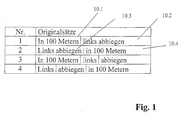
- each of these original sentences is the same Has meaningfulness and - apart from the order - there are no differences in the letters and numbers used, but there are considerable differences between the individual original sentences when they are reproduced acoustically. This is due to the fact that, depending on the position of individual words or groups of words in the sentence structure, different stresses may arise. If, for example, the sentence "Turn left in 100 meters" is to be reproduced as an announcement and segments 10.4 and 10.3 are used instead of segments 10.1 and 10.2, this does not lead to a harmonious reproduction that corresponds to the normal flow of speech.
- the different sentences for an announcement are spoken and recorded as so-called original sentences by a speaker.
- the original sentences recorded in this way are then divided into segments 10, each of these segments 10 being stored in an audio file.
- a group of search criteria is also assigned to each original record. This group of search criteria is divided according to the segmentation of the original records, with each segment 10 being assigned a search criterion.
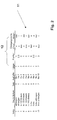
- the mutual assignment of audio files and search criteria takes place in a database 11, which is shown in more detail in FIG. 2.
- alphanumeric character strings are used here as search criteria, the character strings used as search criteria correspond to the textual representation of the assigned segments 10 stored as audio files.
- search criteria correspond to the textual representation of the assigned segments 10 stored as audio files.
- the database 11 has further entries 12. According to the column headings, these entries 12 are the length (L) of the respective segment, its position (P) within the sentence and two connecting sounds or transition values (Ü front , Ü rear ).
- the respective entries 12, which relate to the length (L), e.g. B. obtained by determining the number of words of the assigned segment 10 for each of the search criteria.
- the words within the assigned search criterion can be used in the present exemplary embodiment. This results in the length value 1 for the audio file or the segment 10 assigned to the search criterion “turn”, while the length value 3 is assigned to the search criterion “in 100 meters” since the number sequence “100” is regarded as a word.
- the words contained in the search criterion do not necessarily have to be used to obtain the length information.
- the number of characters contained in the respective search criterion can also be used. For example, this would result in a length value of 8 for the search criterion "and a length value of 13 for the search criterion" in 100 meters ", since the last search criterion also evaluates the spaces between the words and the numbers as characters. It is also conceivable to use the number of syllables or phonemes as a length value.
- the entry 12, which represents the position (P), is obtained, for example, by first the number of segments 10 or search criteria can be determined for each original record. If, for example, an original record is divided into three segments 10 when segmented, the first segment 10 is assigned the position value 0, the second segment 10 the position value 0.5 and the last of the three segments 10 the position value 1. However, if the original sentence is only divided into two segments 10 (for example in the first two original sentences in FIG. 1), the first segment 10 receives the position value 0, while the second and last segment 10 receives the position value 1. If the original set consists of four segments 10, the first segment 10 has the position value 0, the second segment 10 the position value 0.33 and the third segment 10 the position value 0.66, while the last segment again receives the position value 1.
- Transitional values (T) in the sense of this application are understood to mean the relationships of a segment 10 or search criterion to the segment 10 or search criterion preceding and following this segment 10 or search criterion. This relationship for the respective segment 10 is established in the present case to the last letter of the previous segment 10 and to the first letter of the following segment 10. The more detailed explanation is now to be made on the basis of the first set of original signals (turn left at 100 meters) according to FIG. 1. Since the first segment 10 or search criterion of this original sentence (in 100 meters) has no preceding segment 10 or search criterion, the entry in the data record relating to this segment 10 and bearing the index number 3 (FIG. 2) is the front transition value "empty" noted.
- segment 10 (in 100 meters) in the original sentence is followed by segment 10 (turn left), because in the present exemplary embodiment only one letter is used as transition values (Ü), a rear transition value (Ü) is entered in the data record with index number 3 "I" noted.
- the same procedure is followed with the second segment (10) of the original sentence (turn left), which in the data record with index number 9 leads to the front transition value (Ü) "n” and to the rear transition value (Ü) "empty” because segment 10 (in 100 meters), which precedes segment 10 (turn left) in the original sentence, ends with an "n” and segment 10 (turn left) no longer follows segment 10 in the original sentence.
- transition values (Ü) for the respective segment 10 shown in the preceding paragraph to the last letter of the segment 10 preceding this or the first letter of the segment 10 following this segment 10 is not mandatory. Rather, instead of individual letters, it is also possible to use groups of letters or phonemes from the segment 10 preceding and following segment 10 as the respective transition values (Ü). In particular, the use of phonemes leads to a high-quality reproduction of announcements composed from audio files on the basis of the data records according to FIG. 2.
- entries 12 shown in FIG. 2 need not be limited to the length, the position and the two transition values. Rather, further entries 12 (not shown) can also be provided in order to further improve the quality of the announcements. Since there is an emphasis difference between question and exclamation sentences, although the textual rendering of the corresponding sentence is completely identical without taking punctuation marks into account, a column can be provided as a further entry 12 in the database 11 according to FIG. 2, in which it is noted whether the respective segment 10 or search criterion comes from a question or exclamation set.
- the entire sentence intended for reproduction "turn left in 100 meters” is brought into a format in which the search criteria of the corresponding segments 10 are also present. Since in the exemplary embodiment shown the search criteria correspond to the textual reproduction of the audio files, the sentence to be reproduced is also brought into this format if it should not already be in this format. It is then checked whether one or more search criteria are present in the database 11, which have a complete match with the correspondingly formatted sentence intended for reproduction "Turn left in 100 meters". Since this is not the case according to the database shown in FIG.
- the search string of the sentence intended for reproduction (turn left in 100 meters) is shortened by the last word "turn” and it is examined whether this subset "left in 100 meters” in this form occurs in the database 11 as a search criterion. Since this comparison must also be negative due to the content of the database 11, the sentence intended for reproduction is reduced again by one word. Then it is checked again whether the part of the sentence "in 100 meters” which is then reduced in this way occurs in the data records of the database 11 as a search criterion. According to the content of the database 11, this can be affirmed for the data records with the indices 3 to 6. This then leads to temporary storage of the found indices 3 to 6.
- Combinations are then formed from the indices found in each case, which each result in the sentence to be reproduced.
- the latter is shown in more detail in Fig.3. Since in the present case the sentence to be reproduced is formed from the indices 9 and 10 and the indices 3 to 6, only the combinations in FIG. 3 with the serial numbers 1 to 8 are relevant. The other combinations in Fig. 3 have no meaning in this embodiment.
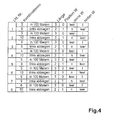
- the length and position information and information on the transition values of the sentence to be reproduced are then created in accordance with the convention, which were relevant when the corresponding entries 12 were made in the database 11, for the sentence parts, their index in the relevant one Combination stands, the length and position information as well as the respective transition values are buffered.
- Such a buffering is shown for the sentence to be reproduced "turn left in 100 meters" in FIG. 4, whereby the designation W indicates that it is the position and the transition values of the segments in the sentence to be reproduced and not that in the database 11 stored values.
- the values that are entered in the data records with the indices 3 to 6 or 9 and 10 can be used, since by the fact that if the sentence to be reproduced or a tell thereof a complete match in the search criteria according to FIG. 2 has found that the length specification in the corresponding data records in the database 11 according to FIG. 2 corresponds to the length value of the part of the record to be reproduced.
- the combinations are evaluated by determining an evaluation measure B for each of these combinations using the entries 12 for the segments 10 or search criteria in the database 11, who are involved in the respective combination.
- the evaluation measure B is determined according to the following formula: where W n is a weighting factor for the nth entry 12, f n, i is a functional relationship of the nth entry 12, n is a running index which runs over the individual entries of a data record assigned to a segment involved in a combination, and i further Run index is, runs over all indices of the data records or segments involved in the combination.
- a functional relationship f n, i (n) is thus created for each entry n included in the formula.
- some or all of the functional relationships can be provided with a weighting factor W n .
- the functional relationship f L, i (L) is formed for the length information L of a segment 10 such that the value one is divided by the value of the length L, which corresponds to the entry (length) in the respective data set i, then receive a value that is less than one for each data record whose index is involved in a combination, provided that - as assumed here - the weighting factor W L for the length is equal to one.
- longer segments 10 provide smaller values f Li (L) due to the formula. These smaller values should be preferred because the longer segments make better use of an existing melody.
- f Pi (P) for the position information P
- the functional relationship for the transition values f Ü, i (Ü front ), f Ü, i (Ü rear ) can be formed analogously to the preceding paragraph by the temporarily stored transition values Ü front, W , Ü rear, W from FIG. 4 with the Transition values Ü front, D , Ü rear, D of the corresponding data records from the database are related in such a way that a zero is assigned if there is a match and a value greater than zero if there is no match.
- a corresponding weighting factor W Ü can be used.
- the functional relationships for the front and rear transition values should expediently each have a weighting factor Wü can be provided from 0.5.
- the table according to FIG. 5 clearly shows that there are B values for each serial number which are between 0.8 and 4.8.
- the table in accordance with FIG. 5 shows that double B values are also present. Since preferably only those audio files from data records of the database 11 are to be combined for speech reproduction, the combinations of which, according to FIG. 3, have the lowest B value of all combinations after an evaluation according to the above formula, all occurring B values are those according to the table 5 are greater than 0.8, meaningless. This insignificance does not exist with the combinations of the serial numbers 1 and 5 according to FIG. 5, since with these combinations the B values are 0.8 and thus represent the smallest B values.
- the data records 3 and 5 used to form the combinations according to the serial numbers 1 and 5 are the same.
- the data records with the indices 3 and 5 are identified as duplicate and only in accordance with a further convention the data record with the smallest index number is left in the database.
- the deletion of the data record with the index 5 means that in Fig. 4 there are no longer any combinations which have the serial numbers 5 and 6. Consequently, the sequence numbers 5 and 6 are also omitted in the table according to FIG. 5, so that no B values are determined for these combinations and the combination 3/9 (sequence number 1) is determined as the combination with the smallest B value becomes.
- the relevant audio files are put together and output based on the indices involved. If it has been found that the combination 3/9 is the combination with the smallest B value in the exemplary embodiment discussed above, the corresponding audio files (file 3 and file 9) are combined and output.
- the audio files do not necessarily have to be stored in the database 11 according to FIG. 2. Much more is sufficient if there are corresponding references in the database 11 to the audio files stored at another location.
- the phrase "Turn left in 100 meters” is used. If this sentence is received as a text string, it is first checked whether at least the beginning of this sentence matches a search criteria in the table according to FIG. 2. In this test, the table according to FIG. H. starting with the last entry. In the present case, this would be the data record with index 10. During this check, the entry "in 100 meters” with index 6 is found. Since the found entry "in 100 meters” cannot completely cover the playback record, the part which is not covered by the search criterion of the data record just found is separated. The data record with index 6 is also buffered.
- the search for the part of the playback sentence "turn left" is continued, starting not at the end of the table in accordance with FIG. 2, but instead at the point where the last correspondence (here data record with index 10) was found. This means that the entry with index 9 is then found. After finding the data record with index 9, the one with index 6 is also copied here and cached together with the found data record with index 9 as a possible interim solution. Then the part found "turn left” is separated from the search string and the search for the rest is started. Since the search string no longer has any content when the "turn left" part is removed, the index combination 6, 9 is noted as a combination which completely exhausts the sentence to be reproduced.
- the part found is separated again "left” and the search for the part remaining in the search string is "bend". This search then leads to the entry with the index 2 being found.
- the combination 6, 8 cached as a partial solution in the last step is copied again and cached together with the data record with index 2 as a further partial solution.
- the part found is then again separated from the search string. Since the search string is now empty again, the combination of the data records with the indices 6, 8, 2 is stored as a combination which completely reproduces the playback record. Then the process returns to the previous step and the search for a match of the search string "turn off" is continued, the search for the entry where the last match (here the data record with index 2) was found also started here.
- the data record with the index 1 is found, which leads to the result that the combination of the data records with the indices 6, 8, 1 is stored as a combination which completely reproduces the playback record.
- the search for combinations is terminated when a predetermined number of combinations, for example 10 combinations, has been found.
- a predetermined number of combinations for example 10 combinations.
- this measure reduces the memory requirement and the required computing power.
- This combination limitation is particularly advantageous if the search is carried out in accordance with the last-mentioned method. This is due to the fact that with this search method, longer and longer segments are found first. This finding of the longer segments ensures that the best combination is usually recognized even under the first combinations and thus there is no loss of quality.
Landscapes
- Engineering & Computer Science (AREA)
- Computational Linguistics (AREA)
- Health & Medical Sciences (AREA)
- Audiology, Speech & Language Pathology (AREA)
- Human Computer Interaction (AREA)
- Physics & Mathematics (AREA)
- Acoustics & Sound (AREA)
- Multimedia (AREA)
- Information Retrieval, Db Structures And Fs Structures Therefor (AREA)
- Electric Clocks (AREA)
- Machine Translation (AREA)
- Document Processing Apparatus (AREA)
- Electrically Operated Instructional Devices (AREA)
Applications Claiming Priority (2)
| Application Number | Priority Date | Filing Date | Title |
|---|---|---|---|
| DE10031008A DE10031008A1 (de) | 2000-06-30 | 2000-06-30 | Verfahren zum Zusammensetzen von Sätzen zur Sprachausgabe |
| DE10031008 | 2000-06-30 |
Publications (3)
| Publication Number | Publication Date |
|---|---|
| EP1168298A2 true EP1168298A2 (fr) | 2002-01-02 |
| EP1168298A3 EP1168298A3 (fr) | 2002-12-11 |
| EP1168298B1 EP1168298B1 (fr) | 2006-11-29 |
Family
ID=7646792
Family Applications (1)
| Application Number | Title | Priority Date | Filing Date |
|---|---|---|---|
| EP01114995A Expired - Lifetime EP1168298B1 (fr) | 2000-06-30 | 2001-06-20 | Procédé d'assemblage de messages pour la synthèse de la parole |
Country Status (5)
| Country | Link |
|---|---|
| US (1) | US6757653B2 (fr) |
| EP (1) | EP1168298B1 (fr) |
| JP (1) | JP2002055692A (fr) |
| AT (1) | ATE347160T1 (fr) |
| DE (2) | DE10031008A1 (fr) |
Families Citing this family (124)
| Publication number | Priority date | Publication date | Assignee | Title |
|---|---|---|---|---|
| US8645137B2 (en) | 2000-03-16 | 2014-02-04 | Apple Inc. | Fast, language-independent method for user authentication by voice |
| US7089184B2 (en) * | 2001-03-22 | 2006-08-08 | Nurv Center Technologies, Inc. | Speech recognition for recognizing speaker-independent, continuous speech |
| US8677377B2 (en) | 2005-09-08 | 2014-03-18 | Apple Inc. | Method and apparatus for building an intelligent automated assistant |
| US8036894B2 (en) * | 2006-02-16 | 2011-10-11 | Apple Inc. | Multi-unit approach to text-to-speech synthesis |
| US9318108B2 (en) | 2010-01-18 | 2016-04-19 | Apple Inc. | Intelligent automated assistant |
| US8027837B2 (en) * | 2006-09-15 | 2011-09-27 | Apple Inc. | Using non-speech sounds during text-to-speech synthesis |
| US8977255B2 (en) | 2007-04-03 | 2015-03-10 | Apple Inc. | Method and system for operating a multi-function portable electronic device using voice-activation |
| US9330720B2 (en) | 2008-01-03 | 2016-05-03 | Apple Inc. | Methods and apparatus for altering audio output signals |
| US8996376B2 (en) | 2008-04-05 | 2015-03-31 | Apple Inc. | Intelligent text-to-speech conversion |
| US10496753B2 (en) | 2010-01-18 | 2019-12-03 | Apple Inc. | Automatically adapting user interfaces for hands-free interaction |
| US20100030549A1 (en) | 2008-07-31 | 2010-02-04 | Lee Michael M | Mobile device having human language translation capability with positional feedback |
| US8396714B2 (en) | 2008-09-29 | 2013-03-12 | Apple Inc. | Systems and methods for concatenation of words in text to speech synthesis |
| US8712776B2 (en) | 2008-09-29 | 2014-04-29 | Apple Inc. | Systems and methods for selective text to speech synthesis |
| US8352272B2 (en) | 2008-09-29 | 2013-01-08 | Apple Inc. | Systems and methods for text to speech synthesis |
| US8352268B2 (en) | 2008-09-29 | 2013-01-08 | Apple Inc. | Systems and methods for selective rate of speech and speech preferences for text to speech synthesis |
| US9959870B2 (en) | 2008-12-11 | 2018-05-01 | Apple Inc. | Speech recognition involving a mobile device |
| US8380507B2 (en) | 2009-03-09 | 2013-02-19 | Apple Inc. | Systems and methods for determining the language to use for speech generated by a text to speech engine |
| US10241752B2 (en) | 2011-09-30 | 2019-03-26 | Apple Inc. | Interface for a virtual digital assistant |
| US9858925B2 (en) | 2009-06-05 | 2018-01-02 | Apple Inc. | Using context information to facilitate processing of commands in a virtual assistant |
| US10241644B2 (en) | 2011-06-03 | 2019-03-26 | Apple Inc. | Actionable reminder entries |
| US10255566B2 (en) | 2011-06-03 | 2019-04-09 | Apple Inc. | Generating and processing task items that represent tasks to perform |
| US9431006B2 (en) | 2009-07-02 | 2016-08-30 | Apple Inc. | Methods and apparatuses for automatic speech recognition |
| US10276170B2 (en) | 2010-01-18 | 2019-04-30 | Apple Inc. | Intelligent automated assistant |
| US10679605B2 (en) | 2010-01-18 | 2020-06-09 | Apple Inc. | Hands-free list-reading by intelligent automated assistant |
| US10705794B2 (en) | 2010-01-18 | 2020-07-07 | Apple Inc. | Automatically adapting user interfaces for hands-free interaction |
| US10553209B2 (en) | 2010-01-18 | 2020-02-04 | Apple Inc. | Systems and methods for hands-free notification summaries |
| DE202011111062U1 (de) | 2010-01-25 | 2019-02-19 | Newvaluexchange Ltd. | Vorrichtung und System für eine Digitalkonversationsmanagementplattform |
| US8682667B2 (en) | 2010-02-25 | 2014-03-25 | Apple Inc. | User profiling for selecting user specific voice input processing information |
| US10762293B2 (en) | 2010-12-22 | 2020-09-01 | Apple Inc. | Using parts-of-speech tagging and named entity recognition for spelling correction |
| US9262612B2 (en) | 2011-03-21 | 2016-02-16 | Apple Inc. | Device access using voice authentication |
| US10057736B2 (en) | 2011-06-03 | 2018-08-21 | Apple Inc. | Active transport based notifications |
| US8994660B2 (en) | 2011-08-29 | 2015-03-31 | Apple Inc. | Text correction processing |
| US9372902B2 (en) | 2011-09-23 | 2016-06-21 | International Business Machines Corporation | Accessing and editing virtually-indexed message flows using structured query langauge (SQL) |
| US10134385B2 (en) | 2012-03-02 | 2018-11-20 | Apple Inc. | Systems and methods for name pronunciation |
| US9483461B2 (en) | 2012-03-06 | 2016-11-01 | Apple Inc. | Handling speech synthesis of content for multiple languages |
| US9280610B2 (en) | 2012-05-14 | 2016-03-08 | Apple Inc. | Crowd sourcing information to fulfill user requests |
| US9721563B2 (en) | 2012-06-08 | 2017-08-01 | Apple Inc. | Name recognition system |
| US9495129B2 (en) | 2012-06-29 | 2016-11-15 | Apple Inc. | Device, method, and user interface for voice-activated navigation and browsing of a document |
| US9576574B2 (en) | 2012-09-10 | 2017-02-21 | Apple Inc. | Context-sensitive handling of interruptions by intelligent digital assistant |
| US9547647B2 (en) | 2012-09-19 | 2017-01-17 | Apple Inc. | Voice-based media searching |
| DE112014000709B4 (de) | 2013-02-07 | 2021-12-30 | Apple Inc. | Verfahren und vorrichtung zum betrieb eines sprachtriggers für einen digitalen assistenten |
| US9368114B2 (en) | 2013-03-14 | 2016-06-14 | Apple Inc. | Context-sensitive handling of interruptions |
| WO2014144579A1 (fr) | 2013-03-15 | 2014-09-18 | Apple Inc. | Système et procédé pour mettre à jour un modèle de reconnaissance de parole adaptatif |
| WO2014144949A2 (fr) | 2013-03-15 | 2014-09-18 | Apple Inc. | Entraînement d'un système à commande au moins partiellement vocale |
| WO2014197334A2 (fr) | 2013-06-07 | 2014-12-11 | Apple Inc. | Système et procédé destinés à une prononciation de mots spécifiée par l'utilisateur dans la synthèse et la reconnaissance de la parole |
| WO2014197336A1 (fr) | 2013-06-07 | 2014-12-11 | Apple Inc. | Système et procédé pour détecter des erreurs dans des interactions avec un assistant numérique utilisant la voix |
| US9582608B2 (en) | 2013-06-07 | 2017-02-28 | Apple Inc. | Unified ranking with entropy-weighted information for phrase-based semantic auto-completion |
| WO2014197335A1 (fr) | 2013-06-08 | 2014-12-11 | Apple Inc. | Interprétation et action sur des commandes qui impliquent un partage d'informations avec des dispositifs distants |
| US10176167B2 (en) | 2013-06-09 | 2019-01-08 | Apple Inc. | System and method for inferring user intent from speech inputs |
| KR101959188B1 (ko) | 2013-06-09 | 2019-07-02 | 애플 인크. | 디지털 어시스턴트의 둘 이상의 인스턴스들에 걸친 대화 지속성을 가능하게 하기 위한 디바이스, 방법 및 그래픽 사용자 인터페이스 |
| KR101809808B1 (ko) | 2013-06-13 | 2017-12-15 | 애플 인크. | 음성 명령에 의해 개시되는 긴급 전화를 걸기 위한 시스템 및 방법 |
| KR101749009B1 (ko) | 2013-08-06 | 2017-06-19 | 애플 인크. | 원격 디바이스로부터의 활동에 기초한 스마트 응답의 자동 활성화 |
| US9620105B2 (en) | 2014-05-15 | 2017-04-11 | Apple Inc. | Analyzing audio input for efficient speech and music recognition |
| US10592095B2 (en) | 2014-05-23 | 2020-03-17 | Apple Inc. | Instantaneous speaking of content on touch devices |
| US9502031B2 (en) | 2014-05-27 | 2016-11-22 | Apple Inc. | Method for supporting dynamic grammars in WFST-based ASR |
| US10289433B2 (en) | 2014-05-30 | 2019-05-14 | Apple Inc. | Domain specific language for encoding assistant dialog |
| US9734193B2 (en) | 2014-05-30 | 2017-08-15 | Apple Inc. | Determining domain salience ranking from ambiguous words in natural speech |
| US10170123B2 (en) | 2014-05-30 | 2019-01-01 | Apple Inc. | Intelligent assistant for home automation |
| US9760559B2 (en) | 2014-05-30 | 2017-09-12 | Apple Inc. | Predictive text input |
| WO2015184186A1 (fr) | 2014-05-30 | 2015-12-03 | Apple Inc. | Procédé d'entrée à simple énoncé multi-commande |
| US9715875B2 (en) | 2014-05-30 | 2017-07-25 | Apple Inc. | Reducing the need for manual start/end-pointing and trigger phrases |
| US9633004B2 (en) | 2014-05-30 | 2017-04-25 | Apple Inc. | Better resolution when referencing to concepts |
| US9842101B2 (en) | 2014-05-30 | 2017-12-12 | Apple Inc. | Predictive conversion of language input |
| US10078631B2 (en) | 2014-05-30 | 2018-09-18 | Apple Inc. | Entropy-guided text prediction using combined word and character n-gram language models |
| US9430463B2 (en) | 2014-05-30 | 2016-08-30 | Apple Inc. | Exemplar-based natural language processing |
| US9785630B2 (en) | 2014-05-30 | 2017-10-10 | Apple Inc. | Text prediction using combined word N-gram and unigram language models |
| US10659851B2 (en) | 2014-06-30 | 2020-05-19 | Apple Inc. | Real-time digital assistant knowledge updates |
| US9338493B2 (en) | 2014-06-30 | 2016-05-10 | Apple Inc. | Intelligent automated assistant for TV user interactions |
| US10446141B2 (en) | 2014-08-28 | 2019-10-15 | Apple Inc. | Automatic speech recognition based on user feedback |
| US9818400B2 (en) | 2014-09-11 | 2017-11-14 | Apple Inc. | Method and apparatus for discovering trending terms in speech requests |
| US10789041B2 (en) | 2014-09-12 | 2020-09-29 | Apple Inc. | Dynamic thresholds for always listening speech trigger |
| US9606986B2 (en) | 2014-09-29 | 2017-03-28 | Apple Inc. | Integrated word N-gram and class M-gram language models |
| US9646609B2 (en) | 2014-09-30 | 2017-05-09 | Apple Inc. | Caching apparatus for serving phonetic pronunciations |
| US9668121B2 (en) | 2014-09-30 | 2017-05-30 | Apple Inc. | Social reminders |
| US10074360B2 (en) | 2014-09-30 | 2018-09-11 | Apple Inc. | Providing an indication of the suitability of speech recognition |
| US10127911B2 (en) | 2014-09-30 | 2018-11-13 | Apple Inc. | Speaker identification and unsupervised speaker adaptation techniques |
| US9886432B2 (en) | 2014-09-30 | 2018-02-06 | Apple Inc. | Parsimonious handling of word inflection via categorical stem + suffix N-gram language models |
| US10552013B2 (en) | 2014-12-02 | 2020-02-04 | Apple Inc. | Data detection |
| US9711141B2 (en) | 2014-12-09 | 2017-07-18 | Apple Inc. | Disambiguating heteronyms in speech synthesis |
| US9865280B2 (en) | 2015-03-06 | 2018-01-09 | Apple Inc. | Structured dictation using intelligent automated assistants |
| US9721566B2 (en) | 2015-03-08 | 2017-08-01 | Apple Inc. | Competing devices responding to voice triggers |
| US10567477B2 (en) | 2015-03-08 | 2020-02-18 | Apple Inc. | Virtual assistant continuity |
| US9886953B2 (en) | 2015-03-08 | 2018-02-06 | Apple Inc. | Virtual assistant activation |
| US9899019B2 (en) | 2015-03-18 | 2018-02-20 | Apple Inc. | Systems and methods for structured stem and suffix language models |
| US9842105B2 (en) | 2015-04-16 | 2017-12-12 | Apple Inc. | Parsimonious continuous-space phrase representations for natural language processing |
| US10083688B2 (en) | 2015-05-27 | 2018-09-25 | Apple Inc. | Device voice control for selecting a displayed affordance |
| US10127220B2 (en) | 2015-06-04 | 2018-11-13 | Apple Inc. | Language identification from short strings |
| US10101822B2 (en) | 2015-06-05 | 2018-10-16 | Apple Inc. | Language input correction |
| US9578173B2 (en) | 2015-06-05 | 2017-02-21 | Apple Inc. | Virtual assistant aided communication with 3rd party service in a communication session |
| US10255907B2 (en) | 2015-06-07 | 2019-04-09 | Apple Inc. | Automatic accent detection using acoustic models |
| US11025565B2 (en) | 2015-06-07 | 2021-06-01 | Apple Inc. | Personalized prediction of responses for instant messaging |
| US10186254B2 (en) | 2015-06-07 | 2019-01-22 | Apple Inc. | Context-based endpoint detection |
| US10671428B2 (en) | 2015-09-08 | 2020-06-02 | Apple Inc. | Distributed personal assistant |
| US10747498B2 (en) | 2015-09-08 | 2020-08-18 | Apple Inc. | Zero latency digital assistant |
| US9697820B2 (en) | 2015-09-24 | 2017-07-04 | Apple Inc. | Unit-selection text-to-speech synthesis using concatenation-sensitive neural networks |
| US11010550B2 (en) | 2015-09-29 | 2021-05-18 | Apple Inc. | Unified language modeling framework for word prediction, auto-completion and auto-correction |
| US10366158B2 (en) | 2015-09-29 | 2019-07-30 | Apple Inc. | Efficient word encoding for recurrent neural network language models |
| US11587559B2 (en) | 2015-09-30 | 2023-02-21 | Apple Inc. | Intelligent device identification |
| US10691473B2 (en) | 2015-11-06 | 2020-06-23 | Apple Inc. | Intelligent automated assistant in a messaging environment |
| US10049668B2 (en) | 2015-12-02 | 2018-08-14 | Apple Inc. | Applying neural network language models to weighted finite state transducers for automatic speech recognition |
| US10223066B2 (en) | 2015-12-23 | 2019-03-05 | Apple Inc. | Proactive assistance based on dialog communication between devices |
| US10446143B2 (en) | 2016-03-14 | 2019-10-15 | Apple Inc. | Identification of voice inputs providing credentials |
| US9934775B2 (en) | 2016-05-26 | 2018-04-03 | Apple Inc. | Unit-selection text-to-speech synthesis based on predicted concatenation parameters |
| US9972304B2 (en) | 2016-06-03 | 2018-05-15 | Apple Inc. | Privacy preserving distributed evaluation framework for embedded personalized systems |
| US10249300B2 (en) | 2016-06-06 | 2019-04-02 | Apple Inc. | Intelligent list reading |
| US10049663B2 (en) | 2016-06-08 | 2018-08-14 | Apple, Inc. | Intelligent automated assistant for media exploration |
| DK179588B1 (en) | 2016-06-09 | 2019-02-22 | Apple Inc. | INTELLIGENT AUTOMATED ASSISTANT IN A HOME ENVIRONMENT |
| US10586535B2 (en) | 2016-06-10 | 2020-03-10 | Apple Inc. | Intelligent digital assistant in a multi-tasking environment |
| US10490187B2 (en) | 2016-06-10 | 2019-11-26 | Apple Inc. | Digital assistant providing automated status report |
| US10192552B2 (en) | 2016-06-10 | 2019-01-29 | Apple Inc. | Digital assistant providing whispered speech |
| US10509862B2 (en) | 2016-06-10 | 2019-12-17 | Apple Inc. | Dynamic phrase expansion of language input |
| US10067938B2 (en) | 2016-06-10 | 2018-09-04 | Apple Inc. | Multilingual word prediction |
| DK201670540A1 (en) | 2016-06-11 | 2018-01-08 | Apple Inc | Application integration with a digital assistant |
| DK179343B1 (en) | 2016-06-11 | 2018-05-14 | Apple Inc | Intelligent task discovery |
| DK179415B1 (en) | 2016-06-11 | 2018-06-14 | Apple Inc | Intelligent device arbitration and control |
| DK179049B1 (en) | 2016-06-11 | 2017-09-18 | Apple Inc | Data driven natural language event detection and classification |
| US10043516B2 (en) | 2016-09-23 | 2018-08-07 | Apple Inc. | Intelligent automated assistant |
| US10593346B2 (en) | 2016-12-22 | 2020-03-17 | Apple Inc. | Rank-reduced token representation for automatic speech recognition |
| DK201770439A1 (en) | 2017-05-11 | 2018-12-13 | Apple Inc. | Offline personal assistant |
| DK179745B1 (en) | 2017-05-12 | 2019-05-01 | Apple Inc. | SYNCHRONIZATION AND TASK DELEGATION OF A DIGITAL ASSISTANT |
| DK179496B1 (en) | 2017-05-12 | 2019-01-15 | Apple Inc. | USER-SPECIFIC Acoustic Models |
| DK201770431A1 (en) | 2017-05-15 | 2018-12-20 | Apple Inc. | Optimizing dialogue policy decisions for digital assistants using implicit feedback |
| DK201770432A1 (en) | 2017-05-15 | 2018-12-21 | Apple Inc. | Hierarchical belief states for digital assistants |
| DK179560B1 (en) | 2017-05-16 | 2019-02-18 | Apple Inc. | FAR-FIELD EXTENSION FOR DIGITAL ASSISTANT SERVICES |
Family Cites Families (21)
| Publication number | Priority date | Publication date | Assignee | Title |
|---|---|---|---|---|
| US3797037A (en) * | 1972-06-06 | 1974-03-12 | Ibm | Sentence oriented dictation system featuring random accessing of information in a preferred sequence under control of stored codes |
| DE3104551C2 (de) * | 1981-02-10 | 1982-10-21 | Neumann Elektronik GmbH, 4330 Mülheim | Elektronischer Textgeber zur Abgabe von Kurztexten |
| DE3642929A1 (de) * | 1986-12-16 | 1988-06-23 | Siemens Ag | Verfahren zur natuerlich klingenden sprachausgabe |
| US4908867A (en) * | 1987-11-19 | 1990-03-13 | British Telecommunications Public Limited Company | Speech synthesis |
| JPH0477962A (ja) * | 1990-07-19 | 1992-03-12 | Sanyo Electric Co Ltd | 機械翻訳装置 |
| CA2051135C (fr) * | 1991-09-11 | 1996-05-07 | Kim D. Letkeman | Dictionnaire de langage comprime |
| CA2119397C (fr) * | 1993-03-19 | 2007-10-02 | Kim E.A. Silverman | Synthese vocale automatique utilisant un traitement prosodique, une epellation et un debit d'enonciation du texte ameliores |
| US5664060A (en) * | 1994-01-25 | 1997-09-02 | Information Storage Devices | Message management methods and apparatus |
| DE19518504C2 (de) * | 1994-10-26 | 1998-08-20 | United Microelectronics Corp | Dynamisch programmierbare Ansage-Einrichtung |
| GB2296846A (en) * | 1995-01-07 | 1996-07-10 | Ibm | Synthesising speech from text |
| US5832434A (en) * | 1995-05-26 | 1998-11-03 | Apple Computer, Inc. | Method and apparatus for automatic assignment of duration values for synthetic speech |
| JP3050832B2 (ja) * | 1996-05-15 | 2000-06-12 | 株式会社エイ・ティ・アール音声翻訳通信研究所 | 自然発話音声波形信号接続型音声合成装置 |
| JPH1097268A (ja) * | 1996-09-24 | 1998-04-14 | Sanyo Electric Co Ltd | 音声合成装置 |
| JP3029403B2 (ja) * | 1996-11-28 | 2000-04-04 | 三菱電機株式会社 | 文章データ音声変換システム |
| JPH1138989A (ja) * | 1997-07-14 | 1999-02-12 | Toshiba Corp | 音声合成装置及び方法 |
| US5913194A (en) * | 1997-07-14 | 1999-06-15 | Motorola, Inc. | Method, device and system for using statistical information to reduce computation and memory requirements of a neural network based speech synthesis system |
| JPH1195796A (ja) * | 1997-09-16 | 1999-04-09 | Toshiba Corp | 音声合成方法 |
| US6047255A (en) * | 1997-12-04 | 2000-04-04 | Nortel Networks Corporation | Method and system for producing speech signals |
| JPH11305787A (ja) * | 1998-04-22 | 1999-11-05 | Victor Co Of Japan Ltd | 音声合成装置 |
| US6266637B1 (en) * | 1998-09-11 | 2001-07-24 | International Business Machines Corporation | Phrase splicing and variable substitution using a trainable speech synthesizer |
| US20030028380A1 (en) * | 2000-02-02 | 2003-02-06 | Freeland Warwick Peter | Speech system |
-
2000
- 2000-06-30 DE DE10031008A patent/DE10031008A1/de not_active Withdrawn
-
2001
- 2001-06-20 DE DE50111522T patent/DE50111522D1/de not_active Expired - Lifetime
- 2001-06-20 AT AT01114995T patent/ATE347160T1/de not_active IP Right Cessation
- 2001-06-20 EP EP01114995A patent/EP1168298B1/fr not_active Expired - Lifetime
- 2001-06-28 US US09/894,961 patent/US6757653B2/en not_active Expired - Lifetime
- 2001-06-29 JP JP2001199251A patent/JP2002055692A/ja active Pending
Also Published As
| Publication number | Publication date |
|---|---|
| DE10031008A1 (de) | 2002-01-10 |
| JP2002055692A (ja) | 2002-02-20 |
| EP1168298B1 (fr) | 2006-11-29 |
| US20020029139A1 (en) | 2002-03-07 |
| ATE347160T1 (de) | 2006-12-15 |
| EP1168298A3 (fr) | 2002-12-11 |
| DE50111522D1 (de) | 2007-01-11 |
| US6757653B2 (en) | 2004-06-29 |
Similar Documents
| Publication | Publication Date | Title |
|---|---|---|
| EP1168298B1 (fr) | Procédé d'assemblage de messages pour la synthèse de la parole | |
| EP0285221B1 (fr) | Procédé pour la reconnaissance de la parole continue | |
| DE69413052T2 (de) | Sprachsynthese | |
| EP0533260B1 (fr) | Procédé et dispositif pour la reconnaissance des mots prononcés dans un signal de parole | |
| DE3878541T2 (de) | Verfahren und einrichtung, um ein markov-modell-referenzmuster von woertern zu erzeugen. | |
| DE69427525T2 (de) | Trainingsmethode für ein tts-system, sich daraus ergebendes gerät und methode zur bedienung des gerätes | |
| DE4397100C2 (de) | Verfahren zum Erkennen von Sprachsignalen und Spracherkennungssystem mit rekursiver Grammatik mit endlicher Zustandsanzahl | |
| DE60035001T2 (de) | Sprachsynthese mit Prosodie-Mustern | |
| DE69814589T2 (de) | Spracherkennung unter verwendung mehrerer spracherkenner | |
| DE602004012909T2 (de) | Verfahren und Vorrichtung zur Modellierung eines Spracherkennungssystems und zur Schätzung einer Wort-Fehlerrate basierend auf einem Text | |
| DE19942178C1 (de) | Verfahren zum Aufbereiten einer Datenbank für die automatische Sprachverarbeitung | |
| EP0797185A2 (fr) | Procédé et dispositif pour la reconnaissance de la parole | |
| DE69917960T2 (de) | Phonembasierte Sprachsynthese | |
| EP1058235B1 (fr) | Procédé de reproduction pour systèmes contrôlés par la voix avec synthèse de la parole basée sur texte | |
| EP0981129A2 (fr) | Procédé et système d'execution d'une requête de base de données | |
| DE69837428T2 (de) | Speichermedium mit elektronischer Schaltung und mit diesem Speichermedium augestatteter Sprachsynthesizer | |
| EP1282897B1 (fr) | Procede pour produire une banque de donnees vocales pour un lexique cible pour l'apprentissage d'un systeme de reconnaissance vocale | |
| EP0417854B1 (fr) | Procédé pour la reconnaissance de N suites différentes de mots dans un signal de parole | |
| DE4111781A1 (de) | Computersystem zur spracherkennung | |
| EP0677835B1 (fr) | Procédé pour rechercher une suite de mots | |
| DE69908106T2 (de) | Erweiterung eines spracherkennungswortschatzes unter verwendung von abgeleiteten wörtern | |
| DE69318223T2 (de) | Verfahren zur sprachanalyse | |
| DE3215868A1 (de) | Verfahren und anordnung zum erkennen der woerter in einer zusammenhaengenden wortkette | |
| DE69329375T2 (de) | Verfahren zur Realisierung von Tonkurven für Sprachnachrichten und Verfahren zur Sprachsynthese und Einrichtung zu seiner Anwendung | |
| DE2363590A1 (de) | Spracherkennungssystem mit merkmalsfolgekodierung |
Legal Events
| Date | Code | Title | Description |
|---|---|---|---|
| PUAI | Public reference made under article 153(3) epc to a published international application that has entered the european phase |
Free format text: ORIGINAL CODE: 0009012 |
|
| AK | Designated contracting states |
Kind code of ref document: A2 Designated state(s): AT BE CH CY DE DK ES FI FR GB GR IE IT LI LU MC NL PT SE TR |
|
| AX | Request for extension of the european patent |
Free format text: AL;LT;LV;MK;RO;SI |
|
| RAP1 | Party data changed (applicant data changed or rights of an application transferred) |
Owner name: NOKIA CORPORATION |
|
| PUAL | Search report despatched |
Free format text: ORIGINAL CODE: 0009013 |
|
| AK | Designated contracting states |
Kind code of ref document: A3 Designated state(s): AT BE CH CY DE DK ES FI FR GB GR IE IT LI LU MC NL PT SE TR |
|
| AX | Request for extension of the european patent |
Free format text: AL;LT;LV;MK;RO;SI |
|
| 17P | Request for examination filed |
Effective date: 20030610 |
|
| AKX | Designation fees paid |
Designated state(s): AT BE CH CY DE DK ES FI FR GB GR IE IT LI LU MC NL PT SE TR |
|
| GRAP | Despatch of communication of intention to grant a patent |
Free format text: ORIGINAL CODE: EPIDOSNIGR1 |
|
| GRAS | Grant fee paid |
Free format text: ORIGINAL CODE: EPIDOSNIGR3 |
|
| GRAA | (expected) grant |
Free format text: ORIGINAL CODE: 0009210 |
|
| AK | Designated contracting states |
Kind code of ref document: B1 Designated state(s): AT BE CH CY DE DK ES FI FR GB GR IE IT LI LU MC NL PT SE TR |
|
| PG25 | Lapsed in a contracting state [announced via postgrant information from national office to epo] |
Ref country code: FI Free format text: LAPSE BECAUSE OF FAILURE TO SUBMIT A TRANSLATION OF THE DESCRIPTION OR TO PAY THE FEE WITHIN THE PRESCRIBED TIME-LIMIT Effective date: 20061129 Ref country code: IE Free format text: LAPSE BECAUSE OF FAILURE TO SUBMIT A TRANSLATION OF THE DESCRIPTION OR TO PAY THE FEE WITHIN THE PRESCRIBED TIME-LIMIT Effective date: 20061129 Ref country code: IT Free format text: LAPSE BECAUSE OF FAILURE TO SUBMIT A TRANSLATION OF THE DESCRIPTION OR TO PAY THE FEE WITHIN THE PRESCRIBED TIME-LIMIT;WARNING: LAPSES OF ITALIAN PATENTS WITH EFFECTIVE DATE BEFORE 2007 MAY HAVE OCCURRED AT ANY TIME BEFORE 2007. THE CORRECT EFFECTIVE DATE MAY BE DIFFERENT FROM THE ONE RECORDED. Effective date: 20061129 |
|
| REG | Reference to a national code |
Ref country code: GB Ref legal event code: FG4D Free format text: NOT ENGLISH |
|
| GBT | Gb: translation of ep patent filed (gb section 77(6)(a)/1977) |
Effective date: 20061129 |
|
| REG | Reference to a national code |
Ref country code: IE Ref legal event code: FG4D Free format text: LANGUAGE OF EP DOCUMENT: GERMAN Ref country code: CH Ref legal event code: EP |
|
| REG | Reference to a national code |
Ref country code: IE Ref legal event code: FG4D Free format text: LANGUAGE OF EP DOCUMENT: GERMAN |
|
| REF | Corresponds to: |
Ref document number: 50111522 Country of ref document: DE Date of ref document: 20070111 Kind code of ref document: P |
|
| PG25 | Lapsed in a contracting state [announced via postgrant information from national office to epo] |
Ref country code: DK Free format text: LAPSE BECAUSE OF FAILURE TO SUBMIT A TRANSLATION OF THE DESCRIPTION OR TO PAY THE FEE WITHIN THE PRESCRIBED TIME-LIMIT Effective date: 20070228 |
|
| PG25 | Lapsed in a contracting state [announced via postgrant information from national office to epo] |
Ref country code: ES Free format text: LAPSE BECAUSE OF FAILURE TO SUBMIT A TRANSLATION OF THE DESCRIPTION OR TO PAY THE FEE WITHIN THE PRESCRIBED TIME-LIMIT Effective date: 20070312 |
|
| REG | Reference to a national code |
Ref country code: SE Ref legal event code: TRGR |
|
| PG25 | Lapsed in a contracting state [announced via postgrant information from national office to epo] |
Ref country code: PT Free format text: LAPSE BECAUSE OF FAILURE TO SUBMIT A TRANSLATION OF THE DESCRIPTION OR TO PAY THE FEE WITHIN THE PRESCRIBED TIME-LIMIT Effective date: 20070430 |
|
| ET | Fr: translation filed | ||
| REG | Reference to a national code |
Ref country code: IE Ref legal event code: FD4D |
|
| PLBE | No opposition filed within time limit |
Free format text: ORIGINAL CODE: 0009261 |
|
| STAA | Information on the status of an ep patent application or granted ep patent |
Free format text: STATUS: NO OPPOSITION FILED WITHIN TIME LIMIT |
|
| 26N | No opposition filed |
Effective date: 20070830 |
|
| BERE | Be: lapsed |
Owner name: NOKIA CORPORATION Effective date: 20070630 |
|
| PG25 | Lapsed in a contracting state [announced via postgrant information from national office to epo] |
Ref country code: MC Free format text: LAPSE BECAUSE OF NON-PAYMENT OF DUE FEES Effective date: 20070630 |
|
| REG | Reference to a national code |
Ref country code: CH Ref legal event code: PL |
|
| PG25 | Lapsed in a contracting state [announced via postgrant information from national office to epo] |
Ref country code: BE Free format text: LAPSE BECAUSE OF NON-PAYMENT OF DUE FEES Effective date: 20070630 |
|
| PG25 | Lapsed in a contracting state [announced via postgrant information from national office to epo] |
Ref country code: CH Free format text: LAPSE BECAUSE OF NON-PAYMENT OF DUE FEES Effective date: 20070630 Ref country code: GR Free format text: LAPSE BECAUSE OF FAILURE TO SUBMIT A TRANSLATION OF THE DESCRIPTION OR TO PAY THE FEE WITHIN THE PRESCRIBED TIME-LIMIT Effective date: 20070301 Ref country code: LI Free format text: LAPSE BECAUSE OF NON-PAYMENT OF DUE FEES Effective date: 20070630 |
|
| PG25 | Lapsed in a contracting state [announced via postgrant information from national office to epo] |
Ref country code: AT Free format text: LAPSE BECAUSE OF NON-PAYMENT OF DUE FEES Effective date: 20070620 |
|
| PGFP | Annual fee paid to national office [announced via postgrant information from national office to epo] |
Ref country code: NL Payment date: 20080603 Year of fee payment: 8 Ref country code: SE Payment date: 20080609 Year of fee payment: 8 |
|
| REG | Reference to a national code |
Ref country code: GB Ref legal event code: 732E Free format text: REGISTERED BETWEEN 20090409 AND 20090415 |
|
| REG | Reference to a national code |
Ref country code: FR Ref legal event code: TP |
|
| PG25 | Lapsed in a contracting state [announced via postgrant information from national office to epo] |
Ref country code: CY Free format text: LAPSE BECAUSE OF FAILURE TO SUBMIT A TRANSLATION OF THE DESCRIPTION OR TO PAY THE FEE WITHIN THE PRESCRIBED TIME-LIMIT Effective date: 20061129 Ref country code: LU Free format text: LAPSE BECAUSE OF NON-PAYMENT OF DUE FEES Effective date: 20070620 |
|
| PG25 | Lapsed in a contracting state [announced via postgrant information from national office to epo] |
Ref country code: TR Free format text: LAPSE BECAUSE OF FAILURE TO SUBMIT A TRANSLATION OF THE DESCRIPTION OR TO PAY THE FEE WITHIN THE PRESCRIBED TIME-LIMIT Effective date: 20061129 |
|
| NLV4 | Nl: lapsed or anulled due to non-payment of the annual fee |
Effective date: 20100101 |
|
| PG25 | Lapsed in a contracting state [announced via postgrant information from national office to epo] |
Ref country code: NL Free format text: LAPSE BECAUSE OF NON-PAYMENT OF DUE FEES Effective date: 20100101 |
|
| PG25 | Lapsed in a contracting state [announced via postgrant information from national office to epo] |
Ref country code: SE Free format text: LAPSE BECAUSE OF NON-PAYMENT OF DUE FEES Effective date: 20090621 |
|
| REG | Reference to a national code |
Ref country code: DE Ref legal event code: R082 Ref document number: 50111522 Country of ref document: DE Representative=s name: VON ROHR PATENTANWAELTE PARTNERSCHAFT MBB, DE |
|
| REG | Reference to a national code |
Ref country code: FR Ref legal event code: PLFP Year of fee payment: 16 |
|
| PGFP | Annual fee paid to national office [announced via postgrant information from national office to epo] |
Ref country code: DE Payment date: 20160621 Year of fee payment: 16 Ref country code: GB Payment date: 20160621 Year of fee payment: 16 |
|
| REG | Reference to a national code |
Ref country code: FR Ref legal event code: PLFP Year of fee payment: 17 |
|
| PGFP | Annual fee paid to national office [announced via postgrant information from national office to epo] |
Ref country code: FR Payment date: 20170511 Year of fee payment: 17 |
|
| REG | Reference to a national code |
Ref country code: DE Ref legal event code: R119 Ref document number: 50111522 Country of ref document: DE |
|
| GBPC | Gb: european patent ceased through non-payment of renewal fee |
Effective date: 20170620 |
|
| PG25 | Lapsed in a contracting state [announced via postgrant information from national office to epo] |
Ref country code: DE Free format text: LAPSE BECAUSE OF NON-PAYMENT OF DUE FEES Effective date: 20180103 Ref country code: GB Free format text: LAPSE BECAUSE OF NON-PAYMENT OF DUE FEES Effective date: 20170620 |
|
| PG25 | Lapsed in a contracting state [announced via postgrant information from national office to epo] |
Ref country code: FR Free format text: LAPSE BECAUSE OF NON-PAYMENT OF DUE FEES Effective date: 20180630 |