EP1168459A2 - Solar-Stromerzeugungsanlage - Google Patents
Solar-Stromerzeugungsanlage Download PDFInfo
- Publication number
- EP1168459A2 EP1168459A2 EP01401500A EP01401500A EP1168459A2 EP 1168459 A2 EP1168459 A2 EP 1168459A2 EP 01401500 A EP01401500 A EP 01401500A EP 01401500 A EP01401500 A EP 01401500A EP 1168459 A2 EP1168459 A2 EP 1168459A2
- Authority
- EP
- European Patent Office
- Prior art keywords
- power generation
- reflection surface
- light receiving
- receiving surface
- generation device
- Prior art date
- Legal status (The legal status is an assumption and is not a legal conclusion. Google has not performed a legal analysis and makes no representation as to the accuracy of the status listed.)
- Withdrawn
Links
- 238000010248 power generation Methods 0.000 title claims abstract description 167
- 230000005540 biological transmission Effects 0.000 claims description 36
- 239000007788 liquid Substances 0.000 claims description 14
- CURLTUGMZLYLDI-UHFFFAOYSA-N Carbon dioxide Chemical compound O=C=O CURLTUGMZLYLDI-UHFFFAOYSA-N 0.000 claims description 10
- 239000000463 material Substances 0.000 claims description 10
- 229910002092 carbon dioxide Inorganic materials 0.000 claims description 5
- 239000001569 carbon dioxide Substances 0.000 claims description 5
- 238000010586 diagram Methods 0.000 description 16
- 238000010521 absorption reaction Methods 0.000 description 7
- 230000007423 decrease Effects 0.000 description 7
- XUIMIQQOPSSXEZ-UHFFFAOYSA-N Silicon Chemical compound [Si] XUIMIQQOPSSXEZ-UHFFFAOYSA-N 0.000 description 5
- 230000003247 decreasing effect Effects 0.000 description 5
- 229910052710 silicon Inorganic materials 0.000 description 5
- 239000010703 silicon Substances 0.000 description 5
- 230000002745 absorbent Effects 0.000 description 4
- 239000002250 absorbent Substances 0.000 description 4
- 239000004065 semiconductor Substances 0.000 description 4
- 230000000694 effects Effects 0.000 description 3
- 239000011521 glass Substances 0.000 description 3
- 230000004075 alteration Effects 0.000 description 2
- 239000007864 aqueous solution Substances 0.000 description 2
- 230000000712 assembly Effects 0.000 description 2
- 238000000429 assembly Methods 0.000 description 2
- 239000003344 environmental pollutant Substances 0.000 description 2
- 230000006872 improvement Effects 0.000 description 2
- 238000012986 modification Methods 0.000 description 2
- 230000004048 modification Effects 0.000 description 2
- 231100000719 pollutant Toxicity 0.000 description 2
- 230000005855 radiation Effects 0.000 description 2
- 229910004613 CdTe Inorganic materials 0.000 description 1
- RYGMFSIKBFXOCR-UHFFFAOYSA-N Copper Chemical compound [Cu] RYGMFSIKBFXOCR-UHFFFAOYSA-N 0.000 description 1
- 229910001218 Gallium arsenide Inorganic materials 0.000 description 1
- BUGBHKTXTAQXES-UHFFFAOYSA-N Selenium Chemical compound [Se] BUGBHKTXTAQXES-UHFFFAOYSA-N 0.000 description 1
- 229910052980 cadmium sulfide Inorganic materials 0.000 description 1
- 238000006243 chemical reaction Methods 0.000 description 1
- 239000004020 conductor Substances 0.000 description 1
- 229910052802 copper Inorganic materials 0.000 description 1
- 239000010949 copper Substances 0.000 description 1
- 231100001261 hazardous Toxicity 0.000 description 1
- 229910052738 indium Inorganic materials 0.000 description 1
- APFVFJFRJDLVQX-UHFFFAOYSA-N indium atom Chemical compound [In] APFVFJFRJDLVQX-UHFFFAOYSA-N 0.000 description 1
- 230000005764 inhibitory process Effects 0.000 description 1
- 238000009434 installation Methods 0.000 description 1
- 230000001678 irradiating effect Effects 0.000 description 1
- 238000005192 partition Methods 0.000 description 1
- 229920006395 saturated elastomer Polymers 0.000 description 1
- 238000007789 sealing Methods 0.000 description 1
- 229910052711 selenium Inorganic materials 0.000 description 1
- 239000011669 selenium Substances 0.000 description 1
- 238000002834 transmittance Methods 0.000 description 1
Images



Classifications
-
- H—ELECTRICITY
- H10—SEMICONDUCTOR DEVICES; ELECTRIC SOLID-STATE DEVICES NOT OTHERWISE PROVIDED FOR
- H10F—INORGANIC SEMICONDUCTOR DEVICES SENSITIVE TO INFRARED RADIATION, LIGHT, ELECTROMAGNETIC RADIATION OF SHORTER WAVELENGTH OR CORPUSCULAR RADIATION
- H10F77/00—Constructional details of devices covered by this subclass
- H10F77/40—Optical elements or arrangements
- H10F77/42—Optical elements or arrangements directly associated or integrated with photovoltaic cells, e.g. light-reflecting means or light-concentrating means
- H10F77/488—Reflecting light-concentrating means, e.g. parabolic mirrors or concentrators using total internal reflection
-
- F—MECHANICAL ENGINEERING; LIGHTING; HEATING; WEAPONS; BLASTING
- F24—HEATING; RANGES; VENTILATING
- F24S—SOLAR HEAT COLLECTORS; SOLAR HEAT SYSTEMS
- F24S23/00—Arrangements for concentrating solar-rays for solar heat collectors
-
- F—MECHANICAL ENGINEERING; LIGHTING; HEATING; WEAPONS; BLASTING
- F24—HEATING; RANGES; VENTILATING
- F24S—SOLAR HEAT COLLECTORS; SOLAR HEAT SYSTEMS
- F24S23/00—Arrangements for concentrating solar-rays for solar heat collectors
- F24S23/70—Arrangements for concentrating solar-rays for solar heat collectors with reflectors
- F24S23/77—Arrangements for concentrating solar-rays for solar heat collectors with reflectors with flat reflective plates
-
- Y—GENERAL TAGGING OF NEW TECHNOLOGICAL DEVELOPMENTS; GENERAL TAGGING OF CROSS-SECTIONAL TECHNOLOGIES SPANNING OVER SEVERAL SECTIONS OF THE IPC; TECHNICAL SUBJECTS COVERED BY FORMER USPC CROSS-REFERENCE ART COLLECTIONS [XRACs] AND DIGESTS
- Y02—TECHNOLOGIES OR APPLICATIONS FOR MITIGATION OR ADAPTATION AGAINST CLIMATE CHANGE
- Y02B—CLIMATE CHANGE MITIGATION TECHNOLOGIES RELATED TO BUILDINGS, e.g. HOUSING, HOUSE APPLIANCES OR RELATED END-USER APPLICATIONS
- Y02B10/00—Integration of renewable energy sources in buildings
- Y02B10/20—Solar thermal
-
- Y—GENERAL TAGGING OF NEW TECHNOLOGICAL DEVELOPMENTS; GENERAL TAGGING OF CROSS-SECTIONAL TECHNOLOGIES SPANNING OVER SEVERAL SECTIONS OF THE IPC; TECHNICAL SUBJECTS COVERED BY FORMER USPC CROSS-REFERENCE ART COLLECTIONS [XRACs] AND DIGESTS
- Y02—TECHNOLOGIES OR APPLICATIONS FOR MITIGATION OR ADAPTATION AGAINST CLIMATE CHANGE
- Y02E—REDUCTION OF GREENHOUSE GAS [GHG] EMISSIONS, RELATED TO ENERGY GENERATION, TRANSMISSION OR DISTRIBUTION
- Y02E10/00—Energy generation through renewable energy sources
- Y02E10/40—Solar thermal energy, e.g. solar towers
- Y02E10/44—Heat exchange systems
-
- Y—GENERAL TAGGING OF NEW TECHNOLOGICAL DEVELOPMENTS; GENERAL TAGGING OF CROSS-SECTIONAL TECHNOLOGIES SPANNING OVER SEVERAL SECTIONS OF THE IPC; TECHNICAL SUBJECTS COVERED BY FORMER USPC CROSS-REFERENCE ART COLLECTIONS [XRACs] AND DIGESTS
- Y02—TECHNOLOGIES OR APPLICATIONS FOR MITIGATION OR ADAPTATION AGAINST CLIMATE CHANGE
- Y02E—REDUCTION OF GREENHOUSE GAS [GHG] EMISSIONS, RELATED TO ENERGY GENERATION, TRANSMISSION OR DISTRIBUTION
- Y02E10/00—Energy generation through renewable energy sources
- Y02E10/50—Photovoltaic [PV] energy
- Y02E10/52—PV systems with concentrators
Definitions
- the present invention relates to a solar power generation device which converts light energy from the sun into electric power. More specifically, the present invention relates to a solar power generation device which is provided with a reflector for reflecting sunlight so that the reflected light may be used for power generation.
- a solar power generation device generates electric power when sunlight strikes semiconductors placed in a plurality of solar cells which form a solar battery so that electrons ejected from the semiconductors by the sunlight may flow through an external circuit and provide electric power. Accordingly, by using a solar power generation device, no pollutants, such as carbon dioxide, which are hazardous to the environment, are generated, whereas such pollutants may be generated when thermal power plants are employed. Therefore, the solar power generation device is a clean power generation device which is very environmentally friendly. For this reason, various applications of solar power generation devices have been studied, and applications as a power source for various devices or as a small power generation device used for homes have been realized.
- a solar power generation device plural solar cells, the number of which corresponds to a desired load, having the above-mentioned power generation characteristics, are connected in series and/or in parallel so as to be arranged on a planar surface so that desired amounts of electric power may be obtained.
- the solar battery is disposed at a constant angle of elevation, for instance, 30°, with its light receiving surface directed south in order to effectively receive sunlight. Since the output of the solar battery is proportional to the transfer quantity of electrons, i.e., the intensity of light, the output of the battery increases as the intensity of the solar radiation increases.
- the present invention takes into consideration the above-mentioned circumstances, and it is an object thereof to provide a solar power generation device by which it becomes possible to decrease the area of a light receiving surface of a power generation assembly, which is necessary for obtaining a certain output, and to reduce the overall cost of the device.
- the present invention provides a solar power generation device including a power generation assembly, which generates power by receiving sunlight by means of a light receiving surface, and a reflector having a reflection surface, which reflects sunlight toward the light receiving surface.
- the reflection surface of the reflector is disposed so as to be inclined downwardly toward the light receiving surface of the power generation assembly at a predetermined angle of inclination.
- the length of the reflection surface is defined by the angle of inclination and the height of the receiving surface of the power generation assembly as variables.
- the maximum angle of inclination of the reflection surface is about 30° and the maximum length of the reflection surface is about six times longer than the height of the light receiving surface.
- the above solar power generation device it becomes possible to generate power independently by each of the cell groups, in which a plurality of solar cells placed at substantially the same height is connected in series. Therefore, even when the angle of incidence of the sun is low and a part of the light receiving surface is shaded by a part of the reflector, it is possible to obtain power from the cell groups which are not shaded because of the difference in the height of placement.
- the solar power generation device further includes a transmission plate which is capable of transmitting sunlight to at least one of the light receiving surface of the power generation assembly and the reflection surface of the reflector.
- the transmission plate absorbs light within a long wavelength region and transmits light within other wavelength regions so that the temperature increase in the light receiving surface of the power generation assembly and a lowering in the power generation efficiency of the device are prevented.
- the transmission plate is disposed so as to cover the reflection surface of the reflector so that a space is formed surrounded by the transmission plate, the reflection surface, and the light receiving surface.
- the transmission plate by placing the transmission plate so as to cover the reflection surface and sealing the liquid in the space surrounded by the light receiving surface, the reflection surface, and the transmission plate, it is possible to facilitate the generation of total reflection inside the transmission plate . Accordingly, it becomes possible to improve the power generation efficiency of the device by reflecting the light repeatedly between the reflection plate and the transmission plate and effectively condensing the sunlight.
- the liquid contains a material which is capable of absorbing light within a long wavelength region.
- the material capable of absorbing light within a long wavelength region is carbon dioxide.
- the above solar power generation device by adding a material which absorbs light within a long wavelength region to the liquid contained in the space, it becomes possible to maintain a desired power generation state of the device for a long period of time since the temperature increase in the light receiving surface of the power generation assembly and a lowering in the power generation efficiency of the device may be prevented by the effect of the material.
- FIG. 1A is a diagram showing an appearance of a solar power generation device according to the first embodiment of the present invention.
- FIG. 1B is a diagram showing a side view of the solar power generation device according to the first embodiment.
- the solar power generation device includes a power generation assembly 10 having a light receiving surface 10a and a reflector 11 having a reflection surface 11a.
- the power generation assembly 10 generates electric power by receiving sunlight by means of the light receiving surface 10a.
- the reflector 11 reflects sunlight toward the light receiving surface 10a of the power generation assembly 10 by means of the reflection surface 11a.
- rays of sunlight incident on the reflector 11 at various incident angles and their reflection states are indicated by arrows.
- the light receiving surface 10a of the power generation assembly 10 is disposed so as to have a constant elevation angle in a standing state with respect to the reflection surface 11a of the reflector 11.
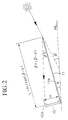
- the reflection surface 11a of the reflector 11 is disposed at an inclination angle ⁇ with respect to a horizontal plane so as to be directed downwardly to the light receiving surface 10a of the power generation assembly 10.
- the light receiving surface 10a of the power generation assembly 10 is disposed at the lower end of the inclined surface 11a at substantially a right angle to the reflection surface 11a. Accordingly, rays of sunlight may be incident on the light receiving surface 10a of the power genration assembly 10 directly as well as being reflected thereon by the reflection surface 11a of the reflector 11.
- the formula (1) defines the minimal length L of the reflection surface 11a which makes a light reflected by the reflection surface 11a effective with respective to the ligth receiving surface 10a.
- Tables 1 - 3 show results of calculating the length L of the reflection surface 11a for various incident angles ⁇ of sunlight based one the formula (1) when the inclination angle ⁇ of the reflection surface 11a is 0°, 20°, or 30°.
- the effective length L of the reflection surface 11a which is calculated based on the formula (1) becomes less than 60% with respect to the height of the light receiving surface 10a when the incident angle ⁇ of sunlight becomes greater than 60°.
- the effect of directing the reflected light reflected by the reflection surface 11a of the reflector 11 onto the light receiving surface 10a of the power generation assembly 10 decreases as the altitude of the sun increases.
- the length L of the reflection surface 11a is determined based on the formula (1), which includes the inclination angle ⁇ of the reflection surface 11a and the height H of the light receiving surface 10a as variables, and the formula (1) defines the minimal length L of the reflection surface 11a which makes light reflected by the reflection surface 11a effective with respective to the light receiving surface 10a. Accordingly, the size of the reflector 11 is limited to the range effective for the light receiving surface 10a, and hence, the increase in cost due to providing the reflector 11 may be minimized. Note that as shown in Tables 2 and 3, the length L of the reflection surface 11a is defined as being about 2 - 6 times of the height H of the light receiving surface 10a. Also, as will be described in the following embodiments, it is preferable to define, for instance, the inclination angle ⁇ of the reflection surface 11a as being about 20° or 30° at a latitude of about 35° north.
- FIG. 3 is a diagram showing a state in which a plurality of the above-mentioned device, each of which includes the power generation assembly 10 and the reflector 11, is arranged in a row.
- each device is arranged adjacent to another in the east-west direction with the light receiving surface 10a of the power generation assembly 10 facing south so that the light receiving surface 10a of the power generation assembly 10 is placed parallel to the east-west direction.
- the above solar power generation device by arranging the plurality of devices in a row, it is possible to receive the light from the sun by means of the light receiving surface 10a of the power generation assembly 10, even when the incident angle ⁇ of the sunlight or the azimuth angle is changed, by reflecting the sunlight using the reflector 11. Accordingly, it is not necessary to install a device for tracking the sun.
- each of the power generation assemblies 10 has plural solar cells GS which generate power when struck by sunlight. These solar cells GS are connected to each other and are arranged on a planar surface. For this reason, if a part of the light receiving surface 10a of the power generation assembly 10 is shaded, the shaded portion functions as a resistor and there is a risk that the flow of electric current will be inhibited at the shaded portion and the output of the solar system may be significantly reduced. Accordingly, it is preferable to connect the solar cells GS at about the same placement height in series when the power generation assembly 10 is constructed from a plurality of the solar cells GS.
- a transmission plate 22 which absorbs light of long wavelengths (i.e., light having wavelengths which are long enough to cause an increase in the temperature of the solar cell GS, for instance, a light ray having a wavelength longer than 1.1 ⁇ m) incident on at least one of the light receiving surface 20a of the power generation assembly 20 and the reflection surface 21a of the reflector 21, and which allows transmission of light having shorter wavelengths.
- an infrared absorption plate which absorbs infrared rays is used as the transmission plate 22.
- FIG. 7A an example in which the transmission plate 22 is placed so as to form a space having a substantially triangular cross-section is shown.
- FIG. 7B an example in which the transmission plate 22 is placed so as to cover the light receiving surface 20a of the power generation assembly 20 is shown.
- the power generation efficiency thereof tends to decrease. Therefore, by absorbing the light of long wavelengths using the transmission plate 22, it becomes possible to suppress the temperature increase of the power generation assembly 20 and prevent the decrease in the power generation efficiency. Also, the light having shorter wavelengths which passed through the transmission plate 22 reaches the light receiving surface 20a and is effectively utilized for power generation.
- the solar power generation device of the second embodiment of the present invention it becomes possible to stably maintain a desired power generation state for a long period of time by absorbing infrared rays contained in sunlight by means of the transmission plate 22 and preventing the increase in the temperature of the power generation assembly 20.
- the solar power generation device of the third embodiment includes a light receiving surface 30a and a reflection surface 31 a.
- a transmission plate 32 which transmits light is provided with the device so as to cover the reflection surface 31a.
- the transmission plate 32 may be made of a member which absorbs the above-mentioned light of long wavelengths, or a normal transmission member 32 having high light transmittance.
- a closed space 33 which is formed by the light receiving surface 30a, the reflection surface 31a, and the transmission plate 32, and has a substantially triangular cross-section, is provided with the solar power generation device. A liquid is sealed and contained in the space 33.
- materials which are capable of absorbing light of long wavelengths, to the liquid contained in the space 32.
- materials include carbon dioxide which is an infrared ray absorbent and is capable of being dissolved in the liquid.
- infrared rays contained in sunlight which may be a cause of increased temperature of the light receiving surface 30a and decrease of the power generation efficiency, may be removed as the sunlight passes through the liquid.
- the solar power generation device of the fourth embodiment includes a light receiving surface 40a, a reflection surface 41a, and a transmission plate 42. A space surrounded by these elements for containing a liquid is also provided with the device.
- the transmission plate 42 of this embodiment is disposed so as to be inclined with respect to the horizontal plane. That is, in the solar power generation device of the fourth embodiment, light from the sun reflected by the reflection surface 41a is readily directed towards the light receiving surface 40a since the transmission plate 42, which is provided so as to cover the reflection surface 41a, is inclined in the direction opposite to the reflection surface 41a with respect to the horizontal plane. Accordingly, it becomes possible to further improve the light condensing efficiency of the device for the light receiving surface 40a.
- the present invention is applicable to solar batteries of any of the crystalline type silicon, amorphous type silicon, GaAs, CdTe, CdS and so forth.
- a battery whose main component is one of copper, indium, and selenium may be utilized.
- the present invention is particularly advantageous for the types of solar batteries whose performance is decreased by the temperature increase caused by the irradiation of infrared rays.
- a power generation assembly was constructed by using six silicon polycrystalline type solar batteries, each of which had the size of 12 cm X 12 cm, and a solar power generation device shown in FIG. 1 was assembled by using the power generation assembly.
- the size of a light receiving surface of the power generation assembly was 40 cm in width and 30 cm in height.
- a mirror having a reflectance of 95% was used as a reflector, and based on the above-mentioned formula (1), the size of the reflection surface was determined to be 50 cm in width and 1800 cm in length.
- the solar power generation device was placed so that the angle of inclination of the reflection surface was 20°.
- the light incident on the power generation assembly was only the direct light, and about 10% of the energy thereof was converted into electric power. Also, about 10 W of electric power was obtained regardless of the angle of incidence of the light. Moreover, if a comparison is made about the power generation characteristics of the devices shown in Tables 4 and 5, it can be seen that the level of generated output is improved by the placement of the reflector according to the embodiment of the present invention. That is, by adopting the configuration of the device shown in FIG. 1, it becomes possible to improve the power generation capacity of the device per unit area.
- Factors used for making the comparison of the device according to an embodiment of the present invention with the conventional device in the abovementioned study are shown in Table 6 below.
- Table 6 Factors used for comparison Present invention Size of light receiving surface 40 cm width, 30 cm height Reflection surface Mirror of 95% reflectance Size of reflection surface 50 cm width, 900 cm length Inclination of reflection surface 30° Conventional art Size of light receiving surface 50 cm width, 900 cm length
- Table 7 Comparison of the characteristics of the solar power generation device according to the present invention with that of the conventional art Present invention Conventional art Light receiving surface area per S.P.G.D. (Net area of P.G.P.) (cm 2 ) 1,200 3,600 Generated output per S.P.G.D. 20 36 Power generation density (W/cm 2 ) (when 1,000 w/cm 2 ) 0.018 0.01 S.P.G.D.: solar power generation device; P.G.P.: power generation part
- the area of the light receiving surface (the net area of the power generation part) necessary for obtaining a predetermined output is decreased to about 1/2, as compared with that of a conventional device, due to the increase in the power generation capacity of the device per unit area.
- the facility area required by an embodiment of the present invention is about 1.6 times larger than that required conventionally, the present invention is more advantageous where the freedom in choosing the installation area is large.
- the angle of incidence of sunlight is varied (30° to 80°)
- the output generated at each angle of inclination (10°, 20°, and 30°) of the reflection surface is also changed. That is, in general, when the angle of incidence of sunlight is small, generated output becomes larger as the angle of inclination of the reflection surface becomes smaller, and when the angle of incidence is large, generated output becomes larger as the angle of inclination becomes larger. That is, it is preferable that the angle of inclination of the reflection surface of the reflector be determined in consideration of the altitude of the sun at the site where the device is to be installed.
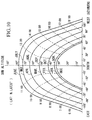
- FIG. 10 is a diagram showing the annual azimuth direction and the hourly altitude of the sun at a site at latitude 35° north.
- the position of the sun at the meridian at the site at a latitude of 35° north is in the range between 30° and 80°.
- the altitude of the sun exceeds 70° only in the months from May through July during the two hours between 11:00 and 13:00.
- the altitude of the sun is relatively low at times other than the period mentioned above.
- the altitude of the sun is less than 70° in periods other than the above-mentioned three-month period all day. It is considered that the angle of inclination of the reflection surface of the reflector is preferably between about 20° and 30°.
- an infrared absorption plate i.e., a transmission plate which absorbs light within a long wavelength region
- the infrared absorption plate used was a so-called "heat reflecting glass", and in this case, a solar control glass was employed. By using the solar control glass, the amount of infrared rays transmitted was decreased and the temperature increase in the power generation assembly was lowered by about 10°C.
- the power generation assembly used in this case was formed by silicon polycrystalline type solar batteries whose power generation efficiency is known to be decreased when the temperature thereof increases. In general, the power generation efficiency of a device at 25°C is used as a standard.
- the power generation efficiency of the solar power generation device was about 12%, and this value was reduced by about 4% when the temperature thereof reached 60°C during use.
- the power generation efficiency of about 11% was obtained due to the satisfactory inhibition of the temperature increase of the power generation assembly.
- a container having a high degree of air tightness was constructed by using a light transmitting partition wall, which was disposed so as to overlap with the light receiving surface of the power generation assembly, the reflector, and a phototransmission plate.
- An aqueous solution containing an infrared absorbent was sealed inside the container.
- carbon dioxide was selected and was used as the infrared absorbent, and the aqueous solution was saturated therewith. In this manner, the amount of infrared rays transmitted was reduced, and as in the above-mentioned example in which the infrared absorption plate was employed, a power generation efficiency of the device of about 11% was obtained.
Landscapes
- Engineering & Computer Science (AREA)
- Physics & Mathematics (AREA)
- Life Sciences & Earth Sciences (AREA)
- Sustainable Development (AREA)
- Sustainable Energy (AREA)
- Thermal Sciences (AREA)
- Chemical & Material Sciences (AREA)
- Combustion & Propulsion (AREA)
- Mechanical Engineering (AREA)
- General Engineering & Computer Science (AREA)
- Photovoltaic Devices (AREA)
Applications Claiming Priority (2)
| Application Number | Priority Date | Filing Date | Title |
|---|---|---|---|
| JP2000199584 | 2000-06-30 | ||
| JP2000199584A JP3558968B2 (ja) | 2000-06-30 | 2000-06-30 | 太陽光発電装置 |
Publications (1)
| Publication Number | Publication Date |
|---|---|
| EP1168459A2 true EP1168459A2 (de) | 2002-01-02 |
Family
ID=18697573
Family Applications (1)
| Application Number | Title | Priority Date | Filing Date |
|---|---|---|---|
| EP01401500A Withdrawn EP1168459A2 (de) | 2000-06-30 | 2001-06-11 | Solar-Stromerzeugungsanlage |
Country Status (3)
| Country | Link |
|---|---|
| US (1) | US20020017317A1 (de) |
| EP (1) | EP1168459A2 (de) |
| JP (1) | JP3558968B2 (de) |
Cited By (1)
| Publication number | Priority date | Publication date | Assignee | Title |
|---|---|---|---|---|
| EP3742603A4 (de) * | 2018-01-16 | 2021-06-02 | Sung Chang Co., Ltd | Solarmodulinstallationsverfahren zur effizienten nutzung von sonnenlicht |
Families Citing this family (5)
| Publication number | Priority date | Publication date | Assignee | Title |
|---|---|---|---|---|
| FR2838564B1 (fr) * | 2002-04-11 | 2004-07-30 | Cit Alcatel | Generateur photovoltaique a concentration protege contre l'echauffement |
| US20080047003A1 (en) * | 2006-08-02 | 2008-02-21 | Oracle International Corporation | Audit system |
| JP2010062519A (ja) * | 2008-08-04 | 2010-03-18 | Ntt Docomo Inc | 太陽光発電装置および太陽光発電方法 |
| WO2010021678A1 (en) * | 2008-08-16 | 2010-02-25 | Zonda Solar Technologies Llc | Solar collector panel |
| KR101042940B1 (ko) * | 2010-06-10 | 2011-06-24 | 신유현 | 기둥형 집광장치를 구비한 태양 위치 추적 장치 |
-
2000
- 2000-06-30 JP JP2000199584A patent/JP3558968B2/ja not_active Expired - Fee Related
-
2001
- 2001-06-08 US US09/875,979 patent/US20020017317A1/en not_active Abandoned
- 2001-06-11 EP EP01401500A patent/EP1168459A2/de not_active Withdrawn
Cited By (1)
| Publication number | Priority date | Publication date | Assignee | Title |
|---|---|---|---|---|
| EP3742603A4 (de) * | 2018-01-16 | 2021-06-02 | Sung Chang Co., Ltd | Solarmodulinstallationsverfahren zur effizienten nutzung von sonnenlicht |
Also Published As
| Publication number | Publication date |
|---|---|
| JP3558968B2 (ja) | 2004-08-25 |
| JP2002026363A (ja) | 2002-01-25 |
| US20020017317A1 (en) | 2002-02-14 |
Similar Documents
| Publication | Publication Date | Title |
|---|---|---|
| US20040025931A1 (en) | Solar panel for simultaneous generation of electric and thermal energy | |
| US7858875B2 (en) | Radiant energy conversion system | |
| US4398053A (en) | Pyramidal energy collector | |
| US4401103A (en) | Solar energy conversion apparatus | |
| US8049150B2 (en) | Solar collector with end modifications | |
| US20030029497A1 (en) | Solar energy converter using optical concentration through a liquid | |
| US8226253B2 (en) | Concentrators for solar power generating systems | |
| AU2008203786A1 (en) | Solar electricity generator | |
| US4249520A (en) | Pyramidal energy collector system | |
| JP3818651B2 (ja) | 太陽光発電システム | |
| JP2005142373A (ja) | 集光型太陽光発電装置 | |
| WO1996024954A1 (en) | Non-tracking solar concentrator heat sink and housing system | |
| KR101945916B1 (ko) | 태양전지를 활용한 태양광 발전 온실 | |
| EP4055706A1 (de) | Elektromagnetischer energiewandler | |
| JP2014232739A (ja) | 太陽光発電装置 | |
| EP1168459A2 (de) | Solar-Stromerzeugungsanlage | |
| Rumyantsev | Terrestrial concentrator PV systems | |
| JP2004531902A5 (de) | ||
| Friedman | Luminescent solar concentrators | |
| US20250055414A1 (en) | Semi-transparent bifacial photovoltaic module with rear irradiance concentrators | |
| JP2014167947A (ja) | 太陽光発電装置 | |
| CN101308879B (zh) | 均质杆 | |
| JP3090923B1 (ja) | 反射式太陽光発電装置 | |
| JP2000031521A (ja) | 太陽電池における採光方法及び採光装置 | |
| Klotz et al. | Field test results of the Archimedes Photovoltaic V-Trough concentrator system |
Legal Events
| Date | Code | Title | Description |
|---|---|---|---|
| PUAI | Public reference made under article 153(3) epc to a published international application that has entered the european phase |
Free format text: ORIGINAL CODE: 0009012 |
|
| 17P | Request for examination filed |
Effective date: 20010618 |
|
| AK | Designated contracting states |
Kind code of ref document: A2 Designated state(s): AT BE CH CY DE DK ES FI FR GB GR IE IT LI LU MC NL PT SE TR |
|
| AX | Request for extension of the european patent |
Free format text: AL;LT;LV;MK;RO;SI |
|
| STAA | Information on the status of an ep patent application or granted ep patent |
Free format text: STATUS: THE APPLICATION IS DEEMED TO BE WITHDRAWN |
|
| 18D | Application deemed to be withdrawn |
Effective date: 20031231 |