EP1168700B1 - Signalisation du type de modulation dans des systèmes de modulation adaptatifs - Google Patents
Signalisation du type de modulation dans des systèmes de modulation adaptatifs Download PDFInfo
- Publication number
- EP1168700B1 EP1168700B1 EP01113861A EP01113861A EP1168700B1 EP 1168700 B1 EP1168700 B1 EP 1168700B1 EP 01113861 A EP01113861 A EP 01113861A EP 01113861 A EP01113861 A EP 01113861A EP 1168700 B1 EP1168700 B1 EP 1168700B1
- Authority
- EP
- European Patent Office
- Prior art keywords
- modulation
- sequences
- sequence
- synchronisation
- cazac
- Prior art date
- Legal status (The legal status is an assumption and is not a legal conclusion. Google has not performed a legal analysis and makes no representation as to the accuracy of the status listed.)
- Expired - Lifetime
Links
- 230000003044 adaptive effect Effects 0.000 title claims abstract description 14
- 230000011664 signaling Effects 0.000 title 1
- 230000005540 biological transmission Effects 0.000 claims description 15
- 125000004122 cyclic group Chemical group 0.000 description 2
- 230000002349 favourable effect Effects 0.000 description 2
- 230000003111 delayed effect Effects 0.000 description 1
Images

Classifications
-
- H—ELECTRICITY
- H04—ELECTRIC COMMUNICATION TECHNIQUE
- H04L—TRANSMISSION OF DIGITAL INFORMATION, e.g. TELEGRAPHIC COMMUNICATION
- H04L1/00—Arrangements for detecting or preventing errors in the information received
- H04L1/0001—Systems modifying transmission characteristics according to link quality, e.g. power backoff
- H04L1/0015—Systems modifying transmission characteristics according to link quality, e.g. power backoff characterised by the adaptation strategy
- H04L1/0017—Systems modifying transmission characteristics according to link quality, e.g. power backoff characterised by the adaptation strategy where the mode-switching is based on Quality of Service requirement
- H04L1/0018—Systems modifying transmission characteristics according to link quality, e.g. power backoff characterised by the adaptation strategy where the mode-switching is based on Quality of Service requirement based on latency requirement
-
- H—ELECTRICITY
- H04—ELECTRIC COMMUNICATION TECHNIQUE
- H04L—TRANSMISSION OF DIGITAL INFORMATION, e.g. TELEGRAPHIC COMMUNICATION
- H04L1/00—Arrangements for detecting or preventing errors in the information received
- H04L1/0001—Systems modifying transmission characteristics according to link quality, e.g. power backoff
- H04L1/0002—Systems modifying transmission characteristics according to link quality, e.g. power backoff by adapting the transmission rate
- H04L1/0003—Systems modifying transmission characteristics according to link quality, e.g. power backoff by adapting the transmission rate by switching between different modulation schemes
-
- H—ELECTRICITY
- H04—ELECTRIC COMMUNICATION TECHNIQUE
- H04L—TRANSMISSION OF DIGITAL INFORMATION, e.g. TELEGRAPHIC COMMUNICATION
- H04L1/00—Arrangements for detecting or preventing errors in the information received
- H04L1/0001—Systems modifying transmission characteristics according to link quality, e.g. power backoff
- H04L1/0023—Systems modifying transmission characteristics according to link quality, e.g. power backoff characterised by the signalling
- H04L1/0025—Transmission of mode-switching indication
Definitions
- the present invention relates in general to telecommunication systems and more in particular, to a data transmission method in an adaptive modulation system.
- Adaptive modulation is a recently conceived technique consisting in transmitting data coded according to different modulations. These modulations are selected in such a way that transmissions from and/or to destination stations, connected through a channel having good transmission characteristics, are made with a comparatively large number of bits per symbol (multilevel modulation), while transmissions from and/or to stations connected through channels having comparatively worse characteristics, are made with a minimum number of bits per symbol (basic modulation).
- Multilevel modulation are particularly convenient in terms of quantity of information per transmitted symbol, since the information associated to each symbol is as high as higher is the number of the different symbols that we can transmit.
- multilevel modulations can be conveniently exploited only if the channel shows characteristics of relatively limited attenuation and interference.
- the adaptive modulation it is possible to adapt the modulation level using a multilevel modulation (for instance 16QAM or 64QAM) if channel attenuation and interference are comparatively limited (this can occur for instance if the destination station is close), or a more robust modulation (for instance QPSK or 4QAM) if channel attenuation and interference are higher (for instance: far destination station).
- a multilevel modulation for instance 16QAM or 64QAM
- QPSK or 4QAM more robust modulation
- Data are generally organised in packets ("bursts") consisting of a preamble followed by a set of data bits (also called “payload", information field or useful data).
- the preamble enables the demodulator to identify the starting of a new packet, to obtain the transmission clock and to recognise, in the phase vector plane, the position of some reference symbols (points of the transmission constellation) whose knowledge is necessary to set the decision thresholds.
- the whole of these functions is often defined “synchronisation” so that said preamble is often defined “synchronisation preamble” and the sequence of symbols forming the same, is often called “synchronisation sequence”.
- synchronisation sequence is often called “synchronisation sequence”.
- burst The problem of identifying the type of modulation used for each packet (“burst") has been solved in many different ways, for instance creating complex frames of data collecting the bursts in groups having the same modulation type.
- a bit sequence (“map") is periodically transmitted in each frame, and within the map the modulation type, used for all the bursts up to the next "map" is identified.
- An optimal solution to the above mentioned problems could consist in implementing self-consistent bursts, that is bursts transporting inside themselves also the information concerning the type of modulation used to code data.
- Such an arrangement is known e.g. from US-A-5 561 468 or US-A-5 289 476, after which the preamble of Claim 1 was patterned.
- said bursts should be characterised by a null additional overhead or in any case by a comparatively limited overhead, compared to conventional bursts, and by a high protection of the information concerning the modulation type, since this information is essential for the correct demodulation of transmitted data.
- the core of the method of the invention consists in employing a specific sequence of symbols for the burst preamble in order to identify a corresponding type of modulation of useful data, thus entrusting the preamble with this new function of modulation identification in addition to the classical synchronisation and channel estimate functions.
- the method of the invention enables to transmit self-consistent bursts with a null, or limited to few symbols, additional overhead maintaining a high protection of the information concerning the type of modulation.
- Another featuring element of the invention consists in employing a sequence very different from the other ones (having high decision distance) to distinguish the most robust modulation (having minimum number of levels, called also basic modulation) and sequences having lower distance to distinguish among the less robust modulations (multilevel modulations).
- a sequence very different from the other ones having high decision distance
- sequences having lower distance to distinguish among the less robust modulations multilevel modulations.
- these synchronisation sequences are CAZAC sequences, possibly cyclically transmitted in partially replicated manner and possibly, when necessary, transmitted together with some other symbols forming an auxiliary sequence.
- the adaptive modulation is performed employing a basic modulation and a multilevel modulation, being the basic modulation the QPSK modulation and the multilevel modulation the 16QAM modulation.
- the invention can be conveniently applied also to modulations different from the mentioned ones.
- Synchronisation sequences are the CAZAC sequences (Constant Amplitude, Zero Auto Correlation). They have the properties of being constant amplitude sequences, and the cyclic correlation between a CAZAC sequence and one of its replica, cyclically delayed, is maximum if the phase shifting is null (aligned sequences), while it is null in the contrary instance. These characteristics make CAZAC sequences particularly adequate to implement synchronisation and channel estimate preambles.
- a CAZAC sequence is employed to identify a corresponding modulation.
- Typical CAZAC sequences conveniently employable with the considered modulations, have 8 quaternary symbols (4 possible values for each symbol). There are only two sequences of this type (except for the variants cyclical in time and the variants given by sign change and cyclical rotations in the complex numbers plane): CAZAC1 1 -1 j 1 1 1 j -1 CAZAC2 1 j -1 1 1 j 1 1 in which 1, -1, j and -j denote the four different values that each transmitted symbol can assume, making precise reference to the symbols of the QPSK modulation.
- the synchronisation sequence being made of quaternary symbols, is transmitted employing the basic modulation QPSK, irrespective of the type of modulation used for useful data.
- the method according to the invention can be implemented using a CAZAC sequence, for example CAZAC1, to identify the basic modulation, which in the case illustrated is the QPSK modulation, while the other CAZAC2 to identify the multilevel modulation (16QAM). Therefore, if a burst containing the CAZAC1 sequence is received, it shall be QPSK demodulated, if on the contrary a burst containing the CAZAC2 sequence is received, it shall be 16QAM demodulated.
- a CAZAC sequence for example CAZAC1
- the basic modulation which in the case illustrated is the QPSK modulation
- 16QAM multilevel modulation
- the method of the present invention enables to transmit data in an adaptive modulation system, supplying the information on the type of modulation without any additional overhead.
- these CAZAC sequences can be cyclically repeated, in full or partially.
- a reasonable compromise between overhead and synchronisation efficiency can be reached transmitting the sequence in a partially replicated cyclical manner, that is, transmitting the last bits of the sequence before the sequence itself, and the first bits of the CAZAC sequence after it.
- the CAZAC sequences are preceded by their last three bits and are followed by the relevant first three bits.
- the number of bits preceding the CAZAC sequence is equal to the number of bits following it ("symmetric partial replica"), since it is always possible to transmit the sequence in cyclical manner partially replicated preceded by a given number of bits and followed by a different number of bits (“non symmetric partial replica"); it is also possible to start from any variant of each one of the two CAZAC sequences.
- sequences in Table 1 are preferred, since their quadratic decision distance is equal to the double of that existing between CAZAC1 and CAZAC2 sequences, without doubling the length of the synchronisation sequence.
- the decision distance between the two sequences indicated in Table 1 is 8.2 , equal to a gain of 12.04dB, sufficient to guarantee in all the cases having practical interest a negligible probability of erroneous recognition of the type of modulation adopted.
- the adaptive modulation is made employing more than one multilevel modulation, so the problem arises to distinguish also multilevel modulations among them.
- the method according to the invention can be applied, transmitting a CAZAC sequence, possibly replicated, for a corresponding type of modulation.
- one of the two CAZAC sequences is employed, possibly replicated, for instance CAZAC1, to identify the basic modulation, while the other one CAZAC2 is employed to identify all the multilevel modulations.
- CAZAC2 is employed to identify all the multilevel modulations.
- an auxiliary sequence made up of a given number of symbols is transmitted. In this way, if the CAZAC2 sequence is recognised in the reception phase, it means that data are coded with a multilevel modulation; identifying the auxiliary sequence, the used multilevel modulation is identified.
- the adaptive modulation is made employing three different modulations: long range, medium range and short range.
- long-range modulation basic modulation
- medium and short-range multilevel modulations are 16QAM and 64QAM modulations, respectively.
- a CAZAC sequence for instance CAZAC1, replicated as indicated in Table 1, is used to identify the long range modulation QPSK, while the other one CAZAC2, replicated in the same way, identifies all the two medium and short range modulations. 16QAM and 64QAM modulations are discriminated transmitting, after the replicated CAZAC2 sequence, a corresponding auxiliary sequence, made for instance of two symbols.
- the synchronisation sequence corresponding to the QPSK modulation shall be at a very high decision distance from the sequences corresponding to 16QAM and 64QAM modulations which, in turn, shall be different but at a lower reciprocal decision distance.
- the two different CAZAC sequences are used because the basic modulation is employed when the channel transmission characteristics are comparatively unfavourable, so that it is opportune that the corresponding synchronisation sequence is largely different from those relating to multilevel modulations, in order to have a reduced probability of wrong recognition.
- the channel shows favourable transmission characteristics so that, to discriminate the multilevel medium range modulation 16QAM from the short range one 64QAM, it is sufficient to transmit an auxiliary sequence of two symbols only, in addition to the CAZAC2 sequence.
- Table 2 QPSK 1 j -1 1 -1 j 1 1 1 j -1 1 -1 j j -j 16QAM j 1 1 -1 j -1 1 1 j 1 1 -1 j -1 1 -1 64QAM j 1 1 -1 j -1 1 1 j 1 1 -1 j -1 -1 1 1
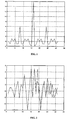
- Fig. 1 shows the trend of the non-cyclic auto-correlation of the sequence relevant to the basic modulation QPSK, indicated in table 2 as a function of the phase shifting.
- the phase shifting is null we have a maximum amplitude peak that enables the synchronisation (synchronisation peak).
- Fig. 3 shows the trend of the cross-correlation between the sequences of Table 2 relevant to multilevel modulations, as a function of the phase shifting.
- a peak having comparatively high amplitude when the two sequences are aligned, since they differ only in the last two symbols. Even if the decision distance between the two sequences is limited, it is however sufficient to discriminate them in a reliable manner.
- the synchronisation sequences of Table 2 enable to discriminate with a 12dB gain (the gain is defined in terms of decision distance compared to a single information bit transmitted with QPSK and gray coding, at equal error probability on the transmitted information unit, for transmitted information it is intended the binary information enabling to distinguish the basic modulation from other modulations) the basic modulation (QPSK) from the other ones, and the multilevel modulations (16QAM and 64QAM) between them with a 15.56dB gain (the gain is defined in terms of decision distance compared to a single information bit transmitted with 16QAM, and gray coding, at equal error probability on the transmitted information unit, for information transmitted it is intended the binary information enabling to distinguish the 16QAM modulation from the 64QAM modulation).
- the overhead increase due to the fact that 16 bit synchronisation sequences are used instead of 14-bit ones, which are generally used in similar cases to assure the synchronisation and the channel estimate, turns out to be within acceptable limits.
Landscapes
- Engineering & Computer Science (AREA)
- Quality & Reliability (AREA)
- Computer Networks & Wireless Communication (AREA)
- Signal Processing (AREA)
- Digital Transmission Methods That Use Modulated Carrier Waves (AREA)
- Transmitters (AREA)
- Two-Way Televisions, Distribution Of Moving Picture Or The Like (AREA)
- Mobile Radio Communication Systems (AREA)
- Facsimiles In General (AREA)
- Telephone Function (AREA)
Claims (10)
- Procédé de transmission non continue ou par salves, en modulation adaptative de données, d'une station émettrice vers une station réceptrice par le biais d'un système de transmission, le procédé incluant• l'organisation de données en paquets standards, appelés salves, formés d'un ensemble de bits de données et d'un préambule contenant une séquence de symboles de synchronisation appelée séquence de synchronisation,• la transmission desdits paquets standards vers la station destinataire,- dans lequel le procédé inclut• la démodulation de chaque paquet standard selon une modulation particulière des données contenues dans le paquet, identifiée par une séquence de synchronisation correspondante contenue dans le préambule du paquet correspondant,caractérisé en ce que :ladite modulation adaptative est réalisée en utilisant une modulation de base et une pluralité de modulations multiniveaux,• chaque séquence de salves de synchronisation codée avec ladite modulation de base inclut une première séquence ;• chaque séquence de synchronisation de salves codées avec une modulation multiniveaux inclut une seconde séquence, située à une distance de décision élevée de la première, suivie d'une séquence auxiliaire particulière d'un nombre donné de symboles identifiant une modulation multiniveaux correspondante.
- Procédé selon la revendication 1, dans lequel lesdites séquences de synchronisation incluent des séquences CAZAC à amplitude constante et autocorrélation nulle.
- Procédé selon la revendication 2, dans lequel chaque symbole desdites séquences CAZAC peut prendre quatre valeurs différentes et lesdites séquences CAZAC sont formées de 8 symboles.
- Procédé selon les revendications 2 ou 3, dans lequel lesdites séquences de synchronisation incluent des séquences CAZAC partiellement répliquées de manière cyclique.
- Procédé selon l'une quelconque des revendications 2 à 4, caractérisé en ce que- chaque séquence de synchronisation de salves codées avec ladite modulation de base inclut une première séquence CAZAC ;- chaque séquence de synchronisation de salves codées avec une modulation multiniveaux inclut une seconde séquence CAZAC suivie d'une séquence auxiliaire particulière d'un nombre donné de symboles identifiant une modulation multiniveaux correspondante.
- Procédé selon la revendication 5, dans lequel ladite modulation adaptative est réalisée en utilisant une modulation de base pour des transmissions de longue portée et deux modulations multiniveaux pour des transmissions de moyenne et courte portée, respectivement, caractérisé en ce que lesdites séquences auxiliaires sont des séquences formées de deux symboles quaternaires et sont situées à la distance de décision maximum.
- Procédé selon la revendication 6, dans lequel ladite modulation de base est une modulation QPSK ou 4QAM, lesdites modulations de moyenne et courte portée sont une modulation 16QAM et une modulation 64QAM respectivement.
- Procédé selon la revendication 7, dans lequel lesdites séquences de synchronisation, qui incluent des séquences CAZAC répliquées et des séquences additionnelles, se présentent comme suit :• QPSK : 1 j -1 1 -1 j 1 1 1 j -1 1 -1 j j -j• 16QAM :j 1 1 -1 j -1 1 1 j 1 1 -1 j -1 1-1• 64QAM :j 1 1 -1 j j -1 1 1 j 1 1 -1 j -1 -1 1
- Procédé selon la revendication 4, dans lequel ladite réplique cyclique est telle que la distance de décision entre deux des séquences de synchronisation mentionnées ci-dessus est maximisée une fois que la longueur des séquences est définie.
- Procédé selon les revendications précédentes, dans lequel ladite séquence de synchronisation est transmise en utilisant la modulation de base quelle que soit la modulation utilisée pour les données.
Applications Claiming Priority (2)
| Application Number | Priority Date | Filing Date | Title |
|---|---|---|---|
| ITMI001441 | 2000-06-27 | ||
| IT2000MI001441A IT1318053B1 (it) | 2000-06-27 | 2000-06-27 | Metodo di trasmissione in sistemi a modulazione adattativa |
Publications (3)
| Publication Number | Publication Date |
|---|---|
| EP1168700A2 EP1168700A2 (fr) | 2002-01-02 |
| EP1168700A3 EP1168700A3 (fr) | 2004-01-21 |
| EP1168700B1 true EP1168700B1 (fr) | 2007-05-09 |
Family
ID=11445351
Family Applications (1)
| Application Number | Title | Priority Date | Filing Date |
|---|---|---|---|
| EP01113861A Expired - Lifetime EP1168700B1 (fr) | 2000-06-27 | 2001-06-07 | Signalisation du type de modulation dans des systèmes de modulation adaptatifs |
Country Status (5)
| Country | Link |
|---|---|
| EP (1) | EP1168700B1 (fr) |
| AT (1) | ATE362247T1 (fr) |
| DE (1) | DE60128294T2 (fr) |
| ES (1) | ES2282172T3 (fr) |
| IT (1) | IT1318053B1 (fr) |
Families Citing this family (9)
| Publication number | Priority date | Publication date | Assignee | Title |
|---|---|---|---|---|
| ITMI20021163A1 (it) * | 2002-05-30 | 2003-12-01 | Siemens Inf & Comm Networks | Sistema di trasmissione radio con topologia pmp inglobante stazioni idonee ad operare secondo molteplici modalita' operative e secondo molte |
| KR100520158B1 (ko) * | 2003-10-27 | 2005-10-10 | 삼성전자주식회사 | 프리앰블 시퀀스 그룹 생성방법 |
| GB2407951A (en) * | 2003-10-28 | 2005-05-11 | Sepura Ltd | Blind modulation scheme detection using training sequences |
| US8913672B2 (en) | 2008-09-12 | 2014-12-16 | Qualcomm Incorporated | Efficiently identifying system waveform in uplink transmission |
| US8588086B2 (en) * | 2009-11-30 | 2013-11-19 | Qualcomm Incorporated | Reverse link data rate indication for satellite-enabled communications systems |
| US9450797B2 (en) | 2013-02-12 | 2016-09-20 | Sepura Plc | Mobile communications system |
| GB201302414D0 (en) | 2013-02-12 | 2013-03-27 | Sepura Ltd | Mobile communication system |
| CN106961405B (zh) * | 2016-01-11 | 2020-06-02 | 中兴通讯股份有限公司 | 多载波系统的数据调制、解调方法、数据传输方法及节点 |
| CN111935042B (zh) * | 2020-07-20 | 2023-04-25 | 武汉邮电科学研究院有限公司 | 一种基于机器学习的概率整形识别系统、方法及接收端 |
Family Cites Families (4)
| Publication number | Priority date | Publication date | Assignee | Title |
|---|---|---|---|---|
| US5289476A (en) * | 1991-05-10 | 1994-02-22 | Echelon Corporation | Transmission mode detection in a modulated communication system |
| JPH0775099A (ja) * | 1993-05-07 | 1995-03-17 | Philips Electron Nv | マルチプレックス直交振幅変調テレビジョン送信用送信方式、送信機及び受信機 |
| US5761190A (en) * | 1995-02-20 | 1998-06-02 | Pioneer Electronic Corporation | OFDM broadcast wave receiver |
| JPH10164157A (ja) * | 1996-11-27 | 1998-06-19 | Nec Corp | 無線データ通信装置 |
-
2000
- 2000-06-27 IT IT2000MI001441A patent/IT1318053B1/it active
-
2001
- 2001-06-07 EP EP01113861A patent/EP1168700B1/fr not_active Expired - Lifetime
- 2001-06-07 AT AT01113861T patent/ATE362247T1/de active
- 2001-06-07 DE DE60128294T patent/DE60128294T2/de not_active Expired - Lifetime
- 2001-06-07 ES ES01113861T patent/ES2282172T3/es not_active Expired - Lifetime
Also Published As
| Publication number | Publication date |
|---|---|
| EP1168700A2 (fr) | 2002-01-02 |
| ITMI20001441A1 (it) | 2001-12-27 |
| ATE362247T1 (de) | 2007-06-15 |
| EP1168700A3 (fr) | 2004-01-21 |
| DE60128294T2 (de) | 2007-09-20 |
| DE60128294D1 (de) | 2007-06-21 |
| IT1318053B1 (it) | 2003-07-21 |
| ES2282172T3 (es) | 2007-10-16 |
| ITMI20001441A0 (it) | 2000-06-27 |
Similar Documents
| Publication | Publication Date | Title |
|---|---|---|
| CA1303678C (fr) | Systemes de transmission de donnees a demande de repetition automatique | |
| KR100370723B1 (ko) | 정보 버스트로 비트를 매핑하기 위한 방법 및 장치 | |
| US20210297148A1 (en) | Satellite communication transmitter | |
| EP0938207A2 (fr) | Système et méthode de transmission de redondance incrémentielle dans un système de communication | |
| US7092434B2 (en) | Mobile station used as a repeater station when communicating with a base station | |
| WO2004075442A2 (fr) | Procedes et appareil de codage ameliore dans des systemes de communications multi-usagers | |
| US7065703B2 (en) | Synchronization of a communications system | |
| KR20000052817A (ko) | 자동 선택가능한 전송속도를 갖는 디지털 통신시스템 | |
| EP1142155B1 (fr) | Procede de signalisation et systeme de telecommunication | |
| EP1073229B1 (fr) | Procédé de démodulation pour récepteur | |
| KR100671508B1 (ko) | 시그널링 방법 및 원격 통신 시스템 | |
| EP1168700A2 (fr) | Signalisation du type de modulation dans des systèmes de modulation adaptatifs | |
| MXPA02003211A (es) | Metodo y sistemas para proteccion tipo cuadro robusto en sistemas que emplean velocidades de bit variable. | |
| US7843989B2 (en) | Systems and methods for embedding a first signal in the coding of a second signal | |
| US20050135507A1 (en) | Apparatus and method for demodulation using detection of channel adaptive modulation scheme | |
| EP0953231B1 (fr) | Procede de multiplexage et emetteur/recepteur | |
| EP1179897B1 (fr) | Méthode de transmission ayant différents modes d'opération | |
| EP1535440B1 (fr) | Saisie incorporee | |
| JP2005057670A (ja) | デジタル通信装置及びデジタル通信システム | |
| US9172443B2 (en) | Layer swapping in EGPRS MIMO | |
| KR20030071310A (ko) | 왈쉬 코드 정보 전송 방법 | |
| MXPA00010714A (en) | Method and system for multiplexing of multiple users for enhanced capacity radiocommunications | |
| GB2432087A (en) | Dividing headers into data bursts |
Legal Events
| Date | Code | Title | Description |
|---|---|---|---|
| PUAI | Public reference made under article 153(3) epc to a published international application that has entered the european phase |
Free format text: ORIGINAL CODE: 0009012 |
|
| AK | Designated contracting states |
Kind code of ref document: A2 Designated state(s): AT BE CH CY DE DK ES FI FR GB GR IE IT LI LU MC NL PT SE TR |
|
| AX | Request for extension of the european patent |
Free format text: AL;LT;LV;MK;RO;SI |
|
| PUAL | Search report despatched |
Free format text: ORIGINAL CODE: 0009013 |
|
| AK | Designated contracting states |
Kind code of ref document: A3 Designated state(s): AT BE CH CY DE DK ES FI FR GB GR IE IT LI LU MC NL PT SE TR |
|
| AX | Request for extension of the european patent |
Extension state: AL LT LV MK RO SI |
|
| RIC1 | Information provided on ipc code assigned before grant |
Ipc: 7H 04L 27/00 B Ipc: 7H 04L 1/00 A |
|
| 17P | Request for examination filed |
Effective date: 20040621 |
|
| RAP1 | Party data changed (applicant data changed or rights of an application transferred) |
Owner name: SIEMENS MOBILE COMMUNICATIONS S.P.A. |
|
| AKX | Designation fees paid |
Designated state(s): AT BE CH CY DE DK ES FI FR GB GR IE IT LI LU MC NL PT SE TR |
|
| RAP1 | Party data changed (applicant data changed or rights of an application transferred) |
Owner name: SIEMENS S.P.A. |
|
| RTI1 | Title (correction) |
Free format text: SIGNALLING OF MODULATION TYPE IN ADAPTIVE MODULATION SYSTEMS |
|
| GRAP | Despatch of communication of intention to grant a patent |
Free format text: ORIGINAL CODE: EPIDOSNIGR1 |
|
| GRAS | Grant fee paid |
Free format text: ORIGINAL CODE: EPIDOSNIGR3 |
|
| GRAA | (expected) grant |
Free format text: ORIGINAL CODE: 0009210 |
|
| AK | Designated contracting states |
Kind code of ref document: B1 Designated state(s): AT BE CH CY DE DK ES FI FR GB GR IE IT LI LU MC NL PT SE TR |
|
| PG25 | Lapsed in a contracting state [announced via postgrant information from national office to epo] |
Ref country code: CH Free format text: LAPSE BECAUSE OF FAILURE TO SUBMIT A TRANSLATION OF THE DESCRIPTION OR TO PAY THE FEE WITHIN THE PRESCRIBED TIME-LIMIT Effective date: 20070509 Ref country code: FI Free format text: LAPSE BECAUSE OF FAILURE TO SUBMIT A TRANSLATION OF THE DESCRIPTION OR TO PAY THE FEE WITHIN THE PRESCRIBED TIME-LIMIT Effective date: 20070509 Ref country code: LI Free format text: LAPSE BECAUSE OF FAILURE TO SUBMIT A TRANSLATION OF THE DESCRIPTION OR TO PAY THE FEE WITHIN THE PRESCRIBED TIME-LIMIT Effective date: 20070509 |
|
| REG | Reference to a national code |
Ref country code: GB Ref legal event code: FG4D |
|
| REG | Reference to a national code |
Ref country code: CH Ref legal event code: EP |
|
| REG | Reference to a national code |
Ref country code: IE Ref legal event code: FG4D |
|
| REF | Corresponds to: |
Ref document number: 60128294 Country of ref document: DE Date of ref document: 20070621 Kind code of ref document: P |
|
| PG25 | Lapsed in a contracting state [announced via postgrant information from national office to epo] |
Ref country code: SE Free format text: LAPSE BECAUSE OF FAILURE TO SUBMIT A TRANSLATION OF THE DESCRIPTION OR TO PAY THE FEE WITHIN THE PRESCRIBED TIME-LIMIT Effective date: 20070809 |
|
| ET | Fr: translation filed | ||
| REG | Reference to a national code |
Ref country code: ES Ref legal event code: FG2A Ref document number: 2282172 Country of ref document: ES Kind code of ref document: T3 |
|
| NLV1 | Nl: lapsed or annulled due to failure to fulfill the requirements of art. 29p and 29m of the patents act | ||
| REG | Reference to a national code |
Ref country code: CH Ref legal event code: PL |
|
| PG25 | Lapsed in a contracting state [announced via postgrant information from national office to epo] |
Ref country code: BE Free format text: LAPSE BECAUSE OF FAILURE TO SUBMIT A TRANSLATION OF THE DESCRIPTION OR TO PAY THE FEE WITHIN THE PRESCRIBED TIME-LIMIT Effective date: 20070509 |
|
| PG25 | Lapsed in a contracting state [announced via postgrant information from national office to epo] |
Ref country code: DK Free format text: LAPSE BECAUSE OF FAILURE TO SUBMIT A TRANSLATION OF THE DESCRIPTION OR TO PAY THE FEE WITHIN THE PRESCRIBED TIME-LIMIT Effective date: 20070509 Ref country code: MC Free format text: LAPSE BECAUSE OF NON-PAYMENT OF DUE FEES Effective date: 20070630 Ref country code: NL Free format text: LAPSE BECAUSE OF FAILURE TO SUBMIT A TRANSLATION OF THE DESCRIPTION OR TO PAY THE FEE WITHIN THE PRESCRIBED TIME-LIMIT Effective date: 20070509 Ref country code: PT Free format text: LAPSE BECAUSE OF FAILURE TO SUBMIT A TRANSLATION OF THE DESCRIPTION OR TO PAY THE FEE WITHIN THE PRESCRIBED TIME-LIMIT Effective date: 20071009 |
|
| PLBE | No opposition filed within time limit |
Free format text: ORIGINAL CODE: 0009261 |
|
| STAA | Information on the status of an ep patent application or granted ep patent |
Free format text: STATUS: NO OPPOSITION FILED WITHIN TIME LIMIT |
|
| 26N | No opposition filed |
Effective date: 20080212 |
|
| PG25 | Lapsed in a contracting state [announced via postgrant information from national office to epo] |
Ref country code: GR Free format text: LAPSE BECAUSE OF FAILURE TO SUBMIT A TRANSLATION OF THE DESCRIPTION OR TO PAY THE FEE WITHIN THE PRESCRIBED TIME-LIMIT Effective date: 20070810 |
|
| PG25 | Lapsed in a contracting state [announced via postgrant information from national office to epo] |
Ref country code: IE Free format text: LAPSE BECAUSE OF NON-PAYMENT OF DUE FEES Effective date: 20070607 |
|
| PG25 | Lapsed in a contracting state [announced via postgrant information from national office to epo] |
Ref country code: CY Free format text: LAPSE BECAUSE OF FAILURE TO SUBMIT A TRANSLATION OF THE DESCRIPTION OR TO PAY THE FEE WITHIN THE PRESCRIBED TIME-LIMIT Effective date: 20070509 |
|
| PG25 | Lapsed in a contracting state [announced via postgrant information from national office to epo] |
Ref country code: LU Free format text: LAPSE BECAUSE OF NON-PAYMENT OF DUE FEES Effective date: 20070607 |
|
| PG25 | Lapsed in a contracting state [announced via postgrant information from national office to epo] |
Ref country code: TR Free format text: LAPSE BECAUSE OF FAILURE TO SUBMIT A TRANSLATION OF THE DESCRIPTION OR TO PAY THE FEE WITHIN THE PRESCRIBED TIME-LIMIT Effective date: 20070509 |
|
| REG | Reference to a national code |
Ref country code: FR Ref legal event code: TP |
|
| REG | Reference to a national code |
Ref country code: ES Ref legal event code: PC2A |
|
| PGFP | Annual fee paid to national office [announced via postgrant information from national office to epo] |
Ref country code: IT Payment date: 20120626 Year of fee payment: 12 |
|
| PG25 | Lapsed in a contracting state [announced via postgrant information from national office to epo] |
Ref country code: IT Free format text: LAPSE BECAUSE OF NON-PAYMENT OF DUE FEES Effective date: 20130607 |
|
| REG | Reference to a national code |
Ref country code: FR Ref legal event code: PLFP Year of fee payment: 16 |
|
| REG | Reference to a national code |
Ref country code: FR Ref legal event code: PLFP Year of fee payment: 17 |
|
| PGFP | Annual fee paid to national office [announced via postgrant information from national office to epo] |
Ref country code: CH Payment date: 20170626 Year of fee payment: 17 |
|
| PGFP | Annual fee paid to national office [announced via postgrant information from national office to epo] |
Ref country code: AT Payment date: 20170504 Year of fee payment: 17 |
|
| PGFP | Annual fee paid to national office [announced via postgrant information from national office to epo] |
Ref country code: ES Payment date: 20170925 Year of fee payment: 17 |
|
| PGFP | Annual fee paid to national office [announced via postgrant information from national office to epo] |
Ref country code: GB Payment date: 20180614 Year of fee payment: 18 Ref country code: DE Payment date: 20180820 Year of fee payment: 18 |
|
| REG | Reference to a national code |
Ref country code: AT Ref legal event code: MM01 Ref document number: 362247 Country of ref document: AT Kind code of ref document: T Effective date: 20180607 |
|
| PG25 | Lapsed in a contracting state [announced via postgrant information from national office to epo] |
Ref country code: FR Free format text: LAPSE BECAUSE OF NON-PAYMENT OF DUE FEES Effective date: 20180630 Ref country code: AT Free format text: LAPSE BECAUSE OF NON-PAYMENT OF DUE FEES Effective date: 20180607 |
|
| REG | Reference to a national code |
Ref country code: ES Ref legal event code: FD2A Effective date: 20190916 |
|
| PG25 | Lapsed in a contracting state [announced via postgrant information from national office to epo] |
Ref country code: ES Free format text: LAPSE BECAUSE OF NON-PAYMENT OF DUE FEES Effective date: 20180608 |
|
| REG | Reference to a national code |
Ref country code: DE Ref legal event code: R119 Ref document number: 60128294 Country of ref document: DE |
|
| GBPC | Gb: european patent ceased through non-payment of renewal fee |
Effective date: 20190607 |
|
| PG25 | Lapsed in a contracting state [announced via postgrant information from national office to epo] |
Ref country code: GB Free format text: LAPSE BECAUSE OF NON-PAYMENT OF DUE FEES Effective date: 20190607 Ref country code: DE Free format text: LAPSE BECAUSE OF NON-PAYMENT OF DUE FEES Effective date: 20200101 |