EP1168715A2 - Dispositif de distribution d'informations multimédia et dispositif de terminal d'information mobile - Google Patents
Dispositif de distribution d'informations multimédia et dispositif de terminal d'information mobile Download PDFInfo
- Publication number
- EP1168715A2 EP1168715A2 EP01114764A EP01114764A EP1168715A2 EP 1168715 A2 EP1168715 A2 EP 1168715A2 EP 01114764 A EP01114764 A EP 01114764A EP 01114764 A EP01114764 A EP 01114764A EP 1168715 A2 EP1168715 A2 EP 1168715A2
- Authority
- EP
- European Patent Office
- Prior art keywords
- information
- information terminal
- terminal device
- server apparatus
- service
- Prior art date
- Legal status (The legal status is an assumption and is not a legal conclusion. Google has not performed a legal analysis and makes no representation as to the accuracy of the status listed.)
- Withdrawn
Links
Images















Classifications
-
- H—ELECTRICITY
- H04—ELECTRIC COMMUNICATION TECHNIQUE
- H04W—WIRELESS COMMUNICATION NETWORKS
- H04W4/00—Services specially adapted for wireless communication networks; Facilities therefor
- H04W4/02—Services making use of location information
-
- G—PHYSICS
- G01—MEASURING; TESTING
- G01C—MEASURING DISTANCES, LEVELS OR BEARINGS; SURVEYING; NAVIGATION; GYROSCOPIC INSTRUMENTS; PHOTOGRAMMETRY OR VIDEOGRAMMETRY
- G01C21/00—Navigation; Navigational instruments not provided for in groups G01C1/00 - G01C19/00
- G01C21/26—Navigation; Navigational instruments not provided for in groups G01C1/00 - G01C19/00 specially adapted for navigation in a road network
- G01C21/34—Route searching; Route guidance
-
- G—PHYSICS
- G01—MEASURING; TESTING
- G01C—MEASURING DISTANCES, LEVELS OR BEARINGS; SURVEYING; NAVIGATION; GYROSCOPIC INSTRUMENTS; PHOTOGRAMMETRY OR VIDEOGRAMMETRY
- G01C21/00—Navigation; Navigational instruments not provided for in groups G01C1/00 - G01C19/00
- G01C21/26—Navigation; Navigational instruments not provided for in groups G01C1/00 - G01C19/00 specially adapted for navigation in a road network
- G01C21/34—Route searching; Route guidance
- G01C21/36—Input/output arrangements for on-board computers
- G01C21/3626—Details of the output of route guidance instructions
- G01C21/3644—Landmark guidance, e.g. using POIs or conspicuous other objects
-
- G—PHYSICS
- G01—MEASURING; TESTING
- G01C—MEASURING DISTANCES, LEVELS OR BEARINGS; SURVEYING; NAVIGATION; GYROSCOPIC INSTRUMENTS; PHOTOGRAMMETRY OR VIDEOGRAMMETRY
- G01C21/00—Navigation; Navigational instruments not provided for in groups G01C1/00 - G01C19/00
- G01C21/26—Navigation; Navigational instruments not provided for in groups G01C1/00 - G01C19/00 specially adapted for navigation in a road network
- G01C21/34—Route searching; Route guidance
- G01C21/36—Input/output arrangements for on-board computers
- G01C21/3626—Details of the output of route guidance instructions
- G01C21/3647—Guidance involving output of stored or live camera images or video streams
-
- G—PHYSICS
- G01—MEASURING; TESTING
- G01C—MEASURING DISTANCES, LEVELS OR BEARINGS; SURVEYING; NAVIGATION; GYROSCOPIC INSTRUMENTS; PHOTOGRAMMETRY OR VIDEOGRAMMETRY
- G01C21/00—Navigation; Navigational instruments not provided for in groups G01C1/00 - G01C19/00
- G01C21/26—Navigation; Navigational instruments not provided for in groups G01C1/00 - G01C19/00 specially adapted for navigation in a road network
- G01C21/34—Route searching; Route guidance
- G01C21/36—Input/output arrangements for on-board computers
- G01C21/3697—Output of additional, non-guidance related information, e.g. low fuel level
-
- G—PHYSICS
- G06—COMPUTING OR CALCULATING; COUNTING
- G06Q—INFORMATION AND COMMUNICATION TECHNOLOGY [ICT] SPECIALLY ADAPTED FOR ADMINISTRATIVE, COMMERCIAL, FINANCIAL, MANAGERIAL OR SUPERVISORY PURPOSES; SYSTEMS OR METHODS SPECIALLY ADAPTED FOR ADMINISTRATIVE, COMMERCIAL, FINANCIAL, MANAGERIAL OR SUPERVISORY PURPOSES, NOT OTHERWISE PROVIDED FOR
- G06Q10/00—Administration; Management
- G06Q10/02—Reservations, e.g. for tickets, services or events
- G06Q10/025—Coordination of plural reservations, e.g. plural trip segments, transportation combined with accommodation
-
- H—ELECTRICITY
- H04—ELECTRIC COMMUNICATION TECHNIQUE
- H04L—TRANSMISSION OF DIGITAL INFORMATION, e.g. TELEGRAPHIC COMMUNICATION
- H04L67/00—Network arrangements or protocols for supporting network services or applications
- H04L67/01—Protocols
- H04L67/04—Protocols specially adapted for terminals or networks with limited capabilities; specially adapted for terminal portability
-
- H—ELECTRICITY
- H04—ELECTRIC COMMUNICATION TECHNIQUE
- H04L—TRANSMISSION OF DIGITAL INFORMATION, e.g. TELEGRAPHIC COMMUNICATION
- H04L67/00—Network arrangements or protocols for supporting network services or applications
- H04L67/50—Network services
- H04L67/52—Network services specially adapted for the location of the user terminal
-
- H—ELECTRICITY
- H04—ELECTRIC COMMUNICATION TECHNIQUE
- H04L—TRANSMISSION OF DIGITAL INFORMATION, e.g. TELEGRAPHIC COMMUNICATION
- H04L67/00—Network arrangements or protocols for supporting network services or applications
- H04L67/50—Network services
- H04L67/53—Network services using third party service providers
-
- H—ELECTRICITY
- H04—ELECTRIC COMMUNICATION TECHNIQUE
- H04W—WIRELESS COMMUNICATION NETWORKS
- H04W4/00—Services specially adapted for wireless communication networks; Facilities therefor
- H04W4/06—Selective distribution of broadcast services, e.g. multimedia broadcast multicast service [MBMS]; Services to user groups; One-way selective calling services
Definitions
- the present invention relates generally to handheld or "mobile” information terminals for access to networks and a server for delivery of information, and more particularly to mobile-oriented multimedia information provision systems employing position information detectable mobile information terminals.
- the invention also relates to multimedia information delivery systems for service-providing information as to a distribution of people at land spots including but not limited to event places and sightseeing spots, along with mobile information terminals operatively associated therewith.
- those for detecting the degree of crowdedness or congestion at a specific place or land spot include the one that detects such congestion by use of image processing technologies as disclosed in Japanese application patent laid-open publication No. Hei 10-312448 (fourth prior art).
- the degree of popularity detected is a mere favorite on networks, and thus a problem occurs as to an inability to well reflect the actual popularity of any place and/or sightseeing spot concerned.
- the present invention has been made in view of the above points, and its primary object is to provide, in a multimedia information delivery system comprising both a plurality of information terminal devices and server apparatus, an improved information delivery system and information terminal device(s) capable of recognizing positions of users who are carrying their information terminal devices to thereby provide information services by utilizing the positions thus recognized.
- Another object of this invention is to effectively make full use, in a multimedia information delivery system comprising both a plurality of information terminal devices and server apparatus, of information processing functions and information storage functions as built in the server apparatus while at the same time letting the information terminal devices connected via communication links to the server apparatus be less in weight and yet high in cost savability in a way suitable for increase in hand-carriability thereof.
- the information delivery system in accordance with this invention is arranged to provide, in each of a plurality of information terminal devices, position detection means for detecting its own position, terminal side communication means for sending information indicative of such detected position toward a server apparatus while receiving information as sent from the server apparatus, operation instruction receipt means for receiving and accepting from a user his or her operation instruction for instruction of the content of a service required and for permitting transmission of the operation instruction to said server apparatus via said terminal side communication means, and output means for outputting information being sent from said server apparatus in a way corresponding to said service required while providing in the server apparatus server side communication means for receiving information indicating a position as sent from said each information terminal device and for sending information being generated by utilization of the position information to the information terminal device and processor means for utilizing the position information as sent from said information terminal device to thereby generate information to be sent to said information terminal device.
- said information terminal device is the one that is designed to send the information as to the position of such information terminal device to said server apparatus in cases where a specified time has elapsed from its previous position information transfer event or alternatively in case the position has changed by a degree greater than a predefined threshold value, characterized in that said server apparatus further comprises position information storage means for storing therein position information as sent from said plurality of information terminal devices in units of users of the information terminal devices.
- Fig. 1 is a diagram showing one exemplary entire configuration of a multimedia information delivery system in this embodiment.
- the Internet 40 there are connected to a globe-spanning computer network called the Internet 40 an information transfer/delivery server 50 and ordinary users' "non-mobile” Internet terminals (personal computers or "PCs") 30a to 30n which are installed at specific positions plus a communication base station 20 offering capabilities to provide over-the-air radio communications.
- PCs personal computers
- handheld or mobile information terminals (personal digital assistants or "PDAs") 10a-10n are connected to the communication base station 20. It is possible to take information as to event places and/or sightseeing spots out of the information transfer/delivery server 50 whenever the need arises .
- the mobile information terminals 10a-10n are, for example, multifunction portable radiophone handsets with image pickup functionality and position detection functionality realizable by use of a global positioning system (GPS) and a camera(s).
- GPS global positioning system
- camera(s) a camera(s).
- a mobile information terminal 10 When a mobile information terminal 10 is built in a land vehicle, it becomes a server type car navigation device for implementation of navigation services upon receipt of information incoming from the server.
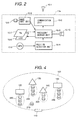
- Fig. 2 is a diagram showing one example of the internal configuration of one mobile information terminal (PDA) 10a in the illustrative embodiment while the remaining mobile information terminals are similar in arrangement thereto.
- PDA mobile information terminal
- 10-1 designates a radiocommunication antenna
- 10-2 denotes a communication unit that is operable to perform communication with the communication base station 20
- 10-3 indicates a processor/browser unit which is constituted from a central processing unit (CPU) and a memory for performing control processing typically including overall control of the mobile information terminal while displaying a variety of cites as provided on the Internet
- 10-9 is a position sensor (GPS) for detection of a present location of the mobile information terminal
- 10-4 a position detector unit for detecting the location from a signal of GPS 10-9.
- the position detector unit 10-4 is operable to detect the position periodically for sending forth information about the detected position toward the communication base station 20 via the processor/browser unit 10-3 and radiocommunication antenna 10-2. Alternatively it may be arranged, in place of the periodical position detection, to send the detected position information to the communication base station 20 in cases where a difference between the detected position information and its previous position information increases to go beyond a predefined value or alternatively in the event that an operation instruction is output or still alternatively in case communication is done with the information delivery server 50.
- the GPS 10-9 is employed for position detection
- the position detection methodology in the invention should not be limited thereto and may be modified to employ any other appropriate methods capable of specifying a present position or location of the mobile information terminal.
- those methods for detecting the position by use of other means are be employable, such as a position detection method utilizing a personal handyphone system (PHS) and a method for detection the position by use of transport distances of radio wave from a plurality of base stations.
- PHS personal handyphone system
- 10-5 designates a charge-coupled device (CCD) camera, a signal of which will be sent to the processor unit 10-3 via an image input unit 10-6.
- 10-7 is a coordinate input device (TB) whereas 10-8 is a display (liquid crystal display or "LCD” device), wherein these are designed to have an integrated structure with an arrangement permitting direct touch-pen input on a display screen.
- 10-10 is a laud speaker that functions as an audio output device.
- Multimedia guidance in accordance with the invention as disclosed herein is realized based on linkage of a software of the processor unit 10-3 and a software of the information delivery server 50 while actively using peripheral devices that are involved in the above-stated mobile information terminal 10a.
- Fig. 3 is a diagram showing an exemplary internal configuration of the information delivery server 50.
- 50-1 designates a communication unit with the Internet 40;
- 50-2 denotes a processing unit of the information delivery server 50 as make up from a CPU and memory or memories for implementing required processings in conjunction with displaying by a browser software of the above-noted mobile information terminal 10 and also maintenance and management plus control of accessible Web cites on the Internet.
- 50-3 to 50-10 are a variety of types of management units for implementation of the functionality of the illustrative information delivery server 50.
- the guidance management unit 50-3 is the one that provides guidance as to event places and/or sightseeing spots by multimedia such as still images or moving or video images and further audio sounds.
- multimedia such as still images or moving or video images and further audio sounds.
- the guidance management unit 50-3 provides guidance as to event places and/or sightseeing spots by multimedia such as still images or moving or video images and further audio sounds.
- the mobile information terminal 10 For instance, at amusement parks, also known as "thema" parks, it provides guidance as to detailed information to a user via the mobile information terminal 10 on a per-thema basis.
- DB guidance database
- a position management unit 50-4 is the one that performs position management by use of a group DB (50-12) and user DB (50-16) plus land map DB (50-13). With the processing at the position management unit 50-4, there are a service for visually displaying a present position information over a land map in a manner such that they overlap each other, and a service for displaying position information of the same group on a map. Obviously it is also possible to perform guidance in a way corresponding to a present position being displayed on a map in cooperation with the processing of the guidance management unit 50-3.
- a landmark management unit 50-5 is the one that performs management of landmarks by using the map DB (50-13) and landmark DB (50-14).
- the term "landmark management” as used herein may refer to an operation for managing and servicing information as to either a building structure or sight point which may become as a mark in maps in every information classification event--this may be carried out in known navigation systems in some cases.
- This landmark management service is convenient for determination of a place to be traveled or for execution of route search. Alternatively it may be arranged to demand a registration fee or request advertisement fee based on an access number of landmarks.
- the landmark management unit 50-5 further comprises landmark display function and landmark registration function along with landmark search function.
- a route search management unit 50-6 is operable to perform route search processing from a present position up to a destination location and also search processing of a recommended route(s). During route searching, this unit performs it by using a land map DB (50-13) and history DB (50-15).
- a situation/history management unit 50-7 performs processing of servicing to users the situation such as the degree of popularity and/or congestion of event places and sightseeing spots and further history information until now.
- database files of a history DB (50-15) and/or user DB (50-16) will be used.
- An individual or person management unit 50-8 is operable to perform processing for management of individual users and/or a group to which respective users belong. Each user may receive a variety of services by inputting a user identification (ID) and password in his or her first access event.
- ID user identification
- the group DB (50-12) and user DB (50-16) are managed separately, it will be permissible that management is done by adding an item of group information into the user DB (50-16).
- the group information contains therein the title of a group, group ID, link data to members belonging thereto, by way of example.
- An image management unit 50-9 is designed to upload an image or images as photographed by the mobile information terminal 10 to the information delivery server 50 and, adversely, download more than one image where necessary and further performs a printout service of a required image(s). Note here that when performing such printout services, it outputs to a printer 50-18 of the information delivery server 50 to thereby send by mail to the postal address of a requester or, alternatively, transfers an image to the terminal of a photo shop at an event place or sightseeing spot for permitting provision of a print service thereat.
- a money collection management unit 50-10 performs money-imposing/charging tasks with respect to users and advertising entities in accordance with service forms and access information.
- Money charge methodology may include a method for renting the mobile information terminal 10 and then making a levy of a rental fee/charge thereof, a method for determining the amount of money based on an access number or the kind and/or content of a service provided and/or option(s), and a method for doing the same based on either an image file size or storage time period.
- FIGs. 4 and 5 are diagrams showing one typical application example of the multimedia information delivery system in the illustrative embodiment.
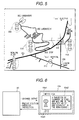
- Fig. 4 is the one that shows a layout of an amusement or "thema” park, which is an event place 100.
- reference numeral "110" is used to designate an entrance of the thema park 100; numerals 120 to 150 denote thema halls or “pavilions” as established in the thema park 100; 200-240 each indicate a queue of people waiting for permission of entry to each thema pavilion.
- G11 to G14, G21-G25 and G31-G33 indicate certain individuals (mobile information terminal positions) who have mobile information terminals 10a-10n respectively, wherein G1X, G2X and G3X show that they are specific users who belong to the same group respectively. For example, it can be seen that people of the group G1X are acting individually at a thema hall 120, thema hall 140 and thema hall 150. Activities of other groups are similar thereto.
- Fig. 5 is a diagram showing a land map of a sightseeing spot, wherein 200 to 240 denote the positions of mobile information terminals 10 at respective sightseeing spots. More specifically, 200 indicates a bowling alley; 210 is a "kkk" hospital; 220, DEG laboratory; 230, ABC lab; 240, shrine.
- This embodiment is the one that is designed to perform information providing services as will be explained below to a user of a mobile information terminal whose position is presently recognized in a situation shown in Figs. 4 and 5.
- Fig. 6 is a diagram showing an outline of service to be performed at the guidance management unit 50-3 by the relation of the mobile information terminal 10a versus information delivery server 50.
- the guidance management unit 50-3 is responsive to receipt of present position information as sent from the mobile information terminal 10 via the communication base station 20 and Internet 40 and an operation instruction being input to a display screen (LCD 10-8 and TB 10-7), for letting an image 10a1, text 10a2 and audio 10a3 (audible guidance is available upon instruction of an icon) corresponding to either the present position or the operation instruction be output from the information delivery server 50.
- a display screen LCD 10-8 and TB 10-7
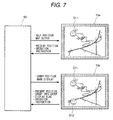
- Fig. 7 is a diagram showing an outline of a service to be done at the position management unit 50-4.
- the information delivery server 50 operates to extract land map data of a region including a position indicated by position information being sent from the mobile information terminal 10a and then return to the mobile information terminal 10a image data indicating the position of mobile information terminal 10a on the land map that has been obtained through expansion of the map data thus extracted.
- an image with the self-position's mark G11 being mapped onto the land map is visually displayed on the display screen.
- a mobile information terminal 10b sending to the information delivery server 50 its present position and group information as well as a group display flag and operation instruction results in marks G11, G12 of positions of a group containing oneself being mapped on a land map, causing it to be displayed on the display screen of this mobile information terminal. Note here that it is possible to establish privacy by preventing this ID mark from being displayed when the group display flag is in the off state.
- a group position service to be done in the example of the mobile information terminal 10b is such that it is also possible to provide such service only to specified individuals who belong to the same group. Due to this, for example, it is also possible by letting an aged person have the mobile information terminal 10 to provide a wondering old person's position specifying service such as acknowledging his or per location only to a family belonging to the same group. Additionally, detailed information will be displayed when letting a mouse pointer go to the group marks G11, G12 or alternatively upon clicking thereof. Alternatively it may also be arranged to change the mark display in accordance with a person or to offer a capability to register a mark dedicated to the individual's usage only. Still alternatively, it will also be possible that in case an increased number of people belongs to a group, a group list is displayed while permitting its mark to be displayed upon selection thereof.
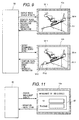
- Fig. 8 is a drawing showing an outline of service to be performed at the landmark management unit 50-5. This shows that the mobile information terminal 10a is in the state that it is receiving a landmark display service.
- the mobile information terminal 10a sends its present position and landmark classification along with scale information and operation instruction toward the information delivery server 50, certain landmarks M11 to M14 which fall within a fixed range from the self-position are mapped onto a land map and then displayed at the mobile information terminal 10a.
- Detailed information will be displayed when letting a mouse pointer be at landmarks M11-M14 or upon clicking thereof.
- the mobile information terminal 10b shown herein is in the state that it is receiving a landmark registration service.
- a landmark registration service when the mobile information terminal 10b sends to the information delivery server 50 several data including but not limited to designated coordinates, landmark information (classification, title, address, telephone number, a uniform resource locator (URL) of his or her home page, etc.) and operation instruction, landmark registration is registerable on a land map being displayed on the display screen of this mobile information terminal 10b.
- Useful access information may be obtained by registration of famous sightseeing spots, hotels, restraints, lavatories and others.
- the landmark registration may be arranged to be done with a charge applied thereto while asking payment of a registration fee.
- the registration per se is possible through the Internet, admission of free registration can result in inferior information being also registered.
- registration and information disclosure be done separately or, alternatively, a method is employed for granting registration based on an administrator's judgment after having received a mail for registration.
- a mobile information terminal 10c shown herein is in the state that it is receiving a landmark search service.
- This service is the one that when the mobile information terminal 10c sends landmark classify/sort data and more than one search key word (KW) plus operation instruction to the information delivery server 50, a search engine being provided in the information delivery server 50 or linked thereto will be executed causing its search result(s) to be displayed on the display screen of the mobile information terminal 10c.
- KW search key word
- the illustrative example is the one that the landmark classification of "Company” and the search keyword (KW) of "XX Factory” (S1) are input resulting in search results being displayed as shown by S2.
- KW search keyword
- S1 search keyword
- This search makes it possible to efficiently access many landmarks registered. Note that upon conduction of a search, if a search engine capable of offering "vague" searchabilities is utilized then the resultant usability will be increased because of the fact that results are obtainable even when any complete title is unavailable.
- Fig. 9 is a diagram showing an outline of a service to be done at the route search management unit 50-6.
- the mobile information terminal 10a shown herein is in the state that it presently receives a route search service.
- This service is such that when the mobile information terminal 10a sends a starting location (present position) (M11) and destination location (M14) plus operation instruction to the information delivery server 50, a route search is carried out causing its route search results to be displayed on the display screen of the mobile information terminal 10a while marking (R11) in colors and/or forms that are readily recognizable by users.
- This route search function is principally the same as that performed in prior art car navigation systems.
- a difference in architecture of the former over the latter is that the intended route search is done by the information delivery server 50 in accordance with a request from a mobile information terminal(s) 10. Due to this, suppose that the information delivery server 50 has a performance capable of processing a plurality of requests from mobile information terminals 10.
- the mobile information terminal 10b shown herein is in the state that it is receiving a recommended route search service.
- This service is such that when the mobile information terminal 10b sends a starting location (present position) (M11) and desired field along with a range (land map display range) and time plus operation instruction to the information delivery server 50, a recommendable route search is carried out causing its recommended route search results to be displayed on the display screen of the mobile information terminal 10b while marking (R11, R12) in colors and/or forms that are readily recognizable by users.
- search is done based on popularity data and time in addition to conditions or criteria as input thereto. Note that in cases where a plurality of recommended routes are available, guidance may be done while adding thereto a course title. The course title is to be added by the system in accordance with a final land point and/or a turn point or else or alternatively the popularity.
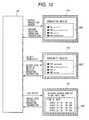
- Fig. 10 is a diagram showing an outline of a service to be done at the situation/history management unit 50-7.
- the mobile information terminal 10a is in the state that it is receiving a congestion service.
- This service is such that when the mobile information terminal 10a sends its present position and operation instruction to the information delivery server 50, the information delivery server 50 uses a plurality of position information items as received from other mobile information terminals 10 being received at such time point to calculate the degree of congestion at a predefined place (each thema hall if in a thema park) and then show it in a graphical form for output (Kon) to the mobile information terminal 10a.
- a predefined place each thema hall if in a thema park
- Kon graphical form for output
- reference numerals 120 to 150 correspond to titles of thema halls or "pavilions," showing that the thema hall 130 is full of people at the maximum degree.
- relative percent (%) is displayed or alternatively a waiting time is displayed or, still alternatively, a number of people will be displayed.
- the mobile information terminal 10b is in the state that it is receiving a popularity service.
- This service is such that when the mobile information terminal 10b sends information as to access to each guidance information along with operation instruction toward the information delivery server 50, the information delivery server 50 operates to calculate the degree of popularity and then show it in a graphical form for output (Best) to the mobile information terminal 10b.
- the access information be employed while changing the weight thereof between then virtually getting access via the Internet (access information in units of virtual objects) and when accessing while actually going to such position (access information in units of real objects). More specifically the per-real object access information is higher in weight than the per-virtual object access information.
- the mobile information terminal 10c shown herein is in the state that it presently receives a history service.
- This service is such that when the mobile information terminal 10c sends access information such as time and date plus place along with operation instruction to the information delivery server 50, it outputs a history (Log) of position information obtained during activity in accordance with such access information.
- a "time/date" icon in the Log as displayed on the display screen of the mobile information terminal 10c, a place to which a person has gone at such time on such day and will be displayed along with a nearby place map thereof, which will be preferably used by the person to put his or her diary and photographs in order after having gone home.
- Note here that in an image service as will be described below in the description, it will be useful for information rearrangement by simultaneously recording when each photograph is taken at which position.
- Fig. 11 is a diagram showing an outline of a service to be done at the individuals management unit 50-8.
- this sends an ID and password (ID-PAS) to the information delivery server 50; if the ID and password sent via the information delivery server 50 are verified to be identical with preregistered ones, a variety of kinds of services will be received.
- ID-PAS ID and password
- Methodology for registration of individuals may include a scheme for permitting a user to do it on a registration screen, and a scheme for expecting a system administrator to issue an ID and password upon receipt of reservation.
- group registration may also be done at the individuals or "person" management unit 50-8. In this case a group name will be registered in Fig. 11: the group registration at the position management unit 50-4 will no longer be required.
- Fig. 12 is a diagram showing an outline of a service to be done at the image management unit 50-9.
- the mobile information terminal 10a shown herein is in the state that it is receiving an image upload service.
- This service is a service that is for sending to the information delivery server 50 those images (Myphoto) as taken or accommodated by image pickup functionalities (CCD camera 10-5 and image input unit 10-6) of the mobile information terminal 10a through execution of an operation instruction of an upload button UPB which is set on the display screen of the mobile information terminal 10a and then permitting storage therein.
- a mobile information terminal 10b shown in Fig. 12 is an example that is receiving an image download service.
- This service is a service that is arranged so that upon issuance of operation instruction of a download button DNB as set on the display screen of the mobile information terminal 10b, more than one image corresponding to the user ID will be able to be downloaded to either any mobile information terminal 10 or an Internet terminal 30 connected on the Internet.
- an arrangement may be employed for initially displaying a photo-list or "thumbnail" image and thereafter receiving a selection instruction for selection of one of thumbnail images being presently displayed and then downloading only such selected image.
- a further available arrangement is that the selected image may be mailed to a destination address designated.
- a mobile information terminal 10c shown in Fig. 12 is an example that is receiving an image printout service.
- This service is a service which is arranged so that upon issuance of an operation instruction of a print service button PRB as set on the display screen of such mobile information terminal 10c, a selected image or images will be printed and output at a printer 50-18.
- the printer 50-18 is, for example, the one that is connected to a terminal or else as disposed within a photo shop at an event place or sightseeing spot while permitting a user to directly receive. Alternatively it is also permissible to employ an arrangement that connects the printer 50-18 directly to the information delivery server 50. In this case, any photo prints will be mailed to an address preregistered in a way corresponding to the user IC or a newly designated address.
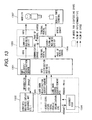
- a computer communications system preferably adaptable for use with the business model of this example is typically arranged to include an information delivery/distribution business entity 1301 which manages and handles the information delivery server 50 stated supra and several associate entities coupled together over communication links with the entity 1301 being as a net center, wherein they may include a contents business entity 1302, advertisers or "sponsors" 1303 such as shops, hotels, public organizations, etc., Internet users or subscribers 1304, carrier business entities 1305 for performing communications, business entities 1306 for performing events and/or planning, and more than one digital mobile tool user (say, "mobiler") 1307 who uses his or her mobile information terminal 10.
- Such arrangement may be variable on a case-by-case basis; for example, two separate business entities, such as a contents provider entity and information distributor, may exist as a single business entity.
- the advertiser(s) 1303 and Internet user 1304 plus carrier provider 1305 are the ones as included in the business model example at a sightseeing spot(s), which will often be excluded in an example of an event place(s).
- the carrier provider 1305 will no longer be required in some cases.
- arrows of solid lines are used to designate a flow of information and commodities whereas dotted line arrows denote money flows.
- the business model of this example employs a method for renting mobile information terminals 10 to the mobilers 1307 who become receivers of information delivery/distribution services while distributing rental charges among respective business entities involved.
- the information delivery business entity 1301 first rents one or more mobile information terminals 10 to the event/planning business entity 1306.
- the event/planning business entity 1306 rents a mobile information terminal 10 to the mobiler 1307 and then charge a fee to use it, say rental charge.
- This rental charge is distributed among the event/planning business entity 1306, carrier business entity 1305 and information delivery business entity 1301 while the information delivery business entity 1301 pays an information use charge to the contents business entity 1302.
- a respective one of the advertisers 1303 pays landmark charge and advertisement fee for landmark registration and commercial advertisement activities.
- the individual Internet user 1304 is expected to pay a commodity purchase price to an advertiser 1303 once at a time whenever s/he purchases therefrom a commercially available product.
- an arrangement may be employed wherein charging a fee such as a rental charge or communication fee to the individual mobiler 1307 is replaced by charging a fee in units of groups to which respective mobilers 1307 belong. Further, an arrangement may be used which permits a mobiler 1307 to make a monitor contract in advance with the information delivery business entity 1301 for unveiling access information concerning a traveling history of the mobiler 1307 and/or to-the-facility access information be laid open to the information delivery business entity 1301 to thereby perform either charged money cancel-out or discount.
- an arrangement may be employable for allowing a hotel or local tourist bureau to rent mobile information terminals to travelers.
- a hotel or tourist bureau already has its own Web cite on the Internet then it may be arranged to add part or all of the functions of the above-stated information delivery server 50 to inside of such cite.
- an arrangement may be used, which is for providing the above-noted services while directly connecting mobile information terminals and its associative information delivery server together by use of wired or wireless radiocommunication schemes, public telephone networks, local area network (LAN) and wide area network (WAN), without via the Internet.
- Fig. 14 is a flow chart showing one example of a processing procedure or routine for realizing the service function of the guidance management unit 50-3.
- Acquire a present position from a mobile information terminal 10 (at step 50-3a).
- Judge whether the acquired present position is a predetermined guidance point (step 50-3b).
- guidance points (coordinate positions) and guidance contents are combined together in a guidance table as provided within the guidance DB 50-11, judge based on whether the present position is identical to (actually, falls within a range of a fixed distance from) the predetermined guidance point (step 50-3b).
- step 50-3c If coincidence is verified then output to the mobile information terminal event/sightseeing-spot guidance corresponding to the present position while at the same time performing "Logging" processing (step 50-3c).
- Logging processing acquire from mobile information terminals 10 access information including count-up and time and data or else in units of users and in units of places of events/sightseeing-spots for prestorage on the guidance management unit 50-3 side for later utilization during popularity calculation and history services.
- This access information is stored as per-real object access information because the access has come at a real position. These access information items are for use with per-customer services and event guidance mails (what is called the "One To One" services).
- this Logging processing will also be used during processing procedures for realization of other service functions, its storage data may differ in units of processings. Practically, this Logging processing is for managing and handling the history of services as provided in order to determine the amount of charge required to each user; for example, the contents of services as provided in units of users will be accumulated along with the history thereof. Additionally, in cases where money charging is done based on a connection time length or service provision time period, an arrangement is employable for monitoring a time length during provision of a service and for determining on a real-time basis an amount of money for debiting the user through the Logging processing once at a time whenever each service providing session is completed.
- an arrangement may be employed which is designed so that any guidance is not output immediately even upon occurrence of coincidence with the guidance point; alternatively, let the user pay attention by blinking a corresponding part of a land map being presently displayed on the display screen of mobile information terminal 10 or alternatively producing alarm sounds and, thereafter, the actual guidance output is performed after receipt of input of a user's instruction. Further, the contents of such guidance to be output are prepared in accordance with places and contents such as still images, video, audio sound/voice, etc.
- step 50-3b if the present position acquired is not identical to the guidance point, then output to the mobile information terminal 10 the overall event/sightseeingspot guidance and/or a list of guidance items capable of being output; then execute the Logging processing (step 50-3d). For instance, if it is an event place then visually display a sketch map of an amusement park or "thema" park; if a sightseeing spot then let a sightseeing MAP (map) be displayed.
- step 50-3e judge whether there is a point instructed by the user (step 50-3e). This is for obtaining a desired point's guidance service even when the mobile information terminal 10 is absent at any guidance point. If a user's instruction is found at step 50-3e then output event/sightseeing-spot guidance at the instructed point to the mobile information terminal 10 and then execute Logging processing (step 50-3f). The process flow of from step 50-3d to step 50-3f will also be used when accessing from a terminal on the Internet. Note that since these accesses will be regarded as per-virtual object access information because of the absence at such position.
- step 50-3g judge whether there is an instruction for termination of this guidance service: if it is not to be terminated, then return to step 50-3a for again repeating the guidance guiding (step 50-3g).
- Fig. 15 is a flow chart showing an example of a processing procedure for realization of the service functionality of the position management unit 50-4.
- the processing is subdivided into three parts depending on the kind of a service to be done. More specifically, judge the kind of a service corresponding to an operation instruction of an user as sent via a mobile information terminal 10 (step 50-4a): if it is a self-position service, then go to self-position processing (step 50-4b); if a group registration service then go to group registration processing (step 50-4d); if a group position service then jump to group position processing (step 50-4c). The above processing will be repeated until termination of this position service (step 50-4e).
- Fig. 16 is a flowchart for realization of the self-position processing 50-4b.
- This processing first acquire from a mobile information terminal 10 (step 50-4b1).
- step 50-4b2 output to the mobile information terminal a land map image indicative of the self-position and then perform Logging processing (step 50-4b2).
- This service is a service convenient when loosing a way to go.
- the self-position is indicated by a cross mark or allow mark or the like. It will be repeated until termination of the self-position service is instructed (step 50-4b3).
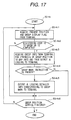
- Fig. 17 is a flowchart for realization of the group position processing 50-4c.
- fetch data indicative of the presence or absence of a present position and group display flag from the mobile information terminal step 50-4c1.
- step 50-4c2 judges whether an user IC as sent from the mobile information terminal has been registered in the group DB 50-12 (step 50-4c2). If it has not been registered then jump to step 50-4c7 because this service is unavailable. On the other hand, if it has already been registered then judge whether the group display flag is present or not (step 50-4c3). If no group display flag is found then prevent displaying in order to protect privacy and then go to step 50-4c7.
- step 50-4c4 acquires from the mobile information terminal group information such as a group name and group ID and then compose or "synthesize" one of group marks present in units of groups onto a land map image in order to indicate the position of each member who belongs to the group with the user ID having been registered and, thereafter, output such composite image to the mobile information terminal, followed by execution of Logging processing (step 50-4c4).
- Logging processing step 50-4c4
- step 50-4c5 to step 50-4c6 execute Logging processing
- Fig. 18 is a flowchart for realization of the group registration processing 50-4d.
- the group registration function first acquire user information (group name, ID, etc.) that has been sent from a mobile information terminal (step 50-4d1).
- step 50-4d2 judge whether it is a new user with respect to the group of interest (step 50-4d2); if new then perform new group registration processing (step 50-4d4). If nor new then output a message saying completion of registration to the mobile information terminal (step 50-4d3).
- step 50-4d5 judges whether the group registration service is to be terminated or not (step 50-4d5); if NO then repeat.
- This service is for implementation of a position service of the same group. It is also possible to temporarily register only an event place or sightseeing spot or alternatively to register it continuously. Note here that upon temporal registration, such group registration is to be deleted when the mobile information terminal is returned back. When utilizing the group position service continuously, it may also be a good idea to increase a group position service fee. It will be preferable that the user is expected at the time of an application to select which one of the services is used.
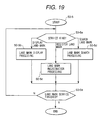
- Fig. 19 is a flowchart showing one exemplary processing routine for realization of the service function of the landmark management unit 50-5.
- the processing is divided into three parts depending on the kind of a service to be done. More specifically, judge the kind of a service required by an operation instruction of a user as sent via a mobile information terminal (step 50-5a): if it is a landmark display service, then go to landmark display processing (step 50-5b); if a landmark registration service then go to landmark registration processing (step 50-5d); if a landmark search service then jump to landmark search processing (step 50-5c). The above processing will be repeated until termination of the landmark service is instructed (step 50-5e). A procedure at each processing will next be explained below.
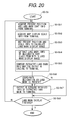
- Fig. 20 is a flowchart for realization of the landmark display processing 50-5b.
- This processing starts with a step which acquires a present position and landmark classification information from the mobile information terminal (see step 50-5b1).
- the "landmark classificatory information” is to be understood to mean the one that indicates a class or "category” of a facility corresponding to the landmark--for example, restraint, movie theater, amusement or "thema” park, etc.
- step 50-5b2 acquire scale information used for land map display from the mobile information terminal
- step 50-5b3 calculate a landmark display range from the present position and scale information
- extract landmark information in category being presently designated (step 50-5b4).
- step 50-5b6 judge whether either designation of coordinates on the landmark or designated of selection of a specific landmark is available from the user. If it is found then output detailed information of the designated landmark to the mobile information terminal and then execute Logging processing (step 50-5b7). Lastly judge whether termination of the landmark display is instructed: if it is not to be terminated then jump to step 50-5b1; then repeat (step 50-5b8).
- this is the one that performs mark-displaying along with a variety of kinds of information items during position display services, which may be utilizable when investigating whether any "want-to-go" sightseeing spot is present at nearby locations.
- this is convenient for making reservations to hotels or eating houses.
- Logging processing to access information available when the user requests detailed displaying of this landmark, it is possible to utilize as basic data for popularity calculation and/or advertisement fee calculation to be done at the information delivery server.
- registering as landmarks specific icons prepared by advertisers makes it possible to further increase the value for use as advertisement. Registering such icons is done by a landmark registration services as will be set forth below.
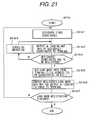
- Fig. 21 is a flowchart for realization of the landmark registration processing 50-5c.
- first designate given coordinates to call for a registration display screen (step 50-5c1).
- the given coordinates may alternatively be prior registered coordinates or coordinates of a landmark registration service to be described later or coordinates of a present location.
- output to the mobile information terminal a land map image of an area including such designated given coordinate position and then perform Logging processing (step 50-5c2).
- step 50-5c2 While having provided a setup position being fixed with respect to the display screen of the mobile information terminal, call for the user's confirmation to judge whether the coordinates corresponding to the setup position are the designated coordinates for registration of a landmark.
- step 50-5c3 If judgment is made to verify that the former is not the designated coordinates, then receive and accept an operation instruction for map scrolling via the mobile information terminal, and then output to the mobile information terminal a land map image obtainable when performing scrolling in accordance with this scroll operation instruction (step 50-5c3); thereafter, jump to step 50-5c2 for repeated execution of the same process until the designated coordinates are actually obtained.
- step 50-5c5 acquire landmark information from the mobile information terminal.
- the landmark information may include the title of a landmark, address, telephone number, sentence for advertisement, URL of a home page to be linked, icon image for landmark, etc.
- a registration fee may be determined in accordance with the amount of information for publication.
- This landmark registration service is such that its conveniency is made higher especially by registration of certain places at which travelers stop, such as sightseeing spots, event sports, hotels or the like. Note however that unconditionally permitting whoever to do such registration can lead to occurrence of a difference from the real place, resulting in a decrease in credibility of landmark. To avoid this, it is necessary upon registration to formulate registrant information into a registration system or alternatively charge a fee for registrants to do it.
- Fig. 22 is a flowchart for realization of a landmark search processing 50-5d.
- this processing first acquire from the mobile information terminal 10 both the class of a landmark to be searched and search keyword (KW) information (step 50-5d1).
- search for a landmark DB 50-14 and output its results to the mobile information terminal 10 and then perform Logging processing (step 50-5d2).
- the search results are usually list-output (see Fig. 8); then, judge whether a request for land map displaying is found (step 50-5d3). If such request is present then output a map image of such landmark to the mobile information terminal for execution of Logging processing (step 50-5d4).
- judge whether the landmark search is to be terminated or not; if it is not to be terminated then go to step 50-5d1 to repeat searching (step 50-5d5).
- landmark search Upon execution of landmark search, it should be required that the intended search can be done from a variety of angles. For instance, it is designed to offer searchabilities by using any kinds of keywords such as classification, title, address, telephone number, sentence for advertisement and the like. It also be designed to offer search narrowing capabilities. With such arrangements, it is possible for users to do searching by use of any keywords as promptly taken into their heads, which in turn increases convenience properties.
- Fig. 23 is a flowchart showing one exemplary processing routine for realization of the service function of the route search management unit 50-6.
- the processing is subdivided into two parts depending on the kind of a service to be done. More specifically, judge the kind of a service requested by a user based on his or her instruction as sent via a mobile information terminal (step 50-6a): if it is a route search service, then go to route search processing (step 50-6b); if a recommended route search service then jump to recommended route search processing (step 50-6c). The above processing will be repeated until entry of an instruction for termination of the route search service (step 50-6d).
- Each processing routine will next be explained below.
- Fig. 24 is a flowchart for realization of the route search processing 50-6b.
- first acquire a self-position and destination location information from a mobile information terminal step 50-6b1.
- Methodology of this route search calculation is such that any method which is the same as route search calculation methods being carried out in prior known navigation systems may be employed, although not specifically limited thereto in the present invention.
- step 50-6b3 step 50-6b3
- this route search service is the one that achieves the route search function in prior known navigation systems, the service is different therefrom in arrangement for realizing its route search function. More specifically, any mobile information terminals in this embodiment are provided with no land map databases--the map databases are provided in the information delivery server 50. Due to this, when compared to prior art navigation systems with built-in map databases, it is possible to always store the newest or "up-to-date" information, leading to an advantage of achievement of excellent maintenance properties.
- the mobile information terminals in accordance with this embodiment there is a merit in that the mobile information terminals are configurable at low production costs because of the fact that any compact disc read-only memories (CD-ROMs) or digital versatile disk (DVD) drives are no longer required for constitution of the land map databases. Additionally, although the mobile information terminals of this embodiment do require a communication fee for receipt of land map data, such communication fee may be reduced by letting a land map of a travel route searched be "cached" in the memory of a mobile information terminal (when looking at from the information delivery server side, the travel route map is sent to the mobile information terminal).
- CD-ROMs compact disc read-only memories
- DVD digital versatile disk
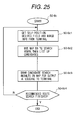
- Fig. 25 is a flowchart for realization of the recommended route search processing 50-6c.
- a mobile information terminal certain information to be considered when conducting a search, such as a desired field (museum course, sightseeing spot course, etc.), range (e.g. a 10-km zone), an estimate and/or time or else (step 50-6c1).
- step 50-6c1 the desired field (museum course, sightseeing spot course, etc.), range (e.g. a 10-km zone), an estimate and/or time or else
- step 50-6c1 utilize the land map DB 50-13 to conduct a search for more than one route that satisfies input conditions or criteria and then list up candidates.
- conducting the route search with the degree of popularity and/or congestion of sightseeing spots or event places makes it possible to increase resultant service quality. Accordingly, it may also be designed so that search conditions concerning the popularity and/or congestion degree are also input from the mobile information terminal.
- step 50-6c3 draw such candidate search results onto a land map with different colors applied thereto and then output them to the mobile information terminal and thereafter execute Logging processing (step 50-6c3).
- the candidate search results are drawn and composed onto the land map, it may alternatively arranged so that a list of candidates is output to the mobile information terminal and, after designation of the list, the map is output to the mobile information terminal.
- An arrangement is also employable which is such that several information items such as the popularity, congestion, required time length, distance and the like are added to the candidate list for use as criteria for course selection.
- an arrangement is employable for adding such information to the above-noted candidate list.
- This recommended route search is such that course selection is left to the information service provider side, which will be convenient when first visiting such event place or sightseeing spot. Further, selecting one from the courses of the recommended route search results makes it possible to realize navigation functionality for indicating a forward traveling direction once at a time whenever reaching a traffic intersection or else, as in known navigation processings. Except for the recommended route search, route searches may be conducted in a way such that certain search conditions may be added to ensure pass-through of recommendable spots the user per se or other users have preregistered or other given spots.
- Fig. 26 is a flow chart showing an exemplary processing procedure for realization of the service function of situation/history management unit 50-7.
- the processing is subdivided into three parts depending on the kind of a service under request. More specifically, judge the kind of a service indicated by an operation instruction of a user as sent via a mobile information terminal (step 50-7a): if it is a congestion degree service, then go to congestion processing (step 50-7b); if a popularity service then go to popularity processing (step 50-7c); if a history service then jump to history processing (step 50-7d). The above processing will be repeated until termination of the situation/history service (step 50-7e).
- a respective processing routine will next be explained below.
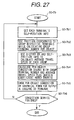
- Fig. 27 is a flowchart for realization of the congestion processing 50-7b.
- step 50-7b1 acquire self-position information of each mobile information terminal
- step 50-7b2 Apply grouping to each mobile information terminal by using coordinates corresponding to the self-position thus acquired; then, calculate a number of mobile information terminals as included in a group per facility of interest (step 50-7b2).
- This calculation enables setting of groupings as shown by 200 to 240 in Figs. 4 and 5. Practically, such grouping will become possible by combining those mobile information terminals existing at mutually nearby locations into a single group.
- step 50-7b3 calculate the average moving speed of respective members from the history DB 50-15 and the self-position information of each mobile information terminal presently acquired.
- the moving speed of each mobile information terminal is obtainable from differences of respective ones of the distance and time of history position information and will be obtained by averaging moving speeds of respective individuals who belong to the same group.
- step 50-7b4 calculate the degree of congestion in units of "object" facilities while adding the mobile information terminal number of each group, average moving speed, and further prespecified coefficient.
- the density of terminals per object facility is obtainable from the mobile information terminal number per object facility with respect to the total number of mobile information terminals in a thema park. The greater this terminal density, the greater the resultant congestion degree.
- the average moving speed is less in value, it will also be possible to judge so that it is full of people.
- adding for consideration the prespecified coefficient is necessary because the mobile information terminal number is not necessarily limited to 1 piece per person.
- graphically represent the congestion degree per object facility for output to the mobile information terminal see Fig. 10); then execute Logging processing (step 50-7b5). Lastly judge whether the congestion service is to be terminated or not; if it is not to be terminated then jump to step 50-7b1 to repeat similar processing (step 50-7b6).
- the congestion degree enables users to be aware of which thema hall is presently full of people on a real-time basis, which in turn permit them to go to other thema halls that are not crowed.
- the congestion service in accordance with this embodiment is applicable not only to the case of thema park but also to any cases where a plurality of enterable facilities are available within a specific land area or region, one practical example of which is such that it is possible to calculate the degree of congestion per conveyance in a recreation ground or alternatively the degree of congestion or else per shop or per restraint at a shopping center.
- Fig. 28 is a flowchart for realization of the popularity processing 50-7c.
- acquire per-real-object access information of each mobile information terminal step 50-7c1. This access information is typically obtainable when the user actually reach such object facility or location.
- use the history DB 50-15 and/or individual's ID to extract repeater information, which is the information indicating that the same information has been accessed many times repeatedly (step 50-7c3).
- step 50-7c4 calculate the degree of popularity through weighted averaging using certain weight coefficient of the above-obtained per-real-object access information and per-virtual-object access information plus repeater information.
- step 50-7c5 graph and output the popularity degree in units of object facilities to the mobile information terminal and then execute Logging processing (step 50-7c5).
- step 50-7c6 judges whether the popularity service is to be terminated or not; if it is not to be terminated then jump to step 50-7c1 to repeat similar processing (step 50-7c6).
- This popularity service is a measure useful for newcomers or beginners. Additionally an arrangement may also be employed for proposing a route in view of this popularity when conducting recommended route searches.
- the information noted above may be used as marketing information or alternatively as basic information of a variety of plans such as shop plan, traffic plans, etc.
- These information items as to population distribution may also be provided to member-registered business enterprises, public and/or individuals with a charge required therefor. It will also be possible to monitor or "watchdog" the population distribution for a fixed length of time period or a change in population distribution based on previously reserved monitoring information for servicing such information.
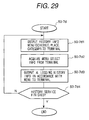
- Fig. 29 is a flowchart for realization of the history processing 50-7d.
- first output a history information menu (schedule, place, classification, etc.) shown for example in Fig. 10 to the mobile information terminal (step 50-7d1).
- acquire menu select information from the mobile information terminal (step 50-7d2).
- output history information pursuant to a selected menu to the mobile information terminal and then execute Logging processing (step 50-7d3).
- Logging processing step 50-7d3
- step 50-7d4 judges whether the history service is to be terminated or not; if it is not to be terminated then jump to step 50-7d1 to repeat similar processing.
- This history service is the one that services the history of events and/or sightseeing spots to which a user having the mobile information terminal of this embodiment has visited in the past, which service will be utilized when rearranging photographs later or when recording sentences or alternatively for preparation of his or her next travel plan. Further, it will be preferable that this history service be arranged not only to enable access from the mobile information terminal but also to enable access by use of the same user's ID by way of example even when the user who owns the mobile information terminal wants to utilize an Internet terminal at his or her home or other Internet terminals.
- Fig. 30 is a flowchart showing an example of a processing procedure for realization of the service function of the individuals or person management unit 50-8.
- the processing is subdivided into three parts depending on the kind of a service requested. More specifically, judge the kind of a service indicated by an operation instruction of a user as sent via a mobile information terminal (step 50-8a): if it is a new registration, then go to new registration processing (step 50-8b); if a person attestation then go to person attestation processing (step 50-8c); if a change or modification then jump to modification processing (step 50-8d). The above processing will be repeated until termination of the individuals management service is instructed (step 50-8e).
- This person management service is the one that handles and manages individuals' IDs and passwords and thus is inevitable for identification of individuals and further for history management on a per-person basis.
- this is an essential function for the so-called "One to One" services which are for providing services in a way corresponding to a request from each individual person.
- step 50-8b new individual registration and issuance of a person ID and password at the new registration processing
- step 50-8c attestation of an individual's ID and password as sent from a user at the person attestation processing
- step 50-8d alteration of a password or else at the modification processing
- individuals management processing similar to prior known individuals management schemes such as member registration to Internet service providers may also be employed.
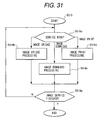
- Fig. 31 is a flowchart showing an exemplary processing routine for realization of the service function of the image management unit 50-9.
- the processing is subdivided into three parts depending on the kind of a service. More specifically, judge the kind of a service in accordance with a user's operation instruction as sent via a mobile information terminal (step 50-9a): if it is an image upload, then go to image upload processing (step 50-9b); if an image download then go to image download processing (step 50-9c); if an image printout then jump to image print processing (step 50-9d).
- step 50-9a judge the kind of a service in accordance with a user's operation instruction as sent via a mobile information terminal
- step 50-9b judge the kind of a service in accordance with a user's operation instruction as sent via a mobile information terminal
- step 50-9b judges the kind of a service in accordance with a user's operation instruction as sent via a mobile information terminal
- step 50-9c image download then go to image download processing
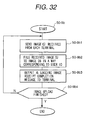
- Fig. 32 is a flowchart for realization of the image upload processing 50-9b.
- first receive an image that has been sent from each mobile information terminal with image data stored therein as shown in Fig. 12 step 50-9b1.
- step 50-9b2 perform filing such received image in the image DB 50-17 in a way corresponding to each user ID of the mobile information terminal from which the image data has been sent.
- step 50-9b3 output an image receipt completion message to the mobile information terminal and then perform Logging processing (step 50-9b3).
- step 50-9b3 Lastly judge whether the image uploading is to be terminated or not; if it is not to be terminated then jump to step 50-9b1 to repeat similar processing (step 50-9b4).
- This image upload service is the service that files any user's photographed images in the information delivery service, which will be used for to-be-later-described image download service and/or image print service or the like. Note here that upon providing the image upload service, an arrangement may also be employed which incorporates a method including the steps of visually displaying a thumbnail image on a mobile information terminal display screen, requesting a user to select only those images need to be uploaded, and then uploading such selected images only.
- the upload image is the one photographed from the user's mobile information terminal
- the present invention should not be limited to this example.
- a CCD camera provided at the mobile information terminal
- more than one camera installed in facility within an event place or thema park is used to automatically shoot subjects or scenes to provide photo images, which will be uploaded periodically.
- an arrangement may be employed which is for assigning a group ID in a way corresponding to such photo-shooting place, filing images together, permitting the individual user to later select from among the filed images certain image(s) at least partly containing therein his or her figure, and then downloading such selected image(s).
- an arrangement may also be employed for setting up a temporary password and for filing images along with such password.
- Fig. 33 is a flowchart for realization of the image download processing 50-9c.
- take out of the image DB 50-17 an image corresponding to a user ID of either a mobile information terminal that has sent an operation instruction for image downloading or an Internet terminal step 50-9c1.
- output the extracted image to either the mobile information terminal or the Internet terminal (step 50-9c2).
- output an image send completion message to the mobile information terminal and then execute Logging processing step 50-9c3.
- step 50-9c3 output an image send completion message to the mobile information terminal and then execute Logging processing.
- step 50-9c3 Lastly judge whether the image downloading is to be terminated or not; if it is not to be terminated then jump to step 50-9c1 to repeat similar processing (step 50-9c4).
- This image download service is for use when downloading an image or images to the user's mobile information terminal in event places or at sightseeing spots (may be serviced in the form of magnetic files) or alternatively when downloading to the Internet terminal.
- an arrangement may also be employed for first outputting a thumbnail image, allowing the user to select an image(s) to be downloaded, and them actually downloading such selected image(s). With such an arrangement, it is possible to reduce a communication fee or charge otherwise required for downloading of unnecessary images.
- Fig. 34 is a flowchart for realization of the image printout processing 50-9d.
- this processing first take out of the image DB 50-17 an image that corresponds to the user ID of interest (step 50-9d1). Next, output such extracted image to either the information delivery server or a printer 50-18 of a printout-exclusive terminal as installed at an event place or sightseeing spot (step 50-9d2). Next output an image print completion message to the mobile information terminal and then execute Logging processing (step 50-9d3). Lastly judge whether the image printout is to be terminated or not; if it is not to be terminated then jump to step 50-9d1 to repeat similar processing (step 50-9d4).
- This image print service is such that printout may be done at a printer machine as connected to the terminal of a photo shop in the event place or sightseeing spot. Also note that at the step 50-9d1, a thumbnail image is first displayed permitting the user to make selection and thereafter image printout is actually done, thereby reducing a communication fee or charge required.
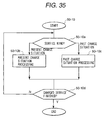
- Fig. 35 is a flowchart showing one exemplary processing routine for realization of the service function of the money-impose/charge management unit 50-10.
- the processing is subdivided into two parts depending on the kind of a service. More specifically, judge the kind of a service indicated by the user's operation instruction as sent via a mobile information terminal (step 50-10a): if it is a present charge situation, then go to present charge situation processing (step 50-10b); if a past charge situation then go to past charge situation processing (step 50-10c). The above processing will be repeated until termination of the charge management service is instructed (step 50-10d).
- a money-charge situation at a present session is calculated in the state of receipt of service provision after startup of a present access, wherein the charge situation thus calculated will be output to the mobile information terminal 10.
- the charge situation thus calculated will be output to the mobile information terminal 10.
- money charge is done in accordance with a connection time period at the present session, the amount of information being sent or received or the contents of a service being provided, and then its accumulation is calculated.
- the situation of charged money up to a previous day for example, is calculated or accumulated for output to the mobile information terminal 10.
- This money-charge service is a service for checking for either optional services or amount-based or "pay-per-data" money charge situation other than a rental fee of a mobile information terminal for rental use and then notifying it to the user.
- it is a service that permits inquiry about a presently charged money amount at any time required on a real time basis in cases where the communication charge is determined on a per-data basis in excess of a predefined length of time period while letting the image upload be of such pay-per-data charging system in accordance with a size if it is greater than a fixed size and, further, in case image printout is also made optional.
- This present charge situation service will also be effective in the case of using the user's mobile information terminal(s). Additionally data of the charge service is calculated from Logging processing data. In addition, payment of a charge required will be done by means of pay-in-cash or payment via postal transfer from a card or the like.
- the mobile information terminal 10 is operable to perform the following processing. More specifically, at the mobile information terminal 10 (see Fig. 2), it performs several processing tasks including but not limited to 1) processing for monitoring operation instructions to the coordinate input unit TB 10-7, 2) present position detection processing by GPS 10-9 and position detector unit 10-4, 3) image input processing by CCD camera 10-5 and image input unit 10-6, 4) display processing and audio processing for performing multimedia guidance by LCD 10-8 and speaker 10-10, and 5) Web processing for getting access to the Internet.
- the mobile information terminal 10 displays a service menu shown in Fig. 36 for example for presentation to the user button regions 3601-3608 corresponding to service functions of respective management units 50-3 to 50-10 whereby it mainly is in charge of the man-machine interface section which enables the user to utilize any given service function while provision of service functions are realized by the information delivery server 50.
- the mobile information terminal is designed to first send to the information delivery server 50 the title of a service the user requests and his or her own present position, then accept data indicative of a service content being automatically generated at the information delivery server 50 in accordance with the present self-position and sent thereto, and then output the data from either the display screen (LCD 10-8) or the speaker 10-10.
- the principles of the present invention may also be used for applications other than this example. More specifically, due to the multimedia information delivery system for providing multimedia guidance by use of position information of more than one mobile information terminal, it is possible to permit a bus travel company to utilize the multimedia guidance service shown in Fig. 14 as an electronic guidance system for subsidiary utilization of bus guides or, alternatively, utilize the group position service shown in Fig. 17 to thereby realize other systems including either a wondering/roaming old person tracing system or a system for allowing a transport company or taxi company to rapidly specify the nearest land vehicle to a customer of interest. Obviously, in case any individual person takes the mobile information terminal 10 in his or her motorcar, it becomes possible to establish not only a mere car navigation service but also a system for enabling the user to receive a variety of kinds of services stated supra.
- Another advantage of this invention is that completion of group preregistration makes it possible successfully recognize the location of a respective one of members who belong to the same group on a real-time basis without requiring mutual communications between members of the group.
- Yet another advantage of the invention is that the position information of the individual mobile information terminal may be used to provide the distribution of people in an event place or at a sightseeing spot with or without its moving situation on a real time basis. Due to this, there is an advantage that the user is able to do prompt handling with respect to his or her activity to be next taken. Furthermore, since the recommended route search is made possible while taking into consideration the degree of congestion or popularity from the people distribution, it is possible to effectively provide route guidance that is easy to even beginners.
- Still another advantage of the instant invention is that the capability to upload or download images from mobile information terminals to the information delivery server in units of individuals avoids the need for provision of any large storage means at the mobile information terminals, which in turn makes it possible to reduce the weight and production cost of such mobile information terminals.
- a further advantage of the invention lies in an ability to establish an appropriate fee/charge determination scheme through execution of the Logging processing in units of users, once at a time whenever guidance is output to a mobile information terminal.
Landscapes
- Engineering & Computer Science (AREA)
- Radar, Positioning & Navigation (AREA)
- Remote Sensing (AREA)
- Automation & Control Theory (AREA)
- Physics & Mathematics (AREA)
- General Physics & Mathematics (AREA)
- Business, Economics & Management (AREA)
- Tourism & Hospitality (AREA)
- Computer Networks & Wireless Communication (AREA)
- Signal Processing (AREA)
- Economics (AREA)
- General Business, Economics & Management (AREA)
- Multimedia (AREA)
- Entrepreneurship & Innovation (AREA)
- Human Resources & Organizations (AREA)
- Marketing (AREA)
- Operations Research (AREA)
- Quality & Reliability (AREA)
- Strategic Management (AREA)
- Development Economics (AREA)
- Theoretical Computer Science (AREA)
- Information Transfer Between Computers (AREA)
- Mobile Radio Communication Systems (AREA)
- Telephonic Communication Services (AREA)
- Information Retrieval, Db Structures And Fs Structures Therefor (AREA)
- Position Fixing By Use Of Radio Waves (AREA)
- Management, Administration, Business Operations System, And Electronic Commerce (AREA)
Applications Claiming Priority (2)
| Application Number | Priority Date | Filing Date | Title |
|---|---|---|---|
| JP2000198124 | 2000-06-30 | ||
| JP2000198124A JP2002015215A (ja) | 2000-06-30 | 2000-06-30 | マルチメデア情報配信システムおよび携帯情報端末装置 |
Publications (2)
| Publication Number | Publication Date |
|---|---|
| EP1168715A2 true EP1168715A2 (fr) | 2002-01-02 |
| EP1168715A3 EP1168715A3 (fr) | 2003-09-03 |
Family
ID=18696333
Family Applications (1)
| Application Number | Title | Priority Date | Filing Date |
|---|---|---|---|
| EP01114764A Withdrawn EP1168715A3 (fr) | 2000-06-30 | 2001-06-25 | Dispositif de distribution d'informations multimédia et dispositif de terminal d'information mobile |
Country Status (4)
| Country | Link |
|---|---|
| US (2) | US20020026289A1 (fr) |
| EP (1) | EP1168715A3 (fr) |
| JP (1) | JP2002015215A (fr) |
| CN (1) | CN1331521A (fr) |
Cited By (13)
| Publication number | Priority date | Publication date | Assignee | Title |
|---|---|---|---|---|
| EP1359519A3 (fr) * | 2002-04-30 | 2004-07-28 | Pioneer Corporation | Dispositif de fourniture d'informations et procédé |
| EP1347403A3 (fr) * | 2002-03-07 | 2004-11-03 | Increment P Corporation | Dispositif, système, procédé, logiciel et support d'enregistement pour le traitement de données |
| EP1482279A2 (fr) | 2003-05-24 | 2004-12-01 | Jentro Technologies GmbH | Système de navigation |
| WO2006051750A1 (fr) | 2004-11-09 | 2006-05-18 | Sega Corporation | Système d’affichage de position |
| WO2006091493A2 (fr) | 2005-02-24 | 2006-08-31 | Cisco Technology, Inc. | Procedes permettant de repartir les donnees entre les noeuds en fonction de l'etat spatial/organisationnel dynamique d'un noeud mobile |
| EP1718050A1 (fr) * | 2005-04-23 | 2006-11-02 | LG Electronics Inc. | Terminal de communication mobile pour fournir des informations géographiques et procédé correspondant |
| EP1725010A2 (fr) | 2005-05-16 | 2006-11-22 | Sony Corporation | Système de formation d'images et procédé de contrôle de système |
| EP2259198A3 (fr) * | 2003-09-17 | 2012-01-25 | Navteq North America, LLC | Archivage de photographies selon un critère de localisation |
| US8116719B2 (en) | 2005-02-05 | 2012-02-14 | Cisco Technology, Inc. | Techniques for determining communication state using accelerometer data |
| RU2457437C2 (ru) * | 2007-11-30 | 2012-07-27 | Сони Корпорейшн | Устройство отображения карты, способ отображения карты и устройство съемки изображений |
| JP2017208077A (ja) * | 2016-03-31 | 2017-11-24 | 京セラドキュメントソリューションズ株式会社 | 印刷システムおよび方法、並びにモバイル・クライアント・コンピューティング・デバイス |
| WO2020160483A1 (fr) * | 2019-02-01 | 2020-08-06 | Qualcomm Incorporated | Aide à la photographie pour dispositifs mobiles |
| US10928213B2 (en) * | 2017-09-22 | 2021-02-23 | Toyota Jidosha Kabushiki Kaisha | In-vehicle device, information processing device, information processing system, control method for in-vehicle device, information processing method, and recording medium |
Families Citing this family (159)
| Publication number | Priority date | Publication date | Assignee | Title |
|---|---|---|---|---|
| US7039630B2 (en) * | 2000-07-27 | 2006-05-02 | Nec Corporation | Information search/presentation system |
| US6700534B2 (en) * | 2000-10-16 | 2004-03-02 | Scott C. Harris | Position privacy in an electronic device |
| JP4567228B2 (ja) * | 2001-03-30 | 2010-10-20 | 住友重機械工業株式会社 | 認証装置及び方法、ネットワークシステム、記録媒体、コンピュータプログラム |
| JP4311890B2 (ja) * | 2001-06-11 | 2009-08-12 | 株式会社リコー | アプリケーションソフト提供システム、サーバ装置、プログラム、及び方法 |
| JP2003016015A (ja) * | 2001-06-27 | 2003-01-17 | Sanyo Electric Co Ltd | 画像提供装置及び画像提供システム。 |
| JP2003030373A (ja) * | 2001-07-10 | 2003-01-31 | Fujitsu Ltd | 人口分布解析装置 |
| JP3695369B2 (ja) * | 2001-08-07 | 2005-09-14 | ソニー株式会社 | 情報配信システム及び情報配信方法、情報供給装置及び情報供給方法 |
| US20030078939A1 (en) * | 2001-10-24 | 2003-04-24 | Tiger Color Inc. | Method of automatically downloading photos from a web page |
| JP2003187026A (ja) * | 2001-12-19 | 2003-07-04 | Fujitsu Ltd | 施設管理支援装置 |
| JP4004818B2 (ja) * | 2002-02-28 | 2007-11-07 | 松下電器産業株式会社 | 位置情報伝達装置及び方法 |
| EP1342991A3 (fr) | 2002-03-07 | 2004-12-22 | Increment P Corporation | Navigateur, système de navigation, procédé de navigation, dispositif de traitement de données, procédé de traitement de données, logiciel, et support d'enregistrement |
| JP2003269969A (ja) * | 2002-03-13 | 2003-09-25 | Sony Corp | ナビゲーション装置、地点情報の表示方法およびプログラム |
| JP3952826B2 (ja) * | 2002-03-28 | 2007-08-01 | セイコーエプソン株式会社 | 移動体誘導システム |
| JP2003323440A (ja) * | 2002-04-30 | 2003-11-14 | Japan Research Institute Ltd | 携帯端末を用いた撮影画像の情報提供システム、撮影画像の情報提供方法、およびその方法をコンピュータに実行させるプログラム |
| US7809501B2 (en) * | 2002-05-24 | 2010-10-05 | Robert Bosch Gmbh | Method for inputting local names |
| JP2004032131A (ja) * | 2002-06-24 | 2004-01-29 | Canon Inc | 撮像装置及び画像処理装置 |
| US7143241B2 (en) * | 2002-08-06 | 2006-11-28 | Hewlett-Packard Development Company, L.P. | Cache management in a mobile device |
| JP4019863B2 (ja) * | 2002-09-04 | 2007-12-12 | 日本電気株式会社 | マルチキャスト制御装置、マルチキャスト配信システム及びマルチキャスト配信方法並びにそのプログラム |
| JP4039622B2 (ja) * | 2002-11-06 | 2008-01-30 | Kddi株式会社 | コンテンツ提供装置のための経路予測方法 |
| US20040092273A1 (en) * | 2002-11-08 | 2004-05-13 | Openwave Systems Inc. | Asynchronous messaging based system for publishing and accessing content and accessing applications on a network with mobile devices |
| US7302254B2 (en) * | 2002-11-08 | 2007-11-27 | Openwave Systems Inc. | MMS based photo album publishing system |
| US20040137921A1 (en) * | 2002-11-08 | 2004-07-15 | Vinod Valloppillil | Asynchronous messaging based system for publishing and accessing content and accessing applications on a network with mobile devices |
| US7343168B2 (en) * | 2002-11-08 | 2008-03-11 | Openwave Systems Inc. | Asynchronous messaging based system for publishing and accessing content and accessing applications on a network with mobile devices |
| US7643054B2 (en) * | 2002-12-09 | 2010-01-05 | Hewlett-Packard Development Company, L.P. | Directed guidance of viewing devices |
| US7194254B2 (en) * | 2002-12-30 | 2007-03-20 | Motorola Inc. | Apparatus for restricted browser access within a wireless communication device and method therefor |
| US8250168B2 (en) * | 2003-01-03 | 2012-08-21 | Openwave Systems Inc. | Methods for accessing published contents from a mobile device |
| US7660870B2 (en) * | 2003-01-03 | 2010-02-09 | Openwave Systems Inc. | Method and apparatus for enhancing discoverability and usability of data network capability of a mobile device |
| KR20040072439A (ko) * | 2003-02-12 | 2004-08-18 | 엘지전자 주식회사 | 차량항법시스템의 개인위치정보 표시장치 및 방법 |
| US7577732B2 (en) | 2003-03-28 | 2009-08-18 | Fujitsu Limited | Information distribution service providing system |
| US20040234140A1 (en) * | 2003-05-19 | 2004-11-25 | Shunichiro Nonaka | Apparatus and method for moving image conversion, apparatus and method for moving image transmission, and programs therefor |
| US9525566B2 (en) * | 2003-07-31 | 2016-12-20 | Cloudsoft Corporation Limited | Self-managed mediated information flow |
| JP2005078288A (ja) * | 2003-08-29 | 2005-03-24 | Toshiba Corp | 情報処理装置及びプレゼンス情報管理方法 |
| EP1530133A1 (fr) * | 2003-11-04 | 2005-05-11 | Sony Ericsson Mobile Communications AB | Organisation de données média à l'aide d'un appareil électronique portable |
| JP2005165406A (ja) * | 2003-11-28 | 2005-06-23 | Hitachi Ltd | サービス提供システム及び方法 |
| JP4401766B2 (ja) * | 2003-12-26 | 2010-01-20 | 京セラ株式会社 | 無線通信システム |
| JP2005196522A (ja) * | 2004-01-08 | 2005-07-21 | Nec Infrontia Corp | 混雑状況管理装置、混雑状況管理システム、及び混雑状況管理装置用プログラム |
| US7567911B2 (en) * | 2004-03-26 | 2009-07-28 | Fmr Llc | Transmitting graphical representations |
| US8832132B1 (en) | 2004-06-22 | 2014-09-09 | Google Inc. | Personalizing search queries based on user membership in social network communities |
| US8655370B2 (en) * | 2004-06-25 | 2014-02-18 | Qualcomm Incorporated | Geographical location information sharing among wireless devices |
| JP2006012075A (ja) * | 2004-06-29 | 2006-01-12 | Navitime Japan Co Ltd | 通信型情報配信システムおよび情報配信サーバならびにプログラム |
| JP4937509B2 (ja) * | 2004-12-28 | 2012-05-23 | パイオニア株式会社 | 経路誘導装置、経路誘導方法、経路誘導プログラム、および、コンピュータに読み取り可能な記録媒体 |
| JP4456021B2 (ja) * | 2005-03-01 | 2010-04-28 | 株式会社エヌ・ティ・ティ・ドコモ | ユーザ誘導システム、移動通信端末、及びユーザ誘導方法 |
| CN1332562C (zh) * | 2005-03-02 | 2007-08-15 | 华为技术有限公司 | 一种用户终端信号的传输装置和传输方法 |
| US7353034B2 (en) | 2005-04-04 | 2008-04-01 | X One, Inc. | Location sharing and tracking using mobile phones or other wireless devices |
| JP2007025817A (ja) * | 2005-07-12 | 2007-02-01 | Pioneer Electronic Corp | テーマパーク管理装置、テーマパーク管理方法、テーマパーク管理プログラムおよび記録媒体 |
| JP2007078639A (ja) * | 2005-09-16 | 2007-03-29 | Canon Inc | 経路案内提供システム、画像形成装置および画像形成方法 |
| CN1852353B (zh) * | 2005-10-18 | 2010-05-05 | 华为技术有限公司 | 一种处理用户数据的方法、装置以及系统 |
| GB0522941D0 (en) * | 2005-11-10 | 2005-12-21 | Ibm | Method, apparatus and computer program product for determining a destination at which a group of devices can store data associated with the devices |
| JP2007156637A (ja) * | 2005-12-01 | 2007-06-21 | Mitsubishi Electric Corp | 情報検索装置およびプログラムならびに情報検索システム |
| US7774001B2 (en) * | 2005-12-16 | 2010-08-10 | Sony Ericsson Mobile Communications Ab | Device and method for determining where crowds exist |
| US10488860B1 (en) | 2006-02-21 | 2019-11-26 | Automodality, Inc. | Geocoding data for an automated vehicle |
| US7904483B2 (en) * | 2005-12-23 | 2011-03-08 | Geopeg, Inc. | System and method for presenting geo-located objects |
| US7617246B2 (en) * | 2006-02-21 | 2009-11-10 | Geopeg, Inc. | System and method for geo-coding user generated content |
| JP2007249941A (ja) * | 2006-02-20 | 2007-09-27 | Ricoh Co Ltd | 出力依頼装置、位置管理サーバ装置および出力依頼プログラム |
| US7450003B2 (en) * | 2006-02-24 | 2008-11-11 | Yahoo! Inc. | User-defined private maps |
| US8334993B2 (en) | 2006-03-01 | 2012-12-18 | Fotomedia Technologies, Llc | Methods, systems, and computer program products for associating an image with a communication characteristic |
| US20070299607A1 (en) * | 2006-06-27 | 2007-12-27 | Verizon Laboratories Inc. | Driving directions with landmark data |
| KR100886142B1 (ko) * | 2006-09-08 | 2009-02-27 | 삼성전자주식회사 | 위치확인시스템을 이용한 휴대 인터넷 서비스 지역 확인방법 및 시스템 |
| JP2008084185A (ja) | 2006-09-28 | 2008-04-10 | Fuji Xerox Co Ltd | 情報配信装置及び情報配信プログラム |
| US20080162037A1 (en) * | 2006-12-27 | 2008-07-03 | Hasan Mahmoud Ashraf S | Location-based interactive display and communication system |
| JP2008177684A (ja) * | 2007-01-16 | 2008-07-31 | Nec Corp | 混雑情報提供システム、移動体端末、サーバー、混雑情報提供方法およびプログラム |
| US20080177667A1 (en) * | 2007-01-18 | 2008-07-24 | Weinberg Stephen J | Mobile computing retail platform |
| US7933609B2 (en) * | 2007-02-16 | 2011-04-26 | Sony Ericsson Mobile Communications Ab | Tracking a group of mobile terminals |
| US20080250337A1 (en) * | 2007-04-05 | 2008-10-09 | Nokia Corporation | Identifying interesting locations based on commonalities in location based postings |
| JP4978288B2 (ja) * | 2007-04-19 | 2012-07-18 | 沖電気工業株式会社 | 無線ネットワークシステム、情報提供装置及び無線端末 |
| JP4465631B2 (ja) * | 2007-05-10 | 2010-05-19 | ソニー株式会社 | ナビゲーション装置及びナビゲーション装置における位置登録方法 |
| US8108144B2 (en) | 2007-06-28 | 2012-01-31 | Apple Inc. | Location based tracking |
| US9066199B2 (en) | 2007-06-28 | 2015-06-23 | Apple Inc. | Location-aware mobile device |
| US9109904B2 (en) | 2007-06-28 | 2015-08-18 | Apple Inc. | Integration of map services and user applications in a mobile device |
| US8385946B2 (en) | 2007-06-28 | 2013-02-26 | Apple Inc. | Disfavored route progressions or locations |
| US9569806B2 (en) * | 2007-09-04 | 2017-02-14 | Apple Inc. | Dynamic presentation of location-specific information |
| JP5526473B2 (ja) * | 2007-10-12 | 2014-06-18 | ソニー株式会社 | 表示システム、表示方法、サーバ装置、表示装置 |
| JP4858400B2 (ja) * | 2007-10-17 | 2012-01-18 | ソニー株式会社 | 情報提供システム、情報提供装置、情報提供方法 |
| JP2009103521A (ja) * | 2007-10-22 | 2009-05-14 | Fujitsu Ten Ltd | ナビゲーションシステム、携帯端末装置および車載装置 |
| CN101159916B (zh) * | 2007-11-22 | 2010-04-21 | 张 | 移动终端播放广告的方法及移动终端设备 |
| US20090182498A1 (en) * | 2008-01-11 | 2009-07-16 | Magellan Navigation, Inc. | Systems and Methods to Provide Navigational Assistance Using an Online Social Network |
| US8731582B2 (en) * | 2008-02-08 | 2014-05-20 | Trimble Navigation Limited | Method and system for generating targeted content |
| JP2009211438A (ja) * | 2008-03-04 | 2009-09-17 | Nec Corp | 施設案内情報提供システム、施設案内情報提供方法、プログラム、及び記録媒体 |
| US9250092B2 (en) | 2008-05-12 | 2016-02-02 | Apple Inc. | Map service with network-based query for search |
| CN101291277B (zh) * | 2008-05-27 | 2011-03-16 | 深圳市宏电技术股份有限公司 | 一种基于无线网络的多媒体信息发布方法 |
| US8103441B2 (en) | 2008-06-26 | 2012-01-24 | Microsoft Corporation | Caching navigation content for intermittently connected devices |
| US20100011020A1 (en) * | 2008-07-11 | 2010-01-14 | Motorola, Inc. | Recommender system |
| JP5243896B2 (ja) * | 2008-09-16 | 2013-07-24 | 株式会社ゼンリンデータコム | 情報表示システム、情報表示方法、および、コンピュータプログラム |
| WO2010049008A1 (fr) * | 2008-10-31 | 2010-05-06 | Telefonaktiebolaget L M Ericsson (Publ) | Procédé et système de vérification de la capacité de description géographique d'un fichier multimédia |
| US8649970B2 (en) * | 2008-11-06 | 2014-02-11 | International Business Machines Corporation | Providing popular global positioning satellite (GPS) routes |
| KR101649764B1 (ko) * | 2009-04-10 | 2016-08-19 | 삼성전자주식회사 | 휴대 광고 시스템에서 휴대 광고 서비스 제공 방법 및 장치 |
| US9071949B2 (en) | 2009-04-28 | 2015-06-30 | At&T Mobility Ii Llc | Data extraction from a call |
| US20100325552A1 (en) * | 2009-06-19 | 2010-12-23 | Sloo David H | Media Asset Navigation Representations |
| JP2011100182A (ja) * | 2009-11-04 | 2011-05-19 | Nec Corp | リコメンド情報配信システム、サーバ、携帯端末、リコメンド情報配信方法、そのプログラムおよび記録媒体 |
| JP5471626B2 (ja) | 2010-03-09 | 2014-04-16 | ソニー株式会社 | 情報処理装置、マップ更新方法、プログラム及び情報処理システム |
| CN101867492B (zh) * | 2010-06-13 | 2011-12-28 | 邹美余 | 光纤路由管理系统及方法 |
| JP5516124B2 (ja) * | 2010-06-22 | 2014-06-11 | 株式会社デンソーアイティーラボラトリ | 位置情報に応じたコンテンツ再生システム及び再生方法 |
| JP5735888B2 (ja) * | 2010-08-13 | 2015-06-17 | 株式会社Nttドコモ | 人口算出装置および人口算出方法 |
| KR101783960B1 (ko) * | 2010-08-19 | 2017-10-11 | 삼성전자주식회사 | 컨텐츠 검색 방법 및 그 장치 |
| CN102035841A (zh) * | 2010-12-16 | 2011-04-27 | 上海一言网络科技有限公司 | 网络多媒体信息发布系统 |
| JP5384472B2 (ja) * | 2010-12-28 | 2014-01-08 | ヤフー株式会社 | 情報配信装置、情報配信システム、および情報配信方法 |
| JP5866767B2 (ja) * | 2011-02-15 | 2016-02-17 | カシオ計算機株式会社 | 出力装置、出力方法及びプログラム |
| KR101110639B1 (ko) | 2011-06-22 | 2012-06-12 | 팅크웨어(주) | 세이프 서비스 시스템 및 그 방법 |
| US9230288B2 (en) | 2011-09-28 | 2016-01-05 | Stubhub, Inc. | User-specific event popularity map |
| GB2497981B (en) * | 2011-12-23 | 2013-11-13 | Charles Linfield Davies | Generating travel time data |
| JP2015508534A (ja) * | 2011-12-28 | 2015-03-19 | インテル・コーポレーション | ネットワーク通信用のペルソナマネージャ |
| JP5569701B2 (ja) * | 2012-02-13 | 2014-08-13 | ヤフー株式会社 | ログ表示装置、ログ表示方法、およびプログラム |
| US8825658B1 (en) * | 2012-03-27 | 2014-09-02 | Google Inc. | Organizing indications of approval for collections |
| JP5979223B2 (ja) * | 2012-03-28 | 2016-08-24 | 富士通株式会社 | 分散処理におけるサービス検索方法、プログラム、およびサーバ装置 |
| JP5949425B2 (ja) | 2012-10-15 | 2016-07-06 | 株式会社デンソー | エリアマップ提供システム、端末装置、及びサーバ装置 |
| CN107167153B (zh) * | 2012-10-23 | 2021-01-29 | 华为终端有限公司 | 导航信息处理方法和车载设备 |
| US9172643B2 (en) * | 2012-10-25 | 2015-10-27 | Opanga Networks, Inc. | Method and system for cooperative congestion detection in cellular networks |
| US9256681B2 (en) * | 2012-11-28 | 2016-02-09 | Raytheon Company | Method and system for identifying clusters within a collection of data entities |
| JP2014123025A (ja) * | 2012-12-21 | 2014-07-03 | Hitachi Solutions Ltd | 地図情報システム |
| JP2014134922A (ja) * | 2013-01-09 | 2014-07-24 | Sony Corp | 情報処理装置、情報処理方法およびプログラム |
| US9341479B2 (en) | 2013-03-05 | 2016-05-17 | Google Inc. | Configurable point of interest alerts |
| US9503634B2 (en) | 2013-03-14 | 2016-11-22 | Futurewei Technologies, Inc. | Camera augmented reality based activity history tracking |
| JP6120960B2 (ja) * | 2013-05-27 | 2017-04-26 | 三菱電機株式会社 | 情報端末装置、および地図データ作成方法 |
| US8755824B1 (en) | 2013-06-28 | 2014-06-17 | Google Inc. | Clustering geofence-based alerts for mobile devices |
| WO2015011861A1 (fr) | 2013-07-22 | 2015-01-29 | パナソニック インテレクチュアル プロパティ コーポレーション オブ アメリカ | Procédé de gestion d'informations |
| KR101561628B1 (ko) * | 2013-12-30 | 2015-10-20 | 주식회사 케이티 | 스마트 글래스의 영상 정보를 제공하는 검색 장치 및 검색 방법 |
| JP6528351B2 (ja) * | 2014-01-31 | 2019-06-12 | 株式会社ニコン | 画像サーバ、サーバ、画像評価サーバ及び画像評価システム |
| US9986375B2 (en) | 2014-02-12 | 2018-05-29 | Google Llc | Energy-efficient location determination |
| CN104244176A (zh) * | 2014-07-29 | 2014-12-24 | 上海本脉信息科技有限公司 | 旅游导览系统 |
| JP2016057706A (ja) * | 2014-09-05 | 2016-04-21 | 東芝テック株式会社 | 遊戯施設案内システム、情報サーバ、及び遊戯施設案内プログラム |
| US11947354B2 (en) * | 2016-06-07 | 2024-04-02 | FarmX Inc. | Geocoding data for an automated vehicle |
| CN104408152A (zh) * | 2014-12-04 | 2015-03-11 | 南通北城科技创业管理有限公司 | 一种电子地图搜索系统 |
| JP2016170625A (ja) * | 2015-03-12 | 2016-09-23 | 株式会社リコー | サービス提供システム、サービス提供方法、及びプログラム |
| CN104887184A (zh) * | 2015-05-27 | 2015-09-09 | 上海斐讯数据通信技术有限公司 | 形象控制方法、系统及设备 |
| JP6520411B2 (ja) * | 2015-05-29 | 2019-05-29 | 富士通株式会社 | 行方不明者捜索支援プログラム、行方不明者捜索支援方法、および情報処理装置 |
| JP6352220B2 (ja) * | 2015-06-08 | 2018-07-04 | 日本電信電話株式会社 | 施設混雑度情報提供装置及び施設混雑度情報提供方法 |
| CN105141981B (zh) * | 2015-09-07 | 2018-08-24 | 天脉聚源(北京)传媒科技有限公司 | 一种机顶盒分布图的显示方法及装置 |
| CN105203123A (zh) * | 2015-09-17 | 2015-12-30 | 成都千易信息技术有限公司 | 一种智能终端指引旅游线路的方法 |
| CN105306549B (zh) * | 2015-09-28 | 2019-04-05 | 北京奇虎科技有限公司 | 一种终端位置分布的可视化方法及装置 |
| BR112018009617B1 (pt) * | 2015-12-22 | 2023-12-19 | Beijing DIDI Infinity Technology and Development Co., Ltd | Sistema e método para atualização de sequência de serviços |
| CN106921620A (zh) * | 2015-12-25 | 2017-07-04 | 中国电信股份有限公司 | 快递派件方法、终端、服务器和系统 |
| JP6693262B2 (ja) * | 2016-05-13 | 2020-05-13 | 富士ゼロックス株式会社 | 通信装置及びプログラム |
| US20180005467A1 (en) * | 2016-06-29 | 2018-01-04 | International Business Machines Corporation | Multi-user hotel tracking and check-in |
| JP6313375B2 (ja) * | 2016-07-19 | 2018-04-18 | トムトム ポルスカ エスペー・ゾオTomTom Polska Sp.z.o.o. | 着目地点の属性を評価する方法および装置 |
| CN106723743A (zh) * | 2016-12-27 | 2017-05-31 | 北京融创远大网络科技有限公司 | 多功能老人行踪管理系统 |
| US11113636B2 (en) | 2016-12-30 | 2021-09-07 | Stubhub, Inc. | Automated generation of a package data object |
| JP6415795B1 (ja) * | 2017-01-25 | 2018-10-31 | 三菱電機株式会社 | 混雑予測装置及び混雑予測方法 |
| CN106887146B (zh) * | 2017-04-01 | 2019-09-03 | 北京广育德视觉技术股份有限公司 | 导向标识系统的信息处理方法与导向标识系统 |
| CN107092704A (zh) * | 2017-05-23 | 2017-08-25 | 上海棠棣信息科技股份有限公司 | 一种服务机器人的业务投放方法和服务机器人 |
| JP7006086B2 (ja) * | 2017-09-27 | 2022-01-24 | ブラザー工業株式会社 | 画像記録装置 |
| GB2574371A (en) * | 2018-05-21 | 2019-12-11 | Ford Global Tech Llc | A vehicle Navigation System |
| WO2019235605A1 (fr) * | 2018-06-07 | 2019-12-12 | 株式会社電通 | Dispositif de fourniture de services, procédé de fourniture de services et programme de fourniture de services |
| JP7141876B2 (ja) * | 2018-07-17 | 2022-09-26 | 本田技研工業株式会社 | システム、撮像装置、及びプログラム |
| WO2020095369A1 (fr) * | 2018-11-06 | 2020-05-14 | 富士通株式会社 | Système de fourniture d'informations, procédé de fourniture d'informations, programme de fourniture d'informations, et dispositif de fourniture d'informations |
| JP7218614B2 (ja) * | 2019-02-27 | 2023-02-07 | 沖電気工業株式会社 | 画像診断システム、画像診断装置、および画像診断方法 |
| CN109922437A (zh) * | 2019-03-08 | 2019-06-21 | 芋头科技(杭州)有限公司 | 定位导航数据采集方法、系统、移动设备及服务器 |
| JP6809558B2 (ja) * | 2019-05-14 | 2021-01-06 | 株式会社ニコン | サーバ及び課金方法 |
| JP7228843B2 (ja) * | 2019-12-19 | 2023-02-27 | クロスロケーションズ株式会社 | データ分析装置、データ分析システム、データ分析方法およびプログラム |
| JP2021149854A (ja) * | 2020-03-23 | 2021-09-27 | パナソニックIpマネジメント株式会社 | 情報配信システム及び情報配信方法 |
| JP7012781B2 (ja) * | 2020-06-12 | 2022-02-14 | ヤフー株式会社 | 情報処理装置、情報処理方法及び情報処理プログラム |
| JP2022006580A (ja) * | 2020-06-24 | 2022-01-13 | 富士フイルムビジネスイノベーション株式会社 | 情報処理装置及びコンピュータプログラム |
| JP7572809B2 (ja) * | 2020-07-31 | 2024-10-24 | 株式会社Nttドコモ | 情報提供装置 |
| JP7464501B2 (ja) * | 2020-11-10 | 2024-04-09 | トヨタ自動車株式会社 | 情報処理装置、情報処理方法、およびプログラム |
| JP7355769B2 (ja) * | 2021-01-19 | 2023-10-03 | トヨタ自動車株式会社 | 情報処理装置、情報処理方法、およびプログラム |
| EP4310766A1 (fr) * | 2021-03-17 | 2024-01-24 | NEC Corporation | Dispositif de traitement d'informations, procédé de traitement d'informations et support d'enregistrement |
| CN113221028B (zh) * | 2021-05-17 | 2022-04-19 | 杭州快盈信息科技有限公司 | 一种基于最优策略的体验式路线搜索系统 |
| JP2021170336A (ja) * | 2021-06-07 | 2021-10-28 | 紘司 余田 | 電子データをスマートに保存管理するシステム |
| WO2025135083A1 (fr) * | 2023-12-20 | 2025-06-26 | 株式会社ニューズドテック | Dispositif de traitement d'informations, procédé de traitement d'informations et programme |
| JP7698374B1 (ja) * | 2023-12-20 | 2025-06-25 | 株式会社ニューズドテック | 情報処理装置、情報処理方法及びプログラム |
Family Cites Families (18)
| Publication number | Priority date | Publication date | Assignee | Title |
|---|---|---|---|---|
| EP0476562A3 (en) * | 1990-09-19 | 1993-02-10 | Hitachi, Ltd. | Method and apparatus for controlling moving body and facilities |
| US6006158A (en) * | 1993-09-07 | 1999-12-21 | H. R. Pilley | Airport guidance and safety system incorporating lighting control using GNSS compatible methods |
| US5343512A (en) * | 1992-03-27 | 1994-08-30 | Motorola, Inc. | Call setup method for use with a network having mobile end users |
| JPH0642979A (ja) * | 1992-07-28 | 1994-02-18 | Kubota Corp | 店舗用の案内システム |
| GB9417600D0 (en) * | 1994-09-01 | 1994-10-19 | British Telecomm | Navigation information system |
| US5727057A (en) * | 1994-12-27 | 1998-03-10 | Ag Communication Systems Corporation | Storage, transmission, communication and access to geographical positioning data linked with standard telephony numbering and encoded for use in telecommunications and related services |
| JP2776286B2 (ja) * | 1995-02-17 | 1998-07-16 | 日本電気株式会社 | スケジュール管理システム |
| JPH08261781A (ja) * | 1995-03-24 | 1996-10-11 | Alpine Electron Inc | 車載用ナビゲーション装置 |
| US5732383A (en) * | 1995-09-14 | 1998-03-24 | At&T Corp | Traffic information estimation and reporting system |
| JP3743037B2 (ja) * | 1995-11-01 | 2006-02-08 | 株式会社日立製作所 | 移動端末への情報提供方法、情報提供システム及び移動端末 |
| EP0785535A1 (fr) * | 1996-01-16 | 1997-07-23 | Mitsubishi Denki Kabushiki Kaisha | Système de guidage intégré pour véhicule |
| JP3370526B2 (ja) * | 1996-04-24 | 2003-01-27 | 富士通株式会社 | 移動通信システム並びに同移動通信システムに使用される移動端末及び情報センタ |
| JPH10143520A (ja) * | 1996-11-07 | 1998-05-29 | Toshiba Corp | マルチメディア情報端末装置 |
| US6169902B1 (en) * | 1997-04-09 | 2001-01-02 | Sony Corporation | Information terminal, processing method by information terminal, information providing apparatus and information network system |
| JPH11282863A (ja) * | 1998-03-30 | 1999-10-15 | Seiko Epson Corp | 情報提供システムおよび情報提供方法 |
| US6125278A (en) * | 1998-07-27 | 2000-09-26 | Wieczorek; Alfred A. | Method for optimizing resource allocation based on subscriber transmission history |
| EP1151627A1 (fr) * | 1998-10-12 | 2001-11-07 | Janus Friis Degnbol | Procede et systeme permettant de transmettre des donnees entre des unites |
| JP3488104B2 (ja) * | 1998-11-18 | 2004-01-19 | 富士通株式会社 | 移動体の特性抽出装置,特性抽出方法およびそのプログラム記録媒体 |
-
2000
- 2000-06-30 JP JP2000198124A patent/JP2002015215A/ja active Pending
-
2001
- 2001-06-13 US US09/879,164 patent/US20020026289A1/en not_active Abandoned
- 2001-06-25 EP EP01114764A patent/EP1168715A3/fr not_active Withdrawn
- 2001-06-30 CN CN01124852A patent/CN1331521A/zh active Pending
-
2005
- 2005-02-24 US US11/063,637 patent/US20050144049A1/en not_active Abandoned
Cited By (28)
| Publication number | Priority date | Publication date | Assignee | Title |
|---|---|---|---|---|
| EP1347403A3 (fr) * | 2002-03-07 | 2004-11-03 | Increment P Corporation | Dispositif, système, procédé, logiciel et support d'enregistement pour le traitement de données |
| US7536545B2 (en) | 2002-03-07 | 2009-05-19 | Increment P Corporation | Navigation apparatus, navigation system, method thereof, program thereof, and recording medium thereof |
| EP1359519A3 (fr) * | 2002-04-30 | 2004-07-28 | Pioneer Corporation | Dispositif de fourniture d'informations et procédé |
| EP1482279A2 (fr) | 2003-05-24 | 2004-12-01 | Jentro Technologies GmbH | Système de navigation |
| EP1482279A3 (fr) * | 2003-05-24 | 2008-04-02 | Jentro Technologies GmbH | Système de navigation |
| EP2259198A3 (fr) * | 2003-09-17 | 2012-01-25 | Navteq North America, LLC | Archivage de photographies selon un critère de localisation |
| EP1811796A4 (fr) * | 2004-11-09 | 2008-01-16 | Sega Corp | Système d affichage de position |
| WO2006051750A1 (fr) | 2004-11-09 | 2006-05-18 | Sega Corporation | Système d’affichage de position |
| US8547907B2 (en) | 2005-02-05 | 2013-10-01 | Cisco Technology, Inc. | Techniques for determining communication state using accelerometer data |
| US9749845B2 (en) | 2005-02-05 | 2017-08-29 | Cisco Technology, Inc. | Techniques for determining communication state using accelerometer data |
| US9363664B2 (en) | 2005-02-05 | 2016-06-07 | Cisco Technology, Inc. | Techniques for determining communication state using accelerometer data |
| US8116719B2 (en) | 2005-02-05 | 2012-02-14 | Cisco Technology, Inc. | Techniques for determining communication state using accelerometer data |
| US8781431B2 (en) | 2005-02-05 | 2014-07-15 | Cisco Technology, Inc. | Techniques for determining communication state using accelerometer data |
| WO2006091493A2 (fr) | 2005-02-24 | 2006-08-31 | Cisco Technology, Inc. | Procedes permettant de repartir les donnees entre les noeuds en fonction de l'etat spatial/organisationnel dynamique d'un noeud mobile |
| EP1851458A4 (fr) * | 2005-02-24 | 2010-12-15 | Cisco Tech Inc | Procedes permettant de repartir les donnees entre les noeuds en fonction de l'etat spatial/organisationnel dynamique d'un noeud mobile |
| US8315636B2 (en) | 2005-02-24 | 2012-11-20 | Cisco Technology, Inc. | Techniques for distributing data among nodes based on dynamic spatial/organizational state of a mobile node |
| EP1718050A1 (fr) * | 2005-04-23 | 2006-11-02 | LG Electronics Inc. | Terminal de communication mobile pour fournir des informations géographiques et procédé correspondant |
| US7787890B2 (en) | 2005-04-23 | 2010-08-31 | Lg Electronics Inc. | Mobile communication terminal for providing geographical information and method thereof |
| US7791645B2 (en) | 2005-05-16 | 2010-09-07 | Sony Corporation | Imaging system and system control method |
| EP1725010A2 (fr) | 2005-05-16 | 2006-11-22 | Sony Corporation | Système de formation d'images et procédé de contrôle de système |
| EP1725010A3 (fr) * | 2005-05-16 | 2008-03-05 | Sony Corporation | Système de formation d'images et procédé de contrôle de système |
| RU2457437C2 (ru) * | 2007-11-30 | 2012-07-27 | Сони Корпорейшн | Устройство отображения карты, способ отображения карты и устройство съемки изображений |
| JP2017208077A (ja) * | 2016-03-31 | 2017-11-24 | 京セラドキュメントソリューションズ株式会社 | 印刷システムおよび方法、並びにモバイル・クライアント・コンピューティング・デバイス |
| US10928213B2 (en) * | 2017-09-22 | 2021-02-23 | Toyota Jidosha Kabushiki Kaisha | In-vehicle device, information processing device, information processing system, control method for in-vehicle device, information processing method, and recording medium |
| WO2020160483A1 (fr) * | 2019-02-01 | 2020-08-06 | Qualcomm Incorporated | Aide à la photographie pour dispositifs mobiles |
| CN113454979A (zh) * | 2019-02-01 | 2021-09-28 | 高通股份有限公司 | 用于移动设备的摄影辅助 |
| US11825189B2 (en) | 2019-02-01 | 2023-11-21 | Qualcomm Incorporated | Photography assistance for mobile devices |
| EP4651506A1 (fr) * | 2019-02-01 | 2025-11-19 | QUALCOMM Incorporated | Aide à la photographie pour dispositifs mobiles |
Also Published As
| Publication number | Publication date |
|---|---|
| JP2002015215A (ja) | 2002-01-18 |
| EP1168715A3 (fr) | 2003-09-03 |
| CN1331521A (zh) | 2002-01-16 |
| US20020026289A1 (en) | 2002-02-28 |
| US20050144049A1 (en) | 2005-06-30 |
Similar Documents
| Publication | Publication Date | Title |
|---|---|---|
| EP1168715A2 (fr) | Dispositif de distribution d'informations multimédia et dispositif de terminal d'information mobile | |
| US7403905B2 (en) | Advertisement information providing system | |
| US7564377B2 (en) | Real-time virtual earth driving information | |
| US7920072B2 (en) | Virtual earth rooftop overlay and bounding | |
| EP1872294B1 (fr) | Terre virtuelle | |
| US20020111172A1 (en) | Location based profiling | |
| US9459105B2 (en) | Method, apparatus and computer program product for community based user involvement in map updating | |
| JP2009100391A (ja) | 通信端末装置と通信システムおよび情報利用方法 | |
| JP2004214875A (ja) | 通信端末及び通信端末を利用した電波状況管理装置 | |
| JP2009105882A (ja) | 通信端末装置と通信システムおよび情報利用方法 | |
| JP2002245077A (ja) | 情報配信サービスシステムおよび移動体データ送受信装置 | |
| EP1947826A1 (fr) | Système de livraison d'informations de congestion, terminal mobile, serveur, procédé de congestion de livraison d'informations et programme de stockage de support lisible sur ordinateur | |
| US20100241352A1 (en) | System and method for location-based searches and advertising | |
| US8612437B2 (en) | System and method for location-based searches and advertising | |
| JP5846576B2 (ja) | 訪問地近隣情報提供サーバ及び情報提供方法 | |
| JP2007164554A (ja) | 空き駐車場斡旋システム及び斡旋方法 | |
| JP2003058984A (ja) | タクシーの配車サービス方法及びそのシステム、並びに見積処理プログラムを記録した記録媒体 | |
| JP4956651B2 (ja) | ナビゲーションシステム、経路探索サーバおよび端末装置ならびに経路案内方法 | |
| US9245040B2 (en) | System and method for automatic searches and advertising | |
| JP4552079B2 (ja) | 個人予定表連動の情報配信サービスシステム | |
| JP2002312381A (ja) | 位置情報システム | |
| KR20060024257A (ko) | 위치기반 맞춤형 주변정보 제공 시스템 및 그 방법 | |
| JP4612016B2 (ja) | ナビゲーションシステム、経路探索サーバおよび経路案内方法 | |
| JP4505465B2 (ja) | サービス情報提供方法 | |
| JP4731272B2 (ja) | 携帯端末装置、移動先情報提供サーバ装置、移動先情報表示プログラム、移動先情報提供プログラム及び移動先情報提供システム |
Legal Events
| Date | Code | Title | Description |
|---|---|---|---|
| PUAI | Public reference made under article 153(3) epc to a published international application that has entered the european phase |
Free format text: ORIGINAL CODE: 0009012 |
|
| AK | Designated contracting states |
Kind code of ref document: A2 Designated state(s): AT BE CH CY DE DK ES FI FR GB GR IE IT LI LU MC NL PT SE TR |
|
| AX | Request for extension of the european patent |
Free format text: AL;LT;LV;MK;RO;SI |
|
| PUAL | Search report despatched |
Free format text: ORIGINAL CODE: 0009013 |
|
| AK | Designated contracting states |
Kind code of ref document: A3 Designated state(s): AT BE CH CY DE DK ES FI FR GB GR IE IT LI LU MC NL PT SE TR |
|
| AX | Request for extension of the european patent |
Extension state: AL LT LV MK RO SI |
|
| 17P | Request for examination filed |
Effective date: 20031212 |
|
| 17Q | First examination report despatched |
Effective date: 20040216 |
|
| STAA | Information on the status of an ep patent application or granted ep patent |
Free format text: STATUS: THE APPLICATION HAS BEEN WITHDRAWN |
|
| AKX | Designation fees paid |
Designated state(s): DE FR GB |
|
| 18W | Application withdrawn |
Effective date: 20040415 |