EP1168894A2 - Verbesserung des Beleuchtungsrückganges bei Metallhalogenidlampen - Google Patents
Verbesserung des Beleuchtungsrückganges bei Metallhalogenidlampen Download PDFInfo
- Publication number
- EP1168894A2 EP1168894A2 EP01305604A EP01305604A EP1168894A2 EP 1168894 A2 EP1168894 A2 EP 1168894A2 EP 01305604 A EP01305604 A EP 01305604A EP 01305604 A EP01305604 A EP 01305604A EP 1168894 A2 EP1168894 A2 EP 1168894A2
- Authority
- EP
- European Patent Office
- Prior art keywords
- metal halide
- ballast
- lamp
- lamps
- halide lamp
- Prior art date
- Legal status (The legal status is an assumption and is not a legal conclusion. Google has not performed a legal analysis and makes no representation as to the accuracy of the status listed.)
- Withdrawn
Links
- 229910001507 metal halide Inorganic materials 0.000 title claims abstract description 42
- 150000005309 metal halides Chemical class 0.000 title claims abstract description 42
- 239000011261 inert gas Substances 0.000 claims abstract 7
- XKRFYHLGVUSROY-UHFFFAOYSA-N Argon Chemical compound [Ar] XKRFYHLGVUSROY-UHFFFAOYSA-N 0.000 claims abstract 6
- 229910052786 argon Inorganic materials 0.000 claims abstract 3
- 229910052743 krypton Inorganic materials 0.000 claims abstract 3
- DNNSSWSSYDEUBZ-UHFFFAOYSA-N krypton atom Chemical compound [Kr] DNNSSWSSYDEUBZ-UHFFFAOYSA-N 0.000 claims abstract 3
- QSHDDOUJBYECFT-UHFFFAOYSA-N mercury Chemical compound [Hg] QSHDDOUJBYECFT-UHFFFAOYSA-N 0.000 claims abstract 3
- 229910052753 mercury Inorganic materials 0.000 claims abstract 3
- 239000000203 mixture Substances 0.000 claims abstract 3
- 229910052724 xenon Inorganic materials 0.000 claims abstract 3
- FHNFHKCVQCLJFQ-UHFFFAOYSA-N xenon atom Chemical compound [Xe] FHNFHKCVQCLJFQ-UHFFFAOYSA-N 0.000 claims abstract 3
- 238000012360 testing method Methods 0.000 description 15
- 230000008901 benefit Effects 0.000 description 10
- 230000000694 effects Effects 0.000 description 3
- 238000004544 sputter deposition Methods 0.000 description 3
- WFKWXMTUELFFGS-UHFFFAOYSA-N tungsten Chemical compound [W] WFKWXMTUELFFGS-UHFFFAOYSA-N 0.000 description 3
- 229910052721 tungsten Inorganic materials 0.000 description 3
- 239000010937 tungsten Substances 0.000 description 3
- 230000015556 catabolic process Effects 0.000 description 2
- 238000001816 cooling Methods 0.000 description 2
- 238000006731 degradation reaction Methods 0.000 description 2
- 238000013329 compounding Methods 0.000 description 1
- 150000001875 compounds Chemical class 0.000 description 1
- 230000001351 cycling effect Effects 0.000 description 1
- 230000006866 deterioration Effects 0.000 description 1
- 229910052751 metal Inorganic materials 0.000 description 1
- 239000002184 metal Substances 0.000 description 1
- 238000012986 modification Methods 0.000 description 1
- 230000004048 modification Effects 0.000 description 1
- 239000007858 starting material Substances 0.000 description 1
Images



Classifications
-
- H—ELECTRICITY
- H05—ELECTRIC TECHNIQUES NOT OTHERWISE PROVIDED FOR
- H05B—ELECTRIC HEATING; ELECTRIC LIGHT SOURCES NOT OTHERWISE PROVIDED FOR; CIRCUIT ARRANGEMENTS FOR ELECTRIC LIGHT SOURCES, IN GENERAL
- H05B41/00—Circuit arrangements or apparatus for igniting or operating discharge lamps
- H05B41/14—Circuit arrangements
- H05B41/26—Circuit arrangements in which the lamp is fed by power derived from DC by means of a converter, e.g. by high-voltage DC
- H05B41/28—Circuit arrangements in which the lamp is fed by power derived from DC by means of a converter, e.g. by high-voltage DC using static converters
- H05B41/288—Circuit arrangements in which the lamp is fed by power derived from DC by means of a converter, e.g. by high-voltage DC using static converters with semiconductor devices and specially adapted for lamps without preheating electrodes, e.g. for high-intensity discharge lamps, high-pressure mercury or sodium lamps or low-pressure sodium lamps
Definitions
- the present invention relates to improving the lamp lumen depreciation performance of metal halide HID lamps. More particularly, the invention relates to much improved lamp lumen depreciation performance of Pulse Arc Metal Halide lamps when used with an electronic ballast.
- the first effort involves increasing the fill pressure in the arc tube of a MH lamp, using a shaped arc tube and eliminating the starter electrode and associated components (bi-metal switch and resistor). An igniter pulse-forming network is then required to start this new lamp.
- the system is generally referred to as Pulse Arc or Pulse Start.
- the second effort involves the use of a high frequency electronic ballast where the 60 Hz output frequency is replaced with a 90 kHz output frequency with a sine wave of voltage and current.
- a ballast designed to operate lamps at 90 kHz is a Delta Power ballast (Delta Power Supply, Inc.). We have found through testing that this ballast will generally improve the LLD of standard MH lamps.
- a desirable aspect of the present invention is that it provides the advantages and compounded benefits of both heretofore uncombined efforts to improve LLD performance of MH lamps. Still a further desirable aspect of the present invention is that it provides the compounded benefits to as wide a range of lamp wattages as possible, thereby simplifying the design of lamp/ballast lighting systems in general.
- a high frequency 90 kHz electronic ballast is used to provide starting pulses capable of starting Pulse Arc MH and Pulse Start MH lamps.
- the ballast is further designed to operate the aforementioned lamps at wattages at least as high as 400 watts.
- the combination of Pulse Arc and Pulse Start MH lamps with a modified 90Khz electronic ballast provides LLD performance for MH lamps previously unmatched in the industry.
- FIGURE 1 provides a schematic representation of a metal halide lamp circuit configuration that is suitable for application to an embodiment of the present invention.
- the configuration illustrated in FIGURE 1 is also exemplary of configurations described below that were used for proving the advantages of the present invention.
- a ballast 10 configured to generate high voltage starting pulses, is connected to a metal halide lamp 11 that contains an arc tube 12 that has main electrodes 13, 14 sealed into opposing ends of arc tube 12 .
- the first electrode 13 is connected to one terminal of ballast 10
- the remaining electrode 14 is connected to the remaining terminal of ballast 10 .
- each ballast and metal halide lamp assumes the position of ballast 10 and metal halide lamp 11 respectively.
- FIGURE 2 summarizes the results of testing standard Sylvania MH 400 watt lamps of type MS400/C/BU on two different types of ballast, a Delta Power HF 90Khz electronic ballast and a magnetic ballast (autoreg).
- Lamp lumen depreciation (LLD) data was collected through 13,000 hours of operation.
- the curve 16 represents the average trend for lamps on the electronic ballast and the curve 17 represents the average trend for lamps on the magnetic ballast.
- the results show that the average degradation, in terms of LLD, for lamps on the electronic ballast was approximately only 40 percent that for lamps on the magnetic ballast after 13,000 hours of operation. This test exemplifies typical improvements in LLD performance for this type of lamp when placed on a high frequency electronic ballast.
- FIGURE 2 also shows the average trend for Sylvania PulseArc lamps on the electronic ballast, and this trend is shown as the curve 18 .
- Data for the PulseArc lamp was only collected through 8,000 hours of operation, however, trend curve 18 also shows improved performance over lamps on the magnetic ballast.
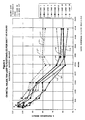
- FIGURE 3 summarizes the results of testing standard Sylvania MH 400 watt lamps of type M400/U on a 120 Hz square wave electronic ballast, a Delta 90 kHz electronic ballast and a Constant Wattage Autoregulator (CWA) ballast.
- the trend for lamps on the 120 Hz square wave ballast is identified by the lowest solid line 20
- the trend for lamps on the CWA ballast is identified by the middle solid line 22
- the trend for lamps on the 90 kHz electronic ballast is identified by the uppermost solid line 24 .
- the lamps were all operated on 11/1 cycles twice a day, meaning 11 hours on followed by a 1 hour cooldown, repeated twice daily.
- FIGURE 4 consists of plots of percent foot-candles per watt versus time for individual MH 70 watt lamps tested on Aromat electronic 170 Hz square wave ballasts manufactured by Aromat Corporation and standard magnetic ballasts. Dashed lines 30 , 32 and 34 represent lamps tested on Aromat electronic ballasts. Solid lines 36 , 38 , 40 , 42 , 44 and 46 represent lamps tested on magnetic ballasts. The test was started with six lamps on each ballast, however, three electronic ballasts failed during the test.
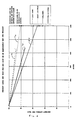
- FIGURE 5 depicts graphically the results of one such benchmarking test using six OSI 320 watt MH lamps, three on one-coil reactor ballasts and three on CWA ballasts.
- the graph shows LLD depreciation versus hours.
- the average results for lamps energized by the reactor ballasts are shown by line 50 .
- the average results for lamps energized by the CWA ballasts are depicted by line 52.
- FIGURE 6 illustrates the effects of starting lamps on their performance in terms of LLD on electronic ballasts and CWA ballasts.
- the cycled lamps used an 11/1 cycle, eleven hours on followed by one hour off. All lamps were OSI 400 watt MH lamps.
- Bold dashed line 74 represents the trend for lamps operated continuously on electronic ballasts.
- Dashed line 76 represents the trend for lamps cycled 11/1 on electronic ballasts.
- Bold solid line 78 and solid line 80 represent, respectively, trends for lamps operated continuously and cycled 11/1 on CWA ballasts. The trends show that cycling lamps contributes to their deterioration. Comparable results were found with another major lamp manufacturer's lamps, showing comparable improvements in LLD.
- the first advantage comes from the effects of fill pressure in the arc tube. Low fill pressures give rise to unacceptably high levels of sputtering damage at startup due to the long mean free path of the gas in the arc tube. Increasing the fill pressure reduces sputtering, however, standard 320 volt ballasts will not start a MH lamp with fill pressures in excess of approximately 33 torr. Pulse Arc lamps allow up to 100 torr but require starting voltages of at least 3,000 volts, however, the high fill pressure reduces sputtering damage, increasing the LLD performance of the lamp.
- the second advantage comes from the effects of frequency on LLD performance.
- the two arc tube electrodes alternately serve as cathodes and anodes during successive halves of the alternating voltage cycles.
- an electrode is serving the role of a cathode, emitting electrons, the electrons are emitted from a very small spot with a current density of approximately 10,000 amps per square millimeter.
- This high current density gives rise to an almost molten spot of tungsten at a temperature of approximately 2,800 K.
- the upside to this is that the hot tungsten can emit up to 3 amps of current with only a 10 volt drop, increasing the efficiency of the lamp.
- the electrode To support a 2,800 K hot spot on the tungsten, the electrode must be operating at a minimum temperature of 1,400 K. A cooler electrode chills the hot spot, thereby losing the efficiency advantages provided by the hot spot. While serving as an anode, there is no hot spot because the electrons arrive randomly over the entire surface of the electrode.
- a factor in maintaining the hot spot is the frequency of operation because the electrode hot spot is cooling while operating as an anode, making it more difficult to maintain the hot spot.
- Operating at a line frequency of 60 Hz causes each electrode to serve alternately as a cathode and an anode for 8 milliseconds each. This is a long period of time in terms of the amount of cooling that can occur during operation as an anode.
- a high frequency electronic ballast operating at 90 kHz, only allows the electrode to operate as an anode for 5.5 microseconds which greatly facilitates maintaining the electrodes at a high temperature with little variation during alternating halves of the cycle. It is the compounding of the above disclosed independent advantages that provides the exceptional and unexpectedly good performance of Pulse Arc MH lamps in combination with electronic sine wave 90 kHz ballasts modified for starting Pulse Arc lamps.
Landscapes
- Circuit Arrangements For Discharge Lamps (AREA)
- Discharge Lamps And Accessories Thereof (AREA)
- Discharge Lamp (AREA)
Applications Claiming Priority (2)
| Application Number | Priority Date | Filing Date | Title |
|---|---|---|---|
| US608759 | 1984-05-10 | ||
| US09/608,759 US6369522B1 (en) | 2000-06-30 | 2000-06-30 | Metal halide lamp lumen depreciation improvement |
Publications (2)
| Publication Number | Publication Date |
|---|---|
| EP1168894A2 true EP1168894A2 (de) | 2002-01-02 |
| EP1168894A3 EP1168894A3 (de) | 2004-01-21 |
Family
ID=24437853
Family Applications (1)
| Application Number | Title | Priority Date | Filing Date |
|---|---|---|---|
| EP01305604A Withdrawn EP1168894A3 (de) | 2000-06-30 | 2001-06-27 | Verbesserung des Beleuchtungsrückganges bei Metallhalogenidlampen |
Country Status (2)
| Country | Link |
|---|---|
| US (1) | US6369522B1 (de) |
| EP (1) | EP1168894A3 (de) |
Families Citing this family (5)
| Publication number | Priority date | Publication date | Assignee | Title |
|---|---|---|---|---|
| CN1606899A (zh) * | 2001-12-21 | 2005-04-13 | 皇家飞利浦电子股份有限公司 | 带干线电压切换的电子镇流器 |
| US7583030B2 (en) * | 2003-07-21 | 2009-09-01 | Advanced Lighting Technologies, Inc. | Dopant-free tungsten electrodes in metal halide lamps |
| US7956556B1 (en) * | 2004-02-24 | 2011-06-07 | Musco Corporation | Apparatus and method for compensating for reduced light output of a solid-state light source having a lumen depreciation characteristic over its operational life |
| US7564192B2 (en) | 2005-10-24 | 2009-07-21 | General Electric Company | HID dimming method and apparatus |
| US7474057B2 (en) * | 2005-11-29 | 2009-01-06 | General Electric Company | High mercury density ceramic metal halide lamp |
Family Cites Families (16)
| Publication number | Priority date | Publication date | Assignee | Title |
|---|---|---|---|---|
| JPS59198699A (ja) * | 1983-04-27 | 1984-11-10 | 株式会社日立製作所 | 高圧放電灯の点灯方法 |
| US4983889A (en) * | 1989-05-15 | 1991-01-08 | General Electric Company | Discharge lamp using acoustic resonant oscillations to ensure high efficiency |
| US5051665A (en) * | 1990-06-21 | 1991-09-24 | Gte Products Corporation | Fast warm-up ballast for arc discharge lamp |
| US5225742A (en) | 1991-12-11 | 1993-07-06 | Delta Coventry Corporation | Solid state ballast for high intensity discharge lamps |
| JP2929838B2 (ja) * | 1992-06-17 | 1999-08-03 | 住友電装株式会社 | ワイヤーハーネスおよびその製造方法 |
| US5796216A (en) | 1993-07-16 | 1998-08-18 | Delta Power Supply, Inc. | Electronic ignition enhancing circuit having both fundamental and harmonic resonant circuits as well as a DC offset |
| EP0713352B1 (de) * | 1994-11-18 | 2001-10-17 | Matsushita Electric Industrial Co., Ltd. | Beleuchtungsgerät mit Entladungslampe |
| DE4442898A1 (de) * | 1994-12-02 | 1996-06-05 | Patent Treuhand Ges Fuer Elektrische Gluehlampen Mbh | Verfahren und Schaltungsanordnung zum Starten und Betreiben von Hochdruck-Entladungslampen |
| US5883475A (en) | 1996-06-17 | 1999-03-16 | Delta Power Supply, Inc. | Method of avoiding acoustic compression wave resonance in high frequency, high intensity discharge lamps |
| US5949192A (en) * | 1996-08-21 | 1999-09-07 | Matsushita Electric Industrial Co., Ltd. | Operating apparatus for discharge lamp |
| US5914571A (en) | 1996-09-03 | 1999-06-22 | Delta Power Supply, Inc. | Method for igniting high frequency operated, high intensity discharge lamps |
| DE19644115A1 (de) * | 1996-10-23 | 1998-04-30 | Patent Treuhand Ges Fuer Elektrische Gluehlampen Mbh | Schaltungsanordnung zum Betrieb einer Hochdruckentladungslampe sowie Beleuchtungssystem mit einer Hochdruckentladungslampe und einem Betriebsgerät für die Hochdruckentladungslampe |
| JP3758291B2 (ja) * | 1997-04-18 | 2006-03-22 | 松下電工株式会社 | 放電灯点灯装置 |
| US5909082A (en) | 1997-05-06 | 1999-06-01 | General Electric Company | Starting aid for high intensity discharge lamps |
| US5898273A (en) | 1997-07-01 | 1999-04-27 | General Electric Company | Metal halide lamp with pre-start arc tube heater |
| US5942850A (en) * | 1997-09-24 | 1999-08-24 | Welch Allyn, Inc. | Miniature projection lamp |
-
2000
- 2000-06-30 US US09/608,759 patent/US6369522B1/en not_active Expired - Lifetime
-
2001
- 2001-06-27 EP EP01305604A patent/EP1168894A3/de not_active Withdrawn
Also Published As
| Publication number | Publication date |
|---|---|
| EP1168894A3 (de) | 2004-01-21 |
| US6369522B1 (en) | 2002-04-09 |
Similar Documents
| Publication | Publication Date | Title |
|---|---|---|
| US3573544A (en) | A gas discharge lamp circuit employing a transistorized oscillator | |
| WO2000045419A1 (en) | Metal halide lamp | |
| CN100466877C (zh) | 用于高压放电灯的发光方法和装置以及高压放电灯装置 | |
| EP0060665B1 (de) | Hochdruck-Metalldampfentladungslampe | |
| CN1835183B (zh) | 高强度放电灯的开槽电极 | |
| US6369522B1 (en) | Metal halide lamp lumen depreciation improvement | |
| JP2005522818A (ja) | ガス放電ランプ駆動方法及び装置 | |
| EP0240066A2 (de) | Hochintensive Entladungslampe mit mehrfachen Entladungsgeräten und mit Vorzugsentzündung | |
| US7564192B2 (en) | HID dimming method and apparatus | |
| JP4345401B2 (ja) | 高圧水銀ランプ装置 | |
| US7825603B2 (en) | Lighting assembly and method of operating a discharge lamp | |
| US3373303A (en) | Amalgam-containing fluorescent lamp with integral starting aid | |
| US4321501A (en) | Low wattage, high pressure metal vapor discharge lamp for minimizing detrimental glow time | |
| CA2006282C (en) | Glow discharge lamp having dual anodes and circuit for operating same | |
| EP1102307A1 (de) | Natrium-Xenon-Lampe mit verbesserten Kenndaten bei Annäherung des Ablaufs der Nutzungsdauer | |
| JPH0157462B2 (de) | ||
| JP3847153B2 (ja) | 放電ギャップ長の調整方法及び調整装置 | |
| KR100590812B1 (ko) | 메탈 할라이드 램프용 순시 점등형 전자식 안정기 | |
| JP2001006614A (ja) | 高輝度放電ランプ | |
| JP3738880B2 (ja) | ショートアーク放電ランプの点灯装置 | |
| WO1993011555A1 (en) | Negative glow discharge lamp having wire anode | |
| KR900006149B1 (ko) | 저압 방전등 | |
| KR200341363Y1 (ko) | 메탈 할라이드 램프용 순시 점등형 전자식 안정기 | |
| JP4756878B2 (ja) | セラミック放電ランプ点灯装置 | |
| US20020190668A1 (en) | High-pressure discharge lamp |
Legal Events
| Date | Code | Title | Description |
|---|---|---|---|
| PUAI | Public reference made under article 153(3) epc to a published international application that has entered the european phase |
Free format text: ORIGINAL CODE: 0009012 |
|
| AK | Designated contracting states |
Kind code of ref document: A2 Designated state(s): AT BE CH CY DE DK ES FI FR GB GR IE IT LI LU MC NL PT SE TR |
|
| AX | Request for extension of the european patent |
Free format text: AL;LT;LV;MK;RO;SI |
|
| PUAL | Search report despatched |
Free format text: ORIGINAL CODE: 0009013 |
|
| AK | Designated contracting states |
Kind code of ref document: A3 Designated state(s): AT BE CH CY DE DK ES FI FR GB GR IE IT LI LU MC NL PT SE TR |
|
| AX | Request for extension of the european patent |
Extension state: AL LT LV MK RO SI |
|
| RIC1 | Information provided on ipc code assigned before grant |
Ipc: 7H 05B 41/04 B Ipc: 7H 05B 41/288 A |
|
| 17P | Request for examination filed |
Effective date: 20040721 |
|
| AKX | Designation fees paid |
Designated state(s): DE FR GB IT |
|
| STAA | Information on the status of an ep patent application or granted ep patent |
Free format text: STATUS: THE APPLICATION IS DEEMED TO BE WITHDRAWN |
|
| 18D | Application deemed to be withdrawn |
Effective date: 20060704 |