EP1169964A2 - Système de diagnose, procédé pour le diagnose produisant des données, dispositif de traitement de l'information, dispositif de terminal et support d'enregistrement utilisé dans le procédé pour le diagnose produisant des données - Google Patents
Système de diagnose, procédé pour le diagnose produisant des données, dispositif de traitement de l'information, dispositif de terminal et support d'enregistrement utilisé dans le procédé pour le diagnose produisant des données Download PDFInfo
- Publication number
- EP1169964A2 EP1169964A2 EP01115400A EP01115400A EP1169964A2 EP 1169964 A2 EP1169964 A2 EP 1169964A2 EP 01115400 A EP01115400 A EP 01115400A EP 01115400 A EP01115400 A EP 01115400A EP 1169964 A2 EP1169964 A2 EP 1169964A2
- Authority
- EP
- European Patent Office
- Prior art keywords
- diagnosis
- data
- image data
- given
- imaging
- Prior art date
- Legal status (The legal status is an assumption and is not a legal conclusion. Google has not performed a legal analysis and makes no representation as to the accuracy of the status listed.)
- Withdrawn
Links
Images




Classifications
-
- A—HUMAN NECESSITIES
- A61—MEDICAL OR VETERINARY SCIENCE; HYGIENE
- A61B—DIAGNOSIS; SURGERY; IDENTIFICATION
- A61B5/00—Measuring for diagnostic purposes; Identification of persons
- A61B5/44—Detecting, measuring or recording for evaluating the integumentary system, e.g. skin, hair or nails
- A61B5/448—Hair evaluation, e.g. for hair disorder diagnosis
-
- A—HUMAN NECESSITIES
- A61—MEDICAL OR VETERINARY SCIENCE; HYGIENE
- A61B—DIAGNOSIS; SURGERY; IDENTIFICATION
- A61B5/00—Measuring for diagnostic purposes; Identification of persons
- A61B5/0002—Remote monitoring of patients using telemetry, e.g. transmission of vital signals via a communication network
- A61B5/0004—Remote monitoring of patients using telemetry, e.g. transmission of vital signals via a communication network characterised by the type of physiological signal transmitted
- A61B5/0013—Medical image data
-
- A—HUMAN NECESSITIES
- A61—MEDICAL OR VETERINARY SCIENCE; HYGIENE
- A61B—DIAGNOSIS; SURGERY; IDENTIFICATION
- A61B5/00—Measuring for diagnostic purposes; Identification of persons
- A61B5/0059—Measuring for diagnostic purposes; Identification of persons using light, e.g. diagnosis by transillumination, diascopy, fluorescence
- A61B5/0082—Measuring for diagnostic purposes; Identification of persons using light, e.g. diagnosis by transillumination, diascopy, fluorescence adapted for particular medical purposes
- A61B5/0088—Measuring for diagnostic purposes; Identification of persons using light, e.g. diagnosis by transillumination, diascopy, fluorescence adapted for particular medical purposes for oral or dental tissue
-
- A—HUMAN NECESSITIES
- A61—MEDICAL OR VETERINARY SCIENCE; HYGIENE
- A61B—DIAGNOSIS; SURGERY; IDENTIFICATION
- A61B5/00—Measuring for diagnostic purposes; Identification of persons
- A61B5/16—Devices for psychotechnics; Testing reaction times ; Devices for evaluating the psychological state
-
- A—HUMAN NECESSITIES
- A61—MEDICAL OR VETERINARY SCIENCE; HYGIENE
- A61B—DIAGNOSIS; SURGERY; IDENTIFICATION
- A61B5/00—Measuring for diagnostic purposes; Identification of persons
- A61B5/44—Detecting, measuring or recording for evaluating the integumentary system, e.g. skin, hair or nails
- A61B5/441—Skin evaluation, e.g. for skin disorder diagnosis
-
- A—HUMAN NECESSITIES
- A61—MEDICAL OR VETERINARY SCIENCE; HYGIENE
- A61B—DIAGNOSIS; SURGERY; IDENTIFICATION
- A61B3/00—Apparatus for testing the eyes; Instruments for examining the eyes
- A61B3/10—Objective types, i.e. instruments for examining the eyes independent of the patients' perceptions or reactions
- A61B3/11—Objective types, i.e. instruments for examining the eyes independent of the patients' perceptions or reactions for measuring interpupillary distance or diameter of pupils
- A61B3/112—Objective types, i.e. instruments for examining the eyes independent of the patients' perceptions or reactions for measuring interpupillary distance or diameter of pupils for measuring diameter of pupils
Definitions
- diagnosis or medical treatment of a disease is conducted by a doctor. Also, it is general that a patient or a person to be diagnosed directly visits a medical doctor and faces the doctor to conduct the diagnosis and the medical treatment.
- a plurality of image data is produced at the same imaging position by repeatedly imaging a given position to be imaged in a user's body, and the image processing device that has received the image data produces the diagnosis data with respect to the respective image data.
- the diagnosis data is produced in accordance with the time series on the basis of the received image data.
- the diagnosis data may be produced on the basis of all of the received image data or may be produced on the basis of only the required image data.
- the diagnosis data can be utilized by the manufacturers or the distributors of the medicine, the cosmetics, medical apparatuses or beauty implements.
- the diagnosis data can be utilized by the distributors.
- a system can be constructed in which the medicine or the cosmetics are delivered from the distributor that has received the diagnosis data automatically or in response to a purchase request from the user.
- the user needs to make some contract with a person who manages the information processing device, and with such a contract, if the user conducts a simple process for photographing and transmitting given image data at home, the user can get the medicine, the cosmetics, medical apparatuses or beauty implements which meet the user's health condition while being at home.
- the information processing device produces the diagnosis data taking not only the image data but also the oral consultation data into consideration.
- a terminal device which is connectable through a network to an information processing device having a diagnosing means for conducting a given diagnosis on the basis of image data and oral consultation data pertaining to the diagnosis contents and including given character information which are received through the network to produce diagnosis data pertaining to a diagnosis result
- said terminal device comprising: a transmitting means that receives, from a given imaging means that repeatedly images a position to be imaged which is located at a given position of a user' s body, the image data produced by imaging the position to be imaged with the use of said imaging means by the user and the diagnosis data and transmits the image data and the diagnosis data to the information processing device through said network.
- the terminal device and the method of transmitting the diagnosis information can be readily realized by using a home computer, a computer only for a game having a communicating means, or the like by allowing the following program recorded in a given recording medium to be read in the computer.
- an information processing device that is connectable through a network to a terminal device having a transmitting means that receives, from a given imaging means that repeatedly images a position to be imaged which is located at a given position of a user' s body, the image data produced by imaging the position to be imaged with the use of said imaging means by the user to transmit the image data through said network
- said information processing device comprising: wherein said image processing device includes a diagnosing means that conducts a given diagnosis on the basis of image data received from said terminal and produces diagnosis data pertaining to a diagnosis result; and wherein said information processing device produces the diagnosis data in a time series manner on the basis of a plurality of image data produced by imaging the position to be imaged at given time intervals.
- the information processing device is structured, for example, as follows.
- An information processing device which is connectable through a network to a terminal device having a transmitting means that receives, from a given imaging means that repeatedly images a position to be imaged which is located at a given position of a user' s body, image data produced by imaging the position to be imaged by the user and oral consultation data pertaining to the diagnosis contents and including given character information and transmits the image data and the diagnosis data through said network, said information processing device comprising: a diagnosing means that conducts a given diagnosis on the basis of the image data and the oral consultation data received from said terminal and produces diagnosis data pertaining to a diagnosis result; wherein said information processing device produces the diagnosis data in a time series manner on the basis of a plurality of image data and oral consultation data produced by imaging the position to be imaged at given time intervals.
- diagnosing means comprises: an image processing means for conducting a given image process on the image data to produce comparison image data if occasion demands; reference data recording means for recording reference data for diagnosis; and a judging means for comparing the comparison image data with the reference data to conduct the given diagnosis.
- the diagnosing means of the information processing device comprises an image processing means for conducting a given image process on the image data to produce comparison image data; reference data recording means for recording reference data for diagnosis; and a judging means for comparing the comparison image data and the oral consultation data with the reference data to conduct the given diagnosis.
- the information processing device that constitutes the network according to the present invention can be executed by the following method.
- a recording medium that records, in a computer readable manner, a program for allowing an information processing device with a computer which is connectable through a network to a terminal device having a transmitting means that receives, from a given imaging means that repeatedly images a position to be imaged which is located at a given position of a user' s body, the image data produced by imaging the position to be imaged with the use of said imaging means by the user to transmit the image data through said network to function as a diagnosis data producing device, said computer executing said program comprising the steps of: receiving the image data from said terminal; and conducting a given diagnosis on the basis of the image data and the oral consultation data to produce the diagnosis data pertaining to the diagnosis result; wherein said receiving step and said conducting step are repeatedly conducted on a plurality of image data produced by imaging the position to be imaged at given time intervals to produce the plurality of diagnosis data in accordance with the time series.
- a recording medium that records, in a computer readable manner, a program for allowing an information processing device with a computer which is connectable through a network to a terminal device having a transmitting means that receives, from a given imaging means that repeatedly images a position to be imaged which is located at a given position of a user' s body, the image data produced by imaging the position to be imaged with the use of said imaging means by the user and oral consultation data pertaining to the diagnosis contents and including given character information to transmit the image data through said network to function as a diagnosis data producing device, said computer executing said program comprising the steps of: receiving the image data and the oral consultation data from said terminal; and conducting a given diagnosis on the basis of the image data and the oral consultation data to produce the diagnosis data pertaining to the diagnosis result; wherein said receiving step and said conducting step are repeatedly conducted on a plurality of image data produced by imaging the position to be imaged at given time intervals and the oral consultation data to produce the plurality of diagnosis data in accordance with the time series
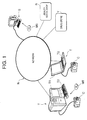
- FIG. 1 A diagnosis system embodied by this embodiment is shown in Fig. 1.
- the diagnosis system includes a terminal T as a terminal device of the present invention and a server S as an information processing device of the present invention, and also includes a beauty goods shop B and a drugstore Y. They are connected to each other through a network N made up of an internet or an intranet.
- the terminal T will be described.
- the terminal T according to this embodiment is made up of a home computer although the present invention is not limited to this.
- the terminal T includes a given display device T1, an input device T2 made up of a keyboard, a mouse and so on for inputting oral consultation data which will be described later, and an imaging device C made up of a digital camera and so on.
- the imaging device C corresponds to an imaging means of the present invention.
- the imaging device A is so designed as to produce image data by imaging.
- the terminal T can receive the above-described image data through an input terminal connected with a cable that connects the terminal T and the imaging device C.
- the imaging device C is so used to image a given position to be imaged which is a part of a user's body by plural times as will be described later. That is, the imaging device C is required to image the same position to be imaged at given time intervals by plural times.
- imaging can be conducted referring to the relative position to a characteristic portion of the body such as a mole, eyes or a nose. For example, a portion 5 mm right from a specific mole is set as the position to be imaged and can continue to be imaged.
- the imaging is repeated while not only the position but also the magnification of imaging is fixed.
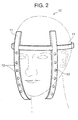
- an implement for subserving the imaging for example, a headgear-shaped positioning implement 10 shown in Fig. 2 can be employed.
- the positioning implement 10 is designed in such a manner that the user wears the positioning implement 10 on his head in a given direction, and the imaging device C is fitted to a given one of a large number of positioning apertures 12 defined in frames 11 each of which extends longitudinally and laterally, thereby being capable of positioning the camera to a specific position.
- the positioning implement 10 may be fixed to a given portion of his face, for example, at three points. This makes it possible to more accurately position the imaging device C.
- the accurate positioning may be conducted by using the above subserving implement before the imaging is conducted.
- the recording medium MT in this embodiment is distributed by a manager of the server S who manages this system, or the like although the present invention is not limited to this. It is not always necessary that the above-described program is installed in the computer through the network, but the program may be installed in the computer through a delivering process via the network.
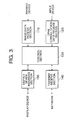
- the CPU that is built in the terminal T of the present invention constitutes the following functional blocks.
- the terminal T is made up of an image data receive section 110, an oral consultation data receive portion 120, a control section 130 and a transmit/receive section 150.
- the image data receive section 110 receives given image data produced by imaging through the imaging device C.
- the image data receive section 110 is so designed as to receive the image data through the cable that connects the imaging device C and the terminal T.
- the image data receive section 110 may be so designed as to receive the image data produced in the imaging device C, and may be so structured as to receive the image data through a memory card or other external recording medium.
- the oral consultation data producing section 120 produces the oral consultation data in response to an input that is conducted by the user through the input device.
- the oral consultation data is directed to information related to the contents of the diagnosis and also includes character information.
- the oral consultation data is generally inputted as the character information from the keyboard that constitutes the input device T.
- the oral consultation data can be produced by freely hitting characters by the user.
- a function of supplying the format of the diagnosis to be conducted to the user is provided in the control section 130 formed by execution of the above-described program, and the use can input the oral consultation data in that format.
- the control section 130 is provided with a function of displaying, in the display device T1, a plurality of options related to information required at the time of conducting the subject diagnosis.
- the oral consultation data is inputted by selecting the options displayed on the display device T1 by the user.
- control section 130 determines the image data and the oral consultation data to be transmitted from the transmit/receive section 140 on the basis of the input contents of the user, and an image displayed on the display device T1.
- control section 130 has a function of producing the correspondence information which is data indicating that for which diagnosis the received image data is on the basis of an input from the above-described input device T2 or the like and adding the correspondence information to the image data.
- the transmit/receive section 140 executes a communication between the terminal T and the network N.
- the transmit/receive section 140 is so designed as to transmit at least the image data (and added correspondence information) and the oral consultation data to the server S through the network N.
- the display device managing section 150 is so designed as to produce display data for displaying a desired image on the display device T1.
- the display device managing section 150 is so designed as to produce the display data under the management by the control section 130.
- the server S is made up of a general computer.
- the server S includes a given display device and a given input device made up of a keyboard, a mouse and so on.
- the computer that serves as the server S includes a disk drive.
- a recording medium MT made up of a CD-ROM or a DVD-ROM according to the present invention is inserted into the disk drive so as to read a program stored in the recording medium according to the present invention.
- the computer has the respective functions required for the server S of the present invention by installing the program of the present invention through the above-described process.
- the program can provide the computer with a function as the information processing device of the present invention by its single unit, or may provide the computer with a function of the information processing device of the present invention in cooperation with OS installed in the computer.
- the CPU built in the server S of the present invention constitutes the following functional block.
- the server S includes a transmit/receive section 210 and a diagnosis section 220.
- the transmit/receive section 210 is so designed as to execute a communication between the terminal T and the network N.
- the transmit/receive section 210 is so designed as to receive at least the image data and the oral consultation data from the terminal T.
- the diagnosis section 220 has both functions of the diagnosing means and the prescribing means of the present invention.
- the diagnosis section 220 conducts a given diagnosis on the basis of the above-described image data and oral consultation data which have been received from the terminal T through the network N, and produces the prescription data related to a prescription that meets the diagnosis result.
- the image processing section 221 corresponds to the image processing means of the present invention, and has a function of producing correspondence image data by conducting a given image process on the image data.
- the reference data recording section 222 corresponds to a part of the reference data recording means according to the present invention, and records the reference data necessary for producing the prescription data.
- the reference data recording section 222 may record the reference data for conducting at least one diagnosis.
- the reference data recording section 222 records the reference data for a drooping eyelid diagnosis, a depression diagnosis, an insomnia diagnosis, an autonomic imbalance diagnosis, a skin aspect diagnosis and a hair diagnosis, and said judging means conducts at least of the depression diagnosis, the insomnia diagnosis, the drooping eyelid diagnosis, the autonomic imbalance diagnosis, the skin aspect diagnosis and the hair diagnosis.
- the prescription data recording section 224 records data related to the prescriptions pertaining to the drooping eyelid diagnosis, the depression diagnosis, the insomnia diagnosis, the autonomic imbalance diagnosis, the skin aspect diagnosis and the hair diagnosis as the prescription data therein although the present invention is not limited to this.
- the correspondence judging section 226 analyzes the correspondence information transmitted from the terminal T which is added to the image data and determines a diagnosis to be conducted on the image data. In this embodiment, because the respective diagnoses of the drooping eyelid diagnosis, the depression diagnosis, the insomnia diagnosis, the autonomic imbalance diagnosis, the skin aspect diagnosis and the hair diagnosis can be conducted, the correspondence judging section 226 determines which of those diagnoses should be conducted on the basis of the correspondence information. The determination is transmitted to the image processing section 221 and the judging section 223. The image processing section 221 conducts an appropriate image process on the basis of the correspondence information, and the judging section 223 judges an appropriate diagnosis.
- a flow of producing the prescription data will be described in each of the drooping eyelid diagnosis, the depression diagnosis, the insomnia diagnosis, the autonomic imbalance diagnosis, the skin aspect diagnosis and the hair diagnosis.
- the depression diagnosis and the subsequent diagnoses duplicate portion of the description of the drooping eyelid diagnosis will be appropriately omitted.
- the drooping eyelid means that an eyelid hangs down due to the abnormality of an eyelid levator or the eyelid chorda which is a muscle that hangs the eyelid or the connection failure of the eyelid levator or the eyelid chorda and a tarsal.
- the drooping eyelid appears as various mental and physical disease symptoms. Therefore, because the various diseases may be prevented by early detecting the drooping eyelid, the detection of the drooping eyelid is very significant.
- the diagnosis of the drooping eyelid is conducted, for example, as follows.
- the user first inputs the declaration of his intention that he determines to be subjected to the drooping eyelid diagnosis through the input device T2.
- the control section 140 produces correspondence information indicating that a diagnosis conducted on the basis of image data which will be inputted later is the drooping eyelid diagnosis.
- the user images his eyes by the imaging device C and produces the image data related to the image of his eyes.
- the image of his eyes is set within a constant range including the user' eyes.
- the terminal T receives the image data produced by imaging the his eyes by the imaging device C by the image data receive section 110.
- the data is transmitted to the transmit/receive section through the control section 140. Also, the control section 140 adds the above-described correspondence information to the image data.
- the transmit/receive section 140 is controlled by the control section 130 in response to a user's demand which is inputted by the operation of the terminal T, and transmits the image data added with the correspondence information to the server S through the network N.
- the user conducts the operation for inputting the oral consultation data including the character information through the input device T2, to thereby produce the oral consultation data.
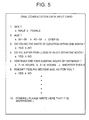
- an image for example, shown in Fig. 5 is displayed in the display device T1.
- the image is displayed on the display device T1 on the basis of display data that is produced by the display device managing section 150 under the control of the control section 130.
- the user selects one option from options a and b (or a, b and c), for example, in examples (1) to (6), and inputs a document through a keyboard or the like in an example (10), to thereby input the oral consultation data.
- the terminal T receives the above-described oral consultation data through the oral consultation data receive section 120.
- the data is transmitted to the transmit/receive section through the control section 140.
- the image data related to the eyes received from the transmit/receive section 210 is transmitted to the diagnosing section 220.
- the correspondence judging section 226 analyzes the correspondence information added with the image data and determines that a diagnosis to be conducted on the basis of the transmitted image data is the drooping eyelid diagnosis on the basis of the correspondence information. This determination is transmitted to the image processing section 221 and the judging section 223 to ensure an appropriate process in the image processing section 221 and an appropriate judgment in the judging section 223.
- the image data is transmitted to the image processing section 221.
- the image processing section 221 conducts a given image process on the image data to produce comparison image data.
- a given threshold value of brightness is set to subject the image to a binary or ternary coding, thereby being liable to conduct the subsequent judgment as to the image of the eyes.
- an edge emphasis or a contour line process due to moire may be conducted.
- the image processing section 221 may conduct a color correction process. Since the image data is frequently different from the natural image due to a difference in the specification between the imaging devices C or a difference in illumination at the time of imaging, the color correction is conducted, thereby being capable of conducting an accurate diagnosis. For example, a seal or the like on which a given reference color is stuck at a given arrangement is distributed to the user in advance, and the user is obliged to stick the seal to an imaging area to conduct imaging. Then, the reference color within the seal which is reflected in the image is adjusted to a color which is prepared in advance, and this process is applied to the entire image. The color correction process may be conducted at the terminal T of the user side.
- the unified image data which has been subjected to the color correction is transmitted to the server S.
- the terminal T is required to provide a means for conducting the color correction, for example, to provide a function of the above-described control section 130.
- the image of the user's eyes is converted into an image of a diagram shown in Figs. 6A to 6C which definitely shows only the contour of the eyes, the boundary of the white and black (gray) of the eye, and the contour of pupil, to produce the comparison image data related to the image.
- the comparison image data which has been subjected to the above-described process as occasion demands is then transmitted to the judging section 223.
- the judging section 223 compares the comparison image data with the reference data read from the reference data recording section 222 to conduct a judgment on the basis of the comparison image data. This judgment corresponds to the diagnosis made by the doctor.
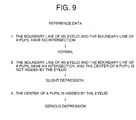
- the reference data related to the drooping eyelid diagnosis recorded in the reference data recording section 222 is not particularly restricted if it is used to conduct an appropriate judgment as to the drooping eyelid.
- the reference data is, for example, shown in Fig. 7.
- the diagnosis can be more accurately produced on the basis of the image.
- the presence/absence of the elevated eyebrows is judged on the basis of the image of the eyebrows in addition to the above-described judgment based on the image, thereby being capable of conducting a more accurate judgment as to the drooping eyelid.
- the judgment that the drooping eyelid is slight on the basis of the image of the eyes can be corrected to the judgment that the drooping eyelid is serious, or the judgment that the symptom is normal on the basis of the image of the eyes can be corrected to the judgment that the symptom is the slight drooping eyelid so far as it is judged that the symptom is normal but close to the drooping eyelid.
- Such a correction may be appropriately conducted as occasion demands.
- the above-described judgment may be made taking the contents of the oral consultation data into consideration to produce the diagnosis data. For example, in the case where the contents that user's sleeping hours are short on a preceding day are included in the oral consultation data, the diagnosis data can be produced taking the above contents into consideration.
- the judgment in the judging section 223 is delicate, the judgment in the judging section 223 is reserved so as to hand the judgment to the doctor or another expert. In this case, the production of the following prescription data can be conducted by the doctor.
- the diagnosis data is transmitted to the prescription data producing section 225.
- the prescription data producing section 225 produces the prescription data on the basis of the diagnosis data.
- the prescription reference data related to the drooping eyelid recorded in the prescription reference data recording section 224 is used.
- the reference data is not particularly restricted if the reference data is used to conduct an appropriate and significant prescription for each of the drooping eyelid symptoms.
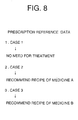
- An example of the reference data is shown in Fig. 8.
- diagnosis data is 1 indicative of "normal”, data 1 indicating that no prescription is required is produced. If the diagnosis data is 1 indicative of "normal”, data 1 indicating that no prescription is required is produced. If the diagnosis data is 2 indicative of "slight drooping eyelid", data 2 suggesting the dosage of a medicine A is produced. If the diagnosis data is 3 indicative of "serious drooping eyelid", data 3 suggesting the dosage of a stronger medicine B. Those data becomes the prescription data.
- the oral consultation data is also transmitted, the above-described diagnosis data and prescription data are produced taking the contents of the interview prescription data into consideration.
- the diagnosis data and the prescription data are transmitted to the terminal T used by the user or the like from the server S for use.
- the user can grasp his health state on the basis of the diagnosis data or the prescription data, or purchase and take a medicine.
- the user can be subjected to a diagnosis by the doctor anew.
- diagnosis data and the prescription data are transmitted from the transmit/receive section 210 of the server S through the network N.
- the terminal T receives the diagnosis data and the prescription data at its transmit/receive section 140.
- the diagnosis data and the prescription data can be utilized by delivering those data from the server S to the drugstore Y.
- the drugstore Y extracts a person who appears to be anxious about his health on the basis of the diagnosis data, and send a direct mail to the person.
- the drugstore Y delivers the above-described medicine A or B indicated by the prescription data to the user, or asks the user about his intention to purchase those medicines by a direct mail, by using the prescription data.
- the utilization of the above diagnosis data and prescription data makes both of the user and the drugstore Y obtain advantages.
- the delivery of the data to the drugstore Y can be conducted by transmitting the data from the transmit/receive section 210 of the server S through the network N.
- the data can be received by a terminal not shown which is located at the drugstore Y.
- the delivery of the data may be conducted through some recording medium, or may be conducted by means of a paper medium printed out from the server S.
- the diagnosis of the depression can be performed by conducting substantially the same treatment as that in the drooping eyelid.
- the depression diagnosis can be executed by a method different from the above method.
- the server S conducts the diagnosis of the depression on the basis of the image data (or both of the image data and the oral consultation data) transmitted from the terminal T through the network N.
- the image data is transmitted to the image processing section 221, and then subjected to, for example, a binary or ternary coding in order to make it easy to detect the area of the pupil.
- a binary or ternary coding in order to make it easy to detect the area of the pupil.
- the same image processing as that in the drooping eyelid diagnosis is conducted, to thereby produce the comparison image data.
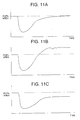
- the reference data is related to the reaction patterns of the pupils, for example, as shown in Figs. 11A to 11C.
- 11C shows a reaction pattern of the pupil of a person who is subjected to depression.
- the pupil that is made small in size by irradiation of a light has a tendency to be hardly expanded, and also may not be frequently returned to the original size. repeatedly expanded and reduced without being not stabilized.
- the judging section 223 judges to which pattern in Figs. 11A to 11C the comparison image data is similar, and on the basis of this result, judges whether the user is subjected to depression or the like. In other words, if the comparison image data is similar to the pattern of Fig. 11A, diagnosis data indicating that the user is in the normal condition is produced, if the comparison image data is similar to the pattern of Fig. 11B, diagnosis data indicating that the user is in the excessively strained condition is produced, and if the comparison image data is similar to the pattern of Fig. 11C, diagnosis data indicating that the user is subjected to depression is produced.
- the diagnosis data is transmitted to the prescription data producing section 225.
- the prescription data producing section 225 produces the prescription data on the basis of the diagnosis data.
- the prescription reference data recorded in the prescription reference data recording section 224 is employed.
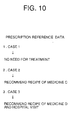
- An example of the prescription reference data is shown in Figs. 12A and 12B.
- the prescription data produced in this example will be described. If the diagnosis data is data indicating the user is in a normal condition, data 1 indicative of "No need for symptom" is produced. If the diagnosis data is data indicating that the user is in an excessively strained condition, data 2 indicative of "Suggest the dosage of a medicine E and hospital visit” is produced. If the diagnosis data is data indicating that the user is subjected to depression, data 3 indicative of "Suggest the dosage of a medicine F and hospital visit" is produced.
- insomnia diagnosis and the autonomic imbalance diagnosis can be conducted by executing the same process as that in the above-described depression diagnosis.
- diagnosis data is selectively produced from insomnia, slight insomnia, serious insomnia and so on, and prescription data related to an appropriate prescription for the selected diagnosis data is produced.
- prescription data including data related to a comment that suggests the dosage of an appropriate chemical agent or data related to a comment that suggests an exercise or a dietetic treatment may be produced.
- the reference data and the prescription reference data may be so set as to produce the above-described diagnosis data and prescription data.
- the user inputs information for inputting correspondence information from the input device T2 or the like. Also, the user images the hair of his head by the imaging device C to produce image data related to the image of the hair of his head.
- the image of the hair of his head is set within a constant range of a given portion of the head skin.
- the positioning implement 10 shown in Fig. 2 can be employed. The positioning implement is employed in the above-described usage, to thereby simply image the same position.
- the terminal T receives the image data produced by imaging the hair of the head through the imaging device C at the image data receive section 110.
- the data is transmitted to the server S through the network N together with additional information in response to a demand from the user.
- the image data of the hair of the head is transmitted to the image processing section 221.
- the image processing section 221 conducts a given image process on the image data to produce the comparison image data.
- a given threshold value of brightness is set to subject the image to a binary or ternary coding, thereby being liable to conduct the subsequent judgment as to the image of the eyes.
- the image of the hair of user's head is binary-coded so as to definitely distinguish the hair of the head from other portions.
- Fig. 12 shows an example of an enlarged image of the hair of the head displayed on the basis of the comparison image data.
- the comparison image data which has been subjected to the above-described process as occasion demands is then transmitted to the judging section 223.
- the judging section 223 compares the comparison image data with the reference data read from the reference data recording section 222, to thereby conduct a judgment on the basis of the comparison image data.
- the above-described judgment is made taking the contents of the oral consultation data into consideration, to thereby produce the diagnosis data.
- the diagnosis data is transmitted to the prescription data producing section 225.
- the prescription data producing section 225 produces the prescription data on the basis of the diagnosis data.
- diagnosis data is indicative of "normal”
- diagnosis data is indicative of "slight thin hair”
- diagnosis data is indicative of "slight thin hair”
- diagnosis data is indicative of "serious thin hair”
- diagnosis data is indicative of "serious thin hair”
- Those data produced on the basis of the diagnosis data becomes the prescription data.
- the prescription data can be delivered from the server S to the drugstore Y, the beauty goods shop B or the like for use. That is, the drugstore Y or the beauty goods shop B can conduct the same direct mail service as that in the drooping eyelid diagnosis by using the diagnosis data or the prescription data.
- the user images the skin aspect by the imaging device C to produce the image data related to the image of the skin aspect.
- the image of the skin aspect is set within a constant range of a given portion of the skin.
- the positioning implement 10 shown in Fig. 2 can be employed.
- the positioning implement 10 is employed in the above-described usage, to thereby easily image the same position.
- the skin aspect is imaged by a predetermined magnification.
- the terminal T receives the image data produced by imaging the skin aspect through the imaging device C by the image data receive section 110.
- the data is transmitted through the network N in response to a demand from the user.
- the user conducts the operation for inputting the oral consultation data including the character information through the input device T2, to thereby produce the oral consultation data.
- an image that prompts the selection of options can be displayed in the display device T1 as in the drooping eyelid diagnosis.
- the terminal T transmits the oral consultation data to the server S through the network N in addition to the image data.
- the server S receives the image data (or both of the image data and the oral consultation data) transmitted from the terminal T by the transmit/receive section 210, and then diagnoses the hair of the head on the basis of that data.
- the image data received by the transmit/receive section 210 is transmitted to the diagnosis section 220 to determine that the skin aspect is diagnosed by the correspondence judging section 226, and the determination is transmitted to the image processing section 221 and the judging section 223.
- the image data of the skin is transmitted to the image processing section 221.
- the image processing section 221 conducts a given image process on the image data to produce the comparison image data.
- a given threshold value of brightness is set to subject the image to a binary coding, thereby being liable to conduct the subsequent judgment.
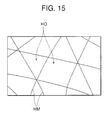
- Fig. 15 shows an example of an enlarged image of the skin indicated by the comparison image data.
- HM expressed as lines that extend lengthwise and breadthwise are grooves in the outer skin which are called “skin grooves", and the respective portions sectioned by the skin grooves HM are called “skin hill HO".
- the comparison image data which has been subjected to the above-described process as occasion demands is then transmitted to the judging section 223.
- the judging section 223 compares the comparison image data with the reference data read from the reference data recording section 222, to thereby conduct a judgment on the basis of the comparison image data.
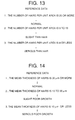
- the reference data related to the skin aspect recorded in the reference data recording section 222 there is used the reference data related to the skin aspect recorded in the reference data recording section 222.
- the reference data is not particularly restricted if an appropriate judgment of the skin aspect is conducted.
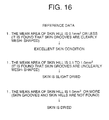
- the reference data is shown, for example, in Fig. 16 on the basis of the size of the skin hill HO.
- the health skin grooves HM extend lengthwise and beadthwise. However, the skin grooves HM of the bad health extends in only one direction, and the worse health skin has no skin groove HM per se. That is, the skin is more delicate with more moisturized health skin, and an area of the skin hill HO becomes small.
- the above-described reference data is used to judge the degree of the skin dry on the basis of the above knowledge.
- the judging section 223 judges which reference shown in Fig. 16 the image shown in Fig. 15 on the basis of the comparison image data is similar to, to thereby produce the diagnosis data.
- the above-described judgment is made taking the contents of the oral consultation data into consideration, to thereby produce the diagnosis data.
- the appropriate size of the area of the skin hill HO depends on age. Therefore, the judgment of "excellent skin condition", “skin is aging” or “skin is aged” is corrected on the basis of the data of ages included in the oral consultation data, thereby being capable of producing more accurate diagnosis data.
- the diagnosis data is transmitted to the prescription data producing section 225.
- the prescription data producing section 225 produces the prescription data on the basis of the diagnosis data.
- the prescription reference data related to the skin aspect recorded in the prescription reference data recording section 224 is used.
- the reference data is not particularly restricted if an appropriate and significant prescription is conducted for each of the skin aspects.
- diagnosis data is indicative of "excellent skin condition”
- diagnosis data is indicative of "skin is aging”
- diagnosis data is indicative of "skin is aged”
- diagnosis data is indicative of "skin is aged”
- data indicating that a cosmetic C should be used and including a comment that proposes that a judgment should be made by an expert can be produced.
- Those data produced on the basis of the diagnosis data becomes the prescription data.
- the above-described prescription data may be produced taking the contents of the oral consultation data into consideration.
- the diagnosis data and the prescription data are, for example, returned from the server S to the terminal T used by the user for use. That is, the user can determine a cosmetic to be purchased, or can ask for a further judgment by the expert on the basis of the prescription data.
- diagnosis data and the prescription data can be delivered from the server S to the beauty goods shop B or the like for use. That is, the beauty goods shop B can conduct the same direct mail service as that in the drooping eyelid diagnosis or send an appropriate cosmetic by using the prescription data.
- the above-described process is regularly or irregularly repeated to produce the prescription data at times, and the prescription data is used by the user.
- the user can be subjected to simple medical care or medical treatment at any time not depending on the convenience of the doctor. Also, according to the present invention, since a fixed point is continuously observed, a precision in the medical care or medical treatment is kept to a high level although the doctor is not required in principle.
Landscapes
- Health & Medical Sciences (AREA)
- Life Sciences & Earth Sciences (AREA)
- Engineering & Computer Science (AREA)
- Physics & Mathematics (AREA)
- Public Health (AREA)
- Veterinary Medicine (AREA)
- Biophysics (AREA)
- Biomedical Technology (AREA)
- Heart & Thoracic Surgery (AREA)
- Medical Informatics (AREA)
- Molecular Biology (AREA)
- Surgery (AREA)
- Animal Behavior & Ethology (AREA)
- General Health & Medical Sciences (AREA)
- Pathology (AREA)
- Dermatology (AREA)
- Nuclear Medicine, Radiotherapy & Molecular Imaging (AREA)
- Oral & Maxillofacial Surgery (AREA)
- Dentistry (AREA)
- Radiology & Medical Imaging (AREA)
- Physiology (AREA)
- Computer Networks & Wireless Communication (AREA)
- Audiology, Speech & Language Pathology (AREA)
- Psychiatry (AREA)
- Developmental Disabilities (AREA)
- Educational Technology (AREA)
- Hospice & Palliative Care (AREA)
- Child & Adolescent Psychology (AREA)
- Psychology (AREA)
- Social Psychology (AREA)
- Ophthalmology & Optometry (AREA)
- Medical Treatment And Welfare Office Work (AREA)
- Measuring And Recording Apparatus For Diagnosis (AREA)
- Facsimiles In General (AREA)
- Image Analysis (AREA)
- Measurement Of The Respiration, Hearing Ability, Form, And Blood Characteristics Of Living Organisms (AREA)
- Image Input (AREA)
- Image Processing (AREA)
Applications Claiming Priority (2)
| Application Number | Priority Date | Filing Date | Title |
|---|---|---|---|
| JP2000192793 | 2000-06-27 | ||
| JP2000192793A JP2002007568A (ja) | 2000-06-27 | 2000-06-27 | 診断システム、診断データ生成方法、それに用いられる情報処理装置、及び端末装置、並びに記録媒体 |
Publications (2)
| Publication Number | Publication Date |
|---|---|
| EP1169964A2 true EP1169964A2 (fr) | 2002-01-09 |
| EP1169964A3 EP1169964A3 (fr) | 2003-11-19 |
Family
ID=18691874
Family Applications (1)
| Application Number | Title | Priority Date | Filing Date |
|---|---|---|---|
| EP01115400A Withdrawn EP1169964A3 (fr) | 2000-06-27 | 2001-06-26 | Système de diagnose, procédé pour le diagnose produisant des données, dispositif de traitement de l'information, dispositif de terminal et support d'enregistrement utilisé dans le procédé pour le diagnose produisant des données |
Country Status (4)
| Country | Link |
|---|---|
| US (1) | US20010056228A1 (fr) |
| EP (1) | EP1169964A3 (fr) |
| JP (1) | JP2002007568A (fr) |
| KR (1) | KR20020001609A (fr) |
Cited By (12)
| Publication number | Priority date | Publication date | Assignee | Title |
|---|---|---|---|---|
| GB2377282A (en) * | 2001-02-16 | 2003-01-08 | Sanjay Kumar Chugh | Computerised medical database |
| US6761697B2 (en) | 2001-10-01 | 2004-07-13 | L'oreal Sa | Methods and systems for predicting and/or tracking changes in external body conditions |
| EP1447968A3 (fr) * | 2003-02-10 | 2004-12-22 | Konica Minolta Holdings, Inc. | Procédé et appareil pour un système de traitement d'images medicales, dispositif de prise d'images medicals et procédé d'administration d'images medicales |
| FR2865824A1 (fr) * | 2004-01-29 | 2005-08-05 | Oreal | Procede et systeme pour determiner une condition physique, notamment l'age apparent, d'au moins une region du coprs ou du visage d'un individu. |
| ES2242484A1 (es) * | 2003-01-24 | 2005-11-01 | Pedro Monagas Asensio | Dispositivo analizador animico para mamiferos. |
| US7317818B2 (en) | 2001-11-26 | 2008-01-08 | L'ORéAL S.A. | Method of enabling an analysis of an external body portion |
| US7324668B2 (en) | 2001-10-01 | 2008-01-29 | L'oreal S.A. | Feature extraction in beauty analysis |
| US7437344B2 (en) | 2001-10-01 | 2008-10-14 | L'oreal S.A. | Use of artificial intelligence in providing beauty advice |
| US7634103B2 (en) | 2001-10-01 | 2009-12-15 | L'oreal S.A. | Analysis using a three-dimensional facial image |
| EP1895464A4 (fr) * | 2005-06-08 | 2011-03-02 | Ibm | Systeme de guide medical |
| EP2064639A4 (fr) * | 2006-09-18 | 2011-10-12 | Aram Huvis Co Ltd | Procédé de réalisation de produits cosmétiques personnalisés et système utilisé à cet effet |
| US8360973B2 (en) | 2000-11-29 | 2013-01-29 | L'oreal | Process for acquiring scanned image data relating to an external body portion and/or a product applied thereto |
Families Citing this family (25)
| Publication number | Priority date | Publication date | Assignee | Title |
|---|---|---|---|---|
| US7315821B2 (en) | 2002-01-31 | 2008-01-01 | Sanyo Electric Co., Ltd. | System and method for health care information processing based on acoustic features |
| US7908155B2 (en) * | 2002-04-12 | 2011-03-15 | Becton, Dickinson And Company | System for collecting, storing, presenting and analyzing immunization data having remote stations in communication with a vaccine and disease database over a network |
| JP4216523B2 (ja) * | 2002-04-25 | 2009-01-28 | スカラ株式会社 | ユニット |
| JP4502571B2 (ja) * | 2002-10-07 | 2010-07-14 | ポーラ化成工業株式会社 | 化粧崩れの傾向の鑑別法 |
| US7319780B2 (en) * | 2002-11-25 | 2008-01-15 | Eastman Kodak Company | Imaging method and system for health monitoring and personal security |
| JP4517619B2 (ja) * | 2002-12-05 | 2010-08-04 | オムロンヘルスケア株式会社 | 脈波測定装置 |
| US20060034521A1 (en) * | 2004-07-16 | 2006-02-16 | Sectra Imtec Ab | Computer program product and method for analysis of medical image data in a medical imaging system |
| JP5120939B2 (ja) * | 2008-03-17 | 2013-01-16 | 独立行政法人産業技術総合研究所 | うつ状態検出装置 |
| JP2010057650A (ja) * | 2008-09-03 | 2010-03-18 | Railway Technical Res Inst | 疲労自己管理システム |
| US20110010380A1 (en) * | 2009-07-08 | 2011-01-13 | Chen Jiunn-Rong | Pet health management system |
| JP5333009B2 (ja) * | 2009-07-27 | 2013-11-06 | 大正製薬株式会社 | 毛髪の計測又は観測の部位特定方法及び装置 |
| JP5588267B2 (ja) * | 2010-08-13 | 2014-09-10 | 株式会社フジミック | 画像データ管理装置、画像データ管理プログラム、及び画像データ管理方法 |
| CN105559802B (zh) * | 2015-07-29 | 2018-11-02 | 北京工业大学 | 基于注意和情感信息融合的抑郁诊断系统及数据处理方法 |
| KR101968965B1 (ko) * | 2016-01-25 | 2019-04-16 | 경희대학교 산학협력단 | 아토피 피부염 관리장치, 및 이를 포함하는 관리 시스템 및 방법 |
| JP6798233B2 (ja) * | 2016-10-06 | 2020-12-09 | 富士ゼロックス株式会社 | 眼球の光計測装置及び眼球の光計測方法 |
| KR102182185B1 (ko) * | 2018-03-05 | 2020-11-24 | 고려대학교 산학협력단 | 안구 운동장애 평가 시스템, 그를 이용한 안구 운동장애 평가 방법 및 컴퓨터 판독 가능한 저장 매체 |
| KR20200121898A (ko) * | 2018-03-12 | 2020-10-26 | 티-바이오맥스 에스디엔 비에이취디 | 모발 및 두피 진단 및 치료 |
| TWI673034B (zh) * | 2018-07-27 | 2019-10-01 | Kaohsiung Medical University | 眼瞼下垂檢測方法及系統 |
| CN112384127B (zh) * | 2018-07-27 | 2023-11-10 | 高雄医学大学 | 眼睑下垂检测方法及系统 |
| JP2018175909A (ja) * | 2018-08-13 | 2018-11-15 | プロモツール株式会社 | 画像処理技術を用いた被検者の肌状態の判定システム |
| IL299087A (en) * | 2020-06-23 | 2023-02-01 | Mor Research Applic Ltd | System and method for characterizing droopy eyelid |
| JP7396224B2 (ja) | 2020-07-28 | 2023-12-12 | トヨタ自動車株式会社 | 搬送管理システム及び搬送管理方法 |
| JPWO2023058157A1 (fr) * | 2021-10-06 | 2023-04-13 | ||
| CN113610067B (zh) * | 2021-10-11 | 2021-12-28 | 北京工业大学 | 情绪状态展示方法、装置及系统 |
| CN117122271B (zh) * | 2022-05-18 | 2026-04-10 | 上海添音生物科技有限公司 | 用于皮肤测试的可穿戴设备 |
-
2000
- 2000-06-27 JP JP2000192793A patent/JP2002007568A/ja active Pending
-
2001
- 2001-06-26 KR KR1020010036565A patent/KR20020001609A/ko not_active Withdrawn
- 2001-06-26 EP EP01115400A patent/EP1169964A3/fr not_active Withdrawn
- 2001-06-28 US US09/893,162 patent/US20010056228A1/en not_active Abandoned
Non-Patent Citations (1)
| Title |
|---|
| No Search * |
Cited By (14)
| Publication number | Priority date | Publication date | Assignee | Title |
|---|---|---|---|---|
| US8360973B2 (en) | 2000-11-29 | 2013-01-29 | L'oreal | Process for acquiring scanned image data relating to an external body portion and/or a product applied thereto |
| GB2377282A (en) * | 2001-02-16 | 2003-01-08 | Sanjay Kumar Chugh | Computerised medical database |
| US6761697B2 (en) | 2001-10-01 | 2004-07-13 | L'oreal Sa | Methods and systems for predicting and/or tracking changes in external body conditions |
| US7634103B2 (en) | 2001-10-01 | 2009-12-15 | L'oreal S.A. | Analysis using a three-dimensional facial image |
| US7437344B2 (en) | 2001-10-01 | 2008-10-14 | L'oreal S.A. | Use of artificial intelligence in providing beauty advice |
| US7324668B2 (en) | 2001-10-01 | 2008-01-29 | L'oreal S.A. | Feature extraction in beauty analysis |
| US7317818B2 (en) | 2001-11-26 | 2008-01-08 | L'ORéAL S.A. | Method of enabling an analysis of an external body portion |
| ES2242484B1 (es) * | 2003-01-24 | 2007-01-01 | Pedro Monagas Asensio | Dispositivo analizador animico para mamiferos. |
| ES2242484A1 (es) * | 2003-01-24 | 2005-11-01 | Pedro Monagas Asensio | Dispositivo analizador animico para mamiferos. |
| EP1447968A3 (fr) * | 2003-02-10 | 2004-12-22 | Konica Minolta Holdings, Inc. | Procédé et appareil pour un système de traitement d'images medicales, dispositif de prise d'images medicals et procédé d'administration d'images medicales |
| FR2865824A1 (fr) * | 2004-01-29 | 2005-08-05 | Oreal | Procede et systeme pour determiner une condition physique, notamment l'age apparent, d'au moins une region du coprs ou du visage d'un individu. |
| EP1895464A4 (fr) * | 2005-06-08 | 2011-03-02 | Ibm | Systeme de guide medical |
| US8234130B2 (en) | 2005-06-08 | 2012-07-31 | International Business Machines Corporation | Method for creating medical treatment models from a database of medical records |
| EP2064639A4 (fr) * | 2006-09-18 | 2011-10-12 | Aram Huvis Co Ltd | Procédé de réalisation de produits cosmétiques personnalisés et système utilisé à cet effet |
Also Published As
| Publication number | Publication date |
|---|---|
| EP1169964A3 (fr) | 2003-11-19 |
| KR20020001609A (ko) | 2002-01-09 |
| US20010056228A1 (en) | 2001-12-27 |
| JP2002007568A (ja) | 2002-01-11 |
Similar Documents
| Publication | Publication Date | Title |
|---|---|---|
| EP1169964A2 (fr) | Système de diagnose, procédé pour le diagnose produisant des données, dispositif de traitement de l'information, dispositif de terminal et support d'enregistrement utilisé dans le procédé pour le diagnose produisant des données | |
| US11779213B2 (en) | Metaverse system | |
| Figner et al. | Using skin conductance in judgment and decision making research | |
| US20190065970A1 (en) | Artificial intelligence and/or virtual reality for activity optimization/personalization | |
| US20070255589A1 (en) | Systems and methods using a dynamic database to provide aesthetic improvement procedures | |
| US20080270175A1 (en) | Systems and methods using a dynamic expert system to provide patients with aesthetic improvement procedures | |
| WO2007103377A2 (fr) | Systèmes et procédés reposant sur l'emploi d'une base dynamique pour la mise en oeuvre de techniques d'amélioration esthétique | |
| JP2003070749A (ja) | 診断システム、肌の診断方法、及びそれに用いられる情報処理装置、並びにプログラム、記録媒体 | |
| KR20110125421A (ko) | 구강 건강 관리 서비스 제공 시스템 및 구강 건강 관리 서비스 제공 방법 | |
| Paterson et al. | Disease-specific influences on meaning and significance in self-care decision-making in chronic illness | |
| KR20230011550A (ko) | 맞춤형 디지털 헬스 케어 시스템 및 그 방법 | |
| US20200279636A1 (en) | System for patient training | |
| JP2003070753A (ja) | 診断システム、診断データ生成方法、それに用いられる情報処理装置、及び端末装置、並びに記録媒体 | |
| US20250014751A1 (en) | Disease diagnosis method using trained model, and system carrying out same | |
| HK1042028A (en) | Diagnosis system, diagnosis data producing method, information processing device, terminal device and recording medium used in the diagnosis data producing method | |
| JP2022094751A (ja) | 介入効果推定装置及び介入効果推定方法 | |
| EP4278953A1 (fr) | Évaluation de la récession gingivale | |
| WO2007103303A2 (fr) | Systèmes et procédés permettant de conseiller un patient quant à des améliorations esthétiques au moyen d'un système expert dynamique | |
| CN114209336A (zh) | 基于心电图机的实时心率监控方法、系统及可读存储介质 | |
| Pluisch et al. | A Multi-Sensor Approach for Cognitive Load Assessment in Mobile Augmented Reality | |
| KR20010104084A (ko) | 인터넷에서의 진맥을 통한 진료방법 | |
| JP2002172093A (ja) | 診断システム、診断データ生成方法、それに用いられる情報処理装置、及び端末装置、並びに記録媒体 | |
| Samizadeh | Facial Assessment in Non-surgical Aesthetic Practice | |
| De Greef | Using Consumer Devices to Monitor Acute Medical Conditions for Infants | |
| Mariakakis et al. | Ocular symptom detection using smartphones |
Legal Events
| Date | Code | Title | Description |
|---|---|---|---|
| PUAI | Public reference made under article 153(3) epc to a published international application that has entered the european phase |
Free format text: ORIGINAL CODE: 0009012 |
|
| AK | Designated contracting states |
Kind code of ref document: A2 Designated state(s): AT BE CH CY DE DK ES FI FR GB GR IE IT LI LU MC NL PT SE TR |
|
| AX | Request for extension of the european patent |
Free format text: AL;LT;LV;MK;RO;SI |
|
| PUAL | Search report despatched |
Free format text: ORIGINAL CODE: 0009013 |
|
| AK | Designated contracting states |
Kind code of ref document: A3 Designated state(s): AT BE CH CY DE DK ES FI FR GB GR IE IT LI LU MC NL PT SE TR |
|
| AX | Request for extension of the european patent |
Extension state: AL LT LV MK RO SI |
|
| AKX | Designation fees paid | ||
| REG | Reference to a national code |
Ref country code: DE Ref legal event code: 8566 |
|
| STAA | Information on the status of an ep patent application or granted ep patent |
Free format text: STATUS: THE APPLICATION IS DEEMED TO BE WITHDRAWN |
|
| 18D | Application deemed to be withdrawn |
Effective date: 20040520 |
|
| REG | Reference to a national code |
Ref country code: HK Ref legal event code: WD Ref document number: 1042028 Country of ref document: HK |