EP1169975B1 - Katheter mit einer eine abgesetzte Ringelektrode aufweisenden Spitzenelektrode - Google Patents
Katheter mit einer eine abgesetzte Ringelektrode aufweisenden Spitzenelektrode Download PDFInfo
- Publication number
- EP1169975B1 EP1169975B1 EP01305874A EP01305874A EP1169975B1 EP 1169975 B1 EP1169975 B1 EP 1169975B1 EP 01305874 A EP01305874 A EP 01305874A EP 01305874 A EP01305874 A EP 01305874A EP 1169975 B1 EP1169975 B1 EP 1169975B1
- Authority
- EP
- European Patent Office
- Prior art keywords
- catheter
- electrode
- region
- tip
- tip electrode
- Prior art date
- Legal status (The legal status is an assumption and is not a legal conclusion. Google has not performed a legal analysis and makes no representation as to the accuracy of the status listed.)
- Expired - Lifetime
Links
- 229920002635 polyurethane Polymers 0.000 claims description 16
- 239000004814 polyurethane Substances 0.000 claims description 16
- 239000004642 Polyimide Substances 0.000 claims description 7
- 229920001721 polyimide Polymers 0.000 claims description 7
- 229920000052 poly(p-xylylene) Polymers 0.000 claims description 4
- 239000004593 Epoxy Substances 0.000 claims description 3
- 230000001419 dependent effect Effects 0.000 claims description 3
- 229920000728 polyester Polymers 0.000 claims description 3
- OKTJSMMVPCPJKN-UHFFFAOYSA-N Carbon Chemical compound [C] OKTJSMMVPCPJKN-UHFFFAOYSA-N 0.000 claims description 2
- 229910052799 carbon Inorganic materials 0.000 claims description 2
- 239000000919 ceramic Substances 0.000 claims description 2
- 229910003460 diamond Inorganic materials 0.000 claims description 2
- 239000010432 diamond Substances 0.000 claims description 2
- 210000001519 tissue Anatomy 0.000 description 24
- 239000003292 glue Substances 0.000 description 23
- 238000002679 ablation Methods 0.000 description 19
- 210000002216 heart Anatomy 0.000 description 18
- 238000000034 method Methods 0.000 description 18
- 210000005003 heart tissue Anatomy 0.000 description 17
- WABPQHHGFIMREM-UHFFFAOYSA-N lead(0) Chemical compound [Pb] WABPQHHGFIMREM-UHFFFAOYSA-N 0.000 description 16
- 238000013507 mapping Methods 0.000 description 16
- 210000004369 blood Anatomy 0.000 description 15
- 239000008280 blood Substances 0.000 description 15
- 230000006835 compression Effects 0.000 description 13
- 238000007906 compression Methods 0.000 description 13
- 230000000694 effects Effects 0.000 description 13
- 208000007536 Thrombosis Diseases 0.000 description 12
- 230000003902 lesion Effects 0.000 description 9
- 206010003119 arrhythmia Diseases 0.000 description 8
- 238000013461 design Methods 0.000 description 8
- BASFCYQUMIYNBI-UHFFFAOYSA-N platinum Chemical compound [Pt] BASFCYQUMIYNBI-UHFFFAOYSA-N 0.000 description 8
- 230000006793 arrhythmia Effects 0.000 description 7
- 230000015572 biosynthetic process Effects 0.000 description 7
- 238000001816 cooling Methods 0.000 description 7
- 239000000463 material Substances 0.000 description 7
- 230000004913 activation Effects 0.000 description 6
- 239000011248 coating agent Substances 0.000 description 6
- 238000000576 coating method Methods 0.000 description 6
- 239000010935 stainless steel Substances 0.000 description 6
- 229910001220 stainless steel Inorganic materials 0.000 description 6
- 238000010438 heat treatment Methods 0.000 description 5
- 229920003023 plastic Polymers 0.000 description 5
- 239000004033 plastic Substances 0.000 description 5
- 238000010276 construction Methods 0.000 description 4
- 229910052751 metal Inorganic materials 0.000 description 4
- 239000002184 metal Substances 0.000 description 4
- 229910052697 platinum Inorganic materials 0.000 description 4
- 229920006362 Teflon® Polymers 0.000 description 3
- 230000001594 aberrant effect Effects 0.000 description 3
- 239000004020 conductor Substances 0.000 description 3
- 238000012545 processing Methods 0.000 description 3
- 230000001681 protective effect Effects 0.000 description 3
- RYGMFSIKBFXOCR-UHFFFAOYSA-N Copper Chemical group [Cu] RYGMFSIKBFXOCR-UHFFFAOYSA-N 0.000 description 2
- 229910000566 Platinum-iridium alloy Inorganic materials 0.000 description 2
- 239000004696 Poly ether ether ketone Substances 0.000 description 2
- 229910000831 Steel Inorganic materials 0.000 description 2
- 238000004873 anchoring Methods 0.000 description 2
- 210000001367 artery Anatomy 0.000 description 2
- 238000007796 conventional method Methods 0.000 description 2
- 230000008021 deposition Effects 0.000 description 2
- 238000006073 displacement reaction Methods 0.000 description 2
- 238000001035 drying Methods 0.000 description 2
- 210000001174 endocardium Anatomy 0.000 description 2
- PCHJSUWPFVWCPO-UHFFFAOYSA-N gold Chemical compound [Au] PCHJSUWPFVWCPO-UHFFFAOYSA-N 0.000 description 2
- 229910052737 gold Inorganic materials 0.000 description 2
- 239000010931 gold Substances 0.000 description 2
- -1 i.e. Polymers 0.000 description 2
- 229910052741 iridium Inorganic materials 0.000 description 2
- GKOZUEZYRPOHIO-UHFFFAOYSA-N iridium atom Chemical compound [Ir] GKOZUEZYRPOHIO-UHFFFAOYSA-N 0.000 description 2
- 238000005259 measurement Methods 0.000 description 2
- 230000007246 mechanism Effects 0.000 description 2
- 238000012544 monitoring process Methods 0.000 description 2
- HWLDNSXPUQTBOD-UHFFFAOYSA-N platinum-iridium alloy Chemical class [Ir].[Pt] HWLDNSXPUQTBOD-UHFFFAOYSA-N 0.000 description 2
- 229920002530 polyetherether ketone Polymers 0.000 description 2
- 238000005476 soldering Methods 0.000 description 2
- 239000010959 steel Substances 0.000 description 2
- 210000003462 vein Anatomy 0.000 description 2
- 102000004506 Blood Proteins Human genes 0.000 description 1
- 108010017384 Blood Proteins Proteins 0.000 description 1
- 229910001006 Constantan Inorganic materials 0.000 description 1
- 229920001651 Cyanoacrylate Polymers 0.000 description 1
- 239000004677 Nylon Substances 0.000 description 1
- 239000004952 Polyamide Substances 0.000 description 1
- 229920002614 Polyether block amide Polymers 0.000 description 1
- 239000004830 Super Glue Substances 0.000 description 1
- 239000000853 adhesive Substances 0.000 description 1
- 238000004026 adhesive bonding Methods 0.000 description 1
- 230000001070 adhesive effect Effects 0.000 description 1
- 230000004075 alteration Effects 0.000 description 1
- 238000005452 bending Methods 0.000 description 1
- 239000012620 biological material Substances 0.000 description 1
- 238000009529 body temperature measurement Methods 0.000 description 1
- 210000005242 cardiac chamber Anatomy 0.000 description 1
- 230000001413 cellular effect Effects 0.000 description 1
- 230000015271 coagulation Effects 0.000 description 1
- 238000005345 coagulation Methods 0.000 description 1
- 230000008602 contraction Effects 0.000 description 1
- 238000002788 crimping Methods 0.000 description 1
- 238000005520 cutting process Methods 0.000 description 1
- 230000006378 damage Effects 0.000 description 1
- 238000001514 detection method Methods 0.000 description 1
- 238000003745 diagnosis Methods 0.000 description 1
- 238000009826 distribution Methods 0.000 description 1
- 238000002001 electrophysiology Methods 0.000 description 1
- 230000007831 electrophysiology Effects 0.000 description 1
- 238000005516 engineering process Methods 0.000 description 1
- 230000002708 enhancing effect Effects 0.000 description 1
- 210000001105 femoral artery Anatomy 0.000 description 1
- 229920002457 flexible plastic Polymers 0.000 description 1
- 239000012530 fluid Substances 0.000 description 1
- 238000002594 fluoroscopy Methods 0.000 description 1
- 238000002847 impedance measurement Methods 0.000 description 1
- 230000000977 initiatory effect Effects 0.000 description 1
- 230000002452 interceptive effect Effects 0.000 description 1
- 230000002107 myocardial effect Effects 0.000 description 1
- 210000004165 myocardium Anatomy 0.000 description 1
- 229910001000 nickel titanium Inorganic materials 0.000 description 1
- HLXZNVUGXRDIFK-UHFFFAOYSA-N nickel titanium Chemical compound [Ti].[Ti].[Ti].[Ti].[Ti].[Ti].[Ti].[Ti].[Ti].[Ti].[Ti].[Ni].[Ni].[Ni].[Ni].[Ni].[Ni].[Ni].[Ni].[Ni].[Ni].[Ni].[Ni].[Ni].[Ni] HLXZNVUGXRDIFK-UHFFFAOYSA-N 0.000 description 1
- 231100000252 nontoxic Toxicity 0.000 description 1
- 230000003000 nontoxic effect Effects 0.000 description 1
- 229920001778 nylon Polymers 0.000 description 1
- 230000037361 pathway Effects 0.000 description 1
- 229920002647 polyamide Polymers 0.000 description 1
- 230000008569 process Effects 0.000 description 1
- 230000000250 revascularization Effects 0.000 description 1
- 230000033764 rhythmic process Effects 0.000 description 1
- 230000019491 signal transduction Effects 0.000 description 1
- 239000007787 solid Substances 0.000 description 1
- 238000002560 therapeutic procedure Methods 0.000 description 1
Images




Classifications
-
- A—HUMAN NECESSITIES
- A61—MEDICAL OR VETERINARY SCIENCE; HYGIENE
- A61B—DIAGNOSIS; SURGERY; IDENTIFICATION
- A61B18/00—Surgical instruments, devices or methods for transferring non-mechanical forms of energy to or from the body
- A61B18/04—Surgical instruments, devices or methods for transferring non-mechanical forms of energy to or from the body by heating
- A61B18/12—Surgical instruments, devices or methods for transferring non-mechanical forms of energy to or from the body by heating by passing a current through the tissue to be heated, e.g. high-frequency current
- A61B18/14—Probes or electrodes therefor
- A61B18/1492—Probes or electrodes therefor having a flexible, catheter-like structure, e.g. for heart ablation
-
- A—HUMAN NECESSITIES
- A61—MEDICAL OR VETERINARY SCIENCE; HYGIENE
- A61B—DIAGNOSIS; SURGERY; IDENTIFICATION
- A61B18/00—Surgical instruments, devices or methods for transferring non-mechanical forms of energy to or from the body
- A61B2018/00053—Mechanical features of the instrument of device
- A61B2018/00059—Material properties
- A61B2018/00071—Electrical conductivity
- A61B2018/00083—Electrical conductivity low, i.e. electrically insulating
-
- A—HUMAN NECESSITIES
- A61—MEDICAL OR VETERINARY SCIENCE; HYGIENE
- A61B—DIAGNOSIS; SURGERY; IDENTIFICATION
- A61B18/00—Surgical instruments, devices or methods for transferring non-mechanical forms of energy to or from the body
- A61B2018/00053—Mechanical features of the instrument of device
- A61B2018/00059—Material properties
- A61B2018/00089—Thermal conductivity
- A61B2018/00095—Thermal conductivity high, i.e. heat conducting
-
- A—HUMAN NECESSITIES
- A61—MEDICAL OR VETERINARY SCIENCE; HYGIENE
- A61B—DIAGNOSIS; SURGERY; IDENTIFICATION
- A61B18/00—Surgical instruments, devices or methods for transferring non-mechanical forms of energy to or from the body
- A61B2018/00636—Sensing and controlling the application of energy
- A61B2018/00773—Sensed parameters
- A61B2018/00839—Bioelectrical parameters, e.g. ECG, EEG
Definitions
- the present invention is directed to a catheter for diagnosis and treatment of the heart, and more particularly to a catheter comprising a tip electrode having a recessed ring electrode mounted thereon.
- Electrode catheters have been in common use in medical practice for many years. They are used to stimulate and map electrical activity in the heart and to ablate sites of aberrant electrical activity.
- the electrode catheter is inserted into a major vein or artery, e.g., femoral artery, and then guided into the chamber of the heart which is of concern. Once the catheter is positioned within the heart, the location of aberrant electrical activity within the heart is then located.
- a major vein or artery e.g., femoral artery
- One location technique involves an electrophysiological mapping procedure whereby the electrical signals emanating from the conductive endocardial tissues are systematically monitored and a map is created of those signals. By analyzing that map, the physician can identify the interfering electrical pathway.
- a conventional method for mapping the electrical signals from conductive heart tissue is to percutaneously introduce an electrophysiology catheter (electrode catheter) having mapping electrodes mounted on its distal extremity. The catheter is maneuvered to place these electrodes in contact with or in close proximity to the endocardium. By monitoring the electrical signals at the endocardium, aberrant conductive tissue sites responsible for the arrhythmia can be pinpointed.
- mapping it is desirable to have a relatively small mapping electrode. It has been found that smaller electrodes record more accurate and discrete electrograms. Additionally, if a bipolar mapping arrangement is used, it is desirable that the two electrodes of the mapping arrangement be in close proximity to each other and that they be similar in size to produce more accurate and useful electrograms.
- the physician uses an ablation procedure to destroy the tissue causing the arrhythmia in an attempt to remove the electrical signal irregularities and restore normal heart beat or at least an improved heart beat.
- Successful ablation of the conductive tissue at the arrhythmia initiation site usually terminates the arrhythmia or at least moderates the heart rhythm to acceptable levels.
- a typical ablation procedure involves providing a reference electrode, generally taped to the skin of the patient.
- RF (radio frequency) current is applied to the tip electrode, and current flows through the media that surrounds it, i.e., blood and tissue, toward the reference electrode.
- the distribution of current depends on the amount of electrode surface in contact with the tissue as compared to blood, which has a higher conductivity than the tissue. Heating of the tissue occurs due to its electrical resistance. The tissue is heated sufficiently to cause cellular destruction in the cardiac tissue resulting in formation of a lesion within the cardiac tissue which is electrically non-conductive. During this process, heating of the electrode also occurs as a result of conduction from the heated tissue to the electrode itself.
- One method for accomplishing this end is to monitor the temperature of the ablation electrode and to control the RF current delivered to the ablation electrode based on this temperature. If the temperature rises above a preselected value, the current is reduced until the temperature drops below this value.
- Another method for determining whether char and thrombus is forming is by monitoring the impedance. Specifically, because dehydrated biological material has a higher electrical resistance than endocardial tissue, impedance to the flow of electrical energy into the tissue also increases. A significant impedance rise thus indicates the formation of char and/or thrombus. With a relatively large electrode, e.g., an 8 mm electrode, an impedance rise from char and thrombus formation may not be easily detected because the char and thrombus is formed over a relatively small percentage of the total surface area of the electrode. In contrast, if the electrically active surface area of the electrode is relatively small, char and thrombus will form over a relatively larger area of the electrode, making detection by impedance measurements easier.
- the cooling effect of the blood on the electrode is dependent on the thermal properties of the ablation electrode, and in particular its surface area.
- ablation electrodes are relatively long, most commonly at least about 4 mm and up to about 8 mm, to provide sufficient surface area for cooling.
- such electrodes are less suitable for mapping because, as discussed above, more accurate electrograms can be obtained with a smaller mapping electrode.
- It is desirable for electrophysiologists use the same catheter for mapping and ablation during a single procedure because, once a site is identified with a high resolution mapping electrode catheter as a target for therapy, it would be difficult to locate that site again with another catheter, particularly where the other catheter has a larger tip electrode. Accordingly, a need exists for an electrode catheter that has a relatively small surface area for enhanced mapping, but has good thermal properties for enhanced cooling during ablation.
- the size of the lesion is often related to the amount surface area in contact with the tissue. As a result, there is less predictability in lesion size.
- a catheter comprising an elongated flexible body having a distal end and at least one lumen extending therethrough.
- the distal end is shown to have an exposed distal region having an outer diameter, a recessed central region having an outer surface proximal to the exposed distal region, and a proximal region having an outer diameter and a surface proximal to the central region.
- the recessed central region has an outer diameter less than the outer diameters of the exposed distal region and the proximal region.
- Electrodes are mounted in the recessed central region, and have an overall outer diameter less than the outer diameters of the exposed distal region and the proximal region. Electrically insulating portions are disposed between the electrodes.
- temperature sensing means are shown disposed within a tip electrode.
- a tip electrode having an exposed distal region, a recessed central region, and a proximal region.
- the outer diameter of the recessed central region is less than the outer diameters of the exposed distal region and the proximal region.
- the catheter comprises an elongated flexible body having a distal region and at least one lumen extending therethrough.
- a tip electrode is mounted on the distal region.
- the tip electrode has an exposed distal region having an outer diameter, a recessed central region having an outer surface proximal to the exposed distal region, and a proximal region having an outer diameter and an outer surface proximal to the central region.
- the recessed central region has an outer diameter less than the outer diameters of the exposed distal region and the proximal region.
- the central region and the proximal region are provided with an electrically insulating and thermally conductive layer over at least a portion of their outer surfaces.
- a ring electrode is mounted on the recessed central region. The ring electrode has an outer diameter less than the outer diameters of the exposed distal region and the proximal region.
- the catheter further comprises an electromagnetic location sensor disposed within the tip electrode, and temperature sensing means disposed within the tip electrode.
- the exposed region of the tip electrode is in direct contact with the heart tissue, and thus senses both the local activation energy (near-field signals) at the point of contact with the heart tissue and far field activation energy (far-field signals) received by the exposed region through the blood.
- the recessed electrode is protected from direct contact with the heart tissue, but does contact with surrounding blood. The close proximity of the recessed electrode to the exposed region enables the recessed electrode to receive approximately the same far-field signals as the exposed region. However, the recessed electrode does not pick up the local activation potential (near-field signals) that are received by the exposed region.
- this design permits the creation of high resolution electrograms
- the catheter further comprises a tip section comprising a flexible tubing that is more flexible than the catheter body is mounted at the distal region of the catheter body.
- the flexible tubing has proximal and distal ends and at least one lumen extending therethrough.
- a tip electrode is mounted on the distal end of the flexible tubing of the tip section.
- catheter 10 comprises an elongated catheter body 12 having proximal and distal ends, a tip section 14 at the distal end of the catheter body 12 , and a control handle 16 at the proximal end of the catheter body 12 .
- the catheter body 12 comprises an elongated tubular construction having a single, axial or central lumen 18 .
- the catheter body 12 is flexible, i.e., bendable, but substantially non-compressible along its length.
- the catheter body 12 can be of any suitable construction and made of any suitable material.
- a presently preferred construction comprises an outer wall 22 made of a polyurethane, or PEBAX.
- the outer wall 22 comprises an imbedded braided mesh of high-strength steel, stainless steel or the like to increase torsional stiffness of the catheter body 12 so that, when the control handle 16 is rotated, the tip section 14 of the catheter 10 will rotate in a corresponding manner.
- the outer diameter of the catheter body 12 is not critical, but is preferably no more than about 2.67 ⁇ m (8 french), more preferably about 2.33 ⁇ m (7 french).
- the thickness of the outer wall 22 is not critical, but is thin enough so that the central lumen 18 can accommodate a puller wire, lead wires, and any other wires, cables or tubes.
- the inner surface of the outer wall 22 is lined with a stiffening tube 20 , which can be made of any suitable material, such as polyimide or nylon.
- the stiffening tube 20 along with the braided outer wall 22 , provides improved torsional stability while at the same time minimizing the wall thickness of the catheter, thus maximizing the diameter of the central lumen 18 .
- the outer diameter of the stiffening tube 20 is about the same as or slightly smaller than the inner diameter of the outer wall 22 .
- Polyimide tubing is presently preferred for the stiffening tube 20 because it may be very thin walled while still providing very good stiffness. This maximizes the diameter of the central lumen 18 without sacrificing strength and stiffness.
- One preferred catheter has an outer wall 22 with an outer diameter of from about 2.29 mm (0.090 inch) to about 2.49 mm (0.098 inch) and an inner diameter of from about 1.55 mm (0.061 inch) to about 1.65 mm (0.065 inch) and a polyimide stiffening tube 20 having an outer diameter of from about 1.52 mm (0.060 inch) to about 1.63 mm (0.064 inch) and an inner diameter of from about 1.30 mm (0.051 inch) to about 1.42 mm (0.056 inch).
- the catheter body construction can be modified as desired.
- the stiffening tube can be eliminated.
- the tip section 14 comprises a short section of tubing 19 having three lumens 30 , 32 and 34 .
- the tubing 19 is made of a suitable non-toxic material that is preferably more flexible than the catheter body 12 .
- a presently preferred material for the tubing 19 is braided polyurethane, i.e., polyurethane with an embedded mesh of braided high-strength steel, stainless steel or the like.
- the outer diameter of the tip section 14 like that of the catheter body 12 , is preferably no greater than about 2.67 mm (8 french), more preferably about 2.33 mm (7 french).
- the size of the lumens is not critical and can vary depending on the specific application.
- the tip section 14 has an outer diameter of about 2.33 mm (7 french (.092 inch)) and the first lumen 30 and second lumen 32 are generally about the same size, each having a diameter of from about 0.51 mm (0.020 inch) to about 0.61 mm (0.024 inch), preferably 0.56 mm (0.022 inch), with the third lumen 34 having a slightly larger diameter of from about 0.81 mm (0.032 inch) to about 0.97 mm (0.038 inch), preferably 0.91 mm (0.036 inch).
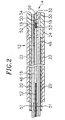
- FIG. 2 A preferred means for attaching the catheter body 12 to the tip section 14 is illustrated in FIG. 2.
- the proximal end of the tip section 14 comprises an outer circumferential notch 24 that receives the inner surface of the outer wall 22 of the catheter body 12.
- the tip section 14 and catheter body 12 are attached by adhesive (e.g., polyurethane glue) or the like.
- adhesive e.g., polyurethane glue
- the stiffening tube 20 is inserted into the catheter body 12 .
- the distal end of the stiffening tube 20 is fixedly attached near the distal end of the catheter body 12 by forming a glue joint (not shown) with polyurethane glue or the like.
- a small distance e.g., about 3 mm, is provided between the distal end of the catheter body 12 and the distal end of the stiffening tube 20 to permit room for the catheter body 12 to receive the notch 24 of the tip section 14 .
- a force is applied to the proximal end of the stiffening tube 20 , and, while the stiffening tube 20 is under compression, a first glue joint (not shown) is made between the stiffening tube 20 and the outer wall 22 by a fast drying glue, e.g. Super Glue®. Thereafter a second glue joint (not shown) is formed between the proximal ends of the stiffening tube 20 and outer wall 22 using a slower drying but stronger glue, e.g., polyurethane.
- a fast drying glue e.g. Super Glue®
- a tip electrode 36 At the distal end of the tip section 14 is a tip electrode 36.
- the tip electrode 36 Preferably the tip electrode 36 generally has a diameter about the same as the outer diameter of the tubing 19 .
- the tip electrode 36 can be made from any suitable material, such as platinum, gold, or stainless steel, and is preferably made of a platinum-iridium alloy (90% platinum/10% iridium).
- the tip electrode 36 is generally solid, having first and second blind holes 31 and 33 extending proximally therethrough, as described in more detail below.
- the tip electrode 36 has a length preferably ranging from about 4 mm to about 14 mm, more preferably from about 6 mm to about 12 mm.
- the tip electrode 36 comprises an exposed distal region 35 , a proximal region 37 , and a recessed central region 38 between the exposed region 35 and the proximal region 37 .
- the exposed region 35 has a length preferably ranging from about 1.5 mm to about 4.0 mm, more preferably from about 2.0 mm to about 3.0 mm, still more preferably from about 2.3 mm to about 2.5 mm, and an outer diameter preferably ranging from about 2.0 mm to about 3.0 mm, more preferably from about 2.3 mm to about 2.5 mm.
- the exposed region has a length similar to its diameter.
- the ratio of the length to the diameter ranges from about 0.8:1 to about 1.2:1, more preferably from about 0.9:1 to about 1.1:1.
- the length of the exposed region is approximately equal to the diameter of the exposed region.
- the tip electrode preferably has a length and diameter equal to about 2.3 mm.
- the surface area of the tip electrode (having a generally hemispherical distal end) is the same in the parallel orientation and in the perpendicular orientation.
- the central region 38 is recessed to permit a ring electrode 39 to be mounted thereon with the ring electrode being recessed relative to the exposed region 35 and proximal region 37 to be protected from direct contact with the heart tissue, but permitting contact with surrounding blood, as described in more detail below.
- the central portion 38 has an outer diameter that is smaller than the other diameter of the exposed region 35 , with the difference between the outer diameter of the central portion and the outer diameter of the exposed region preferably ranging from about 0.1 mm to about 1 mm, more preferably from about 0.5 mm to about 0.7 mm, thus resulting in a recess having a depth ranging from about 0.05 to about 0.4 mm, more preferably about 0.25 mm to about 0.35 mm.
- the central region 38 preferably has a length slightly greater than the length of the ring electrode 39 mounted thereon. The length of the central region 38 preferably ranges from about 0.5 mm to about 4 mm, more preferably from about 1 mm to about 3 mm.
- the proximal region 37 has an outer diameter generally similar to the outer diameter of the exposed region 35 .
- the length of the proximal region 37 preferably ranges from about 3 mm to about 8 mm, more preferably from about 4 mm to about 6 mm.
- the tip electrode 36 can be mounted on the distal end of the tubing 19 by any suitable technique.
- the proximal end of the proximal region 37 of the tip electrode 36 includes a circumferential notch 26 that mates with a corresponding circumferential notch 27 in the distal end of the tubing 19 .
- the tip electrode 36 is then bonded to the tubing 19 with polyurethane glue or the like.
- the proximal end of the tip electrode 36 can be provided with a stem, i.e., a region of reduced diameter, that fits into a hole in the distal end of the tubing 19 .
- the proximal region 37 and central region 38 of the tip electrode 36 are provided with an electrically insulating and thermally conductive layer 55 over at least a portion, and preferably over all, of their outer surfaces.
- the electrically insulating and thermally conductive layer 55 is made of any suitable electrically insulating and thermally conductive material, including, but not limited to diamond, carbon, parylene, polyimide, polyester, polyurethane, epoxy, ceramic, and combinations thereof.
- the electrically insulating and thermally conductive layer 55 preferably has a thickness no greater than about 10 ⁇ m, more preferably ranging from about 0.5 ⁇ m to about 10 ⁇ m, still more preferably from about 1 ⁇ m to about 5 ⁇ m.
- the insulating layer 55 can be applied by any suitable technique.
- a layer of parylene can be applied by a deposition coating technique where the exposed region 35 of the tip electrode 36 is placed in a deposition chamber. The chamber functions to both hold the tip electrode 36 in place, as well as protect the exposed region 35 from exposure to parylene deposits.
- the insulating layer 55 may comprise a shrink-sleeve made of, for example, a thin polyester (e.g., about 6.35 ⁇ m (0.00025 inch), or may comprise a thin coating of polyurethane or the like painted onto the surface of the central region 38.
- the ring electrode 39 is mounted on the central portion 38 .
- the ring electrode 39 is fixed in place by glue or the like over the portion of the electrically insulating and thermally conductive layer 55 on the recessed central portion 38.
- the electrically insulating and thermally conductive layer 55 prevents electrical contact between the ring electrode 39 and the tip electrode 36.
- the ring electrode 39 can be made of any suitable material, such as platinum, gold, or stainless steel, and is preferably made of a platinum-iridium alloy (90% platinum/10% iridium).
- the ring electrode 39 is preferably fixed near the distal end of the central portion 38 and in close proximity to the tip portion 35 .
- the ring electrode can be created by any suitable technique.
- the ring electrode 39 comprises a resilient ribbon-shaped conductive material that is wrapped within the recess 26 and fixed in place by glue or the like.
- the ring electrode 39 can be made of any suitable conductive material, such as those discussed above for the tip electrode.
- the width and thickness of the ring electrode 39 are suitable for fitting within the recess 26 so that the outer surface of the ring electrode 39 is recessed within the recess 26. In other words, the ring electrode 39 has an outer diameter less than the outer diameter of the exposed region 35 .
- the outer diameter of the ring electrode 39 is at least about 5%, more preferably from about 10% to about 20%, less than the outer diameter of the exposed region 35 , although the difference between the outer diameters could be greater if desired.
- the ring electrode 39 has a width preferably ranging from about 0.5 mm to about 4 mm, more preferably from about 1 mm to about 3 mm.
- the ring electrode 39 is in the form of a snap ring, where the width and thickness of the ring 39 are suitable for fitting within the recess 26, as described above.
- the tip electrode 36 and ring electrode 39 are each connected to a separate lead wire 44 .
- the lead wires 44 extend through the first lumen 30 of tip section 14 , the central lumen 18 of the catheter body 12 , and the control handle 16 , and terminate at their proximal end in an input jack (not shown) that may be plugged into an appropriate signal processing unit and/or source of RF energy (not shown).
- the portion of the lead wires 44 extending through the central lumen 18 of the catheter body 12 , control handle 16 and proximal end of the tip section 14 may be enclosed within a protective sheath 49 , which can be made of any suitable material, preferably polyimide (as shown in FIGs. 2 and 4).
- the protective sheath 49 is preferably anchored at its distal end to the proximal end of the tip section 14 by gluing it in the first lumen 30 with polyurethane glue or the like.
- the lead wires 44 are attached to the tip electrode 36 and ring electrodes 39 by any conventional technique. Connection of a lead wire 44 to the tip electrode 36 is accomplished, for example, by soldering the lead wire 44 into the second blind hole 33 .
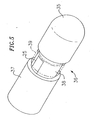
- the lead wire 44 for the ring electrode 39 extends through the first blind hole 31 in the tip electrode 36 and through an opening 25 in the side of the ring electrode, as shown in FIGs. 3A and 5.
- the ends of the lead wire 44 are then stripped of any coating and soldered or welded to the underside of the ring electrode 39 , which is positioned over the opening 25 and fixed in place with polyurethane glue or the like.
- extra polyurethane glue 28 is used to seal the region between the distal end of the proximal region 37 and the ring electrode in the general area of the opening 25 to protect internal components of the catheter from surrounding fluids.
- Two additional ring electrodes 59 are mounted of the distal end the tip section 14 .
- the ring electrodes 59 are slid over the flexible tubing 19 and fixed in place by glue of the like.
- the position and spacing of the additional ring electrode 59 are not critical. If desired, more or less ring electrodes 59 may be used and can be positioned over the flexible tubing 19 of the tip section 14 .
- a temperature sensing means is provided for the tip electrode 36 and, if desired, one or more of the ring electrodes 39 and 59 . Any conventional temperature sensing means, e.g., a thermocouple or thermistor, may be used.
- a preferred temperature sensing means for the tip electrode 36 comprises a thermocouple formed by an enameled wire pair. One wire of the wire pair is a copper wire 41 , e.g., a number 40 copper wire. The other wire of the wire pair is a constantan wire 45 .
- the wires 41 and 45 of the wire pair are electrically isolated from each other except at their distal ends where they are twisted together, covered with a short piece of plastic tubing 58 , e.g., polyamide, and covered with epoxy (as shown in FIG. 3c).
- the plastic tubing 58 is then attached in the distal end of the first blind hole 31 of the tip electrode 36 by polyurethane glue or the like.
- the wires 41 and 45 can be soldered in the blind hole 31 .
- the distal end of the first blind hole 31 preferably has a smaller diameter than the proximal end (which is sized to accommodate a location sensor, as described further below).
- the distal end of the blind hole 31 preferably has a size suitable for fitting the tubing 58 and wires 41 and 45 snugly into the blind hole.
- the distal end of the blind hole 31 is preferably positioned in the middle of the exposed region 35 to provide accurate temperature measurement by the thermocouple wires 41 and 45 mounted therein.
- the wires 41 and 45 extend through the second lumen 32 in the tip section 14 and through the central lumen 18 of the catheter body 12 .
- the wires 41 and 45 then extend out through the control handle 16 and to a connector (not shown) connectable to a temperature monitor (not shown).
- the temperature sensing means may be a thermistor.
- a suitable thermistor for use in the present invention is Model No. AB6N2-GC 14KA143E/37C soldby Thermometrics (New Jersey).
- an electromagnetic location sensor 72 is contained within the distal end of the tip section 14 .
- the electromagnetic location sensor 72 is located within the proximal end of the first blind hole 31 in the tip electrode 36 and fixed by polyurethane glue or the like.
- the electromagnetic sensor 72 is connected to an electromagnetic sensor cable 74 , which extends through the third lumen 34 of the tip section 14 , through the catheter body 12 , and out through control handle 16 .
- the electromagnetic sensor cable 74 comprises multiple wires encased within a plastic covered sheath.
- the sensor cable 74 is connected to a circuit board, which amplifies the signal received from the electromagnetic sensor 72 and transmits it to a computer in a form understandable by the computer.
- the circuit board is contained within the control handle 16 , as described in U.S. Patent Application Serial No. 08/924,616, entitled “Steerable Direct Myocardial Revascularization Catheter” (now published as US 5,964,757).
- Suitable electromagnetic sensors for use with the present invention are described, for example, in EP-A-0 989 384 and U.S. Patent Nos. 5,558,091, 5,443,489, 5,480,422, 5,546,951, 5,568,809, and 5,391,199 and International Publication No. WO 95/02995.
- the senor 72 can alternatively be contained, at least in part, within a rigid plastic housing, e.g., made of polyetheretherketone (PEEK), that is mounted between the tip electrode 36 and the flexible tubing 19 .
- PEEK polyetheretherketone
- the mechanism comprises a puller wire 50 extending through the catheter body 12 .
- the puller wire 50 is anchored at its proximal end to the control handle 16 and is anchored at its distal end to the tip section 14 .
- the puller wire 50 is made of any suitable metal, such as stainless steel or Nitinol, and is preferably coated with Teflon® or the like. The coating imparts lubricity to the puller wire 50 .
- the puller wire 50 preferably has a diameter ranging from about 0.15 ⁇ m (0.006 inches) to about 0.25 ⁇ m (0.010 inches)
- a compression coil 52 is situated within the catheter body 12 in surrounding relation to the puller wire 50.
- the compression coil 52 extends from the proximal end of the catheter body 12 to the proximal end of the tip section 14 .
- the compression coil 52 is made of any suitable metal, preferably stainless steel.
- the compression coil 52 is tightly wound on itself to provide flexibility, i.e., bending, but to resist compression.
- the inner diameter of the compression coil 52 is preferably slightly larger than the diameter of the puller wire 50 .
- the Teflon® coating on the puller wire 50 allows it to slide freely within the compression coil 52 .
- the outer surface of the compression coil 52 can be covered by a flexible, non-conductive sheath 46, e.g., made of polyimide tubing, to prevent contact between the compression coil 52 and any other wires within the catheter body 12 .
- the compression coil 52 is anchored at its proximal end to the proximal end of the stiffening tube 20 in the catheter body 12 by glue joint 51 and at its distal end to the tip section 14 by glue joint 53 .
- Both glue joints 51 and 53 preferably comprise polyurethane glue or the like.
- the glue may be applied by means of a syringe or the like through a hole made between the outer surface of the catheter body 12 and the central lumen 18 . Such a hole may be formed, for example, by a needle or the like that punctures the outer wall 22 of the catheter body 12 and the stiffening tube 20 which is heated sufficiently to form a permanent hole.
- the glue is then introduced through the hole to the outer surface of the compression coil 52 and wicks around the outer circumference to form a glue joint about the entire circumference of the compression coil 52 .
- the puller wire 50 extends into the second lumen 32 of the tip section 14 .
- the puller wire 50 is anchored at its distal end to the tip electrode 36 within the second blind hole 33 along with the lead wire 44.
- a preferred method for anchoring the puller wire 50 within the tip electrode 36 is by crimping metal tubing 54 to the distal end of the puller wire 50 and soldering the metal tubing 54 inside the second blind hole 33 .
- Anchoring the puller wire 50 within the tip electrode 36 provides additional support for the tip electrode 36 on the flexible plastic tubing 19 , reducing the likelihood that the tip electrode 36 will separate from the tubing 19 .
- the puller wire 50 can be attached to the side of the tip section 14 . Such a design is described in U.S. Patent Application No.
- the puller wire 50 extends through a plastic, preferably Teflon®, sheath 56 , which prevents the puller wire 50 from cutting into the wall of the tubing 19 when the tip section is deflected.
- the catheters in accordance with the present invention are particularly suitable for mapping the heart and ablating heart tissue, such as accessory signal pathways causing arrhythmias.
- the distal end of the catheter 10 is inserted into a vein or artery and advanced into the heart.
- the puller wire 50 and control handle 16 are used to deflect the tip section 14 .
- the electrical activity of the heart may be identified, evaluated or mapped, and electrophysiological sources of arrhythmia may be identified and/or treated.
- the bipolar electrode pair namely, the exposed region 35 of the tip electrode 36 and ring electrode 39 mounted on the tip electrode, is used to map the electrical activity of the heart.
- the catheter of the present invention is designed such that the exposed region 35 of the tip electrode 36 is in direct contact with the heart tissue.
- the exposed region 35 senses both the local activation energy (near-field signals) at the point of contact with the heart tissue and far field activation energy (far-field signals) received by the exposed region through the blood.
- the ring electrode 39 is recessed relative to the exposed region 35 to be protected from direct contact with the heart tissue, but permitting contact with surrounding blood. The close proximity of the ring electrode 39 to the exposed region 35 enables the ring electrode to receive approximately the same far-field signals as the exposed region.
- the ring electrode 39 does not pick up the local activation potential (near-field signals) that are received by the exposed region 35 .
- the signals received by the exposed region 35 and the ring electrode 39 are sent to a suitable signal processing unit.
- the signal detected by the ring electrode 39 which includes only far-field activity, is subtracted from the signal detected by the exposed region 35 of the tip electrode 36 , which includes both near-field and far-field activity.
- the near-field signals can be more accurately determined. This improved method of detecting electrical activity allows the physician or operator to determine the location of the arrhythmiogenic focus more accurately for ablating and other purposes.
- the electrically insulating layer 55 limits the electrically active surface area of the tip electrode 36 to the exposed region 35 , providing improved electrogram resolution compared to a conventional tip electrode. More specifically, electrograms recorded from the relatively small exposed region 35 will be more discrete, reporting electrical activity from a smaller area of tissue.
- the electromagnetic location sensor 72 in the tip section 14 of the catheter is used to provide a map of the heart so that the physician can better determine where to ablate and can have a better sense for where the tip section 14 is located during the procedure.
- the patient is placed in a magnetic field generated, for example, by situating under the patient a pad containing coils for generating a magnetic field, and a reference electromagnetic sensor is fixed relative to the patient, e.g., taped to the patient's back.
- Signals generated in the heart by both the fixed reference sensor and the electromagnetic location sensor 72 in the catheter are amplified and transmitted to a computer that analyzes the signals and displays them on a monitor.
- the precise location of the location sensor 72 (and thus the tip section 14 , including the tip electrode 36 ) relative to the reference sensor can be ascertained and visually displayed.
- the sensor 72 can also detect displacement of the catheter that is caused by contraction of the heart muscle.
- the electromagnetic mapping sensor 72 preferably is used in combination with the tip electrode 36 and ring electrodes 39 .
- a physician can simultaneously map the contours or shape of the heart chamber, the electrical activity of the heart, and the extent of displacement of the catheter.
- the tip electrode 36 and ring electrode 39 are used to monitor the strength of the electrical signals at a particular location.
- the physician uses the same catheter for ablating the heart tissue.
- the relatively large surface area of the tip electrode 36 which includes the exposed region 35 as well as the proximal region 37 and central region 38 , which are covered with the thermally conductive layer 55 , enhances the ability of the electrode to dissipate heat during ablation compared to a comparable tip electrode having a length closer to the that of the exposed region 35 of the present catheter.
- the tip electrode of the present invention having a preferred length of about 6 mm to about 8 mm provides improved convective cooling by the passing blood, such that additional power can be applied to the tissue.
- conventional 8 mm tip electrodes require more power than the inventive tip electrode.
- the tip electrode of the present invention preferably has an exposed length of only about 2 mm to about 3 mm, reducing the amount of power required to ablate compared to a tip electrode have an exposed length of 8 mm.
- a conventional 8 mm tip electrode uses more energy heating the surrounding blood rather than heating the adjacent heart tissue. This heating of the blood can cause significant coagulation of the blood along the surface of the tip electrode.
- the present invention overcomes this problem by providing an electrically insulating, but thermally conductive layer over the non-exposed portion of the tip electrode 36 , allowing the electrical power to be concentrated at the exposed region 35 , while the insulated portion (the central region 38 ) of the tip electrode is convectively cooled by passing blood.
- the inventive electrode can create the same sized lesion as a standard tip electrode having a total length equal to the total length of the inventive electrode (but without an electrically insulating and thermally conductive covering), but using less power. This holds true because the inventive electrode has a higher current density than a standard tip electrode, while still having similar cooling capabilities, and therefore less power is needed.
- electrode impedance is routinely monitored during ablation to detect the potential formation of dangerous char or thrombus on the tip electrode. Because the electrically active area (i.e., the exposed region 35 ) of the inventive tip electrode is smaller than with conventional ablation tip electrodes that offer similar cooling ability, changes in impedance due to char or thrombus formation are more readily detected with the inventive catheter.
Landscapes
- Health & Medical Sciences (AREA)
- Life Sciences & Earth Sciences (AREA)
- Surgery (AREA)
- Engineering & Computer Science (AREA)
- Plasma & Fusion (AREA)
- Medical Informatics (AREA)
- Otolaryngology (AREA)
- Physics & Mathematics (AREA)
- Cardiology (AREA)
- Biomedical Technology (AREA)
- Heart & Thoracic Surgery (AREA)
- Nuclear Medicine, Radiotherapy & Molecular Imaging (AREA)
- Molecular Biology (AREA)
- Animal Behavior & Ethology (AREA)
- General Health & Medical Sciences (AREA)
- Public Health (AREA)
- Veterinary Medicine (AREA)
- Media Introduction/Drainage Providing Device (AREA)
- Surgical Instruments (AREA)
Claims (10)
- Katheter (10) mit:einem gestreckten flexiblen Körper (12) mit einem distalen Bereich und mindestens einem sich hierdurch erstreckenden Lumen (18);einer auf dem distalen Bereich angeordneten Spitzenelektrode (36) mit einem freigelegten distalen Bereich (35), welcher einen Außendurchmesser aufweist, einem ausgesparten Zentralbereich (38) mit einer Außenoberfläche proximal zum freigelegten distalen Bereich und einem proximalen Bereich (37), welcher einen Außendurchmesser und eine Außenoberfläche proximal zum Zentralbereich aufweist, wobei der ausgesparte Zentralabschnitt (38) einen Außendurchmesser aufweist, der kleiner als die Außendurchmesser des freigelegten distalen Bereiches (35) und des proximalen Bereiches (37) ist, und wobei der Zentralbereich (38) und der proximale Bereich (35) in wenigstens einem Abschnitt ihrer Außenoberflächen mit einer elektrisch isolierenden und thermisch leitenden Schicht (55) versehen sind;einer auf dem ausgesparten Zentralbereich (38) angeordneten Ringelektrode (39) mit einem Außendurchmesser, der kleiner ist als die Außendurchmesser des freigelegten distalen Bereiches (35) und des proximalen Bereiches (37);einem in der Spitzenelektrode (36) angeordneten, elektromagnetischen Ortungssensor (72); undin der Spitzenelektrode (36) angeordneten Temperaturerfassungsmitteln (41, 45).
- Katheter nach Anspruch 1, gekennzeichnet durch einen Spitzenabschnitt (14) mit einem flexiblen Rohrmittel (19), welches flexibler ist als der Katheterkörper (12), am distalen Bereich des Katheterkörpers angeordnet ist und proximale und distale Enden afuweist, wobei sich wenigstens ein Lumen (30, 32, 34) hierdurch erstreckt und wobei die Spitzenelektrode (36) am distalen Ende des flexiblen Rohrmittels (19) des Spitzenabschnittes (14) angeordnet ist.
- Katheter nach Anspruch 1 oder 2, dadurch gekennzeichnet, daß die Spitzenelektrode (36) eine Länge zwischen 4 mm und 12 mm, vorzugsweise zwischen 6 mm und 10 mm, aufweist.
- Katheter nach einem der Ansprüche 1 bis 3, dadurch gekennzeichnet, daß der freigelegte distale Bereich (35) eine Länge zwischen 1,5 mm und 4,0 mm, vorzugsweise zwischen 2 mm und 3 mm, aufweist.
- Katheter nach einem der Ansprüche 1 bis 4, dadurch gekennzeichnet, daß der freigelegte distale Bereich (35) eine Länge aufweist, die etwa gleich seinem Außendurchmesser ist.
- Katheter nach einem der Ansprüche 1 bis 5, dadurch gekennzeichnet, daß die Differenz zwischen dem Außendurchmesser des Zentralbereiches (38) und dem Außendurchmesser des freigelegten distalen Bereiches (35) zwischen 0,25 mm und 1,5 mm, vorzugsweise zwischen 0,5 mm und 1 mm, beträgt.
- Katheter nach einem der Ansprüche 1 bis 6, dadurch gekennzeichnet, daß die elektrisch isolierende und thermisch leitende Schicht (55) eine Zusammensetzung aus Diamant, Kohlenstoff, Parylen, Polyimid, Polyester, Polyurethan, Epoxyharz, Keramik oder einer Kombination hieraus aufweist.
- Katheter nach einem der Ansprüche 1 bis 7, dadurch gekennzeichnet, daß die elektrisch isolierende und thermisch leitende Schicht (55) eine Dicke von nicht mehr als 10µm, vorzugsweise von 1µm bis 5µm, aufweist.
- Katheter nach Anspruch 2 oder einem der hiervon abhängigen Ansprüche, gekennzeichnet durch mindestens eine am distalen Ende des flexiblen Rohrmittels (19) angeordnete Ringelektrode (54).
- Katheter nach Anspruch 2 oder einem der hiervon abhängigen Ansprüche, gekennzeichnet durch Mittel (50) zum Biegen des Spitzenabschnittes (14).
Applications Claiming Priority (2)
| Application Number | Priority Date | Filing Date | Title |
|---|---|---|---|
| US611849 | 2000-07-07 | ||
| US09/611,849 US6405067B1 (en) | 2000-07-07 | 2000-07-07 | Catheter with tip electrode having a recessed ring electrode mounted thereon |
Publications (2)
| Publication Number | Publication Date |
|---|---|
| EP1169975A1 EP1169975A1 (de) | 2002-01-09 |
| EP1169975B1 true EP1169975B1 (de) | 2005-06-22 |
Family
ID=24450639
Family Applications (1)
| Application Number | Title | Priority Date | Filing Date |
|---|---|---|---|
| EP01305874A Expired - Lifetime EP1169975B1 (de) | 2000-07-07 | 2001-07-06 | Katheter mit einer eine abgesetzte Ringelektrode aufweisenden Spitzenelektrode |
Country Status (3)
| Country | Link |
|---|---|
| US (1) | US6405067B1 (de) |
| EP (1) | EP1169975B1 (de) |
| DE (1) | DE60111594T2 (de) |
Families Citing this family (57)
| Publication number | Priority date | Publication date | Assignee | Title |
|---|---|---|---|---|
| US6733497B2 (en) * | 2001-07-09 | 2004-05-11 | Scimed Life Systems, Inc. | Clamshell distal catheter assembly |
| US6740083B2 (en) * | 2001-07-09 | 2004-05-25 | Scimed Life Systems, Inc. | Distal catheter assembly with proximal mounting member |
| US6730082B2 (en) * | 2001-07-09 | 2004-05-04 | Scimed Life Systems, Inc. | Two-piece distal catheter assembly |
| US8774913B2 (en) | 2002-04-08 | 2014-07-08 | Medtronic Ardian Luxembourg S.A.R.L. | Methods and apparatus for intravasculary-induced neuromodulation |
| US7653438B2 (en) | 2002-04-08 | 2010-01-26 | Ardian, Inc. | Methods and apparatus for renal neuromodulation |
| US8150519B2 (en) | 2002-04-08 | 2012-04-03 | Ardian, Inc. | Methods and apparatus for bilateral renal neuromodulation |
| AU2003262896B2 (en) | 2002-08-24 | 2008-08-07 | Subramaniam C. Krishnan | Method and apparatus for locating the fossa ovalis and performing transseptal puncture |
| US6922579B2 (en) * | 2002-12-12 | 2005-07-26 | Scimed Life Systems, Inc. | La placian electrode |
| WO2004086993A2 (en) * | 2003-03-28 | 2004-10-14 | C.R. Bard, Inc. | Method and apparatus for adjusting electrode dimensions |
| US7569052B2 (en) | 2003-09-12 | 2009-08-04 | Boston Scientific Scimed, Inc. | Ablation catheter with tissue protecting assembly |
| US7489971B1 (en) | 2004-06-05 | 2009-02-10 | Advanced Neuromodulation Systems, Inc. | Notched electrode for electrostimulation lead |
| JP5018476B2 (ja) * | 2005-06-06 | 2012-09-05 | 旭硝子株式会社 | ガラス製造装置およびその構成要素、ならびに該構成要素を通電加熱する方法 |
| EP2032201B1 (de) * | 2006-06-01 | 2013-04-03 | Cathprint AB | Rohrförmiger katheter für invasive verwendung und herstellungsverfahren dafür |
| US8764742B2 (en) | 2007-04-04 | 2014-07-01 | St. Jude Medical, Atrial Fibrillation Division, Inc. | Irrigated catheter |
| US8979837B2 (en) | 2007-04-04 | 2015-03-17 | St. Jude Medical, Atrial Fibrillation Division, Inc. | Flexible tip catheter with extended fluid lumen |
| US8517999B2 (en) | 2007-04-04 | 2013-08-27 | St. Jude Medical, Atrial Fibrillation Division, Inc. | Irrigated catheter with improved fluid flow |
| US8974454B2 (en) | 2009-12-31 | 2015-03-10 | St. Jude Medical, Atrial Fibrillation Division, Inc. | Kit for non-invasive electrophysiology procedures and method of its use |
| US10220187B2 (en) | 2010-06-16 | 2019-03-05 | St. Jude Medical, Llc | Ablation catheter having flexible tip with multiple flexible electrode segments |
| US11395694B2 (en) * | 2009-05-07 | 2022-07-26 | St. Jude Medical, Llc | Irrigated ablation catheter with multiple segmented ablation electrodes |
| US8123745B2 (en) * | 2007-06-29 | 2012-02-28 | Biosense Webster, Inc. | Ablation catheter with optically transparent, electrically conductive tip |
| US8301265B2 (en) | 2007-09-10 | 2012-10-30 | Medtronic, Inc. | Selective depth electrode deployment for electrical stimulation |
| US9795442B2 (en) | 2008-11-11 | 2017-10-24 | Shifamed Holdings, Llc | Ablation catheters |
| US8652129B2 (en) | 2008-12-31 | 2014-02-18 | Medtronic Ardian Luxembourg S.A.R.L. | Apparatus, systems, and methods for achieving intravascular, thermally-induced renal neuromodulation |
| US8954161B2 (en) | 2012-06-01 | 2015-02-10 | Advanced Cardiac Therapeutics, Inc. | Systems and methods for radiometrically measuring temperature and detecting tissue contact prior to and during tissue ablation |
| US8926605B2 (en) | 2012-02-07 | 2015-01-06 | Advanced Cardiac Therapeutics, Inc. | Systems and methods for radiometrically measuring temperature during tissue ablation |
| US9226791B2 (en) | 2012-03-12 | 2016-01-05 | Advanced Cardiac Therapeutics, Inc. | Systems for temperature-controlled ablation using radiometric feedback |
| US9277961B2 (en) | 2009-06-12 | 2016-03-08 | Advanced Cardiac Therapeutics, Inc. | Systems and methods of radiometrically determining a hot-spot temperature of tissue being treated |
| US8280477B2 (en) * | 2009-07-29 | 2012-10-02 | Medtronic Cryocath Lp | Mono-phasic action potential electrogram recording catheter, and method |
| US8870863B2 (en) | 2010-04-26 | 2014-10-28 | Medtronic Ardian Luxembourg S.A.R.L. | Catheter apparatuses, systems, and methods for renal neuromodulation |
| WO2014141105A1 (en) | 2013-03-12 | 2014-09-18 | Baylis Medical Company Inc. | Medical device having a support structure |
| US10765473B2 (en) | 2010-11-08 | 2020-09-08 | Baylis Medical Company Inc. | Electrosurgical device having a lumen |
| US9572620B2 (en) * | 2010-12-29 | 2017-02-21 | Kyungmoo Ryu | System and method for treating arrhythmias in the heart using information obtained from heart wall motion |
| US8682410B2 (en) | 2011-03-10 | 2014-03-25 | Medtronic Ablation Frontiers Llc | Multi-array monophasic action potential medical device |
| AU2012242739A1 (en) | 2011-04-12 | 2013-10-17 | Thermedical, Inc. | Devices and methods for shaping therapy in fluid enhanced ablation |
| US9554847B2 (en) * | 2012-07-02 | 2017-01-31 | Biosense Webster (Israel) Ltd. | Real time assessment of ablation from electrocardiogram signals |
| US10022176B2 (en) | 2012-08-15 | 2018-07-17 | Thermedical, Inc. | Low profile fluid enhanced ablation therapy devices and methods |
| US11937873B2 (en) | 2013-03-12 | 2024-03-26 | Boston Scientific Medical Device Limited | Electrosurgical device having a lumen |
| US9610396B2 (en) | 2013-03-15 | 2017-04-04 | Thermedical, Inc. | Systems and methods for visualizing fluid enhanced ablation therapy |
| US9033972B2 (en) | 2013-03-15 | 2015-05-19 | Thermedical, Inc. | Methods and devices for fluid enhanced microwave ablation therapy |
| CN108742830A (zh) | 2013-10-28 | 2018-11-06 | 圣犹达医疗用品心脏病学部门有限公司 | 具有增强诊断能力的消融导管设计以及方法 |
| KR20170107428A (ko) | 2014-11-19 | 2017-09-25 | 어드밴스드 카디악 테라퓨틱스, 인크. | 고분해능 전극 어셈블리를 이용한 절제 장치, 시스템 및 방법 |
| JP6673598B2 (ja) | 2014-11-19 | 2020-03-25 | エピックス セラピューティクス,インコーポレイテッド | ペーシングを伴う組織の高分解能マッピング |
| WO2016081606A1 (en) | 2014-11-19 | 2016-05-26 | Advanced Cardiac Therapeutics, Inc. | Systems and methods for high-resolution mapping of tissue |
| US9636164B2 (en) | 2015-03-25 | 2017-05-02 | Advanced Cardiac Therapeutics, Inc. | Contact sensing systems and methods |
| CN107427323B (zh) | 2015-03-31 | 2021-02-02 | 圣犹达医疗用品心脏病学部门有限公司 | 高热敏性消融导管和导管尖端 |
| JP6923549B2 (ja) | 2016-03-15 | 2021-08-18 | エピックス セラピューティクス,インコーポレイテッド | 灌注式焼灼のための改良されたシステム |
| US9743984B1 (en) | 2016-08-11 | 2017-08-29 | Thermedical, Inc. | Devices and methods for delivering fluid to tissue during ablation therapy |
| WO2018067248A1 (en) | 2016-10-04 | 2018-04-12 | St. Jude Medical, Cardiology Division, Inc. | Ablation catheter tip |
| EP3614946B1 (de) | 2017-04-27 | 2024-03-20 | EPiX Therapeutics, Inc. | Bestimmung der art des kontaktes zwischen katheterspitze und gewebe |
| US11109788B2 (en) * | 2017-07-17 | 2021-09-07 | Biosense Webster (Israel) Ltd. | Catheter with Fibonacci distributed electrodes |
| US11083871B2 (en) | 2018-05-03 | 2021-08-10 | Thermedical, Inc. | Selectively deployable catheter ablation devices |
| US11918277B2 (en) | 2018-07-16 | 2024-03-05 | Thermedical, Inc. | Inferred maximum temperature monitoring for irrigated ablation therapy |
| US11452484B2 (en) | 2018-10-25 | 2022-09-27 | Biosense Webster (Israel) Ltd. | Electrodes on double-sided printed circuit board (PCB) to cancel far-held signal |
| US11596324B2 (en) | 2018-10-25 | 2023-03-07 | Biosense Webster (Israel) Ltd. | Combined active current location (ACL) and tissue proximity indication (TPI) system |
| US11660050B2 (en) | 2018-10-25 | 2023-05-30 | Biosense Webster (Israel) Ltd | Balloon catheter with diagnostic electrodes, far field electrodes, and guidewire |
| CN117119985A (zh) * | 2021-03-03 | 2023-11-24 | 圣犹达医疗用品心脏病学部门有限公司 | 具有受保护的阻抗降低涂层的电极 |
| US20240407696A1 (en) * | 2023-06-09 | 2024-12-12 | Biosense Webster (Israel) Ltd. | Medical probe with concentric reference and sense electrodes |
Family Cites Families (29)
| Publication number | Priority date | Publication date | Assignee | Title |
|---|---|---|---|---|
| US4444195A (en) | 1981-11-02 | 1984-04-24 | Cordis Corporation | Cardiac lead having multiple ring electrodes |
| US4481953A (en) | 1981-11-12 | 1984-11-13 | Cordis Corporation | Endocardial lead having helically wound ribbon electrode |
| US4892102A (en) * | 1984-04-16 | 1990-01-09 | Astrinsky Eliezer A | Cardiac pacing and/or sensing lead and method of use |
| US4966597A (en) | 1988-11-04 | 1990-10-30 | Cosman Eric R | Thermometric cardiac tissue ablation electrode with ultra-sensitive temperature detection |
| US5230349A (en) | 1988-11-25 | 1993-07-27 | Sensor Electronics, Inc. | Electrical heating catheter |
| US5257635A (en) * | 1988-11-25 | 1993-11-02 | Sensor Electronics, Inc. | Electrical heating catheter |
| US5749914A (en) * | 1989-01-06 | 1998-05-12 | Advanced Coronary Intervention | Catheter for obstructed stent |
| US5179952A (en) | 1990-08-13 | 1993-01-19 | Arzco Medical Electronics Inc. | Electrocardial stimulator probe |
| US5085659A (en) | 1990-11-21 | 1992-02-04 | Everest Medical Corporation | Biopsy device with bipolar coagulation capability |
| US5315996A (en) | 1991-02-15 | 1994-05-31 | Lundquist Ingemar H | Torquable catheter and method |
| WO1992021285A1 (en) * | 1991-05-24 | 1992-12-10 | Ep Technologies, Inc. | Combination monophasic action potential/ablation catheter and high-performance filter system |
| US5327905A (en) * | 1992-02-14 | 1994-07-12 | Boaz Avitall | Biplanar deflectable catheter for arrhythmogenic tissue ablation |
| US5383922A (en) * | 1993-03-15 | 1995-01-24 | Medtronic, Inc. | RF lead fixation and implantable lead |
| US5462544A (en) | 1993-05-05 | 1995-10-31 | Energy Life System Corporation | Continuous heart tissue mapping and lasing catheter |
| DE69434185T2 (de) | 1993-06-10 | 2005-06-02 | Imran, Mir A., Los Altos Hills | Urethrales gerät zur ablation mittels hochfrequenz |
| US5391199A (en) | 1993-07-20 | 1995-02-21 | Biosense, Inc. | Apparatus and method for treating cardiac arrhythmias |
| US5487757A (en) * | 1993-07-20 | 1996-01-30 | Medtronic Cardiorhythm | Multicurve deflectable catheter |
| US5558091A (en) | 1993-10-06 | 1996-09-24 | Biosense, Inc. | Magnetic determination of position and orientation |
| US5447519A (en) * | 1994-03-19 | 1995-09-05 | Medtronic, Inc. | Method and apparatus for discrimination of monomorphic and polymorphic arrhythmias and for treatment thereof |
| US5810802A (en) | 1994-08-08 | 1998-09-22 | E.P. Technologies, Inc. | Systems and methods for controlling tissue ablation using multiple temperature sensing elements |
| US5967976A (en) | 1994-08-19 | 1999-10-19 | Novoste Corporation | Apparatus and methods for procedures related to the electrophysiology of the heart |
| WO1996034567A1 (en) | 1995-05-02 | 1996-11-07 | Heart Rhythm Technologies, Inc. | System for controlling the energy delivered to a patient for ablation |
| US5782760A (en) | 1995-05-23 | 1998-07-21 | Cardima, Inc. | Over-the-wire EP catheter |
| US5891027A (en) | 1996-10-21 | 1999-04-06 | Irvine Biomedical, Inc. | Cardiovascular catheter system with an inflatable soft tip |
| US5782900A (en) * | 1997-06-23 | 1998-07-21 | Irvine Biomedical, Inc. | Catheter system having safety means |
| US6024739A (en) * | 1997-09-05 | 2000-02-15 | Cordis Webster, Inc. | Method for detecting and revascularizing ischemic myocardial tissue |
| US6201387B1 (en) | 1997-10-07 | 2001-03-13 | Biosense, Inc. | Miniaturized position sensor having photolithographic coils for tracking a medical probe |
| US5938603A (en) | 1997-12-01 | 1999-08-17 | Cordis Webster, Inc. | Steerable catheter with electromagnetic sensor |
| US5919222A (en) | 1998-01-06 | 1999-07-06 | Medtronic Inc. | Adjustable medical electrode lead |
-
2000
- 2000-07-07 US US09/611,849 patent/US6405067B1/en not_active Expired - Lifetime
-
2001
- 2001-07-06 DE DE60111594T patent/DE60111594T2/de not_active Expired - Lifetime
- 2001-07-06 EP EP01305874A patent/EP1169975B1/de not_active Expired - Lifetime
Also Published As
| Publication number | Publication date |
|---|---|
| DE60111594T2 (de) | 2006-05-18 |
| US6405067B1 (en) | 2002-06-11 |
| DE60111594D1 (de) | 2005-07-28 |
| EP1169975A1 (de) | 2002-01-09 |
Similar Documents
| Publication | Publication Date | Title |
|---|---|---|
| EP1169975B1 (de) | Katheter mit einer eine abgesetzte Ringelektrode aufweisenden Spitzenelektrode | |
| EP1169972B1 (de) | Ablationskartierungskatheter | |
| KR100857038B1 (ko) | 심장의 포텐셜의 바이폴라 매핑 | |
| AU2015234342B2 (en) | Dual-purpose lasso catheter with irrigation field of the invention | |
| US8133220B2 (en) | Enhanced ablation and mapping catheter and method for treating atrial fibrillation | |
| JP5788205B2 (ja) | 環状に配置されたリングバンプ電極を使用した、灌注を伴う二重目的ラッソーカテーテル | |
| EP2641556B1 (de) | Flowerkatheter für Mapping und Ablation an venösen und anderen röhrenförmigen Positionen | |
| EP1382310B1 (de) | Atriale Ablationskatheter |
Legal Events
| Date | Code | Title | Description |
|---|---|---|---|
| PUAI | Public reference made under article 153(3) epc to a published international application that has entered the european phase |
Free format text: ORIGINAL CODE: 0009012 |
|
| AK | Designated contracting states |
Kind code of ref document: A1 Designated state(s): DE NL Kind code of ref document: A1 Designated state(s): AT BE CH CY DE DK ES FI FR GB GR IE IT LI LU MC NL PT SE TR |
|
| AX | Request for extension of the european patent |
Free format text: AL;LT;LV;MK;RO;SI |
|
| 17P | Request for examination filed |
Effective date: 20020614 |
|
| AKX | Designation fees paid |
Free format text: DE NL |
|
| 17Q | First examination report despatched |
Effective date: 20040514 |
|
| GRAP | Despatch of communication of intention to grant a patent |
Free format text: ORIGINAL CODE: EPIDOSNIGR1 |
|
| GRAS | Grant fee paid |
Free format text: ORIGINAL CODE: EPIDOSNIGR3 |
|
| GRAA | (expected) grant |
Free format text: ORIGINAL CODE: 0009210 |
|
| AK | Designated contracting states |
Kind code of ref document: B1 Designated state(s): DE NL |
|
| REF | Corresponds to: |
Ref document number: 60111594 Country of ref document: DE Date of ref document: 20050728 Kind code of ref document: P |
|
| PLBE | No opposition filed within time limit |
Free format text: ORIGINAL CODE: 0009261 |
|
| STAA | Information on the status of an ep patent application or granted ep patent |
Free format text: STATUS: NO OPPOSITION FILED WITHIN TIME LIMIT |
|
| 26N | No opposition filed |
Effective date: 20060323 |
|
| PGFP | Annual fee paid to national office [announced via postgrant information from national office to epo] |
Ref country code: NL Payment date: 20200715 Year of fee payment: 20 |
|
| PGFP | Annual fee paid to national office [announced via postgrant information from national office to epo] |
Ref country code: DE Payment date: 20200624 Year of fee payment: 20 |
|
| REG | Reference to a national code |
Ref country code: DE Ref legal event code: R071 Ref document number: 60111594 Country of ref document: DE |
|
| REG | Reference to a national code |
Ref country code: NL Ref legal event code: MK Effective date: 20210705 |