EP1170611B1 - Hülse und deren Herstellungsverfahrung - Google Patents
Hülse und deren Herstellungsverfahrung Download PDFInfo
- Publication number
- EP1170611B1 EP1170611B1 EP01116142A EP01116142A EP1170611B1 EP 1170611 B1 EP1170611 B1 EP 1170611B1 EP 01116142 A EP01116142 A EP 01116142A EP 01116142 A EP01116142 A EP 01116142A EP 1170611 B1 EP1170611 B1 EP 1170611B1
- Authority
- EP
- European Patent Office
- Prior art keywords
- light
- sleeve
- leading path
- optical fiber
- receiving
- Prior art date
- Legal status (The legal status is an assumption and is not a legal conclusion. Google has not performed a legal analysis and makes no representation as to the accuracy of the status listed.)
- Expired - Lifetime
Links
Images



Classifications
-
- G—PHYSICS
- G02—OPTICS
- G02B—OPTICAL ELEMENTS, SYSTEMS OR APPARATUS
- G02B6/00—Light guides; Structural details of arrangements comprising light guides and other optical elements, e.g. couplings
- G02B6/24—Coupling light guides
- G02B6/42—Coupling light guides with opto-electronic elements
- G02B6/4201—Packages, e.g. shape, construction, internal or external details
- G02B6/4204—Packages, e.g. shape, construction, internal or external details the coupling comprising intermediate optical elements, e.g. lenses, holograms
-
- G—PHYSICS
- G02—OPTICS
- G02B—OPTICAL ELEMENTS, SYSTEMS OR APPARATUS
- G02B6/00—Light guides; Structural details of arrangements comprising light guides and other optical elements, e.g. couplings
- G02B6/24—Coupling light guides
- G02B6/42—Coupling light guides with opto-electronic elements
- G02B6/4201—Packages, e.g. shape, construction, internal or external details
- G02B6/4204—Packages, e.g. shape, construction, internal or external details the coupling comprising intermediate optical elements, e.g. lenses, holograms
- G02B6/4206—Optical features
-
- G—PHYSICS
- G02—OPTICS
- G02B—OPTICAL ELEMENTS, SYSTEMS OR APPARATUS
- G02B6/00—Light guides; Structural details of arrangements comprising light guides and other optical elements, e.g. couplings
- G02B6/24—Coupling light guides
- G02B6/42—Coupling light guides with opto-electronic elements
- G02B6/4292—Coupling light guides with opto-electronic elements the light guide being disconnectable from the opto-electronic element, e.g. mutually self aligning arrangements
-
- G—PHYSICS
- G02—OPTICS
- G02B—OPTICAL ELEMENTS, SYSTEMS OR APPARATUS
- G02B6/00—Light guides; Structural details of arrangements comprising light guides and other optical elements, e.g. couplings
- G02B6/24—Coupling light guides
- G02B6/42—Coupling light guides with opto-electronic elements
- G02B6/4201—Packages, e.g. shape, construction, internal or external details
- G02B6/4204—Packages, e.g. shape, construction, internal or external details the coupling comprising intermediate optical elements, e.g. lenses, holograms
- G02B6/421—Packages, e.g. shape, construction, internal or external details the coupling comprising intermediate optical elements, e.g. lenses, holograms the intermediate optical component consisting of a short length of fibre, e.g. fibre stub
-
- G—PHYSICS
- G02—OPTICS
- G02B—OPTICAL ELEMENTS, SYSTEMS OR APPARATUS
- G02B6/00—Light guides; Structural details of arrangements comprising light guides and other optical elements, e.g. couplings
- G02B6/24—Coupling light guides
- G02B6/42—Coupling light guides with opto-electronic elements
- G02B6/4201—Packages, e.g. shape, construction, internal or external details
- G02B6/4246—Bidirectionally operating package structures
Definitions
- the present invention relates to a sleeve and an optical connector having the sleeve, which sleeve is put between an optical fiber and a transmitting module or between an optical fiber and a receiving module so as to optically connect the optical fiber and the transmitting or receiving module.
- An optical connector having a sleeve between an optical fiber and a transmitting module and between an optical fiber and a receiving module is disclosed in Japanese Utility Modes Registration Application Laid-open No.6-33443.
- the optical connector has a sleeve having a light-leading path with a constant diameter along an optical axis. Therefore, when a light-receiving surface of the receiving module is smaller than the light-emitting surface of the sleeve, a part of signal light transmitted through the optical fiber could not be received by the receiving module, thereby lowering the transmission efficiency.
- LED light emitting diode
- EP-A-903 602 discloses a connecting structure between an optical fiber and a photodetector, said structure having a frusto-conical shape, the small diameter end facing the photodetector.
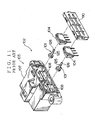
- An optical connector, shown in FIG.11, disclosed in Japanese Patent Application Laid-open No.2000-304980 has a higher transmission efficiency of the signal light.
- the optical connector 102 in FIG.11 has a receptacle 103 (an equipment-side connector) and a non-shown optical plug to couple the receptacle 103.
- the receptacle 103 has a housing 107 of synthetic resin, transmitting and receiving modules 104 and a pair of sleeves 101.
- the housing 107 is formed in a box-shape and has a pair of accommodating chambers 108 opening in the external wall. And, the housing 107 couples with the optical plug shown in FIG.11.
- the transmitting and receiving modules 104 are accommodated in the respective chambers 108.
- a pair of sleeves 101 are installed in the housing 107.
- the sleeve 101 has a light-leading path 126 in a flat-headed conic shape 126.
- One sleeve 101 is arranged between the optical fiber of the optical plug and the light-emitting surface the transmitting module 104, and the other sleeve 101 is arranged between the other optical fiber of the optical plug and the light-receiving surface of the receiving module 104 in the housing 107.
- the sleeve 101 is arranged in the housing 107 in a state that the light-leading path 126 reduces its diameter toward the transmitting or receiving module 104.
- a cap 110 is attached to the housing 107 after accommodating the transmitting and receiving modules 104 in the chambers 108.
- the optical plug has a pair of optical fibers, a pair of ferrules, and the plug housing.
- the pair of optical fibers are arranged in parallel.
- Each ferrule covers the optical fiber in a state of the end face of the optical fiber being exposed.
- the plug housing accommodates the ferrule and couples with in the housing.
- the signal light from the optical fiber proceeds in the light-leading path 126 while making total reflections on the side portion 125 and gathering as approaching the receiving module 104.
- the light-leading path 126 with the tapered side surface can prevent the light from scattering, thereby improving the transmission efficiency.
- the above structure requires not a little man-hour for its assembly work thereby increasing the cost. And also, since the transmitting and receiving modules 104 can not necessarily be optically secured with the optical fibers, the transmission efficiency of the signal light would be lowered. Further, the sleeve 101 would slip off to an extent of releasing the optical connection.
- an object of the present invention is to provide a sleeve and a manufacturing method of the sleeve, wherein the transmission efficiency of the optical connector can be improved and the cost of the optical connector can be reduced with its easier assembly work.
- a sleeve according to claim 1 is arranged between an optical fiber and a transmitting or receiving module for optically connecting the optical fiber and the transmitting or receiving module and comprises: a light-leading path being in a flat-headed conic shape having a small-diameter end face facing the transmitting or receiving module; a peripheral projecting portion projecting in a radial direction from another end portion, being on a side of the optical fiber, of the light-leading path; and an outer tube portion extending in an optical axis direction of the light-leading path from a peripheral portion of the peripheral projecting portion toward the small-diameter end face while covering an entire length of the light-leading path.
- the peripheral projecting portion is circularly formed coaxially with the light-leading path
- the outer tube portion is cylindrically formed coaxially with the light-leading path.
- an outside diameter of the outer tube portion is equally formed over an entire length of the light-leading path.
- the outer tube portion has a flange projecting circularly in a radial direction from a peripheral surface thereof.
- a lens is formed integrally with said another end portion of the light-leading path convexly toward the optical fiber.
- the lens does not project over an optical fiber side end of the outer tube portion.
- an end face of said another end portion of the light-leading path is a light-receiving surface to receive light transmitted by the optical fiber, and a diameter of the light-receiving surface is larger than a diameter of a light-emitting surface being an end face of the optical fiber.
- the small-diameter end face of the light-leading path is a light-emitting surface to emit light transmitted to the receiving module, and a diameter of the light-emitting surface is smaller than a diameter of a light-receiving surface of the receiving module.
- the small-diameter end face of the light-leading path is a light-receiving surface to receive light transmitted from the transmitting module, and a diameter of the light-receiving surface is larger than a diameter of a light-emitting surface of the transmitting module.
- a method according to claim 10 of manufacturing a sleeve arranged between an optical fiber and a transmitting or receiving module for optically connecting the optical fiber and the transmitting or receiving module wherein the sleeve comprises: a light-leading path being in a flat-headed conic shape having a small-diameter end face facing the transmitting or receiving module; a peripheral projecting portion projecting circularly in a radial direction from another end portion, being on a side of the optical fiber, of the light-leading path; and an outer tube portion extending in an optical axis direction of the light-leading path from a peripheral portion of the peripheral projecting portion toward the small-diameter end face while covering an entire length of the light-leading path, comprising the step of: setting a first metal mold having a first molding portion being along an external shape of said another end portion of the light-leading path of the sleeve and along an external shape of the outer tube portion and a second metal mold having a second
- a sleeve 1 as an embodiment of the present invention shown, for example, in FIG.3 is used in an optical connector 2 shown in FIG. 1 and FIG.2.
- the optical connector 2 as shown in FIG.1 and FIG.2, has a receptacle (an equipment-side connector) 3 and an optical plug (an optical fiber-side connector) 5.
- the optical plug 5 has a pair of optical fibers 6 arranged in parallel, a pair of ferrules 15, a plug housing 17, and a spring cap 18.
- Each optical fiber 6, as shown in FIG.7 and FIG.8, is a well-known step-type multimode plastic optical fiber having a core 6b and a clad 6c which have different index of refraction and are formed coaxially.
- Each ferrule 15 is cylindrically formed with steppingly changing outside diameters. Each ferrule 15 is fixed with the optical fiber 6, while covering the optical fiber 6 in a state of the end face 6a of the optical fiber 6 being exposed.
- the ferrule 15 integrally has a base end portion 15a remotest from the above end face 6a of the optical fiber 6, a circular ring portion 15b projecting in a radial direction from the base end portion's end nearer the end face 6a, a middle portion 15c continuing from a face of the circular ring portion 15b and having a diameter smaller than that of the above base end portion 15a, and a front end portion 15d continuing from the end of the middle portion 15c and having a diameter smaller than that of the middle portion 15c.
- the base end portion 15a, the circular ring portion 15b, the middle portion 15c, and the front end portion 15d are arranged coaxially.
- the plug housing 17 is formed of synthetic resin in a box-shape.
- the plug housing 17 has two accommodating chambers 17a therein, which accommodating chambers 17a each have end openings at the respective axial ends. These accommodating chambers 17a are partitioned off each other by a partition wall 16.
- the ferrule 15 having the optical fiber 6 is inserted into each accommodating chamber 17a.
- the accommodating chamber 17a has a step portion 17b to abut the circular ring portion 15b when the ferrule 15 is accommodated.
- the plug housing 17 has engaging holes 17c bored through the external wall.
- the engaging hole 17c is provided on the end portion of the plug housing 17 neat the base end portion of the ferrule 15.
- the spring cap 18 is formed of synthetic resin generally tabularly.
- the spring cap 18 has a pair of optical fiber through-holes 18b and a plurality of engaging claws 18a on the peripheral portion.
- the engaging claw 18a engages the engaging hole 17c.
- the optical fiber 6 is put through the optical fiber through-hole 18b.
- a coil spring 19 to energize the ferrule 15 toward the step portion 17b is provided on the ferrule 15.
- the coil spring 19 is arranged in a state of the base end portion 15a being put therethrough.
- the above optical plug 5 is assembled as follows.
- the base end portion 15a of the ferrule 15 is put through the coil spring 19, and the coil spring 19 is abutted against the circular ring portion 15b.
- the optical fiber 6 is put through the optical fiber through-hole 18b of the spring cap 18.
- optical fiber 6 is secured to the ferrule 15.
- the ferrule 15 is insert into the accommodating chamber 17a.
- the spring cap 18 is attached to the plug housing 17, while engaging the engaging claws 18a to the respective engaging holes 17c.
- the receptacle 3 as shown in FIG.2, has a housing 7 of synthetic resin, a receiving device 4a (FIG.7) as the receiving module, a transmitting device 4b (FIG.8) as the transmitting module, and a pair of sleeves 1.
- the housing 7 is formed in a box-shape.
- the housing 7 has a pair of accommodating chambers 8 (FIG.2) opening in the external wall, a pair of mediating pipes 12 communicating with the respective accommodating chambers, and an opening portion 13 communicating with the mediating pipes 12 and the accommodating chambers 8.
- the mediating pipes 12 formed cylindrically are arranged in parallel.
- the mediating pipes 12 are arranged in parallel with the respective optical axes of the transmitting and receiving devices 4a,4b accommodated in the respective accommodating chamber 8.
- the optical plug 5 couples with the receptacle 3.
- the end portion, of the mediating pipe 12, on the side of the opening portion 13 is arranged between the peripheral surface of the front end portion 15d of the ferrule 15 and the inner surface of the accommodating chamber 17a of the plug housing 17.
- a step portion 7a to abut a later-described the flange 31 of the sleeve 1 accommodated in the mediating pipe 12 is provided.
- a cap 10 is attached to the housing 7.
- the cap 10 covers the openings of the accommodating chambers 8, while covering the receiving device 4a and the transmitting device 4b accommodated in the accommodating chambers 8.
- the receiving device 4a and the transmitting device 4b are accommodated in the respective accommodating chambers 8.
- the receiving device 4a has a light-receiving surface 4c (FIG.7) to receiver the signal light and converts the received signal light into the electrical signal.
- the transmitting device 4b converts the electrical signal into the signal light and has a light-emitting surface 4d (FIG.8) to emit the signal light.
- the sleeve 1 is formed, for example, by the injection molding with synthetic resin such as Polymethylmethacrylate (PMMA), transparent polycarbonate (PC), or Cycloolefin.
- PMMA Polymethylmethacrylate
- PC transparent polycarbonate
- Cycloolefin Cycloolefin.
- a small-diameter end face 29 of the light-leading path 26, as shown in FIG.7 and FIG.8, is smaller than the light-receiving surface 4c of the receiving device 4a and larger than the light-emitting surface 4d of the transmitting device 4b.
- the above end face 29 is arranged in a state of facing the light-receiving surface 4c or the light-emitting surface 4d so that the end face 29 can be optically connected with the transmitting device 4b or the receiving device 4a.
- the light-leading path 26 is arranged in a state of an end face 32, on the side of the other end portion 30 with a larger diameter, facing the end face 6a of the optical fiber 6. That is, the end face 32 is optically connected with the optical fiber 6.
- the light-leading path 26 has a lens 35 integrally with the end face 32.
- the lens 35 is formed convexly with a defined radius of curvature toward the optical fiber 6 from the end face 32.
- the lens 35 is a spherical one. This lens 35 attains an efficient transmission of the signal light. And, the lens 35 does not project over an end face 33b of the outer tube portion 28.
- the peripheral projecting portion 27 projects from the peripheral surface of the other end portion 30 of the light-leading path 26 in a radial direction thereof.
- the peripheral projecting portion 27 is formed circularly around the optical axis P of the light-leading path 26.
- the outer tube portion 28 extends from the peripheral portion of the peripheral projecting portion 27 toward the end face 29.
- the outer tube portion 28 covers the entire light-leading path 26 along the optical axis P.
- An end face 33a of the outer tube portion 28 is generally flush with the above end face 29.
- the outside diameter of the outer tube portion 28 is the same over the entire length thereof.
- the center line of the outer tube portion 28 agrees with the optical axis P.
- the light-leading path 26, the peripheral projecting portion 27, and the outer tube portion 28 are formed coaxially.
- the flange 31 projects circularly in a radial direction from the peripheral surface of the outer tube portion 28.
- the flange 31 is provided on a generally longitudinal center of the outer tube portion 28 circularly around the optical axis P.
- the flange 31 is formed coaxially with the light-leading path 26, the peripheral projecting portion 27, and the outer tube portion 28.
- the sleeve 1 is accommodated in the mediating pipe 12 such that the lens 35 abuts the end face 6a of the optical fiber 6, that is, such that a pair of end faces 29 abut the respective transmitting and receiving devices 4b,4a. In this state, the above flanges 31 abut the step portions 7a.
- the receptacle 3 with the above structure is assembled as follows.
- the sleeve 1 is inserted in the transferring tube 12 from the upper side (FIG.2) thereof.
- the lens 35 is inserted in the mediating pipe 12 such that the lens 35 is positioned on the side of the opening portion 13 and the end face 29 is positioned on the side of the accommodating chamber 8.
- the receiving device 4a and the transmitting device 4b are accommodated in the respective accommodating chambers 8.
- the cap 10 is attached on the housing 7. In this state of the receptacle 3, the receptacle 3 and the optical plug 5 are coupled.
- the sleeve 1 abuts the step portion 7a in the receptacle 3 as shown in FIG.2. And, a distance between the ferrules 15 and the respective receiving device 4a and the transmitting device 4b are kept in minimum so that a distance loss in the optical axis P direction can be the minimum.
- a state of transmitting the light from the transmitting device 4b to the optical fiber 6 through the sleeve 1 is shown by an arrow in FIG. 8. That is, the light C3 emitted, for example, from a LED (also including the laser light) and then emitted from the light-emitting surface 4d of the transmitting device 4b enters the sleeve 1 through the end face 29 of the sleeve 1. And, similarly to the light C3, the LED light C3 arrives at the lens 35 due to the tapered side portion 25 of the light-leading path 26 and the contact with the air, while spreading total reflection. And, the LED light C3 is gathered by the lens 35 and enters the optical fiber 6 without a loss through the end face 6a (the light-receiving surface) of the optical fiber 6.
- the sleeve 1 has the light-leading path 26 having the tapered side portion as shown in FIG. 8.
- the number of the total reflection of the LED light C3, in the light-leading path 26, having entered the light-leading path 26 through the end face 29 is smaller than that of the light, in the light-leading path 26, reaching the receiving device 4a show in FIG.7.
- the smaller number of the total reflection in the light-leading path 26 could improve transmission speed of the light C3 in the sleeve 1.
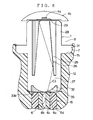
- the LED light C3 which has an entering angle larger than the critical angle ( ⁇ ) (FIG.9) of a cylindrical light-leading path, enters the sleeve 1, the LED light C3 makes the total reflection due to the tapered side portion 25 of the light-leading path 26. Like this, a drop of the transmission efficiency of the signal light emitted from the transmitting device 4b can be prevented.
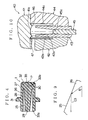
- a metal mold unit 40 shown in FIG.10 is used for the injection molding of the sleeve 1.
- the metal mold unit 40 has a first mold 41, a second mold 42, a third mold 43, a fourth mold 44, and a fifth mold 45.
- the above molds 41-45 can be assembled and disassembled and can form a cavity 46 for the sleeve 1 as shown in FIG. 10. And, the molded sleeve 1 can be taken out of the cavity 46 by disassembling the molds.
- the first mold 41 has a molding portion 41a along external forms of the above end face 32 and the lens 35.
- the second mold 42 and the fourth mold 44 cooperate to form molding portions 42a,44a along an external form of the outer tube portion 28.
- the second mold 42 has a gate 47 to supply the melted synthetic resin into the above cavity 46.
- the above first mold 41, the second mold 42, and the fourth mold 44 constitute the first metal mold.
- the above molding portions 41a,42a,44a constitute a first molding portion along external forms of the outer tube portion 28 and the other end portion 30 of the sleeve 1.
- the third mold 43 has a molding portion 43a as a second molding portion along the inner surface of the outer tube portion 28, the peripheral surface of the light-leading path 26, and the surface of the peripheral projecting portion 27.
- the molding portion 43a is made of a hard material such as the SKH steel or the super steel.
- the SKH steel is a highspeed tool steel standardized by JIS (Japanese Industrial Standard) G4403, and the super steel is, for example, the SKS steel standardized by JIS G4404.
- the fifth mold 45 is cylindrically formed, which outside diameter is almost the same as the inside diameter of the third mold 43, and has a molding portion 45a along the above end face 29.
- the third mold 43 and the fifth mold 45 constitute the second metal mold.
- the transmission efficiency of the signal light can be improved.
- the optical connector 2 can be assembled in a state that the sleeve 1 is accommodated and positioned in the mediating pipe 12 of the housing 7, thereby improving productivity of the optical connector 2 with the sleeve 1 and reducing the cost thereof by reducing man-hour for the assembly work and simplifying the manufacturing process.
- the sleeve 1 can be prevented from deflecting in the mediating pipe 12, thereby improving the transmission efficiency between the sleeve 1 and the optical fiber 6, the sleeve 1 and the transmitting device 4b, and the sleeve 1 and the receiving device 4a; that is, improving the transmission efficiency of the optical connector 2 with the sleeve 1.
- the sleeve 1 is integrally formed of a transmissible synthetic resin material, the productivity thereof can be improved. And, because the molding portion 43a of the third mold 43 is made of the hard material, the sleeve 1 with the above structure can be molded securely.
- an optical connection efficiency can be easily calculated by using an optics calculation software for the structure of the sleeve 1 with the light-leading path 26, the lens 35 and the like, dimensions optimizing the optical connection efficiency can be easily obtained.
- the optical fiber 6 is of a step type
- an optical fiber of a gray dead type may be used.
- the lens 35 may be an aspherical lens having a plurality of radii of curvature.
Landscapes
- Physics & Mathematics (AREA)
- General Physics & Mathematics (AREA)
- Optics & Photonics (AREA)
- Optical Couplings Of Light Guides (AREA)
- Mechanical Coupling Of Light Guides (AREA)
- Moulds For Moulding Plastics Or The Like (AREA)
Claims (10)
- Hülse (1), die zwischen einer optischen Faser (6) und einem Sende- (4b) oder Empfangsmodul (4a) zum optischen Verbinden der optischen Faser (6) und des Sende- (4b) oder Empfangsmoduls (4a) angeordnet ist, wobei die Hülse (1) aufweist:einen lichtleitenden Pfad (26), der eine sich verjüngende flachköpfige Form aufweist, der eine Endfläche (29) mit kleinem Durchmesser hat, die dem Sende- (4b) oder Empfangsmodul (4a) zugewandt ist; gekennzeichnet durch weiteres Vorhandenseinseines peripheren vorstehenden Abschnitts (27), der in einer radialen Richtung von einem anderen Endabschnitt (30) des lichtleitenden Pfades (26) auf Seiten der optischen Faser (6) vorsteht; undeines äußeren Rohrabschnitts (28), der sich in eine optische Achsenrichtung des lichtleitenden Pfads (26) von einem peripheren Abschnitt des peripheren vorstehenden Abschnitts (27) in Richtung zu der Endfläche mit kleinem Durchmesser (29), die gesamte Länge des lichtleitenden Pfads (26) abdeckend erstreckt.
- Hülse gemäß Anspruch 1, wobei
der periphere vorstehende Abschnitt (27) koaxial zu dem lichtleitenden Pfad (26) kreisförmig ausgebildet ist, und
der äußere Rohrabschnitt (28) koaxial zu dem lichtleitenden Pfad (26) zylindrisch ausgebildet ist. - Hülse gemäß Anspruch 2, wobei
der Außendurchmesser des äußeren Rohrabschnitts (28) über die gesamte Länge des lichtleitenden Pfads (26) hin gleichmäßig ausgebildet ist. - Hülse gemäß Anspruch 1, wobei
der äußere Rohrabschnitt (28) einen Flansch (31) hat, der in radialer Richtung von der Umfangsoberfläche desselben kreisförmig vorsteht. - Hülse gemäß Anspruch 1, wobei
eine Linse (35) einstückig mit dem anderen Endabschnitt (30) des lichtleitenden Pfads (26) konvex in Richtung zu der optischen Faser (6) ausgebildet ist. - Hülse gemäß Anspruch 5, wobei
die Linse (35) nicht über ein Seitenende der optischen Faser (6) des äußeren Röhrenabschnitts (28) vorsteht. - Hülse gemäß Anspruch 1, wobei
eine Endfläche des anderen Endabschnitts (30) des lichtleitenden Pfads (26) eine lichtempfangende Oberfläche ist, um Licht zu empfangen, das von der optischen Faser (6) gesendet wird, und
der Durchmesser der lichtempfangenden Oberfläche größer als der Durchmesser einer lichtemittierenden Oberfläche ist, die eine Endfläche (6a) der optischen Faser (6) ist. - Hülse gemäß Anspruch 1, wobei
die Endfläche mit kleinem Durchmesser (29) des lichtleitenden Pfads (26) eine lichtemittierende Oberfläche ist, um Licht zu emittieren, das zu dem Empfangsmodul (4a) gesendet wird, und
der Durchmesser der lichtemittierenden Oberfläche kleiner als der Durchmesser einer lichtempfangenenden Oberfläche (4c) des Empfangsmoduls (4a) ist. - Hülse gemäß einem der Ansprüche 1-6, wobei
die Endfläche mit kleinem Durchmesser (29) des lichtleitenden Pfads (26) eine lichtempfangende Oberfläche ist, um Licht zu empfangen, das von dem Sendemodul (4b) gesendet wird, und
der Durchmesser der lichtempfangenden Oberfläche größer als der Durchmesser einer lichtemittierenden Oberfläche (4d) des Sendemoduls (4b) ist. - Verfahren zum Herstellen einer Hülse (1), die zwischen einer optischen Faser (6) und einem Sende- (4b) oder Empfangsmodul (4a) zum optischen Verbinden der optischen Faser (6) und des Sende- (4b) oder Empfangsmoduls (4a) angeordnet ist, wobei die Hülse (1) aufweist:einen lichtleitenden Pfad (26), der eine sich verjüngende flachköpfige Form aufweist, der eine Endfläche (29) mit kleinem Durchmesser hat, die dem Sende- (4b) oder Empfangsmodul (4a) zugewandt ist;einen peripheren vorstehenden Abschnitt (27), der in einer radialen Richtung von einem anderen Endabschnitt (30) des lichtleitenden Pfades (26) auf Seiten der optischen Faser (6) vorsteht; undeinen äußeren Rohrabschnitt (28), der sich in eine optische Achsenrichtung des lichtleitenden Pfads (26) von einem peripheren Abschnitt des peripheren vorstehenden Abschnitts (27) in Richtung zu der Endfläche mit kleinem Durchmesser (29), die gesamte Länge des lichtleitenden Pfads (26) abdeckend erstreckt, das die Schritte aufweist:Einrichten
einer ersten Metallform (41, 42, 44), die einen ersten Formabschnitt hat, der sich entlang des Außenumrisses des anderen Endabschnitts (30) des lichtleitenden Pfads (26) der Hülse (1) und entlang des Außenumrisses des äußeren Rohrabschnitts (28) erstreckt, und
einer zweiten Metallform (43, 45), die einen zweiten Formabschnitt hat, der aus einem harten Material hergestellt ist und sich entlang der Innenfläche des äußeren Rohrabschnitts (28) und entlang der Umfangsfläche des lichtleitenden Pfads (26) erstreckt.
Applications Claiming Priority (2)
| Application Number | Priority Date | Filing Date | Title |
|---|---|---|---|
| JP2000202163 | 2000-07-04 | ||
| JP2000202163A JP2002023024A (ja) | 2000-07-04 | 2000-07-04 | スリーブおよび該スリーブの製造方法 |
Publications (3)
| Publication Number | Publication Date |
|---|---|
| EP1170611A2 EP1170611A2 (de) | 2002-01-09 |
| EP1170611A3 EP1170611A3 (de) | 2004-10-20 |
| EP1170611B1 true EP1170611B1 (de) | 2006-09-20 |
Family
ID=18699729
Family Applications (1)
| Application Number | Title | Priority Date | Filing Date |
|---|---|---|---|
| EP01116142A Expired - Lifetime EP1170611B1 (de) | 2000-07-04 | 2001-07-03 | Hülse und deren Herstellungsverfahrung |
Country Status (4)
| Country | Link |
|---|---|
| US (1) | US6751378B2 (de) |
| EP (1) | EP1170611B1 (de) |
| JP (1) | JP2002023024A (de) |
| DE (1) | DE60123174T2 (de) |
Families Citing this family (7)
| Publication number | Priority date | Publication date | Assignee | Title |
|---|---|---|---|---|
| JP2004151373A (ja) * | 2002-10-30 | 2004-05-27 | Yazaki Corp | 車載用光コネクタ |
| EP1722258A1 (de) * | 2005-05-13 | 2006-11-15 | STMicroelectronics S.r.l. | Kopplungsmodul für optische Strahlung |
| JP4898549B2 (ja) | 2007-05-14 | 2012-03-14 | アルプス電気株式会社 | 光結合素子及び光結合ユニット |
| CN103270444B (zh) * | 2010-12-24 | 2015-02-18 | 株式会社自动网络技术研究所 | 光学组件 |
| JP2014032256A (ja) * | 2012-08-01 | 2014-02-20 | Auto Network Gijutsu Kenkyusho:Kk | 光トランシーバと光コネクタとの嵌合構造 |
| US9733440B2 (en) * | 2014-04-29 | 2017-08-15 | Corning Incorporated | Optical connectors for coupling light sources to optical fibers |
| JP2022179073A (ja) * | 2021-05-21 | 2022-12-02 | 株式会社エンプラス | 光レセプタクルおよび光モジュール |
Family Cites Families (12)
| Publication number | Priority date | Publication date | Assignee | Title |
|---|---|---|---|---|
| US4377322A (en) * | 1980-10-27 | 1983-03-22 | General Electric Company | Fiber optic coupler |
| US4547039A (en) * | 1982-04-16 | 1985-10-15 | Amp Incorporated | Housing mountable on printed circuit board to interconnect fiber optic connectors |
| US4729621A (en) * | 1985-03-11 | 1988-03-08 | Shiley Inc. | Integral optical fiber coupler |
| US5136676A (en) * | 1991-05-01 | 1992-08-04 | Coherent, Inc. | Coupler for a laser delivery system |
| JPH0823137B2 (ja) | 1992-03-17 | 1996-03-06 | 中富 栗本 | 砂杭造成装置 |
| US5832151A (en) * | 1995-01-17 | 1998-11-03 | Remote Source Lighting International, Inc | Reflector and illumination system |
| US5661832A (en) * | 1995-11-28 | 1997-08-26 | Sumitomo Electric Industries, Ltd. | Optical connector structure, optical fiber cord assembly and process of producing optical fiber cord assembly |
| US5647041A (en) * | 1996-04-17 | 1997-07-08 | Lucent Technologies Inc. | Multimode fiber beam compressor |
| JPH10239559A (ja) * | 1997-02-26 | 1998-09-11 | Sumitomo Wiring Syst Ltd | 光伝送装置 |
| JPH1184182A (ja) * | 1997-09-11 | 1999-03-26 | Sumitomo Wiring Syst Ltd | プラスチック光ファイバと受光素子との接続構造 |
| US6428216B1 (en) * | 1998-11-09 | 2002-08-06 | John M. Savage, Jr. | Optical coupling of light pipes, with light diffusion |
| JP3958891B2 (ja) | 1999-04-23 | 2007-08-15 | 矢崎総業株式会社 | 光コネクタ |
-
2000
- 2000-07-04 JP JP2000202163A patent/JP2002023024A/ja active Pending
-
2001
- 2001-06-29 US US09/893,548 patent/US6751378B2/en not_active Expired - Fee Related
- 2001-07-03 EP EP01116142A patent/EP1170611B1/de not_active Expired - Lifetime
- 2001-07-03 DE DE60123174T patent/DE60123174T2/de not_active Expired - Lifetime
Also Published As
| Publication number | Publication date |
|---|---|
| US20010051027A1 (en) | 2001-12-13 |
| JP2002023024A (ja) | 2002-01-23 |
| DE60123174T2 (de) | 2007-09-13 |
| DE60123174D1 (de) | 2006-11-02 |
| US6751378B2 (en) | 2004-06-15 |
| EP1170611A3 (de) | 2004-10-20 |
| EP1170611A2 (de) | 2002-01-09 |
Similar Documents
| Publication | Publication Date | Title |
|---|---|---|
| US9846288B2 (en) | Fiber optic devices and methods of manufacturing fiber optic devices | |
| EP1170610B1 (de) | Opto-elektrischer Hybridstecker und Verfahren für seinen Zusammenbau | |
| US6459835B1 (en) | Optical connector | |
| US6776537B2 (en) | Light source-optical fiber coupler | |
| JP3771222B2 (ja) | 光モジュール及びそれを備えた光コネクタ | |
| EP1170611B1 (de) | Hülse und deren Herstellungsverfahrung | |
| KR20060090579A (ko) | 광섬유 접속 부품 및 이를 사용한 광섬유 접속기 | |
| CN117471615A (zh) | 插芯组件、光纤连接器、光网络设备及光通信系统 | |
| WO2010007861A1 (ja) | 光コネクタ | |
| US5450514A (en) | Optical waveguide terminating sleeve usable with optical waveguide connectors | |
| EP1217406B1 (de) | Optischer Sender-Empfänger-Stecker | |
| US20040146250A1 (en) | Ferrule and optical coupling structure using the same | |
| US20040146251A1 (en) | Optical connector | |
| US7175353B2 (en) | Duplex optical transceiver | |
| CN101506704B (zh) | 包括光传导光学器件壳体的影像传导光学组件 | |
| US7387449B2 (en) | Coupling unit for coupling an optical transmitting and/or receiving module to an optical fiber connector | |
| CN2516985Y (zh) | 光学次组合 | |
| US6425696B1 (en) | Molded fiber optic ferrule receptable | |
| JP5022889B2 (ja) | 光結合用光導波路 | |
| US20030071318A1 (en) | Optical sub-assembly housing structure for an optical transceiver module | |
| US7665907B2 (en) | Optical connector assembly | |
| JP3103890U (ja) | デュプレックス式光信号送受信モジュール | |
| CN103630979A (zh) | 光连接器和装配单元 | |
| CN2507191Y (zh) | 双工光收发模组 | |
| JP2000329972A (ja) | 発光・受光装置、及び、一芯式光ファイバ双方向通信システム |
Legal Events
| Date | Code | Title | Description |
|---|---|---|---|
| PUAI | Public reference made under article 153(3) epc to a published international application that has entered the european phase |
Free format text: ORIGINAL CODE: 0009012 |
|
| AK | Designated contracting states |
Kind code of ref document: A2 Designated state(s): AT BE CH CY DE DK ES FI FR GB GR IE IT LI LU MC NL PT SE TR |
|
| AX | Request for extension of the european patent |
Free format text: AL;LT;LV;MK;RO;SI |
|
| PUAL | Search report despatched |
Free format text: ORIGINAL CODE: 0009013 |
|
| AK | Designated contracting states |
Kind code of ref document: A3 Designated state(s): AT BE CH CY DE DK ES FI FR GB GR IE IT LI LU MC NL PT SE TR |
|
| AX | Request for extension of the european patent |
Extension state: AL LT LV MK RO SI |
|
| 17P | Request for examination filed |
Effective date: 20050317 |
|
| AKX | Designation fees paid |
Designated state(s): DE FR GB IT SE |
|
| GRAP | Despatch of communication of intention to grant a patent |
Free format text: ORIGINAL CODE: EPIDOSNIGR1 |
|
| GRAS | Grant fee paid |
Free format text: ORIGINAL CODE: EPIDOSNIGR3 |
|
| GRAA | (expected) grant |
Free format text: ORIGINAL CODE: 0009210 |
|
| AK | Designated contracting states |
Kind code of ref document: B1 Designated state(s): DE FR GB IT SE |
|
| PG25 | Lapsed in a contracting state [announced via postgrant information from national office to epo] |
Ref country code: IT Free format text: LAPSE BECAUSE OF FAILURE TO SUBMIT A TRANSLATION OF THE DESCRIPTION OR TO PAY THE FEE WITHIN THE PRESCRIBED TIME-LIMIT;WARNING: LAPSES OF ITALIAN PATENTS WITH EFFECTIVE DATE BEFORE 2007 MAY HAVE OCCURRED AT ANY TIME BEFORE 2007. THE CORRECT EFFECTIVE DATE MAY BE DIFFERENT FROM THE ONE RECORDED. Effective date: 20060920 |
|
| REG | Reference to a national code |
Ref country code: GB Ref legal event code: FG4D |
|
| REF | Corresponds to: |
Ref document number: 60123174 Country of ref document: DE Date of ref document: 20061102 Kind code of ref document: P |
|
| REG | Reference to a national code |
Ref country code: SE Ref legal event code: TRGR |
|
| ET | Fr: translation filed | ||
| RAP2 | Party data changed (patent owner data changed or rights of a patent transferred) |
Owner name: YAZAKI CORPORATION |
|
| PLBE | No opposition filed within time limit |
Free format text: ORIGINAL CODE: 0009261 |
|
| STAA | Information on the status of an ep patent application or granted ep patent |
Free format text: STATUS: NO OPPOSITION FILED WITHIN TIME LIMIT |
|
| 26N | No opposition filed |
Effective date: 20070621 |
|
| REG | Reference to a national code |
Ref country code: FR Ref legal event code: PLFP Year of fee payment: 15 |
|
| PGFP | Annual fee paid to national office [announced via postgrant information from national office to epo] |
Ref country code: GB Payment date: 20150701 Year of fee payment: 15 Ref country code: DE Payment date: 20150630 Year of fee payment: 15 |
|
| PGFP | Annual fee paid to national office [announced via postgrant information from national office to epo] |
Ref country code: FR Payment date: 20150629 Year of fee payment: 15 Ref country code: SE Payment date: 20150713 Year of fee payment: 15 |
|
| PGFP | Annual fee paid to national office [announced via postgrant information from national office to epo] |
Ref country code: IT Payment date: 20150727 Year of fee payment: 15 |
|
| REG | Reference to a national code |
Ref country code: DE Ref legal event code: R119 Ref document number: 60123174 Country of ref document: DE |
|
| REG | Reference to a national code |
Ref country code: SE Ref legal event code: EUG |
|
| GBPC | Gb: european patent ceased through non-payment of renewal fee |
Effective date: 20160703 |
|
| PG25 | Lapsed in a contracting state [announced via postgrant information from national office to epo] |
Ref country code: DE Free format text: LAPSE BECAUSE OF NON-PAYMENT OF DUE FEES Effective date: 20170201 Ref country code: SE Free format text: LAPSE BECAUSE OF NON-PAYMENT OF DUE FEES Effective date: 20160704 Ref country code: FR Free format text: LAPSE BECAUSE OF NON-PAYMENT OF DUE FEES Effective date: 20160801 |
|
| REG | Reference to a national code |
Ref country code: FR Ref legal event code: ST Effective date: 20170331 |
|
| PG25 | Lapsed in a contracting state [announced via postgrant information from national office to epo] |
Ref country code: GB Free format text: LAPSE BECAUSE OF NON-PAYMENT OF DUE FEES Effective date: 20160703 |
|
| PG25 | Lapsed in a contracting state [announced via postgrant information from national office to epo] |
Ref country code: IT Free format text: LAPSE BECAUSE OF NON-PAYMENT OF DUE FEES Effective date: 20160703 |