EP1171966B1 - Systemes integres, a grande vitesse, de communications terrestre et par satellite, destines au reseau internet et a d'autres reseaux - Google Patents
Systemes integres, a grande vitesse, de communications terrestre et par satellite, destines au reseau internet et a d'autres reseaux Download PDFInfo
- Publication number
- EP1171966B1 EP1171966B1 EP00921973A EP00921973A EP1171966B1 EP 1171966 B1 EP1171966 B1 EP 1171966B1 EP 00921973 A EP00921973 A EP 00921973A EP 00921973 A EP00921973 A EP 00921973A EP 1171966 B1 EP1171966 B1 EP 1171966B1
- Authority
- EP
- European Patent Office
- Prior art keywords
- data content
- data
- content
- queued
- user
- Prior art date
- Legal status (The legal status is an assumption and is not a legal conclusion. Google has not performed a legal analysis and makes no representation as to the accuracy of the status listed.)
- Expired - Lifetime
Links
- 238000004891 communication Methods 0.000 title claims description 56
- 238000000034 method Methods 0.000 claims abstract description 26
- 230000004044 response Effects 0.000 claims description 4
- 238000012544 monitoring process Methods 0.000 claims 2
- 230000005540 biological transmission Effects 0.000 description 15
- 238000012384 transportation and delivery Methods 0.000 description 9
- 230000008901 benefit Effects 0.000 description 7
- 238000012546 transfer Methods 0.000 description 7
- 238000010586 diagram Methods 0.000 description 6
- 238000004590 computer program Methods 0.000 description 5
- 238000012545 processing Methods 0.000 description 5
- 238000012986 modification Methods 0.000 description 4
- 230000004048 modification Effects 0.000 description 4
- 230000001419 dependent effect Effects 0.000 description 3
- 238000013439 planning Methods 0.000 description 3
- 230000000704 physical effect Effects 0.000 description 2
- 238000013459 approach Methods 0.000 description 1
- 230000002457 bidirectional effect Effects 0.000 description 1
- 238000005266 casting Methods 0.000 description 1
- 238000010276 construction Methods 0.000 description 1
- 235000019800 disodium phosphate Nutrition 0.000 description 1
- 230000010354 integration Effects 0.000 description 1
- 238000007726 management method Methods 0.000 description 1
- 230000007246 mechanism Effects 0.000 description 1
- 230000006855 networking Effects 0.000 description 1
- 230000008569 process Effects 0.000 description 1
- 230000011664 signaling Effects 0.000 description 1
Images



Classifications
-
- H—ELECTRICITY
- H04—ELECTRIC COMMUNICATION TECHNIQUE
- H04B—TRANSMISSION
- H04B7/00—Radio transmission systems, i.e. using radiation field
- H04B7/14—Relay systems
- H04B7/15—Active relay systems
- H04B7/185—Space-based or airborne stations; Stations for satellite systems
- H04B7/18578—Satellite systems for providing broadband data service to individual earth stations
- H04B7/18584—Arrangements for data networking, i.e. for data packet routing, for congestion control
-
- H—ELECTRICITY
- H04—ELECTRIC COMMUNICATION TECHNIQUE
- H04B—TRANSMISSION
- H04B7/00—Radio transmission systems, i.e. using radiation field
- H04B7/14—Relay systems
- H04B7/15—Active relay systems
- H04B7/185—Space-based or airborne stations; Stations for satellite systems
- H04B7/18578—Satellite systems for providing broadband data service to individual earth stations
- H04B7/18591—Arrangements for interconnecting multiple systems
Definitions
- the present application relates to systems and methods for managing the delivery of a plurality of types of data content to data users, and more particularly, to systems and methods for managing the allocation of bandwidth resources for the transmission and delivery of a plurality of types of data content to data users via a satellite telecommunications network.
- a network communications systems ability to deliver data content to its data users is often constrained by the available bandwidth resources found within the system.
- the amount of bandwidth resources that can be made available to any individual data user within a network communications system is dependent upon such factors as the total bandwidth resources available within the system, the number of data users connected to the system, and the size of the data content being demanded by such data users at any given moment.
- the first factor, the amount of bandwidth resources found within a given network communication system tends to be the single most important factor influencing the quality of service (in terms of the systems' ability to deliver data content in a timely fashion) experienced by the system's data users; other factors tend to only address how the system's available resources are to be allocated to meet the needs of its data users.
- the amount of bandwidth resources found within a given network can be constrained by both the physical properties of the medium over which the system's data content is delivered to its data users, and in the way in which the system transmits data content to its data users (note, however, that these factors are not generally wholly independent of each other).
- bandwidth resources can easily be seen in typical non-wireless terrestrial Internet communication networks.
- Data users can access data content found on the Internet through an Internet service provider. Commonly, the data user communicates with the Internet service provider and the holders of desired data content through normal telephone lines; a request for data content travels from the data user to the holder of the desired data content and then the holder transmits the data content to the requesting data user.
- This typical terrestrial Internet network system suffers two drawbacks that constrain the amount of available bandwidth resources that the data user may utilize in obtaining the desired data content. First, the amount of bandwidth resources available to deliver data content in existing telephone lines is quite limited.
- Non-wireless Internet communication networks are constrained in their ability to deliver data content, in other words, because they are unicast systems. With each data user's request for data content, the non-wireless Internet communication network system must allocate bandwidth resources to transmit the data content to the requesting data user.
- International Patent Application Publication WO 99/16201 describes an asymmetric access satellite-based system that includes multicasting, caching, roaming, and Internet Protocol (IP) packet routing.
- International Patent Application Publication WO 99/09707 describes a system that can route data via either a network that supports Internet Protocol (IP) or a satellite transmission network. The system can route data via the IP network or the satellite transmission network based on a size of the data.
- IP Internet Protocol
- Clausen et al describe a system that uses direct broadcast satellites to downlink Internet data to user terminals in Internet Services via Direct Broadcast Satellites, IEEE International Performance Computing and Communications Conference, February 2-5, 1997, pps. 468-75 (1997).
- A. Hung et al describe framework for integrating satellite uplink access scheduling and asynchronous transfer mode (ATM) protocols in ATM via satellite: A framework and an implementation, Wireless Networks, vol. 4, pps. 141-153, (1998).
- ATM asynchronous transfer mode
- One objective of the present invention is to provide systems and methods that take advantage of the broadband resources available in satellite telecommunication network systems to deliver Internet Protocol (IP) data content to data users at rates of speed that may not be available in traditional terrestrially-based Internet communication networks.
- IP Internet Protocol
- satellite networks presently exist in the United States, Asia and Europe that were originally installed for television distribution broadcasting.
- ASTRA satellite system in Europe currently provides television broadcast service to approximately twenty-five million homes.
- Internet facility includes both Internet service providers and Internet content providers.
- An additional objective of the present invention is to provide systems and methods that are able to deliver non-Internet Protocol data content to data users by utilizing the broadband resources available in satellite telecommunication network systems.
- the delivery of continuous streams of digital data content to data users may be possible.
- a MPEG4 stream of audio or video digital data content such as MPEG4-formatted data, may be delivered to data users in this way.
- non-IP, non-streaming digital data content can also be delivered to data users by utilizing the broadband resources available in satellite telecommunication network systems.
- the delivery of digital data content (i.e., file transfers) to data users can be conducted via satellite telecommunication networks at rates of speed which may not be achievable in a traditional non-wireless communication network.
- Another objective of the present invention is to provide systems and methods that take advantage of the multicasting capabilities of satellite telecommunication network systems so as to be able to simultaneously deliver data content to a multitude of data users with a single transmission of the data content. Additionally, to take further advantage of the multicasting capabilities of satellite telecommunication networks, methods for queuing the delivery of digital data content to data users are disclosed in the present invention.
- a further object of the present invention is to provide systems and methods for delivering a plurality of types of data content to data users via a satellite telecommunication network.
- an integrated communications system manager may provide bi-directional control and signaling capability interconnecting a plurality of diverse bandwidth-originating communications networks, an integrated high speed data content manager and a distribution network.
- a distribution network may comprise a plurality of distribution networks, some of which are dynamically established and disestablished in accordance with the requirements of customers and/or the dictates of an operating protocol.
- An advantageous aspect of a communications system would be a system manager that can direct the constitution of the aforesaid dynamic networks and that can coordinate their interrelation with other components of the communications system.
- a plurality of types of data content such as IP data packets, streaming digital data content and file transfers of stored digital data content. for example, could be delivered to and received by data users simultaneously in this way.
- the systems and methods described herein allocate bandwidth resources for the delivery of a plurality of types of data content to data users via a satellite telecommunications network.
- the systems and methods of the present invention create a new Internet capability that permits the worldwide distribution of media content at megabit bandwidth.
- Such an architecture can involve the integration and combination of current terrestrial Internet facilities with the wide spread availability of high speed information channels that is associated with the complex of satellite television distribution networks located throughout the world.
- Figure 1 provides a block diagram of an illustrative embodiment of an integrated terrestrial/satellite architecture.
- the interrelationships comprising the architecture are controlled and managed by a telecommunications facility 16, as shown in Figure 1.
- a plurality of types of data content may be delivered to at least one data user terminal 2.
- the plurality of types of data content deliverable to the at least one data user terminal may include, but is not limited to, Internet Protocol data content, streaming audio and video digital data content, and non-streaming digital data content.
- the data user terminal 2 may include, for example, a PC assembly, a standard television set equipped with a set top box mechanism, a laptop computer, or any other device capable of processing and displaying a plurality of types of data content.
- An arrangement of the data user terminal 2 is shown in more detail in Figure 5.
- the data user terminal 2 is adapted so as to be able to process and display the plurality of types of data content received by a ground-based satellite receiving antenna 4.
- the data user terminal 2 is interconnected via a communication device such as a modem (not shown) to a dial-up modem 8 providing an interface with the data user terminal 2 and the telecommunications facility 16.
- the data user terminal 2 may interface directly with the dial-up modem 8 via a direct line dial-up connection.
- the data user terminal 2 (and its modem) may interface with modem 8 through the Internet via an Internet service provider.
- the telecommunications facility 16 can include a dial-up router 10 for routing data users requests for data content to a communications systems manager 18.
- the communications systems manager 18 as shown comprises of a data content manager 12 , an intermediate router/traffic shaper 14, a satellite antenna 20 and a satellite modem (not shown).
- the data content manager 12 is responsible for managing the data users' requests for differing types of data content and managing the reception of the received plurality of types of data content.
- the intermediate router/traffic shaper 14 is responsible for allocating the system's available bandwidth resources for the transmission of the plurality of types of data content received and directing the plurality of types of data content to a satellite gateway 22.
- the communication systems manager 18 also includes a satellite antenna 20 and a satellite modem (not shown) so that the telecommunications facility 16 will be capable of receiving streams of digital data content delivered from a communications network and to direct the received digital data content to the data content manager 12.
- this communications network may transmit streams of digital data content formatted in the MPEG4 protocol to the telecommunications facility 16.
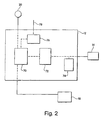
- FIG. 2 illustrates one embodiment of a data content manager 12 in accordance with the invention.
- the data content manager 12 shown comprises of a processor 70, a queuing engine 72, a generator 74, and a memory device 76.
- the processor 70 is responsible for controlling the received plurality of types of data content and for identifying digital data content to be placed in a queue for transmission.
- the processor 70 is capable of communicating with, and controlling, the queuing engine 72, the generator 74 and the memory device 76.
- the queuing engine 72 queues digital data content identified by the processor 70 to be queued, and releases the queued digital data content at predetermined times to the intermediate router/traffic shaper 14.
- the generator 74 generates messages to be broadcasted to data users informing them that a queued digital data content will be available for transmission at a predetermined time and inviting these data users to request the queued digital data content prior to the predetermined time for releasing the queued digital data content.
- FIG. 2 graphically depicts the processor 70, the queuing engine 72, a generator 74, and the memory device 76 of the data content manager 12 as functional block elements, it will be apparent to one of ordinary skill in the art that these elements can be realized as computer programs or portions of computer programs according to the invention.
- the data content manager 12 can be realized as a software component operating on a conventional data processing system such as a Unix workstation.
- the data content manager 12 can be implemented as a C language computer program, or a computer program written in any high level language including C++, Fortran, Java or basic.
- the data content manager 12 can be realized as a computer program written in microcode or written in a high level language and compiled down to microcode that can be executed on the platform employed.
- Data content can be introduced into the processor 70 via three separate communications networks. While the illustrated embodiment depicts a preferred embodiment of the invention, it will be readily apparent to one skilled in the art, however, that the depicted embodiment may be modified or adapted without departing from the scope of the invention.
- the first communications network represents data content available on the Internet, which may be delivered to the processor 70 via the backbone router 40 and dial-up router 10 as discussed below.
- the second communications network comprises a network which generates streams of digital data content deliverable to the processor 70.
- This communications network may consist of streams of digital data content broadcasted via satellite communications as shown by the satellite antenna 20 in both Figures 1 and 2.
- the streams of digital data content need not be delivered to the processor 70 of the data content manager 12 via a satellite network.
- Streams of digital data content may be delivered to the processor 70 via a television cable broadcasting system.
- the third communications network comprises a network where digital data content is delivered to the processor 70.
- the digital data content of this network may be deliverable to the processor 70 of the data content manager 12 via a LAN (or equivalent) system connection 78, or the digital data content may be directly downloaded into a memory device 76 via a driver interface (not shown).
- the memory device 76 additionally may be utilized to store any data content delivered to the processor 70 from the first and second communications networks.
- the data content manager 12 can control the delivery of the plurality of types of data content to the intermediate router/traffic shaper 14 for transmission to data users.
- a key feature of the data content manager 12 is its ability to queue digital data content for transmission to data users. For example, if data users wanted to download the latest version of an Internet browser engine, a data content which may be quite large, the data content manager 12 might queue the desired data content for a later transmission to data users. In this way, the system can better utilize its ayailable bandwidth resources by taking advantage of a satellite telecommunication network's ability to multicast data content to data users.
- the identification of the digital data content to be queued will be determined by evaluating the likelihood that other data users might desire the digital data content requested by single data user.
- the identification of the digital data content to be queued is made independent of whether a data user has requested a particular digital data content. In both of these approaches, the queuing engine 72's predetermined time for releasing a queued digital data content may be based upon historical data user traffic patterns.
- queued digital data content may be released for transmission to data users in the early morning hours when data user demand upon the system is traditionally at its lowest.
- the queuing engine 72's predetermined time for releasing a queued digital data content may be dependent upon either the bandwidth resources available within the system or upon the size of the queued digital data content.
- the queuing engine 72 of the data content manager 12 may queue the identified digital data content for a fixed length of time measured from the time at which a data user's request for that digital data content is received. Alternatively, the queuing engine 72 may queue the digital data content until a predetermined time wherein the predetermined time, as measured from the time at which the initial data user request is received, is dependent upon the bandwidth resources available within the system or upon the size of said requested digital data content. Or the queuing engine 72 may queue the digital data content until a predetermined time wherein the predetermined time for the transmission of the requested digital data, as discussed above, is based upon historical data user traffic patterns.
- the figure further shows the interface of the systems of the present invention with established terrestrial backbone networks.
- Data content can enter the dial-up router 10 of the telecommunications facility 16 by way of a backbone router 40.
- the backbone router 40 is a hub (i.e., node) within the World Wide Web (or the Internet) where signals (i.e., data content) from either a European backbone network 34 or a U.S. backbone network 38 pass through. It is understood that linkages with other geographically established backbone systems can be established without departing from the scope of this invention.
- the embodiment depicted in Figure 1 shows the European backbone network 34 supported by a terabit caching server 42.
- FIG. 1 shows the U.S. backbone network 38 connected to the telecommunications facility 16 of the present invention via a satellite linkage, shown here with two representative satellite antennas 50 and 52 and a representative satellite 54. It is understood, however, that the systems and methods of the present invention can interface with a plurality of satellites, antennas or networks of the same, including non-wireless systems.
- one satellite antenna 52 interfaces with a satellite modem 58 interconnected to the backbone router 40.
- a second satellite antenna 50 interfaces with a satellite modem 60 that provides a gateway to the U.S. backbone network 38.
- the satellite modem 60 transmits bidirectional signals that pass through a frame relay switch 62 en route to a router 64 that is connected to the U.S. backbone network 38. Signals passing from the router 64 to the satellite modem 60 can be transmitted at a rate differing from the rate at which signals pass in the opposite direction. It is to be understood that these data rates are illustrative only, to be selected according to the particular application, and that modifications thereof will be readily apparent to those of ordinary skill in the relevant arts.
- IP Internet Protocol
- a network of terrestrial and satellite communications facilities as shown in Figure 1 can be dynamically configured and reconfigured to provide instantaneous availability of bandwidth on demand. ranging from relatively low speeds in the kilobit range, up to approximately 35 megabits.
- the delivery points and delivery terminals may also be selected by the customers and users and automatically signaled to participate in a specified "feed”. Said bandwidth may be used at customer or user discretion for video streaming, caching, file down loading, multi-casting, and all manner of multi-media distribution.
- a plurality of types of data content may pass from the communications systems manager 18 to a satellite antenna 30 via a satellite gateway 22, that may interface with a radio-frequency (rf) multiplexer 24 where the rf multiplexer 24 can be utilized to further control the plurality of types of data content transmitted by the telecommunications facility, and a satellite modem 28.
- the radio-frequency multiplexer 24 transmits the plurality of types of data content to the satellite antenna 30 by way of the satellite modem 28 which provides an interface between the telecommunications facility and a satellite telecommunications network.
- the satellite antenna 30 transmits a satellite 32.
- Figure 1 shows, for purposes of illustration, a single satellite antenna 30 and satellite 32.
- the systems and methods of the present invention can interface with a plurality of satellites, antennas or networks of the same.
- the satellite 32 is capable of receiving the plurality of types of data content transmitted from the telecommunications facility 16 and transmitting the received types of data content to at least one ground-based satellite receiving antenna 4.
- the ground-based satellite receiving antenna 4 then receives the plurality of types of data content transmitted by the satellite 32 and directs the plurality of types of data content to a data user terminal 2 which is capable of processing and displaying the plurality of received types of data content.
- Figure 3 shows an example of how the instantaneous availability of bandwidth on demand according to an embodiment of the present invention can permit improved planning of a satellite telecommunication network's available bandwidth resources. This improved planning of usage can be advantageous for certain Internet applications, including multimedia distribution and e-commerce, as well as for delivering streaming digital data content and file transfers of digital data content.
- Figure 3 provides a graph that shows an illustrative deployment of a satellite's available bandwidth resources over a selected twenty-four hour period. The y-axis is calibrated to show a twenty-four hour day. The x-axis legend at the top of the graph is calibrated to show a range of bandwidths from 1 through 38 Mbits/sec.
- the area on the graph of Figure 3 designated 200 can indicate a bandwidth segment that provides streamed digital video data content at a rate of 8 Mbits/sec which is constant throughout the selected 24 hour period. In one embodiment, a MPEG 4 protocol may be used to provide this data content access.
- the area on the graph of Figure 3 designated 202 can indicate a bandwidth segment that provides streamed digital audio data content at a rate of 12 Mbits/sec which is constant throughout the selected 24 hour period.
- the area on the graph of Figure 3 designated 204 can represent corporate demands of Internet data content at rates ranging from 3 to 10 Mbits/sec throughout the selected 24 hour period.
- This area 204 illustrates the variability of bandwidth utilization for this purpose at different times of the day.
- between 15 and 50 data users may be actively downloading at 200 K/bits, consistent with a data user base between 240 and 800 subscribers.
- the area on the graph of Figure 3 designated 208 can represent corporate demand of Internet data content at rates ranging from 2 to 10 Mbits/sec, which correlates with a set of between 35 and 178 data users actively downloading at 56 Kbits/sec, and which is consistent with a data user base of between 580 and 2850 subscribers.
- This area 208 illustrates the variability of bandwidth utilization for this purpose at different times of the day.
- the area on the graph of Figure 3 designated 210 depicts bandwidth availability across time for scheduled downloads from 2 to 10 Mbits/sec.
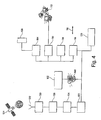
- Figure 4 shows a functional block diagram of an embodiment of a system according to the present invention that interrelates terrestrial and satellite communications.
- Figure 4 depicts a communications systems manager 100 that regulates and directs the passage of data content through a gateway router 102 (where the gateway router 102 represents the dial-up modem 8, the dial-up router 10, the satellite gateway 22, and satellite modem 28 from Figure 1).
- the communications systems manager 100 can include a server (not shown) and proprietary software. Together the systems management controller 100 and the gateway router 102 manage the reception of data content from various inputs (examples shown here at 104, 110, 114 and 118) and manage the transmission of a plurality of data content towards a satellite antenna 132.
- the network structure can be dynamically configured to provide multi-layer addressing and device selectivity, thereby enabling the creation on demand of specifically configured network distribution points and participants.
- the communications systems manager 100 may arrange the information queues in accordance with the control algorithms that have been specified for the network. This same system of control algorithms can provide the configuration and reconfiguration of the space segment, as shown in Figure 3, so as to maintain continuous highly efficient use of space distribution capabilities.
- the communications systems manager 100 also can regulate. through software control, the multiplicity of data content inputs as shown in Figure 4.
- a plurality of types of data content can be received into the communications systems manager 100 from a variety of sources.
- data content can be received from terrestrial data caches 104 which in turn can accept data content from a master cache 108 that cooperates with caches (not shown) of terrestrial partners.
- Data content can be received from line input sources 110, shown here as connected to remote Internet networks 112.
- Data content can be received from line connections 114 to third parties.
- Data content can be received from satellite sources 118 via KU band and future KA band, and can be transmitted thereunto, this bidirectionality being indicated by the double headed arrow at 116.
- Signals to and from satellite sources 118 can be directed by a separate control system 120 that is in communication with the communications systems manager 100.
- the communications systems manager 100 can likewise affect the flow of data content from satellite sources 118 into a video server 122, wherefrom data content can be transmitted along an uplink path to a satellite antenna site 132.
- the satellite antenna site 132 is shown in this figure to be in communication with a satellite 134. It is understood, however, that the systems and methods of the present invention can include a plurality of satellite antenna sites, satellites or networks of the same.
- the data content transmitted to the video server 122 from satellite sources 118 may take the form of broadcast data content.
- Data content emerging from the gateway router 102 may be optionally directed into a rf multiplexer 124 to be passed to the satellite antenna site 132.
- a rf multiplexer 124 can direct data content to a modulator 128 and thence to a transmitter 130 that comprises the satellite antenna site 132. If a multiplexer 124 is not employed, data content can pass directly from the gateway router 102 to the modulator 128.
- the systems according to the present invention can include an apparatus adapted for interface with the consumer's television set or PC to comprise a data user terminal.
- This apparatus may include both devices and software.
- Figure 5 provides a diagram of certain features of such a data user terminal.
- Figure 5 shows a block diagram of an embodiment of a data user terminal 300 according to the systems of the present invention.
- the data user terminal 300 can be in the form of a PC, a set top box or an Internet box.
- the data user terminal 300 can comprise a receiver card 308, an ISDN adapter 310 and a software system, depicted diagrammatically generally at 312.
- the software system 312 can include a stack of interacting layers such as described by the OSI protocol.
- Figure 5 shows one embodiment of a software system 312, comprising an Internet protocol (IF) layer 314, an UDP/TCP data transfer layer 318 and a data services layer 320, which may include proprietary software for signal processing or for other data processing.
- IF Internet protocol
- UDP/TCP data transfer layer 318 UDP/TCP data transfer layer 318
- data services layer 320 which may include proprietary software for signal processing or for other data processing.
- a monitor 302 and a speaker 304 are shown in communication with the receiver card 308.
- Figure 5 shows a flow of data from a satellite system 322 into the data user terminal 300 entering the receiver card 308 and passing therefrom into the software system 312.
- Data content entering the software system 312 pass from the IP layer 314 to the data transfer layer 318 to the data services layer 320.
- data content passes through the data transfer layer 318 to the IP layer, to exit the software system 312.
- Processed data content may then be routed to an ISDN adapter 310 which interfaces with an ISDN 324.
- Requests for data content transmission can be sent from the consumer data user terminal 300 to the ISDN 324.
- Responses to such requests can be transmitted from the satellite system 322 into the data user terminal 300.
- the satellite system 322 may comprise satellite receivers, satellites and networks thereof. While the arrangement of components shown in Figure 5 represents an illustrative embodiment according to the systems of the present invention, it is understood that other arrangements can be envisioned by those of ordinary skill in the relevant arts without departing from the scope of the present invention.
Landscapes
- Engineering & Computer Science (AREA)
- Computing Systems (AREA)
- Physics & Mathematics (AREA)
- Astronomy & Astrophysics (AREA)
- Aviation & Aerospace Engineering (AREA)
- General Physics & Mathematics (AREA)
- Computer Networks & Wireless Communication (AREA)
- Signal Processing (AREA)
- Radio Relay Systems (AREA)
- Data Exchanges In Wide-Area Networks (AREA)
- Photoreceptors In Electrophotography (AREA)
- Mobile Radio Communication Systems (AREA)
Claims (15)
- Système pour délivrer un contenu de données, le système incluant:une installation de télécommunication (16) pour recevoir un contenu de données depuis un réseau de communication (34, 38) et pour émettre le contenu de données jusqu'à un réseau de communication par satellite (4, 32), l'installation de télécommunication incluant:un gestionnaire de contenu de données (12) pour gérer la réception d'un contenu de données et pour surveiller des demandes en provenance d'utilisateurs de données quant à un contenu de données, le gestionnaire de contenu de données incluant:un moteur de mise en file d'attente (72) pour placer un contenu de données qui est demandé par un premier utilisateur de données (2) dans une file d'attente pour émettre un contenu de données; etun générateur (74) pour générer, en réponse à la mise en file d'attente du contenu de données qui est demandé par le premier utilisateur de données, un message à diffuser sur des utilisateurs de données qui informe les utilisateurs de données du fait que le contenu de données mis en file d'attente sera émis à un temps prédéterminé et qui invite les utilisateurs de données à demander avant le temps prédéterminé le contenu de données mis en file d'attente; etun réseau de communication par satellite (4, 32) pour recevoir le contenu de données mis en file d'attente depuis l'installation de télécommunication (16) et pour émettre le contenu de données mis en file d'attente sur le premier utilisateur de données (2) et sur les utilisateurs de données qui ont demandé le contenu de données mis en file d'attente.
- Système selon la revendication 1, dans lequel le contenu de données inclut au moins un élément pris parmi: des paquets de données de protocole Internet, un contenu de données numériques et un contenu de données numériques en train continu.
- Système selon la revendication 1, dans lequel le moteur de mise en file d'attente (72) place un contenu de données dans la file d'attente pendant une durée temporelle fixe.
- Système selon la revendication 1, dans lequel le moteur de mise en file d'attente (72) place un contenu de données dans la file d'attente pendant une durée temporelle qui est basée sur une largeur de bande qui est disponible dans le système.
- Système selon la revendication 1, dans lequel le moteur de mise en file d'attente (72) place un contenu de données dans la file d'attente pendant une durée temporelle qui est basée sur une dimension du contenu de données demandé.
- Système selon la revendication 1, dans lequel le moteur de mise en file d'attente (72) place un contenu de données dans la file d'attente pendant une durée temporelle qui est basée sur un motif de trafic d'utilisateur historique.
- Système selon la revendication 1, dans lequel le réseau de communication par satellite (4, 32) multi-diffuse le contenu de données mis en file d'attente sur le premier utilisateur de données (2) et sur un second utilisateur de données qui a demandé le contenu de données mis en file d'attente.
- Procédé pour délivrer un contenu de données via un réseau de communication par satellite (4, 32), le procédé incluant:la surveillance de demandes en provenance d'utilisateurs de données quant à un contenu de données;le placement d'un contenu de données qui est demandé par un premier utilisateur de données (2) dans une file d'attente pour émettre le contenu de données;en réponse à la mise en file d'attente du contenu de données qui est demandé par le premier utilisateur de données, la diffusion sur les utilisateurs de données d'un message qui informe les utilisateurs de données du fait que le contenu de données mis en file d'attente sera émis à un temps prédéterminé et qui invite les utilisateurs de données à demander avant le temps prédéterminé le contenu de données mis en file d'attente;la réception d'une demande pour le contenu de données mis en file d'attente de la part d'un second utilisateur de données; etl'émission du contenu de données mis en file d'attente au temps prédéterminé sur le premier utilisateur de données (2) et sur le second utilisateur de données formulateur de demande.
- Procédé selon la revendication 8, dans lequel le contenu de données inclut au moins un élément pris parmi: des paquets de données de protocole Internet, un contenu de données numériques et un contenu de données numériques en train continu..
- Procédé selon la revendication 8, dans lequel le placement inclut le placement d'un contenu de données dans la file d'attente pendant une durée temporelle fixe.
- Procédé selon la revendication 8, dans lequel le placement inclut le placement d'un contenu de données dans la file d'attente pendant une durée temporelle sur la base d'une largeur de bande disponible.
- Procédé selon la revendication 8, dans lequel le placement inclut le placement d'un contenu de données dans la file d'attente pendant une durée temporelle qui est basée sur la dimension du contenu de données demandé.
- Procédé selon la revendication 8, dans lequel une mise en file d'attente inclut le placement d'un contenu de données dans la file d'attente pendant une durée temporelle qui est basée sur un motif de trafic d'utilisateur historique.
- Procédé selon la revendication 8, dans lequel l'émission du contenu de données mis en file d'attente inclut l'émission via le réseau de communication par satellite (4, 32) du contenu de données mis en file d'attente sur le premier utilisateur de données (2) et sur le second utilisateur de données formulateur de demande.
- Procédé selon la revendication 14, dans lequel l'émission du contenu de données mis en file d'attente inclut une multi-diffusion via le réseau de télécommunication par satellite (4, 32) du contenu de données mis en file d'attente sur le premier utilisateur de données (2) et sur le second utilisateur de données formulateur de demande.
Applications Claiming Priority (3)
| Application Number | Priority Date | Filing Date | Title |
|---|---|---|---|
| US12861099P | 1999-04-08 | 1999-04-08 | |
| US128610P | 1999-04-08 | ||
| PCT/US2000/009496 WO2000060770A1 (fr) | 1999-04-08 | 2000-04-10 | Systemes integres, a grande vitesse, de communications terrestre et par satellite, destines au reseau internet et a d'autres reseaux |
Publications (2)
| Publication Number | Publication Date |
|---|---|
| EP1171966A1 EP1171966A1 (fr) | 2002-01-16 |
| EP1171966B1 true EP1171966B1 (fr) | 2004-09-01 |
Family
ID=22436156
Family Applications (1)
| Application Number | Title | Priority Date | Filing Date |
|---|---|---|---|
| EP00921973A Expired - Lifetime EP1171966B1 (fr) | 1999-04-08 | 2000-04-10 | Systemes integres, a grande vitesse, de communications terrestre et par satellite, destines au reseau internet et a d'autres reseaux |
Country Status (7)
| Country | Link |
|---|---|
| EP (1) | EP1171966B1 (fr) |
| AT (1) | ATE275303T1 (fr) |
| AU (1) | AU4222500A (fr) |
| CA (1) | CA2370041A1 (fr) |
| DE (1) | DE60013423D1 (fr) |
| HK (1) | HK1043888A1 (fr) |
| WO (1) | WO2000060770A1 (fr) |
Families Citing this family (3)
| Publication number | Priority date | Publication date | Assignee | Title |
|---|---|---|---|---|
| FR2815507B1 (fr) * | 2000-10-16 | 2003-01-31 | Cit Alcatel | Procede de gestion des ressources radio dans un reseau de telecommunication interactif |
| US7245874B2 (en) * | 2001-08-01 | 2007-07-17 | Shiron Satellite Communications (1996) Ltd. | Infrastructure for telephony network |
| ATE503309T1 (de) * | 2001-08-10 | 2011-04-15 | Cast4All N V | Verfahren und gerät zur übertragung von daten und netzbetriebszentrum dafür |
Family Cites Families (3)
| Publication number | Priority date | Publication date | Assignee | Title |
|---|---|---|---|---|
| FI964919A7 (fi) * | 1994-06-08 | 1997-02-07 | Hughes Electronics Corp | Laite ja menetelmä hybridiverkkoon pääsyä varten |
| US6385647B1 (en) * | 1997-08-18 | 2002-05-07 | Mci Communications Corporations | System for selectively routing data via either a network that supports Internet protocol or via satellite transmission network based on size of the data |
| MY127869A (en) * | 1997-09-22 | 2006-12-29 | Zak Sat General Trading Co Wll | Asymmetric satellite-based internet service |
-
2000
- 2000-04-10 AU AU42225/00A patent/AU4222500A/en not_active Abandoned
- 2000-04-10 EP EP00921973A patent/EP1171966B1/fr not_active Expired - Lifetime
- 2000-04-10 HK HK02105276.2A patent/HK1043888A1/zh unknown
- 2000-04-10 CA CA002370041A patent/CA2370041A1/fr not_active Abandoned
- 2000-04-10 AT AT00921973T patent/ATE275303T1/de not_active IP Right Cessation
- 2000-04-10 DE DE60013423T patent/DE60013423D1/de not_active Expired - Lifetime
- 2000-04-10 WO PCT/US2000/009496 patent/WO2000060770A1/fr not_active Ceased
Also Published As
| Publication number | Publication date |
|---|---|
| DE60013423D1 (de) | 2004-10-07 |
| WO2000060770A9 (fr) | 2001-11-29 |
| EP1171966A1 (fr) | 2002-01-16 |
| WO2000060770A1 (fr) | 2000-10-12 |
| HK1043888A1 (zh) | 2002-09-27 |
| AU4222500A (en) | 2000-10-23 |
| CA2370041A1 (fr) | 2000-10-12 |
| ATE275303T1 (de) | 2004-09-15 |
Similar Documents
| Publication | Publication Date | Title |
|---|---|---|
| US10999860B2 (en) | Satellite network service sharing | |
| JP4410408B2 (ja) | ネットワーク機器のサービス品質管理方法及び装置 | |
| EP1131981B1 (fr) | Identification de noeud logique dans un reseau de transmission d'informations | |
| US9088428B2 (en) | Location specific event broadcasting | |
| US7236738B2 (en) | Multicast control systems and methods for dynamic, adaptive time, bandwidth,frequency, and satellite allocations | |
| US20010054110A1 (en) | Enhanced integrated data delivery system | |
| US20020009060A1 (en) | Satellite transceiver card for bandwidth on demand applications | |
| MXPA02007308A (es) | Sistema y metodo para determinar un servidor optimo en una red distribuida para dar servicio a flujos de contenido. | |
| US8099756B2 (en) | Channel changes between services with differing bandwidth in a switched digital video system | |
| WO2001055912A1 (fr) | Procede et dispositif d'authentification cote client et de selection de flux dans un systeme de distribution de contenu | |
| US20020040366A1 (en) | System and method for rewriting a media resource request and/or response between origin server and client | |
| EP1169836A1 (fr) | Systeme et procede pour attribution dynamique des tranches de temps et des largeurs de bande | |
| IL148751A (en) | Adaptive bandwidth system and method for broadcast data | |
| WO2001055913A1 (fr) | Procede d'utilisation de localisateur de ressources uniformes unique pour des ressources de formats multiples | |
| WO2007111695A2 (fr) | Gestion de la qualité de service dans un environnement vidéo numérique commuté | |
| EP1330901B1 (fr) | Systeme de telecommunication | |
| EP1171966B1 (fr) | Systemes integres, a grande vitesse, de communications terrestre et par satellite, destines au reseau internet et a d'autres reseaux | |
| EP1793552A1 (fr) | Réseau de communication et procédé d'obtention d'information d'usager | |
| JP2002335512A (ja) | ケーブルテレビジョン網を用いたコンテンツの配信システム |
Legal Events
| Date | Code | Title | Description |
|---|---|---|---|
| PUAI | Public reference made under article 153(3) epc to a published international application that has entered the european phase |
Free format text: ORIGINAL CODE: 0009012 |
|
| 17P | Request for examination filed |
Effective date: 20011108 |
|
| AK | Designated contracting states |
Kind code of ref document: A1 Designated state(s): AT BE CH CY DE DK ES FI FR GB GR IE IT LI LU MC NL PT SE |
|
| AX | Request for extension of the european patent |
Free format text: AL;LT;LV;MK;RO;SI |
|
| 17Q | First examination report despatched |
Effective date: 20020828 |
|
| GRAP | Despatch of communication of intention to grant a patent |
Free format text: ORIGINAL CODE: EPIDOSNIGR1 |
|
| GRAS | Grant fee paid |
Free format text: ORIGINAL CODE: EPIDOSNIGR3 |
|
| GRAA | (expected) grant |
Free format text: ORIGINAL CODE: 0009210 |
|
| AK | Designated contracting states |
Kind code of ref document: B1 Designated state(s): AT BE CH CY DE DK ES FI FR GB GR IE IT LI LU MC NL PT SE |
|
| AX | Request for extension of the european patent |
Extension state: AL LT LV MK RO SI |
|
| PG25 | Lapsed in a contracting state [announced via postgrant information from national office to epo] |
Ref country code: NL Free format text: LAPSE BECAUSE OF FAILURE TO SUBMIT A TRANSLATION OF THE DESCRIPTION OR TO PAY THE FEE WITHIN THE PRESCRIBED TIME-LIMIT Effective date: 20040901 Ref country code: LI Free format text: LAPSE BECAUSE OF FAILURE TO SUBMIT A TRANSLATION OF THE DESCRIPTION OR TO PAY THE FEE WITHIN THE PRESCRIBED TIME-LIMIT Effective date: 20040901 Ref country code: IT Free format text: LAPSE BECAUSE OF FAILURE TO SUBMIT A TRANSLATION OF THE DESCRIPTION OR TO PAY THE FEE WITHIN THE PRESCRIBED TIME-LIMIT;WARNING: LAPSES OF ITALIAN PATENTS WITH EFFECTIVE DATE BEFORE 2007 MAY HAVE OCCURRED AT ANY TIME BEFORE 2007. THE CORRECT EFFECTIVE DATE MAY BE DIFFERENT FROM THE ONE RECORDED. Effective date: 20040901 Ref country code: FR Free format text: LAPSE BECAUSE OF FAILURE TO SUBMIT A TRANSLATION OF THE DESCRIPTION OR TO PAY THE FEE WITHIN THE PRESCRIBED TIME-LIMIT Effective date: 20040901 Ref country code: FI Free format text: LAPSE BECAUSE OF FAILURE TO SUBMIT A TRANSLATION OF THE DESCRIPTION OR TO PAY THE FEE WITHIN THE PRESCRIBED TIME-LIMIT Effective date: 20040901 Ref country code: CH Free format text: LAPSE BECAUSE OF FAILURE TO SUBMIT A TRANSLATION OF THE DESCRIPTION OR TO PAY THE FEE WITHIN THE PRESCRIBED TIME-LIMIT Effective date: 20040901 Ref country code: BE Free format text: LAPSE BECAUSE OF FAILURE TO SUBMIT A TRANSLATION OF THE DESCRIPTION OR TO PAY THE FEE WITHIN THE PRESCRIBED TIME-LIMIT Effective date: 20040901 Ref country code: AT Free format text: LAPSE BECAUSE OF FAILURE TO SUBMIT A TRANSLATION OF THE DESCRIPTION OR TO PAY THE FEE WITHIN THE PRESCRIBED TIME-LIMIT Effective date: 20040901 |
|
| REG | Reference to a national code |
Ref country code: GB Ref legal event code: FG4D |
|
| REG | Reference to a national code |
Ref country code: CH Ref legal event code: EP |
|
| REG | Reference to a national code |
Ref country code: IE Ref legal event code: FG4D |
|
| REF | Corresponds to: |
Ref document number: 60013423 Country of ref document: DE Date of ref document: 20041007 Kind code of ref document: P |
|
| PG25 | Lapsed in a contracting state [announced via postgrant information from national office to epo] |
Ref country code: SE Free format text: LAPSE BECAUSE OF FAILURE TO SUBMIT A TRANSLATION OF THE DESCRIPTION OR TO PAY THE FEE WITHIN THE PRESCRIBED TIME-LIMIT Effective date: 20041201 Ref country code: GR Free format text: LAPSE BECAUSE OF FAILURE TO SUBMIT A TRANSLATION OF THE DESCRIPTION OR TO PAY THE FEE WITHIN THE PRESCRIBED TIME-LIMIT Effective date: 20041201 Ref country code: DK Free format text: LAPSE BECAUSE OF FAILURE TO SUBMIT A TRANSLATION OF THE DESCRIPTION OR TO PAY THE FEE WITHIN THE PRESCRIBED TIME-LIMIT Effective date: 20041201 |
|
| PG25 | Lapsed in a contracting state [announced via postgrant information from national office to epo] |
Ref country code: DE Free format text: LAPSE BECAUSE OF FAILURE TO SUBMIT A TRANSLATION OF THE DESCRIPTION OR TO PAY THE FEE WITHIN THE PRESCRIBED TIME-LIMIT Effective date: 20041202 |
|
| PG25 | Lapsed in a contracting state [announced via postgrant information from national office to epo] |
Ref country code: ES Free format text: LAPSE BECAUSE OF FAILURE TO SUBMIT A TRANSLATION OF THE DESCRIPTION OR TO PAY THE FEE WITHIN THE PRESCRIBED TIME-LIMIT Effective date: 20041212 |
|
| LTIE | Lt: invalidation of european patent or patent extension |
Effective date: 20040901 |
|
| NLV1 | Nl: lapsed or annulled due to failure to fulfill the requirements of art. 29p and 29m of the patents act | ||
| REG | Reference to a national code |
Ref country code: CH Ref legal event code: PL |
|
| PG25 | Lapsed in a contracting state [announced via postgrant information from national office to epo] |
Ref country code: GB Free format text: LAPSE BECAUSE OF NON-PAYMENT OF DUE FEES Effective date: 20050410 Ref country code: CY Free format text: LAPSE BECAUSE OF FAILURE TO SUBMIT A TRANSLATION OF THE DESCRIPTION OR TO PAY THE FEE WITHIN THE PRESCRIBED TIME-LIMIT Effective date: 20050410 |
|
| PG25 | Lapsed in a contracting state [announced via postgrant information from national office to epo] |
Ref country code: IE Free format text: LAPSE BECAUSE OF NON-PAYMENT OF DUE FEES Effective date: 20050411 |
|
| PG25 | Lapsed in a contracting state [announced via postgrant information from national office to epo] |
Ref country code: MC Free format text: LAPSE BECAUSE OF NON-PAYMENT OF DUE FEES Effective date: 20050430 |
|
| PLBE | No opposition filed within time limit |
Free format text: ORIGINAL CODE: 0009261 |
|
| STAA | Information on the status of an ep patent application or granted ep patent |
Free format text: STATUS: NO OPPOSITION FILED WITHIN TIME LIMIT |
|
| 26N | No opposition filed |
Effective date: 20050602 |
|
| EN | Fr: translation not filed | ||
| PGFP | Annual fee paid to national office [announced via postgrant information from national office to epo] |
Ref country code: LU Payment date: 20051026 Year of fee payment: 6 |
|
| GBPC | Gb: european patent ceased through non-payment of renewal fee |
Effective date: 20050410 |
|
| PG25 | Lapsed in a contracting state [announced via postgrant information from national office to epo] |
Ref country code: LU Free format text: LAPSE BECAUSE OF NON-PAYMENT OF DUE FEES Effective date: 20060430 |
|
| PG25 | Lapsed in a contracting state [announced via postgrant information from national office to epo] |
Ref country code: PT Free format text: LAPSE BECAUSE OF NON-PAYMENT OF DUE FEES Effective date: 20050201 |
|
| REG | Reference to a national code |
Ref country code: HK Ref legal event code: WD Ref document number: 1043888 Country of ref document: HK |