EP1172155A2 - Rohrleitungsmolch - Google Patents
Rohrleitungsmolch Download PDFInfo
- Publication number
- EP1172155A2 EP1172155A2 EP01304264A EP01304264A EP1172155A2 EP 1172155 A2 EP1172155 A2 EP 1172155A2 EP 01304264 A EP01304264 A EP 01304264A EP 01304264 A EP01304264 A EP 01304264A EP 1172155 A2 EP1172155 A2 EP 1172155A2
- Authority
- EP
- European Patent Office
- Prior art keywords
- pipeline
- pig
- signals
- wall
- electronics module
- Prior art date
- Legal status (The legal status is an assumption and is not a legal conclusion. Google has not performed a legal analysis and makes no representation as to the accuracy of the status listed.)
- Withdrawn
Links
- 238000012544 monitoring process Methods 0.000 claims description 24
- 238000000034 method Methods 0.000 claims description 12
- 238000004458 analytical method Methods 0.000 claims description 8
- 239000000463 material Substances 0.000 claims description 6
- 239000012530 fluid Substances 0.000 claims description 5
- 239000004033 plastic Substances 0.000 claims description 2
- 229920003023 plastic Polymers 0.000 claims description 2
- 229920002635 polyurethane Polymers 0.000 abstract description 7
- 239000004814 polyurethane Substances 0.000 abstract description 7
- 229910001220 stainless steel Inorganic materials 0.000 description 8
- 239000010935 stainless steel Substances 0.000 description 8
- XLYOFNOQVPJJNP-UHFFFAOYSA-N water Substances O XLYOFNOQVPJJNP-UHFFFAOYSA-N 0.000 description 8
- 241000282887 Suidae Species 0.000 description 5
- 239000003921 oil Substances 0.000 description 5
- 239000000571 coke Substances 0.000 description 4
- 229910052799 carbon Inorganic materials 0.000 description 3
- 238000005235 decoking Methods 0.000 description 3
- 230000001681 protective effect Effects 0.000 description 3
- 238000007670 refining Methods 0.000 description 3
- OKTJSMMVPCPJKN-UHFFFAOYSA-N Carbon Chemical compound [C] OKTJSMMVPCPJKN-UHFFFAOYSA-N 0.000 description 2
- 229910000831 Steel Inorganic materials 0.000 description 2
- 230000005540 biological transmission Effects 0.000 description 2
- 238000004891 communication Methods 0.000 description 2
- 238000011109 contamination Methods 0.000 description 2
- 230000001276 controlling effect Effects 0.000 description 2
- 238000005260 corrosion Methods 0.000 description 2
- 230000007797 corrosion Effects 0.000 description 2
- 239000002184 metal Substances 0.000 description 2
- 238000002601 radiography Methods 0.000 description 2
- 239000010959 steel Substances 0.000 description 2
- 238000001931 thermography Methods 0.000 description 2
- 229910000669 Chrome steel Inorganic materials 0.000 description 1
- 230000002547 anomalous effect Effects 0.000 description 1
- 230000015572 biosynthetic process Effects 0.000 description 1
- 238000004140 cleaning Methods 0.000 description 1
- 239000011248 coating agent Substances 0.000 description 1
- 238000000576 coating method Methods 0.000 description 1
- 238000004939 coking Methods 0.000 description 1
- 238000010276 construction Methods 0.000 description 1
- 239000000356 contaminant Substances 0.000 description 1
- 239000010779 crude oil Substances 0.000 description 1
- 230000001419 dependent effect Effects 0.000 description 1
- 230000000694 effects Effects 0.000 description 1
- 230000002708 enhancing effect Effects 0.000 description 1
- 230000003628 erosive effect Effects 0.000 description 1
- 238000011156 evaluation Methods 0.000 description 1
- 238000007689 inspection Methods 0.000 description 1
- 239000007788 liquid Substances 0.000 description 1
- 238000012423 maintenance Methods 0.000 description 1
- 238000004519 manufacturing process Methods 0.000 description 1
- 238000000465 moulding Methods 0.000 description 1
- 230000002093 peripheral effect Effects 0.000 description 1
- 230000001105 regulatory effect Effects 0.000 description 1
- 230000000717 retained effect Effects 0.000 description 1
- 238000007789 sealing Methods 0.000 description 1
- 238000000926 separation method Methods 0.000 description 1
- 238000003860 storage Methods 0.000 description 1
- 238000002604 ultrasonography Methods 0.000 description 1
Images

Classifications
-
- B—PERFORMING OPERATIONS; TRANSPORTING
- B08—CLEANING
- B08B—CLEANING IN GENERAL; PREVENTION OF FOULING IN GENERAL
- B08B9/00—Cleaning hollow articles by methods or apparatus specially adapted thereto
- B08B9/02—Cleaning pipes or tubes or systems of pipes or tubes
- B08B9/027—Cleaning the internal surfaces; Removal of blockages
- B08B9/04—Cleaning the internal surfaces; Removal of blockages using cleaning devices introduced into and moved along the pipes
- B08B9/053—Cleaning the internal surfaces; Removal of blockages using cleaning devices introduced into and moved along the pipes moved along the pipes by a fluid, e.g. by fluid pressure or by suction
- B08B9/055—Cleaning the internal surfaces; Removal of blockages using cleaning devices introduced into and moved along the pipes moved along the pipes by a fluid, e.g. by fluid pressure or by suction the cleaning devices conforming to, or being conformable to, substantially the same cross-section of the pipes, e.g. pigs or moles
- B08B9/0557—Pigs with rings shaped cleaning members, e.g. cup shaped pigs
-
- B—PERFORMING OPERATIONS; TRANSPORTING
- B08—CLEANING
- B08B—CLEANING IN GENERAL; PREVENTION OF FOULING IN GENERAL
- B08B9/00—Cleaning hollow articles by methods or apparatus specially adapted thereto
- B08B9/02—Cleaning pipes or tubes or systems of pipes or tubes
- B08B9/027—Cleaning the internal surfaces; Removal of blockages
- B08B9/04—Cleaning the internal surfaces; Removal of blockages using cleaning devices introduced into and moved along the pipes
- B08B9/053—Cleaning the internal surfaces; Removal of blockages using cleaning devices introduced into and moved along the pipes moved along the pipes by a fluid, e.g. by fluid pressure or by suction
- B08B9/055—Cleaning the internal surfaces; Removal of blockages using cleaning devices introduced into and moved along the pipes moved along the pipes by a fluid, e.g. by fluid pressure or by suction the cleaning devices conforming to, or being conformable to, substantially the same cross-section of the pipes, e.g. pigs or moles
- B08B9/0551—Control mechanisms therefor
-
- F—MECHANICAL ENGINEERING; LIGHTING; HEATING; WEAPONS; BLASTING
- F28—HEAT EXCHANGE IN GENERAL
- F28G—CLEANING OF INTERNAL OR EXTERNAL SURFACES OF HEAT-EXCHANGE OR HEAT-TRANSFER CONDUITS, e.g. WATER TUBES OR BOILERS
- F28G1/00—Non-rotary, e.g. reciprocated, appliances
- F28G1/12—Fluid-propelled scrapers, bullets, or like solid bodies
-
- G—PHYSICS
- G01—MEASURING; TESTING
- G01M—TESTING STATIC OR DYNAMIC BALANCE OF MACHINES OR STRUCTURES; TESTING OF STRUCTURES OR APPARATUS, NOT OTHERWISE PROVIDED FOR
- G01M3/00—Investigating fluid-tightness of structures
- G01M3/005—Investigating fluid-tightness of structures using pigs or moles
Definitions
- This invention relates to a pipeline pig.
- High temperature refining activity within the furnace leads to separation of crude oil into its component parts, which can lead to corrosion of the tube wall. Decoking carried out by steam or air can also lead to a thinning of the tube wall.
- Radiography can be time consuming, for example taking 6 or 7 days fully to radiograph an entire furnace, and requires the furnace tube to be abrasively scored on the outer wall to carry out the radiograph sample successfully.
- a furnace would normally need to be fully scaffolded internally to enable this work to be carried out, this being disadvantageous in time and cost and also omission open to misinterpretation.
- Thermal imaging usually looks for hotspots as an indication of contamination. Monitoring is carried out whilst the furnace is in operation, and some areas of tube may not be visible from the access windows. Furthermore, the far side of tubes cannot be monitored by this technique.
- the present invention thus provides a pipeline pig, which is self-contained, and which is small enough to pass through small bore pipelines, especially fired furnace tube systems.
- a pipeline pig for monitoring a pipeline from the interior thereof, the pig comprising an electronics module arrangement, which may be enclosed within an outer casing, wherein the electronics module arrangement comprises a transmitter for transmitting monitoring signals to the wall of the pipeline, a receiver arrangement for receiving transmitted signals returned from the wall of the pipeline, a microprocessor for analysing the received signals, a data logger for storing the data analysed by the microprocessor, and a source of electrical power for supplying the transmitter, receiving arrangement, microprocessor and data logger.
- the pig of the present invention finds particular application in the monitoring of the tube system of a fired furnace, e.g. a coil, pass or loop that usually shuttles backwards and forwards within the box of the furnace, it is also applicable to straight or meandering long lengths of pipe.
- the term ' pipeline ' is to be understood as encompassing all such applications of the pig of the invention.
- the pig of the present invention is not dependent on a power supply that is external to the pipeline, and is able to analyse and store onboard the results of the monitoring for subsequent downloading when the pig has exited the pipeline.
- the pig can be produced down to a size to allow it to pass through tubes with, for example, a diameter down to 85 mm. Since there is no tethering required for the pig, it can conveniently be sent through convoluted pipeline configurations from end-to-end, without the risk of snagging.
- pipeline pig will be driven through the pipeline by fluid pressure, for example by water being forced therethrough.
- the receiver arrangement may comprise an analogue receiver for receiving the returned signals and an associated digital receiver arranged to convert the analogue signals into digital form and to send the digital signals to the microprocessor.
- the digital receiver may conveniently comprise an analogue-to-digital converter.
- the power source preferably comprises a battery
- the electronics module arrangement advantageously comprises a charging circuit for the battery.
- the battery may provide up to 2 hours operating time within the pipeline, and the module arrangement may be provided with a fast re-charger for maximum efficiency of usage of the pig.
- the pipeline pig has an outer casing that is flexible, and may advantageously be made of a plastics material, for example polyurethane.
- the flexibility of the casing allows the pig to negotiate bends within the pipeline.
- the electronics module arrangement may comprise several modules that are interconnected by electric cables, the modules, or each module being enclosed within an outer casing, or coating, which provides impact and mechanical handling protection. Since the diameter of the cable will usually be less than that of each of the modules, a degree of articulation can be provided for the pig, further to enhance its ability to negotiate sharp bends in the pipeline.
- the casing comprises a single piece that contains the electronics modules.
- the electronics modules may be enclosed within separate casings.
- the preferred configuration of the pipeline pig of the invention comprises three modules, each contained within a respective protective casing and connected to each other by a cable, or hose. Flexibility of the device is thus enhanced.
- a scanner of the electronics arrangement is provided as one of the discrete modules, preferably as the third, trailing module.
- the electronics module is protected by peripheral flanges, for example circumferentially-extending discs, which may be integral with the outer casing.
- the discs also help to keep the arrangement centred within the pipeline.
- the casing or flanges are preferably selected so as to form a sliding fit within the pipeline, to assist in the driving of the pig through the pipeline under pressure of water.
- flanges of different dimension for example diameter, may be fitted to the core of the pipe independence on the size of the bore of the pipeline.
- the casing and/or flanges may be made of polyurethane. A single moulding of these components can be slid over the stainless steel body of the or each module, and can be locked into place with threaded and grooved metal rings.
- the components of the electronics module arrangement are advantageously sealed units, for protection against the environment, for example the water that is used to push the pig through the pipeline, wall contaminants, or oil product residue within an oil tube.
- the electronics module arrangement is sealed into an outer casing, this being especially useful when the driving fluid is a liquid.
- the signals transmitted by the transmitter are acoustic, preferably ultrasonic, signals. It is also envisaged, however, that a laser or radio transmitter may be used.
- the analysis of the returned signals can be arranged to discriminate between a steel wall (of the pipeline), carbon deposits (coke) and carbonaceous scales (on the inner wall of the pipeline).
- the electronics module arrangement can also be arranged to provide an estimate of the thickness of the pipeline wall, thus producing early indication of wear therein.
- a method of monitoring a pipeline wherein a pipeline pig comprising an electronics module arrangement, preferably enclosed within an outer casing, is driven along the interior of the pipeline by fluid pressure, wherein the pig transmits monitoring signals to the wall of the pipeline, receives signals returned from the wall, analyses the returned signals and stores therewithin data relating to the condition of the wall of the pipeline, the electronics module arrangement being supplied with electrical power from a source within the pig.
- a pipeline pig in accordance with said one aspect of the present invention is used in the monitoring method of the further aspect.
- the unharnessed, flexible pipeline pig of the present invention with its self-contained onboard electronics can conveniently be sent through small bore and convoluted pipelines, and the information gathered thereby can subsequently be downloaded and reviewed by the operator after the pig has exited the pipeline.
- the monitoring may be carried out subsequent to a de-coking operation to determine its effectiveness, and/or may be carried out at other times, for example on a regular basis, so that a process engineer can establish a clear understanding of developing patterns of characteristics of the pipeline. In this way erosion of the pipeline can be noted before it occurs to a damaging extent and preventative maintenance can be planned into the normal operation of the pipeline, thereby avoiding undesirable downtime, and enhancing the cost effective management of the refining process, for example.
- Monitoring of a pipeline in accordance with the present invention can be completed in as little as 30 minutes.
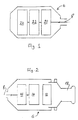
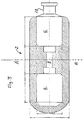
- a pipeline pig 2 for monitoring a pipeline in the form of a tube system of an oil refining fired furnace comprises a sealed generally cylindrical stainless steel front module 4, a sealed generally cylindrical stainless steel rear module 6, a flexible cable 8 interconnecting the modules 4 and 6, and an enclosing outer casing 10.
- the rear module 6 comprises a stainless steel container that houses a miniaturised ultrasonic transmitter 12, a miniaturised analogue receiver 14, and a miniaturised digital receiver 16.
- the rearward end of the module 6 is closed by scanner18 enclosed within a screw-threaded cap, which operates under control of the transmitter 12.
- the transmitter 12 is an 8 channel transmitter that is arranged to send ultrasound signals to the tube wall (not shown).
- the (nominal) 8 channel acoustic analogue receiver 14 will receive transmitted signals that have been returned, usually reflected, by the inner wall of the tube , allowing identification of the material content on the tube wall, and also providing an indication of the thickness of the wall by reference to known data of the wall thickness.
- the scanner 18 can be arranged to send out a signal every 100 ms over a programmable length of pipeline, for example 100 mm, with the transmission being repeated after a programmable period, for example every 300 mm.
- the speed of send and receive of signals is set in accordance with the speed of travel of the pipeline pig, say between 1 and 5 metres per second.
- the digital receiver 16 receives the output from the analogue receiver 14, processes the information into digital form and sends its output signals via the cable 8 to the front module 4 of the pig 2.
- the front module 4 comprises a container that houses a miniaturised microprocessor 20, a miniaturised data logger 22 and a miniaturised battery pack and charging circuit 24.
- the digitised signals received by the receiver 16 and sent along the cable 8 are received by the microprocessor 20 which analyses them.
- the microprocessor 20 also performs the overall controlling function for the operation of the pig 2, including controlling the transmitter 12, the receivers 14 and 16 and the data logger 22.
- the microprocessor 20 performs an initial analysis to verify the acceptability of the returned signals, rejecting those regarded as being in error.
- the accepted signals are averaged and a "picture" of the inner wall of the pipeline is produced with the data being passed to the logger 22 for storage.
- the pig 2 may be travelling through the pipeline at 3m per second and eight transmissions from each of eight transducers located around the outer circumference of the scanner 18 may be directed over a length of 100 mm of the pipe wall.
- sixty four 'shots' are fired and received, and the data therefrom will be analysed and stored before the next 64 samples are taken, less than 300 mm further along the pipeline.
- the analysis carried out by the microprocessor 20 results in the production of data that identifies the surface material of the inner wall of the tube system , whether it is clean steel, a carbon deposit (coke), or carbonceous scaling. The results also provide an evaluation of the thickness of the wall of the pipeline, thus being indicative of the extent of wear.
- the data produced by the analysis in the microprocessor 20 is then supplied to the data logger 22 where it is stored.
- the software within the microprocessor 20 can also arrange for the analysed results to be identified by a time, and thus position, reference to the pig 2 in its journey through the pipeline
- the final component of the electronics control arrangement is the miniaturised battery pack and charging circuit 24, which ensures a sufficient and steady supply of electrical power to the components 12, 14, 16, 20 and 22.
- a multi purpose "junction box” style surface unit is provided at the external control location to supply regulated power to recharge the batteries and to provide an interface to the computer to read and display the information collected by the pig 2 subsequent to its retrieval from the pipeline.
- the pig 2 in carrying its own electrical power source, exemplified by the battery 24, and a means for storing the data received thereby , as exemplified of the data logger 22, is self contained in that it needs no external cable, for example, to supply electrical power thereto for it to operate, or for retrieving the data that is gathered thereby.
- the stainless steel electronics modules 4 and 6 and the interconnecting cable 8 are enclosed within the outer casing 10 which not only provides mechanical, impact protection for the electronics module arrangement but also provides for sealing of the pig to the tube wall, which is important when the pig 2 is urged along the tube system by water pressure.
- the material of the casing 10 such as to allow the pig to flex, thereby facilitating navigation along a pipeline, which may form a tortuous path.
- the physical arrangement shown in Figure 3 in which the electronics modules 4 and 6 are interconnected by a relatively smaller and advantageously flexible, cable 8, will provide for some articulation of the pig 2, thereby assisting in its ability to bend and to navigate sharp curves in a pipeline.
- the interconnecting cable arrangement advantageously comprises a communications cable disposed within a flexible sheath, which is preferably armoured to provide the required strength. This may be exemplified by a hydraulic hose or compressed air.
- the casing 10 will be of integral form enclosing an electronics module arrangement that comprises the integral structure of the two modules 4 and 6 and the cable, or other interconnecting means, 8.
- the entire pipeline pig may be provided in two parts, each part containing an electronics module enclosing only some of the components and a cable or compressed air hose extending therefrom terminating in a connector, each part being enclosed within an outer casing part.
- this may be envisaged, for example, by having the pig 2 of Figure 3 formed in two parts, either side of the line A-A.
- the electronic components of the pig exemplified by the components 12, 14 16, 20, 22 and 24, may be located in two cup-like containers which are seam-welded together to form a single cylindrical stainless steel container therearound, the single container then being enclosed within an outer casing. This configuration results in a shorter overall length of the pipeline pig.
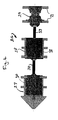
- a preferred construction of a pipeline pig 26 comprises three modules 27, 28 and 29.
- the leading module 27 operationally corresponds to the front module 4 of the previous embodiment
- the middle module 28 corresponds operationally to that part of the rear module 6 of the previous embodiment excluding the scanner 18,
- the trailing module 29 encompasses the now-separate scanner device of the pig 26.
- the modules 27 and 28 are substantially entirely circumferentially protected by ribbed polyurethane outer coverings 30, 31 respectively, and the scanner module 29 is fitted with a pair of protective discs 34.
- the covering 30 of the leading module 27 is conically-shaped at the front to facilitate movement of the device within a pipeline. Cables 32 , 33 provide articulated connection between the modules 27, 28, 29 thus allowing the pig 26 to negotiate tight, and for example 180°, bends within pipelines.
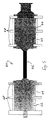
- a pipeline pig 40 has its electronics components distributed between two sealed stainless steel modules 42,44 with an articulated connection 46 therebetween in the form of an hydraulic hose enclosing a communications cable.
- a plurality of polyurethane discs 48 are mounted around the outsides of the modules 42, 44 and provide impact protection therefor. The diameter of the discs 48 is selected in accordance with the bore of the system to be monitored by the pig 40 so that the pig is sealed to the inner tube wall for ease of being driven therethrough by water pressure.
- the discs 48 are retained in grooves in the outer surface of the casing 42, 44 to facilitate their replacement by discs of different size for use of the pig 40 in tube systems of different bores. Further impact protection is provided by tubular polyurethane sleeves 49 approximately 5 mm thick, which are slid over the casings 42, 44.
- a pipeline pig 50 comprises two stainless steel modules 52, 54 which contain the required electronics components sealed therewithin against water ingress.
- Each module 52, 54 is enclosed within a respective polyurethane protective housing 56, 58 and they are connected together in an articulated manner by a flexible cable 60.
- each of the modules 4 and 6 may have a maximum outer diameter of 65 mm, and that the pig 2 may have a maximum overall diameter down to 85 mm.
- the overall length of a three module arrangement may be between 550 mm and 700 mm, depending on the geometry of the tube system being studied.
- the computer software programme that supports the operation of the pipeline pig of the present invention is arranged to produce an easily understood display in minimum time.
- the pipeline wall thickness measured at eight points around 360° at each longitudinal location, together with the designed wall thickness, and the distance from the start of the survey, are all displayed, along with images of the inside of the pipeline.
- the software selects for display that information which is anomalous, that is to say relating to positions of the pipeline wall that are thinner or thicker than operating requirements, thus obviating the need for tedious and time-consuming viewing, 'frame-by-frame', of each cross-sectional image. In this way, the attention of the operator is drawn to specific areas of the inner wall of the pipeline that may give evidence of contamination, thinning, metal loss, or corrosion.
Landscapes
- Engineering & Computer Science (AREA)
- Physics & Mathematics (AREA)
- Mechanical Engineering (AREA)
- Fluid Mechanics (AREA)
- Chemical & Material Sciences (AREA)
- Combustion & Propulsion (AREA)
- General Engineering & Computer Science (AREA)
- General Physics & Mathematics (AREA)
- Investigating Or Analyzing Materials By The Use Of Ultrasonic Waves (AREA)
- Pipeline Systems (AREA)
- Length Measuring Devices Characterised By Use Of Acoustic Means (AREA)
Applications Claiming Priority (2)
| Application Number | Priority Date | Filing Date | Title |
|---|---|---|---|
| GB0011933 | 2000-05-17 | ||
| GBGB0011933.9A GB0011933D0 (en) | 2000-05-17 | 2000-05-17 | Pipeline pig |
Publications (2)
| Publication Number | Publication Date |
|---|---|
| EP1172155A2 true EP1172155A2 (de) | 2002-01-16 |
| EP1172155A3 EP1172155A3 (de) | 2002-11-13 |
Family
ID=9891791
Family Applications (1)
| Application Number | Title | Priority Date | Filing Date |
|---|---|---|---|
| EP01304264A Withdrawn EP1172155A3 (de) | 2000-05-17 | 2001-05-14 | Rohrleitungsmolch |
Country Status (3)
| Country | Link |
|---|---|
| US (1) | US20020011124A1 (de) |
| EP (1) | EP1172155A3 (de) |
| GB (1) | GB0011933D0 (de) |
Cited By (7)
| Publication number | Priority date | Publication date | Assignee | Title |
|---|---|---|---|---|
| EP1756717A2 (de) | 2004-06-01 | 2007-02-28 | Quest Trutec, LP | 2d- und 3d-display-system und verfahren zur ofenrohrinspektion |
| EP2039440A1 (de) * | 2007-09-24 | 2009-03-25 | Cokebusters Limited | Verbesserungen bei oder im Zusammenhang mit Rohrmolchen |
| EP2159574A3 (de) * | 2008-06-23 | 2010-09-08 | Röntgen Technische Dienst B.V. | Vorrichtung zur Inspektion von Pipelines und Verwendungsverfahren |
| ITMI20101340A1 (it) * | 2010-07-20 | 2012-01-21 | Eni Spa | Metodo di monitoraggio e di analisi delle condizioni di una condotta |
| US8894772B2 (en) | 2012-04-20 | 2014-11-25 | Cokebuster Ltd. | Relateing to pipeline pigs |
| GB2530772A (en) * | 2014-10-01 | 2016-04-06 | Dry Ice Integration Ltd | Inspection device |
| US9498804B2 (en) | 2007-12-31 | 2016-11-22 | Cokebusters Ltd. | Pipeline pigs |
Families Citing this family (22)
| Publication number | Priority date | Publication date | Assignee | Title |
|---|---|---|---|---|
| US20070151055A1 (en) | 2006-01-04 | 2007-07-05 | 766089 Alberta Ltd. | Pipeline pig brush and brush assembly |
| US7218102B2 (en) * | 2004-10-07 | 2007-05-15 | Battelle Memorial Institute | Pipeline inspection apparatus and method |
| KR100574583B1 (ko) | 2004-10-08 | 2006-05-02 | 김장훈 | 배관 세척 및 살균장치 |
| US7452161B2 (en) * | 2006-06-08 | 2008-11-18 | Halliburton Energy Services, Inc. | Apparatus for sealing and isolating pipelines |
| US20090140133A1 (en) * | 2007-11-29 | 2009-06-04 | Halliburton Energy Services, Inc. | Pipeline pig and method for irradiation of bacteria in a pipeline |
| CO6170078A1 (es) | 2008-12-12 | 2010-06-18 | Ecopetrol Sa | Herramienta inteligente para deteccion de perforacines e interpretacion de datos en linea |
| US20100154153A1 (en) * | 2008-12-24 | 2010-06-24 | 766089 Alberta Ltd. | Pipeline pig brush |
| NO334629B1 (no) * | 2009-04-17 | 2014-04-28 | Tdw Offshore Services As | System og innretning for å monitorere et bevegelig pluggelement i en rørledning |
| US8425683B2 (en) * | 2009-11-17 | 2013-04-23 | Acoustic Systems, Inc. | Method for tracking a scraper within a pipeline |
| CA2707557A1 (en) * | 2010-06-10 | 2011-12-10 | Enbridge Gas Distribution Inc. | Device, system and method for locating a pipe |
| GB2498482B (en) | 2011-11-30 | 2013-12-11 | Fras Technology As | Vibrating Cleaning Pig |
| US9958417B2 (en) | 2012-06-11 | 2018-05-01 | Arise Global Pte. Ltd | Non-traversing tube inspection system |
| US9728817B2 (en) | 2013-03-14 | 2017-08-08 | Invodane Engineering Ltd. | Apparatus and method for in-line charging of a pipeline tool |
| US9535039B2 (en) | 2014-04-30 | 2017-01-03 | Control Devices, Inc. | Acoustic transmitter and method for underwater pipeline inspection gauges |
| GB2537124B (en) * | 2015-04-07 | 2018-09-05 | Innospection Group Ltd | In-line inspection tool |
| WO2016203486A1 (en) * | 2015-06-17 | 2016-12-22 | Acousticeye Ltd | Adjustable wide bandwidth guidedwave (gw) probe for tube and pipe inspection system |
| US10189026B2 (en) | 2015-06-26 | 2019-01-29 | Spt Group Llc | System and method for thermal ablation of pigging devices |
| US10279380B2 (en) | 2016-04-29 | 2019-05-07 | Chevron Phillips Chemical Company Lp | Cleaning coke deposits from process equipment |
| US20190346334A1 (en) * | 2018-05-10 | 2019-11-14 | Rhediant, Inc. | Pipeline pig for generation of acoustic waveforms |
| ES2983447T3 (es) | 2018-05-25 | 2024-10-23 | Quest Integrity Group Llc | Sistema y método de limpieza de serpentines de calentador con llama |
| BR102018072062B1 (pt) * | 2018-10-26 | 2023-12-12 | Universidade Federal Do Rio Grande Do Sul - Ufrgs | Sistema tracionador de intervenção compreendendo um umbilical |
| CN110773522B (zh) * | 2019-07-16 | 2022-05-17 | 中国石油大学(华东) | 一种石蜡清理作业管道机器人 |
Family Cites Families (6)
| Publication number | Priority date | Publication date | Assignee | Title |
|---|---|---|---|---|
| US3744298A (en) * | 1971-09-24 | 1973-07-10 | Texaco Inc | Pipeline leak detector and method |
| JPH0736988B2 (ja) * | 1984-05-18 | 1995-04-26 | 東京瓦斯株式会社 | 配管内移動ロボット及びその制御システム |
| GB2258284A (en) * | 1991-07-22 | 1993-02-03 | Shell Int Research | A pipeline pig or tool |
| US5155356A (en) * | 1991-11-29 | 1992-10-13 | Troxler Electronic Laboratories, Inc. | Apparatus and method for detecting subterranean leakage from a large storage vessel |
| US5924158A (en) * | 1994-06-20 | 1999-07-20 | Watts; Robert C | Pipeline pig |
| GB9520387D0 (en) * | 1995-10-06 | 1995-12-06 | R S T Projects Ltd | Debris monitoring system and apparatus |
-
2000
- 2000-05-17 GB GBGB0011933.9A patent/GB0011933D0/en not_active Ceased
-
2001
- 2001-05-14 EP EP01304264A patent/EP1172155A3/de not_active Withdrawn
- 2001-05-16 US US09/859,617 patent/US20020011124A1/en not_active Abandoned
Cited By (13)
| Publication number | Priority date | Publication date | Assignee | Title |
|---|---|---|---|---|
| EP1756717A2 (de) | 2004-06-01 | 2007-02-28 | Quest Trutec, LP | 2d- und 3d-display-system und verfahren zur ofenrohrinspektion |
| US8491722B2 (en) | 2007-09-24 | 2013-07-23 | Cokebusters Ltd | Pipeline pigs |
| EP2039440A1 (de) * | 2007-09-24 | 2009-03-25 | Cokebusters Limited | Verbesserungen bei oder im Zusammenhang mit Rohrmolchen |
| US9498804B2 (en) | 2007-12-31 | 2016-11-22 | Cokebusters Ltd. | Pipeline pigs |
| EP2159574A3 (de) * | 2008-06-23 | 2010-09-08 | Röntgen Technische Dienst B.V. | Vorrichtung zur Inspektion von Pipelines und Verwendungsverfahren |
| ITMI20101340A1 (it) * | 2010-07-20 | 2012-01-21 | Eni Spa | Metodo di monitoraggio e di analisi delle condizioni di una condotta |
| CN103097871A (zh) * | 2010-07-20 | 2013-05-08 | 艾尼股份公司 | 管道的状态的监控和分析方法 |
| US9188270B2 (en) | 2010-07-20 | 2015-11-17 | Eni S.P.A. | Monitoring and analysis method of the conditions of a pipeline |
| CN103097871B (zh) * | 2010-07-20 | 2016-08-03 | 艾尼股份公司 | 管道的状态的监控和分析方法 |
| WO2012010474A1 (en) * | 2010-07-20 | 2012-01-26 | Eni S.P.A. | Monitoring and analysis method of the conditions of a pipeline |
| AP3973A (en) * | 2010-07-20 | 2017-01-01 | Eni Spa | Monitoring and analysis method of the conditions of a pipeline |
| US8894772B2 (en) | 2012-04-20 | 2014-11-25 | Cokebuster Ltd. | Relateing to pipeline pigs |
| GB2530772A (en) * | 2014-10-01 | 2016-04-06 | Dry Ice Integration Ltd | Inspection device |
Also Published As
| Publication number | Publication date |
|---|---|
| EP1172155A3 (de) | 2002-11-13 |
| US20020011124A1 (en) | 2002-01-31 |
| GB0011933D0 (en) | 2000-07-05 |
Similar Documents
| Publication | Publication Date | Title |
|---|---|---|
| US20020011124A1 (en) | Pipeline pig | |
| EP2039440B1 (de) | Rohrmolch und Verfahren zum Überwachen einer Rohrleitung | |
| EP2653238B1 (de) | Rohrmolch und Verfahren zum Überwachen unter Verwendung des Rohrmolchs | |
| Roman et al. | Pipe crawling inspection robots: an overview | |
| CA2821100C (en) | Pipeline inspection apparatus | |
| US10060567B2 (en) | Tool, method, and system for in-line inspection or treatment of a pipeline | |
| EP0212456A2 (de) | Apparat zur Fortbewegung in Rohren | |
| RU2505805C2 (ru) | Инструмент для обнаружения отверстий и онлайновой интерпретации данных | |
| US5254944A (en) | Inspection probe for inspecting irregularly-shaped tubular members for anomalies | |
| EP2472056B1 (de) | Bohrlochinspektionssystem und Verfahren zum Beschicken von Sprenglöchern mit Sprengstoff | |
| EP3671204A1 (de) | Molch zur inspektion eines rohrförmigen objekts | |
| EP3775661B1 (de) | Interne inspektion von rohrleitungen | |
| US3911750A (en) | Apparatus for the internal inspection of tubular conduits | |
| US4679448A (en) | System for the internal inspection of pipelines | |
| EP3801936B1 (de) | System und verfahren zur reinigung von befeurten heizschlangen | |
| KR100798931B1 (ko) | 옥내 급수관을 위한 반자동형 배관 탐사 장치 | |
| CN115087520A (zh) | 机器人设备 | |
| CN120161122B (zh) | 一种基于管道机器人的管道探伤检测方法及系统 | |
| WO2026093754A1 (en) | Inspection assembly for imaging a pipeline | |
| GB2642822A (en) | Method of determining fouling | |
| WO2026093753A1 (en) | Inspection assembly for imaging a pipeline | |
| US20090120191A1 (en) | Methods and apparatus for inspecting furnace tubes | |
| WO2025058643A1 (en) | Movable inspection system for a pipe | |
| JPH10148617A (ja) | 管路診断方法とその装置 | |
| Martinez et al. | Instrumented ultrasonic PIG (Pipeline Inspection Gauge) using free swimming and online umbilical fiber glass cable technologies |
Legal Events
| Date | Code | Title | Description |
|---|---|---|---|
| PUAI | Public reference made under article 153(3) epc to a published international application that has entered the european phase |
Free format text: ORIGINAL CODE: 0009012 |
|
| AK | Designated contracting states |
Kind code of ref document: A2 Designated state(s): AT BE CH CY DE DK ES FI FR GB GR IE IT LI LU MC NL PT SE TR |
|
| AX | Request for extension of the european patent |
Free format text: AL;LT;LV;MK;RO;SI |
|
| PUAL | Search report despatched |
Free format text: ORIGINAL CODE: 0009013 |
|
| AK | Designated contracting states |
Kind code of ref document: A3 Designated state(s): AT BE CH CY DE DK ES FI FR GB GR IE IT LI LU MC NL PT SE TR |
|
| AX | Request for extension of the european patent |
Free format text: AL;LT;LV;MK;RO;SI |
|
| AKX | Designation fees paid | ||
| REG | Reference to a national code |
Ref country code: DE Ref legal event code: 8566 |
|
| STAA | Information on the status of an ep patent application or granted ep patent |
Free format text: STATUS: THE APPLICATION IS DEEMED TO BE WITHDRAWN |
|
| 18D | Application deemed to be withdrawn |
Effective date: 20030514 |